PART 2: Dozens Walked Past the Starving Mother and Her Four Puppies—Then the Smallest One Crawled Toward Me and Collapsed
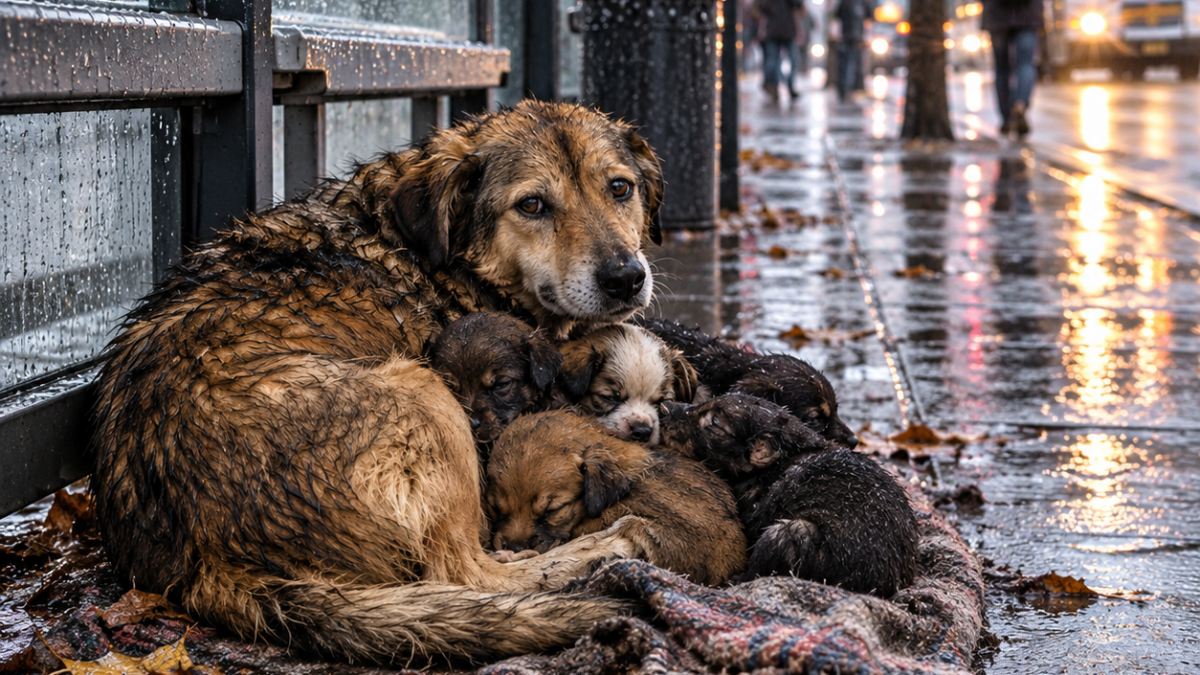
PART 2
I called the local rescue organization first.
“Mother dog and four puppies,” I said before the volunteer on the other end could finish greeting me. “Bus shelter on Westfield Road. The mother is extremely thin and can barely stand. One puppy is cold and barely responsive.”
“Any obvious injuries?”
“Nothing bleeding heavily.”
“How old are the puppies?”
“I don’t know. Maybe five or six weeks. Possibly younger.”
“Can you keep them out of traffic?”
“Yes.”
“We’re sending someone.”
“How long?”
“Twenty to thirty minutes.”
I looked at the puppy inside my coat.
His breathing was so shallow that the fur along his ribs barely moved.
“Tell them to hurry.”
I ended the call and crouched again.
The mother had not moved from where I’d left her.
She stared at the small shape hidden against my chest.
One of her other puppies crawled toward me.
She immediately stretched her body forward.
“Your baby’s here.”
I slowly opened the front of my coat enough for her to smell the puppy.
Her nose moved frantically.
She leaned closer.
The tiny puppy made the faintest squeak.
The mother’s entire expression changed.
She licked his forehead once.
Then again.
“Okay.”
I swallowed hard.
“He knows you’re here.”
A man standing beneath the shelter roof watched us.
I recognized him as someone who had been waiting for a bus when I arrived.
“Have they been here long?” I asked.
He shrugged.
“They were here when I came this morning.”
“What time?”
“About six-thirty.”
It was nearly nine.
“Did anybody feed them?”
“A couple people threw something down.”
“What kind of food?”
“I don’t know.”
“Did anyone call anybody?”
Another shrug.
“I figured somebody probably did.”
That sentence made my anger spike.
Somebody probably did.
Maybe the most dangerous words in a public place.
Everybody sees.
Everybody assumes.
Nobody acts.
I forced myself not to argue.
The dog needed my energy more than the man deserved it.
I took out the rest of the food.
Small portions.
I placed a little near each puppy.
The mother stared.
“Yours is here.”
I put a separate portion directly in front of her.
She hesitated.
Then finally ate.
Fast.
Too fast.
I stopped after several bites.
She looked at my hand.
“I know.”
Her eyes followed the food.
“You’ll get more. I promise.”
She licked the wet pavement where crumbs had fallen.
That image hurt more than I expected.
I asked a nearby kiosk worker for water.
The woman behind the counter filled a plastic container.
“Those dogs have been here since yesterday,” she said.
I turned.
“Yesterday?”
“I saw them before I closed.”
“What time?”
“Five. Maybe five-thirty.”
My stomach dropped.
“They’ve been outside all night?”
“Looks like it.”
“Did you call anyone?”
She looked embarrassed.
“I thought they belonged to somebody nearby.”
I stared at the mother.
Her fur was damp.
The puppies were cold.
There was no nearby home.
No leash.
No bowl.
No owner.
But again, anger wasn’t useful.
“Can I borrow a piece of cardboard?”
The woman immediately brought two flattened boxes.
And an old towel.
“I should’ve done something last night.”
“Do something now.”
She nodded.
That answer seemed to help both of us.
We built the driest temporary nest we could against the inside wall of the shelter.
Cardboard beneath.
Towel over it.
I moved the puppies one at a time.
The mother watched nervously.
Each time I picked one up, I brought it close to her face first.
Sniff.
Lick.
Then onto the towel.
When all three stable puppies were together, I gently lowered the smallest one beside them.
He didn’t crawl.
His siblings moved toward him.
The mother tried to stand.
Her legs shook.
I slid one arm carefully beneath her chest.
“I’m helping.”
She froze.
I expected a bite.
Instead, she looked at me.
I supported enough of her weight that she could make the short distance to the cardboard.
Once she reached the puppies, she collapsed beside them.
Immediately, all four pressed against her.
Including the smallest.
His nose moved weakly toward her belly.
“Come on.”
I rubbed his side with two fingers.
He tried to nurse.
Failed.
Tried again.
The mother licked him.
The kiosk woman stood beside me.
“Is he going to die?”
“I don’t know.”
I hated saying it.
But lying would have been worse.
“I hope not.”
The next twenty minutes moved unbearably slowly.
People came and went.
Several stopped now.
Not because the family looked different.
Because one person had stopped first.
A young woman offered a scarf to wrap around the puppies.
Another man called his wife and asked her to bring a blanket from their nearby apartment.
Someone bought bottled water.
The same bus shelter that had ignored them became a small circle of people trying to help.
That did not erase the hours before.
But it mattered.
The rescue van arrived twenty-three minutes after my call.
Two volunteers stepped out carrying carriers, blankets, gloves, and a medical kit.
One immediately knelt beside the mother.
“She looks worse than the photo.”
“What photo?”
The volunteer held up her phone.
One of the teenagers had posted a picture online.
Someone had tagged the rescue.
The timestamp showed the family had been photographed almost an hour before I arrived.
My anger returned.
A photograph had traveled farther than help.
“Can she stand?” the volunteer asked.
“Barely.”
“Any aggression?”
“Only protecting the puppies.”
“That’s not aggression. That’s motherhood.”
The volunteer checked the mother’s gums.
“Pale.”
Temperature.
Low.
Weight.
Impossible to assess accurately there, but far too little.
Then the smallest puppy.
The volunteer picked him up.
Her face changed.
“He’s hypothermic.”
“Bad?”
“Very.”
She placed him inside a warmed carrier with heat support.
“Can we move now?”
“Yes.”
We counted puppies.
One.
Two.
Three.
Four.
Then counted again.
Four.
The mother watched us.
When the first puppy went into the carrier, she tried to stand.
Her legs failed.
“We’ll keep them beside her.”
The volunteers prepared a larger transport area where she could lie next to the puppies without crushing them.
Moving her took all three of us.
The moment we lifted her, she panicked.
“Easy.”
Her head turned wildly.
She searched for the puppies.
A volunteer held the puppy carrier near her nose.
“Right here.”
The mother sniffed.
One puppy cried.
Her body relaxed slightly.
We loaded them together.
I climbed into my own car.
Then stopped.
I looked back at the bus shelter.
The old concrete wall.
Wet leaves.
Food crumbs.
People waiting again.
Within minutes, it looked ordinary.
That disturbed me.
Tragedy can happen in public and leave almost no physical evidence afterward.
I followed the rescue van to the clinic.
The smallest puppy—later named Theo—was taken first.
The mother came next.
The other three puppies followed.
The veterinary staff moved quickly.
I ended up standing against the wall holding the towel from the bus shelter because nobody needed me anymore.
That is one of the strangest parts of rescue.
You spend an hour feeling essential.
Then professionals take over and you become a witness.
The veterinarian examined the mother.
Severe malnutrition.
Dehydration.
Fleas.
Intestinal parasites likely.
Possible anemia.
Muscle wasting.
Pressure sores beginning along one hip.
No major fractures.
No obvious spinal injury.
Her weakness came from something simpler and crueler.
She had almost no reserves left.
“How long does a dog have to go without food to look like this?” I asked.
The veterinarian didn’t give me a number.
“It doesn’t happen in a day.”
“Several days?”
“Long enough that her body has been sacrificing itself.”
I looked at her.
“She’s nursing four puppies.”
“Exactly.”
The veterinarian explained that producing milk requires enormous energy.
If a mother doesn’t eat enough, her body burns fat.
Then muscle.
Then anything available.
“She gave everything to them.”
“Biologically, yes.”
Emotionally, the sentence felt much larger.
They estimated the puppies were roughly five weeks old.
Old enough to nibble soft food.
Young enough to still depend heavily on their mother.
The three larger puppies were thin and cold but stable.
Theo was the problem.
His blood sugar was dangerously low.
His temperature too low.
He was dehydrated.
The staff began controlled warming and glucose support.
“Can he survive?”
The veterinarian paused.
“We’re trying.”
That pause followed me for hours.
The mother was placed in a warm recovery area.
The puppies were close.
We offered her a small portion of specially prepared food.
She ate.
Then immediately looked toward the puppies.
When another portion came, she stopped eating after a few bites because one puppy began crying.
She moved toward him.
I sat on the floor nearby.
“You’ve done enough.”
Of course she didn’t understand.
“You can eat.”
She licked the puppy instead.
The technician smiled sadly.
“She’s a good mother.”
“Too good.”
We named her Mara.
I don’t know why that name felt right.
Maybe because it sounded soft enough for a dog whose life had not been.
Mara.
The puppies became Theo, Poppy, Max, and Lily.
Theo remained in critical care.
Poppy was the boldest.
Max already had the appetite of a much larger dog.
Lily hid beneath Mara whenever anyone entered.
The first night, I went home.
I didn’t sleep.
At 12:40 a.m., I checked my phone.
Nothing.
At 1:15, I called.
“Theo’s stable.”
“Stable good or stable bad?”
“Stable means he hasn’t worsened.”
Not enough.
At 3:06, I woke from a dream in which I was back at the bus shelter and couldn’t find the puppies.
I called again.
This time the overnight technician laughed.
“You’re the bus-stop person.”
“Unfortunately.”
“He’s warmer.”
“Is he awake?”
“More responsive.”
“Did he eat?”
“Not yet.”
That hurt.
“Call me if anything changes.”
“We will.”
At 5:42 a.m., my phone rang.
I answered before the first ring finished.
“Theo ate.”
Two words.
I sat on the edge of my bed.
“By himself?”
“With help at first. Then he latched onto the nipple.”
“How much?”
“Enough.”
I laughed.
Then cried.
The technician kindly pretended not to hear.
The next morning, Theo looked like a different puppy.
Not healthy.
But present.
Eyes open.
Tiny head lifting.
When placed beside Mara, he crawled immediately toward her.
Mara began licking him so intensely that the technician had to gently move her face aside.
“Easy, Mom.”
Theo found a nipple.
Latched.
Mara closed her eyes.
I stood watching.
That was the first truly peaceful moment of the story.
It lasted about six minutes.
Then Max crawled over Theo.
Theo screamed.
Poppy started crying.
Lily tried to burrow beneath Mara.
Normal chaos.
Beautiful chaos.
Mara remained at the clinic for several days.
Her meals were carefully controlled at first because severe starvation can make sudden refeeding dangerous.
Small meals.
Frequent meals.
High-quality nutrition.
Fluids.
Parasite treatment.
Wound care.
Rest.
She never complained.
What frightened me was how little she expected.
If a bowl was placed down, she ate.
If it disappeared, she didn’t protest.
If someone changed her bedding, she moved away.
If a hand reached toward her, she lowered her head.
Not submission exactly.
Expectation.
As though hands came with consequences.
One technician noticed it too.
“She flinches around her neck.”
“Collar?”
“Possibly.”
There was an old worn patch beneath the fur.
Not as severe as some tethering injuries I’d seen.
But enough.
Mara had belonged to someone.
That was obvious.
She knew people.
Doors.
Bowls.
Leashes.
Commands.
She was not a feral dog.
That made the bus stop harder to understand.
How did a domestic dog with four puppies end up there?
The answer began with the teenager’s photograph.
Remember the two boys who had laughed and taken pictures?
One of them contacted the rescue after the post started circulating.
His message was simple.
**I think I have more photos from yesterday.**
The rescue coordinator asked him to send everything.
There were six photographs and one short video.
Most showed the puppies.
One showed Mara watching people.
Another showed something important in the background.
A blue pickup truck parked beside the bus stop.
Not remarkable by itself.
But the timestamp was 5:18 p.m. the evening before I found them.
The kiosk worker remembered the truck.
“I thought the dogs came from it.”
My stomach tightened.
“What do you mean?”
“I wasn’t watching closely. I was closing. But I remember the truck stopping.”
“Did you see anyone take the dogs out?”
“No.”
“Did you see the dogs before it arrived?”
She thought.
“I’m not sure.”
That distinction mattered.
The rescue asked nearby businesses for security footage.
The bus shelter itself had no camera.
A pharmacy across the road did.
The angle was poor.
But it captured part of the street.
At 5:11 p.m., a blue pickup pulled over.
A man got out.
Walked around to the passenger side.
The view was blocked partly by the shelter.
He disappeared behind it for less than a minute.
Then returned to the truck.
Drove away.
Thirty seconds later, Mara appeared from behind the shelter.
One puppy followed.
Then another.
The other two were already there.
I watched the video twice.
Then stopped.
My hands were shaking.
“He dumped them.”
The rescue coordinator sat beside me.
“It appears that way.”
“Appears?”
“We need identification.”
“Four puppies don’t just materialize.”
“I know.”
The pharmacy camera didn’t capture the plate clearly.
Another camera farther down the road did.
Not enough to read the entire plate.
But enough to narrow it.
Vehicle model.
Color.
Partial plate.
The teenager’s phone video helped too.
For one second, as he turned, the pickup appeared larger in frame.
The last three characters were visible.
The investigation was referred to local animal welfare officers.
I wanted answers immediately.
Investigations don’t work that way.
While I waited, Mara improved.
That became my anchor.
After one week, she stood without trembling.
The first time, she seemed confused by her own body.
She pushed herself up.
Looked around.
Stayed upright.
I crouched.
“Look at you.”
Tail movement.
Small.
But real.
She took three steps toward me.
Then stopped.
I held out my hand.
She sniffed.
No flinch.
Then the puppies screamed from the next area.
Mara turned instantly.
Mother before everything.
She went back.
At two weeks, her coat looked better.
At three, the ribs were less shocking.
The puppies began eating soft food independently.
That was a major turning point.
Mara could finally keep some nutrition for herself.
The first time she ate a full meal while the puppies ate from separate bowls, I sat nearby.
She kept looking over.
“Eat.”
Poppy barked.
Mara stopped.
I gently touched the floor beside her bowl.
“They’re fine.”
She looked at me.
Then continued.
It seems ridiculous to be proud of a dog for finishing dinner.
I was.
Theo grew slowly.
Still smallest.
But fierce.
He developed a habit of climbing onto Max while Max slept.
Poppy stole everything.
Lily became affectionate first.
She would crawl into any available lap.
Mara watched.
Always watching.
But gradually she stopped intervening every time a human touched them.
Trust grew through repetition.
Pick up puppy.
Return puppy.
Feed.
Return.
Check.
Return.
Nobody disappeared.
That last lesson mattered most.
The investigators called during the fourth week.
They had found a likely owner.
The truck was registered to a man named Russell Hale, who lived six miles away.
Animal control visited.
Russell admitted owning Mara.
Except he called her Sadie.
That was our first confirmation.
Her old name.
Sadie.
When I said it at the clinic, Mara turned immediately.
“Sadie?”
Tail.
Not a dramatic response.
Enough.
Russell claimed she had “gotten out.”
With four puppies?
He said they must have followed.
Investigators asked why security footage showed him stopping at the bus shelter.
He said he’d been looking for something in the truck.
Behind the shelter?
No good explanation.
Then came another problem.
Russell claimed the puppies were not his.
That statement confused everyone.
If Mara was his dog and had been nursing four puppies, whose did he think they were?
He changed the wording.
He meant he hadn’t bred her intentionally.
Fine.
Investigators asked for veterinary records.
None recent.
Vaccinations overdue.
No spay.
No documented care during pregnancy or nursing.
He said money had been tight.
I understood financial hardship.
I did not understand leaving a starving mother and four babies beside a bus stop.
Investigators searched the property under the authority available to them.
They found an outdoor kennel.
Old bowls.
A chain.
No dogs.
But a neighbor provided the next piece.
She had seen Mara with puppies behind Russell’s shed.
“How many?”
“Four.”
“When?”
Two days before the bus shelter.
The neighbor had even taken a photograph because she thought the puppies were cute.
All four visible.
Mara too.
Same family.
Same dog.
Same week.
Now Russell’s story about them “getting out” had a problem.
The neighbor remembered his truck leaving with the dog crate in the bed the afternoon before the family appeared at the station.
Again, not direct proof of what happened at the shelter.
But the pieces were stacking.
Then one of Russell’s own text messages did the rest.
An investigator obtained it through the appropriate process after a witness volunteered screenshots.
Russell had written to a friend:
**Can’t keep feeding five dogs. I’m dropping the lot somewhere people will deal with it.**
The friend had replied:
**Don’t do that. Call the shelter.**
Russell:
**They’ll ask questions.**
I read those words twice when the rescue coordinator showed me the official summary.
Then a third time.
They’ll ask questions.
So he chose a bus stop.
People everywhere.
Responsibility nowhere.
Drop them in public.
Let guilt become anonymous.
Maybe someone feeds them.
Maybe someone calls.
Maybe not.
He had placed his decision into the hands of strangers.
And strangers nearly failed them.
For almost an entire night.
I felt sick.
“What happens now?”
“Charges are being reviewed.”
“Can he get them back?”
“No.”
That answer mattered first.
Mara would never go back.
The puppies would never go back.
Everything else could take time.
Russell apparently asked once whether the rescue intended to return “his dog.”
The answer was no.
His ownership rights were addressed through the legal process, and eventually he surrendered any claim as the case proceeded.
That ended one fear.
It did not end my anger.
The rescue posted a general update.
No name.
No address.
No mob.
Just:
**The mother and puppies will not be returned to the previous environment. The matter is being handled by appropriate authorities.**
People still wanted revenge.
Comments poured in.
“Leave him at the bus stop.”
“Starve him.”
“Put him outside in winter.”
I understood the emotion.
But every time I looked at Mara, revenge felt smaller.
She wasn’t thinking about Russell.
She was thinking about food.
Puppies.
Warm bedding.
A volunteer named Anna who discovered exactly where Mara liked being scratched behind the ear.
Her world had moved forward.
I decided mine needed to follow.
At five weeks in rescue, the puppies were old enough for more independence.
They were vaccinated on schedule.
Treated for parasites.
Socialized.
We introduced toys.
Theo attacked a rope toy twice his size.
Max ate the corner of a cardboard box.
Poppy figured out how to escape their pen.
Lily preferred people.
Mara began taking breaks.
At first, five minutes.
Then ten.
Eventually she could lie in another room while the puppies played.
That sounds normal.
It was enormous.
One afternoon, I found Mara alone on a blanket.
No puppies.
No anxiety.
Sleeping.
Deeply.
Her paws twitched.
Her breathing slow.
For the first time, she looked like a dog rather than a mother on permanent emergency duty.
I sat nearby.
She opened one eye.
“Go back to sleep.”
She did.
That trust felt sacred.
Adoption applications for the puppies came quickly.
Of course.
Small dogs with big eyes are easy to want.
We screened carefully.
The first family wanted Theo because they had followed his survival from the beginning.
That worried me.
“Do you want Theo, or do you want the story of Theo?”
The father looked surprised.
“What’s the difference?”
“One lasts fifteen years.”
He thought.
Good answer came later.
They returned.
Asked questions about training.
Veterinary costs.
Adult size.
Behavior.
Commitment.
They were approved.
Theo left first.
The smallest.
The one who collapsed at the bus shelter.
I held him before he left.
“You caused a lot of trouble.”
Theo bit my thumb.
“Exactly.”
His new family laughed.
Mara sniffed him.
Licked his face.
Theo tried to climb onto her.
Then he left.
Mara watched the door.
I held my breath.
She sniffed around for several minutes.
Then Poppy attacked her tail.
Life continued.
Max left next.
Then Lily.
Poppy stayed longest because Poppy was, frankly, a criminal.
She stole socks.
Chewed shoelaces.
Escaped pens.
Dragged blankets across rooms.
Perfect puppy.
Her adopter was a nurse who laughed when Poppy stole a glove from her bag during the meet-and-greet.
“I like her.”
“You say that now.”
Poppy climbed into her lap.
“Still do.”
Approved.
When Poppy left, Mara’s foster room became quiet.
Unnaturally quiet.
Mara walked around.
Checked the bedding.
Looked behind the chair.
Then returned to her bed.
I sat beside her.
“They’re safe.”
Mara looked at me.
“All four.”
She lowered her head onto my knee.
Exactly there.
A month earlier, she wouldn’t let herself rest unless every puppy was touching her.
Now she finally had nobody to protect.
That was when the next challenge began.
Everybody wanted the puppies.
Nobody had applied for Mara.
Not one serious application.
Weeks passed.
Her online photographs got reactions.
“Beautiful mama.”
“Poor girl.”
“She deserves the best.”
But no forms.
No home visits.
No family.
That’s the cruel irony of rescue sometimes.
The mother becomes the story.
The babies become the adoptees.
She does the work.
They leave.
She waits.
Mara didn’t know she was waiting.
She had a foster home.
Food.
Walks.
People.
But I knew.
And it bothered me more every week.
Then Russell’s case returned to the news.
A local reporter obtained public information about the neglect and abandonment proceedings.
Suddenly Mara’s face was everywhere again.
Old photo at the bus shelter.
New photo healthy.
Stories about the truck.
The text.
The previous owner.
People were furious.
Adoption applications poured in.
That should have made me happy.
Instead, we rejected most.
Some wanted her because she was famous.
Some wanted to “show Russell.”
One applicant actually wrote:
**I want to adopt her so I can take a picture in front of his house.**
Immediate no.
Mara was not a revenge prop.
She had already been used enough.
Then one application arrived from a woman named Claire.
Fifty-eight.
Widowed.
Worked from home as a bookkeeper.
No other pets.
Fenced yard.
Had owned two rescue dogs previously, both into old age.
Her application included one sentence I read three times.
**I don’t care what happened to her before except to understand what might frighten her. I want to know who she is now.**
That was different.
Claire visited.
Mara stayed behind the chair.
Claire sat on the floor.
No calling.
No treats waved dramatically.
No reaching.
After fifteen minutes, Mara came out.
Sniffed the air.
Retreated.
Claire kept talking to me.
“What does she like?”
“Food.”
“Excellent.”
“Quiet mornings.”
“Same.”
“Soft blankets.”
“Same.”
“She doesn’t really understand toys.”
“Neither do I.”
I laughed.
Mara came closer.
Claire didn’t move.
Mara sniffed her shoe.
Then hand.
Claire waited.
Mara sat three feet away.
That was the whole first visit.
Claire smiled.
“Good.”
“That’s enough?”
“She stayed.”
Second visit.
Mara accepted food from her hand.
Third.
Allowed one touch beneath the chin.
Fourth.
Mara walked in carrying a blanket corner.
Dropped it beside Claire.
Claire looked at me.
“What does that mean?”
“Honestly?”
“Yes.”
“I think you’ve been selected.”
Home check.
Excellent.
Adoption approved.
The day Mara left, I thought about the bus stop constantly.
Same season.
Similar gray sky.
But no cold concrete.
No puppies under her body.
Mara wore a harness.
We avoided tight pressure around her neck.
Claire opened the back door of her car.
Blanket.
Water.
Seat protection.
Everything ready.
Mara stopped.
Looked at the vehicle.
Backed away.
Claire did not pull.
“We can wait.”
We stood there nearly five minutes.
Mara sniffed.
One paw onto the step.
Back down.
Another attempt.
Then finally climbed in.
Claire sat beside her instead of immediately closing the door.
Mara looked at me through the opening.
I touched her cheek.
“No more bus stops.”
Her nose touched my wrist.
Claire cried.
I pretended not to.
They drove away.
That should have been enough.
It almost was.
Then the legal case reached its conclusion.
Russell accepted responsibility under an agreement covering abandonment and neglect.
The court imposed financial penalties, restitution toward veterinary costs, probationary conditions, and a restriction on owning or breeding dogs for a period set by the court.
People argued online.
Too light.
Too much.
Not enough.
I stopped reading.
The most important legal outcome was simple.
He didn’t get Mara back.
He didn’t get the puppies.
He couldn’t simply repeat the same cycle without consequence.
That was accountability.
The emotional ending arrived later.
Three months after adoption, Claire asked if she could bring Mara to a small rescue fundraiser held near the same bus station.
I hesitated.
“Do you think that will upset her?”
“We won’t go close if she’s uncomfortable.”
Good answer.
We arranged a quiet area away from the traffic.
Mara arrived looking almost unrecognizable.
Healthy weight.
Clean coat.
Bright eyes.
Harness fitted perfectly.
Tail loose.
Claire opened the car.
Mara stepped down without hesitation.
That alone nearly made me cry.
People recognized her.
One of the kiosk workers came out.
The same woman who had brought cardboard.
Her hands flew to her face.
“That’s her?”
“That’s Mara.”
She crouched.
Mara sniffed her.
The woman cried.
“I should’ve called that night.”
I didn’t answer immediately.
Then:
“You helped the next morning.”
“Too late.”
“Not too late.”
That matters.
People make mistakes.
Guilt becomes useful only when it changes the next decision.
The teenage boy who had taken the original photo came too.
Older by several months.
Still embarrassed.
“I didn’t know they were that bad.”
“You didn’t look.”
He nodded.
“I know.”
“What did you learn?”
He held up a box.
Inside were donated puppy blankets.
“That.”
Good.
Then a bus arrived.
Doors opened.
People stepped off.
For a strange second, the entire scene folded onto itself.
Same shelter.
Same wind.
Same traffic.
Except Mara wasn’t lying against the wall.
She stood beside Claire.
Fed.
Warm.
Safe.
A woman getting off the bus recognized her from the news.
“Is that the mother dog?”
Claire smiled.
“Yes.”
The woman stared.
“She looks completely different.”
She did.
Then something unexpected happened.
A man in a dark jacket approached.
I recognized him from the first morning.
The briefcase man.
The one who glanced down and kept walking.
He recognized Mara too.
He stood several feet away.
“I was here that day.”
I said nothing.
“I saw them.”
Mara looked toward him.
No recognition.
Why would she remember one stranger among dozens?
The man looked uncomfortable.
“I had a meeting.”
Still I said nothing.
“I thought somebody would call.”
There it was again.
Somebody.
He looked at Mara.
“I’ve thought about it since.”
Claire rested one hand lightly on Mara’s back.
The man reached into his coat.
For one second I tensed.
He pulled out an envelope.
“I brought this for the rescue.”
Donation.
He handed it to the volunteer.
Then looked at me.
“I know it doesn’t change that morning.”
“No.”
He nodded.
“But maybe it helps the next dog.”
“Yes.”
That was enough.
Then the woman who had complained on the phone arrived.
Not deliberately.
She was simply waiting for another bus.
She noticed the crowd.
Saw Mara.
Her expression changed.
“I remember her.”
Of course.
Everyone remembered now.
That’s how public guilt works.
Pain becomes visible only after survival gives it a story.
She came closer.
“All the puppies?”
“Adopted.”
“And her?”
Claire smiled.
“Mine.”
The woman looked relieved.
Then ashamed.
“I said something stupid that day.”
I remembered.
Where are the authorities?
As though authorities were an abstract machine that noticed suffering without someone first making a call.
I didn’t repeat her words.
“Did you learn anything?”
She nodded.
“I called last month about an injured cat near my building.”
“What happened?”
“Rescue got him.”
There.
Again.
Change.
The closest thing to revenge I wanted.
Not humiliation.
The next animal getting help faster.
Mara became restless.
Claire noticed immediately.
“She’s had enough.”
No obligation to stay for our emotional closure.
They walked toward the car.
Mara passed the old shelter.
Stopped.
Sniffed.
For one second, everyone around me seemed to disappear.
I saw the thin mother again.
Four puppies.
Cold ground.
Eyes following people.
Then Mara lifted her head.
Claire opened the car.
Mara walked past the shelter and climbed inside.
Did she remember?
No idea.
Didn’t matter.
She left because she chose to.
That difference was everything.
Claire sent updates constantly.
Not dramatic ones.
My favorite kind.
Mara stealing half a sandwich.
Mara learning the couch.
Mara sleeping under a desk during work.
Mara refusing to go outside in heavy rain.
Mara eventually discovering one toy she liked—a ridiculous stuffed carrot.
Of course.
Months earlier she’d ignored every toy.
Now she carried the carrot from room to room.
Claire wrote:
**I bought her six better toys. She wants the $3 carrot.**
I replied:
**That’s your financial problem now.**
The puppies grew too.
Theo became confident.
His family sent a video of him sprinting through a yard.
I watched it repeatedly.
The puppy whose body had been almost cold in my coat now ran so fast he slid around corners.
Max became huge.
Poppy remained a criminal.
Lily slept under her adopter’s blanket every night.
Four puppies.
Four homes.
Mara.
Five lives.
One bus stop.
The arithmetic stayed with me.
People say, “You can’t save them all.”
True.
But “all” is not a useful number when five lives are in front of you.
Save these.
Then see what comes next.
One year after the rescue, Claire organized something I wasn’t expecting.
A small reunion.
Not all puppies could come.
But Theo and Lily did.
Mara arrived first.
She sniffed the field.
Relaxed.
Theo entered.
Young adult now.
He approached quickly.
Mara stiffened.
Theo slowed.
Sniff.
Mara sniffed back.
Did she recognize him?
Maybe scent triggered something.
Maybe not.
Then Theo bowed.
Play invitation.
Mara stared.
Theo bounced.
Mara ran.
Actually ran.
Claire shouted.
I laughed.
Mother and son chased each other across the grass.
Not a cinematic reunion.
No obvious maternal recognition.
Just two dogs playing.
That was better.
Lily joined.
Three dogs circling.
For a moment, I remembered Mara unable to stand.
The puppies barely walking.
Bus wind.
Cold.
Then reality replaced memory.
Grass.
Sunlight.
Healthy bodies.
Choice.
Sometimes happy endings are physically loud.
Paws.
Barking.
People laughing.
This was one.
The legal case became old news.
Russell’s name disappeared from discussion.
Mara’s did not.
Not because she remained famous.
Because the rescue started using her story in volunteer training.
The lesson wasn’t:
Look what a terrible owner did.
It was:
Don’t assume somebody else has called.
A photograph from the bus shelter appeared in presentations.
Then a photograph of Mara healthy.
Underneath:
**See it. Report it. Stay if you safely can.**
That made sense.
The first failure in Mara’s story was abandonment.
The second was collective hesitation.
The first one belonged to one man.
The second belonged to many people.
Myself included, if I hadn’t stopped.
The difference between the final tragedy and final rescue wasn’t that I was kinder than everyone else.
I simply acted before walking away.
That is less heroic.
More reproducible.
Good.
We don’t need heroes.
We need fewer people saying “somebody.”
Years passed.
Claire became one of the rescue’s regular foster volunteers.
Mara was partly responsible.
The first foster dog arrived two years after adoption.
A terrified beagle mix named Lucy.
Lucy hid behind a chair.
Refused food.
Mara walked into the room.
Stopped.
Looked.
Then lay down ten feet away.
No approach.
No pressure.
Within an hour, Lucy moved closer.
Within two days, she followed Mara into the yard.
Claire called me.
“She’s teaching.”
“Teaching what?”
“That I’m not dangerous.”
I smiled.
Mara—who once watched every passing stranger hoping one might help—had become the calm animal showing another frightened dog that a home could be safe.
That was almost too perfect.
I visited.
Lucy hid.
Mara greeted me.
Healthy.
Slight gray around the muzzle now.
“You’re getting old.”
Claire called from the kitchen.
“Don’t insult her.”
“Everybody says that.”
“Because everybody is right.”
Mara leaned against my legs.
The neck scar was almost impossible to see beneath her coat.
I could still feel a slight ridge.
Physical memory.
Healed.
The puppies visited occasionally through photographs.
Poppy destroyed a sofa cushion at age three.
Her adopter sent:
**You warned me.**
I replied:
**I tried.**
Theo became a therapy dog candidate because of his calm temperament as an adult.
The same puppy who nearly died from cold.
Max loved children.
Lily remained shy but deeply attached to her family.
None of them carried the bus stop as identity.
Good.
Their past belonged to us more than to them.
They simply lived.
That is rescue success at its purest.
The animal becomes boring.
Mara’s biggest emergency eventually became stealing an entire loaf of bread.
Claire called.
“She’s going to die.”
“What?”
“She ate half a loaf.”
“That’s not usually fatal.”
“She looks proud.”
“That part may be permanent.”
Mara was fine.
Too fine.
Dinner was reduced slightly.
She filed a complaint with management.
Age softened her in other ways.
She became more affectionate.
Not dramatically.
First sleeping beside Claire’s chair.
Then resting her head on Claire’s foot.
Then one winter night, climbing onto the couch and pressing herself along Claire’s side.
Claire didn’t move for forty minutes because she was afraid Mara would leave.
She texted me a photo.
**I need to use the bathroom. Send help.**
I replied:
**You live there now.**
That trust took years.
Worth every one.
Eventually Mara grew old enough that her walks shortened.
Her hips became stiff.
The veterinarian diagnosed arthritis.
Routine senior-dog problems.
I cannot explain how happy ordinary medical problems can make you when you remember the alternative.
She had lived long enough to get arthritis.
Long enough for her muzzle to gray.
Long enough to slow down.
Aging is not a tragedy in rescued animals.
It’s proof they escaped one.
Claire added rugs to slippery floors.
A ramp for the car.
Softer bedding.
Mara accepted every accommodation with the dignity of a queen who believed she had always deserved staff.
Correct.
One anniversary, we met near the old bus shelter.
Not with Mara.
I no longer wanted to bring her back unnecessarily.
The rescue installed a small weatherproof board nearby with emergency contact numbers and instructions for found animals.
The kiosk owner allowed a water bowl beside the shop.
Several regular commuters volunteered to refill it.
The teenage boy from the first day—now in college—paid for the sign with money from a small fundraiser.
At the bottom he requested one sentence:
**Don’t assume someone else already called.**
Perfect.
No name.
No guilt.
Action.
The shelter itself was repainted.
Same old structure.
Different memory.
Several animals were helped there in later years.
A lost terrier reunited with his owner.
An injured pigeon transferred to wildlife care.
A stray cat with an infected paw.
One winter, another dog appeared.
Thin.
No puppies.
A commuter called within ten minutes.
Ten.
Not overnight.
The rescue coordinator texted me:
**Mara’s effect.**
Maybe.
Communities learn.
Slowly.
Imperfectly.
But they can.
When Mara was around nine or ten, Claire discovered a lump.
The word terrified everyone.
Veterinary testing.
Waiting.
Results.
Benign fatty mass.
We celebrated.
Mara did not understand.
She received chicken.
Therefore medical appointments were good.
Another year.
Then another.
Theo’s family sent a birthday picture.
Gray muzzle starting.
I stared.
The smallest puppy was getting old too.
Time had done its work.
The mother and babies from the bus stop were no longer a rescue emergency.
They were senior dogs.
That felt almost impossible.
At twelve, Mara’s kidneys began showing age-related changes.
Managed.
Diet.
Monitoring.
Then heart changes.
Managed.
Medication.
She remained happy.
Good appetite.
Short walks.
Carrot toy.
Claire.
Foster dogs occasionally.
Ordinary.
One autumn afternoon, I visited.
Cold wind.
Gray sky.
Almost exactly like the first day.
Mara was asleep beside the heater.
I sat on the floor.
She woke.
Looked at me.
Took several seconds to stand.
Old legs.
She walked over.
Placed her head against my chest.
I scratched beneath her chin.
“Remember the bus stop?”
Of course she didn’t answer.
“I’m glad you don’t have to.”
Claire sat nearby.
“Do you think she remembers?”
“Maybe smells. Feelings. Who knows.”
Mara sighed.
“She remembers lunch.”
At the word lunch, ears up.
We laughed.
Good.
Let food replace trauma.
Let comfort overwrite cold.
Let routine drown out abandonment.
That was the story.
Mara’s final year was peaceful.
There is no better word.
She slept more.
Ate well until near the end.
Loved Claire.
Tolerated young foster dogs with less patience.
Barked when dinner was late.
Still occasionally carried the carrot.
Then one winter morning, Claire called.
Not frantic.
Quiet.
“I think it’s time.”
I knew.
Mara had stopped eating the night before.
Her breathing was different.
The veterinarian had visited.
Heart failure progressing.
Medication no longer giving enough comfort.
I drove over.
Mara lay on her favorite blanket.
Claire beside her.
No puppies.
No bus.
No wind.
Warm house.
Her body looked old.
Not starved.
There is a difference.
One is deprivation.
The other is time.
I sat.
“Mara.”
Her eyes opened.
Tail moved once.
That tiny movement carried me backward more than a decade.
Thin body.
Concrete wall.
Four puppies.
Her trying to stand.
I held out my hand.
Mara sniffed.
Then licked one finger.
Weakly.
Claire cried.
“I don’t want her to think I’m leaving.”
The sentence hit me.
Same fear.
Different side.
I put my hand on Claire’s shoulder.
“Then don’t.”
The veterinarian came to the house.
Mara stayed on her blanket.
Claire held her head.
I sat near her chest.
The rescue coordinator came too.
Older now.
All of us.
People who had met because one dog was left where everyone could see her but nobody knew what to do.
The final injection was gentle.
Mara’s breathing slowed.
Claire whispered into her ear:
“You don’t have to protect anybody anymore.”
That sentence destroyed me.
Because it was true.
Her entire first chapter had been protection.
Give food away.
Shield puppies.
Stand when she couldn’t.
Watch every stranger.
Her last chapter required none of it.
Everyone in the room was protecting her.
Mara exhaled.
And was gone.
For a long time nobody moved.
Then Claire touched the old scar near her neck.
“It’s almost invisible.”
I looked.
Healthy fur covered it.
Only those who knew could find it.
That’s what healing had done.
Not erased.
Covered with years.
The puppies’ families were told.
Every one sent photographs.
Theo lying beside his owner.
Poppy with a stolen sock.
Max asleep near two children.
Lily curled in a blanket.
Four lives continuing.
Mara had left pieces of herself everywhere.
Not metaphorically.
Literally.
Four dogs.
Four families.
Hundreds of ordinary days.
That helped.
Several months later, the rescue held a small memorial fundraiser.
No dramatic slideshow of suffering.
Claire refused.
“Don’t use the bus-stop photo.”
I agreed.
The main picture showed Mara old and gray, lying on the couch with the stuffed carrot beneath one paw.
Underneath:
**MARA — MOTHER, SURVIVOR, PROFESSIONAL BREAD THIEF**
Perfect.
People laughed through tears.
The fundraiser paid for emergency food packs stored at three bus stations around town.
Simple bags.
Basic dog food.
Water bowls.
Rescue contact cards.
Not because commuters should handle every animal themselves.
Because no mother with puppies should wait hours for the first person to do something.
That became Mara’s legacy.
Practical.
Unsentimental.
Useful.
A few weeks after the food packs were installed, one was used.
A young mother dog appeared near another station.
Two puppies.
A commuter noticed.
Opened the emergency pack.
Fed them.
Called rescue.
Stayed.
The family was safe within forty minutes.
The coordinator sent me the message.
I stared at it for a long time.
Then wrote:
**That’s the ending.**
Not Russell’s sentence.
Not public shame.
Not the fundraiser.
This.
Another mother didn’t wait all night.
That is how suffering becomes meaning without pretending the suffering was necessary.
Mara did not need to suffer to teach us.
But because she had, we had a responsibility to learn.
We did.
At least a little.
Years later, I still pass the old shelter sometimes.
The water bowl is often full.
The sign is faded but readable.
**Don’t assume someone else already called.**
Most people waiting for buses have no idea why it’s there.
That’s fine.
A lesson doesn’t require a legend.
It just needs to work.
Occasionally I see someone leave food.
Sometimes I see nothing.
Just commuters.
Phones.
Bags.
Rain.
The ordinary world.
But I can never see that concrete wall without seeing Mara.
Thin.
Shivering.
Puppies beneath her.
Eyes following people.
Not accusing.
Not begging.
Just hoping.
Then I see everything that came after.
Theo warming in the clinic.
Poppy escaping the pen.
Max eating everything.
Lily sleeping in laps.
Mara finishing her first whole meal.
Mara choosing Claire.
Mara on a couch.
Mara stealing bread.
Mara aging.
Mara dying in warmth.
That is the full story.
Not abandonment.
Not rescue.
A life.
That’s the mistake we make when stories go viral.
We freeze animals inside their worst photograph.
Starving dog.
Injured dog.
Abandoned mother.
But those labels describe minutes.
Maybe days.
The animal deserves years after the image.
Mara got them.
So when people ask me whether there was revenge, I tell them yes.
Just not the kind they expect.
Russell lost the right to treat animals as disposable.
The breeding stopped.
The court created consequences.
Other dogs were protected.
That was legal justice.
But Mara’s revenge was different.
The man who thought five lives were too expensive to feed became irrelevant to every one of them.
Theo did not know his name.
Poppy did not know his name.
Max did not know his name.
Lily did not know his name.
Mara stopped living in a world where his choices mattered.
That was the strongest revenge imaginable.
He abandoned them to strangers.
Strangers became family.
He refused to feed them.
They spent years with full bowls.
He left Mara on cold concrete.
She died on a soft blanket in a heated home.
He treated the puppies as a burden.
Four families treated them as irreplaceable.
He thought a bus stop would make the problem disappear.
The bus stop became the place that taught an entire neighborhood to notice.
Every outcome moved in the opposite direction from what abandonment intended.
That’s enough for me.
More than enough.
The last photograph I have of Mara was taken three weeks before she died.
She’s sleeping beside Claire’s chair.
Gray face.
Eyes closed.
The carrot toy under her chin.
Sunlight crossing her back.
Nothing dramatic.
No one would click it because it looked tragic.
No one would share it because it created outrage.
That’s exactly why I love it.
It’s the photograph of the life rescue is supposed to create.
Boring.
Safe.
Unremarkable.
Complete.
When I found Mara, every stranger who passed seemed like another closed door.
At the end, she had too many people who would have opened theirs.
That transformation did not happen in one viral moment.
It happened meal by meal.
Vet visit by vet visit.
Walk by walk.
Choice by choice.
Trust by trust.
I think about the smallest puppy too.
Theo.
The one who crawled toward me and collapsed.
If he had not moved, would I still have acted as quickly?
Yes.
I hope.
But that tiny collapse changed the urgency.
His body said what none of them could say.
We are running out of time.
He survived.
Years later, his family sent me a picture from his twelfth birthday.
White fur around the muzzle.
Still small.
Still bright-eyed.
Caption:
**He still steals Mara’s old trick—gives us the saddest face whenever dinner is late.**
I laughed.
Twelve.
The puppy who almost died in my coat had reached twelve.
That’s the scale I use now.
Not how many likes a rescue story receives.
Years.
How many years did stopping create?
For Theo, twelve and counting.
For Poppy, nearly as many.
Max.
Lily.
Mara.
Together, decades of life came out of one decision not to keep walking.
That’s the arithmetic of compassion.
One stop can become forty years.
Fifty.
More.
You never know.
That’s why I still get angry at the phrase:
Somebody else will help.
Maybe.
But what if everybody says it?
Mara’s family taught me exactly what happens.
The cold continues.
The hunger continues.
The puppies get weaker.
The mother gives away the last food.
Everybody sees.
Nobody acts.
Until somebody does.
You don’t have to be a rescuer.
You don’t have to take the animal home.
You don’t have to become the hero in the story.
Call.
Bring water.
Create distance from traffic.
Contact people who know what to do.
Stay if safe.
Become the bridge between suffering and help.
That’s what I was.
Not a hero.
A bridge.
Mara crossed.
So did four puppies.
Years later, Claire told me something I never forgot.
We were talking about Mara’s final days.
She said:
“The saddest part isn’t that someone abandoned her.”
I asked what was.
“That for a while, she believed that was normal.”
That sentence stayed.
Because rescue did not simply remove Mara from the bus shelter.
It had to change what she expected from life.
Food is not temporary.
Beds are not traps.
Hands do not always take.
Doors can open.
People who leave for work can return.
Puppies can leave without disappearing into danger.
Cars can lead home.
Humans can be predictable.
Love can be boring.
That took years.
And she learned.
Near the end, Mara would sometimes remain asleep when Claire left the house.
No pacing.
No panic.
No following to the door.
She knew.
Claire comes back.
That may have been the final healing.
Not the healthy weight.
Not the coat.
Not the adoption.
Expectation.
The future became trustworthy.
That is a gift abandonment tries to destroy.
Mara rebuilt it.
If I could return to that first morning, I would not shout at the people who walked by.
At least not first.
I’d probably still feel angry.
But I know now that shame alone changes very little.
I would say:
Look.
Actually look.
The mother is shaking.
The puppies are too small.
Her ribs are showing.
She cannot stand.
You don’t need to understand the whole story.
You only need to understand enough to make one call.
That is what mattered.
Not perfect compassion.
Action.
The briefcase man eventually donated.
The kiosk woman learned.
The teenager changed.
The woman who complained called about another animal later.
None of them could undo the first morning.
But each helped prevent another version of it.
People are allowed to become better after failing.
Animals need that.
The world does too.
Mara’s story could have been used only to divide people into cruel and kind.
Instead, it became more complicated.
One man abandoned.
Many people ignored.
One person stopped.
Then others joined.
Professionals treated.
Families adopted.
A guilty teenager volunteered.
A commuter later called.
A community improved.
Human beings were the worst and best part of the same story.
That’s reality.
Mara didn’t need us to decide whether humanity was good.
She needed breakfast.
We managed that.
Then lunch.
Then years.
Sometimes that’s enough philosophy.
Feed the dog.
Call the vet.
Show up tomorrow.
Repeat.
That was Mara’s life after rescue.
Tomorrow.
A word she almost lost.
She got thousands of them.
The old bus shelter will eventually be replaced.
The city has discussed renovating the route.
Maybe the concrete wall will disappear.
I thought that would bother me.
It doesn’t.
Places aren’t sacred because suffering happened there.
If anything, I hope it changes.
Build a better shelter.
More light.
Camera.
Bench.
Emergency contact sign.
Let the site become useful.
Mara didn’t need a monument.
She needed people to remember the lesson.
If the wall goes, fine.
Her life is elsewhere.
In photographs.
In Theo.
Poppy.
Max.
Lily.
In Claire.
In the emergency food packs.
In the next person who stops.
That is enough.
The mother dog who once gave away every scrap she found eventually lived in a house where people had to stop her from stealing too much bread.
The puppies who huddled beneath her eventually slept across four separate beds.
The smallest puppy who collapsed at my feet grew old enough to develop arthritis.
The strangers who once passed by eventually helped fund food for animals they might never meet.
And the bus stop where nobody wanted responsibility became the place where a sign now reminds people exactly what responsibility looks like.
Call.
Stay.
Help.
I cannot give Mara a better ending than that.
Not because it was perfect.
One puppy could have died.
Mara could have died.
The system could have failed.
People did fail at first.
But they did not fail forever.
Neither did Mara’s body.
She stood.
She healed.
She trusted.
She mothered.
She let go.
She went home.
She aged.
And when her life finally ended, it ended after so many ordinary days that the cold bus shelter became almost impossibly far away.
That is the ending I want people to remember.
Not the crowd.
Not the anger.
Not even the man who abandoned her.
Remember the mother who was starving and still stepped away from food so her puppies could eat.
Remember that one life can look completely defeated and still contain years you cannot see yet.
Remember that compassion does not have to be dramatic.
And remember that sometimes the difference between tragedy and an entire lifetime is simply whether one person decides to keep walking.
I didn’t.
Mara noticed.
Theo survived.
The others followed.
And for the rest of their lives, none of them ever had to sit beside a bus stop waiting for kindness again.