PART 2: Cars Kept Flying Past the Kitten Collapsing on the Roadside—Then He Lifted One Tiny Paw Toward Me
PART 2
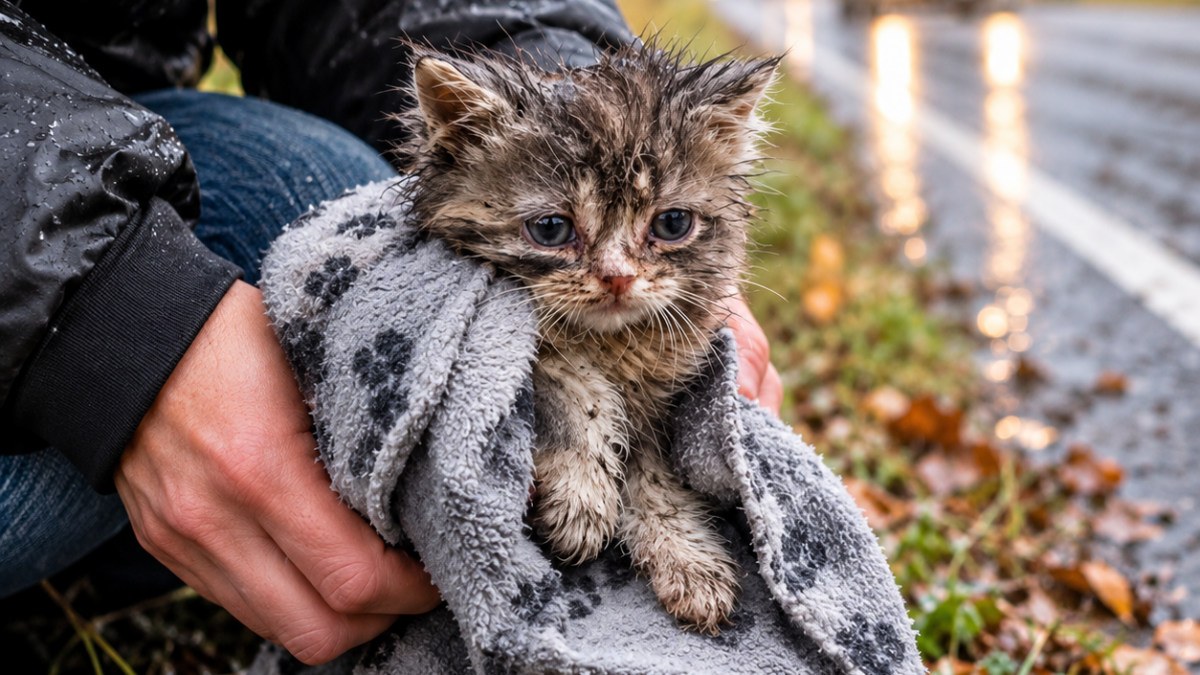
We got back into the car with the kitten still wrapped inside my jacket.
The heater went on immediately.
“Not too hot,” I said.
“I know.”
I sat in the passenger seat and kept him against me.
His trembling didn’t stop.
For the first few minutes, he remained stiff and alert, lifting his head every time we turned or another vehicle passed close enough to send light flashing through the windows.
Then slowly, exhaustion won.
His head sank against my arm.
The paw on my chest slid down.
His eyes began closing.
That should have looked peaceful.
Instead, it scared me.
“Hey.”
I touched the side of his face.
His eyes opened slightly.
“Stay with me.”
The driver glanced over.
“Is he okay?”
“I don’t know.”
“He’s breathing?”
“Yes.”
But barely.
His breaths were shallow enough that I found myself counting them.
One.
Two.
Three.
Pause.
Four.
I didn’t like the pauses.
I pulled out my phone and called the nearest emergency veterinary clinic.
“We found a kitten on the roadside,” I said as soon as someone answered. “Very weak. Can’t stand properly. He’s cold, soaked, extremely thin.”
“Is he conscious?”
“Yes, but fading.”
“Any bleeding?”
“Nothing obvious.”
“Possible vehicle strike?”
“I don’t know.”
“Bring him straight in. Keep him warm, but don’t put direct heat against him.”
“We’re about fifteen minutes away.”
“We’ll be ready.”
I ended the call.
Fifteen minutes.
Under normal circumstances, fifteen minutes is nothing.
When you’re holding something that might stop breathing, it feels endless.
At one red light, the kitten suddenly went limp.
My heart stopped.
“No.”
I lifted his head.
“Hey. Hey!”
His eyes opened.
Barely.
The light changed.
“Go.”
The car accelerated.
I held him closer.
“Don’t you dare.”
I knew how ridiculous it sounded.
He didn’t know me.
I didn’t know him.
Twenty minutes earlier, I thought he was a rag beside a road sign.
Now I was bargaining with a kitten as though sheer stubbornness could keep him alive.
“You’re already in the car,” I whispered. “You don’t get to quit now.”
His ear moved.
That tiny movement felt like an answer.
When we reached the clinic, I was out of the car before it had fully settled into the parking space.
A technician met us at the door.
“This him?”
I nodded.
She took one look at the bundle in my arms.
“Bring him back.”
Everything moved quickly after that.
The jacket opened.
The kitten was placed on a warm towel.
Someone took his temperature.
Another person checked his gums.
A third listened to his chest.
I stood near the wall because there was suddenly no useful place for my hands.
“Temperature’s low.”
“How low?”
“Too low for comfort.”
His blood sugar was checked.
Also low.
He was dehydrated.
Underweight.
His hind legs were weak.
There were abrasions along one side of his body and a small wound near the base of his tail.
No obvious major bleeding.
No dramatic fracture sticking through skin.
But none of that made me feel better.
The veterinarian began examining his spine and legs carefully.
“Can he feel this?”
The kitten twitched.
“Good.”
Another test.
Another small response.
“That’s good too.”
I finally asked the question.
“Is he paralyzed?”
The veterinarian looked at me.
“I don’t think we can say that.”
My stomach tightened.
“What can you say?”
“He’s severely weak. That can come from hypothermia, low blood glucose, starvation, dehydration, trauma, or several of those at once. He does have pain in the rear half of his body.”
“Was he hit by a car?”
“Possible. But we don’t know yet.”
They wanted imaging.
Blood work.
Warming.
Fluids.
Supportive care.
I nodded at everything.
“Do it.”
The kitten lifted his head when a technician moved him.
He looked around the room.
Then toward me.
Maybe coincidence.
Maybe he recognized the jacket.
I stepped closer.
“You’re okay.”
His eyes stayed on me.
The technician smiled.
“He knows your voice.”
“I’ve known him for forty minutes.”
“Forty minutes can be enough.”
They took him for imaging.
I waited.
That may be the most difficult part of rescue.
Before the clinic, you’re busy.
Driving.
Holding.
Calling.
Doing.
Then professionals take over.
Suddenly you have nothing but time to imagine every possible ending.
I looked down at my jacket.
Mud covered one sleeve.
Gray fur clung to the inside.
There was a small spot where his wet nose had pressed against the fabric.
I rubbed it with my thumb.
The driver sat beside me.
“He’s going to make it.”
“You don’t know that.”
“No.”
A pause.
“But neither do you.”
I hated that they were right.
Twenty minutes later, the veterinarian returned.
“No major fractures.”
I exhaled so hard it almost hurt.
“So he’ll walk?”
“Slow down.”
Of course.
There was always another sentence.
“He has soft-tissue trauma around the pelvis and lower back. His legs are responding, which is encouraging. But he’s also extremely depleted. Right now, weakness is a major part of what you’re seeing.”
“Can he recover?”
“I think he has a real chance.”
A real chance.
Not certainty.
But much better than what I’d been imagining in the waiting room.
“What’s the biggest danger tonight?”
“Hypothermia. Low blood sugar. His nutritional state. We also need to watch for internal problems that aren’t obvious yet.”
“Can I see him?”
“In a few minutes.”
They placed him in a warm recovery area.
Fluids were started carefully.
His blood glucose was corrected.
The mud around his paws and belly was cleaned just enough for treatment.
They didn’t give him a full bath.
His body didn’t need the stress.
When I was finally allowed back, he looked even smaller beneath the clinic blankets.
Only his head showed.
“Hey.”
His eyes opened.
No hiss.
No attempt to crawl away.
Just that exhausted stare.
I put one finger near his nose.
He sniffed.
Then his head moved forward.
Barely.
His forehead touched my finger.
The technician beside me said, “That’s a good sign.”
“What?”
“He’s interested.”
“In me?”
“In anything.”
That hit harder than I expected.
Interest meant he still wanted something from the world.
Warmth.
Food.
Touch.
Anything.
It meant there was still a little fight left.
We named him Ash.
Not because the name was clever.
Because beneath all the mud, his coat was a soft smoky gray.
Ash.
A tiny name for a tiny animal who had somehow survived long enough for headlights to find him.
The clinic kept him overnight.
I didn’t want to leave.
Of course I had to.
“You can call anytime,” the technician said.
“Anytime?”
“Anytime.”
“You’re going to regret saying that.”
She laughed.
“I’ve had worse.”
Before leaving, I leaned close to Ash.
“I’ll come back.”
His eyes were already closing.
“I mean it.”
That promise felt heavier than it should have.
Maybe because somewhere in his short life, someone else had failed to come back.
I didn’t know.
But I did know one thing.
I wasn’t going to become another person who disappeared.
That night, I slept badly.
At 1:10 a.m., I checked my phone.
Nothing.
At 1:23, I called.
“He’s stable,” the overnight technician said.
“Still cold?”
“Warmer.”
“Blood sugar?”
“Better.”
“Has he eaten?”
“Not yet.”
“Is that bad?”
“Not unexpected.”
At 3:47, I woke again.
I didn’t call.
I stared at the ceiling and forced myself to wait.
At 5:06, the phone rang.
My stomach dropped before I answered.
“This is the clinic.”
“Is he alive?”
There was a pause.
Then the technician laughed softly.
“Yes. Very much alive.”
I sat up.
“What happened?”
“He ate.”
Two words.
That’s all.
He ate.
I covered my face with one hand.
“How much?”
“Not a lot. But enough to make us happy.”
“Did he eat on his own?”
“Yes.”
I laughed.
Then, embarrassingly, I started crying.
The technician pretended not to notice.
“Come by later this morning.”
“I’ll be there.”
Ash had made it through the night.
That did not mean he was safe.
But it meant there was a morning.
Sometimes that’s the first victory.
When I returned, he was sitting.
Not standing.
Sitting.
But upright.
His head was higher.
His eyes looked brighter.
A small dish of food sat near him.
Half empty.
“Look at you.”
Ash blinked.
I crouched.
He leaned forward.
This time, he didn’t just touch my finger.
He rubbed the side of his face against it.
The technician raised an eyebrow.
“Forty minutes, huh?”
I smiled.
“Apparently I’m unforgettable.”
Ash attempted to stand.
His front legs came up.
The rear legs shook.
He rose halfway.
Then sank.
My smile disappeared.
The veterinarian noticed.
“Remember what I told you.”
“I know.”
“He’s weak.”
“I know.”
“It may take time.”
“I know.”
Knowing and feeling are very different things.
Ash was alive.
That should have been enough for the morning.
Instead, my mind had already moved the finish line.
I wanted him walking.
Running.
Jumping.
Being annoying.
Recovery makes people greedy.
You get one miracle and immediately ask for another.
The veterinarian showed me the imaging.
There was bruising and inflammation but no catastrophic spinal fracture.
His pelvis did not appear shattered.
His responses were present.
That was all encouraging.
“What happened to him?”
“I can’t tell you.”
“Could someone have kicked him?”
“It’s possible.”
“Could a car have clipped him?”
“Also possible.”
“Could he have just become too weak to walk?”
“Possible too.”
I hated the uncertainty.
Pain invites a villain.
The human brain wants a person to blame.
A driver.
An owner.
Someone who made a choice.
But facts matter.
Ash couldn’t tell us.
His body carried damage, not a written explanation.
I promised myself I wouldn’t turn suspicion into certainty.
Still, something about his fear bothered me.
Whenever a man in heavy work boots entered the room, Ash flattened himself.
Whenever keys jingled loudly, he flinched.
When a hand moved from above his head, he recoiled.
Maybe those reactions meant something.
Maybe they didn’t.
Street animals learn fear from many things.
I filed it away.
Not as evidence.
As a question.
Ash remained hospitalized for three days.
Each day brought a small improvement.
First, appetite.
Then warmth.
Then hydration.
Then strength.
On the second afternoon, he stood for almost three seconds.
The technician called me immediately.
“You missed it.”
“What?”
“He stood.”
“On his own?”
“Mostly.”
“How long?”
“Two or three seconds.”
“That’s standing.”
“I agree.”
I arrived later with the unreasonable expectation that he would perform on command.
He did not.
I placed him on a padded surface.
“Come on.”
Ash sat.
“Your fan club is waiting.”
Ash licked one paw.
The technician laughed.
“He knows he has leverage now.”
I put a small bit of food a few inches away.
His eyes locked onto it.
“Ah.”
The technician nodded.
“Now you’re speaking his language.”
Ash leaned forward.
Front paws moved.
Then his rear legs pushed.
His hips lifted.
He trembled violently.
For a second, I thought he would collapse.
But he stayed up.
One second.
Two.
Three.
Then one tiny step.
His left hind leg almost folded.
He caught himself.
Another step.
He reached the food and dropped into a sit.
I covered my mouth.
The technician clapped quietly.
Ash ate the treat.
Completely unimpressed by his own achievement.
“You walked.”
He licked his lips.
“You actually walked.”
That was the moment I started believing we might eventually get the annoying kitten I wanted.
But recovery had another problem waiting for us.
Ash had nowhere to go.
He couldn’t return to the roadside.
Obviously.
He wasn’t strong enough for a general shelter environment.
He needed a quiet foster home.
A controlled space.
Food.
Medication.
Short movement sessions.
Someone willing to watch him closely.
I volunteered before anyone finished the sentence.
The veterinarian smiled.
“I assumed.”
“You shouldn’t assume.”
“You came here four times in three days.”
“That’s irrelevant.”
“Of course.”
Ash came home with me on the fourth day.
The carrier sat on the passenger seat.
This time, the heater wasn’t fighting hypothermia.
The kitten inside wasn’t wrapped like a dying animal.
He was awake.
Watching.
When we passed the stretch of road where we’d found him, I slowed.
I don’t know why.
Ash couldn’t see much from the carrier.
Maybe I needed to look.
The road sign was still there.
Wet grass.
Ditch.
Gray shoulder.
Cars.
Everything looked ordinary.
That offended me.
The place where Ash had nearly disappeared from the world hadn’t changed at all.
No marker.
No evidence.
No reason for anyone passing to know that a life had almost ended there.
Then I noticed something else.
A gas station sat about two hundred yards farther down.
I’d seen it that night without really registering it.
A convenience store.
Two fuel pumps.
Security cameras under the roof.
I slowed more.
“What are you doing?” the driver asked.
“Cameras.”
“What?”
“That station has cameras.”
“So?”
“So maybe one points toward the road.”
“You think it saw Ash?”
“I don’t know.”
We had no reason to believe it did.
But the question I had filed away came back.
How did a kitten that small end up beside a high-speed road on a cold evening?
Maybe he wandered.
Maybe he fell from somewhere.
Maybe he was born nearby.
Maybe someone left him.
I wanted to know.
Not because knowing would heal Ash.
Because if someone had deliberately abandoned him, there might be other animals.
We stopped at the station.
I left Ash safely in the warm car with the driver and went inside.
A tired-looking cashier stood behind the counter.
“Can I ask you something strange?”
“Depends how strange.”
“Do your cameras record the road?”
She looked toward the windows.
“Some of it.”
“How long do you keep footage?”
“Maybe a week. Why?”
I showed her a photo of Ash at the clinic.
“We found him two nights ago near the sign back there.”
Her expression changed.
“Oh.”
“Do you remember seeing a kitten?”
“No.”
“Would someone be able to check the camera?”
She called the manager.
The manager was less interested.
“We can’t review hours of footage for a cat.”
“I understand.”
I showed him the photo from the roadside.
Ash wrapped in the jacket.
His body barely visible.
Then a photo from the clinic.
“He’s injured. If somebody dropped him there and has other animals, I’d like to know.”
The manager sighed.
“What time?”
I gave the rough window.
“Come back tomorrow.”
“That’s it?”
“Come back tomorrow.”
I thanked him.
Back in the car, the driver looked at me.
“Any luck?”
“Maybe.”
Ash meowed from the carrier.
A strong, irritated meow.
I smiled.
“Listen to that.”
The driver laughed.
“He’s already complaining.”
“Exactly what I wanted.”
At home, Ash discovered blankets.
Not figuratively.
With genuine astonishment.
I opened the carrier inside a small quiet room.
He stayed inside for ten minutes.
Then one paw appeared.
Then his head.
He looked around.
Food bowl.
Water.
Low-sided litter tray.
Soft bed.
Blankets.
No traffic.
No rain.
No boots.
No hands reaching from above.
He stepped out.
His gait was awkward.
Rear legs still weak.
But he walked.
He sniffed the nearest blanket.
Then climbed onto it.
Turned once.
Collapsed.
I sat on the floor several feet away.
“You like that?”
Ash closed his eyes.
Within minutes, he was asleep.
Deeply.
His paws twitched.
His breathing slowed.
I watched longer than I should have.
People underestimate the emotional force of watching a rescued animal sleep.
When they finally sleep hard enough not to monitor every sound, it means something.
The body is saying what the mind hasn’t learned yet.
Maybe I’m safe.
Ash woke two hours later and screamed for food.
I laughed.
“Okay. That’s enough recovery for you.”
He ate.
Then tried to climb my leg.
His rear half failed halfway up.
He slid.
I caught him.
“No climbing.”
He looked offended.
“Doctor’s orders.”
He bit my sleeve.
Softly.
“Great. Violence.”
Over the next week, Ash became less like a patient and more like a kitten.
That sounds obvious.
It wasn’t.
Patients endure.
Kittens interfere.
Ash interfered with everything.
Changing his water?
He attacked the cup.
Cleaning the litter tray?
He sat in it.
Doing movement exercises?
He tried to bite the towel.
Taking medication?
Suddenly he possessed the jaw strength of a tiger.
Every irritating behavior made me ridiculously happy.
The first time he sprinted three feet after a toy, he fell over at the end.
I gasped.
He immediately got up and attacked the toy again.
The fall hadn’t scared him.
It had scared me.
His rear legs still wobbled.
But they were getting stronger.
We did gentle exercises.
Short walks across carpet.
Encouraged weight-bearing.
No jumping from heights.
No slippery floors.
Ash disagreed with every restriction.
One morning, I found him on the low couch.
I stared.
“How did you get up there?”
Ash stared back.
There was no answer I would have liked.
“You’re not supposed to climb.”
He began washing his face.
“Unbelievable.”
The gas station called that afternoon.
“We found something.”
My stomach tightened.
“What?”
“You should come see.”
I left Ash safely at home and drove there.
The manager had security footage paused on a computer.
The image quality wasn’t perfect.
Night.
Road.
Headlights.
Time stamp.
He clicked play.
At 6:11 p.m. on the night we found Ash, a small van pulled onto the shoulder near the sign.
My chest tightened.
A person got out.
We couldn’t see the face clearly.
They opened the passenger door.
Reached inside.
Then placed something on the ground.
A box.
Cardboard.
Small.
They got back in.
The van drove away.
The box remained.
For almost a minute, nothing happened.
Then something gray climbed over the edge.
Ash.
I knew before the manager zoomed.
A tiny shape.
He dropped to the ground.
The box tipped sideways.
Ash moved toward the grass.
The video continued.
At 6:23, the box blew into the ditch.
At 6:41, a truck passed close.
Ash crouched.
At 6:52, he tried walking toward the station.
Collapsed.
At 7:07, he returned toward the sign.
At 7:19, our car appeared.
I stopped breathing.
There it was.
Not suspicion.
Not imagination.
Someone had left him.
In a box.
Beside a high-speed road.
On a cold night.
The manager swore under his breath.
I said nothing.
Anger doesn’t always feel hot.
Sometimes it becomes very cold.
Very focused.
“Can we save this?”
“Already copied it.”
“Is the license plate visible?”
“Partly.”
We paused.
Enhanced as much as possible.
Several characters could be read.
Not all.
“There’s another camera near the entrance,” the cashier said behind us.
The manager turned.
“It catches vehicles leaving eastbound.”
We checked.
The van passed.
This angle was better.
Still imperfect.
But enough that the manager thought the plate might be recoverable.
I felt my hands shaking.
“Can I have copies?”
“For animal control?”
“Yes.”
The manager nodded.
“Take them.”
I called the local animal welfare authority from the parking lot.
I explained everything.
Kitten.
Roadside.
Medical treatment.
Video.
Vehicle.
They asked me to submit the footage and veterinary records.
I did.
Then I sat in the car and stared at the steering wheel.
For days, I had imagined possibilities.
A car strike.
A lost kitten.
An accident.
Now I knew.
Someone had taken a kitten weak enough that he could barely stand, placed him in a box beside a dangerous road, and driven away.
Maybe they assumed somebody would find him.
Maybe they didn’t care.
Either possibility made me furious.
I went home.
Ash met me at the door of his room.
He was not supposed to be near the door.
He was.
“You.”
He meowed.
I crouched.
He walked toward me with his still-wobbly gait.
I picked him up.
He immediately climbed against my chest.
That same tiny paw touched my shirt.
Stronger now.
I buried my face against his fur.
“I’m sorry.”
Ash purred.
“I’m so sorry.”
He didn’t know what I meant.
Maybe that was a mercy.
Two days later, animal welfare officers contacted us.
The partial plate, vehicle type, and surrounding footage had led them to an owner.
They would not give me every detail.
They shouldn’t have.
Investigations need process.
But they told me enough.
The person claimed Ash had been “sick” and that they believed someone at the gas station would take him.
I stared at the phone.
“Then why didn’t they walk inside?”
The officer didn’t answer.
They didn’t need to.
There were also questions about how long Ash had been ill and why he had not received veterinary care.
The investigation expanded.
That frightened me.
“Other animals?”
“We’re checking.”
That was all they could say.
I looked at Ash sleeping beside me.
If there were other animals in that home, this story wasn’t only about him anymore.
Days passed.
Then a week.
Ash improved.
The investigation continued.
I tried not to obsess.
Failed.
Every time the phone rang, I expected news.
Eventually it came.
There had been other cats at the property.
Not dozens.
Not a horror-house situation.
But several animals living in poor conditions.
They were removed for evaluation.
The person faced consequences for abandonment and neglect under the applicable local process.
I deliberately did not ask for details I didn’t need.
A fine wouldn’t undo what happened.
A charge wouldn’t warm the night Ash spent outside.
Punishment couldn’t go backward in time.
What mattered most was that the other animals had been seen.
They received care.
And the person responsible could no longer pretend a cardboard box beside a highway counted as finding help.
That was enough accountability for me.
For a while.
Then anger returned anyway.
It came unexpectedly.
During one of Ash’s follow-up appointments, the veterinarian watched him walk across the exam room.
He still had a slight weakness in one rear leg.
But he was mobile.
Confident.
He chased a pen cap.
The veterinarian laughed.
“He’s doing really well.”
I should have been happy.
Instead, I thought of the video.
The box.
The van driving away.
Ash climbing out alone.
“What kind of person does that?”
The veterinarian stopped smiling.
“You mean abandon him?”
“Yes.”
A pause.
“I don’t know.”
“I keep imagining them driving away.”
“Don’t.”
“How?”
“By looking at what’s in front of you.”
Ash was trying to climb the scale.
The veterinarian pointed.
“That.”
I looked.
Ash slipped.
Recovered.
Tried again.
“He’s here.”
“I know.”
“Other animals from the property are safe.”
“I know.”
“The case is being handled.”
“I know.”
“Then don’t let the person who left him keep owning your attention.”
That sentence stayed with me.
Don’t let them keep owning your attention.
Revenge sounds powerful when you’re angry.
You imagine confrontation.
Shame.
The person seeing what they did.
Regretting it.
But the veterinarian was right.
Every minute I spent replaying the abandonment was another minute the person who left Ash occupied space in a story that should have belonged to Ash.
So I changed the question.
Not: What happened to the person?
What happens to Ash now?
That answer became much more interesting.
Ash discovered windows.
He loved them.
For hours, he would sit watching birds.
The first time rain hit the glass, he froze.
His ears flattened.
He backed away from the window.
I noticed.
I didn’t approach.
Didn’t pick him up.
I let him decide.
He stood several feet from the window.
Rain tapped the pane.
A car drove through water outside.
Ash crouched.
Then looked around the room.
Warm blanket.
Food bowl.
Me sitting nearby.
The rain stayed outside.
After several minutes, he moved toward the window again.
Slowly.
One paw.
Then another.
He sat.
Watched.
That was it.
No miracle.
No dramatic collapse into my arms.
Just a kitten learning that weather could happen without hurting him.
A month after rescue, he jumped onto the couch without help.
I saw it.
All four paws left the floor.
He landed.
Turned around as if he had always been capable of it.
I shouted.
“Ash!”
He sprinted away.
I chased him.
“You are absolutely not cleared for that!”
He hid beneath a chair.
I called the veterinarian.
“He jumped.”
“Good.”
“Good?”
“Did he fall?”
“No.”
“Is he limping?”
“No.”
“Then good.”
“You’re supposed to be stricter.”
“He’s a kitten.”
“That’s not medical advice.”
“You’re the one who called me because a cat jumped onto a couch.”
Fair.
At his next recheck, the veterinarian manipulated his hind legs.
Tested strength.
Watched his gait.
“His recovery is excellent.”
“Will the weakness disappear completely?”
“Maybe. Maybe not.”
That old answer.
Maybe.
But this time, it didn’t frighten me.
If Ash always had a slight hitch in one leg, fine.
He could have the world’s strangest walk.
He was alive.
He was mobile.
He was already faster than me.
The rescue organization eventually posted his adoption profile.
I stared at it for a long time.
**Ash — young gray male kitten. Friendly once comfortable. Playful. Recovered from severe neglect and roadside abandonment.**
My chest tightened.
Adoption.
Of course.
That was the goal.
I had known it from the beginning.
Fostering means temporary.
Save.
Heal.
Release.
I hated all three words suddenly.
Applications arrived quickly.
Ash was young.
Cute.
Gray.
Photogenic.
His story made people emotional.
That worried me.
Emotion gets animals adopted.
Commitment keeps them adopted.
We rejected the first application.
The person wanted him as a surprise gift.
No.
The second had no plan for veterinary care.
No.
The third wanted an outdoor kitten.
Absolutely not.
Then came a family with a teenage daughter named Sophie.
She had read Ash’s profile.
When she arrived, she didn’t immediately ask to hold him.
Good sign.
She sat on the floor.
Ash remained beneath a chair.
She waited.
Five minutes.
Ten.
Her father whispered, “He’s shy.”
Sophie shrugged.
“He’s allowed to be.”
Another good sign.
Ash eventually emerged.
Sniffed her shoe.
Retreated.
Sophie didn’t move.
He came back.
Sniffed her hand.
She let him.
Then Ash did something traitorous.
He climbed into her lap.
I stared.
“You’ve known her twelve minutes.”
Sophie laughed.
Ash curled against her sweatshirt.
His purr started.
That same purr.
Soft.
Steady.
The one I first heard beneath traffic.
I looked away.
Sophie noticed.
“Are you okay?”
“Fine.”
Her father smiled.
“You’re not fine.”
“I’m professionally fine.”
They laughed.
Ash closed his eyes.
The family asked the right questions.
Medical history.
Possible long-term weakness.
Indoor safety.
Diet.
Follow-up.
What scared him.
What he liked.
Whether he could live with another cat.
They weren’t asking for a heroic rescue symbol.
They were asking about Ash.
That mattered.
Still, I didn’t say yes that day.
I needed to see the home.
Check windows.
Talk through everything.
Part of me also needed to delay.
I’m not proud of that.
When you carry something from the edge of death, a dangerous thought can grow quietly.
Nobody will protect him as well as I do.
Sometimes that thought is intuition.
Sometimes it’s ego.
You have to know the difference.
The home check was good.
Better than good.
Safe windows.
No outdoor access.
A quiet room prepared for transition.
Another calm adult cat.
A regular veterinarian.
Parents who understood that a teenager’s enthusiasm needed adult backup.
Everything was right.
I still wanted to find a problem.
There wasn’t one.
That night, Ash slept at the foot of my bed.
I stared at him.
“You planned this.”
One ear moved.
“You deliberately became adorable.”
Ash stretched.
His rear legs extended fully.
Once, those legs couldn’t hold him.
Now he kicked one into my ankle.
“Rude.”
He went back to sleep.
Adoption day arrived in early December.
Cold again.
Not raining.
The kind of morning when your breath hangs in front of you.
Sophie came with a carrier lined with a thick blanket.
Inside was a small toy mouse.
A tag already engraved with Ash’s name.
Not a new name.
Ash.
That affected me more than it should have.
“You kept it.”
“Of course.”
I handed over the medical folder.
Food instructions.
Follow-up notes.
Everything practical.
Then there was nothing left to explain.
Ash sat near my feet.
I picked him up.
He immediately put one paw against my chest.
Exactly where he had that first night.
I laughed.
“That’s dirty.”
Sophie looked confused.
“What?”
“He did this when I found him.”
I told her.
Not the whole story.
Just the paw.
The purr.
She touched his head gently.
“He knew.”
“No.”
I shook my head.
“He was terrified.”
Ash purred.
“I think he just wanted something warm.”
Sophie opened the carrier.
Ash looked inside.
Sniffed the blanket.
Saw the toy.
Walked in.
Just like that.
No dramatic goodbye.
No turning back.
No understanding that my heart had decided this was a major event.
He went into a box willingly.
That was what struck me.
The last box he had been placed in was left beside a highway.
Now he stepped into a carrier because the people around him had taught him that boxes could lead somewhere safe.
I closed the door.
My hands stayed on the latch for a second longer than necessary.
Sophie said quietly, “I’ll take care of him.”
I looked at her.
“I know.”
And I did.
That was why he was leaving.
Their car drove away.
I stood outside long after it disappeared.
The house felt enormous without him.
No gray blur attacking my shoelaces.
No food bowl being shoved across the floor.
No kitten screaming at closed doors.
No one violating medical restrictions.
I hated it.
Which meant the foster had succeeded.
Three days later, Sophie sent a photo.
Ash was asleep upside down on her bed.
One rear leg hanging over the edge.
Caption:
**He owns my room now.**
I replied:
**That took longer than expected.**
A week later:
Ash and the older cat sleeping near each other.
Two weeks:
Ash on the windowsill.
One month:
Ash climbing a cat tree.
Higher than I thought he should.
I wrote:
**Tell him I said get down.**
Sophie replied:
**He said no.**
Perfect.
The abandonment case moved forward quietly in the background.
I did not attend every proceeding.
I did not seek the person out.
I did not post their name online.
People wanted me to.
When the story circulated locally, anger exploded.
“Expose them.”
“Make them pay.”
“Post the plate.”
“No.”
Some people accused me of protecting cruelty.
I wasn’t.
Accountability and mob punishment are not the same thing.
The authorities had the evidence.
The animals had been removed.
The process existed.
Ash did not need strangers turning his rescue into a hunt.
He needed his story to remain about survival.
Eventually, I was informed that the case had resulted in formal consequences and restrictions relating to animal ownership.
I read the message twice.
Then deleted it.
Not because it didn’t matter.
It mattered.
But I didn’t need to frame it.
Ash’s best photograph was already on my phone.
He was standing on top of Sophie’s cat tree.
Tail high.
Eyes bright.
Four paws holding him perfectly.
That was the judgment I cared about.
Months passed.
Spring came.
The road where we’d found him changed with the season.
Grass grew taller.
The ditch dried.
I still slowed whenever I drove past.
One afternoon, I stopped at the gas station.
The same manager was there.
He recognized me.
“Kitten person.”
“That’s my legal name now.”
He laughed.
“How’s he doing?”
I showed him a photo.
His eyebrows lifted.
“That’s the same cat?”
“Yep.”
“He got big.”
“Too big.”
The manager pointed toward the security monitor.
“We changed something because of him.”
“What?”
He walked me outside.
Near the edge of the parking area stood a small weatherproof sign.
**Found or abandoned animal? Tell staff. We can contact local rescue services.**
Below it sat a small covered water bowl.
I looked at him.
“You did this?”
“Staff suggested it.”
“The cashier?”
“Mostly.”
I smiled.
“Good.”
He became serious.
“I’ve watched that footage a lot.”
“You shouldn’t.”
“I know.”
A pause.
“I keep thinking how many cars passed.”
“Me too.”
“Then I think maybe that’s the wrong thing.”
“What do you mean?”
He pointed at the sign.
“Better to think about the one that stopped.”
That stayed with me.
The one that stopped.
Rescue stories can make everyone else look heartless.
Sometimes that’s deserved.
Sometimes people genuinely don’t see.
Night.
Speed.
Distraction.
We can’t know.
But we do know the difference one stopped car can make.
That station later called the rescue twice about stray animals.
One was a dog with a collar who had escaped from a yard.
Reunited with his family within hours.
The second was an injured adult cat.
Treated.
Recovered.
Adopted.
Ash never knew he had caused any of that.
He didn’t know about footage.
Investigations.
Signs.
Other rescues.
He knew food.
Windows.
Sophie.
The older cat.
The sound of treat bags.
Probably enough.
One year after I found him, Sophie asked if I wanted to visit.
I did.
Ash met me at the door.
At first, he stared.
Adult now.
Longer body.
Thicker coat.
Bright greenish eyes.
No muddy fur.
No shaking legs.
No roadside fear.
I crouched.
“Hey.”
Ash sniffed me.
For half a second, nothing.
Then his head pushed into my hand.
Hard.
I laughed.
“You remember.”
He rubbed along my arm.
Then climbed halfway into my lap.
His purr started.
Louder now.
Sophie smiled.
“He does that when he really likes somebody.”
“Good taste.”
Ash put one paw against my chest.
There it was again.
The same place.
I looked at Sophie.
“He still does it.”
“What?”
“The paw.”
She smiled.
“He does that with me too.”
I pretended to be offended.
“So it’s not special?”
“Sorry.”
Ash purred.
I scratched beneath his chin.
“It’s fine.”
And it was.
Maybe the gesture hadn’t been about me.
Maybe it was just Ash.
A habit.
A way of anchoring himself to someone warm.
That made it better.
Because now he had more than one person to reach for.
Sophie showed me videos.
Ash jumping from couch to chair.
Running through the hallway.
Wrestling with the older cat.
One clip showed him sprinting so fast his back feet skidded around a corner.
I watched it twice.
“Any weakness?”
“Sometimes after he plays too hard, one leg looks a little funny.”
“The vet knows?”
“Yes.”
“Good.”
She rolled her eyes.
“You really think we don’t take care of him?”
“No.”
“You’re doing the face.”
“What face?”
“The foster-parent face.”
I laughed.
She was right.
Ash jumped onto the windowsill.
Outside, rain had started.
He watched it.
No fear.
No backing away.
Just interest.
A car passed.
Water sprayed.
Ash’s tail twitched.
Then a bird landed near the fence and he forgot the rain entirely.
That’s recovery.
Not when the memory disappears.
When life becomes more interesting than the memory.
We sat in the living room talking.
Sophie asked me something unexpected.
“Do you hate the person who left him?”
I thought for a while.
“I did.”
“Not now?”
“I don’t know them.”
“That’s not what I asked.”
Fair.
Ash jumped down.
Walked across the room.
Tail high.
“I hate what they did.”
Sophie waited.
“I don’t want to carry them around forever.”
She nodded.
“Because Ash doesn’t?”
“Exactly.”
He had no idea his life was supposed to be a revenge story.
He wasn’t waking every morning thinking about the van.
He didn’t need a punishment update.
He wasn’t waiting for an apology.
He wanted breakfast.
The window.
His toy.
Sophie.
A nap.
Another breakfast if possible.
Animals can teach us something humiliating about moving forward.
Humans like to keep receipts.
Dogs and cats like to keep routines.
That doesn’t mean cruelty should be ignored.
It shouldn’t.
The person who abandoned Ash needed to be stopped from doing it again.
That happened.
But once the danger ended, Ash moved on faster than I did.
Maybe I had to catch up.
Before leaving, I sat near the doorway.
Ash walked over.
I put my hand on his back.
He was solid now.
Muscle.
Healthy weight.
Warm fur.
I remembered lifting him from the roadside.
How little he weighed.
How easily my jacket held his entire body.
“You’re heavy.”
Sophie called from the kitchen.
“Don’t body-shame my cat.”
“Your cat tried to die in my jacket. I earned one comment.”
She came back carrying treats.
Ash abandoned me immediately.
“Traitor.”
He sat in front of her.
Perfect posture.
Sophie handed him one.
Then another.
I smiled.
That was the revenge.
Not the case file.
Not the fine.
Not the restrictions.
Not the embarrassment of being caught on camera.
This.
A cat who once searched a cold roadside for somewhere not to collapse now manipulating a teenager into giving him extra treats.
A cat who was placed in a cardboard box like unwanted trash now sleeping on a bed someone bought blankets for.
A cat whose legs folded beneath him now sprinting through hallways.
A cat left near speeding vehicles now watching traffic from behind safe glass.
A cat who flinched from my hand now reaching for people first.
Every ordinary comfort felt like a refusal of the ending someone had chosen for him.
They had left him on the side of a road.
Ash left that road behind.
Completely.
The person who abandoned him eventually became a footnote.
Ash became the whole story.
That’s what I wanted.
The gas station sent me a message later that winter.
Someone had found a box behind the building.
My heart stopped.
Another animal?
I called immediately.
“No,” the cashier said quickly. “Not like that.”
“What happened?”
“Somebody left blankets and canned cat food beside the rescue sign.”
“Oh.”
“No note.”
I smiled.
Anonymous kindness.
Maybe from someone who knew Ash’s story.
Maybe not.
It didn’t matter.
The box this time didn’t contain a terrified kitten.
It contained things that might save one.
I thought about the strange symmetry.
One cardboard box had been used to abandon.
Another to help.
Objects don’t decide what they mean.
People do.
The same is true of hands.
A hand can push an animal away.
Or lift it from traffic.
A car can leave.
Or stop.
A box can discard.
Or protect.
A human being can look.
Or look away.
Ash’s entire life had turned on those differences.
People often ask what they should do if they see an animal beside a road.
I tell them the practical things.
Don’t run into traffic blindly.
Pull over safely.
Use hazards.
Approach cautiously.
Injured animals may bite or scratch.
Call local animal services or a rescue group.
Use a towel or blanket if safe.
Don’t assume weakness means the animal is friendly.
Get veterinary care.
Those details matter.
But beneath all the practical advice is something simpler.
Believe what you’re seeing.
If an animal looks wrong, look again.
Ash looked like trash from a distance.
That is not poetic exaggeration.
I genuinely thought he was a rag.
If he hadn’t moved at that exact moment, maybe we would have driven past.
That thought still makes me uncomfortable.
People like to imagine rescuers as uniquely observant.
We’re not.
Sometimes we’re lucky.
Ash moved.
I saw it.
We stopped.
That’s all.
The difference between his life and death may have been one movement small enough to miss.
Years later, I still think about that.
Not obsessively.
But whenever I see something at the edge of the road.
A shape.
An animal.
A bag.
I look twice.
Ash trained me.
He probably trained other people too.
Sophie began volunteering with a local cat rescue when she was old enough.
Her father blamed Ash.
“Before him, we had one cat.”
He pointed around their house during a later visit.
They now had three.
“This is your fault.”
“Absolutely.”
Ash sat on the arm of the couch like management.
The newest cat was a frightened tortoiseshell foster.
She hid under furniture.
Sophie moved slowly around her.
Never reached suddenly.
Left food nearby.
Gave space.
I watched.
“You’ve gotten good at this.”
She shrugged.
“Ash taught me.”
The roadside kitten had become a teacher.
Again without knowing.
The tortoiseshell eventually found a home.
Then Sophie fostered another.
Then two kittens.
Ash tolerated them with varying levels of dignity.
One photo showed a foster kitten asleep directly on his back.
Ash’s expression looked deeply offended.
I saved it.
“Revenge,” I wrote.
Sophie replied:
**For what?**
**For making us all worry.**
She sent:
**He says he has no regrets.**
Of course.
Ash aged.
Not old.
Just older.
His kitten face sharpened.
His body filled out.
The slight irregularity in his back leg remained when he was tired.
A reminder.
Not a limitation.
One veterinarian described it as “his little hitch.”
Sophie hated the phrase at first.
Then adopted it.
“He’s hitching today.”
“Did he overplay?”
“Yes.”
“Rest.”
“Tell him.”
Ash continued living like veterinary recommendations were rumors.
He jumped.
Ran.
Climbed.
Stole food once.
Knocked over a plant.
Destroyed a roll of toilet paper.
All the achievements I had begged the universe to let him experience.
Funny how miracles become annoyances when you get used to them.
That’s success.
You stop treating every movement like a medical milestone.
You start saying things like:
“Ash, get off the counter.”
“Ash, that’s not your food.”
“Ash, leave the curtain alone.”
“Ash!”
Every shouted complaint contains a hidden thank you.
You’re alive enough to be irritating.
Good.
One October evening, exactly several years after the rescue, Sophie sent me a photo.
Ash sat beside a road sign.
My heart jumped before I read the message.
Then I realized.
He was on a leash.
Harnessed.
Safe.
The road was a quiet lane near their house.
Autumn grass.
Gray sky.
Sophie had taken him outside for supervised enrichment.
The caption read:
**He doesn’t know why this made me emotional.**
I did.
I called her.
“Why would you send me that without warning?”
She laughed.
“Sorry.”
“I thought he was loose.”
“He would never survive five minutes outside.”
“After all this, that’s your conclusion?”
“He has no street skills.”
Ash meowed in the background.
“Exactly.”
I looked at the photo again.
Strong legs.
Clean coat.
Bright collar.
Leash attached to a person who would never abandon him.
Another road.
A completely different meaning.
I asked, “Does he like it?”
“Mostly he eats grass.”
“Naturally.”
There was a long pause.
Then Sophie said, “I’m glad you stopped.”
Simple.
No drama.
No speech.
I’m glad you stopped.
I looked out my window.
Cars moved along the street outside.
“Me too.”
After the call, I found the oldest photo I had of Ash.
The first night.
Wrapped in my jacket.
Eyes enormous.
Mud on his face.
One paw visible near my chest.
I put it beside the new photo.
Same cat.
I could see it in the eyes.
But almost nothing else matched.
Then I thought about the title people might give his life.
Abandoned kitten.
Roadside rescue.
Neglect survivor.
All technically true.
None complete.
Labels freeze animals at their worst moment.
Ash had lived thousands of moments after that.
The first full meal.
The first warm sleep.
The first successful step.
The first jump.
The first adoption day.
The first night on Sophie’s bed.
The first bird watched from a window.
The first foster kitten he tolerated.
The first plant he destroyed.
The thousandth purr.
Why should one terrible night get naming rights over an entire life?
It shouldn’t.
Ash wasn’t the abandoned kitten anymore.
He was Ash.
That was enough.
Sometimes readers want a dramatic confrontation at the end.
They want me to say I stood face-to-face with the person who left him.
That I showed them photographs.
That I told them exactly what I thought.
That they cried.
Apologized.
Regretted everything.
That never happened.
And I’m glad.
Real accountability did happen.
Evidence existed.
Authorities handled it.
Other animals were protected.
That mattered.
But I didn’t need a movie scene.
I didn’t need Ash carried into a courtroom.
I didn’t need the person who failed him to become the climax.
Why give them that importance?
The climax was a three-second stand in a clinic.
A kitten trembling on legs that had folded beneath him beside a road.
Pushing.
Holding.
Taking one step.
Then another.
Everything after that was Ash reclaiming the future someone had discarded.
That was the revenge.
The person left him in a box.
Ash grew up in a home.
The person drove away.
Ash became the reason other people stopped.
The person treated his life as disposable.
Ash’s life changed a gas station, a family, a teenager, future foster cats, and strangers who never met him.
How small the original act of cruelty looked compared with everything it accidentally failed to destroy.
That is the kind of ending I can live with.
Not because punishment is unimportant.
Because survival is bigger.
The last time I saw Ash, he was asleep on Sophie’s couch.
Older.
Heavier.
One paw draped over his face.
I sat beside him.
He opened one eye.
Then closed it again.
“That’s all I get?”
His tail flicked.
I scratched his cheek.
The purr started.
Still the same sound.
The roadside disappeared for a second.
No headlights.
No cold grass.
No trucks.
Just warmth.
A room.
A cat.
A person nearby.
Ash stretched.
His back legs extended behind him.
Strong enough to push against the cushion.
I put my hand under one paw.
He pressed against me.
I remembered the first touch.
That tiny paw against my chest.
At the time, I thought it meant trust.
Maybe it didn’t.
Maybe he was simply exhausted and reaching for warmth.
But trust came later.
Real trust.
Built meal by meal.
Touch by touch.
Day by day.
That’s better than instant rescue magic.
Ash didn’t owe us trust because we saved him.
We had to prove we were safe.
Sophie had to prove it.
The clinic had to prove it.
Every person after the abandonment had to write over what came before.
They did.
Eventually, Ash stopped waiting for hands to hurt.
Stopped expecting boxes to mean danger.
Stopped believing cold was normal.
Stopped flinching at every sound.
Not all at once.
But enough.
That’s what healing looks like when it’s real.
Not forgetting.
Relearning.
The world hurt me.
The world can also feed me.
A person left.
A person can also stay.
A box trapped me.
A carrier can take me home.
A road almost killed me.
A car can also stop.
Contradictions.
Ash learned them all.
So did I.
Before him, I believed rescue was mostly about action.
Find.
Lift.
Treat.
Adopt.
After Ash, I understood how much of it is about rewriting expectations.
An animal comes to you with a private set of rules shaped by experience.
Hands are dangerous.
Food disappears.
Sleep lightly.
Run first.
Trust nobody.
Your job is not to explain those rules are wrong.
Your job is to live differently around them until they no longer make sense.
Food returns.
Hands are gentle.
Doors open.
Beds stay.
People come back.
Eventually, the animal updates the rules.
Ash did.
That’s the victory.
Several years after the rescue, the gas station replaced the original rescue sign because weather had faded it.
The new sign was larger.
Better printed.
Under the emergency contact information was a photograph.
Ash.
Not the roadside picture.
A recent one.
Healthy.
Standing on a cat tree.
The caption:
**He was found 200 yards from here. One stopped car changed his life. If you see an animal in danger, tell us.**
The manager sent me a picture of the sign.
I stared at it.
Then laughed.
Ash, local celebrity.
Sophie loved it.
“He has no idea.”
“Best kind of fame.”
Someone eventually added a small weatherproof box beneath the sign containing disposable gloves, a slip lead, and emergency contact cards.
Not for people to perform risky rescues themselves.
Just enough to help staff respond safely while professionals were called.
The station had become something different.
Not an animal shelter.
Not a rescue center.
Just a place that noticed.
That’s powerful.
You don’t need every person to become a rescuer.
You need enough places to stop pretending they didn’t see.
I sometimes imagine what would have happened if the van had pulled into that station instead.
If the person had walked inside carrying Ash.
“I can’t care for this kitten.”
That one sentence could have changed everything.
Staff could have called someone.
A rescue.
A shelter.
A clinic.
Even if help took time, Ash would have been inside.
Warm.
Visible.
Contained.
Not beside speeding traffic.
Abandonment is often defended with helplessness.
“I had no choice.”
Usually there was another choice.
Maybe difficult.
Maybe embarrassing.
Maybe inconvenient.
But better than a box beside a road.
Ash’s story became proof of that.
Years later, people still occasionally recognized him online.
Not millions.
This wasn’t celebrity.
Just a local story that traveled farther than expected.
Comments often focused on anger.
“How could anyone do that?”
“Monsters.”
“People are horrible.”
I understand those reactions.
I felt them.
But I always wanted to add something.
People are also the reason he lived.
One person failed him.
Another stopped.
Clinic staff worked overnight.
Investigators followed evidence.
A gas station manager shared footage.
Rescue volunteers helped.
A family adopted.
A teenager learned.
Strangers donated.
Others reported animals later.
Human beings were on both sides of Ash’s story.
That’s worth remembering.
If cruelty proves what people can do, rescue proves it too.
You choose which side you feed.
Ash never had to make that philosophical choice.
He had simpler priorities.
At his most recent update, Sophie sent a video of him sitting beside the refrigerator screaming.
“Why?”
“Chicken.”
“Did you give him chicken?”
“Obviously.”
I watched the video again.
The kitten who once didn’t have enough strength to hiss now had enough strength to argue with an appliance.
I typed:
**Perfect ending.**
Sophie replied:
**He’s not dead.**
I laughed.
She was right.
Stories love endings.
Lives don’t.
Ash’s story kept going after every point that felt like a conclusion.
Rescue.
Recovery.
Adoption.
Anniversary.
Visit.
Sign.
Each “ending” became another middle.
That’s the best outcome.
The animal gets to outlive the story you first knew.
One day, hopefully many years from now, Ash’s life will have an actual ending.
But the roadside will be a tiny fraction of it.
One cold October night inside a long life full of warm rooms.
That’s what I want for every rescued animal.
Not just survival.
Proportion.
Let the terrible part become small compared with everything afterward.
Let hunger become one memory inside thousands of meals.
Let one cruel person become irrelevant beside dozens of kind ones.
Let one night outside become invisible beneath years of sleep inside.
Let fear lose the math.
Ash did that.
The last image I keep returning to isn’t even a photograph.
It’s a sensation.
His weight in my arms that first night.
Almost nothing.
My jacket around him.
Traffic behind us.
That paw.
The purr.
At the time, I thought I was carrying him away from the road.
Now I understand the road was only the beginning.
I was carrying him toward people I hadn’t met yet.
Veterinarians.
Investigators.
Rescuers.
Sophie.
A family.
Other cats.
A gas station staff that would later help animals because of him.
All of that existed in the future, invisible.
Ash had no idea.
Neither did I.
That’s why I think about roadside rescues differently now.
When you stop for a frightened animal, you are not only changing the next hour.
You may be opening a door into years you will never personally witness.
Birthdays.
Beds.
Families.
Annoying habits.
Future photographs.
Someone crying years later because the pet you found as a dirty bundle became their whole heart.
All of that can be hiding inside one weak body at the edge of traffic.
You don’t see it yet.
You just see a kitten.
Cold.
Dirty.
Scared.
Trying to stand.
That’s enough.
That evening, Ash could barely hold his own weight.
Cars kept passing.
The person who left him had already decided his problem belonged to someone else.
Then our car stopped.
Not because we were special.
Because we saw him move.
That tiny movement changed his life.
But Ash changed ours too.
He taught me that sometimes the most important thing a person can do isn’t heroic.
It is inconvenient.
Pull over.
Walk back.
Get wet.
Get scratched.
Call someone.
Be late.
Change plans.
Miss dinner.
Stop.
A few minutes of inconvenience can become an animal’s entire future.
Ash is living proof.
The person who abandoned him gave him a cardboard box and a cold road.
Life answered with warm blankets.
Medical care.
A home.
A girl who kept his name.
Windows.
Other cats.
Food he screams for.
A sign with his photograph.
Years.
And that, to me, is the most satisfying revenge imaginable.
Someone decided he wasn’t worth the trouble.
Then Ash spent the rest of his life becoming worth everything to somebody else.
He wasn’t forgotten.
He wasn’t left behind.
He wasn’t the gray bundle beside the road anymore.
He became the cat waiting on Sophie’s bed.
The cat stealing another cat’s food.
The cat attacking shoelaces.
The cat climbing higher than his old injuries should have allowed.
The cat whose tiny paw once rested against my chest because he had nothing else warm to hold onto.
Now he has an entire home.
And every night, when the lights go out, somebody knows exactly where he is.
Safe.
Warm.
Wanted.
The road kept moving after we found him.
The cars never stopped.
The sign stayed where it was.
But Ash did not.
He got up.
He walked.
He ran.
And he never had to stand beside that road waiting for kindness again.