PART 2: At Seventy, I Pulled a Chained Dog From Floodwater—Then He Pulled Me Back Into Life
PART 2
For several seconds, I stayed sitting on the pavement with a wet dog pressed against me.
Rain ran down the back of my neck.
My shoulder throbbed.
One grocery bag was visible through the open car door, tipped over on its side.
A carton of eggs had probably become a crime scene.
I didn’t care.
The dog did not want to move.
Every time I loosened my arms, he pushed closer.
“Okay.”
I rubbed the side of his neck.
“You’ve made your point.”
His collar was old.
Brown leather.
No tag.
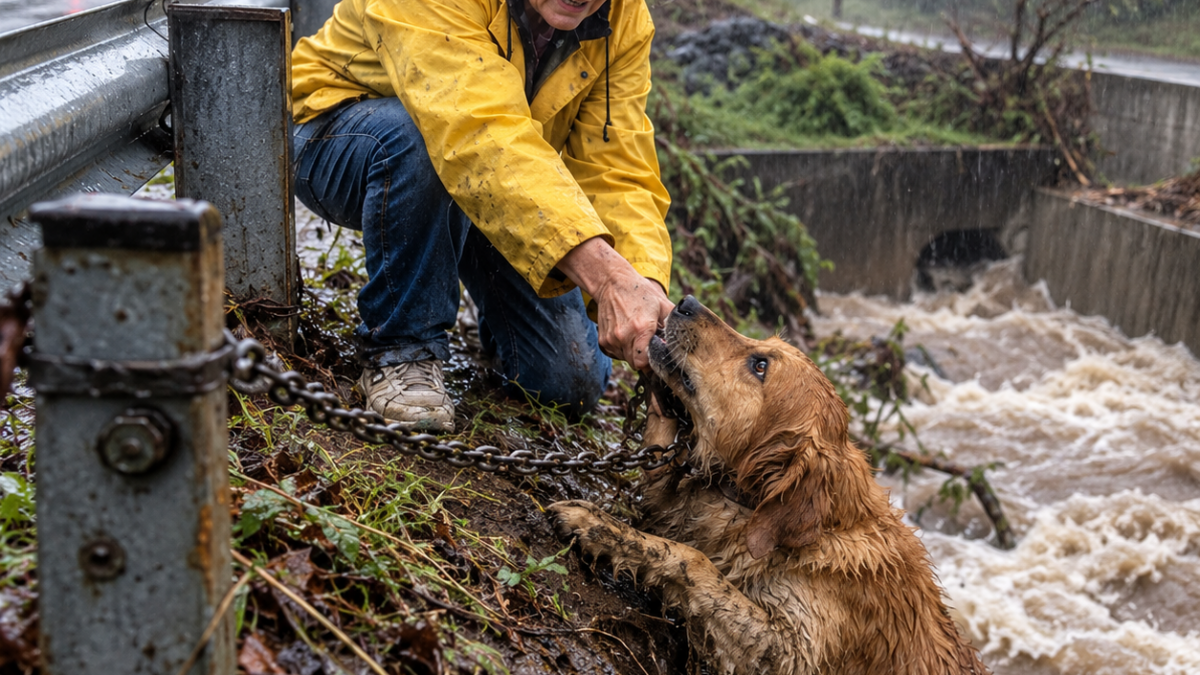
The chain remained on the ground beside us.
I looked at it.
Heavy.
Much heavier than anything you would use for an ordinary dog tie-out.
One end had been looped twice around the guardrail.
No broken clip.
No sign he’d escaped from somewhere and become accidentally tangled.
Somebody had attached him there.
My laughter disappeared.
I looked up and down the road.
No house nearby.
No parked vehicle.
No person running toward us shouting that their dog was missing.
Nothing.
Just stormwater.
Trees.
Road.
Chain.
“Who did this to you?”
The dog lowered his head against my chest.
That was answer enough for the moment.
I got him to his feet.
He limped slightly on one front leg.
Scrape, maybe.
Nothing obviously broken.
“Can you walk?”
He looked at me.
“Again, foolish question.”
I led him toward my car.
No leash.
So I held the collar.
He followed immediately.
When I opened the rear door, he hesitated.
I could feel him stiffen.
“It’s okay.”
He looked inside.
Then at me.
I didn’t pull.
Didn’t know enough about dogs to do much, but forcing a frightened animal into a car seemed like a terrible idea.
So I climbed into the back seat first.
“Yes, this is absurd.”
The dog stared.
“My groceries are getting soaked.”
Still staring.
“I am seventy years old and sitting backward in my own car because of you.”
His tail moved once.
Then he placed one paw inside.
Second paw.
Climbed in.
Immediately curled against my leg.
“Fine.”
I shut the door.
Then climbed out the other side because there was now no graceful way to leave.
The county shelter was twelve miles away.
I knew because Ray and I had donated blankets there once after a winter storm.
Ray had wanted a dog years earlier.
I said no.
Not because I disliked animals.
I had simply spent forty-six years being the practical one.
Dogs required schedules.
Vet bills.
Travel arrangements.
Hair.
Mud.
Noise.
Ray used to tease me.
“One day, Evie, you’re going to fall in love with something inconvenient.”
“I married you.”
He would grin.
“Exactly.”
I thought about that while driving.
The dog lay across the back seat.
I checked the mirror every few seconds.
He wasn’t shaking anymore.
Just watching me.
At one red light, I said:
“Do not get attached.”
His ears lifted.
“I mean me.”
The shelter was chaos because of the storm.
Two employees were moving crates away from a leaking wall.
Phones ringing.
A volunteer carrying towels.
I walked in dripping water.
“Excuse me.”
A young woman looked up.
Then saw the dog beside me.
“Oh.”
I explained quickly.
Road.
Guardrail.
Chain.
Floodwater.
Her expression changed.
“Bring him back.”
A shelter technician named Marisol dried him while another employee scanned for a microchip.
Nothing.
No tag.
No chip.
No tattoo.
The collar offered no information.
“He’s cold,” Marisol said.
“Is he okay?”
“Looks okay.”
That wasn’t enough.
“Looks?”
“We’ll have the vet examine him.”
The dog drank an entire bowl of water.
Then another half bowl.
He ate a small amount of food.
Marisol cleaned the scrapes on his paws.
One nail was torn.
His neck had a rubbed area where the collar had tightened during the slide.
Otherwise, astonishingly, he seemed healthy.
Thin, but not starving.
Maybe four years old.
Possibly five.
Lab mix.
Golden retriever somewhere in there.
Something hound-like in the face.
“Has he been outside long?” I asked.
“Hard to say.”
She touched his coat.
“Probably not months.”
That gave me a strange kind of relief.
“So somebody left him recently?”
“Maybe.”
The relief vanished.
I looked at the chain now sitting in a plastic evidence bag near the desk.
“Can they find who?”
Marisol shrugged.
“Animal control can investigate. The sheriff may want the location documented.”
“I took pictures.”
She looked surprised.
“Of the chain?”
“Yes.”
“Road?”
“Yes.”
“Guardrail?”
“Yes.”
Ray had taught me that.
He had spent thirty-one years doing insurance claims.
Whenever anything went wrong, his first response was:
Take pictures before somebody moves anything.
I had thought it annoying for most of our marriage.
Now I was grateful.
Marisol smiled.
“That’s useful.”
A shelter employee took my contact information.
I stood beside the dog until the veterinary exam finished.
Nothing serious.
Mild hypothermia.
Exhaustion.
Surface wounds.
No fractures.
“Lucky,” the vet said.
Lucky.
I looked at the floodwater still visible through the shelter windows.
Another ten minutes and luck might have meant something different.
Eventually, there was no practical reason for me to stay.
The dog had food.
Warmth.
Professionals.
I picked up my purse.
“All right.”
He watched.
I took one step toward the front desk.
The dog stopped drinking.
Second step.
He stood.
I turned.
“No.”
His ears lifted.
“I am going home.”
He walked toward the kennel door.
“You can’t do that.”
His tail tapped once against the floor.
“I’ve never owned a dog.”
Tap.
“I don’t know anything about dogs.”
Faster tapping.
Marisol leaned against the counter.
I looked at her.
“Don’t.”
“I didn’t say anything.”
“You’re thinking something.”
“I was thinking we have a temporary foster program.”
I laughed.
“No.”
“Okay.”
“Temporary?”
“Could be one night. A weekend. A week.”
I looked at the dog.
He stared at me.
“What happens if I don’t?”
“He stays here.”
“That sounds reasonable.”
“It is.”
“How crowded are you?”
Marisol looked around.
Very.
Storm rescues had filled half the building.
Another volunteer passed carrying a small terrier wrapped in a towel.
Marisol said:
“Pretty crowded.”
I closed my eyes.
Ray would have enjoyed this.
Not the dog being abandoned.
My predicament.
He would be smiling that smug little smile that meant he knew exactly what I was going to do before I did.
“Temporary,” I said.
Marisol nodded far too quickly.
“Temporary.”
“Do not look happy.”
“I can’t control my face.”
“You absolutely can.”
Half an hour later, I left the shelter with:
One wet dog.
One bag of food.
Two metal bowls.
A leash.
A borrowed crate.
A blanket.
Medication for the torn nail.
And a foster agreement.
The dog sat in the back seat.
I drove home.
At the first traffic light, I looked in the mirror.
“Temporary.”
Tail wag.
“I mean it.”
More wagging.
“This is emotional manipulation.”
No response.
When we reached my house, the rain had slowed.
I opened the back door.
The dog jumped out.
Then immediately turned toward me.
“Good.”
I carried the groceries inside.
The eggs were destroyed.
Ray would have said:
“Dog: one. Omelet: zero.”
I almost heard him.
That hurt.
Then the dog entered the kitchen and slipped on the tile.
His legs flew outward.
He recovered with such offended dignity that I laughed again.
Twice in one day.
That felt almost disrespectful.
Grief makes joy feel disloyal sometimes.
Nobody warns you.
You can spend months wishing you could feel normal.
Then the first time you do, guilt arrives.
Ray was dead.
Why was I laughing?
The dog shook water all over my cabinets.
I stared.
He stared back.
“Because apparently this is my life now.”
I found two old towels.
Dried him.
He tolerated it.
Then walked through the house.
Slowly.
Living room.
Dining room.
Hallway.
Bedroom.
He stopped at Ray’s office.
I hadn’t changed much in there.
His chair.
Books.
A sweater hanging behind the door.
The dog sniffed.
Walked inside.
Sat beside the desk.
I froze in the doorway.
“Not that room.”
The words came out sharper than I meant.
The dog lowered his head.
I immediately felt terrible.
“No.”
I stepped closer.
“That’s not your fault.”
He looked at me.
I hadn’t entered Ray’s office for more than a few seconds in months.
I cleaned around it.
Closed the door often.
But I rarely stayed.
Too much of him remained.
The dog walked toward Ray’s chair.
Sniffed the sweater.
Then lay down beside the desk.
My first instinct was to call him out.
Instead I stood there.
For some reason, seeing another living body in the room made it less unbearable.
“Fine.”
I sat in Ray’s chair.
The dog put his head on my shoe.
That was how our first evening began.
I had no name for him.
The shelter paperwork said:
**Temporary ID: Dog 1847**
Absolutely not.
I tried several.
Buddy.
No reaction.
Charlie.
Nothing.
Sam.
Yawn.
“Ray?”
The dog looked at me.
I burst into tears.
Not because I wanted to name him Ray.
Because saying my husband’s name to someone in the house and having a face look back was too much.
The dog stood.
Walked over.
Pressed his chest against my knees.
I held onto his neck.
“I miss him.”
He stayed.
No fixing.
No talking.
No telling me grief had stages.
Just weight.
Warmth.
Breathing.
Eventually, I wiped my face.
“You need a name that is not my dead husband.”
The dog licked my wrist.
I looked toward the rain outside.
The drainage channel.
The rushing water.
“River.”
His ears moved.
“River?”
Tail.
“That is terribly obvious.”
More tail.
“River it is.”
The first night was awful.
River refused the crate.
Completely.
I placed treats inside.
He took the treats.
Backed out.
I tried moving the crate into my bedroom.
Same result.
I sat beside it.
No.
Finally, I gave up and put the blanket on the floor beside my bed.
River lay down.
Five minutes later, he stood.
Paced.
Lay down.
Stood.
Went to the bedroom door.
Back to me.
I realized he was checking that I remained there.
I whispered:
“I’m not going anywhere.”
He lay down again.
Slept.
At 3:17 a.m., I woke because River was whining.
I turned on the lamp.
He stood by the door.
“Bathroom?”
He wagged.
Good enough.
I put on a coat over my pajamas and walked him into the backyard.
Rain had stopped.
Cold air.
Wet grass.
River sniffed everything.
Then looked at me as though this was the most exciting place in the world.
My backyard.
The one I hadn’t used since Ray died.
Ray gardened.
Tomatoes.
Peppers.
Herbs.
After he died, I let everything go.
Dead vines still hung from one trellis.
Weeds grew around the raised beds.
River walked to the old tomato patch.
Sniffed.
Sneezed.
I laughed quietly.
“That’s Ray’s mess.”
River looked at me.
“Mine now, I suppose.”
He did what he needed to do.
Then instead of returning inside immediately, he sat beside me.
The night was silent.
But different from the silence inside the house.
Outdoor silence had rain dripping from leaves.
Distant cars.
Frogs.
A dog breathing.
I realized I hadn’t stood in the yard at night since the funeral.
River nudged my hand.
“Fine.”
I scratched his head.
“You can stay until the shelter finds someone.”
That was our agreement.
One week.
Maybe two.
Nothing permanent.
The next morning, Melissa called.
“You fostered what?”
“A dog.”
“Mom.”
“Temporary.”
“You have never wanted a dog.”
“That’s not true.”
“It is completely true.”
“I have occasionally tolerated dogs.”
She laughed.
That sound made me smile.
“Send me a picture.”
I did.
Ten seconds later:
**Oh no.**
“What does that mean?”
“He looks like the kind you’ll keep.”
“I am not keeping him.”
“Okay.”
“You sound like your father.”
“That is the nicest thing you’ve said to me all year.”
I went quiet.
“So,” she said gently, “how are you?”
I looked at River sleeping under the kitchen table.
“Different.”
“Good different?”
“I don’t know yet.”
That was honest.
The first week became a series of adjustments.
River followed me everywhere.
Bathroom.
Kitchen.
Laundry room.
If I closed a door, he waited on the other side.
He hated being left alone.
The first time I went to the grocery store without him, I returned to find him sitting directly behind the front door.
Not destructive.
Not barking.
Waiting.
That bothered me.
I spoke with the shelter’s behavior volunteer, a woman named Denise.
“He may have separation anxiety.”
“Can I fix it?”
“Don’t think in terms of fix.”
I hated answers like that.
“What should I do?”
“Teach him departures aren’t abandonment.”
“How?”
“Very small absences.”
Keys.
Door.
Thirty seconds.
Return.
Then one minute.
Five.
Ten.
No dramatic goodbye.
No dramatic reunion.
Predictability.
I followed instructions.
River learned.
So did I.
The strange thing was that the training worked on both of us.
Before River, leaving the house required no emotional thought.
Coming home felt empty.
After River, there was someone waiting.
At first that frightened me.
What if I became dependent?
What if I lost him too?
People don’t understand how grief can make attachment feel dangerous.
When you’ve lost the person you thought would always be there, love stops feeling safe.
Love becomes evidence of future pain.
River had no interest in my philosophy.
He wanted breakfast.
Walks.
A tennis ball Melissa brought over.
Cheese.
Especially cheese.
Ray had loved cheese too.
One morning, I dropped a piece.
River caught it before it hit the floor.
“Excellent.”
Tail wag.
“You and Ray would’ve formed a criminal organization.”
River sneezed.
The house began changing.
Leash by the door.
Dog bed in the living room.
Then one in my bedroom.
Water bowl in the kitchen.
Hair on the couch despite clear rules against couch hair.
River ignored rules selectively.
I started waking earlier.
Walking every morning.
At first, just one block.
My knees protested.
River didn’t.
He wanted more.
Two blocks.
Then three.
Soon we were walking to the small park where Ray and I used to sit.
The first time, I almost turned around.
The bench was still there.
Of course.
Ray had once carved a tiny “R + E” beneath the seat when we were sixty-two and apparently twelve years old emotionally.
I had forgotten.
River pulled toward the bench.
I sat.
He placed his chin on my knee.
I ran my fingers over the old carving.
“Your timing is terrible.”
River sighed.
I cried.
Then we walked home.
Grief didn’t disappear.
It started moving.
That was different.
Two weeks after River came home, animal control called.
They had found something.
A traffic camera approximately half a mile from where I found him had captured a pickup truck pulling onto the shoulder during the storm.
The vehicle remained there about four minutes.
Then left.
The image showed a person at the guardrail.
A dog-shaped figure.
Not perfect evidence.
But enough to follow.
The license plate was partially visible.
County investigators identified the truck.
Registered to a man named Dean Walsh.
I didn’t know him.
Animal control did.
One prior citation for inadequate shelter for two dogs three years earlier.
No criminal conviction.
They asked whether I could identify River’s chain.
“Yes.”
They’d preserved it.
Heavy hardware-store chain.
A clip at one end.
The man initially denied ever owning River.
Then investigators found veterinary records.
Same dog.
Same markings.
Different name.
**Buster.**
I stared at the report.
“Buster?”
The animal control officer nodded.
“Looks like it.”
I looked at River.
He was lying under my chair.
“Buster.”
One ear moved.
That hurt.
He remembered.
Not enough to run.
Enough to recognize.
“What happened?”
The officer said Dean claimed he had “given the dog away” several days before the storm.
“To who?”
“He couldn’t provide a full name.”
“How convenient.”
“We’re still investigating.”
I thought about River sliding toward the flood channel.
Collar choking him.
Mud breaking beneath his paws.
“What does he say about the guardrail?”
“Claims someone else must’ve done it.”
I laughed once.
No humor.
“Of course.”
The officer looked at me.
“We may need your statement.”
“You’ll have it.”
For the first time since Ray died, I felt something hot enough to cut through sadness.
Anger.
Clear.
Useful.
I wanted Dean punished.
That frightened me a little.
I’m not an angry person.
Ray could get angry quickly and recover quickly.
I took longer to reach it.
Longer to leave.
That night I sat in the living room staring at River.
He slept.
I imagined somebody driving away while he stood chained beside a road during a flood warning.
Did he watch the truck disappear?
Did he pull?
Bark?
Wait?
How long until the ground began slipping?
I could feel myself building a story.
A cruel story.
Denise had warned me:
“Don’t invent details you don’t know.”
She was right.
Facts were bad enough.
River had been chained there.
The truck was there.
Dean’s story had holes.
Investigation would determine what could be proven.
But grief and anger share one dangerous habit.
They both fill blanks.
I went into Ray’s office.
Sat in his chair.
River followed.
I said:
“I want to hate somebody.”
River lay near the desk.
“I hate that.”
Ray would have said:
Then don’t waste hate. Use it.
He believed anger should have a job.
So I gave mine one.
I documented everything.
River’s scars.
Behavior.
Vet visits.
Fear around chains.
The way he froze the first time I accidentally dropped his leash near a metal fence.
I didn’t exaggerate.
Didn’t need to.
Weeks passed.
Temporary fostering became less temporary.
The shelter called twice with potential adopters.
The first was a young couple with another dog.
Good home.
Fenced yard.
Responsible.
I agreed to a meeting.
Then spent the entire morning sick to my stomach.
Melissa came over.
“You don’t have to do this.”
“He needs a permanent home.”
“He has one.”
“No.”
“Mom.”
“I said temporary.”
She looked around.
River’s bed.
Toys.
Food bins.
Leash.
A framed photograph of him with Ray’s old garden hat hanging crookedly over his ears.
“You’ve spent two hundred dollars on orthopedic bedding for a four-year-old dog.”
“He likes comfort.”
“You bought him a raincoat.”
“He has trauma involving rain.”
“You embroidered his name on it.”
“That was included.”
She sat across from me.
“Why are you fighting this?”
I knew.
Because if River was mine, I could lose him.
Temporary things are supposed to hurt less when they leave.
Except they don’t.
Sometimes calling love temporary just lets you pretend you’re protected.
Melissa’s voice softened.
“Dad dying wasn’t punishment for loving him.”
My eyes filled.
“I know.”
“Do you?”
I couldn’t answer.
River walked over.
Placed his head on my lap.
Melissa smiled sadly.
“He already picked you.”
I looked down.
“I am seventy.”
“And?”
“What if something happens to me?”
“Then we plan.”
“What if I can’t care for him in five years?”
“Then we plan.”
“What if—”
“Mom.”
She took my hand.
“You can’t make every future problem happen today.”
Ray used to say something almost identical.
I laughed through tears.
“Both of you are irritating.”
“Genetics.”
I canceled the adoption meeting.
Then called the shelter.
“I think I need different paperwork.”
Marisol laughed.
“I wondered how long.”
“Do not become smug.”
“Never.”
River became legally mine three days later.
His old registered name remained Buster in the investigation records.
I kept River.
Names can be reclaimed too.
The adoption certificate said:
**RIVER CARTER**
I stared at it longer than necessary.
Then placed it in Ray’s old desk drawer with important family papers.
That felt right.
The legal case against Dean moved slowly.
He changed his story.
First River had been given away.
Then River had run away and he assumed somebody else found him.
Then he claimed the truck had been driven by his brother.
Traffic footage placed Dean’s phone near the road.
A gas station camera captured him with River in the truck earlier that afternoon.
A receipt showed he purchased chain and a clip that morning.
Investigators found another detail.
His landlord had recently warned him he could no longer keep an unregistered dog on the property.
River wasn’t licensed.
Dean had apparently been trying to “get rid of him.”
Those words came from a text message to a friend.
**Need to get rid of Buster before inspection.**
When I heard that, I had to sit down.
Get rid of.
As if River were broken furniture.
Later messages showed the friend offered to take him temporarily.
Dean never replied.
That was the part that made me furious.
There had been another option.
Maybe imperfect.
But an option.
Instead, guardrail.
Chain.
Storm.
The prosecutor charged him with animal abandonment and cruelty-related offenses under applicable state law.
Not attempted murder.
Not the dramatic charges strangers online later demanded.
Law works with statutes and proof.
Still, charges meant something.
Dean requested River back at one point.
That shocked me.
“He wants what?”
The shelter representative explained that his attorney argued ownership had never legally transferred before the seizure.
My entire body went cold.
“No.”
“They’re not handing River over.”
“Good.”
“The court will decide final forfeiture.”
I looked at River.
He was asleep on my couch.
His couch now.
“No.”
I said it again even though nobody was arguing.
I had lost Ray because nobody could stop death.
I was not losing River because paperwork moved slowly.
Melissa found me pacing.
“Mom.”
“He’s not going back.”
“He won’t.”
“You don’t know that.”
“I do.”
“How?”
“Because every official involved has documented what happened.”
I looked at her.
“People fail.”
“Yes.”
“Systems fail.”
“Yes.”
“Then stop telling me not to worry.”
She came closer.
“I’m not telling you not to worry.”
Her voice softened.
“I’m telling you not to let fear steal the dog while he’s still sitting ten feet away.”
River chose that moment to roll onto his back.
All four paws in the air.
Melissa pointed.
“Exhibit A.”
I laughed.
She was right.
Again.
So I focused on River.
Not Dean.
Not court.
River.
His fear of rain improved slowly.
At first, heavy storms sent him beneath the dining table.
He panted.
Paced.
Pressed against my legs.
I sat on the floor.
Didn’t tell him he was silly.
Didn’t force him out.
We listened together.
The first time he walked outside voluntarily during light rain, I almost applauded.
Didn’t.
Denise said:
“Let brave choices remain ordinary.”
So I opened the door.
River stepped onto the porch.
Sniffed.
Urinated.
Came back inside.
Ordinary.
Inside, I cried quietly into a dish towel.
Progress makes fools of us.
His separation anxiety improved too.
Thirty minutes alone.
Then one hour.
Two.
He learned I returned.
I learned the same thing in a different way.
Going out became easier.
The food pantry asked again.
This time I said yes.
First one morning a week.
Then two.
River stayed home.
When I returned, he greeted me like I’d crossed an ocean.
I began talking to people again.
Not because grief ended.
Because River forced movement.
Walks created neighbors.
The pet store clerk knew his name.
A little boy down the street called him “Mr. River.”
An older widower named Frank began walking with us twice a week.
His wife had died three years before Ray.
At first we talked about dogs.
Then spouses.
Then everything.
The world expanded.
Exactly what grief had been resisting.
Months after the rescue, court day arrived.
I hated that I was nervous.
I was a witness, not the accused.
Still, walking into the courthouse made everything real again.
I saw Dean in the hallway.
First time in person.
He looked ordinary.
That unsettled me.
I wanted someone who looked like cruelty.
A villain.
Instead:
Jeans.
Gray jacket.
Receding hairline.
Phone in his hand.
He could have been anybody buying coffee.
Our eyes met.
He looked away first.
Good.
I testified about the road.
Rain.
Chain.
River sliding.
The collar tightening.
Pulling him up.
The rescue.
My photographs.
The defense attorney asked:
“You cannot testify that my client personally attached the chain, correct?”
“No.”
“You did not witness him there.”
“No.”
“You don’t know who left the dog.”
“I know what I found.”
He asked whether River could have tangled himself.
I answered:
“The chain was looped around the guardrail twice and clipped back onto itself.”
“Could an animal create that arrangement?”
“I suppose anything is theoretically possible.”
The attorney smiled slightly.
I continued:
“But I have never met a dog who can operate a locking metal clip.”
The judge looked down, possibly hiding a reaction.
The prosecutor later presented:
Traffic footage.
Gas station video.
Phone-location data.
Hardware receipt.
Veterinary records.
Text messages.
Dean’s contradictory statements.
His defense shifted.
He had left River temporarily.
Intended to come back.
Storm worsened unexpectedly.
That argument nearly broke my restraint.
Temporarily?
During a flood warning?
Chained to a guardrail?
No shelter?
No water?
But anger doesn’t testify well.
Facts do.
The prosecutor asked Dean:
“If you intended to return, why did you tell animal control you had given the dog away?”
He didn’t have a good answer.
The court convicted him.
The sentence included fines, probation, restitution for veterinary and shelter expenses, and a prohibition on owning animals for several years.
River’s forfeiture became permanent.
Dean could never reclaim him.
People later asked if the punishment was enough.
I didn’t know.
Nothing felt equal to the image of River sliding toward floodwater.
But equality wasn’t the goal.
River was safe.
Dean lost legal control over him.
The case became part of his record.
Future animals had protection because authorities now knew his history.
Useful.
That became my standard.
After sentencing, Dean passed near me outside the courtroom.
He stopped.
For one second, I wondered if he was going to apologize.
He didn’t.
He said:
“He always hated storms.”
I stared at him.
That sentence made me angrier than everything else.
Because it meant he knew.
I could have said many things.
Cruel things.
True things.
I thought about Ray.
Anger should have a job.
So I gave mine one final job.
I said:
“He doesn’t anymore.”
Then I walked away.
That was all.
No screaming.
No revenge speech.
No satisfaction on Dean’s face.
I went home.
River met me at the door carrying one of Ray’s old slippers.
I had no idea where he found it.
I had packed most of Ray’s shoes months earlier.
But River had discovered one under the guest-room bed.
He stood proudly.
Slipper in mouth.
I stared.
“Really?”
Tail wag.
“That belonged to Ray.”
River lowered his head slightly.
I almost took it.
Then stopped.
“Fine.”
He carried it to his bed.
That slipper became one of his favorite possessions.
He never chewed it.
Just carried it.
Sometimes slept with his chin across it.
Melissa saw.
Immediately cried.
“Mom.”
“I know.”
“Are you okay with that?”
I looked at River.
“Yes.”
And I was.
Months earlier, Ray’s belongings had felt like museum pieces.
Untouchable.
Every object had to remain exactly where grief placed it.
River changed that.
A slipper became a dog pillow.
Ray’s old baseball cap became Halloween costume material.
His garden became alive again because River kept digging where the tomatoes used to grow.
At first I yelled.
“Stop!”
River froze.
Dirt on nose.
Then I saw a tiny tomato seedling growing near the fence.
Volunteer plant.
One of Ray’s old varieties.
I sat down in the grass and laughed until I cried.
The next spring, I replanted the garden.
Frank helped.
Melissa brought seedlings.
River supervised.
Badly.
He dug one pepper plant twice.
We built a small barrier.
Ray’s empty garden became a garden again.
That mattered.
Life after loss isn’t replacing what was there.
It’s letting the same space become useful again.
River and I learned that together.
Our first Gotcha Day came during another rainy week.
I didn’t plan a party.
Melissa did.
She arrived with a dog-safe cake shaped like a bone.
Frank brought treats.
Marisol from the shelter came.
Denise too.
River wore a blue bandana.
He hated it.
We took one photograph.
Then removed it.
The rain started during dinner.
Heavy.
River stopped eating.
I saw the old tension return.
Ears back.
Eyes toward the window.
I sat on the floor.
Everyone became quiet.
River walked toward me.
Then past me.
Toward the back door.
I stared.
He waited.
“You want out?”
Tail.
I opened the door.
Rain hammered the porch roof.
River stepped outside.
One paw.
Then another.
He stood under the porch.
Watched the yard.
Lightning flashed far away.
He didn’t run inside.
Instead, he walked onto the wet grass.
Melissa covered her mouth.
I whispered:
“Nobody make a big deal.”
River sniffed the garden.
Walked to Ray’s tomato bed.
Lifted his leg on the fence.
Frank whispered:
“Very dignified.”
I laughed.
River returned.
Shook rain all over everyone.
Marisol screamed.
Perfect.
That night, after everybody left, River slept beside me on the couch.
Rain continued.
He didn’t hide.
I ran my hand over his back.
“One year.”
He sighed.
“You know what today is?”
Nothing.
“I saved your life.”
River snored.
“Humility is important.”
The truth was more complicated.
I had pulled him up a muddy hill.
Yes.
But River had pulled me somewhere too.
Not out of grief.
You don’t get pulled out of grief.
Grief becomes part of the landscape.
He pulled me out of stillness.
That was different.
Before him, every day was organized around not feeling too much.
River demanded things.
Breakfast.
Walk.
Door.
Vet.
Toy.
Outside.
Inside.
Cheese.
Again.
Life became inconvenient.
Ray had been right.
One day I did fall in love with something inconvenient.
The second year, River became certified as a therapy dog.
That happened accidentally.
At the food pantry, people loved him whenever I brought him after hours.
One volunteer suggested testing.
I laughed.
“River?”
He was licking spilled peanut butter off a cardboard box.
“Yes.”
“He’s not exactly dignified.”
“That isn’t a requirement.”
We trained.
Basic commands.
Crowds.
Wheelchairs.
Dropped objects.
Unusual noises.
River was excellent.
Not flashy.
Calm.
His greatest skill was leaning.
He would approach someone sitting down and gently press his side against their legs.
Not demanding.
Just present.
The same thing he had done to me.
His first regular visits were at a senior community.
That almost felt too neat.
But life sometimes circles themes without asking permission.
Many residents had lost spouses.
Homes.
Independence.
Pets.
One woman named Joyce barely spoke during our first visit.
River sat beside her.
She touched his ear.
Then whispered:
“I had a dog once.”
I sat.
“What kind?”
“Beagle.”
That became twenty minutes.
Dog.
Marriage.
Children.
Farm.
Life.
River rested his head on her knee.
Afterward, a nurse said Joyce had spoken more to us than she had all morning.
I drove home thinking about Ray.
He would have adored therapy visits.
He would have talked to every resident until staff removed him.
For the first time, thinking that made me smile before it hurt.
Progress.
Not absence of pain.
Change in order.
Joy first.
Pain second.
Some days.
The third year brought a scare.
River collapsed during a walk.
Not dramatic.
His back legs simply went weak.
I knelt immediately.
“River.”
He looked alert.
Tried to stand.
Couldn’t.
Frank called the vet.
We carried him into my car using a blanket.
I shook the entire drive.
At the clinic, tests showed a spinal issue likely manageable with rest, medication, and physical therapy.
Not fatal.
Not permanent paralysis.
Still, for two days, River needed help walking.
I used a support sling.
The irony didn’t escape me.
The first day I met him, I’d pulled him uphill.
Now I was helping him stand again.
I hated how scared I felt.
Not just for River.
For myself.
Because suddenly I understood what attachment had cost.
Melissa sat with me at the clinic.
“I knew this would happen.”
She looked at me.
“What?”
“This.”
“What?”
“Loving him enough that I can lose him.”
She took my hand.
“Mom.”
“I was right to be afraid.”
“No.”
“How can you say that?”
“Because fear isn’t proof something was a mistake.”
I looked at River through the treatment-room window.
She continued:
“You would’ve had three empty years instead.”
That landed.
Three years.
Walks.
Garden.
Food pantry.
Frank.
Therapy visits.
Rain.
Laughter.
Slippers.
All absent if I’d protected myself.
I nodded.
River recovered.
Slowly.
No more long runs.
Shorter walks.
Weight management.
Physical therapy.
He hated the underwater treadmill.
Absolutely.
He planted all four paws at the entrance and refused.
The technician bribed him with turkey.
Instant mobility.
Traitor.
Within months he was walking normally again.
Not perfectly.
Enough.
We adjusted.
That became our pattern.
Problem.
Adapt.
Continue.
Life doesn’t promise the same version forever.
It only asks whether you can work with the version you have.
By the fourth year, I was seventy-four.
River had gray around his muzzle.
Frank joked we were aging competitively.
Melissa worried about me less.
Or maybe differently.
I returned to the community center regularly.
Led one pantry shift a month.
Had coffee with friends.
Went to Melissa’s house every Sunday.
River came unless weather was too hot.
I even traveled once.
Three nights away.
River stayed with Melissa.
I almost canceled.
“Mom.”
“I don’t think he likes your house.”
“He sleeps on my bed.”
“He doesn’t sleep on beds.”
She sent me a photograph.
River upside down across her comforter.
Betrayal.
I traveled.
Returned.
River greeted me.
I survived.
So did he.
Dependence became relationship instead of fear.
That’s healthier.
The fifth Gotcha Day was quiet.
Just me.
River.
One piece of steak.
One candle I did not let him near.
I sat on the porch.
Rain threatened but never came.
River rested beside me.
I thought about the roadside.
Chain.
Mud.
Floodwater.
Then looked at his body now.
Older.
Safe.
He wore a soft collar with his name and my number.
No heavy chain.
He still disliked metal rattling behind him.
Some memories stay in the nervous system.
But he recovered quickly.
Look.
Recognize.
Move on.
I wished humans could do that as efficiently.
That year, the shelter invited us to speak at an event about senior fostering and grief companionship.
I refused the speech part.
Agreed to sit at a table.
People asked about River’s story.
One woman said:
“You saved him.”
I answered automatically:
“He gave me plenty back.”
She smiled.
“No, really. You saved his life.”
I looked at River.
Then said:
“Maybe we should stop acting like saving only goes one direction.”
That became the line Marisol used later in a shelter newsletter.
I didn’t mind.
Because it was true.
River didn’t cure widowhood.
Didn’t replace Ray.
Didn’t fill a husband-shaped hole.
That kind of language is wrong.
Love does not fill holes left by other love.
It grows beside them.
River gave me structure.
Touch.
Responsibility.
Reasons to leave the house.
Reasons to return.
He made silence less absolute.
That’s different.
Enough.
Years passed.
River became unmistakably senior.
Arthritis.
Hearing loss.
Longer naps.
Shorter walks.
He retired from therapy visits when crowds became tiring.
His last visit was with Joyce.
She was ninety-three.
River moved slowly into her room.
Joyce smiled.
“My boy.”
He went to her.
Placed his head on her knee.
She stroked his gray ears.
“You got old.”
I said:
“So did you.”
She pointed at me.
“You’re not young either.”
Fair.
River stayed twenty minutes.
Then stood.
Walked to the door.
His way of saying done.
Choice.
We left.
Joyce died two months later.
Her nurse called to tell me.
I cried.
Then took River to the park.
That’s what grief teaches you eventually.
Movement.
Not escape.
Movement.
Ray.
Joyce.
Others.
Love creates names you carry.
River’s health began declining more seriously around age eleven or twelve.
Exact age uncertain.
Kidney values changed.
Heart murmur.
Arthritis worsened.
We managed.
Medication.
Diet.
Ramps.
More rugs.
I bought a low platform bed.
River ignored it.
Preferred Ray’s old slipper beside his regular bed.
The slipper was almost disintegrating.
I should have thrown it away.
Didn’t.
Some things earn retirement from practicality.
One evening, Melissa came over and found me sitting on the floor beside River.
“Bad day?”
“He didn’t finish dinner.”
River had never voluntarily left chicken.
That scared me.
The vet adjusted medication.
He improved.
Then declined again.
The pattern became clearer.
Good days.
Mixed days.
Hard days.
I tracked them because the vet recommended it.
Not to obsess.
To be honest.
Quality of life becomes harder to judge when love is doing the judging.
One morning, River stood at the back door but couldn’t manage the step down.
I used the ramp.
He walked into Ray’s garden.
Slow.
Stopped near the tomatoes.
There were tomatoes again every summer now.
I knelt beside him.
“Remember when you destroyed these?”
River sniffed.
“Criminal.”
Tail moved once.
He lay in the grass.
I sat beside him.
At seventy, I’d believed my life was narrowing.
Now I was nearing eighty.
Funny.
River had added years I hadn’t counted.
Not lifespan.
Life inside the years.
That’s different.
The final decline came in autumn.
He stopped wanting walks.
Then stopped eating breakfast consistently.
His breathing changed.
The vet found heart failure progressing.
Medication helped briefly.
Then less.
I knew.
Didn’t want to.
Knew.
Melissa came every day.
Frank too.
Marisol had moved to another shelter but visited once.
River recognized her.
Tail thump.
She cried.
“You look good, old man.”
He did not look good.
Love allows lies at the end.
The vet told me:
“You’re close.”
“How close?”
“Days or weeks.”
“Is he suffering?”
“Not constantly.”
“What should I watch?”
She listed things.
Breathing.
Restlessness.
Refusing food.
Unable to stand.
No interest.
More bad than good.
I asked:
“How will I know?”
She said:
“You’ll keep wanting one more day.”
I nodded.
“And eventually you’ll realize you’re asking him to carry that day for you.”
That was the sentence.
Carry that day for you.
I went home.
River slept.
I sat in Ray’s chair.
The same chair River had first rested beside.
I said aloud:
“I don’t want to do this.”
No answer.
Of course.
Then I imagined Ray.
He would’ve said:
You pulled him up once. Don’t make him pull you now.
Maybe that was unfair.
Maybe grief invents advice from the dead because we need permission.
Still.
It helped.
River’s final good day came after three difficult ones.
He ate scrambled eggs.
Walked into the backyard.
Lay near the tomato bed.
Sunlight.
Cool air.
Melissa came.
Frank.
No party.
No crowd.
Just people River knew.
I gave him cheese.
Probably too much.
Rules become flexible near endings.
He carried Ray’s old slipper from the living room into the yard.
That surprised me.
He hadn’t carried it in months.
He placed it beside himself.
Then rested his chin across it.
Melissa covered her mouth.
I said:
“Don’t.”
She laughed and cried.
“I’m not doing anything.”
We stayed outside until River wanted in.
That evening, he struggled to settle.
Breathing faster.
Changing position.
Looking at me.
At midnight, I knew.
Not tomorrow.
Today.
The vet came in the morning.
Home visit.
River was on his bed in Ray’s office.
He had chosen that room more often during his final weeks.
I didn’t stop him.
The room no longer hurt the same way.
Photographs remained.
Books.
Ray’s chair.
And now River’s bed.
Layers.
Life over grief.
The vet examined him.
Then looked at me.
I nodded before she spoke.
Melissa sat beside me.
River’s head rested in my lap.
The first medication made him sleepy.
His body relaxed.
I stroked his face.
“You remember the rain?”
His eyes half closed.
“I told you I had you.”
My voice broke.
“That part was true.”
Melissa put one hand on my back.
River sighed.
I thought about the muddy road.
His collar pulled tight.
Both of us slipping.
His body landing beside mine.
The lick on my cheek.
That first laugh.
I whispered:
“You don’t have to hold on now.”
The vet gave the final medication.
River took one more breath.
Then another.
Then stopped.
No storm.
No flood.
No chain.
No panic.
Just a quiet room.
My hand on his head.
Ray’s books around us.
His slipper beneath River’s paw.
I cried differently than I had when Ray died.
Not less.
Different.
With Ray, grief felt like being pushed out of a life I thought would continue.
With River, grief felt like completing a promise.
I had found him trying not to drown.
Years later, I was there when he no longer had to fight for another breath.
Both were love.
Just opposite directions.
We buried the slipper with him.
Melissa asked if I was sure.
“Yes.”
Ray would’ve approved.
Two old friends leaving together in some symbolic sense.
River’s ashes came home later.
I placed them in the garden room overlooking the tomatoes.
Not Ray’s office.
River deserved his own place too.
The shelter held a small memorial fundraiser months later.
They created an emergency foster program for pets found during storms.
They named part of it the **River Safe Harbor Fund**.
I resisted.
Then allowed it.
The first grant paid temporary boarding for three dogs evacuated during a flash flood.
That felt right.
No dramatic monument.
Practical help.
Useful anger becoming useful love.
Dean’s ownership ban eventually expired years later.
I learned this because animal control called after he applied for a pet license.
The prior cruelty record triggered review.
They inspected his property.
He did not receive approval immediately.
Extra monitoring was required.
Someone asked whether that felt like revenge.
No.
Revenge would’ve required me to keep Dean central.
I didn’t.
By then, he had become almost irrelevant to River’s story.
That was better.
The man who once decided where River could stand no longer determined a single thing about his life.
River slept where he wanted.
Ate what was safe.
Walked where he wanted.
Loved who he wanted.
Aged.
Died at home.
Dean became paperwork.
River became family.
That’s justice I can live with.
After River died, I worried the old silence would return.
It did.
For a while.
The leash stayed by the door for three weeks.
I couldn’t move it.
Dog bowl stayed in the kitchen.
Hair remained under the couch.
I found one tennis ball beneath Ray’s desk.
I sat on the floor holding it.
Cried.
Then laughed.
Grief, again.
Familiar.
But I was no longer the woman from six years earlier.
My life was bigger now.
Melissa.
Frank.
Food pantry.
Shelter volunteers.
Neighbors.
Community center.
People River had led me toward.
He was gone.
The roads he opened remained.
That might be the greatest gift relationships leave us.
Not replacement.
Infrastructure.
Paths.
Habits.
People.
Courage.
I kept walking every morning.
Alone at first.
Then Frank joined.
One rainy day, I almost stayed home.
Then I put on the yellow raincoat.
Same one.
Older.
Stained faintly near one knee despite years of washing.
I walked past the county road where I found River.
The guardrail had been replaced after another storm.
Nothing about the place looked important.
Cars passed.
Water moved quietly through the channel.
I stopped.
Not long.
I didn’t need to reenact anything.
I just stood.
Then said:
“Good decision, Evie.”
Ray used to call me Evie.
I smiled.
Kept walking.
A year after River died, I returned to the shelter.
Donation.
Blankets.
Nothing else.
Marisol no longer worked there.
New staff.
New animals.
I walked through the kennel area.
Bad idea.
Too emotional.
Then I saw an old dog.
Gray muzzle.
Small terrier mix.
Sleeping.
A card read:
**Age: 13**
**Owner deceased**
I stared.
No.
Absolutely not.
I knew where stories like this went.
A volunteer approached.
“Her name is Daisy.”
“I am not adopting a dog.”
The volunteer nodded.
“I didn’t ask.”
“I am eighty.”
“Okay.”
“I travel to my daughter’s.”
“Sounds nice.”
“I have arthritis.”
“So does Daisy.”
I looked at the dog.
Daisy opened one eye.
Then went back to sleep.
No dramatic connection.
No flood.
No chain.
No fate.
Just an old dog.
I laughed.
“Temporary foster?”
The volunteer smiled.
“Could be.”
I pointed.
“Do not manipulate me.”
“Wouldn’t dream of it.”
Daisy came home that afternoon.
Temporary.
Of course.
Melissa called.
“Mom.”
“Don’t.”
“I haven’t said anything.”
“You’re thinking like your father.”
“Probably.”
Daisy slept eighteen hours.
Ignored toys.
Loved blankets.
No trauma story.
No crisis.
Just old age.
I fostered her for six months.
Then adopted her.
She lived another two years.
Quietly.
Beautifully.
When she died, it hurt.
Of course.
And I survived.
That’s what River ultimately taught me.
Not that love prevents loneliness.
Not that rescuing someone rescues you.
Those statements are too neat.
He taught me that pain is not evidence we should stop loving.
Loss is not proof attachment was a mistake.
At seventy, I thought protecting myself meant keeping life small enough that nothing else could hurt me badly.
River ruined that plan.
He made life larger.
Larger lives hurt more.
They also contain more.
More mud.
More bills.
More worry.
More laughter.
More people.
More memory.
More love.
When people hear the story now, they focus on the roadside.
The seventy-year-old widow.
The flood.
The chain.
The dramatic rescue.
I understand.
That’s the cinematic part.
But it isn’t the part I treasure most.
My favorite memory happened years later.
No storm.
No danger.
I was sitting on the back porch reading.
Ray’s tomatoes growing behind the fence.
River asleep in the grass.
He wasn’t touching me.
Didn’t need reassurance.
Didn’t need rescue.
Just sleeping in sunlight.
A delivery truck passed.
He opened one eye.
Decided civilization could survive without his intervention.
Closed it again.
I looked at him and thought:
You trust this place.
That was the victory.
The dog who had been chained beside floodwater had reached a point where he could sleep outside without worrying whether the world would turn against him while his eyes were closed.
And the woman who once believed the rest of her life would be breakfast, laundry, television, bed—
she was sitting on a porch surrounded by people, memories, work, garden, responsibility, and love.
We were both wrong about our futures.
I’m glad.
Sometimes life changes with enormous decisions.
Marriage.
Children.
Moving.
Careers.
Sometimes it changes because you see something beside a road and decide not to keep driving.
One brake pedal.
One open car door.
One old shoulder pulling harder than it should.
One wet dog crawling into your lap.
That’s all.
People called me brave afterward when the story circulated locally.
I wasn’t.
I was scared.
My knees hurt.
I nearly lost my footing.
I didn’t know what I was doing.
Courage doesn’t always feel impressive from inside it.
Sometimes it sounds like:
Hold on, buddy.
Sometimes it is just refusing to leave while another living thing is slipping away.
River and I did that for each other at different times.
I pulled him away from the flood.
He pulled me back toward people.
Toward mornings.
Toward gardens.
Toward laughter.
Toward the possibility that grief could coexist with another beginning.
Not erase Ray.
Never.
Ray remained forty-six years of my life.
River became another chapter beside that one.
That is the thing I wish I had understood earlier.
Love is not a room with limited chairs.
You don’t dishonor the dead by letting the living sit down.
Ray would’ve understood.
Probably before I did.
If he had been in the car that rainy afternoon, he would have stopped before I saw River.
He always noticed things first.
Then he would have said:
“Evie, we’re keeping him.”
I would’ve objected.
He would’ve smiled.
And eventually, as usual, he would’ve been right.
Maybe that is why River found Ray’s office on his first night.
Not destiny.
Not ghosts.
Just a dog following a scent.
Still, I like the image.
The dog I wasn’t going to keep sleeping beside the chair of the man who would’ve wanted him.
Two inconveniences I loved.
One gone.
One arriving.
Life doesn’t ask permission before changing shape.
Sometimes that is cruelty.
Sometimes grace.
The only thing we control is whether we keep the door closed afterward.
Mine was open that day.
Literally.
I left the car door wide open in the rain.
Groceries soaked.
Eggs broken.
My shoulder hurt for a week.
Best mistake I ever made.
River came home.
Then, slowly, so did I.