PART 2: At 82, I w My Old Dog Into the Snow Because I Thought He Was a Stranger—Then I Found My Dead Wife’s Notebook
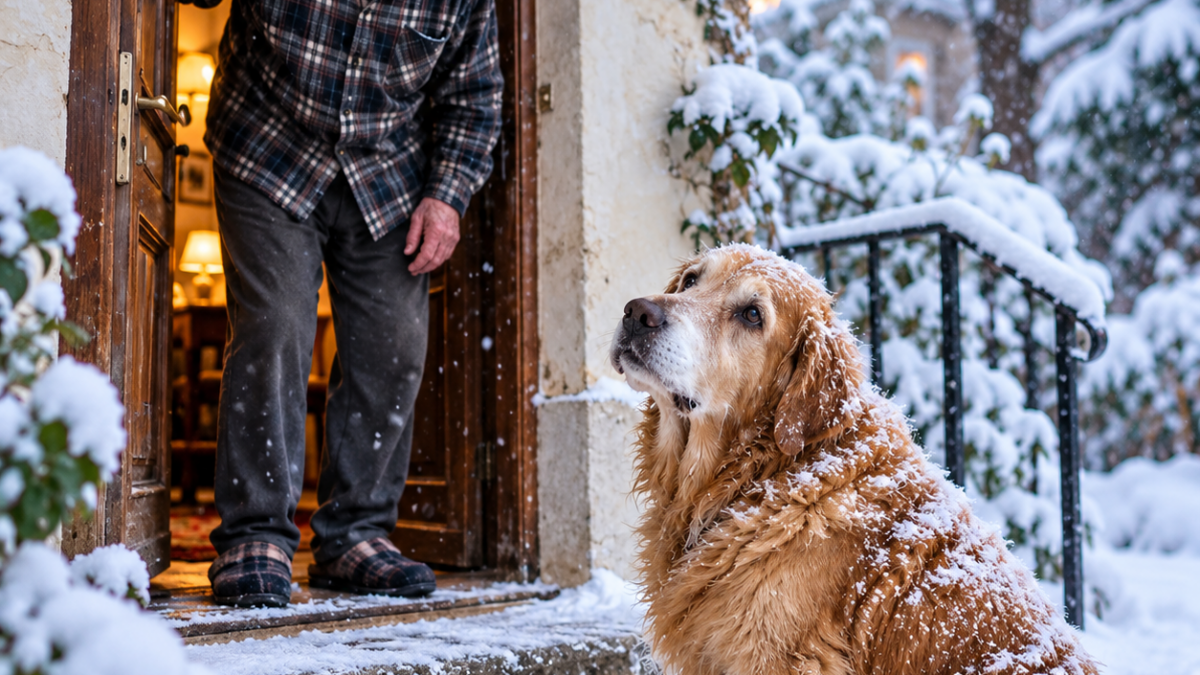
The old dog looked at me as if I had just broken a promise I couldn’t remember making.
I shoved him out into the snow because I was certain he didn’t belong in my house—and five minutes later, I found a notebook written in my wife’s handwriting telling me exactly who he was.
But the worst thing written inside that notebook wasn’t that my memory was failing me.
My name is Marcel Delorme.
At least, that is what the notebook says.
That afternoon, I believed I was forty-five years old.
I believed it was 1998.
And I believed my wife, Jeanne, would be home any minute with groceries for Tuesday dinner.
So when I saw a large, old golden dog following me through the house, I became angry.
“Out.”
The animal stopped.
His cloudy eyes stayed fixed on me.
“Go on.”
He didn’t move.
I grabbed the loose skin near his collar and pushed.
The dog stumbled through the open doorway, lost his footing on the three porch steps, and rolled into the snow.
He didn’t bark.
Didn’t bare his teeth.
Didn’t even try to come back inside.
He simply lay there for a moment, tangled golden fur dusted white, and looked up at me.
There was something in those eyes.
Not fear.
Not anger.
Sadness.
As though he knew me.
As though I had done this before.
“Don’t come back!”
I slammed the door.
Locked it.
Once.
Twice.
My heart was pounding.
I brushed golden hairs from my pants.
“Jeanne hates a dirty house,” I muttered. “She just vacuumed.”
The clock read 5:15.
Perfect.
Jeanne always made roast beef and potatoes on Tuesdays.
I set the table.
Two plates.
Two glasses.
One cold beer for me.
I turned on the television.
The screen showed a news presenter I didn’t recognize.
The picture was too sharp.
The graphics looked strange.
I switched channels.
Same problem.
“What is this nonsense?”
I turned it off.
Then I noticed the living room.
Really noticed it.
The carpet looked worn.
Not slightly.
Decades old.
The wallpaper had yellowed near the windows.
There was a dark mark beside my chair that I didn’t remember.
Photographs stood on the mantel.
Too many.
Some showed people I didn’t know.
One showed an old man beside Jeanne.
I moved closer.
The old man had my eyes.
“No.”
I stepped backward.
My shoulder struck the wall.
In the hallway mirror, a stranger stared at me.
White hair.
Sunken cheeks.
Deep wrinkles.
A plaid shirt stained near the stomach.
I touched my face.
He copied me.
“Who are you?”
My own voice frightened me.
“Jeanne?”
Silence.
“Jeanne!”
Only wind against the shutters.
“Jeannette?”
Nothing.
My chest tightened.
Where was she?
Why did the house look wrong?
Why was there a plastic box filled with pills on the table?
And why had that dog followed me all afternoon as if he belonged here?
I staggered toward my chair.
That was when I noticed the notebook.
Thick.
Brown leather.
Blue tape across the cover.
Five words written in black marker:
**READ THIS WHEN YOU’RE SCARED.**
I knew the handwriting.
Jeanne’s long loops.
Her crooked capital R.
The way she pressed too hard at the ends of words.
My hands shook so badly I opened the book three times before finding the first page.
At the top, Jeanne had written:
**My Marcel, if you are reading this, there is a good chance today does not feel like today. So I need you to trust me more than you trust what your mind is telling you.**
I stopped breathing.
Below that:
**You are safe.**
**You are eighty-two years old.**
**The year is 2035.**
“No.”
I closed the book.
“No.”
I stood too quickly.
The room spun.
“This is ridiculous.”
I looked toward the front door.
Jeanne would come home.
She would laugh.
She would explain.
I opened the notebook again.
The next line destroyed that hope.
**Jeanne died on November 14, 2031.**
I stared until the letters blurred.
Then farther down the page, beside a small drawing of a paw, she had written:
**The old golden dog is Arthur. Please don’t send him away. He is yours. And Marcel… when you forget me, Arthur remembers for both of us.**
I looked toward the door.
Outside, somewhere in the freezing dark, the dog I had just thrown into the snow was waiting.
And suddenly I understood why he had looked at me like I had broken his heart.
—
PART 2
For several seconds I could not move.
Arthur.
I whispered the name.
It felt unfamiliar in my mouth.
“Arthur.”
Nothing happened.
No memory returned.
No image appeared.
The notebook remained open across my knees.
Jeanne had drawn an arrow beneath the paragraph.
**If Arthur is not in the room with you, find him first. Everything else can wait.**
I stared at the sentence.
Then at the front door.
Snow.
The dog.
I stood.
My knees almost failed beneath me.
At eighty-two—if the notebook was telling the truth—my body did not respond the way the forty-five-year-old man in my head expected.
I reached the door.
Unlocked it.
Once.
Twice.
Cold air hit my face.
“Arthur?”
Nothing.
The porch light cast a weak yellow circle over the snow.
Paw prints crossed the yard.
The place where he had fallen was still marked by a shallow depression.
“Arthur!”
My voice cracked.
I stepped down.
The cold cut through my slippers immediately.
I had forgotten shoes.
“Arthur!”
A sound came from beside the hedge.
Not a bark.
A small movement.
I followed it.
The dog was curled beneath a bare lilac bush.
Snow had collected across his back.
He was shaking.
When he saw me, his head lifted.
But he didn’t come.
I crouched.
Nearly fell.
“Arthur.”
His ears shifted.
“I’m sorry.”
The word felt strange.
How do you apologize to someone for forgetting who they are?
I held out my hand.
Arthur watched it.
“Come inside.”
Nothing.
I tried to move closer.
He backed away.
My stomach twisted.
He was afraid of me.
The notebook had said he was mine.
Mine.
And I had thrown him into the snow.
“Please.”
Arthur stared.
His eyes were cloudy with age, but something behind them remained sharp.
He knew me.
That was obvious now.
Perhaps better than I knew myself.
“I don’t know what happened.”
My voice broke.
“I don’t know what’s happening to me.”
Arthur took one step.
Then another.
He sniffed my fingers.
I didn’t touch him.
Not yet.
Finally, he pressed his nose into my palm.
I began crying.
Not loudly.
Just tears running down an old face I still did not recognize.
“I’m sorry.”
Arthur stepped closer.
Then leaned his entire body against my legs.
I almost fell.
I wrapped both arms around his neck.
His fur smelled like snow, wet earth, and something faintly familiar.
Home.
Maybe.
“I’m sorry.”
He licked my cheek.
No punishment.
No resentment.
Nothing.
Dogs are unfairly generous that way.
We went inside.
I dried him with towels.
Or tried to.
My hands were clumsy.
Arthur stood patiently.
When I finished, he shook water across the hallway wall.
I laughed.
The sound startled me.
It sounded old too.
Arthur walked toward the living room.
Then stopped.
Looked back.
Waiting.
I followed.
He went directly to the leather notebook.
Sat beside it.
I stared at him.
“You know that book?”
Tail.
One slow movement.
I sat.
Opened it.
Page two.
**Arthur is twelve years old. We adopted him when he was four.**
Beneath that, Jeanne had taped a photograph.
Arthur looked younger.
Golden coat bright.
Eyes clear.
Beside him stood Jeanne.
Older than the woman in my memory.
But unmistakably Jeanne.
And beside her stood me.
Older too.
My arm around her.
My hand resting on Arthur’s head.
All three of us smiling.
I touched the photograph.
“When?”
Arthur rested his head on my knee.
I continued reading.
**You did not want a dog.**
That sounded right.
**I did.**
Also right.
I smiled despite myself.
**You said we were too old to start with an animal who would outlive our furniture. I told you the furniture was ugly anyway.**
I laughed again.
Jeanne.
That was Jeanne.
I could hear her saying it.
Not imagine.
Hear.
A tiny door opened somewhere inside my mind.
Her standing in the kitchen.
Flour on her cheek.
Calling me stubborn.
Then the image vanished.
I grabbed at it mentally.
Nothing.
Gone.
I read faster.
**Arthur was supposed to be my dog. Within three months he stopped following me and began following you. You complained about this every day while feeding him pieces of cheese under the table.**
I looked down.
Arthur watched me.
“Traitor.”
His tail moved.
Another photograph.
Arthur sleeping beside my chair.
Another.
Arthur in the back seat of my car.
Another.
Jeanne laughing while I tried to place a Christmas hat on him.
Page after page.
Proof of a life I had lived and could not access.
Then the handwriting changed.
Still Jeanne.
But less steady.
**Marcel, the doctor says there may come a day when you wake up somewhere in your past.**
I stopped.
My pulse quickened.
**You may believe I am alive even after I am gone.**
I closed my eyes.
No.
**You may believe strangers are in the house. Arthur may be one of them. Please remember this: the fear will feel real even when the story your mind gives you is wrong.**
I looked around the room.
The carpet.
The walls.
The photographs.
They still felt wrong.
Not fake.
Wrong.
As if someone had taken my house and aged it while I slept.
Arthur shifted closer.
I kept reading.
**When that happens, do three things.**
**First, look at the date board in the kitchen.**
**Second, call Claire.**
**Third, find Arthur. He knows what to do when you are confused.**
“Claire?”
Arthur’s ears lifted.
“Who is Claire?”
I turned pages.
Near the back of the front section was a list.
**PEOPLE YOU CAN TRUST**
**Claire Delorme — your niece.**
**Dr. Renaud Marchal — your doctor.**
**Sophie Bernard — home nurse.**
**Luc Moreau — neighbor across the road.**
Then, underlined twice:
**DO NOT SIGN PAPERS FOR LAURENT WHEN YOU ARE ALONE.**
I froze.
Laurent.
That name felt familiar.
Not warm.
Something darker.
A pressure behind my eyes.
I read the next line.
**If Laurent says I told him he can sell the house, he is lying.**
Arthur raised his head.
I stared at the notebook.
“What?”
A photograph fell from between two pages.
I picked it up.
A man around fifty stood beside me outside the house.
Tall.
Dark coat.
Sharp face.
His arm was around my shoulder.
I knew him.
Laurent.
My sister’s son.
My nephew.
A memory surfaced.
Laurent at our table.
Jeanne not smiling.
Voices raised.
Something about money.
Then darkness again.
The telephone rang.
I jumped.
Arthur stood.
The phone continued.
I looked at the notebook.
**When frightened, call Claire.**
The ringing stopped.
Then started again.
I answered.
“Hello?”
“Uncle Marcel?”
A woman.
“Who is this?”
Silence.
Then gently:
“It’s Claire.”
I looked at the notebook.
“You’re in the book.”
She exhaled.
“That’s good.”
“What?”
“Did you find Jeanne’s notebook?”
“How do you know?”
“Because Sophie called me.”
“Who?”
“Your nurse.”
“I don’t have a nurse.”
Another pause.
“Okay.”
She didn’t argue.
That helped.
“Are you at home?”
“Yes.”
“Is Arthur with you?”
I looked down.
Arthur’s head rested against my leg.
“Yes.”
Claire’s voice changed.
Relief.
“Good.”
“I threw him outside.”
Silence.
“What?”
“I thought he was a stray.”
“Is he hurt?”
“I don’t think so.”
“Where is he now?”
“Here.”
“Uncle Marcel, listen to me. I’m coming over.”
“No.”
“Why?”
“I’m waiting for Jeanne.”
The sentence left my mouth before I could stop it.
Claire didn’t respond immediately.
I looked at the notebook.
November 14, 2031.
Jeanne died.
Four years ago.
My chest hurt.
Claire spoke softly.
“Read the page.”
“I did.”
“I’m sorry.”
“No.”
“Uncle Marcel—”
“She went for groceries.”
“Okay.”
“No. Not okay. She’s coming back.”
Arthur pressed closer.
I looked at the photograph of Jeanne.
The older Jeanne.
The one I didn’t remember becoming old with.
Claire whispered:
“I’ll be there in twenty minutes.”
I hung up.
I hated her.
Not really.
But in that moment, I hated everyone who agreed the notebook was true.
Because if they were right, Jeanne was dead.
And if Jeanne was dead, then the last thirty-seven years of my life had vanished somewhere inside my own head.
I opened the notebook again.
Several pages later, I found an envelope.
**FOR THE DAYS YOU DON’T BELIEVE I’M GONE.**
I didn’t want to open it.
I did.
Inside was a letter.
My Marcel,
If today you think I am at the market, or upstairs, or angry with you in another room, I wish more than anything that I could walk through that door and let you be right.
I wish I could do that once.
Just once.
But if you are reading this, I cannot.
I am gone.
And I need you to forgive your mind for going somewhere safer.
That line hurt.
I read it again.
**Forgive your mind for going somewhere safer.**
Arthur’s head grew heavy across my knee.
Jeanne continued.
You have always hated feeling helpless.
You repaired everything yourself.
Cars.
Roofs.
Pipes.
Furniture.
Even things that did not need repairing.
You are going to hate that this is something you cannot fix.
So do not try to fix it every morning.
Just get through the morning.
Arthur will help.
He has already learned when you are confused.
If you pace, he follows.
If you forget where the bedroom is, he walks there.
If you become frightened at night, he lies across the doorway so you know someone is there.
And Marcel, please remember this even if you remember nothing else:
Arthur is not a burden I left you.
He is the last promise I made to you.
I stopped.
The words doubled.
Arthur.
Last promise.
I placed my hand on his head.
He sighed.
Then Claire arrived.
I heard her car.
Arthur stood before I did.
He went to the door.
Tail moving.
Claire entered without knocking.
She was maybe forty.
Brown hair.
Red scarf.
Tears already in her eyes.
I recognized nothing.
She stopped several feet away.
“Hi, Uncle Marcel.”
“Do I know you?”
Her face broke for half a second.
Then recovered.
“Yes.”
“I’m sorry.”
“You don’t have to be.”
“I should know my own niece.”
“You know me enough.”
“What does that mean?”
She looked at Arthur.
“He knows.”
I almost became angry.
Then Arthur walked toward her.
Claire knelt.
He pressed his head against her chest.
She hugged him.
“You’re freezing.”
“I threw him out.”
She looked at me.
“I know.”
“Sophie told you?”
“She found the front gate open when she arrived earlier. You wouldn’t let her inside.”
I didn’t remember that.
“Why?”
“You thought she was trying to rob you.”
My stomach dropped.
“I did?”
Claire nodded.
“She called me instead of arguing.”
I sat.
“Is this normal?”
The word tasted awful.
Claire sat opposite me.
“More frequent lately.”
“How frequent?”
“You have good days.”
“That wasn’t my question.”
She took a breath.
“Several episodes this month.”
I looked at Arthur.
“How long have I been…”
I couldn’t say it.
Claire did.
“Living with dementia?”
I flinched.
She noticed.
“About five years since diagnosis.”
“Five?”
“Jeanne noticed changes before that.”
I stood.
“No.”
“Uncle Marcel.”
“No. Five years? I was at work yesterday.”
“You retired twenty-one years ago.”
The room shifted.
I grabbed the chair.
“No.”
Arthur immediately stood.
He pushed his body against my leg.
Claire stayed seated.
“Sit down.”
“I was at the factory.”
“Maybe you remember being there.”
“I WAS THERE.”
Arthur flinched.
I saw it.
The shame was immediate.
I lowered my voice.
“Sorry.”
Claire’s eyes were wet.
“Don’t apologize.”
“I frightened him.”
“He understands.”
“I don’t.”
That was the worst part.
Arthur understood me better than I understood myself.
Claire stayed that night.
She slept in the guest room.
I barely slept at all.
At 3:11 a.m., I woke believing I heard Jeanne in the kitchen.
I got out of bed.
“Jeanne?”
Dark hallway.
Then claws.
Tac.
Tac.
Tac.
Arthur appeared.
He stood between me and the staircase.
“Move.”
He didn’t.
“Arthur.”
Nothing.
I tried stepping left.
He moved left.
Right.
He followed.
I became angry.
Then noticed the stairs.
The gate across them.
A memory.
No.
A note taped beside the light switch:
**ARTHUR BLOCKS THE STAIRS AT NIGHT BECAUSE YOU FELL LAST WINTER. TRUST HIM.**
I stared at him.
“You’re working?”
Tail.
I laughed quietly.
“Apparently one of us still has a job.”
Arthur turned.
Walked toward my bedroom.
Stopped.
Looked back.
The notebook had been right.
He knew what to do.
I followed him.
He lay across the doorway.
I went back to bed.
Morning brought humiliation.
That is the word.
People talk about fear.
Confusion.
Sadness.
Nobody talks enough about humiliation.
Claire placed medication beside my breakfast.
I stared at the pills.
“So I can’t even remember these?”
“Sometimes.”
“Do I need permission to eat too?”
“No.”
“Bathroom schedule?”
“Uncle Marcel.”
“I’m not a child.”
“I know.”
“Then stop treating me like one.”
Claire’s jaw tightened.
“I drove here at midnight because you threw your twelve-year-old dog into the snow and locked yourself inside believing it was 1998.”
The words landed hard.
She regretted them instantly.
I didn’t.
Because they were true.
I looked at Arthur.
He slept near the heater.
“I could’ve killed him.”
“No.”
“He could’ve wandered onto the road.”
“But he didn’t.”
“Because why?”
Claire’s expression softened.
“Because he waited.”
I stared.
“What?”
“He always waits.”
“Always?”
“There have been other episodes.”
My chest tightened.
“I’ve thrown him out before?”
“No.”
“Then what?”
“You’ve forgotten him.”
“How?”
“You wake up and ask whose dog he is.”
I swallowed.
“What does he do?”
“Wait.”
“Then?”
“Eventually you recognize him. Or he brings you something.”
“What?”
Claire smiled sadly.
“Jeanne’s slipper.”
I looked toward Arthur.
He had apparently kept one of Jeanne’s old slippers.
Claire went to a basket near the fireplace.
Pulled out a faded blue house slipper.
Arthur woke immediately.
Tail.
She gave it to him.
Arthur took it.
Walked toward me.
Placed it in my lap.
The smell was almost gone.
But not entirely.
Lavender.
Jeanne used lavender soap.
A memory flashed.
Jeanne sitting on the bed.
Arthur younger.
Stealing that slipper.
Me shouting:
“Give your mother back her shoe!”
Her laughing.
“His mother? You said he was my dog!”
The memory vanished.
I gripped the slipper.
“Oh God.”
Claire came closer.
“What?”
“I remembered.”
“What?”
“Her laughing.”
Claire covered her mouth.
Arthur rested his head against my leg.
I began to understand why Jeanne had left him.
Not because he could cure me.
He couldn’t.
But because memory is strange.
Sometimes a smell opens a door.
A sound.
A gesture.
A dog carrying an old slipper.
Arthur was walking through rooms my mind had locked.
Over the following weeks, I learned how much of my life had continued without my permission.
Jeanne’s cancer.
I remembered none of the final year.
Not reliably.
According to Claire, Jeanne had hidden the severity from me early on because my diagnosis was already destabilizing me.
Later, when she could no longer hide it, she created routines.
Photographs.
Labels.
The notebook.
Arthur.
She had trained him with a behavior specialist.
Not as an official service dog.
He was too old by then.
But he learned tasks.
Block the stairs at night.
Lead me toward the kitchen if I wandered.
Stay near when I became agitated.
Bring the slipper.
Find Claire when she visited.
Lie beside me during confusion.
And one more command.
“Home.”
Claire showed me.
We went outside into the yard.
Arthur wandered near the hedge.
Claire said:
“Arthur. Home.”
He immediately walked to me.
Pressed against my leg.
I looked down.
“What is that supposed to do?”
“If you wander outside and someone finds you, his tag says to tell him ‘home.’”
My throat tightened.
Arthur’s collar had a metal tag.
I had never read it.
I knelt.
On one side:
**ARTHUR**
On the other:
**MY PERSON HAS MEMORY LOSS. SAY ‘ARTHUR, HOME’ AND FOLLOW US.**
I stopped breathing.
“Jeanne did this?”
“Yes.”
“When?”
“Three years before she died.”
Arthur looked at me.
I touched the tag.
“She knew.”
“She knew what might happen.”
“She prepared for her death.”
“She prepared for you living after it.”
That distinction mattered.
Jeanne had not left instructions for dying.
She had left instructions for continuing.
Then Laurent appeared.
I recognized him immediately.
That bothered me.
I had struggled to recognize Claire.
But Laurent walked through the front door and my body knew before my mind did.
Tension.
He smiled too much.
“Uncle Marcel.”
“Laurent.”
He hugged me.
Arthur growled.
Low.
I looked down.
“Stop.”
Laurent glanced at him.
“Still got that old thing?”
Something cold moved through me.
“His name is Arthur.”
“I know.”
Arthur stayed between us.
Claire had warned me:
**Do not sign papers for Laurent when you are alone.**
I looked toward the notebook on the table.
Laurent noticed.
His smile changed.
“Still reading Aunt Jeanne’s little instruction manual?”
“What do you want?”
“Just checking on you.”
“You never just check.”
The sentence came automatically.
Laurent raised an eyebrow.
“Well. Nice to know some things stick.”
I didn’t like him.
I didn’t know exactly why.
He sat.
Arthur remained standing.
Laurent looked at the dog.
“Can’t you put him somewhere?”
“No.”
“He never liked me.”
“He knows people.”
Laurent laughed.
“Now you sound like Jeanne.”
My chest tightened.
“What about Jeanne?”
“Nothing.”
“No. Say it.”
He leaned back.
“She always thought I was after something.”
“Were you?”
His smile disappeared.
“Uncle Marcel, I’m trying to protect what’s left.”
“What’s left of what?”
“Your estate.”
Arthur growled again.
Laurent ignored him.
“You can’t maintain this place forever.”
“I maintain it fine.”
“The roof needs work.”
“So?”
“The heating system is thirty years old.”
“I know heating systems.”
“You knew them.”
That word.
Knew.
Past tense.
I stood.
“Get out.”
“Marcel.”
“Out.”
He exhaled.
“All right.”
Then he placed a folder on the table.
“Think about this.”
“What is it?”
“Just an authorization so I can speak to the property agent.”
I remembered the notebook.
**DO NOT SIGN PAPERS FOR LAURENT WHEN YOU ARE ALONE.**
I pushed the folder toward him.
“No.”
He smiled.
“You haven’t even read it.”
“No.”
“Who told you not to?”
I said nothing.
His eyes moved toward the notebook.
“Claire?”
“No.”
“Jeanne?”
Something in his tone made me angry.
“Yes.”
He almost laughed.
“Jeanne’s been dead four years.”
Arthur barked.
Once.
Sharp.
I slapped my hand against the table.
“GET OUT.”
Laurent stood.
“You need supervised care.”
“Maybe.”
“You can’t keep living alone.”
“Maybe.”
“You’ll end up in a facility eventually.”
“Maybe.”
“And this house will have to be sold.”
“Maybe.”
He reached for the folder.
“But I’ll decide that while I still can.”
For the first time, Laurent looked uncertain.
Then Arthur stepped closer to me.
I rested my hand on his head.
Laurent left.
That evening, I called Claire.
Not because I remembered the number.
The notebook gave it to me.
“Laurent came.”
Silence.
“What did he want?”
“House.”
“Did you sign anything?”
“No.”
“Good.”
“Why doesn’t Jeanne trust him?”
Claire hesitated.
“Read the red-tabbed section.”
I found it.
The handwriting was firmer there.
Angrier.
**ABOUT LAURENT**
Marcel,
If you are reading this, I am sorry.
I hoped family would behave like family.
Laurent borrowed money from us twice.
The second time he did not ask.
He used your confusion to convince you that you had already agreed.
I stopped the bank transfer.
He was furious.
He told me one day you wouldn’t remember enough to stop him.
I have never forgiven him for that sentence.
Neither should you.
I stared at the page.
Below it:
**Claire has copies of all legal documents. The house is protected. Laurent has no authority over your finances, property, medical decisions, or Arthur.**
I kept reading.
**Arthur is to remain with you as long as your care team believes it is safe for both of you. If you ever need residential care, Claire has instructions for a facility that accepts companion animals or for Arthur to live with her and visit you. Laurent is never to take him.**
Why?
I turned the page.
A photograph.
Laurent holding Arthur’s leash.
Arthur pulling away.
Jeanne had written:
**Because he once said the first thing he’d do after I died was “get rid of the dog.”**
My hand closed into a fist.
Arthur lay nearby.
Old.
Gray around the muzzle.
He had spent years keeping me connected to my own life.
And Laurent had called him “that old thing.”
I understood the growling now.
Maybe Arthur remembered too.
The next months were uneven.
Some mornings I woke knowing exactly who I was.
Eighty-two.
Widower.
Arthur beside me.
Jeanne gone.
Those were painful days.
Then there were mornings when I was forty-five.
Sometimes thirty.
Once I woke thinking my mother was alive.
That day destroyed me twice.
First when I forgot.
Then when I remembered.
Arthur remained constant.
On bad mornings, he brought the slipper.
On worse ones, the notebook.
Yes.
The notebook.
We taught him.
Claire placed it inside a fabric pouch with a loop.
Arthur learned to pick it up.
When I became agitated, Claire would say:
“Arthur, book.”
He carried it.
Eventually he did it without the command.
One afternoon I spent twenty minutes trying to find Jeanne.
Searching every room.
Calling.
Opening closets.
Arthur followed.
I yelled at him.
“Stop following me!”
He disappeared.
For a moment, I was relieved.
Then he returned.
Notebook in his mouth.
He placed it at my feet.
I stared.
Arthur nudged it.
“Not now.”
He nudged again.
I sat.
Opened it.
The first page.
**You are safe.**
I cried.
Arthur lay beside me.
That became our life.
Not inspirational every day.
Some days were ugly.
I accused Claire of stealing.
I called Sophie by Jeanne’s name.
I refused medication.
I forgot how the shower worked.
Once I tried to drive.
The keys had been removed months earlier.
I became furious.
Arthur stood at the garage door.
Would not move.
I shouted.
He stayed.
I pushed.
He stayed.
Finally I exhausted myself.
Sat on the floor.
Arthur sat beside me.
“I hate you.”
Tail.
“You know I don’t mean that?”
He leaned against my shoulder.
The disease took pieces.
Arthur gave me routines.
That was the exchange.
Then Laurent came back.
This time he waited until Claire was away.
He knew Sophie’s schedule.
I never proved how.
I answered the door.
He carried papers.
“Uncle Marcel.”
I believed I was fifty-two that afternoon.
I recognized Laurent as younger than he was.
That gave him an advantage.
He knew immediately.
People learn your confusion from your eyes.
“What year is it?” he asked casually.
“2005.”
His expression softened in a way I now know was false kindness.
“Right.”
He entered.
Arthur growled.
Laurent shut him in the kitchen before I fully understood what was happening.
“What are you doing?”
“He’s excited.”
Arthur scratched the door.
Laurent placed papers on the table.
“Aunt Jeanne asked me to finish these.”
“Jeanne?”
“Yes.”
My heart lifted.
“Where is she?”
“Hospital.”
I froze.
“What happened?”
“Nothing serious.”
He slid a pen toward me.
“She needs you to sign so we can take care of the house.”
Arthur began barking.
Loud.
Repeated.
Laurent raised his voice.
“Shut up!”
Something in me shifted.
Arthur never barked like that unless—
Notebook.
Jeanne.
Trust Arthur.
I looked at Laurent.
“Where is Jeanne?”
“Hospital.”
“Which one?”
He hesitated.
“Limoges.”
“Which hospital?”
“Uncle Marcel, you’re confused.”
Maybe.
But the notebook had taught me something.
Confusion did not mean everyone else was telling the truth.
I stood.
“Arthur. Home.”
The barking stopped.
Then intensified.
Laurent frowned.
“What?”
I repeated.
“Arthur. Home.”
The kitchen door handle moved.
Arthur couldn’t open it.
But he understood the word.
Home meant me.
I walked toward the kitchen.
Laurent grabbed my arm.
“Sit down.”
The contact triggered something.
Not memory.
Instinct.
I had been a factory foreman.
Forty years lifting parts.
At eighty-two I was weak.
But I still knew what it felt like when someone tried to control my body.
“Take your hand off me.”
“Marcel.”
“Take. Your. Hand. Off.”
Arthur barked like thunder behind the door.
Laurent released me.
I opened the kitchen.
Arthur came out.
He didn’t attack.
He placed himself between us.
Teeth visible.
Laurent backed away.
“Control your dog.”
I looked at Arthur.
For once, there was no confusion.
“He is.”
Then the front door opened.
Claire.
Behind her, Luc from across the road.
Claire saw the papers.
Saw Laurent.
Saw me.
“What the hell are you doing?”
Laurent changed instantly.
Smile.
Calm voice.
“Helping.”
Claire picked up the papers.
Her face went white.
“What is this?”
“Routine authorization.”
“This transfers property-management authority.”
“Temporarily.”
“To you.”
“He can’t manage it.”
Claire took out her phone.
Laurent’s expression changed.
“Don’t be dramatic.”
“You came here when he was alone.”
“He’s my uncle.”
“You lied to him.”
“You don’t know that.”
I spoke.
“He said Jeanne was in the hospital.”
Claire stared at him.
Everything stopped.
Laurent looked at me.
Then at Claire.
“I was trying to keep him calm.”
Claire’s voice dropped.
“Jeanne has been dead four years.”
“I know.”
“And you used her name to get his signature.”
“No signature happened.”
“Because Arthur stopped you.”
Laurent laughed nervously.
“You’re going to call the police because a dog barked?”
“No.”
Claire held up the documents.
“Because you attempted to exploit a vulnerable adult.”
That phrase sounded clinical.
Cold.
I liked it.
Laurent became angry.
“Do you have any idea what this house costs to maintain?”
“It isn’t your house.”
“It will be wasted.”
“It isn’t yours to decide.”
“He won’t even know where he is in a year.”
Arthur moved forward.
Laurent stepped back.
I heard the sentence.
**He won’t even know where he is.**
Something inside me broke.
Not because it might be true.
Because Laurent thought that made me less human.
I walked toward him.
Slowly.
“Maybe I won’t.”
He looked at me.
“Maybe tomorrow I won’t know your name.”
Silence.
“Maybe one day I won’t know mine.”
I pointed toward the door.
“But today I know exactly who you are.”
His face changed.
“And I want you out of my house.”
Laurent left before police arrived.
But that was not the end.
Claire had installed a small security camera months earlier after previous concerns.
She had told me.
I had forgotten.
It recorded everything.
Laurent entering.
Closing Arthur in the kitchen.
Telling me Jeanne was in hospital.
Placing the documents.
Taking my arm.
Claire arriving.
Every word.
For once, forgetting did not erase the evidence.
That mattered.
The investigation uncovered more.
Old attempted transfers.
Emails to property agents.
Messages where Laurent described me as “too far gone to notice.”
One message to a friend read:
**Once the dog is out of the picture, the old man will be easier to move.**
Claire showed me that only once.
I asked her not to again.
The legal consequences were less cinematic than people imagine.
Protection orders.
Financial safeguards tightened.
Laurent lost any possibility of serving in a decision-making role.
The attempted document fraud and exploitation resulted in formal proceedings.
He paid legal costs and penalties.
Most importantly, he was barred from approaching me without authorization.
Some relatives said Claire had gone too far.
Family should handle things privately.
Claire answered:
“Family is exactly who should have known better.”
I agreed.
When I remembered.
The satisfying part came later.
Laurent had expected my illness to make me powerless.
Instead, Jeanne had planned for him years before he tried anything.
Copies.
Witnesses.
Legal instructions.
Claire.
Arthur.
Even dead, Jeanne had protected me.
That woman always did like being right.
One evening after the case settled, I opened the notebook and found a page I had somehow missed.
Blue tab.
**IF LAURENT EVER TRIES AGAIN**
I laughed before reading.
Jeanne had known him very well.
Marcel,
If he tries to use your memory against you, I want you to know something.
Needing help does not make you stupid.
Forgetting does not make you worthless.
And being confused does not give another person permission to steal your choices.
If you cannot protect them alone, let Claire help.
Let the law help.
Let Arthur bark his ridiculous head off.
I looked at Arthur.
“Ridiculous head?”
Tail.
“She wrote that.”
Arthur sneezed.
I continued.
And if Laurent complains that I am controlling things from beyond the grave, tell him I always was the organized one.
I laughed until I cried.
“Jeanne.”
For a few minutes, I remembered her perfectly.
Not young.
Not forty.
The real final Jeanne.
Seventy-eight.
Gray hair.
Thin from illness.
Sitting at this same table.
Writing.
Arthur beside her.
She looked up at me.
“What?”
I had probably asked why she was writing so much.
She smiled.
“Insurance.”
“For what?”
“You.”
I remembered rolling my eyes.
“I’m not a broken refrigerator.”
“No. Refrigerators are easier.”
The memory stayed longer than usual.
Maybe thirty seconds.
Then it faded.
But I had it.
That was enough.
Arthur aged faster after that winter.
Or maybe I finally noticed.
His hips became stiff.
He struggled with the porch steps.
His eyes clouded further.
He slept more.
One morning, he failed to bring the slipper when I became confused.
I found him trying to stand near the basket.
His back legs wouldn’t cooperate.
I called Claire.
We took him to the veterinarian.
Arthritis.
Age.
Nothing surprising.
Medication helped.
We built a ramp.
He hated it.
For three weeks.
Then accepted it when cheese became involved.
I told him:
“You’re becoming difficult.”
Claire laughed.
“He learned from you.”
Arthur continued working.
Nobody asked him to.
He still blocked the stairs.
Still followed me.
Still brought the notebook on bad days.
But sometimes he forgot where he put the slipper.
I found that strangely comforting.
“You too?”
Arthur looked at me.
“Good.”
We could be old together.
My care plan changed.
I could no longer live fully alone.
Sophie came daily.
Claire stayed more often.
Luc checked evenings.
Sensors were installed on doors.
I hated all of it.
Then forgot I hated it.
Then hated it again.
Arthur adapted.
The door sensor beeped whenever I tried leaving at night.
Arthur learned the beep.
He would stand in front of me.
Once, at 2:30 a.m., I was convinced I needed to catch the bus to the factory.
Coat on.
Shoes.
Lunchbox—God knows where I found an old lunchbox.
I opened the door.
Beep.
Arthur woke.
Stood.
Walked into the doorway.
“Move.”
Nothing.
“I’ll be late.”
Tail.
“Arthur.”
He sat.
I tried stepping around.
He leaned against my knees.
I became furious.
Then the notebook pouch caught my eye.
Arthur was wearing it.
Someone had attached it to his collar that evening.
I opened the book.
**You retired in 2014.**
“Oh.”
Arthur waited.
I looked at the lunchbox.
Then at him.
“Right.”
We went back inside.
I made coffee.
Decaffeinated, according to a label Sophie had stuck on the jar.
Insulting.
Arthur slept beneath the table.
That was what rescue looked like by then.
Not dramatic.
A dog blocking a doorway.
A notebook.
A ridiculous old lunchbox at two in the morning.
People began telling Claire it was time for residential care.
She resisted at first.
So did I.
Then I left the stove on.
Arthur barked until Luc came over.
The next week I wandered nearly half a mile before Arthur guided me home.
Someone found us near a pharmacy.
They read his tag.
“Arthur, home.”
Arthur turned.
I followed.
That story terrified Claire.
“We need more help.”
“I’m fine.”
“You were walking in traffic.”
“I was going to work.”
“You haven’t worked in twenty-one years.”
I hated her again.
Then remembered.
Cried.
Arthur pushed against me.
Claire sat nearby.
“I promised Aunt Jeanne I’d keep you home as long as home was safe.”
“Then keep your promise.”
“I am.”
“What does that mean?”
“It means home isn’t safe enough anymore.”
“No.”
“Uncle Marcel.”
“No.”
Arthur lifted his head.
Claire wiped her face.
“There’s a residence outside town.”
“No.”
“They specialize in memory care.”
“No.”
“They allow dogs.”
I stopped.
“What?”
“Dogs.”
Arthur’s ears moved because he heard the word.
Claire continued.
“They have garden rooms. Ground floor. Private patios. Arthur can stay with you.”
I stared.
“You found that?”
“Aunt Jeanne did.”
Of course.
The notebook.
Another tab.
Green.
**IF HOME BECOMES TOO HARD**
Jeanne had written:
Marcel, you will fight everyone about this.
You will accuse Claire of betrayal.
You will probably call the residence a prison.
Please remember that I visited it myself.
The garden is beautiful.
The food is acceptable, though their potatoes need more salt.
I laughed.
You can keep Arthur if his health allows it.
I chose this place because I know you.
You do not need the house.
You need familiar things.
Your chair.
My photographs.
Arthur.
The notebook.
Take those.
A building is not a marriage.
A building is not a life.
Home is what recognizes you when you walk in.
I looked at Arthur.
He recognized me.
Every version.
Forty-five.
Fifty-two.
Eighty-two.
Angry.
Lost.
Afraid.
He always knew.
“All right.”
Claire blinked.
“What?”
“I’ll visit.”
“That’s all I’m asking.”
We visited.
I hated it.
Then liked the garden.
Then hated the hallways.
Then met a man named René who insisted we had served in the military together.
We had not.
Arthur liked him anyway.
A nurse named Amélie knew not to correct me harshly.
When I asked where Jeanne was, she said:
“Tell me about her.”
That was better than:
“She’s dead.”
Because sometimes the truth can be correct and still unnecessarily cruel.
I moved in three weeks later.
Arthur came.
My chair came.
Jeanne’s photographs.
Blue slipper.
Notebook.
Orange lamp from the living room.
No carpet.
Good.
I had always hated that carpet.
Or maybe I only thought I had.
Life at the residence settled.
Some days I knew where I was.
Some days I believed it was a hotel.
Once I thought it was a factory dormitory.
Arthur didn’t care.
He learned the hallways.
He became famous.
Residents knew him.
Staff kept biscuits.
Arthur gained three pounds.
The veterinarian blamed “community overfeeding.”
I blamed René.
René denied everything while holding sausage.
Arthur began spending mornings in the common room.
People who barely spoke would touch his fur.
One woman named Marguerite had not said her daughter’s name in months.
Arthur placed his head in her lap.
She whispered:
“Pierre.”
Wrong name.
But a name.
Her nurse cried.
Arthur didn’t understand why.
He just wanted the biscuit afterward.
Claire visited twice a week.
Sometimes I recognized her.
Sometimes I called her Jeanne.
The first few times, she corrected me.
Then stopped.
If I called her Jeanne, she simply sat beside me.
Once I said:
“You look different.”
She answered:
“People change.”
Good answer.
Arthur remained my anchor.
Then one February morning, he didn’t get up.
I knew immediately.
Strangely, completely.
There are days when I forget my wife is dead.
But that morning I understood my dog was dying.
He lay beside the bed.
Breathing heavily.
I touched his head.
“Arthur.”
His tail moved once.
I pressed the call button.
Amélie came.
Then Claire.
Veterinarian.
Heart failure.
Old age.
Twelve had become thirteen.
Then nearly fourteen.
Good years for a large dog.
Numbers don’t help when it is your dog.
The vet explained options.
Treatment might give days.
Maybe weeks.
Hospitalization.
Stress.
Or comfort.
I looked at Arthur.
For years he had kept me from being lost.
Now he looked tired.
“Home,” I said.
Claire cried.
“We are home.”
I nodded.
Exactly.
Arthur stayed in my room.
They gave him medication.
Blankets.
Claire lay on the floor beside him.
I sat in my chair.
The notebook was on my lap.
I opened it randomly.
A page near the middle.
Jeanne.
**IF ARTHUR GOES BEFORE YOU**
I laughed once.
“Of course.”
Claire looked up.
“What?”
“She planned everything.”
I read.
Marcel,
If Arthur dies before you, I am sorry.
I know what he became for you.
He became what I hoped he would become: proof that love can keep a routine even when memory cannot.
Do not think he failed because he eventually leaves.
He stayed as long as he could.
Let him rest.
And this is important:
Do not let anyone tell you he was “just a dog.”
He carried parts of our marriage after I no longer could.
I stopped.
Couldn’t continue.
Claire finished reading.
He knew when you were frightened.
He knew when you were lost.
And on days when you forgot my name, he still smelled me on your clothes, my chair, my slipper, our house.
He kept me near you in the only way an animal can.
If you remember nothing else when that day comes, put your hand on him.
He will know you.
I slid from the chair to the floor.
My knees protested.
Didn’t care.
I placed my hand on Arthur.
His eyes opened.
Cloudy.
Old.
Still Arthur.
“I know you.”
That sentence mattered.
Because I did.
Completely.
In that moment, every fog cleared.
I remembered finding him at the shelter with Jeanne.
Eight years earlier.
He had been six.
Nobody wanted the older golden retriever with arthritis beginning in one hip.
Jeanne knelt beside him.
He placed his paw in her lap.
She looked at me.
“He chose.”
I said:
“He chose badly.”
We adopted him that afternoon.
I remembered his first night.
First Christmas.
Jeanne feeding him roast potatoes even though I complained.
Her cancer.
Arthur lying beside her bed.
The final morning.
Jeanne barely awake.
Her hand buried in his fur.
She whispered:
“Take care of him.”
At the time I thought she meant me.
Maybe she meant both of us.
I remembered the funeral.
Arthur waiting beside the front door for three days.
I remembered sleeping in my chair because the bed felt impossible.
Arthur beneath my hand.
I remembered the first morning I forgot Jeanne had died.
I set breakfast for two.
Arthur brought the slipper.
I screamed at him.
Then remembered.
All of it.
For one brilliant, terrible minute, my whole life returned.
Then Arthur exhaled.
Long.
Soft.
His head became heavier beneath my hand.
I knew.
Claire knew.
Nobody spoke.
Arthur died while I remembered him.
That is one of the greatest gifts my broken mind ever gave me.
For once, it did not take the moment away.
Afterward, I forgot again.
Of course.
The next morning, I asked where Arthur was.
Claire cried before answering.
I became furious.
“He was here.”
“I know.”
“Where did you take him?”
“Uncle Marcel—”
Then Amélie brought the notebook.
Arthur could no longer bring it.
That was the cruelest part.
I read Jeanne’s page.
Remembered.
Cried.
The next day, I forgot.
Read again.
The cycle lasted weeks.
Arthur died for me many times.
That is one of the hidden brutalities of memory loss.
Grief can become new again.
Eventually the staff changed their approach.
They did not tell me every time.
If I asked:
“Where’s Arthur?”
They sometimes answered:
“He’s resting.”
Or:
“Tell me about Arthur.”
Then they gave me the blue slipper.
Or the notebook.
Some days I understood.
Some days I didn’t.
Claire had Arthur cremated.
His ashes were placed in a simple wooden box.
She asked where I wanted them.
I surprised her.
“Jeanne.”
“What?”
“Put him with Jeanne.”
Jeanne was buried in a small cemetery outside Limoges.
Arthur’s ashes could not legally be buried in the same grave without arrangements, so Claire worked with the cemetery.
Eventually a small memorial stone was placed beside Jeanne’s.
It read:
**ARTHUR
HE ALWAYS KNEW THE WAY HOME.**
Claire showed me a photograph.
I read the words.
“Who wrote that?”
“You did.”
I didn’t remember.
Apparently, during one lucid afternoon, I had dictated it.
Good.
I liked it.
Laurent returned once more after Arthur died.
Not to see me.
To challenge part of Jeanne’s estate arrangement after learning that Claire had been designated sole financial guardian for certain protected matters.
His argument failed.
The court already had everything.
Video.
Prior findings.
Jeanne’s notarized documents.
Medical assessments showing exactly when I could and could not independently execute complex legal decisions.
Laurent tried claiming Claire manipulated me.
Then Claire’s attorney produced Jeanne’s original papers, signed years before her death.
Laurent had underestimated a dead woman again.
He lost.
He also lost access to me.
Completely.
That was the revenge.
Not mine.
Jeanne’s.
She had spent years preparing because she knew the disease would eventually steal my ability to defend myself consistently.
Laurent saw weakness coming.
Jeanne saw vulnerability coming.
He planned to exploit it.
She planned around him.
And when the moment arrived, the person everyone thought powerless had already been protected.
One afternoon, months after Arthur died, Claire told me what happened.
I understood for perhaps ten minutes.
“So he gets nothing?”
“He gets what the will originally gave him.”
“What?”
“Your father’s old watch.”
I stared.
“That ugly silver one?”
“Yes.”
I began laughing.
Jeanne had hated that watch.
Laurent apparently expected property.
Money.
Authority.
He got a watch that stopped working in 1987.
I laughed until my sides hurt.
Claire joined me.
“Your aunt did that on purpose?”
“She left a note.”
“What note?”
Claire showed me.
Jeanne had written:
**Laurent has always complained that Marcel never gave him enough time. Now he can have the watch.**
I slapped the table.
“Jeanne!”
That woman had waited beyond death to deliver a punchline.
Perfect.
The notebook became thicker over the years.
Not because Jeanne wrote more.
Claire added pages.
So did Sophie.
Amélie.
Even René once, though his handwriting looked like an earthquake.
There were photographs.
Notes.
Dates.
Small truths.
**You like coffee with two sugars now.**
**Your room is number 14.**
**Claire has a red scarf.**
**You no longer drive.**
**Arthur was real.**
That last one hurt.
Beneath it was the pool of golden fur in every photograph.
Arthur beside Jeanne.
Arthur beside me.
Arthur in snow.
Arthur sleeping at the residence.
Arthur’s memorial stone.
Proof.
I began writing too on good days.
Short lines.
Sometimes repeated.
**Jeanne was funny.**
**Arthur forgave me.**
**Claire stayed.**
**I am still Marcel even when I forget Marcel.**
That final sentence became important.
I wrote it after a doctor asked how I felt about the disease.
I answered:
“Like someone keeps stealing rooms from my house while I’m still living in it.”
Then later, after thinking, I added:
“But the house is still mine.”
That is how I began seeing it.
My memory did not contain all of me.
It contained parts.
But even when those parts disappeared, something remained.
I still liked roast potatoes.
Still hated overcooked carrots.
Still disliked being told what to do.
Still smiled when Claire wore Jeanne’s old perfume.
Still calmed when a dog entered the room.
Especially dogs.
The residence eventually started a therapy-dog program partly because of Arthur.
Every Thursday, volunteers brought dogs.
Small ones.
Big ones.
One ridiculous poodle named Gaston who wore scarves.
I hated Gaston’s scarves.
Loved Gaston.
On bad Thursdays, I asked whether he was Arthur.
Nobody corrected me harshly.
Gaston didn’t either.
He simply climbed closer.
One winter afternoon, a golden retriever named Milo visited.
He looked enough like Arthur that my chest hurt.
I called him Arthur.
The handler started to correct me.
Claire stopped her.
“It’s okay.”
Milo placed his head in my lap.
I stroked him.
“Why are you getting so gray?”
Milo sighed.
Everyone around me knew Arthur was dead.
I didn’t.
For fifteen minutes, Arthur was back.
Some people might call that sad.
Maybe.
But I was happy.
And sometimes kindness means not tearing a harmless comfort away merely because reality demands accuracy.
I turned eighty-five.
At least that is what the cake said.
Claire brought a photograph album.
The first page showed me at twenty.
Then Jeanne.
Wedding.
Factory.
House.
Trips.
No children.
We had wanted them.
Couldn’t.
That grief had once been enormous.
Arthur arrived much later.
Toward the end of the album was the photograph I had seen that first terrifying evening.
Jeanne.
Me.
Arthur.
All old.
All smiling.
I touched Jeanne’s face.
“Beautiful.”
Claire nodded.
“She was.”
“Was?”
Claire waited.
I looked at the notebook beside me.
Then remembered.
“Oh.”
She took my hand.
“Sorry.”
“No.”
I stared at Jeanne.
“Don’t be sorry she existed.”
Claire began crying.
I didn’t know why.
Sometimes I said wise things accidentally.
Other days I put my slippers in the refrigerator.
Balance.
My final lucid memory of Arthur came on a snowy afternoon.
Snow covered the residence garden.
A nurse opened the patio door so residents could look outside.
Cold air came in.
I saw paw prints.
A visiting dog had crossed earlier.
For one second, I was back at my old house.
Arthur in the snow.
Me shouting.
“Don’t come back.”
I gasped.
Claire was beside me.
“What?”
“I threw him out.”
She understood immediately.
“That was years ago.”
“I hurt him.”
“You were confused.”
“He looked at me.”
“I know.”
“I remember his eyes.”
Claire put her hand on mine.
“He came back inside.”
“I know.”
“You dried him.”
“Yes.”
“He forgave you.”
“Yes.”
“He stayed.”
I closed my eyes.
That was the answer to everything.
He stayed.
Not because I deserved perfect loyalty.
Not because dementia made cruelty harmless.
Not because dogs forget.
Arthur stayed because dogs sometimes love through things humans would never understand.
And because after that day, we changed the plan.
Door alarms.
Notes.
More help.
No repeat.
My mistake mattered.
So did what we did after.
I asked Claire:
“Do you think he knew I didn’t mean it?”
“Yes.”
“How?”
“Because after you opened the door, he chose to come back to you.”
I looked out at the snow.
That helped.
A lot.
Years earlier, Laurent had believed that once I forgot enough, my relationships would stop mattering.
He was wrong.
Jeanne mattered even when I forgot she was dead.
Arthur mattered even when I forgot his name.
Claire mattered even when I called her someone else.
Love did not disappear simply because I could no longer label it correctly.
Sometimes I forgot the person.
But not the feeling.
I might not know Claire.
Yet trust her voice.
I might not remember Jeanne.
Yet cry at her handwriting.
I might not know Arthur.
Yet feel safer when golden fur touched my leg.
That was the lesson Laurent never understood.
He thought memory was ownership.
If I couldn’t remember something, he assumed it no longer belonged to me.
My home.
My money.
My choices.
My dog.
My dignity.
But forgetting a thing is not surrendering the right to it.
Jeanne made sure the law understood that.
Claire made sure people did.
Arthur made sure I felt it.
Toward the end of my life, the notebook became less useful in the traditional sense.
I could read a page and forget before reaching the bottom.
So Claire began reading aloud.
Sometimes I listened.
Sometimes slept.
My favorite page was always the first.
Not because I remembered it.
Because Jeanne’s voice seemed to exist inside the words.
**My Marcel, if you are reading this, there is a good chance today does not feel like today.**
Claire would continue.
**You are safe.**
I would ask:
“Who wrote that?”
“Jeanne.”
“My wife?”
“Yes.”
“Where is she?”
Depending on the day, Claire answered differently.
Sometimes:
“She died years ago.”
If I was strong enough.
Other times:
“She loved you very much.”
That was always true.
Then came the line about Arthur.
**The old golden dog is Arthur. Please don’t send him away. He is yours.**
By then Arthur had been gone years.
But I often smiled.
“Where is he?”
Claire would touch the little wooden paw charm attached to the notebook.
“Home.”
I liked that answer.
When I was eighty-seven, I stopped walking without help.
By eighty-eight, names disappeared more often than they returned.
The notebook records this because Claire later wrote the final pages.
I obviously do not remember them now in the way a healthy person remembers.
But this is the story she told me on my clearer days.
And it is the story I chose to leave.
On one of my last lucid mornings, Claire sat beside my bed.
I recognized her.
Fully.
“Claire.”
She froze.
“Yes.”
“You’re Jeanne’s niece.”
“Yours too.”
“Right.”
I smiled.
“Always correcting me.”
She laughed and cried at the same time.
The notebook lay on the blanket.
I touched it.
“Arthur?”
“Gone.”
I nodded.
I remembered.
“Jeanne?”
“Gone too.”
Another nod.
“Laurent?”
Claire laughed unexpectedly.
“Still annoyed about the watch.”
I smiled.
“Good.”
Silence.
Then I asked:
“Did we win?”
Claire looked confused.
“Win what?”
I pointed weakly toward the notebook.
“All of it.”
She understood.
“Yes.”
“How?”
“You stayed yourself.”
I shook my head.
“No.”
Because I knew that wasn’t entirely true.
The disease had taken too much.
Then Claire said:
“You stayed loved.”
That was better.
I closed my eyes.
“Arthur?”
“Loved you.”
“Jeanne?”
“Loved you.”
“You?”
She squeezed my hand.
“Still do.”
I nodded.
“Then we won.”
That became the final line Claire added to Jeanne’s notebook after I could no longer write.
Not a legal victory.
Not revenge.
Not property.
Not defeating dementia.
Nobody defeats dementia by wanting harder.
The victory was smaller.
And larger.
Laurent had tried to use forgetting as a weapon.
Jeanne turned preparation into protection.
Arthur turned routine into loyalty.
Claire turned care into dignity.
And I—
I survived long enough to understand, on at least one final morning, that being remembered by others can hold you together when you can no longer reliably remember yourself.
The old house was eventually sold.
Not to Laurent.
Never to Laurent.
The money went toward my care and, according to Jeanne’s plan, whatever remained later supported a local program helping elderly people keep companion animals when they moved into assisted living.
Claire chose that cause because of Arthur.
I approved it on a lucid day with legal witnesses present.
That mattered.
The program was named **The Arthur Fund**.
I objected.
Apparently I said:
“He already thinks too highly of himself.”
Claire ignored me.
The first person it helped was a seventy-nine-year-old woman named Colette who was told she might have to give up her thirteen-year-old spaniel when moving into residential care.
The fund helped arrange veterinary costs and facility accommodation.
Colette kept her dog.
Then another person.
Then another.
Arthur kept finding people after he was gone.
Jeanne would have liked that.
Laurent received the watch.
Claire mailed it in its original box.
No note.
No money.
No house.
No authority.
Just the silver watch.
It still didn’t work.
He apparently asked whether there had been a mistake.
Claire replied:
“No. Marcel wanted you to have more time.”
That was not exactly what I said.
But it was close enough.
The last photograph in the notebook was taken years before my death.
I am sitting in my old chair at the residence.
Arthur is beside me.
His head rests across my feet.
I am reading Jeanne’s notebook.
My expression is confused.
Arthur’s isn’t.
On the back, Claire wrote:
**He did not always know Arthur. Arthur always knew him.**
That sentence became the one people remembered.
But if I had been able to choose, I would add another.
Arthur did not save me from forgetting.
Nobody could.
He did something harder.
He loved me without demanding that I remember correctly first.
When I believed he was a stranger, he waited outside.
When I brought him back, he forgave me.
When I wandered, he guided me.
When I raged, he stayed nearby.
When Jeanne became a photograph instead of a person I could reliably place in time, Arthur carried her slipper to me.
And when he finally died, he left behind routines strong enough for other people to continue.
The notebook began with five words:
**READ THIS WHEN YOU’RE SCARED.**
For years, I thought those words were meant to bring me back to reality.
Maybe they were.
But eventually I understood something else.
Jeanne never expected the notebook to restore everything I lost.
She knew better.
She wanted it to remind me of what remained.
I was safe.
I had been loved.
Arthur belonged to me.
Jeanne had existed.
Claire could be trusted.
And even if I woke believing it was 1998, there were people waiting patiently in 2035 until I could find them again.
Sometimes I never did.
They loved me anyway.
That is the part Laurent could never steal.
He could try to take property.
Try to manipulate paperwork.
Try to use my illness as proof that I no longer deserved control over my own life.
But he could not take the years Jeanne had spent preparing.
He could not make Arthur stop recognizing me.
He could not turn Claire away.
He could not rewrite my marriage.
He could not make forgetting equal consent.
And in the end, the man who thought my failing memory made me easy to erase became almost irrelevant to the story.
Jeanne remained.
Arthur remained.
Claire remained.
Even after death.
Even after memory.
Laurent got an old broken watch.
I got a lifetime.
That seems fair.
If I could return to that winter evening when I shoved Arthur through the door, I would stop myself.
I would kneel.
Look into those cloudy eyes.
And say:
“I’m sorry. I don’t know you today.”
Then I imagine Arthur would do exactly what he always did.
He would wait.
Because tomorrow I might know.
Or ten minutes later.
Or never.
It did not matter to him.
He knew enough for both of us.
That was the promise Jeanne left behind.
Not that I would remember.
That I would not have to remember alone.
And when my mind eventually carried away almost everything—dates, rooms, names, faces—somewhere deeper than memory remained the feeling of golden fur pressed against my leg.
A door.
Snow outside.
A dog waiting.
And the knowledge, even when I could no longer explain where it came from, that I should open the door.
Because someone who loved me was trying to come home.