PART 2: At 3:14 A.M., I Found My Missing Husband in a Frozen Ditch—Our 14-Year-Old Dog Was Lying Over His Heart
PART 2
For several seconds I stood beside the road unable to move.
People imagine that panic makes you fast.
Sometimes it does.
Sometimes terror freezes you more completely than winter ever could.
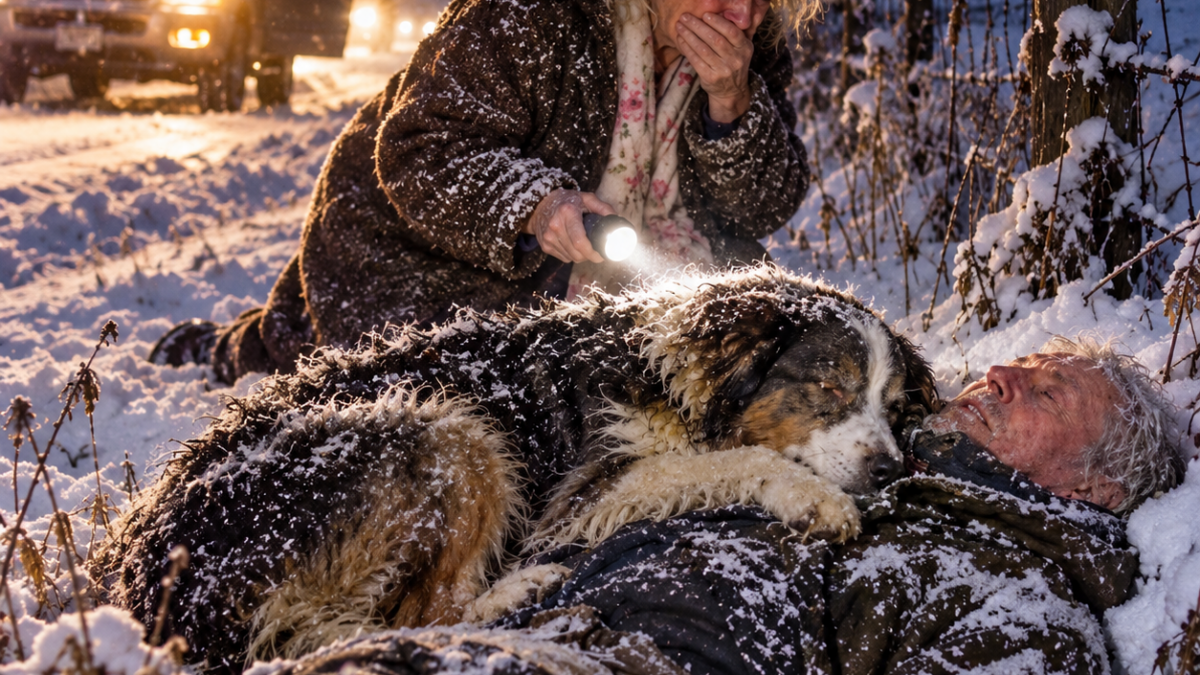
My husband was at the bottom of a ditch.
My dog was lying on top of him.
Neither was moving enough.
Then Jean made a sound.
Not a word.
A low moan.
It snapped me back into my body.
“Jean!”
I slid down the snowy bank.
My knees hit frozen ground.
I nearly fell directly onto them.
Oscar’s head rose.
His eyes found me.
“Good boy. It’s me.”
His tail moved once.
Barely.
I touched Jean’s cheek.
Cold.
Far too cold.
“Jean, can you hear me?”
His eyelids fluttered.
“Marie?”
My name.
He knew my name.
I nearly collapsed from relief.
“Yes. Yes, it’s me.”
He stared past me.
Confused.
“Why are you here?”
I swallowed.
“Because you’re freezing in a ditch.”
He looked around as if noticing the place for the first time.
“The cows.”
“There are no cows.”
“I have to bring them in.”
“No, Jean.”
“They’ll freeze.”
His words slurred.
I put my hand against his chest.
Oscar was still covering most of him, but beneath the dog I could feel Jean breathing.
Slow.
Unsteady.
Alive.
That was enough for one second.
I pulled out my phone.
One bar of signal.
I called emergency services.
“My husband is seventy-eight, he has cognitive impairment, he’s been outside in freezing weather, and I found him in a roadside ditch.”
The dispatcher asked if he was conscious.
“Sometimes.”
Breathing?
“Yes.”
Bleeding?
“I don’t see any.”
Possible fall?
“Yes.”
“Do not move him unless he is in immediate danger. Cover him. Keep him sheltered from the wind if you can.”
Then she asked:
“Are you alone?”
I looked at Oscar.
“No.”
Technically true.
“Our dog is with him.”
The dispatcher probably thought that didn’t matter.
It mattered more than anything.
“Ambulance is coming from Saint-Flour. Roads are icy. Stay on the line.”
I put the phone on speaker.
Then I focused on Oscar.
“Come here, sweetheart.”
I slid one hand beneath his chest.
His fur was wet and bitterly cold.
When I touched his side, he trembled violently.
He had not been shivering when I first arrived.
That frightened me more.
Shivering is the body fighting.
Stillness can mean it’s losing.
“Come on.”
I tried to move him enough to put my coat over Jean.
Oscar resisted.
Weakly.
But clearly.
“No.”
His paws scraped against Jean’s coat.
He pushed himself back over my husband’s chest.
I started crying.
“You’ve done enough.”
Oscar looked at me.
Then lowered his head.
He did not believe me.
For fourteen years, Jean had been his person.
If Jean was down, Oscar’s place was there.
That’s what he’d decided.
I removed my own coat.
The cold cut through my sweater instantly.
I spread it over both of them.
Oscar remained on top.
“Fine.”
My voice shook.
“Stay there.”
I climbed halfway up the bank and dragged a wool blanket from the utility vehicle.
Then another.
We kept emergency blankets in winter because country roads are country roads.
I wrapped Jean.
Then Oscar.
Jean began mumbling.
“Papa’s waiting.”
My heart broke.
His father.
Again.
“Your father’s not waiting, sweetheart.”
“I told him I’d fix the lower fence.”
“That was fifty years ago.”
Jean frowned.
“No.”
“It’s okay.”
“I forgot.”
The way he said it made something inside me collapse.
Not frightened.
Ashamed.
As if memory loss were a moral failure.
I put my hand beside his face.
“You don’t have to remember right now.”
He looked at me but I don’t know whether he understood.
Oscar understood my voice.
His tail moved once beneath the blanket.
I touched his ears.
Freezing.
His paws were stiff.
One rear leg lay at an unnatural angle, not broken exactly, but stretched awkwardly after what must have been a difficult slide down the ditch.
I wondered how he’d gotten there.
Had Jean fallen first?
Had Oscar followed deliberately?
Had he tried to pull him up?
There were scratches in the snow above Jean’s shoulder.
Claw marks.
Long fur trapped on a thorn.
Oscar had moved around.
He had done something.
The snow told part of the story.
Not enough.
I began reconstructing the night in my mind.
Jean wakes.
The disease takes him somewhere backward in time.
Maybe he believes the cows are still ours.
Maybe he thinks his father needs help.
He dresses badly.
Leaves the front door open.
Oscar sees.
Old dog rises from his warm bed.
Follows.
Jean walks down the road.
Oscar limps behind him.
Jean slips near the curve.
Falls into the ditch.
Maybe hits his head.
Maybe cannot climb.
Oscar goes down.
And then?
Hours.
Cold.
Darkness.
No one passing.
Oscar beside him.
What does a dog do when his human stops moving?
Stay.
Warm.
Bark.
Wait.
My phone speaker crackled.
“Madam, are you still there?”
“Yes.”
“Can you see the ambulance yet?”
“No.”
“Approximately how long do you think he’s been outside?”
I looked at Jean.
I had gone to sleep around eleven-thirty.
He’d been beside me then.
Maybe he left at midnight.
Maybe one.
At least two hours.
Possibly more.
“I don’t know.”
My voice broke.
“Two hours. Maybe three.”
The dispatcher became more serious.
“Keep him covered. Do not give him food or drink. Keep speaking to him.”
I laughed once.
Not because anything was funny.
“Speaking is all I’ve been doing for forty years.”
Jean opened his eyes.
“Too much.”
I stared.
Had he made a joke?
He closed his eyes again.
I kissed his forehead.
“You old bastard.”
Oscar’s ear twitched.
Somewhere far away, I heard a siren.
At first I thought I imagined it.
Then again.
Closer.
I stood and waved the flashlight.
“Here!”
Blue lights appeared around the bend.
The ambulance stopped.
Two paramedics came down with equipment.
One looked at Jean.
The other looked at Oscar.
“Dog won’t bite?”
“No.”
Oscar tried to lift his head.
Couldn’t.
“He won’t.”
They assessed Jean quickly.
Temperature dangerously low.
Pulse irregular.
Blood pressure concerning.
Possible head injury.
Possible hip injury.
They needed to move him.
One paramedic touched Oscar gently.
“We have to get the dog off.”
I nodded.
“Let me.”
I slid both arms beneath him.
He weighed less than he used to.
Still heavy for me.
I lifted.
Oscar gave a low cry.
Pain.
I almost dropped him.
“Sorry. Sorry.”
The moment his body left Jean’s chest, Jean shivered violently.
One of the paramedics immediately added warming blankets.
Oscar tried to twist back toward him.
“He’s okay.”
I held him against me.
“He’s going.”
Oscar stared at the stretcher.
The paramedics immobilized Jean.
Lifted him.
He became agitated.
“No. No, the cows—”
“Jean!”
His eyes found me.
“You’re going to the hospital.”
“I can’t.”
“You can.”
“Oscar.”
That word.
The first clear word he’d spoken in minutes.
I brought Oscar close enough for him to see.
“He’s here.”
Jean stretched one gloved hand toward him.
Oscar’s nose touched his fingers.
Then Jean relaxed.
They carried him up.
I followed, still holding Oscar.
At the ambulance door, the paramedic stopped me.
“We can’t take the dog.”
Of course.
“I know.”
“Can someone stay with him?”
My mind went blank.
Our son lived forty minutes away.
At 3:50 in the morning.
I called him.
Three rings.
“Mom?”
“Paul.”
He heard my voice and woke instantly.
“What happened?”
“It’s your father.”
Silence.
“What?”
“And Oscar.”
He was already moving.
“I’ll meet you.”
“No. Come to the road near Fournol. The ambulance is taking Dad. I need you to take Oscar to the emergency vet.”
“Is Dad alive?”
“Yes.”
“Is Oscar?”
I looked down.
Oscar’s eyes were half closed.
“Yes.”
That answer felt less certain.
Paul arrived faster than was safe.
His truck stopped behind the ambulance.
He got out without closing the door.
“Dad?”
“They’re leaving now.”
Paul looked into the ambulance.
Jean didn’t recognize him.
That hurt him.
I saw it immediately.
“Dad, it’s Paul.”
Jean stared.
Then turned away.
Paul’s face changed.
No time.
I pushed Oscar toward him.
“Take him.”
Paul looked down.
“What happened to him?”
“He’s freezing.”
“Mom—”
“He saved your father.”
I did not know that medically yet.
But I knew.
“Take him.”
Paul accepted Oscar.
Our old dog whimpered when transferred.
“Easy, buddy.”
Paul had known him since he was a puppy.
Oscar rested his head against his chest.
I pointed toward town.
“Veterinary emergency clinic. Call them on the way.”
“You’re going with Dad?”
“Yes.”
“Call me.”
“I will.”
We split.
One old man toward the hospital.
One old dog toward the veterinarian.
And for the first time since I’d found them, I had no idea which one I was more afraid to lose.
The ambulance ride blurred.
Jean’s temperature was dangerously low.
The paramedic spoke in calm, clipped sentences.
They placed warming packs carefully.
Started an IV.
Monitored his heart.
He had a cut behind one ear that I hadn’t noticed.
Blood had frozen in his hair.
“Did he hit his head?”
“Likely.”
“Is he having a heart attack?”
“We’re seeing some rhythm abnormalities, but cold can cause those. The hospital will evaluate.”
“Will he survive?”
The paramedic looked at me.
Professionals hate that question because honesty has edges.
“He’s alive now.”
Not an answer.
The only answer available.
I held Jean’s hand.
He pulled it away once.
Then took mine again.
“Marie?”
“Yes.”
“Where are we?”
“In an ambulance.”
“Why?”
“You went for a walk.”
“At night?”
“Apparently.”
“That’s stupid.”
I laughed and cried at the same time.
“Yes.”
He looked at the ceiling.
“Did I bring Oscar?”
My throat closed.
“He brought you.”
Jean frowned.
Then forgot the question.
At the hospital, everything moved quickly.
Scan.
Blood work.
Cardiac monitoring.
Gradual warming.
X-rays.
Questions.
Medical history.
Medication list.
Diagnosis.
Yes, cognitive decline.
Yes, episodes of nighttime disorientation.
No, he had never wandered outside before.
Yes, we had locks.
No, apparently not enough.
That last answer burned.
I blamed myself immediately.
Of course.
Caregivers are specialists in finding ways to make every disaster their fault.
I should have installed an alarm.
I should have locked the upper bolt.
I should have heard him get up.
I should have—
My phone rang.
Paul.
I answered in the hospital corridor.
“Oscar’s at the clinic.”
“How is he?”
Silence.
“Paul.”
“They’re warming him.”
“What else?”
“His temperature was really low. His heart rate’s slow. His back legs are bad.”
“Bad how?”
“They think he overexerted himself and aggravated the arthritis. Maybe muscle injury. One paw is cut open.”
I closed my eyes.
“Is he going to live?”
“They won’t say yet.”
Same answer everywhere.
“Did you tell them what happened?”
“Yes.”
“The vet said…”
Paul stopped.
“What?”
“He said lying on Dad may actually have helped preserve core temperature.”
My knees weakened.
I sat on a plastic chair.
“Say that again.”
“Oscar’s body heat. Dad’s chest. The vet said it could’ve slowed the cooling. Not enough to keep him safe forever, but…”
Paul inhaled.
“He may have bought Dad time.”
I covered my mouth.
People walked past me.
Nurses.
Families.
Someone carrying coffee.
The whole ordinary world continued while mine split open.
“Mom?”
“I’m here.”
“How’s Dad?”
“Alive.”
“Good.”
Neither of us said the obvious.
Oscar had spent whatever he had left to make that possible.
Jean’s scan showed no major brain bleed.
A miracle.
He had a concussion.
Bruised ribs.
A badly sprained wrist.
No hip fracture.
His heart rhythm normalized gradually as his temperature rose.
By midmorning, the doctor told me the words I’d been waiting for.
“He is out of immediate danger.”
I almost laughed.
“Immediate.”
She nodded.
“He was very cold. Another hour outside could have changed the outcome significantly.”
Another hour.
Oscar.
I looked through the glass.
Jean slept under warmed blankets.
“Can I go see my dog?”
The doctor blinked.
“My son is with my dog.”
“Of course.”
I left Paul at the hospital when he arrived around noon.
Jean barely recognized him again.
Then suddenly did.
“Paul?”
Our son froze.
“Yeah, Dad.”
“Why are you so old?”
Paul laughed.
“I’m fifty-two.”
Jean looked horrified.
Then fell asleep.
Dementia can be cruel and funny in the same minute.
I drove to the veterinary clinic.
Oscar was in a heated kennel.
Blankets surrounded him.
An IV line ran into one foreleg.
His paw was bandaged.
His breathing was shallow.
When I entered, he opened one eye.
Tail.
Once.
That was all.
I sat on the floor.
“Oh, sweetheart.”
His head tried to lift.
“Don’t.”
I put my hand through the opening.
Oscar’s nose rested against my fingers.
The veterinarian joined me.
Dr. Pelletier had treated Oscar for years.
He knew exactly how strong our dog had once been.
His expression told me enough.
“Tell me.”
“His temperature is better.”
“Good.”
“Heart rhythm improved.”
“Good.”
“The paw injury is manageable.”
I waited.
“But?”
Dr. Pelletier sat beside me.
“Marie, Oscar was already a very old dog with severe degenerative joint disease and some cardiac changes.”
“I know.”
“What he did last night was physically extreme.”
“I know.”
“Hours in the cold. The walk. The ditch. Prolonged exposure. Maintaining position over Jean. He appears to have repeatedly tried climbing the bank.”
“How do you know?”
“His nails. Muscle strain. Ice abrasions. And Paul showed me the pictures from the site.”
I hadn’t known Paul took them.
“He spent everything.”
The veterinarian didn’t say it.
I did.
“Yes.”
My hand remained beneath Oscar’s muzzle.
“Will he recover?”
Another pause.
“I think he’ll recover from the hypothermia.”
Hope.
“But I don’t know if his body will recover to where it was before.”
There it was.
The price.
“What does that mean?”
“He may have significantly worsened his mobility. His heart is tired. His kidneys took stress from the cold. We need twenty-four to forty-eight hours.”
“Pain?”
“Controlled.”
“Is he suffering?”
“Not right now.”
That mattered most.
I leaned close.
“You idiot.”
Oscar blinked.
“You beautiful, stupid old man.”
His tail moved again.
Jean woke fully around three that afternoon.
By fully, I mean as fully as Jean could anymore.
He knew me.
Knew Paul.
Knew he was in hospital.
Didn’t remember leaving home.
Didn’t remember the ditch.
Didn’t remember Oscar.
When I told him, he stared at me.
“I wouldn’t walk that far.”
“You did.”
“At night?”
“Yes.”
“Why?”
“You thought there were cows.”
He looked embarrassed.
“We don’t have cows.”
“I know.”
His face changed.
Fear.
Not of the accident.
Of himself.
“What’s happening to me?”
I had heard that question before.
It always destroyed me.
I sat beside him.
“Your memory is sick.”
He looked away.
“I don’t want to be stupid.”
“You’re not.”
“I went into snow.”
“Yes.”
“Stupid.”
“You were confused.”
“Same result.”
He had always been practical.
Even dementia couldn’t erase that completely.
Then he asked:
“Oscar?”
I took out my phone.
Paul had sent a photograph from the veterinary clinic.
Oscar beneath blankets.
Jean stared.
“He’s sick?”
“He followed you.”
Jean looked at me.
“He did?”
“He found you. Stayed with you.”
I hesitated.
“He lay over your chest.”
Jean’s eyes filled.
“He hates sleeping on people.”
True.
Oscar loved proximity.
Never lap-dog behavior.
He wanted a floor.
A porch.
A patch of grass.
Not a chest.
“He made an exception.”
Jean turned his face toward the window.
Tears ran down his temples.
I had seen my husband cry four times in forty years.
When his father died.
When our daughter was born.
When our daughter died.
And now.
“I hurt him.”
“No.”
“I did.”
“You were sick.”
“He followed me because of me.”
“Because he loves you.”
Jean shook his head.
“Same thing.”
I didn’t argue.
That evening, Paul stayed with his father while I returned home.
The house was unbearable.
Jean’s coat was missing.
Oscar’s rug was empty.
Two bowls remained near the pantry.
One belonged to a dog at the clinic.
I picked it up.
Put it down.
Walked away.
Then I noticed snow melted near the doorway.
Paw prints dried into faint dirt marks across the tile.
Oscar had followed Jean through that door.
I sat on the floor and cried.
Not gracefully.
Not quietly.
Months of caregiving had already hollowed me out.
Watching Jean forget our lives.
Being patient when I wanted to scream.
Answering the same question fifteen times.
Hiding keys.
Removing knobs from the stove.
Sleeping lightly.
Pretending I wasn’t exhausted.
Then one night I failed to wake.
And an old dog had done what I hadn’t.
I know now that thought was unfair.
At the time, fairness had nothing to do with it.
I whispered into the empty kitchen:
“I’m sorry.”
No one answered.
The next morning Oscar tried to stand.
He couldn’t.
Dr. Pelletier called.
“We supported him with a sling.”
“And?”
“Front legs okay. Rear legs collapse.”
My heart sank.
“Permanent?”
“Too early.”
I drove there.
Oscar was awake.
More alert.
He ate chicken from my fingers.
That was good.
Then he tried to rise when he saw me.
His body lifted.
Rear legs shook.
Folded.
Oscar looked confused.
He tried again.
Dr. Pelletier stopped him gently.
“Easy.”
Oscar panted.
Not pain.
Frustration.
Working dogs hate being unable to work.
I knew that expression.
Jean wore the human version whenever I took his car keys.
I put both hands around Oscar’s face.
“You don’t have to stand for me.”
He licked my wrist.
“Enough.”
Again.
Tail.
The vet tried a support sling later.
Oscar managed four steps.
Then six.
His left rear leg dragged badly.
But he moved.
I cried over six ugly steps.
Rescue and caregiving destroy your standards.
You learn to celebrate swallowing.
Standing.
Remembering a name.
One safe night.
The following afternoon Jean was medically stable enough to leave the hospital.
The doctors wanted him supervised constantly.
No more unsecured exterior doors.
Medication review.
Neurology follow-up.
Home safety assessment.
Perhaps eventually residential memory care.
I hated that last phrase.
Jean would too.
Paul drove us home.
Before we went inside, Jean looked around.
“Where’s Oscar?”
“Clinic.”
He frowned.
“Why?”
He had forgotten.
I told him again.
His face broke again.
The disease took the memory but returned the grief fresh each time.
That became another cruelty.
We eventually stopped retelling the entire story unless he asked directly.
That evening, Jean wandered toward Oscar’s empty rug.
“Dog?”
“At the veterinarian.”
“Sick?”
“Yes.”
Jean sat in his chair.
“Poor old thing.”
Five minutes later:
“Where’s Oscar?”
I closed my eyes.
“Veterinarian.”
“Sick?”
“Yes.”
This time my voice cracked.
Jean looked at me.
“Why are you crying?”
Because he’d asked twice.
Because he couldn’t remember why.
Because tomorrow he might not remember Oscar at all.
Because Oscar might die knowing Jean only as someone he needed to rescue.
Instead I said:
“I’m tired.”
Jean reached for my hand.
Some memories vanish before habits do.
He squeezed.
“You always worry too much.”
I laughed.
“Forty years and that’s what survives?”
“What?”
“Nothing.”
The next day, Oscar came home.
Dr. Pelletier thought familiar surroundings might help.
His condition had stabilized.
Kidneys improving.
Heart acceptable.
Temperature normal.
Mobility poor.
Pain manageable.
I brought him inside using a wide support harness beneath his hips.
Jean was asleep in his chair.
Oscar entered.
Stopped.
Looked.
His ears lifted.
He pulled forward.
“Slow.”
Oscar ignored me.
One step.
Another.
Rear legs shaking.
Jean woke.
“Vasco?”
Wrong dog.
Vasco had belonged to Jean’s childhood.
Oscar stopped.
For half a second I thought the wrong name might matter.
Then Jean opened his arms slightly.
“Come here, boy.”
Oscar went.
He reached the chair.
Jean bent forward.
Oscar placed his head on his knees.
My husband stroked him.
“Where’ve you been?”
I covered my mouth.
Oscar didn’t care.
The name.
The forgotten night.
None of it.
He had found his person again.
That was enough.
Jean scratched behind his ear.
Oscar’s eyes closed.
They stayed like that nearly twenty minutes.
Paul stood in the kitchen doorway.
He whispered:
“Does Dad know?”
“Not right now.”
“Should we tell him?”
“No.”
For once, memory loss could be a mercy.
Let Jean believe his dog had simply returned from somewhere.
Oscar had already done the hard part.
He didn’t need gratitude explained.
That night Oscar slept beside Jean’s chair.
Not on his rug.
Closer.
Jean fell asleep too.
I watched both of them.
Two old bodies.
One mind fading.
One body failing.
I wondered which loss would come first.
That’s a terrible thought.
Caregivers have terrible thoughts.
We just rarely say them aloud.
The next several weeks became an adjustment to a new life.
We installed door alarms.
Locks high enough that Jean couldn’t open them automatically.
Motion sensors in the hallway.
A pressure mat near the front entrance that sounded in our bedroom.
Paul installed GPS identification in Jean’s coat and eventually a discreet tracker he wore on his wrist.
Jean hated it on the days he understood what it was.
“I’m not a prisoner.”
“No.”
“Then remove it.”
“I can’t.”
“This is my house.”
“I know.”
“I built half of it.”
“I know.”
“Then stop treating me like a child.”
Those were the hardest days.
Because he was right and wrong at the same time.
Autonomy mattered.
So did survival.
Oscar watched our arguments from his rug.
Sometimes Jean pointed at him.
“He understands.”
Probably.
“He doesn’t put trackers on me.”
“No. He just follows you into frozen ditches.”
Jean stared.
Some days the story penetrated.
Other days not.
On one clear morning, I showed him the photographs Paul had taken.
Footprints.
The ditch.
Oscar’s body over his.
Jean studied them.
Then looked at the dog.
“You did that?”
Oscar lifted his head.
Jean’s voice became soft.
“You came after me.”
Tail.
“I don’t remember.”
His hand shook.
“I’m sorry.”
Oscar stood with effort.
Walked to him.
Pressed his face into Jean’s palm.
Jean cried.
Then five minutes later he asked why everyone looked sad.
This disease never fought fair.
Oscar improved slightly.
With medication and gentle exercises, he regained enough strength to walk through the house.
Not well.
His left rear paw sometimes folded under.
I used a sling outdoors.
He hated it.
His pride had survived perfectly.
“Yes, I know.”
He glared at me.
“You’re a mighty wolf.”
Tail.
“But the mighty wolf needs help peeing.”
Glare.
Jean laughed.
Those moments became precious.
Sometimes my husband couldn’t remember our daughter’s birthday.
But he could laugh at his dog.
Oscar’s appetite returned.
He gained a little of the weight he’d lost during the ordeal.
The paw healed.
His heart remained fragile.
Dr. Pelletier told us to avoid exertion.
Oscar disagreed.
Every time Jean stood, Oscar tried to stand.
That became our biggest problem.
If Jean walked to the bathroom, Oscar followed.
Kitchen.
Follow.
Porch.
Follow.
Even when his body clearly needed rest.
“You can’t keep doing this,” I told him.
Oscar watched Jean.
Not me.
So we moved his bed.
At first beside Jean’s chair.
Then a second one beside our bedroom door.
Then another near the kitchen.
Paul joked we had turned the house into Oscar stations.
Good.
Wherever Jean wandered, Oscar could supervise without walking far.
It worked.
Mostly.
One February afternoon, Jean became agitated.
He wanted to “check the western field.”
There had been no western field under our ownership for twelve years.
I tried distraction.
Lunch.
Photographs.
Television.
Nothing.
He put on his coat.
Door alarm sounded.
Oscar stood.
“No.”
I stepped between them.
Jean glared.
“Move.”
“You’re not going alone.”
“I’m not asking permission.”
“Then Paul goes with you.”
“I don’t need Paul.”
Oscar moved beside him.
Jean pointed.
“I have Oscar.”
My throat closed.
“No.”
Why?
Because Oscar nearly died last time.
Because Jean had nearly died.
Because I could not survive another night.
“He’s old.”
“So am I.”
Exactly.
Jean reached for the door.
I lost patience.
“No!”
He flinched.
I almost never shouted.
“I am not finding you frozen in another ditch!”
Silence.
Jean stared at me.
For one beautiful, terrible second, full understanding returned.
“The ditch.”
“Yes.”
“Oscar.”
“Yes.”
His eyes moved toward the dog.
Oscar stood awkwardly.
Jean sat down.
“I did that.”
“You were sick.”
“Stop saying that like it makes it disappear.”
I knelt before him.
“It doesn’t.”
His voice was quiet.
“What happened?”
I told him.
Everything.
The empty bed.
The footprints.
The ditch.
Oscar.
His body over Jean’s heart.
The hospital.
The vet.
Oscar losing strength in his back legs.
Jean listened.
This time he remembered long enough to grieve fully.
When I finished, he reached down.
Oscar came close.
Jean put his forehead against the dog’s.
“I nearly killed you.”
I started to correct him.
He raised one hand.
“No, Marie.”
Then to Oscar:
“I should’ve been protecting you.”
Oscar licked his nose.
Jean laughed through tears.
The moment was so human and so simple that I wished I could preserve it.
I couldn’t.
By evening, Jean had forgotten the conversation.
But something else remained.
For nearly two weeks afterward, whenever he approached the front door, he looked for me first.
Maybe procedural memory.
Maybe coincidence.
Maybe somewhere deeper than words, the lesson stayed.
That was enough.
Spring came.
Oscar made it to spring.
I had doubted he would.
The first warm afternoon, I carried his support sling outside.
He stood in sunlight.
No snow.
No ditch.
Birds in the hedges.
Jean sat on a chair beneath the eaves.
Oscar walked toward him.
Slowly.
One dragging paw.
Jean watched.
“Old dog.”
I smiled.
“Old man.”
He pointed at me.
“Careful.”
I laughed.
Oscar lay at his feet.
For an hour nothing happened.
That hour remains one of my favorite memories.
No crisis.
No heroism.
No dementia episode.
Just warm air.
My husband.
My dog.
Ordinary peace.
People underestimate how extraordinary ordinary life becomes when you nearly lose it.
Oscar’s sacrifice became known around the village because country stories travel faster than weather.
A paramedic mentioned the old dog who had kept his owner warm.
Then a local newspaper asked for an interview.
I refused at first.
Jean couldn’t consent meaningfully.
Oscar certainly couldn’t.
I didn’t want our worst night turned into entertainment.
But Paul convinced me there might be value in discussing wandering prevention for families dealing with dementia.
So we agreed to one short piece.
No dramatic photographs of Jean.
No medical details beyond what we approved.
They photographed Oscar beside the stove.
Gray muzzle.
Cloudy eyes.
One paw slightly turned beneath him.
The article called him a hero.
I disliked that.
Oscar looked like a tired old dog.
That’s what he was.
A tired old dog who made one faithful decision after another.
The story spread.
Letters arrived.
People sent dog treats.
Blankets.
One child mailed Oscar a handmade medal.
Paul hung it near his bed.
Oscar tried to eat the ribbon.
Heroism intact.
More important were the messages from families.
A woman wrote that after reading the story, she installed door alarms because her father had begun wandering.
Another bought a GPS bracelet for her husband.
One family moved a relative’s bedroom farther from an exterior door.
A man wrote:
**Your dog scared us into taking my mother’s wandering seriously.**
That mattered.
The storm had become useful.
I wish it never happened.
Both things can be true.
Jean’s disease progressed.
Of course it did.
Love does not stop neurodegeneration.
Neither does loyalty.
By summer, he sometimes forgot our house while standing inside it.
He’d ask when we were going home.
At first I’d say:
“We are home.”
That upset him.
So I learned another answer.
“We’ll go soon.”
Then I’d make tea.
Five minutes later, the question often disappeared.
Oscar adapted too.
When Jean wandered through rooms, Oscar followed with his eyes.
Not always his body anymore.
His legs couldn’t.
But his head tracked every step.
Jean often forgot Oscar’s name.
“Vasco.”
“Rex.”
“Boy.”
Sometimes simply “dog.”
Oscar responded to all of them.
A name is mostly for humans.
Love recognizes tone.
One evening, Jean called him “Papa’s dog.”
That one hurt.
Then he smiled.
Oscar wagged.
No harm.
The mind had folded decades together.
Oscar simply entered whatever year Jean happened to inhabit.
That’s one reason dogs can be extraordinary companions in dementia.
They don’t argue with time.
If Jean thought he was thirty, Oscar didn’t correct him.
If he thought the cattle still existed, Oscar listened.
If Jean called him by a dead dog’s name, he came.
No shame.
No frustration.
Just presence.
I envied him.
I was not always that patient.
Some days I snapped.
“Jean, I told you already.”
Immediately regretted it.
He’d look wounded.
“I forgot.”
Two words.
Knife.
Oscar would get up and move between us.
Not accusing.
Just there.
I would sit.
Take Jean’s hand.
Start again.
“Okay.”
Again.
Caregiving is mostly again.
Oscar understood again better than anyone.
By autumn, his mobility worsened.
Dr. Pelletier increased pain medication.
We added rubber mats.
A ramp over the porch step.
A rear support harness permanently hung near the door.
Oscar stopped climbing stairs completely.
I stopped asking him to.
Jean noticed.
“Why doesn’t he come upstairs?”
“His hips.”
“Oh.”
The next day:
“Why doesn’t he come upstairs?”
“His hips.”
“Oh.”
Then again.
Eventually we moved into the downstairs bedroom.
For Jean.
For Oscar.
For me.
Our house shrank around old age.
That sounds sad.
It wasn’t entirely.
We needed fewer rooms.
The important things fit.
A bed.
Two chairs.
Oscar’s rug.
Photographs.
The stove.
A kitchen table.
Forty years of marriage does not require an upstairs.
Christmas approached.
One year since the ditch.
The date frightened me.
I didn’t tell anyone.
December twenty-fourth arrived cold but clear.
No snow.
Paul came with his wife and our granddaughter, Sophie.
We kept dinner simple.
Jean was having a confused day.
He believed Paul was his brother at one point.
Paul went along with it.
Then Jean recognized him correctly during dessert.
“Sophie?”
Our granddaughter froze.
He remembered.
“Yes, Grandpa.”
“You got tall.”
She was twenty-three.
She laughed and hugged him.
Oscar slept near the stove.
After dinner, I sat on the floor beside him.
Exactly one year earlier, he had followed Jean into snow.
Now his breathing was slower than I liked.
His body thin.
His fur still beautiful in patches.
I whispered:
“One year.”
Oscar opened one eye.
“Show-off.”
Tail.
That night, we locked every door.
Checked every alarm.
Paul slept downstairs too.
Nobody said why.
At 3:14 a.m., I woke.
Automatically.
Looked at Jean.
There.
Breathing.
Then Oscar.
There.
Sleeping.
I started crying silently.
Jean woke.
“Marie?”
“I’m okay.”
“Bad dream?”
“Something like that.”
He reached for my hand.
Oscar lifted his head.
Everyone accounted for.
This time the clock moved past 3:14 without anyone missing.
That felt like victory.
January was hard.
Oscar stopped eating breakfast one morning.
He ate dinner.
Then next day, half breakfast.
We went to Dr. Pelletier.
Blood tests.
Kidney values worse.
Heart disease progressed.
Nothing catastrophic.
Everything cumulative.
“How long?”
I asked.
He shook his head.
“We don’t count that way.”
“I do.”
“I know.”
“Months?”
“Maybe.”
“Weeks?”
“Maybe.”
I hated maybe.
Jean was in the waiting room with Paul.
He had insisted on coming.
When we returned, Jean looked at Oscar.
“Bad?”
I nodded.
Jean stroked him.
“He’s old.”
“Yes.”
“So am I.”
“Yes.”
“Which of us first?”
“Jean.”
He smiled faintly.
“Fair question.”
I could not answer.
Oscar did.
He placed his paw on Jean’s shoe.
That paw.
The same one with arthritis.
The same one that had left dragging prints beside Jean’s footprints in the snow.
Jean leaned down.
“Don’t rush.”
Oscar stayed another four months.
Long enough for daffodils.
Long enough for warm sunlight on the porch.
Long enough for one last visit from Sophie, who brought him forbidden sausage.
I pretended not to see.
Long enough for Jean to have one astonishingly clear afternoon.
Those rare windows happened sometimes.
He woke after a nap and seemed almost entirely himself.
Not younger.
Not cured.
Just present.
He knew the year.
Knew me.
Knew Paul.
Knew where we lived.
And knew Oscar.
He sat beside the dog.
“Fourteen?”
“Fifteen now,” I said.
Jean stared.
“He made fifteen?”
“Yes.”
Oscar had turned fifteen in March.
Jean shook his head.
“Stubborn.”
Then he looked at me.
“Did I ever thank him?”
I swallowed.
“For the ditch?”
“Yes.”
“I don’t know.”
“I remember pieces.”
My heart stopped.
“What pieces?”
“Cold.”
He looked toward the window.
“His fur against my face.”
I didn’t speak.
“I remember waking and thinking I was in bed because something warm was on me.”
Tears came.
Jean continued.
“I remember telling him to go home.”
“You did?”
“I think so.”
“He didn’t.”
Jean smiled.
“No.”
Oscar raised his head when he heard his voice.
Jean lowered himself painfully onto the rug beside him.
“Come here.”
Oscar was already there.
Jean put both hands around his face.
“I remember you.”
That sentence.
God.
“I remember you.”
Oscar licked his chin.
Jean laughed.
Then cried.
“I was supposed to take care of you.”
Oscar rested his head in Jean’s lap.
They stayed there.
I didn’t photograph it.
Some moments deserve to exist only in the people who survive them.
By evening, the clarity faded.
Jean asked me where his mother was.
But he’d had the afternoon.
So had Oscar.
Maybe that was enough.
Two weeks later, Oscar could not stand even with the sling.
His rear legs simply stopped cooperating.
He still ate.
Still recognized us.
Still wagged.
Pain medication kept him comfortable at rest.
Dr. Pelletier came to the house.
We sat in the kitchen.
Jean nearby.
The doctor examined Oscar.
Then looked at me.
“You know.”
Yes.
I knew.
Quality of life.
We had discussed it.
Could he eat?
Yes.
Drink?
Yes.
Rest comfortably?
Mostly.
Enjoy affection?
Yes.
Move independently?
No.
Increasing pain when repositioned?
Yes.
Episodes of breathlessness?
Now yes.
The balance was changing.
“What would you do?”
I asked.
Doctors hate that too.
Dr. Pelletier looked at Oscar.
“If he were mine, I would choose a good day rather than wait for a terrible night.”
I thought of the ditch.
No terrible night.
Not again.
I nodded.
Jean did not understand the conversation.
Then suddenly he did.
“You’re killing the dog?”
The words came sharp.
“No.”
“Yes, you are.”
“Jean—”
“No.”
He stood.
Angry.
Terrified.
“Oscar stays.”
My heart broke.
“He hurts.”
“Give him medicine.”
“We are.”
“More.”
“It won’t fix him.”
Jean’s face crumpled.
“Everything leaves.”
That stopped all of us.
Everything leaves.
His father.
Our daughter.
His memories.
Soon Oscar.
Eventually us.
I went to him.
“I’m still here.”
“For how long?”
“I don’t know.”
“That’s the problem.”
I held him.
He resisted.
Then stopped.
Oscar watched.
Dr. Pelletier quietly packed his things.
We postponed.
Not because Oscar needed delay.
Because Jean needed one more day.
Maybe selfish.
Maybe compassionate.
I don’t know.
That night, Oscar slept between our bed and the door.
I lay awake.
Jean slept.
At 2:40 a.m., Oscar began breathing harder.
I sat beside him.
“Not tonight.”
He looked at me.
“Please.”
I didn’t want another emergency.
I called Dr. Pelletier before dawn.
He came at seven.
Paul arrived.
Sophie came too.
Jean was calmer.
I had explained again.
And again.
Then I changed strategy.
“Jean, Oscar is very tired.”
He nodded.
“Yes.”
“He can’t walk.”
“I know.”
“We don’t want him scared.”
“No.”
“We’re going to let him sleep.”
That language reached him.
“Here?”
“Yes.”
“Not clinic?”
“No.”
“Good.”
We arranged blankets beside the stove.
Oscar’s favorite place.
Morning light entered through the window.
No snow.
No ditch.
No wind.
Warmth.
Jean sat in his chair.
I sat beside Oscar.
Paul on the floor.
Sophie near his back.
Dr. Pelletier gave the sedative first.
Oscar relaxed gradually.
His head rested on my thigh.
Jean leaned down.
“Boy.”
Oscar’s eyes moved.
Jean didn’t know his name in that moment.
It didn’t matter.
“Good boy.”
Tail.
One weak movement.
Sophie sobbed.
Paul turned away.
I kissed Oscar’s forehead.
“You brought him home.”
Jean looked at me.
“What?”
I shook my head.
“Nothing.”
Then Jean did something I didn’t expect.
He slid from the chair onto his knees.
Paul moved to help.
Jean waved him away.
He crawled close enough to place one hand on Oscar’s chest.
Right over the heart.
The exact place Oscar had lain across his.
I stopped breathing.
Maybe coincidence.
Probably.
Life does not arrange symbolism for us.
But there it was.
Jean’s palm over Oscar’s heart.
Oscar’s eyes half closed.
Jean whispered:
“Warm.”
I covered my mouth.
He didn’t remember the ditch.
Not consciously.
But some fragment lived somewhere.
The veterinarian gave the final medication.
Oscar’s breathing slowed.
Jean’s hand stayed on his chest.
I held Oscar’s face.
His eyes met mine once.
Then closed.
One breath.
Another.
Long pause.
Nothing.
Dr. Pelletier listened.
Then nodded.
Fifteen years.
Gone.
Jean kept his hand there.
“He’s sleeping?”
I could have lied.
I almost did.
“No.”
Jean looked at me.
This time he understood.
“Oh.”
One word.
He bent forward and placed his forehead against Oscar’s.
The same old man whose heart Oscar had warmed through a frozen night was now warming a body that no longer needed it.
For several minutes, nobody moved.
Then Jean whispered:
“Thank you.”
Whether he remembered why or not, I will never know.
I choose to believe some part of him did.
We buried Oscar beneath the old apple tree behind the house.
Jean had planted it the year Paul was born.
Oscar used to lie there in summer when shade covered the grass.
Paul dug.
I helped.
Sophie placed Oscar’s worn collar in a small wooden box.
We did not bury his tags because Jean wanted one.
“Why?”
He shrugged.
“Dog.”
Good enough.
We put one tag on Jean’s keychain even though he no longer carried keys.
He sometimes held it in his palm.
Asked whose it was.
I’d say:
“Oscar’s.”
Sometimes:
“Who?”
Other times:
“My dog.”
Those were the good days.
The house changed after Oscar.
Silence expanded.
No nails on tile.
No sigh near the stove.
No body between Jean and whatever confused him.
Our safety measures became stricter because the living alarm system was gone.
A home-care aide started nights twice a week.
I resisted for months.
Pride.
Money.
Guilt.
Exhaustion finally won.
Paul said:
“Mom, Oscar died because he tried to do a job none of us should have left to him.”
That hurt.
Because it was partly true.
Not that we’d deliberately left it to him.
But the sentence changed me.
Care cannot depend on sacrifice.
Not a spouse’s.
Not a child’s.
Not a dog’s.
We accepted help.
That was perhaps Oscar’s final gift.
The story people remembered was that he saved Jean.
The lesson I carried was different.
Love is not measured by how completely you destroy yourself caring for someone.
Oscar had done that because he was a dog.
Because instinct and loyalty left him no other choice.
We humans had choices.
Alarms.
Doctors.
Home aides.
Family schedules.
Respite care.
Community.
Asking.
Accepting.
I started doing those things.
At first Jean hated strangers in the house.
Then he liked one aide named Camille because she knew old farming songs.
He couldn’t remember her name.
He remembered the songs.
She sang.
Jean calmed.
Another aide brought a therapy dog once.
A golden retriever named Milo.
Jean stared at him.
“Oscar?”
I almost corrected him.
Then stopped.
Milo walked over.
Placed his head beneath Jean’s hand.
Jean smiled.
“Oscar.”
Fine.
If memory needed to borrow a new body for an old love, I wasn’t going to argue.
The first anniversary of Oscar’s death came quietly.
Sophie placed flowers near the apple tree.
Jean asked:
“Who’s buried there?”
I told him.
He looked confused.
Then touched the tag on his keychain.
“Mine?”
“Yes.”
He nodded.
We stood there together.
A few minutes later he forgot why.
I didn’t.
Jean’s decline continued for another two years.
Language became harder.
Walking too.
Eventually he stopped asking for cows because even those old memories faded.
Sometimes he recognized me.
Sometimes I was “Madame.”
Sometimes his mother.
Sometimes no one.
People told me that must be unbearable.
It was.
It was also still marriage.
Not the marriage we’d planned.
But the one we had.
I fed him.
He held my hand.
I told stories he couldn’t follow.
He sometimes kissed my cheek out of habit.
Love became less about being remembered and more about continuing to remember for both of us.
I carried forty years.
Then forty-two.
Oscar remained part of it.
Whenever Jean became restless at night, I would say:
“The dog is sleeping. Everything is okay.”
There was no dog.
Still, the sentence soothed him.
“The dog is sleeping.”
Home safe.
Animals accounted for.
No need to go outside.
Strangely, that worked better than medication some nights.
Oscar kept protecting him even after death.
Not magically.
Through association.
Memory deeper than language.
One winter night Jean woke around three.
My heart still reacted to the hour.
He sat up.
“Need to go.”
“Where?”
“Father.”
“No.”
“He needs me.”
I put my hand on his arm.
“The dog already checked.”
Jean stopped.
“Dog?”
“Yes.”
“Everything okay?”
“Everything’s okay.”
He lay back down.
Within minutes, asleep.
I stared at the ceiling.
Then whispered:
“Thank you, Oscar.”
Habit.
Gratitude.
Ghost.
Whatever you want to call it.
Jean eventually moved into a small memory-care residence twenty minutes from home.
That decision nearly broke me more than any emergency.
For months I had promised:
“I’ll never put you somewhere.”
Promises made before dementia are sometimes promises made without understanding the disease.
He needed more than one exhausted seventy-six-year-old woman could safely provide.
On his first day there, he panicked.
“Marie, we’re leaving.”
I cried in the hallway.
Camille—our former aide—had helped us choose the place.
She brought Oscar’s old blanket.
Not because Jean remembered the dog clearly.
Because the smell of home remained in it.
We put it on his chair.
Jean ran his fingers across the fabric.
Then calmed.
Again.
Oscar.
Always there somewhere.
I visited every day at first.
Then five days a week.
Then less when staff convinced me rest was not abandonment.
That word.
Abandonment.
Caregivers fear it.
Dogs teach another definition.
Oscar left Jean physically to run for help.
Leaving can be love if leaving is what brings safety.
I had to learn that too.
Placing Jean in care was not leaving him.
It was going for help.
Oscar had already shown me.
That realization released something in me.
Jean lived there eighteen months.
He became quieter.
The man who once ran a farm, repaired tractors, climbed roofs, drove through winter storms, and danced terribly at weddings eventually needed help lifting a cup.
Disease is merciless.
Yet tenderness remained.
One afternoon I arrived with Sophie.
She was pregnant with her first child.
Jean no longer knew her.
She sat beside him.
“Grandpa, I’m having a baby.”
Jean stared at her stomach.
Then smiled.
“Good.”
She laughed.
“That’s all?”
“Good.”
Enough.
Before leaving, Sophie showed him a photograph on her phone.
Oscar lying beside the stove.
Jean touched the screen.
“Good dog.”
We froze.
“Do you know him?” I asked.
Jean looked at me.
“No.”
Then back at the photo.
“Good dog.”
Maybe you don’t need a name to know character.
Jean died the following spring.
Not in a ditch.
Not alone.
No cold.
I sat beside him.
Paul on the other side.
Sophie held his hand.
Our great-granddaughter, only three months old, slept in her mother’s arms.
Jean’s breathing became shallow.
The nurse told us it was close.
I held the Oscar tag in my palm.
The one from his keychain.
I put it beside Jean’s hand.
He couldn’t grip anymore.
Still, his fingers touched it.
I said:
“Everyone’s home.”
That phrase had become important to me.
Everyone’s home.
Jean.
Paul.
Sophie.
Baby.
Me.
Oscar somewhere beyond whatever I could prove.
“Nobody’s outside.”
Jean’s breathing slowed.
“Everything’s okay.”
He died quietly.
After forty-three years of marriage, the side of my life beside me became empty in a way no cold pillow could prepare me for.
We buried Jean in the village cemetery.
I kept Oscar’s tag.
For a while.
Then I changed my mind.
Before the coffin was closed, I placed it inside Jean’s coat pocket.
Paul saw.
“Mom?”
“He’ll lose it otherwise.”
Paul laughed through tears.
“Probably.”
We closed the coffin.
I like to imagine Jean waking somewhere with all his memory restored.
Not young necessarily.
Just himself.
Looking around.
Confused.
Then hearing nails on a floor.
A fourteen-year-old Australian Shepherd suddenly young enough to run again.
Oscar charging toward him.
Jean saying:
“Where have you been?”
And Oscar, if dogs are allowed one sentence in whatever comes next:
**Waiting for you to find your way home.**
I don’t know whether any of that is true.
I don’t need it to be.
The truth we had was already enough.
A confused old man walked into a freezing night.
An old dog followed.
When Jean fell, Oscar stayed.
When cold began taking him, Oscar gave him warmth.
When help didn’t come, Oscar used his own failing body as a blanket.
When I arrived, he was still there.
That is fact.
The doctors could not tell me precisely how many minutes Oscar bought him.
Maybe ten.
Maybe thirty.
Maybe none in a way medicine can measure confidently.
But they agreed his body heat helped reduce exposure.
I don’t care about exact arithmetic anymore.
Jean survived that night.
Oscar made sure he was not alone.
Sometimes survival begins there.
Not alone.
The local article about them stayed framed in Paul’s house for years.
I never framed it.
I kept another photograph instead.
Jean sitting on the porch the following spring.
Oscar at his feet.
Both old.
Both tired.
No emergency.
No snow.
Jean’s hand resting on Oscar’s head.
The caption on the back is written in my handwriting:
**The ordinary afternoon we nearly never had.**
That’s the picture I want remembered.
Hero stories freeze people at the most dramatic second of their lives.
Oscar deserved more.
He loved cheese.
He hated being bathed.
He stole one of Paul’s socks every Christmas for reasons we never understood.
He barked at tractors but was terrified of our vacuum cleaner.
He could open the old kitchen door with his nose.
He once spent an entire afternoon guarding a dead hedgehog because he believed it was dangerous.
He was ridiculous.
Stubborn.
Loyal.
Old.
He was not born to become a symbol of devotion.
He was a dog.
Our dog.
That’s what made the sacrifice matter.
He didn’t understand hypothermia.
He didn’t know Jean had dementia.
He didn’t calculate risk.
His person walked out.
So he followed.
His person fell.
So he stayed.
His person became cold.
So Oscar lay where he could give warmth.
Simple.
The best parts of love often are.
Years have passed now.
I still wake occasionally at 3:14.
The clock no longer terrifies me.
Usually.
Sometimes I lie in the dark and remember that open door.
The footprints.
The dragging paw mark.
The headlights finding the ditch.
Oscar’s snow-covered back.
Jean beneath him.
Then I force myself to continue the memory.
This is important.
Trauma likes to stop at the worst frame.
I don’t let it.
I continue.
Ambulance.
Hospital.
Oscar coming home.
Jean’s hand on his head.
Spring sunlight.
The porch.
One-year anniversary.
The clear afternoon when Jean said, “I remember you.”
Jean’s palm on Oscar’s heart.
Oscar leaving peacefully.
Jean living two more years.
A great-grandchild born.
The final room warm.
Everyone home.
That’s the whole story.
Not the ditch.
The ditch was one night.
Love had decades.
People sometimes ask whether I’m angry at Jean’s disease.
Of course.
If dementia were a person, I would hate it.
It stole names.
Dates.
Independence.
Dignity on some days.
Eventually almost everything.
But it never quite stole the deepest habits.
Jean forgot my birthday and still reached for my hand in bed.
He forgot Paul’s name and worried whether he had eaten.
He forgot Oscar’s name and still recognized that a dog belonged close to him.
Memory is not one thing.
Disease taught me that.
Oscar seemed to know it before I did.
He never demanded Jean remember correctly.
He simply stayed recognizable through touch.
Smell.
Routine.
Presence.
Maybe that’s why the night in the ditch still feels larger than an animal rescue story.
Oscar did what families of people with dementia spend years learning to do.
He entered Jean’s reality without arguing with it.
Jean believed he had somewhere to go.
Oscar didn’t understand why.
He followed anyway.
When Jean fell, Oscar didn’t ask how he’d gotten there.
He stayed.
When Jean couldn’t find home, Oscar became part of home.
That was the lesson.
Not heroism.
Presence.
Today there is another dog in our family.
Not mine.
Sophie adopted him after Jean died.
A young shepherd mix named Jules.
The first time she brought Jules to my house, he ran directly to the old space beside the stove where Oscar’s rug once lay.
Turned three times.
Collapsed.
I laughed so hard I cried.
Sophie looked worried.
“Grandma?”
“I’m fine.”
Jules is nothing like Oscar.
Good.
He is loud.
Clumsy.
Afraid of chickens.
Oscar would have been disgusted.
But when Jules visits, the house sounds alive again.
His nails cross the tile.
He sighs.
He watches doors.
Sometimes he sleeps beneath Jean’s old chair.
Life does not replace.
It layers.
Jean.
Oscar.
Jules.
The people we were.
The people we became.
All occupying the same rooms in different years.
I eventually donated money to the memory-care residence for nighttime door alarms and wandering-prevention equipment.
Paul added more.
Sophie organized a fundraiser.
We named nothing after Jean.
Nothing after Oscar.
I didn’t want plaques.
The money bought practical things.
Door sensors.
GPS units for families who couldn’t afford them.
Reflective winter blankets for emergency searches.
Staff training.
One nurse told me later that a door alarm funded by the program alerted them when a resident tried leaving at two in the morning during a snowstorm.
They stopped him before he reached the parking lot.
I went home and cried.
Not because history repeated.
Because it didn’t.
No ditch.
No hypothermia.
No old dog sacrificing himself.
Prevention.
That is the most satisfying ending to a tragedy.
Not inspiring another rescue.
Preventing the next emergency.
Oscar should never have needed to do what he did.
Jean should never have reached that road.
We couldn’t change our night.
We could help change someone else’s.
That’s what we did.
If you want revenge against dementia, that’s the closest thing I know.
Not anger.
Not pretending the illness didn’t win pieces of Jean.
It did.
The revenge is refusing to let those stolen pieces become meaningless.
Jean’s wandering taught another family to install an alarm.
Oscar’s sacrifice bought equipment that helped another person stay inside.
Our worst night became someone else’s ordinary morning.
Their father woke in his bed.
Their dog stayed asleep.
No ambulance.
No frozen ditch.
They may never know our names.
Perfect.
That is how I want it.
I no longer ask why Oscar followed Jean.
The answer is too obvious.
He always had.
For fourteen years.
Pastures.
Barns.
Tractor tracks.
Morning rounds.
Afternoon naps.
Hospitals would have been the only place Jean ever went without him.
When Jean walked into his final great danger at 1 or 2 in the morning, Oscar did what repetition had taught him.
Where Jean goes, I go.
His body was old.
The rule wasn’t.
That’s what carried him down the road.
That’s what brought him into the ditch.
That’s what kept him over Jean’s chest.
His body eventually failed.
The rule didn’t.
Jean survived.
For a little longer.
Long enough to sit in spring sunlight.
Long enough to remember Oscar once more.
Long enough to touch his heart at the end.
Long enough to meet his great-granddaughter, even if he didn’t understand who she was.
Would I trade Oscar’s final year of decline to erase that night?
Of course.
If I could somehow keep Jean safely inside and let Oscar sleep near the stove, I would.
A thousand times.
Sacrifice is beautiful only when you cannot prevent the need for it.
I would always prefer prevention.
But life did not offer us that choice.
It offered Oscar a dark road.
He chose Jean.
It offered him a ditch.
He chose to stay.
It offered him cold.
He gave warmth.
It offered him failing legs.
He used them anyway.
Then life finally offered him rest.
We gave it.
That is the complete shape of his last mission.
Not death.
Not suffering.
Completion.
Jean came home.
Oscar saw him home.
Then, months later, when Oscar could no longer carry himself, Jean placed a hand where Oscar had once placed his whole body.
Heart to heart.
Debt impossible to repay.
Love never keeps accounts anyway.
The last thing I have from that night is not a photograph.
It’s Jean’s old coat.
I nearly donated it after he died.
Then I found several black-and-white hairs embedded deep in the wool.
Oscar’s.
Probably from years of leaning against him.
Possibly from the ditch.
No way to know.
I left them.
The coat hangs in my closet.
Some winters I touch the sleeve.
It smells like nothing now.
Time removes scent eventually.
Memory has to carry the rest.
Mine still does.
The cold side of the bed.
3:14.
The open door.
Two tracks in snow.
One human.
One canine.
Then the ditch.
But now, when I reach that point, I don’t stop at the image that haunted me.
I see Oscar lift his head.
One weak bark.
Not dying.
Reporting.
**Found him.**
That’s what the bark means in my memory.
**I found him.**
And maybe:
**You’re late.**
He would have been right.
Then I remember what came after.
I came down into the ditch.
The ambulance came.
Paul came.
Veterinarians came.
Home-care aides came.
Family came.
Help came.
Oscar had held the line until everyone else arrived.
That was all one dog could do.
It was more than enough.
There are nights when I still miss both of them so badly I cannot sleep.
On those nights, I sit in Jean’s old chair.
Jules sometimes visits and puts his head on my knee.
I scratch behind his ears.
I look toward the front door.
Closed.
Locked.
Alarmed.
Safe.
Then toward the empty place near the stove.
And I think of an old dog walking into snow because the man he loved had forgotten the road home.
Oscar remembered for him.
When Jean’s mind could no longer hold the map, Oscar carried it.
When Jean’s body could no longer hold its heat, Oscar lent him his.
When Jean lay alone in a frozen ditch, Oscar made sure he wasn’t alone.
And when Oscar’s own body finally had nothing left to give, Jean was there with his hand over the old dog’s heart.
That is how I choose to tell their story now.
Not as a tragedy.
Not even as a miracle.
As a forty-year marriage, a fourteen-year friendship, and one freezing night when memory failed—but loyalty did not.
Jean forgot where home was.
Oscar never did.
And until help arrived, he became home.