PART 2: A Starving Dog Waited Beside My Car Like He Knew I Would Come—Then the Vet Found the Mark Around His Neck
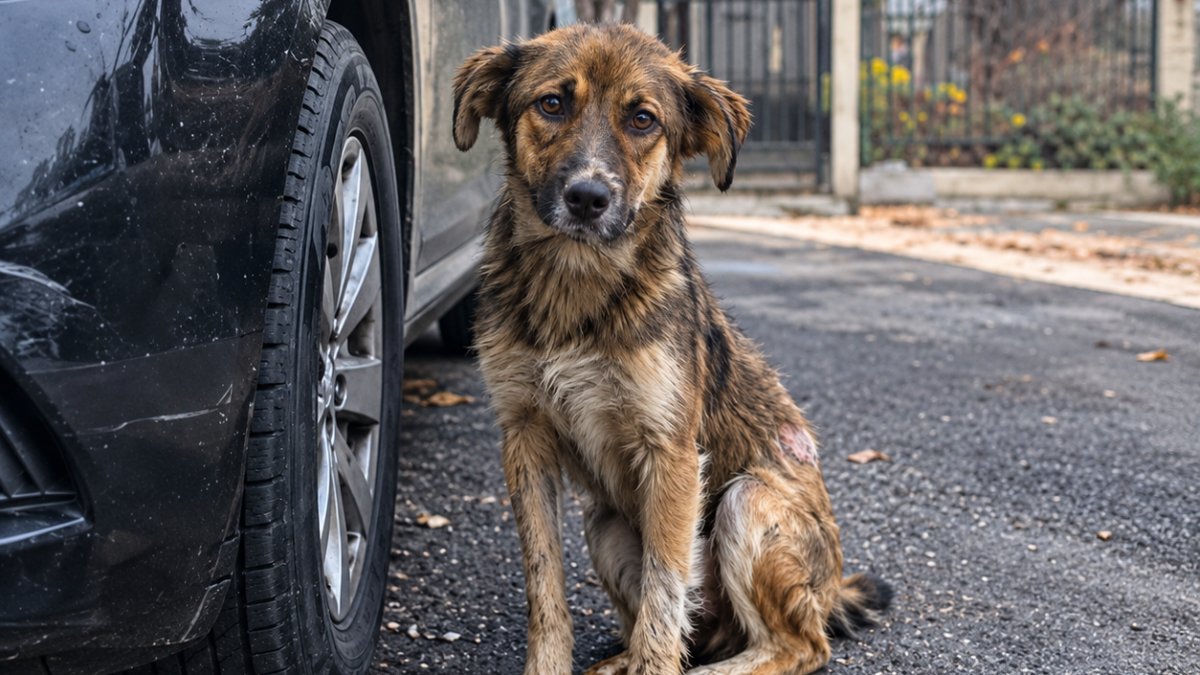
PART 2
The first thing I did was bring him water.
Not much.
I had read enough over the years to know that a severely dehydrated animal could make himself sick if allowed to gulp too quickly, so I poured a little into a shallow bowl and placed it several feet away.
He watched me.
Then the bowl.
Then me again.
“Go ahead.”
Nothing.
I moved backward.
That was enough.
He crawled toward the water and drank.
Fast.
Too fast.
I slid the bowl away after a few seconds.
He looked up at me with an expression so offended that I almost laughed.
“You’re getting more.”
His tongue moved across his lips.
“I promise.”
I gave him another small amount.
Then I brought food.
Dry kibble softened with warm water because I didn’t know how long it had been since he’d eaten properly.
The smell changed him.
For the first time, urgency replaced exhaustion.
He stood.
Stumbled.
Recovered.
Then moved toward the bowl.
“Easy.”
He ate as though the food might disappear.
I stayed close enough to help but far enough not to trigger the fear I’d already seen.
Halfway through, he stopped.
His head snapped toward the street.
A truck had turned the corner.
The dog froze.
Not normal alertness.
Terror.
The truck continued past.
He didn’t move until the sound had faded completely.
Then he returned to the bowl.
That small reaction lodged in my mind.
Vehicle.
Fear.
Maybe coincidence.
Maybe not.
I called my office.
“I won’t be in this morning.”
“Everything okay?”
I looked at the dog.
“No.”
Then I called a veterinary clinic that opened early.
The receptionist asked whether he was injured.
“I don’t know. He’s extremely thin. There’s something wrong with the skin around his neck. And he acts like someone’s been hitting him.”
Her voice changed.
“Bring him in.”
I found an old blanket and tried to guide him toward my car.
That created the next problem.
The second I opened the passenger door, he stopped.
Completely.
His body lowered.
His back legs shook.
“It’s okay.”
He backed away.
I closed the door.
He immediately relaxed slightly.
Interesting.
I opened it again.
Same reaction.
Panic.
Not the car itself.
The open door.
I crouched.
“Did somebody put you in one before?”
He obviously couldn’t answer.
The morning wind moved through the driveway.
I looked at him.
We needed the vet.
I couldn’t force him carelessly.
So I sat beside the car.
Opened the door.
Then did nothing.
Five minutes.
Ten.
I tossed a piece of softened kibble near the threshold.
He ate it.
Another closer.
Then one on the floor mat.
He stared.
I waited.
Eventually, hunger won.
One front paw went inside.
Then out.
I threw another.
This time he put both front paws in.
His body shook.
I said softly, “Nobody’s taking you back anywhere.”
That sentence came from nowhere.
Yet the moment I said it, I knew I meant it.
Another treat.
He climbed into the passenger footwell.
I didn’t close the door immediately.
I let him sniff.
Look.
Breathe.
Then I moved slowly.
“Door.”
Closed.
His head snapped around.
Panic flashed.
I put my hand on the dashboard instead of touching him.
“You’re okay.”
His breathing stayed fast for several minutes.
Then he lowered himself onto the blanket.
I drove like someone transporting glass.
Every bump made me check him.
Every truck made him lift his head.
At the clinic, I opened the passenger door.
He didn’t move.
“Come on.”
Nothing.
A veterinary technician came outside.
She took one look at him and lowered herself several feet away.
“Hey, handsome.”
His ears moved.
“You’ve got a rough morning?”
No response.
She tossed a treat.
He sniffed.
Ate.
Then another.
Between us, we eventually persuaded him out.
The moment she reached toward his collar area, he flattened himself.
Her hand stopped.
“Oh.”
She looked at me.
“You weren’t exaggerating.”
“No.”
We used a slip lead placed as gently as possible and went inside.
The examination room was small.
The dog stood pressed against my legs.
That surprised me.
He’d known me less than two hours.
But apparently I was already the least frightening thing available.
The veterinarian entered.
Middle-aged woman.
Calm voice.
No sudden movements.
“Good morning.”
She looked at the dog.
“Well, maybe not good for him.”
She sat instead of approaching.
“Do we have a name?”
“No.”
“Owner?”
“No idea.”
“Microchip?”
“Haven’t checked.”
She nodded.
“Let’s do that after I examine him enough to make sure he’s stable.”
The exam took time.
Weight first.
Far too low.
Temperature.
Slightly elevated.
Gums.
Pale.
Skin.
Inflammation.
Flea dirt.
Old scabs.
When she reached the neck, her face changed.
She parted the fur.
Then asked the technician for clippers.
“What?”
“I want to see what’s underneath.”
She clipped a narrow patch carefully.
The dark ring became clearer.
It circled nearly the entire neck.
Not bruising from one day.
Thickened skin.
Hair loss.
Scarring.
Inflammation.
I felt my stomach turn.
“What causes that?”
The veterinarian ran one finger near the line without pressing.
“Prolonged pressure and friction.”
“A collar?”
“Most likely.”
“Too tight?”
“Very.”
“For how long?”
“Long enough to cause chronic injury.”
I stared at the dog.
He was looking toward the wall.
The vet continued checking him.
Then she touched near the hairless patch on his side.
Skin infection.
Probably secondary to neglect, parasites, nutrition, maybe stress.
There were small scars on his legs.
A healing wound near one paw.
No obvious fractures.
Then came the microchip scanner.
The vet passed it between his shoulder blades.
Beep.
We all stopped.
“He’s chipped.”
My heart started beating harder.
The veterinarian repeated the scan.
Same number.
I should have felt relieved.
A microchip meant history.
Maybe family.
Someone looking for him.
Instead, I remembered the neck.
The flinch.
The car door.
The truck.
I said, “Don’t call the owner yet.”
The veterinarian looked at me.
“We need to identify them.”
“I know.”
“But?”
“If whoever owns him did that…”
She understood.
“We’ll contact animal control before arranging any return.”
Relief.
“Thank you.”
We drew blood.
The dog hated the needle but tolerated it.
He pressed so hard against my knees that I nearly lost balance.
“You’re okay.”
The vet looked up.
“He trusts you.”
“He met me this morning.”
“Sometimes frightened animals choose quickly.”
I wasn’t ready to think about that.
Bloodwork confirmed malnutrition and mild anemia.
Dehydration.
No catastrophic organ failure.
Skin infection.
Parasites.
The good news mattered.
The vet said, “He’s in bad condition, but I don’t see anything right now that makes me think he can’t recover.”
I exhaled.
“Really?”
“Really.”
Then she added, “But emotionally, he may take longer.”
I looked down.
The dog was sitting with his body touching my shoe.
“What do we do?”
“Food in controlled portions. Parasite treatment. Antibiotics for the skin where needed. Medicated baths. Rechecks. And patience.”
“Does he need hospitalization?”
“Not necessarily if someone can monitor him closely.”
We both looked at me.
I laughed once.
“What?”
The vet smiled.
“You know what.”
“I found him two hours ago.”
“Yes.”
“I have work.”
“Yes.”
“I don’t even know his name.”
“We can fix one of those.”
The receptionist knocked and entered with printed registration information.
The chip was registered.
Male dog.
Name: Milo.
Two years old.
Owner: Ethan Cole.
Address less than five miles away.
Phone number active.
I said the name.
“Milo.”
The dog’s head lifted immediately.
There was no question.
Again.
“Milo.”
Tail.
One small movement.
Then another.
I felt something tighten in my chest.
“Okay.”
He had a name.
A life before my driveway.
And maybe someone who had made him afraid of his own.
Animal control arrived about an hour later.
An investigator named Karen asked questions.
Where found.
Exact time.
Condition.
Whether he had a collar.
He didn’t.
Only the damaged ring on his skin.
She photographed everything.
Then she called the registered phone number from the clinic.
I was not supposed to listen.
I absolutely listened.
She put the call on speaker only after identifying herself and explaining the situation.
A man answered.
“Ethan?”
“Yeah.”
“This is county animal control. We’re contacting you regarding a dog named Milo registered to your information.”
Silence.
Then:
“What about him?”
Not “You found him?”
Not “Is he okay?”
What about him.
Karen’s eyes met mine briefly.
“Milo was found this morning.”
Another pause.
“Okay.”
“Have you reported him missing?”
“No.”
“How long has he been missing?”
Silence.
“A few days.”
“How many?”
“I don’t know. Three? Four?”
My stomach tightened.
Karen continued.
“Where was he last seen?”
“My yard.”
“Address?”
He gave the same one on the chip.
“Was he wearing a collar?”
“Yeah.”
“What kind?”
“Black.”
“How tight?”
He hesitated.
“What?”
Karen repeated, “How tight was his collar?”
“I don’t know. Normal.”
The veterinarian looked at the dark scar around Milo’s neck.
So did I.
Karen asked, “Does Milo have any current medical conditions?”
“No.”
“Any veterinary treatment recently?”
“No.”
“Has he lost weight?”
“He’s always skinny.”
I felt anger rising.
Milo leaned against my leg.
Karen’s tone remained flat.
“We need you to come to the clinic to discuss his condition and ownership.”
“Why? Just bring him back.”
Milo’s body stiffened at the man’s voice.
Every person in the room noticed.
Not subtle.
His ears flattened.
His breathing changed.
He moved behind me.
I felt cold.
Karen said, “We’re not returning him today.”
“What do you mean?”
“His condition requires investigation.”
The man’s voice hardened.
“He’s my dog.”
“Correct. Which is why we need to speak.”
He hung up.
Nobody said anything for a moment.
Then the veterinarian whispered, “Well.”
Karen wrote something in her notebook.
“That reaction matters.”
I looked down.
Milo was still behind me.
“Can he stay here?”
“Yes.”
“Until when?”
“We’ll arrange temporary protective custody through the shelter or foster network.”
I said, “He can stay with me.”
Too fast.
Karen looked up.
The veterinarian smiled.
I pointed at both of them.
“This is temporary.”
No one argued.
That was more suspicious.
Milo came home with medication, special food, a soft harness instead of anything around his neck, and an entire pharmacy’s worth of instructions.
The first day, he followed me everywhere.
Not confidently.
Like someone afraid a closed door meant abandonment.
Kitchen.
Bathroom.
Living room.
If I disappeared from sight, he stood.
If I came back, he sat.
That night, I put a dog bed beside my bedroom door.
Milo stared at it.
Then at me.
“That’s yours.”
He sniffed.
Walked around it.
Lay on the floor beside it.
“Excellent use of money.”
No reaction.
I went to bed.
At two in the morning, I woke because something touched my hand.
Milo stood beside the mattress.
I hadn’t heard him enter.
His nose pressed against my fingers.
“Hey.”
He froze.
Then relaxed.
I sat up.
“You okay?”
His tail moved once.
I patted the side of the mattress, not expecting anything.
Milo climbed up.
Slowly.
Carefully.
Then curled at the foot of the bed.
Within seconds, he was asleep.
I watched him longer than I care to admit.
At some point, his legs started twitching.
Dreaming.
Then suddenly, his whole body jerked.
He woke violently.
Head up.
Eyes wide.
One soft whine.
I said, “Milo.”
He looked at me.
“You’re here.”
He crawled closer.
Not onto me.
Beside me.
Close enough that his back touched my leg.
Then slept again.
The investigation began revealing pieces.
Not quickly.
Real investigations rarely do.
Ethan came to the clinic the next day.
I wasn’t supposed to be there.
I happened to be dropping off paperwork.
Convenient.
He looked younger than I’d imagined.
Early thirties.
Work boots.
Baseball cap.
Normal.
That’s always the disturbing part.
Cruel people don’t wear signs.
Karen met him in a consultation room.
He immediately demanded Milo back.
She refused.
He became angry.
He claimed Milo was an escape artist.
Claimed the collar had been fine.
Claimed the dog was thin because he “wouldn’t eat.”
Claimed the skin problem had appeared recently.
Then the veterinarian entered with photographs.
The conversation changed.
The neck injury couldn’t have formed in several days.
The malnutrition wasn’t new.
The skin infection wasn’t new.
The scars weren’t new.
Ethan became defensive.
“I work twelve hours a day.”
Karen said, “That doesn’t answer the question.”
“My girlfriend was supposed to feed him.”
“Where is she?”
“Gone.”
“Since when?”
“A month.”
“Who cared for Milo after that?”
“I did.”
“How often was he outside?”
“He liked outside.”
“Was he chained?”
Pause.
“No.”
That pause mattered.
Karen asked again.
“Was Milo tethered?”
“Sometimes.”
“What kind of tether?”
“Chain.”
“Attached to what?”
“Post.”
“How long per day?”
“I don’t know.”
“Hours?”
Silence.
The picture became uglier.
A young dog.
Tight collar.
Chain.
Hours outside.
Food inconsistent.
No treatment.
Fear of trucks maybe linked to work vehicles.
Fear of open car doors.
But how had Milo reached my driveway?
That mystery came later.
A neighbor contacted animal control.
Mrs. Alvarez.
Seventy-one.
Lived two houses from Ethan.
She had been feeding Milo through the fence.
For months.
Small pieces of chicken.
Kibble.
Water when his bowl was empty.
She said Milo was often tethered in the backyard.
The collar grew tighter as he matured.
She told Ethan.
He said Milo was “fine.”
She offered a larger collar.
He told her to mind her business.
One evening, she saw Ethan strike Milo after the dog knocked over a trash can.
Not beat him.
One strike.
Then another.
Enough.
She threatened to report it.
Ethan shouted at her.
Two days later, Milo disappeared.
She assumed he’d been moved.
Then animal control knocked on her door.
Karen called me afterward.
“She cried when she saw his photo.”
“Did she know he got out?”
“No.”
“What does Ethan say now?”
“That Milo slipped his tether.”
“Could he?”
“Possible.”
Something bothered me.
Milo had arrived without collar or chain.
If he slipped a collar that tight, his neck should show fresh damage.
The veterinarian didn’t think so.
So how did the collar come off?
Then someone found footage.
A doorbell camera.
Not from Ethan’s house.
Across the street.
The night before Milo appeared beside my car, Ethan’s pickup left his driveway at 11:43 p.m.
A dog-shaped figure was visible in the truck bed behind a secured gate.
At 12:06 a.m., another camera near my neighborhood captured the same truck turning onto my street.
At 12:14, it left.
No clear image showed Milo being removed.
But the timeline was difficult to ignore.
Milo hadn’t escaped.
He had been driven there.
Left.
Why my house?
Maybe random.
Maybe not.
Karen looked into it.
My property was close to a small green space.
Quiet street.
No cameras visible from the curb.
Easy place to leave a dog.
Except one neighbor across from me had a camera.
The footage showed Ethan’s truck stopping thirty yards from my driveway.
The passenger door opened.
A dog was pushed out.
The truck drove away.
The dog stood in the road for almost a minute.
Then walked.
Slowly.
Toward my driveway.
I watched the footage once.
Never again.
There was Milo.
Thin.
Confused.
Watching the truck disappear.
Then turning toward darkness.
He wandered into my driveway.
Curled beside my tire.
Waited until morning.
The anger I felt was physical.
“He dumped him.”
Karen nodded.
“Looks that way.”
“And then lied that he escaped.”
“Yes.”
“Why here?”
“No indication he knew you.”
“So random.”
“Probably.”
That made it worse somehow.
Ethan hadn’t chosen a rescue.
A clinic.
A shelter.
A person.
He chose a street.
And drove away.
When confronted with the footage, his story collapsed.
He admitted taking Milo.
But claimed he intended someone to find him.
The same cowardly logic cruelty always seems to borrow.
Someone.
Someone will help.
Someone will feed him.
Someone will take responsibility.
Someone turned out to be me.
But Milo could easily have run into traffic.
Could have disappeared.
Could have been hit.
Could have starved.
The fact that he survived did not make the decision less cruel.
Charges followed.
Neglect.
Abandonment.
Animal cruelty-related violations based on the total circumstances.
I was asked to give a statement.
So was Mrs. Alvarez.
The veterinarian documented Milo’s injuries.
The camera footage did the rest.
Meanwhile, Milo changed.
Slowly at first.
Then suddenly.
His weight increased.
The dark ring around his neck began healing.
New fur appeared.
The patch on his side filled in.
The medicated baths became easier after the third one.
The first had been awful.
When I turned on the water, he panicked.
Not normal bath resistance.
He tried to escape.
Scratched the tub.
Whined.
I shut the water off.
Sat beside him.
“Okay.”
His entire body shook.
“No bath.”
I called the vet.
She suggested sponge cleaning and gradual desensitization.
So we started with a damp cloth.
Milo sniffed it.
Flinched when it touched his shoulder.
I stopped.
Treat.
Again.
Treat.
Days.
Then shallow water.
Weeks.
Eventually, warm baths became something he tolerated.
Later, oddly, enjoyed.
He would stand with eyes half closed while I massaged medicated shampoo into his coat.
The first time that happened, I whispered, “You trust me.”
Milo opened one eye.
Probably wondering why the idiot was emotional during a bath.
He started playing around week three.
I had bought toys immediately.
Too many.
Milo ignored every one.
Then one afternoon, I accidentally dropped a tennis ball.
It bounced.
Milo’s ears went up.
The ball rolled across the room.
He stared.
Then chased it.
Three steps.
Stopped.
Looked back at me.
I picked it up.
“Want it?”
Tail.
A real wag.
I threw it gently.
Milo ran.
Not fast.
Still weak.
But he ran.
He grabbed the ball.
Then seemed confused about what came next.
“Bring it back.”
He walked away with it.
“Okay. We need to work on that.”
For an hour, he carried the ball everywhere.
Kitchen.
Hallway.
Bed.
That night he slept with it.
I took a picture.
Sent it to the veterinarian.
Her reply:
**That’s the dog we were waiting for.**
Me too.
The fearful dog didn’t disappear.
He still ducked when hands moved too fast.
Brooms scared him.
Raised voices froze him.
Men in baseball caps were particularly difficult.
One delivery driver stepped toward him too quickly and Milo urinated.
I wanted to disappear from secondhand heartbreak.
The driver apologized repeatedly.
“It’s okay.”
“No, I scared him.”
“You didn’t know.”
Milo hid behind me.
I crouched.
No touching.
Wait.
After several minutes, he came back.
Trust wasn’t linear.
Good day.
Bad day.
Progress.
Trigger.
Recovery.
Again.
The biggest breakthrough happened because of Mrs. Alvarez.
Animal control asked whether I would allow her to visit.
I said yes.
When she entered my yard, Milo was outside.
He heard her voice before he saw her.
“Mijo.”
His entire body stopped.
Then exploded.
He ran.
Full speed.
Straight toward her.
Mrs. Alvarez dropped to her knees.
“Milo!”
He jumped against her chest.
She cried.
Not quietly.
She held his face.
“Oh, baby.”
Milo whined.
Licked her.
Circled.
Returned.
His tail would not stop.
I stood back.
She had been one of the few good humans in his old life.
He remembered.
That mattered.
She told me more while Milo lay across her feet.
“I tried.”
“I know.”
“I should have called sooner.”
“You fed him.”
“I should have done more.”
I understood the guilt.
Different version of mine.
“What happened the night he disappeared?”
She wiped her eyes.
“I heard shouting.”
“From Ethan?”
“Yes.”
“At Milo?”
“I think so.”
“Then?”
“Truck.”
She looked at Milo.
“I thought maybe he took him somewhere.”
He did.
Just not somewhere safe.
Mrs. Alvarez visited often after that.
Milo adored her.
She brought treats.
Too many.
“You’ll make him fat.”
“He deserves fat.”
“The vet disagrees.”
“The vet has no heart.”
I laughed.
Milo learned that not all reminders of his past were dangerous.
Some people had loved him.
That was important.
The court process dragged.
Months.
Delays.
Hearings.
The prosecutor eventually offered a plea arrangement that included fines, probation, restitution toward Milo’s medical care, restrictions involving animal ownership during the court period, mandatory education/community service, and a cruelty record.
I wanted more.
I won’t pretend otherwise.
When I thought about the truck footage, I wanted more.
When Milo ducked at a raised hand, I wanted more.
When I saw the permanent scar beneath his fur, I wanted more.
Then I looked at Milo.
He didn’t care.
He cared about tennis balls.
Food.
Mrs. Alvarez.
My couch.
Whether the mailman had treats.
His life wasn’t improved by my anger.
Consequences mattered.
Vengeance did not.
Still, one moment gave me the closure I hadn’t expected.
At sentencing, Ethan was allowed to speak.
He looked different.
Not destroyed.
Not transformed.
Just uncomfortable.
He said he’d been overwhelmed.
Lost work.
Relationship problems.
Couldn’t afford veterinary care.
Milo kept getting sick.
The dog “wouldn’t behave.”
He said taking him to my street had been “a mistake.”
The judge asked one question.
“Why didn’t you surrender him?”
Ethan said shelters were full.
The prosecutor produced records.
He had never contacted any.
Silence.
Then:
“Why did you leave him at midnight instead of outside a clinic or animal shelter?”
No answer.
The judge waited.
Finally Ethan said, “I was ashamed.”
The same word that appears in so many cruelty cases.
Ashamed.
I thought about that.
Shame had made him hide the problem instead of solve it.
But Milo paid the price.
The judge said something simple.
“Your hardship may explain why you felt overwhelmed. It does not explain why the animal had to suffer.”
Exactly.
When we walked outside, Ethan saw me.
He hesitated.
Then approached.
Every part of me tightened.
“I’m not supposed to contact you,” he said.
“Then don’t.”
He stopped.
“I just wanted to ask…”
I said nothing.
“Is he okay?”
For one second, I almost walked away.
Then I remembered Milo’s body pressed against my knee.
Mrs. Alvarez crying.
The tennis ball.
I answered for Milo.
“He’s healthy.”
Ethan nodded.
“Good.”
I continued.
“He still drops his head when people move too quickly.”
His face changed.
“He still panics around trucks.”
He looked down.
“He still has a scar around his neck.”
Silence.
“But he plays now.”
Ethan swallowed.
“I didn’t mean—”
I cut him off.
“Don’t.”
He stopped.
“You don’t get to make what happened smaller because you regret it now.”
His eyes stayed on the pavement.
I said the only thing I had left.
“He trusted you.”
Ethan closed his eyes.
Then nodded.
“I know.”
I walked away.
That was enough.
Not forgiveness.
Not revenge.
Truth.
Milo became legally adoptable after Ethan formally surrendered ownership during the case.
The rescue coordinator called.
“You still fostering?”
I looked at Milo.
He was asleep upside down on my couch.
One tennis ball under his chin.
Another somehow beneath his back.
“Technically.”
“Want to make it official?”
“No.”
Pause.
Then I laughed.
“I’m kidding.”
She groaned.
“Don’t do that.”
“Yes.”
“Yes what?”
“Send the paperwork.”
It arrived that afternoon.
I filled it out before dinner.
The adoption application asked:
**Why do you want to adopt Milo?**
I wrote:
**Because he already chose my driveway, my couch, my bed, and apparently my entire schedule. More importantly, because I never want him to wait beside another car wondering whether someone is coming back for him.**
Approved.
Official.
Mine.
Or rather, I became his.
Adoption day changed nothing.
That was the best part.
Milo woke.
Ate breakfast.
Stole my sock.
Played ball.
Slept on the couch.
The paperwork simply confirmed what both of us already knew.
Months passed.
Then a year.
The scar around his neck faded beneath new fur.
Still there if you knew where to touch.
The skin had thickened.
Permanent reminder.
I rarely touched it.
No need.
Milo grew strong.
Not bulky.
Athletic.
His ribs disappeared.
His coat became glossy.
The irritated patch healed.
The veterinarian eventually said, “He’s at ideal weight.”
I smiled.
“You remember when we celebrated every ounce?”
“I remember telling you not to overdo it.”
“You were right.”
“Please say it again.”
“No.”
Milo became obsessed with running.
The dog I’d found folded beside a tire wanted open space.
At first, fenced yard.
Then trails on a long line.
Eventually, recall training.
We worked for months.
“Milo.”
Turn.
“Come.”
Treat.
Again.
Again.
Again.
Trust became training.
Training became freedom.
The first time I released him in a safely enclosed field, Milo stood still.
I expected him to run immediately.
He looked at me.
I said, “Go.”
He ran.
Not away.
Across the grass.
Huge circles.
Tail high.
Mouth open.
Every few seconds he looked back.
There.
Still there.
Again.
Run.
Look.
Still there.
Eventually, he sprinted directly toward me.
Too fast.
“Milo!”
He hit my legs and nearly knocked me down.
I laughed so hard I couldn’t stand.
He jumped around me.
For a moment, I remembered the driveway.
Same dog.
Different body language.
Then:
Head down.
Waiting for a blow.
Now:
Head high.
Running toward me because he knew I wouldn’t disappear.
Mrs. Alvarez came to the field one day.
Milo saw her and abandoned me immediately.
“Traitor.”
She laughed.
“Smart dog.”
She sat under a tree.
Milo dropped beside her.
She ran her hand over his coat.
“He looks so different.”
“He is.”
“No.”
She shook her head.
“He’s the same.”
I thought about it.
Maybe she was right.
The fear wasn’t his personality.
The thin body wasn’t him.
The damaged neck wasn’t him.
Those were things done to him.
Milo himself had always been underneath.
Playful.
Affectionate.
Stubborn.
Ridiculous.
He just needed enough safety to emerge.
The revenge part of Milo’s story eventually became something I didn’t expect.
Not court.
Not Ethan’s shame.
Not fines.
It was visibility.
The local rescue used Milo’s case in educational material about tether injuries and neglect.
Photographs showed what tight collars can do.
How chronic chaining affects behavior.
How fear responses are often misread as “bad temperament.”
One workshop trained volunteers to recognize shutdown behavior.
They used Milo as an example.
A dog that doesn’t bark, growl, or run isn’t always calm.
Sometimes he’s learned resistance is useless.
That line stuck with people.
One volunteer later told me they recognized similar behavior in another dog because of Milo’s story.
They moved slowly.
Used food.
Avoided forced contact.
The dog eventually opened up.
I told Milo.
“You have a career now.”
He yawned.
“Very impressive.”
He rolled onto his back.
No interest.
Another dog came into our lives temporarily two years later.
Not adoption.
Foster.
At least that was the plan.
A young female named Rosie.
Terrified.
Hid behind furniture.
Milo surprised me.
He didn’t crowd her.
Didn’t force play.
He lay several feet away.
Quiet.
The first day.
Second.
Third.
On day four, Rosie moved closer.
Milo stayed.
She sniffed him.
Then lay down.
I watched.
Milo had become for another dog what I had tried to become for him.
Safe.
Predictable.
No pressure.
That almost broke me.
Rosie went to a family six weeks later.
Milo searched for her one evening.
Then returned to his ball.
Resilient.
Several more fosters passed through.
Milo became a strange kind of emotional anchor.
Dogs trusted him.
Maybe because he understood fear.
Maybe because he simply wasn’t pushy.
He had once needed someone to sit still.
Now he knew how to do the same.
The years changed him.
Gray appeared around his muzzle.
Not much.
Then more.
The young dog beside my tire became a mature dog.
The scar around his neck remained.
The fear of trucks faded.
Not completely.
Large diesel engines still made him look up.
But he no longer flattened himself.
He looked.
Checked me.
Continued.
That tiny sequence meant everything.
Trigger.
Check.
Safety.
Move on.
Healing.
One afternoon, a pickup identical in color to Ethan’s old truck parked near us.
Milo froze.
I saw it.
He saw me see it.
I said, “You’re okay.”
The driver got out.
Milo remained standing.
No crouch.
No trembling.
The driver walked past.
Milo sniffed the grass.
Continued.
I had to look away for a second.
Victory can be incredibly boring to anyone who doesn’t know the history.
A dog sniffing grass while a truck passes.
For us, enormous.
My life changed too.
Before Milo, I had been the kind of person who cared about animal rescue abstractly.
Shared posts.
Donated occasionally.
Felt sad.
Then continued.
After Milo, I understood the distance between sympathy and action.
Not everyone can adopt.
Not everyone can foster.
But almost everyone can do something.
Stop.
Call.
Document.
Bring water.
Contact a rescue.
Report neglect.
Offer temporary help.
Milo had needed one person to notice him beside a tire.
Then many others.
Vet.
Investigator.
Neighbor.
Rescue.
Judge.
Healing is rarely a solo project.
On the third anniversary of finding him, I woke before sunrise.
Same time.
October chill.
I made coffee.
Opened the front door.
Milo followed.
He walked to the driveway.
Stopped beside the front wheel of my newer car.
I laughed.
“Seriously?”
He sniffed the tire.
Then looked at me.
The image hit me so hard that I sat on the front step.
Three years earlier, he’d been lying there.
Thin.
Afraid.
Waiting.
Now he stood beside me wearing a loose harness, healthy coat shining under the porch light.
No collar scar visible unless fur moved.
I touched his shoulder.
“Do you remember?”
Milo wagged.
Probably not the way I did.
Good.
I hoped the worst morning of his life had become less important than thousands of better ones.
He nudged my hand.
Breakfast.
Of course.
We went inside.
Years later, Mrs. Alvarez died.
Her daughter called me.
I hadn’t expected it.
Milo was older then.
Eight, maybe nine.
She asked whether I could bring him to the memorial gathering.
“He was important to Mom.”
We went.
Milo recognized the house immediately.
Even after years.
He walked inside.
Sniffed.
Searched.
Went to Mrs. Alvarez’s old chair.
Stopped.
His ears moved.
No voice.
He waited.
My chest hurt.
Her daughter knelt.
“She loved you.”
Milo leaned against her.
People shared stories.
Someone mentioned the chicken she used to sneak through the fence.
I laughed.
“That explains everything.”
Milo spent the afternoon near her chair.
I wondered whether animals understand absence.
Maybe not conceptually.
But Milo knew someone was missing.
He had learned that once before.
This time, nobody had abandoned him.
Loss and abandonment are not the same.
That mattered.
Milo aged slowly.
His hips stiffened around ten.
Supplements.
Then medication.
Shorter runs.
Longer naps.
Tennis balls remained sacred.
He could no longer sprint full circles without tiring.
Didn’t matter.
I rolled the ball indoors.
He fetched badly.
Still refused to bring it all the way back.
A decade of training had accomplished almost nothing there.
“You’re supposed to return it.”
Milo dropped it six feet away.
“Closer.”
He sat.
“Fine.”
I retrieved it.
He had trained me.
At eleven, the veterinarian heard a mild heart murmur.
Monitoring.
At twelve, arthritis.
More management.
At thirteen, occasional confusion at night.
I hated every sign of aging.
Not because I resented care.
Because time felt unfair.
The dog had lost part of youth to neglect.
Now old age wanted the rest.
I knew that wasn’t rational.
Milo didn’t know he had been cheated.
He knew today.
Food.
Walk.
Nap.
Me.
That was enough.
One evening, he woke disoriented.
Walked into the hallway.
Stopped.
Whined.
I came out.
“Milo.”
His ears lifted.
He found me.
Pressed his head against my leg.
Same gesture as the first morning.
Only now there was no fear.
Just reassurance.
I sat on the floor.
“You found me again.”
His tail moved.
I stayed until he settled.
Old dogs return us to the beginning in unexpected ways.
The body becomes fragile.
Needs increase.
Patience matters again.
But this time, Milo never had to wonder whether increased need would cost him his home.
That became my promise.
I remembered Ethan’s complaint.
Milo became difficult.
Old age did make Milo difficult sometimes.
Night waking.
Accidents.
Medication.
Slow stairs.
Vet bills.
Special food.
Lifting him into the car.
So what?
Difficulty is not disqualification from love.
The hardest part came at fourteen.
Maybe fifteen.
A tumor.
Spleen.
The veterinarian found it after Milo became suddenly weak.
Ultrasound.
Bloodwork.
The room went quiet.
“What does this mean?”
She explained.
Could be benign.
Could rupture.
Could be cancer.
Surgery possible.
Age increased risk.
I hated every option.
“If he were yours?”
The same question I’d asked years earlier about other animals.
The veterinarian looked at Milo.
“He is otherwise doing remarkably well for his age.”
“So surgery?”
“If staging doesn’t show widespread disease, I would consider it.”
We did imaging.
No obvious metastasis.
Surgery.
I sat in the same kind of waiting room where his story had begun medically.
Different clinic now.
Same helplessness.
Two hours.
Three.
The surgeon came out.
Mass removed.
No rupture.
Milo stable.
Pathology later showed benign hematoma.
I cried.
Ridiculous relief.
Another year.
We got another year.
A whole year.
Walks.
Chicken.
Balls.
Summer grass.
Winter blankets.
People say “only a year” as if a year is small.
A year is 365 mornings.
365 chances to hear a dog’s nails on the floor.
365 dinners.
365 ordinary proofs of life.
I learned to stop calling time small.
At fifteen or sixteen, Milo’s kidneys declined.
Age.
Nothing dramatic.
Fluids.
Food changes.
Medication.
He tolerated treatment better than I did.
One evening, he refused the ball.
That scared me more than skipped food.
I rolled it.
Milo watched.
Didn’t stand.
I sat beside him.
“You okay?”
He put his head on my knee.
The next morning, he ate.
Chased the ball once.
Relief.
But decline continued.
Eventually, the veterinarian said the sentence I’d feared for years.
“We need to start thinking about quality of life.”
I already had.
Every day.
Good days.
Bad days.
Food.
Pain.
Mobility.
Interest.
Connection.
For months, good remained ahead.
Then the balance shifted.
Milo stopped wanting walks.
Then food became difficult.
Then standing.
One cold October morning, almost exactly thirteen years after he’d appeared beside my car, he tried to rise and couldn’t.
I helped.
He stood.
Looked at me.
No fear.
Just tired.
That expression took me back.
The first morning.
Young dog with old eyes.
Now he actually was old.
He had earned the gray muzzle.
Earned the slow body.
Earned the right to be tired.
I called the veterinarian.
She came to the house.
I couldn’t take Milo on one last frightening car ride.
He hated cars less now.
Still.
Home felt right.
I made his bed beside the front window.
Sunlight.
Blanket.
Ball.
Ridiculous ball.
My sister came.
The rescue coordinator from years ago came briefly.
Even Karen, now retired, sent a message.
**Tell him he was a very good boy.**
I laughed through tears.
“He knows.”
The veterinarian arrived quietly.
Milo lifted his head at her voice.
She sat beside him.
“No rush.”
I looked at him.
“Remember the driveway?”
Tail moved once.
“I’m sure you don’t.”
I touched the fur around his neck.
The scar was still there underneath.
Barely.
“You scared me.”
Milo breathed slowly.
“You looked at me like I was going to hit you.”
My voice broke.
“And then you walked over anyway.”
He nudged my hand.
Even then.
Still him.
I pressed my forehead against his.
“You had terrible judgment.”
My sister laughed.
Cried.
“He chose you.”
“Yeah.”
The vet waited.
I wasn’t ready.
No one ever is.
But love eventually asks for the thing we least want to give.
Release.
I whispered, “You don’t have to wait beside any more cars.”
His ears moved.
“You don’t have to check whether I’m coming back.”
I put one hand on his chest.
“I’m here.”
Sedative.
Milo relaxed.
His head became heavy in my lap.
The tennis ball sat beside his paw.
I said his name.
Again.
Again.
Again.
Not because he didn’t know it.
Because once, someone had said Milo and made him afraid.
I wanted the last voice saying it to mean home.
His breathing slowed.
The final injection came after he was fully asleep.
One breath.
Another.
Then none.
The veterinarian listened.
Looked at me.
“I’m sorry.”
I knew.
Still destroyed me.
I held him for a long time.
His body warm at first.
Then gradually not.
The same dog who had once pressed himself against cold asphalt was leaving from a thick blanket inside a warm house.
No hunger.
No chain.
No fear.
No truck driving away.
Only people staying until the end.
I had Milo cremated.
His ashes came in a wooden box.
I placed the first tennis ball I’d saved beside it.
Not the actual first one.
He had destroyed that years ago.
A replacement with the same worn green color.
For weeks, mornings felt wrong.
I opened the door and expected him.
Nothing.
I looked beside the car.
Empty pavement.
That hurt more than I expected.
Eventually, I adopted again.
Not quickly.
Another rescue dog.
Different story.
Different personality.
The first morning the new dog sat beside my car, I froze.
Then laughed.
“Absolutely not.”
He wagged.
Milo’s story had changed the shape of my life.
I became a foster.
Then volunteer.
Then the person neighbors called when a frightened dog appeared somewhere.
I never became an expert.
I simply became unable to look away.
That was Milo’s legacy.
Not the cruelty case.
Not the news article.
Not the scar.
Attention.
He taught me that some animals do not ask loudly.
They don’t bark.
They don’t chase cars.
They don’t collapse dramatically in front of crowds.
Sometimes they lie quietly beside a tire.
Sometimes they lower their head when you approach.
Sometimes the emergency is hidden inside stillness.
You have to notice.
Years after Milo died, I saw Ethan once.
Grocery store parking lot.
He recognized me.
I recognized him.
Neither spoke at first.
Then he said, “I’m sorry about Milo.”
I didn’t know how he knew.
Maybe public rescue page.
Maybe Mrs. Alvarez’s family.
He looked older.
So did I.
I said, “He had a good life.”
Ethan nodded.
“I saw pictures.”
Silence.
“He looked happy.”
“He was.”
Ethan looked toward the ground.
“I think about him.”
I believed him.
That didn’t change what happened.
“I’m glad.”
He looked surprised.
“Why?”
“Because forgetting would be worse.”
He nodded.
Then asked the question he’d asked years before.
“Did he ever stop being afraid?”
I thought about the truck.
The raised hand.
The field.
The last years.
“Mostly.”
His eyes filled.
“Good.”
I could have punished him with details.
Could have described every fear response.
Every scar.
Instead, I said something simpler.
“He learned people could stay.”
Ethan looked away.
I walked inside.
That conversation gave me more peace than rage ever had.
Milo’s revenge had never been Ethan’s pain.
It was Milo’s freedom.
The young dog who’d been chained became the dog who ran open fields.
The dog afraid of vehicles became the dog who rode to parks with his head near the window.
The dog who expected hands to strike him became the dog who pushed his head underneath any available hand for scratches.
The dog left beside a random driveway became the dog whose home lasted the rest of his life.
That is the part I carry.
Not the truck footage.
Not court.
Not the dark ring around his neck.
I remember one afternoon more clearly than any of those things.
Milo was maybe six.
Healthy.
Strong.
We were in the fenced field.
I threw the tennis ball.
He chased it.
Ignored bringing it back, obviously.
Then suddenly he stopped halfway across the grass.
Turned.
Looked directly at me.
For no reason.
I lifted one hand.
“Milo.”
He ran back.
Full speed.
Straight toward me.
No hesitation.
No lowered head.
No bracing.
He knew exactly what my raised hand meant.
Come here.
You’re safe.
Home is this direction.
That’s the ending.
Everything else was how we got there.
When Milo first appeared beside my car, I thought he’d chosen the spot because it sheltered him from wind.
Maybe.
Maybe he was simply exhausted.
Maybe my driveway happened to be where his legs finally stopped.
But some irrational part of me still likes the first thought I had that morning.
He looked like he’d been waiting for me.
I know that’s sentimental.
Dogs don’t predict rescuers.
Fate is a word people use when coincidence becomes emotionally important.
Still.
He waited.
I came outside.
He looked at me.
Then, despite everything people had already taught him, he walked forward.
That was the bravest thing Milo ever did.
Not surviving the chain.
Not surviving hunger.
Not surviving abandonment.
Trusting again.
One frightened step.
Then another.
Then his forehead against my knee.
The entire rest of his life began there.
If I could go back to that cold morning and speak to the young dog beside my wheel, I wouldn’t ask who hurt him.
There would be time for evidence.
Investigations.
Consequences.
I wouldn’t ask where he’d come from.
Wouldn’t ask how he’d gotten there.
I would kneel exactly as I did.
Keep my hands low.
Wait.
And when he finally moved toward me, I would tell him the one thing he couldn’t possibly have understood yet.
“You don’t need to brace yourself anymore.”
“No one’s hitting you here.”
“No one’s leaving you on this street.”
“And the next time you see a car door open, it won’t mean someone is taking you away.”
“It will mean we’re going home.”
Because that’s what Milo eventually learned.
Home wasn’t the place where his microchip had once been registered.
It wasn’t the yard where a chain wore a scar around his neck.
It wasn’t the street where a truck left him.
Home was the place where his bowl returned after every meal.
Where hands moved gently.
Where medicine came when he hurt.
Where old age didn’t make him disposable.
Where difficult days didn’t cancel belonging.
Where someone answered when he woke afraid.
Where someone stayed.
The man who abandoned him had once looked at Milo and decided he was too much trouble.
He was wrong.
Milo was worth every bit of it.
Every vet bill.
Every ruined blanket.
Every bath.
Every training session.
Every sleepless night.
Every tennis ball hidden under furniture.
Every slow walk at the end.
Every tear after.
All of it.
And if there was ever a revenge greater than a courtroom could deliver, it was this:
Ethan left a frightened, starving dog on a dark street expecting him to disappear into somebody else’s problem.
Instead, Milo became impossible to forget.
He healed.
He ran.
He trusted.
He grew old.
He became loved enough that years after his last breath, I can still look toward the front tire of my car on a cold morning and see him there.
Young.
Thin.
Head lowered.
Waiting.
Then I remember what happened next.
He stood.
He came closer.
And this time, somebody stayed.