PART 2: A Mother Dog Dragged Five Puppies Out of the Flood—But Her Sixth Trip Exposed the Man Who Left Them to Die
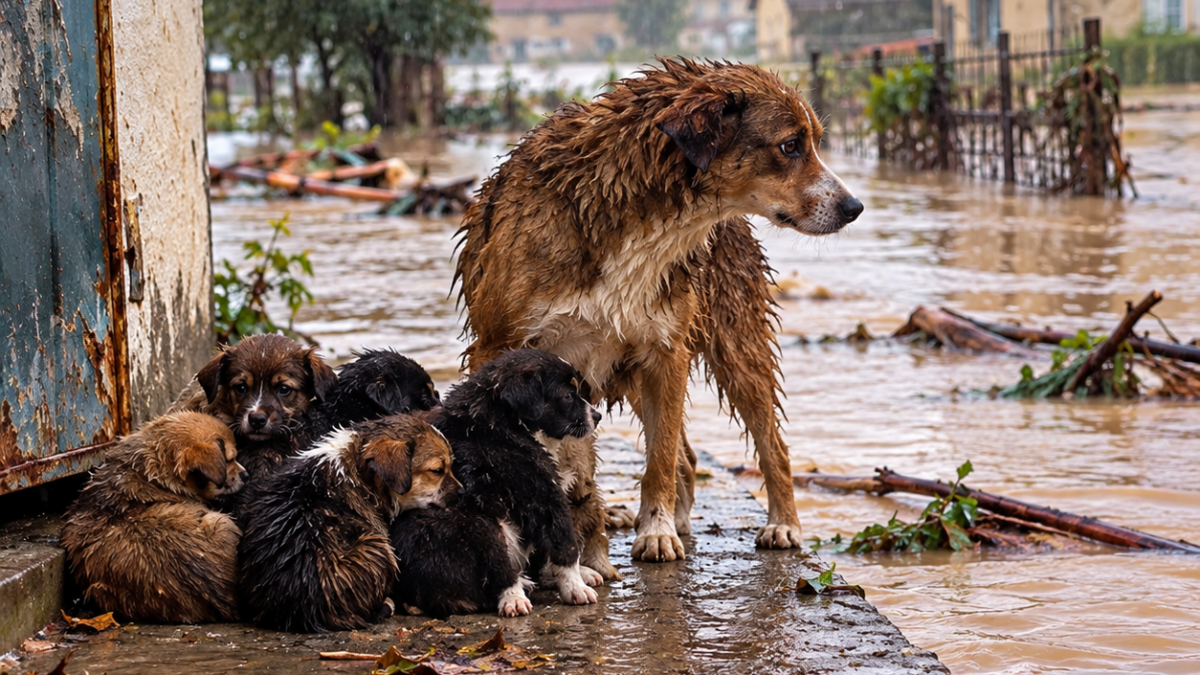
PART 2
It was a collar.
A small red collar.
Soaked, muddy, and twisted around something dark.
For one terrible second, I thought she was carrying a dead puppy by the neck.
Then Maya reached the edge of the concrete slab and dropped the bundle at my feet.
It hit the ground with a wet slap.
Not a puppy.
A collar, a torn piece of rope, and a plastic tag still attached to the metal ring.
Maya collapsed beside it.
The five puppies immediately crawled toward her, whining and pushing their little noses against her face.
“Maya,” I said again, even though I still did not know whether that was her name.
She tried to raise her head.
Her front legs gave out.
“Get us closer!” I shouted.
Marc drove the boat in as carefully as he could without sending waves over the slab. Julien jumped out first, water up to his thighs, rope around his waist. I followed with a thermal blanket clutched against my chest.
Maya made no attempt to run.
She had nothing left.
Her eyes moved to the puppies.
Then to the red collar.
Then back to me.
I had seen injured animals ask for help before. Not with words. With stillness. With surrender. With the heartbreaking moment when fear loses to exhaustion.
But Maya did something different.
She pushed the red collar toward me with her nose.
Just an inch.
Then she laid her head flat on the concrete.
“She wants us to see it,” Julien murmured.
I crouched in the water beside her.
The tag was coated in mud. I wiped it with my thumb.
One word appeared first.
MAYA.
Then a phone number.
My stomach tightened.
“She belongs to someone.”
Marc looked over my shoulder. “Or she used to.”
I looked toward the storage shed she had fought so hard to reach.
The water was halfway up the door now. One side of the roof had caved in. A section of chain-link fencing was tangled against the entrance, along with broken pallets and a piece of blue tarp.
“Why would her collar be out there?” Julien asked.
I already knew the answer I feared.
Because someone had tied her.
Because someone had removed the collar or lost it while trying to leave.
Because that shed was not just a hiding place.
Because Maya had gone back for proof.
The current slapped my knees hard enough to almost knock me sideways.
“Questions later,” I said. “Get the puppies in the boat.”
We moved fast.
The volunteer wrapped each puppy in a towel and placed them into a plastic carrier lined with thermal blankets. The smallest black puppy barely cried. His gums were pale, and his body felt too cold in my hands.
“Stay with me, little one,” I whispered.
Maya lifted her head when I picked him up.
“I have him,” I told her. “I promise.”
She seemed to understand only one part.
Her baby was leaving her reach.
She tried to stand.
Her legs shook violently.
I turned toward her. “No, sweetheart. We’re taking all of you.”
Julien helped me wrap the blanket around her body. When I slid my arms beneath her, she flinched once, then went limp against me.
She was lighter than she should have been.
Too thin beneath the soaked fur.
Too bony for a nursing mother.
And far too cold.
Her heart hammered against my forearm.
We loaded her into the boat beside the carrier. The puppies cried louder when they smelled her. Maya turned her head weakly toward them and tried to crawl closer.
“Let her see them,” I said.
The volunteer shifted the carrier so the puppies were beside their mother. Maya stretched her neck and touched the plastic bars with her nose.
Only then did her body relax.
Marc turned the boat toward higher ground.
Behind us, the old parish hall groaned as water pushed through the lower windows.
I looked back once.
The shed Maya had returned to was almost gone beneath the flood.
If she had not gone back when she did, that red collar would have disappeared.
So would the rope.
So would the first clue.
At the emergency veterinary station, everything became movement.
Warm towels.
Heat lamps.
Oxygen.
Fluids.
Puppies being weighed, dried, checked, and warmed.
Maya was placed on a heated blanket while Dr. Renaud examined her.
“She’s severely exhausted,” he said. “Cold stress, dehydration, possible aspiration risk. Nursing, underweight, and injured.”
“Injured?” I asked.
He pointed to the side of her abdomen. Beneath the wet fur was a dark bruise where the floating plank had struck her.
“There are older marks too.”
My eyes moved to Maya’s neck.
The fur there was rubbed thin.
Almost raw in places.
A collar mark.
Or a rope mark.
Dr. Renaud followed my gaze.
“We’ll document everything.”
I placed the red collar in an evidence bag Sophie from animal protection handed me when she arrived.
Sophie Dubois had worked cruelty cases long enough to read a room before anyone spoke. Her eyes went from Maya to the puppies to the bag in my hand.
“What did you find?”
“Maya brought it back from the shed.”
Sophie frowned. “The dog brought it?”
“She swam back for it after rescuing five puppies.”
Sophie looked at me for a long moment.
Then she said, “Show me.”
I handed her the bag.
She read the tag.
“Maya,” she said quietly.
The mother dog lifted her head weakly from the blanket.
At the sound of her name, her ears moved.
Sophie’s expression hardened.
“She recognizes it.”
“We need to call the number,” I said.
“We will,” Sophie replied. “But not before we document her condition.”
I knew that tone.
It meant Sophie was already angry.
Not loud angry.
Not dramatic angry.
The dangerous kind.
The kind that turned into paperwork, testimony, warrants, and court orders.
The kind that did not cool down.
The smallest puppy was the one we nearly lost first.
He was black with white toes, the last one Maya had placed on the slab before returning for the collar. We named him Button because one white spot on his chest looked like a tiny button.
He could not regulate his temperature properly. His suckling was weak. Every time he grew quiet, my heart stopped.
Maya was too exhausted to nurse safely at first, so the veterinary team helped support the litter with careful feeding while keeping them close enough for her to see and smell them.
She never took her eyes off them.
Not even when her own body trembled from fatigue.
When Button whimpered, she tried to rise.
When one of the brown puppies rolled away from the others, Maya pushed herself up on shaking legs and nudged him back.
When anyone lifted a puppy for examination, she watched every movement.
Not aggressively.
Desperately.
As if the flood had not ended for her.
As if every hand might be another current carrying her babies away.
I sat beside her for most of that first night.
“You did it,” I whispered. “You saved them.”
Maya blinked slowly.
Her eyes were a warm amber brown, almost golden beneath the exhaustion.
“You saved all five.”
At the word five, I stopped.
Because that was the question none of us had asked aloud yet.
Were there only five?
Had Maya gone back for the collar because all her puppies were accounted for?
Or had the sixth trip originally been for someone else?
I looked at the carrier.
Five puppies.
Three brown.
Two black.
No more.
Still, the shape of Maya’s panic haunted me.
The way she had looked at the shed.
The way she fought to return even when her body was failing.
The way she carried that collar like it mattered more than her own survival.
At dawn, Sophie returned with news.
“The number on the tag belongs to a man named Alain Bresson,” she said. “He lives about fifteen kilometers from the parish hall.”
“Did you reach him?”
“Yes.”
“And?”
“He says Maya ran away two months ago.”
I stared at her.
“Two months?”
“That’s what he claims.”
“Maya’s puppies are four weeks old.”
“I know.”
“And she had a rope mark on her neck.”
“I know.”
Sophie’s mouth tightened.
“He says she was difficult. That she escaped before the storm. He says he searched, couldn’t find her, and assumed someone picked her up.”
I looked toward Maya.
She was sleeping with her nose pressed against the side of the puppy carrier.
“Did he ask if she was alive?”
Sophie’s silence answered before she did.
“No.”
My anger came so fast I had to stand up.
“He didn’t ask?”
“He asked if there would be a fine for not reporting her missing.”
I walked to the window and pressed both hands against the sill.
Outside, the floodwater still moved through the lower parts of town. Emergency vehicles passed every few minutes. Families were being evacuated. People were standing on rooftops waiting for help.
And somewhere, a man had been called about a dog who nearly drowned saving five puppies.
His first concern was whether he would be fined.
Sophie stepped beside me.
“We’re going to his property today.”
“I’m coming.”
“No,” she said.
I turned.
“Sophie.”
“You are exhausted, and Maya needs someone here.”
“I need to see where she came from.”
“I know. But if this becomes a formal cruelty investigation, we do it properly.”
She lowered her voice.
“Let me build the case.”
The case.
That word steadied me.
Because rage wanted to run straight to Alain Bresson’s door.
Justice needed evidence.
So I stayed.
I stayed while Button finally latched onto a bottle.
I stayed while Maya accepted her first small meal.
I stayed while the puppies slept in a warm pile against her belly once she was stable enough to have them close.
At midday, Maya lifted her head and looked at me.
For the first time, her tail moved.
Only once.
A tiny, exhausted tap against the blanket.
I cried like a fool.
“Good girl,” I whispered. “You brave, impossible girl.”
Sophie called that evening.
Her voice told me everything before her words did.
“We found the place.”
My stomach tightened.
“What place?”
“The shed wasn’t random. It belonged to Bresson years ago before the parish sold the property. He still used it for storage, illegally.”
I sat down.
“And Maya?”
“There are signs she was kept there.”
I closed my eyes.
“What signs?”
“Old bowls. Rope tied to an interior beam. Torn bedding. Puppy stains. A rusted chain. And an empty dog-food bag inside a sealed plastic bin.”
My voice came out flat.
“He knew she was there.”
“We don’t know that yet.”
“Sophie.”
“We need proof.”
I gripped the phone.
“She swam through floodwater six times. She almost died. And her owner’s old shed has a rope tied inside?”
“I know.”
“What else?”
Sophie hesitated.
That scared me.
“What else?”
“There were scratch marks high on the inside of the door.”
I stopped breathing.
“Like she tried to get out?”
“Yes.”
The room seemed to tilt.
Maya had not simply hidden there.
She had been trapped.
The storm came.
The water rose.
She had puppies too young to swim.
And at some point, somehow, she had gotten out.
Maybe the door broke under pressure.
Maybe debris smashed part of the wall.
Maybe desperation gave her strength no one would believe unless they saw what she did afterward.
But she had escaped.
Then she had gone back.
Not once.
Not twice.
Again and again.
For the babies that had been locked in with her.
My voice shook.
“Can you prove he locked her in?”
“Not yet.”
“Then find a way.”
“I intend to.”
The first confrontation happened two days later.
Alain Bresson came to the emergency veterinary station wearing rubber boots and a navy raincoat, looking more irritated than worried. He was in his late forties, broad-shouldered, with a trimmed beard and the kind of face that had learned how to appear reasonable in public.
Sophie met him at the entrance.
I stood behind the reception desk, close enough to hear.
“I’m here for my dog,” he said.
Sophie kept her voice professional.
“Maya is currently under veterinary care and part of an active animal welfare inquiry.”
His eyebrows lifted.
“An inquiry? She’s my dog.”
“She was found in life-threatening conditions with five puppies.”
“She ran away.”
I stepped out before I could stop myself.
“Into a locked shed you used to own?”
His eyes shifted to me.
“Who are you?”
“The person who watched her nearly drown saving her puppies.”
For one second, something flickered in his face.
Not guilt.
Annoyance.
“She’s always been dramatic,” he said.
I stared at him.
Dramatic.
Maya had fought floodwater until her body collapsed.
Dramatic.
She had carried helpless puppies one by one through a current that could have killed a grown man.
Dramatic.
She had gone back for the collar that led us to him.
My voice lowered.
“Do not talk about her like that.”
Sophie moved slightly between us.
“Mr. Bresson, you are not permitted to remove Maya at this time.”
He laughed once.
“You people are unbelievable. A storm happens, my dog turns up, and suddenly I’m a criminal?”
“No one used that word,” Sophie said.
“Not yet.”
He looked toward the treatment area.
“I want to see her.”
“No.”
His polite mask slipped.
“You can’t keep my property from me.”
I saw Sophie’s expression change.
Property.
There it was.
Not Maya.
Not my dog.
Property.
Sophie took one step closer.
“Under the circumstances, yes, we can.”
Bresson’s jaw tightened.
“You’ll hear from my lawyer.”
“I expect we will.”
He turned to leave.
Then he looked at me.
“You should be careful getting attached. She isn’t yours.”
I thought of Maya pushing the red collar toward me on the concrete slab.
“No,” I said. “But she isn’t a thing you get to collect either.”
He left without asking to see the puppies.
Not once.
Afterward, I went straight to Maya.
She was awake, lying beside her babies.
The moment I entered, she lifted her head.
Had she heard his voice?
Had she recognized it?
Her body was tense.
I sat on the floor a few feet away.
“He’s gone,” I whispered.
Her eyes stayed on me.
“He’s not taking you tonight.”
Button squeaked beside her belly. Maya lowered her nose to him and began cleaning his tiny face.
I watched her, and my anger sharpened into something calmer.
Bresson wanted us emotional.
He wanted us reckless.
He wanted us to overstep so he could pretend to be the victim of hysterical rescuers.
Fine.
We would give him something else.
A case so tight he could not smile his way through it.
The investigation moved piece by piece.
The flood had damaged everything, but it had also exposed things people had ignored for years.
Neighbors began talking.
One woman said she had heard puppies crying near the old parish storage building the week before the storm.
A retired teacher said she had seen Bresson’s truck parked there late at night, even though he claimed he had not used the property in years.
A teenager had taken a video two days before the flood because he thought it was strange to see a man unloading dog food near an abandoned building.
The video showed Bresson’s truck.
The license plate was clear.
That changed everything.
Then Julien found the second clue.
Not firefighter Julien from the boat, but another man, a municipal worker helping remove debris from the parish site. He called Sophie after finding a broken padlock tangled in weeds behind the shed.
The lock had snapped under pressure or impact.
Attached to it was a piece of metal from the shed door.
Inside the doorframe were fresh splinter marks.
Maya had not been released.
The flood had broken the door.
Or something floating in the current had struck it hard enough to tear it open.
Either way, if the lock had held a little longer, Maya and all five puppies would have drowned inside.
When Sophie told me, I sat beside Maya and felt sick.
She was nursing her puppies, eyes half-closed, finally resting.
She did not know how close she had come.
Or maybe she did.
Maybe every look toward a door carried that memory.
The veterinary reports came next.
Maya was underweight for a nursing mother. She had skin irritation from prolonged damp confinement. Rope abrasions on her neck. Bruising from flood impact. Worn paw pads. And old signs of repeated restraint.
The puppies, though miraculously alive, showed signs of poor conditions before the flood: parasites, mild dehydration, and low body weight.
Bresson’s story fell apart slowly.
Then quickly.
He claimed Maya had run away two months earlier.
But the teenager’s video placed his truck at the shed two days before the flood.
He claimed he had not known about the puppies.
But a neighbor had heard them crying.
He claimed the shed was not his.
But municipal records and witness statements showed he had continued using it illegally.
He claimed he cared about Maya.
But when offered supervised updates through official channels, he asked only whether he could avoid paying veterinary costs.
The revenge I wanted at first had been simple and ugly.
I wanted him humiliated.
I wanted him dragged into the same water Maya had crossed six times.
I wanted him to feel even one minute of the fear she had felt when that shed filled around her babies.
But as the evidence grew, I realized a better revenge was forming.
The truth.
Public.
Documented.
Undeniable.
And strong enough to remove every animal from his reach.
Three weeks after the rescue, Button opened his eyes fully.
He was still the smallest, still weaker than the others, but he had a stubborn little spirit that reminded me of his mother. When his siblings pushed him aside, he climbed over them. When he lost the nipple on the bottle, he squeaked in outrage. When Maya moved, he wobbled after her like a tiny shadow.
We named the other puppies River, Willow, Scout, and Penny.
River was the biggest brown male, calm and heavy-bodied.
Willow was a brown female with a white chin.
Scout was one of the black puppies, always trying to escape the blanket nest.
Penny, the smallest brown female after Button, had one ear that folded backward no matter how many times Maya cleaned it.
Maya became calmer as they grew stronger.
At first, if we lifted a puppy even for a medical check, she strained to rise. By the third week, she watched carefully but allowed it. By the fourth, she began resting her head while we handled them, as if finally believing they would be returned.
Trust came to Maya in inches.
And every inch felt earned.
One afternoon, I found her standing at the door of the recovery room.
Not panicking.
Not whining.
Just looking out.
“You want to walk?”
Her tail moved uncertainly.
I clipped on a leash, though she did not need much control. Her body was still recovering, and her steps were slow.
We walked down the hallway toward the small fenced yard behind the clinic.
At the threshold, Maya stopped.
Sunlight stretched across the ground.
For a moment, she stared at it the way she had stared at the flood.
Then Button squeaked from the recovery room behind us.
Maya looked back.
Then forward.
I crouched beside her.
“You came through water for them,” I whispered. “You can walk through sunlight for yourself.”
She did not understand the words.
But maybe she understood my voice.
She stepped forward.
One paw.
Then another.
Outside, the grass was damp but not flooded. Maya lowered her nose and sniffed.
The breeze lifted the fur along her ears.
Then, very slowly, she sat down in the sun.
I turned away so no one would see me cry.
Marc visited that evening.
He brought supplies, towels, and a donation from his firehouse.
When Maya saw him, she surprised both of us by wagging her tail.
“Look at that,” he said softly. “She remembers the boat.”
“I hope she remembers you helped.”
He crouched several feet away.
Maya sniffed the air, then returned to her puppies.
Marc smiled.
“She’s allowed. I wouldn’t trust people quickly either.”
We stood outside the recovery room, watching the little family sleep.
Marc’s voice turned serious.
“Any word on Bresson?”
“Sophie is building the case.”
“Good.”
I looked at him.
“You saw her out there.”
His jaw tightened.
“I did.”
“If this goes to court, would you testify?”
“Without hesitation.”
That mattered more than he knew.
Because animal cruelty cases can become fragile when people reduce suffering to sentiment.
The defense would say we were emotional.
That the flood created confusion.
That a frightened dog running into danger did not prove neglect.
That a collar in her mouth did not prove intent.
But Marc had seen what I saw.
The sixth trip.
The collar.
The choice Maya made after saving her puppies.
She had not simply survived.
She had brought us evidence.
The hearing took place two months later.
By then, the floodwaters had receded. The town had cleaned mud from its streets, repaired broken walls, and reopened roads. People were still arguing with insurance companies. Some families had not returned home. The old parish hall was marked unsafe, its windows broken, its walls stained with the waterline.
Maya and her puppies were no longer at the emergency station.
They had moved to our rehabilitation center outside town, where Maya had a quiet room, daily medical care, and access to a small private yard.
The puppies were fat, loud, and endlessly determined to chew everything.
Maya watched them with exhausted dignity.
Button had become the boss.
No one expected that.
He was still smaller than River, but he had more attitude than all his siblings combined. He was the first to bark, the first to climb out of the puppy pen, and the first to fall asleep in Maya’s food bowl.
Whenever I scolded him gently, Maya looked at me as if to say, He survived a flood, let him have this.
On the morning of the hearing, I stood outside Maya’s room for a long time.
She was nursing the puppies one of the last times before we began gradual weaning.
Her body was stronger now. Her coat had regained a deep brown shine. Her white chest had brightened again. The rope mark on her neck was healing, though the fur had not fully returned.
I crouched beside her.
“I have to tell them what happened.”
She blinked slowly.
“You already did the hard part.”
Button rolled onto his back, milk-drunk and round-bellied.
I touched his tiny paw.
“All of you did.”
In court, Alain Bresson looked exactly as he had at the clinic.
Clean.
Controlled.
Annoyed.
His lawyer argued that Maya had been a runaway. That the flood created dangerous circumstances beyond anyone’s control. That old supplies in an abandoned shed did not prove confinement. That the rope could have been used for anything. That animal rescuers had misunderstood normal farm-dog management.
Normal.
That word made my pulse pound.
There was nothing normal about a mother dog tied in a shed with five puppies as floodwater rose around her.
Sophie testified first.
She laid out the timeline.
The reports.
The location.
The collar.
The phone call.
Bresson’s statements.
The property links.
The witness accounts.
The broken lock.
The video of his truck.
The veterinary findings.
Every piece was placed carefully, like stones across a river.
Then Marc testified.
He described Maya’s sixth trip.
His voice stayed steady until the prosecutor asked him what condition she was in when she returned with the collar.
Marc swallowed.
“She was done,” he said.
“Can you explain what you mean?”
“She had no strength left. If we had not reached her then, I don’t believe she would have survived another minute in that current.”
“And what did she do after reaching the slab?”
“She dropped the collar and pushed it toward Ms. Martin.”
Bresson’s lawyer stood.
“Objection. The witness cannot testify to what the animal intended.”
The judge nodded slightly.
“Sustained as to intent. The witness may describe what he observed.”
Marc looked at the judge.
“She dropped the collar in front of us,” he said. “Then moved it with her nose toward Ms. Martin.”
That was enough.
Then it was my turn.
I told them about the water.
The five puppies.
The sixth trip.
The collar.
Maya collapsing.
How she watched every puppy as we lifted them into the boat.
How she responded to the name on the tag.
How she panicked when Bresson appeared at the veterinary station.
His lawyer tried to make me sound sentimental.
“You work in animal rescue, correct?”
“Yes.”
“So you are emotionally invested in animals.”
“Yes.”
“You often see distressing situations.”
“Yes.”
“Would it be fair to say you sometimes view owners harshly when animals are found in poor condition?”
I looked directly at him.
“I view evidence harshly.”
There was a small shift in the room.
He frowned.
I continued before he could stop me.
“And the evidence in this case is a nursing mother dog with rope wounds, five underweight puppies, a broken lock on a flooded shed, and the owner’s truck at the site two days before the storm.”
The prosecutor hid the faintest smile behind his hand.
Bresson’s lawyer moved on.
Then came the video from the teenager.
It showed Bresson’s truck reversing near the parish shed.
The timestamp was clear.
Two days before the flood.
Bresson had claimed he had not been there in months.
His face darkened.
Then came the municipal worker’s photographs.
The rope tied inside.
The food bin.
The scratch marks.
The broken lock.
Finally, Dr. Renaud testified about Maya’s medical condition.
His testimony was calm, clinical, and devastating.
“This was not simply a dog caught in a flood,” he said. “This was a nursing mother already in compromised condition before the flood exposure. The injuries and body condition are consistent with neglect and restraint prior to rescue.”
The judge listened without expression.
But when the prosecutor placed the red collar in an evidence bag on the table, I saw Bresson look away.
That was the first moment he seemed afraid.
Not of us.
Of the thing Maya had brought back.
The collar he thought the water would take.
The trial did not end that day.
Legal things rarely end when the heart wants them to.
There were continuances, additional filings, expert statements, and arguments about ownership, intent, and responsibility.
During that time, Maya kept healing.
The puppies grew.
At eight weeks, they began meeting carefully screened adopters.
River went to a retired couple who lived near a lake but promised me, laughing, that he would never be near water without supervision.
Willow went to a nurse and her teenage daughter.
Scout went to Marc.
No one was surprised.
He tried to act casual about it, but the puppy had chosen him by falling asleep inside his fire helmet during a visit.
Penny went to a family with two gentle older dogs and a fenced garden.
Button stayed the longest.
I told myself it was because he needed extra monitoring.
That was true.
It was not the whole truth.
The whole truth was that Button had survived because Maya refused to let the flood have him.
And somewhere along the way, I had started feeling responsible for the life she had fought so hard to deliver into my hands.
Maya noticed when each puppy left.
She sniffed the blankets.
Checked the corners.
Watched the doors.
But she did not panic the way she had in the beginning. We let her say goodbye. We kept her routine stable. We gave her time.
The day Scout left with Marc, Maya touched her nose to Scout’s forehead before he carried him out.
Marc’s eyes filled.
“I’ll bring him back to visit,” he promised.
Maya watched them leave.
Then she came back to me and rested her head against my knee.
I scratched behind her ear.
“You did good, Mama.”
She sighed.
By the time Button was ready for adoption, I had already failed.
I knew it the morning I found him asleep on Maya’s front paws while she gently licked his ear.
He opened one eye, saw me, and wagged his whole back end without getting up.
Maya looked at me.
I looked at her.
“All right,” I said. “Don’t both stare at me.”
Button stayed.
And because Button stayed, Maya stayed too.
At least, that was what I told Sophie when she brought me the adoption paperwork.
Sophie raised an eyebrow.
“So you’re adopting the puppy for the mother’s emotional stability?”
“Yes.”
“And the mother?”
“For the puppy’s emotional stability.”
“That is the worst excuse I’ve ever heard.”
“But the paperwork is ready?”
She slid it across the desk.
“Of course it is.”
Maya came home with me two weeks later.
Button rode in a crate beside her, complaining for twenty minutes before falling asleep upside down.
Maya watched him, then looked out the window.
She was not the same dog I had pulled from the flood.
She was stronger.
Still cautious, still watchful, still carrying memories in her body, but stronger.
At my house, she stepped carefully through each room.
Button immediately tried to chew the leg of a chair.
Maya looked at him, then at me, as if he were my problem now.
“He gets that from your side,” I told her.
Her tail wagged once.
The court decision came in early winter.
I was in the yard with Maya and Button when Sophie called.
Her first words were, “We got him.”
I gripped the phone.
“What happened?”
“Convicted on multiple animal neglect and cruelty violations. Fines, restitution, probationary supervision, and a ban on keeping animals for a court-ordered period. He also has to pay toward Maya’s veterinary care and the puppies’ treatment.”
I closed my eyes.
Maya was standing near the fence, watching Button attack a leaf.
“He can’t own dogs?”
“Not during the ban. And we’ll be watching.”
I breathed out.
It was not perfect.
No legal sentence could recreate the night Maya spent trapped in rising water.
No fine could measure the terror of five puppies crying in a locked shed.
No punishment could make him feel what she felt when she swam that sixth time.
But it was real.
It was public.
It was permanent in the record.
And best of all, every animal connected to him had been removed or accounted for.
His reputation in town was finished.
Not because people gossiped.
Because evidence spoke.
The teenager’s video.
The broken lock.
The rope.
The collar.
Maya’s body.
And a mother dog’s impossible sixth trip.
A week later, the local paper published the story.
They did not use Maya’s most distressing photos. I would not allow that. She had suffered enough without becoming a spectacle.
They printed one image of her in my yard, standing beside Button.
Her coat shone dark brown in the winter sun.
Button sat between her front paws, ears too big for his head.
The headline read:
MOTHER DOG’S FLOOD RESCUE LEADS TO ANIMAL CRUELTY CONVICTION
I placed the paper on the kitchen table.
Maya sniffed it.
Button tried to eat the corner.
I laughed and took it away.
“You two are famous.”
Maya walked to her bed and lay down as if fame meant nothing compared to a warm blanket.
She was right.
Months passed.
Button grew into a handsome, ridiculous dog with his mother’s eyes and none of her caution. He loved puddles, which felt like a cosmic joke. The first time he splashed into one, I nearly panicked.
Maya did not.
She stood at the edge, watching him.
Then she stepped forward and touched the water with one paw.
I held my breath.
She did not tremble.
She did not flee.
She looked at Button, who was bouncing like a fool, and gave a soft huff.
Then she walked around the puddle and continued down the path.
That was Maya.
She did not have to love water.
She only had to know it no longer owned her.
Marc brought Scout for visits.
River, Willow, and Penny’s families sent photos constantly.
All five puppies survived.
All five grew.
All five became proof that Maya’s fight had not been in vain.
One year after the flood, we returned to the old parish hall.
Not during a storm.
Not during a rescue.
On a clear morning when the sky was wide and blue.
The building had been fenced off for demolition. The storage shed was gone. Only a concrete foundation remained, stained but dry.
I brought Maya and Button with me.
Marc met us there with Scout. Sophie came too.
For a while, none of us said much.
Button and Scout sniffed the grass near the fence, unaware that their lives had nearly ended there before they had truly begun.
Maya stood still.
Her ears moved.
Her nose lifted.
I watched her closely, ready to leave at the first sign of distress.
Instead, she walked toward the fence.
Slowly.
Purposefully.
She stopped near the place where the concrete slab had been.
The place where she had deposited each puppy.
The place where she had collapsed with the red collar at her feet.
I crouched beside her.
“You saved them here,” I whispered.
Maya looked at Button.
He bounced toward her, tail swinging, alive in every careless inch of his body.
Maya touched her nose to his forehead.
Then she turned away from the fence.
Not afraid.
Done.
Sophie wiped her eyes.
Marc cleared his throat and pretended to look at the sky.
I smiled.
The revenge was complete then.
Not because Alain Bresson had been punished, though he had.
Not because the town knew the truth, though it did.
But because Maya stood at the place meant to be her grave and walked away with her son beside her.
That was the ending he had never planned for.
That was the part the flood had not taken.
That was what no locked shed, no rope, no rising water, and no careless owner could erase.
Maya lived.
Her puppies lived.
The truth lived.
And every morning after that, when Button raced into my room carrying one of my socks and Maya followed behind him with slow, patient steps, I remembered the sight of her in that brown water.
The impossible strength.
The sixth trip.
The collar in her mouth.
The way she pushed it toward me as if to say, This matters. Look closer.
So I did.
And because we looked closer, a man who thought a dog could not testify learned that sometimes a mother speaks louder than any human witness ever could.
Maya never told us what happened in that shed.
She did not need to.
She showed us.
With every puppy she carried.
With every breath she fought for.
With every stroke through the flood.
And with the red collar she dragged out of the water when her body had nothing left to give.
That collar stayed in the evidence archive until the case closed.
Afterward, Sophie asked if I wanted it.
I thought about it for a long time.
Then I said no.
Maya did not need it back.
She had a new collar now.
Soft blue fabric.
Her name stitched clearly across it.
My phone number beneath.
Not because she was property.
Because she was family.
And family is not something you lock away and remember only when someone calls.
Family is who you go back for.
Maya had gone back six times.
The least I could do was make sure no one ever made her fight alone again.