PART 2: A Dying Cat Lay Alone on a Rooftop—Then My Security Camera Caught a Crow Doing Something I Couldn’t Explain
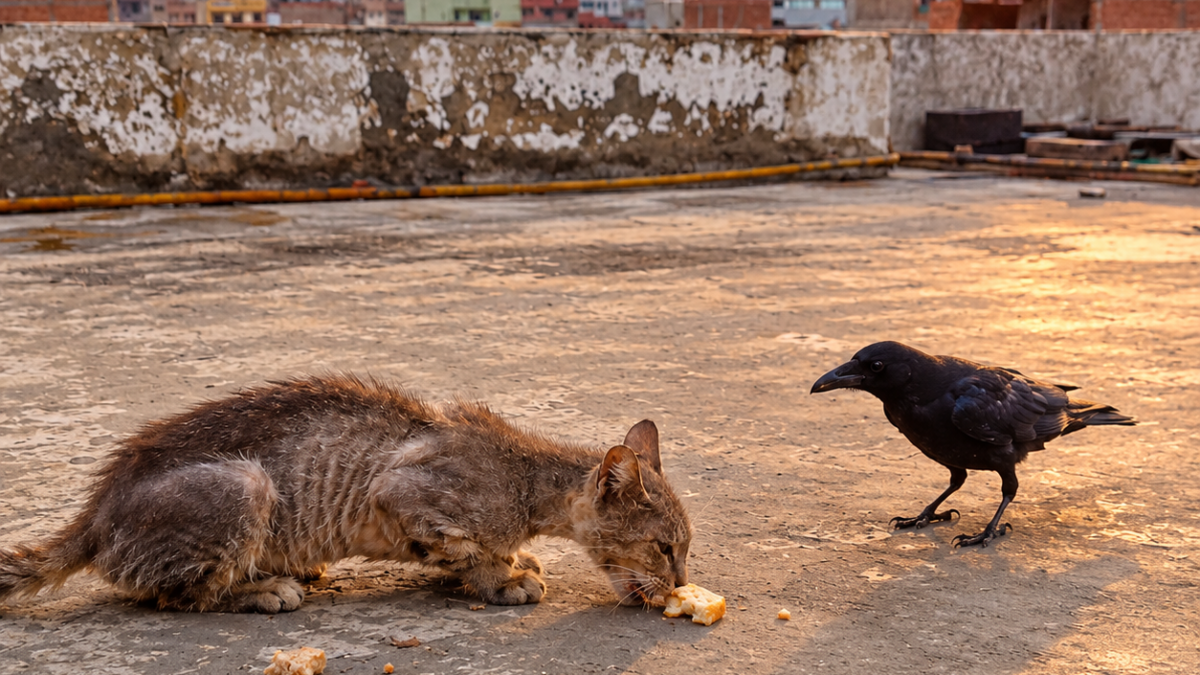
The first time I noticed the gray cat on my security footage, she had been lying on the concrete roof for so long that I thought I was looking at a dead animal, and if her ribs hadn’t moved slightly beneath her skin, I probably would have closed the camera feed and never known she was still alive.
What bothered me even more was that the rooftop was difficult to reach, the cat seemed too weak to stand, and nobody in our building knew where she had come from or how many days she had been stranded above a busy neighborhood in Lima without anyone realizing she was there.
Then, shortly after eight that morning, a black bird landed several feet from her with something in its beak, and what happened next made me replay the recording so many times that I eventually stopped believing coincidence could explain it.
The camera had been installed for security, not animals.
Our building wasn’t unusual. Shops occupied the lower level, apartments sat above them, and the flat concrete roof collected everything a city roof collects—dust, old leaves, scraps blown in by the wind, and the occasional pigeon.
I checked the camera recordings only when something happened.
A damaged door.
A missing package.
Someone complaining about noise.
That morning, a tenant asked if I could review footage from the previous day because he thought someone had been climbing near the rooftop access.
I expected to find a person.
Instead, I found the cat.
At 6:13 a.m., she was already there.
Gray.
Small.
Painfully thin.
She lay on her side near a low wall, almost blending into the concrete.
I leaned toward the monitor.
“Is that a cat?”
My coworker Luis looked over my shoulder.
“Where?”
I pointed.
He squinted.
“She’s not moving.”
I sped up the footage.
Ten minutes.
Twenty.
Forty.
Nothing.
Then her head shifted less than an inch.
Luis exhaled.
“She’s alive.”
Barely, from the look of her.
Even through grainy security footage, I could see the outline of her ribs.
Around seven, she tried to raise herself.
Her front legs pushed.
Her head lifted.
Then her body collapsed again.
“Why didn’t anybody see her?” Luis asked.
I didn’t have an answer.
The roof wasn’t somewhere residents visited often, especially early in the morning.
I kept watching.
At 8:02, a crow landed on the wall.
That wasn’t unusual.
Crows and other birds visited rooftops constantly.
This one had a piece of bread in its beak.
It hopped twice along the concrete.
I expected it to eat.
Instead, it turned toward the cat.
“Look.”
Luis leaned closer.
The bird approached slowly.
Not close enough to touch her.
Just close enough that the cat lifted her head.
Then the crow lowered its beak.
The bread fell onto the concrete directly in front of her.
Neither of us spoke.
The crow stepped backward.
The cat stared at the bread.
For several seconds, she did nothing.
Then she stretched her neck forward and took a bite.
Luis frowned.
“Did that bird just feed her?”
“No.”
We had both watched it happen.
Still, “no” was the first answer my brain offered.
The cat ate slowly.
The crow remained nearby.
It didn’t try to steal the bread back.
It didn’t attack.
It simply watched.
Eventually the cat finished.
The crow flew away.
I paused the video.
Luis looked at me.
“That’s strange.”
“Very.”
“Maybe it dropped the bread.”
“Right in front of her?”
“Maybe.”
I wanted that explanation.
Accidents are comfortable.
But seven minutes later, the crow returned.
Another piece of bread.
This time I stopped the recording before it landed.
“No way.”
Luis crossed his arms.
“Play it.”
The crow touched down.
Walked toward the same cat.
Dropped the second piece.
Backed away.
The cat ate.
My skin prickled.
We kept watching.
A third trip came later.
Then a fourth.
Within an hour, the same bird had returned four times carrying food while the gray cat remained too weak to rise.
I sat back from the screen.
“What are we looking at?”
Luis didn’t answer.
Then he pointed to the time stamp.
“If this happened yesterday, where is she now?”
I looked toward the locked door leading to the stairs.
For the first time, the footage stopped feeling strange.
It became urgent.
I grabbed the rooftop keys.
And as I reached the door, Luis called after me.
“Wait.”
I turned.
He was staring at the monitor again.
The recording had advanced to the following morning.
The cat was sitting near the edge of the roof.
And less than two feet away, the crow was waiting beside her.
PART 2
For a second, neither of us moved.
The cat was upright.
That should have been good news.
But the way she sat made my stomach tighten.
Her back curved sharply.
Her shoulders stuck out beneath her coat.
Her head hung low, as if even holding it up required concentration.
The crow stood beside her.
Close enough that I could see the difference in size clearly now.
It wasn’t pecking at her.
It wasn’t trying to take something from the roof.
It was simply there.
Luis pointed at the screen.
“That’s from this morning.”
I checked the time stamp.
7:41.
I looked at my watch.
8:16.
“She could still be up there.”
We ran.
The stairwell ended at a metal rooftop door that was usually kept locked because residents had no reason to go through it.
I fumbled with the keys.
Luis reached past me.
“Give me those.”
“I have it.”
“You’ve tried the wrong key twice.”
“I know.”
He took them anyway.
The lock opened.
Morning sunlight hit us as soon as the door swung outward.
The roof looked larger in person than it did through the security feed.
Water tanks.
Antennas.
Concrete walls.
Pipes.
Long stretches of sun-bleached gray.
“Where was she?” Luis asked.
“West edge.”
We walked slowly.
I didn’t want to charge toward a sick cat and frighten her into jumping or hiding somewhere dangerous.
“Cat?”
No response.
We reached the section where the footage had shown her.
Nothing.
My heart dropped.
“She’s gone.”
Luis pointed.
“No.”
A pair of ears barely showed above an old vent.
I stopped.
There.
The gray cat was pressed against the concrete behind it.
She was even thinner than she had looked on video.
Security cameras flatten things.
They remove smell.
Detail.
Reality.
Up close, I could see dirt clumped in her fur and a patch near one hip where the coat had thinned.
Her face was narrow.
Eyes half closed.
Her sides moved rapidly with each breath.
“Oh, God.”
Luis whispered, “She’s tiny.”
I crouched several feet away.
“Hey.”
One ear moved.
At least she heard me.
I extended my hand without approaching.
“You’re okay.”
Obviously she wasn’t.
But people say useless things when they’re scared.
The cat tried to stand.
Her legs straightened.
Then folded immediately.
I moved forward.
She hissed.
Weak.
Barely audible.
That hiss relieved me.
There was still some fight in her.
“Okay.”
I stopped.
“You can hate me.”
Luis looked around.
“Where’s the bird?”
I had forgotten about it.
Then a shadow crossed the roof.
The crow landed on the wall behind us.
Bread in its beak.
Luis and I both turned.
The bird froze.
We froze.
For several seconds, it seemed like the strangest standoff I had ever been part of.
Two men.
One dying cat.
One crow carrying breakfast.
The crow hopped along the wall.
It did not come closer.
The cat’s head lifted toward the flutter of wings.
I looked at Luis.
“She knows it.”
Luis whispered, “Or knows food is coming.”
The crow dropped to the concrete.
Still several yards away.
I expected it to leave because of us.
Instead, it waited.
I backed farther from the cat.
“So does the bird get priority?”
Luis almost laughed.
“I have no idea.”
The crow hopped forward.
The piece of bread remained in its beak.
Another hop.
Then another.
It stopped at a distance that must have felt safe.
Dropped the bread.
Backed away.
Exactly like the footage.
The cat crawled toward it.
Not walked.
Crawled.
Her rear legs pushed weakly while her front paws dragged her a few inches at a time.
That was when whatever fascination I had felt disappeared.
This was not a cute story.
It was not a charming wildlife moment.
The cat was starving.
Whatever the crow was doing, the bread was not enough to save her.
“We need to get her down.”
Luis nodded.
“I’ll call a clinic.”
“Tell them severe weakness, probably dehydration, malnutrition.”
He pulled out his phone.
I stayed low.
The cat reached the bread.
Took one bite.
Then stopped.
Her eyes closed.
The crow remained near the wall.
I had no idea what it understood.
I still don’t.
People like explanations.
They want me to tell them the crow loved her.
That it adopted her.
That it understood she was dying and consciously chose to rescue her.
I can’t say that.
I can only say what I saw.
A crow had food.
A weak cat was on the roof.
The bird repeatedly brought food close to her and stepped away while she ate.
That was strange enough without pretending I could read its mind.
I took off my overshirt.
Luis returned.
“Clinic can see her.”
“Good.”
“How do we catch her?”
“Carefully.”
“Helpful.”
I moved another step closer.
The cat hissed again.
“I know.”
Her eyes opened.
Yellow-green.
Dull but aware.
“You don’t know me.”
Another step.
“I’m going to make today worse for about ten minutes.”
Luis crouched on the other side.
“Your bedside manner is terrible.”
“I’m trying honesty.”
The cat tried to retreat.
Her body didn’t cooperate.
That was our chance.
I threw the shirt gently over her upper body and supported her before she could panic.
She twisted.
Claws caught my wrist.
“Got her.”
Luis opened the carrier we had brought from a tenant downstairs.
The cat felt impossibly light.
Bones under fabric.
A body that should have carried weight but didn’t.
I lowered her inside.
She gave one exhausted growl.
Then collapsed.
I closed the carrier.
Luis looked toward the crow.
It had moved to the wall.
Watching.
I picked up the carrier.
For a moment, something in me wanted to explain.
Ridiculous.
Explain to a bird that the cat was going somewhere safe.
Instead, I said, “We’re taking her.”
The crow tilted its head.
Then flew away.
The veterinary clinic was only a short drive.
It felt longer.
I held the carrier steady while Luis drove.
The cat did not move much.
Every few seconds, I looked through the door.
“Still breathing.”
Luis gripped the wheel.
“Stop saying it like that.”
“Like what?”
“Like there’s a chance she won’t.”
“There is.”
He was quiet.
We arrived.
A technician took one look at the cat and called for help.
“What happened?”
“Found on a roof.”
“How long?”
“Don’t know.”
“Eating?”
“A little bread.”
She looked at me.
“Bread?”
“That’s complicated.”
They took the carrier.
I followed until someone stopped me outside the treatment area.
“You’ll need to wait here.”
I hated that.
But I waited.
Luis sat beside me.
For several minutes, neither of us spoke.
Then he said, “You think the crow kept her alive?”
I looked toward the treatment doors.
“I think it gave her food.”
“That’s not what I asked.”
“I know.”
We sat longer.
A veterinarian finally came out.
“She’s severely underweight.”
“How severely?”
He gave us the number.
Lower than expected for her frame.
“She’s dehydrated. Her blood glucose is low. She’s weak, and I’m concerned about anemia and possible underlying disease.”
“Can she survive?”
“She’s alive now.”
That answer reminded me of every cautious doctor I had ever heard.
Not promising what they could not guarantee.
“What does she need?”
“Fluids. Controlled nutrition. Bloodwork. Parasite screening. Infectious disease testing. Temperature support.”
“She ate bread this morning.”
The veterinarian looked at me.
“Bread?”
Luis sighed.
“You should probably tell him.”
So I did.
The security camera.
The crow.
The repeated trips.
The food.
The veterinarian listened without interrupting.
When I finished, he said, “That’s unusual.”
“That’s it?”
“What would you like me to say?”
“I don’t know.”
He smiled slightly.
“I treat cats, not crow psychology.”
Fair.
“What matters medically is that bread isn’t an adequate diet, especially in this condition.”
“I know.”
“But small calories may have been better than none.”
There it was.
Not a miracle.
Not proof of anything mystical.
Just a fact.
Some food may have mattered.
We authorized treatment.
The clinic staff asked what name they should use.
I looked at Luis.
He shrugged.
“You found her.”
“The camera found her.”
“The crow found her first.”
I thought about that.
“Gray?”
Luis frowned.
“That’s terrible.”
“You have something better?”
He looked through the glass toward the treatment room.
“Lima?”
“Too obvious.”
“Roof?”
“Worse.”
The technician waited.
I looked at the cat.
“Paloma.”
Luis raised an eyebrow.
“That means dove.”
“I know.”
“She was fed by a crow.”
“That’s why it’s funny.”
The technician wrote Paloma on the chart.
The name stayed.
Paloma spent that first day on fluids and warming support.
Bloodwork showed severe malnutrition and anemia, though not at the level requiring an immediate transfusion. She had parasites. Her coat condition suggested she had been struggling for longer than the day or two captured on camera.
The veterinarian suspected she might have been scavenging for some time before reaching the roof.
“How did she get up there?” I asked.
“No idea.”
“There isn’t an easy route.”
“Cats find routes humans don’t.”
“Can starvation make them climb somewhere like that?”
“Hunger makes animals do many things.”
Maybe she had climbed while searching for food.
Maybe someone had abandoned her there.
Maybe she had reached the roof through another building.
No answer ever became certain.
That bothered me less as time passed.
The important thing was that she was there when the camera happened to be watching.
On the second day, Paloma ate proper food.
Very little.
A spoonful.
Then another later.
The clinic used controlled feeding because her stomach and metabolism had been through enough.
I visited after work.
She was lying in a warm enclosure.
Her eyes opened when I approached.
“Hi.”
She watched me.
No hiss.
I wasn’t sure whether that was trust or exhaustion.
Probably exhaustion.
“You look terrible.”
Luis, standing behind me, said, “Again. Bad bedside manner.”
“I’m consistent.”
Paloma’s head lifted slightly.
Then lowered.
The veterinarian came by.
“She’s a little more responsive.”
“Good?”
“Yes.”
“Out of danger?”
“No.”
I nodded.
Always the unfinished sentence.
He showed us the treatment plan.
Parasite control.
Nutrition.
Hydration.
Monitoring.
Tests.
More monitoring.
It would take time.
The body does not become starved overnight.
It does not rebuild overnight either.
Before leaving, I asked the question that had been bothering me all day.
“Can a crow remember a cat?”
The vet looked at me.
“Wrong doctor.”
I laughed.
“Right.”
When I returned to the building the next morning, Luis was standing outside waiting.
“You’re late.”
“It’s 7:55.”
“Exactly.”
“For what?”
He pointed upward.
I understood.
We climbed to the roof.
Nothing.
The spot where Paloma had lain was empty.
I expected the roof to feel relieved.
Instead, it felt strangely unfinished.
At 8:03, wings cut through the air.
The crow landed.
Bread in its beak.
Luis whispered, “There.”
The bird looked toward the place where the cat had been.
It hopped down.
Waited.
No cat.
Then it dropped the bread.
Exactly where it had before.
Neither of us spoke.
The crow stood there.
One minute.
Two.
Eventually it picked the bread back up.
Then dropped it again.
Luis looked at me.
“You seeing this?”
“Yes.”
At 8:11, it flew away.
I thought that was the end.
It wasn’t.
The next morning, it returned at 8:01.
Bread.
Same area.
Wait.
No cat.
Third morning.
Again.
Fourth.
Again.
I started arriving early just to check.
I told myself I was documenting behavior.
That sounded more rational than admitting I felt guilty toward a bird.
One morning, I put a bowl of water on the roof.
Luis found me doing it.
“That for the crow?”
“For any bird.”
“Right.”
He smiled.
I ignored him.
We avoided leaving inappropriate food because we didn’t want to create a new problem or make wild birds dependent on us.
But water seemed reasonable during the warm days.
The crow eventually drank from it.
Then left.
The bread deliveries continued.
Not every morning forever.
But consistently enough that we noticed the pattern.
Around eight.
Land.
Look.
Sometimes carrying food.
Wait.
Leave.
I saved the recordings.
By then, word had spread inside the building.
People wanted to see them.
I was reluctant.
I didn’t want the rooftop turning into a spectacle.
One tenant said, “You should post this. It’ll go viral.”
I immediately disliked the idea.
“What would that help?”
“People would love it.”
“That’s not an answer.”
“We could raise money for the cat.”
That was a better argument.
Paloma’s veterinary care was not free.
We spoke with the clinic and a local animal rescue volunteer.
Eventually we shared limited footage privately within a rescue network to help cover treatment.
The response was immediate.
People called the crow an angel.
A guardian.
Paloma’s friend.
Some invented entire histories for them.
They said the crow must have known Paloma for years.
There was no evidence of that.
Others claimed crows routinely adopt dying animals.
Again, no basis from our footage.
I became strangely protective of the truth.
The real footage was already extraordinary.
Why exaggerate it?
A wild bird repeatedly carried bread toward a starving cat.
That happened.
The cat ate.
That happened.
After rescue, the bird returned.
That happened too.
Anything beyond that belonged to interpretation.
And interpretations became wilder every day.
One woman messaged me:
THE CROW THINKS HUMANS STOLE ITS CAT.
I read it to Luis.
He laughed.
“Maybe.”
“We are not starting that.”
Another person wrote:
YOU NEED TO TAKE PALOMA BACK SO THE CROW KNOWS SHE SURVIVED.
That one stayed in my mind.
At first, I dismissed it.
Paloma needed medical care.
We weren’t taking a recovering cat back to an exposed rooftop for a sentimental reunion with wildlife.
But weeks later, when she was stronger, the idea became less ridiculous in a different form.
Not return her permanently.
Just bring her, safely contained, to the building once she was medically cleared.
Maybe the crow would be there.
Maybe not.
Maybe neither animal would care.
Still, I wondered.
Paloma’s recovery accelerated in the third week.
Her appetite grew.
That was the first major change.
At the beginning, food had to be offered carefully.
Then one evening, the technician opened her cage with dinner and Paloma stood.
Actually stood.
Four legs beneath her.
Thin.
Shaky.
But standing.
She moved toward the dish.
I smiled.
“There you are.”
The technician placed it down.
Paloma started eating.
Not desperately.
Not yet.
But with purpose.
I watched her sides.
Still too narrow.
Ribs still obvious.
But less frightening than before.
“What does she weigh now?”
The technician told me.
A modest gain.
I celebrated anyway.
Paloma finished part of the meal.
Then sat.
She looked at me.
I held out my hand.
She sniffed.
For several seconds, nothing.
Then she pushed her forehead lightly into my fingers.
My throat tightened.
“Oh.”
Luis whispered, “Was that affection?”
“Don’t ruin it.”
Paloma moved closer.
I scratched her gently behind one ear.
She closed her eyes.
That was the first time she chose contact.
The rooftop cat who had barely raised her head for bread had enough energy to ask for touch.
I went home thinking about the crow.
It seemed absurd, but I wanted to tell it.
She’s eating.
She stood today.
She’s getting better.
Instead, the next morning I went to the roof.
8:04.
The bird landed.
No bread that time.
Just itself.
It stood on the wall.
I stayed far back.
“You’re going to think I’m insane.”
The crow stared.
“Paloma’s better.”
Nothing.
“She ate a full portion yesterday.”
It turned its head sideways.
“I know you have no idea what I’m saying.”
The bird flew away.
Luis had come through the door behind me.
“I really wish I had recorded that.”
“Go away.”
“You just gave a medical update to a crow.”
“It seemed polite.”
He laughed the entire way downstairs.
By the end of the first month, Paloma had enough strength to groom herself.
That mattered more than I expected.
She sat in her enclosure and licked one shoulder.
Stopped to rest.
Started again.
A cat grooming itself is ordinary.
That was why it felt extraordinary.
She had energy to spend on cleanliness.
Not just breathing.
Not just eating.
Living.
Her anemia improved.
Parasites were treated.
Hydration normalized.
She gained weight steadily.
Tests did not reveal the catastrophic underlying disease we had feared.
Her main enemies had been prolonged starvation, parasites, dehydration, and the weakness they created.
“Prognosis?” I asked during a checkup.
The veterinarian smiled.
“Much better.”
“Meaning?”
“Meaning I expect her to recover.”
I stood quietly.
For weeks, every answer had been cautious.
Maybe.
Wait.
Monitor.
Not out of danger.
Now:
I expect her to recover.
I looked at Paloma.
She was trying to bite the edge of a towel.
“She seems ungrateful.”
“That’s usually a good sign in cats.”
She came into foster care shortly afterward.
A rescue volunteer named Sofia had experience rehabilitating underweight cats.
Her apartment was quiet.
Secure.
No rooftop access.
That last part became a running joke.
When we brought Paloma there, she hid behind the carrier at first.
Sofia sat on the floor.
No grabbing.
No forcing.
Food several feet away.
Soft voice.
Patience.
Paloma eventually emerged.
She inspected the room.
Sniffed the bed.
Then went directly to the food.
Sofia laughed.
“I guess I know my ranking.”
I said, “Food first. Humans second.”
“That’s fair.”
Over the next month, Sofia sent updates almost every day.
Paloma sleeping on a blanket.
Paloma eating.
Paloma sitting in a window.
Paloma discovering toys.
Paloma trying to steal food from another cat.
That last update made me laugh.
A cat who had once been too weak to stand had become a food thief.
I replied:
DO NOT ENCOURAGE CRIME.
Sofia answered:
TOO LATE.
Paloma’s coat changed as her body recovered.
The gray fur thickened.
Her ribs disappeared beneath healthy weight.
Her face rounded.
Her eyes became bright.
If I hadn’t kept the rooftop footage, I might eventually have doubted how thin she really was.
But the video existed.
That frail outline on concrete.
Then the bird.
Then bread.
It became a before image unlike any other I had seen.
Not because it captured rescue.
It captured what happened just before humans noticed.
That difference haunted me.
How many animals suffer beyond the edge of our attention?
How many survive because of random scraps?
How many disappear without a camera?
Paloma happened to lie inside a rectangle of pixels someone reviewed the next day.
The camera did not save her.
But it made her visible.
The crow had seen her first.
At least before we did.
That became impossible to forget.
The bird continued appearing, though its schedule became less exact after several weeks.
Sometimes 8:00.
Sometimes 8:20.
Sometimes not at all for a day or two.
Then back.
The repeated bread delivery gradually stopped.
Maybe because no cat was there.
Maybe because the behavior had served whatever purpose caused it.
Again, I refused to pretend I knew.
Still, whenever the crow landed, I recognized it by behavior and markings.
I believed it was the same bird, though I couldn’t prove that with scientific certainty.
One morning it landed with bread again after nearly a week without doing so.
Placed it on the concrete.
Waited.
Something in that image hurt.
Luis stood beside me.
“We should bring her.”
I looked at him.
“To the roof?”
“Not loose.”
“No.”
“Carrier.”
I crossed my arms.
“Why?”
“You want to.”
That irritated me because it was true.
“I want a lot of stupid things.”
“This is less stupid than talking to the crow.”
“That’s debatable.”
We asked the veterinarian.
His first response was exactly what I expected.
“No.”
Luis said, “Hear us out.”
“No.”
“She’d stay inside a carrier.”
“Why?”
We explained.
The doctor looked between us.
“You want to arrange a reunion between a recovering domestic cat and a wild crow because of security footage.”
When he phrased it like that, it sounded ridiculous.
“Yes.”
He rubbed his forehead.
“Is the rooftop secure?”
“Mostly.”
“Mostly is not a veterinary term.”
“We’d keep her enclosed.”
“Temperature?”
“We’d go early.”
“Stress?”
“That’s what we need you to judge.”
He looked at Paloma.
She was in good health by then, though still gaining strength.
Finally he said, “Not yet.”
That was not no.
“When?”
“If she continues improving, perhaps later. Briefly. And if she shows stress, you leave.”
Luis grinned.
I pointed at him.
“This is your fault.”
Weeks passed.
Paloma became strong enough that Sofia started considering adoption.
That was a bigger question.
People who had heard the story wanted her.
A lot of people.
Some for good reasons.
Others because she was “the crow cat.”
That concerned us.
Animals shouldn’t spend their lives as souvenirs from viral stories.
Paloma needed a home interested in Paloma.
Not the novelty.
We filtered applications carefully.
One applicant asked whether the crow could come with her.
Rejected.
One asked if Paloma could be trained to interact with wild birds for videos.
Rejected immediately.
Another said the cat would be perfect for a business account.
Absolutely not.
Sofia stared at the applications.
“People are unbelievable.”
“Yes.”
“Maybe she should stay with me.”
I looked at her.
“That sounds suspiciously convenient.”
Paloma was sleeping in Sofia’s lap at the time.
Sofia stroked her back.
“She likes it here.”
“Clearly.”
“I’m serious.”
“So am I.”
Sofia had been a foster many times.
She knew the danger.
The animals who arrive temporarily and quietly become permanent.
“I wasn’t planning another cat.”
“Nobody ever is.”
Paloma stretched.
One paw landed on Sofia’s arm.
Decision pending.
Before adoption became official, we finally took her back to the building.
Not onto the open roof at first.
We placed her carrier just inside the rooftop doorway with the metal door open.
Safe.
Shaded.
No chance of escape.
It was 7:50.
Paloma seemed curious.
Not frightened.
She sniffed.
Looked outward.
Did she remember?
We had no idea.
Luis set up a chair far away.
Sofia stayed beside the carrier.
I checked the time.
8:01.
Nothing.
8:05.
Still nothing.
I laughed softly.
“Of course.”
Luis said, “Bird has stage fright.”
8:12.
A pigeon landed.
I stared at it.
“Wrong bird.”
Sofia smiled.
Paloma watched the pigeon.
Her body lowered slightly.
Predatory interest.
That was new.
“You were dying here and now you’re hunting residents?”
Paloma’s tail flicked.
The pigeon left.
8:19.
Wings.
A black shape crossed the roof.
My chest tightened.
The crow landed on the opposite wall.
Nobody moved.
I whispered, “There.”
Paloma saw it.
Her ears pointed forward.
The crow looked toward us.
Then toward the carrier.
It did not approach immediately.
Paloma stood inside.
Sofia touched the carrier gently.
“Easy.”
The crow hopped along the wall.
Closer.
Stopped.
Paloma made a small sound.
Not a hiss.
Not a meow exactly.
A soft chirp.
The crow tilted its head.
I forgot to breathe.
Then it flew down to the concrete.
Still far from the carrier.
It walked several steps.
Paloma pressed closer to the carrier door.
The bars separated them.
Good.
Safe.
The crow stopped.
For maybe ten seconds, they faced each other.
I wanted something dramatic.
Of course I did.
A magical recognition.
The crow rushing forward.
Paloma calling out.
Some undeniable proof that they had formed a bond.
Reality was quieter.
The crow looked.
Paloma watched.
That was all.
Then the bird hopped sideways.
Picked at something on the concrete.
Looked back.
Paloma remained standing.
The crow stayed for several minutes.
Eventually it flew to the wall.
Then away.
Luis exhaled.
“Well.”
Sofia looked at me.
“You disappointed?”
I thought about it.
“No.”
I was surprised to realize I meant it.
“What did you expect?” she asked.
“I don’t know.”
That was the truth.
We had brought Paloma back for ourselves as much as anything.
We wanted closure.
Animals do not owe us closure.
The crow had once brought bread.
Paloma had once eaten it.
Today, both were alive.
That was enough.
Then, as we prepared to leave, wings returned.
The crow landed again.
This time something was in its beak.
Luis whispered, “No.”
A small piece of bread.
I felt every hair on my arms rise.
The crow dropped to the concrete.
Approached farther than before.
Stopped several feet from the carrier.
Dropped the bread.
Then backed away.
Nobody spoke.
Paloma stared at it.
The bread sat between them.
The old pattern.
Except now Paloma was standing.
Healthy enough that her ribs no longer showed.
Safe behind the carrier door.
She did not need the bread.
She had eaten breakfast.
She would eat dinner.
Tomorrow too.
Still, she watched.
The crow watched.
Sofia wiped beneath one eye.
Luis whispered, “You can’t tell me that means nothing.”
I answered just as quietly.
“I’m not saying that.”
“What does it mean?”
“I don’t know.”
For once, not knowing felt beautiful instead of frustrating.
We didn’t let Paloma eat the bread.
Her diet was controlled and she didn’t need it.
But after we took her downstairs, I went back.
The bread was still there.
The crow had gone.
I picked it up.
Held it in my palm.
A little dry piece.
Almost weightless.
How many calories?
Hardly anything.
How much difference could it have made to a starving cat?
Maybe very little.
Maybe just enough to help her survive until we saw the footage.
There was no way to calculate it.
I threw the bread away responsibly.
That probably sounds terrible after everything.
But the meaning wasn’t in preserving old bread.
It was in what had already happened.
Paloma went home with Sofia.
Two days later, Sofia called.
“I’m keeping her.”
I smiled.
“Shocking.”
“I filled out the paperwork.”
“Congratulations.”
“She’s asleep in my laundry.”
“Even more shocking.”
Paloma’s adoption became official.
There was no grand ceremony.
She woke.
Ate.
Knocked something off a table.
Slept.
Her life had become wonderfully ordinary.
Sofia kept sending photographs.
Healthy gray coat.
Bright eyes.
Full body.
One picture showed Paloma sprawled in sunlight.
I compared it with the rooftop footage.
Same cat.
Completely different relationship with the world.
On the roof, sunlight had fallen on a body too weak to move away.
Now she chose it.
That detail stayed with me.
The crow continued visiting the building.
Not every day.
The bread behavior faded.
Sometimes it perched on the wall.
Sometimes drank from the water we kept available.
Then disappeared into the city.
Eventually, weeks passed without seeing it.
Then months.
Luis asked once, “Do you think it died?”
“Why would you ask that?”
“I don’t know.”
“It could be anywhere.”
Lima is enormous.
A bird does not owe one rooftop permanent residence.
I preferred imagining it somewhere else.
Finding food.
Stealing food.
Doing whatever crows do when humans aren’t turning them into symbols.
One morning almost a year after Paloma’s rescue, I saw a crow on the roof.
Same one?
I couldn’t be certain.
It landed around eight.
That was enough to make me smile.
No bread.
It looked around.
Drank water.
Left.
I didn’t tell anyone it was definitely her crow.
By then, I had become careful with ownership.
“The crow.”
Not “Paloma’s crow.”
Wild things belong to themselves.
The security footage became more famous locally than I expected.
People continued asking for it.
A small animal welfare group wanted to use the story to encourage residents to check rooftops and abandoned spaces for injured animals.
That I agreed to.
The important message wasn’t “crows are secret animal rescuers.”
It was simpler.
Look.
Pay attention.
A living creature can be suffering above your head while you walk beneath it every day.
We had done exactly that.
The cat spent hours on our roof.
Maybe longer.
Nobody noticed until a camera did.
That embarrassed me.
It should have.
People praised us for rescuing Paloma.
I never felt completely comfortable with that.
We rescued her after the video forced us to see her.
The crow had acted while she was invisible to us.
Whatever its reason, that fact remained.
Once, during a community meeting, a man said, “Nature is amazing. The bird knew exactly what to do.”
I answered, “Maybe.”
He looked disappointed.
“You don’t believe it?”
“I believe what happened.”
“What’s the difference?”
“A big one.”
I explained that I couldn’t claim the crow understood starvation in human terms.
I couldn’t say it intended to save a cat.
I couldn’t say they were friends because we had no history beyond the footage.
But I could say the crow repeatedly delivered bread to the exact place where the cat could reach it and waited while she ate.
“That isn’t enough for you?” he asked.
I smiled.
“It’s more than enough.”
Truth does not become more beautiful when we add things we cannot know.
Sometimes it becomes smaller.
Paloma’s story taught me that.
The most moving part was not an invented explanation.
It was the uncertainty.
Why did the crow do it?
I still don’t know.
Why return after the cat disappeared?
I don’t know.
Why bring bread again the day Paloma briefly returned?
I don’t know.
I know only that it happened.
There was no villain to punish in this story.
For a while, that bothered people.
They wanted to know who let Paloma become so thin.
Was she abandoned?
Did someone neglect her?
Was there an owner?
Did somebody leave her on the roof?
We checked.
Asked around.
No one claimed her.
No proof emerged that a particular person had deliberately harmed her.
So I refused to create an antagonist just to give the story a more dramatic ending.
The real enemy was simpler and more frightening.
Being unseen.
Paloma nearly died in the middle of a city full of people because she was somewhere nobody was looking.
The revenge, if anyone insists on using that word, was what happened afterward.
She became impossible to overlook.
The cat nobody saw became the cat people asked about from other neighborhoods.
The starving animal too weak to stand became a healthy cat who once stole a chicken breast from Sofia’s kitchen and ran under the bed.
That story still makes me laugh.
Sofia called furious.
“She stole dinner.”
“Paloma?”
“Yes.”
“The cat we had to encourage to eat?”
“Don’t start.”
“How much did she take?”
“Half a chicken breast.”
I laughed.
“This is serious.”
“You’re laughing.”
“I’m celebrating her appetite.”
“She’s a criminal.”
Paloma apparently listened from beneath the bed and refused to come out.
Later, Sofia sent a photograph.
Only two yellow-green eyes visible in the darkness.
Caption:
NO REMORSE.
I saved it beside the rooftop still.
That was my favorite before-and-after pair.
Not sick versus beautiful.
Bread versus stolen chicken.
Scarcity versus confidence.
Paloma no longer waited for food to be delivered by chance.
She expected meals.
Sometimes demanded them.
Sometimes attempted unauthorized acquisition.
That was recovery.
Months later, I visited Sofia.
Paloma recognized my voice.
At least I think she did.
She approached slowly.
Sniffed my shoes.
Then rubbed along my leg.
“You remember the roof?”
Sofia laughed.
“Why would she answer?”
“I ask every time.”
Paloma jumped onto the couch.
Her movement was smooth.
Strong.
No trace of the collapse I remembered.
I sat beside her.
She climbed onto my thigh without invitation.
“I’m taking that as yes.”
Sofia handed me coffee.
“Everyone thinks the crow saved her.”
I scratched Paloma behind one ear.
“Maybe it helped.”
“You still won’t say saved.”
“No.”
“Why?”
“Because the clinic saved her. You rehabilitated her. The camera helped us find her. The crow fed her. Paloma kept eating. It was all of it.”
Sofia nodded.
“That’s less poetic.”
“It’s more true.”
She looked at the cat.
“Paloma did the hardest part.”
“Yes.”
Survival stories often get reduced to one hero.
Real survival is usually a chain.
The bird with bread.
The person checking footage.
The coworker who helped catch her.
The clinic.
The rescue network.
The foster.
The adopter.
And the animal’s own body, somehow continuing through all of it.
Remove one link and maybe the ending changes.
That thought makes rescue feel less like heroism and more like responsibility.
You may only be one link.
Be a strong one.
Paloma eventually reached a healthy adult weight.
Her annual veterinary checkup became almost boring.
That was wonderful.
The veterinarian listened to her heart.
Checked teeth.
Eyes.
Coat.
Weight.
Bloodwork when appropriate.
Nothing dramatic.
At one appointment, I happened to be there.
The veterinarian looked at the chart.
“Do you remember her first day?”
“Yes.”
“I thought she might not make it.”
I looked at Paloma.
She was trying to climb off the table.
“You never told me that.”
“I try not to share every worst-case thought.”
“Thank you.”
Paloma jumped down before either of us stopped her.
The veterinarian laughed.
“Good muscle tone.”
“She demonstrates it through disobedience.”
“That’s common.”
I picked her up.
She complained loudly.
I smiled.
On the roof, she had been too weak to complain.
Now she had opinions.
Another victory.
The years made the story smaller in the best way.
People moved on.
The footage stopped circulating.
New tenants came into the building who had no idea why there was sometimes a water dish on the roof.
Luis left for another job.
Before he went, we climbed up one final morning together.
No crow.
No cat.
Just Lima waking around us.
Buildings.
Traffic.
Distant horns.
Birds crossing between rooftops.
Luis stood where Paloma had been found.
“Crazy.”
“What?”
“That this was almost the end.”
I nodded.
“And now it’s just concrete.”
“That’s good.”
He looked at me.
“Why?”
“Because she doesn’t need it anymore.”
The rooftop had once been Paloma’s entire world.
Now it meant nothing to her.
She had a home.
A window.
Beds.
Toys.
A kitchen to rob.
That was exactly how it should be.
Luis leaned against the wall.
“You still think about the crow?”
“Yes.”
“Me too.”
We stayed quiet.
Then a black bird flew overhead.
Luis pointed.
“That one?”
“No idea.”
“Come on.”
“No idea.”
“You’re impossible.”
I laughed.
We went downstairs.
After Luis left, I became the only person in the building who still checked the rooftop camera regularly.
Habit.
Sometimes days passed.
Then weeks.
I would open the feed.
Nothing unusual.
That emptiness became comforting.
No collapsed animals.
No emergency.
Just weather and birds.
One morning, years after Paloma’s rescue, I found an old folder on the security system.
PALOMA ROOF.
I opened it.
There she was.
So thin.
I had forgotten how bad it looked.
The recording played.
Crow arrives.
Bread.
Drop.
Back away.
Paloma lifts her head.
Eats.
I watched all four visits again.
Then the next day.
Paloma sitting near the edge.
Crow beside her.
The image held on my screen.
I remembered how desperately we had wanted an explanation.
Maybe we still did.
But the more years passed, the less I needed one.
There are moments that lose something when you force them into categories.
Instinct.
Empathy.
Food-sharing.
Curiosity.
Learned behavior.
Bond.
Coincidence.
Maybe researchers could examine the footage and propose possibilities.
Good.
I would listen.
But none of those labels change what the camera recorded.
A weak animal was hungry.
Another animal had food.
For reasons we cannot fully know, the food moved from one to the other.
Then it happened again.
And again.
And again.
Sometimes facts are enough to break your heart.
I paused the video when the crow stepped backward and Paloma began eating.
Then I closed the file.
That afternoon, Sofia sent me a new photo without knowing what I had been watching.
Paloma lay on her back across a bed.
Gray fur thick.
Belly exposed.
One paw hanging off the edge.
She looked completely ridiculous.
The message said:
SOMEONE HAS HAD A VERY DIFFICULT DAY OF EATING AND SLEEPING.
I laughed.
I sent back:
BRAVE SURVIVOR.
Sofia replied:
SHE JUST BIT ME.
Perfect.
That was how I wanted Paloma remembered.
Not eternally starving.
Not eternally helpless.
Not eternally needing to be saved.
Alive enough to be inconvenient.
The crow had disappeared from our routine by then.
I never knew what happened to it.
Maybe it found another territory.
Another source of food.
Another rooftop.
Maybe it died, as all living things eventually do.
Maybe descendants of that crow still fly over the building.
There was no way to know.
But sometimes around eight in the morning, I still looked up.
Not because I expected bread.
Because once, one ordinary morning, a camera captured a moment I still cannot explain completely.
It changed the way I looked at animals.
It also changed the way I looked at cities.
We think urban life belongs to us.
Our buildings.
Our traffic.
Our schedules.
Meanwhile entire relationships may exist above our heads, behind walls, along power lines, in alleys, on rooftops.
Lives touching lives without our permission or understanding.
Paloma and the crow occupied the same roof for a tiny piece of time.
That was enough to connect their stories forever in ours.
Whether they understood that connection is another question.
Probably not in the way humans do.
That is okay.
Meaning does not require everyone involved to name it.
Years later, I visited Paloma again on a quiet Sunday.
She was older.
Not elderly.
Just settled into adulthood.
Sofia opened the door.
Paloma was lying on the windowsill.
“Look who’s here,” Sofia said.
Paloma’s ears moved.
I spoke.
“Still stealing chicken?”
She turned.
Jumped down.
Walked toward me.
I crouched.
She touched her nose to my fingers.
Then rubbed her face against my hand.
I smiled.
“You do remember.”
Sofia laughed.
“You always say that.”
“One day she’ll confirm it.”
“No, she won’t.”
Paloma walked away.
I followed her into the living room.
Above the couch, Sofia had framed two photographs.
One showed Paloma shortly after recovery.
The second showed her healthy.
No rooftop picture.
I liked that.
“Where’s the dramatic before photo?”
“In a drawer.”
“Why?”
Sofia shrugged.
“I don’t want the worst day of her life to be the first thing people see.”
I stared at her.
“That’s a good answer.”
“She lives here now.”
Paloma jumped onto the couch.
Sofia sat.
The cat immediately climbed beside her.
That image contained everything I needed.
A known place.
A known person.
A body relaxed enough to sleep.
I remembered the concrete roof.
The bird.
The bread.
I realized the crow’s role had become smaller over the years and more important at the same time.
Smaller because Paloma’s life was no longer about it.
More important because the tiny act remained near the beginning of everything that followed.
Maybe the bread did not save her medically.
Maybe it only gave her a few calories.
Maybe the crow had some behavioral reason that would sound less emotional than our interpretation.
None of that reduces it.
If anything, it makes the scene more extraordinary.
The crow didn’t need to understand the ending.
It only needed to do what it did that morning.
The rest came later.
One afternoon, the building manager asked whether we could finally remove the rooftop water bowl.
“No birds use it much.”
I thought about it.
Then nodded.
“Sure.”
We removed it.
That surprised me.
Years earlier, I might have treated the bowl as sacred.
A monument.
But stories don’t need every object preserved.
Paloma had moved on.
The crow had moved on.
So could we.
The camera remained.
The roof remained.
Life continued.
Several months after that, a pigeon built a nest behind one of the vents.
Everyone complained about the mess.
I laughed.
“What?”
The manager asked.
“Nothing.”
The roof had returned to being just a roof.
That was another kind of happy ending.
The strangest chapter became history.
No emergency remained trapped there.
When people ask me now what I believe the crow was doing, I give the same answer.
“I don’t know.”
They often look disappointed.
So I add:
“But I know what it did.”
It arrived with bread.
It placed the bread in front of a cat too weak to stand.
It stepped back.
It waited while she ate.
Then it returned and did it again.
Four times that hour.
The next day, after we removed Paloma for treatment, it came back.
And later, when Paloma briefly returned safely in a carrier, the bird appeared again with bread.
Those are the facts.
For me, they are enough.
Because the most powerful part of the story was never proving that the crow thought like a human.
It was realizing compassion does not always arrive in a form we recognize.
Sometimes help is a veterinarian with fluids.
Sometimes it is a woman opening her home.
Sometimes it is a security camera recording the one place nobody thought to check.
And sometimes, for reasons we may never completely understand, it looks like a black bird landing on a concrete rooftop with a small piece of bread in its beak.
Paloma never needed that bread again.
She had food every day after rescue.
Clean water.
Medical care.
Warmth.
A home.
Eventually, the rooftop became something she would never have to remember.
But on certain mornings, when sunlight reaches the buildings and birds begin crossing the Lima sky, I still think about that first recording.
The frail gray body.
The crow approaching.
The bread falling.
The bird stepping away.
The cat slowly raising her head.
At the time, I thought I was watching something impossible.
Now I think I was watching something simpler.
One living creature had something another living creature needed.
And, somehow, it gave it away.
That tiny act did not complete Paloma’s rescue.
It did not cure her.
It did not replace veterinary medicine.
But it happened before the rest of us even knew she needed saving.
By the time humans finally looked up, a crow had already been showing up.
And perhaps that is why, years later, I no longer remember the rooftop as the place where Paloma nearly died.
I remember it as the place where she was noticed twice.
First by a bird.
Then by us.
The second time changed her life.
But I will always wonder whether the first gave her just enough time for us to arrive.
[END OF STORY]