PART 2: A Burned Kitten Walked Into a Stranger’s Garage on Christmas Night—What She Survived After That Left Us Speechless
PART 2
I stayed beside Cloe until the staff finally convinced me that standing over her would not change what happened next.
That is one of the hardest lessons in rescue.
Sometimes love looks like action.
Driving.
Calling.
Carrying.
Signing consent forms.
Finding money for treatment.
Cleaning wounds.
Giving medicine.
And sometimes love looks like walking away from a hospital cage because the people who can save the animal need room to work.
I hated that version.
Before I left, I crouched beside Cloe’s enclosure.
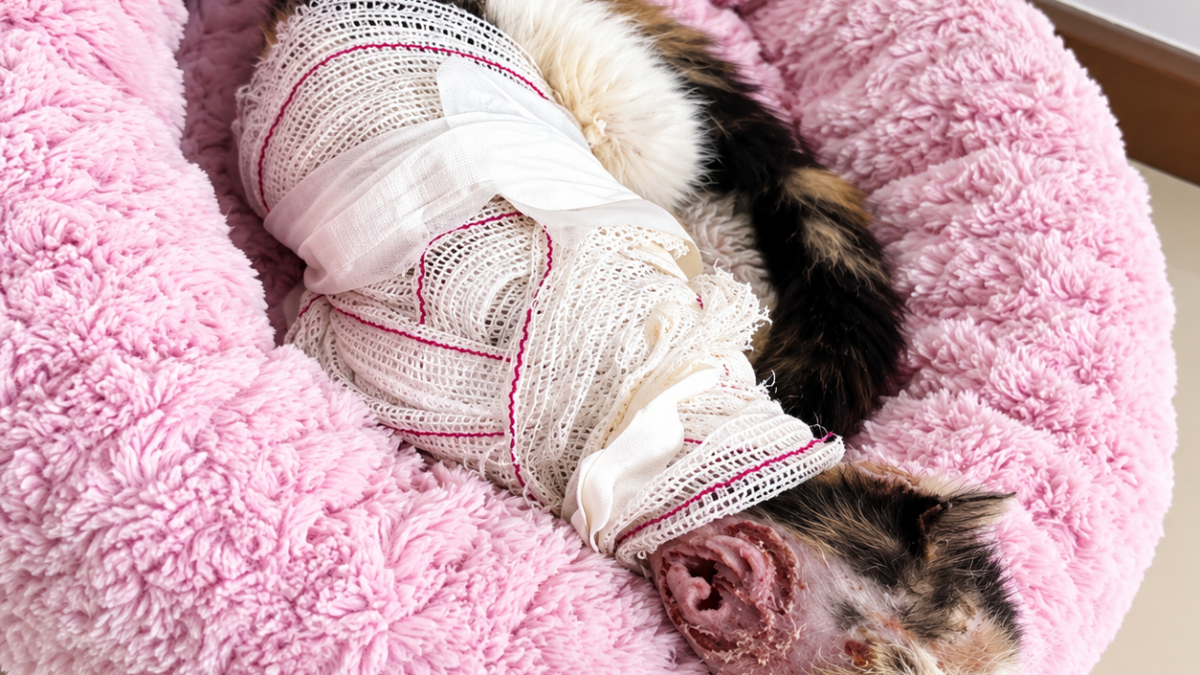
Her body was wrapped carefully where bandaging was possible.
Other burned areas had been left exposed according to the veterinarian’s plan.
Even under medication, she looked exhausted.
“You picked a terrible night to meet me,” I whispered.
Her eyelids moved.
“Christmas is supposed to be easier than this.”
She didn’t respond.
I touched the edge of the blanket.
“Tomorrow morning, I’m coming back.”
That was a promise I could make.
Not that she would live.
Not that the burns would heal.
Not that she would keep her ears.
Not that infection wouldn’t take hold.
Only that if morning came for her, I would be there.
I went home after midnight.
Christmas decorations were still glowing in windows.
People were laughing inside houses.
I stopped at a red light and realized I was gripping the steering wheel so hard my knuckles hurt.
I kept seeing Cloe standing in that garage.
Not crying.
Not hiding.
Standing.
As if she had walked until she found the first place that felt slightly safer and then had nothing left to do except wait.
I wanted to know what happened.
Where had the fire been?
Was it an accident?
Had she been sleeping somewhere when something caught fire?
Had she crawled beneath something hot?
Had someone hurt her?
The last possibility made anger rise through me so quickly that I had to force myself to breathe.
But we had no evidence.
No witness.
No known owner.
No location where the burns occurred.
The woman had not seen flames.
She had not heard screaming.
Cloe had simply appeared.
I could either invent a villain or stay with what I actually knew.
A kitten had been burned.
A stranger had opened her garage.
The kitten had chosen that opening.
Now she was in a hospital.
Those facts were enough.
My phone stayed beside me all night.
I slept for perhaps forty minutes at a time.
At 2:11 a.m., I checked the screen.
Nothing.
At 3:02, again.
Nothing.
At 4:17, I convinced myself silence was good.
At 4:23, I became convinced silence meant something terrible.
I almost called.
Then I remembered the staff had promised they would contact me if Cloe deteriorated sharply.
I waited.
At six in the morning, my phone rang.
I answered before the second vibration.
“Cloe?”
The technician recognized my voice.
“She’s still with us.”
I sat on the edge of the bed.
Those words hit harder than I expected.
“Still with us.”
“Yes.”
“How was the night?”
“Difficult, but stable enough.”
“Is she awake?”
“Intermittently.”
“Eating?”
“Not yet.”
“Temperature?”
“We’re supporting her.”
“Any infection?”
“It’s too soon to say.”
I realized I had asked six questions without breathing.
The technician continued.
“The veterinarian will update you when you arrive.”
“I’m leaving now.”
“You don’t have to—”
“I know.”
I was already putting on shoes.
When I arrived, Cloe looked almost the same as she had several hours earlier.
That disappointed me until the veterinarian reminded me what “the same” meant.
Alive.
Breathing.
Maintaining circulation.
Not crashing.
With severe burns, dramatic improvement in one night was unrealistic.
“What are we looking for today?” I asked.
“Stability.”
“That’s all?”
“That’s a lot.”
He was right.
Burn injuries are deceptive.
The full depth can become clearer over time.
Tissue that initially looks damaged may recover.
Other tissue may declare itself nonviable.
The body loses fluids through damaged skin.
Temperature regulation becomes difficult.
Infection can turn a survivable injury into a fatal one.
Cloe was not at the end of the emergency.
She was inside it.
That morning, the team began more extensive wound care.
I watched only part of it.
Not because I couldn’t handle the sight.
I had seen difficult wounds before.
But this was different.
Cloe was so young.
She had no idea why people kept touching the places that hurt.
Medication controlled as much pain as possible, but wound cleaning is still an invasion.
The technician spoke quietly.
“Cloe, sweetheart.”
The kitten’s paw flexed.
“I know.”
They removed damaged material carefully.
Cleaned the areas.
Applied appropriate dressings.
Protected what could be protected.
I stood near her head.
“You can hate all of us later.”
One ear—or what remained intact enough to move—shifted slightly.
“I mean it. You can become the meanest cat in town.”
The veterinarian glanced at me.
“I’ll note that in the treatment plan.”
I almost laughed.
Almost.
Humor felt strange in that room.
Then I realized we needed it.
Not to minimize what was happening.
To survive it.
The first bandage change took a long time.
When it ended, Cloe looked completely drained.
She was placed back onto warm bedding.
I expected her to collapse immediately.
Instead, she moved her front paw.
Slowly.
Toward me.
I put one finger near it.
Her paw touched the tip.
Then dropped.
That was all.
It might have meant nothing.
A reflex.
A random movement.
I decided it meant enough.
“Okay,” I whispered. “I’m here.”
By the second day, we began seeing the burn pattern more clearly.
Some areas were superficial enough to heal with careful management.
Others were deeper.
Her ears were especially concerning.
The edges had suffered serious damage.
The veterinarian prepared me for the possibility that portions might not survive.
“Will she hear?”
“The external ear damage doesn’t automatically mean hearing loss.”
“So she may lose shape, not hearing.”
“Correct.”
I looked at Cloe.
Her ears had once probably been one of the cutest things about her.
Tiny kitten ears.
Now blackened edges made them look fragile.
I touched nowhere near them.
“Looks don’t matter,” I said.
The veterinarian nodded.
“They matter less than infection and tissue viability right now.”
That became another theme.
What mattered changed.
Day one, survival.
Day two, tissue.
Day three, infection.
Then nutrition.
Then pain.
Then healing.
Then movement.
We lived one priority at a time.
Cloe still refused food on the second day.
That worried everyone.
Cats cannot go indefinitely without nutrition.
Her body desperately needed protein and calories to repair skin.
The veterinarian discussed assisted feeding if necessary.
We tried small portions of highly palatable food first.
I placed a little near her.
She turned her head away.
“Come on.”
Nothing.
I moved it slightly closer.
Cloe closed her eyes.
A technician shook her head.
“Don’t push her.”
“I know.”
But I hated seeing untouched food.
I had learned in rescue that eating can feel like an animal voting for tomorrow.
Cloe wasn’t voting yet.
The third night was almost as stressful as the first.
Her temperature fluctuated.
One wound looked more inflamed.
Bloodwork showed changes the team wanted to monitor closely.
Antibiotic decisions were made based on the infection risk and clinical picture.
Pain medication continued.
Fluids continued.
Bandage changes continued.
Laser therapy was introduced as part of the treatment plan where the veterinarians believed it could support healing and reduce inflammation.
I had never seen it used on burns this extensive.
The device moved over selected areas according to the veterinarian’s protocol.
Cloe lay quietly.
“Does it hurt?” I asked.
“No.”
“Good.”
I had grown suspicious of every treatment.
Not because I distrusted the medical team.
Because Cloe had endured enough.
Anything that helped without adding pain felt like mercy.
By the fourth day, she ate.
Three bites.
That was all.
I remember the number.
Three.
The technician called me over.
“Watch.”
She placed the food near Cloe.
The kitten sniffed weakly.
Licked once.
Then took a bite.
I held my breath.
Second bite.
Third.
Then she stopped.
I smiled.
“Again.”
The technician shook her head.
“Let’s not ruin it.”
“Three bites.”
“Three more than yesterday.”
I looked at Cloe.
She licked the edge of her mouth.
“Good girl.”
The next meal, she ate five.
Then less.
Then more.
Progress never moved neatly.
One morning she seemed brighter.
That afternoon, she slept almost constantly.
A wound looked cleaner.
Another area sloughed damaged tissue and looked worse before it began looking better.
Every victory arrived attached to another worry.
I stopped asking, “Is she better?”
The question was too broad.
Instead:
Did she eat?
Did she urinate?
Is the temperature stable?
How do the wounds look?
How is her pain?
What does the bloodwork say?
How much fluid is she losing?
One problem at a time.
One day at a time.
By the end of the first week, Cloe had survived longer than some of us privately feared she would.
Nobody celebrated.
Not fully.
But the atmosphere changed.
The veterinarians began talking less about whether she would survive the next few hours and more about what the next stage of treatment would involve.
That distinction meant everything.
One afternoon, a technician said, “She tried to groom herself.”
I looked up.
“What?”
“Just once.”
“Where?”
“Her front paw.”
Cloe could not safely groom the burns, obviously, but the instinct mattered.
A dying kitten does not spend energy on ordinary cat behavior.
I crouched by her enclosure.
“You’re trying to be a cat again.”
Cloe looked toward me.
Her eyes were clearer.
Still tired.
But present.
“You have terrible timing.”
She blinked.
I smiled.
“I’m taking that as criticism.”
Daily bandage changes became our routine.
They were physically exhausting for Cloe and emotionally exhausting for everyone else.
The burned tissue had to be kept clean.
Dressings needed replacing.
Some areas required debridement as damaged tissue separated.
The smell of injured tissue is something you never forget.
Neither is the sight of new healthy granulation tissue appearing beneath it.
That became the first real sign of rebuilding.
Pink.
Delicate.
Alive.
A veterinarian pointed.
“See that?”
I leaned closer.
“It’s good?”
“Yes.”
I nearly laughed at how desperate I was for someone to call anything good.
“What does it mean?”
“Her body is healing.”
I looked at Cloe.
“Did you hear that?”
She was asleep.
“Rude.”
The veterinarian smiled.
The woman whose garage Cloe had entered stayed in contact.
Her name was Marissa.
She called nearly every day.
“How is she?”
“Still fighting.”
“Can I help?”
“You already did.”
“I opened a garage.”
“You opened the right garage.”
She struggled with guilt.
“I keep thinking she must have been out there for hours.”
“Maybe.”
“What if she tried other houses first?”
“We don’t know.”
“I should have seen her sooner.”
“You didn’t know she existed.”
People are strangely talented at finding ways to blame themselves for suffering they did not cause.
Marissa had done the opposite of what mattered least.
She had noticed.
Called.
Stayed.
Cloe’s survival belonged partly to that choice.
Around day ten, Cloe stood for longer than a few seconds.
A technician sent me a video before I arrived.
In it, Cloe pushed herself upright.
Her legs trembled.
She stood.
Looked around.
Then sat.
Five seconds.
Maybe six.
I watched the clip twelve times.
At the hospital, I showed Cloe my phone.
“That’s you.”
She obviously did not care.
“I’m impressed.”
She looked toward her food.
“Yes, yes.”
Her appetite had improved significantly.
Eating brought another problem.
Cloe began expecting food.
Then demanding it.
That was the first hint that a personality was buried beneath the patient.
She heard a dish.
Her head lifted.
Someone opened a can.
Eyes wide.
A technician walked past with food for another animal.
Cloe attempted to stand.
I laughed.
“You’ve joined the hospital gossip network.”
Her tail moved slightly.
“You know that isn’t yours.”
She stared.
“Not yours.”
More staring.
“You have no respect for boundaries.”
That was the day one technician said it.
“She’s getting feisty.”
I had been waiting to hear that word.
Not critical.
Not fragile.
Not painful.
Feisty.
I could have hugged her.
The next weeks became an endurance test.
Burn healing is slow.
There is no dramatic switch where injured skin suddenly becomes normal.
The wounds contract.
New tissue forms.
Dressings protect.
Infection is watched.
Pain is controlled.
The animal gains strength.
Then one day you compare a photograph from two weeks earlier and realize half the terrifying surface has changed.
Cloe’s ears did lose damaged tissue at the edges.
It happened gradually.
The nonviable portions could not be restored.
The veterinary team managed them carefully to allow the healthiest possible healing.
Her ears would never look exactly the way they had before the burns.
When I first understood that, I felt surprisingly sad.
Not for vanity.
For what it represented.
Permanent evidence.
Cloe could recover beautifully and still carry the night with her forever.
Then I looked at her.
She was attacking a folded towel.
That helped.
Cloe didn’t care that her ears looked different.
She cared that the towel moved when she grabbed it.
I pulled gently.
She held on.
“Is this your first game?”
Cloe pulled harder.
I moved the towel again.
Her back end shifted.
She pounced.
Poorly.
I laughed.
“Okay.”
She attacked again.
For the first time since Christmas, I forgot the burns for several seconds.
All I saw was a kitten playing.
That moment made me cry later.
Not then.
In the moment, I laughed.
Hours afterward, sitting in my car, it hit me.
Cloe had played.
A kitten whose survival had been uncertain had wasted energy for fun.
That is what recovery looks like.
Not merely absence of death.
The return of unnecessary joy.
Her foster placement began once the veterinary team believed she no longer required continuous hospitalization.
I volunteered before anyone asked.
“She can come with me.”
One of the veterinarians raised an eyebrow.
“Are you sure?”
“Yes.”
“Her care is going to be intensive.”
“I know.”
“Bandage changes.”
“I know.”
“Medication.”
“I know.”
“Follow-ups.”
“Yes.”
“Skin protection.”
“Yes.”
“Potential complications.”
“I know.”
He looked at me.
“You’ve thought this through.”
“No.”
He laughed.
“Honest.”
The truth was that I did not know what caring for Cloe at home would feel like.
I only knew I couldn’t imagine sending her somewhere unfamiliar when she had finally started trusting us.
So we prepared.
A quiet room.
Clean bedding.
No rough surfaces.
Temperature control.
Medication station.
Dressings.
Approved cleaning supplies.
Food.
Litter box with modifications to reduce contamination risk.
Everything had to be arranged around protecting healing skin.
Cloe arrived in a carrier.
When I opened the door, she didn’t come out.
I sat several feet away.
“You can stay.”
She watched.
“No hospital people here.”
Her ears moved.
“Well, one hospital person.”
Nothing.
“You know what I mean.”
After ten minutes, one paw emerged.
Then the other.
Cloe stepped out.
Sniffed.
Turned.
Went back inside.
I laughed.
“Fair.”
Five minutes later, she tried again.
This time she walked two feet.
Stopped.
The house was probably enormous compared with a hospital cage.
New smells.
New sounds.
A refrigerator humming.
Distant traffic.
Floor texture.
My footsteps.
Cloe walked slowly.
Then she discovered the bed.
Soft.
Low.
Warm.
She climbed in.
Turned once.
Lay down.
I sat nearby.
“Good choice.”
She slept for almost four hours.
That first night, I woke constantly.
Every time Cloe moved, I listened.
Once, around two in the morning, I heard a small sound.
I got up.
Cloe was sitting in her bed staring toward the doorway.
“What?”
She meowed.
It was weak.
But unmistakable.
I froze.
“You have a voice.”
Another meow.
I went closer.
“Hungry?”
Meow.
I laughed quietly.
“Of course.”
The feeding schedule did not technically include a two-in-the-morning banquet, but her body still needed calories.
I prepared a small approved meal.
Cloe ate.
Then she returned to bed.
I stared at her.
“You woke me for room service.”
She started grooming one front paw.
I smiled.
“That’s fine.”
The next morning, she followed me.
Three steps at first.
I moved.
She moved.
I stopped.
Cloe stopped.
“What are you doing?”
She sat.
I walked toward the door.
Cloe followed again.
That became our new routine.
Everywhere I went inside the safe area, Cloe wanted to know why.
She had gone from entering one stranger’s garage alone to fearing that another person might disappear from her sight.
I understood.
So I announced my movements.
“Kitchen.”
Cloe followed.
“Bathroom.”
Followed.
“Laundry.”
Followed.
“You’re becoming inconvenient.”
Meow.
“Fair.”
Her wound care remained difficult.
At home, there were no extra technicians to help every time.
I had been trained on what to do and knew when something required veterinary attention rather than home management.
Still, the first bandage change made my hands sweat.
Cloe recognized the supplies.
She tried to leave.
“Come back.”
She moved faster.
“Cloe.”
She hid behind the bed.
I stared.
“You could barely stand three weeks ago.”
Silence.
“And now you’re avoiding medical care.”
A tiny face appeared.
I almost laughed.
“Progress.”
Eventually, I brought her out gently.
Medication first according to schedule.
Then cleaning.
Fresh dressings.
Cloe complained.
I apologized.
She complained more.
“I know.”
A paw pushed my hand.
“I know.”
Another push.
“You are allowed to file a complaint.”
When it was finished, she left dramatically.
Then returned five minutes later because food existed.
Trust survived.
That meant everything.
Some wounds healed faster than others.
Her shoulders improved.
Her back developed healthy new skin.
Areas along the sides contracted.
The ears remained sensitive.
Scarring formed.
New fur began appearing in patches.
At first, it was so fine I thought I imagined it.
I touched one area.
Soft.
Short.
Fur.
“Cloe.”
She looked up.
“You’re growing back.”
Her tail moved.
I took a photograph.
Then found one from Christmas night.
I regretted looking.
The difference was enormous.
But so was the memory.
I could almost feel the heat of the garage again.
Cloe’s shaking body.
Her burned ears.
My fear of touching her.
I put the phone down.
Cloe climbed onto my leg.
Not gracefully.
She used my pants like a ladder.
“Excuse me.”
She continued.
“You have claws.”
No concern.
She reached my lap.
Turned.
Sat.
I looked at her.
“Oh.”
That was new.
Cloe had accepted being held for treatment.
She had tolerated brief affection.
But choosing my lap was different.
I didn’t touch her immediately.
I let her settle.
Then I placed one hand gently on the uninjured part of her back.
Cloe began purring.
I froze.
The sound was faint.
I felt it before I fully heard it.
A vibration under my palm.
“Are you purring?”
It grew slightly louder.
My eyes filled.
“Seriously?”
Cloe tucked her paws.
I sat there for almost forty minutes because I refused to be the one who ended it.
That purr became one of the moments I remember more clearly than the surgeries, dressings, or medical updates.
Pain makes noise.
Healing is sometimes quieter.
A kitten purring on the lap of someone she had learned not to fear.
Weeks passed.
The rawness disappeared.
Scars replaced wounds.
The risk of serious infection decreased.
Medication schedules shortened.
Vet visits became less frightening.
Each appointment brought cautious optimism.
“She’s healing beautifully.”
I heard that sentence one day and nearly asked the veterinarian to repeat it.
“Beautifully?”
He smiled.
“Yes.”
I looked at Cloe.
She was trying to climb into an open cabinet.
“Her?”
“Unfortunately.”
I pulled her out.
“She’s become terrible.”
“That’s usually a good sign.”
It was.
Cloe became a menace.
She discovered toys.
Real toys.
A feather wand became an obsession.
The first time I moved it across the floor, she crouched.
Her eyes widened.
Tail flick.
I dragged the toy.
Cloe pounced.
Missed.
Stopped.
Looked offended.
I moved it again.
Pounce.
This time she caught it.
I pulled gently.
She refused to release.
“Let go.”
Cloe growled.
I stared.
“You survived forty-percent burns and now you’re threatening me over feathers?”
Growl.
I laughed until my face hurt.
Another toy had a bell.
Cloe chased it across the room.
One evening she ran so fast that I panicked.
“Slow down.”
She didn’t.
“Cloe.”
She skidded.
Turned.
Ran again.
Her healed skin moved normally.
No obvious pain.
No hesitation.
I stood there watching.
There was a time when every movement had looked painful.
Now movement itself was joy.
She climbed.
Jumped.
Stalked imaginary enemies.
Attacked blankets.
Sat inside boxes that were too small.
Discovered windows.
The first time she sat at one, sunlight fell across her scarred back.
I nearly moved her.
Heat had become emotionally connected to danger in my mind.
But the glass was cool.
The sunlight was gentle.
Cloe closed her eyes.
I stopped.
The sun had not hurt her.
Whatever happened that night had.
Sunlight itself was allowed to become safe again.
So I let her stay.
Her ears healed into a shape that made her immediately recognizable.
They were smaller at the damaged edges.
Not symmetrical.
Some people might have seen scars first.
I stopped seeing them.
Cloe’s face was simply Cloe’s face.
Her expression mattered more.
She had an enormous amount of attitude for such a small animal.
Visitors would arrive.
Cloe would inspect them.
If approved, she climbed nearby.
If not, she left.
Marissa, the woman whose garage she had entered, came to visit once Cloe was strong enough.
I wanted that meeting more than I expected.
When Marissa arrived, she stood in the doorway.
Her hands went to her mouth.
“Oh my God.”
Cloe was sitting on the couch.
Healthy.
Bright-eyed.
Fur covering most of her body.
Marissa began crying.
I smiled.
“Don’t scare her.”
“I’m sorry.”
Cloe watched.
Marissa crouched.
“Hi, baby.”
Cloe tilted her head.
“You don’t remember me.”
Maybe she did.
Probably not.
Marissa’s role in Cloe’s life had been brief.
But important.
Cloe approached.
Sniffed.
Then rubbed against her hand.
Marissa cried harder.
I laughed.
“She does that now.”
“I thought she was going to die in my garage.”
“She nearly did.”
Marissa sat on the floor.
Cloe climbed against her leg.
“I keep thinking about Christmas.”
“I know.”
“I opened the door because I forgot something in the car.”
I looked at her.
“You never told me that.”
She wiped her face.
“I almost waited until morning.”
My stomach tightened.
“If I had…”
I knew where the sentence went.
I stopped her.
“You didn’t.”
“But—”
“You didn’t.”
Cloe began playing with the string on Marissa’s sweater.
Marissa laughed through tears.
I pointed.
“That is what actually happened.”
Cloe tugged harder.
“She found you. You called. We treated her. She lived.”
Marissa looked down.
“I guess.”
“No. Not ‘I guess.’”
She looked at me.
“You are allowed to remember the good decision.”
That was something Cloe’s story taught all of us.
The mind loves alternate tragedies.
What if the garage stayed shut?
What if Marissa didn’t notice?
What if we arrived later?
What if Cloe became septic?
What if she stopped breathing?
But none of those things happened.
Cloe had enough reality to survive without us adding imaginary pain.
By the third month, the veterinarian reduced many of her restrictions.
She still required monitoring.
Scars needed protection.
The ears needed care.
But Cloe was now medically stable.
Those words sounded almost unbelievable.
Medical stable.
Not critical.
Not guarded.
Stable.
The next question was adoption.
I knew it was coming.
I hated it.
A rescue coordinator asked me one afternoon.
“Are you ready to list her?”
I looked at Cloe.
She was sleeping upside down on my couch.
“No.”
The coordinator laughed.
“That was fast.”
“I mean medically.”
“Of course.”
I knew what she meant.
Was I keeping Cloe?
I had not planned to.
Plans have very little authority once an animal starts sleeping on your pillow.
Still, I tried to be rational.
A permanent home needed to fit.
Cloe might benefit from someone with experience handling medical needs.
She could have future skin sensitivities.
Scarring might require monitoring.
Her ears would always need protection from excessive environmental exposure.
Follow-up care mattered.
“I’ll foster until the right person appears,” I said.
The coordinator smiled.
“Sure.”
“What?”
“Nothing.”
“You think she’s staying.”
“I said nothing.”
Cloe opened one eye.
I pointed at her.
“Stop recruiting allies.”
The truth was I did not know.
I loved her.
That wasn’t enough by itself.
Good rescue decisions require more than emotion.
Could I give her the long-term care she needed?
Could my home remain appropriate?
Was there another household that might be better?
We kept the question open.
Then something happened that answered it.
One evening, a storm came through.
Thunder rattled the windows.
Cloe had never reacted strongly to normal household sounds, but the first loud crack sent her under the couch.
I crouched.
“Cloe?”
Nothing.
Another thunderclap.
She pressed farther back.
I sat on the floor.
“It’s okay.”
I didn’t reach.
I remembered the Christmas night.
Fire sometimes brings explosive sounds.
We still did not know how Cloe was burned.
Maybe thunder had nothing to do with it.
Maybe the reaction was ordinary kitten fear.
I refused to create a trauma story we could not prove.
I simply stayed.
After ten minutes, Cloe’s face appeared.
“Hi.”
Another rumble.
She froze.
I put one hand on the floor.
No grabbing.
No pulling.
Just a hand.
Cloe crawled forward.
Slowly.
Then climbed directly into my lap.
She buried her face against my shirt.
I wrapped my arms around her carefully.
And in that exact moment, the adoption question ended.
Not because Cloe was afraid.
Because I understood something simple.
When the world frightened her, this was where she came.
I was home.
The next morning, I called the coordinator.
“She’s staying.”
The response was immediate.
“I know.”
“You’re annoying.”
“I know.”
We completed the adoption formally.
Cloe did not care.
There was no ceremony from her perspective.
No understanding that paperwork had changed.
She ate breakfast.
Attacked a toy.
Slept.
For me, it felt enormous.
Christmas night had begun with a kitten who walked into a stranger’s garage because she had nowhere else.
Now she would never need to search for another safe door.
Months passed.
The scars matured.
Her fur grew.
Some areas remained thinner.
Her ear edges stayed visibly damaged.
Those things became part of her.
Cloe grew from a tiny burned kitten into a lean, confident young cat.
She learned every corner of the house.
She had favorite windows.
Favorite blankets.
Favorite foods.
Favorite places to sleep.
She learned the sound of my keys.
The refrigerator.
The cabinet where treats lived.
The exact noise of the laser toy drawer opening.
She developed an unreasonable sense of ownership over things that belonged to me.
My chair.
My bed.
My laundry.
My laptop.
One morning, I found her sleeping across papers I needed.
“Move.”
Cloe looked at me.
“Those are mine.”
Slow blink.
“Cloe.”
She put her head down.
I laughed.
“Fine.”
The kitten who once had nowhere safe to lie now controlled furniture.
I considered that justice.
People continued asking what caused the burns.
I never had an answer.
Over time, I became more comfortable saying that.
“We don’t know.”
Some people found that unsatisfying.
They wanted a villain.
A person who could be hated.
Punished.
Exposed.
Maybe there was one.
Maybe there wasn’t.
Perhaps Cloe had encountered an accidental fire.
Maybe she climbed somewhere dangerous.
Maybe she was near an outdoor heat source.
Maybe something far worse occurred.
I would not turn possibility into fact.
The truth mattered more than drama.
The only injustice I could prove was that a kitten suffered terribly.
And the only revenge I could honestly offer was what came afterward.
Cloe lived.
That sounds simple until you remember how close she came to not doing it.
She lived long enough for scars to become old.
Long enough for damaged ears to become adorable rather than frightening.
Long enough to forget that food had once required coaxing.
Long enough to become picky.
Long enough to turn medicine time into a chase.
Long enough to discover the Christmas tree the following year.
That was an event.
I had debated putting one up.
Cloe had arrived on Christmas night.
Part of me worried the decorations would make me emotional.
Then I realized that was my issue, not hers.
So I put up the tree.
Cloe watched from across the room.
“No.”
Her eyes locked onto an ornament.
“Absolutely not.”
She crouched.
“Cloe.”
She launched.
The lower branch shook.
An ornament swung.
Cloe attacked.
I grabbed her.
“You nearly died last Christmas and this is how you honor the anniversary?”
She twisted toward the tree.
“Unbelievable.”
I moved the fragile ornaments higher.
Cloe spent the next hour trying to climb.
I sent Marissa a photograph.
She replied immediately:
SAME CAT???
I typed back:
UNFORTUNATELY.
Marissa sent laughing faces, then:
BEST CHRISTMAS PRESENT EVER.
I looked at Cloe.
She was halfway inside a box.
Maybe.
That night, I thought about the symmetry.
One Christmas, Cloe had walked into a garage burned across nearly forty percent of her body.
The next, she was trying to destroy my decorations.
If someone wanted a happy ending, there it was.
But life continued.
That mattered too.
A real happy ending is not a freeze-frame.
It is years of ordinary days after the crisis.
Cloe still needed veterinary follow-up.
Scar tissue can behave differently from normal skin.
We watched for irritation.
Monitored exposed areas.
Protected her appropriately.
Her ears required sensible care.
But those tasks became routine.
No emergency.
No panic.
Routine.
One checkup ended with the veterinarian saying, “She looks great.”
I smiled.
“She knows.”
Cloe was sitting on the exam table glaring at us.
The veterinarian scratched beneath her chin.
“You remember when we weren’t sure she’d survive the night?”
“I try not to.”
“I do.”
I looked at him.
“Why?”
“Because it makes this better.”
Cloe swatted gently at his stethoscope.
He laughed.
“Exactly.”
He had a point.
There is danger in living entirely inside the worst memory.
But there is also value in remembering just enough to understand the distance traveled.
I did not want Christmas night to define Cloe.
But I did not want to erase it either.
The scars mattered because survival mattered.
One day, nearly a year after rescue, I found the original blanket.
The one from her first week at my house.
It had been washed and stored.
Cloe walked over while I was sorting a closet.
She sniffed it.
Then sat on it.
I froze.
Did she recognize the smell?
Probably not.
Too much time had passed.
Too many washes.
Maybe it was simply soft.
I sat beside her.
“You used to fit in half of that.”
Cloe kneaded the fabric.
“You used to need medication just to tolerate being touched.”
Knead.
“You used to hate bandage changes.”
She looked at me.
“You still hate everything I ask you to do.”
Cloe lay down.
I smiled.
“Consistency.”
I kept the blanket.
Not as a shrine.
Just a piece of her history.
Marissa visited again that winter.
This time, Cloe greeted her at the door.
Marissa laughed.
“She’s huge.”
“She’s normal-cat-sized.”
“She was so tiny.”
“I know.”
Cloe rubbed against her.
Marissa looked at the ears.
“They healed better than I imagined.”
“They did.”
“She’s beautiful.”
I nodded.
“Yes.”
Then Marissa asked something that surprised me.
“Do you ever get angry?”
“At what?”
“Whoever did this.”
I was quiet.
“I don’t know that anybody intentionally did.”
“You know what I mean.”
“Yes.”
I sat down.
Cloe jumped onto the chair beside us.
“I was angry for months.”
“Were?”
“Sometimes I still am.”
“At who?”
“That was the problem. I didn’t know.”
Marissa stroked Cloe’s back.
“I wanted somebody responsible too.”
“I think we both wanted a person because then the story had somewhere to put the pain.”
She looked at me.
“Exactly.”
Cloe rolled onto one side.
I continued.
“But we never got proof. So I stopped building an imaginary criminal just so I’d have someone to hate.”
“Then what did you do with the anger?”
I looked at Cloe.
The cat was trying to bite the end of Marissa’s sleeve.
“I watched this.”
Marissa laughed.
“That helped?”
“More than hatred did.”
Because that became Cloe’s real revenge.
Not a person being punished.
Not a courtroom.
Not an arrest we had no evidence to justify.
Life.
The fire, whatever caused it, had tried to reduce Cloe’s world to pain.
She built a bigger one.
The burns tried to make touch terrifying.
Cloe learned to ask for affection.
The wounds made movement painful.
She learned to race through rooms.
The first days made food difficult.
She became the cat who screamed if dinner was four minutes late.
Her damaged ears made strangers pity her.
Cloe used them to ignore me more efficiently.
Nothing erased what happened.
But everything afterward made it smaller.
That was justice I could believe in.
Around eighteen months after her rescue, Cloe discovered an open garage.
Mine.
I had been carrying boxes inside.
The door was open.
Cloe was an indoor cat, so she never had unrestricted outdoor access.
I turned around and found her sitting several feet inside the garage.
My heart stopped.
“Cloe.”
She looked at me.
For a second, the entire first night returned.
A garage.
A small cat.
Christmas.
Burns.
The image was so strong I could barely move.
Cloe, meanwhile, sniffed a cardboard box.
“Come here.”
She looked toward me.
“Now.”
Maybe my voice sounded different.
She walked over.
I scooped her up.
She protested immediately.
I held her tighter than necessary.
“Sorry.”
She squirmed.
“I know.”
I carried her inside.
Once the door was closed, I put her down.
Cloe walked away as if nothing had happened.
I sat on the floor.
My hands were shaking.
That was when I realized some injuries had healed on her much faster than they had healed in me.
Cloe did not know garages were symbolic.
I did.
She had moved on.
I still carried Christmas night in places I didn’t recognize until something opened the door.
I called Marissa later.
“You’ll laugh.”
“What?”
“She walked into my garage.”
Silence.
Then, “Oh.”
“Yeah.”
“How did you handle it?”
“Badly.”
She laughed softly.
“I would have too.”
“I grabbed her like the building was on fire.”
“Was it?”
“No.”
“Then yes. Badly.”
I laughed.
Cloe jumped onto the couch beside me.
“She doesn’t care.”
“Good.”
Marissa was right.
Good.
Cloe didn’t need to carry the fear for both of us.
Eventually, I learned to release some of it too.
The second anniversary of her rescue passed quietly.
I didn’t post anything dramatic.
I did not buy a special cake.
Cloe had no idea what date it was.
She spent the morning sleeping.
At noon, she chased a toy.
In the afternoon, she lay in the window.
That evening, she climbed into my lap while I was watching television.
I looked down.
Her scars were mostly hidden beneath fur now.
Not all.
You could still see parts along the ears and some thinner areas if you knew where to look.
I ran one finger along her shoulder.
Cloe purred.
That was enough.
I thought of the veterinarian’s words from the first night.
I don’t know yet whether her body has enough left to finish it.
Cloe had answered.
Not immediately.
Not dramatically.
One bandage at a time.
One meal.
One laser session.
One cleaned wound.
One night without infection.
One patch of new tissue.
One purr.
One toy.
One lap.
One year.
Then another.
Yes.
She had enough.
Years later, people meeting Cloe for the first time rarely knew the full story.
Some noticed the ears.
“What happened?”
“She was burned as a kitten.”
Their expressions changed immediately.
“Oh, poor thing.”
Usually, at that exact moment, Cloe did something destructive.
Knocked something off a shelf.
Attacked a shoelace.
Tried to steal food.
And the pity evaporated.
I liked that.
Cloe was never “poor thing” for long.
Her scars deserved respect.
They did not require sadness every time someone looked at her.
One visitor once asked, “Does she know she’s different?”
I looked at Cloe.
She was sitting in the center of the kitchen waiting for chicken.
“No.”
“How can you be sure?”
“Because she believes the universe revolves around her.”
The visitor laughed.
Cloe meowed.
“See?”
That confidence might have been the greatest transformation.
The kitten in the garage had asked for nothing.
She barely had strength to stand.
The adult cat demanded everything.
Food.
Space.
Attention.
Doors opened on schedule.
Blankets arranged correctly.
Humans available when needed.
Safety had made her entitled.
I was proud of that.
Fear teaches an animal to make itself small.
Home allowed Cloe to become enormous.
Not physically.
In presence.
She occupied the house.
My routines.
My photographs.
My Christmases.
When people asked why I kept her, I eventually stopped giving the long answer.
I just said, “She stayed.”
That was true in every sense.
She stayed alive.
Stayed through the first night.
Stayed through infection risk.
Stayed through bandage changes.
Stayed through pain.
Stayed through the days when eating was difficult.
Stayed through the loss of damaged ear tissue.
Stayed until wounds became scars.
Then she stayed with me.
The story had never needed a more complicated conclusion.
On one Christmas evening several years after the rescue, I invited Marissa over.
We ate dinner.
Cloe sat beneath the table hoping gravity would improve her situation.
Marissa looked down.
“She still begs?”
“She has survived adversity but not character development.”
Marissa laughed.
Cloe stared upward.
I slipped her an approved tiny piece of food.
Marissa pointed.
“That’s why.”
“I know.”
After dinner, we went into the living room.
The Christmas tree stood in the corner.
The lower ornaments were still strategically placed higher than normal.
Lessons had been learned.
Cloe jumped onto the couch.
Marissa sat beside her.
For a while we talked about ordinary things.
Work.
Family.
Weather.
Then Marissa looked at Cloe.
“Do you remember that phone call?”
“Yes.”
“I thought you were going to tell me she needed to be put down.”
I nodded.
“I thought I might have to.”
“Did you really?”
“The possibility existed.”
Cloe began washing one paw.
Marissa stared.
“She has no idea.”
“No.”
“Do you think that’s better?”
“Yes.”
I answered immediately.
“She doesn’t need to know.”
Cloe had no use for the story humans told about her.
She didn’t need to understand percentages.
Forty percent burned.
Days critical.
Months healing.
Those numbers mattered to us.
Not her.
To Cloe, life was present tense.
Warm couch.
Full stomach.
Known voices.
Safe house.
A human hand.
That was enough.
Marissa reached toward her.
Cloe rubbed her cheek against the fingers.
“She picked my garage.”
“Yes.”
“Why?”
“We’ll never know.”
Marissa smiled.
“I like to think she knew.”
“Maybe.”
I didn’t argue.
Some questions can remain gentle mysteries.
We sat in silence.
Outside, Christmas lights reflected in the window.
Cloe eventually walked across the couch and climbed into my lap.
She turned twice.
Settled.
Purred.
Marissa smiled.
“Look at her.”
I did.
There was a time when looking at Cloe meant checking damage.
How deep?
How infected?
How much skin?
How much pain?
How much fluid loss?
Now looking meant nothing more complicated than looking at my cat.
Her ears were different.
Her scars existed.
Her body remembered in tissue what her mind seemed to have released.
But none of it made the room sad.
Quite the opposite.
Cloe had turned survival into something almost rude.
She had survived so thoroughly that suffering no longer received top billing.
Her life was about ordinary things now.
And maybe that was the most satisfying revenge possible.
Whatever burned her had once controlled almost forty percent of her body.
It did not get one hundred percent of her life.
It got one night.
Some scars.
A few pieces of her ears.
A stretch of painful months.
Then Cloe took everything else.
The mornings.
The toys.
The windows.
The meals.
The Christmas trees.
The naps.
The people who loved her.
The right to grow old somewhere safe.
I could never punish an unknown cause.
I could never go back to Christmas night and prevent the fire.
I could never erase the moment she walked into that garage.
But I could make sure it remained the worst night of her life instead of the pattern of it.
That was the promise rescue could actually keep.
Not “nothing bad will ever happen again.”
No one can promise that.
The promise was simpler.
“You will not face it alone again.”
Cloe never did.
As the evening grew quiet, Marissa left.
I closed the door behind her.
When I returned to the living room, Cloe was sitting in front of the tree.
“Don’t.”
Her eyes went to a low ornament.
“Cloe.”
Tail flick.
“You are an adult.”
Crouch.
“You have survived too much to die by Christmas decoration.”
She jumped.
I caught the ornament before it hit the floor.
Cloe ran.
I laughed and chased her halfway down the hall.
She disappeared around the corner.
Then came back at full speed.
Healthy paws pounding against the floor.
No bandages.
No burned skin cracking with movement.
No frightened silence.
Just Cloe.
She ran past me.
Turned.
Ran again.
I stopped in the hallway and watched her.
For a moment, the years collapsed.
I saw the tiny kitten standing in a cold garage on Christmas night.
Burned.
Weak.
Waiting.
Then that image disappeared beneath the cat racing through my house.
Cloe jumped onto the couch.
I sat beside her.
She immediately walked across my legs and settled in my lap as though the chase had been my fault.
I ran a hand down her back.
She purred.
Outside, Christmas lights glowed through the window.
Years earlier, she had walked toward the only open door she could find.
This time, she didn’t need to search for one.
She was already home.
And the kitten who had once arrived on Christmas night with nearly forty percent of her tiny body burned now slept beneath those lights, scarred but safe, surrounded by people who would never let her face another terrible night alone.
The years after that Christmas became the part of Cloe’s story I eventually loved the most.
Not because anything dramatic happened.
Quite the opposite.
For so long, every update about her had sounded like a medical report.
Temperature.
Pain level.
Wound condition.
Bandage changes.
Eating.
Infection.
New tissue.
Medication.
Possible complications.
Then one day, without any of us really noticing when it happened, the questions changed.
“Did Cloe eat?”
became
“Why is Cloe trying to steal my breakfast?”
“Can Cloe stand?”
became
“Can somebody get Cloe off the kitchen counter?”
“Is Cloe in pain?”
became
“Why is Cloe screaming outside the bathroom because I closed the door for thirty seconds?”
The emergency disappeared slowly until ordinary life replaced it.
That was the victory no photograph could fully show.
Cloe learned the rhythm of my mornings.
She knew I woke before the alarm sometimes, and if I moved even slightly beneath the blanket, she appeared beside my face.
Not gently.
Cloe had no interest in subtlety.
She would walk across my chest, put one paw against my shoulder, and stare.
“Five minutes.”
She stared harder.
“Cloe.”
Meow.
“You have food.”
Another meow.
“You always have food.”
She stepped onto my ribs.
“All right.”
I would get up.
Cloe would jump off the bed and hurry toward the kitchen like she had personally prevented starvation.
Watching her eat never became completely ordinary to me.
I wanted it to.
Most days, it was.
But every once in a while, I would remember the hospital.
Three bites.
The first meal where three tiny bites had felt like a miracle.
Now she stood in the kitchen complaining because I was opening the can too slowly.
I would catch myself smiling.
“What?”
Cloe would meow.
“Nothing.”
She had no idea what I was remembering.
That was probably a gift.
Her life was not divided into before and after the way mine was.
She lived inside whatever moment she was in.
Breakfast mattered because breakfast existed now.
A sunbeam mattered because it was warm now.
A toy mattered because it moved now.
There was something almost enviable about that.
Humans drag history into rooms where it no longer belongs.
Cloe did not.
For a while, I worried every holiday would take me back to the garage.
The decorations.
The lights.
Cold evenings.
The particular quiet that comes after Christmas dinner.
I assumed December would always feel heavy.
But Cloe changed that too.
The first Christmas after her rescue, the holiday belonged partly to fear.
The second belonged to memory.
By the third, Cloe had made it hers.
She discovered wrapping paper.
That was the year I stopped trying to make Christmas emotionally meaningful.
I had placed gifts beneath the tree.
Nothing fragile.
I knew better by then.
Cloe walked into the room, noticed a loose piece of ribbon, and froze.
I saw the calculation in her face.
“No.”
Her tail twitched.
“Don’t.”
She crouched.
“Cloe.”
She attacked.
Wrapping paper tore.
A bow flew.
One box slid halfway across the floor.
I lunged forward.
Cloe ran.
Marissa, who had come over for coffee, laughed so hard she nearly spilled her cup.
“This is your inspirational survivor?”
I looked at the destruction.
“She has become a criminal.”
Cloe reappeared from behind the couch with a ribbon hanging from her mouth.
Marissa laughed harder.
“I’m serious.”
I pointed.
“She has no respect for what she survived.”
“That might be healthy.”
I stopped.
She was right.
Cloe did not perform gratitude.
She did not move through the house like an animal aware that she had been granted a second chance.
She behaved as if she had always been entitled to food, warmth, safety, and trouble.
At first, I thought that meant she had forgotten.
Later, I understood it meant we had succeeded.
The goal was never to make Cloe spend the rest of her life understanding how lucky she was.
The goal was to make safety so normal that luck no longer entered into it.
The house became hers in small ways.
A blanket on the couch became Cloe’s blanket.
A chair near the window became Cloe’s chair.
The top of a cabinet became somewhere she apparently had legal rights.
If I left a sweater on the bed, it became a sleeping surface.
If I opened a cardboard box, ownership transferred immediately.
If I sat down with important papers, Cloe sat on them.
“You have three beds.”
She blinked.
“Three.”
No response.
“You’re on tax documents.”
She lay down.
“I need those.”
Cloe closed her eyes.
I learned to work around her.
That, too, was part of belonging.
The home did not simply contain Cloe.
It adjusted to her.
Years earlier, her entire existence had depended on whether someone would make room for her.
Now rooms rearranged themselves around where she chose to sleep.
The irony never escaped me.
One afternoon, Marissa brought over a printed photograph.
She set it facedown on the table.
“What’s that?”
“You’ll know.”
I turned it over.
My stomach tightened immediately.
Cloe in the garage.
Not the worst photograph.
Marissa had never photographed her at the closest distance because she had been too afraid to approach before help arrived.
Still, the image was painful.
Cloe stood near the wall.
Small.
Burned.
Head lowered.
I stared.
“I found it on an old phone.”
I nodded.
“I haven’t seen this one.”
“I almost deleted it.”
“Why didn’t you?”
“I don’t know.”
Cloe entered the room.
She jumped onto a chair.
Then onto the table.
“Perfect timing,” I said.
She walked directly across the photograph.
Marissa laughed.
Cloe sat on top of it.
Neither of us spoke for several seconds.
Then I started laughing too.
“What?”
Marissa pointed.
“The symbolism is a little obvious.”
Cloe began washing one paw while sitting on the image of herself at the worst moment of her life.
I leaned back.
“Apparently she has an opinion about historical documentation.”
Marissa reached out and stroked her.
“I think this is better.”
“What?”
“This.”
She touched Cloe’s back.
“Not looking at the old picture.”
I understood.
The photograph had value.
It proved where the story began.
But the living cat sitting on top of it mattered more.
We put the photograph away.
I never threw it out.
But I stopped needing to look at it often.
There is a difference between remembering suffering and preserving it as the center of someone’s identity.
Cloe deserved better than to remain forever frozen in a garage because that was the image people found most emotional.
Her life became larger than the wound.
That realization changed how I talked about her.
If someone asked what happened to her ears, I answered.
If someone wanted to know about the burns, I explained.
But I stopped introducing Cloe through the tragedy.
“This is Cloe.”
That was enough.
Maybe later someone learned the story.
Maybe not.
She was allowed to meet people as herself first.
One evening, a friend came over who knew almost nothing about her history.
Cloe jumped beside him.
He scratched beneath her chin.
“She’s friendly.”
“On her terms.”
He noticed the ears after several minutes.
“What happened there?”
“She was badly burned as a kitten.”
His hand stopped.
“Oh.”
Cloe shoved her head under his fingers, demanding he continue.
He laughed.
“Okay.”
I smiled.
That was exactly why I wanted people to meet her before hearing everything.
The scars changed the way humans looked at Cloe.
They did not change the way Cloe expected to be treated.
She still wanted the chin scratch.
Continue.
Don’t make this weird.
That became one of the quiet lessons of living with her.
Injury can make other people uncomfortable long after the injured one has learned to live.
Cloe did not need us staring at what was missing or damaged.
She needed dinner.
Play.
Medical care when appropriate.
Boundaries she could ignore.
A clean litter box.
Someone to open the blinds.
Life.
As she grew older, her veterinarian continued monitoring the scarred areas.
Burn scars can change.
Skin can become more delicate.
Some regions remain sensitive.
Sun exposure has to be considered, particularly where fur is thin.
We took those things seriously.
But seriously did not mean fearfully anymore.
At checkups, Cloe behaved like a cat who believed veterinary medicine was a personal insult.
She would arrive curious.
Then recognize the examination room.
Then become offended.
The veterinarian would listen to her heart.
Cloe would glare.
Check the ears.
Glare.
Examine the healed skin.
More glaring.
“Looks good,” he would say.
I would look at Cloe.
“She disagrees.”
One appointment ended with him stepping back and smiling.
“She’s aging beautifully.”
That word struck me.
Aging.
For a second, I couldn’t respond.
“What?”
He looked concerned.
“Nothing.”
I touched Cloe’s back.
“Aging.”
The first Christmas, the future had been measured in hours.
Could she survive the night?
Then days.
Could she avoid infection?
Then weeks.
Could the wounds close?
Months.
Could she grow?
Years later, somebody could casually describe her as aging.
I wanted to hear that word a thousand times.
Aging was not sad.
Not for Cloe.
Aging was something she had almost been denied.
Every year added to her life felt like an argument against that Christmas night.
She was here long enough to become older.
Long enough for her toys to change.
Long enough for habits to form.
Long enough for routines to become traditions.
Cloe slowed slightly as she matured.
Not dramatically.
She was still capable of chaos.
But the kitten who once attacked everything became a cat who thought more carefully before wasting energy.
She liked watching birds through the window.
There was a particular ledge where she would sit for hours.
In the morning, the light landed there first.
I put a cushion beneath it.
Cloe ignored the cushion for two weeks.
Then one day, she used it.
I took a photograph.
Marissa replied:
SHE FINALLY APPROVED IT?
I wrote:
TEMPORARILY.
Cloe became deeply interested in neighborhood birds she had no possibility of reaching.
Her jaw would chatter.
Tail twitch.
Eyes lock.
Sometimes I sat beside her.
“Big plans?”
Cloe watched.
“You know the glass is there.”
No response.
“Good conversation.”
There was peace in those mornings.
The same sunlight that once made the burned skin on her back something we had to protect carefully now warmed a healthy adult cat behind safe glass.
I thought about that often.
Not in a grand way.
Just a quiet awareness.
Safety does not always look dramatic.
Sometimes it looks like a cat asleep by a window.
As the years passed, Marissa and I stayed in contact largely because of Cloe.
Without that Christmas night, we probably never would have known each other.
At first, our conversations were medical updates.
Then photographs.
Then holidays.
Eventually, friendship.
One evening, she admitted something.
“I used to open the garage door every Christmas night.”
I looked at her.
“Why?”
“I don’t know.”
She laughed at herself.
“I think some part of me wondered if another animal would be there.”
“Was there?”
“No.”
“Good.”
“I know.”
She became serious.
“But for years I checked.”
I understood more than I wanted to.
Rescue teaches superstition.
Once something terrible happens in a particular place or at a particular time, the mind expects repetition.
“You were waiting for the same story.”
“Maybe.”
I looked toward Cloe.
She was asleep nearby.
“But it only had to happen once.”
Marissa nodded.
One injured kitten.
One open garage.
One person who noticed.
Sometimes that is the entire difference between life and death.
The thought still humbled me.
Not because it made us heroes.
It made me aware of how much can depend on ordinary attention.
Marissa did not have medical training.
She did not perform surgery.
She did not know burn care.
She opened a door.
She saw suffering.
She called.
That was enough to begin.
Cloe stretched in her sleep.
Marissa smiled.
“I think she saved me from something too.”
“What?”
“Walking through life without looking closely.”
I did not answer immediately.
Cloe’s story had done that to me too.
It made suffering harder to ignore.
But it also taught me not to turn every painful situation into spectacle.
The point was not to look at hurt and feel devastated.
The point was to notice what action was possible.
Sometimes action is enormous.
Sometimes it is one phone call.
Cloe became part of many people’s lives without understanding any of that.
She was only interested in whether Marissa had brought treats.
The older she became, the more confident she became about asking.
One Christmas, Marissa arrived with a bag.
Cloe appeared immediately.
“You don’t know that’s for you,” I said.
She sniffed it.
Marissa laughed.
“It partly is.”
“Traitor.”
She pulled out a small toy.
Cloe grabbed it before she finished removing the tag.
“Wait.”
Too late.
Cloe ran.
Marissa looked at me.
“She’s still fast.”
“Unfortunately.”
We watched her disappear down the hallway.
“She’s happy.”
I nodded.
That word was simple.
But it was the end I had wanted from the beginning without knowing how to ask for it.
Not inspiring.
Not brave.
Not miraculous.
Happy.
There were still moments when the past returned.
A strange smell of smoke from a neighbor’s fireplace made me tense once.
A distant siren on Christmas night.
A photograph surfacing automatically on my phone.
The scars when the light hit at a certain angle.
But the memories no longer controlled the room.
Cloe did.
And usually she was doing something too ridiculous to allow sadness much time.
Once, while I was remembering the hospital, Cloe jumped onto the table and knocked a cup of water directly onto my papers.
I stared.
She stared.
“I was having a meaningful moment.”
Cloe stepped through the water.
“Fantastic.”
She jumped down.
I grabbed towels.
That was life with her.
Every attempt to turn her into a symbol was eventually interrupted by the fact that she was a cat.
I came to appreciate that.
Cloe did symbolize things to me.
Survival.
Attention.
Patience.
The enormous difference between being noticed and being ignored.
But she never carried those meanings herself.
She carried toys.
Sometimes socks.
Once, inexplicably, a kitchen sponge.
That kept the story grounded.
Years after the rescue, I was asked what I thought had saved Cloe.
I could have said medicine.
And that would have been true.
Pain control mattered.
Wound management mattered.
Fluids mattered.
Bandages mattered.
Antibiotics when medically necessary mattered.
Laser therapy was part of the treatment strategy.
Nutrition mattered.
Veterinary skill mattered enormously.
But the answer was bigger.
Cloe survived because care continued.
One person did not stop after the first phone call.
The hospital did not stop after stabilizing her.
The staff did not stop because bandage changes became repetitive.
We did not stop when healing became slow.
Marissa did not forget her after the garage door closed.
I did not stop caring because the emergency ended.
Her survival was built from continuity.
People imagine rescue as a moment.
A hand reaching down.
An animal lifted from danger.
But that is only the beginning.
The real work is what happens on day twelve when there is no dramatic rescue photo anymore.
Day twenty-seven when another wound still needs cleaning.
Month three when medical bills continue.
Year two when scars still require attention.
Year seven when the animal needs ordinary senior care and no one is watching.
That is love too.
Maybe more so.
One winter, Cloe developed a minor unrelated health issue.
Nothing like the burns.
Nothing catastrophic.
But the first symptom sent my mind immediately to the worst place.
The veterinarian examined her.
“Routine.”
“Are you sure?”
He looked at me.
“Yes.”
“Completely?”
He smiled.
“You still do this?”
I looked at Cloe.
She was sitting on the table irritated.
“Yes.”
He nodded.
“Understandable.”
The problem resolved quickly.
But that experience reminded me that healing does not erase fear from the people who witnessed the beginning.
You simply learn to manage it.
Cloe taught me how.
Look at the animal in front of you.
Not the animal from the old photograph.
Not the worst possible future.
This animal.
Today.
What does she need now?
That question saved me from many unnecessary nights of panic.
Cloe, naturally, contributed nothing to my emotional growth.
She demanded dinner.
When she began showing the first subtle signs of becoming an older cat, I noticed immediately.
She slept longer.
Jumped with a little more calculation.
Sometimes chose the lower surface instead of the highest shelf.
I added steps near one favorite spot.
Cloe ignored them.
Then began using them when she thought I wasn’t watching.
I said nothing.
Dignity mattered.
We adjusted her care just as we had throughout her life.
Not because she was fragile.
Because bodies change.
Young survivors become adult survivors.
Adult survivors become seniors if they are lucky.
That final stage felt like another victory.
White hairs appeared around her face.
I found one and stared at it.
“You’re getting gray.”
Cloe blinked.
“I’m serious.”
She walked away.
I sent Marissa a photograph.
She called instead of texting.
“Is that gray?”
“Yes.”
There was silence.
Then she laughed and cried at the same time.
“She’s old enough to go gray.”
“I know.”
We both understood why that mattered.
A burned kitten on Christmas night had lived long enough for age, not trauma, to change her appearance.
I could not imagine a more satisfying insult to death.
Cloe continued growing older at her own pace.
She remained herself.
Bossy.
Selective.
Affectionate when she chose.
Hungry at inconvenient times.
Deeply committed to sleeping on things I needed.
Every Christmas, the tree went up.
Every Christmas, lower ornaments remained a bad idea.
Every Christmas, Marissa visited if she could.
And every year, at some point, our eyes would meet across the room while Cloe did something completely ordinary.
We never needed to say it.
She is still here.
That sentence never lost its power.
One Christmas night, much later, Cloe fell asleep in my lap before midnight.
The house was quiet.
The tree lights reflected softly across the room.
Her ears, permanently altered by the burns, moved slightly when a car passed outside.
I ran my fingers along the fur behind them.
Cloe purred without opening her eyes.
I remembered the garage.
I always would.
But the memory felt different.
It no longer ended with the injured kitten.
It continued automatically.
Hospital.
Bandages.
Three bites.
New tissue.
Purring.
Home.
Christmas trees.
Gray hairs.
Years.
The worst image no longer had the final word.
I looked down.
“You really stayed.”
Cloe kept purring.
I smiled.
There had been a time when I promised her only one thing.
If morning came, I would be there.
Morning came.
Then another.
Then thousands more.
And somewhere along the way, that frightened kitten stopped being the animal I was trying to save.
She became the cat who shared my life.
That was the ending I never could have imagined on Christmas night.
Not that Cloe survived one terrible injury.
That would have been enough.
But she received something larger.
Time.
Enough time for pain to become an old memory.
Enough time for scars to become familiar.
Enough time for strangers to become family.
Enough time for the kitten who once searched for an open garage to forget what it felt like not to have a home.
Outside, the night was cold.
Inside, Cloe stretched across my lap.
Her eyes opened for a second.
She looked at me.
Then at the Christmas tree.
I followed her gaze.
“No.”
Her ears moved.
“You are too old for that.”
Cloe slowly stood.
“Cloe.”
She stepped onto the couch arm.
I stared.
“Absolutely not.”
Her body lowered.
I reached for her just as she made one remarkably undignified attempt toward a low ornament.
She missed.
Landed on the cushion.
Turned around as if nothing had happened.
I laughed until my eyes filled.
“Still you.”
Cloe sat beside me.
I lifted the ornament higher.
Then she climbed back into my lap.
A few minutes later, she was asleep again.
I looked at the scars that still showed faintly beneath the fur.
The fire had marked her.
There was no denying that.
But the marks no longer told the whole story.
They were only evidence that something terrible had happened once.
Everything around them was evidence of what happened after.
Warmth.
Age.
Home.
Trust.
Years.
And love strong enough to become completely ordinary.
That Christmas night, Cloe had walked through a stranger’s open garage door because she needed somewhere to stop running from pain.
She never had to search for another open door again.
For the rest of her life, she knew exactly where home was.
[END OF STORY]