HOA Tried to Force My Guard Dogs Out—Then Three Homes Were Hit in One Week and Everyone Learned Why I Needed Them
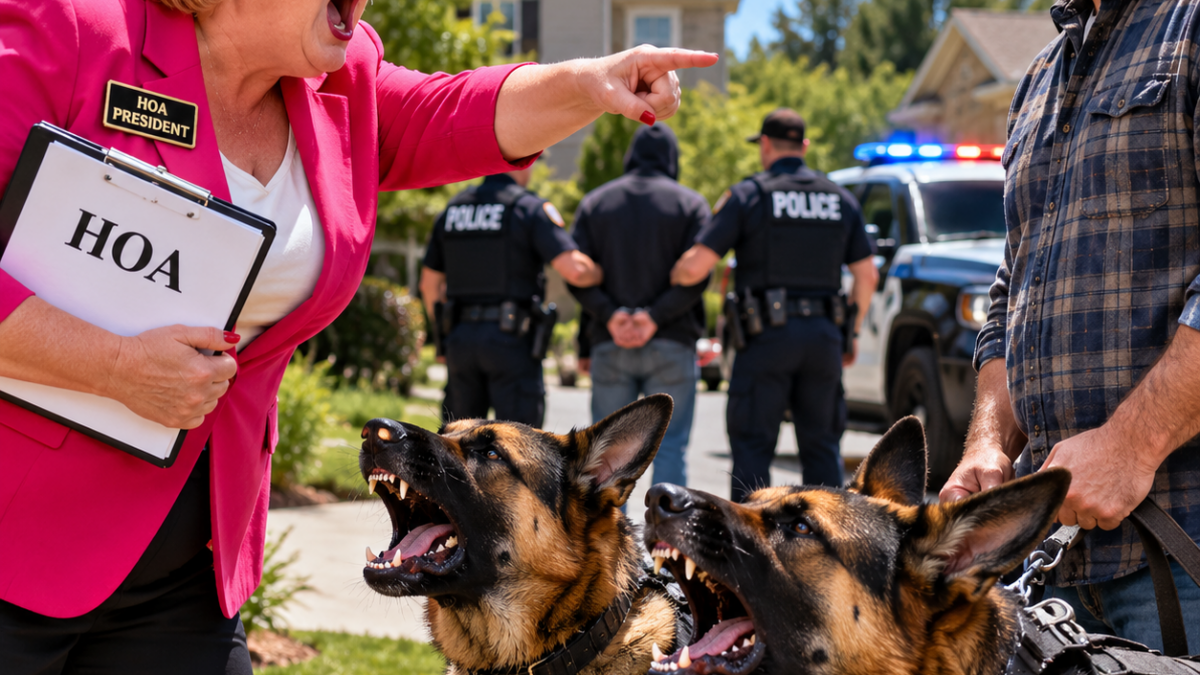
—
PART 2
—
The first thing I did was not call Karen.
That was what she expected.
She wanted an angry phone call she could describe later as threatening. She wanted me emotional, reactive, careless. She wanted a version of me she could point to and say, *See? This man is dangerous, and so are his dogs.*
Twenty years in uniform had taught me something that transferred surprisingly well to suburban politics.
Never give an opponent the version of you they’re prepared for.
So I made coffee.
I cleared the dining room table.
Then I started building a file.
Zeus watched from the floor as I laid out his veterinary records, training documentation, service-animal information, letters from my VA therapist, and records from the K9 facility where both dogs had completed hundreds of hours of obedience and specialized training.
Apollo eventually wandered over and dropped a tennis ball on top of the violation notice.
I looked at him.
“That your legal opinion?”
His tail thumped against the floor.
Sarah almost smiled.
Almost.
But I could still see fear behind her eyes.
“Mark, what if they don’t care about the documents?”
“Then the documents aren’t for them.”
“What does that mean?”
“It means if Karen wants to turn this into a legal fight, we’re going to make sure everyone who comes after her sees exactly what she knew before she acted.”
She stared at me for a few seconds.
Then nodded.
“Okay.”
That word mattered.
Sarah had followed me through years when I wasn’t always easy to live with. She had learned that when I became this calm, it didn’t mean I wasn’t afraid.
It meant I’d found something to do with the fear.
The monthly HOA meeting was six days later.
I walked into the clubhouse carrying a three-inch binder.
Karen sat at the center of the board table like a queen holding court.
Beside her was Gary Thompson, a retired salesman who laughed at everything Karen said, and Brenda White, who rarely seemed to speak unless Karen spoke first.
Only seven homeowners were in the audience.
That was normal.
Karen’s greatest source of power wasn’t that people supported her.
It was that people were exhausted by her.
They had jobs.
Children.
Mortgages.
Parents to care for.
Nobody wanted to spend Wednesday night arguing about fence stains.
Karen understood that.
She weaponized fatigue.
When my name was called, I stepped to the podium.
Karen leaned back.
“Mr. Stevens, you have three minutes.”
“I’ll be brief.”
I opened the binder.
I explained Zeus and Apollo’s training.
I explained the role they played in my treatment.
I showed records demonstrating their behavior history.
No bites.
No attacks.
No complaints from animal control.
Nothing.
I explained that they remained under control at all times on my property and on walks.
Then I addressed the so-called aggressive breed amendment.
“Please provide the meeting minutes where this amendment was adopted.”
Karen’s expression changed slightly.
“It was adopted according to board procedure.”
“When?”
“The board has records.”
“Great. I’d like the date.”
She smiled.
“Tonight isn’t a deposition, Mr. Stevens.”
A few homeowners glanced at each other.
I continued.
“The current governing documents I received when I purchased my home contain no breed restriction for Belgian Malinois.”
“We have the authority to update community standards.”
“Then there should be a record of the update.”
“There is.”
“Then please provide it.”
Gary interrupted.
“This isn’t relevant.”
“It seems extremely relevant if you’re fining me a thousand dollars a day based on that rule.”
Someone in the audience murmured, “A thousand?”
Karen’s eyes flicked toward them.
That was the first crack.
Until then, most residents had no idea how much she was trying to fine me.
Karen immediately changed tactics.
She stopped talking about documents.
Instead, she turned toward the homeowners.
“Mr. Stevens would like everyone to believe these are harmless pets.”
My jaw tightened.
She continued.
“But by his own admission, these animals have received advanced military-style training. Ask yourselves something. What happens if one escapes? What happens if your child is outside? What happens if their training is triggered?”
Lily wasn’t in the room.
That was fortunate.
Because hearing my dogs portrayed as a threat to children would have devastated her.
I looked at Karen.
She knew what she was doing.
She wasn’t arguing facts.
She was manufacturing fear.
One woman in the audience asked, “Have they ever bitten anyone?”
Karen ignored her.
“Community safety requires prevention, not waiting until someone is mauled.”
I leaned toward the microphone.
“Zeus has spent more hours around children than most pets in this neighborhood. Apollo has never shown uncontrolled aggression toward a person.”
Karen smiled.
“Until the first time.”
There it was.
You cannot disprove a hypothetical.
That was why she loved them.
Gary moved to uphold the violation.
Brenda seconded.
Karen voted yes.
Three to zero.
My appeal was denied.
The fines remained.
Karen tapped the gavel.
“You have seven days to remedy the violation.”
I closed the binder.
She expected an argument.
I gave her nothing.
I simply nodded.
“Thank you.”
As I walked away, she called after me.
“Mr. Stevens?”
I turned.
“I strongly suggest you use this week wisely.”
I looked at her.
“I intend to.”
That night, Sarah and I sat at the kitchen table after Lily had gone to sleep.
Zeus lay beneath my chair.
Apollo slept against Sarah’s feet.
She rubbed his ear absentmindedly.
“They didn’t listen to anything you said.”
“No.”
“So what now?”
“Now I stop trying to convince Karen.”
“Who are you going to convince?”
“Everyone else.”
The next morning I mailed a formal request for five years of HOA financial records, vendor contracts, meeting minutes, architectural decisions, board resolutions, and amendments.
The bylaws gave homeowners inspection rights.
I knew Karen would hate that.
She didn’t disappoint me.
Two days later, an attorney representing the HOA sent a letter calling my request “unduly burdensome.”
They would provide the records, the attorney wrote, after payment of an $875 administrative reproduction fee.
Sarah read that number.
“They’re charging you almost nine hundred dollars for paper?”
“They’re hoping I won’t pay.”
“Will you?”
I reached for my keys.
Twenty minutes later, I was standing at the bank requesting a cashier’s check.
Sarah laughed when I returned.
“Remind me never to play poker with you.”
“I’m terrible at poker.”
“No, you’re terrible at pretending you don’t know what the other person is doing.”
While I waited for the records, I started walking Zeus and Apollo through the neighborhood every evening.
Not to intimidate anyone.
Exactly the opposite.
They wore their service vests.
Their leashes remained loose.
When children asked to pet them, I explained how to approach properly.
Apollo quickly became famous for leaning his entire body against anyone who scratched behind his ears.
Zeus maintained more dignity but eventually surrendered whenever Lily’s friend Emma showed up with dog biscuits.
Neighbors started seeing the animals Karen had described as weapons.
What they saw instead were two disciplined dogs walking at heel beside a middle-aged father while his seven-year-old daughter skipped ahead drawing chalk butterflies on the sidewalk.
And because I was outside, people started talking.
Mr. Henderson talked first.
He was seventy-eight, widowed, and lived three doors down.
I found him watering flowers one evening.
Apollo sat automatically when we stopped.
Mr. Henderson looked at him.
“That’s one of the terrorists?”
I laughed.
“Apparently.”
He shook his head.
“Karen made me tear down my shed.”
“I heard something about that.”
“Six inches.”
“What?”
“My shed was six inches too close to the property line.”
He pointed toward his backyard.
“I built that thing myself. Cedar siding. Roof matched the house. Cost me six grand.”
“What happened?”
“Karen’s friend next door complained.”
“Was the setback rule real?”
“Technically.”
He paused.
“But the Harrison place has a pergola four feet inside the same setback. Karen approved that.”
“Friends?”
“Very.”
I remembered the name.
I wrote it down later.
Two streets over, I met Carlos and Maria Garcia.
Their issue involved a children’s playset.
Karen had rejected the natural cedar color because it allegedly violated the neighborhood’s “earth-tone aesthetic.”
Maria stared at me.
“Wood isn’t an earth tone?”
“Apparently trees are in violation.”
She laughed despite herself.
Then her expression hardened.
“They’re fining us seventy-five dollars every day.”
“For a playset?”
“Our kids cry when we tell them they can’t use it.”
Her husband looked embarrassed.
“We thought about taking it down just to make this stop.”
That sentence bothered me.
Not because of the money.
Because people shouldn’t feel defeated inside homes they had worked years to buy.
Over the next week, the stories accumulated.
A wheelchair ramp challenged because it disrupted the front elevation.
A widow cited for a garden bench.
A family fined for parking a visiting nurse’s car overnight.
And strangely, Karen’s friends rarely seemed to face the same scrutiny.
I didn’t promise anybody revenge.
I didn’t tell them I was organizing a rebellion.
I listened.
Then I wrote everything down.
Two weeks after my records request, two cardboard boxes arrived.
Sarah stared at them.
“You paid eight hundred seventy-five dollars for that?”
“Apparently premium-grade corruption comes on white copy paper.”
She laughed.
Then we opened the boxes.
For three nights, our dining room disappeared beneath invoices, meeting minutes, bank statements, landscaping contracts, architectural applications, budgets, and receipts.
Sarah worked as a financial controller.
Numbers that looked meaningless to me made her eyes narrow.
On the third night, she pushed a folder across the table.
“Look at Evergreen Landscaping.”
I flipped through the invoices.
The company handled HOA common areas.
Entrance landscaping.
Clubhouse maintenance.
Seasonal planting.
Mulch.
Tree trimming.
The bills were substantial.
“What am I looking for?”
“Specificity.”
“There isn’t any.”
“Exactly.”
Thousands of dollars appeared under descriptions like GENERAL GROUNDS SERVICE.
SEASONAL ENHANCEMENT.
EMERGENCY LANDSCAPING.
No labor hours.
No material breakdown.
No receipts.
Sarah pulled up a business registration she had printed.
“Owner is David Miller.”
The name bothered me.
“Miller…”
She looked at me.
“Karen Miller.”
I sat back.
“You think they’re related?”
We didn’t need to wonder long.
Mr. Henderson answered the question the next evening.
When I showed him the registration, his eyebrows lifted.
“That’s Karen’s brother-in-law.”
“You sure?”
“I sat across from him at their Fourth of July party three years ago.”
Sarah and I looked at each other.
The HOA had paid Karen’s brother-in-law hundreds of thousands of dollars over several years.
No competitive bids appeared in the minutes.
No conflict-of-interest disclosure.
No recusal from Karen.
Nothing.
Sarah said quietly, “Mark, this isn’t just favoritism.”
“What are you seeing?”
“Maybe nothing criminal yet. But this needs an audit.”
I looked toward Zeus sleeping beside Lily’s backpack.
Karen had made one mistake.
She had assumed I would spend all my energy defending my dogs.
Instead, she had forced me to examine everything.
The next violation letter arrived the following morning.
Fines exceeding ten thousand dollars.
Payment demanded within seventy-two hours.
And now the threat was explicit.
The HOA intended to record a lien against my home.
Sarah sat down when she read it.
“They’re really doing this.”
I took the paper.
For the first time since the fight began, my calm cracked.
Not outwardly.
Inside.
I could handle Karen insulting me.
I could handle her hating my dogs.
But threatening the house where my daughter slept was different.
Sarah saw it in my face.
“Mark.”
I looked at her.
“Don’t disappear into this.”
“I’m right here.”
“No.”
She reached across the table.
“I know that look.”
I covered her hand with mine.
She whispered, “You don’t have to turn this into a war.”
“It already is one.”
“Then promise me you remember what we’re fighting for.”
Behind her, Lily was kneeling on the living-room rug, whispering something into Apollo’s ear.
I looked at my daughter.
Then back at Sarah.
“Home.”
She nodded.
“Exactly.”
That Saturday night, I woke at 2:06 a.m.
Red and blue light flickered across the bedroom ceiling.
Zeus lifted his head before I even sat up.
I walked to the window.
Two police cruisers were parked outside the Peterson house.
The Petersons were on an Alaskan cruise.
I knew because I had been bringing their mail inside.
I dressed quickly.
Outside, several neighbors had gathered near the sidewalk.
Mr. Henderson stood in his robe.
“What happened?”
He looked toward the Peterson house.
“Burglary.”
My stomach tightened.
“How’d they get in?”
“Rear window.”
An officer emerged carrying a camera.
Another was talking to the neighbor who had called 911.
The peaceful street looked different under police lights.
More fragile.
For years, Oak Creek had felt insulated from the world.
People left bicycles in driveways.
Garage doors stayed open while homeowners worked in backyards.
Children moved between houses without parents worrying.
That illusion had been punctured.
The next morning, neighbors gathered in the cul-de-sac.
Karen arrived wearing a solemn expression.
“I’ve already contacted our security patrol provider,” she announced.
I looked at Mr. Henderson.
He looked at me.
We had no security patrol provider.
Karen continued.
“We will increase patrols immediately.”
A woman named Diane raised her hand awkwardly.
“Can I ask something?”
Karen smiled.
“Of course.”
Diane looked toward my house.
Zeus and Apollo were visible behind the front window.
“If somebody’s breaking into houses, aren’t big dogs kind of… good?”
A few people murmured.
Karen’s smile tightened.
“Excuse me?”
“I mean Mark’s dogs. Wouldn’t burglars avoid a house with dogs like that?”
Karen’s eyes flashed.
“That is completely unrelated.”
“How?”
“Because dangerous animals are themselves a security risk.”
Diane frowned.
“But they’re trained.”
“Military trained.”
“So?”
Karen’s voice sharpened.
“We are not sacrificing children’s safety because people suddenly feel frightened by one burglary.”
She walked away before the conversation could continue.
But the damage was done.
That afternoon, I checked my cameras.
I’d installed four high-definition cameras around our property when the HOA fight escalated.
One camera had a clear view of the cul-de-sac entrance.
At 4:31 p.m. the afternoon before the Peterson burglary, a white cargo van entered.
It drove slowly.
Too slowly.
It stopped for several seconds.
Moved again.
Turned around.
The camera caught the rear plate.
I copied the footage.
Then drove straight to the police department.
Detective Harris watched it twice.
“Good camera.”
“I’ve learned documentation is useful.”
“You recognize the van?”
“No.”
“We’ll run the plate.”
I stood to leave.
Harris paused.
“Mr. Stevens?”
“Yeah?”
“Keep those cameras running.”
I did.
Karen, meanwhile, doubled down.
Two days after the burglary, the HOA announced an emergency meeting.
The agenda contained one major item.
Authorization for legal counsel to record a lien against my property.
I read the notice twice.
Sarah stood beside me.
“After a burglary?”
“Apparently my dogs are still the emergency.”
That evening, Lily climbed into my lap.
She was getting too big for it, but I didn’t tell her.
“Daddy?”
“Yeah, Bug?”
“Is the loud lady going to take Zeus?”
My throat tightened.
“No.”
“She said they’re bad.”
“Sometimes grown-ups say things when they’re scared or angry.”
“Zeus isn’t bad.”
“I know.”
“He sleeps next to me when there’s thunder.”
“I know.”
She put both arms around my neck.
“You won’t let them take him?”
I closed my eyes.
“No.”
That promise frightened me more than Karen ever had.
Because children hear promises differently.
They believe them.
Tuesday night, shortly after eleven, Zeus woke me before any alarm did.
His head snapped toward the bedroom door.
Apollo rose simultaneously.
I heard nothing.
Then Zeus growled.
Not loud.
Low.
Controlled.
Every muscle in his body changed.
I sat up.
“What is it?”
He was already moving.
Both dogs reached the living room.
Then exploded into barking.
The sound was violent.
Not random noise.
A warning.
Deep, rapid, focused.
I reached the window facing the Kennedys’ property next door.
Their side floodlight was on.
Two men stood near a rear window.
One held something in his hand.
A pry bar.
They froze when Zeus and Apollo erupted.
Apollo hit the front window with his paws but didn’t cross the invisible boundary created by years of training.
Zeus stood slightly behind him, barking with a force I felt in my chest.
The two men looked toward our house.
One pointed.
Then both ran.
I grabbed my phone.
“911. What’s your emergency?”
“Attempted burglary. Two suspects leaving the Kennedy residence on foot, northbound toward Willow.”
I gave descriptions.
Then I opened the camera app.
The entire thing was recorded.
Two men entering.
Moving along the Kennedy house.
One approaching the window.
Then the precise moment my dogs reacted.
The thieves ran before they broke the glass.
I stared at the screen.
Zeus stopped barking once the figures disappeared.
He came to me.
His body pressed against my leg.
The same animal Karen called a danger was already checking on me.
I crouched.
“Good boy.”
Apollo was still staring toward the window.
“Both of you.”
The Kennedys returned from a late movie around midnight.
Mrs. Kennedy started crying when the police showed her the footage.
She hugged Sarah.
Then she walked straight toward Zeus.
“May I?”
I nodded.
She wrapped her arms around his neck.
Zeus stood perfectly still.
“Thank you,” she whispered into his fur.
The next morning, the neighborhood group chat was chaos.
The video had spread.
Everyone had seen it.
There was no hypothetical now.
No speculation.
Two men had approached a house.
Two dogs had reacted.
Two burglars had run.
Karen sent a message at 8:14 a.m.
Residents are reminded not to interfere with active police investigations and not to promote unauthorized security measures.
Mr. Henderson replied:
Do burglars need architectural approval now?
I laughed so hard I spilled coffee.
Even Sarah laughed.
But the relief lasted less than twelve hours.
Wednesday afternoon, Carlos Garcia called me.
His voice was shaking.
“Mark.”
“What happened?”
“They got us.”
My chest tightened.
“What?”
“Our house.”
Maria and Carlos had taken their children out for an early dinner before the HOA meeting.
They returned to a shattered rear door.
The master bedroom had been destroyed.
Drawers emptied.
Jewelry stolen.
Electronics gone.
Maria’s grandmother’s necklace disappeared.
So did Carlos’s father’s watch.
The police estimated the burglars had been inside less than ten minutes.
When I arrived, Maria stood in the kitchen holding one of her daughter’s stuffed animals.
“They went through her room.”
Nothing had been taken from the child’s room.
That wasn’t the point.
Someone had entered it.
Touched things.
Opened drawers.
Crossed the invisible line between outside and home.
Maria looked at me.
“I keep thinking about them standing beside her bed.”
Sarah hugged her.
Carlos punched the kitchen counter.
“Three houses in one week.”
Petersons.
Another home near the entrance that had reported theft from a garage the previous night.
Now the Garcias.
And the Kennedy house would have been another if Zeus and Apollo hadn’t reacted.
Oak Creek wasn’t arguing about landscaping anymore.
People were frightened.
Really frightened.
And the emergency HOA meeting was in less than two hours.
I went home.
Opened my garage.
And called the people I had been quietly speaking with for weeks.
By 6:30, fifteen homeowners were standing inside.
Then twenty.
Mr. Henderson carried financial documents.
Maria arrived directly from talking with police.
Her face looked exhausted.
But her voice was steady.
Karen had spent years making everyone believe their problem was individual.
Your shed.
Your playset.
Your dog.
Your mailbox.
Your fine.
Your appeal.
That night, for the first time, everyone saw the pattern.
I stood beside a whiteboard.
“I don’t want anybody walking into that clubhouse tonight screaming.”
Several people looked surprised.
“We have facts. Facts are stronger.”
I pointed to the first section.
Selective enforcement.
The Henderson shed.
The Garcia playset.
Several other cases.
Then the financial section.
Evergreen Landscaping.
Karen’s brother-in-law.
No bids.
Vague invoices.
No conflict disclosure.
Finally, I pointed to the security timeline.
Three burglaries.
One attempted burglary stopped when Zeus and Apollo alerted.
I looked at everyone.
“Karen wants tonight’s meeting to be about my dogs.”
Mr. Henderson muttered, “Not anymore.”
“No.”
I looked around the garage.
“Tonight is about whether this neighborhood belongs to the people who live here or one person who figured out how to frighten everybody separately.”
Maria lifted a stack of papers.
“I reviewed the bylaws.”
That caught everyone’s attention.
“A recall petition can be triggered when homeowners representing more than fifty-one percent of voting interests sign.”
She placed the papers on my workbench.
“We’re already at forty-eight.”
Silence.
Then Diane stepped forward.
“Give me a pen.”
One by one, people signed.
Fifty-one.
Fifty-four.
Fifty-eight.
Sixty-one percent.
Maria checked every signature.
Then she looked at me.
“We have it.”
I breathed slowly.
The clubhouse was packed when we arrived.
Karen was already seated.
Her face changed when she saw us.
She expected maybe ten residents.
More than thirty came.
People stood along the walls.
Gary whispered something to her.
Brenda wouldn’t look up.
Karen struck the gavel.
“This meeting will come to order.”
Nobody spoke.
She rushed through formalities.
Then finally reached the agenda item she had been waiting for.
“Authorization of legal action regarding the property at 1224 Oak Creek Court.”
My address.
She looked at me.
“Mr. Stevens, you have three minutes before the board votes.”
I stood.
Walked to the podium.
Opened no binder.
Made no argument.
“Madam President, I’ll give my time to Mr. Henderson.”
Karen blinked.
“No, that’s not how—”
Mr. Henderson was already standing.
He carried a laptop.
Carlos helped connect it to the projector.
Karen struck the gavel.
“This is not on the agenda.”
Mr. Henderson calmly turned toward her.
“HOA financial oversight is always relevant to HOA business.”
“You have not been recognized.”
A homeowner shouted from the back.
“Recognize him.”
Others joined.
“Let him speak.”
Karen’s face reddened.
She realized forcing him to sit down would make things worse.
“Five minutes.”
Mr. Henderson smiled.
“That’ll be enough.”
The first invoice appeared on the projector.
EVERGREEN LANDSCAPING & MAINTENANCE.
$4,850.
Description:
SEASONAL ENHANCEMENT.
Another.
$6,200.
Another.
$3,975.
Then the business registration.
Owner: David Miller.
Mr. Henderson faced the room.
“Does anyone here know who David Miller is?”
Several hands rose.
Someone said loudly, “Karen’s brother-in-law.”
The room erupted in whispers.
Karen stood.
“This is outrageous.”
Mr. Henderson continued.
“I reviewed five years of records. I found no competitive bids for this contract. No documented conflict disclosure. No recusal by President Miller.”
Karen pointed at him.
“Sit down.”
He changed slides.
A table of payments appeared.
Nearly every year, costs increased.
Some projects appeared nowhere on the property.
“Sit down!”
Mr. Henderson finally looked directly at her.
“No.”
The word was quiet.
That made it powerful.
“For years, you counted on people sitting down.”
Silence.
“I’m done.”
He closed the laptop.
Maria walked forward.
Karen looked exhausted already.
Maria spoke.
“I reviewed the rule being used against the Stevens family.”
Karen’s eyes narrowed.
Maria held up the so-called amendment.
“There is no valid homeowner vote adopting this restriction.”
Gary shifted in his chair.
Maria continued.
“There is no properly recorded amendment. There is no documented procedure showing this rule became enforceable.”
Karen interrupted.
“The board has authority—”
“Not unlimited authority.”
Applause erupted.
Maria waited.
“Further, the enforcement pattern across multiple homeowners appears selectively applied.”
She listed examples.
Henderson.
Garcia.
Two more residents.
Then corresponding approvals given to Karen’s friends.
People who had remained silent for years were no longer silent.
One man shouted, “She waived my neighbor’s fence!”
Another woman said, “She fined me for the same thing!”
Karen pounded the gavel.
“This meeting is out of control!”
I stood.
The room gradually quieted.
Karen looked at me.
“Finally.”
She thought I was going to argue about Zeus and Apollo.
Instead, I turned on the projector.
The camera footage began.
White van.
Slow turn.
License plate visible.
Then the Kennedy footage.
Two men.
Dark clothing.
One carrying a tool.
Approaching the window.
Then the barking.
Zeus.
Apollo.
The men freezing.
Looking toward my house.
Running.
I stopped the video.
Nobody spoke.
I looked at Karen.
“You called them a menace.”
She opened her mouth.
I kept going.
“You told everyone these animals endangered this neighborhood.”
The image behind me still showed one burglar looking toward my house.
“Three homes have been hit this week.”
I pointed at the screen.
“This one wasn’t.”
Mrs. Kennedy stood.
Her voice shook.
“Because of his dogs.”
Karen said, “That proves nothing.”
The room turned toward her.
She knew instantly she’d made a mistake.
Mrs. Kennedy stared at her.
“What did you say?”
Karen adjusted.
“I mean we cannot determine definitively—”
“We watched the video.”
“Anne, please—”
“They were at my window.”
Mrs. Kennedy’s voice cracked.
“I watched a man standing outside my house with a pry bar. Then those dogs barked and he ran.”
Karen’s face hardened.
“This board cannot make policy based on fear.”
Carlos Garcia stood.
His expression changed the room.
“My daughter’s bedroom was searched by strangers today.”
Karen went quiet.
Carlos continued.
“They opened her drawers.”
Maria reached for his hand.
“I don’t care about your mailbox rules tonight. I don’t care about your landscaping standards. I care that while you were spending association money trying to force trained dogs out of this neighborhood, families were being robbed.”
Applause wasn’t the right word for what followed.
It was anger finally finding a direction.
Karen shouted over it.
“This is manipulation!”
I looked at her.
“No.”
I pointed toward Zeus on the screen.
“This is evidence.”
Her mouth tightened.
“You’ve been orchestrating this entire attack against me.”
“Karen, the burglars aren’t working for me.”
A few people laughed.
She didn’t.
“This is personal revenge.”
I shook my head.
“It stopped being personal when you threatened my house.”
Her expression flickered.
Sarah stood against the wall.
Lily wasn’t there.
Thank God.
I continued.
“You came onto my property and called two animals that help keep me functioning ‘beasts.’ You invented a rule. You fined my family until my wife was afraid we’d lose our home. You ignored every document I gave you because winning mattered more than being right.”
Karen stared at me.
“And while you were busy fighting dogs that had never hurt anybody, you ignored the people who actually needed leadership.”
I stepped away from the podium.
“I’m done defending myself.”
Maria walked forward carrying the petitions.
Karen saw them.
Her face changed completely.
“What is that?”
Maria placed the stack on the table.
“A petition representing more than sixty percent of voting homeowners.”
“For what?”
“You know what.”
Karen stood.
“No.”
Maria’s voice remained calm.
“Immediate recall proceedings against Karen Miller, Gary Thompson, and Brenda White.”
Gary turned toward Karen.
“What?”
Brenda went pale.
“You told us they didn’t have enough votes.”
Karen snapped, “Be quiet.”
That was the moment her coalition died.
Gary stared at her.
“You said this was five or six troublemakers.”
Karen pointed toward Maria.
“This petition is invalid.”
“It isn’t.”
“I will have counsel review it.”
“The bylaws don’t give you unilateral authority to suspend a valid recall demand.”
“I am the president.”
Mr. Henderson spoke from the front row.
“Not for much longer.”
Karen looked around.
For the first time, she wasn’t seeing subjects.
She was seeing voters.
Mr. Henderson was nominated to preside over the recall process.
Karen objected.
The homeowners overruled her.
Then came the vote.
“All in favor of removing Karen Miller from the Oak Creek HOA Board—”
“Aye.”
The response came before he finished.
Loud.
Overwhelming.
He tried again formally.
“All in favor?”
Hands rose throughout the room.
Karen looked toward Gary.
His hand stayed down.
Then, slowly, almost apologetically, Brenda raised hers.
Karen stared at her.
“You?”
Brenda started crying.
“I’m sorry.”
Karen looked as though she’d been struck.
The vote was counted.
It wasn’t close.
Karen Miller was removed.
Gary followed.
Then Brenda.
The gavel remained on the table.
No one handed it back to Karen.
She stood there staring at it.
The object had seemed almost magical when she controlled the room with it.
Now it was just wood.
“You can’t do this to me,” she whispered.
Nobody answered.
Because we already had.
An interim board was appointed.
Mr. Henderson became treasurer.
Maria became secretary.
A woman named Diane became interim president.
Someone nominated me to chair a new community safety committee.
I actually laughed.
“I think you’ve got the wrong guy.”
Diane shook her head.
“No. We finally have the right one.”
The motion passed.
My first recommendation was simple.
Cancel every pending fine against Zeus and Apollo.
Approved unanimously.
Void the attempted lien.
Approved unanimously.
Suspend the disputed breed restriction pending legal review.
Approved unanimously.
Commission an independent audit of HOA finances.
The room went silent before that vote.
Everybody understood what it meant.
If Evergreen was just sloppy governance, an audit would say so.
If it was worse…
Karen understood too.
She grabbed her purse.
“This is a witch hunt.”
Mr. Henderson looked at her.
“No. It’s accounting.”
She left through the side door.
Nobody followed her.
That night, when I got home, Zeus was waiting behind the door.
He pressed against my leg.
Apollo brought me his tennis ball.
Sarah wrapped her arms around me.
“It’s over.”
I held her.
“No.”
She pulled back.
“What?”
“The dog part is over.”
I looked toward the boxes of financial records still sitting beside the dining table.
“The rest is just starting.”
Two days later, Detective Harris called.
“We found the van.”
I sat up.
“And?”
“Two suspects. Both have burglary histories.”
He paused.
“Your camera gave us the plate we needed.”
I looked at Zeus.
“What did they say?”
“We’re still working it, but one of them admitted they’d been watching several neighborhoods.”
“Were they targeting empty houses?”
“Yes.”
“Did they mention dogs?”
Harris laughed softly.
“You’ll like this.”
“What?”
“One suspect said they avoided homes with big dogs because it wasn’t worth the noise.”
I looked at Apollo, who was upside down on the sofa with his feet in the air.
“Good policy.”
The burglars were eventually connected to the Oak Creek break-ins.
Property from multiple homes was recovered.
Not everything.
Maria’s grandmother’s necklace never came back.
Carlos’s watch did.
But the arrests mattered for another reason.
They ended Karen’s final argument.
The dogs hadn’t caused danger.
They had deterred it.
The independent HOA audit began the next week.
Mr. Henderson initially thought it would uncover overpriced landscaping contracts.
What it found was far worse.
Evergreen had billed the HOA for work never performed.
Mulch quantities were inflated.
Seasonal plantings appeared on invoices for months when no planting occurred.
“Emergency repairs” lacked photographs, work orders, or receipts.
One invoice listed almost $7,000 for storm cleanup during a month when county weather records showed no major storm.
Then the auditor found direct reimbursements.
A patio set purchased for Karen’s home had been disguised as clubhouse outdoor furniture.
A weekend vacation rental had been categorized as a board planning retreat.
There were fuel purchases.
Personal equipment.
Restaurant bills.
And dozens of transfers routed through Evergreen.
Sarah sat beside me when Mr. Henderson brought the preliminary report.
“How much?” I asked.
He removed his glasses.
“Potentially over a hundred thousand dollars in questionable transactions.”
Sarah stared at him.
“A hundred thousand?”
“Potentially.”
I thought about Karen threatening Mr. Henderson over six inches.
Fining the Garcias over the color of a children’s playset.
Threatening a lien against my home.
All while money disappeared under her administration.
Mr. Henderson’s jaw tightened.
“I spent forty years auditing companies. You know what bothers me most?”
“What?”
“The contempt.”
I knew exactly what he meant.
People sometimes think corruption is fundamentally about greed.
Often it is.
But there is another ingredient.
Contempt.
The belief that everyone around you is too stupid, too tired, or too frightened to notice.
The final break came from emails recovered from the HOA office computer.
Karen and David had discussed invoice amounts.
One message joked about homeowners paying for “premium mulch.”
Another referred to moving extra money through a landscaping invoice.
The forensic accountant stopped treating the situation as merely poor governance.
The board contacted law enforcement.
The district attorney’s office opened an investigation.
Karen hired an attorney.
Within weeks, local reporters discovered the story.
A former HOA president accused of financial misconduct was already interesting.
Add a dispute over trained service dogs.
Add multiple burglaries.
Add an attempted lien against a veteran’s home.
Add camera footage showing those same dogs frightening burglars away.
The story exploded locally.
I hated that part.
Reporters knocked on our door.
One tried speaking to Lily while she was riding her bicycle.
I stepped between them.
“Do not interview my daughter.”
He backed away immediately.
I gave exactly one short statement.
“The dogs were never the story. Accountability was.”
Then I stopped talking.
Karen did not.
She released a statement accusing “a coordinated group of disgruntled residents” of attempting to destroy her reputation.
That lasted until the indictment.
Conspiracy.
Fraud-related charges.
Embezzlement-related charges.
The exact legal counts shifted as prosecutors built the case, but the reality didn’t.
Karen and David had gone from sending other people violation notices to receiving documents from the state.
Sarah showed me the article over breakfast.
Karen’s booking photo appeared below the headline.
For several seconds, I felt nothing.
Then something I hadn’t expected.
Sadness.
Not for her exactly.
For everything she had destroyed simply because being powerful had felt better than being useful.
Sarah watched me.
“You okay?”
“Yeah.”
“You don’t look happy.”
“Should I?”
She considered that.
“No.”
I looked toward the backyard.
Zeus was lying beneath a maple tree.
Lily had covered his back with flower petals.
He tolerated it with the expression of a soldier being forced to attend a children’s costume party.
“I thought I’d feel something bigger.”
“Winning?”
“Maybe.”
Sarah reached across the table.
“You kept your family together.”
I looked at her.
“That’s bigger.”
She was right.
Oak Creek changed quickly after Karen left.
Not because everybody suddenly became best friends.
Real communities don’t work that way.
People still argued.
Someone complained about parking.
Two homeowners nearly started a civil war over a shared fence.
Mr. Henderson continued to believe every budget discussion required at least one spreadsheet containing seventeen tabs.
But the atmosphere changed.
Board meetings were open.
Financial statements were posted.
Large vendor contracts required competing bids.
Conflicts of interest had to be disclosed.
Architectural rules were rewritten in plain English.
No more mysterious standards that existed only when Karen needed them.
The Garcias submitted their playset application again.
Approved.
Mr. Henderson applied to rebuild his shed.
Approved.
He intentionally moved it two feet farther from the property line.
“Why two feet?”
“So I never have to hear the phrase ‘six inches’ again before I die.”
I laughed.
My safety committee turned into something more useful than I expected.
I refused to create the militarized neighborhood patrol Karen probably would have imagined.
Instead, we worked with local police.
Better lighting.
Cameras where appropriate.
Vacation notifications between trusted neighbors.
Package pickup.
A phone tree.
Door and window security information.
People started knowing when neighbors were away.
More importantly, they started knowing their neighbors.
That sounds simple.
It wasn’t.
Before the burglaries, Oak Creek had been a collection of houses.
Afterward, it slowly became a community.
Sometimes fear can make people suspicious of one another.
Ours eventually did the opposite.
It reminded us that safety was something we built together.
Zeus and Apollo became unofficial mascots.
That embarrassed me more than them.
Apollo loved the attention.
Zeus behaved as though celebrity were beneath him.
Mrs. Kennedy carried treats in her pocket specifically for them.
Every time she saw Zeus, she said the same thing.
“There’s my security system.”
One afternoon, she was standing beside Karen’s former house when I walked past.
A FOR SALE sign had appeared in the yard.
Karen hadn’t been seen in weeks.
Mrs. Kennedy looked at the sign.
“Never thought I’d be happy seeing somebody leave.”
I stopped.
“Try not to be.”
She looked at me.
“Why?”
“Because if the lesson becomes that we defeated Karen, we miss the bigger lesson.”
“Which is?”
“Don’t build systems that require everyone in charge to be a good person.”
She smiled.
“That sounds very Army.”
“It probably is.”
“Still true.”
Months passed.
The criminal case moved slowly.
Lawyers argued.
Documents multiplied.
David eventually reached an agreement with prosecutors and cooperated.
Karen’s position deteriorated.
Some money was recovered.
The HOA insurance covered certain losses.
Other funds came back through restitution proceedings.
Nobody got everything.
That’s another lesson television never teaches very well.
Justice doesn’t always arrive as a dramatic check returning every dollar.
Sometimes justice is messy.
Partial.
Slow.
But Oak Creek survived.
The most important night for me came almost a year after Karen first stepped onto my lawn.
The HOA held a neighborhood barbecue.
Nothing fancy.
Grills in the cul-de-sac.
Folding chairs.
Children with water guns.
Music from a portable speaker.
Mr. Henderson stood beside his newly rebuilt shed telling anybody who would listen about its perfectly legal setback distance.
Carlos Garcia grilled enough meat to supply a small military base.
Maria had regained some of her old laugh.
Their house still carried scars from the burglary.
So did they.
But their children were running through sprinklers again.
That mattered.
Lily was nine by then.
She had tied a blue bandanna around Apollo’s neck.
Zeus lay in the grass.
Three children sat beside him.
One little boy nervously reached toward his back.
Zeus turned his head.
The boy froze.
I walked over.
“Let him smell your hand.”
The boy extended his fingers.
Zeus sniffed.
Then lowered his head.
Permission granted.
The boy stroked him.
“He’s soft.”
“Don’t tell him. He has a reputation.”
The boy laughed.
Sarah came up beside me.
For a while we stood without speaking.
She slipped her hand into mine.
“You know what I remember?”
“What?”
“The lien letter.”
I looked at her.
“You were terrified.”
“I was.”
“I thought you trusted me.”
“I did.”
“Those aren’t mutually exclusive.”
I squeezed her hand.
“No.”
She watched Lily throwing the ball for Apollo.
“I kept thinking somebody with a title could just decide whether our family was allowed to stay whole.”
My chest tightened.
“I’m sorry.”
“For what?”
“Making you go through it.”
She turned toward me.
“You didn’t.”
“Karen—”
“No.”
Her eyes held mine.
“Don’t give her that much ownership.”
I smiled slightly.
“You’re getting philosophical.”
“I’ve been married to you too long.”
Across the cul-de-sac, people started laughing.
Apollo had stolen a hamburger bun and was being pursued by three children.
Zeus remained where he was.
The difference between them had never been clearer.
I watched my daughter.
Safe.
Happy.
Not asking whether someone was going to take her dogs away.
And I realized something.
For years after retiring, I had thought peace meant the absence of threat.
That was why I chose the cul-de-sac.
One entrance.
Clear sight lines.
Quiet streets.
I wanted a place where nothing bad could reach us.
That isn’t peace.
That’s an illusion.
Bad things reach everyone eventually.
Loss.
Crime.
Illness.
Fear.
Conflict.
You cannot build walls high enough to guarantee they won’t.
Real peace is knowing what remains when they do.
My family remained.
My neighbors remained.
Zeus and Apollo remained.
And I remained.
That surprised me most.
Because there had been years when I wasn’t sure how much of the man who went overseas had actually come home.
The dogs helped.
Sarah helped more.
Lily helped without ever knowing she was doing it.
And strangely enough, even this ridiculous HOA war helped.
It gave me a chance to defend something without destroying something else.
That distinction mattered.
Toward sunset, Detective Harris stopped by the barbecue.
He wasn’t in uniform.
He carried a six-pack of soda.
“Am I trespassing?”
“Depends. Did you submit the proper architectural request?”
He laughed.
“I heard the new board is brutal.”
“Terrifying.”
Zeus walked over.
Harris scratched his chest.
“I owe this guy.”
“For what?”
“Your footage helped connect several cases.”
“That was the camera.”
“This one made sure the Kennedy burglary stayed attempted.”
I looked at Zeus.
He leaned into Harris’s hand.
“Yeah.”
Harris looked toward the neighborhood.
“One of the suspects said your place was on their original list.”
I stared at him.
“What?”
“He said they considered your house.”
“When?”
“Before the first burglary.”
My stomach went cold.
“Why didn’t they?”
Harris nodded toward the dogs.
“Saw them in the yard.”
For several seconds, the sounds of the barbecue seemed far away.
Children laughing.
Music.
Conversation.
I looked toward Sarah.
Then Lily.
Then Zeus.
Karen had spent weeks trying to remove the very thing that had caused burglars to pass over my home.
If she’d succeeded…
I didn’t finish the thought.
Some doors are better left closed.
Harris noticed my expression.
“They never tried.”
“I know.”
“Your family was okay.”
“I know.”
He squeezed my shoulder.
“That’s the part to keep.”
After sunset, people slowly went home.
I folded chairs.
Collected paper plates.
Helped Carlos move a cooler.
By ten, the street was quiet again.
Lily had fallen asleep on the sofa.
Apollo lay beside her.
Zeus followed me outside.
I sat on the front steps.
He settled beside me.
The same lawn.
Almost exactly the same spot where Karen had stood a year earlier pointing at him.
I could still hear her voice if I tried.
*Your beasts are a menace.*
I looked down.
Zeus looked back.
“Menace.”
His ears moved.
I laughed.
Then his head settled against my knee.
A FOR SALE sign stood across the street at Karen’s house.
Her place sold two months later.
A young couple moved in.
They had a toddler.
And, almost unbelievably, a German Shepherd.
When I saw the dog for the first time, I laughed so hard the new owner probably thought something was wrong with me.
He looked confused.
“Everything okay?”
“Yeah.”
I shook his hand.
“Welcome to Oak Creek.”
The new dog eventually became friends with Apollo.
Zeus tolerated him.
The HOA never created another breed ban.
Karen’s criminal case ended later than anyone expected.
I attended none of the hearings.
Mr. Henderson followed every update.
Maria understood the legal language.
Sarah occasionally read articles.
I stopped caring about the details.
Not because consequences didn’t matter.
They did.
Karen lost her position.
Her reputation.
Money.
The illusion that nobody could challenge her.
She faced the legal consequences of the financial conduct investigators uncovered.
But I didn’t need to sit in a courtroom watching it happen.
My revenge had already become something better.
The people she had isolated started talking to one another.
The people she had intimidated started voting.
The money she treated like personal property became transparent.
The board she treated like a throne became boring again.
That last part may have been the greatest victory of all.
An HOA board is supposed to be boring.
Budgets.
Drainage.
Common-area landscaping.
Roof approvals.
Nobody should wake up excited to rule their neighbors.
The first anniversary of the recall meeting landed on a Wednesday.
Mr. Henderson suggested commemorating it.
Maria immediately said no.
“Absolutely not.”
“Why?”
“Because normal people do not celebrate HOA coups annually.”
He looked offended.
“It was historically significant.”
She stared at him.
“We removed three retirees from a suburban volunteer board, James. We did not storm the Bastille.”
I almost choked on my coffee.
Mr. Henderson muttered something about people having no respect for civic history.
That moment told me more about how far we’d come than any official report could.
We could laugh about it.
The fear had left.
One Saturday morning, I was trimming the same edge of grass where everything began.
Zeus and Apollo sat beneath the maple tree.
A little grayer around the muzzle now.
Still watchful.
Still mine.
Lily came outside.
“Dad?”
“What?”
“Can Zeus come to school Friday?”
I shut off the trimmer.
“Why?”
“Career day.”
I stared at her.
“Zeus does not have a career.”
She looked offended.
“Yes, he does.”
“What career?”
“Hero.”
I laughed.
“I don’t think that’s a career.”
“It is now.”
She crossed her arms.
Sarah’s daughter.
No question.
“What are you going to tell everybody?”
“That he helps veterans.”
That stopped me.
“And protects people.”
I looked at Zeus.
“And he stopped burglars.”
“Technically, he barked.”
“Dad.”
“Okay.”
“And I’m going to tell them people shouldn’t judge dogs because they look scary.”
I swallowed.
“That’s a pretty good lesson.”
She smiled.
“Can he come?”
“Ask your teacher.”
“She already said yes.”
“Then why are you asking me?”
“Mom said I had to.”
I looked through the window.
Sarah was watching.
She waved.
I shook my head.
“Fine.”
Lily hugged me.
Then Zeus.
Apollo looked personally betrayed.
“What about Apollo?”
“He can come next time.”
Apollo sneezed.
“See? He’s furious.”
Friday morning, I walked into Lily’s classroom with Zeus at heel.
Twenty-three third-graders stared.
Some looked excited.
A few looked nervous.
I explained that Zeus was trained.
That they should never approach unfamiliar working dogs without permission.
That service animals perform different tasks for different people.
Then Lily stood in front of the class.
She placed one hand on Zeus’s back.
“My dad was in the Army.”
I looked down.
She continued.
“Sometimes his brain still thinks he’s in danger even when he’s home.”
The room became quiet.
Children understand more than adults think.
“Zeus helps tell his brain he’s safe.”
My throat closed.
“And Apollo too.”
A boy raised his hand.
“Did Zeus really scare robbers?”
Lily nodded enthusiastically.
“Three.”
I cleared my throat.
“That’s slightly exaggerated.”
She ignored me.
“The HOA lady wanted to make him leave because she thought he was dangerous.”
Another child asked, “What happened to the lady?”
Every adult instinct told me to intervene.
Lily answered first.
“She learned she wasn’t the boss of everything.”
The teacher covered a smile.
I laughed.
“That’s… actually a reasonable summary.”
On the walk home, I thought about that sentence.
She learned she wasn’t the boss of everything.
That was the entire story.
Karen’s problem had never really been dogs.
Or sheds.
Or playsets.
Or paint colors.
Her problem was that somewhere along the way, she confused responsibility with ownership.
Being elected to serve a community made her believe the community belonged to her.
It didn’t.
Power rarely announces the exact moment it becomes abuse.
Usually it happens slowly.
One exception.
One favor.
One rule selectively enforced.
One homeowner too tired to appeal.
Then another.
Then another.
Eventually everyone becomes accustomed to lowering their voice around the person holding the clipboard.
Until somebody doesn’t.
People sometimes ask whether Zeus and Apollo really “saved the neighborhood.”
That’s too simple.
They helped stop one attempted burglary.
Their presence probably deterred others.
My cameras helped police.
Neighbors helped each other.
Investigators caught the burglars.
The new board repaired the systems Karen had corrupted.
No single hero fixed Oak Creek.
That’s another story people like because it’s easy.
One hero.
One villain.
One victory.
Reality is better.
Thirty homeowners walked into that clubhouse.
A retired accountant studied invoices.
A paralegal read bylaws.
A terrified family spoke after their home was invaded.
A woman whose house almost got burglarized refused to let Karen rewrite what happened.
My wife refused to let fear fracture our family.
And two Belgian Malinois did what they’d been trained to do.
They paid attention.
Years later, Zeus slowed down.
Age always wins eventually.
His muzzle turned almost completely gray.
Stairs became harder.
He no longer ran after tennis balls with Apollo.
But every night, he still checked Lily’s room.
Then ours.
Then settled near the hallway.
One winter evening, I sat beside him.
His head rested across my leg.
Snow covered the cul-de-sac.
Oak Creek was quiet.
I rubbed the gray fur beneath his chin.
“You remember Karen?”
His ear twitched.
“I’ll take that as yes.”
Sarah walked past.
“Are you discussing HOA politics with the dog again?”
“He has strong views.”
“About what?”
“Term limits.”
She shook her head.
Later that night, I stepped outside alone.
The houses glowed warmly in the darkness.
Motion lights.
Cameras.
Locked doors.
Nothing looked dramatically different from years earlier.
But everything was.
I knew the people behind those doors now.
They knew us.
When someone traveled, somebody collected mail.
When Mr. Henderson had surgery, six families brought meals.
When Maria’s mother died, the clubhouse filled with flowers.
When Lily sold school fundraiser cookies, she exploited the entire neighborhood without mercy.
That was security too.
Not just locks.
Connection.
Karen had spent years trying to make Oak Creek uniform.
Same fences.
Same colors.
Same compliance.
What finally made it strong was the opposite.
People stopped acting like identical homeowners and started acting like neighbors.
A few months before Zeus turned eleven, the current HOA president—Diane was still serving, despite repeatedly threatening to quit—knocked on my door.
She handed me a letter.
I groaned.
“What did I do?”
“Read it.”
I opened the envelope.
It was an HOA resolution.
I immediately became suspicious.
Then I read the first paragraph.
The Oak Creek Homeowners Association hereby recognizes Zeus and Apollo Stevens for their role in helping protect residents during the burglary incidents of…
I stopped.
“Diane.”
She smiled.
“No fines attached.”
I kept reading.
The board had unanimously voted to recognize both dogs during the annual neighborhood meeting.
At the bottom were signatures from every board member.
Even Mr. Henderson, who had drawn a tiny paw print beside his name.
“This is ridiculous.”
“You crying?”
“No.”
“You are.”
“Wind.”
“We’re indoors.”
“Draft.”
She laughed.
At the ceremony, Lily attached small blue ribbons to their collars.
Apollo tried eating his.
Zeus sat beside me while Diane read the resolution.
When she reached the sentence describing them as “valued members of the Oak Creek community,” I looked down.
Years earlier, Karen had stood twenty feet from that spot and called them beasts.
A menace.
An unacceptable risk.
Now children sat beside them.
Mrs. Kennedy cried.
Carlos applauded louder than everyone.
Sarah took photographs.
And Lily looked at me with the triumphant smile of someone who had never doubted the ending.
Afterward, she hugged Zeus.
“I told you he was a hero.”
I couldn’t argue anymore.
That evening, I placed the resolution inside the old binder.
The same binder I’d carried into that first HOA meeting.
I flipped through it.
Violation letters.
Fine notices.
The threatened lien.
Training records.
Legal correspondence.
Photographs.
Petitions.
Copies of the Evergreen invoices.
A whole war reduced to paper.
Then I reached the original violation notice.
$500 per dog, per day.
I remembered the fear in Sarah’s face.
I remembered Lily asking whether the loud lady was going to take Zeus.
I remembered walking into that clubhouse believing three people behind a folding table might have the power to break apart my family.
They didn’t.
The lesson was never that you can defeat anyone if you fight hard enough.
Sometimes you can’t.
Sometimes people lose.
Sometimes systems fail.
Sometimes the outcome isn’t fair.
The lesson was narrower.
And more useful.
Power depends on people believing resistance is more painful than obedience.
Karen’s entire kingdom had rested on that equation.
Most homeowners decided paying seventy-five dollars was easier than fighting.
Removing a shed was easier than hiring a lawyer.
Repainting a playset was easier than arguing.
And every surrender taught her that the next threat would work too.
Until she threatened the wrong thing.
Not because I was tougher than everyone else.
Because Zeus and Apollo weren’t property to me.
They were family.
Zeus had pulled me out of nightmares my wife couldn’t reach.
Apollo had pressed himself against my chest while panic tried convincing me I was dying.
They had watched Lily grow.
Guarded our house.
Made me laugh when I didn’t want to.
Given my brain something solid to return to when old memories tried dragging me somewhere else.
Karen thought she had selected two dogs.
She had actually selected the one line I couldn’t quietly retreat from.
And once I stopped retreating, other people realized they could stop too.
That’s how her power ended.
Not when the DA investigated.
Not when auditors found the money.
Not when her house went up for sale.
Not even when sixty percent of the neighborhood signed her recall.
Her power ended earlier.
It ended when people stopped being afraid individually and started comparing notes together.
Years after everything happened, strangers sometimes moved into Oak Creek and heard some version of the story.
The details became exaggerated.
Depending on who told it, Zeus and Apollo had personally chased six armed burglars across three counties.
I had supposedly stormed an HOA meeting with federal agents.
Mr. Henderson was occasionally described as a forensic accountant for the FBI.
He encouraged that version.
Maria corrected everyone.
I generally let the stories go.
Except when someone called it a revenge story.
That part I corrected.
Because revenge would have been making Karen afraid simply because she made us afraid.
That wasn’t what happened.
We made her accountable.
There is a difference.
Accountability leaves something useful behind.
Clear rules.
Honest budgets.
Safer houses.
Neighbors who know one another.
Children playing outside again.
A community where a seven-year-old girl didn’t have to wonder whether someone with a clipboard could take away her dogs.
That was what remained.
And on quiet evenings, when Zeus and Apollo lay near the porch watching the cul-de-sac, I sometimes thought back to Karen’s first threat.
*”They will be gone by Friday.”*
She had been right about one thing.
Someone was eventually gone.
It just wasn’t them.
Karen left Oak Creek with a FOR SALE sign on her lawn and a criminal case hanging over the empire she’d tried to build.
Zeus and Apollo stayed.
They stayed beside me.
Beside Sarah.
Beside Lily.
Beside the neighbors who finally understood what they were.
Not weapons.
Not monsters.
Not nuisances.
Guardians.
And as strange as it sounds, so were the rest of us by then.
Because the neighborhood eventually learned the same thing I had learned overseas and spent years trying to understand after coming home.
Safety isn’t created by one strong person controlling everybody else.
It’s created when ordinary people decide the person beside them is worth protecting.
I had come to Oak Creek looking for somewhere quiet enough to hide from the parts of myself I didn’t know how to carry.
I thought the corner lot would give me distance.
The dogs would give me warning.
The house would give me walls.
Instead, a ridiculous war with an HOA president taught me the thing I had been missing all along.
A sanctuary isn’t the place where nothing bad can happen.
It’s the place where, when something bad does happen, you aren’t standing alone.
One evening, years after Karen left, Lily came outside and sat beside me on the porch.
She was older now.
Too old for plastic tea parties.
Too old to believe every promise adults made automatically came true.
Zeus slept between us.
Apollo lay near the steps.
She looked down the street.
“Do you ever miss the Army?”
I thought about it.
“Parts of it.”
“What parts?”
“The people.”
“Not the fighting?”
“No.”
She nodded.
Then scratched Zeus behind his ear.
“Mom says you were different when you first came home.”
“Mom says too much.”
“She says you didn’t sleep.”
I smiled faintly.
“She’s right.”
“Zeus fixed you?”
I looked at the old dog.
“No.”
She frowned.
“But you always say he helped.”
“He did.”
“Then what’s the difference?”
I thought carefully.
“Fixing something means putting it back exactly the way it was.”
She waited.
“I didn’t need to become who I was before.”
Zeus breathed slowly beside me.
“I needed to learn how to be who I was after.”
Lily leaned against my shoulder.
“And Zeus helped?”
“Every day.”
We sat quietly.
Across the street, the German Shepherd barked once at a delivery truck.
A porch light turned on.
Mr. Henderson shuffled outside to retrieve a package.
Maria waved from her driveway.
Normal things.
Beautifully normal things.
I put my arm around my daughter.
Zeus’s head rested against my boot.
And for perhaps the first time in my adult life, I wasn’t scanning the street for danger.
I was simply looking at home.
Karen had tried to take the two animals she believed made our neighborhood dangerous.
Instead, her crusade exposed the real danger hiding inside Oak Creek—the silence, fear, corruption, and isolation that had allowed one person to control everyone for years.
Three homes were hit in a single terrifying week.
Families lost property.
Trust was shattered.
People slept with lights on.
And I would never call any of that fortunate.
But when the fear finally forced us to look at one another instead of looking away, Karen’s entire system began to collapse.
The burglars were caught.
The corrupt contracts ended.
The stolen HOA money was investigated and partially recovered.
The fines disappeared.
The lien vanished.
The board was rebuilt.
And the two dogs Karen had declared dangerous became the safest sight on our street.
In the end, that was enough for me.
I didn’t need Karen to apologize.
I didn’t need her to admit I had been right.
I didn’t need to see her humiliated.
Every morning when I opened my front door and Zeus and Apollo stepped outside with me, I already had the only verdict that mattered.
They were still home.
Sarah was still home.
Lily was still home.
And finally, after twenty years of learning how to survive battles and several more years learning how to live without them, so was I.
Home.
Really home.
For the first time in a very long time.