HOA President Tried to Revoke My Grandfather Rights—Archives Show Her House Is Illegal
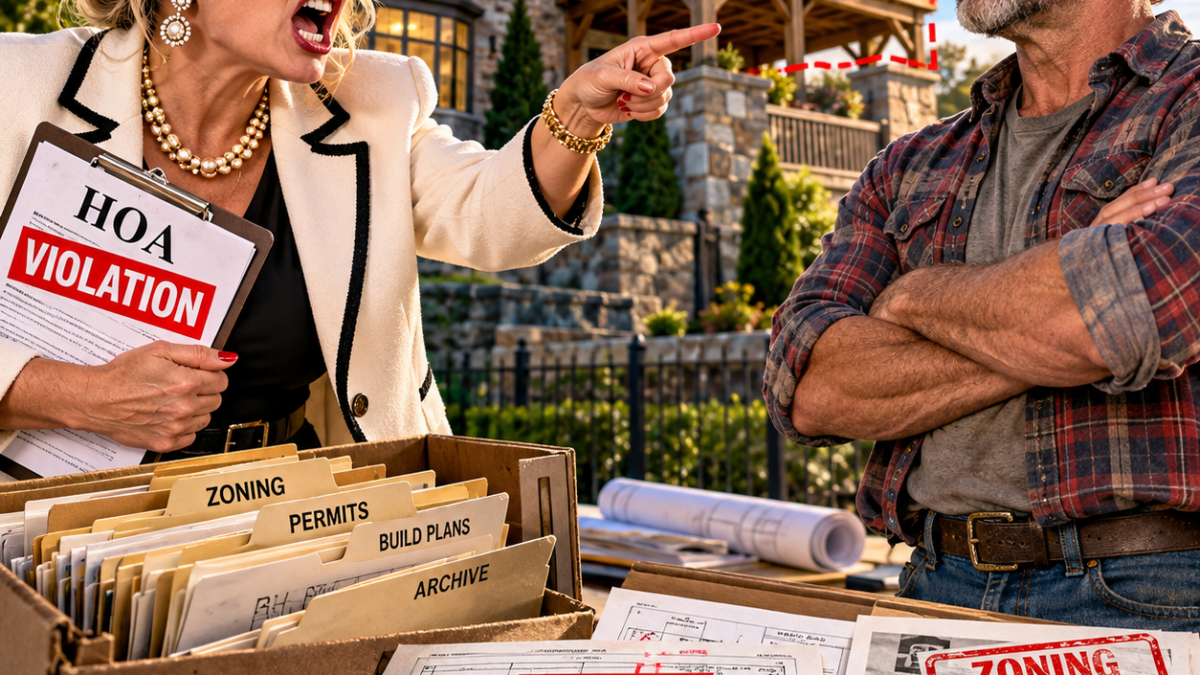
Karen told me my grandfather’s workshop had survived long enough, and that thirty days from now she intended to fine me until I either tore it down or lost the ability to keep fighting.
She said it while standing twenty feet from a building that had existed decades before her house, her HOA, or even the subdivision around us, smiling as if sixty-four years of family history could disappear because she had printed a new rule on fresh paper.
I didn’t know yet what I would find buried in the county archives, but the moment she told me old rights stopped mattering when new people took power, I knew I was going to read every document connected to both of our properties.
“That dilapidated shed is an eyesore, Mark, and your grandfather isn’t here to protect it anymore.”
For several seconds, I said nothing.
Karen Miller stood at the edge of my lawn in a floral-print dress, a clipboard tucked under one arm and her phone held in the other hand as if she expected to photograph my surrender. She had lived in Oak Ridge for six months and had somehow already managed to become president of the homeowners association, rewrite half its enforcement policies, and make people who had lived there twenty years nervous about leaving garbage cans outside an extra hour.
Behind me stood the object of her disgust.
My grandfather’s workshop.
Two hundred square feet.
Weathered cedar siding.
Old six-pane windows.
A roof I had replaced with him fourteen years earlier.
A heavy wooden door scarred by decades of tools, boots, lumber, and winter weather.
It had been built in 1958 by John Davis, my grandfather, on land he had bought before Oak Ridge was anything more than pasture and oak trees.
Calling it a shed was technically possible.
Calling a church a room with chairs was technically possible too.
Neither description came close to explaining what it meant.
Granddad had been a carpenter and a World War II veteran who rarely talked about the war. When he came home, he wanted to build things instead of destroy them. First came the little house. Then the workshop.
That was where he taught me how to sharpen a hand plane.
How to read grain.
How to hold a chisel without losing a finger.
How to make a square cut.
How to start again when you ruined an expensive piece of oak.
After my own years in Iraq and Afghanistan and twenty years working with the Army Corps of Engineers, I returned to help care for him.
Some nights, when sleep wouldn’t come, I went into that workshop.
I didn’t talk.
Granddad didn’t ask questions.
He would simply slide a piece of wood across the bench and say, “Hold that.”
It became the place where I learned how to be home again.
Karen pointed at it.
“Bylaw Seven, Section C. Detached nondwelling structures over one hundred square feet are prohibited.”
“That rule didn’t exist when the workshop was built.”
“It exists now.”
“It didn’t exist when the HOA was formed either.”
She smiled.
“Rules evolve.”
“Property rights don’t disappear because you changed a paragraph.”
“They do when homeowners agree to community covenants.”
“My property has a recorded exemption.”
Her smile became almost maternal.
“Oh, Mark.”
I hated the way she said my name.
“You’re talking about some ancient arrangement your grandfather made with people who aren’t even on the board anymore.”
“It’s notarized.”
“So?”
“Tied to the property.”
“So you claim.”
“No. So the document says.”
She adjusted her sunglasses.
“The current board has determined that the workshop violates our new structural-uniformity standards. You have thirty days to remove it.”
“And if I don’t?”
“One hundred dollars per day.”
I stared at her.
“Retroactive penalties may also apply.”
“You’re threatening thousands of dollars over a structure you have no authority over.”
“I’m enforcing community standards.”
“You’re trying to erase something because you don’t like how it looks.”
Her eyes narrowed.
“What I like is irrelevant.”
“No, Karen.”
I looked toward her clipboard.
“I’m starting to think what you like is the only thing that matters.”
Her expression hardened.
“Thirty days.”
Then she turned toward the sidewalk.
I called after her.
“My grandfather got that exemption in writing because he knew one day somebody would forget this neighborhood was built around him, not the other way around.”
She glanced back.
“Your grandfather is dead, Mark.”
The words hit harder than I expected.
Not because they were false.
Because of the satisfaction in her voice.
I felt anger rise instantly.
Twenty years of military discipline kept it behind my teeth.
Karen continued walking.
I looked at the workshop.
At the old windows.
At Granddad’s workbench visible through the glass.
At the door where his hand had worn a smooth patch into the wood.
Before he died, he had made me promise something.
“Don’t let anybody tear this place down just because old things become inconvenient.”
At the time, I thought he was being sentimental.
Standing there with Karen’s threat hanging in the humid afternoon air, I finally understood.
Some inheritances come with money.
Mine came with a promise.
And Karen had just given me thirty days to decide what that promise was worth.
PART 2
The official violation arrived three days later.
Karen had clearly spent time on presentation.
Heavy white envelope.
Embossed Oak Ridge Homeowners Association logo.
Certified mail.
Inside were four pages of bureaucratic language describing Granddad’s workshop as an “unauthorized auxiliary structure incompatible with current community design standards.”
The phrase unauthorized irritated me immediately.
There was nothing unauthorized about it.
The county had authorized it in 1958.
The original developer had acknowledged it decades later.
The first HOA board had explicitly exempted it.
What Karen meant was:
I did not authorize it.
Sarah read the letter over my shoulder at Granddad’s old dining table.
“Visually disruptive.”
She looked through the window toward the workshop.
“What exactly is disruptive?”
“The terrifying presence of cedar.”
She continued.
“Fails to contribute to the community’s intended aesthetic.”
She looked at me.
“What does that mean?”
“It means she wrote a rule that can mean anything.”
“That’s legal?”
“Depends how it’s used.”
Sarah had taught high school history for eighteen years.
She approached rules differently than I did.
I looked for procedure.
She looked for patterns.
She tapped the page.
“This is what people do when they want discretion without admitting they want discretion.”
I looked at her.
“Explain.”
“If she writes, ‘No sheds over one hundred square feet,’ people can argue measurements and exemptions.”
She pointed toward the phrase.
“But ‘fails to contribute to the intended aesthetic’ means Karen gets to decide what intention looks like.”
I nodded.
“Weaponized ambiguity.”
“Exactly.”
That became the phrase we used throughout the fight.
Weaponized ambiguity.
I opened the metal document box I had inherited with the house.
Granddad saved everything.
Tax receipts from 1963.
Warranty information for a table saw that no longer existed.
Survey maps.
Building permits.
Deeds.
A handwritten receipt for lumber dated March 1958.
Then the document I wanted.
November 12, 1998.
Notarized.
Signed by the developer.
Signed by the first HOA president.
Signed by Granddad.
The language was unusually clear.
The existing workshop, outbuildings, setbacks, and agricultural-style accessory uses on the Davis parcel were recognized as preexisting nonconforming conditions and would remain exempt from future architectural restrictions governing detached structures, provided they were maintained safely and not materially expanded beyond their established footprint.
Granddad had insisted on it when the neighborhood expanded around him.
I remembered asking him about the document when I was younger.
“Why make them sign all that?”
“Because people remember promises differently once land gets expensive.”
At seventeen, I thought he was cynical.
At forty-eight, I thought he was brilliant.
I assembled my first response.
Original deed.
1958 building permit.
Tax-assessor records listing the workshop.
1998 exemption.
Photographs showing maintenance.
Insurance records.
No expansion.
No safety complaints.
Then I requested a hearing.
Karen scheduled it for Thursday at six.
Sarah came with me.
The clubhouse smelled faintly of pool chlorine and lemon disinfectant.
About a dozen residents attended.
Karen sat in the center of the board table.
Gerald Knox sat to her right.
Thin.
Nervous.
Retired insurance salesman.
Brenda Walsh sat left.
Always agreed with Karen before Karen finished speaking.
I laid out the documents.
No emotion.
Timeline.
1955 land purchase.
1958 permit.
1998 exemption.
Current structure unchanged.
Then I placed the notarized letter in front of Karen.
“This is not an informal handshake agreement.”
She barely looked down.
“It’s a letter.”
“It is a recorded agreement acknowledging the property’s preexisting rights.”
“Signed by a board from twenty-four years ago.”
“Yes.”
“That board no longer exists.”
“The corporation does.”
Her smile thinned.
“The current board has authority to adopt new standards.”
“Not retroactively against a specifically exempted structure.”
“You’re not an attorney.”
“No.”
I slid another paper forward.
“My attorney is.”
That wasn’t entirely true yet.
Arthur Vance had represented me once in a boundary dispute and had agreed over the phone that Karen’s position sounded weak.
But mentioning him worked.
Gerald looked uncomfortable.
Karen noticed.
“Threatening litigation will not intimidate this board.”
“I’m not threatening anything.”
I pointed toward the documents.
“I’m asking you to acknowledge what your own association previously agreed to.”
“Previous boards do not dictate modern standards.”
“Property instruments do.”
Karen leaned back.
“Mr. Davis, this community has changed.”
“So?”
“Home values have increased.”
“Good.”
“Expectations have increased.”
“What does that have to do with my workshop?”
“New families did not invest here to look at outdated structures.”
Several people shifted in their chairs.
There it was.
Not safety.
Not law.
Not even architectural consistency.
Outdated.
Granddad’s workshop offended Karen because it reminded people Oak Ridge had a history before beige stucco and uniform mailboxes.
Robert Henderson spoke from the audience.
“Karen, that shop has been there since before my house.”
Karen turned.
“Thank you, Robert.”
“He has papers.”
“The board is reviewing them.”
“No, you’re ignoring them.”
Brenda leaned toward her microphone.
“Public comment isn’t open.”
Robert sat back slowly.
Karen looked at me.
“Your appeal is denied.”
“On what legal basis?”
“Bylaw Seven-C.”
“The bylaw that was passed last month?”
“Yes.”
“That cannot override a recorded exemption.”
“Our counsel may disagree.”
“Has your counsel reviewed the 1998 document?”
Silence.
That was interesting.
“Karen?”
“The board is not required to disclose attorney communications.”
“That’s not what I asked.”
Her face tightened.
Gerald whispered something.
Karen ignored him.
“The demolition deadline remains.”
Then she picked up the tiny wooden gavel.
“Meeting adjourned.”
Bang.
Sarah and I walked out without speaking.
Halfway across the parking lot she said:
“She didn’t send the exemption to a lawyer.”
“I don’t think so either.”
“Why?”
“Because she didn’t want an answer.”
Sarah stopped.
I turned.
“She wants the workshop gone whether she has authority or not.”
“Yes.”
She crossed her arms.
“So what now, Major Engineer?”
I looked toward the clubhouse.
Lights glowed behind the blinds.
Karen’s silhouette moved at the table.
“Now we find out whether she follows her own rules.”
The next three nights turned our home office into a document bunker.
HOA bylaws.
Amendments.
Minutes.
Voting requirements.
Fine schedules.
Election procedures.
Records policies.
Sarah drank coffee.
I used highlighters.
By midnight on the third night, we found the first serious defect.
“Mark.”
Sarah’s voice had changed.
I rolled my chair toward her.
She pointed to Article Nine.
Any amendment creating a new category of violation or monetary penalty required thirty days’ written notice to all owners before the membership vote.
Then she opened the meeting notice for Seven-C.
Dated fifteen days earlier.
“That’s half.”
“Yes.”
“Could be harmless?”
“No.”
Then she pulled the sign-in sheet.
“Quorum?”
“Twenty-five percent.”
“How many homes?”
“One hundred twenty.”
“So thirty households.”
She counted.
Twenty-two signatures.
We counted again.
Twenty-two.
The rule Karen was using against me had never been validly adopted.
Not just improperly noticed.
No quorum.
I leaned back.
Sarah smiled.
“There it is.”
“Maybe.”
“Maybe?”
“She can fix it.”
“How?”
“Hold another vote properly.”
Her smile disappeared.
“You’re right.”
“This defeats the current fine, but not Karen.”
“What do you want?”
“I want the workshop safe permanently.”
Sarah studied me.
“And?”
“And I want to know why she rushed this rule through so badly.”
“You think there’s more.”
“I think people get sloppy when they’re certain nobody will check.”
That was the beginning of the file.
KAREN MILLER.
I felt slightly ridiculous writing the label.
Sarah did not.
“Make two.”
“Why?”
“I’m helping.”
We started with neighbors.
Robert Henderson.
Retired postal supervisor.
Garden full of ceramic gnomes his late wife collected.
Karen fined him two hundred dollars because they violated a new “decorative harmony” policy.
“They were Helen’s,” he told me.
We sat on his porch.
One gnome held a fishing pole.
Another had a chipped red cap.
“Karen said I should donate them.”
“To who?”
“Goodwill.”
His jaw tightened.
“Helen bought that fisherman on our thirtieth anniversary.”
I looked at the gnome.
“Did you pay?”
“The fine?”
“Yes.”
He nodded.
“I didn’t want trouble.”
That sentence would become familiar.
Maria Alvarez lived two streets over.
Single mother.
Two jobs.
Older Toyota.
Small oil leak.
Karen issued repeated notices because of three dark spots on Maria’s driveway.
“She says it damages neighborhood appearance.”
“Does the car run?”
“Yes.”
“Can you afford another?”
“No.”
Her eyes became wet.
“I’m trying to save enough to fix the gasket.”
“How much have they fined you?”
“Six hundred.”
I felt something cold settle into my chest.
Not anger exactly.
Clarity.
Karen had created a system where people already under pressure were easier targets because they could not afford the time to challenge her.
Young family.
Plastic playset.
Bright blue and yellow.
Violation.
Retired veteran.
Flagpole six inches above Karen’s approved height.
Violation.
Teenage basketball hoop.
Violation.
One couple had received a warning because their front-door wreath remained up seven days after the seasonal-decoration deadline.
Karen wasn’t preserving property values.
She was curating obedience.
Then I requested the financial records.
Association bylaws guaranteed member inspection rights.
Income.
Expenses.
Vendor payments.
Fine revenue.
Contracts.
Karen sent me one page.
Landscaping: $42,000.
Administration: $31,000.
Legal: $18,000.
Community improvements: $27,000.
No vendors.
No transaction detail.
No invoices.
I emailed:
This does not satisfy the records provision.
Her response:
The summary is sufficient.
I checked the bylaws.
It wasn’t.
That was the moment I decided to go to the county records office.
At first, my goal had nothing to do with Karen’s house.
I wanted to strengthen Granddad’s history until the workshop became untouchable.
Certified copies are different from old family copies.
Official seal.
Recorded references.
Chain.
I spent two days building it.
1955 deed.
1958 workshop permit.
Electrical approval.
Tax records.
Historic parcel maps.
1998 developer agreement.
Every document confirmed what I already knew.
The workshop was not a rogue structure.
It was part of the legal history of the land.
On the third morning, I brought Karen’s address.
Lot 82.
Oak Ridge.
Phase Three.
I told myself I was checking whether she had benefited from exceptions she now denied others.
That was all.
I pulled her deed.
Standard.
Mortgage.
Standard.
Subdivision master plan.
Then I stopped.
A dotted line crossed the rear corner of four lots.
Twenty-four-inch high-pressure gas-main easement.
I leaned closer.
Lot 82.
Karen’s lot.
Twenty-foot right-of-way.
I knew enough engineering to feel my attention sharpen immediately.
High-pressure gas easements are not decorative lines.
They exist because utility access matters.
Inspection matters.
Repair matters.
Safety matters.
You do not casually build over them.
I pulled up an aerial image on my phone.
Karen’s three-car garage sat near the rear corner.
Very near.
Too near.
Still, maps deceive.
Scales.
Perspective.
Later modifications.
Maybe she had a variance.
I asked for permit history.
Gloria, the records clerk, looked at the year.
“2005.”
She sighed.
“Microfiche.”
“I’m sorry.”
“You will be.”
She was right.
Four hours of scrolling.
Foundation.
Framing.
Electrical.
Plumbing.
Roof.
Mechanical.
Then original building plan.
I photographed the screen.
The garage footprint was smaller.
Noticeably smaller.
I kept searching.
Variance application.
There it was.
The developer had asked permission because the lot’s buildable area was constrained by the pipeline easement.
Approved.
With strict conditions.
Foundation no closer than ten feet to easement boundary.
Special floating slab design for garage.
Mandatory post-construction survey before final occupancy certification.
I searched for that survey.
Nothing.
Second reel.
Nothing.
Certificate of occupancy.
Signed.
But no attached final survey.
I called Gloria.
“Could a required attachment be stored separately?”
“Sometimes.”
We searched indexes.
Nothing.
I stared at the original approved footprint.
Then the aerial image.
Karen’s current garage was wider.
At least ten feet wider by rough scaling.
I went home with certified copies.
Sarah found me at the dining table after dinner.
“What did you find?”
“I don’t know yet.”
She looked at my face.
“That means something.”
I spread the plat.
“This is the gas main.”
Her eyes widened.
“That goes under the neighborhood?”
“Across four lots.”
“Karen’s?”
“Yes.”
I placed the approved plan.
“This was the garage they were permitted to build.”
Then aerial image.
“This is the garage that exists.”
Sarah looked.
“They’re different.”
“Yes.”
“Could the aerial image be distorted?”
“Yes.”
“You need a survey.”
“Yes.”
“Are you going to get one?”
“Yes.”
She leaned back.
“Mark.”
“What?”
“Be careful.”
“I’m not trespassing.”
“I don’t mean legally.”
“What do you mean?”
“I know that look.”
“What look?”
“The one where something stopped being about the workshop.”
She was right.
That worried me.
I called Dave Mercer.
Licensed surveyor.
Former Marine reconnaissance.
We had worked together once years earlier.
I explained what I needed.
No access to Karen’s private yard.
Public benchmarks.
Recorded plat.
Right-of-way references.
Aerial overlay.
“I’m not asking you to prove a violation from outside the property.”
“Good.”
“I’m asking you to map the recorded easement accurately enough to show whether a formal investigation is justified.”
He whistled.
“So the HOA president threatening your grandfather’s workshop may have built her garage on a high-pressure gas easement.”
“May.”
“Engineers ruin every good sentence with qualifiers.”
“Surveyors too.”
“Fair.”
Dave’s crew came the next morning.
They worked from public right-of-way and known control points.
Karen noticed.
She watched from behind the front curtains.
At one point she came outside.
“What are you doing?”
Dave smiled politely.
“Survey work.”
“On whose authority?”
“Our client’s.”
“Who?”
“That’s confidential.”
“This is a private community.”
“We’re on public right-of-way.”
“I’m HOA president.”
“Congratulations.”
I heard about that later.
Dave enjoyed telling it.
By noon, he called.
“Mark.”
“What?”
“You were right.”
I sat straighter.
“How right?”
“Easement boundary runs roughly three feet inside the garage footprint.”
I didn’t respond.
“Mark?”
“I’m here.”
“This isn’t a close call.”
He emailed the overlay.
Red line.
Recorded easement.
Aerial imagery.
Survey control.
Corner of Karen’s garage crossed directly into the protected zone.
My first emotion should have been satisfaction.
It wasn’t.
It was unease.
Because there is a difference between discovering someone violated an HOA aesthetic rule and discovering a permanent structure may interfere with infrastructure carrying high-pressure natural gas.
Sarah saw the map.
Her face changed.
“That’s serious.”
“Yes.”
“What now?”
“Lawyer.”
Arthur Vance’s office looked like every expensive property lawyer’s office should.
Dark wood.
Books nobody touched.
Heavy desk.
He was sixty-two, sharp, impatient, and famous for making zoning boards miserable.
I showed him Granddad’s file first.
He skimmed.
“This is easy.”
“That’s encouraging.”
“The HOA exemption is clear. The new rule appears procedurally defective too.”
“How fast can you stop the fines?”
“If necessary? Emergency injunction.”
Then:
“Now show me why you look like you haven’t slept.”
I opened Karen’s binder.
Plat.
Variance.
Approved footprint.
Missing survey.
Dave’s overlay.
Arthur stopped smiling.
He read everything twice.
Then removed his glasses.
“This is much bigger than your workshop.”
“I know.”
“If accurate, the county has a serious problem.”
“I know.”
“The gas company will care.”
“I know.”
“The title insurer may care.”
“Yes.”
“The lender may care.”
“Yes.”
He leaned back.
“How did you find this?”
“Archives.”
“Of course.”
He stared at the map.
Then:
“What do you want to do?”
“First, stop Karen.”
“With this?”
“No.”
That surprised him.
“Why not?”
“Because if I anonymously report this tomorrow, Karen gets buried and the HOA stays exactly as broken as it is.”
Arthur smiled slowly.
“You want the recall.”
“I want transparency.”
“You want the recall.”
“Yes.”
“And then?”
“Then authorities get the pipeline issue.”
He tapped the binder.
“You’re more patient than I am.”
“I had good teachers.”
Granddad had always said:
If a board is warped, don’t sand one corner and call it straight.
We prepared two tracks.
First:
Workshop defense.
Arthur drafted injunction papers.
Cease fines.
Recognize exemption.
Second:
Governance.
Recall petition.
Bylaw Seven-C invalid because of notice and quorum defects.
Failure to produce financial records.
Selective enforcement concerns.
We needed twenty-four households.
Twenty percent.
I began with Robert.
I showed him the meeting notice and sign-in sheet.
He read slowly.
“So this rule was never valid?”
“That’s our position.”
“And she fined me under it?”
“Yes.”
His eyes moved toward Helen’s gnomes.
“I want copies.”
Maria joined next.
Then young families.
Retirees.
People who had never attended meetings.
I did not tell them about Karen’s house.
Not yet.
That information was too serious to turn into neighborhood gossip.
We focused on what affected everyone.
Process.
Fair rules.
Money.
Sarah designed the flyer.
No insults.
No cartoons.
No “Karen” in giant red letters.
She wrote:
Oak Ridge belongs to all of us.
Questions every homeowner deserves answered:
Was Bylaw 7C legally adopted?
Are fines being issued consistently?
Why have transaction-level financial records not been provided?
Should one board officer possess unilateral enforcement discretion?
That was enough.
Our first organizing meeting took place inside Granddad’s workshop.
Fifteen residents.
Robert sat on an overturned crate.
Maria near the door.
A young father named David perched on a lumber stack.
Sarah passed coffee.
The old shop smelled of cedar and machine oil.
I stood beside Granddad’s workbench.
“Twenty-four signatures force the special meeting.”
Maria asked:
“What happens if we get them?”
“Recall vote.”
“And if she refuses?”
“Management company has obligations.”
“What if the management company sides with her?”
“Arthur handles that.”
Robert raised his hand.
“What about our fines?”
“We challenge Seven-C separately and request a freeze.”
Someone asked:
“Are you trying to become president?”
“No.”
Instantly.
People laughed.
“I mean that.”
Maria smiled.
“Good.”
“Why good?”
“Because anyone who wants that job this badly should not have it.”
Fair.
We collected forty-five signatures.
Almost twice what we needed.
When the petition reached the management company, Karen responded with a mass email.
A SMALL GROUP OF DISGRUNTLED RESIDENTS is attempting to destabilize our community.
She accused us of threatening property values.
Trying to eliminate standards.
Creating hostility.
People who had signed the petition forwarded it to Sarah with laughing emojis.
Karen’s biggest tactical weakness was that she could not distinguish criticism from rebellion.
The special meeting was set for four weeks later.
Meanwhile, Arthur sent the legal demand concerning the workshop.
Withdraw fines.
Acknowledge exemption.
Stop demolition threats.
Karen’s board refused.
Gerald and Brenda signed the response.
That told me something too.
They were no longer merely passive.
At least for now, they had chosen her.
State Department of Commerce received our financial-transparency complaint.
Management company requested Karen provide full records.
She delayed.
That only gave us more material.
Then came the special meeting.
Standing room only.
Karen wore black.
No floral dress.
No smile.
The gavel sat before her.
Gerald looked sick.
Brenda looked furious.
I sat beside Sarah with two binders at my feet.
Granddad.
Karen.
Karen called the meeting.
“This malicious petition represents an attempt by a minority of residents to overthrow a duly elected board because they do not wish to follow standards.”
Someone laughed.
She glared.
“I will not allow disorder.”
Robert whispered:
“She means disagreement.”
Karen opened the floor.
I walked to the microphone.
“My name is Mark Davis.”
I looked at the crowd.
“Most of you know this started with my grandfather’s workshop.”
Then at Karen.
“But this meeting is not about that building.”
I projected Article Nine.
Thirty-day notice.
Then Seven-C meeting notice.
Fifteen days.
Next:
Quorum requirement.
Thirty households.
Attendance:
Twenty-two.
I didn’t need dramatic language.
“By your own governing documents, Seven-C did not receive proper notice or quorum.”
Murmurs.
Karen interrupted.
“That interpretation has not been legally established.”
Arthur stood from the side wall.
“I’m happy to litigate it.”
Silence.
Karen’s jaw tightened.
I continued.
“Whether a court ultimately agrees is one question. But homeowners also deserve to ask why the board enforced this rule aggressively when its own adoption records show obvious procedural defects.”
Next slide.
Financial request.
Karen’s one-page response.
“Article Eleven gives members access to transaction-level records.”
I looked at everyone.
“We asked.”
“Those records contain confidential information,” Karen said.
Arthur replied:
“Vendor payments are not confidential simply because they are inconvenient.”
Applause.
Then Robert stood.
Karen tried to stop him.
“This is petitioner presentation time.”
“I’m a petitioner.”
He faced the room.
“My wife Helen died two years ago.”
The room quieted.
“She collected garden gnomes for thirty-seven years.”
Karen looked down.
“Karen fined me for keeping them.”
Robert held up the fisherman.
He had brought it.
“This one came from our thirtieth anniversary trip.”
His voice shook.
“She told me it lowered property values.”
No one laughed.
Maria stood next.
She described the car.
The oil leak.
Two jobs.
Six hundred dollars in fines.
Young family described the playset.
Veteran described the flagpole.
One by one.
Karen’s administration had made people feel alone.
Standing together broke that illusion.
When I returned to the microphone, Karen was red-faced.
“This is not leadership.”
She grabbed the gavel.
“This is a mob.”
“No.”
Sarah’s voice came from the second row.
“This is attendance.”
People laughed.
Even Gerald almost smiled.
Karen slammed the gavel.
“Enough!”
I held up the petition.
“The motion is removal of Karen Miller as HOA president.”
Karen stood.
“You do not chair this vote.”
She was right.
Management company representative took over.
Ballots.
Verified homeowners.
Counted openly.
Removal passed by an overwhelming margin.
Only a handful opposed.
Brenda voted no.
Gerald abstained.
Karen sat perfectly still.
Then the result was announced.
For the first time since she moved into Oak Ridge, Karen had no title.
No President Miller.
Just Karen.
People clapped.
Some cheered.
I didn’t.
I watched her.
Humiliation can make people unpredictable.
She stood slowly.
Pointed at me.
“You think this is over?”
“No.”
“I will sue you.”
“Talk to Arthur.”
“I will destroy that workshop.”
That was when I knew the second binder had to come out.
Not as revenge.
As warning.
I carried it to the table.
Opened it.
Karen stared.
“What is this?”
“County archives.”
She started to laugh.
Then saw the map.
I spoke quietly.
“You wanted to erase my grandfather’s rights because you said old records no longer matter.”
Her eyes moved over the plat.
“This is your subdivision’s original Phase Three map.”
She saw the dotted easement.
“This is the high-pressure gas-main corridor.”
Her face changed slightly.
“This is the variance issued for your lot.”
I placed it beside the map.
“You’re prohibited from building within ten feet of the easement.”
“What are you implying?”
“I’m not implying anything.”
Survey overlay.
Her garage.
Red boundary.
“I hired a licensed surveyor using recorded benchmarks and public right-of-way data.”
She stared.
“The mapped easement appears to extend approximately three feet into the footprint of your garage.”
Karen’s face went white.
“That’s impossible.”
“Maybe.”
“My house passed inspection.”
“I know.”
“I have a certificate of occupancy.”
“I know.”
“You’re lying.”
“Then the county will clear it up.”
Her eyes rose.
“You reported me?”
“Not yet.”
That frightened her more than yes would have.
“Why are you doing this?”
I almost laughed.
Instead:
“I’m checking whether rules apply to everybody.”
“You went digging through my private records.”
“Public records.”
“You surveilled my property.”
“Public plats and aerial images.”
“You hired someone to trespass.”
“He did not enter your property.”
She looked at Arthur.
He said nothing.
Karen’s voice dropped.
“You wouldn’t.”
I closed the binder.
“This stopped being about what I wanted the moment I saw a possible pipeline-safety violation.”
“You’re trying to ruin me.”
“No.”
I looked directly at her.
“I tried to show you a sixty-four-year-old workshop exemption and you told me old records didn’t matter.”
Silence.
“It turns out records matter quite a lot.”
She grabbed her purse and left.
The room parted.
Nobody spoke to her.
That was not the end.
It was the beginning of consequences.
The next morning, after consulting Arthur, I contacted county code enforcement and the regional pipeline operator.
Not anonymously.
That detail mattered to me.
I submitted copies of public records.
No accusations beyond what documents supported.
Possible encroachment.
Missing post-construction survey.
Survey overlay indicating foundation intrusion.
Requested safety review.
Two days later, county vehicles arrived.
Pipeline safety truck.
Survey crew.
Inspector.
Karen refused entry initially.
Then officials returned with appropriate legal authority.
Orange flags appeared.
One by one.
Across the grass.
Along the driveway.
Toward the garage.
Then underneath it.
Neighbors watched.
No one needed Facebook speculation.
The flags told the story.
Formal investigation confirmed the garage extension did not match the approved footprint.
The required setback had not been maintained.
The final survey required by the variance could not be located.
That triggered a cascade.
County review.
Pipeline operator requirements.
Title questions.
Occupancy review.
Structural remediation.
Karen hired attorneys.
Then engineers.
Then another surveyor.
For once, I felt no satisfaction.
Watching bureaucracy turn toward someone is different when you understand its weight.
Sarah and I stood at our kitchen window one morning while workers measured Karen’s property.
“You okay?”
“Yeah.”
“You don’t look happy.”
“I thought I would.”
“About what?”
“Being right.”
Sarah took my hand.
“Being right about something dangerous isn’t fun.”
Exactly.
The county ultimately required substantial remediation.
Portions of the garage and adjoining construction had to be removed from the protected zone.
Utility access restored.
Foundation reconfigured.
Permits resubmitted.
Inspections reopened.
Costs climbed.
Whether the original builder, inspector, seller, insurer, or Karen ultimately bore each dollar became a legal battle separate from ours.
Arthur warned me:
“Do not speculate publicly.”
I didn’t.
That was important.
The story in the neighborhood became exaggerated almost immediately.
Her entire house is built on a gas pipe.
Not true.
The garage corner encroached into the protected easement.
The house will explode.
No.
There was no evidence of an active leak.
She committed fraud when she built it.
We did not know who enlarged the garage or when every modification occurred.
Facts mattered even when exaggeration would hurt Karen more.
Especially then.
I corrected people.
Dave the surveyor laughed when I told him.
“You’re defending her?”
“No.”
“What are you doing?”
“Protecting truth.”
“Engineers are exhausting.”
“Yes.”
Meanwhile, Oak Ridge rebuilt the HOA.
Robert Henderson became interim president.
Against his wishes.
His first meeting began:
“I don’t want this job.”
Everyone applauded.
“That is not encouragement.”
More applause.
His first motions:
Freeze all Seven-C fines.
Passed.
Review every enforcement action Karen’s board issued.
Passed.
Full independent financial audit.
Passed.
Restore transaction-level financial access.
Passed.
Independent architectural appeal panel.
Passed.
Then:
Repeal Seven-C entirely and, if residents wanted replacement standards later, begin from scratch using proper notice and quorum.
Unanimous.
Maria’s fines disappeared.
Robert’s gnomes returned.
The playset stayed.
Flagpole stayed.
Granddad’s workshop received formal written reaffirmation of its 1998 exemption.
Robert handed me the letter personally.
“I thought you’d like a new one for your box.”
I smiled.
“Granddad would appreciate redundancy.”
Then the audit returned.
Karen had not stolen millions.
That was never our claim.
But the records showed sloppy spending.
Unapproved consulting expenses.
Legal bills for aggressive enforcement.
Fines used to offset escalating administrative costs.
Vendor arrangements that lacked adequate bidding.
Nothing as dramatic as the pipeline issue.
Still unhealthy.
The HOA rewrote financial rules.
Two board approvals for expenditures over certain limits.
Vendor conflicts disclosed.
Quarterly transaction reports.
Homeowners could inspect invoices electronically.
No mystery.
No empire.
Karen remained in Oak Ridge for several months while her property dispute continued.
Her garage was partly dismantled.
For weeks, blue tarp covered one side.
The woman who had called Granddad’s workshop an eyesore now lived behind temporary fencing, construction barriers, and bright-orange utility markers.
The irony was impossible to miss.
I refused to comment.
One afternoon, I was carrying cedar into the workshop when her car stopped at my curb.
Karen stepped out.
No clipboard.
No makeup-heavy smile.
She looked tired.
“Mark.”
I set down the lumber.
“Karen.”
“You’re proud of yourself?”
“No.”
“Don’t lie.”
“I’m not.”
She laughed bitterly.
“My home is destroyed.”
“Part of your garage is being remediated.”
“You know what I mean.”
“Yes.”
She looked toward the workshop.
“All of this because of that.”
“No.”
Her eyes snapped toward me.
“This happened because you wouldn’t leave me alone.”
“No, Karen.”
I stayed calm.
“This happened because you threatened a protected structure.”
“You could have let it go.”
“So could you.”
Silence.
“You went into archives looking for dirt.”
“I went looking for records.”
“Same thing.”
“No.”
I pointed toward the workshop.
“My grandfather protected this building in writing because he understood someday somebody might decide history was inconvenient.”
She looked away.
“I found a serious safety and permitting issue while checking whether your enforcement was consistent.”
“You could have kept it to yourself.”
“That involved a high-pressure pipeline easement.”
“My family was living there.”
“Exactly.”
That stopped her.
For a moment, anger disappeared.
Fear took its place.
I continued more quietly.
“If the easement issue mattered, ignoring it would have been worse.”
She didn’t answer.
Then:
“You enjoyed removing me.”
“No.”
“I saw your face.”
“I was relieved.”
“Same thing.”
“It isn’t.”
She stared at the workshop.
“Why does this place matter so much?”
That question surprised me.
I looked through the open door.
Granddad’s workbench.
Old plane.
Photograph.
Saw marks.
“Because he taught me how to come home in there.”
Karen frowned.
I realized she would not understand unless I explained.
“When I came back from overseas, I wasn’t easy to live with.”
I had never said that to her.
Barely said it to anyone.
“I didn’t sleep.”
“I was angry.”
“I didn’t know what to do when nobody needed me to solve a problem.”
“Granddad never pushed.”
“He gave me work.”
I looked at my hands.
“A board to plane.”
“A hinge to fix.”
“A drawer to repair.”
“He knew repetitive physical work could quiet a head full of noise.”
Karen’s face softened slightly.
“This wasn’t a shed to him.”
“No.”
“Or to me.”
She crossed her arms, but not defensively.
For the first time, I saw something besides the HOA president.
A woman whose certainty had collapsed.
Then she said:
“I still think it looks terrible.”
I laughed.
Couldn’t help it.
For a second, she almost smiled.
Then she returned to her car.
We never spoke again.
Two months later, a FOR SALE AS IS sign appeared at her house.
The remediation and legal disputes had become expensive.
Karen and Rick moved.
The new buyer eventually completed repairs and rebuilt the garage within the required setback.
Life continued.
Oak Ridge became boring again.
That was the victory.
Robert’s board cared about roofs leaking at the clubhouse.
Pool maintenance.
Landscaping bids.
Insurance.
Actual community problems.
Meetings became short.
One evening Robert called.
“You coming tonight?”
“What’s on agenda?”
“Mulch.”
“No.”
“Coward.”
“Absolutely.”
Sarah hung framed copies of two documents in the workshop.
Granddad’s 1998 exemption.
New HOA reaffirmation.
I complained.
“This looks like a lawyer’s office.”
“It looks like history.”
“You’re a history teacher.”
“Exactly.”
Underneath them, she placed Granddad’s photograph.
1958.
Young man.
White T-shirt.
Work pants.
Standing beside the newly completed shop.
He looked proud.
Not smiling much.
He rarely smiled in photographs.
I stared for a long time.
Sarah stood behind me.
“You kept your promise.”
I swallowed.
“Almost lost my mind doing it.”
“That part isn’t in the frame.”
“Good.”
The years after Karen softened the story.
At first, neighbors discussed it constantly.
The Recall.
The Pipeline.
The Workshop War.
Every retelling became more dramatic.
Eventually I stopped correcting all of it.
Except one thing.
People would say:
“You destroyed Karen’s house.”
No.
I never allowed that.
“County enforcement required remediation.”
“But you found it.”
“Yes.”
“You reported it.”
“Yes.”
“So you destroyed it.”
“No.”
I found records indicating a potentially dangerous violation and reported them.
The distinction matters.
Revenge feels satisfying in stories because it creates symmetry.
You threatened my workshop.
I destroyed your garage.
Real life is better when consequences follow facts rather than symmetry.
If Dave’s survey had shown Karen’s house was compliant, I would have dropped it.
That is what separates investigation from vengeance.
Granddad taught me something similar with woodworking.
“You don’t cut where you want the line to be.”
“You cut where the measurement says the line is.”
Reality first.
Emotion second.
I carried that lesson through everything.
Robert served as president for two years.
Then refused a third.
At his final meeting, somebody nominated me.
“No.”
Laughter.
“I formally decline.”
Maria raised her hand.
“Why?”
“I’ve seen what the job does to people.”
Robert laughed.
“It turns you into a reasonable old man with garden gnomes.”
“Exactly my fear.”
A younger homeowner named Jennifer Cole became president.
Accountant.
Two children.
No interest in controlling flower colors.
Excellent.
Her first major project was updating the HOA rules.
She invited everyone.
We removed vague language.
“Visual harmony” became specific where specificity mattered and disappeared where it didn’t.
Safety restrictions.
Setbacks.
Drainage.
Exterior modifications that materially affected neighbors.
Reasonable.
No rules about gnome counts.
Robert celebrated by buying another.
Maria finally repaired her oil leak.
The HOA refunded her invalid fines.
She tried to give part of the money back to the community.
Jennifer refused.
“Buy groceries.”
Maria cried.
Those moments mattered more than Karen leaving.
Because tearing down a bad system is easy compared with building a fair one.
Granddad understood building.
He always said demolition happens quickly.
Good construction takes patience.
Oak Ridge had to learn that.
So did I.
For months after the fight, I remained hyper-alert.
Every HOA email made my pulse rise.
Every certified letter felt threatening before I opened it.
Sarah noticed.
“You’re still fighting her.”
“She’s gone.”
“I know.”
“You don’t.”
I looked at her.
“Every time that phone buzzes, you reach for the binder.”
She was right.
Conflict creates habits.
Mine came easily because I had spent a career preparing for threats.
But a threat-response system does not automatically shut off when the threat leaves.
That had happened after deployments.
Now, in a much smaller and admittedly absurd suburban version, it was happening again.
So I moved the Karen binder to the attic.
Not destroyed.
Let’s not become reckless.
Archived.
I returned the dining table to dinners.
Sarah celebrated.
“I forgot it was wood.”
“Very funny.”
We spent more evenings in Granddad’s workshop.
She read while I worked.
Sometimes no one spoke.
That silence felt different from the silence I had sought after combat.
Not empty.
Safe.
One Saturday, I decided to restore Granddad’s old tool chest.
Oak.
Dovetail corners.
Brass pulls.
The finish had cracked.
Inside were chisels wrapped in cloth.
Hand plane.
Marking gauge.
Old square.
Sarah sat nearby.
“Should you refinish it?”
“No.”
“Why?”
“Too much history.”
“You’re sanding it.”
“Cleaning.”
“That sounds like history-teacher logic.”
“You’re rubbing off on me.”
I repaired one split.
Replaced no hardware.
Waxed the wood.
Then found something beneath the lowest drawer.
Folded paper.
Granddad’s handwriting.
Material list from 1958.
Cedar siding.
Roofing felt.
Glass.
Nails.
Hinges.
At the bottom:
SHOP—DO IT RIGHT. MAYBE MARK WILL USE IT SOMEDAY.
I sat down.
Sarah saw my face.
“What?”
I handed her the paper.
She read.
Covered her mouth.
“He wrote your name?”
“I was born twelve years later.”
We looked again.
Maybe MARK referred to a mark on the lumber.
Maybe not.
Granddad sometimes planned decades ahead.
We would never know.
That uncertainty somehow made it more beautiful.
I framed that too.
The workshop became a family archive without trying.
Not museum.
Still working shop.
Sawdust.
Repairs.
Projects.
But history lived in it.
Years later, my nephew brought his daughter over.
She wanted to build a birdhouse.
Seven years old.
Terrible hammer control.
I held nails.
Nearly regretted it.
She painted the birdhouse bright purple.
Granddad would have hated the color.
We hung it from the oak near the workshop.
A robin ignored it.
A wren eventually used it.
Every spring after, I watched that little purple box.
It reminded me that preservation does not mean freezing something forever.
History stays alive by allowing new things to happen around it.
Karen’s vision of preservation had been the opposite.
Uniformity.
Same colors.
Same shapes.
Same approved appearances.
But communities aren’t photographs.
They change.
Children grow.
Families grieve.
Buildings age.
People add things.
Remove things.
Keep strange gnomes because their dead wives loved them.
Leave old workshops standing because someone learned how to become himself again inside.
Those differences are not necessarily threats to property values.
Sometimes they are the things that make property worth calling home.
The pipeline easement became part of neighborhood lore too.
The repaired property eventually sold again.
New owners knew everything.
Title clean.
Garage compliant.
Pipeline access preserved.
One day the new owner, Brian, knocked on my door.
“Can I ask you something weird?”
“Probably.”
“Did you really find the easement that caused all this?”
“Yes.”
“By accident?”
“Mostly.”
He laughed.
“The seller disclosed approximately nine hundred pages.”
“I’m sorry.”
“No, it’s good.”
He pointed toward his property.
“We rebuilt everything correctly.”
“Good.”
“My wife wants to plant trees near the easement.”
“Call the utility first.”
“I knew you’d say that.”
“Why ask?”
“Marriage requires independent confirmation.”
Wise man.
We became friends.
His children played in the yard Karen once treated like a throne.
That was satisfying in a quiet way.
Not because it belonged to someone else.
Because it became a normal home again.
No orange flags.
No inspectors.
No HOA drama.
Just bicycles.
Barbecue.
Children.
A dog that barked too much.
Ordinary life reclaiming a place from conflict.
Arthur Vance retired.
Before he did, he sent me a final bill marked PAID IN FULL.
Below it he wrote:
Please never find another pipeline under anyone’s garage.
I framed that too.
Sarah objected.
“The workshop has enough paperwork on the walls.”
“He earned it.”
“You’ve turned Granddad’s sanctuary into an administrative museum.”
“Accurate records matter.”
She removed the invoice the next day.
Marriage compromises.
Dave the surveyor occasionally called.
“You finding any more illegal mansions?”
“No.”
“Disappointing.”
One year we hired him to mark a garden boundary.
He charged me full price.
“So much for professional courtesy.”
“That expired after the revolution.”
Fair.
Robert Henderson died at eighty-six.
His children asked me to help clean his garage.
I found Helen’s gnomes wrapped carefully in newspaper.
His daughter said:
“Dad wanted the neighborhood kids to have them.”
We placed several in the Oak Ridge community garden.
No one voted.
No one filed an application.
Jennifer, still president, said:
“I officially see nothing.”
One of the gnomes was the fisherman.
I sat on the garden bench beside it for a while.
Robert had been the first person to stand up for me publicly.
Before lawyers.
Before surveys.
Before petitions.
Just:
Karen, the man has proof.
Sometimes revolutions begin with very small sentences.
We added a tiny plaque beneath the gnomes.
IN MEMORY OF ROBERT AND HELEN HENDERSON.
NO AESTHETIC APPROVAL REQUIRED.
Jennifer blamed me.
I blamed Maria.
Maria blamed Robert from beyond the grave.
Perfect.
Sarah retired from teaching.
Her final class gave her a scrapbook.
Former students wrote memories.
One had written:
Mrs. Davis taught us that history is not dead things. It is the argument over which old things still matter.
I read that twice.
“Did you teach them that?”
“Maybe.”
“Sounds familiar.”
She smiled.
“Living with you gave me material.”
We spent retirement more quietly than the first few years.
Travel.
Grandchildren.
Workshop.
Community.
No wars.
Exactly what we wanted.
One fall evening, Sarah asked:
“Do you ever wish you had just ignored Karen?”
“No.”
“Instant answer.”
“I’ve thought about it before.”
“What if the pipeline issue had destroyed her financially?”
“It did cost her.”
“You know what I mean.”
I did.
There is always a moral discomfort when another person’s mistake produces enormous consequences.
Even if they attacked you.
Even if they were arrogant.
Even if they would have enjoyed your loss.
I looked at the workshop.
“If I had found the easement and hidden it because I didn’t want consequences for her, that would have been irresponsible.”
Sarah nodded.
“That’s what I think too.”
“But I’m glad I didn’t discover it because I wanted revenge.”
“Didn’t you?”
I considered carefully.
“Maybe part of me did.”
“That’s more honest.”
“But once I understood the safety issue, what I wanted stopped mattering.”
That distinction gave me peace.
We do not control all consequences of truth.
We control whether we distort it.
I tried not to.
That became the standard I carried from the whole ordeal.
A few years later, Oak Ridge faced another controversy.
A family wanted to install solar panels.
Some residents disliked how they looked from the street.
Old habits surfaced.
Aesthetic harmony.
Property values.
Uniformity.
I attended the meeting.
Not because I cared about solar panels.
Because I heard the old language.
One resident said:
“We can’t let everybody do whatever they want.”
I raised my hand.
Jennifer groaned.
“Mark.”
“I haven’t said anything.”
“You’re about to.”
“Yes.”
I stood.
“Rules should address identifiable harms.”
I looked around.
“Safety.”
“Drainage.”
“Structural integrity.”
“Actual interference with neighboring property.”
“But if the argument is simply ‘I don’t like seeing it,’ be careful.”
People listened.
“Twenty years from now, someone else may dislike something you value.”
Solar panels approved with reasonable installation requirements.
No lawsuits.
No recall.
That was progress.
People had learned.
So had I.
Granddad’s workshop turned seventy years old.
We held no ceremony.
Sarah disagreed.
She brought cake.
Family came.
Kids.
Grandkids.
Brian from Karen’s old property.
Maria.
Jennifer.
Dave.
Arthur, moving slowly with a cane.
We set folding tables on the lawn.
Someone hung a banner:
70 YEARS—STILL NONCOMPLIANT WITH KAREN’S FEELINGS.
I denied involvement.
Nobody believed me.
Inside the workshop, I displayed Granddad’s photo.
His material list.
1998 exemption.
New HOA reaffirmation.
The old building permit.
Arthur stood looking at the papers.
“You realize normal people frame family photographs.”
“These are family photographs.”
He shook his head.
Later my grandson asked:
“Grandpa, why did Great-Great-Grandpa build this?”
“To work.”
“Why did you keep it?”
That required more thought.
“Because he asked me to.”
“That’s it?”
“At first.”
“And now?”
I looked around.
Family voices outside.
Tools.
Old wood.
New projects.
“Now I’d keep it even if he hadn’t.”
My grandson nodded as if that made perfect sense.
Kids sometimes understand inheritance better than lawyers.
That evening, after everyone left, I locked the workshop.
Then stopped.
The door had the same old scars.
Some were older than me.
Some I made.
Some came from grandchildren.
No HOA rule could assign value to that.
That was the flaw in Karen’s thinking from the beginning.
She believed new rules automatically improved old places.
Sometimes they do.
Building codes save lives.
Pipeline easements protect communities.
Safety rules matter.
Granddad himself respected all of that.
But age is not evidence of defect.
Newness is not evidence of wisdom.
The irony was almost too perfect.
Karen tried to destroy my workshop because it was old and nonconforming.
The old records proved it legal.
Then those same archives exposed that her much newer house contained a serious nonconforming condition.
She had treated history like an inconvenience.
History answered with receipts.
That is why I still keep the original binder.
Not Karen’s.
Granddad’s.
Deed.
Permit.
Exemption.
Tax records.
It sits in the fireproof safe.
Sarah says no one will ever need it again.
Maybe.
Granddad probably thought the same thing in 1998.
He saved it anyway.
One afternoon my son asked if I wanted to digitize everything.
“Yes.”
“Then throw away originals?”
“No.”
He laughed.
“Knew it.”
“Digital files fail.”
“So does paper.”
“Not this paper.”
“Dad.”
“Make two backups.”
He did.
Some instincts survive forever.
Oak Ridge is different now.
Less beige.
Someone painted their front door blue.
Another house has yellow flowers everywhere.
Solar panels.
Gnomes.
Playsets.
Old cars.
New cars.
People.
Property values did not collapse.
The neighborhood remained desirable.
Maybe more so because it finally felt inhabited instead of staged.
The HOA still exists.
Still enforces important rules.
Roofing requirements.
Drainage.
Unsafe structures.
Shared costs.
What changed was humility.
The board knows its authority comes from documents, votes, and homeowners.
Not personality.
No one says:
My community.
Not anymore.
At meetings, Jennifer sometimes begins with:
“Reminder: we are volunteers, not royalty.”
Robert would have loved that.
Karen became almost forgotten.
New families occasionally hear the story.
Versions vary.
“Was she really living directly on top of a gas pipeline?”
“Not exactly.”
“Did the county bulldoze her whole house?”
“No.”
“Did she go to jail?”
“No.”
“Did you secretly own the pipeline?”
Absolutely not.
I correct the dramatic parts.
Reality was enough.
She overreached.
Records exposed flaws.
Neighbors organized.
She lost office.
Authorities addressed a legitimate easement violation.
She moved.
The workshop stayed.
That is the story.
No need to invent explosions.
The real ending is quieter.
Most mornings, I unlock the workshop and open the windows.
Light crosses the workbench.
Dust moves in the beams.
Granddad’s hand plane still works.
I sharpen the blade occasionally.
Wood curls away in thin ribbons.
That sound is one of the most peaceful sounds I know.
Sarah sometimes brings coffee.
We sit.
No conversation required.
I used to think the promise I made Granddad was about preserving a building.
It wasn’t.
Not completely.
His real legacy was the attitude inside it.
Build carefully.
Measure honestly.
Repair before replacing.
Keep records.
Stand behind your work.
Don’t throw something away simply because it is old.
And when a piece is warped, find the cause before forcing it into place.
Karen was trying to force an entire neighborhood into her shape.
The more pressure she applied, the more things cracked.
Once residents stopped pretending those cracks were normal, the system changed.
Granddad would have understood that.
Carpenters understand pressure.
One winter afternoon, I found myself alone in the shop while snow fell outside.
I took Granddad’s photograph off the shelf.
Looked at the young man in 1958.
He could not have imagined Oak Ridge.
HOAs.
Recall petitions.
Digital surveys.
Satellite images.
High-pressure pipeline disputes.
But he understood people.
That was why he got the exemption in writing.
I said aloud:
“You were right.”
No answer.
Obviously.
But saying it felt good.
Then I added:
“The shop’s still here.”
That mattered more.
Sometimes justice looks dramatic.
A courtroom.
A recall vote.
Officials hammering orange stakes into a lawn.
But the justice I value most is simpler.
The fact that I can stand in this room.
The fact that Granddad’s bench remains where he left it.
The fact that a child can still learn to cut wood here.
The fact that no one asks Karen whether the door color is acceptable.
She tried to erase an old right because the person who negotiated it was dead.
What she failed to understand was that legal rights do not need their original owner alive to remain real.
Neither do stories.
Granddad died.
His signature stayed.
His workshop stayed.
His lessons stayed.
His promise stayed.
And, eventually, so did the community he had watched grow around his land.
Only better.
Karen once told me:
“Your grandfather isn’t here to protect it anymore.”
She was right about one thing.
He wasn’t.
So I did.
Not by threatening her.
Not by vandalizing anything.
Not by matching cruelty with cruelty.
I did it the way Granddad would have.
I found the measurements.
I checked the records.
I followed the line.
And when the line eventually crossed through the foundations of Karen’s own certainty, I simply let the truth show where she had built in the wrong place.
Her presidency disappeared.
The workshop did not.
Her illegal rule disappeared.
The 1998 exemption did not.
Her house had to change.
The old workshop did not.
There is something almost poetic about that.
But if Granddad were here, he would probably roll his eyes at the poetry.
Then hand me a board.
“Stop talking.”
“Hold this.”
So that is what I do.
I keep working.
I keep the tools sharp.
I keep the documents dry.
I keep the workshop standing.
Because some promises are inherited like property.
And some rights survive precisely because someone, years before you need them, had enough wisdom to put them in writing.