HOA Karen Tried to Steal My 80 Acres With One Typo—Then That Same Error Cost Her Control of Every Road in Her Own Neighborhood
PART 2
That night, I spread everything across my dining room table.
The table itself had been built from oak cut on our land in the 1940s, and it felt right that the first real council of war happened there.
My deed.
My father’s deed.
My grandfather’s records.
Property tax receipts.
The old survey.
The new violation notice.
A hand-drawn map my father had kept in a farm ledger.
Photographs of the fence line.
And one empty space where Karen’s revised plat map should have been.
I did not have her map yet.
But I had seen enough.
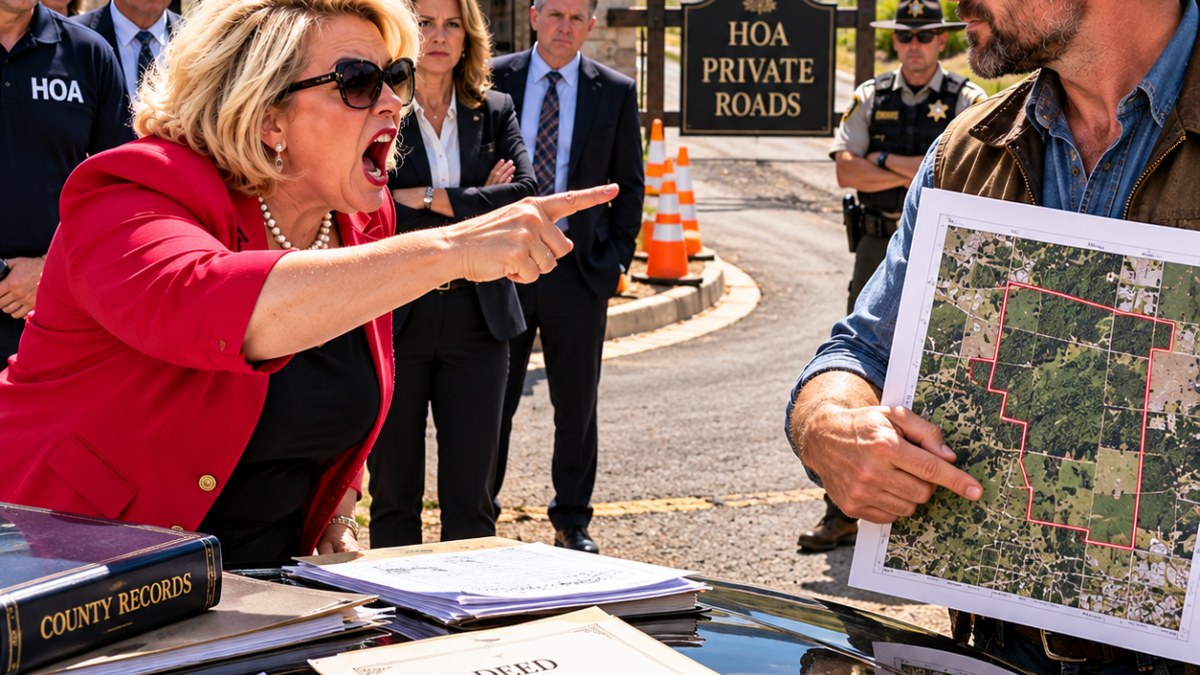
The label she showed me—Whispering Pines HOA Designated Green Space Preserve—had been printed directly across my parcel.
My eighty acres had not been slightly nudged by a bad line.
They had been absorbed.
The word that kept circling in my head was erase.
She was trying to erase me.
Not irritate me.
Not fine me.
Not pressure me over dust, tractors, pasture grass, deer trails, or fence lines.
Erase.
I called my brother first.
He was a corporate lawyer in Charlotte and had the exhausted voice of a man who spent his days watching rich people fight over commas.
He listened while I told him everything.
The map.
The fine.
Karen’s threat.
The phrase “nature preserve.”
The county filing.
The way she spoke like the fight was already over.
When I finished, he was quiet.
“That sounds like color of title,” he said.
“English.”
“They may be trying to use a faulty recorded document to create the appearance of ownership. If they act like they own it long enough, fine you, restrict access, manage the land, maybe improve it, maybe convince you not to fight—they build a record.”
“A record based on a lie.”
“Yes.”
“How does a lie get filed with the county?”
“Sometimes by mistake. Sometimes by negligence. Sometimes because somebody pays the right person to look the wrong way.”
I rubbed my hand over my face.
“What do I need?”
“A title attorney. Not a general real estate lawyer. A real title bloodhound. Someone who can go back a hundred years if he has to.”
He gave me a name.
Elias Vance.
“Semi-retired,” my brother said. “Cantankerous. Brilliant. He lives in county archives and hates bad paper like a preacher hates sin.”
The next morning, I drove into town.
Elias’s office sat between a bail bondsman and a barbecue joint, in a narrow brick building with faded gold letters on the door.
Inside, the air smelled like old paper, leather, and pipe tobacco, though no pipe was visible.
Files covered every surface.
Rolled maps stood in bins like artillery shells.
Behind the desk sat a wiry old man with white hair, sharp blue eyes, and the expression of someone who had been disappointed by mankind for eighty years but kept showing up anyway.
I told him the story.
He did not interrupt once.
When I finished, he leaned back, steepled his fingers, and smiled in a way that made me grateful he was on my side.
“A homeowners association,” he said. “Petty tyranny wrapped in property values.”
He held out his hand.
“Show me what you have.”
I gave him the fine.
He snorted.
“Bylaw 17.4. Adorable. They write little rules and start believing they outrank recorded title.”
He stood and walked to a wall of maps.
“Whispering Pines. I remember that development. Pinnacle Estates built it. Slick company. Fast closings. Cheap infrastructure. They bought the old Holloway tract.”
“You know it?”
“I know almost every ugly plat in this county.”
He pulled down a map, unrolled it, and weighted the corners.
“Let’s go see what they filed.”
The county records office was sterile and cold, nothing like Elias’s paper cave.
A clerk printed the revised plat after twenty minutes of searching.
When the large-format sheet rolled out of the machine, my stomach tightened.
Official county stamp.
Recorded date.
Surveyor’s seal.
Whispering Pines HOA common area revision.
And there, in the middle of that recorded mess, was my land.
My parcel outline.
My legal description.
Labeled as a preserve controlled by the HOA.
It hit me harder in print than it had in Karen’s hand.
Elias leaned over the map.
“Sloppy,” he muttered.
That one word gave me more comfort than sympathy would have.
He traced the southern boundary with a bent finger.
“Look here. This corner references a stone marker that hasn’t existed in that position since the county widened Old Farm Road in 1978.”
He moved to the creek line.
“And this call follows an old watercourse description, but the creek shifted slightly after the flood of ’96. Any competent retracement would account for that.”
“So it’s fake?”
He shook his head.
“Worse. It’s real, but wrong.”
That sentence chilled me.
“It has been filed,” he said. “Recorded. Stamped. Indexed. It is now part of the county record until we prove it should not be.”
“How do we prove that?”
“With more truth than they have lies.”
That was how the work began.
For two weeks, Elias and I lived in the records room.
We pulled every deed tied to my family’s land.
Every survey.
Every tax record.
Every easement.
Every plat.
Every map involving the Holloway tract that became Whispering Pines.
Every developer filing.
Every HOA covenant.
Every transfer from Pinnacle Estates.
My chain of title was strong.
Not simple, because old land rarely is, but strong.
My great-grandfather had acquired the land from a family that had held it after a post-Civil War settlement. The early descriptions spoke in the old language of land—white oak, creek bend, ridge stone, wagon path, fence corner.
Poetic.
Frustrating.
But traceable.
Elias cross-referenced old descriptions with modern coordinates, historic aerial photography, tax maps, field notes, and physical remnants.
A lightning-scarred stump where the white oak once stood.
An old stone pile near the creek.
A fence line visible in 1950s aerial images.
Piece by piece, we built a chain so solid it felt less like paper and more like iron.
Then we dug into Whispering Pines.
That was where things turned interesting.
Pinnacle Estates had bought the 200-acre tract, subdivided it, built the roads, laid out the lots, transferred common areas to the HOA, sold homes, and dissolved after the money was made.
Standard developer behavior.
In and out before the cracks show.
Elias studied the master deed with growing irritation.
“They transferred common areas,” he said.
“Parks?”
“Yes.”
“Clubhouse?”
“Yes.”
“Entrance sign?”
“Yes.”
“Roads?”
He did not answer.
He flipped pages.
Then more pages.
Then he smiled.
“Roads are land, Mark. Not decorations. If the HOA owns the roads, there should be deeds for the strips beneath them.”
“And?”
“And I do not see them.”
We went deeper.
The 200-acre tract Pinnacle bought had not been a neat rectangle. It had been assembled from three smaller parcels.
One of those parcels contained a strange exception.
Save and except for a fifty-foot-wide strip of land running north to south, intended for future county road access, as described in Survey Book 12, Page 45.
Elias froze.
Then whispered, “There it is.”
We pulled Survey Book 12.
There, on a survey from the 1950s, was a proposed county road that had never been built.
A fifty-foot strip cutting through the middle of what was now Whispering Pines.
And the main entrance road, Whispering Pines Drive, had been built almost exactly on top of it.
“Pinnacle bought the donut,” Elias said, eyes glittering, “but not the hole.”
My pulse picked up.
“They never owned it?”
“Not according to this.”
“Then they couldn’t transfer it to the HOA.”
“No.”
“Then who owns it?”
Elias looked at the old survey like a hunter looking at fresh tracks.
“That is the question that may ruin Karen Miller’s entire month.”
While we hunted ghosts in county archives, Karen escalated in the present.
The fines kept coming.
One thousand dollars for “unmaintained natural growth” because I allowed a pasture section to grow wildflowers for pollinators.
Fifteen hundred for an “unapproved structure,” which turned out to be a deer stand my grandfather built in the 1960s.
Another for “visual nuisance.”
Another for “failure to comply with green space maintenance.”
Each letter threatened liens.
Each envelope was taped to my front gate like a dare.
Then Karen went public.
My neighbor Tom slipped me a copy of the Whispering Pines newsletter.
The headline read:
PRESIDENT MILLER ACTS TO PROTECT COMMUNITY FROM ROGUE DEVELOPMENT
There was Karen, soft-focus photo, perfect smile, looking like a woman saving civilization from weeds.
The article painted me as a hostile outsider refusing a generous community preservation effort. It hinted that I was secretly planning to sell my land to a developer for high-density housing.
That was a lie.
A calculated one.
Fear sells better than facts.
Cars began slowing by my gate.
Residents stared.
One woman walking a golden retriever let the dog foul the edge of my lawn. When I asked her to clean it up, she shrieked that I was harassing her.
Karen had turned neighbors into spectators.
Then into soldiers.
I responded the way I knew how.
I built a record.
I called Dave, an old Army friend who now ran a private security company.
“I need cameras,” I told him. “Every inch of my property line. High resolution. Night vision. Hidden if possible.”
The next day, he and his crew installed a system so clean you would never notice it unless you knew where to look.
Fence posts.
Tree mounts.
Gate angle.
Driveway.
Creek crossing.
All linked to a server in my basement.
Then I called a few veterans from my old unit.
We met at the VFW.
Mack, a retired sergeant major with a voice like gravel and a stare like a locked gate, listened to the whole story without touching his beer.
When I finished, he said, “This isn’t just about acreage.”
“No.”
“It’s principle.”
“Yes.”
“You let a bully with a title steal a man’s land, the next bully learns the method.”
That was Mack.
He and a few others began doing what soldiers do well when official channels are slow.
They gathered information.
Public records.
Old lawsuits.
Board member histories.
Financial filings.
Prior HOA disputes.
What Mack found changed my understanding of Karen.
She was not a misguided volunteer.
She was a predator with stationery.
The worst file was the Hendersons.
An elderly couple.
Retired teachers.
Original Whispering Pines residents.
Mr. Henderson had suffered a stroke, and during the chaos they missed a fifty-dollar quarterly dues payment.
Karen’s board refused to waive the late penalty.
Fines compounded.
Legal fees piled on.
Within a year, the HOA placed a lien on their home and began foreclosure over a debt that started at fifty dollars.
The Hendersons sold under pressure and moved in with their daughter.
They had signed a non-disclosure agreement.
Mack handed me the file.
“She did this over fifty dollars,” he said.
I stared at the couple’s photo.
Suddenly, my eighty acres were no longer only mine.
Karen had been practicing on people with less leverage.
Less fight.
Less proof.
Then the cameras caught her husband.
It happened at 1:18 in the morning.
My phone buzzed with a motion alert near the main gate.
I opened the feed and watched a dark SUV roll up with its headlights off.
Two people got out.
One was a teenager from the neighborhood.
The other was Ron Miller.
Karen’s husband.
They carried spray paint.
I watched them paint GET OUT across the stone gate posts my father and I had rebuilt by hand after a winter storm.
They laughed.
Took pictures.
Got back in the SUV.
Drove away.
I did not call the police that morning.
I saved the video in three places.
Dave saved it in a fourth.
I was learning from Elias.
Evidence should be used at the moment when it weighs the most.
The phantom road parcel became Elias’s obsession.
The fifty-foot strip had been carved out in the 1950s for a county road that was never built.
The county eventually took it through tax foreclosure in the late 1960s after no one paid taxes.
Then the trail nearly vanished because a storage annex fire in the 1970s destroyed several ledgers.
Elias refused to accept that.
“If the front door burned,” he said, “we use the back.”
He went to newspaper archives.
By law, tax auctions had to be advertised.
So for three days, we sat in the basement of the County Chronicle scrolling microfilm until my eyes burned.
Legal notices.
Classifieds.
Obituaries.
Auction lists.
Then Elias shouted, “Got it.”
October 17, 1972.
Annual tax auction.
Parcel ID 77-B-412.
A 1.8-acre strip formerly part of the old Henderson farm.
Sold at auction.
The notice did not show the buyer.
For that, we needed a receipt book.
A records clerk named Mildred led us to a smoke-damaged metal box salvaged from the old annex fire.
Inside, wrapped in brittle plastic, were surviving ledger scraps.
One carbon-copy receipt showed parcel 77-B-412 sold for two hundred dollars.
Buyer: Oak Ridge Holdings Inc.
From there, we followed corporations.
Oak Ridge Holdings became Appalachian Land Ventures.
Appalachian Land Ventures later bundled nuisance parcels and sold them to Southeastern Asset Management.
A Delaware company.
Elias groaned when he saw that.
“The swamp where ownership goes to wear a mask.”
For a week, the trail seemed dead.
Then Mack called.
“I found something.”
He had been digging into Pinnacle Estates, the developer that built Whispering Pines.
Its vice president of land acquisition had been Ronald Miller.
Ron.
Karen’s husband.
The same man who spray-painted my gate.
The same man who lived in the neighborhood built on a road strip his old company never owned.
Now the picture darkened.
Ron had helped acquire land for Pinnacle.
He likely knew the development history.
Did he know about the missing road parcel?
Maybe.
Could we prove it?
Not yet.
Then Elias’s insurance investigator contact pierced the corporate veil.
Southeastern Asset Management was owned through layers of holding companies ultimately tied to a pension fund.
Not just any pension fund.
The United States Army Officers Pension Fund.
When Elias told me, I laughed for the first time in weeks.
The system I had served for twenty-five years, the source of my retirement check, indirectly owned the strip of land under Karen Miller’s neighborhood roads.
She had tried to steal a retired officer’s land.
And the Army, in the most absurd possible way, owned her streets.
But Elias warned me not to celebrate yet.
“If we alert the pension fund directly,” he said, “they’ll sell the nuisance parcel to the HOA for pennies just to avoid headache.”
“So what do we do?”
“We buy it first.”
That was how Alethea Holdings LLC was born.
Alethea.
Truth.
Elias’s idea.
We used attorneys, a broker, and enough corporate distance that no one would know I was behind it.
Alethea made an offer to acquire Southeastern Asset Management’s nuisance parcel portfolio.
To the pension fund managers, it was trash.
Odd strips.
Unbuildable remnants.
Administrative costs.
Alethea offered cash for the whole package.
It cost me fifty thousand dollars, plus legal fees I had intended to spend on a new barn.
But the idea of owning the ground under Karen’s roads was worth every cent.
While that deal moved quietly, my litigation attorney, David, filed the quiet title lawsuit over my eighty acres.
Turner v. Whispering Pines HOA and Karen Miller.
Fraud.
Slander of title.
Harassment.
Conspiracy to deprive me of property.
Punitive damages.
The complaint laid out my chain of title in brutal detail.
Certified deeds.
Historical maps.
Surveyor affidavits.
Tax receipts.
Aerial photos.
The fraudulent plat overlay.
The fines.
The newsletter.
The lien threats.
The whole campaign.
Karen responded by doubling down.
Her lawyer filed motions, discovery demands, and a counterclaim seeking to have my land declared a public nuisance and forcing a sale to the HOA at a value set by their appraiser.
A bully’s move.
When pushed, push harder.
I told David, “Let them spend.”
Meanwhile, Alethea closed.
In one quiet transaction, my anonymous company acquired Southeastern Asset Management’s assets.
Parcel 77-B-412.
The fifty-foot strip.
The land beneath the entrance road.
And several connected road parcels that had never properly transferred to the HOA.
I sat in my study that night holding the deed.
It was not triumph I felt.
It was cold calm.
Karen had waved a false map in my face.
Now I held a real deed to the roads under her subdivision.
The special HOA meeting came the following week.
Karen had called it to approve a five-hundred-dollar special assessment per household to fund the legal fight and begin development of the new “Whispering Pines Nature Preserve.”
My land.
My home.
Her war chest.
The clubhouse parking lot was full when we arrived.
David sat beside me.
Elias sat in the back of the car, refusing to miss “the last act of a good play.”
Mack and three veterans from my old unit met us outside.
Tom was there too, pale but determined.
We walked in together.
The room quieted.
Karen stood at the podium in a bright pink pantsuit, smiling until she saw me take a front-row seat.
The meeting began with ordinary nonsense.
Treasurer report.
Mailbox colors.
Pool furniture.
Then Karen stepped forward.
“And now,” she said, “we come to the future of our community.”
She spoke about preservation.
Property values.
Aesthetic character.
Green space.
Rogue landowners.
Community defense.
She never said my name.
She did not have to.
Finally, she announced the assessment.
Five hundred dollars per household.
To fund litigation.
To acquire and develop the preserve.
Before anyone could vote, David stood.
“Madam President,” he said, calm enough to chill the room, “before residents approve funding for litigation, they should be informed of several legal facts.”
Karen’s face went hard.
“You are out of order. This is a private meeting for residents only.”
David smiled faintly.
“My client is the landowner whose property you are discussing, and I am his counsel. We can speak here, or we can speak in front of a judge.”
The HOA lawyer, Peterson, stood.
“What is the meaning of this?”
David turned toward the residents.
“The meaning is that your president has been lying to you.”
The room gasped.
Karen shouted, “Lies!”
David opened his briefcase and lifted the lawsuit.
“This complaint has been filed in county court. It documents harassment, fraud, and slander of title. It presents the unbroken ownership history of Mr. Turner’s eighty acres and shows that the revised plat map your president relies on is legally defective and maliciously used.”
He handed a copy to Peterson.
The lawyer began flipping pages.
His confidence drained as he read.
Then I stood.
I did not shout.
I did not perform.
“My family has owned that land for over a hundred years,” I said. “I was born in the house I live in now. I bought out my siblings so the land would stay whole. It is not abandoned. It is not underutilized. It is not a preserve. It is my home. It is not for sale.”
That quieted them more than anger would have.
Then David delivered the second blow.
He pulled another document from his briefcase.
“Mr. Peterson,” he said, “can you confirm that the Whispering Pines HOA holds clear title to the roads inside this development?”
Peterson looked irritated.
“Of course. The roads are common property maintained by the HOA.”
“Have you personally run title on the land beneath Whispering Pines Drive, Creekside Court, and the connecting roads?”
“That is a ridiculous question.”
Elias’s voice cut from beside me.
“It is a yes or no question.”
Peterson faltered.
David handed him a certified deed.
“This is the deed for parcel ID 77-B-412. It covers the strip of land beneath your entrance and main road. The owner is Alethea Holdings LLC. As of last week, Alethea Holdings also owns the remaining road parcels that were never properly transferred by Pinnacle Estates.”
Peterson stared at the paper.
David turned back to the room.
“In short, your HOA does not own its roads.”
Silence.
Then chaos.
“What does that mean?”
“Peterson?”
“Karen, is this true?”
“We don’t own the roads?”
“How do we get to our houses?”
Karen grabbed the microphone.
“This is a trick. They cannot do this. We have bylaws.”
David’s voice cut through the noise.
“Your bylaws do not create ownership of land that was never conveyed to you.”
The room froze.
Then he pulled out the final documents.
“Alethea Holdings has issued formal notice restricting access to its private road parcels. Gates may be installed at the entrance to Whispering Pines Drive. Access will be granted only through temporary agreements.”
Panic hit the room.
David continued.
“Alethea has also prepared an invoice for twenty years of uncompensated road use. Market rent plus interest totals just over one point two million dollars.”
That number detonated.
People stood.
Some yelled at Peterson.
Some yelled at Karen.
Some yelled at the board.
A man in the back shouted, “What did you get us into?”
Tom climbed onto a chair.
“Everybody quiet!”
To my surprise, they listened.
I stood again.
“I did not want this,” I said. “I wanted to be left alone. Your president tried to take my home with a bad plat map. In doing so, she exposed the fact that this community has been standing on bad title for twenty years.”
Karen stared at me with pure hatred.
“You weaponized rules against me,” I said. “You weaponized the legal system. It turns out that game works both ways. The difference is that my case is built on facts. Yours was built on arrogance.”
David then offered the way out.
Alethea would grant a permanent road easement to a newly formed community association.
No gates.
No back rent.
No one loses access.
But the conditions were non-negotiable.
One: the existing Whispering Pines HOA must dissolve, and Karen Miller and the entire current board must resign immediately and be barred from future leadership.
Two: the new association must withdraw the counterclaim, join my quiet title action, affirm my undisputed ownership of the eighty acres, and vacate the fraudulent plat.
Three: the old HOA reserve funds must pay my legal fees, and the community must issue a public apology.
David had offered surrender disguised as rescue.
The residents understood it immediately.
All eyes turned to Karen.
“No,” she screamed. “I am the president. This is my community.”
A woman near the front stood.
“No, Karen. You almost destroyed this community.”
Someone else shouted, “Resign.”
Then another.
Then the whole room.
“Resign. Resign. Resign.”
Karen looked around for allies.
Her board stepped away from her.
Peterson packed his briefcase and left without a word.
The queen of Whispering Pines stood alone at the podium while the people she had ruled finally saw the bill for her arrogance.
That night, an emergency steering committee formed.
Tom became temporary chairman.
Karen refused to resign voluntarily, but by the end of the week, legal counsel for the new committee had everything needed to remove her and dissolve the old structure.
The old HOA died in paperwork.
Quietly.
Officially.
Permanently.
The new Whispering Pines Community Association was formed with bylaws that focused on actual maintenance and safety instead of mailbox shades, power trips, and weaponized fines.
Alethea Holdings granted permanent road easements to the new association.
The $1.2 million invoice was forgiven.
No gates were installed.
The new association joined my lawsuit as a co-plaintiff and petitioned to quiet title to my eighty acres.
The court granted it without a fight.
The fraudulent plat was vacated.
A corrected map was filed.
My land stood separate again in county records, exactly as it always had been in reality.
The old HOA reserve fund paid my legal fees.
The public apology appeared in the local paper.
It acknowledged the malicious and unwarranted campaign against me, the misuse of association authority, and the harm done by prior leadership.
Mack found the Hendersons.
The retired teachers Karen had forced out over a fifty-dollar dues issue.
The new association reached a private settlement with them.
It did not give them back their house.
Some damage cannot be perfectly repaired.
But it gave them money, acknowledgment, and the dignity of being believed.
That mattered.
Months later, I finally built the barn I had delayed.
Fresh pine.
Clean roofline.
Big sliding doors.
A structure made with honest measurements and no hidden claims.
The cameras came down.
I stopped checking the property line every time a car slowed.
Residents waved again when they passed.
Some apologized.
Some left vegetables on my gate post.
Mrs. Gable, the retired teacher who became the new association president, sent me a handwritten note saying she hoped fences could become fences again, not battle lines.
I kept that note.
One afternoon, I was mowing the hay field along the Whispering Pines border when I saw a moving truck outside Karen’s old house.
She had listed it after the scandal.
The sale took months.
Ironically, the property values she claimed to protect had been damaged most by her own war.
A young family stood in the driveway, two small children running excited circles around their parents.
A fresh start.
Then I saw Karen.
She stood on the sidewalk across the street, thinner than before, wearing a drab tracksuit instead of one of her bright power suits.
She looked at the house.
Then at the neighborhood.
Then at me.
I stopped the tractor.
For a long moment, we stared at each other across the field she had tried to steal.
I expected anger.
But there was none left in me.
Only finality.
Karen Miller had not been destroyed by me.
She had been destroyed by the distance between what she believed she could get away with and what the records eventually proved.
She thought a typo could take my land.
She thought fines could break me.
She thought a newsletter could turn a community against me.
She thought bylaws could outrank deeds.
She thought power was ownership.
She was wrong every time.
After a while, she turned and walked away from Whispering Pines for the last time.
I put the tractor back in gear.
The engine settled into its steady rhythm.
The field opened ahead of me.
My land was safe.
The roads were settled.
The old HOA was gone.
And the same clerical error Karen tried to use as a weapon against my eighty acres had exposed the rotten foundation under her own kingdom.
That was the lesson Elias had taught me in dusty records rooms and old map books.
Land is not a concept.
It is real.
It has edges.
It has history.
It has truth beneath the paperwork.
And sometimes, when a bully tries to steal the ground beneath your feet, the calmest answer is to follow the paper trail until it leads right back under theirs.
[EXPANDED ENDING — 5000 WORDS]
The night Karen Miller’s power finally broke, the clubhouse did not feel like a victory hall.
It felt like the inside of a storm shelter after the tornado had already passed.
People were still standing, but not because they were calm. They were standing because sitting down would have made what had just happened feel too final. The room was full of residents who had arrived expecting to approve a special assessment against me, a man they had been told was dangerous, greedy, and unreasonable. Instead, they had learned their HOA president had led them into a legal trap built from bad title, false records, weaponized bylaws, and personal ambition.
The air buzzed with panic.
Some residents shouted questions at Peterson, the HOA lawyer, though he had already packed his briefcase and retreated toward the side exit with the expression of a man suddenly remembering another appointment. A few people surrounded Tom, the neighbor who had climbed onto a chair and demanded order. Others stood in stunned silence staring at Karen, as if seeing her clearly for the first time required physical effort.
Karen herself had gone rigid at the podium.
Her pink pantsuit, which had looked so aggressively confident an hour earlier, now seemed almost ridiculous beneath the harsh clubhouse lights. Her face was pale except for two red patches high on her cheeks. One hand gripped the edge of the podium so hard her knuckles looked white.
“This is illegal,” she said.
Nobody answered.
She looked toward her board.
The treasurer would not meet her eyes. The secretary had stepped away from the table. The vice president was whispering with a group of residents near the wall, shaking his head like he wanted witnesses to understand he had not known everything.
Karen saw it.
The desertion.
The circle widening around her.
That was the first real consequence she felt.
Not the lawsuit.
Not the deed to the roads.
Not the million-dollar invoice.
The absence of loyalty.
For years, she had mistaken obedience for respect. She had mistaken fear for support. She had mistaken silence for agreement. In that room, with her own residents chanting for her resignation, the difference finally became visible.
Tom stepped down from the chair and walked to the front.
He was not a large man. He was not theatrical. For most of the years I had lived beside Whispering Pines, I knew him only as the neighbor who waved politely, apologized for noise he had not made, and once brought me a plate of cookies after a storm knocked branches across my fence.
That night, he looked like someone whose decency had finally outrun his fear.
“Karen,” he said, voice shaking but clear, “step away from the podium.”
“This is my meeting.”
“No,” he said. “It belongs to the residents.”
Her mouth twisted.
“The bylaws say—”
“The bylaws don’t matter if the HOA itself has put every family in this room at risk.”
That sentence landed.
Not because Tom shouted it.
Because he did not.
A resident near the front said, “Let him speak.”
Another added, “We need new leadership right now.”
Karen pointed at David, then at me.
“You are letting an outsider take over your community.”
A woman from the second row stood. I recognized her from mornings when she jogged past my fence line with headphones in.
“He’s not taking anything,” she said. “You tried to take his land, and now we might lose access to our own homes because you didn’t check the roads.”
“I did check—”
“No,” Elias growled from his chair. “You checked only what confirmed your appetite.”
The room went quiet again.
Elias looked older than everyone there and somehow more dangerous than all of them combined. He sat with his cane across his knees, eyes bright, enjoying the collapse of bad paper in the way a surgeon might appreciate a clean incision.
Karen glared at him.
“You have no authority here.”
Elias smiled.
“My dear woman, neither do you.”
That broke something loose.
Not laughter exactly.
Not applause.
A low sound moved through the room—half shock, half agreement.
David stepped forward before the chaos could rise again.
“Everyone needs to understand the immediate path forward,” he said. “This is not a mob proceeding. This has to be done correctly, or the legal mess gets worse.”
That calmed people in a way anger could not.
Because now they knew legal mess was not an abstraction. It had a number attached to it. One point two million dollars. It had gates. It had road access. It had the terrifying possibility that the woman who fined residents for mailbox colors had never confirmed ownership of the roads under their tires.
David continued.
“First, the current board must voluntarily resign, or residents must initiate removal according to the association documents. Second, a temporary steering committee can be formed tonight to retain independent counsel. Third, the new entity can negotiate directly with Alethea Holdings for permanent road easements. Fourth, the quiet title action regarding Mr. Turner’s land can be resolved through a joint filing.”
He looked at Karen.
“None of that requires your consent if the residents proceed properly.”
Karen’s face went flat.
That was when she understood the trap was not emotional.
It was procedural.
People like Karen can survive anger. They feed on it. They know how to twist outrage into instability, then present themselves as the only adult in the room.
Procedure was different.
Procedure took the microphone out of her hand.
Procedure counted votes.
Procedure read bylaws back to the people who had abused them.
Procedure turned her own system against her.
One by one, board members resigned.
The treasurer first.
He stood with visible reluctance, loosened his tie, and said, “Effective immediately, I resign from the board.”
A woman in the back snapped, “You should.”
He flinched but continued.
“I was not aware of the road title issue.”
That drew angry murmurs.
Tom raised one hand.
“Let him finish.”
The treasurer looked around the room.
“But I should have asked harder questions. I should not have accepted summaries from the president without source documents. I apologize.”
The apology did not fix anything.
But it was the first time anyone at that table had said the words I should have.
The secretary resigned next.
Then the vice president.
Karen remained.
“I will not resign,” she said.
Her voice sounded strange now.
Not powerful.
Bare.
“This community elected me.”
Tom looked at the residents.
“Then this community can remove you.”
The vote that followed was messy, emotional, and imperfect, but David and Elias kept steering everyone toward order. Names were recorded. Homeowners were confirmed. The governing documents were checked. An emergency removal procedure was invoked under provisions Karen herself had pushed through years earlier to remove a board member who questioned her landscaping contract.
That was one of the most satisfying ironies of the night.
Karen had built the blade.
Now the residents used it.
When the count ended, she was removed pending formal dissolution and reorganization.
She stood motionless for a moment.
Then she gathered her folder, her purse, and the agenda she had printed for what was supposed to be her coronation.
As she stepped down from the podium, she came close enough that I could see the rage in her eyes.
“You think this is over?” she whispered.
I looked at her for a long second.
“No, Karen. I think this is what over feels like before you admit it.”
Two of Mack’s veteran friends, at Tom’s request, walked beside her to the door. They did not touch her. They did not threaten her. They simply made sure she left the room she no longer controlled.
When the door closed behind her, the room did not erupt.
No cheering.
No celebration.
Only a heavy silence.
People had just watched the woman they followed nearly drive their community off a cliff. Relief came mixed with embarrassment, fear, and the sick realization that they had helped fund her campaign against me.
Tom turned to face everyone.
“We need volunteers for a temporary committee.”
Hands went up slowly.
Then more.
By midnight, Whispering Pines had a steering committee, independent counsel selected for emergency consultation, and a written acceptance of the framework David had offered.
I signed nothing that night.
Alethea Holdings signed nothing that night.
The old HOA signed nothing that night.
But the shape of the end had been drawn.
Karen’s kingdom had lost its roads.
And the residents, terrified by how close they had come to losing basic access to their homes, were ready to pay the only price that mattered.
Her authority.
The next few weeks were not dramatic in the way outsiders later imagined.
People liked to retell the clubhouse meeting as though everything changed with one explosive confrontation. In truth, that night was only the public collapse. The real ending came through filings, signatures, notices, corporate documents, recorded easements, motions, clerk stamps, and long conference calls where exhausted lawyers repeated parcel numbers until everyone wanted to set the phone on fire.
The old Whispering Pines HOA did not vanish in one clean breath.
It had to be dissolved.
Its obligations had to be accounted for.
Its bank accounts had to be reviewed.
Its pending litigation had to be reassigned or dismissed.
Its board actions had to be examined to determine which were valid, which were voidable, and which were simply reckless.
Tom became temporary chairman of the transition committee. The job seemed to age him five years in five days. He went from a man who avoided conflict to a man carrying binders under both arms and answering calls from angry neighbors until his voice went hoarse.
Once, he called me at eight in the evening.
“Mark,” he said, “I owe you an apology.”
“You already apologized.”
“Not enough.”
I heard papers rustling on his end.
“I found the newsletters. All of them. The ones Karen sent about you.”
“I’ve seen them.”
“She made you sound like a criminal.”
“That was the idea.”
He was quiet.
“I believed some of it.”
I appreciated that more than he probably knew.
Most people apologize for outcomes. Few apologize for the moment they chose not to question the lie.
“I wondered why you wouldn’t just sell,” he admitted. “I thought maybe you were being stubborn.”
“I was being stubborn.”
He gave a tired laugh.
“You know what I mean.”
“Yes.”
“I should have walked over and asked you directly.”
“That would have helped.”
“I know.”
The silence that followed was not comfortable, but it was honest.
Finally, he said, “We’re going to fix it.”
“You’re going to start fixing it,” I said. “That’s not the same thing.”
“No. I’m learning that.”
The first major document completed was the road easement.
Alethea Holdings, my anonymous company that was not anonymous anymore to the people who needed to know, granted a permanent, irrevocable easement over the road parcels to the newly formed Whispering Pines Community Association.
No gates.
No back rent.
No access agreements for individual homeowners.
No chaos.
The roads remained usable, openly and permanently, but now the right existed because it was properly granted, not because everyone had spent twenty years assuming a developer must have done the paperwork right.
Elias attended the signing.
He sat in the conference room with a satisfied look, cane across his lap, while the new association’s attorney reviewed the easement language line by line.
The attorney, a careful woman named Ruth Gable, was also the new interim president’s sister-in-law and had no patience for vague title.
She looked up at one point and said, “This should have been done when the subdivision was built.”
Elias leaned back.
“Yes.”
“That would have saved everyone a lot of trouble.”
“Yes.”
She glanced toward me.
“I suppose then Mr. Turner would not have had leverage.”
Elias smiled faintly.
“Bad paper always charges interest.”
That line was pure Elias.
I wrote it down later.
The second major filing was the motion to quiet title to my eighty acres.
The new association joined as co-plaintiff.
That was the part Karen would have hated most.
The very community she had tried to weaponize against me now stood beside me in court filings, affirming that my land was mine and that the revised plat had been wrongfully used.
The motion included the full chain of title Elias had built.
Great-grandfather.
Grandfather.
Father.
Me.
The tax receipts.
The original surveys.
The historic aerials.
The creek descriptions.
The old oak stump.
The boundary reconciliation.
The flawed revised plat.
The fines.
The newsletter.
The lien threats.
The attempted assessment.
Everything.
The judge reviewed the filing and granted the relief without requiring a hearing.
The fraudulent plat was vacated.
The county record was corrected.
A new map was filed.
My eighty acres appeared separate again—pasture, hardwoods, creek, and home—untouched by Whispering Pines lines, labels, or fantasies.
When I received the certified copy, I took it home and placed it on the oak dining table where the war had begun.
For a long time, I just looked at it.
A piece of paper had started the whole fight.
A piece of paper ended it.
The difference was truth.
That evening, I walked the property line alone.
No cameras buzzed in my pocket.
No strange cars slowed at the gate.
No envelopes were taped to the fence.
The pasture had gone gold in the late light. The creek was low, whispering over stones. A deer moved through the far tree line, following the same wildlife trail Karen had once tried to blame on nonexistent livestock.
I stopped near the place where she had stood with her rolled map.
For a moment, I could see her again.
Pink suit.
Predatory smile.
County stamp.
All that certainty.
I wondered if she had ever understood the land at all.
Not legally.
Not emotionally.
Not physically.
To her, land was an object in a plan.
A blank shape on a map.
A potential amenity.
A line item in a property-value argument.
To me, it was not abstract.
It had weight.
History.
Smell.
Sound.
Responsibility.
A man does not keep land by loving it only when threatened. He keeps it by maintaining fences when no one is watching. Paying taxes. Clearing culverts. Mowing firebreaks. Walking lines. Pulling invasive vines. Replacing rotten posts. Knowing which low field floods first and which oak drops branches in ice.
Karen wanted to manage what she had never served.
That was why she lost.
The financial settlement came next.
The old HOA reserve funds paid my legal fees in full. Every filing, every title search, every survey review, every attorney hour, every document retrieval, every mile Elias drove to some dusty archive because a developer forty years earlier had been too careless to finish a proper transfer.
David sent the final accounting.
The number was painful.
Not because I had to pay it.
Because I realized how easily Karen could have bankrupted someone without my resources, my brother, Elias, David, Mack, and enough stubbornness to keep going.
The Hendersons came to mind often during those weeks.
Mack found them living two counties away with their daughter.
Mr. Henderson’s health had declined after the move. Mrs. Henderson still kept copies of every HOA notice in a shoebox because she said she never stopped feeling like someone might come after them again.
When Tom told me the new association wanted to reach out to them, I told him to do it quietly.
“They do not need to be used as proof that the community is better now,” I said.
Tom nodded.
“They need to be treated like people.”
The settlement with the Hendersons was private, but Mrs. Henderson sent me a note afterward.
Her handwriting was small and careful.
Mr. Turner,
We heard what happened at Whispering Pines. We heard you stood up to her. I wish someone had been able to do that years ago, but I am grateful someone finally did. Thank you for not letting her keep hurting people.
I read that note three times.
Then I put it in the drawer with my corrected plat.
Not because the two documents were legally related.
Because morally, they were.
Karen’s system had always depended on choosing targets who would fold.
The Hendersons folded because their lives were already hard. Karen called that enforcement.
I did not fold because I had tools they did not. Karen called that hostility.
The truth was simpler.
She had been a bully long before she came for me.
I was just the first person she attacked who could pull the foundation out from under her.
The public apology appeared in the local paper on a Sunday.
It was written in careful legal language, but underneath the caution, the meaning was clear.
The new Whispering Pines Community Association acknowledged that previous leadership had pursued an unwarranted claim against my property, relied on defective records, issued improper fines, promoted false statements, and caused damage to my title and reputation.
It apologized.
Formally.
Publicly.
I did not expect that to matter much.
It did.
Not because I needed strangers to know I had been right.
Because lies spread in public should be corrected in public.
For weeks after that apology, people I barely knew stopped me in town.
At the hardware store, an older man in a seed cap shook my hand and said, “Glad you beat them.”
At the diner, the waitress refused to let me pay for coffee.
A county clerk gave me a quiet smile and said, “Mr. Vance is still terrifying, by the way.”
I said, “Yes, ma’am.”
Mrs. Gable, the retired schoolteacher who eventually became president of the new association, began leaving vegetables at my gate.
Tomatoes first.
Then squash.
Then cucumbers.
No notes.
No speeches.
Just food.
A neighborly offering.
The first time I found them, I stood at the gate longer than necessary.
For so long, that gate had been a place of envelopes, fines, graffiti, and surveillance alerts.
Now there was a basket of tomatoes sitting on the post.
It felt almost absurd.
It also felt like repair.
Not complete repair.
Not forgetting.
But a beginning.
The surveillance cameras came down slowly.
I removed the first one from a fence post near the creek.
Then another from the oak tree facing the entrance.
Then the gate camera.
Dave came out to help with the server.
“You sure?” he asked.
I looked toward Whispering Pines.
A car passed slowly on the road. The driver lifted a hand in a cautious wave.
I waved back.
“I’m sure.”
Dave disconnected the system.
The house felt different that night.
For months, I had lived with digital eyes around my land. Useful eyes. Necessary eyes. But eyes all the same. The absence of alerts felt like silence returning after a generator shuts down.
I slept better than I had in weeks.
By spring, I started building the barn.
The one I had delayed because Alethea Holdings, lawsuits, title work, and legal fees had eaten the money.
I built it anyway.
Fresh pine.
Deep footings.
Straight roofline.
Wide doors.
I took extra care with the foundation.
That old Army Corps habit never left me.
A structure is only as honest as what holds it up.
That thought made me laugh one afternoon while setting anchor bolts.
Karen’s whole kingdom had looked impressive from the road.
Clubhouse.
Entrance sign.
Rules.
Committees.
Fine schedules.
Newsletters.
But beneath it sat bad title, unexamined assumptions, and one woman’s hunger for control.
Rotten foundation.
No wonder it cracked when pressure finally came.
Elias visited the barn when the framing was up.
He walked through with his cane, tapping posts, looking at beams like they were legal clauses.
“Good work,” he said.
“That almost sounds like praise.”
“It is. Don’t get greedy.”
I handed him a bottle of water.
He stood in the open doorway looking toward Whispering Pines.
“Have they behaved?”
“So far.”
“Good.”
“Do you think Karen knew about the road issue?”
Elias took a long drink before answering.
“Ron may have known. Karen may have known parts. Or maybe neither of them understood the title problem until we put it in front of them.”
“That generous?”
“No. Practical. Proving knowledge is different from suspecting arrogance. But I know this much.”
He pointed his cane toward the subdivision.
“They were very comfortable using a flawed record against you. That comfort rarely appears out of nowhere.”
I thought of Ron spray-painting my gate.
The video had never become the centerpiece of the public fight. It did not need to. But it was in the file. It remained available. It ensured he stayed quiet when the settlement came.
Ron and Karen listed their house two months later.
The sign stayed up for a long time.
People noticed.
Of course they did.
Whispering Pines had become the kind of place where everyone pretended not to watch that house while absolutely watching it.
I heard from Tom that Karen tried to blame the scandal on me even after moving out.
She told one neighbor I had “used military connections” to steal community roads.
She told another the court had been confused.
She told someone else Elias had manufactured old records.
People stopped listening.
That may have been her worst punishment.
For years, her voice had carried weight in that neighborhood. She could turn a rumor into a violation, a preference into a rule, a grudge into a fine. After the meeting, her words became noise.
That is how power dies in a community.
Not when someone yells at the powerful person.
When people stop repeating them.
The day the moving truck came, I was on the tractor cutting the hay field near the border.
A young family stood in the driveway of Karen’s old house. A couple in their thirties. Two children. One little boy ran circles around the mailbox while his sister pointed at the upstairs window, already choosing a bedroom.
They looked hopeful.
That made me unexpectedly glad.
Houses deserve better than being monuments to the people who once misused them.
A few minutes later, Karen appeared on the sidewalk.
Not in pink.
Not in one of her structured power suits.
A loose gray tracksuit hung from her shoulders. Her hair was pulled back. Her face looked pale, smaller somehow, as if the performance had taken up more space than the person underneath.
She stopped across from the house.
The young family did not notice her at first.
Then the mother saw her and gave an awkward half-smile, the kind strangers give when they do not know the history of the person staring at their home.
Karen did not smile back.
Her eyes shifted across the street, past the entrance sign, past the trimmed lawns, past the community she once ruled, and finally landed on me.
I stopped the tractor.
The engine idled.
Across the field, we looked at each other.
There had been a time when I imagined what I would say if given that moment.
I thought I might tell her she deserved it.
That she brought this on herself.
That the Hendersons deserved better.
That my father’s land was never hers to rename.
That all her bylaws and newsletters and fines had been nothing but paper armor over a frightened need to control people.
But when the moment arrived, I said nothing.
Because the land had already answered her.
The court had answered her.
Her residents had answered her.
Even her own house had answered her by welcoming someone new.
For the first time, I felt no anger.
Only finality.
She turned away first.
She walked down the sidewalk slowly, shoulders rounded, a ghost at the edge of a neighborhood that had survived her.
I put the tractor back in gear and returned to the field.
The mower blades caught the grass in clean rows.
The engine settled into its steady rhythm.
The smell of cut hay rose around me, warm and green.
Above the tree line, the sky opened clear and blue.
That was the life I had wanted back.
Not revenge.
Not headlines.
Not people calling me a folk hero at the diner.
This.
The ordinary music of work on land that belonged to me because my family had held it, cared for it, paid for it, and defended it when someone tried to turn a typo into a theft.
Later that evening, I walked to the creek.
The water ran low but clear over the stones. I sat on the bank where my father used to sit and watched the light fade between the trees.
I thought about the phrase Karen had used.
Underutilized parcel.
There may be no colder way to describe land.
Underutilized by whose measure?
No gazebo?
No walking trail?
No clubhouse?
No revenue?
No HOA brochure?
The land was doing what it had always done.
Holding roots.
Carrying water.
Feeding deer.
Growing grass.
Keeping memory.
Giving me a place to stand when the rest of life had shifted too many times.
That was not underutilized.
That was sacred.
I do not mean sacred in a church sense, though I have prayed there more than once.
I mean sacred in the way any honest boundary can be sacred.
This is where my responsibility begins.
This is where yours ends.
That line, properly understood, makes neighbors possible.
Karen hated lines she did not control.
So she tried to redraw them.
In the end, she revealed lines she had never bothered to check.
My eighty acres.
Their roads.
Her authority.
The residents’ trust.
The difference between law and performance.
The difference between leadership and ownership.
All of it had been there beneath the surface.
The typo did not create the truth.
It exposed where truth had been neglected.
Elias called me a week after Karen left.
“I have something for you,” he said.
I drove to his office and found him behind the same mountain of files, holding a framed copy of the corrected plat.
Not the whole map.
Just the section showing my land and Whispering Pines beside it.
Separate.
Clean.
Properly labeled.
He had marked one corner in pencil.
“Why frame it?” I asked.
“So you remember.”
“I don’t think I’ll forget.”
“People forget peace faster than conflict.”
That was true.
He handed it to me.
“Hang it somewhere you’ll see it when life becomes normal again.”
I hung it in the new barn office.
Not in the house.
The house already knew what the land meant.
The barn was the future.
Months passed.
The new association held meetings that were, by all reports, boring.
That was the highest compliment I could give them.
They fixed drainage near the duck pond.
Repaired a sidewalk.
Negotiated insurance.
Reduced fines.
Removed half the old restrictions.
No one formed a committee to measure grass height with religious zeal.
No one taped envelopes to my gate.
When issues came up along the border, Mrs. Gable called me like an adult.
Once, a storm dropped a tree across both properties. She called before sending anyone near the fence.
“Mr. Turner,” she said, “we have a shared tree problem.”
I looked out at the fallen oak.
“That we do.”
Her crew cut from their side. I cut from mine. We stacked firewood, shook hands, and nobody filed a bylaw complaint.
Progress.
Mack came by one Saturday while I was finishing the barn doors.
He brought beer and a folder.
“What is that?” I asked.
“Closure.”
Inside were the public records of Karen’s resignation, the dissolution documents, the corrected plat notice, and a photocopy of the old Henderson settlement acknowledgment with personal details blacked out.
“You making a scrapbook?” I asked.
“History file.”
“I have enough files.”
“Not like this.”
He looked toward Whispering Pines.
“You beat her clean.”
“We beat her.”
“No,” he said. “A lot of us helped. But you refused to move.”
That stayed with me.
Because refusing to move was not always brave.
Some days it had felt exhausting.
Some days I wondered whether selling would be easier. Take money, walk away, buy land somewhere farther out where no HOA existed within five miles.
But land is not interchangeable when it carries your dead.
My parents were buried in the church cemetery, not on the farm, but everything they had built seemed rooted there. The fence my father repaired after the hurricane. The pasture my mother loved in spring. The creek where my brother broke his wrist. The ridge where my grandfather taught me to shoot. The kitchen window where I watched dawn after coming home from deployment, grateful to see a horizon that did not belong to a war zone.
Karen thought she was fighting over acreage.
She was fighting memory.
That is why I could not sell.
The final legal bill was paid from the old HOA reserve without argument.
David sent me a closing letter that read like a victory wrapped in invoice language.
Elias sent no bill for some of his hours. When I protested, he waved me off.
“I charged enough to remain respectable,” he said. “The rest was entertainment.”
“You enjoyed this too much.”
“Bad title corrected, bully dethroned, roads properly conveyed. A man needs hobbies.”
I asked him whether he would retire now.
He looked offended.
“After a case like this? Absolutely not. There may be other fools out there trusting developer paperwork.”
He was right.
There usually are.
One year after Karen stood on my land with that rolled-up map, I drove the tractor along the same boundary again.
Not as defiance this time.
Routine.
The hay needed cutting.
The wildflower patch needed trimming around the edges.
The fence needed checking after a storm.
At the exact place where she had threatened me, I stopped and shut off the engine.
Silence settled.
A cardinal called from the same oak.
Or maybe a different cardinal.
The world rarely marks our victories as dramatically as we do.
No monument stood there.
No sign said A Bully Failed Here.
No plaque explained how one typo meant to steal eighty acres had uncovered a legal ghost under an entire subdivision.
Just grass, fence, wind, and land.
I got down from the tractor and stood with one boot on each side of the old tire track.
For a moment, I let myself feel the full weight of it.
The fear I had not admitted at first.
The anger.
The humiliation of being lied about.
The exhaustion of record rooms and legal filings.
The satisfaction of the clubhouse reveal.
The relief of the corrected plat.
The quiet grief for the Hendersons.
The strange pity I felt watching Karen walk away.
All of it moved through me and then settled.
Land teaches that.
Storms come through.
Grass lies down.
Then it rises again.
I climbed back onto the tractor.
Before starting it, I looked once toward Whispering Pines.
A car turned into the main entrance road.
The road they now had proper legal right to use.
A child on a bicycle followed his father along the sidewalk.
Someone had planted new flowers near the sign.
Life had moved on.
That was good.
I did not need Whispering Pines afraid of me.
I did not need them grateful forever.
I only needed them to understand where their community ended and my home began.
The engine turned over.
The tractor rumbled to life.
I drove forward, the mower cutting a clean line through the field.
My land stretched ahead under a wide Carolina sky.
Safe.
Separate.
Mine.
Karen Miller tried to take eighty acres with a typo.
She never understood that bad paper cuts both ways.
And when we followed that error all the way down, it did not erase my farm.
It erased her throne.
[END]