HOA Karen Blocked My $500,000 Harvester for Six Hours—Then Her $155,000 Mistake Cost Her the SUV She Refused to Move
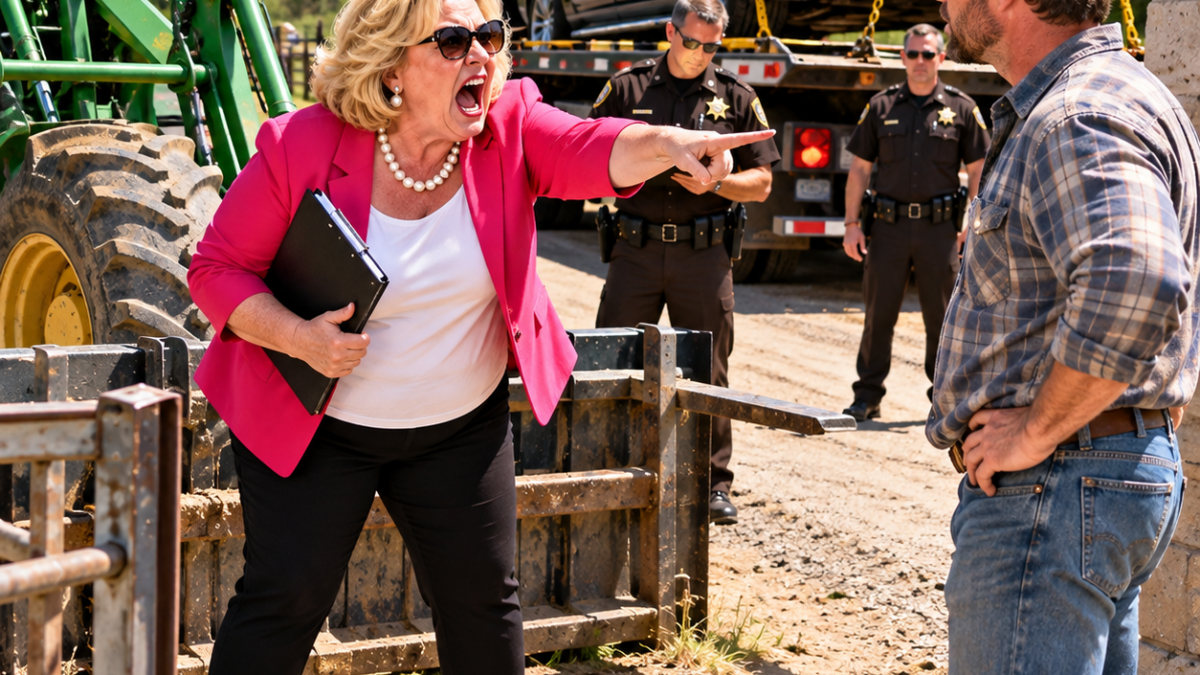
PART 2
CHAPTER 1 — THE SIX HOURS THAT COST ME EVERYTHING
The first thing I did after Karen’s SUV disappeared wasn’t scream, throw something, or chase after her.
I turned off the combine.
That probably sounds insignificant to anyone who has never depended on a harvest to pay a mortgage, but I can still remember the feeling of reaching for the ignition switch.
For six hours, the machine had rumbled behind Karen’s Lexus, burning fuel while we waited for someone to recognize that a private citizen couldn’t simply hold another person’s livelihood hostage because she disliked the appearance of agricultural equipment.
Every minute the engine ran, I held on to the possibility that we’d still get into the field.
Maybe the storm would slow down.
Maybe the deputies would convince her to move.
Maybe we’d get two or three productive hours before the rain arrived.
But when the sky opened, those possibilities vanished.
I reached forward and shut off the engine.
The enormous machine shuddered.
Then everything went quiet except the rain.
I sat in the cab for several moments, watching water stream down the windshield.
Beyond the access gate, my alfalfa bent beneath the storm.
I’d worked that field for months. The second cutting was particularly valuable because the quality was excellent, and I’d already arranged delivery to a regional dairy operation willing to pay a premium for properly harvested feed.
The money was spoken for long before it reached my account.
Mortgage payments.
Equipment repairs.
Fuel bills.
Property taxes.
And Emily’s education.
I’d planned everything carefully because that’s what farmers do when they don’t have wealthy relatives or investors waiting to rescue them.
One bad season can erase several good ones.
One unexpected repair can consume a year’s savings.
And one person with an inflated sense of authority can apparently put an entire operation at risk by parking a Lexus in the wrong place.
A knock against the cab door startled me.
Dave stood on the steps, rainwater running down his face.
“Mark, come on. You’re getting soaked.”
I climbed down.
He handed me his spare rain jacket.
We walked toward the barn without speaking.
When we reached the shelter of the equipment shed, Dave looked back at the field.
“That was deliberate.”
I didn’t answer.
“She knew exactly what she was doing.”
“I know.”
“She watched the storm coming.”
“I know, Dave.”
His expression softened.
“I’m sorry, brother.”
That almost broke me.
Not Karen’s threats.
Not the officers’ inability to resolve the standoff sooner.
Not even the sight of the ruined crop.
It was hearing a man I’d served beside in a different kind of struggle tell me he was sorry.
Dave had joined my farm two years earlier after leaving the Marines. He’d been struggling to find stable work, and I needed someone who understood machinery and wasn’t afraid of long hours.
Within months, he’d become more than an employee.
He was family.
I looked toward the field.
“What am I going to tell Emily?”
Dave took off his wet cap.
“The truth.”
“She thinks this harvest is paying for college.”
“Then tell her what happened.”
I shook my head.
“She’s going to think she needs to give up her place.”
“Then you tell her she doesn’t.”
I stared at him.
He rested a hand on my shoulder.
“Mark, you’ve handled worse than one spoiled woman with a luxury car.”
“Not with my daughter’s future sitting on the table.”
He didn’t answer immediately.
Then he said something I never forgot.
“That’s why you don’t quit.”
I walked into the barn office and opened my laptop.
I created a new folder.
Agricultural Access Obstruction — August 14.
Then I began writing.
The time we arrived.
The position of Karen’s SUV.
Her statements.
The weather forecast.
The officers’ arrival.
The ambulance response.
The moment the tow truck finally cleared the lane.
I called the sheriff’s office and requested the incident report and information about obtaining available recordings and other public records.
I saved the video from my phone.
Dave retrieved footage from his truck’s dashcam.
I photographed the tire marks where Karen had driven onto the gravel shoulder and positioned her vehicle across the lane.
Then I walked the field in the pouring rain, recording conditions as safely as I could.
I filmed the flattened stalks.
The pooling water.
The muddy access road.
The equipment standing idle.
I made certain the timestamps were preserved.
Dave watched me from the barn doorway.
“What are you doing?”
“Making sure nobody gets to change the story.”
He nodded.
Then he brought me a dry towel and his written notes.
We worked until nearly midnight.
By the time I closed the laptop, I had several hours of recordings, photographs, and observations.
I also had a preliminary financial estimate that made my stomach turn.
More than forty thousand dollars in potential crop damage.
I stared at the number.
I had been shot at overseas.
I’d survived roadside explosions and watched good men carried away on stretchers.
But sitting in that barn office, looking at a number on a computer screen, I felt a kind of helplessness I hadn’t experienced in years.
Because I knew exactly who would suffer if I couldn’t recover.
My daughter.
And she had already lost enough.
CHAPTER 2 — THE PROMISE I MADE TO MY DAUGHTER
Emily was awake when I came home.
The kitchen light was on, and she’d left a plate of dinner covered with aluminum foil beside the stove.
She sat at the table in an oversized sweatshirt, her college paperwork spread out in front of her.
When I entered, she immediately stood.
“Dad?”
“Hey, kiddo.”
She looked at my muddy boots and exhausted face.
“Did you get the hay in?”
I removed my cap.
“No.”
Her expression changed.
“The storm?”
I nodded.
She came closer.
“How bad?”
I pulled out a chair.
“Sit down, sweetheart.”
She sat.
I told her what had happened.
I explained Karen’s blockade, the deputies, the ambulance, and the tow truck arriving too late.
I tried to keep my voice steady.
Emily listened without interrupting.
When I finished, she looked toward the window.
For several seconds, she said nothing.
Then she asked, “She knew you needed to harvest?”
“Yes.”
“And she wouldn’t move?”
“No.”
“Even when the police told her to?”
“That’s right.”
Emily lowered her eyes.
“Why would somebody do that?”
I wanted to give her a simple answer.
Because Karen was selfish.
Because she liked power.
Because she’d never worried about how she would pay a mortgage.
But I didn’t know everything about Karen’s life, and I didn’t want to teach my daughter that anger justified making assumptions about another person.
So I said, “Sometimes people care more about being in control than understanding what their decisions do to others.”
Emily thought about that.
Then she asked the question I’d been dreading.
“How much did we lose?”
“I don’t know exactly yet.”
“Dad.”
I rubbed my face.
“Possibly forty thousand dollars or more.”
Her mouth opened slightly.
She looked down at the college documents.
Then she began gathering them into a neat stack.
“What are you doing?”
“Nothing.”
“Emily.”
She kept arranging the papers.
Finally, she whispered, “I can defer for a year.”
I felt my chest tighten.
“No.”
“Dad, it’s okay.”
“No, sweetheart.”
“I could work. Save money. Maybe take some classes at the community college.”
I reached across the table.
“Look at me.”
She raised her head.
Her eyes were wet.
“You worked for that acceptance letter. You earned it. We’re not giving it up because somebody decided to block a farm road.”
“But what about the mortgage?”
“I’ll handle it.”
“What about the equipment loan?”
“I’ll handle that too.”
She shook her head.
“You always say that.”
The words stung.
Not because they were cruel.
Because they were true.
Ever since Sarah died, I’d answered nearly every problem with the same promise.
I’ll handle it.
When the roof leaked.
When the truck broke down.
When Emily needed braces.
When the hospital bills arrived.
When she woke from nightmares about losing me too.
I’d wanted her to feel protected.
But somewhere along the way, I’d taught her that I was supposed to carry every burden alone.
I looked at my daughter.
“You’re right.”
She blinked.
“What?”
“I do say that too much.”
I took her hand.
“I’m scared, Emily.”
Her expression softened.
“I know.”
“I’m scared because I worked hard for this farm. I’m scared because I promised your mother I’d give you a good life. And I’m scared because I don’t know how long it will take to recover from this.”
A tear slid down her cheek.
“But listen carefully. Being scared doesn’t mean we’re finished.”
She stood and came around the table.
I pulled her into my arms.
She cried against my shoulder.
I held her the way I had when she was little, when thunderstorms frightened her and she’d climb into my bed carrying a stuffed horse.
After a while, she whispered, “I don’t need a fancy college, Dad. I just need you.”
I closed my eyes.
“You’ve got me.”
“And I don’t want you losing the farm.”
I kissed her hair.
“Neither do I.”
That night, after Emily went upstairs, I opened the refrigerator door and looked at the acceptance letter she’d attached with a little horseshoe magnet.
The words blurred.
I remembered Sarah standing in that same kitchen years earlier, laughing because Emily had announced she intended to become a veterinarian, a horse trainer, and a wildlife photographer all at once.
Sarah had said, “That girl is going to do something wonderful.”
I touched the corner of the letter.
“I know, honey,” I whispered into the empty kitchen.
Then I made another promise.
Karen Whitmore wasn’t going to decide my daughter’s future.
CHAPTER 3 — THE FARM THAT CAME BEFORE THE HOA
The next morning, I drove to the field before sunrise.
The storm had passed.
The sky was painfully clear.
Sunlight moved across the wet alfalfa, making it look almost beautiful from a distance.
But when I stepped out of my truck, I could see how badly the crop had suffered.
The plants were flattened and saturated.
Standing water remained in low sections.
Harvesting would be delayed, and the quality required under my premium sales arrangement was now in serious doubt.
I called a crop-loss specialist named Harold Peterson.
He arrived that afternoon.
Harold was a practical man in his early sixties who’d spent decades assessing agricultural damage for insurers, lenders, and farmers.
He didn’t offer false reassurance.
He asked for planting records, harvest history, expected yields, contracts, weather information, and photographs from before the storm.
We walked the field together.
He examined the crop carefully.
“Did you have equipment ready before the storm?”
“Yes.”
“Operators?”
“Dave and me.”
“Any alternate access?”
“Nothing that could safely accommodate the combine.”
“Could you have entered from the south?”
“There’s a drainage ditch and a neighboring pasture. We’d have needed permission, temporary fence removal, and ground conditions firm enough for the machine. None of that could be arranged in time.”
Harold wrote everything down.
Then he looked at the wet plants.
“Mark, I’m not going to tell you what you want to hear.”
“I wouldn’t have called you if I wanted that.”
He nodded.
“The premium crop is in serious trouble. Some of this might still have salvage value, depending on what happens over the next few days.”
I looked across the field.
“But not what I contracted to sell.”
“Not at that quality.”
Two days later, Harold delivered his assessment.
$42,800 in documented crop loss.
I sat in my truck and read the report three times.
Forty-two thousand eight hundred dollars.
I had known the loss would be substantial.
Seeing it confirmed by an independent specialist was different.
It made everything real.
I took the report home, printed another copy, and added it to the evidence binder.
Then I started reviewing the access road’s legal history.
My farm had once been part of a much larger agricultural property.
The original owners had used the gravel lane for decades, long before any subdivision existed.
In the late 1990s, a developer bought most of the surrounding acreage and built the Estates at Whispering Pines.
Large houses.
Manicured lawns.
Decorative entrances.
Private common areas.
A homeowners association.
My twenty-acre farm remained outside the subdivision.
Its deed, agricultural zoning, and recorded access rights had not been replaced by the HOA’s residential covenants.
But the developer’s subdivision map included the gravel lane within a section designated as association common property.
Karen had apparently decided that designation gave her absolute authority over everything traveling across it.
That was the mistake.
The older documents showed a continuing agricultural access easement benefiting my farm.
Ownership of the land beneath an easement and the legal right to use that land are not necessarily the same thing.
The HOA might have an interest in the underlying parcel, but that didn’t automatically erase my right of access.
I obtained the old deed, recorded plats, easement language, and the subdivision’s declaration from the county records.
I spread everything across my kitchen table.
Emily came downstairs carrying a bowl of cereal.
She stopped.
“Are we buying another farm?”
I looked up.
“What?”
She pointed at the maps.
“There’s enough paperwork here to purchase half the county.”
I laughed.
“Just trying to figure out what Karen thinks she owns.”
Emily leaned over the oldest survey.
“How old is this?”
“Decades older than Whispering Pines.”
She traced the gravel lane with her finger.
“This is our road?”
“It’s the lane we have a recorded right to use.”
“And Karen blocked it anyway?”
“Yep.”
Emily looked thoughtful.
“Maybe she should’ve read the paperwork before buying the fancy SUV.”
I nearly spilled my coffee.
For the first time since the storm, I laughed hard enough that my stomach hurt.
Then I got serious.
I prepared a formal demand letter.
It described the blockade, the documented agricultural loss, the sheriff’s involvement, and the recorded access rights.
I requested compensation and confirmation that the HOA would not interfere with my access again.
I addressed it to the entire board, not just Karen.
Then I sent it by certified mail.
I wanted proof that they’d received it.
Ten business days passed.
No response.
On the eleventh day, an envelope appeared in my mailbox.
The HOA logo was embossed across the top.
I opened it at the kitchen table.
Inside were three violation notices.
The first demanded $500 for improper parking of commercial equipment.
The second demanded $1,000 for unauthorized commercial activity visible from the community.
The third demanded $250 for an improperly maintained agricultural landscape.
That last one nearly took my breath away.
Karen was fining me because the storm-damaged field looked neglected.
The same field she’d prevented me from harvesting.
At the bottom of the paperwork was her signature.
The total was $1,750, with warnings about additional penalties and possible collection action.
I stared at the notices.
Then I looked at the certified-mail receipt.
Karen had signed for my compensation demand.
The next day, the fines were issued.
I placed both documents side by side.
And I realized the dispute had become much larger than a blocked road.
CHAPTER 4 — THE WOMAN WHO THOUGHT SHE OWNED EVERYONE
I’d met Karen Whitmore about six months before the blockade.
At the time, I thought she was merely an irritating neighbor.
She’d approached me while I was moving a planter between fields.
The equipment had been temporarily staged near the gravel lane while I retrieved seed.
Karen appeared wearing white pants, oversized sunglasses, and the expression of someone who believed the world had been arranged incorrectly.
“That machine is an eyesore,” she announced.
I looked at the planter.
“Morning to you too.”
“I’m serious, Mr. Evans. Residents shouldn’t have to look at industrial machinery.”
“It’s farm equipment.”
“Whatever you call it, it’s lowering our property values.”
I glanced toward the twenty acres beyond her.
“Karen, this was farmland before your subdivision was built.”
“That doesn’t mean we should tolerate anything.”
I tried to explain that the equipment would be moved shortly.
She wasn’t interested.
A week later, I received a formal warning about commercial machinery on common property.
Then another letter about agricultural noise.
Then another about the appearance of my equipment.
At first, I ignored them.
My land wasn’t an HOA member property, and I had work to do.
Looking back, that was my first mistake.
Not because Karen’s letters were necessarily enforceable.
But because silence allowed her to believe I could be intimidated.
Now I wondered how many residents had been receiving similar warnings.
I started with Carlos Rodriguez.
Carlos lived on the western edge of Whispering Pines with his wife, Maria, and their three sons.
He was repairing a bicycle chain when I stopped by.
“Hey, Mark,” he called. “How’s the farm?”
“Had a rough week.”
“I heard.”
I explained the crop loss and the fines.
As I spoke, Carlos’s expression changed from sympathy to recognition.
“Let me guess,” he said. “Architectural control committee?”
I nodded.
“Karen signed the notices?”
“Yes.”
He shook his head.
“That woman.”
He pointed toward a basketball hoop beside the driveway.
“Five hundred dollars.”
I frowned.
“For the hoop?”
“Apparently it’s an unapproved permanent structure.”
“That thing has wheels.”
“Tell Karen.”
Carlos wiped grease from his hands.
“My oldest boy saved for months to buy it. He did yard work. Washed cars. Helped an elderly neighbor clean her garage. He was proud of himself.”
“What happened?”
“Karen sent us a notice. Said it didn’t fit the neighborhood appearance standards.”
“Did you appeal?”
Carlos sighed.
“Maria wanted to. But Karen threatened additional daily fines, and I didn’t want trouble.”
He looked toward the house.
“So I paid.”
I stared at the hoop.
“Did your son know?”
“He overheard us arguing about it.”
Carlos’s voice dropped.
“He asked if we’d have to sell it.”
Something tightened in my chest.
Because suddenly I saw the same fear I’d seen in Emily.
Children worrying about money because an adult with authority decided to be cruel.
I asked Carlos whether other residents had experienced similar problems.
He nodded.
“Plenty.”
Over the next week, Dave and I began speaking with homeowners willing to share their experiences.
We approached people respectfully.
We asked for documents, dates, and verifiable details.
We did not ask anyone to exaggerate.
We didn’t promise a lawsuit would make them rich.
We simply wanted to understand whether the problem was widespread.
It was.
An elderly Navy veteran named Mr. Hemlock had been fined repeatedly because his flagpole exceeded the height limit by two inches.
A young mother received warnings about her daughter’s brightly colored backyard playset.
Another family said their proposed wheelchair ramp for an aging parent had been rejected because it conflicted with the subdivision’s visual standards.
Several residents had paid fines they believed were unfair because they feared escalating penalties.
One woman opened her door, recognized why I was there, and immediately became nervous.
“I can’t get involved,” she whispered.
“That’s okay.”
“She’ll find something wrong with my house.”
I looked at her.
“Karen?”
She nodded.
“Last time I complained, I received three violation letters in two weeks.”
She glanced down the street.
“Please don’t tell her I spoke to you.”
I promised I wouldn’t disclose her information without permission.
Then I walked back to my truck.
Dave was waiting.
“Another one?”
I nodded.
“She’s scared.”
He looked toward the houses.
“That’s what Karen counts on.”
He was right.
The more people I spoke with, the clearer it became that Karen’s authority depended on something more powerful than the HOA rulebook.
Fear.
Residents were afraid of legal costs.
Afraid of liens.
Afraid of being singled out.
Afraid that fighting one fine would produce five more.
I understood that fear better than most.
I’d spent the previous week wondering whether my daughter’s education would survive a single afternoon of Karen’s arrogance.
But I also knew something else.
Fear loses much of its power when people stop facing it alone.
CHAPTER 5 — THE NAVY VETERAN AND THE FLAGPOLE
Mr. Hemlock lived in a small brick house near the center of Whispering Pines.
He was seventy-eight, a retired Navy chief petty officer, and the kind of man who still polished his shoes before church.
When I knocked, he opened the door wearing a faded Navy cap.
“Mark Evans?”
“Yes, sir.”
“Carlos said you might come.”
He stepped aside.
“Coffee?”
“Thank you.”
His home was immaculate.
Photographs of naval ships lined the hallway.
A framed picture of his late wife stood on the mantel.
Through the front window, I could see the American flag flying from the pole in his yard.
He noticed me looking.
“That’s what all the trouble’s about.”
We sat at the dining table.
He brought out a folder of HOA correspondence.
The notices showed recurring penalties concerning the flagpole’s height.
I examined the dates.
“How long has that pole been there?”
“Twenty years.”
“And when was the rule adopted?”
“Long after we put it in.”
He shook his head.
“Karen says that doesn’t matter.”
I studied the photograph on the mantel.
“Your wife?”
His face softened.
“Margaret.”
He took the picture down.
“She picked the location for that flagpole.”
He sat again.
“We installed it together on our anniversary. I dug the hole. She mixed the concrete. We argued for twenty minutes because she said I couldn’t hold the level straight.”
He smiled faintly.
“She was right.”
I listened.
“Margaret passed away seven years ago. Cancer.”
“I’m sorry.”
He nodded.
“Every morning, I raise that flag. Every evening, I bring it down. It’s something we used to do together.”
He looked toward the window.
“When Karen told me to shorten the pole, I explained why it mattered.”
“What did she say?”
His expression changed.
“She said personal sentiment didn’t excuse a violation.”
I looked at the letters again.
Two inches.
Twenty years of memories.
And a woman who had apparently decided that uniformity mattered more than compassion.
Mr. Hemlock folded his hands.
“I served this country for thirty years, Mark. I followed orders. I understand rules. But rules have purposes.”
“Yes, sir.”
“And people who enforce them have responsibilities.”
I nodded.
He looked directly at me.
“I don’t mind being told I’m wrong when I’ve done something wrong. But I won’t accept being treated like a nuisance because I want to keep something my wife loved.”
I sat quietly for a moment.
Then I said, “Would you be willing to let an attorney review these documents?”
He studied me.
“You’re going after Karen?”
“I’m going after what she did. There’s a difference.”
A faint smile touched his face.
“Good answer.”
He agreed to help.
When I left, he walked me to the front porch.
The flag snapped gently in the breeze.
He looked up at it.
“Margaret would’ve liked you.”
I felt a lump in my throat.
I’d never met his wife.
But I knew what it meant to hold on to something because it carried the memory of a person you loved.
After Sarah died, I couldn’t bring myself to repaint the kitchen.
She’d chosen the yellow color herself.
Friends suggested changing it after several years.
I never did.
Sometimes love remains in ordinary things.
A kitchen wall.
A flagpole.
An old photograph.
And sometimes a person who has never known that love believes those things are disposable.
As I drove away, I understood that my fight was no longer just about a ruined harvest.
CHAPTER 6 — THE NUMBERS NOBODY WANTED TO SEE
Dave had always been good with records.
In the Marines, he’d worked in logistics, managing equipment, supplies, and transport schedules.
He could look at a spreadsheet and spot a missing number faster than most people could find their car keys.
When I showed him the stack of HOA fines residents had shared, he immediately suggested organizing them.
“Not just names and amounts,” he said. “Dates, rule citations, committee approvals, appeal results, everything.”
We created a spreadsheet.
Every entry linked to a document.
Every claim had a source.
When someone told us a story but couldn’t produce records, we noted that it remained unverified.
Within days, patterns emerged.
The architectural control committee appeared repeatedly.
Karen’s signature appeared on many notices.
Certain households had received clusters of penalties after disputing earlier fines.
Several older installations had been cited under newer standards.
We also reviewed the HOA’s publicly available financial statements.
Over Karen’s three-year presidency, the records showed more than $70,000 in fines assessed.
Not all of those fines were necessarily improper.
We were careful about that distinction.
But the volume was significant enough to justify questions.
Then Dave noticed the beautification budget.
“Mark, look at this.”
He pointed to a line item.
“Community improvements.”
I leaned over his shoulder.
“What about it?”
“The spending increased around the same period as fine revenue.”
We examined the records.
Money had gone toward decorative landscaping near Karen’s street, improvements around a common pond visible from her property, and contracts with a landscaping company maintaining selected common areas.
There was nothing inherently unlawful about landscaping common property.
But the records did not clearly explain why those projects had received priority or how the contracts were approved.
Dave leaned back.
“Looks convenient.”
“Could be.”
“Could also be something worse.”
I nodded.
“But we don’t know that.”
He smiled.
“That’s why we ask for invoices.”
We added the financial records to our binder.
Then I invited Carlos and Mr. Hemlock to the barn.
We spread everything across the workbench.
Carlos examined the spreadsheet.
“Seventy thousand dollars?”
“That’s what the records indicate.”
He shook his head.
“People paid all that?”
“Some paid. Some contested. We still need to reconcile the totals.”
Mr. Hemlock looked at the beautification budget.
“She fined me over my flagpole while spending association money on flowers near her house.”
“We don’t yet know whether the spending was improper,” I said.
“But homeowners deserve an explanation.”
Mr. Hemlock nodded.
Carlos looked toward the barn door.
“What do we do?”
I closed the binder.
“We find someone who knows how to fight this legally.”
CHAPTER 7 — THE ATTORNEY WHO ASKED THE RIGHT QUESTION
Arthur Vance was nothing like I expected.
I’d imagined a loud, aggressive attorney who would pound the table and promise to destroy Karen.
Instead, Arthur was calm.
He was in his late sixties, with neatly trimmed white hair, a careful manner, and the quiet confidence of someone who didn’t need to raise his voice to be heard.
A retired Air Force JAG officer, he had spent years working in military law before building a civilian practice focused on property disputes and institutional accountability.
His office was lined with legal volumes and photographs from his service.
When I arrived carrying two binders, he looked at them and smiled.
“Colonel McGregor said you were organized.”
“I tried.”
He gestured toward the conference table.
“Let’s see what you’ve got.”
I began with the access road.
The older easement.
The subdivision maps.
Karen’s warnings.
The blockade.
The deputies.
The ambulance.
The six-hour delay.
Then I showed him Harold Peterson’s crop-loss assessment.
Arthur read it carefully.
“Forty-two thousand eight hundred dollars.”
“Yes.”
“Contracted premium crop?”
“Yes.”
“Weather records?”
“In the binder.”
“Equipment logs?”
“Also there.”
He looked up.
“Did you attempt to mitigate the loss?”
I described the alternate routes we’d considered and why they weren’t practical.
He nodded.
Then I showed him the retaliatory fines.
He placed the certified-mail receipt beside the violation notices.
“She received your demand letter on August twenty-sixth.”
“Yes.”
“And these were issued August twenty-seventh.”
“Yes.”
Arthur studied the dates.
“Interesting.”
He asked whether the HOA had authority to assess fines against my property.
I explained that my farm was not a member parcel.
He reviewed the recorded documents.
Then he sat back.
“Mark, I’m going to tell you something important.”
I waited.
“A judge will not rule in your favor simply because Karen behaved badly. We need legal grounds, admissible evidence, and proof that her conduct caused the losses you’re claiming.”
“I understand.”
“Good. Because anger makes people careless.”
He turned to the agricultural easement.
“This document may be central to the case.”
I leaned forward.
“How?”
“The subdivision’s later common-property designation doesn’t necessarily extinguish a previously recorded access right. We need to verify the complete chain of title, but this is strong evidence that your farm retained lawful access.”
He reviewed the sheriff’s report.
Then the videos.
Then Dave’s statement.
Finally, I opened the neighborhood binder.
Arthur went quiet.
He read Mr. Hemlock’s notices.
Carlos’s basketball hoop fine.
The statements concerning the playset and proposed wheelchair ramp.
The spreadsheets.
The financial records.
When he finished, he removed his glasses.
“There’s a broader pattern here that deserves investigation.”
“That’s what I thought.”
“But we need to be careful. These homeowners have separate legal rights and potential claims. Your lawsuit won’t automatically resolve everything that happened to them.”
“I know.”
He looked at me.
“What do you actually want?”
The question surprised me.
“I want compensation.”
“Of course.”
“I want the road protected.”
“Reasonable.”
“And I want Karen to stop treating people like this.”
Arthur rested his hands on the table.
“That last part may require more than litigation.”
I nodded.
“Then we’ll do more than litigation.”
He smiled slightly.
“Now we’re having the right conversation.”
Arthur explained a strategy involving claims arising from the intentional obstruction, compensation for provable losses, and a request for judicial clarification of the easement.
The retaliatory fines would be challenged as well.
Karen could be named personally if the evidence supported liability for her own conduct.
He warned that personal liability wasn’t automatic simply because she served as HOA president.
I appreciated that.
I didn’t need promises.
I needed someone who would tell me the truth.
When he quoted his retainer, I felt my stomach tighten.
Five thousand dollars.
Money I desperately needed for the farm.
Arthur noticed.
“Take your time deciding.”
I looked down at the binders.
Then I pictured Emily quietly stacking her college paperwork.
I wrote the check.
Arthur accepted it without celebration.
“Then let’s begin.”
CHAPTER 8 — THE DAY KAREN WAS SERVED
Karen called me the evening she received the lawsuit.
I was repairing a fence along the south pasture when my phone rang.
Her name appeared on the screen.
I considered ignoring it.
Then I answered.
“Mr. Evans!”
“Good evening, Karen.”
“Have you lost your mind?”
“Not that I’m aware of.”
“You named me personally in a lawsuit!”
“Yes.”
“I’m the president of the HOA!”
“I know.”
“You can’t sue someone for doing her job.”
“Arthur Vance believes there’s a legal basis for the claims. Your attorney can address them.”
She made a sharp sound.
“You’re trying to destroy my reputation.”
I looked at the broken fence rail in my hand.
“Karen, I asked you to move your car.”
“That road belongs to the association.”
“I have a recorded right to use it.”
“You should’ve respected the community.”
“I was trying to harvest my crop before a storm.”
“You could’ve waited.”
I closed my eyes.
For a second, I was back in the rain.
Watching the field disappear beneath the water.
“That’s what I did, Karen. I waited six hours.”
She said nothing.
Then I continued.
“Now the court can decide the consequences.”
I ended the call.
My hands were shaking.
Not because she frightened me.
Because I was struggling to control my anger.
The lawsuit made everything feel larger.
More permanent.
More dangerous.
I knew Karen had resources.
She lived in an expensive home.
She drove a luxury SUV.
She controlled much of the HOA’s administrative machinery.
And I was a farmer already recovering from a substantial financial loss.
But I also knew I had evidence.
The HOA’s attorney, Barry Thompson, filed a motion seeking dismissal of the case.
He argued that the association had acted within its authority and that Karen’s conduct was protected by her official responsibilities.
Arthur prepared a detailed response.
He emphasized the recorded easement and the distinction between enforcing legitimate HOA rules and intentionally obstructing access to private agricultural property.
He also presented the chronology of Karen’s later fines.
The first hearing took place in a county courtroom on a gray Tuesday morning.
Emily helped me straighten my tie before I left.
“You look like you’re going to a funeral,” she said.
“Feels a little like one.”
She smiled faintly.
“Don’t let her get under your skin.”
“I’ll try.”
She stepped closer.
“Mom would’ve told you to breathe.”
I laughed softly.
“Your mother was usually right.”
Emily adjusted my collar.
“Then listen to her.”
At the courthouse, Karen arrived wearing a cream-colored suit and carrying an expensive leather handbag.
She looked at me briefly.
Then smiled.
It was the same smile she’d worn beside her Lexus.
Certain.
Superior.
Completely convinced she was untouchable.
Judge Carmichael entered the courtroom.
Arthur presented our arguments.
Thompson responded.
The judge questioned both sides about the access documents, the authority claimed by the HOA, and the alleged conduct.
She examined the chronology of the obstruction and later fines.
Then she ruled that the central claims could proceed.
The motion to dismiss was denied in relevant part.
Discovery would begin.
I didn’t understand every legal detail.
But I understood Karen’s expression.
Her smile disappeared.
Outside the courtroom, Arthur gathered his papers.
“Important first step,” he said.
“Did we win?”
“No. We earned the opportunity to prove the case.”
I nodded.
“Then let’s prove it.”
CHAPTER 9 — WHAT SHE ADMITTED UNDER OATH
My deposition came first.
Arthur prepared me carefully.
“Answer only what you know. Don’t exaggerate. Don’t speculate. If you don’t remember, say so.”
I nodded.
“Sounds familiar.”
“Military training?”
“Something like that.”
The deposition lasted three hours.
Thompson questioned my history with Karen, my equipment, the farm, the access road, and the storm.
He suggested I’d been aggressive.
He implied that I’d ignored reasonable HOA warnings.
He questioned whether the crop would have been harvested even without the blockade.
I answered calmly.
“Mr. Evans, you were angry with my client?”
“Yes.”
“Extremely angry?”
“I was concerned about losing my harvest.”
“Did you threaten to call the sheriff?”
“I told her I would call the sheriff if she continued obstructing access.”
“So you threatened her with law enforcement?”
“I informed her I would contact law enforcement.”
He frowned.
“Wouldn’t you agree that calling the police can be intimidating?”
“Not when a person is seeking assistance with an obstruction.”
Arthur sat quietly beside me.
The questions continued.
“Isn’t it true you ignored several HOA letters?”
“Yes.”
“Because you believed you were above the rules?”
“Because my property is not part of the HOA and I believed the notices exceeded its authority.”
“That’s your personal interpretation.”
“It’s based on the recorded documents.”
Thompson tried repeatedly to provoke me.
I didn’t give him what he wanted.
When the deposition ended, I was exhausted.
But I’d told the truth.
Nothing more.
Nothing less.
Karen’s deposition took place the following week.
Arthur asked the questions.
He began with her position and responsibilities.
Then he moved to the blockade.
“Ms. Whitmore, did you park your Lexus across the agricultural access lane on August fourteenth?”
“Yes.”
“Did the vehicle prevent Mr. Evans’s combine from passing?”
“I was addressing an HOA violation.”
“That wasn’t my question.”
She sighed.
“Yes.”
“Did Mr. Evans ask you to move?”
“Several times.”
“Did he explain that he needed to harvest before a storm?”
“He kept talking about the weather.”
“Did you understand that delay might result in crop damage?”
“He made that claim.”
“And you chose not to move?”
“I was enforcing community standards.”
Arthur paused.
“Which specific recorded provision authorized you to block an existing agricultural access easement?”
Karen shifted.
“The road is common property.”
“Are you familiar with the easement recorded before the subdivision was developed?”
She looked at the document.
“Not particularly.”
“Had you reviewed it before confronting Mr. Evans?”
“No.”
“Yet you told him he had no right to use the lane?”
“I’m HOA president. I know what is best for our neighborhood.”
Arthur waited.
The court reporter continued typing.
Then he asked about the fines.
He showed Karen the certified-mail receipt.
“Your signature?”
“Yes.”
“And these three violation notices were issued the following day?”
“Yes.”
“One concerned the appearance of Mr. Evans’s storm-damaged field?”
“Correct.”
“Did you consider whether the condition of that field resulted from the delay caused by your obstruction?”
Karen’s lips tightened.
“The field looked terrible.”
“That wasn’t my question.”
She folded her arms.
“The rules are the rules.”
I glanced toward Arthur.
He didn’t smile.
He simply turned another page.
“Let’s discuss the authority of the architectural control committee.”
The questioning continued for hours.
Arthur asked about the process used to approve fines, whether committee members reviewed supporting evidence, and how residents could appeal.
He asked about older structures cited under newer standards.
He questioned her involvement in particular enforcement decisions.
Karen became increasingly defensive.
At one point, she snapped, “I didn’t become president so every homeowner could challenge every decision.”
Arthur looked up.
“Isn’t review of official decisions part of accountable governance?”
She glared at him.
“People need to understand that somebody is in charge.”
The room fell quiet.
Arthur let the words stand.
When it ended, Karen gathered her bag and left without looking at me.
Arthur waited until the door closed.
Then he turned toward me.
“That was productive.”
I almost laughed.
“Productive?”
“She acknowledged intentionally blocking the lane despite knowing you needed access. She also acknowledged she hadn’t reviewed the older easement.”
“Is that enough?”
“It’s important evidence. We still have legal issues to establish.”
I nodded.
He closed his binder.
“But her testimony is considerably more useful to us than I expected.”
CHAPTER 10 — THE LETTER THAT TERRIFIED MY DAUGHTER
Karen didn’t become quieter after her deposition.
She became more aggressive.
A few weeks later, the HOA sent another demand.
My disputed $1,750 in fines had supposedly grown beyond $5,000 through additional charges.
The letter threatened further collection action.
It raised the possibility of a claim affecting my property.
I read it at the kitchen table.
Emily came downstairs while I was studying the notice.
“What is that?”
“Another HOA letter.”
She saw the amount.
“Five thousand dollars?”
“That’s what they’re demanding.”
She read the next paragraph.
Then her face went pale.
“Dad, can they take the house?”
I felt something cold settle in my stomach.
“No one’s taking our home without us fighting it.”
“But it says—”
“I know what it says.”
She put the letter down.
For a moment, she looked nine years old again.
Nine years old, standing in a hospital hallway after being told her mother wasn’t coming home.
I remembered that expression.
The terrible realization that adults could make promises they couldn’t always keep.
I stood and put my arms around her.
“I’m calling Arthur.”
He reviewed the notice that afternoon.
Then he began preparing a motion seeking protection against collection of the disputed fines while the lawsuit proceeded.
We returned to Judge Carmichael’s courtroom.
Arthur explained that the HOA was attempting to enforce charges whose validity and jurisdictional basis were central issues in the pending case.
Thompson defended the association’s position.
The judge examined the documents and asked several pointed questions.
Eventually, she granted interim relief preventing collection activity on the challenged fines while the relevant issues remained unresolved.
She also cautioned the parties against using unnecessary collection pressure to complicate the litigation.
When we left, I called Emily.
“They can’t collect those disputed fines under the order while the case is pending.”
She exhaled.
“Really?”
“Really.”
There was a pause.
Then she whispered, “I was so scared.”
I closed my eyes.
“I know, sweetheart.”
That evening, Dave found me sitting outside the barn.
The sun was setting over the damaged field.
He handed me a bottle of water.
“Rough day?”
“Long one.”
“Heard the judge ruled in your favor on the collection issue.”
“Yeah.”
“That’s good.”
I nodded.
Dave sat beside me.
After a while, he asked, “You ever think about settling for whatever they offer?”
“Every day.”
“Wouldn’t blame you.”
I looked at the farmhouse.
“But then I think about Emily.”
“And?”
“And Mr. Hemlock. Carlos. All those people who think they have no choice but to pay.”
Dave nodded.
“I get it.”
I took a breath.
“I’m not doing this because I enjoy fighting Karen.”
“Good. Because she’s exhausting.”
I laughed.
Then I grew serious.
“I’m doing it because I don’t want my daughter to believe that the person with the biggest house and the loudest voice always wins.”
CHAPTER 11 — THE NEWSLETTER THAT BACKFIRED
The next HOA newsletter arrived several days later.
It usually contained reminders about lawn maintenance, holiday decorations, and trash collection.
This edition featured an article Karen had written under the heading Protecting Our Community’s Character.
She described an agricultural operation near the subdivision that allegedly disregarded community standards.
She complained about large machinery.
She suggested that litigation was threatening association resources.
She portrayed herself as defending innocent homeowners against an unreasonable neighboring farmer.
She didn’t use my name.
She didn’t have to.
I read the article twice.
Then I called Arthur.
“Can she do this?”
“She can express opinions,” he said. “But there are limits to false factual statements. We’ll preserve the newsletter and examine it carefully.”
“I want to respond.”
“With facts. Not insults.”
I took a breath.
“Understood.”
Then Carlos called.
“Mark, did you read that garbage?”
“Yes.”
“She’s telling the whole subdivision you’re trying to take everyone’s money.”
“I know.”
“Maria’s furious.”
I could hear voices in the background.
Carlos lowered his tone.
“People are calling each other. A lot of them know what really happened.”
That evening, Mr. Hemlock called.
His voice was trembling with indignation.
“She’s attacking your character.”
“That’s how it reads.”
“I won’t stand by while she makes a fellow veteran look like some sort of criminal.”
I thanked him.
Then something surprising happened.
Residents who had previously been reluctant to speak started contacting us.
They shared additional notices.
Asked questions.
Offered to testify.
Karen had intended to isolate me.
Instead, she’d reminded people how often she’d used the association’s authority against them.
Arthur suggested a community forum.
Not a protest.
Not a shouting match.
A documented discussion about HOA governance, homeowner rights, and the concerns residents had raised.
We reserved a room at the local VFW post.
Carlos and Maria helped distribute invitations.
Dave contacted fellow veterans.
Mr. Hemlock personally invited several older residents who no longer attended HOA meetings because they felt intimidated.
Arthur contacted Jessica Chen, an investigative reporter who had covered property-rights disputes and consumer complaints.
Jessica reviewed the public court documents.
Then she agreed to attend.
Karen learned about the forum.
She sent an email calling it an unauthorized gathering intended to undermine the HOA.
That message only increased interest.
By the night of the meeting, more than a hundred people had arrived.
CHAPTER 12 — THE NIGHT EVERYONE STOPPED BEING AFRAID
The VFW hall was crowded.
Families filled rows of folding chairs.
Some residents stood along the walls.
Others waited in the hallway.
I recognized faces from the subdivision, but there were also people I’d never met.
Arthur sat at the front table.
Jessica Chen and her cameraman prepared their equipment in the back.
Carlos sat beside Maria.
Their children were with a neighbor.
Mr. Hemlock wore his Navy cap.
I stood near the podium holding the thick binder that had become part of my daily life.
For the first time in months, I wasn’t nervous about facing Karen.
I was nervous about speaking for people who had trusted me with their stories.
Arthur opened the meeting.
“We’re here to discuss transparency, fair enforcement, property rights, and the proper limits of association authority.”
He paused.
“This is not a court. We’re not here to declare anyone guilty of misconduct. We’re here to understand the concerns residents have raised and the documents supporting them.”
Then he introduced me.
I approached the microphone.
“My name is Mark Evans. I own the twenty-acre farm bordering Whispering Pines.”
A few people nodded.
“Last August, the HOA president parked her SUV across the agricultural access lane to my property. For six hours, my combine couldn’t enter the field.”
The room grew quiet.
“A storm arrived before we could harvest. An independent crop-loss assessment documented $42,800 in losses.”
Someone gasped.
I continued.
“When I requested compensation, I received three HOA fines totaling $1,750. One of those fines concerned the appearance of the field that had been damaged during the delay.”
I held up copies of the notices.
“I filed a lawsuit because I believe the obstruction was unlawful and caused serious financial damage. The court will decide the legal issues.”
I looked across the room.
“But as I began reviewing what happened, I discovered many of you had your own stories.”
I displayed the spreadsheet.
“These records indicate more than $70,000 in fines assessed during the current HOA president’s term. Not every fine is necessarily improper, but many residents have raised serious questions about fairness, consistency, and the appeal process.”
Then I introduced Mr. Hemlock.
He approached slowly.
His hands trembled as he placed a photograph beside the microphone.
“My wife, Margaret, helped me install our flagpole twenty years ago,” he began.
He looked at the photograph.
“We’d been married thirty-nine years when cancer took her.”
The room became still.
“She loved that flag. She loved our home. She loved watching the children in this neighborhood grow up.”
He paused.
“Every morning when I raise the flag, I remember her standing beside me.”
His voice broke.
“When I was told the pole was two inches too tall, I explained when we’d installed it and why it mattered.”
He swallowed.
“I was told the rules were the rules.”
Several people shook their heads.
Mr. Hemlock lifted his chin.
“I served this country for three decades. I know what rules mean. But I also know that authority carries responsibility.”
His eyes shone.
“I didn’t expect to spend the final years of my life afraid of getting another letter because I wanted to preserve something my wife loved.”
He stepped back.
For a moment, nobody moved.
Then Carlos began clapping.
Maria stood.
Others followed.
Soon the room was on its feet.
I watched Mr. Hemlock wipe his eyes.
Then Carlos approached the microphone.
He explained how his oldest son had saved money to buy a basketball hoop.
How the family received a $500 fine.
How they paid because they feared additional penalties.
“My youngest boy asked whether we were doing something bad by playing in our driveway,” Carlos said.
He looked toward the audience.
“I didn’t know how to answer him.”
Maria spoke next.
“We bought our home because we wanted a safe neighborhood for our children.”
Her voice trembled.
“But safety doesn’t mean much if your children become afraid of ordinary childhood things.”
A young mother described the fines over her daughter’s playset.
Another resident discussed the difficulty of obtaining approval for a wheelchair ramp.
One by one, people came forward.
Their experiences differed.
But a common theme emerged.
Many felt they hadn’t been treated fairly or given meaningful opportunities to challenge decisions.
Then Thomas Reed stood.
He was a member of the architectural control committee.
His face was pale.
“I need to say something,” he began.
The room went quiet.
“I approved some of these notices.”
A murmur passed through the crowd.
Thomas swallowed.
“I’m not asking anybody to excuse me. But I need to explain that committee members often received summaries prepared by the president. We didn’t always review the underlying circumstances independently.”
He looked toward the other board members.
“I should have asked more questions.”
Jessica Chen raised her microphone.
“Are you saying the committee relied heavily on information supplied by the president?”
Thomas nodded.
“Yes.”
The room erupted into quiet conversation.
Arthur stepped forward and reminded everyone that specific decisions would require further review.
But the damage to Karen’s authority was unmistakable.
For years, residents had believed the board spoke with one informed voice.
Now a committee member had acknowledged serious weaknesses in the process.
When the forum ended, people didn’t rush home.
They stayed.
They compared documents.
Exchanged phone numbers.
Offered support.
Asked how to request records and participate in future elections.
Carlos approached me.
“Look around.”
I turned.
Mr. Hemlock was speaking with a young family.
Maria was helping another homeowner organize paperwork.
Dave was answering questions near the entrance.
“What do you see?” Carlos asked.
I looked across the room.
“Neighbors.”
He smiled.
“Exactly.”
CHAPTER 13 — THE REPORT THAT CHANGED THE CASE
Jessica Chen’s report aired on the ten o’clock news two evenings later.
I watched from the living room with Emily and Dave.
The report opened with footage of my combine sitting behind Karen’s red Lexus.
Then Jessica explained the dispute over the agricultural access lane.
She described the alleged obstruction, the crop-loss assessment, and the pending lawsuit.
The report included excerpts from public court filings.
Then it showed the community forum.
Mr. Hemlock spoke about Margaret.
Carlos described his children’s basketball hoop.
Maria talked about the fear of repeated fines.
Thomas Reed acknowledged gaps in the committee’s review procedures.
Jessica also discussed questions surrounding the HOA’s fine revenue and beautification expenses, while making clear that the financial concerns remained under examination.
The HOA’s attorney had been invited to respond.
He disputed the allegations and emphasized that the litigation was unresolved.
When the report ended, Emily turned toward me.
“Dad, people are going to see what happened.”
“Some of it.”
“Enough to understand.”
I hoped she was right.
The next morning, Arthur called.
“The insurer wants to discuss resolution.”
I sat down.
“Really?”
“Yes.”
“What changed?”
“They’ve evaluated the testimony, the documents, the litigation risks, and the potential cost of continuing.”
“Are they offering compensation?”
“They’ve indicated a willingness to negotiate.”
I looked through the kitchen window.
The fields were quiet.
For the first time in months, I allowed myself to imagine receiving enough money to repair the damage to our finances.
Then Arthur added, “Their initial position focuses primarily on your crop-loss claim.”
“What about the fines?”
“Not fully addressed.”
“The easement?”
“They’re willing to discuss it.”
“And Karen?”
“They want a broad release.”
I understood.
They wanted to pay a number, close the case, and move forward.
But I wasn’t convinced that would solve the real problem.
I drove to Arthur’s office.
We reviewed the proposal.
It would have helped the farm.
It would have relieved enormous financial pressure.
But it didn’t provide the kind of broader accountability I’d hoped for.
Arthur watched me carefully.
“Mark, you need to consider the risks. Litigation is unpredictable. Settling a claim doesn’t mean surrendering your principles.”
“I know.”
“Then tell me what matters most.”
I looked at the document.
“Compensation for the loss.”
He nodded.
“Protection of the road.”
“Yes.”
“Cancellation of the fines.”
“Reasonable.”
“And a meaningful review of what happened to the neighbors.”
Arthur leaned back.
“That will require negotiation with the board. Some homeowners have separate claims. We can’t simply settle their rights without their consent.”
“I understand.”
I looked at him.
“But I don’t want the agreement to protect Karen and leave everyone else in the same position.”
Arthur was quiet for a moment.
Then he said, “Let’s see what the other side is prepared to do.”
CHAPTER 14 — THE OFFER I REFUSED
The first serious settlement conference took place several weeks later.
The insurance company’s attorneys were professional, experienced, and careful.
They did not behave like Karen.
They asked questions about damages.
Requested clarification concerning equipment expenses.
Discussed litigation costs.
And evaluated the enforceability of the agricultural easement.
For several hours, the conversation remained focused on numbers.
Finally, one attorney looked at Arthur.
“If we can agree on the damages, is your client prepared to release the individual defendant?”
Arthur glanced toward me.
I shook my head.
The attorney noticed.
“Mr. Evans, perhaps you could explain your concern.”
I took a breath.
“Karen intentionally blocked my farm equipment while a storm was approaching. She knew I needed access. Afterward, she signed fines against me, including one about the damaged field.”
The attorney nodded.
“Those are disputed allegations and facts under review.”
“I understand that.”
I leaned forward.
“But I didn’t start this lawsuit because I wanted a fight. I started it because somebody used authority she didn’t have to interfere with my livelihood.”
I paused.
“And when I tried to resolve it, she escalated.”
The attorney folded his hands.
“What would accountability look like to you?”
“An acknowledgment. Protection for the road. Correction of the fines. And assurance that the same person won’t keep doing this to other people.”
He exchanged a glance with his colleague.
“Board governance is not entirely within the insurer’s control.”
Arthur nodded.
“We recognize that. But the board can participate in a broader agreement.”
The conference ended without a final settlement.
I drove home exhausted.
That night, I sat at the kitchen table reviewing expenses.
The farm was surviving, but the financial pressure was real.
I’d delayed equipment repairs.
Postponed some purchases.
Used savings I’d intended to preserve.
Emily came downstairs and found me staring at the ledger.
“Bad news?”
“Not exactly.”
She sat opposite me.
“Did they offer money?”
“Yes.”
“Why didn’t you take it?”
I looked at her.
“Because I don’t think it solves enough.”
She considered that.
“Is it worth the risk?”
The question was fair.
I didn’t answer immediately.
Then I said, “I don’t know for certain.”
She nodded slowly.
I continued.
“I want you to understand something. Standing up for yourself doesn’t guarantee you win. Sometimes it costs more than you expect.”
“I know.”
“But there are times when accepting the easiest answer means leaving the underlying problem in place.”
Emily looked at the ledger.
Then at me.
“I trust you, Dad.”
I felt my throat tighten.
“Thank you.”
She reached across the table.
“But promise me something.”
“Anything.”
“Don’t let this fight become your whole life.”
I looked toward Sarah’s photograph on the mantel.
My daughter was right.
For months, Karen had occupied my thoughts from the moment I woke until I finally fell asleep.
Anger had become almost a second job.
I squeezed Emily’s hand.
“I promise.”
CHAPTER 15 — THE PAPER TRAIL TIGHTENS
Discovery continued.
Arthur obtained additional HOA records through the litigation process.
The documents included committee meeting minutes, enforcement correspondence, and information concerning the association’s handling of the disputed fines.
He also reviewed the underlying invoices and approvals for the beautification projects.
Some expenses appeared to be legitimate community improvements.
Others raised questions about the process used to prioritize and authorize them.
Arthur refused to make accusations beyond what the evidence supported.
He was especially careful about the distinction between poor governance and fraud.
“Not every bad decision is a crime,” he told me.
“I know.”
“But patterns can establish how decisions were made, whether procedures were followed, and whether officials acted in good faith.”
The more records we examined, the less convincing Karen’s claim of consistent, neutral enforcement appeared.
Arthur prepared a motion asking the court to resolve issues he believed were supported by undisputed evidence.
He included the recorded access documents, deposition excerpts, the incident records, and sworn statements.
The insurer’s attorneys reviewed the motion.
Then they requested another settlement discussion.
This time, the conversation changed.
They weren’t asking only how much the crop was worth.
They wanted to know how the entire dispute could be resolved.
Arthur laid out the proposed terms.
Compensation for my documented losses and agreed legal expenses.
Recognition and protection of the agricultural access easement.
Cancellation of the disputed fines against me.
A review and refund arrangement for specifically identified homeowners whose penalties the board agreed had been improperly assessed.
Improvements to enforcement and appeal procedures.
And Karen’s voluntary resignation and acknowledgment of her conduct as part of a comprehensive settlement.
The attorneys pushed back.
They questioned the scope of the proposed community remedies.
They emphasized that Karen’s board position was not something the insurer could simply terminate.
Arthur acknowledged that.
“Then the association and Ms. Whitmore need to decide whether they’re willing to participate in a global resolution.”
The attorneys requested time to consult their clients.
I left the meeting cautiously hopeful.
Two days later, Arthur called.
“The board wants to discuss terms.”
I leaned against the kitchen counter.
“All of them?”
“The board and its counsel. Karen’s individual position is still being negotiated.”
I closed my eyes.
For months, I’d wondered whether the association would ever recognize the cost of allowing Karen to act without proper scrutiny.
Now it seemed the other directors were finally asking questions.
CHAPTER 16 — THE BOARD CHOOSES A DIFFERENT FUTURE
I wasn’t present at the emergency board meeting.
But later, several participants described how the discussion unfolded.
Karen had expected the directors to support her.
She argued that the lawsuit was an attack on the association.
She insisted that conceding anything would encourage homeowners to challenge rules.
She warned that changing leadership would make the board appear weak.
But the other directors were looking at something she couldn’t dismiss with a speech.
The legal exposure.
The cost of defending the case.
The uncertainty surrounding the older easement.
The documentation of fines that required review.
And the residents demanding accountability.
Thomas Reed reportedly acknowledged again that enforcement procedures had been inadequate.
Other members questioned why so much authority had become concentrated in Karen’s hands.
The board debated the settlement conditions.
Karen opposed the provision calling for her resignation.
She reportedly argued that she had been elected and that nobody had the right to push her aside.
The remaining directors did not agree to defend her position indefinitely.
They authorized counsel to pursue a resolution that would protect the association and address the homeowners’ concerns.
Karen faced a difficult decision.
Continue defending her conduct in litigation, with all the uncertainty and expense that involved.
Or agree to terms that would end the dispute but require her to surrender the presidency she valued so highly.
It wasn’t immediate.
There were more discussions.
More revisions.
More legal review.
But eventually, Karen agreed to participate in the settlement.
Arthur called me with the news.
“Mark, I think we have the essential terms.”
I sat down.
“Tell me.”
He read through the agreement.
The overall financial resolution totaled just over $155,000.
That amount combined compensation for my crop loss and related costs, agreed legal expenses, and refunds or reimbursements to affected homeowners covered by the settlement arrangements.
It wasn’t a $155,000 check written solely to me.
It wasn’t a punitive fine paid entirely from Karen’s personal bank account.
It was the total negotiated financial cost of resolving the claims and associated homeowner issues.
The payment obligations were divided according to the final settlement documents.
But the impact was significant.
Karen’s six-hour blockade had triggered a dispute that ultimately required more than $155,000 to resolve.
Arthur continued.
“The HOA will formally recognize your agricultural access rights and agree not to obstruct your lawful use of the lane.”
I exhaled.
“The fines against you will be withdrawn.”
“Good.”
“The association will refund the identified improper fines under the agreed review.”
I thought about Carlos.
Mr. Hemlock.
The other families.
“And Karen?”
Arthur paused.
“She’s agreed to a public acknowledgment of her conduct and to resign from the board.”
For several seconds, I couldn’t speak.
Then I asked, “Is it finished?”
“Not until every document is signed and the settlement becomes effective.”
I nodded.
“Then let’s finish it.”
CHAPTER 17 — THE $155,000 CONSEQUENCE
When the final settlement documents were signed, I didn’t celebrate immediately.
I sat in Arthur’s conference room with a pen in my hand, staring at the pages.
For months, the dispute had consumed my life.
It had strained my finances.
Frightened my daughter.
Pulled me away from the farm.
And forced me to spend countless hours documenting, explaining, defending, and reliving one afternoon.
Now the result sat before me in a stack of legal paper.
Arthur reviewed the key provisions one final time.
The documented crop loss.
The related expenses.
The monetary settlement.
The access protection.
The fine cancellations and refunds.
The governance commitments.
Karen’s acknowledgment and resignation.
I signed where he indicated.
Then I set down the pen.
Arthur extended his hand.
“Congratulations, Mark.”
I shook it.
“Thank you.”
He studied me.
“You don’t look particularly excited.”
I considered that.
“I’m relieved.”
“That’s understandable.”
I looked toward the window.
“I wish none of this had happened.”
Arthur nodded.
“Most people who go through serious litigation feel that way.”
I thought about the harvest.
All that work.
Gone.
The lawsuit couldn’t bring the original crop back.
It couldn’t erase Emily’s fear.
It couldn’t return the hours I’d spent awake at night.
But it could provide compensation.
Protect the farm.
And change what happened next.
When I got home, Emily was waiting on the porch.
She hurried down the steps.
“Well?”
I smiled.
“It’s signed.”
Her eyes widened.
“Really?”
“Really.”
She threw her arms around me.
I held her tightly.
Then she pulled back.
“What happens now?”
“Now we get back to farming.”
She laughed through tears.
“And college?”
I smiled.
“College too.”
For the first time in months, the house felt light.
We made dinner together.
Dave joined us.
We ate at the old kitchen table while Emily talked about dormitory supplies and veterinary courses.
Nobody mentioned Karen until late that evening.
Dave leaned back in his chair.
“One hundred fifty-five thousand dollars.”
“The total settlement package,” I corrected.
He nodded.
“Still an expensive six-hour parking job.”
I laughed.
Emily shook her head.
“All she had to do was move her car.”
The room became quiet.
Because that was the truth.
Thirty seconds.
One turn of the ignition.
A few feet of driving.
And none of this would have happened.
CHAPTER 18 — KAREN’S FINAL HOA MEETING
The clubhouse was packed.
Word of the settlement had spread throughout Whispering Pines.
Residents filled every chair.
Others stood along the walls.
Carlos and Maria sat beside me.
Mr. Hemlock wore his Navy cap.
Dave stood near the back.
Arthur sat quietly at my side.
At the front of the room, the HOA board looked tense.
Karen’s chair remained empty.
The vice president opened the meeting.
He reviewed routine business.
Nobody appeared interested.
Every eye kept moving toward the entrance.
Ten minutes later, the door opened.
Karen entered.
She wore a tailored dark jacket and carried a single sheet of paper.
Her expression was rigid.
She walked toward the head table.
For a moment, she rested her hand on the president’s chair.
Then she faced the audience.
The vice president cleared his throat.
“As part of the final settlement arrangements, Ms. Whitmore will make a statement.”
Karen looked down.
Her hands trembled slightly.
She began reading.
“I acknowledge that my actions on August fourteenth, when I blocked Mr. Mark Evans’s agricultural equipment from using the access lane, were inappropriate and outside the authority I should have exercised as HOA president.”
The room fell silent.
She swallowed.
“I regret the harm resulting from that incident and the subsequent dispute.”
Her voice was flat.
The words clearly cost her.
She continued.
“The association has agreed to recognize the existing agricultural easement and to correct certain enforcement actions that were handled improperly or inconsistently.”
I glanced toward Mr. Hemlock.
He was staring at the floor.
Karen paused.
Then she reached the final paragraph.
“In the interest of allowing the community to move forward, I hereby resign as president and as a member of the board of directors of the Estates at Whispering Pines Homeowners Association, effective immediately.”
She lowered the paper.
For several seconds, nobody moved.
Then Mr. Hemlock stood.
He began clapping.
Slowly.
Deliberately.
Carlos stood beside him.
Maria followed.
Then the people behind us.
Soon the entire room was on its feet.
Karen’s jaw tightened.
She placed the paper on the table.
Then she turned and walked toward the door.
Before leaving, she looked at me.
I met her eyes.
I had imagined this moment countless times.
I’d imagined telling her how much pain she’d caused.
How she’d frightened my daughter.
How she’d turned a farm harvest into a legal battle.
But when the moment arrived, I felt no need to speak.
The result was already there.
The settlement.
The access protection.
The returned fines.
The neighbors standing together.
Karen turned away.
The door closed behind her.
And for the first time in years, Whispering Pines had an opportunity to begin again.
CHAPTER 19 — WHAT HAPPENED TO THE RED LEXUS
People often asked me what happened to Karen’s SUV.
It had become a symbol of the entire dispute.
That crimson Lexus was the vehicle she’d deliberately parked across the farm lane while I pleaded for access.
It was the vehicle she refused to move as storm clouds gathered.
And it was the vehicle the tow truck finally hauled away while rain began destroying my harvest.
Karen had treated that SUV like a private barricade.
But the deputies’ response ended with it being removed from the lane.
The tow was documented in the incident records.
The blockade and the circumstances surrounding the removal became important evidence in the case.
The vehicle wasn’t permanently confiscated under the settlement, and I didn’t receive it.
But the moment it was towed represented the first time Karen discovered that declaring herself an authority didn’t make her immune from consequences.
Several months after the settlement, I drove past her house.
A real estate sign stood in the front yard.
A moving truck was parked outside.
Her red Lexus sat in the driveway.
I slowed at the intersection.
Karen was speaking to one of the movers.
For a moment, she noticed my pickup.
Her face tightened.
I didn’t wave.
Didn’t smile.
Didn’t stop.
I simply drove on.
She was leaving the neighborhood she’d once tried to control.
I didn’t know whether she regretted her actions.
I didn’t know whether she blamed me.
And I no longer cared.
I had spent too much of my life thinking about Karen Whitmore.
I wasn’t going to spend the rest of it wondering whether she’d learned her lesson.
The legal dispute was resolved.
The road was clear.
My daughter was going to college.
That was enough.
CHAPTER 20 — THE CHECK THAT BROUGHT MY DAUGHTER’S DREAM BACK
When the settlement funds arrived, I sat at the kitchen table with Emily and opened the farm ledger.
We paid overdue and deferred operating expenses.
Set aside money for equipment maintenance.
Replenished the savings we’d used during the lawsuit.
And restored the funds I’d intended for her education.
Emily watched me write the figures.
Then she pointed to one entry.
“What’s that?”
“Your college account.”
She stared.
“That’s still there?”
“Yes.”
“But after everything?”
I smiled.
“After everything.”
Her eyes filled.
“Dad…”
I closed the ledger.
“Come here.”
She threw her arms around me.
For months, she’d been quietly preparing herself to give up the college she’d worked so hard to attend.
She’d researched cheaper alternatives.
Talked about deferring.
Pretended she wasn’t disappointed.
Now she stood in our kitchen crying because she didn’t have to sacrifice her dream.
I held her tightly.
“You’re going, sweetheart.”
She nodded against my shoulder.
“I know.”
“You’re going to study hard.”
“I will.”
“And you’re going to become an incredible veterinarian.”
She laughed through tears.
“You sound pretty sure.”
“I am.”
Then she looked up.
“Mom would’ve been happy.”
My throat tightened.
“Yeah.”
I looked toward Sarah’s photograph.
“She would’ve been very happy.”
That evening, Emily and I sat on the porch.
The sun was setting across the fields.
She rested her head against my shoulder.
“Dad?”
“Yeah?”
“Did you ever think we’d lose everything?”
I stared toward the barn.
“Yes.”
She lifted her head.
“Really?”
“More than once.”
“Then why didn’t you tell me?”
“Because I was trying to protect you.”
She thought about that.
“You don’t have to protect me from every scary thing.”
I looked at her.
She smiled faintly.
“I’m almost eighteen.”
“I noticed.”
She laughed.
Then she became serious.
“You know what I learned from all this?”
“What?”
“Being right isn’t enough if you’re too scared to stand up for yourself.”
I nodded.
“That’s true.”
“But you also taught me something else.”
“What’s that?”
She took my hand.
“You don’t have to fight alone.”
I looked toward the road.
For months, that narrow gravel lane had been the center of my anger.
Now I thought about everyone who’d helped us.
Dave.
Arthur.
Carlos.
Maria.
Mr. Hemlock.
The neighbors who found the courage to speak.
I squeezed Emily’s hand.
“No,” I said quietly. “You don’t.”
CHAPTER 21 — THE NEIGHBORHOOD GETS ITS LIFE BACK
The new HOA board was elected several weeks after Karen’s resignation.
Carlos joined.
So did Mr. Hemlock.
The board began reviewing enforcement procedures, appeals, and the records of fines imposed during Karen’s presidency.
Some fines were canceled.
Qualifying homeowners received refunds under the settlement arrangements.
The association adopted clearer procedures for reviewing alleged violations and documenting decisions.
It also formally acknowledged the agricultural access easement and the rights of nonmember properties.
For the first time, I didn’t feel like a stranger living beside Whispering Pines.
I felt like a neighbor.
One Saturday, Carlos invited me to his house.
When I arrived, his three sons were playing basketball in the driveway.
The youngest spotted my truck.
“Mr. Evans!”
He ran toward me holding a basketball.
“Watch this!”
He took a shot.
Missed badly.
Then laughed.
His older brother grabbed the rebound.
“You’ve got to bend your knees!”
Carlos came down the porch steps.
He held out an envelope.
“The refund came.”
I smiled.
“Good.”
“Five hundred dollars.”
He looked toward his children.
“You know what we’re doing with it?”
“What?”
“Taking them camping.”
Maria joined us.
“We haven’t had a proper family vacation in two years.”
Carlos nodded toward the basketball hoop.
“That money’s nice. But seeing my boys play without worrying about another violation letter?”
He shook his head.
“That’s worth more.”
I stayed for dinner.
We ate outside while the children played.
Maria told stories about the neighborhood before Karen became president.
Carlos talked about the changes the new board hoped to make.
For the first time, nobody sounded afraid.
A few days later, I visited Mr. Hemlock.
His American flag was flying proudly.
He welcomed me inside and showed me a photograph.
Margaret stood beside the flagpole, smiling.
Mr. Hemlock was holding a carpenter’s level.
“Found this in an old album,” he said.
I studied it.
“She looks happy.”
“She was.”
He sat down slowly.
“The board confirmed the fine is canceled. The refund arrived too.”
“That’s wonderful.”
He looked toward the window.
“Margaret would’ve liked that.”
His voice trembled.
“After she died, I started keeping to myself. Then those letters came. I began feeling like an old man who didn’t belong in his own neighborhood anymore.”
I listened.
He turned toward me.
“You reminded me that I still have a voice.”
I shook my head.
“You always had one.”
He smiled.
“Sometimes you need someone to remind you.”
I looked toward the flag outside.
And I understood that our fight had given people back something money couldn’t measure.
Dignity.
CHAPTER 22 — THE FIRST HARVEST AFTER THE STORM
The following spring, we prepared the fields for another season.
Dave and I repaired drainage channels.
Serviced the combine.
Checked the baler.
Replaced worn hydraulic hoses.
And spent long days doing the kind of work that had brought me to farming in the first place.
The days were hard.
But the work felt good again.
I no longer woke up thinking about Karen.
I woke up thinking about soil moisture, machinery maintenance, market prices, and whether rain would arrive before we finished cutting.
Ordinary farming problems.
Problems I knew how to handle.
One morning, Dave and I drove toward the access lane.
The sun was rising over the trees.
The gravel road stretched ahead.
Empty.
Clear.
Unobstructed.
I slowed the truck.
Dave glanced at me.
“You okay?”
I nodded.
For a moment, I could see Karen’s Lexus parked in the same spot.
Could hear her voice.
Could feel the rain striking my face.
Then the memory passed.
Dave looked ahead.
“Road’s clear, brother.”
I smiled.
“Yeah.”
We drove through.
No argument.
No police.
No threats.
Just a farmer using the road he’d always had a right to use.
The crop was excellent that season.
By early summer, healthy alfalfa covered the field.
When the weather gave us a good harvest window, we moved the equipment into position.
Dave checked the machinery.
I climbed into the cab.
Then I looked toward the farmhouse.
Emily stood on the porch.
She raised one hand.
I waved back.
Then I started the engine.
The machine rumbled forward.
Hour after hour, we worked.
By evening, the field had been harvested successfully.
The equipment was parked.
The crop was ready for the next stage.
I climbed down and stood beside Dave.
He handed me a bottle of water.
“Well,” he said, “we did it.”
I looked across the field.
“We did.”
He glanced toward the access lane.
“All that trouble over a road.”
I smiled faintly.
“Wasn’t really about the road.”
“No?”
I shook my head.
“It was about somebody believing she could decide whether another person’s life mattered.”
Dave considered that.
Then he raised his water bottle.
“To never letting that happen again.”
I touched mine against his.
“To that.”
CHAPTER 23 — THE HARVEST DINNER
That autumn, the new HOA board organized a community harvest dinner.
Carlos called me several weeks before the event.
“We’ve got a request.”
I laughed.
“Should I be worried?”
“Probably not.”
“That’s reassuring.”
“We’re decorating the common area by the pond. Tables, lights, pumpkins, the whole thing.”
“Sounds nice.”
“We were hoping you could bring some hay bales.”
I stared at the phone.
Then I burst out laughing.
“You’re asking me to bring agricultural material into Whispering Pines?”
Carlos laughed too.
“Times have changed.”
“Better check the bylaws.”
“Already did.”
I promised to bring the hay.
The evening of the dinner, I arrived with Dave and a small trailer.
Families were setting up tables.
Children were running across the grass.
Strings of warm lights hung between trees.
Nobody complained about the trailer.
Nobody called the sheriff.
Nobody threatened a fine.
Instead, people helped unload the bales.
I stood there for a moment, amused by the simplicity of it.
Something that would once have caused a neighborhood dispute had become part of a celebration.
Maria brought homemade enchiladas.
Mr. Hemlock brought an apple pie using Margaret’s recipe.
Dave arrived with a cooler and announced that for once, he intended to attend a social event without repairing anyone’s machinery.
We ate beneath the lights.
Children played.
Neighbors laughed.
People who’d barely spoken before were sharing stories.
At one point, Mr. Hemlock approached carrying two cups of coffee.
He handed me one.
“Beautiful evening.”
“It is.”
He looked across the gathering.
“Margaret would’ve loved this.”
I nodded.
“Sarah too.”
We stood quietly.
Then he said, “Funny how something terrible can lead people to find one another.”
I watched Carlos teaching his youngest son how to throw a football.
“Yeah.”
Mr. Hemlock smiled.
“Funny, but good.”
CHAPTER 24 — THE LAST NIGHT BEFORE COLLEGE
The night before Emily left for college, I found her sitting on the porch steps.
A suitcase stood beside the door.
Most of her belongings were packed.
Her room was nearly empty.
She looked out toward the fields.
I sat beside her.
“Everything ready?”
“Mostly.”
“Excited?”
“Very.”
“Nervous?”
“Terrified.”
I laughed.
“Good. That means you’re paying attention.”
She smiled.
Then she leaned against my shoulder.
“Dad?”
“Yeah?”
“Can I ask you something?”
“Anything.”
“Did you ever think the farm was a mistake?”
The question surprised me.
I looked toward the barn.
“When we first bought it?”
She nodded.
“Sometimes.”
“Really?”
“After your mom died, I didn’t know what I was doing. I thought moving here might give us a fresh start.”
“It did.”
“I hoped so.”
She looked at me.
“Do you still think it was the right decision?”
I thought about the long days.
The equipment repairs.
The financial worries.
Karen’s blockade.
The lawsuit.
Then I thought about Emily growing up among horses, dogs, open fields, and people who eventually became family.
“Yes,” I said. “I do.”
She smiled.
“Me too.”
We sat quietly for a while.
Then she reached into her pocket and handed me a small photograph.
It showed Sarah standing in our field shortly after we purchased the farm.
She was laughing.
Emily, much younger, stood beside her holding a kitten.
On the back, Sarah had written:
For all the good things we’re going to grow here.
I ran my thumb across the handwriting.
The words blurred.
Emily watched me.
“I made a copy for my dorm room.”
I nodded.
“Your mom loved this place.”
“I know.”
“She would’ve been proud of you.”
Emily’s eyes filled.
“I wish she could see me now.”
I put my arm around her.
“Me too, sweetheart.”
She leaned against me.
For a while, we sat beneath the porch light without speaking.
The fields stretched quietly beyond the yard.
The house Sarah had helped us choose stood behind us.
And tomorrow, our daughter would leave to begin the future Sarah had always imagined for her.
CHAPTER 25 — THE REAL COST OF SIX HOURS
I drove Emily to college the next morning.
Her car was packed with clothes, bedding, textbooks, and supplies.
She talked almost the entire trip.
About her roommate.
Her classes.
The veterinary program.
The animal hospital where she hoped to volunteer.
I listened.
Mostly, I tried to memorize the sound of her excitement.
When we reached campus, families were unloading boxes from vehicles.
Students hurried between buildings.
Parents argued about parking.
Someone dropped a lamp.
Someone else cried while carrying a laundry basket.
It was ordinary.
Chaotic.
Wonderful.
We carried Emily’s belongings upstairs.
Her roommate, Natalie, greeted us.
Within an hour, the room looked like a place where two young women were about to begin building their futures.
Then came the goodbye.
Emily walked me to the parking lot.
She stood beside my truck.
“You’re going to call too much,” she said.
“Probably.”
“You’re going to ask whether I’m eating vegetables.”
“Definitely.”
“And you’re going to worry.”
“Every day.”
She smiled.
Then she hugged me.
“Thank you, Dad.”
“For what?”
“For not giving up.”
I held her tightly.
“You were worth every minute.”
She stepped back.
“Go take care of the farm.”
I nodded.
“Go make your mom proud.”
Her eyes filled.
“I will.”
I watched her walk toward the dormitory.
Halfway there, she turned and waved.
I waved back.
Then she disappeared inside.
I sat in my truck for several minutes.
On the passenger seat lay Sarah’s photograph.
I turned it over and read the words again.
For all the good things we’re going to grow here.
I finally understood something I’d struggled to see during the lawsuit.
The farm wasn’t simply land.
It was a promise.
A place where Sarah and I had hoped to raise our daughter.
A place where I’d found a reason to rebuild after years of military service and the devastation of losing my wife.
A place where Emily had grown from a frightened child into a young woman brave enough to follow her dreams.
Karen had threatened that future.
But she’d failed to destroy it.
EPILOGUE — THE ROAD HOME
Nearly a year after the settlement, I was working in the field when Emily called.
“Hey, Dad!”
I shut down the equipment.
“Hey, sweetheart. How’s college?”
“Busy. Exhausting. Amazing.”
I smiled.
“Sounds about right.”
She told me about classes, exams, and an injured dog she’d helped care for while volunteering.
I listened with the kind of pride that makes it difficult to speak.
Then she asked, “How’s the farm?”
I looked across the field.
The crop was healthy.
The barn roof had been repaired.
The equipment was running.
The gravel access lane was clear.
“Better than ever.”
“Any trouble from the HOA?”
“Not a bit.”
She laughed.
“Good.”
There was a pause.
Then she asked, “Dad, do you ever think about that day?”
I knew exactly which day.
The red Lexus.
The six-hour blockade.
The storm.
The ruined harvest.
The fear that followed.
“Sometimes,” I said.
“Does it still make you angry?”
I thought about Karen sitting inside her vehicle, refusing to move.
I remembered the rain hammering my field.
The $42,800 crop-loss report.
The $1,750 in retaliatory fines.
The threatening letters.
The courtroom hearings.
The settlement that exceeded $155,000 in combined financial obligations.
The tow truck carrying away her Lexus.
And the clubhouse meeting where she finally resigned.
But I also remembered something else.
Dave standing beside me in the barn.
Arthur carefully reviewing our evidence.
Carlos telling me about his sons.
Mr. Hemlock speaking about Margaret.
The neighbors standing together at the VFW hall.
Emily crying when I told her she could still attend college.
And the new harvest growing beneath my feet.
“Not the way it used to,” I answered.
“Why?”
I smiled.
“Because when I think about that day now, I don’t just remember what we lost.”
“What do you remember?”
I looked toward the farmhouse.
“What we got back.”
She was quiet for a moment.
Then she said, “I love you, Dad.”
“I love you too, sweetheart.”
After we hung up, I stood beside the tractor and watched the sunlight move across the fields.
Karen Whitmore had blocked my equipment for six hours because she believed her title gave her the right to control somebody else’s livelihood.
She had watched a storm approach and refused to move.
She had seen the crop destroyed and acted as though she’d won.
But that afternoon eventually cost the defendants and the association’s settlement arrangements more than $155,000.
Her Lexus was towed.
Her authority collapsed.
Her presidency ended.
The fines imposed on innocent families were reviewed and corrected.
And the neighborhood she’d tried to control discovered how much stronger people become when they refuse to remain divided.
But the greatest victory wasn’t the settlement.
It wasn’t the money.
It wasn’t watching Karen walk out of the clubhouse after resigning.
It was seeing my daughter standing on the steps of her college dormitory, smiling through tears, ready to begin the life she’d dreamed about since she was a little girl.
I’d once believed revenge meant making somebody suffer as much as they’d made you suffer.
Now I understood that the most satisfying outcome was something different.
Recovering what you could.
Protecting the people you loved.
Holding wrongdoers accountable.
And refusing to let somebody else’s cruelty determine the rest of your life.
I climbed onto the tractor.
Ahead of me stretched twenty acres of healthy alfalfa.
The same land Karen had once tried to keep me from reaching.
I started the engine.
The familiar rumble filled the afternoon air.
Then I drove forward beneath a clear blue sky.
No red Lexus blocked the lane.
No one threatened my home.
No one demanded that I ask permission to work the farm I’d spent years building.
And when I looked toward the gravel road, I no longer saw the place where a woman had tried to destroy my livelihood.
I saw the road that led me home.
THE END