HOA Fined Me $500 a Day for My Garage Workshop—Then Learned I Own the Patent Their Water System Depends On
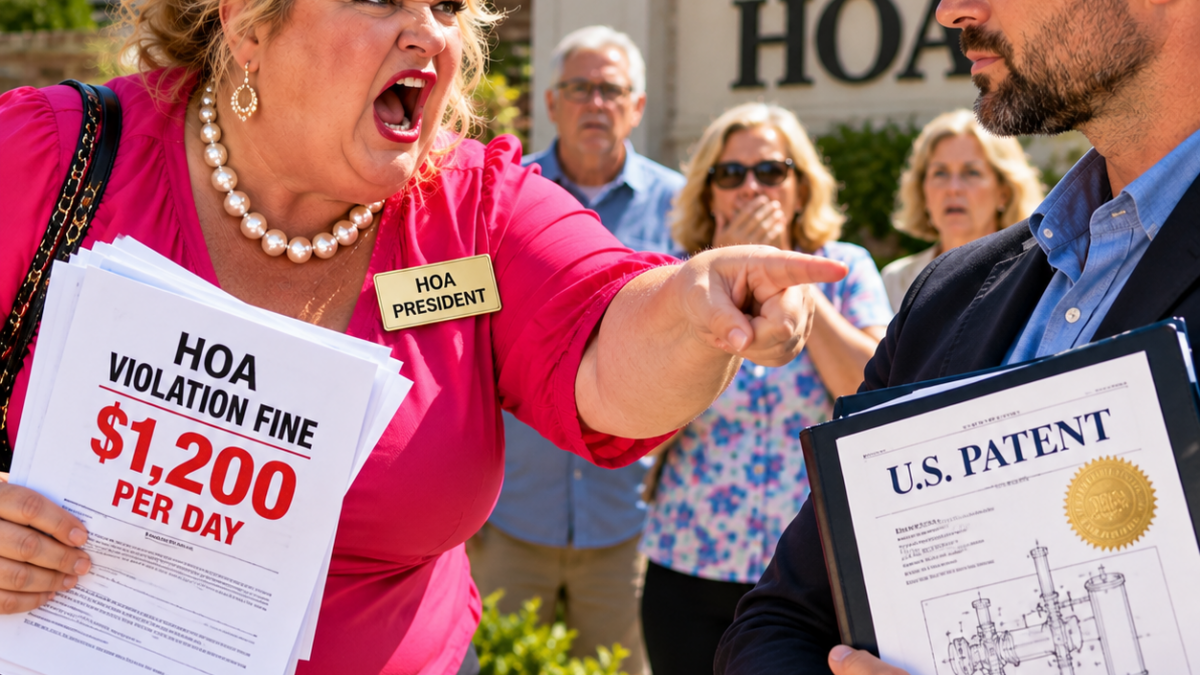
PART 2
I had spent thirty years in the Army Corps of Engineers.
That meant I possessed one skill people frequently underestimate until they need it.
I could read terrible documents for very long periods of time without losing consciousness.
Military specifications.
Engineering contracts.
Environmental reports.
Procurement manuals.
Safety regulations.
Pages of language seemingly designed by committees trying to punish literacy itself.
The Crimson Peak covenants were irritating.
They were not difficult.
At 6:17 that evening, I found Section 7.4.
Karen had cited it correctly.
That surprised me.
The clause prohibited commercial, industrial, or business activity that generated significant traffic, persistent noise, fumes, dust, odors, outdoor storage, or other conditions inconsistent with residential character.
I read it again.
Then smiled.
Karen had quoted only the heading on my notice.
PROHIBITED BUSINESS ACTIVITY.
She had not quoted the actual standard.
My workshop did not produce significant traffic.
No persistent noise.
No fumes.
No dust leaving the property.
No exterior inventory.
No customers.
No employees.
Most weeks, nobody besides me entered the garage.
The occasional specialized shipment came by freight because you cannot order every precision component through Amazon.
That was it.
Then I found the enforcement procedure.
First violation:
written warning.
Fourteen days to cure or contest.
Then formal hearing.
Then monetary penalties if the violation remained established.
Karen had skipped the warning.
Skipped the cure period.
Skipped the hearing.
Started at five hundred dollars a day.
I leaned back.
There is an important difference between having authority and becoming so accustomed to authority that you stop checking whether you are using it correctly.
Karen had crossed that line.
I opened a new folder on my computer.
For a moment I considered naming it something mature.
HOA Dispute.
Davies Architectural Appeal.
Instead I typed:
OPERATION HOA FREEDOM
Martha would have rolled her eyes.
I could practically hear her.
Marcus, you are sixty-three years old.
“I know.”
I said to the empty garage.
Talking to a dead spouse is not as strange as it sounds.
Eventually, silence becomes a conversation partner.
I photographed the notice.
Scanned it.
Saved the original.
Then drafted my response.
No anger.
No sarcasm.
No accusations.
One thing the Army teaches well is that angry writing ages badly.
I began:
Dear Members of the Crimson Peak Estates Board of Directors:
I acknowledged receipt.
Then described what I actually did.
Specialized engineering.
Personal prototyping.
Occasional contracted one-off projects.
No retail operations.
No client meetings.
No workforce.
No advertising.
No nuisance.
I included photographs.
Street conditions.
Garage interior.
Equipment placement.
Noise specifications for the lathe and drill press.
Then I cited the enforcement procedure.
Written warning.
Fourteen-day cure.
Formal hearing.
None provided.
Finally, I requested:
A hearing before an impartial body.
A written definition of what specific activity constituted the violation.
An immediate suspension of daily fines until due process concluded.
And copies of any complaints supporting Karen’s claim.
I sent it by certified mail.
Receipt required.
Copies to every director.
Karen received hers on Tuesday morning.
I knew because the green card came back signed.
Seven days later, a plain envelope appeared in my mailbox.
One page.
No supporting reasoning.
No hearing.
No definitions.
Just:
Your request is denied. The violation is self-evident and ongoing. All penalties remain in effect. Failure to comply may result in collection action including lien proceedings.
I read it twice.
Then once more.
Not because it was complicated.
Because it was stupid.
Martha used to say I had two expressions when dealing with stupidity.
One was disbelief.
The other meant somebody was about to get a spreadsheet.
I opened Excel.
Day One:
$500.
Day Two:
$1,000.
Day Seven:
$3,500.
Day Thirty:
$15,000.
At sixty days:
$30,000.
Absurd.
And dangerous.
The ridiculousness was part of the strategy.
Most residents would see that number increasing and panic long before it became legally tested.
Pay.
Stop.
Submit.
That evening, Karen drove past my house twice.
Slowly.
I saw her through the garage window.
The next afternoon:
three times.
By Friday, neighbors began behaving differently.
Tom from two houses down used to stop regularly.
He had borrowed my drill press so often that I once threatened to start charging storage.
Now he waved from across the street and kept walking.
A couple who normally chatted with me at the mailbox smiled nervously and ended the conversation quickly.
Then Sarah Jenkins stopped.
Not my wife.
Different Sarah.
Young mother.
Two children.
House near the corner.
She had a stroller with her.
“Mr. Davies?”
“Marcus is fine.”
She glanced toward Karen’s house.
“I heard you’re running some kind of manufacturing company.”
I laughed.
“Would you like to see it?”
She hesitated.
“Seriously.”
I opened the garage door wider.
She peered inside.
Lathe.
Workbench.
Small mill.
Tool cabinets.
One brass assembly.
Nothing else.
“This?”
“This.”
“She said delivery trucks come every week.”
“One truck came six weeks ago.”
“For what?”
I pointed at a crate in the corner.
“Special alloy components.”
Sarah frowned.
“So this is basically a fancy workshop.”
“Very fancy.”
She laughed.
Then lowered her voice.
“She does this.”
“Does what?”
“Turns people into problems.”
That was the first thread.
I pulled carefully.
Sarah told me about the sidewalk chalk.
Her children had drawn flowers.
A rainbow.
Hopscotch squares.
Karen issued a written notice accusing them of defacing community property.
“They made me pressure-wash it.”
Sarah said.
“The rain would have washed it away.”
“I know.”
“Why comply?”
Sarah looked embarrassed.
“Because I didn’t want trouble.”
There it was.
The phrase every bully depends on.
I don’t want trouble.
I asked Sarah if anyone else had stories.
She laughed.
“Everyone.”
That evening, I walked.
Not canvassing.
Just walking.
I met George Albright, a retired corporate attorney.
Sharp eyes.
Dry humor.
Satellite dish dispute.
Karen claimed it was two inches too large.
George measured.
She was wrong.
He sent a letter.
Karen backed down.
“Only because I threatened litigation.”
he said.
“She counts on people not knowing what she can and can’t do.”
Then:
basketball hoop.
Wind chime.
Door color.
Garbage cans.
Flowers.
Oil spots.
Holiday decorations.
Little things.
Nothing individually dramatic.
Together, a pattern.
Karen was not maintaining standards.
She was maintaining fear.
And fear works best when each target thinks he is alone.
I invited George and Sarah to my workshop.
George entered and whistled.
“This is cleaner than my kitchen.”
Sarah pointed at the tool wall.
“My husband owns the same number of tools. He stores his in two buckets and a cardboard box.”
“Divorce him.”
“I’ve considered it.”
We sat around my drafting table.
I showed them everything.
Karen’s fine.
My appeal.
The covenants.
The skipped procedures.
The denial letter.
George read quietly.
Then tapped the paper.
“She denied your hearing?”
“Yes.”
“That’s extraordinarily foolish.”
“Good.”
He looked at me.
“You want me to say illegal.”
“I want you to say useful.”
He smiled.
“Potential breach of governing documents. Potential arbitrary enforcement. Possibly selective enforcement if we can show similar activities being treated differently.”
Sarah leaned forward.
“What if we show all the other people she’s harassed?”
George looked at her.
“Even better.”
Sarah was in marketing.
That meant she understood something George and I did not.
Information is only powerful if people can understand it.
A lawsuit might eventually work.
But Karen’s real power lived socially.
Neighbors believed resistance was dangerous.
So Sarah created a private resident group.
Not public.
Invite-only.
No Karen.
No board allies.
Name:
Crimson Peak Residents for Fairness.
I suggested:
People Karen Annoyed.
Sarah vetoed it.
The group started with six people.
Then twelve.
Twenty.
Thirty-five.
Every day somebody posted a photograph of a violation letter.
$200 for a garbage can.
$150 for chalk.
$300 for a lawn ornament.
$400 for holiday lights.
Warning over wind chimes.
Threat over a garden bed.
George started organizing documents by category.
I started organizing dates.
Sarah organized people.
Within two weeks, we had something more dangerous than anger.
We had comparable evidence.
Similar houses.
Different enforcement.
Board allies ignored.
New residents targeted.
Appeals denied faster than normal review timelines.
Penalties escalating immediately.
The question shifted.
Why?
Power explained part of it.
Money might explain more.
George suggested we inspect HOA finances.
“Members have rights to association records.”
he said.
“Contracts?”
“Yes.”
“Invoices?”
“Yes.”
“Meeting minutes?”
“Yes.”
“Then let’s ask.”
I wrote another certified letter.
Five years.
Budgets.
Vendor contracts.
Invoices.
Expense reports.
Board minutes.
Enforcement legal expenses.
The response came in the form of a phone call.
Karen.
“What are you doing?”
Her voice had lost the syrup.
“I’m reviewing association records.”
“You are harassing volunteer board members.”
“No.”
“You have made repeated excessive document demands.”
“One request.”
“This is retaliation because you don’t like being told no.”
I almost admired the projection.
“Karen, I am exercising rights provided by the same documents you keep quoting at me.”
“You are creating hostility in this community.”
“Please send that concern in writing.”
Silence.
“What?”
“If you believe my records request is improper, respond in writing.”
She hung up.
Nine days later:
two file boxes.
Classic document dump.
I carried them home.
George came over.
He saw the boxes.
“She’s hoping you get bored.”
“I survived Army procurement records.”
“Poor woman.”
For four nights I found almost nothing.
Landscaping.
Clubhouse cleaning.
Insurance.
Pool service.
Legal.
Administrative charges.
Some inflated.
Some sloppy.
Family connections.
Nothing yet dramatic.
Then, Thursday night at 11:43, I reached the utilities section.
Aqua Regulator Systems, Inc.
Annual contract:
$108,400.
Licensing and maintenance of community water infrastructure.
I stopped.
Read the name again.
Aqua Regulator.
Something old moved in my memory.
I stood.
Walked to the metal filing cabinet.
Bottom drawer.
PATENTS / LICENSING.
The folder had not been opened in years.
I sat at the drafting table.
Original patent certificate.
United States Patent.
Flow Control and Filtration Valve Assembly.
Inventor:
Marcus A. Davies.
Then the licensing agreement.
Aqua Regulator Systems.
At the time, they were a much smaller engineering company.
They acquired exclusive manufacturing and distribution rights to my valve architecture and associated pressure-control design.
The invention happened almost by accident.
I was twenty-eight.
Army Corps assignment.
Small utility system plagued by pressure spikes.
Standard regulators failed repeatedly because sediment clogged the mechanism.
I spent six months redesigning the flow path.
Integrated filtration.
Pressure stabilization.
Simplified service access.
It worked.
Someone higher up suggested patenting it.
I did.
Aqua Regulator licensed it.
Then adapted the technology.
Improved it.
Expanded product lines.
Built a business around a family of systems whose roots traced back to that original assembly.
I received royalties.
Never got rich-rich.
But Martha and I paid the mortgage.
Put our son through college.
Retired comfortably.
I had stopped thinking about the invention as mine.
Technology grows.
Companies improve it.
Engineers build on each other.
Then I looked at Crimson Peak’s contract.
Equipment model numbers.
Licensing references.
Technical appendix.
There it was.
The modern Aqua Regulator platform installed beneath our own development used technology descending directly from my patented system.
I sat completely still.
Karen wanted to shut down my workshop because she believed engineering work did not belong in a residential community.
The same association paid six figures every year for infrastructure derived from work I had originally done at a bench not very different from the one twenty feet away.
The irony was magnificent.
But irony is not leverage.
I kept reading.
Licensing agreement.
Service relationships.
Good-faith clauses.
Reputation.
Client conduct.
Contractual review provisions.
I called George the next morning.
He arrived before coffee finished brewing.
I put the patent down.
Then the HOA contract.
Then the original license.
George read.
His eyebrows climbed.
“No.”
“Yes.”
“This is yours?”
“Yes.”
“You invented this?”
“The original platform.”
“And Aqua Regulator still pays royalties?”
“On covered derivatives and licensed families.”
He looked toward the ceiling.
“You understand this is absurdly poetic.”
“I’m trying not to enjoy it.”
“Failing?”
“Completely.”
He kept reading.
Then became serious.
“Do not do anything stupid.”
“I’m sixty-three.”
“That has never prevented engineers from doing stupid things.”
“What’s stupid?”
“Threatening to shut off everyone’s water.”
“I wasn’t planning to.”
“Good.”
“Can Aqua Regulator cancel the HOA contract?”
“That depends on the current contract, licensing chain, service obligations, utility regulation, transition rights—about fifteen other things.”
“So not simple.”
“Nothing legal is.”
He looked at me.
“But if the association is creating reputational and contractual exposure involving the patent holder, Aqua Regulator will care.”
“Enough to attend a meeting?”
George smiled.
“Ask them.”
I did not call immediately.
First, we let Karen continue.
Daily fines.
Notice after notice.
$18,500.
$21,000.
$27,500.
At $30,000, Sarah Jenkins messaged me:
Is this real money anymore or are we using Monopoly rules?
I wrote:
Still real enough for a lien threat.
Karen escalated publicly.
Rumors circulated that I was refusing to pay “legitimate business-use fees.”
Someone said I employed workers at night.
False.
Someone claimed chemicals were stored in the garage.
False unless cutting oil counted.
Someone said I was manufacturing military hardware.
That one was almost funny.
My work was valves.
Control assemblies.
Occasional one-off designs.
Nothing classified.
Nothing remotely dangerous.
Then George sent the formal legal letter.
This one was no polite appeal.
The association was placed on notice regarding:
Failure to follow fine procedures.
Denial of hearing rights.
Selective enforcement.
Potential bad-faith harassment.
Possible fiduciary violations.
Potential personal liability for directors acting outside authority.
And a demand to halt collection.
Then one paragraph designed as bait:
Our clients are also reviewing vendor contracts, disbursements, related-party transactions, and other association expenditures that may constitute conflicts of interest or breaches of fiduciary duty.
No Aqua Regulator.
No patent.
Just:
We are looking.
Karen panicked.
Emergency board session.
Raised voices.
Sarah’s group lit up.
Then official notice:
SPECIAL MEMBERSHIP MEETING.
Sole agenda:
Authorization of lien proceedings against 124 Willow Creek Lane.
Outstanding fines:
$38,500.
Karen wanted a public execution.
Fine.
Now I called Benjamin Carter.
Vice President of Licensing and Compliance.
Aqua Regulator Systems.
His assistant almost routed me to general counsel.
Then I said:
“My name is Marcus Davies.”
Pause.
“The Marcus Davies?”
“That depends on how many you have.”
Twenty seconds later:
Benjamin Carter.
“Mr. Davies, this is an honor.”
“Thank you.”
“I studied your original valve design in college.”
“That makes me feel extremely old.”
He laughed.
Then I told him why I was calling.
No theatrics.
I sent:
Violation notices.
Appeal.
HOA denial.
Legal letter.
Aqua Regulator contract.
Patent.
Current licensing relationship.
Benjamin grew quiet.
“This is highly unusual.”
“Yes.”
“You are being fined for engineering activity inside your private garage?”
“Yes.”
“By an association that is our customer.”
“Yes.”
“And the association is aware you hold the foundational patent?”
“Not yet.”
He paused.
“Why not?”
“I’d prefer they hear it once.”
“Mr. Davies.”
“Marcus.”
“Marcus, what exactly are you asking us to do?”
“Observe.”
“Observe?”
“Special HOA meeting tomorrow night.”
Silence.
Then:
“I can be there.”
I blinked.
“You’re flying in?”
“This customer is under a significant infrastructure service agreement. If their board is creating potential contractual or reputational risk involving one of our foundational inventors, I need to understand it.”
That was more than I expected.
“Thank you.”
“One condition.”
“What?”
“We do not threaten service interruption casually.”
“Agreed.”
“Residents depend on the water system.”
“I know.”
“Any review would follow contract, law, utility obligations, and safe transition procedures.”
“Absolutely.”
“Then send me the address.”
Karen had no idea.
The special meeting was standing-room only.
Sarah’s group did its work.
Residents were tired of being afraid.
George had coached everyone:
No shouting.
No personal insults.
Bring documents.
Ask questions.
Karen sat at the front.
Electric blue suit.
Barb.
Stan.
Board secretary.
Treasurer.
She called the meeting to order.
Then delivered twenty minutes of narrative.
Commercial operation.
Defiant homeowner.
Sixty-three notices.
Refusal to cooperate.
Community standards.
Property values.
Thirty-eight thousand five hundred dollars.
Then:
“Because Mr. Davies has shown no intention of complying, I move that the association authorize counsel to record a lien against the property.”
Stan:
“Second.”
“Members in favor—”
George stood.
“Point of order.”
Karen’s jaw tightened.
“Mr. Albright.”
“Mr. Davies has a right to address the membership.”
“This matter has been discussed extensively.”
“Not tonight.”
“He has submitted written correspondence.”
“Not equivalent.”
Karen looked around.
The room was watching.
“Fine.”
She waved.
“Five minutes.”
I stood.
Laptop.
Small projector.
No notes.
My first slide:
Photograph of my garage.
Clean.
Orderly.
Quiet.
“My name is Marcus Davies.”
I looked at the crowd.
“For sixty-three days, your board has described this room as a commercial nuisance.”
Next:
Noise measurements.
Delivery log.
Traffic.
No employees.
No customers.
“I could spend tonight arguing about that.”
Pause.
“I won’t.”
Next slide:
CRIMSON PEAK COMMUNITY WATER INFRASTRUCTURE
People shifted.
Karen frowned.
I displayed the Aqua Regulator contract.
Annual expenditure.
More than $100,000.
“Who here knew we spend this every year?”
A few hands.
Treasurer looked uncomfortable.
“This contract provides licensing, maintenance, technical support, and equipment servicing for major parts of Crimson Peak’s pressure regulation and filtration infrastructure.”
Karen interrupted.
“What does this have to do with your garage?”
“Everything.”
Next slide.
Patent certificate.
Huge on the wall.
Marcus A. Davies — Inventor.
Silence.
Not murmuring.
Silence.
I let them read.
Then:
“Thirty-one years ago, I designed the original flow-control and filtration valve architecture from which key parts of this platform developed.”
Karen stared at the screen.
I continued.
“I licensed the patent to Aqua Regulator Systems.”
Another slide.
Original agreement.
Signatures.
Dates.
“This community now pays that company more than one hundred thousand dollars a year to maintain technology whose lineage runs directly through work I created.”
A man whispered:
“You’ve got to be kidding.”
I looked at Karen.
“The kind of work that began in workshops.”
Her face changed.
Not yet fear.
Confusion.
I turned back to residents.
“This does not mean I own your pipes.”
A few people laughed.
“It does not mean I can shut off your water.”
Good to say explicitly.
“It does mean that the board has spent two months portraying engineering work as inherently incompatible with residential life while depending every day on engineering born in environments exactly like the one they are fining me for.”
That landed.
Then George stood.
“More importantly, members should understand the contractual problem.”
He explained carefully.
Aqua Regulator’s service relationship included provisions requiring good-faith conduct and allowing review when client actions created intellectual-property, reputational, legal, or operational risks.
Karen found her voice.
“This is ridiculous.”
Then someone stood at the back.
Benjamin Carter.
Dark suit.
Calm.
“My name is Benjamin Carter.”
Karen turned.
“I am Vice President of Licensing and Compliance for Aqua Regulator Systems.”
You could feel the room inhale.
Benjamin walked forward.
“Mr. Davies contacted me yesterday.”
Karen said:
“He coordinated this ambush?”
Benjamin ignored the wording.
“Our company reviewed the documents.”
He held a folder.
“I want to be very clear.”
He looked around.
“We are not here to threaten anyone’s access to water.”
Good.
People relaxed slightly.
“However, Crimson Peak Estates is a substantial contractual customer. Its leadership’s documented conduct toward the holder of foundational intellectual property used throughout our product history raises issues our legal and compliance departments are obligated to review.”
Karen’s face whitened.
Benjamin continued.
“The account was placed under formal compliance review this morning.”
Murmurs.
“If the association persists in conduct that our legal team determines breaches contractual obligations or creates unacceptable legal or reputational exposure, we may exercise remedies available under the agreement.”
Someone shouted:
“What does that mean?”
Benjamin answered:
“It could mean renegotiation.”
Pause.
“Suspension of certain licensing benefits.”
Another pause.
“Or, in the most serious circumstance, structured termination of the service relationship consistent with law and safe transition requirements.”
A homeowner near the front asked:
“What would replacing the system cost?”
Benjamin looked at him.
“I cannot estimate accurately without engineering review.”
Karen jumped in.
“So this proves nothing!”
Benjamin turned.
“But I can say this.”
Silence.
“Replacing a community-wide regulated-water platform is not inexpensive.”
Karen’s husband looked sick.
The motion to lien my house died in that moment.
Nobody needed to announce it.
It simply became impossible.
But the patent was only the door.
Sarah Jenkins stood.
She had printed examples from the private group.
“Can we talk about why we’re here?”
Karen snapped:
“We are discussing Mr. Davies.”
“No.”
Sarah said.
“We’re discussing you.”
A cheer rose.
George immediately raised a hand.
“No mob.”
The room settled.
Sarah held up her sidewalk-chalk notice.
“My children were fined for drawing flowers.”
David from another block held a wind-chime notice.
Another homeowner:
basketball hoop.
Another:
trash can.
Another:
door color.
Another:
garden.
Twenty stories.
Then George turned to the financial records.
“While examining Mr. Davies’ case, we reviewed association expenditures.”
Karen stiffened.
“There is no evidence of theft.”
George said.
“Let me be clear.”
Karen looked relieved too soon.
“There is, however, substantial evidence requiring independent review.”
Landscaping.
No-bid renewals.
Vendor related to prior leadership.
Catering expenses.
Legal fees driven by trivial enforcement.
Administrative charges.
Questionable discretionary spending.
Nothing dramatic alone.
Together:
bad governance.
George said:
“This association has spent thousands enforcing trivial aesthetic disputes while denying basic due process.”
Sarah looked around.
“This is our money.”
That was the phrase that moved everyone.
Not Marcus’s patent.
Not my grief.
Their money.
Their homes.
Their board.
A resident named Tom Reynolds stood.
“I move to suspend all collection action against Mr. Davies pending independent review.”
Seconded.
Vote.
Overwhelming yes.
Karen tried to object.
George cited procedure.
Then another resident stood.
“I move for recall of the board.”
Karen exploded.
“You cannot do that!”
George opened the bylaws.
Section 3.2.
Two-thirds of members present.
Quorum confirmed.
Karen stared around the room.
For eight years, she had controlled Crimson Peak because people did not come to meetings.
Tonight they came.
That was the difference.
Ballots.
Address verification.
Counting.
Karen remained seated.
Barb whispered to her.
Stan stared at the floor.
Final result:
Board recalled.
Only two votes against.
Barb.
Stan.
Karen didn’t cry.
Didn’t scream.
Didn’t threaten me.
She gathered her papers.
Then looked toward the patent still projected behind the table.
For a second, I saw something almost human in her face.
Not remorse.
Shock.
The realization that she had built an entire campaign without ever asking the simplest question:
Who is this man?
Then she left.
The room stayed quiet until the door closed.
Only then did people applaud.
I did not.
Sarah Jenkins came toward me.
“You okay?”
I looked at Martha’s photograph on my laptop desktop.
“Yes.”
I meant it.
George became interim president.
He hated it.
Perfect candidate.
Sarah became vice president.
Priya Shah, an accountant, became treasurer.
First motion:
Void every fine against me.
Second:
Remove violation from my file.
Third:
Commission independent financial audit.
Fourth:
Review enforcement procedures.
Fifth:
Suspend all ongoing fine escalation until procedural review.
Benjamin Carter approached.
“I’m sorry.”
“For what?”
“That one of our clients put you through this.”
“Not your fault.”
He gave me his card.
“I meant what I said. We’re reviewing the agreement.”
“Please don’t punish residents.”
“We won’t.”
“Good.”
He looked into the garage photo still on screen.
“You still prototype?”
“Sometimes.”
“We may call you.”
“Please don’t.”
He laughed.
“I probably will.”
Walking home that night felt strange.
For three years after Martha died, I had wanted isolation.
Crimson Peak appealed to me because nobody knew me.
Nobody needed anything.
I could close the garage.
Work.
Eat.
Sleep.
Repeat.
Karen’s attack destroyed that isolation.
And somehow, in fighting to protect the workshop where I hid from the world, I had accidentally built relationships with half the neighborhood.
Martha would have found that hilarious.
I entered the garage.
Turned on one light.
Her photograph caught the glow.
“We won.”
I said.
Silence.
Then:
“No.”
I corrected myself.
“We survived.”
That felt more accurate.
The independent audit took six weeks.
It did not reveal a Hollywood criminal empire.
Reality rarely cooperates with drama that neatly.
But it showed enough.
Excessive legal spending.
Weak controls.
Poor competitive bidding.
Related-party vendors inadequately disclosed.
Catering and social expenses that crossed reasonable lines.
Enforcement revenue being treated too casually.
Thousands wasted pursuing small disputes.
The association recovered money through negotiated vendor adjustments.
Insurance covered some professional review expenses.
No grand arrest.
No handcuffs.
No prosecutor kicking down Karen’s door.
Good.
Justice does not require spectacle.
Sometimes reform is better punishment than humiliation.
George published the entire audit summary.
Every homeowner could read it.
Karen hated that more than any speech.
The new board attacked the covenants.
Not literally.
Though Sarah brought a shredder to one meeting as a joke.
The two-hundred-shades-of-beige culture started disappearing.
Clear nuisance standards replaced vague aesthetic language.
Home businesses permitted where they produced no material traffic, noise, hazard, signage, or nuisance.
Warnings required.
Cure periods mandatory.
Hearings real.
Appeals reviewed by people without direct conflicts.
Daily fines capped.
Lien action required independent legal review and full board approval.
Related-party contracts disclosed.
Large contracts competitively bid.
My garage was formally approved as a permitted low-impact engineering workshop.
George handed me the document.
“Frame it.”
“I have enough framed paper.”
“You literally framed patents.”
“That was work.”
“This is also work.”
I put it in a drawer.
Two months later, Karen listed her house.
The sign appeared Tuesday.
Martha’s anniversary.
That coincidence hit strangely.
I stood in the driveway looking across the street.
Karen came outside.
No clipboard.
No entourage.
Just jeans and a sweatshirt.
She saw me.
We looked at each other.
For a moment, I expected one final speech.
Instead:
“You ruined this place for me.”
I could have answered cruelly.
Part of me wanted to.
“You were trying to take my home.”
I said.
“My workshop violated the rules.”
“You skipped the rules.”
She looked away.
“You turned everyone against me.”
“No.”
I took a breath.
“You taught everyone they were afraid of you.”
“That isn’t the same thing.”
She said.
“No.”
I agreed.
“It isn’t.”
Karen looked toward her house.
“You think they’ll do better without me?”
“I hope so.”
“You’ll see.”
She shook her head.
“They’ll let standards collapse.”
“Maybe some standards needed collapsing.”
She almost smiled.
“Sidewalk chalk?”
“Yes.”
“Wind chimes?”
“Yes.”
“Hunter green doors?”
“Absolutely.”
Karen looked at me.
“You’re impossible.”
“Martha said that.”
Her expression softened at the name.
She had heard about my wife by then.
Everybody had.
“I’m sorry about her.”
That surprised me.
“Thank you.”
Karen nodded.
Then went inside.
No redemption.
No apology for the HOA fight.
But not every story needs one.
She moved three weeks later.
I watched movers load furniture.
She glanced once toward my garage.
The door was open.
Lathe running.
I raised one hand.
She did the same.
Then left.
The first block party under the new board happened that summer.
No mandatory signup.
No catered board lunch.
Residents brought food.
Kids covered the sidewalk in chalk.
Sarah Jenkins’ children drew an enormous machine they claimed was my valve.
It looked like a submarine fighting an octopus.
I told them engineering standards required revision.
They ignored me.
George grilled burgers badly.
Priya confiscated the spatula.
Tom brought beer.
Somebody hung wind chimes near the pavilion just to make a point.
For the first time since moving there, Crimson Peak sounded alive.
I sat at a picnic table.
Sarah Jenkins joined me.
“You know what’s weird?”
“What?”
“Before all this, I knew maybe six people on this street.”
“Same.”
“Karen accidentally created community.”
I looked around.
“Don’t tell her.”
“Never.”
A month later, Benjamin Carter called.
“Marcus.”
“No.”
“You don’t know what I want.”
“Yes I do.”
“How?”
“You want engineering.”
He laughed.
“Remote Alaska.”
“No.”
“Village water system.”
I paused.
“That was unfair.”
“Extreme cold. Pressure fluctuations. Existing regulator freezes intermittently.”
I looked toward the workshop.
“What temperature?”
“Minus forty range.”
“That’s not temperature. That’s hostility.”
“Interested?”
I walked inside.
Martha’s photograph.
Lathe.
Drafting table.
Tools.
For years, the workshop had been therapy.
Then sanctuary.
Then battlefield.
Now maybe it could become something else.
Useful again.
“Send me the specs.”
Benjamin did.
I worked three nights.
Not because I had to.
Because I wanted to.
Thermally isolated control body.
Modified flow path.
Heated enclosure.
Serviceability in gloves.
Redundant filtration.
At two in the morning on the fourth night, I realized I was smiling.
Martha used to catch me doing that.
“You’re talking to metal again.”
she would say.
“Metal listens.”
“Metal doesn’t have a choice.”
The prototype took six weeks.
Aqua Regulator engineers refined it.
Field-tested.
Installed.
Benjamin sent me photographs.
Snow.
Tiny utility building.
My valve inside.
Another community with water because something built in a garage worked.
The irony did not escape me.
George stopped by.
“You realize Karen created this.”
“No.”
“She forced you back into engineering.”
I thought.
“Martha created it.”
That felt more true.
She was the one who told me, during her final months:
“Don’t turn my death into your retirement from life.”
I hated that sentence when she said it.
She knew I hated it.
She said it again anyway.
After she died, I went through motions.
Moved.
Built workshop.
Made things.
But remained separate.
Karen attacked the one place I still felt alive.
Defending it forced me to admit why I needed it.
Not to hide.
To build.
There is a difference.
One year after the recall, George refused reelection.
“I saved corporations from regulators for forty years.”
he said.
“I am not spending retirement discussing mailbox finishes.”
Sarah Jenkins became president.
She ran meetings efficiently.
No gavel.
First rule:
“Nobody talks more than five minutes unless the house is literally on fire.”
Meetings shortened.
Attendance remained healthy.
Then gradually declined.
Good sign.
People trusted again.
Sarah worried.
“Is apathy coming back?”
“Some.”
“What do we do?”
“Make information easy.”
So the board published one-page summaries.
Budget.
Votes.
Contracts.
Violations.
Appeals.
No secrets.
Transparency reduces the need for heroics.
That was the real lesson.
Karen’s power had not come from evil genius.
It came from boredom.
People hate HOA meetings.
People assume somebody else is watching.
Nobody watches.
A determined personality fills the vacuum.
Then a committee becomes a kingdom.
You do not prevent that with better people alone.
You prevent it with better procedures.
Term limits.
Disclosure.
Open records.
Independent review.
Real appeals.
Financial controls.
The boring stuff.
Boring protects people.
Three years passed.
The workshop became known.
Not as a factory.
As Marcus’s place.
Kids visited with school projects.
I helped one build a bridge model.
Another wanted a robot arm.
Tom still borrowed tools.
He never returned drill bits.
I started charging him cookies.
One winter evening, George and I sat in the garage drinking coffee.
He looked at the original violation notice, now pinned to a corkboard.
“You kept it.”
“Yes.”
“Sentimental.”
“Evidence.”
“Case is over.”
“Historical evidence.”
He smiled.
“How high did the fines get?”
“Over forty thousand by her final calculation.”
“And you paid?”
“Zero.”
“Best return on investment in the neighborhood.”
I looked at the patent certificate.
“What if I hadn’t found the water contract?”
George considered.
“We still would have won.”
“You think?”
“Eventually.”
“Why?”
“Due process failures. Selective enforcement. Community evidence. Financial concerns.”
He pointed at the patent.
“That was theater.”
“Powerful theater.”
“Extremely.”
He drank coffee.
“But don’t make the mistake of thinking the patent saved you.”
“What did?”
“People.”
I looked at him.
“Annoying answer.”
“Correct answer.”
He was right.
The patent got attention.
Benjamin’s presence shifted the room.
But if Sarah had not organized residents…
If George had not understood the bylaws…
If dozens of homeowners had not shown up…
Karen might have survived.
No single document saved Crimson Peak.
Community did.
That realization changed how I thought about my own invention.
Engineers love mechanisms.
Input.
Output.
Cause.
Effect.
But human systems do not work like valves.
You cannot control pressure with one component.
People require trust.
Trust requires process.
Process requires participation.
Ignore any piece long enough, pressure builds.
Eventually something bursts.
Martha would have enjoyed the metaphor.
Our son, Andrew, visited that Christmas.
He lived in Denver.
Software engineer.
He walked into the garage.
“Dad.”
“Yeah?”
“This place is famous now?”
“Unfortunately.”
“I heard the HOA story from three people at the airport.”
“Impossible.”
“Mom would love this.”
That hurt and healed at the same time.
“I know.”
Andrew looked at her photograph.
Then at the prototype drawings.
“You’re working again.”
“I never stopped.”
“You know what I mean.”
I did.
He sat on a stool.
“For a while after Mom, I worried you were disappearing.”
I looked at him.
“What?”
“You moved here.”
“Needed a smaller house.”
“You stopped calling people.”
“I called you.”
“Sometimes.”
He stared at the floor.
“Every conversation was about weather or tools.”
“I like weather and tools.”
“Dad.”
I sighed.
“I didn’t know what else to say.”
Andrew nodded.
“I know.”
Silence.
Then:
“I’m glad Karen pissed you off.”
I laughed unexpectedly.
“Martha would object to the language.”
“No she wouldn’t.”
True.
She wouldn’t.
The following spring, Crimson Peak replaced part of the community water infrastructure.
Not because of the contract dispute.
Routine lifecycle upgrade.
Aqua Regulator offered new models.
Benjamin invited me to the commissioning.
I declined.
He insisted.
At the pump station, a young engineer named Maya explained the new system to residents.
Smart monitoring.
Pressure sensors.
Improved filtration.
Remote alerts.
My original valve architecture was now almost invisible inside generations of improvement.
Good.
That is what invention should become.
Not a monument.
A foundation.
Maya pointed toward an old assembly removed from service.
“That one is based on the Davies architecture.”
A resident said:
“Marcus invented that.”
Maya looked at me.
“The Marcus Davies?”
I hated that phrase.
“Yes.”
She smiled.
“I wrote a paper on your early regulator geometry.”
“Please stop making me older.”
People laughed.
Karen would have hated the whole scene.
The neighborhood celebrating engineering.
At the end, Sarah Jenkins raised a cup of lemonade.
“To workshops.”
Groans.
I looked at the pump station.
Then back toward my street.
“Fine.”
I raised mine.
“To workshops.”
Five years after the recall, Mrs. Peterson’s old house belonged to a family named the Morenos.
Good people.
Two teenagers.
Dog that barked at squirrels.
They painted the front door deep red.
No one fined them.
One afternoon Mr. Moreno came over.
“My son needs help.”
“With?”
“Science fair.”
His son, Luis, wanted to build a low-cost pressure regulator.
I laughed.
Of course.
We worked for three weekends.
Luis asked endless questions.
“Why does cavitation happen?”
“Why is this chamber wider?”
“Why brass?”
“Why not plastic?”
At fourteen, he had the curiosity Karen tried to call commercial activity.
I thought about that often.
What if some future engineer had been told to shut down because a workshop looked wrong?
Innovation is messy.
Prototypes are ugly.
Ideas arrive before permission.
Not every garage contains the next patent.
Most do not.
That does not matter.
People need spaces where they can make things.
Try.
Fail.
Learn.
The residential character of a community should include residents actually living.
Not simply maintaining a picture.
Luis won second place.
He brought me the ribbon.
“That’s yours.”
“No.”
“You helped.”
“So did your teacher.”
“He gets nothing.”
“Harsh.”
Luis looked at Martha’s picture.
“Your wife?”
“Yes.”
“She liked this stuff?”
“She tolerated it.”
I smiled.
“Which is sometimes more impressive.”
By the tenth anniversary of Martha’s death, I could finally speak about her without every memory feeling like a wound reopening.
That anniversary, I sat alone in the workshop.
No machines.
No radio.
Just quiet.
Her photo.
I thought about the three years after she died.
How I moved because every room in our old house contained her.
How I believed quiet would heal me.
Then Karen entered my driveway with a clipboard and accidentally blew up the quiet.
I laughed.
“Martha.”
I said.
“You would absolutely hate that I’m grateful to Karen.”
No answer.
I imagined one anyway.
Don’t be dramatic, Marcus.
Fair.
I took the original patent certificate off the wall.
Behind it was a smaller photograph I had forgotten.
Martha standing beside me in 1992.
Patent celebration dinner.
I was thirty-two.
Hair.
She looked proud.
On the back, in her handwriting:
BUILD SOMETHING USEFUL. THEN BUILD SOMETHING ELSE.
I sat down.
That sentence became the title of the next project.
Not a valve.
A scholarship.
I used part of the patent royalties to establish a small annual engineering scholarship at the local high school.
Preference for students who built things.
Not necessarily top grades.
Projects.
Curiosity.
Hands-on work.
First recipient:
Luis Moreno.
When they announced it, he called me.
“You rigged this.”
“I did not.”
“You’re on the scholarship committee.”
“I recused.”
“What does that mean?”
“I wasn’t allowed to vote.”
“Still suspicious.”
“Take the money.”
“Yes, sir.”
Crimson Peak eventually became known locally for something other than its HOA meltdown.
Community maker fair.
Sarah Jenkins started it.
Garages opened.
Woodworking.
3D printing.
Gardening.
Robotics.
Art.
Bicycles.
Luis demonstrated his regulator.
I displayed nothing.
People complained.
So I put the original violation notice on a folding table.
Beside it:
EXHIBIT A — APPARENTLY THIS IS HOW IT STARTED.
Everyone laughed.
Then someone asked:
“Where’s the patent?”
“At home.”
“That’s the famous part.”
“No.”
I looked around.
Kids painting.
Adults talking.
Tools.
Projects.
“The famous part is this.”
That answer sounded sentimental.
I hated it.
It was also true.
The last time I saw Karen was twelve years after the fight.
Not in Crimson Peak.
At a hardware store.
I was buying machine oil.
She was buying paint.
We recognized each other simultaneously.
Older.
Both.
She looked at my cart.
“Still tinkering?”
“Yes.”
She smiled faintly.
“Of course.”
I looked at her paint.
“What color?”
“Blue.”
“Approved?”
She actually laughed.
That surprised both of us.
Then she grew serious.
“I heard about the scholarship.”
“Small thing.”
“No.”
She looked down.
“I’ve thought about what happened.”
I waited.
She continued.
“I believed if I let one person ignore the rules, everything would fall apart.”
“I didn’t ask to ignore them.”
“I know that now.”
That was as close to apology as I expected.
Then:
“I was scared.”
This surprised me more.
“Of what?”
“Losing control.”
She looked embarrassed saying it.
“My husband was retiring. Kids gone. HOA was…”
She searched.
“Something I was good at.”
I understood more than I wanted to.
The workshop had been that for me.
A place where I still knew who I was.
Karen had made the HOA hers for the same reason I made the workshop mine.
The difference was boundaries.
My identity did not require controlling other houses.
Hers eventually did.
“I’m sorry.”
she said.
There it was.
Years late.
Still meaningful.
“I accept.”
She looked relieved.
We did not hug.
Thank God.
We talked three minutes.
Then left.
Driving home, I thought about revenge.
When the story happened, neighbors called my patent reveal revenge.
Perfect revenge.
Ultimate revenge.
Karen fines inventor.
Inventor threatens the infrastructure she depends on.
Viral.
Satisfying.
But revenge was not what lasted.
Karen lost power.
That felt good for maybe a week.
The fines disappeared.
Good.
She moved.
Fine.
Years later, none of that mattered much.
What mattered:
I kept the workshop.
I returned to engineering.
I met my neighbors.
I repaired part of myself after Martha.
Luis went to college.
The scholarship continued.
The HOA became boring.
Aqua Regulator kept operating.
Water kept flowing.
Nothing shut down.
Nobody lost service.
No one had to become collateral damage in my dispute.
That mattered to me.
Because power is easiest to abuse when you convince yourself somebody deserves whatever happens next.
Karen did that.
I refused to.
The patent gave me leverage.
I used only enough.
That was the difference.
One summer evening, decades after I first invented the valve, I stood inside Crimson Peak’s utility building with Maya.
She was now regional engineering director.
Aqua Regulator was replacing another generation of hardware.
She handed me one of the original internal regulator components.
“You want this?”
“Why?”
“History.”
I held it.
Heavy brass.
Worn.
Functional.
Based on an idea from a younger man who had no idea where life would go.
I took it home.
Mounted it beneath Martha’s photograph.
Not the patent.
The actual component.
Because paper proves an invention existed.
Wear proves it worked.
George came by.
He was eighty by then.
Cane.
Still sarcastic.
He looked at the display.
“Sentimental.”
“Historical.”
“You’re hopeless.”
We sat.
Coffee.
Garage door open.
Children rode bicycles outside.
Luis, home from engineering school, stopped by.
Sarah Jenkins waved while walking her dog.
Nothing dramatic.
That was the victory.
Ordinary life without fear.
George pointed at the violation notice still pinned nearby.
“You going to keep that forever?”
“Yes.”
“Why?”
I thought.
Because it reminded me that rights disappear when nobody uses them.
Because it reminded me to read contracts.
Because it reminded me grief can disguise itself as isolation.
Because it reminded me innovation comes from imperfect spaces.
Because it reminded me that a bully’s greatest weakness is often their certainty that nobody will examine the paperwork.
Instead, I said:
“It’s funny.”
George nodded.
“Much healthier answer.”
After he left, I turned on the lathe.
Low hum.
Metal spinning.
Tool approaching slowly.
That sound had once kept grief quiet.
Then it became the sound of resistance.
Now it was simply the sound of work.
I liked that best.
People sometimes ask whether I would have shut off Crimson Peak’s water if Karen refused to stop.
No.
Absolutely not.
Residents did nothing to deserve that.
And in reality, infrastructure contracts do not disappear with a dramatic snap of the fingers.
There are obligations.
Regulations.
Transition procedures.
Public safety.
Engineering.
The power of the patent was never that I could make every faucet stop.
The power was that Karen had unknowingly created serious contractual and reputational risk with a vendor the community could not casually replace.
That forced scrutiny.
Scrutiny did the rest.
That is less cinematic.
It is also smarter.
The best revenge is rarely maximum destruction.
Maximum destruction leaves you living in the ruins too.
Better revenge is forcing the truth into a room where everyone can see it.
Then letting people choose.
Crimson Peak chose.
Forty-eight people might not sound like an army.
You should have seen Karen’s face when they raised their hands.
That was enough.
When the HOA fined me five hundred dollars a day, I thought I was fighting for a garage.
I was wrong.
I was fighting for the right to decide what my life after Martha looked like.
For the right to use my own hands.
For the right to build.
For neighbors who had forgotten they could say no.
For an old attorney who still enjoyed a good procedural fight.
For a young mother whose kids wanted to draw flowers on pavement.
For a teenager who would someday become an engineer because somebody let him experiment in a garage.
The patent made a good reveal.
But Martha was the reason I stayed.
She once told me that living after loss was also a form of loyalty.
At the time, I thought that was nonsense.
How could moving forward honor somebody?
Wouldn’t continuing mean leaving them behind?
I understand now.
Martha is in everything I built afterward.
Not because I remained frozen in grief.
Because I didn’t.
The workshop survived.
So did I.
Karen handed me a notice because she thought a clean garage with a lathe threatened property values.
Instead, that notice pushed me back toward the work I had almost abandoned.
Years later, when I look at the framed patent, I do not think first about Aqua Regulator.
I think about Martha.
Then Karen.
Then I laugh.
Because without meaning to, Karen Peterson gave me one final engineering problem.
Pressure.
A system under too much pressure eventually fails.
Unless there is a regulator.
For decades, I designed valves to prevent pressure from destroying pipes.
At Crimson Peak, we learned the same principle applied to people.
Too much concentrated authority.
No relief.
No oversight.
No outlet.
Pressure builds.
Someone gets crushed.
So we redesigned the system.
Open meetings.
Clear procedures.
Checks.
Appeals.
Transparency.
Shared authority.
Pressure regulation.
Maybe I never really retired after all.
The last project was just bigger than brass.
It was a neighborhood.
One night, long after the fight ended, I shut down the workshop around ten.
The street was quiet.
Garage door halfway closed.
I noticed water from a sprinkler crossing the pavement in a glittering arc under the streetlight.
Crimson Peak water.
Stable pressure.
Clean.
Ordinary.
Nobody thought about the system beneath the ground.
They shouldn’t have to.
Good infrastructure disappears into daily life.
So does good governance.
You notice either one mostly when it fails.
I watched the sprinkler for a moment.
Then looked at Martha’s photograph.
Then at the old violation notice.
Five hundred dollars a day.
Forty thousand dollars by the end.
Zero paid.
One recalled board.
One protected workshop.
One community rebuilt.
And a patent Karen never knew existed until the night she tried to put a lien on the home of the man whose name was printed across the technology contract keeping her neighborhood running.
I turned off the garage light.
The machine room went quiet.
But before I closed the door, I heard Martha in my memory as clearly as if she were standing beside me.
Build something useful.
I smiled.
“I did.”
Then I closed the garage.
Not because Karen ordered me to.
Because the work was finished for the night.
And that difference meant everything.