HOA Board Called Me a Dumb Farmer and Tried to Steal My Family’s Land—Then I Walked Into Court With One Binder That Destroyed Their Entire Empire
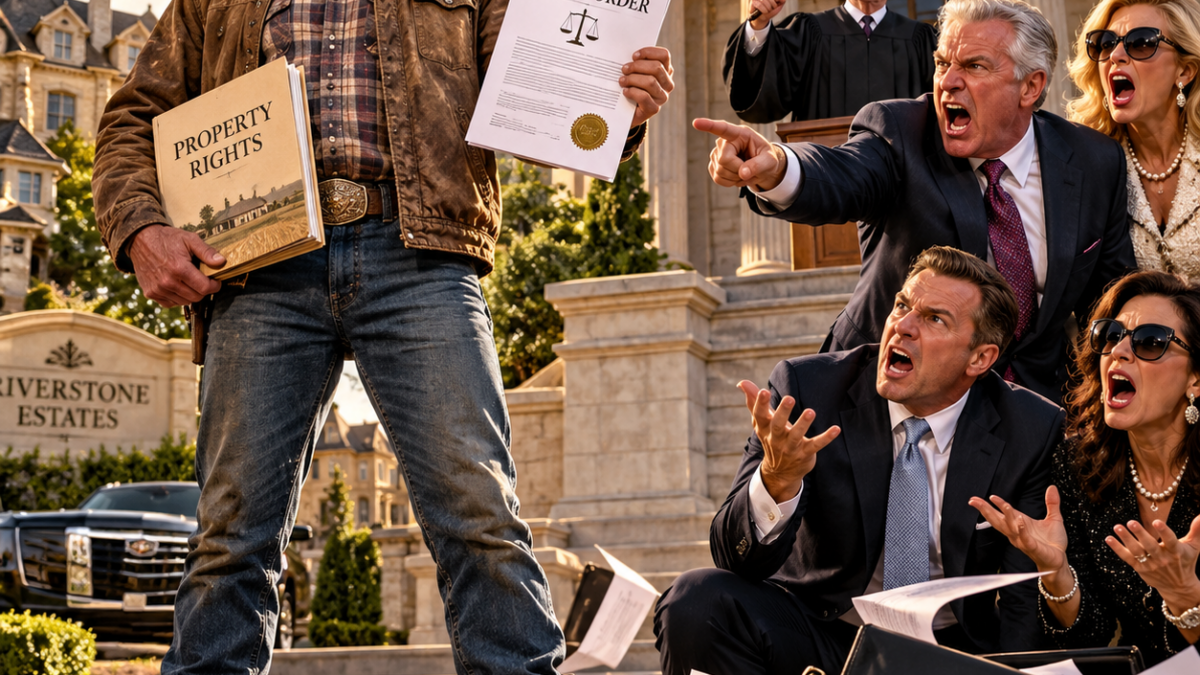
PART 2
There are certain sounds a person never forgets.
The scrape of a shovel against frozen ground. The rattle of an old truck struggling to start on a January morning. The heavy silence inside a hospital room after someone you love has taken their final breath.
For me, another sound joined that list.
The sound of a certified letter sliding through my mailbox.
Three days after Karen’s visit, the first one arrived.
The envelope was cream-colored, with the Creekwood Estates logo printed above my address. Inside was a formal notice informing me that I had failed to correct an architectural violation.
The penalty was fifty dollars.
Another fifty would be added according to their escalating schedule if I continued refusing to comply.
At the bottom, in bold letters, was a warning that unpaid penalties could result in further enforcement action.
I read the letter twice while standing at my kitchen counter.
Then I laid it beside a photograph of my grandfather.
In that picture, he was standing near the same fence, wearing overalls and a battered felt hat, with his favorite horse grazing behind him.
The photograph had been taken in 1974.
He looked proud.
Not wealthy. Not important. Just proud of something he had built.
I touched the corner of the frame.
“I suppose we’ve got ourselves another problem, Grandpa.”
The farmhouse was quiet.
My wife, Helen, had died six years earlier after a long battle with cancer. Since then, the rooms had become too large for one person, and the silence sometimes felt heavier than the furniture.
I’d returned to the farm hoping hard work would give my days structure again.
I wasn’t searching for another war.
I wanted to plant vegetables, restore the buildings, feed the chickens, and live out whatever years I had left without asking permission from strangers.
But there was something Helen used to tell me whenever I faced a difficult decision.
“Sam, being peaceful doesn’t mean letting people walk over you.”
She’d said it with a smile, usually when I was trying too hard to avoid an argument.
I thought about that as I opened my laptop.
Then I created a folder.
**CREEKWOOD HOA — EVIDENCE.**
The fifty-dollar letter became Document One.
The next morning, I drove to the county records office.
I wasn’t interested in winning an argument with Karen. I wanted to know exactly what rights I had, what documents governed my land, and whether the HOA’s claims were supported by anything more substantial than a threatening letter.
The records clerk, a woman named Linda who looked like she’d spent thirty years listening to people complain about property boundaries, raised an eyebrow when I explained what I needed.
“How far back do you want to go?”
“As far as the records will take us.”
She gave me a measuring look.
“Property dispute?”
“Something like that.”
“Those can get ugly.”
“I’ve noticed.”
For most of the afternoon, I examined plats, recorded surveys, deeds, and old development agreements.
The history of my twenty acres unfolded in faded ink.
There was the original deed from my grandfather’s purchase.
There were later boundary surveys.
There was the documentation surrounding the development of Creekwood Estates.
And there, on a certified survey recorded in 1972, was the first piece of information I needed.
A notation along the eastern boundary identified an existing four-foot split-rail fence.
The same fence Karen had ordered me to cut.
I asked Linda to make a certified copy.
Then I compared that survey against the HOA documents.
Buried in the covenants was a provision protecting certain preexisting structures.
It did not automatically resolve every question. The association could still challenge whether the present fence matched the historical one, whether alterations had been made, and whether its regulations applied.
But it gave me a credible defense they hadn’t bothered to discuss.
I sat in my truck outside the records office, reading the provision again.
For the first time since Karen’s visit, I smiled.
She had spent twenty minutes measuring a fence.
She hadn’t spent twenty minutes studying its history.
That difference was going to matter.
The second violation arrived eleven days later.
This one concerned my barn.
According to Creekwood Estates, I’d committed an architectural offense by painting it red.
The approved colors were listed in an attachment.
Pebble Gray.
Warm Sand.
Soft Linen.
Silver Taupe.
Twenty-six different ways to make a building look like it had surrendered its personality.
Apparently, none of them included the traditional red that had covered my barn for more than sixty years.
I walked outside carrying the notice.
The barn stood beneath the afternoon sun, bright red against the yellowing autumn trees.
I remembered painting it with my father when I was fifteen.
We’d worked through an entire weekend, arguing about baseball, drinking lemonade, and laughing whenever a gust of wind sent paint onto our clothes.
Dad had told me that his father loved that particular shade because the barn could be seen from the road even during a snowfall.
After Dad died, I promised myself I’d keep it red.
So when I restored the building, I matched the old color as closely as I could.
Now the HOA wanted me to erase it.
I opened my grandfather’s photo albums, found an old picture of the barn, and placed it beside the original 1958 building permit.
Then I checked the architectural guidelines.
Another provision dealt with historic agricultural structures.
Another potential exception.
Another fine issued without a meaningful review.
I added the papers to my binder.
The violations kept arriving.
My compost pile was declared improper refuse storage.
My pickup truck was classified as a prohibited commercial vehicle.
One notice complained about agricultural equipment visible from the road.
Another objected to the appearance of a stack of empty planting trays beside my greenhouse.
The letters grew more frequent.
So did the penalties.
Sometimes I caught myself standing at the mailbox with my stomach twisted into a knot, wondering what ordinary part of my life would be declared illegal next.
That frightened me more than I wanted to admit.
Not the possibility of losing an argument.
The realization that someone could turn a person’s home into a place where they felt constantly watched.
One afternoon, after another violation arrived, I sat at the kitchen table long after sunset.
The letter was still unopened.
I looked across the room at Helen’s empty chair.
“I don’t know how long I can keep doing this,” I whispered.
Nobody answered.
The refrigerator hummed.
The clock ticked.
Then I remembered what she had told me during the hardest months of her treatment, when every day seemed to bring another appointment, another bill, another frightening result.
“You don’t have to win the whole fight today, Sam. Just don’t quit today.”
I opened the envelope.
Scanned the document.
Filed it.
Then I went to bed.
## PART 3 — THE PEOPLE WHO HAD STOPPED FIGHTING
At first, I believed Karen simply disliked my farm.
The more I studied her behavior, the more I realized that the fence was only one part of something larger.
She didn’t want cooperation.
She wanted obedience.
The distinction became clear when I started spending time in Creekwood Estates.
I’d walk through the neighborhood in the evenings, wearing my old jeans and work boots, occasionally stopping to admire a garden or speak with someone working outside.
Most residents were polite.
A few looked at me as though I had wandered into the wrong neighborhood.
But I began noticing something strange.
People lowered their voices whenever Karen’s name came up.
Conversations ended when her SUV passed.
Neighbors complained about violations only after looking over their shoulders.
That wasn’t normal.
It reminded me of places I’d served overseas where everyone knew who held power and nobody wanted to attract attention.
My first real conversation happened because of a broken lawn mower.
A man was standing in his driveway, pulling the starter cord with increasing frustration.
He was around fifty, broad-shouldered, wearing a faded college T-shirt.
After the sixth unsuccessful attempt, he kicked the rear tire.
“Come on, you worthless piece of junk!”
I stopped at the end of his driveway.
“Mind if I take a look?”
He looked up suspiciously.
“Are you a mechanic?”
“Not officially.”
“Then what makes you think you can fix it?”
“Because I spent enough years repairing equipment that had no business still running.”
He laughed.
“Fair enough.”
Ten minutes later, after cleaning the flooded carburetor and adjusting the choke, I pulled the cord.
The engine started immediately.
The man stared at it.
“You’ve got to be kidding.”
“Sometimes the simple things work.”
He introduced himself as Dave Reynolds.
When I mentioned that I owned the farm beside Creekwood, his expression changed.
“Oh. You’re Sam.”
“That’s what they call me.”
“Karen’s favorite project.”
I laughed despite myself.
“That obvious?”
He nodded toward the basketball hoop beside his garage.
“My boy’s ten. Loves basketball more than breathing. Karen says the hoop has to be stored out of sight by six every evening.”
“That sounds inconvenient.”
“Inconvenient? She fined me three hundred dollars because sometimes my kid forgets to put it away.”
I looked at the hoop.
It was clean, portable, and tucked neatly beside the driveway.
Nothing about it looked dangerous.
“Did she warn you first?”
“She gave me one warning. After that, every time it stayed out, another notice showed up.”
“Did you appeal?”
Dave gave a bitter laugh.
“To whom? The same board that votes with her on everything?”
He leaned against the garage.
“I tried once. She embarrassed me in front of everybody. Said I was teaching my son that rules don’t matter.”
“How did your son take that?”
Dave’s expression softened.
“He heard her. Asked me later if playing basketball was something bad people did.”
That hit me harder than the fines.
“What did you tell him?”
“I told him no. But he hasn’t played much lately.”
I glanced at the quiet driveway.
A small basketball lay in the grass beneath a rosebush.
Sometimes people who enjoy power don’t understand the damage they cause.
Other times, I suspect they understand it perfectly.
“Dave,” I said, “would you be willing to show me those notices?”
He hesitated.
“Why?”
“Because I think Karen is doing the same thing to a lot of people.”
His eyes narrowed.
“What are you planning?”
“Right now? I’m gathering facts.”
“And after that?”
“I’ll let the facts tell me.”
He studied me for several seconds.
Then he held out his hand.
“Come inside.”
By the time I left his house, I had copies of eight violation notices.
I also had the name of another resident.
Mrs. Eleanor Gable.
She lived three streets over in a small brick home with white shutters and the most beautiful rose garden I’d seen in years.
Eleanor was seventy-nine, a widow, and a former elementary school teacher.
When I knocked on her door, she greeted me cautiously.
Dave had called ahead.
We sat in her living room, surrounded by family photographs and crocheted blankets.
She brought tea and homemade cookies.
Then she showed me the letters.
Karen had fined her for a string of solar-powered fairy lights woven through her rose bushes.
The lights were tiny.
They glowed softly at night.
Her late husband had bought them during their last Christmas together.
“He liked sitting on the porch after supper,” Eleanor told me, tracing one wrinkled finger along the edge of the photograph she was holding.
“He said the roses looked like they had little stars caught in them.”
Her voice trembled.
“After he died, I kept them up. I know it’s silly.”
“It isn’t silly.”
She swallowed.
“Karen called them a tacky holiday display. Said they violated the approved landscaping standards.”
I looked down at the notice.
Another fifty-dollar penalty.
A threat of additional fines.
“Did you explain why you kept them?”
Eleanor nodded.
“She told me personal sentiment wasn’t an exemption.”
I felt something cold settle in my chest.
It was one thing to enforce reasonable neighborhood standards.
It was another to use those standards to humiliate a grieving woman over a few lights.
“Did you pay?”
“Yes.”
“Why?”
“Because I can’t afford lawyers, Mr. Jones. I live on Social Security and my husband’s pension. I was afraid she’d keep raising the fines until they took my house.”
She wiped her eyes.
“That house is all I have left of him.”
I sat quietly, listening to the ticking of the mantel clock.
Then I said, “Eleanor, would you be willing to tell your story again if other people were listening?”
She looked frightened.
“Would Karen find out?”
“Eventually, probably.”
“Then she’ll come after me.”
I couldn’t promise otherwise.
And I refused to give her a comforting lie.
“She might,” I said. “That’s why we need to stop dealing with this alone.”
I left Eleanor’s house carrying another folder.
And a responsibility I hadn’t expected.
Over the next several weeks, Dave introduced me to more residents.
There was Sarah Mitchell, a young mother who’d received fines for leaving a temporary diaper pail beside her house.
There was George Peterson, a retired accountant penalized for a tree that the developer had planted before he bought his home.
There was a couple whose daughter had been ordered to remove a painted wooden birdhouse she’d built for a school project.
Another family had been fined for placing a small memorial bench near their garden.
Every story was different.
But the pattern was the same.
Minor violations.
Immediate penalties.
Humiliation during appeal hearings.
And a president who seemed to enjoy reminding people that she controlled the board.
I began inviting residents to the farm.
At first, only Dave came.
Then Eleanor.
Then George and Sarah.
Soon there were twelve people sitting on hay bales inside my barn, talking quietly beneath the bare overhead lights.
They arrived separately because some were afraid their neighbors would report them.
I watched them gather around my workbench, holding envelopes full of letters that looked almost identical to mine.
And I realized what Karen had really built.
Not a community.
A system where people were afraid of each other.
That night, I stood before them with my evidence binder.
“Here’s what I know,” I began. “I’m not here to tell anybody they can ignore every legitimate rule. Communities need reasonable standards. But those standards have to be applied fairly, through proper procedures, and within the authority the association actually has.”
George nodded.
I continued.
“Karen has convinced everyone that fighting back is too expensive and too dangerous. She counts on each person believing they’re the only one being treated this way.”
I looked around the barn.
“Well, you’re not alone anymore.”
Nobody spoke for a moment.
Then Eleanor raised her hand, the way she probably had during staff meetings when she was a teacher.
“Mr. Jones?”
“Please call me Sam.”
“Sam. What exactly are we going to do?”
I opened the binder.
“We’re going to find out what the rules really say.”
## PART 4 — FOLLOW THE MONEY
George Peterson turned out to be the quietest man in the group and, quite possibly, the most dangerous person Karen had ever underestimated.
He was sixty-seven, silver-haired, and so precise that he once corrected a bank teller over a three-cent discrepancy.
He’d spent thirty-five years as an accountant.
Numbers were his native language.
During our third meeting, he sat beside the barn workbench examining copies of violation notices.
“Something doesn’t make sense,” he said.
I looked up.
“What?”
“These fines.”
“What about them?”
“The association collects assessments from every household. Landscaping, common-area maintenance, insurance, reserves. That’s normal. But these penalties seem unusually aggressive.”
“You’re telling me.”
George ignored the joke.
“If they’re collecting this much in fines, where is the money going?”
Sarah leaned forward.
“Community expenses, supposedly.”
“Then there should be records.”
“I asked for them last year,” she replied. “They sent me a one-page budget summary.”
George held out his hand.
“Do you still have it?”
She found it in her folder.
He examined the sheet.
His brow furrowed.
“Administrative services. A hundred and twelve thousand dollars.”
“Is that high?” Dave asked.
“It depends on the contract and services. But it’s high enough that I’d like to see the supporting invoices.”
He moved down the page.
“Landscaping expenses. Eighty-four thousand.”
“Those flower beds must be made of gold,” Dave muttered.
George didn’t smile.
“There’s also a president’s discretionary fund.”
I looked at him.
“Is that normal?”
“A modest authorized budget for community events can be. This amount deserves scrutiny.”
He tapped the paper.
“And look at the reporting. Nearly everything is bundled into broad categories. No vendor-level detail.”
Sarah folded her arms.
“I asked Karen about that at the annual meeting.”
“What did she say?”
“She said ordinary homeowners weren’t qualified to interpret complex financial reports.”
George slowly removed his glasses.
“Did she now?”
I recognized that expression.
It was the same look I used to see on engineers when someone told them a bridge was perfectly safe but refused to provide the load calculations.
George placed the paper on the table.
“I’d like to request the books.”
I smiled.
“I was hoping you’d say that.”
Within three days, George had drafted a formal request for the financial records members were entitled to inspect under the governing documents and applicable law.
He requested three years of ledgers, invoices, management agreements, vendor contracts, bank reconciliations, and meeting minutes relating to expenditures.
He sent it by certified mail.
Two weeks passed.
Then the response arrived.
It came from an attorney representing the association.
The letter described George’s request as excessively burdensome and suggested that further inquiries could result in costs being charged to the requesting members.
George brought it to my house.
He laid it on the kitchen table.
“Read the last paragraph.”
I did.
Then I looked at him.
“They’re threatening you for asking how your money is spent?”
“Essentially.”
“Does that discourage you?”
George smiled thinly.
“Sam, I spent thirty-five years being paid to ask questions people didn’t want to answer.”
He sat down.
“Now I’m retired.”
I poured him coffee.
“So you’ve got time.”
“All the time in the world.”
While George pursued the financial records, Sarah began organizing testimony from residents.
Sarah was a paralegal who had taken time off work after her baby was born.
She understood legal paperwork and knew that a convincing story was not the same as admissible evidence.
“People need to be specific,” she told us during one meeting.
“Dates. What was said. Who witnessed it. Whether the fine was appealed. Whether comparable violations were ignored elsewhere.”
She looked toward Dave.
“No exaggerations. No guessing. No claiming someone said something unless you can support it.”
I liked that.
For years, I’d learned that a plan was only as strong as the quality of its information.
Anger could motivate people.
But evidence was what gave anger direction.
We created a timeline.
We photographed violation notices.
We collected copies of appeal decisions.
We compared penalties imposed on different homeowners for similar conduct.
And slowly, a troubling picture emerged.
Residents who openly supported Karen often received warnings or informal exceptions.
Residents who criticized her at meetings received formal notices and escalating fines.
One homeowner had photographs showing that a board member’s basketball hoop remained visible for weeks without a documented penalty.
Another possessed emails in which Karen discussed making certain residents “examples.”
Then Sarah found something particularly revealing.
A message Karen had sent to another board member after Sarah questioned the diaper-pail fine.
The message read:
“People like the Mitchells need to learn that challenging this board has consequences.”
When Sarah showed me, her hands shook.
“She wasn’t even trying to hide it.”
“Who gave you this?”
“A former board member. He resigned last year. He said he couldn’t take it anymore.”
“Will he testify?”
Sarah hesitated.
“He said he’ll think about it.”
I placed the email beside the others.
“He doesn’t have to decide today.”
Then the next certified letter arrived.
And everything changed.
## PART 5 — THE THREAT AGAINST MY HOME
The envelope was heavier than the previous ones.
It contained a formal demand from the HOA’s attorney.
By then, the association claimed I owed more than ten thousand dollars in accumulated penalties and charges.
The amount was staggering.
I went through the calculations line by line.
Some charges were based on escalating schedules.
Others appeared to include administrative fees.
Several were difficult to reconcile with the governing documents.
I wrote questions in the margins.
Then I reached the final section.
**NOTICE OF INTENT TO RECORD LIEN AND PURSUE AVAILABLE LEGAL REMEDIES.**
The letter threatened enforcement against my property if I did not resolve the alleged balance within thirty days.
For the first time, I felt genuine fear.
Not because I believed every charge was valid.
Because I knew that even a weak legal claim could become dangerous when the other side had money, lawyers, and the determination to exhaust you.
I walked outside.
The sun was setting over my fields.
A flock of birds lifted from the far fence line.
The farmhouse stood behind me, its windows glowing amber.
That house was where I’d spent childhood summers.
Where Dad had taught me to drive.
Where my grandfather had died peacefully in his favorite chair.
Where Helen had spent her final weeks watching the sunlight move across the bedroom wall.
Losing it would mean losing more than property.
It would mean losing the physical place where my family still seemed close enough to touch.
I sat on the porch steps with the letter.
For a long time, I couldn’t move.
Then my phone rang.
Dave.
“Sam, you all right?”
“Why wouldn’t I be?”
He hesitated.
“Karen’s been talking.”
“That’s not new.”
“She told people at the community center you’re about to lose the farm. Said she’s looking forward to watching the auction.”
I closed my eyes.
“Did she actually say that?”
“According to two people who were there.”
“Can they confirm it in writing?”
There was a pause.
“You’re still collecting evidence?”
“Dave, I don’t know how to do anything else.”
He let out a slow breath.
“Man, she’s really going after you.”
I looked out over the fields.
“Then I suppose it’s time I stopped handling this alone.”
The next morning, I called Ben Carter.
Ben was a former military attorney who had moved into civilian practice, specializing in property disputes and civil litigation.
We’d been introduced years earlier through an old Army friend.
He had a sharp mind, an unimpressed expression, and the kind of dry humor that made people uncomfortable when they were trying to bluff him.
His office was in Richmond.
I arrived carrying three binders and a banker box.
He looked at the stack.
“Sam, did you bring evidence or are you moving in?”
“Depends how good your coffee is.”
He laughed.
Then he started reading.
For nearly ninety minutes, he barely spoke.
He examined the original recorded documents, correspondence, financial demands, and my chronology of events.
Sometimes he’d pause to write something on a legal pad.
Other times he’d flip backward and compare two documents.
Finally, he leaned back.
“Tell me something.”
“Go ahead.”
“Did you prepare all this yourself?”
“Yes.”
“You’ve indexed every document.”
“Yes.”
“Cross-referenced the association’s rules against its own notices.”
“Seemed useful.”
“Tracked every deadline and mailing receipt.”
“That seemed useful too.”
He looked at me over his glasses.
“Remind me what you did in the Army.”
“Engineering and logistics.”
“I should have guessed.”
He set down the last binder.
Then his expression became serious.
“Sam, some of these charges appear deeply questionable. And the way they’re treating you raises significant concerns.”
“So we can fight?”
“We can investigate, challenge the charges, and defend you if they sue. But don’t assume that being right means the process will be easy.”
“I never do.”
“Good. Because this could become expensive.”
I nodded.
“And there’s something else,” Ben said. “We need to examine the underlying property documents carefully. Municipal annexation doesn’t automatically create private HOA obligations. We need to establish exactly what was recorded against your land, what you agreed to when you bought it, and which restrictions can actually be enforced.”
That mattered.
The association had treated its authority as unquestionable.
Ben intended to make it prove every part of that authority.
He reviewed the documents again.
“Whatever the answer, don’t let them bully you into paying charges you haven’t verified.”
I stared at the lien notice.
“What if they actually try to take the farm?”
Ben’s voice softened.
“Then we’ll make them prove their case in court.”
I looked at the binders.
“There’s something I want.”
“What?”
“If this goes to trial, I want to speak for myself.”
He stopped.
“Sam.”
“I know what you’re going to say.”
“Then you already know it’s a risky idea.”
“I do.”
“You’re not an attorney. Court isn’t a place where the person with the most paperwork automatically wins.”
“I understand.”
“No, I need you to really understand. Evidence has rules. Procedure matters. Witnesses have to be examined properly. One bad decision can hurt an otherwise strong defense.”
I considered that.
“Then teach me.”
Ben stared.
“Teach you?”
“Prepare me. Tell me where I’m wrong. Help me understand what I can and can’t do.”
He rubbed his forehead.
“Why is it so important that you be the one speaking?”
I looked at the photograph of the fence tucked inside the binder.
“Because Karen has spent months telling people I’m too stupid to understand her rules. She’s convinced the board I’m just an old farmer who doesn’t know the difference between a deed and a grocery receipt.”
I paused.
“I want to show them what happens when you mistake quiet for ignorance.”
Ben studied me for a long moment.
Then he smiled.
“Well, Colonel Jones, I think we’ve got some work to do.”
## PART 6 — THE DAY THE BOARD LAUGHED AT ME
Two weeks later, Karen called a special HOA board meeting.
The notice described it as a discussion of persistent agricultural and architectural noncompliance affecting community standards.
Everybody knew whose farm they meant.
Dave persuaded me to attend.
“She wants to talk about you in front of the whole neighborhood,” he said. “You ought to be there.”
I wasn’t enthusiastic.
But Ben thought it would be useful to hear exactly what the board claimed.
“Take notes,” he advised. “Stay calm. Don’t debate legal conclusions in a hostile room.”
So I went.
The community center was packed.
Residents sat in folding chairs beneath bright fluorescent lights.
Karen occupied the center seat at a long table with four other board members.
Beside her sat Henderson, the association’s attorney.
He wore an expensive gray suit and a smile that suggested he had never lost an argument to someone wearing work boots.
I took a seat near the back.
Eleanor sat beside me.
“Are you nervous?” she whispered.
“A little.”
She patted my arm.
“Good. Means you’re human.”
The meeting began with landscaping updates, followed by a discussion about pool maintenance.
Then Karen cleared her throat.
“We now need to address a continuing problem involving a property at the eastern boundary of our community.”
She didn’t look toward me.
Not at first.
“The owner has repeatedly refused to comply with architectural and maintenance requirements, despite numerous formal notices.”
A few people shifted in their chairs.
Karen continued.
“His refusal has cost the association considerable time and money.”
I glanced at George.
He was taking notes.
Then Karen said something I hadn’t expected.
“Some individuals simply don’t understand how a modern residential community functions. They come from agricultural backgrounds where they assume rules are optional.”
She finally turned toward me.
“Mr. Jones is a perfect example.”
A few board members smiled.
I remained seated.
One of them, a man named Richard Coleman, leaned toward his microphone.
“With respect, Karen, we’ve wasted enough time. We’re dealing with a farmer who clearly doesn’t have the education to understand a basic covenant.”
The room became very quiet.
Richard gave a little shrug.
“You can’t expect someone who’s spent his life shoveling manure to suddenly grasp legal documents.”
Two board members laughed.
Then a third.
Karen smiled broadly.
“There is a difference between being hardworking and being capable of understanding complex community standards.”
I felt Eleanor stiffen beside me.
She whispered, “Sam, don’t listen to them.”
But I was listening very carefully.
Henderson leaned back in his chair.
“Mr. Jones has had ample opportunity to seek appropriate legal advice. His continued resistance speaks for itself.”
Karen looked directly at me.
“Perhaps if someone explained the rules in simpler language, we wouldn’t be in this position.”
The board laughed again.
I looked around.
Dave’s face was red with anger.
Sarah was gripping the armrest of her chair.
George had stopped writing.
I stood.
“Madam President, may I ask a question?”
Karen’s smile grew.
“Certainly, Mr. Jones. We’ll try to keep the explanation understandable.”
A few more chuckles.
I waited for them to stop.
“Could you identify the recorded instrument that subjects my agricultural property to the specific restriction you’re enforcing against the fence?”
The room fell silent.
Karen blinked.
“I’m sorry?”
“The recorded instrument. The declaration, applicable amendment, or other document that establishes the restriction against my property.”
She looked at Henderson.
He adjusted his tie.
“The association’s authority is set forth in its governing documents.”
“I’m familiar with those documents. I’m asking which recorded provision applies to this particular structure, considering that county records identify it decades before the subdivision existed.”
Karen frowned.
“That is not the issue under discussion.”
“Then perhaps you can explain why my barn was fined before I received the historical-structure review contemplated by your architectural guidelines.”
Henderson leaned toward the microphone.
“Mr. Jones, this is not a courtroom.”
“I understand that.”
“Then I suggest you raise your arguments through the proper legal process.”
I nodded.
“That sounds reasonable.”
Karen looked pleased, believing she’d regained control.
“Then perhaps you’ll finally comply.”
I glanced at her.
“No, ma’am.”
Her smile disappeared.
“What?”
“I said the legal process sounds reasonable.”
I looked around the table.
“If that’s where you’d prefer to discuss these documents, I’ll be there.”
For several seconds, nobody spoke.
Then Karen leaned forward.
“Mr. Jones, you’re making an enormous mistake.”
“Maybe.”
“You could lose everything.”
I looked at the five board members sitting before me.
“I understand the risk.”
Richard scoffed.
“Then you’re even dumber than I thought.”
This time, I didn’t respond.
I collected my notebook.
Helped Eleanor to her feet.
And walked out.
Behind me, Karen announced that the board would proceed with the strongest enforcement measures available.
Her voice echoed through the room.
She sounded victorious.
But outside, as we crossed the parking lot, George caught my arm.
“Sam.”
“Yes?”
He looked more excited than I’d ever seen him.
“I got a call today.”
“From whom?”
“A former employee of the management company.”
I stopped walking.
George lowered his voice.
“He says he has copies of invoices that don’t match the services provided.”
I stared at him.
“How bad?”
George glanced back toward the building.
“Bad enough that I think our little fence dispute is about to become the least of Karen’s problems.”
## PART 7 — THE INVOICES THAT SHOULDN’T HAVE EXISTED
The next evening, six of us gathered in the barn.
George arrived carrying a thick envelope.
He set it on the workbench without speaking.
Nobody moved.
Finally, Dave said, “Are you going to open that thing or make us stare at it all night?”
George removed his glasses.
“I want everyone to understand something. These are copies provided by a former contractor who says the accounting entries were manipulated. That is an allegation until we verify it.”
I nodded.
“Go on.”
He opened the envelope.
Inside were invoices, vendor records, payment summaries, and correspondence.
One company appeared repeatedly.
**Creekwood Community Management Services, LLC.**
It received large monthly payments for administration, recordkeeping, compliance processing, and miscellaneous management functions.
“Who owns it?” Sarah asked.
George slid a corporate registration across the table.
“The registered ownership traces back to an entity associated with Karen’s maiden name.”
Dave stared.
“You’re telling me Karen has been paying herself?”
“I’m telling you the association appears to have paid a company financially connected to her. That relationship should have been disclosed and properly authorized. We need the complete records to determine what happened.”
He placed another invoice beside it.
The association had also paid substantial landscaping fees to a company owned by Karen’s brother-in-law.
“The contractor says some of these projects were billed but never completed.”
Sarah leaned forward.
“Can we prove that?”
“We have photographs, project schedules, and testimony indicating discrepancies. The full bank records should tell us more.”
I examined an invoice for decorative stonework.
The listed project location was a community garden near the western entrance.
I knew the area.
There had never been decorative stonework there.
“Forty-eight thousand dollars?” I asked.
George nodded.
“For a project that appears never to have happened.”
Dave let out a low whistle.
“She’s been fining people over basketball hoops while this is going on?”
“Possibly,” George said. “But don’t get ahead of the evidence.”
Then he turned to another page.
“This is the part that concerns me most.”
The page contained entries from the president’s discretionary fund.
Conference expenses.
Board development.
Community outreach.
Travel.
Meals.
A series of expenditures appeared to correspond with personal trips, shopping, and private events.
George had highlighted them.
“Some might have legitimate explanations,” he said. “But the supporting documentation we’ve obtained doesn’t match the stated purposes.”
Eleanor sat very still.
“Do you mean the money I paid because of my rose lights might have been used for those things?”
George’s expression softened.
“We can’t trace your specific payment without complete records. But the association’s money should have been accounted for properly.”
Eleanor looked down at her hands.
She’d paid those penalties out of a small fixed income.
Money that could have bought groceries.
Medicine.
A birthday present for one of her grandchildren.
I remembered her standing in her rose garden, apologizing because she couldn’t afford to fight.
And something inside me hardened.
I had been angry before.
Now I understood that my anger wasn’t the most important thing.
Those people had trusted the association to act lawfully.
Karen had treated that trust as an opportunity.
We spent the rest of the evening organizing the evidence.
The former contractor agreed to speak with Ben.
George identified the records needed to authenticate the transactions.
Sarah prepared witness summaries.
By midnight, the barn workbench had disappeared beneath paper.
Dave looked around.
“Can I ask something?”
“Sure,” I said.
“Are we still trying to save your farm, or are we taking down the whole board?”
I considered that.
“We started because Karen was trying to take something that belonged to me.”
I looked at Eleanor.
Then Sarah.
Then George.
“But this isn’t just about my farm anymore.”
Eleanor wiped her eyes.
“For the first time in years,” she whispered, “I think someone might actually listen to us.”
Nobody had a clever answer to that.
We just kept working.
## PART 8 — THE LAWSUIT
The HOA recorded its claimed lien.
Then its attorneys filed suit.
By the time the complaint was served, the amount demanded had grown beyond fifteen thousand dollars, including penalties and claimed additional charges.
The association also requested court orders compelling compliance and sought to preserve whatever collection remedies it believed the law allowed.
Karen wanted the maximum possible pressure.
She wanted me to believe the farm could be taken away from me.
And, whether or not that eventual outcome was legally available, the threat was terrifying.
I stood in my doorway holding the papers after the process server left.
It was raining.
Water ran down the porch steps and gathered in the gravel.
I had spent my life believing that if I worked hard, obeyed the law, and treated people decently, I could build a reasonably peaceful existence.
Now I was facing a lawsuit over a fence, a red barn, a truck, and a compost pile.
I wondered what Grandpa would have said.
Probably something short.
Something stubborn.
Something involving the words *over my dead body.*
But I didn’t feel brave that night.
I felt old.
And tired.
For the first time, I seriously considered selling.
Not because I wanted to give Karen the satisfaction.
Because I couldn’t bear the thought of watching everything my family built become an endless legal battlefield.
I walked into the bedroom and opened the bottom drawer of the dresser.
Inside was a small wooden box containing Helen’s wedding ring, a few letters, and the folded note she’d left me near the end of her illness.
I’d read it dozens of times.
I opened it again.
Her handwriting was unsteady.
*Sam, wherever life takes you, don’t spend your remaining years being afraid to live. You spent so much of your life protecting other people. I hope one day you give yourself permission to protect the things that make you happy.*
I sat on the edge of the bed with the note in my hands.
And I cried.
Not loudly.
Not dramatically.
Just the quiet kind of crying that comes when you’ve held everything together for too long.
I missed her.
I missed my father.
I missed Grandpa.
I missed the days when home felt like the one place nobody could threaten.
Eventually, I folded the letter and put it back.
Then I called Ben.
“She filed.”
“I know. I received notice.”
“Can we stop her?”
“We’re going to answer the lawsuit and challenge the claimed charges. We’ve also got the property documents and the additional evidence George uncovered.”
I looked toward the dark window.
“Ben?”
“Yes?”
“I’m scared.”
There was a pause.
“Good,” he said gently.
“Good?”
“Fear means you understand the stakes. What matters is what you do with it.”
I swallowed.
“I’m not selling.”
“Then we’ll prepare the defense.”
The next morning, I returned to work.
There were crops to harvest.
Equipment to repair.
Animals to feed.
Court schedules did not stop the seasons.
Some mornings I worked with tears behind my eyes.
Some evenings I fell asleep over legal notes.
But I kept going.
Ben taught me how court proceedings actually worked.
We discussed jurisdiction, evidence, procedural rules, and which issues could properly be presented at the hearing.
We practiced questions.
He played the HOA attorney and interrupted me whenever I wandered into argument instead of testimony.
“Stop,” he’d say.
“What now?”
“You’re making a speech.”
“I’m explaining the facts.”
“You’re explaining what you think the facts mean. Ask a question.”
I’d grit my teeth.
Start again.
He made me prepare every document as though the opposing attorney would challenge it.
Certified records.
Dates.
Witnesses.
Authenticity.
Foundation.
Relevance.
I learned that court wasn’t a place where outrage automatically became justice.
A person could be morally right and still lose if they couldn’t prove the necessary legal facts.
That lesson mattered more than anything else Ben taught me.
Meanwhile, George and Sarah continued working.
Formal proceedings produced additional financial records.
Ben helped pursue discovery and the necessary requests for documents.
We obtained more ledgers, contracts, and correspondence.
George compared the records against the information supplied by the former contractor.
The discrepancies were significant.
Some invoices lacked adequate supporting documentation.
Some approvals appeared incomplete.
Several transactions raised questions about undisclosed conflicts of interest.
Ben was careful about what we could claim.
“Financial irregularities are not automatically proof of theft,” he reminded us. “We need investigators and proper records before anyone starts making criminal accusations.”
So we documented everything.
Then the night before the hearing, Karen called me.
I didn’t recognize the number.
“Mr. Jones,” she said when I answered.
“Karen.”
“I thought we might discuss a resolution.”
I glanced at the clock.
It was almost nine.
“Through our attorneys would be better.”
“Don’t be difficult.”
I said nothing.
She exhaled sharply.
“Look, you can still avoid embarrassing yourself tomorrow. Pay the amount, correct the violations, and this can all go away.”
“The amount is disputed.”
“You think anyone is going to believe you over an entire board of respectable homeowners?”
I looked at my binders.
“I think the court will look at the evidence.”
She laughed.
“You’re a farmer, Sam. A farmer. You grow vegetables. You don’t understand what you’re walking into.”
I felt surprisingly calm.
“Good night, Karen.”
“Don’t you hang up on me.”
I ended the call.
Then I wrote down the time, date, and substance of the conversation.
One final note for the file.
## PART 9 — THE MORNING EVERYTHING CHANGED
The hearing took place on a cold October morning.
The leaves around the courthouse square had turned red and gold.
I drove my Ford F-150, the same pickup Karen had described as an unacceptable commercial vehicle.
I wore clean jeans, a pressed blue shirt, my best work boots, and a dark navy blazer.
Ben met me near the courthouse entrance.
He looked at my clothes.
“Not bad.”
“That a compliment?”
“Don’t get used to it.”
He noticed the binder under my arm.
“Remember what we discussed. We need the court to admit the evidence properly. We need to keep the issues clear. And if a question goes beyond what this hearing can decide, we don’t force it.”
I nodded.
“Understood.”
He looked at me more seriously.
“You’re allowed to care about this, Sam. But don’t let Karen turn your emotions into a distraction.”
I looked toward the courthouse doors.
“I’ve waited a long time for somebody to ask her to explain herself.”
“I know.”
We went inside.
The courtroom was smaller than I’d imagined.
Dark wooden panels lined the walls.
A state seal hung behind the judge’s bench.
The room smelled faintly of polished furniture and old paper.
On the plaintiff’s side sat Karen, Richard, the HOA treasurer, and Henderson.
Karen wore a vivid fuchsia suit.
Her blond hair was perfectly styled.
She looked as if she’d come to receive an award.
When she saw me, she leaned toward Henderson and whispered something.
He glanced at my boots.
Both smiled.
Then Richard looked over his shoulder.
“Farmer showed up for his execution,” he muttered.
I heard him.
So did Ben.
Ben touched my elbow.
“Eyes forward.”
Behind us, the public benches slowly filled.
Dave arrived with his wife.
Sarah came with her husband.
George took a seat near the front.
Eleanor walked in carrying a small purse and wearing a floral dress she’d told me was reserved for important occasions.
Several other residents followed.
By the time Judge Margaret Miller entered, nearly thirty Creekwood homeowners were watching.
The clerk called the case.
Creekwood Estates Homeowners Association versus Samuel T. Jones.
I stood.
And for one strange moment, I remembered my grandfather standing at the edge of the property, telling me how to hold a level.
Keep it steady, Sammy.
Don’t force the bubble.
Just watch where it settles.
I took a breath.
The judge reviewed the appearances and the procedural posture.
Ben had already helped prepare the necessary filings and appeared in a limited advisory capacity, while I handled the portions of my defense the court permitted me to present.
Judge Miller looked at me.
“Mr. Jones, you understand the responsibility of proceeding without full courtroom representation?”
“Yes, Your Honor.”
“And you understand that you are held to the applicable rules?”
“Yes, ma’am.”
She nodded.
“Very well.”
Henderson rose first.
He was smooth.
I’ll give him that.
He had a deep, polished voice and the confident movements of someone accustomed to being believed.
“Your Honor, this case is fundamentally simple. The defendant owns property subject to community restrictions. He has repeatedly violated those restrictions and ignored every opportunity to correct his behavior.”
He gestured toward the board.
“My client has shown exceptional patience.”
I heard Dave shift behind me.
Henderson continued.
“Instead of cooperating, Mr. Jones has chosen a campaign of defiance. He insists that his personal preferences should override the collective standards of a residential community.”
He introduced the violation notices.
Copies of mailing receipts.
Photographs of my fence.
Photographs of the barn.
Photographs of the pickup.
A carefully prepared summary of the alleged balance.
Then he turned toward me.
“Some people,” he said, “simply resent being told that the rules apply to them.”
Karen nodded.
He finished by asking the court to uphold the charges and grant appropriate enforcement relief.
Then he sat down.
He looked satisfied.
Judge Miller turned toward me.
“Mr. Jones?”
I stood.
My knees felt stiff.
My mouth was dry.
For a second, I could hear my own heartbeat.
Then I opened the binder.
“Your Honor, I agree with counsel about one thing. This case is about rules.”
I looked at the judge.
“But before anyone can punish a person for breaking a rule, somebody has to prove that the rule actually applies.”
Henderson’s smile faded slightly.
I continued.
“The association has supplied photographs. It has supplied letters. It has supplied a spreadsheet showing money it says I owe.”
I paused.
“What it has not adequately established is that these particular charges were properly imposed against these particular circumstances.”
Judge Miller leaned forward.
“Proceed with your evidence, Mr. Jones.”
I turned to the first divider.
**EXHIBIT ONE — THE FENCE.**
## PART 10 — SIX AND ONE-QUARTER INCHES
I began with the fact nobody disputed.
“The tallest fence post measures six and one-quarter inches above the height the HOA says is permitted.”
Henderson nodded as though I’d just confessed.
Karen smiled.
Then I continued.
“But the present height is not the only fact the court needs to consider.”
I submitted the certified 1972 survey through the procedure Ben had helped me prepare.
The document showed the historical boundary and noted the presence of the split-rail fence.
I also provided photographs, maintenance records, and supporting testimony about its age and location.
“This structure existed long before Creekwood Estates,” I explained. “The association’s own documents recognize protections for qualifying preexisting structures.”
Henderson rose.
“Objection. The defendant is treating the exception as automatic.”
Judge Miller looked at me.
“Can you address the requirements of that provision?”
“Yes, Your Honor.”
I turned to the tab containing the relevant language.
I explained the conditions.
The evidence supporting the fence’s age.
The continuity of its location.
And the lack of a meaningful evaluation by the board before it began issuing escalating penalties.
The judge studied the documents.
“Mr. Henderson, where is the association’s documented determination that this structure does not qualify?”
Henderson opened his folder.
He searched.
Then he checked another page.
“Your Honor, the board concluded the fence was noncompliant based on its height.”
“That is not the question I asked.”
The room grew still.
The judge continued.
“Where is the analysis of the preexisting-structure provision?”
Henderson cleared his throat.
“I don’t believe a separate written analysis was prepared.”
“I see.”
I kept my expression neutral.
But inside, something shifted.
For months, Karen had behaved as though the mere existence of a violation letter proved I had done something wrong.
Now someone with actual authority was asking her to demonstrate how she reached that conclusion.
And she couldn’t.
I moved to the second divider.
**EXHIBIT TWO — THE BARN.**
I submitted the original 1958 permit.
The photographs showing the historical red paint.
Restoration records.
And the architectural guideline addressing historic agricultural structures.
“This barn has been red for generations,” I said. “When I restored it, I preserved that appearance.”
Henderson stood.
“The guidelines require committee review. The defendant did not seek approval before painting.”
“Did the association offer the historical review process before imposing the fine?” Judge Miller asked.
Henderson hesitated.
“The board treated the repainting as a standard modification.”
“Why?”
He glanced toward Karen.
She whispered something angrily.
Judge Miller noticed.
“Counsel, please answer based on the record.”
Henderson shifted.
“The association believed the exemption was inapplicable.”
“What evidence supports that determination?”
He turned another page.
None of the documents he identified showed the careful historical review the guidelines contemplated.
The judge made a note.
I moved on.
**EXHIBIT THREE — THE TRUCK.**
The association had described my Ford F-150 as a prohibited commercial vehicle.
I provided its registration and evidence of its use.
I explained the distinction between using a privately owned truck for farm work and operating a commercial fleet vehicle.
I also identified the association’s own definition.
The problem was not simply that Karen disliked the truck.
The problem was that the paperwork did not support the classification she had chosen.
Then came the compost pile.
I explained my agricultural operation and the role compost played in maintaining the soil.
Ben had helped identify the relevant right-to-farm protections and their limits.
I did not claim that farming made every activity immune from regulation.
I showed why the association’s characterization of ordinary agricultural compost as illegal refuse was disputed by the actual use, records, and applicable standards.
I gave the court photographs.
Farm records.
Descriptions of the materials.
Maintenance procedures.
And evidence showing the pile was managed as part of my working farm.
With each issue, the pattern became harder to ignore.
The association had selected a rule.
Issued a fine.
Then treated the resulting letter as sufficient proof that the charge was valid.
But the documents were more complicated than Karen’s clipboard suggested.
After the fourth violation, Judge Miller removed her glasses.
“Mr. Henderson, I have a concern.”
He stood.
“Yes, Your Honor.”
“Your client appears to have imposed multiple penalties without adequately addressing material exceptions and factual distinctions in its own governing documents.”
Karen stiffened.
Henderson replied, “The board exercised its discretion.”
“Discretion isn’t the absence of standards, counsel.”
I looked down at my binder.
Those were the words I’d been waiting months to hear.
Not because they meant I’d won.
Because they meant somebody was finally asking the right questions.
## PART 11 — THE QUESTION KAREN COULDN’T ANSWER
The financial evidence and allegations of selective enforcement were not automatically part of the HOA’s debt claim.
Ben had warned us repeatedly about that.
A courtroom isn’t a place where one lawsuit becomes an unrestricted investigation into every accusation against a party.
But certain evidence could be relevant to credibility, good faith, enforcement patterns, and the claims properly placed before the court.
Other issues would need separate proceedings.
So we approached them carefully.
Through the admitted records and permitted testimony, we focused first on how the association had enforced its rules.
Dave testified about the basketball hoop.
He provided dates, photographs, notices, and appeal correspondence.
He described being penalized repeatedly for something other residents appeared to do without consequence.
Henderson questioned him.
“Mr. Reynolds, you acknowledge that you received the community rules when you purchased your home?”
“Yes.”
“And you acknowledge that your son’s basketball hoop remained visible after the required time?”
“Sometimes.”
“So you broke the rule?”
Dave hesitated.
Then he looked toward me.
I kept my face still.
He turned back.
“Sometimes my son forgot to move it. I never said otherwise.”
Henderson spread his hands.
“Then the fines were a result of your own conduct.”
Dave’s voice hardened.
“What I’m saying is that when Karen’s friends do the same thing, nobody seems to care.”
Henderson objected to the implication.
The judge directed Dave to stick to facts he could personally establish.
Dave did.
Dates.
Photos.
Examples.
The record began speaking for itself.
Then Eleanor testified.
She walked slowly to the witness stand.
Her hands trembled as she took the oath.
I had never seen her look so small.
But when she started speaking about her roses, her voice became clear.
She explained the lights.
Why she’d kept them.
What the notice said.
How she’d tried to appeal.
Karen watched with an expression of open irritation.
Henderson asked a series of questions about whether Eleanor understood the outdoor-decoration rule.
Finally, she looked directly at him.
“Sir, I taught children for forty-two years. I understand what a rule is.”
A faint movement passed through the gallery.
Eleanor continued.
“What I don’t understand is why a person in charge of a neighborhood would think frightening an old widow over a few little lights makes the neighborhood better.”
Nobody laughed.
Nobody whispered.
Even Henderson looked uncomfortable.
When Eleanor stepped down, I helped her back to her seat.
She squeezed my hand.
“You did fine,” I whispered.
She smiled through tears.
“So did you, Sam.”
Sarah testified next.
She described the diaper-pail violation and the correspondence surrounding her appeal.
Where permitted, the court considered the email discussing consequences for challenging the board.
Henderson argued that the message had been taken out of context.
Sarah remained composed.
He asked, “Isn’t it true that you were angry because the association required you to follow the same rules as everyone else?”
“No.”
“Then why did you complain?”
“Because we had a newborn baby, my husband was working nights, and we were trying to manage a temporary situation. I asked for clarification. Instead, I was treated like I’d committed some terrible offense.”
“Rules cannot depend on personal convenience, Mrs. Mitchell.”
She looked toward Karen.
“Then why did the president write that challenging her should have consequences?”
Henderson paused.
He didn’t have a good answer.
The judge examined the admitted correspondence.
Then came the question that changed the atmosphere in the room.
During the permitted examination of Karen’s role in the enforcement decisions, she was asked about the distinction between a violation and a personal disagreement with a homeowner.
She sat straight-backed, chin lifted.
Every inch the association president.
She explained how important consistency was.
How community standards protected investments.
How difficult it was to manage residents who resisted authority.
Then I referred her to the correspondence.
“Mrs. Miller, do you remember describing the Mitchell family as people who needed to learn that challenging the board had consequences?”
She shifted.
“I don’t recall the exact wording.”
I directed her attention to the admitted email.
“Is that your message?”
She stared at it.
“Yes, but that’s not what I meant.”
“What did you mean?”
“I meant that rules need consequences.”
“Even when someone simply questions whether a rule has been applied correctly?”
“People who challenge every decision make the board’s job impossible.”
I let her answer hang.
Then I asked another question.
“Did you ever personally refer to me as a dumb farmer?”
Henderson rose.
“Objection. Relevance.”
The judge considered it.
The question was narrowed to the decision-making process and statements tied to enforcement.
I referred to the board meeting.
“Did you tell residents I didn’t understand community standards because of my agricultural background?”
Karen crossed her arms.
“I said you didn’t seem willing to understand them.”
“Did you know I’d served twenty years in the Army?”
“That doesn’t give you special privileges.”
“I agree.”
She blinked.
I continued.
“It doesn’t place me above the rules. But being a farmer doesn’t place me beneath them either, does it?”
Karen’s lips tightened.
“No.”
“And the association still has to follow its own procedures?”
“Of course.”
“And support the penalties it imposes?”
“Yes.”
I nodded.
“Thank you.”
It wasn’t a dramatic confession.
She didn’t collapse.
She didn’t scream.
But in that moment, the whole room heard her acknowledge the principle she’d ignored for months.
The rules applied to her too.
## PART 12 — THE ACCOUNTANT’S TESTIMONY
When George’s turn came, Henderson looked relieved.
Perhaps he thought a discussion about accounting would be dull enough to restore some normalcy.
He was wrong.
George entered the witness area carrying a carefully organized folder.
He had worked with Ben to prepare his testimony and identify the records that could properly be introduced.
He spoke slowly.
Clearly.
Without a trace of emotion.
That made his words even more powerful.
“My review began with a simple question,” he explained. “Whether the association’s recorded revenue and expenditures could be reconciled with the supporting documentation available to its members.”
He described the records he’d requested.
The summaries initially provided.
The invoices and contracts later produced.
And the discrepancies that emerged when they were compared.
Henderson objected to efforts to convert the collection hearing into a trial of unrelated financial misconduct.
The judge agreed that criminal allegations were not for this proceeding to decide.
But she permitted the limited evidence relevant to the issues before her and directed that any broader concerns be referred through appropriate channels.
George did not overstate what the records proved.
That was one of his strengths.
He identified amounts.
Dates.
Vendors.
Ownership connections.
Missing approvals.
Conflicting descriptions.
He explained which entries could be reconciled and which remained unsupported.
Then he came to the management company.
“According to the available corporate documents,” George said, “the vendor receiving substantial administrative payments has an ownership connection to an entity associated with the association president.”
The judge looked toward Karen.
Henderson stood.
“Your Honor, related-party transactions are not necessarily improper.”
“Correct,” George replied before Henderson finished.
Everyone looked at him.
He continued.
“A transaction involving a related party can be legitimate when properly disclosed, approved, and documented. The concern here is that the records provided do not adequately establish those safeguards.”
The judge nodded.
“That distinction is important.”
George turned to the landscaping invoices.
He showed how the same vendor appeared across multiple projects.
How descriptions differed between the budget summaries and underlying bills.
How several claimed services could not be confirmed from the records we’d obtained.
He did not claim that every missing document meant fraud.
He explained why the discrepancies required independent investigation.
Then he addressed the discretionary fund.
The records contained expenses classified as board development and community outreach, but the supporting documents did not always identify a clear community purpose.
“These entries,” George said, “raise questions about whether association money was used for authorized purposes.”
Karen began whispering urgently to Henderson.
He held up a hand to silence her.
The judge reviewed the exhibits.
“Mr. Peterson, have you made these records available to the appropriate authorities?”
“Yes, Your Honor. The concerns have been referred for independent review.”
“Very well.”
I looked toward the residents seated behind us.
Dave was staring at the documents.
Sarah looked furious.
Eleanor had tears running down her face.
I knew what she was thinking.
Every dollar Karen had extracted from frightened homeowners had mattered to someone.
To a young couple buying diapers.
To a retired teacher paying for prescriptions.
To a father trying to give his son a normal childhood.
And now the records raised serious questions about the people entrusted with that money.
At the end of George’s testimony, Henderson asked one final question.
“Mr. Peterson, you are not a certified fraud investigator, are you?”
“No.”
“And you cannot state that every questioned transaction represents criminal conduct?”
“Correct.”
Henderson turned slightly toward the judge.
“Then your testimony is speculative.”
George shook his head.
“No, counselor.”
Henderson looked back.
“What?”
“I’ve identified accounting discrepancies, incomplete support, and apparent related-party relationships. Those are facts drawn from the records. Determining whether crimes occurred is a separate matter for investigators.”
He paused.
“An accountant doesn’t need to call something theft to demonstrate that the books deserve examination.”
The courtroom fell silent.
For the first time all morning, Henderson looked as though he wished he had never asked the question.
## PART 13 — THE JUDGE’S DECISION
By late afternoon, the sunlight had shifted across the courtroom floor.
My back ached.
My throat was dry.
The binder before me lay open to its final section.
Judge Miller had heard the evidence relevant to the collection action, the documents concerning my property, and the testimony bearing on the disputed enforcement process.
Both sides made their closing arguments.
Henderson tried to recover ground.
He emphasized the need for community standards.
He argued that the association had acted within its authority and that I had knowingly refused to comply.
Then I stood.
I looked at the judge.
“Your Honor, I didn’t come here because I believe farmers should be exempt from every rule.”
I took a breath.
“I understand why people want well-maintained neighborhoods. I understand why associations need procedures. I understand the importance of protecting property.”
I glanced toward Karen.
“But rules don’t become lawful simply because a board prints them on expensive paper.”
Henderson shifted in his chair.
I continued.
“My grandfather bought that farm after serving his country. He worked on it for decades. My father worked there. I work there now.”
My voice tightened.
“I didn’t ask for special treatment. I asked the association to recognize what existed before its development, apply the actual language of its documents, and explain the charges it imposed.”
I looked down at the old photograph tucked inside my binder.
“When I was a boy, my grandfather told me that a man’s word ought to mean something. If he made a mistake, he admitted it. If he owed somebody money, he paid it. And if he accused another man of wrongdoing, he’d better have a reason.”
I raised my eyes.
“That’s all I’ve asked for.”
I paused.
“Proof.”
The judge listened without interrupting.
I finished quietly.
“Karen called me a dumb farmer. Maybe she thought my clothes told her everything she needed to know about me. Maybe she assumed that because I work with dirt, I couldn’t understand documents.”
I shook my head.
“But none of that matters here.”
I placed my hand on the binder.
“The documents matter. The evidence matters. The law matters.”
Then I sat down.
For several seconds, nobody moved.
Judge Miller examined her notes.
Finally, she began.
“The court has considered the testimony, the admitted exhibits, and the arguments presented.”
Her voice was measured.
Professional.
Almost painfully calm.
She addressed the association’s burden to establish the claimed charges and its compliance with its own enforcement procedures.
She discussed the preexisting fence.
The historical barn.
The classification of my vehicle.
The farm-related activities.
And the board’s failure to adequately address material questions before escalating the penalties.
Then she delivered the decision I’d spent months preparing for.
The association had failed to establish entitlement to the disputed penalties and the requested enforcement relief.
Its collection claim was denied.
Its requested injunction would not issue.
The claimed lien could not remain as an enforceable encumbrance on the basis presented, and appropriate relief would be entered to clear the title.
I heard someone behind me inhale sharply.
But I barely noticed.
I was staring at the judge.
Trying to understand the words.
The farm was safe from this lawsuit.
Karen’s attorney rose to preserve certain objections.
The judge addressed them.
Then she turned to the additional issues.
“The financial matters raised in these proceedings are serious,” she said. “They require investigation through the proper legal mechanisms and are not adjudicated as criminal offenses in this civil collection case.”
She directed attention to the referrals and appropriate procedures.
She also addressed the association’s conduct in bringing and pursuing the claims, reserving or deciding related questions of costs and sanctions according to the applicable motions and authority.
Karen’s face had changed.
The smug certainty was gone.
She looked furious.
Then frightened.
Then furious again.
She leaned toward Henderson.
He whispered something.
She shook her head violently.
Finally, she couldn’t contain herself.
“This is ridiculous!”
Henderson immediately touched her arm.
“Karen.”
She stood.
“That man has ignored every rule we’ve given him!”
Judge Miller looked at her.
“Mrs. Miller, sit down.”
“But Your Honor—”
“Sit. Down.”
The room went absolutely still.
Karen lowered herself into the chair.
The judge continued.
“An association’s authority is not unlimited. Its officers are not exempt from the governing documents, applicable law, or the requirement to act within their lawful powers.”
Karen stared straight ahead.
Judge Miller looked at me.
“Mr. Jones, you have approached this matter with substantial documentation. You are entitled to the relief the court has identified.”
My hands began to shake.
Not much.
Just enough that I had to grip the edge of the table.
I’d spent months imagining this moment.
Imagining what victory would feel like.
I thought I’d feel triumphant.
Instead, I felt something far more overwhelming.
Relief.
The kind that drains every bit of strength out of your body.
The kind that makes you realize how frightened you’ve been.
The judge completed the necessary rulings.
Then the court adjourned.
For a moment, nobody spoke.
I remained standing beside the table, staring at the old photograph in my binder.
Then Ben placed a hand on my shoulder.
“Sam.”
I looked at him.
“We did it.”
He nodded.
“Your farm’s still yours.”
I tried to answer.
But no sound came out.
Behind me, Dave began clapping softly before realizing that we were still in a courtroom.
He stopped.
Then he laughed through his tears.
Eleanor came forward.
She wrapped her arms around me.
“You kept your promise,” she whispered.
I held her tightly.
“No, Eleanor.”
I looked over her shoulder at the neighbors who had stood together.
“We kept it.”
## PART 14 — KAREN’S EMPIRE BEGINS TO COLLAPSE
If Karen believed the courtroom defeat was the end of her problems, she was mistaken.
It was only the beginning.
The civil case had brought her conduct into public view.
The financial records gathered during the dispute had also been sent to the appropriate investigators.
In the weeks that followed, state authorities began examining the association’s accounting and management practices.
More records were requested.
Bank statements.
Vendor contracts.
Board minutes.
Payment authorizations.
Corporate ownership information.
Former employees and contractors were interviewed.
At first, Karen insisted the entire investigation was political retaliation.
She sent messages to residents claiming that disgruntled homeowners were trying to destroy the association.
She described George as an incompetent amateur.
She accused Sarah of inventing grievances.
And she claimed I had manipulated the court through sympathy.
But the financial records didn’t care about her opinions.
Numbers didn’t become false because she called the accountant stupid.
Invoices didn’t become legitimate because she shouted at the people questioning them.
And missing documentation didn’t magically appear because she gave another angry speech.
Under mounting pressure, members demanded an emergency meeting.
This time, the community center was filled beyond capacity.
People stood along the walls.
Others crowded near the entrance.
Karen arrived with two board members and attempted to take her usual seat at the front.
But the atmosphere had changed.
The fear that once surrounded her had started to disappear.
Residents asked questions.
Direct questions.
How much money had been paid to the management company?
Who authorized those contracts?
What disclosures had been made?
Why had members’ financial requests been refused?
Why had the board spent so much money pursuing penalties against my farm?
Karen tried to dismiss them.
“These matters are confidential.”
George stood.
“Not every association financial record is confidential, Karen. And we’re asking about expenditures made with members’ money.”
She glared.
“You have no authority to interrogate this board.”
He adjusted his glasses.
“I’m a member. I have the same right to ask legitimate questions as everyone else.”
Applause broke out.
Karen slammed her hand on the table.
“Order!”
Nobody quieted.
Not because they wanted chaos.
Because they were finished being frightened.
Then Dave stood.
He didn’t raise his voice.
He didn’t insult anyone.
He simply asked, “How much money did we spend trying to take Sam’s farm?”
Karen’s face went red.
“That’s an inflammatory characterization.”
“Then tell us what the legal bills were.”
Henderson was not there to rescue her.
The board treasurer shifted uncomfortably.
A woman in the second row stood.
“Why did my fine double when I asked for an appeal?”
Another voice followed.
“Why was I penalized for a tree the builder planted?”
Then another.
“Why did the association threaten my family over Christmas decorations?”
Sarah stood with her baby in her arms.
“Why did you tell another board member that challenging you should have consequences?”
Karen looked around the room.
For years, she had relied on people remaining silent.
Now everybody seemed to have a question.
And she couldn’t answer all of them.
The meeting ended in demands for a full independent audit, changes to the board, and lawful action to protect association records.
Several directors resigned.
The remaining board members faced formal challenges under the association’s governing procedures.
Karen’s position became untenable.
Within weeks, she was no longer president.
The woman who had threatened to take my home had lost control of the organization she’d treated like her private kingdom.
But there was more to come.
## PART 15 — THE PRICE OF HER GREED
The investigation continued for months.
I returned to my ordinary routines, although nothing about the situation felt entirely ordinary yet.
Occasionally, an investigator called to clarify a document.
George spent hours reviewing additional records.
Sarah helped residents organize their claims.
Ben coordinated the legal issues that remained unresolved.
Eventually, the authorities announced criminal charges arising from the financial investigation.
The allegations involved misuse of association funds, fraudulent transactions, and related misconduct.
Karen denied wrongdoing.
She hired a defense attorney.
And for a while, she continued insisting that she was the victim of a conspiracy.
But more evidence emerged.
Investigators traced payments through the management company.
They examined the relationships between Karen and the vendors.
They questioned the legitimacy of billed services.
They compared claims of community outreach with actual purchases and travel records.
The case against her grew.
At a later proceeding, testimony and authenticated financial records established the wrongdoing for which she was held responsible.
The court imposed criminal penalties and restitution obligations as appropriate to the offenses proved.
Other involved parties faced their own legal consequences where the evidence warranted it.
I didn’t attend every hearing.
I had no desire to watch Karen suffer for entertainment.
But I did attend the proceeding where the financial damage to the homeowners was discussed.
I sat near Eleanor.
She held her purse in her lap and listened quietly.
When the court addressed restitution, her fingers tightened around mine.
I realized she had never really cared about punishing Karen.
She wanted the money back.
She wanted the harassment to stop.
She wanted to feel safe in the house she’d shared with her husband.
That was all.
Afterward, we stood together outside the building.
Eleanor looked up at me.
“Do you feel better now, Sam?”
I considered the question.
“Some.”
“Only some?”
“Well, I never wanted any of this.”
She nodded.
“Neither did I.”
I looked toward the courthouse steps.
“Sometimes I wish she’d simply left that fence alone.”
Eleanor squeezed my arm.
“But then we might never have found out what was happening.”
She was right.
The consequences for Karen were severe.
She lost her leadership position.
Her reputation collapsed.
Her legal expenses mounted.
The restitution and financial liabilities placed enormous pressure on her assets.
Eventually, she sold the large home in Creekwood Estates that she had once used as proof of her superiority.
I heard she’d moved away.
I didn’t follow her.
I didn’t drive past her house.
I didn’t celebrate the moving truck.
I had spent too much of my life watching conflict tear people apart to find joy in somebody else’s destruction.
But I also didn’t feel sorry for her in the way she might have wanted.
She had repeatedly been given opportunities to stop.
She could have reviewed the fence’s history.
She could have treated residents fairly.
She could have provided financial transparency.
She could have apologized.
Instead, she had kept escalating.
Every threat was a choice.
Every unjustified fine was a choice.
Every questionable transaction was a choice.
And eventually, all those choices caught up with her.
## PART 16 — THE NEW CREEKWOOD
Removing Karen didn’t immediately fix everything.
That surprised some people.
They expected the neighborhood to become peaceful overnight.
But a broken system doesn’t heal the moment the person at the top disappears.
The association still had obligations.
It had common areas to maintain.
Insurance to pay.
Contracts to review.
Records to reconstruct.
Money to recover.
Trust to rebuild.
And hundreds of homeowners who had spent years believing the board was something to fear.
George became treasurer of the transitional leadership team.
Dave agreed to serve because he knew how to talk to people and, more importantly, how to listen.
Sarah accepted a role helping with governance and records.
A new president was elected after the required procedures.
The group hired independent professionals to assist with the audit and review of the governing documents.
They also held open meetings where residents could ask questions without being mocked or threatened.
The first meeting was awkward.
People were used to sitting quietly.
When the chairperson asked for questions, nobody raised a hand.
Then Eleanor stood.
“May I say something?”
“Of course, Mrs. Gable.”
She glanced around the room.
“I don’t think anybody wants to live in a neighborhood without rules.”
Several people nodded.
“We just want rules that make sense. And we want the people enforcing them to remember that we’re neighbors, not enemies.”
The room erupted in applause.
The new board began a formal review of the restrictions and enforcement procedures.
They didn’t simply burn the old covenants or pretend binding legal documents could vanish overnight.
They worked through the lawful amendment process.
They established clearer notice requirements.
Fairer hearing procedures.
Better record access.
Controls over vendor contracts and conflicts of interest.
Limits on discretionary spending.
And meaningful opportunities for residents to challenge disputed violations.
Some rules remained.
Nobody complained about that.
People understood the need to maintain shared property and address genuine hazards.
What disappeared was the culture of punishment.
Dave’s son began playing basketball again.
The first afternoon I heard the sound of a ball bouncing against pavement, I was delivering a basket of tomatoes to their house.
Dave opened the door.
His son was shooting hoops in the driveway.
“Hey, Mr. Sam!”
I raised a hand.
“How’s the jump shot?”
“Better!”
He took a shot.
The ball hit the backboard, bounced against the rim, and dropped through the hoop.
I clapped.
“Looks pretty good to me.”
Dave smiled.
“You know, he wouldn’t touch that thing for months.”
I looked at the boy chasing his basketball.
“Glad he’s using it again.”
“Me too.”
Then he looked at me seriously.
“Sam, I don’t think I ever properly thanked you.”
“Don’t start.”
“I’m serious.”
“So am I.”
I handed him the tomatoes.
“Make something good with those.”
He laughed.
“That’s all the payment you’re taking?”
“Got any zucchini?”
“Not a chance.”
We laughed together.
For the first time since I’d begun walking through Creekwood, the neighborhood felt like somewhere people actually lived.
Not a display.
Not a collection of properties to be inspected.
A place where children played, neighbors argued about ordinary things, and people could make small mistakes without fearing a certified letter.
## PART 17 — THE LAST NOTICE
Several months after the court decision, I received another envelope bearing the Creekwood Estates logo.
For a moment, my stomach tightened.
Old habits die hard.
I stood beside the mailbox staring at it.
Then I carried it to the kitchen.
I made coffee.
Sat at my grandfather’s desk.
And opened the letter.
It wasn’t a violation notice.
It was an official acknowledgment from the newly elected board concerning the resolution of the claims against my property and the removal of the disputed lien.
The board had also included a personal letter.
It apologized for the way I had been treated.
It recognized that the association’s previous leadership had pursued enforcement without adequately respecting the history and circumstances of my farm.
It thanked me for helping bring the problems to light.
And it stated the board’s intention to work cooperatively with neighboring property owners going forward.
I read it twice.
Then I took it outside.
The fence stood exactly where it always had.
Weathered silver-gray rails.
Solid oak posts.
One stubborn section still six and one-quarter inches taller than the standard Karen had tried to impose.
I placed the letter on the top rail.
And laughed.
It started quietly.
Then became the kind of laughter that makes your shoulders shake.
I wasn’t laughing because I’d humiliated anyone.
I was laughing because after months of threats, fear, sleepless nights, and legal paperwork, the final letter from the HOA contained no demand for money.
No warning.
No deadline.
No threat against my property.
Just an acknowledgment that something had gone badly wrong.
I went into the barn and brought out a small brass plaque I’d ordered.
It was simple.
Nothing flashy.
I fastened it to the inside of one fence post, where visitors could read it without leaving the public path.
It said:
**BUILT BY THOMAS JONES. 1972.**
**STILL STANDING.**
I stepped back and looked at it.
Grandpa would have liked that.
He never cared much for grand speeches.
He liked solid things.
Things that lasted.
Things a man could point to years later and say, *I built that right.*
That evening, Eleanor stopped by.
She brought a homemade apple pie.
Dave came with his family.
George arrived carrying a bottle of sparkling cider.
Sarah came with her husband and baby.
We sat outside the barn on folding chairs as the sun dipped behind the tree line.
The fields smelled of cool soil and fallen leaves.
For once, nobody brought a binder.
Nobody talked about deadlines.
Nobody mentioned legal fees.
We just ate pie and watched Dave’s son throw a ball for my old farm dog, Rusty.
Then Eleanor reached into her purse.
“Sam, I have something for you.”
She handed me a small photograph.
It showed her rose garden at dusk.
Tiny lights glowed among the flowers.
“Those look beautiful,” I said.
She smiled.
“The new board confirmed I can keep them under the updated guidelines.”
I looked at the picture.
Then at her.
“Your husband would have liked that.”
Her eyes filled with tears.
“I think he would.”
She wiped them away quickly.
“Did I ever tell you his name was Henry?”
“I don’t believe you did.”
“He was a kind man. Used to say that the best thing about a neighborhood wasn’t the houses. It was having someone nearby who’d come when you needed help.”
She looked around at the people sitting beside the barn.
“For a while, I thought everybody had forgotten that.”
I didn’t know what to say.
So I reached over and held her hand.
We watched the sunset in comfortable silence.
## PART 18 — WHAT MY GRANDFATHER REALLY LEFT ME
Winter arrived early that year.
The first snowfall came in November, covering the fields in a thin white blanket.
I was repairing the barn door when I found something I’d forgotten existed.
A small wooden box tucked behind an old shelf.
Inside were rusty hinges, spare bolts, several hand tools, and a folded sheet of paper.
The handwriting was my grandfather’s.
It was an inventory of fence materials from the year he built the eastern boundary.
Post measurements.
Oak rails.
Hardware costs.
Notes about soil conditions.
And at the bottom, in pencil, a short sentence.
*Leave the old oak alone. It gives shade to the fence line, and things grow better when you make room for them.*
I stared at those words.
That was Grandpa.
Even when he built fences, he thought about what would happen to the trees.
I carried the page inside and sat at his desk.
For months, people had asked whether I felt proud.
Whether I was satisfied with what happened to Karen.
Whether I’d enjoyed watching the board lose power.
I never knew quite how to answer.
Because the truth was complicated.
Yes, I was relieved that the people who abused their authority had faced consequences.
Yes, I was glad the questionable financial dealings had been investigated.
Yes, I was grateful that the court had rejected the claims threatening my farm.
But revenge wasn’t what stayed with me.
What stayed with me was the way Eleanor’s hands trembled when she first showed me her fine notices.
The way Dave’s boy stopped playing basketball.
The way Sarah feared another letter while caring for her newborn.
The way George’s voice changed when he realized homeowners’ money might have been misused.
And the way thirty neighbors had filled a courtroom because, somewhere along the way, my fight had become theirs.
My grandfather had left me twenty acres.
A farmhouse.
A barn.
A fence.
But those weren’t the most important things he gave me.
He taught me that land isn’t valuable only because of what someone would pay for it.
It’s valuable because of what people build there.
The memories.
The work.
The promises.
The lives that take root.
And he taught me something else without ever putting it into words.
You don’t protect what’s yours by making everybody else afraid.
You protect it by standing firm when someone tries to take away what doesn’t belong to them.
That was something Karen never understood.
She thought power meant people stepping aside when she entered a room.
She thought respect meant everyone agreeing with her.
She thought wealth and status gave her the right to humiliate people she considered beneath her.
And because I wore muddy boots and spent my days working the soil, she thought I would be an easy target.
She never bothered to learn who I was.
She didn’t know about my military service.
She didn’t know the training I’d received.
She didn’t know how many nights I’d spent reading engineering manuals by flashlight.
She didn’t know what it meant to keep a supply operation functioning when lives depended on every calculation.
And she certainly didn’t understand that farmers are some of the most patient people in the world.
We plant seeds without knowing what the weather will bring.
We work for months before seeing the results.
We learn that preparation matters more than pride.
And we understand that sometimes you have to endure a long, difficult season before anything good can grow.
Karen saw a farmer.
She thought she saw weakness.
What she really saw was a man who knew how to wait.
## PART 19 — ONE LAST MEETING
Nearly a year after the lawsuit, Creekwood Estates held its annual community gathering.
The new board invited me.
I almost declined.
I still preferred my farm to crowded meeting rooms.
But Sarah insisted.
“Sam, people want to thank you.”
“They already have.”
“Then come for the food.”
“That an order?”
“Absolutely.”
So I went.
The community center looked different.
Not physically.
The same walls.
The same folding chairs.
The same bland carpet.
But the atmosphere had changed.
People greeted each other warmly.
Children ran between tables.
A volunteer was organizing a charity food drive.
There were displays explaining how the community budget was spent.
Residents could inspect the reports and ask questions.
The new board’s leadership stood near the entrance, talking with homeowners rather than watching them from a raised table.
Dave spotted me.
“There he is!”
I groaned.
“Don’t start.”
Too late.
He waved people over.
George shook my hand.
Sarah hugged me.
Eleanor arrived carrying a plate of cookies.
Then the new HOA president approached.
Her name was Rebecca Lawson.
She had lived in Creekwood for twelve years and had once received a warning for hanging a flag outside her house.
She was practical, soft-spoken, and entirely uninterested in acting important.
“Sam, would you mind saying a few words?”
I looked at her.
“About what?”
“Whatever you think people need to hear.”
I sighed.
“You’re all determined to make me uncomfortable.”
She smiled.
“Only for a few minutes.”
Eventually, I stood at the front.
I looked out over the room.
A year earlier, the same space had been filled with people too afraid to challenge a woman who had insulted me publicly.
Now I saw familiar faces.
Neighbors.
Friends.
Children laughing.
People who no longer lowered their voices when they asked questions.
I cleared my throat.
“I’m not much of a speaker.”
Dave called from the back.
“Could’ve fooled the judge!”
Everyone laughed.
I smiled.
“All right. Maybe I’ve had some practice.”
The room quieted.
“I want to tell you something my grandfather taught me. He said that when you build a fence, you need to know why you’re building it.”
I paused.
“A fence can protect a garden. Keep livestock safe. Mark a boundary. Help neighbors understand where one person’s property ends and another’s begins.”
I looked around.
“But you can also build fences for the wrong reasons.”
I glanced toward Eleanor.
“You can use them to separate people who ought to be helping each other.”
Then I continued.
“When this started, I thought I was defending an old wooden fence. Then I thought I was defending my farm. It took me longer than it should have to realize I was defending something bigger.”
I rested my hands on the lectern.
“The right to ask questions without being punished.”
A few people nodded.
“The right to disagree without being threatened.”
More nods.
“And the right to be treated with dignity, whether you own the largest house in the neighborhood or work twenty acres with a used pickup truck.”
The room was silent.
“I spent twenty years in the Army. I’ve known men and women from every background you can imagine. Rich families. Poor families. Big cities. Tiny farming towns.”
I paused.
“You know what I learned?”
Nobody answered.
“The people who demand the most respect often understand it the least.”
I looked toward the children gathered near the back.
“Real respect isn’t something you can fine people into giving you.”
I smiled faintly.
“It’s something you earn.”
For a moment, the room remained still.
Then someone began clapping.
Eleanor.
Dave joined her.
Then George.
Then Sarah.
Soon everyone was standing.
I felt heat rise into my face.
I wasn’t used to being the center of attention.
I wasn’t sure I liked it.
But I looked at those people and understood what had changed.
Nobody was applauding because a farmer had beaten a rich woman.
They were applauding because they’d stopped being afraid.
And that meant more than anything I’d won in court.
## PART 20 — THE FENCE STILL STANDS
It’s been some time since Karen last set foot near my farm.
The lawsuits are over.
The disputed lien is gone.
The financial wrongdoing was investigated and addressed through the legal process.
The old board is history.
And Creekwood Estates has slowly become the kind of neighborhood its residents believed they were moving into.
My own life has returned to something resembling peace.
I wake before sunrise.
Feed the chickens.
Check the equipment.
Walk the fields.
Sometimes I spend half the morning repairing something that should have been replaced twenty years ago.
Other times I sit on the porch with a cup of coffee and watch the sun rise above the barn.
The farm is still twenty acres.
The barn is still red.
The pickup still sits beneath the maple tree.
And the old split-rail fence still marks the eastern boundary.
The tallest post is still six and one-quarter inches above the height Karen tried to enforce.
Every now and then, somebody asks why I never cut it down.
I usually smile.
“Because it isn’t hurting anybody.”
But that’s not the whole answer.
I leave that post alone because my grandfather built it.
Because my father maintained it.
Because I spent months fighting to keep the property where it belongs.
And because it reminds me that sometimes a person has to decide which things are worth defending, even when everyone else thinks surrender would be easier.
One afternoon, Dave came over with his son.
The boy had grown taller.
He was thirteen now.
He helped me carry a few bags of feed into the barn.
Then he stopped beside the fence.
“Mr. Sam?”
“Yeah, buddy?”
“Is this really the fence that started everything?”
I looked at the weathered oak rails.
“Sure is.”
He studied the tallest post.
“Doesn’t look very dangerous.”
I laughed.
“No. It doesn’t.”
He thought about that.
“Then why did that lady make such a big deal about it?”
I considered how to explain years of arrogance, intimidation, financial misconduct, and legal conflict to a thirteen-year-old boy.
Finally, I said, “Sometimes people become so concerned with being in charge that they forget what they’re supposed to be taking care of.”
He nodded slowly.
Then he asked, “Were you scared when they tried to take your farm?”
I looked at him.
His eyes were serious.
There was no reason to pretend.
“Terrified.”
He seemed surprised.
“But you won.”
“Eventually.”
“So how come you weren’t afraid?”
“I was afraid every day.”
He frowned.
“Then how’d you do it?”
I rested my hand on the fence post.
“Being brave doesn’t mean you aren’t afraid. It means you decide something matters more than the fear.”
He looked toward the farmhouse.
“Like your family?”
I swallowed.
“Exactly like my family.”
He smiled.
“That’s pretty cool, Mr. Sam.”
I laughed.
“Go help your dad load those bags before he decides I’m putting you on payroll.”
He ran toward the truck.
I remained beside the fence.
The afternoon sunlight filtered through the old oak tree.
For a moment, I could almost see my grandfather working on that same boundary, lifting the heavy rails into place.
I could hear my father’s laughter.
I could picture Helen sitting on the porch, reading her book and telling me not to stay outside too long.
And I realized something that had taken me a long time to understand.
For months, I’d been so afraid of losing the farm that I had forgotten what made it worth keeping.
It wasn’t the acreage.
Not really.
It was the feeling of belonging.
The knowledge that generations of people had poured their lives into a place and left part of themselves behind.
Karen had looked across my fence and seen an ugly piece of old wood.
I looked at it and saw my grandfather.
She saw a red barn that didn’t match her approved color palette.
I saw afternoons with my father.
She saw a shabby farmhouse standing in the way of an expensive neighborhood.
I saw the place where my wife had loved me until her final breath.
And no stack of violation notices could change what those things meant.
That evening, after Dave and his son left, I walked back to the porch.
The sky was turning orange.
The fields were quiet.
I sat in my grandfather’s old rocking chair with a cup of coffee.
On the table beside me was the brass nameplate I’d had made for the farmhouse.
It carried three generations of our family name.
I ran my thumb over the letters.
Then I looked out toward the fence.
I thought about the day Karen first stood there.
Her clipboard.
Her threats.
Her certainty that she could make me bend.
I remembered the laughter of the board members when they called me a dumb farmer.
I remembered the anxiety of opening certified letters.
The long nights at my desk.
The fear of foreclosure.
The courtroom.
The moment the judge began questioning their evidence.
The expression on Karen’s face when she realized that the rules she had used against others could be examined just as carefully as she claimed to examine everyone else’s conduct.
And I remembered Eleanor’s face when she learned she could keep the lights in her roses.
That was the memory that stayed with me most.
Not Karen’s downfall.
Not the board’s embarrassment.
Not the financial consequences.
A seventy-nine-year-old widow standing in her garden at dusk, smiling because the little lights her husband had given her were glowing again.
That was what winning looked like.
I leaned back in the chair.
The old wood creaked beneath me.
Somewhere beyond the fields, a dog barked.
The farmhouse windows reflected the last light of the evening.
And for the first time in a very long while, I felt completely at peace.
Karen had called me a stupid farmer.
The board had laughed because they thought an old man in muddy boots couldn’t possibly understand the documents they were using against him.
They tried to bury me beneath fines, lawyers, and threats until I’d become so frightened that I’d surrender the only home my family had ever known.
But they made one terrible mistake.
They assumed a person who works quietly has nothing to say.
They assumed a person who doesn’t boast has nothing to prove.
And they assumed that because my hands were rough, my mind must be simple.
They never understood that the same hands that plant a field can organize evidence, build a case, and stand firmly for what is right.
**They thought the man behind that old fence was too stupid to fight back.**
**They discovered that he was patient enough to let the truth do the fighting.**
And in the end, after the hearings, the investigations, the resignations, and the long-overdue consequences, the most important thing was still there.
The land my grandfather bought.
The home my family built.
The neighbors who had finally learned to stand together.
And one weathered oak fence, standing exactly where it had stood for generations.
I finished my coffee as the last sunlight disappeared behind the barn.
Then I looked toward the sky and whispered the words I’d wanted to say since the day the judge ruled in my favor.
“We kept it, Grandpa.”
I smiled.
“Every last acre.”
**THE END.**