PART 2: After Her Owner Died, She Waited With a Stuffed Rabbit—And Made Everyone Remember Him
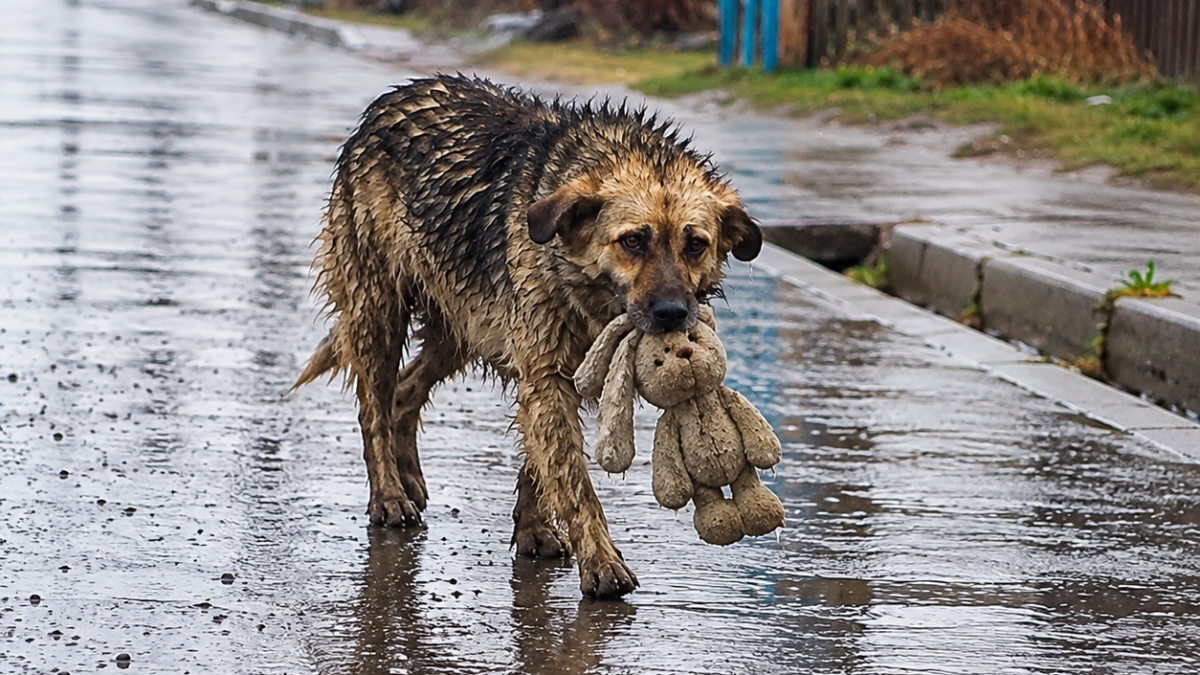
PART 2
I stayed crouched on that frozen porch for what felt like a long time, though it could not have been more than a minute.
The dog watched me with eyes that were too tired to panic. That frightened me more than running would have. A dog that runs still has fuel left in the body. This dog had spent hers waiting.
I kept my hands low.
“My name is Carla,” I said, because I always introduced myself to frightened dogs. Maybe it was silly. Maybe they did not understand the words. But I had learned that voice mattered. Rhythm mattered. Calm mattered.
“You don’t know me,” I continued. “That’s okay. I’m not going to take anything from you.”
Her paw tightened over the rabbit.
Behind me, someone sniffled.
I did not turn around.
Too many eyes can feel like a trap to a scared animal.
“Everybody step back, please,” I said gently.
The neighbors moved away from the porch.
The dog’s breathing was shallow. Her ears were back. The cut on her front paw looked angry, and I could see dirt packed into the wound. She smelled like wet fur, cold pavement, and exhaustion.
Not filth.
Not neglect in the way people imagine from a dog who had never known love.
She smelled like a house dog who had been outside too long.
That difference mattered.
I inched my hand forward with a soft slip lead hidden loosely in my palm. Her eyes flicked toward it.
She knew.
Of course she knew.
Dogs know when humans are trying to catch them. They know even when we call it rescue.
“I know,” I whispered. “I know you don’t want to leave.”
At the word leave, she made a sound.
Not a growl.
Not a bark.
A low, broken whine that seemed to come from somewhere deep inside her chest.
The neighbor across the street covered her mouth.
I looked at the dog’s face.
“You’re waiting for him, aren’t you?” I said before I knew the whole story.
The dog blinked slowly.
Then she rested her chin back on the rabbit.
Animal control had parked down the block so the vehicle would not scare her. One officer, Ramirez, stood by the gate, watching silently. We had worked together many times before. She knew not to rush me.
I slid one hand under the edge of the blanket I had brought and placed it near the dog’s side. She trembled harder but did not move away.
“Good girl,” I whispered. “That’s it.”
The slip lead went over her head on the second try.
She did not fight.
She did not bite.
She did not even stand.
That was when fear pushed through my chest.
“She’s weaker than we thought,” I said.
Ramirez came closer immediately. “Stretcher?”
“Yes.”
The word stretcher made one neighbor start crying openly.
“She used to walk every morning,” the woman said. “Every morning with Mr. Bennett. Even in the snow.”
I looked back. “Mr. Bennett?”
The woman nodded, wiping her face with her sleeve. “Arthur Bennett. He lived there. That was his dog.”
The dog’s eyes lifted at the sound of the name.
Arthur.
The movement was tiny.
But I saw it.
“What happened to him?” I asked.
The street went quiet.
The neighbor swallowed.
“He died. Heart attack. About three weeks ago.”
I looked at the boarded door.
The newspapers.
The mail.
The dog pressed against the threshold.
“And she’s been out here since?”
Nobody answered right away.
That silence told me enough.
Another neighbor, an older man in a black knit cap, spoke from the sidewalk.
“The paramedics came at night. There was a lot going on. Door open, people everywhere. We think she slipped out. After that… I don’t think anybody realized.”
“His family?”
“No close family around here,” the man said. “A nephew came once, maybe. Took some papers. Didn’t see the dog after.”
My jaw tightened, but I said nothing.
Anger would not warm her.
Ramirez returned with the stretcher. Together, we wrapped the dog in blankets, carefully keeping the rabbit tucked where she could see it.
But the moment I touched the toy to move it with her, she lifted her head and cried.
It was weak.
It was hoarse.
But it had urgency.
The first real strength I had seen in her.
“I’m not taking it,” I promised quickly. “I’m not taking it from you.”
I placed the rabbit against her chest.
Her body softened.
The neighbors saw it.
I think that was when they understood what the toy meant.
Not a cute habit.
Not a strange behavior.
A lifeline.
We lifted her gently. She was lighter than she looked. Her fur was wet through, her body cold even beneath the blanket. The rabbit stayed under her chin the whole time.
As we carried her down the porch steps, she turned her head toward the front door.
That nearly destroyed me.
She was leaving the place she had fought so hard to return to.
Not because she understood safety was waiting somewhere else.
Because she had no strength left to resist.
“I’m sorry,” I whispered. “I know this feels wrong.”
Her eyes stayed on the door until the van blocked her view.
At the clinic, the staff moved fast but carefully. Her temperature was low. She was dehydrated, underweight, and exhausted. The wound on her front paw was infected from broken pavement, ice, and weeks of walking without rest. She had fleas. Her skin was irritated in places. Her nails were worn unevenly.
But the veterinarian, Dr. Patel, gave us the first piece of mercy that day.
“Physically, she can recover,” he said. “She needs warmth, fluids, antibiotics, nutrition, and rest. The paw will need treatment, but I don’t see anything that makes me think she won’t heal.”
I let out a breath.
Then he looked toward the kennel where she lay wrapped in towels with the rabbit beside her.
“Emotionally,” he said, “that may take longer.”
The dog did not react to food at first.
That scared the techs.
Most hungry dogs, even frightened ones, show interest when warm food appears. She only looked at the bowl, then at the door of the treatment room, then back at the rabbit.
“She’s shut down,” Dr. Patel said.
I hated that phrase.
Shut down.
It sounds mechanical, like something you can restart with a button.
But in animals, it is grief turned inward.
For the next few hours, she lay curled around the rabbit while warm air circulated through the kennel. Every time a staff member walked away, she lifted her head weakly. Not enough to stand. Just enough to watch them leave.
The same question in her eyes every time.
Are you coming back?
I sat on the floor beside the kennel.
“You don’t know this yet,” I told her, “but people can come back.”
She stared at me.
“I’m going to prove it.”
I did not know her name then.
The neighbors had called her “Mr. Bennett’s dog.” One thought he had called her Rosie. Another thought Daisy. Someone else said he mostly called her “my girl.”
The vet paperwork needed something, so temporarily, I wrote:
Brown-and-white female pit mix. Found on Benton Street.
No name.
That felt unbearable.
She had belonged to someone for eight years. She had walked beside him through Detroit winters. She had slept in his home, carried his granddaughter’s toy, waited on his porch after his death.
And now, on paper, she had no name.
The rabbit had more history than she did.
That evening, after she was stabilized, I drove back to Benton Street.
I told myself I was going for statements.
That was true.
But I also needed to see the house again.
The neighbors were still watching.
Grief had woken them up.
Sometimes rescue does that. It makes people see what had been right in front of them for days.
Mrs. Alvarez, the woman across the street, invited me into her kitchen. She was the one who had said the dog walked every morning with Arthur Bennett.
Her house smelled like coffee and cinnamon. A small space heater hummed near the table. Through the window, I could see the dark porch across the street where the dog had waited.
Mrs. Alvarez placed a mug in front of me with shaking hands.
“I should have done more,” she said.
“You called when you understood.”
“I watched her sit there.”
Her voice cracked.
“I watched her come back every night. I told myself she knew what she was doing. That maybe someone was feeding her. That maybe she went somewhere warm.”
I did not offer cheap comfort.
Guilt deserved truth, but not cruelty.
“You know now,” I said. “That means you can help now.”
She nodded and wiped her eyes.
“Arthur loved that dog,” she said. “He was quiet. Kept to himself mostly. But he talked to her like she was a person.”
“What was her name?”
Mrs. Alvarez frowned, thinking.
“I heard him call her Bunny sometimes.”
“Because of the rabbit?”
“Yes. But I don’t think that was her real name. Maybe it became her name after a while.”
She looked toward the window.
“That toy belonged to his granddaughter. Years ago. Little pink rabbit. The girl carried it everywhere when she visited. Then one summer, she left it behind. The dog found it and decided it was hers.”
“Did the granddaughter still visit?”
“Not after she got older. Family things, I think. Distance. Arguments. You know how people are.”
Yes.
I knew how people were.
They drifted away from each other, and sometimes animals were left holding the last proof that love had ever lived in a house.
Mrs. Alvarez continued, “Arthur used to joke that the dog was keeping the rabbit safe until the little girl came back.”
I looked down into my coffee.
“And then Arthur died.”
“Yes.”
“And she kept waiting.”
Mrs. Alvarez covered her face.
“I think she was waiting for both of them.”
The next neighbor I spoke to was the man in the knit cap, Mr. Jenkins. He had seen the nephew arrive two days after Arthur died.
“Name’s Derek, I think,” he said. “Came in a black pickup. Didn’t stay long.”
“Did he ask about the dog?”
Mr. Jenkins’ mouth tightened.
“He asked if anyone had seen ‘the pit.’ Not her name. Not if she was okay. Just ‘the pit.’ I told him she’d been around. He said she probably ran off and that he had enough to deal with.”
My pen stopped moving.
“He said that?”
“Something like that.”
“Did he leave food? Call animal control?”
“Not that I saw.”
I wrote it down.
Not because I knew yet what it would become.
Because small details become large later.
When I returned to the clinic, the dog was asleep with her nose buried in the rabbit’s torn side.
A tech had tried to clean the toy while she was being examined. The dog had panicked so badly they stopped immediately. Now a note hung on her kennel:
Do not remove rabbit unless medically necessary.
I stared at that note for a long time.
Then I sat beside her and whispered, “I found out a little about you today.”
Her remaining strength was still thin, but her eyes opened.
“You had a person,” I said. “Arthur.”
At his name, her ears moved.
My throat tightened.
“You loved him.”
She looked at me.
“And he loved you.”
A tear dropped onto my sleeve.
“I’m sorry nobody understood fast enough.”
The next few days were slow.
She warmed. She drank. She began eating small amounts. Her paw was cleaned, treated, and bandaged. Antibiotics started working. The fleas were handled. Her body, at least, began responding.
Her spirit stayed somewhere else.
She ignored most toys. Soft blankets did not interest her unless the rabbit was on them. Treats worked only sometimes. Voices made her look up, but not with hope yet. Every time someone left the room, she watched until they disappeared.
If they stayed gone too long, she whined.
Not loudly.
Just enough to break your heart.
I visited twice a day.
Morning and evening.
Each time, I made a point of saying the same words.
“I’m leaving now. I’ll come back.”
At first, she only stared.
On the fourth day, when I returned in the evening, her tail moved once beneath the blanket.
Barely.
A small tap.
I froze.
“Was that for me?”
She did not repeat it.
Of course not.
Dogs enjoy keeping humans humble.
But it had happened.
A tiny signal.
A crack in the wall grief had built around her.
On the fifth day, Dr. Patel asked what we planned to call her.
“She may have had a name,” he said. “But if no one can confirm it…”
“I know.”
“What are you thinking?”
I looked at her.
She lay with the rabbit tucked against her chest, the way a child might sleep with a photo of someone gone.
“Memory,” I said.
Dr. Patel softened.
“That fits.”
I was not sure if it was too sad.
Then she lifted her head slightly when I said it again.
“Memory.”
Her eyes met mine.
Not bright.
Not healed.
But present.
So Memory she became.
When she was medically stable enough to leave the clinic, I agreed to foster her.
I had fostered many dogs before. Puppies with broken legs. Seniors with cloudy eyes. Terrified mothers rescued from garages. Big dogs people feared because of their heads. Small dogs people underestimated because of their size.
But I had never fostered grief in quite this shape.
I brought Memory home on a cold evening with her medications, bandage instructions, a bag of food, and the stuffed rabbit sealed carefully in a clean pillowcase for the drive. She sat in the back seat, not restless, not excited. Just watching the windows.
Every streetlight passed across her face like a memory.
When we reached my house, I opened the car door and waited.
She did not move.
“You can come out,” I said.
She looked at my porch.
Then down the street.
Then back toward the car.
I understood.
The last house she entered had not given her person back.
“I know,” I whispered. “This is not home yet.”
I lifted the pillowcase and took out the rabbit.
Her body changed instantly.
She reached for it with the careful urgency I had come to recognize. Once it was in her mouth, she stepped down from the car.
The rabbit led her inside.
Not me.
That was fine.
I had no pride about it.
The first night, she paced.
Room to room.
Door to door.
Window to window.
She carried the rabbit the entire time.
My house is small, but she inspected it like a detective searching for one missing clue. She looked behind the couch. Down the hallway. Into the bathroom. At the back door. At the front door.
Especially the front door.
Around midnight, I found her sitting there.
Still.
Silent.
Rabbit in her mouth.
Waiting.
The porch light outside made a pale square on the floor.
I sat a few feet behind her.
“He isn’t coming here,” I said gently.
Her ears flicked.
“I wish I could bring him back for you.”
She did not turn around.
I stayed there for nearly an hour.
Eventually, her body swayed with exhaustion. She lowered herself slowly to the rug by the door and rested her chin on the rabbit.
I slept on the couch that night so she would not wake alone.
At 3:00 a.m., she stood and checked the door again.
At 4:30, she checked the window.
At 6:00, she finally fell into a deeper sleep.
When the sun came up, I realized what the first battle would be.
Not food.
Not medicine.
Not the infected paw.
Memory had to learn that doors did not only take people away.
Sometimes they brought people back.
So I started small.
I walked to the kitchen and returned.
Walked to the bathroom and returned.
Stepped outside for ten seconds and returned.
Each time, I said, “I’ll come back.”
Each time, she watched like her life depended on the answer.
In a way, it did.
The first week was full of tiny rituals.
Medication wrapped in soft food.
Paw bandage checks.
Warm meals.
Short leash walks.
Rest.
Lots of rest.
Memory accepted care politely, but from a distance. She did not lean into affection at first. She allowed my hand on her shoulder for a second, then shifted away. She never growled. Never snapped. Never acted dangerous.
She acted careful.
That was all.
Careful dogs are often mistaken for cold dogs.
They are not cold.
They are measuring the cost of trust.
I gave her space.
The rabbit got special treatment.
After the clinic panic, I knew removing it would only hurt her. But it was filthy, and the seams were failing. So I cleaned it slowly, in pieces, with Memory watching every step.
I placed it on a towel in front of her.
“I’m going to wipe this part,” I said.
She stared.
I wiped one paw of the toy gently with a damp cloth, then pushed it back toward her.
She took it immediately and inspected it.
The next day, I cleaned one ear.
The day after, the side.
It took almost a week to make it safe enough to keep near her bedding without causing her distress.
Then I repaired the first tear.
That was harder.
Needle and thread looked suspicious to her.
She hovered over my hands while I stitched the rabbit’s side, her nose almost touching my fingers.
“I know,” I said. “I’m fixing it. Not hurting it.”
Her eyes stayed locked on the toy.
When I finished and handed it back, she sniffed the seam, then looked at me.
It was the first time I felt she might have understood I could protect something she loved.
That night, she slept closer to the couch.
Not beside me.
But closer.
Meanwhile, the story of the dog with the rabbit had spread through the neighborhood.
Mrs. Alvarez called every few days.
Mr. Jenkins dropped off a bag of dog treats, though Memory was not ready to meet him yet.
The mail carrier, whose name was Kevin, asked if she had survived the first night and cried when I said yes.
But not everyone reacted with tenderness.
A week after I brought Memory home, I got a call from Officer Ramirez.
“We found the nephew,” she said.
“Derek?”
“Derek Bennett. Arthur’s sister’s son. He says he is handling the estate.”
My stomach tightened.
“Does he want the dog?”
A pause.
“He wants access to the house and any property of value. He asked whether the rescue removed ‘anything that belonged to the estate.’”
I looked across the room.
Memory was curled on a blanket, the rabbit between her paws.
“You mean the rabbit.”
“He didn’t specify.”
“He can forget it.”
“Carla.”
“No.”
“I’m not saying we’re giving it to him,” Ramirez said. “I’m telling you he may make noise.”
“Let him.”
There are moments when I can be professional.
That was not one of them.
The stuffed rabbit was not an antique watch. Not cash in a drawer. Not furniture. It was the one thing keeping a grieving dog from collapsing completely. If Derek Bennett wanted to argue ownership over a dirty toy he had not cared enough to notice when the dog was freezing on the porch, he would have to argue with me.
Two days later, he did.
He called the rescue office sounding irritated before I even said hello.
“Is this Carla?”
“Yes.”
“This is Derek Bennett. My uncle Arthur owned the property on Benton Street.”
“I know who you are.”
“I heard you have his dog.”
“She is in foster care with me.”
“Right. Well, there’s been a lot of talk going around about me, and I don’t appreciate it.”
I leaned back in my chair.
“What talk?”
“That I abandoned the dog.”
“Did you?”
He scoffed. “I didn’t even know where she was.”
“You knew she existed.”
“She wasn’t my responsibility.”
The sentence hit like a slap.
I looked at Memory.
She was asleep, one paw resting over the rabbit’s crooked ear.
“She was your uncle’s dog,” I said carefully. “He died. She was left outside for weeks.”
“I had funeral arrangements, paperwork, property issues. You people act like a dog is the only thing that matters.”
“No,” I said. “We act like a living animal matters.”
He was quiet for half a second.
Then he said, “I want my uncle’s belongings left alone.”
That was when I understood.
This was not about grief.
This was about control.
“What belongings are you referring to?”
“Anything taken from the property.”
“The dog was found outside. Her toy was with her.”
“That toy belonged to my family.”
I closed my eyes for one second.
Then I opened them.
“That toy belongs to Memory.”
“Memory?”
“That is her name now.”
He laughed once, humorlessly. “That dog had a name.”
“What was it?”
Silence.
I waited.
“What was her name, Derek?”
He cleared his throat. “My uncle called her different things.”
“You don’t know.”
“I know she’s part of the estate.”
My voice went cold.
“She is not furniture.”
“I didn’t say she was.”
“You said enough.”
He threatened to call a lawyer. I told him to do what he thought was necessary. Then I documented the conversation and called Ramirez.
She sighed when I finished.
“I expected something like that.”
“Can he take the rabbit?”
“Unlikely, especially since it was with the dog at recovery and has no monetary value. But keep records.”
Rescue runs on records.
Medical records.
Intake records.
Behavior notes.
Photos.
Statements.
I had all of it.
And now I had a new entry:
Family representative aware of dog after owner’s death. Did not recover or provide care. Expressed concern over property.
That line mattered later.
In the second week, Memory began following me from room to room.
Not closely.
Not affectionately yet.
More like she was auditing my reliability.
If I entered the kitchen, she stood in the doorway. If I folded laundry, she watched from the hall. If I stepped onto the porch, she came to the window with the rabbit in her mouth.
Each time I returned, her body softened a little faster.
One evening, I sat on the living room floor while she lay on her blanket. The rabbit rested between us.
“You really loved him, didn’t you?” I asked softly.
I did not expect anything.
It was just one of those questions grief pulls out of you.
Memory lifted her head.
For a long moment, she looked at me.
Then she stood, walked slowly across the rug, and leaned her body against my shoulder.
Not for long.
Maybe ten seconds.
But it was the first time she chose contact.
I did not move.
I did not wrap my arms around her.
I did not make a sound big enough to scare her away.
I simply let her lean.
When she stepped back, she picked up the rabbit and returned to her blanket.
I cried after she fell asleep.
The third week brought snow.
Not much, only a thin layer, but enough to turn the backyard white. Memory saw it through the glass door and froze.
I wondered if it reminded her of the porch.
The cold.
The waiting.
Arthur walking her in old winters.
I opened the door and let her decide.
She stepped out slowly with the rabbit in her mouth, which was not ideal because the yard was wet, but some battles are not worth fighting.
Her paws touched the snow.
She paused.
Then she sniffed.
A memory seemed to move through her, but not all memories hurt the same way. Her tail lifted slightly.
I heard Mrs. Alvarez’s voice in my mind.
He used to walk her every morning, even during snowstorms.
Maybe snow meant him.
Maybe snow meant home before loss.
Memory took another step.
Then another.
She placed the rabbit carefully on a dry patch under the porch awning and walked into the yard without it.
That was new.
She had left the rabbit behind voluntarily.
Only for thirty seconds.
Then she ran back to check it.
But still.
A beginning.
Her paw healed slowly but well. Her appetite improved. She gained weight. Her coat softened. She began accepting treats from my hand and, eventually, from Kevin the mail carrier when he visited. She remembered him, I think. Or maybe she remembered that he had found her and called for help when others were still hesitating.
Either way, she took the treat gently and wagged once.
Kevin turned away and wiped his eyes.
“I’m fine,” he said.
“You’re not,” I replied.
“No, I am absolutely not.”
As Memory healed, the situation with Derek got uglier.
He went to the house and began clearing it out. That was his legal right in some ways, but he did it with an indifference that made the neighbors furious. Arthur Bennett had lived there for decades. People expected care. Respect. A pause at least.
Instead, Derek hired a junk removal truck and started throwing pieces of Arthur’s life into black bags.
Mrs. Alvarez called me crying.
“They’re throwing away his photos,” she said.
I drove over immediately.
I told myself I had no authority.
I told myself estate matters were not rescue matters.
I told myself not to get involved.
Then I saw a framed photo sticking out of a trash bag near the curb.
Arthur Bennett stood on that porch in a winter coat, smiling down at the brown-and-white dog beside him. She was younger then, fuller, bright-eyed. In her mouth was the pink stuffed rabbit, still clean enough to show its color.
I picked up the frame.
Derek came down the porch steps.
“Can I help you?”
I held up the photo.
“You were throwing this away.”
His expression barely changed. “There’s a lot of junk.”
“This is your uncle.”
“I know who it is.”
“And this is his dog.”
“She’s not my dog.”
“No,” I said. “She definitely is not.”
He narrowed his eyes.
“You people have made me look like some kind of monster.”
“I did not make you look like anything.”
“The posts online. The neighbors. All this drama about a dog with a toy.”
I stepped closer.
“That dog nearly froze to death on your uncle’s porch.”
His jaw tightened.
“I had responsibilities.”
“She was one of them.”
“No, she wasn’t.”
There it was again.
The same sentence in different clothes.
I looked at the bags by the curb. Photos. Books. Old coats. A life reduced to inconvenience.
Then I looked back at Derek.
“Arthur walked her every morning. He loved her. She waited for him at that door until her body almost gave out.”
Derek looked away.
For a fraction of a second, I thought I saw shame.
Then it hardened into irritation.
“You don’t know my family.”
“You’re right,” I said. “But I know the dog knew who loved her.”
The neighbor across the street had come onto her porch. Mr. Jenkins stood near his fence. Kevin’s mail truck slowed at the corner.
Derek noticed them watching.
That mattered to him.
Good.
“Can I keep the photo?” I asked.
He shrugged. “Take it.”
As if it were nothing.
To him, maybe it was.
To Memory, it became everything.
I cleaned the frame and brought it home that evening.
Memory was lying on her blanket when I placed the photo on the floor several feet away.
At first, she only glanced at it.
Then she lifted her head.
Her body went still.
She stood slowly.
The rabbit was already in her mouth.
She walked toward the frame with careful steps and lowered her nose to the glass.
For several seconds, she did not move.
Then she made a sound I had never heard from her before.
Not a whine.
Not a bark.
A soft, trembling breath.
She lay down in front of the photo and placed the rabbit beside it.
I sat on the floor across from her, tears running down my face.
“That’s him,” I whispered. “That’s Arthur.”
She touched the glass with her nose.
That night, she did not sleep by the front door.
She slept beside the photo.
With the rabbit between her paws.
That was when I knew healing did not always mean letting go.
Sometimes healing means being allowed to keep the memory without being trapped inside it.
The photo changed something in her.
Not quickly.
Not magically.
But meaningfully.
She still checked the window. She still followed me when I left a room. She still slept with the rabbit every night. But the desperate waiting softened into something quieter.
The house was no longer the only place Arthur existed.
He was in the photo.
In the rabbit.
In the morning walks I started taking with her.
At first, our walks were short. Down the block, around the corner, home. Memory moved cautiously, nose low, rabbit sometimes in her mouth, sometimes left safely at home.
One cold morning, she stopped near a patch of sidewalk and stared.
Mrs. Alvarez, who had joined us, touched my arm.
“This is where Arthur used to stop and talk to the crossing guard.”
Memory sniffed the ground.
The crossing guard was gone now, replaced by a younger man who did not know the story.
But Memory remembered.
Dogs map love differently than we do.
They remember corners, smells, routines, the sound of a particular step beside them. They know which porch meant biscuits, which tree meant waiting, which hand held the leash.
Every morning walk became both grief and tribute.
I began calling them Arthur walks.
Memory seemed to like them.
Or maybe I did.
Maybe both.
The community began changing too.
Mrs. Alvarez organized a small neighborhood watch list for pets whose elderly owners lived alone. Not formal at first. Just names, phone numbers, and who to call if mail piled up or a dog was suddenly seen outside alone.
Kevin helped.
Mr. Jenkins helped.
Even the convenience store owner offered to keep spare bowls and food behind the counter for emergencies.
Memory’s story had embarrassed the neighborhood.
That embarrassment became useful.
People stopped saying, “Someone should do something,” and started asking, “What can I do before it’s too late?”
That was the kind of revenge I could believe in.
Not against Arthur.
Never Arthur.
Not even only against Derek, though he had earned the shame.
The real enemy was indifference.
Memory’s survival exposed it.
And then, slowly, the neighborhood began correcting it.
One afternoon, about six weeks after her rescue, Derek returned to the house while Memory and I were walking with Mrs. Alvarez.
Memory saw the black pickup first.
Her body stiffened.
I did not know whether she recognized the truck from the days after Arthur’s death. Maybe she did. Maybe she only felt the tension move through the leash.
Derek stepped out carrying a box.
He saw us and stopped.
Memory stood beside me, the rabbit in her mouth.
For once, Derek did not look irritated.
He looked uncomfortable.
Mrs. Alvarez muttered something in Spanish under her breath.
I held the leash steady.
“Come on,” I said softly to Memory. “We can cross.”
But Memory did not move.
She stared at Derek.
He stared back.
The street went quiet in that strange way neighborhoods do when drama appears without warning.
Finally, Derek looked at me.
“She looks better.”
“She is better.”
He nodded.
His eyes moved to the rabbit.
“She still carries that thing?”
“Yes.”
“My cousin used to have it. Maria. Arthur’s granddaughter.”
“I know.”
He looked surprised. “You know Maria?”
“No. I know the story.”
Derek shifted the box in his arms.
“My uncle loved that dog,” he said.
I said nothing.
“He talked about her all the time when we called. I just…” He stopped.
Mrs. Alvarez crossed her arms.
“You just what?” she asked sharply.
Derek looked down.
“I didn’t think.”
That answer was not enough.
But it was the first honest thing I had heard from him.
Memory lowered her head slightly, still watching him.
“I saw the photo you took,” he said to me.
“What photo?”
“The one with her by his picture. Mrs. Alvarez showed me.”
I glanced at Mrs. Alvarez. She did not look sorry.
Derek swallowed.
“I forgot that picture existed.”
“You were throwing it away.”
“I know.”
The words hung there.
For once, he did not defend himself.
“I was angry,” he said. “At my uncle. At the mess. At my mother for leaving me to handle it. At everyone. I walked into that house and all I saw was work.”
Mrs. Alvarez’s voice softened, but only slightly.
“And the dog?”
He looked at Memory.
“I saw one more problem.”
Memory’s jaw tightened around the rabbit.
My own anger returned fast.
“She was grieving.”
“I know that now.”
“No,” I said. “You know it because everyone else made you look.”
He flinched.
Good.
Some truths should sting.
Derek set the box on the porch.
“What do you want from me?” he asked.
“Nothing for me.”
“Then what?”
I looked down at Memory.
Her eyes were clearer now. Her body stronger. She no longer looked like the frozen dog on the porch.
But she still carried the rabbit.
Still carried the story.
“You could start by saying her name,” I said.
He frowned.
“Her name is Memory.”
He looked uncomfortable.
Then he crouched, not close enough to touch her.
“Memory,” he said quietly.
Her ears moved.
His face changed.
Maybe hearing himself say it made her real.
Not the pit.
Not the dog.
Memory.
“I’m sorry,” he said.
Memory did not go to him.
She did not wag.
She did not forgive him in some dramatic scene that would make everyone feel better.
She simply stood there, rabbit in her mouth, alive and loved despite his failure.
That was enough.
A week later, Derek donated part of Arthur’s remaining furniture sale to the rescue.
Not a fortune.
Not redemption.
But something.
More importantly, he gave us a box of Arthur’s things he had almost thrown away: the dog’s old collar, a leash, two photos, a vet record with her original name.
Her name had been Sadie.
I sat on my living room floor with the old paper in my hand.
Sadie Bennett.
Female pit bull mix.
Vaccinated.
Loved by Arthur.
Memory lay beside me, chewing gently on a repaired corner of the rabbit.
“Sadie,” I said softly.
Her head lifted.
Her eyes met mine.
There it was.
Recognition.
Not confusion.
Not fear.
Recognition.
I said it again.
“Sadie.”
Her tail moved.
My heart cracked open.
For days, I did not know what to do with that.
I had named her Memory because she had no name.
But she did.
She had always had one.
It had simply been buried under loss.
I called Dr. Patel.
“Can a dog have two names?” I asked.
He laughed gently. “Dogs can have twenty if love says them right.”
So she became Sadie Memory.
On official papers, I kept Memory because that was the name of her rescue and rebirth.
At home, sometimes, when she was sleepy or soft-eyed, I called her Sadie.
She always heard it.
The adoption happened quietly.
By then, everyone assumed I had already adopted her. Mrs. Alvarez began saying “your dog” before I signed anything. Kevin brought treats addressed to “Memory and Carla.” Dr. Patel wrote “foster failure?” on her chart with a question mark that felt judgmental.
I held out for about three more days.
Then I gave up pretending.
Angela, the rescue director, came over with the papers. Memory greeted her politely, then took the rabbit to the living room and lay on it as if afraid the paperwork might involve toy surrender.
Angela watched her.
“You know,” she said, “I have other approved adopters.”
I nodded.
“Good homes.”
“I know.”
“But?”
I looked at Memory.
She had begun sleeping through the night. She no longer sat by the door until dawn. She still watched when I left, but now she waited from her bed instead of pacing. When I came home, she picked up the rabbit and met me in the hallway with a slow wag.
Trust had grown here.
Not easily.
Not quickly.
But honestly.
“But she’s home,” I said.
Angela smiled.
“Then sign here.”
I signed.
Memory became mine.
Or maybe, more accurately, I became hers.
That evening, I placed Arthur’s photo on a small shelf in the living room, low enough for Memory to see but high enough that the rabbit could not be used as a battering ram against the frame.
Beside it, I placed her old collar.
Not as a shrine to sadness.
As proof that her life had chapters.
Arthur loved her first.
I loved her now.
Love had not replaced love.
It had continued it.
Winter deepened.
Memory learned the pleasures of blankets, heating vents, and stealing my spot on the couch. She discovered that the kitchen produced chicken if she looked tragic enough. She accepted that baths were unfortunate but survivable. She decided Kevin the mail carrier was family and greeted him through the window every afternoon.
The rabbit remained essential.
I repaired it again in December.
Then again in January.
One ear stayed crooked no matter what I did. The pink was almost entirely gone. The fabric had thinned from years of being carried. I bought other toys—soft bears, ducks, ropes, squeaky bones.
Memory accepted them politely.
Then returned to the rabbit.
Some love is not replaceable.
On Christmas Eve, Mrs. Alvarez invited us over.
I hesitated at first. Memory had improved, but new houses still made her nervous. Mrs. Alvarez insisted.
“Only for a few minutes,” she said. “Arthur used to bring her treats on Christmas morning. I want to continue.”
So we walked across the street with Memory wearing a red bandana and carrying the rabbit.
Mrs. Alvarez had placed a framed copy of Arthur’s photo on her side table. She had also baked plain dog biscuits shaped like stars.
Memory stepped inside cautiously.
Then she smelled the biscuits.
Grief paused for snacks.
Mrs. Alvarez laughed and cried at the same time.
“She remembers this kitchen,” she said.
Memory sniffed the table leg, the rug, the doorway. Then she walked to the front window and looked across the street at Arthur’s house.
The house had been sold by then.
A young couple was renovating it. They had replaced the boards on the windows. A wreath hung on the front door.
Memory stared for a long moment.
Then she turned away and came back to us.
That was another milestone.
She could look at the old house and leave it.
Not because she forgot.
Because she knew where she belonged now.
In January, the local paper ran a story about the neighborhood pet safety list.
They wanted to include Memory.
At first, I refused.
I did not want her reduced to a sad headline.
But Mrs. Alvarez said something that changed my mind.
“Arthur would want people to learn,” she told me. “He would hate that she suffered, but he would love that she helped someone else.”
So I agreed to one interview.
The reporter came to my house and sat on the floor, letting Memory approach at her own pace. Memory sniffed her shoes, accepted one treat, and then brought the rabbit to her bed.
The reporter watched quietly.
“She still carries it?”
“Every day.”
“Do you think she’s still waiting?”
I looked at Memory.
She was lying on the rug in a patch of winter sunlight, rabbit between her paws, eyes half-closed.
“No,” I said slowly. “Not the way she was.”
“What do you mean?”
“At first, she was waiting for Arthur to come back. Now I think she carries the rabbit because love doesn’t disappear just because waiting ends.”
The reporter’s eyes softened.
That line became the heart of the article.
The headline read:
A Detroit Dog Waited Weeks With a Stuffed Rabbit. Now Her Story Is Helping Protect Other Pets.
Derek read it.
I know because he called me the next day.
I almost did not answer.
But I did.
“I saw the article,” he said.
“Okay.”
There was a pause.
“They used a good photo of her.”
“They did.”
Another pause.
“My cousin Maria saw it too.”
I sat up.
“Arthur’s granddaughter?”
“Yes. She lives in Ohio now. She didn’t know about any of this until someone sent it to her.”
My grip tightened on the phone.
“And?”
“She wants to meet the dog.”
I looked at Memory.
She was asleep, rabbit tucked under her chin.
The granddaughter.
The original owner of the rabbit.
The child Arthur had joked would one day come back for it.
“No,” I said at first.
Derek exhaled. “I figured you’d say that.”
“I’m not putting Memory through confusion for someone else’s feelings.”
“She’s not like me,” he said quietly.
That stopped me.
“She loved my uncle. Family got complicated. Her mother and Arthur argued years ago. She was a kid when it happened. She didn’t choose the distance.”
I said nothing.
“She cried when she saw the rabbit,” Derek continued. “She said she remembers leaving it there.”
My chest tightened.
Memory shifted in her sleep.
“I’ll think about it,” I said.
That was all I could promise.
I spoke with Angela. With Dr. Patel. With Mrs. Alvarez. Everyone had opinions. Good ones. Protective ones.
In the end, I decided Memory could meet Maria only if it was slow, quiet, and entirely on Memory’s terms.
Maria arrived on a Saturday afternoon in February.
She was in her twenties now, with dark hair tucked into a knit hat and eyes already red when she stepped out of her car. She stood on my sidewalk holding a small envelope in both hands.
“I’m Maria,” she said.
“I know.”
“I’m sorry,” she said immediately.
Not defensive.
Not irritated.
Just sorry.
That helped.
We sat on the porch first, without Memory. Maria told me about Arthur. About summers in Detroit when she was small. About the pink rabbit she had named Clover. About the brown-and-white dog who had stolen it and carried it proudly through the house while Arthur laughed.
“She was Sadie,” Maria said, wiping her eyes. “Grandpa called her Sadie-girl.”
I nodded.
“She remembers that name.”
Maria pressed the envelope to her chest.
“I didn’t know he died until after the funeral. My mom and him hadn’t spoken. Derek handled everything. I should have called sooner. I should have…”
Her voice broke.
“I left the rabbit there. Then I left them too.”
I could have corrected her.
She had been a child.
Family wounds are not simple.
But guilt is rarely logical, and sometimes people need space to feel it before they can set it down.
“Do you want to come inside?” I asked.
She nodded.
Memory was in the living room when we entered. She stood immediately, rabbit in her mouth.
Maria made a sound.
“Oh my God,” she whispered. “Clover.”
Memory’s ears lifted.
Not at Maria’s voice, I think.
At the name.
Clover.
The rabbit had a name too.
Memory looked at me, then at Maria.
Maria dropped to her knees but did not reach out.
“Hi, Sadie,” she said softly.
Memory froze.
Her eyes widened.
The rabbit shifted in her mouth.
“Hi, Sadie-girl.”
For one impossible second, nobody moved.
Then Memory walked forward.
Slowly.
Carefully.
She stopped in front of Maria and sniffed her hands.
Maria was crying too hard to speak.
Memory sniffed her sleeve, her hair, her face. Maybe there was no scent left from childhood. Maybe there was. Dogs know worlds we do not.
Then Memory placed the rabbit in Maria’s lap.
I covered my mouth.
Maria broke.
She bent over the toy and sobbed while Memory stood beside her, tail moving slowly.
Not frantic.
Not confused.
Just present.
After a moment, Memory leaned against her.
The room felt full of ghosts, but gentle ones.
Arthur.
A little girl.
A pink rabbit.
A dog who had carried love across years, grief, and frozen streets.
Maria opened the envelope with shaking hands.
Inside was an old photograph.
A younger Arthur sat in a lawn chair. A little girl stood beside him, grinning with missing front teeth. At their feet, Sadie lay in the grass with the pink rabbit under one paw.
On the back, in Arthur’s handwriting, were the words:
Maria and Sadie guarding Clover. Summer 2015.
I read it and had to sit down.
Memory put her nose against the photo.
Maria laughed through tears.
“You always stole my rabbit,” she told her.
Memory wagged.
That day did not reopen her wound.
It completed a circle.
Maria did not ask for the rabbit back. She did not ask for Memory. She did not make grief about ownership.
Instead, she asked if she could visit sometimes.
I said yes.
Derek came once more, weeks later, to finish closing the estate. He did not come inside my house, but he met us on the sidewalk after one of Memory’s Arthur walks.
This time, he brought something wrapped in newspaper.
“I found this in a drawer,” he said.
It was Arthur’s old dog tag for Sadie. Scratched, faded, but readable.
My throat tightened.
Memory sniffed it.
Derek looked at her.
“I put Arthur’s house on the market,” he said. “The new owners seem decent.”
“I know.”
He nodded toward Memory. “She looks… happy.”
“She is.”
He looked relieved and ashamed at the same time.
“I deserved what people said.”
I did not answer.
“I did,” he repeated. “I treated everything like a burden. Including her.”
Memory stood calmly beside me, rabbit in her mouth.
Derek lowered his gaze.
“I’m sorry, Sadie.”
This time, he used the old name.
Memory’s tail moved once.
I do not know if that was forgiveness.
Maybe it was only recognition.
Maybe that is all forgiveness starts as.
“You can donate Arthur’s remaining pet supplies to the neighborhood list,” I said.
He nodded immediately.
“I will.”
And he did.
Food, leashes, bowls, blankets, money for emergency vet care. Not enough to erase what happened, but enough to make something better happen after.
That became his sentence, in a way.
No court ordered it.
No judge forced it.
Memory did.
Her story made him look at the part of himself that had walked away.
That was the revenge.
Not revenge with shouting.
Not revenge with cruelty.
Revenge by remembrance.
Memory turned neglect into action.
She made a neighborhood ashamed enough to change.
She made a nephew who had dismissed her say her name.
She brought Arthur’s granddaughter back to the love she thought she had lost.
And she did all of it while carrying a ruined stuffed rabbit everyone else would have thrown away.
Spring came slowly to Detroit.
Snow melted into dirty water along the curbs. Trees pushed out small green buds. The air softened. People came outside again.
Memory changed with the weather.
Her walks grew longer. Her limp disappeared. Her coat shone. She gained healthy weight. She began greeting some neighbors with soft wags. She learned which houses gave treats and which squirrels deserved serious concern.
She still carried the rabbit often, but not always.
That mattered.
Some mornings, she left it on her bed while we walked.
Some afternoons, she carried a newer toy into the yard.
But at night, always, she returned to Clover.
I had repaired the toy so many times by then that it was part original rabbit, part thread, part stubbornness. One ear remained crooked forever. I could not fix it without changing the whole shape, and I had learned better than to overcorrect old love.
Memory liked it exactly as it was.
In May, the neighborhood held a small gathering on Benton Street.
It started as a practical event: a table for emergency contact cards, pet food donations, microchip information, and a list for elderly residents who wanted someone to check on their pets if something happened.
But Mrs. Alvarez insisted on calling it Arthur’s Walk.
“We begin with a walk,” she said. “Like he did.”
So we did.
Neighbors gathered on a Saturday morning outside the old brick house, now freshly painted by the new owners. They had heard the story and welcomed the event. They even placed a water bowl near the porch in Memory’s honor.
Maria came from Ohio.
Derek came too, standing quietly near the back.
Kevin brought his mailbag even though it was his day off.
Officer Ramirez attended with animal control flyers.
Dr. Patel came, because he claimed he was “just passing by,” which was a lie nobody believed.
Memory wore a blue harness and carried Clover.
When we began walking, she led the way.
Not pulling.
Not afraid.
Just steady.
Mrs. Alvarez pointed out Arthur’s old route. The corner where he bought coffee. The tree where Sadie always sniffed too long. The crossing where he waved to kids. The porch where he once slipped on ice and laughed because Sadie looked offended on his behalf.
People told stories I had never heard.
Arthur fixing a neighbor’s steps.
Arthur shoveling snow for Mrs. Alvarez.
Arthur giving Halloween candy to children long after his own granddaughter stopped visiting.
Arthur and Sadie walking every morning like clockwork.
The man who had died alone inside that house became more than a sad detail in Memory’s story.
He became a person again.
Remembered.
That was something I had not expected.
Memory had not only needed us to remember her love.
She had made us remember his.
At the end of the walk, Maria stood on Arthur’s old porch and read from the back of the photograph.
“Maria and Sadie guarding Clover. Summer 2015.”
Her voice shook.
Then she looked down at Memory.
“I thought I left a toy here when I was a kid,” she said. “I didn’t know I had left a piece of love behind. Thank you for keeping it safe.”
Memory stared up at her, rabbit in her mouth.
Kevin cried.
Dr. Patel pretended his allergies were acting up.
Derek looked at the ground.
Mrs. Alvarez took my hand.
“This is better,” she whispered. “This is how it should have been.”
I nodded.
But my throat was too tight to answer.
After that day, the neighborhood list became official enough to matter. The local shelter helped create a simple form: emergency pet contact, veterinarian, feeding instructions, permission for welfare checks. Volunteers distributed copies to seniors on the block.
Within months, the list helped two cats whose owner was hospitalized and one elderly beagle whose owner fell and could not call for help.
Every time I heard about another animal helped, I thought of Memory on that frozen porch.
Still waiting.
Still holding Clover.
Her suffering had become prevention.
That did not make the suffering fair.
But it made it refuse to be wasted.
Summer arrived.
Memory discovered sunbathing.
She would lie in the backyard with Clover nearby, eyes closed, belly warm, body loose in a way I had not seen during winter. Sometimes she slept so deeply that birds landed on the fence and she did not move.
A dog once unable to rest now slept through entire afternoons.
That is one of the quiet miracles of rescue.
The moment the body finally believes no emergency is coming.
Maria visited every few weeks. At first, Memory greeted her with cautious interest. Then familiarity. Then joy. Maria never tried to reclaim a role she had lost. She built a new one.
She became someone who brought homemade dog biscuits and stories about Arthur.
Derek kept donating to the neighborhood pet fund. He remained awkward. Sometimes guilt makes people stiff. But he showed up. He hauled food bags. He repaired a fence for an elderly man whose terrier kept escaping. He stopped making excuses.
One afternoon, I saw him kneel to fill a water bowl at a community event. A small stray dog approached, nervous and thin. Derek stayed still, hand low, waiting.
Mrs. Alvarez saw it too.
“Good,” she said.
That was all.
Good.
Not forgiven.
Not erased.
But good.
Memory’s revenge continued in small ways like that.
The world around her became less careless.
One night in late August, a thunderstorm rolled over the city.
Memory had never liked storms. The first rumble sent her to the hallway, Clover in her mouth. I sat on the floor and patted the space beside me.
She came, pressed her side against my leg, and trembled.
“You’re okay,” I said.
Rain hit the windows hard.
Lightning flashed.
For a moment, her eyes went distant.
Maybe storms reminded her of the freezing rain.
Maybe she remembered the porch.
Maybe she remembered being cold enough to stop moving.
I placed Arthur’s photo on the floor near us.
Not every night. Not always.
But that night, it felt right.
Memory lowered her head to look at it.
Then she placed Clover between the photo and her paws.
The thunder continued.
She trembled less.
I stroked her shoulder slowly.
“You were loved before me,” I whispered. “You are loved now.”
She leaned her head against my knee.
That sentence became the heart of our life together.
Loved before.
Loved now.
Not rescued from nothing.
Rescued from loss.
There is a difference.
By October 2024, nearly a year after the first sightings, Memory was almost unrecognizable from the frozen dog on the porch.
Her body was strong.
Her eyes were soft.
Her coat was glossy.
She had opinions about meal times, blankets, and which direction walks should go.
She still had sadness sometimes. I could see it when she sat by the window with Clover between her paws, staring at the street. But it was not the same desperate waiting from before.
It was memory.
Quiet.
Complicated.
Allowed.
On the anniversary of Arthur’s death, Maria came over. So did Mrs. Alvarez. Derek dropped off flowers but did not stay, saying he did not want to intrude. That, too, showed growth.
We walked to Arthur’s former house.
The new owners had planted mums near the steps. The porch was clean. The door was painted deep green. Life had moved in where silence once sat.
Memory climbed the steps slowly.
For a moment, I felt fear move through me.
Would she collapse into old grief?
Would she scratch at the door?
Would she wait again?
Instead, she stood at the top of the porch and sniffed the air.
Then she placed Clover gently on the welcome mat.
Maria began crying.
Mrs. Alvarez whispered a prayer.
Memory stood there quietly, then picked the rabbit back up and turned toward me.
Ready to go.
That was goodbye.
Not forgetting.
Not replacing.
Goodbye.
We walked home under a pale autumn sky.
Leaves scraped along the sidewalk. Cars moved slowly down the street. Somewhere, a dog barked behind a fence.
Memory walked beside me, steady and calm.
At home, she ate dinner, stole my throw blanket, and fell asleep with Clover tucked beneath her chin.
Ordinary.
Sacred.
Complete.
Sometimes people ask why I kept the name Memory when we later learned she had been Sadie.
I tell them because both names are true.
Sadie was the dog Arthur loved.
Memory was the dog who carried that love through freezing streets and survived long enough to share it.
She is both.
She always will be.
The rabbit, Clover, sits beside her every night. The stitching is uneven because I am not nearly as good with a needle as I pretend to be. One ear is still crooked. The fabric is faded beyond color. I have replaced stuffing, patched holes, reinforced seams, and once spent two hours searching the house because Memory hid it behind the laundry basket and then looked at me like I had lost it.
She still carries it gently before bed.
Room to room.
Past the shelf with Arthur’s photo.
Past the window where she no longer waits in panic.
Past the front door that now opens to people who return.
Then she climbs onto her bed, circles twice, and places Clover between her paws.
Every night.
Some might say it is only a toy.
They are wrong.
It is a bridge.
A promise.
A piece of a man who loved her, a child who left it behind, and a life that refused to disappear when grief tried to swallow it.
Memory taught me that dogs do not measure love by time the way we do.
Three weeks on a porch can hold eight years of devotion.
A torn stuffed rabbit can carry a whole family’s history.
A dog can be starving, freezing, and heartbroken, yet still protect the last soft thing she was given.
And people?
People can fail.
They can look away.
They can tell themselves someone else will handle it.
They can reduce a life to inconvenience.
But they can also change.
They can call sooner.
Show up.
Make lists.
Repair what they almost threw away.
Say the name they once refused to learn.
That is what Memory did.
She did not get revenge by becoming bitter.
She got revenge by making everyone remember.
Arthur was remembered.
Maria came back.
Derek faced his shame.
The neighborhood changed.
Other animals were protected.
And Memory, the dog who once slept under abandoned porches with a rabbit in her mouth, now sleeps in a warm house where nobody questions whether she belongs.
She belongs.
Completely.
On quiet evenings, she still sits near the living room window with Clover resting between her paws. She watches the street below, calm and still. Sometimes I wonder what she sees there.
Arthur walking toward the porch?
Maria as a little girl?
The old house before loss?
Or maybe nothing so sad.
Maybe she simply watches the world from a place of safety now, holding the proof that love once existed and still does.
I used to think the saddest part of her story was that she kept waiting for someone who could never return.
Now I understand something else.
She was not only waiting.
She was remembering.
And because she remembered so faithfully, none of us were allowed to forget.
Not Arthur.
Not Sadie.
Not the frozen porch.
Not the rabbit.
Not the responsibility we owe to the animals who trust us completely.
Today, Memory is older. Softer. A little gray around the muzzle. She snores when she sleeps and gets offended if breakfast is late. She has more toys than any reasonable dog needs.
But every night, out of all of them, she chooses Clover.
She carries that ruined rabbit through my house with the same gentle mouth that carried it through the streets of Detroit.
Only now, she is not lost.
She is not freezing.
She is not waiting at the wrong door.
She is home.
And if you ask me what justice looked like for the dog with the stuffed rabbit, I will tell you this:
It looked like warmth.
It looked like a repaired toy.
It looked like a neighborhood learning to care before it was too late.
It looked like Arthur’s photo on my shelf and Memory sleeping peacefully beneath it.
It looked like a dog who lost her first home finding another without losing the love that made her who she was.
That is the ending she deserved.
Not forgetting.
Not replacing.
Not moving on as if grief never happened.
But carrying love forward.
Gently.
Faithfully.
The way Memory carries Clover.
The way she always has.
The way, I think, she always will.