“You Can’t Do Anything to Me!” The HOA Queen Believed She Was Untouchable as She Destroyed My Trash Cans for the 23rd Time — But This 62-Year-Old Welder Had Spent 18 Months Preparing, and When Her Cadillac Finally Stopped, Her Real Nightmare Was Only Beginning.v
FULL STORY CONTINUATION
Sloan’s Friday routine became clear before I knew I was part of it.
She left her driveway at exactly 7:28 a.m., five mornings a week, drove east on Township Road 167, turned south at State Route 39, and reached her Pilates studio around 7:40. Her route took her past my mailbox and trash cans every Friday morning.
Trash pickup in our township runs Friday between eight and ten.
Every Thursday evening, I rolled the county-issued ninety-six-gallon black trash can down near the road. I placed it where my father had always placed cans, inside our property line, not on the public road, not in the lane, not blocking traffic. My father had set a right-of-way marker in 1991, and I knew exactly where the boundary was.
Township Road 167 is not much to outsiders.
Two narrow lanes.
A shoulder that seems to disappear whenever you need it.
A rumble strip on the eastbound right edge approaching the intersection.
A posted speed limit of forty-five, though most local folks move somewhere between thirty-eight and fifty depending on weather, tractors, deer, and whether they have a pie cooling on the passenger seat.
Sloan drove past our place on Friday mornings at about thirty-one miles an hour. I know because eventually I measured her speed from video enough times to average it.
At first, that number meant nothing.
Later, it meant she was consistent.
Very consistent.
The first trash can was crushed on April 15, 2022.
I was on the porch with coffee. Hazel was inside. The air still had that early spring edge to it, and the cardinals were moving in the dogwood.
Sloan’s Escalade came eastbound, bright white against the gray morning road.
As it reached my mailbox, the right front wheel rolled over my trash can.
The sound was hollow and ugly.
Plastic cracking.
A wheel assembly folding.
The can split and collapsed under the weight, one wheel popping loose and skittering into the grass.
The Escalade did not stop.
It did not slow.
It did not brake.
It rolled on toward town as if nothing had happened.
I remember standing there with my coffee cooling in my hand, watching the taillights shrink.
At first, I assumed distraction.
Everybody makes mistakes.
People drift. People misjudge. People look down for one second and regret it. I do not like assuming malice when carelessness is a simpler explanation.
So I walked down to the road, picked up the pieces, stacked what I could, and called the county that Monday.
Replacement cost: seventy-six dollars.
Annoying, but not life-changing.
The second trash can was crushed the next Friday.
Same time.
Same vehicle.
Same direction.
Same right front wheel.
This time, I stood on the porch longer after it happened.
Hazel came out behind me.
“Again?”
“Again.”
“Did she stop?”
“No.”
Hazel watched the empty road.
“That’s odd.”
Hazel does not use the word odd lightly.
The third can died April 29.
The fourth on May 6.
The fifth on May 13.
By then, I was not confused.
I was being studied.
That is how it felt.
Not attacked dramatically.
Not threatened.
Studied.
Sloan had found a thing she could do to me that was small enough to dismiss, irritating enough to hurt, and repetitive enough to send a message.
You are not worth stopping for.
Your property is not worth respecting.
I can damage what is yours and drive away.
Small violations are powerful when they are repeated. They make you feel ridiculous for caring. One trash can sounds petty. Two sounds like complaining. Five begins to sound like you have become the sort of man who keeps count of trash cans.
So I kept count.
The first call to the sheriff’s office happened after the fifth crushing.
Deputy Holly Brewster came out.
Holly was thirty-seven then, with the patient face of a man who had heard every rural explanation for property damage at least twice. He looked at the broken can, listened carefully, measured the position, checked the road edge, looked at the right-of-way marker, and wrote everything down.
Then he told me the truth.
“Quinn, I can’t do much without video.”
“I figured.”
“I believe you. But belief is not enough for charges.”
“I know.”
“You need to document intent. Get a camera. If she does it again, send me the footage.”
I appreciated that he did not pretend the system could move on my word alone. I had spent thirty years telling students that wishing a weld would hold was not inspection. Same principle.
That Saturday, I installed a small motion-activated camera near the mailbox. It covered the trash can position and about forty feet of road in both directions. The clips uploaded to my phone.
The first recorded hit came the morning of May 27.
I watched the footage three times before sending it to Holly.
There was no ambiguity.
The Escalade approached steady. At about two car lengths before the trash can, the front angle changed. Not a swerve from panic. Not a drift from the road. A deliberate correction to the right. The front wheel struck the can square. Plastic shattered. The vehicle continued.
I sent the clip to Holly along with the location measurements and receipt for the replacement cans.
He filed an incident report.
He called Sloan.
She denied intent.
According to her, my trash can had been in the road and she had no safe way to avoid it.
The video showed the can was not in the road.
Still, as Holly explained, one incident with a vehicle hitting a can could be argued too many ways. Especially if Sloan hired an attorney who would say the rumble strip caused confusion, the shoulder line was narrow, and the can placement created a hazard.
“She’s going to lean on the road design,” Holly told me.
“She aimed at it.”
“I agree.”
“But?”
“But I need repeated incidents.”
So I gave him repeated incidents.
June 3.
June 10.
June 17.
Then more across the summer.
Then fall.
Then winter.
The file grew.
Every Friday morning felt like waiting for a train that only existed to prove you were not imagining it.
Some Fridays she missed because of weather, travel, holidays, whatever rich people do when they do not go to Pilates. But whenever she drove that route and the can was out, the pattern returned.
Right front wheel.
Same angle.
Same refusal to stop.
I replaced twelve cans out of pocket across the worst of it. Some weeks I salvaged a lid or wheel assembly. Some weeks there was nothing worth saving.
By February of 2024, we had twenty-three incidents across roughly eighteen months.
Every one on video.
Every one reported.
Every one under the same incident number.
Holly’s file was an inch and a half thick.
I had begun to think of it as the slowest-built truth in Holmes County.
Then Holly came to the porch one afternoon and told me the part I did not want to hear.
“Quinn, I can take this to the prosecutor, but I need you to understand something.”
Hazel was inside, but I knew she could hear through the screen.
“Go ahead.”
“A defense attorney is going to say the rumble strip and shoulder geometry explain the contact.”
“It doesn’t.”
“I know.”
“The video shows her steering.”
“It shows movement. They’ll call it correction.”
“Twenty-three times?”
“They’ll call it habit.”
“That’s absurd.”
“Yes.”
“But possible.”
“Yes.”
I looked out toward the road.
The can was not there that day.
It still felt like I was looking at a battlefield too small for anyone else to recognize.
Holly leaned on the porch rail.
“Sometimes the law needs a cleaner event.”
I knew what he meant.
Not because he was telling me to set a trap.
He was telling me the existing case, while true, might not convict.
Sloan had found the weakness of the system. Not innocence. Plausible explanation. The space between what everybody knows and what a jury can say beyond doubt.
I thanked Holly.
Then I called Wesley.
It was February 23, 2024.
I gave him the story again, not because he did not know it, but because engineers like complete inputs.
He listened quietly.
Occasionally he asked a measurement question.
Distance from right-of-way marker?
Approximate can location?
Road width?
Vehicle angle?
Shoulder grade?
Camera height?
Incident speed average?
He did not interrupt otherwise.
When I finished, he said, “Dad, you have a legal solution and an engineering solution.”
“Your mother said something similar about me when we married.”
“I’m serious.”
“So am I.”
“The legal solution is going to struggle because she has built a defense around the rumble strip. The engineering solution succeeds because physics does not negotiate.”
I smiled.
There are few pleasures in life better than hearing your grown son repeat something you taught him, especially when he is using it properly.
“What’s your engineering solution?”
“Install a fixed property-protection bollard inside your property line, exactly where she keeps making contact.”
“That thought has crossed my mind.”
“I bet it has.”
“You think it’s legal?”
“Inside your property line, not in the right-of-way, documented as a response to repeated vandalism? Yes. But talk to Holly first. Create the record before you pour concrete or set steel. Make clear you are protecting your own property, not creating a road hazard.”
“That’s my plan.”
“Then build it.”
He paused.
“Build it strong.”
Hazel was in the kitchen baking bread when I came in from the shop after that call.
She looked at me, flour on her hands, and said, “You have that look.”
“What look?”
“The look you get when metal is about to become an answer.”
I told her Wesley’s view.
She listened, wiping her hands on her apron.
When I finished, she said, “Quinn, build it strong. Build it right. Build it so it will still be there when our granddaughters tell their grandchildren about the day the Cadillac met the welder.”
I laughed.
So did she.
Then she came around the island and kissed my forehead.
“Wesley will want to help.”
“I know.”
“Call him tonight.”
“I already did.”
“Call him again. Engineers need to feel consulted.”
That is marriage too.
The next week, I went to the courthouse and met with Holly. I brought the entire incident folder. Videos. Reports. Receipts. Measurements. Still frames. Replacement costs. A map showing the can location inside my property.
I told him plainly what I intended to do.
A fixed property-protection post.
Inside my boundary.
Documented.
Not in the public right-of-way.
Not blocking the road.
Not interfering with trash pickup.
A permanent structure designed to prevent continued vandalism.
Holly read through the folder for thirty minutes.
Then he wrote and signed an acknowledgment that my installation was a reasonable property-owner response to repeated documented damage.
He slid the paper across the desk.
“Quinn,” he said, “I have been waiting two years for you to find a solution that did not require a Holmes County jury.”
“That bad?”
“That practical.”
He tapped the folder.
“This is the most patient file I’ve ever built over trash cans.”
“Glad to contribute to county history.”
“Build it strong.”
“That seems to be the consensus.”
I will not describe the build like an instruction guide, because that is not what this story is about. It was not a stunt for people to copy carelessly. It was a specific response to a specific pattern, documented with law enforcement and placed on my property.
But I will say this:
It was engineered.
It was lawful.
It was inside my boundary.
It was fixed deep enough to behave like a fixed post should behave.
It was covered so that, from the road at normal driving speed, it resembled the same target Sloan had already chosen twenty-three times.
The point was not to create danger.
The point was to stop mine from being the only object in the story that kept yielding.
Wesley drove down from Akron to help with the concrete work. He brought drawings, calculations, and the earnest seriousness of a man making sure his father did not accidentally become a defendant for the wrong reason.
We checked the boundary twice.
Then again.
Hazel brought coffee out to the shop and watched us work.
At one point Wesley said, “Dad, you know she’s going to sue.”
“Probably.”
“You ready?”
“I’ve been ready since can number six.”
He smiled.
“I was thinking can number five.”
“Your mother had it at can number two.”
Hazel, walking past with coffee, said, “Your mother had it at can number one. She just gave the woman grace.”
By late March, the post was in.
The cover was fitted.
The camera angle was checked.
The documents were filed.
The real trash can remained part of the ordinary pickup routine. I was not interfering with the county service. The real can went out when it needed to go out and came back when collected.
The cover remained.
On Thursday evening, March 28, I placed everything as usual.
The actual can sat in the standard collection position for the Friday truck.
Behind it, to a passing driver, appeared to be another can.
The county truck came Friday morning and collected the real one.
I rolled the empty actual can back to the garage.
The cover stayed near the road.
The first test would be Friday, April 5.
Hazel and I woke early.
She made coffee strong enough to wake my grandfather.
We sat on the porch at 6:50.
Neither of us spoke much.
There are some mornings you do not want to fill with words because words might make you sound more eager than you are. I was not eager. I was not celebrating. I was waiting for a person to make the same choice she had made twenty-three times before, while hoping, in some small stubborn part of me, that maybe this would be the Friday she finally drove straight.
At 7:20, Hazel said, “She’ll be here in ten minutes.”
“I know.”
Hazel took my hand.
“You are not wrong for protecting what is ours.”
“I know.”
“I want you to hear me say it.”
“I hear you.”
At 7:30, the white Escalade appeared on the rise to the west.
It came down Township Road 167 exactly as it had before.
The same line.
The same speed.
The same smooth confidence.
As it approached the mailbox, I saw the small rightward correction.
A familiar movement.
A signature.
The front wheel line moved toward the target.
At 7:32 and seventeen seconds, the Escalade struck.
The sound rolled across the yard.
Not the hollow crack of plastic this time.
A deeper sound.
A hard, compressed, expensive crunch.
The front end of the Cadillac stopped.
The body rocked.
A piece of plastic skidded across the road edge.
The post did not move.
Hazel squeezed my hand.
“The trash can held.”
“The post held,” I said.
“That too.”
We sat for another minute and a half.
Then I stood, picked up my coffee, and walked toward the road.
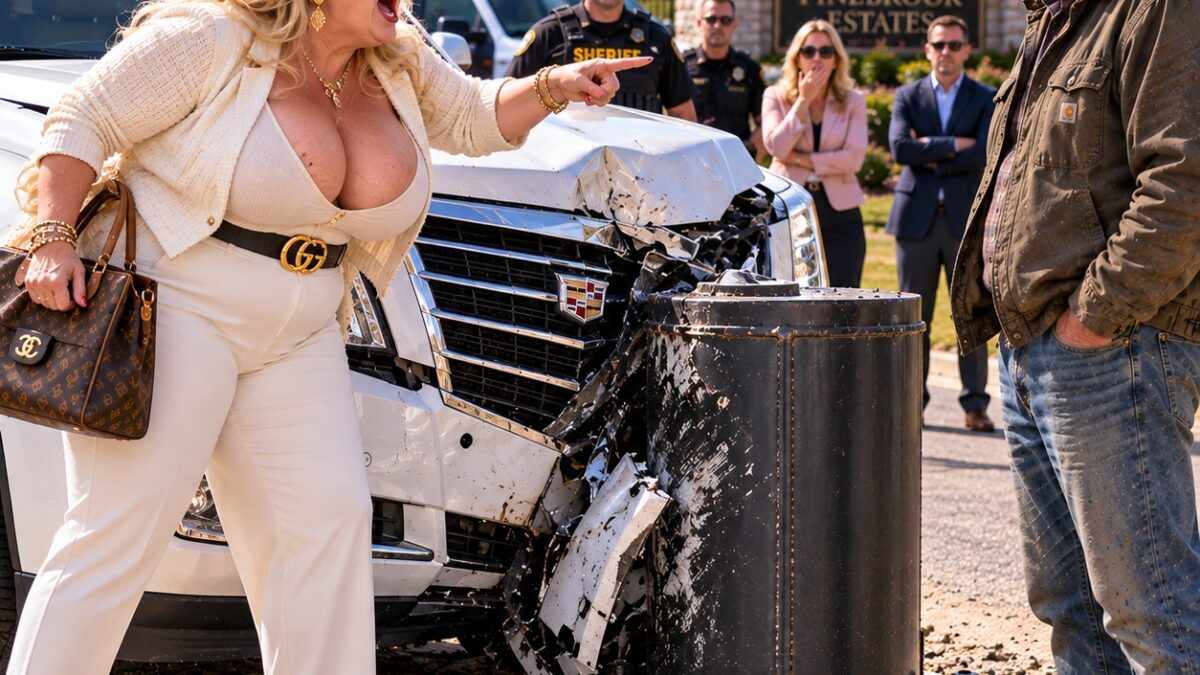
The Escalade sat angled slightly toward my property, front end crushed inward. No airbags had deployed, but the damage was obvious even before I reached it. The grille was broken. The bumper assembly folded. A headlight hung wrong. Fluid began to drip near the underside.
Sloan remained inside for nearly three minutes.
The camera caught it all.
Her hands stayed on the steering wheel.
Her face stared forward.
Then she got out.
She wore a tennis skirt, light jacket, perfect hair, and the stunned expression of a person who had lived her life believing consequences were things other people received.
She walked to the front of the Escalade.
Bent.
Looked.
Then turned toward the thing she had hit.
To her, it still looked like a trash can.
She kicked it once.
It did not move.
She kicked it harder.
Still nothing.
Then she bent down, grabbed the upper edge, and tried to lift it.
Nothing.
For forty seconds, she just stared.
I stopped a few feet away.
“Mrs. Westbrook Calhoun. Good morning.”
She turned.
Her face had gone pale except for two spots of color high on her cheeks.
“What did you do?”
“I protected my property.”
“This is a trash can.”
“No,” I said. “It is a cover. The county trash can is in my garage. Under that cover is a fixed property-protection post. It is inside my property line.”
“You trapped me.”
“No. I placed a fixed structure on my property after twenty-three documented incidents of you driving onto my property to crush my trash cans.”
She opened her mouth.
Closed it.
Opened it again.
No sound came out.
That was the first time I had ever seen Sloan Westbrook Calhoun without language prepared.
She got back into the Escalade and tried to restart it.
The engine did not cooperate.
I went back to the porch.
Hazel poured me another cup.
The tow truck arrived at 8:20.
The insurance assessor came later that morning. He reviewed my camera footage, took pictures, checked the placement, and filed a report calling it a single-vehicle collision with a permanent fixed structure, vehicle at fault, structure inside property line.
The damage estimate came to $14,800.
Sloan’s insurance paid for the vehicle damage minus her deductible, then later pursued its own issues with her once the full pattern of prior incidents became clear.
That might have been the end of it if Sloan had been capable of embarrassment without escalation.
She was not.
On April 11, she filed a civil lawsuit against me in Holmes County Common Pleas Court for negligent installation of a roadside hazard.
Roadside hazard.
That was the phrase.
I have admired fine absurdity before, but that one deserved framing.
For eighteen months, she had driven at my property. When my property finally stopped collapsing, she argued that the problem was the existence of something strong enough to resist her.
Wesley came down that weekend.
Hazel cleared the kitchen table.
Saskia called twice with organization suggestions because teachers understand folders better than most lawyers.
By Sunday evening, we had eighty-one pages ready.
The twenty-three videos.
Sheriff reports.
Replacement receipts totaling $912.
The pre-installation acknowledgment from Holly.
The county right-of-way survey.
The engineering design review.
The timeline.
The insurance report.
Every photograph.
Every date.
Every measurement.
Every document in the proper order.
Judge Cordelia Halverson held the pretrial conference on April 18.
The whole thing lasted twenty-eight minutes.
Sloan arrived in court dressed like someone attending a charity luncheon under protest. Her attorney was from Wooster, polished enough, probably used to turning disputes into billable fog.
Judge Halverson was not fog-friendly.
She read the materials.
Asked a few questions.
Then looked at Sloan’s attorney and said, “Your client claims this fixed structure created a hazard?”
“Yes, Your Honor.”
“After twenty-three prior contacts with trash cans in the same location?”
“My client disputes intentional—”
“I understand what she disputes. Did she stop after any of those contacts?”
The attorney hesitated.
“Not according to the submitted reports.”
“Did she compensate the property owner for any damaged cans?”
“No, Your Honor.”
“Did she adjust her driving pattern?”
“I cannot speak to—”
“The videos speak to it.”
That was the moment I knew the lawsuit was over.
Judge Halverson dismissed Sloan’s claim and referred the full incident file to the Holmes County Prosecutor’s Office for potential vandalism charges.
I did not smile in court.
Hazel says my left eyebrow moved.
That is possible.
On May 2, the prosecutor filed twenty-three misdemeanor vandalism counts.
Sloan took a no-contest plea on June 17.
Suspended jail time conditioned on probation.
Eighteen months probation.
Restitution for the cans.
Community service.
And a separate civil judgment for emotional distress and continuing harassment.
I thought that would be the end of Sloan Westbrook Calhoun in my life.
But sometimes a trash can is only the first loose thread.
During the civil process, Wesley and Saskia helped me look through HOA financial records that residents had begun sharing after Sloan’s accident became the most discussed event in Pinebrook history.
The residents had questions now.
That matters.
Abuse works best when people believe they are the only one being targeted. Once they compare notes, patterns start showing.
It turned out Sloan had been billing Pinebrook Estates $1,200 a month for “community safety patrol consulting” through her personal LLC.
Thirty-one months.
$37,200.
Most residents had no idea.
There had been no proper board approval.
No meaningful documentation.
No legitimate services anyone could identify beyond Sloan driving around and acting official.
The HOA investigation became a state case.
On July 23, Sloan entered another plea tied to embezzlement.
Jail time.
Probation.
Restitution.
A permanent ban from serving on any Ohio common-interest community board.
That last part seemed right to me.
Some people should never be given authority over anything more complicated than their own grocery list.
Her husband, Holden, filed for divorce in August.
Their house sold in November at a steep loss.
I did not celebrate that.
I know some people wanted me to.
They expected me to enjoy watching the Calhoun household come apart. But I kept thinking about the three children in that house. Children do not vote in HOA elections. Children do not file consulting invoices. Children do not steer Cadillacs into trash cans.
They inherit the wreckage adults make.
Holmes County is not perfect, but it has quiet ways of looking after children caught in storms they did not create. Sloan’s children ended up staying with family in Wooster. People checked on them. Not loudly. Not for credit. Just because decent communities do not punish children for their parents’ collapse.
Pinebrook elected a new HOA board in late August.
The new president was Magnus Witford, a retired public school principal. He drove to our place the first Saturday in September carrying a casserole and a handwritten apology from the new board.
That is Holmes County.
Sometimes the apology arrives with noodles.
Magnus sat on the porch with Hazel and me for three hours. He apologized for the prior board’s failure to address Sloan’s behavior. He told us they had repealed the self-serving bylaws Sloan had pushed through during her presidency. He promised the HOA would be a quieter neighbor.
He did not overpromise.
I respected that.
He and his wife have since come for Sunday dinner twice. Magnus drives a 2007 Toyota Camry and slows to about fifteen miles per hour when passing my mailbox.
Magnus has never crushed anything.
That counts.
The post remains at the road.
The cover was replaced after the Escalade impact, and twice more later from ordinary weather wear. No vehicle has struck it since April 5. The trash truck still arrives at 9:15 most Fridays. Bram, the driver, knows the story and always asks how the post is holding up.
I always tell him it is holding.
The story traveled farther than I expected.
The Wooster paper wrote about it.
Then the Akron paper.
Then a Cleveland television station came out and interviewed me in the shop.
Reporters liked the image: retired welding instructor builds strongest trash can in Ohio; HOA president in Escalade learns physics.
I understood the appeal.
It sounded clean.
Almost funny.
But the funny version leaves too much out.
It leaves out Hazel sitting beside me on the porch, quietly reminding me I was allowed to protect what was ours.
It leaves out Holly Brewster building a file for eighteen months because he knew truth sometimes needs patience before it becomes usable.
It leaves out Wesley, who took the irritation of a rural property dispute and translated it into safety design and legal placement.
It leaves out the way small violations wear on a person.
It leaves out how often people with fake authority rely on everybody else deciding the fight is too petty.
After the news story aired, people started calling my fabrication shop.
A retired teacher whose mailbox had been knocked down weekly by a neighbor.
A farmer whose fence corner kept being clipped by contractors.
A couple whose driveway reflector posts were being destroyed by a delivery driver who refused to slow down.
Every case was different.
Not every case needed steel.
Sometimes they needed cameras.
Sometimes a letter.
Sometimes the county.
Sometimes a survey.
But in fourteen cases, I built property-protection posts designed for specific legal locations and specific documented damage patterns.
I stamped each one with a small bronze tag from Galloway Custom Fabrication.
That was not vanity.
That was accountability.
If I build something, I want my name on it because I want the work to be good enough to carry it.
Our church held a discussion night later that spring about lawful self-protection in the face of repeated vandalism.
Pastor Eldrid was careful not to make it only about my case. Mennonite-adjacent communities have a deep instinct against making one person the center of a lesson when the lesson belongs to everyone.
The question was broader.
When someone repeatedly targets property, what does a peaceful community owe itself?
The discussion lasted two hours.
People spoke slowly.
People listened.
Some worried that building strong protection might feel too close to retaliation.
Others argued that stewardship includes preventing ongoing harm.
In the end, the congregation supported a statement saying lawful structural property protection could be consistent with proportional response and stewardship.
Hazel cried when the statement was read aloud the next Sunday.
I did not.
Not where anyone saw.
Holmes County is polite enough not to study a man’s face too closely in church.
Holly Brewster retired from the sheriff’s office that fall after twenty-eight years of service. His retirement party was at the Kilbuck VFW. I gave a short toast.
I told the room that the post at my road worked because Holly had done the unglamorous work first.
The reports.
The measurements.
The file.
The patience.
Without that, my steel would have looked like anger.
Because of that, it looked like evidence.
Holly wiped his eyes when the room applauded.
Then he took a part-time job as a school resource officer at Holmes County Joint Vocational School, the same building where I taught for thirty years. He tells welding students the story now, apparently more often than I deserve. The current instructor says it has become part of orientation.
I like that.
Young welders should know two things early:
Heat moves metal.
Documentation moves courts.
Hazel wrote the children’s book that winter.
The Strongest Trash Can on Township Road 167.
It follows a little wooden figure named Rumpus who learns that standing firm is not the same as being mean. I told her the title was ridiculous. She told me my opinion was noted and dismissed.
A small regional publisher agreed to release it at the Holmes County Antique Festival.
Hazel has asked me to read from it at the children’s tent.
I have practiced.
She says I read like a welding instructor.
I told her I am a welding instructor.
She said, “Exactly. Slow down.”
That is also marriage.
One reporter came back a year later and wrote a follow-up article. She interviewed Magnus, Holly, Wesley, Pastor Eldrid, the prosecutor, and Hazel.
Hazel had avoided speaking on record before that.
This time, she sat at the kitchen table and talked for forty minutes.
In the article, she said, “Quinn taught 2,800 young people how to weld across his career. He taught them carefully. He taught them that good work has to last. The post at the road is the smallest piece of work he has ever made. It is also the most public. It tells the truth about what he taught for thirty years.”
I read that on the porch with coffee.
Then I cried for almost a minute.
Hazel came out with a fresh cup and said, “I meant every word.”
“I know.”
“It is in writing now.”
“I know that too.”
The cardinals were in the dogwood that morning.
The road was quiet.
The new family in Lot 14 walked their dog past later that week. Their little girl stopped near the mailbox and asked her mother, in a voice clear enough to reach the porch, “Is that the famous trash can?”
Her mother said yes.
The little girl studied it seriously.
Then she took her mother’s hand and walked on.
The post did not move.
That is the part people miss when they want the story to be about revenge.
Revenge would have burned hot and gone cold quickly.
This was not hot.
This was patient.
This was eighteen months of choosing not to do something foolish.
This was replacing cans when I was angry enough to throw the broken pieces into Sloan’s driveway.
This was calling Holly instead of confronting her at Pilates.
This was letting the camera watch.
This was letting the file grow.
This was asking my son for engineering advice rather than letting pride design the answer.
This was Hazel telling me to build it right, not build it loud.
This was a judge reading the record.
This was a community deciding, carefully, that peaceful does not mean defenseless.
Sloan believed small damage could stay small forever.
She was wrong.
Small damage repeated becomes a pattern.
A pattern documented becomes evidence.
Evidence organized becomes a case.
A case supported by lawful work becomes consequence.
And consequence, when it finally arrives, can sound like a Cadillac front end meeting steel on a Friday morning.
I still sit on the porch in the evenings with coffee. Our hound, Reuben, lies near my feet. Yes, he is named for my grandfather. The shop still runs. Three current welding seniors come by on Saturday mornings for informal mentorship. They are good kids. Careful enough. Impatient in the usual ways. I write them recommendation letters and sign each one the same way.
Physics does not negotiate.
Take care of the work.
Quinn Galloway.
The trash can sleeve still sits near the road when needed.
The real can comes and goes.
The county truck stops.
Life goes on.
That is the best kind of ending for a rural property dispute.
Not fireworks.
Not speeches.
Not somebody standing in the road declaring victory.
Just quiet.
Just the road being a road again.
Just the property line holding where it always was.
Just Hazel beside me, the dog at my feet, the cardinals in the dogwood, and a piece of steel under a plain cover reminding anyone who needs the reminder:
Some things can be pushed around for a while.
But not forever.
And not if you build them right.