The Wounded Dog Who Refused to Let the Mountain Keep Its Secret
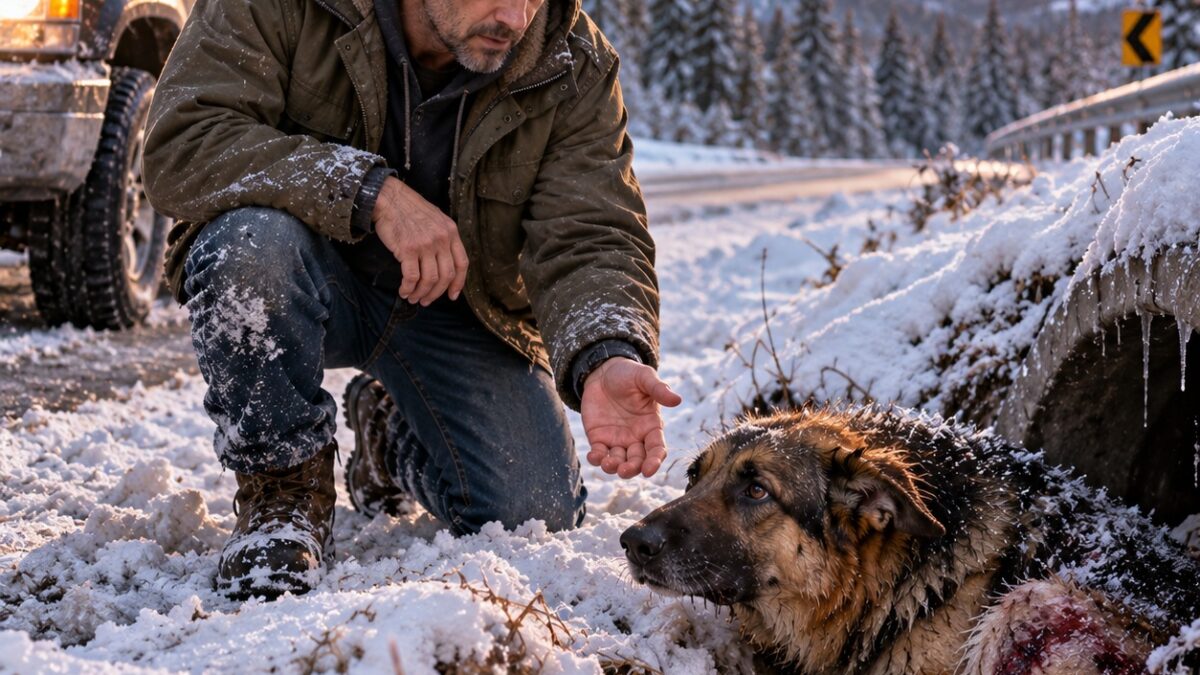
The Wounded Dog Who Refused to Let the Mountain Keep Its Secret
I HAD ONLY ENOUGH GAS TO GET MYSELF HOME, BUT THE DYING GERMAN SHEPHERD IN THE DITCH LOOKED AT ME LIKE I WAS THE LAST PERSON LEFT WHO MIGHT STILL TURN AROUND.
I THOUGHT I WAS SAVING ONE WOUNDED DOG FROM A MONTANA STORM, UNTIL HE DRAGGED HIS BROKEN BODY TOWARD MY TRUCK AND BEGGED ME TO FOLLOW HIM BACK INTO THE WHITEOUT.
WHAT HE LED ME TO BENEATH THE SNOW WASN’T JUST A WRECK THE WHOLE TOWN HAD MISSED—it was the purpose I thought the world no longer needed from me.
Winter had come early to Silverpine, Montana.
Not as a storm at first.
As an occupation.
Snow rested on the roofs of the hardware store, the laundromat, the old bakery with the cracked blue sign, and the narrow porches of houses that leaned closer together against the cold. It covered the empty lots behind Main Street and gathered in soft white drifts around pickup tires, fence posts, mailboxes, and the low stone walls outside the county bank.
The mountains beyond town stood bright and distant under a pale sky, their pine-covered slopes washed in a clean, merciless light.
It was the kind of winter that did not need darkness to feel lonely.
It only needed silence.
I sat in my old pickup outside the Silverpine Freight office and watched the manager through the frosted glass door. He was already back at his desk, already leaning toward a computer screen, already returned to whatever part of the day had value.
The interview had lasted nineteen minutes.
I knew because I had looked at my watch when I stepped inside and again when I stepped out.
Nineteen minutes was long enough for a man to be politely measured and quietly set aside.
The manager had not been cruel.
That made it harder to resent him.
He had shaken my hand with warmth and caution, scanned my résumé, nodded at my military experience, and asked about route coordination, fuel tracking, emergency planning, dispatch communication, and winter driving.
For a few minutes, I almost believed the old skills still had names that mattered.
Then the questions shifted toward scheduling software, live fleet dashboards, driver app compliance, automated routing updates, and whether I would be comfortable learning a new digital system quickly while working rotating overnight shifts.
I answered honestly.
I could learn.
I had learned harder things in worse places.
I had coordinated convoys through roads that were not roads anymore, checked fuel under hostile skies, rerouted trucks around washed-out bridges, and kept men moving when weather and fear both wanted them still.
But I did not know how to sell those facts in a room that smelled like printer ink and warm coffee.
I spoke too plainly.
Paused too long.
Looked at the map on the wall more than the tablet on the desk.
The manager thanked me and said they were looking for someone a little more current with systems integration, a little more flexible, a better fit for the pace of the operation.
A better fit.
I had heard that phrase three times in two months.
It was never shouted.
It never had to be.
I turned the key. The pickup coughed once before the engine caught, rough and tired like an old animal asked to stand one more time. The fuel needle trembled just above empty.
I watched it for a second.
Not because staring could move it upward.
Because some habits had survived every other failure in my life.
Check the fuel.
Check the weather.
Check the road.
Check the people you were responsible for.
Those rules had once kept men alive.
Here, they made me look rigid, old-fashioned, difficult.
I pulled away from the curb and drove slowly through town. Snowbanks glowed along the street in late afternoon light. A woman came out of the pharmacy with a white paper bag held under her coat. Two men in work jackets salted the steps of the diner. A plow truck rolled past, orange lights turning lazily, pushing a blade full of snow toward the edge of the road.
Everything was ordinary.
That somehow made me feel more outside of it.
In the glove compartment, folded beneath an expired registration notice and a pair of work gloves, was the letter from the bank.
I did not need to read it again.
The words had arranged themselves inside me.
Past due.
Final review.
Payment plan required.
Property at risk.
It was not a foreclosure notice yet, not the final door slamming shut, but it was close enough that I could hear the hinges moving.
The small house outside town had belonged to my parents, then to my father after my mother died, then to me after the funeral that left me standing alone in a yard full of snowmelt and folded chairs.
It was not worth much to anyone else.
To me, it was the last fixed point on a map that had otherwise gone blank.
I drove past the gas station without turning in. The sign showed a price that made my jaw tighten. I had enough in my wallet for a few gallons or a cheap meal, not both, and maybe neither if the card at the pump held a pending charge too long.
There was a dented red fuel can in the shed at home, half full if I remembered right. I had been saving it for the generator in case the power went out.
Winter did not care whether a man had choices.
It only arranged the consequences.
The road climbed as I left Silverpine behind. Houses thinned into dark timber and fenced fields. The sky opened wide over the pass, pale blue fading toward iron at the edges. Snow lay smooth across the shoulders, broken only by tire tracks and the dark ribs of frozen grass.
I drove with both hands on the wheel, shoulders squared, jaw set.
I did not turn on the radio.
The truck heater blew weakly against the windshield, making a small clear arc in the fogged glass. Beyond that arc, the world looked distant, as if I were watching it through old film.
At the first sharp curve above Miller’s Creek, the back tires slipped lightly.
I corrected without thinking, easing off the gas, letting the truck settle.
My body remembered what usefulness felt like before my mind could argue with it.
That small correction, that quiet knowing, made something ache in me.
I had not stopped being capable.
I had only stopped being easy to place.
A mile later, I saw the dark shape near the drainage ditch.
At first, I thought it was trash.
A torn tarp maybe.
Or a coat blown from the bed of somebody’s truck.
It lay half in the snow, half against the culvert, black and brown at the edge of the road where plows had thrown dirty ice.
I drove past it because people drive past things all the time.
Then a sound reached me through the closed window.
So faint it seemed less heard than felt.
A thin, broken whine.
My foot lifted from the gas.
The truck rolled forward another few yards.
I looked at the fuel needle.
Then at the road ahead, white and empty, bending toward home.
The whine came again, weaker this time, nearly swallowed by wind moving through the pines.
I braked.
For a few seconds, I stayed in the driver’s seat, both hands still on the wheel.
I could keep going.
That was the clean fact.
I could tell myself the animal was already too far gone, or that someone else would come, or that stopping on an icy pass with almost no gas and a bank letter in the glove compartment was foolishness wearing the mask of decency.
I had heard men excuse worse decisions with better words.
The truck idled roughly.
The fuel needle trembled lower.
I shut off the engine.
FULL STORY CONTINUATION
The cold hit me the moment I opened the door.
It slid under my jacket, through my sleeves, into the joints of my fingers. I stepped down carefully, boots crunching through packed snow, and walked back along the road with my collar pulled high.
The wind pushed at me from the west, carrying fine grains of snow that stung my face.
The shape by the ditch moved once.
It was a German Shepherd.
Male.
Large-framed, though hunger and cold had pulled the strength out of him.
His coat was yellow and black beneath blood and snow, honey-gold along the legs and chest, with a dark saddle across his back like spilled coal. One ear stood rigid. The other had a small nick at the tip. His muzzle was black, dusted white with frost.
A brown leather collar circled his neck, but the tag was gone, leaving only a small empty metal ring that clicked faintly when he breathed.
Blood had dried along his left shoulder, then opened again where ice had rubbed it raw. His front right leg trembled whenever he tried to move it.
He did not bark.
He did not growl.
He only watched me with amber-brown eyes that seemed too awake for a body that close to giving up.
I crouched several feet away, slow enough not to frighten him.
Pain pulled at my knee, an old weather gauge buried in the joint.
I ignored it and took off one glove.
“Easy,” I said.
The dog’s eyes shifted to my bare hand. His body tightened, expecting the hand to become something else.
I knew that flinch.
I had seen versions of it in men.
In mirrors.
Anyone who has learned that help can arrive wearing the same shape as harm knows how to look at an open hand and still brace for pain.
“I’m not going to grab you,” I said, though the dog could not know the promise by its words. “Not unless you let me.”
I placed my hand palm down on the snow between us and waited.
The wind moved over the road.
A crow called once from somewhere in the trees.
The dog’s breath came shallow and uneven. I could see the faint movement of ribs beneath wet fur.
Every practical part of me began listing the costs.
The clinic was back in town.
Town meant fuel.
Fuel meant money.
Money meant the letter in the glove compartment.
If I used the last of what I had to save a dog, nothing about my life became more secure. No employer would call because of this. No bank would extend mercy because of this. No furnace would fill itself with heat because Caleb Ror had once again mistaken responsibility for survival.
The dog lowered his head, then lifted it again with terrible effort.
His nose stretched toward my hand.
He did not make contact.
He came close enough for me to feel the warmth of one weak breath against my knuckles.
That was enough.
Something inside me shifted.
Not dramatically.
Not like courage arriving with music.
More like an old lock turning after years of rust.
I had spent the whole morning being told gently that I did not fit where people needed me. Now, in the ditch beside an empty mountain road, a wounded animal looked at me as if I were the last possible answer left in the world.
I hated that it mattered.
I hated that I still had enough heart for it to hurt.
But I could not unsee the look.
I could not drive home and sit in my father’s chair with that sound still alive in my head.
“All right,” I whispered. “All right, boy.”
I stood, went back to the truck, and pulled the old wool blanket from behind the seat. The engine was off, the silence around it total.
When I returned, the dog had not moved except to follow me with his eyes.
I spread the blanket beside him first, letting him see it, letting him smell it.
Then I eased one arm under his chest and another beneath his hips.
The dog stiffened. A low sound caught in his throat.
But he did not bite.
I lifted him carefully.
He was heavier than he looked, all bone and wet fur and exhausted muscle. The movement sent a hot line of pain up my back, but I held steady.
By the time I reached the passenger door, my breath was coming hard.
I laid the dog across the seat and tucked the blanket around him.
Snow melted instantly on the torn vinyl. Blood smeared my sleeve. The dog’s eyes stayed open, fixed on me. Not trusting. Not surrendering. Only watching.
I climbed behind the wheel and turned the key.
The pickup hesitated.
For one sick second, the engine did nothing but grind.
I closed my eyes briefly, one hand on the wheel, the other still cold and bare.
“Come on,” I murmured.
The engine caught.
The fuel needle sagged against empty.
I looked once toward the road home. Then into the rearview mirror at the white pass behind me. Then at the dog lying on the seat under my coat and blanket.
The choice had already been made.
But my body still understood its weight.
I turned the truck around slowly, tires sliding slightly before finding grip, and pointed the hood back toward Silverpine.
Snow thickened across the windshield. The wipers dragged it aside in tired arcs. The dog made one faint sound.
Not pain exactly.
Not peace either.
I reached over and rested my gloved hand near the blanket without touching him.
“Stay with me,” I said.
The town lights were far below, blurred by falling snow. The truck rolled downhill on the last gas in the tank, carrying a man who had almost nothing left and a wounded German Shepherd who had even less.
I did not know whether we would make it to the clinic.
I did not know whether I would make it home afterward.
I did not know whether the bank letter in the glove compartment had already decided more than I could undo.
I only knew the road behind me had held a dying creature in the snow, and for once, I had not kept driving.
So I leaned closer to the windshield, guided the old pickup through the white, and kept going.
The pickup made it into Silverpine on fumes.
I felt the engine hesitate twice on the last downhill stretch, each stutter traveling through the steering column into my hands like a warning I had no money left to answer.
The dog lay across the passenger seat under the old wool blanket and my forest-green jacket, his breath so shallow that I kept glancing over to make sure the rise and fall of his ribs had not stopped.
Snow came harder now. No longer drifting in soft white veils, but striking the windshield in quick, slanted bursts. The town looked smaller through it, storefronts blurred behind halos of yellow light, sidewalks already filling after the plow had passed.
I did not go to the gas station.
I did not have enough fuel to waste turning in and not enough cash to make the stop useful.
I drove straight through Main Street, past the darkened bakery and closed thrift store, then turned toward the low blue building near the edge of town where a hand-painted sign read:
Vale Veterinary Clinic.
One light still burned behind the front window.
The truck rolled into the clinic lot just as the engine began to shudder. I parked crookedly beside a snowbank and killed the ignition before the engine could die on its own.
For a second, I sat there with one hand on the wheel and the other hovering over the blanket, listening to the dog breathe.
The clinic porch light swung in the wind. Inside, someone moved behind frosted glass.
I got out, opened the passenger door, and gathered the dog carefully against my chest. Injured bodies are heavy in a way that is hard to explain. All resistance gone, but none of the weight spared.
Warm blood had seeped through the blanket and darkened my sleeve. The empty metal ring on the dog’s collar clicked once against the button of my shirt, a small sound that seemed too delicate for the storm around us.
I shouldered through the clinic door with my back because both arms were full.
A bell above the frame gave a sharp little ring.
A woman’s voice called from somewhere beyond the counter.
“We’re closed unless it’s an emergency.”
Then Maggie Vale stepped out of the treatment room and saw what I was carrying.
Whatever else she had meant to say vanished.
Maggie was in her mid-forties, with chestnut-brown hair pulled low at the back of her neck and a few silver strands that had escaped around her temples. She wore a soft teal veterinary coat over a gray turtleneck, charcoal cargo pants, and black slip-resistant shoes.
There was nothing sentimental in her face at first glance. Her eyes were dark, direct, and tired in the practical way of someone who had seen too many people wait until suffering became convenient to notice.
She pointed at the exam table.
“There. Now.”
I laid the German Shepherd down as gently as I could.
The dog’s head rolled slightly, and his amber-brown eyes opened halfway.
Maggie was already moving.
She pulled towels from a warmer, clipped a thermometer into place, checked gum color, listened to his chest, and ran careful hands along his ribs, shoulder, hip, and foreleg. Her movements were quick without being rough.
I stood beside the table, useless for the first time since I had stopped on the mountain road, and watched her read the animal the way I once read weather and maps.
“Male,” she said. “Adult. Six, maybe seven. Hypothermic, dehydrated. Shoulder laceration is deep, but not clean enough to be from a knife. More like he tore himself open on metal or rock. Front right leg is unstable. Maybe a sprain, maybe partial dislocation. I need X-rays, fluids, antibiotics, sutures, and heat.”
She glanced at me only long enough to take in the wet clothes, the snow in my beard, the blood on my sleeve.
“He yours?”
“No.”
Her hands did not stop.
“Found him on the pass.”
“How long ago?”
“Twenty minutes. Maybe thirty.”
In that storm, there was no admiration in her tone.
Only calculation and concern.
She lifted the blanket and saw the raw torn skin at the shoulder more clearly.
The dog flinched but did not snap.
Maggie noticed that too.
“You’re lucky he didn’t bite you.”
I looked at the dog’s face.
“He had other things on his mind.”
Maggie paused just long enough for that sentence to land, then reached for a syringe.
“Hold his head steady, but don’t pin him. If he panics, let me know before he does.”
I stepped closer.
The dog’s eyes moved to me, wary and glassy with pain.
I placed one hand near the side of his neck, not pressing, only present.
“Easy,” I murmured. “Nobody’s taking anything from you.”
The dog did not understand the words, but his breathing changed slightly.
Maggie inserted the needle, taped the line, and hung a bag of warm fluids from a hook beside the table.
The clinic heater groaned in the corner, pushing out thin warmth that smelled of dust, antiseptic, damp wool, and clean towels. Outside, the storm slapped snow against the windows. Inside, the room narrowed to the small facts of survival.
Pulse.
Temperature.
Blood.
Breath.
When the dog was wrapped in heated towels and the worst of the bleeding had been controlled, Maggie finally looked fully at me.
“I can stabilize him tonight,” she said. “But I need to be honest with you. This isn’t a rinse-and-bandage situation. He’ll need medication, monitoring, probably X-rays tomorrow if the weather lets up. He may have internal bruising. He may crash once he warms if shock sets in.”
I nodded.
I had known there would be a cost.
Knowing did not make the moment easier.
Maggie studied me.
“You said he isn’t yours.”
“He isn’t.”
“Then I need to ask the question before I start building a bill nobody can pay.”
She did not say it cruelly.
That made it worse.
“Are you authorizing treatment?”
I felt the weight of my wallet before I touched it.
A few folded bills.
A card I was not sure would clear.
A life reduced to small humiliations counted silently in public rooms.
I looked toward the window where snow erased the parking lot in white strokes.
Then down at the dog.
The German Shepherd had turned his muzzle slightly toward the clinic door. Even half conscious, he was not resting into safety. His ears twitched whenever the wind rattled the frame, whenever the metal tray beside Maggie’s sink vibrated faintly, whenever something outside sounded like it might be leaving.
I reached for my left wrist.
The watch came off harder than I expected. The leather strap had stiffened with age and cold, and my fingers were still numb. It was an old military field watch with a dark face, scratched steel case, and a faint crack running from the three to the six.
To most people, it was worth little.
To me, it was the only thing I had carried through every version of myself.
Soldier.
Son.
Man returning for a funeral.
Man trying to sleep in a house too quiet.
Applicant sitting across from strangers who smiled while removing him from consideration.
I set it on the counter between myself and Maggie.
“I don’t have enough tonight,” I said. “Keep that until I do.”
Maggie looked at the watch but did not pick it up.
“That won’t cover this.”
“I know. It might not cover the medication.”
“You could have taken him to county animal control.”
“Would they be open in this storm?”
She said nothing.
I kept my voice even.
“I’m not asking you to do it free. I’m asking you to start before he runs out of time.”
Maggie’s face softened so slightly someone less observant might have missed it.
She looked at my hands, red and chapped from cold, one sleeve stiffening with the dog’s blood. A small tremor in the fingers that had nothing to do with fear.
Then she looked back at the German Shepherd, who had lifted his head a fraction at the sound of a truck passing outside, weak body answering some urgency no one in the room had named.
“Fine,” Maggie said. “I’ll treat him tonight. You stay and help. If he wakes scared, I need someone he’s already decided not to bite. If he crashes, I need hands. If he makes a mess, you clean. If he lives, we talk about payment when the roads open.”
I exhaled through my nose.
It was not relief exactly.
Relief would have required something to be solved.
This was only the door not closing yet.
“Yes, ma’am.”
“Don’t ma’am me. It makes me feel like I should have retired ten years ago.”
She picked up the watch, considered it, then placed it in a small tray near the register instead of sliding it into her pocket.
“And don’t look grateful. Hold this towel.”
For the next hour, I did what I was told.
I held pressure when Maggie cleaned the shoulder wound. I kept a warm towel around the dog’s abdomen while she clipped fur away from torn skin. I opened packets, handed gauze, and lifted him only when Maggie told me exactly how.
The German Shepherd shuddered when antiseptic touched the wound, a deep tremor passing through his body, but he still did not bite.
Once, when a metal instrument slipped in the tray and rang sharply against another, the dog jerked so hard the IV line tugged. I caught his shoulder before he could roll off the table.
“Easy,” I said low and close. “Easy.”
Maggie’s eyes flicked to the dog’s collar.
“No tag. Just the ring. Looks like it was torn off, not unclipped.”
She leaned closer, touching the collar without pulling it.
“Old leather. Worn smooth. Somebody cared about him once.”
The dog made a sound then, barely more than air through his throat.
I felt it under my hand.
“Maybe they still do,” I said.
Maggie did not answer, but the silence that followed was not empty.
Somewhere, perhaps, there was an owner.
Somewhere, perhaps, a person was missing a dog.
Or perhaps the story was uglier than that.
I had learned not to fill unknown spaces too quickly.
Men died when guesses became facts.
When the wound was finally cleaned and loosely closed, Maggie eased the dog onto a padded mat in a warmed recovery room off the main treatment area. The room was small, dimly lit, with a low hum from a space heater and shelves stacked with folded blankets.
I sat on the floor because the wooden chair looked too far away from the dog, and because my back no longer trusted standing.
The German Shepherd lay with his head turned toward the doorway. His breathing had steadied, though each inhale still seemed to cost him something.
“He needs a name for the chart,” Maggie said from the doorway.
I rubbed both hands over my face.
I had not thought that far.
Names were not small things.
You could call something stray and keep distance.
You could call it dog and hand it to the next authority.
A name required the imagination to picture morning.
“Harlon,” I said finally.
Maggie tilted her head. “Family name?”
“No.”
I looked at the dog’s torn shoulder. The damp fur. The empty ring where a tag should have been.
“A man I knew pulled me out of a bad road once.”
Maggie accepted that without pressing.
“Harlon it is.”
The dog’s ear twitched at the sound, though he did not lift his head.
I almost smiled, but it hurt too much to complete.
Later, after Maggie locked the front door and taped a note to the glass saying EMERGENCY CALLS ONLY, she brought me a mug of coffee that had been sitting too long on the burner.
It was bitter and lukewarm.
I drank it anyway.
She stood near the recovery room entrance, arms folded, watching Harlon watch the door.
“He’s exhausted,” she said. “But he keeps fighting the sedative.”
“Pain.”
“Some fear too.”
She frowned.
“But not only fear.”
I looked up.
“I see dogs trying to go home,” Maggie said. “I see dogs trying to get away. This is different.”
Harlon’s eyes opened again.
The wind pushed hard against the building, and a strip of metal flashing outside tapped once against the siding. The sound was faint, thin, almost like a tag hitting wood.
Harlon’s whole body tightened.
He tried to lift his head, failed, then dragged one front paw forward against the blanket as if he meant to stand.
The effort was so weak it should not have mattered.
It mattered anyway.
I set the coffee down and moved beside him.
“Hey,” I said. “No. Not yet.”
Harlon looked at me.
Not through me.
At me.
The amber eyes were clouded with medication and pain, but something inside them had sharpened.
The dog was not asking to be comforted.
He was asking to be understood.
I felt that look settle in the room with more weight than any bill, any bank letter, any empty fuel tank.
It carried no words, but it seemed to say that surviving was not the same as being finished.
Maggie watched my face.
“You found him on the pass?”
“Yes.”
“Near any houses?”
“No.”
“Any wreck?”
“I didn’t see one.”
“That doesn’t mean there wasn’t one.”
I looked down at Harlon’s paw, still extended toward the doorway, toes trembling on the edge of the blanket.
“No,” I said quietly. “It doesn’t.”
The night lengthened.
Maggie moved between the front desk and the treatment room, writing notes, checking the IV, warming more towels. I stayed beside Harlon until his tremors eased.
Once near midnight, my own eyes closed and my chin dropped toward my chest. I woke when Harlon whined softly.
Not a cry of pain.
A thin, restrained sound that came from somewhere deeper than the wound.
I reached out, then stopped before touching him.
“You’re safe,” I said.
Harlon stared past me at the door.
By two in the morning, the storm had wrapped the clinic so completely that the windows were white from the outside. Maggie dimmed the lights and told me I could use the chair in the corner.
I sat there because arguing would have been pride without purpose.
Harlon lay beneath two blankets, breathing steadier now, body warmer, the IV dripping slowly in the quiet.
I should have slept.
Instead, I watched the dog and felt the old watch missing from my wrist. My skin kept expecting the weight of it. Each time my thumb moved to check the time and found nothing, I remembered the tray near the register, the bill waiting somewhere ahead, the truck sitting outside with almost no fuel, and the house at the edge of town cooling in my absence.
Maggie came in once more before dawn carrying a fresh towel. She looked at me with the blunt compassion of someone too tired to decorate the truth.
“You could have kept driving,” she said.
I did not answer at first.
Harlon’s eyes were closed now, but even in sleep, his ears shifted toward the door whenever the wind rose.
I studied the dog for a long moment.
The black muzzle.
The torn shoulder.
The empty collar ring.
The body that had nearly surrendered and still somehow seemed pointed toward something beyond the room.
Finally, I said, “There are enough things left out there already.”
Maggie looked at me, not quite understanding, not quite needing to.
Then she nodded once and adjusted the blanket over Harlon’s side.
I leaned back in the wooden chair, snow beating softly against the clinic walls, the old watch gone from my wrist, the last gas gone from my tank, and a wounded dog breathing in the yellow light as if the night had given us both one more hour than we deserved.
Morning did not arrive so much as thin the darkness.
The storm had spent the night pressing itself against the windows of Vale Veterinary Clinic, and by dawn the glass was feathered with frost. The parking lot lay buried beneath fresh snow, the town beyond it muffled into pale shapes and slow-moving headlights.
I woke in the wooden chair with a stiff neck, a dead hand, and the first blind second of not knowing where I was.
Then the antiseptic smell reached me, followed by the low hum of the space heater.
I remembered the dog.
Harlon was awake on the padded mat across the small recovery room, wrapped in two blankets Maggie had warmed before sunrise. His amber-brown eyes were clearer than they had been in the night, but there was no peace in them.
He was alive.
That should have been enough.
Instead, the German Shepherd lay with his head raised just high enough to face the clinic door, ears tense, body too weak to obey whatever command was moving through him.
I sat forward slowly.
“Morning,” I said, my voice rough from little sleep.
Harlon did not look at me.
Outside, a truck passed on the road, chains clinking softly against packed snow. Harlon’s body tightened so sharply that the IV tape on his foreleg pulled. He tried to lift himself, failed, and let out a thin sound that was not quite a whine and not quite a warning.
I stood before thinking and crossed the room.
“Easy. You’re not going anywhere yet.”
Harlon’s eyes flicked to me then, not with gratitude, not with fear alone, but with a kind of furious helplessness I had seen before in men who could hear trouble over the radio and were pinned too far away to reach it.
Maggie came in carrying medication cups and a mug of coffee that looked stronger than anything served to paying customers. Her chestnut hair was tied back with the same old blue cloth band, though more strands had escaped during the night. There were shadows under her eyes that made her look less sharp but no less steady.
She noticed Harlon’s posture before I spoke.
“He’s been doing that since four,” she said. “Every vehicle that passes. Every door hinge. Every little metal sound. He wakes up like he’s waiting for the world to answer him.”
She crouched beside the mat, not close enough to crowd the dog, and checked his gums, temperature, and bandage.
“Fever’s not bad. Shoulder’s ugly but holding. Leg still needs imaging when the roads clear. He should be resting.”
“He doesn’t know that.”
Maggie gave a tired breath that almost became a laugh.
“Dogs usually know more than we do about what they need. This one knows something else.”
She stood and rubbed both hands over her face.
“I called the county shelter before the line got patchy. Nobody reported a missing German Shepherd this morning. I left a message. Doesn’t mean much. Phones are down in pockets all over the valley.”
I nodded.
I should have felt relieved that no owner had called.
Instead, the absence made Harlon’s urgency heavier.
No one had claimed him.
But Harlon seemed to be claiming something outside that room with every breath.
By midmorning, Maggie had done all she could without better equipment and clearer roads. Keeping Harlon at the clinic would have been easier in ordinary weather, but ordinary had left sometime during the night.
A supply truck had slid sideways at the far edge of town. One of Maggie’s heat lamps had burned out. Emergency calls were starting to come in from ranches that could not wait until the storm felt convenient.
She did not like sending a wounded dog home with a man she barely knew.
And she said so plainly.
“He needs quiet warmth, water, small food if he’ll take it, and no stairs. He gets one antibiotic tonight and one at one in the morning. If the bandage bleeds through, call me. If he vomits, collapses, or starts breathing hard, call me. If he tries to run, you stop him without wrestling him. And if you decide you can’t handle this, bring him back before pride kills him.”
I took the paper bag of medication and the folded instruction sheet.
“I can handle quiet.”
Maggie glanced at me.
Then at the empty place on my wrist where the watch had been.
“Can you handle help?”
I did not answer quickly enough.
She gave the smallest nod, as if that confirmed what she already suspected.
“Thought so. I put a half bag of food by the door. Don’t argue. It was donated. That means you are not robbing me.”
I looked down.
Gratitude rose in me, uncomfortable and hard to swallow.
“I’ll pay for it.”
“You’ll keep him alive first.” Her tone softened only after the words had done their work. “Then we’ll discuss your heroic plan to repay a veterinary clinic with a cracked field watch and stubbornness.”
The pickup had not forgiven me for the previous day.
It started, but only after a long cough that made me hold my breath until the engine caught. Maggie helped me settle Harlon across the passenger seat, wrapped in the blanket with the medicine tucked in a box on the floor.
The dog’s head lifted weakly as soon as the truck faced west toward the edge of town.
I saw it.
I said nothing.
I drove carefully, using downhill when I could, avoiding hard acceleration because the fuel needle already lay so low it seemed less like a measurement than an accusation.
My house stood at the edge of Silverpine, where the last gravel road met a line of dark pines. It was a small one-story place with cedar siding faded gray, a porch that sagged slightly on the left, and smoke-dark stones around the chimney my father built before I was old enough to hand him tools properly.
Snow sat on the roof in a clean white cap.
The house looked patient from the road, as if it had been waiting without complaint for me to return with yet another impossible thing.
Inside, the air was cold but not frozen. I fed kindling into the stove until the first small flames found their shape. The room brightened in orange pieces.
The worn kitchen table.
The old brown chair by the window.
The wall where paper maps of county roads were still pinned under yellowing tape.
The metal cabinet of tools.
The coat hooks by the door.
Nothing in the house was decorative unless it had first been useful.
I liked it that way.
Usefulness was the only kind of beauty I trusted without suspicion.
I laid Harlon on a folded quilt near the stove, but not too close. Then I set water beside him and opened a small portion of food.
Harlon sniffed it, took two bites, and stopped.
His eyes went to the door.
I tried not to notice.
I changed the bandage as Maggie had shown me, hands steady, voice low. Harlon endured it with a tight jaw and trembling shoulders. When a gust of wind slapped the loose screen door against its frame, Harlon jerked upright with such suddenness that I caught his chest to keep him from falling.
“No,” I said, sharper than I meant to.
Harlon froze.
I felt the mistake immediately.
I lowered my voice.
“No. Not like that. I’m sorry.”
The dog watched me, breathing hard.
For the first time since the ditch, I understood that saving a body was the easiest part of mercy.
The harder part was not becoming another thing it had to survive.
By afternoon, the house had warmed enough for the windows to fog at the edges. I made coffee, counted the bills in my wallet, put them back without changing the outcome, and stood for several minutes at the kitchen counter reading Maggie’s instructions, though I already knew them by heart.
Harlon did not sleep.
He shifted.
Rested.
Lifted his head.
Listened.
Each time a vehicle passed far out on the county road, his ears sharpened. Each time the wind moved through the pines, his eyes returned to the west wall as if he could see through it to the pass.
I tried to distract him with water, food, a gentler voice, even the flat palm on the floor that had worked in the snow.
Harlon accepted none of it for long.
At last, near four, as the sky outside turned the color of tin and the snow began again in thicker flakes, the German Shepherd dragged himself to his feet.
It was not dramatic.
There was no bark, no sudden burst of strength.
It was worse than that.
A wounded animal was forcing pain into obedience because something beyond pain mattered more.
I moved toward him.
“Harlon.”
The dog took one uneven step toward the door.
Then another.
His injured leg buckled.
I caught him before he went down.
“Stop.”
Harlon twisted, not away from me, but toward the hook where my jacket hung. He pressed his muzzle against the sleeve, gripped the cuff gently in his teeth, and pulled.
At first, I thought he needed to go outside.
I took the leash Maggie had sent, clipped it carefully to the collar, and opened the door only wide enough for him to step onto the porch.
Harlon did not turn toward the yard.
He turned toward the pickup.
“No,” I said.
Harlon stood in the open doorway, snow blowing around his legs, and looked at the truck.
Not the road.
Not the trees.
The truck.
I shut the door against the wind, and the dog stumbled, then caught himself.
Frustration rose hot and humiliating because it had nowhere clean to go.
“I saved you,” I said, the words out before I could make them kinder. “Do you understand that? I found you. I got you warm. I put the last gas I had into getting you help. I don’t have more. I don’t have a second truck. I don’t have money sitting in a drawer. I don’t have the strength to chase ghosts up that pass because you can’t lie down.”
Harlon did not lower his eyes.
The anger left me as quickly as it had come, leaving only the shame of having spoken to a hurt creature as if it were responsible for the ruin of my life.
I turned away and pressed both hands to the edge of the table.
The bank letter lay there under a magnet shaped like a trout, its official language folded but not silenced. The house creaked around me. The stove popped softly.
Behind me, Harlon moved again.
This time, he did not go to the door.
He limped under the table, nosed aside my old boots, and pushed something across the floor.
I looked down.
It was the faded green canvas first-aid bag I had brought in from the truck the night before and dropped beside the table.
Harlon shoved it once weakly.
Then he looked up at me.
The room went very still.
I did not believe in signs.
I believed in tracks, fuel, weather, radio checks, road conditions, and the terrible importance of confirming what other people assumed.
But I also believed in trained eyes.
And Harlon’s eyes were not lost in panic.
Now they were fixed on me with exhausted insistence.
The dog had watched me.
He had seen the bag matter.
He had connected me with aid.
Movement.
Rescue.
Not comfort.
Rescue.
I crouched slowly, my knees aching.
“What did you leave out there?” I asked.
Harlon’s ears moved at my voice.
His body trembled with the effort of standing. He took the canvas strap of the bag in his teeth and pulled it one inch closer to the door.
I stared at the bag.
Then I stood and reached for the phone.
The county dispatcher answered on the fifth ring, her voice thinned by bad lines and too many calls.
I gave my name, then asked whether there had been any report of a wreck on the west pass near milepost seventeen.
I could hear typing, static, another voice in the background.
“Nothing active,” she said. “A couple slide-offs on Highway 6. One delivery van stuck near Elk Ridge. No injuries reported.”
“If someone saw something, we can log it.”
“Community transit?” I asked. “Any shuttle late?”
More typing.
“Routes show complete.”
“Show complete how?”
The dispatcher hesitated, perhaps hearing something in my tone.
“System status. Last driver check-ins are green.”
I closed my eyes.
Green.
Complete.
Clear.
Safe.
Words made by machines and tired people.
“Did anyone speak to the drivers?”
Static filled the line for two seconds.
“Sir, we’re in weather operations. If you have an emergency to report, report it.”
I looked at Harlon.
The dog stood beside the first-aid bag, shaking, eyes bright with pain and a plea that had no language but still demanded an answer.
“I don’t know yet,” I said. “That’s the problem.”
The dispatcher softened a fraction.
“If you go out, call us back with anything concrete. Roads are turning bad.”
The line clicked off.
I went to the wall maps.
I pulled down the county sheet with taped corners and spread it across the kitchen table. My finger found the place where I had stopped the day before.
Milepost seventeen sat on a secondary road that looped around the west side of the pass before rejoining the highway near the old timber yard. It was not a route most drivers chose unless the main road was blocked or unless they were local enough to trust memory over signs.
Years ago, I had done seasonal work checking tire chains and emergency kits for volunteer drivers who took older residents to appointments when families could not.
I remembered that road.
I remembered the way snow filled the ditch on the outside curve.
I remembered the dead pocket where radios failed for half a mile below the ridge.
Harlon had come from that direction.
I looked toward the window.
Snow thickened in the yard, falling straight now, heavy and quiet.
The sensible decision was to call again, insist harder, wait for county crews, keep the dog warm, keep myself warm, preserve the half-full red fuel can in the shed for the generator because losing power that night would make the house bitterly cold by morning.
But sensible decisions have limits when they are built on incomplete information.
I had spent too many years learning that if one fact refused to settle, you checked it yourself before it became a casualty count.
I put on my jacket.
Harlon’s whole body changed.
Not with joy.
With relief so sudden it nearly broke my heart.
“Don’t look at me like that,” I muttered. “I haven’t agreed to anything smart.”
I went out to the shed and dug the red fuel can from behind a stack of split wood. It was heavier than I expected, which meant memory had been kind for once. Half full. Maybe enough to reach the pass and return if I drove like a man with no right foot.
Maybe not.
I carried it through the snow, poured it into the pickup, and listened to the hollow glug of the last reserve leaving the can.
The sound had finality.
Heat later traded for motion now.
Back inside, I moved with the disciplined speed of a man who had stopped arguing with the decision. I packed blankets, the first-aid bag, two flashlights, spare batteries, gloves, a coil of rope, a folding shovel, bottled water, Maggie’s medication, and the instruction sheet I hoped I would not need to explain to her later.
I wrapped Harlon’s injured shoulder again, tighter but not too tight, then helped him toward the door.
His legs trembled.
I almost changed my mind at the sight of it.
Then Harlon lifted his head toward the truck, and I saw not strength, but purpose.
At the passenger door, I paused with one hand under his chest.
“You understand I don’t know what I’m following,” I said.
Harlon looked toward the road.
I helped him onto the seat, tucked the blanket around him, and placed the first-aid bag on the floor where the dog could see it.
The truck started rough but steady.
Snow swept across the headlights in bright rushing lines. I glanced once at the dark house, the empty fuel can near the porch, the thin smoke rising from the chimney.
Then I shifted into reverse.
“All right,” I said, backing into the white road. “Lead the way.”
The road back to the pass looked different the second time.
Yesterday, it had been a way home, a line through weather and worry. A stretch of mountain blacktop I wanted only to survive long enough to reach my stove and the silence of my own house.
Now it felt like a question laid out beneath the snow.
The pickup climbed slowly, headlights cutting two narrow tunnels through the storm. Snow came at the windshield in silver streaks, and the wipers shoved it aside with tired rubber groans.
Beside me, Harlon lay wrapped in the blanket Maggie had sent, his injured shoulder bandaged, his front leg tucked awkwardly beneath him.
He should have been asleep.
He should have been too weak to care where the truck went.
But every time the road curved west, his ears lifted. Every time I eased off the gas to keep the tires from sliding, Harlon’s head rose a little higher. His amber eyes fixed beyond the glass as though the mountain were calling in a frequency meant only for him.
I drove without the radio, without heat turned higher than necessary, without wasting a movement.
The old habits returned not as comfort, but as command.
I watched the shoulder, the ditch line, the changing color of packed snow, the way wind dragged loose powder across the road in low streams. The red fuel can was empty in the truck bed. The gauge still sat too close to nothing. At home, if the power went out, there would be no generator until I found more gas.
That fact waited in the back of my mind, cold and practical.
I did not let it take the wheel.
There were worse things than a cold house.
There were people who never made it back to one.
Harlon gave a sharp, breathless whine as we approached the first marker past Miller’s Creek.
I slowed.
“Not yet?”
I did not know what answer I expected.
Harlon’s paw pressed weakly against the seat. His muzzle turned toward the windshield, then left toward the outside curve.
I leaned closer, searching through the snow.
Nothing.
Only white road, dark trees, a guardrail half buried in plowcast, and beyond it, the steep fall of a talus slope.
I drove another hundred yards.
Harlon struggled upright so suddenly the blanket slid from his back. Pain shook through him, but he stayed braced on three legs and stared hard through the passenger window.
“All right,” I said. “I see you.”
I pulled onto the shoulder, tires crunching into deeper snow, and set the parking brake.
The moment the engine went quiet, the mountain seemed to swell around us. Wind moved through the pines with a low wooden moan. Snow hit the hood, the roof, the glass.
No horn sounded.
No voice called.
No smoke rose from the trees below.
The world looked clean, closed, innocent.
That frightened me more than wreckage would have.
I clipped the leash to Harlon’s collar but kept it loose.
“Slow,” I said. “You tear those stitches, Maggie will skin me alive.”
Harlon did not wait for the joke.
He limped toward the passenger door as soon as I opened it. I lifted him down before he could jump, feeling the tremor in his body through the blanket.
Harlon stood in the snow with his head lowered, sniffed once, then pulled toward the edge of the road.
Not wildly.
Not like a dog chasing scent for pleasure.
He moved with the exhausted certainty of a creature following the last part of a promise.
I took the flashlight from my jacket pocket and swept the beam across the shoulder.
At first, the light found nothing but unbroken snow.
Then I crouched.
Near the lip of the road, under a thin crust of fresh powder, a shallow groove curved away from the lane.
A tire mark almost gone.
I brushed snow aside with my glove.
The track was wide enough for a small bus or shuttle, too deep to be from a sedan. It angled wrong across the shoulder instead of along it.
My pulse changed.
I followed the groove ten feet.
Then twenty.
Until it vanished over the edge where snow had slumped.
A branch from a young pine below was broken, green wood exposed against white.
Farther down, another branch hung at an unnatural angle.
I swept the light lower.
The beam caught a tiny glint of glass embedded in ice.
“Harlon,” I said softly.
The dog strained forward and gave one low sound that seemed to come from the bottom of his chest.
I tied the leash around a roadside post long enough to keep Harlon from going over the lip, then opened the rear door of the truck and pulled out the rope, first-aid bag, flashlights, and two folded blankets.
I worked fast.
Not hurried.
Hurry killed people.
I looped the rope around a guardrail support, tested it with my weight, and began down the slope backward, boots cutting into snow crust, one gloved hand on the rope and the other holding the flashlight.
Twice my feet slid.
Once my bad knee twisted and sent a flash of pain up my thigh so sharp I had to stop and breathe through it.
I did not curse.
Cursing used air.
Halfway down, the beam of my flashlight crossed something yellow beneath a hanging veil of snow-laden branches.
Not bright yellow.
Not school bus yellow.
A duller paint faded by years of mountain weather.
A community shuttle.
Small and boxy, nose down between two pines, rear end lifted slightly by the slope behind it. Snow had buried the wheels and climbed halfway up the side panels. One side window was spiderwebbed with cracks. The front door was jammed into a drift and pinned by a young tree.
If I had stood on the road and looked straight down, I might have missed it completely.
I descended faster now, controlled but urgent.
At the shuttle’s rear corner, I pressed my flashlight to the glass and peered inside.
A face stared back.
For one second, my body went still before my mind understood the face belonged to an elderly woman wrapped in a pale coat. Her eyes were open but unfocused. Her mouth moved without sound.
Behind her, shapes shifted weakly in the dim interior. Frost silvered the inside of the windows. A man coughed deep and wet.
Someone whispered, “Light.”
I moved to the rear emergency door. Snow and bent metal blocked it, but not completely. I shoved my shoulder into it once, stopped when the shuttle creaked, and reassessed.
The vehicle was wedged, but not stable enough for brute force.
I cleared packed snow from the bottom seam, used the folding shovel to pry ice from the latch, and pulled.
The door opened six inches.
Then stuck.
Cold air moved out, carrying the smell of old vinyl, fear, diesel, and human breath.
“Can you hear me?” I called through the gap. “My name is Caleb Ror. I’m going to get help. How many are inside?”
For a moment, only coughing answered.
Then a woman’s voice, thin but steady enough to matter.
“Five. Driver and four passengers.”
“Any children?”
“No. No children.”
Good.
One less category of terror.
Not less urgent.
Just less fragile in a different way.
“I need names if you can give them.”
The woman nearest the back shifted under a blanket too light for the cold. She looked to be in her late sixties, maybe older, with silver hair crushed beneath a knit cap and the composed eyes of someone who had once given orders in rooms where people bled.
“Mavis Shaw,” she said. “Retired nurse. Driver is Arthur Bell. Head wound. Leg trapped. Mrs. Leland is hypothermic. George Pike has bad lungs. Roy Mercer’s shoulder is out or broken.”
The discipline in her voice steadied the whole bus.
I recognized the type immediately.
Not unafraid.
Useful inside fear.
“Good,” I said. “Mavis, I need you to keep talking to them. Short sentences. Names. Keep them awake if you can. Don’t move Arthur’s leg.”
“I know,” she said.
Then, softer, “We thought no one saw us.”
I took that sentence in and set it somewhere I could survive later.
“Someone did.”
I widened the gap enough to push one blanket through.
Then another.
I passed in bottled water but warned them to take small sips. I used my flashlight to assess what I could see.
George Pike, thin and gray-faced, clutched a portable oxygen cylinder with hands that shook too hard.
Roy Mercer, broad and white-bearded, sat braced against a seat with one arm held tight to his chest.
Mrs. Leland was curled beneath a coat, lips bluish, breathing shallow.
At the front, slumped sideways against the driver’s partition, was Arthur Bell. He was a small, weathered man in a navy quilted driver’s jacket, white hair matted with blood near the temple, one leg pinned awkwardly under the bent panel below the wheel.
His face had the soft-lined kindness of men who had spent years saying good morning even when the road was bad.
His eyes fluttered but did not open.
I checked the shuttle’s position again.
Pulling them out without equipment would risk shifting the vehicle.
Leaving them as they were meant cold would keep working on them.
I had minutes to make the inside less deadly and longer to bring rescue to the exact place.
Then a sound came from above.
Claws scraping snow.
A weak, desperate whine.
I turned.
Harlon had pulled free of the roadside post.
“No!”
I snapped the word, but the dog was already sliding down the slope in a clumsy, painful scramble, half falling, half dragging himself toward the shuttle.
I lunged up two steps and caught the leash before Harlon hit the side panel too hard.
“You stubborn son of—”
I stopped when Harlon pressed his muzzle against the rear door gap and made a sound I had not heard from him before.
It was not a whine now.
It was grief with a body.
Inside the shuttle, Arthur Bell stirred.
The old driver’s eyelids lifted a fraction. His hand moved, fingers searching weakly against the floor.
“Har…”
His voice broke on the second part.
Then came again, barely breath.
“Harlon.”
The dog pushed forward until I had to support his weight to keep him from tearing the shoulder wound open. Harlon’s nose found Arthur’s hand through the narrow space between the seats and the rear aisle where I had cleared room.
Arthur’s fingers touched the dog’s ear.
The contact was barely anything.
It changed the air inside the shuttle.
Mavis Shaw began to cry without making noise.
I stood frozen with one hand in Harlon’s collar and the other braced against the cold metal door.
The truth arrived all at once.
Not as revelation with drama.
As a simple, devastating correction.
Harlon had not been abandoned on the pass.
He had left the wreck hurt, bleeding, freezing.
He had crawled away from the man he loved because staying would not save him.
He had gone into the storm to find someone who would turn around.
I swallowed hard and lowered my head once.
Just once.
There was no time to let the feeling have its full size.
“All right,” I said, my voice changing. “Now we know.”
I helped Harlon inside just far enough for the dog to lie beside Arthur’s trapped leg without blocking the aisle.
Maggie would be furious.
I would accept that if we lived long enough for her to be.
Harlon settled with his muzzle against Arthur’s knee, body trembling, eyes open.
Arthur’s hand rested on the dog’s neck as if even unconsciousness knew where comfort belonged.
Then I moved.
I tore strips from an extra cloth to secure part of the cracked window, wedged a blanket against the worst draft, checked George’s oxygen flow, and instructed Mavis to keep Mrs. Leland’s hands under the blanket against her own body heat.
Roy tried to help with one arm, so I gave him a simple job.
“Hold the flashlight steady against the ceiling. Keep this cab from feeling like a tomb.”
Men like Roy needed tasks more than reassurance.
Then I climbed out.
“I’m going up for signal,” I told Mavis. “If the bus shifts, call out. If Arthur stops responding, say his name and Harlon’s. Keep him with you.”
Mavis nodded.
“You’ll come back.”
I looked at the faces in the dim shuttle, at Harlon lying still by Arthur, at snow thickening beyond broken branches.
“Yes.”
The climb back to the road was worse than the descent.
The rope burned against my glove. Wind shoved snow into my eyes. My bad knee slipped once, and my body swung sideways hard enough to slam my hip into a rock hidden under powder.
Pain flashed white for a moment.
I hung there, breath knocked out, the slope below pulling at me like an open hand.
I thought of the empty fuel can at home.
The bank letter.
The watch in Maggie’s tray.
All the small proofs that my own life was already too thin to spend recklessly.
Then I heard Mavis below, faint through the storm, calling Arthur’s name.
I heard Harlon answer with one hoarse bark.
I dug my boot into the slope and climbed.
At the top, the wind hit harder. My phone showed one bar, then none, then one again. I walked along the shoulder, arm raised, searching for signal, boots slipping on buried ice.
The first call failed.
The second rang once and dropped.
I moved higher toward the curve, found the place where the road crowned before dipping toward the dead pocket, and tried again.
The dispatcher answered through static.
“This is Caleb Ror,” I said, each word clipped and clear. “I have a community shuttle over the west side of milepost seventeen. Secondary pass road. Approximately thirty feet below grade. Nose down between two pines. Five adults inside. Driver trapped with head injury and leg entrapment. One passenger with respiratory compromise on portable oxygen. One likely hypothermic. One shoulder injury. One retired nurse conscious and assisting. Vehicle unstable but currently wedged. Access from the north shoulder. You’ll need rope, medical extraction, and a tow rig. Marking location with hazard lights and flashlight.”
The dispatcher’s voice sharpened.
“Repeat location.”
I repeated it.
Then again.
I gave the approach, the road condition, the slope angle as best I could estimate, the safest place to stage vehicles, and the warning about the dead signal pocket.
I did not waste words on fear.
Fear was already present.
It did not need airtime.
“Units are being dispatched,” the woman said. “Stay on scene if safe.”
I looked down toward the darkness below the guardrail. Through shifting snow, I could see the dim glow of the flashlight Roy held inside the shuttle.
I could not see Harlon.
I knew where he would be.
“I’m staying,” I said.
I ended the call only after confirming they had the coordinates. Then I switched on my truck’s hazard lights, set one flashlight blinking near the roadside post, and tied a strip of orange cloth from my emergency vest to the guardrail.
Down below, five people waited in a bus the mountain had almost erased.
Harlon lay beside Arthur with his eyes open, as if he would not permit himself to sleep until the world finally admitted they were there.
I took the rope in both hands and started back down.
The first rescue lights appeared as color without sound.
Red and blue flickered through falling snow above the ridge, blurred by wind and distance, turning the white road into something unsteady and unreal. I was halfway down the slope when I saw them pulse across the tree trunks.
For a moment, I stopped with one hand locked around the rope and the other braced against the side of the shuttle, breath steaming hard in front of me.
The sound came later.
Engines.
Chains.
A short burst of siren cut off quickly.
Men calling to one another with the controlled urgency of people trained not to waste panic.
Inside the buried shuttle, Mavis Shaw heard it too. She closed her eyes for one second, just long enough for relief to pass through her face, then opened them and returned to Arthur Bell’s name as if it were a line tied around him.
“Arthur, stay with us. Harlon’s here. Help is here.”
Harlon lay beside the trapped driver with his muzzle pressed against Arthur’s knee, eyes open, body shaking under the blanket I had thrown over him. The dog had spent what little strength he had left getting them heard.
Now that the world was finally arriving, he seemed afraid to believe it would be enough.
The rescue crew moved with ropes, sleds, medical packs, and headlamps that cut hard white beams through the storm.
A county deputy reached me first at the roadside.
She was a compact woman in a dark navy winter jacket with a sheriff’s patch half frosted over on the sleeve. Her hair was black with silver at the edges, cut blunt to her jaw, and her eyes had the clear, unsentimental focus of someone who took notes because memory became slippery after emergencies.
“Marla Keen,” she said. “Deputy.”
I nodded.
“Five adults below. Driver trapped. Vehicle wedged between two pines, rear access partly open. I stabilized what I could.”
Marla looked past me down the slope where the shuttle’s yellow roof barely showed beneath snow and branches.
Her expression changed.
Not dramatically.
Enough.
“From the road, you can’t see a damn thing.”
“No,” I said. “You can’t.”
She turned and began giving orders before the sentence had fully left my mouth.
“Anchor on the north guardrail. Medical goes down on rope. Tow rig stays back until we assess shift risk. Nobody crowds the slope.”
The first paramedic down was a broad man with ice in his beard and a calm voice that reminded me of winter itself.
Cold.
Steady.
Impossible to argue with.
Another rescuer followed with a folded sled.
I showed them the door seam, unstable front end, vehicle angle, and passenger conditions. I stepped aside when trained hands took over, but I did not leave. I stayed where I could pass equipment, hold light, repeat names, and answer questions that mattered.
I watched them fit a collar around Arthur’s neck, check his pupils, assess the trapped leg, and work to cut away bent paneling without shifting the vehicle.
I watched Mavis surrender control only when a paramedic put a hand on her shoulder and said, “You did good. Let us do the next part.”
She gave one sharp nod, then turned toward Mrs. Leland as if duty could not end until everyone was warmer than she was.
By the time they moved the first passenger out, the storm had softened into thick falling snow that made the whole rescue feel strangely quiet despite the engines above.
Mrs. Leland came first, wrapped in a thermal blanket, her face small and bluish beneath a wool hat someone had pulled low over her ears.
George Pike came next, oxygen mask fogging with each breath, one hand still gripping the portable cylinder as though he did not trust anyone else to keep air near him.
Roy Mercer refused the sled at first until his injured shoulder betrayed him and his knees buckled.
“Stubborn old mule,” Mavis muttered from behind him.
Roy managed a cracked smile before they hauled him upward.
I watched each body rise toward the road one by one, and with each person lifted out, the buried shuttle seemed less like a machine and more like a confession.
It had been there the whole time.
That was the part that would not leave me.
The road had held its secret under a white cover while status screens somewhere in town called the route complete.
A heavier truck arrived then, orange hazard lights flashing through the trees.
A man jumped down before the engine fully settled, boots sinking into churned snow. He was tall, thick through the shoulders from work rather than polish, wearing a burnt-orange high-visibility rescue jacket with reflective strips dulled by slush. His beard was short, dark brown with early gray at the chin, and his hair, mashed by a black knit cap, stuck out damp at the temples. A ring of keys and metal fobs hung at his belt, swinging hard with each step.
“Where is he?” he called.
Not to anyone in particular.
Not loudly enough to be performance.
His voice had the rough edge of a man trying not to let fear become public.
Marla intercepted him at the guardrail.
“Jonah.”
He looked past her down the slope.
“Where’s my father?”
The word father changed the cold around me.
Marla’s voice lowered.
“Alive. Trapped leg. Head injury. They’re working him out now.”
Jonah Bell gripped the guardrail with one gloved hand. His face lost color so quickly that, for a second, I thought the man might go over the side himself.
Jonah did not cry.
Did not shout.
He stood there as if someone had shown him the narrow space between ordinary afternoon and permanent loss, and he could not step back from it.
I climbed up to the road to make room for the extraction team. My legs felt hollow, and the pain in my knee had settled into a deep pulse.
Jonah turned toward me only because Marla did.
“This is Caleb Ror,” she said. “He found them.”
Jonah stared at me, and I saw the question before it became words.
Not gratitude yet.
Shock first.
Suspicion maybe.
The mind looking for a sequence that made sense.
“How?”
I looked down the slope where Harlon’s blanket-covered body was visible through the rear door, pressed beside Arthur.
“Your father’s dog found me first.”
Jonah’s eyes shifted, struggling to fit that into the world.
“Harlon?”
I nodded.
Jonah’s hand tightened on the guardrail.
“We thought he was in the bus.”
“He was,” I said. “Then he wasn’t.”
The answer was not enough, but there was no time to build the whole truth gently.
Arthur came out last.
The extraction took patience, cutting, bracing, quiet commands, and a silence on the road that made even engines seem to lower themselves. When they finally brought him up on the sled, wrapped in thermal layers, oxygen mask over his face, blood dark at his temple beneath gauze, Jonah stepped forward and stopped.
It was not hesitation from lack of love.
It was fear that touching too soon might prove the sight unreal.
Arthur’s eyes fluttered open beneath the lights. He did not seem to know where he was.
Then faintly, his hand moved against the blanket.
“Harlon,” he breathed behind the mask.
Jonah bent close, face breaking in a way he had been fighting since the truck door opened.
“He’s here, Dad. He’s here.”
But Arthur’s eyes were searching past him toward the slope.
Maggie Vale arrived in an old Subaru with snow packed into the wheel wells and her burgundy parka half-zipped over clinic clothes. She got out carrying a veterinary emergency bag in one hand and a look on her face that made two firefighters move aside before she asked.
“Where is the dog?”
I pointed down.
“He tore the shoulder open again getting into the shuttle.”
“Of course he did,” Maggie said, not as anger, but as grief wearing irritation.
She descended with a rescuer helping her on the rope.
When she reached Harlon, the dog tried to rise.
“Don’t you dare,” she told him, kneeling in the snow.
Harlon ignored her.
Arthur was being loaded toward the ambulance above, and Harlon dragged himself one foreleg at a time toward the slope.
I went down after Maggie and reached for Harlon’s collar, but the dog twisted with a weak, desperate sound.
Not aggression.
Refusal.
He was watching Arthur disappear into the red-lit haze above.
“Harlon,” I said, trying to steady him.
The dog kept pulling.
Maggie cursed under her breath and pressed a wad of gauze to the bleeding shoulder.
“If he keeps this up, he’ll undo everything I did.”
I did not pull harder.
I looked up the slope.
“Wait,” I called. “Just wait a second.”
The paramedics had nearly loaded Arthur into the ambulance. Jonah heard me and turned.
Arthur must have heard Harlon because his eyes opened again. He lifted one trembling hand from beneath the blanket.
They lowered the sled just enough for Harlon to see him.
The dog stopped fighting.
Arthur’s hand found the air, and Harlon stretched forward until the old man’s fingers brushed the nicked tip of his ear.
“Stay,” Arthur whispered, barely audible through the mask. “Good boy. Stay.”
Harlon shuddered once.
A full-body surrender.
Then he let his head lower into my hands.
Only then could Maggie wrap the wound tight enough to move him.
That moment held everyone in place.
Not long.
Emergencies do not allow long ceremonies.
But long enough for the men at the ambulance to stop pretending they were only handling a dog.
Long enough for Jonah to look at Harlon as if he had just understood that his father’s life had depended on a loyalty no system had measured.
Long enough for me to feel something open painfully in my chest.
The dog had not wanted rescue for himself.
He had wanted confirmation that leaving Arthur had not been betrayal.
After the ambulances pulled away with Arthur and the passengers, the scene changed from rescue to explanation.
Snow kept falling. Work lights hummed. Tow cables were prepared. Marla photographed the road edge, tire groove, displaced snow, broken branches, and shuttle position.
I stood beside her when she found the first thing wrong.
The portable warning sign for black ice lay half-buried behind a drift thirty yards from where it should have been. The metal legs were twisted, but not newly.
“This didn’t go down today,” I said.
Marla brushed snow from the hinge with her glove.
“No.”
Farther up the road, the temporary barricade had been shoved toward the trees, not blocking the lane at all. The orange reflective tape was torn loose and fluttering under ice. At the pole near the curve, the traffic camera faced slightly away from the road, its housing cracked, its small indicator light dead.
Jonah joined us, moving like a man whose body had stayed at the scene while his mind rode in the ambulance.
I expected him to ask about Arthur.
Instead, Jonah stared at the road hardware with sick recognition.
“We flagged that camera last week,” he said. “Town said it was low priority because the software reroutes around hazards now.”
Marla looked at him.
“Did it reroute this shuttle?”
Jonah pulled out his phone with stiff fingers. The screen glowed green and indifferent. He opened a route app, tapped twice, and turned it so we could see.
Community Route 4: Complete.
I looked at the word complete.
Five people had been freezing under the road while a screen in town had already put them away.
Nobody spoke for several seconds.
Then Jonah said, “I saw that at 3:10. I saw green. I thought Dad was done.”
His voice did not break.
That made it worse.
“I didn’t call him because I thought he was done.”
I looked at him and did not offer comfort.
Some wounds became dishonest if touched too quickly.
“Green isn’t a voice,” I said. “It’s not eyes on a road.”
Jonah turned toward me then, not offended, not grateful yet, only struck by the plainness of it.
Marla closed her notebook slowly.
“We’ll sort responsibility after everyone’s warm,” she said. “But this road was not checked. That’s already clear.”
Maggie came up from the slope with Harlon wrapped against her chest as best she could manage with help from a firefighter. The German Shepherd’s eyes were half closed now, exhaustion finally overtaking purpose. His bandage was stained red. His body was slack in a way that made me step forward before I meant to.
Maggie saw me and shook her head once.
“He’s breathing. Barely polite about it, but breathing. I’m taking him back to the clinic.”
Harlon’s eyes opened at my voice when I said his name.
Not fully.
Just enough.
I put a hand near the dog’s muzzle, and Harlon touched his nose to my knuckles once before his eyes lowered again.
Maggie noticed but said nothing.
Jonah came closer.
For the first time, he looked directly at me. Not at the scene. Not at the dog. At the man standing in front of him.
Snow clung to his beard and shoulders. His keys were silent now against his belt.
“I don’t know what to say,” he said.
I looked toward the ambulance tracks already filling with snow.
“Then don’t say it yet.”
Jonah swallowed.
“My father could have died down there.”
“Yes.”
“Those people could have died.”
“Yes.”
Jonah glanced at Harlon in Maggie’s arms.
“And that dog…”
His voice failed for a second.
“He came for help.”
I watched the road, the hidden slope, the sign half-buried where warning had failed.
“He didn’t accept what everyone else accepted.”
Jonah looked back at me.
My voice stayed low, not hard, but shaped by the kind of truth weather leaves behind.
“If that dog wasn’t willing to quit, I didn’t have the right to quit before him.”
For a long moment, Jonah said nothing.
Behind us, Marla’s deputies marked the scene. The tow truck idled. The storm covered tire tracks almost as soon as they were made.
Jonah’s face changed slowly, shock settling into something more focused.
He was no longer looking at me as the stranger who had found his father by accident.
He was looking at a man who had recognized danger where a town saw only a completed route.
A man who had followed a wounded dog into a storm because one unchecked thing still felt wrong.
Down the slope, the buried shuttle waited to be pulled from the snow.
On the road above it, red and blue lights flashed against the white afternoon, making visible for a little while what everyone had failed to see.
By the time I reached my house that night, the storm had quieted into a steady fall of dry snow, the kind that made no sound when it landed and yet seemed to cover everything with accusation.
The pickup rolled into the yard on nearly nothing.
I cut the engine and sat in the dark cab for a moment, listening to the tick of cooling metal, the wind against the pines, and the absence of Harlon’s breathing beside me.
Harlon was back at Maggie’s clinic, sedated, stitched again, wrapped in warmed blankets under a watchful lamp.
Arthur Bell and the passengers had gone to the hospital.
Jonah had followed the ambulance.
Deputy Marla Keen had stayed at the pass with her notebook, her camera, and the ugly little facts snow had tried to hide.
I had been told to go home.
I had nodded like a man who understood orders, though home no longer felt like the end of anything.
I stepped out of the truck and nearly lost my balance when my bad knee took my weight. The pain had waited until the emergency was over to present its bill.
My gloves were wet. My knuckles were scraped raw. My jacket had dried blood on one sleeve from Harlon and dark slush on the other from the shuttle’s rear door.
When I reached the porch, I saw the red fuel can lying on its side near the steps, empty, its cap hanging by the little plastic strap.
I stared at it longer than I meant to.
That can had been heat.
Generator power.
One small reserve against a Montana night.
Now it was only a hollow thing in the snow.
Inside, the stove had burned low. The house was not freezing yet, but the cold had moved in around the edges, settling against windows and floorboards.
I fed the fire with careful hands, then stood in the dim orange light while the flames took.
The bank letter still lay on the table under the trout magnet.
My wallet sat beside it, thin and honest.
Nothing about the rescue had paid the overdue notice.
Nothing about saving five people from the pass had put fuel in the tank, food in the cabinet, or my watch back on my wrist.
I touched the empty place where the watch should have been and felt again the small humiliation of skin expecting weight and finding none.
I should have felt proud.
People used that word for moments like this.
Proud.
Brave.
Hero.
The words felt too large and too clean for how I actually felt.
I felt tired.
Sore in places that had no right to hurt anymore.
Afraid of tomorrow morning, when the storm would stop and the world would return to invoices, phone calls, balances, forms, and polite refusals.
But beneath all that, beneath the exhaustion and the cold and the hollow fuel can, there was a quiet I had not felt in months.
Not happiness.
Not relief.
The silence that comes after a man does what he knows is right and no longer has to argue with himself about whether he turned away.
I ate half a can of soup standing at the counter because sitting down seemed dangerous. Then I slept in the chair near the stove, boots still on, waking twice to add wood and once because I thought I heard Harlon’s collar ring in the room.
Each time I opened my eyes to the empty floor, the ache in my chest surprised me.
I had known the dog less than two days.
That should have made the absence smaller.
It did not.
Morning came bright and hard.
Snow lay deep over the yard, but the sky above Silverpine had cleared to a pale blue that made the mountains look carved from glass. I drove to town after coaxing the pickup to start with the last goodwill left in the battery.
I stopped first at Vale Veterinary Clinic.
Maggie opened the back door before I knocked, as if she had been expecting me to stand there pretending I was not worried. Her burgundy parka was thrown over clinic scrubs, and her hair had escaped its tie entirely on one side.
She looked like she had slept less than I had.
“He’s alive,” she said before I could ask. “And before you make that face, alive is a complete sentence this morning.”
I let out a breath I had not realized I was holding.
“Can I see him for two minutes?”
“No touching the shoulder. No exciting him. No speeches about duty.”
“I don’t give speeches.”
“You give silent ones. Dogs hear those too.”
Harlon lay in the recovery room beneath a clean blanket, his yellow-and-black coat brushed free of most snow and blood, his shoulder bandaged more heavily than before. The empty metal ring on his collar rested against the blanket.
His eyes opened when I came in.
They were dulled by medication, but they found me.
I lowered myself to the floor a few feet away. I did not reach immediately.
I had learned that much.
“You did enough,” I said quietly. “You hear me? Enough.”
Harlon’s tail did not wag.
His body barely moved.
But his eyes stayed on me, and after a moment, the dog exhaled in a long, uneven breath, as if the word enough had reached some place pain could not.
Maggie stood in the doorway, watching both of us with the careful restraint of a woman who had seen bonds form out of worse circumstances than anyone deserved.
“Arthur made it through the night,” she said. “Hospital called. Head injury is being monitored. Leg’s bad, but not impossible. Passengers are stable. Mrs. Leland is warming up. George is on oxygen but talking. Roy has a dislocated shoulder and an attitude problem. Mavis Shaw is apparently correcting nurses on blanket technique.”
I almost smiled.
“Sounds right.”
“Jonah Bell came by before dawn,” Maggie added. “He asked where you were.”
I looked up.
“Why?”
Maggie folded her arms.
“Because when a man’s father gets pulled out of a buried shuttle after everyone thought the route was complete, he tends to have questions.”
“I answered everything for Marla.”
“Not those kinds of questions.”
I understood before she finished.
Gratitude.
Debt.
The unbearable social machinery that tried to turn one person’s necessary act into another person’s obligation.
I stood slowly.
“I’m going to the hospital.”
“Good,” Maggie said. “Try not to be impossible when someone says thank you.”
“I don’t like being bought.”
“That’s not the same thing as being thanked.”
I had no answer for that.
So I left.
Silverpine County Hospital was small, brick-faced, and too bright inside after the winter glare. The lobby smelled of disinfectant, coffee, wet coats, and floor polish. Volunteers had hung paper snowflakes along the reception window, cheerful in a way that made me feel older.
A nurse pointed me toward the second-floor waiting area, where Jonah Bell stood near a vending machine with a cup of untouched coffee in his hand.
In daylight, Jonah looked less like the man from the rescue scene and more like someone who had spent his life carrying too much equipment and too many responsibilities. His burnt-orange rescue jacket was gone, replaced by a dark brown canvas work coat over a gray hoodie. His beard was rough with fatigue. His eyes were red but clear.
When he saw me, he did not rush forward.
That helped.
“Ror.”
“Bell.”
For a moment, we stood with the awkwardness of men who had shared something severe before learning how to speak to each other.
Jonah looked down at the coffee, then set it on the windowsill without drinking.
“My father’s awake off and on. Doesn’t remember everything yet. Keeps asking for Harlon.”
“He’s at Maggie’s.”
“I know. She told me.”
Jonah reached into his coat and took out an envelope. Plain white. Thick enough to be money.
He held it out.
“For fuel, the clinic, whatever you spent. More than that, but start there.”
I did not take it.
Jonah’s mouth tightened.
“Don’t make this hard.”
“It already is.”
“My father is alive because you went back.”
“He’s alive because his dog refused to quit and because you listened.”
I looked toward the hallway where nurses moved between rooms.
“I’m not taking money for that.”
“It’s not payment.”
“It feels close enough.”
Jonah lowered the envelope slowly. There was frustration in his face, but not insult.
That mattered.
“You think I’m trying to make you smaller?”
“I think people hand money to a man like me and feel better because then the story has an ending.”
Jonah studied me.
“A man like you?”
I regretted the phrase but did not pull it back.
“Unemployed veteran. Old truck. Bad jacket. Dog blood on the sleeve. You know what people see.”
Jonah slipped the envelope back into his coat. He looked out the window at the parking lot, where snowplows were working in slow grinding lines.
“My company runs wreckers, sand trucks, chain checks, roadside pulls, winter maintenance for three private yards, and sometimes county overflow when they’re overwhelmed. I’ve had men with clean jackets put trucks in ditches because they believed a screen over their own eyes. I’ve had young drivers panic on ice and old drivers pretend they weren’t tired because nobody wanted to delay a route.”
He turned back.
“Yesterday, my father almost died under a road I’ve driven a hundred times. So let’s not talk about what people see. Tell me what you know.”
I said nothing.
Jonah waited.
“What did you do in the service?” he asked.
“Route coordination. Convoy logistics. Fuel and weather planning. Risk assessment. Training younger drivers not to kill themselves when the plan stopped matching the road.”
Jonah’s eyes sharpened.
I continued because the words, once started, had shape.
“You don’t trust one source of information. You confirm. Map, radio, road, sky, driver, fuel. You check the weak point before it becomes the point of failure. You plan for the place where signal dies. You assume the road is lying until you prove otherwise.”
Jonah looked down, almost smiling without joy.
“That last part should be printed above my dispatch desk.”
“I’m not trying to be clever.”
“I know.”
Jonah reached into his coat again, but this time he did not take out the envelope.
He took out a business card smudged slightly at one corner with grease.
“I need someone to build a winter safety layer over our routes. Not a tow driver. Not a guy with a shovel and a radio. Someone who checks secondary roads before storms, marks dead signal pockets, trains drivers to call in by voice, audits route completion instead of trusting green boxes. Someone who can look at a pass and know what software missed.”
I stared at the card without taking it.
Jonah held it steady.
“It’s a job.”
“Because I found your father.”
“No.” Jonah’s voice hardened, not with anger, but with insistence. “If I wanted to thank you, I’d make you take the envelope. If I want my father and half this town to survive the next storm, I need you working.”
The sentence struck me with unexpected force.
Not because it was kind.
Kindness I could defend against.
Need was different.
Need had weight, structure, use.
For months, men had told me indirectly that I no longer fit.
Jonah was not saying I fit.
He was saying there was a hole shaped like what I knew.
The hallway seemed to recede around me.
For a moment, I was not in a hospital with vending machines and paper snowflakes. I was at a map table under bad light, reading terrain while younger men watched my hands because their lives depended on whether I missed anything.
I had hated parts of that life.
I carried losses from it like metal under the skin.
But I had not felt useless there.
Before I could answer, a nurse stepped out of the room behind Jonah.
“Mr. Bell, your father is asking for the dog again. He’s more awake now.”
Jonah looked at me.
“Come in.”
I hesitated.
“That’s family.”
“My father already knows you’re part of why he has one.”
Arthur Bell looked smaller in the hospital bed than he had in the shuttle, as if warmth and clean sheets had removed the stubborn outline that kept him upright in a driver’s seat. A bandage crossed his temple. His left leg was elevated and braced. Without his navy driver’s jacket, he seemed less like a man who drove others through winter and more like an old father forced to admit the road had finally taken something from him.
But when his pale blue eyes found me, there was recognition there.
Faint.
Real.
“You’re the man Harlon found,” Arthur said.
I stepped closer to the foot of the bed.
“He did the hard part.”
Arthur’s mouth moved in a tired, almost smile.
“Always did like having a route.”
Jonah stood by the window, arms folded tightly.
Arthur turned his head a little.
“Where is he?”
“At Maggie Vale’s clinic,” I said. “Shoulder opened again. She’s got him warm.”
Arthur closed his eyes.
The relief that crossed his face was mixed with pain.
“He left me.”
Jonah flinched, but Arthur lifted a hand weakly before anyone could correct him.
“No, I know why. I told him once if I ever went quiet behind the wheel, he should make noise until someone came. Stupid thing to say to a dog maybe. But he listened better than people.”
His eyes opened, wet now, but steady.
“He left me to bring someone back.”
I could not speak for a moment.
Arthur looked at me.
“A dog like that. People think loyalty means staying. Sometimes it means leaving the warmest place because someone has to go for help.”
The room was quiet except for the soft beeping of the monitor.
Jonah cleared his throat.
“Dad, when he’s healed, we’ll bring him home.”
Arthur looked at his son with tenderness and exhaustion.
“Maybe.”
Jonah frowned. “What does that mean?”
“It means Harlon isn’t a set of keys.”
Arthur’s fingers moved restlessly against the blanket, searching perhaps for fur that was not there.
“He did a big thing. Bigger than a dog ought to have to do. When he’s well, we’ll see where he rests. We won’t drag him back just because I’m lonely.”
I looked away.
I did not want Arthur’s words to touch me.
They did anyway.
Harlon was not a reward, not a debt, not proof that I had earned something. He was a living creature with fear in his body and choices ahead of him, if people were decent enough to let those choices matter.
Arthur turned back to me.
“You got him to Maggie?”
“Yes.”
“And you went back with him?”
“Yes.”
“Then thank you.” Arthur’s voice weakened, but the words did not. “Not for being a hero. For listening when something wounded still had something to say.”
I nodded once.
It was all I trusted myself to do.
When I left the room, Jonah followed me into the hall.
The business card was still in my hand.
I did not remember taking it.
But there it was.
Bell Winter Recovery and Road Surface.
Jonah’s name.
A phone number.
An address on the south edge of town.
The card was not heavy.
It felt heavy anyway.
“I’m not asking for an answer this minute,” Jonah said.
I looked toward the hospital window. Outside, snow fell lightly over the parking lot, softening the tops of cars, the ambulance bay, the plow piles, the black lines of tire tracks that crossed and vanished.
Somewhere across town, Harlon slept under Maggie’s lamp.
Somewhere on the mountain, a yellow shuttle waited to be pulled from the trees.
At home, the bank letter still lay under the trout magnet.
None of that had disappeared.
But the card in my hand was not charity.
It did not erase the debt or warm the house or make yesterday easy to remember.
It asked something of me.
It required skill, discipline, judgment, and the willingness to check what others assumed.
It did not offer rescue.
It offered responsibility.
For the first time in a long while, I did not feel insulted by being needed.
I looked at Jonah.
“I’ll come by in the morning.”
Jonah nodded, and there was gratitude in his face now, but not the kind I had feared.
It was not pity.
It was recognition.
I stood in the hospital hallway a moment longer after Jonah walked back into Arthur’s room. I turned the business card over once between my fingers, then slipped it carefully into my wallet beside the last of my cash.
Through the window, snow kept falling quiet and steady over a town that had almost lost people because everyone believed a route was finished.
I understood then that the work being offered to me was not a reward for what I had done.
It was a promise I would have to keep if I accepted it.
Maybe that was the only kind of help I knew how to receive.
I reported to Bell Winter Recovery before sunrise on a Monday when the sky over Silverpine was still dark blue and the snowbanks along the yard glowed under sodium lights.
The building was not impressive.
That helped.
It was a long metal shop on the south edge of town with three tow trucks parked outside, two sanders under a roofed bay, a row of plows waiting like blunt-nosed animals, and a coffee machine inside that sounded closer to machinery than hospitality.
Jonah met me at the office door in a brown canvas work coat, keys hanging at his belt, hair still damp from snow.
He did not clap me on the shoulder.
Did not make a speech.
He handed me a clipboard, a folded route map, and a paper cup of black coffee.
“Start with what’s wrong,” Jonah said.
I looked at the map.
Then at the yard full of equipment.
For the first time in months, no one was asking me to explain why my past mattered.
They were asking me to use it.
The contract came later that morning.
It was not a miracle dressed as paperwork. It was a ninety-day position with wages, duties, reporting requirements, and a legal advance against future pay that Jonah’s bookkeeper made me read twice before signing.
I appreciated that more than Jonah probably knew.
Charity often came wrapped in softness that made a man feel handled.
This had edges.
Numbers.
Signatures.
Dates.
Deductions.
It did not erase the bank letter, but it gave me something real to take to the county bank.
Proof that tomorrow had an address.
The woman behind the bank desk glanced over the contract, made a phone call, asked for two forms of identification, and finally printed a temporary payment plan that would keep the house out of the next stage of foreclosure if I kept to schedule.
She did not smile too much.
She did not call me brave.
She stamped the papers, slid them across the desk, and said, “Don’t miss the first payment.”
I almost thanked her for the plainness of it.
Work did not wait for my emotions to catch up.
By the second day, I was riding the secondary pass before daylight, marking dead zones where phones failed, noting places where wind carried snow across pavement in long, invisible sheets, and listing signs that had faded past usefulness.
I found a camera housing full of ice on the north ridge, a missing reflector before a blind curve, and a culvert grate clogged with frozen brush that would flood the shoulder during thaw.
I did not announce discoveries like victories.
I wrote them down.
Took photos.
Called them in.
Checked them again.
Jonah’s younger drivers learned quickly that I did not care how long someone had been driving trucks if they could not tell me where the next safe turnaround was.
I was not harsh.
That would have been easier to dismiss.
I was precise.
When one young driver laughed and said the routing app would show trouble before they saw it, I took him to milepost seventeen and made him stand on the road until the buried scar of the rescue site became visible only because I pointed out the broken pine limbs, the scraped guardrail, and the unnatural dip in the snow.
“A screen tells you what it’s been fed,” I said. “The road tells you what’s true. Learn both or don’t drive for us.”
Harlon healed more slowly than everyone wanted.
Maggie Vale would not allow dramatic recoveries in her clinic.
“Tissue does not care about inspirational timing,” she told me when I asked too casually whether Harlon could walk farther.
The dog’s shoulder closed inch by inch. His front leg stopped shaking when he stood. The nicked ear lifted again. His gold-and-black coat regained some shine after Maggie brushed out the last of the blood and grit, though a pale scar remained at his left shoulder where the fur grew uneven.
He still startled at metal clatter.
He still turned toward doors when engines passed outside.
But he no longer fought sleep every time the room went quiet.
Sometimes, when I came after work and sat on the floor near him, Harlon rested his muzzle on his own paws and watched me without urgency.
That felt like progress no chart could measure.
Arthur Bell came to the clinic two weeks after the accident, moving slowly with a walker and Jonah hovering close enough to annoy him. The old driver had lost weight in the hospital, and his face looked carved deeper by pain, but his eyes were clear.
He wore a gray cardigan over a white thermal shirt, a plaid blanket folded over one arm because he insisted he was not cold while visibly being cold.
Maggie met him in the reception area with the expression of a woman prepared to defend a patient from sentiment.
“Five minutes,” she said.
Arthur nodded with grave obedience.
“Yes, doctor.”
“I’m a veterinarian.”
“Then I’ll try not to shed.”
Harlon heard Arthur’s voice before he saw him.
The dog lifted his head, then pushed himself to standing with an effort that made my hands twitch at my sides.
Arthur stepped into the recovery room and stopped.
For a moment, neither moved.
Then Harlon crossed the mat in slow, uneven steps and pressed his head into Arthur’s open hand.
Arthur’s fingers sank into the fur behind the nicked ear, and the old man closed his eyes.
No one in the room spoke.
Jonah looked away first.
Maggie looked down at the medical chart as if the paper had suddenly become urgent.
I stood near the door, feeling like an intruder at a reunion that had begun long before I entered the story.
Arthur lowered himself carefully onto a bench. Harlon leaned against his knees, not with the frantic desperation from the pass, but with the deep, tired relief of recognizing home.
Arthur whispered something I could not hear.
Harlon’s tail moved once.
Then, after a long minute, the dog turned his head and looked at me.
Not away from Arthur.
Toward me.
The look held no confusion that a human could solve with ownership papers.
It held two truths at once.
Arthur was the man Harlon had loved long enough to leave in order to save.
I was the man who had listened when Harlon had nothing left but insistence.
Arthur saw it.
His hand stilled on the dog’s neck.
“There it is,” he said softly.
Jonah frowned. “Dad.”
Arthur shook his head.
“No. Don’t make it small because it hurts.”
He looked at me.
“I drove that community route thirty years. Some people think a route is a line from one place to another. It isn’t. It’s who trusts you to come back.”
Harlon stood quietly between us.
“Harlon trusted me,” Arthur said. “Then he trusted you when it mattered.”
His voice thinned, but he kept going.
“A dog like him doesn’t belong to the hand that holds the leash. He belongs where he can rest without wondering who still needs saving.”
I felt the words settle against all the places in me that resisted gifts.
“He’s your dog,” I said.
“He is,” Arthur answered. “That’s why I have to want more for him than my own porch.”
He looked down at Harlon, eyes wet but steady.
“When he’s strong enough, take him home with you. Bring him by whenever he wants to remind me I’m still old and slow. But don’t make him choose guilt over peace.”
Harlon stood between us, breathing quietly.
After a while, he moved from Arthur’s knees to my side and rested his good shoulder against my leg.
Arthur smiled then, and the sadness in it did not make the smile weaker.
It made it honest.
I bent and placed one hand lightly on Harlon’s back.
I did not say thank you.
Not yet.
Some promises were too large to answer with manners.
I only nodded.
Arthur nodded back, as if the agreement had been signed somewhere deeper than paper.
The weeks that followed did not become easy.
Easy belonged to stories told by people who did not have to pay bills in winter.
I made the first bank payment.
Then the second.
I bought fuel before groceries one week and groceries before replacing a cracked windowpane the next. I repaired the sagging porch step with boards from the shed and sealed the kitchen window with weather stripping Jonah insisted was leftover from a shop job, though I suspected otherwise and chose not to challenge the kindness because it had been offered like spare material, not pity.
Harlon came home on a clear morning when snow outside my house shone blue in the shade.
He explored slowly, sniffing the stove, table legs, door, and the place beneath the window where light fell warmest.
That first evening, I returned late from checking a drift-prone road east of town and found Harlon lying by the door, awake but calm, as if waiting had become possible without panic.
I stood in the entry, boots wet, hand on the knob, and felt something in the old house shift.
It was still drafty.
Still unpaid.
Still full of work.
But it was no longer only a place where one man endured the night.
Near Christmas, Silverpine entered one of those bright cold spells that made every ridge look sharpened and every sound travel farther.
I was on evening route check with Harlon in the passenger seat, the dog wearing a simple brown leather collar with a new tag I had bought after three days of pretending I did not care whether it looked right.
The tag held my number on one side and Arthur’s on the other.
Maggie called it emotionally complicated but medically acceptable.
Jonah laughed for the first time I had heard since the accident.
Arthur held the tag a long while before clipping it on, then told Harlon, “Easy road, boy.”
The pass was quiet when I drove up.
Snow lay clean along the shoulders, but the road itself was sanded and marked. New reflective posts stood before the dangerous curve. The black-ice sign had been replaced and bolted properly. The camera near the ridge had a heated housing now, and the new protocol required voice confirmation from every driver before a route could be marked complete.
I slowed near milepost seventeen.
The headlights caught the reflectors one by one until they glowed like small lanterns along the edge of the world.
I stopped where I had first found Harlon in the ditch.
For a moment, I did not get out.
Harlon sat beside me, ears upright, eyes calmer than they had been that day.
Below the road, the slope fell white and silent.
No one would know by looking that a shuttle had once been hidden there. That five adults had waited beneath the snow. That a wounded dog had crawled out of pain and into weather because love had required motion.
I shut off the engine, and the mountain opened around us in stillness.
Down in the valley, Silverpine shone under the winter night.
The clinic light was probably still on. Maggie rarely closed when weather turned mean. Jonah would be at the yard, checking schedules and pretending he did not worry about every route. Arthur would be home, recovering slowly, maybe asleep in his chair with the television low and the old community shuttle bell on the side table.
My own house waited beyond the pines with a patched porch step, a stacked woodpile, and a bank notice no longer screaming from the table.
Not saved forever.
Not safe by magic.
But standing.
Lit.
I looked at Harlon.
“Last time we were here, I had no business turning around.”
Harlon blinked once, then leaned his weight against the seat.
I almost smiled.
“Good thing you didn’t ask.”
I started the truck again. The engine caught stronger than it had in weeks, helped by repairs I had made one part at a time.
As we rolled down the mountain, the new reflectors lit in sequence along the road, each one catching the headlights and passing the light forward.
I drove slowly, not because I feared the road, but because I respected it.
Beside me, Harlon rested his head near the window, no longer a wounded shape pulled from a ditch. No longer only Arthur’s dog or my rescue, but a companion who had brought two men back to what they still had to give.
I had not been handed youth again.
My knee still hurt in cold weather.
The debt still existed.
Winter still waited for mistakes.
But I had work that mattered, a house with fire in it, and a dog who trusted me to come back.
More than that, I had recovered a part of myself I thought the world no longer needed.
The part that checked again.
Turned around.
Refused to let anyone disappear just because a road looked empty.
The pickup moved through the clear Montana night, past the repaired sign and shining posts, carrying a man and a German Shepherd along a mountain road that no longer vanished into silence.