The War Dog They Tried to Kill Heard the Lie Before Any of Us Did
The War Dog They Tried to Kill Heard the Lie Before Any of Us Did
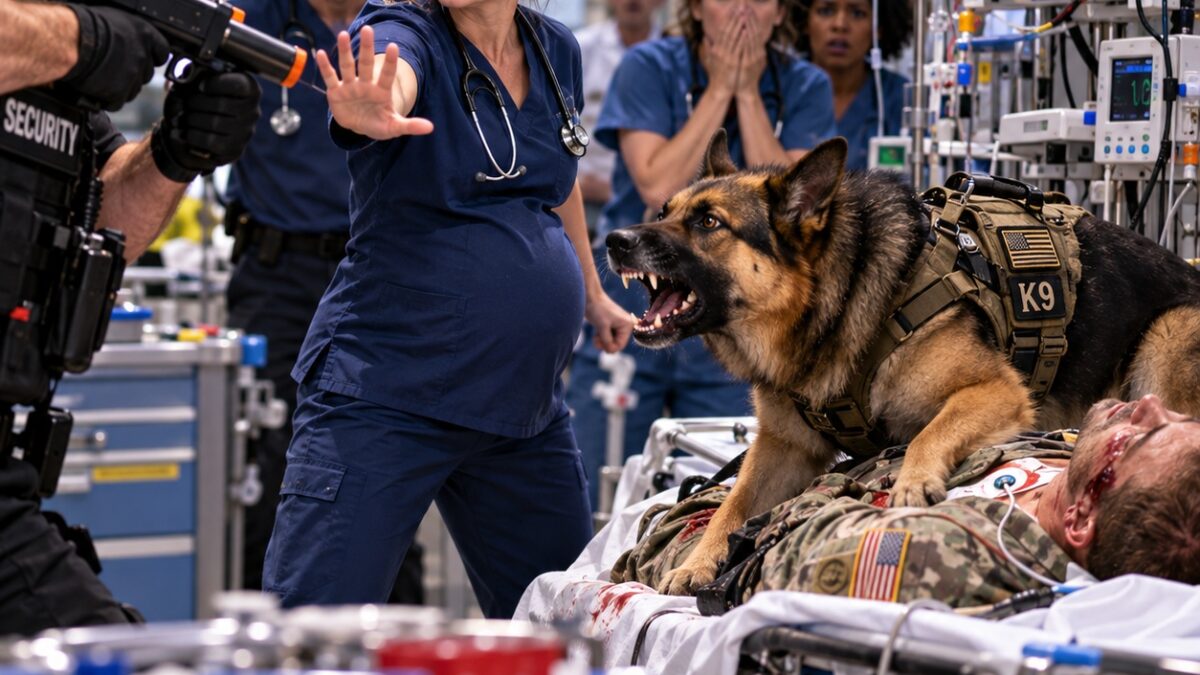
THE GERMAN SHEPHERD HIT THE TRAUMA BAY LIKE A WEAPON, AND EVERYONE IN THE ROOM DECIDED HE WAS DANGEROUS BEFORE THEY ASKED WHAT HE WAS TRYING TO SAY.
SECURITY HAD A TRANQUILIZER GUN RAISED WHEN I STEPPED IN FRONT OF IT, THIRTY-FOUR WEEKS PREGNANT, EXHAUSTED, AND DONE BEING TREATED LIKE MY BODY MADE ME STUPID.
TEN MINUTES LATER, ONE HOSPITAL MONITOR TONE WOULD TURN THAT DOG FROM A “THREAT” INTO THE FIRST LIVING WARNING IN A FEDERAL CASE POWERFUL PEOPLE HAD TRIED TO BURY.
The German Shepherd came through the trauma bay doors at full speed, and the whole room scattered.
Nurses dove behind crash carts.
A physician stumbled backward into a supply rack and sent stainless steel trays clattering across tile.
Somebody screamed.
Somebody shouted for security.
Somebody shouted for animal control.
The monitor above bay three shrieked through the chaos, sharp enough to make every nerve in my body tighten.
And in the middle of all that noise, nobody noticed the one thing that mattered.
The dog was not attacking randomly.
He was placing himself over the unconscious soldier on the gurney.
Teeth bared.
Hackles raised.
Body angled outward.
Every inch of him issuing a warning in a language most of the room had already decided not to hear.
Do not touch him until I know who you are.
Security Chief Dale Morrow already had his radio to his mouth.
“Animal control authorization pending,” he barked. “Get up here now. We need sedation clearance. Potential euthanasia if this escalates.”
I heard sedation.
Then I heard euthanasia.
That was when I moved.
I stepped directly in front of Dale’s tranquilizer gun.
For one second, the trauma bay froze around me.
The unconscious soldier lay on the gurney with blood at his hairline, his chest half-exposed beneath cut fabric, one muddy boot still strapped to his foot. The dog stood over him like the last line of defense in a war the rest of us had walked into uninvited. Dale stared at me like I had lost my mind.
“Nora,” he said, my name coming out like a warning. “Move.”
“No.”
“You are thirty-four weeks pregnant, standing between security and an agitated military dog.”
“He isn’t attacking,” I said. “Something is wrong with him, and it isn’t aggression.”
That was the first time anyone in that room truly looked at me.
Not at my belly.
Not at the tiredness under my eyes.
Not at the way my scrubs stretched over a body everybody had developed opinions about.
Me.
My name is Norah Vasquez.
At Morrow General Hospital, most people knew me as the pregnant ER nurse who should probably be sitting down more.
They knew I had worked emergency for six years. They knew I was good with trauma documentation, difficult patients, patient flow, and keeping my voice steady when everybody else’s started climbing. They knew I lived alone in a small apartment on Ridge Street and that my due date was close enough for people to discuss my body in hallways as if I had left it there for public review.
What they did not know was that before Morrow General, before Callaway, before civilian scrubs and quiet apartments and the strange softness people used when they talked to pregnant women, I had spent eight years as a United States Army combat medic.
Two deployments.
One in mountain terrain where evacuation windows were measured in hours, not minutes, and where you learned fast that panic wastes oxygen and assumptions get people killed.
I had worked beside military K-9 handlers long enough to understand the difference between a dog trying to hurt someone and a dog trying to follow protocol while his entire world was collapsing.
I had left that version of myself behind when I separated from service.
At least, I thought I had.
Then Staff Sergeant Marcus Webb came into my trauma bay unconscious, bleeding, and barely holding on.
And Rex, his military working dog, came in beside him.
The room saw a monster.
I saw a partner refusing to abandon his soldier.
Dale’s jaw clenched.
“You’ve got ninety seconds,” he said. “Then I make the call.”
I turned toward Rex.
The German Shepherd’s attention shifted immediately.
Not submission.
Assessment.
I slowed my breathing, lowered my center of gravity, and turned my body slightly so I was not squared off against him. I kept my hands visible at my sides. I did not stare into his eyes. I looked at the floor just beside his front paws and let him decide what I was.
“Easy,” I said quietly. “I know he’s yours. I know.”
For one fragile second, Rex held.
Then the monitor above bay three released a three-pulse alert tone.
Rex exploded.
Not toward me.
Not toward Patrick, the trauma nurse closest to Marcus’s collar.
Not toward any human being in that room.
He spun and launched himself at the monitor cart.
And that was when I saw it.
FULL STORY CONTINUATION
The room saw the lunge.
I saw the target.
Rex had not gone for the closest person. He had not gone for the hand reaching toward Marcus. He had not gone for me, even though I was directly in his path and would have been the easiest thing to hit if he were simply panicked and lashing out.
He went for the monitor.
Specifically, he went for it in the half-second after the alert tone.
The sound that came out of him changed too.
Before, he had warned us.
This was different.
This was pain.
Raw, confused, furious pain.
The kind that comes out of an animal when something is hurting him and he cannot understand where the hurt is coming from.
Corporal Dawes, the young soldier holding Rex’s lead, dragged him back with both arms locked around the tactical line. His face had gone pale, and sweat shone at his hairline. Two orderlies grabbed the monitor cart before it toppled. Dr. Ellison Pratt shouted for somebody to get the dog out of the building immediately.
Dale lifted his radio again.
I did not move.
Because once you see the right detail in a crisis, you cannot unsee it.
“Dale,” I said.
“Enough, Vasquez.”
“Listen to me.”
“No. You listen to me. I have an uncontrolled animal in a trauma bay.”
“You have a military working dog reacting to a specific auditory trigger.”
He looked at me as if I had started speaking in code.
“Do you hear yourself right now?”
“Yes.”
“That dog nearly attacked a trauma team.”
“No. That dog tried to stop the thing hurting him.”
Dr. Pratt was already demanding sedation authority. Patrick stood near the wall, one hand pressed to his chest, still shaken by how close Rex had come to him. Marcus Webb lay between all of us, unconscious and bleeding internally, while the room wasted time arguing about the one living creature that had noticed something wrong before the rest of us.
I pointed at Rex.
“Look at his body. He is not escalating toward people. He is bracing.”
Dale’s eyes cut to my stomach again.
That same glance.
The one I had seen from nurses, doctors, patients, orderlies, administrators, even strangers in elevators.
The reflexive flick down to my abdomen before deciding how seriously to take my words.
For months, people had softened themselves around me until softness became its own form of dismissal. They offered to carry things I had not asked them to carry. They whispered about whether I should still work nights. They lowered their expectations and called it care.
I had spent months being turned into a liability by people who thought they were being kind.
In that moment, I refused to be softened.
“Call Fort Callaway veterinary command,” I said.
Dale stared at me.
“Now.”
“You are not running this scene.”
“No. But I know what I’m seeing. Tell them you have a military working dog reacting to audio alarms after a crash involving his handler and tactical equipment. Tell them you have a nurse on site with prior combat medic experience saying this is not aggression.”
The words landed harder than I expected.
Combat medic.
I had not planned to say it.
I had kept that part of my life quiet at Morrow General because civilian hospitals do not always know what to do with people who have lived through different kinds of emergencies. It was easier to be Norah from the ER. Norah who charted cleanly. Norah who stayed calm. Norah who was pregnant and competent and ordinary.
Dale lowered the radio slightly.
“You were a combat medic?”
“Eight years.”
The room shifted.
Patrick looked at me like he was seeing a coworker he had somehow never met. Dr. Pratt looked irritated, as if my history had inconvenienced his authority. Dale looked trapped between wanting to dismiss me and recognizing that I had just put enough specific information into the room that dismissing me could become his problem later.
“Fine,” Dale said. “But if that dog goes at one more person—”
“He won’t.”
“You don’t know that.”
“I know more than you do right now.”
He hated that.
But he made the call.
The next forty minutes happened in layers.
Marcus Webb was stabilized enough for imaging. Dr. Pratt’s team moved with tight, angry efficiency, which I could live with because trained hands can still do good work while pride catches up later. Marcus had blunt force trauma to the chest and head, probable internal bleeding, and a Glasgow score that made every minute matter.
Rex was moved into a curtain-side bay with two leads secured, Corporal Dawes sitting close enough for the dog to smell a familiar uniform but far enough not to interfere if he surged again.
The first Fort Callaway liaison arrived within minutes and spoke quietly with Dr. Pratt.
Two more soldiers from Marcus’s unit came soon after and stood in the corridor with the particular stillness civilians mistake for calm. It was not calm. It was control.
Then Lieutenant Colonel Adair Marsh walked into the emergency department.
Army Veterinary Corps.
Late forties.
Short gray hair.
Hard-sided case in one hand.
She did not ask who was in charge. She did not introduce herself to the room. She moved like a person who had already been briefed on the difference between authority and usefulness.
She went directly to Rex.
By then, he had gone still.
Not calm.
Still.
There is a difference.
Calm is peace.
Stillness, after too much stress, is conservation.
Marsh stood outside the curtain and looked at him for a long time.
Then she said, without turning around, “Who made the primary behavioral observations?”
“I did.”
She turned.
Her gaze moved from my badge, to my belly, to my face.
Unlike everyone else, she did not stop at the belly.
“Name?”
“Norah Vasquez. ER charge nurse.”
“What did you see?”
I told her in order.
Rex’s first position over Marcus.
The guard behavior.
The lack of random targeting.
His response to staff reaching toward Marcus.
The monitor tone.
The half-second delay.
The turn toward the monitor cart.
The change in vocalization.
Marsh listened without interrupting.
When I finished, she stayed quiet for three seconds.
Then she said, “You are not describing aggression.”
“No.”
“You are describing a pain response.”
“Yes.”
Dale, standing close enough to hear, crossed his arms.
“A pain response to a hospital monitor?”
Marsh did not look at him.
“How many monitor alerts have sounded in this department since Rex arrived?”
“Four,” I said before I realized I had been counting. “Three from bay three. One from bay seven.”
Her eyes returned to me.
“And he reacted to which ones?”
“Bay three.”
“All three?”
“Yes.”
“Not bay seven?”
“No.”
“What kind of tone?”
“Three-pulse threshold alert.”
Marsh’s jaw tightened.
Dale shifted.
She opened her case and pulled out a small diagnostic device I did not recognize. It looked almost like a remote attached to a display. She crouched near the curtain edge without entering Rex’s space and powered it on.
Rex lifted his head.
Not with aggression.
With recognition.
That was somehow worse.
Because it meant he knew the source of his pain before it even happened.
Marsh watched the readout.
Her face gave away almost nothing.
“When was the last diagnostic check on his tactical equipment?” she asked.
Dawes answered immediately.
“Pre-deployment check. Eight weeks ago. Standard issue.”
“Standard issue,” Marsh repeated.
She said it like she was quoting something she did not respect.
Then she stood, closed the device, and turned toward Dale.
“That dog is not leaving this hospital tonight.”
Dale straightened.
“This is a hospital security matter.”
“No,” Marsh said. “It is now a military veterinary and equipment matter.”
“Animal control is already—”
“Cancel it.”
“They were discussing euthanasia authorization.”
For the first time, Marsh’s expression changed.
Only slightly.
Enough.
“No,” she said. “They were not.”
She walked toward him with the controlled speed of someone who had spent a career making careless people regret speaking too quickly.
After that, Marcus’s treatment moved forward without Rex in the trauma room.
Chest imaging confirmed fractured ribs and a splenic laceration. He was intubated, stabilized, and moved toward surgery within the hour. His unit followed as far as they were allowed, then waited in the corridor outside surgery with faces too still to be called calm.
My shift had technically ended at midnight.
At two in the morning, I was still at the nurses’ station, writing documentation.
I wrote everything.
The transfer notation.
The dog’s initial position.
The first lunge.
Rex’s body angle.
The monitor tone.
The exact timing.
Dale’s sedation call.
My intervention.
Marsh’s questions.
Every observable detail I could tie to a time and place.
I had learned a long time ago that memory gets challenged when power gets nervous.
So I built records.
Patrick came over with a coffee he clearly did not know how to offer.
“That was an uncontrolled animal, Norah.”
“I know what it looked like.”
“Pratt’s going to file a complaint about delayed treatment access.”
“Marcus Webb is in surgery receiving treatment. The delay was under three minutes.”
“You still stepped in front of security.”
“I stepped in front of a decision that did not have enough facts behind it.”
Patrick set the coffee down.
“You’ve got a baby coming in less than six weeks. You don’t have to be the one who steps in front of every dangerous situation.”
I looked at him.
“Somebody had to.”
He left without the coffee.
Down the hall, Marsh was on the phone.
I heard fragments while pretending not to listen.
Equipment.
Serial numbers.
Eight weeks.
Then one phrase lodged inside me.
Not the first case.
Not the first case.
I wrote it in my personal log after I finished the official report.
Not because it belonged in the hospital record yet.
Because I knew it might matter later.
At 4:15 that morning, three vehicles from Fort Callaway pulled into the parking structure.
The people who came out of them were not the kind of personnel Morrow General usually received before dawn. Two wore civilian clothes that fit too precisely at the shoulders. One was in uniform and carried a larger case than Marsh’s.
They moved through the ER without stopping at check-in.
Marsh had cleared them.
Which meant Marsh had expected them.
I stayed.
I told myself I was finishing documentation.
That was partly true.
The fuller truth was that I knew I was standing near the center of something still unfolding, and leaving would mean missing the part that mattered.
Dale stayed too, planted near security, recalculating where his authority ended.
Forty minutes later, Marsh came to the station.
“Your incident report,” she said. “I need a copy.”
“Hospital legal has to authorize release.”
“I know. I’m asking whether it’s complete.”
“Yes.”
She placed a card on the counter.
Name.
Rank.
Contact number.
No unit designation.
“When legal clears release, send it there before anyone else gets it.”
I picked up the card.
“What’s happening with Rex?”
“He’s being evaluated by my team.”
“The equipment?”
Her eyes sharpened.
“What about it?”
“You asked Dawes about the diagnostic date. You said standard issue like it meant something. Then you made a long phone call and opened with a serial number.”
She was quiet.
“You were listening.”
“I was fifteen feet away.”
“Most people do not retain serial-number context.”
“I retain everything.”
That was not arrogance.
It was survival.
Marsh studied me for a few seconds.
“The equipment evaluation is ongoing. I can’t share specifics.”
“I’m not asking for specifics. I’m asking whether Rex is going to be okay.”
For one moment, the officer gave way to the veterinarian.
“That depends on findings I do not have yet.”
She pushed the card closer.
“Get some sleep, Vasquez. You look like you need it.”
“Everyone says that.”
“Everyone is probably right.”
I went home at 6:15 that morning, slept four hours, ate toast over the kitchen sink, and drove back for my three o’clock shift because my body was tired but my mind had not released the night.
The ER looked different in afternoon light.
Not calm.
Emergency rooms are never calm.
They simply lower the volume of crisis for a while and let you pretend.
For about an hour, it was ordinary work.
A construction worker with a nail through his palm.
An elderly woman convinced anxiety was a cardiac event, needing patience more than speed.
A teenage basketball player trying not to cry in front of his father while his father tried equally hard not to notice.
Then Dale walked past the nurses’ station, did not look at me, and went into Administrator Cynthia Pelum’s office.
Fifteen minutes later, Pelum’s assistant came to find me.
Cynthia Pelum ran Morrow General with the efficiency of a woman who understood institutions better than patients. She was not cruel. She was precise. Her kindness always seemed to pass through a cost analysis before delivery.
Dale sat to the left of her desk and did not meet my eyes.
Pelum had my incident report and Dale’s security report printed in front of her.
“I’ve been reviewing last night’s documentation,” she said.
“Okay.”
“They describe the same event very differently.”
“They describe it from different positions.”
“Dale’s report states you physically positioned yourself between a member of security and an animal he was attempting to manage.”
“I stepped in front of a tranquilizer gun aimed at a military working dog exhibiting a pain response, not aggression.”
“A tranquilizer gun,” she said. “Not a firearm.”
“At that range, with an animal Rex’s size, a dosage error could have been fatal. And he did not need sedation. He needed the stimulus removed.”
“You are not a veterinarian.”
“No. But I worked with military K-9 units, and I understood what I was seeing.”
Pelum folded her hands.
“Norah, you are thirty-four weeks pregnant. You intervened in a situation involving a large agitated animal in a way that created direct risk to you and your child.”
“The dog never moved toward me.”
“You could not have known that.”
“I had a reasonable basis to believe it. I documented that basis.”
“Your documentation includes observations about monitor-tone correlations and tactical equipment that are outside your scope as charge nurse.”
“They were accurate. Lieutenant Colonel Marsh confirmed them.”
“Lieutenant Colonel Marsh is investigating a military equipment matter. Your jurisdiction is patient care.”
Dale still said nothing.
That told me the conversation before I entered had not gone entirely his way. Dale was the kind of man who used eye contact as a dominance tool. Avoiding it was not his style unless the tool had slipped.
Pelum continued.
“I am not disciplining you. But I am reassigning your duties for the remainder of your pregnancy. Desk coordination. Patient flow. Documentation. No trauma floor response.”
My body went still.
“That is at least three weeks.”
“Likely. We can revisit after delivery.”
“Marcus Webb is alive because treatment moved fast once the room stopped misunderstanding Rex. Rex is alive because someone recognized what was happening before a decision was made that could not be undone.”
“I am grateful for that,” Pelum said. “I am also responsible for this facility.”
Her eyes dropped to my abdomen.
Again.
Always.
“This is not punishment,” she said. “It is risk management.”
It was both.
We both knew it.
But I also knew that arguing further in that room would cost me something I might need later.
“All right,” I said.
The reassignment took effect the next morning.
Second-floor coordination desk.
Patient flow.
Interdepartmental communication.
Documentation.
The kind of work people call administrative when they do not understand that hospitals run on it.
Several colleagues offered condolences as if I had been exiled.
I accepted them without comment.
What none of them knew was that the coordination desk had direct lines to ER charge, access to all active patient records, and a clear view down the main corridor toward the auxiliary wing where Marsh’s team had set up Rex’s temporary veterinary space.
I had not asked for that view.
It was simply where the desk was.
So I documented.
I coordinated.
I watched.
Rex had been moved to an auxiliary veterinary setup under Marsh’s supervision. I knew because I processed the supply requisition for specialized veterinary monitoring equipment and a dietary modification order that did not match anything in Morrow General’s standard animal protocols.
On my second day at the desk, one of Marcus Webb’s unit members came looking for a quiet room to make a call.
His name tag said Reeves.
I directed him to the family consultation room.
When he came back forty minutes later, he looked older.
“Thank you,” he said.
“The room is open until four if you need it longer.”
He paused.
“Were you the one who sat outside Rex’s bay last night?”
I did not answer right away.
“Corporal Dawes said somebody sat with him at three in the morning and talked to him. Said it was the only time he settled.”
“I told him Marcus made it through surgery.”
Reeves looked down at his hands.
“Rex and Marcus have been partnered three years. Rex doesn’t do well when Marcus is…”
He stopped.
I spared him the need to finish.
“The surgeons are watching Marcus closely,” I said.
“They keep saying the next forty-eight hours are significant.”
“That means they are paying attention. That is what you want.”
He nodded, though neither of us believed that was enough.
Before he left, he said, “Dawes told us what you did. None of us knew how bad it had gotten until we saw the security report.”
“How did you get the security report?”
“Marsh requested it.”
Of course she had.
Two hours later, the supply log flagged an anomaly.
It was buried inside a requisition chain most coordinators would have routed automatically.
I gave it a second look because I gave everything a second look.
One line item listed a diagnostic system with a model prefix I recognized from military contractor procurement materials years earlier.
VTA7.
I sat there, staring at those four characters while the coordination queue kept blinking.
VTA7.
Experimental battlefield communication enhancement for K-9 tactical units.
I remembered a briefing.
Not enough to accuse anyone.
Not enough to know the full history.
But enough to remember concerns about ultrasonic feedback parameters.
I could not access restricted military records.
But I could access hospital-side intake paperwork.
Originating unit.
Chain of custody.
Last service certification.
The certification date was eight weeks earlier.
The same date Dawes had given Marsh.
I wrote both in my personal observation log.
Then I flagged the supply discrepancy through standard hospital channels as a routine clarification request.
Routine.
Boring.
Traceable.
At 4:49, Marsh walked past my desk without stopping.
“Good catch,” she said.
I kept typing.
“What?”
She did not answer.
The next seventy-two hours ran on two tracks.
The first was Marcus.
He came out of the critical window on day two. Stable vitals. Improved responsiveness. Reduced support. Cautiously optimistic surgeons, which in surgery language means they think the patient might live but are not ready to let the sentence sound like hope.
Every time Marcus regained enough consciousness, he asked about Rex.
Every time staff told him Rex was being cared for in the facility, he tried to sit up.
The second track was quieter and faster.
Marsh’s team ran diagnostics on Rex’s tactical equipment.
Two federal investigators arrived. One from contract oversight. One connected to the Department of Defense Inspector General. A woman named Reyes came with them and wrote everything in notebooks instead of on a device.
On the third morning, Pelum called me back into her office.
This time Dale was not there.
“The military team has formally requested your supplemental observation log,” she said.
“That log is not standard hospital record.”
“I understand. They requested it through a federal investigative mechanism.”
“Then they’ll get it. I would like to be present for any questions about content.”
“That’s not usually—”
“I would like to be present.”
There was no heat in my voice.
Just decision.
Pelum looked at me for a moment.
“I’ll pass that along.”
The meeting happened in the auxiliary wing.
Holt was older, methodical, and patient in the way of people who have spent careers letting silence make others uncomfortable. Crandall was younger, more direct, and clearly allergic to institutional delay. Reyes sat with a notebook and wrote down everything that mattered, along with several things people probably did not realize mattered yet.
They had my hospital incident report, Dale’s security report, and my supplemental log.
Holt looked over his glasses.
“You served eight years as an Army combat medic. Two deployments.”
“Yes.”
“That is not in your employment file.”
“No.”
“Why?”
“It was not relevant to civilian nursing practice, and I did not volunteer it.”
Crandall leaned forward.
“You recognized the VTA7 prefix.”
“Yes.”
“What did you know about it before this incident?”
“I knew it had been introduced as an experimental communication enhancement for K-9 tactical units. I knew concerns had been raised in review about ultrasonic feedback parameters. I did not know the status of those concerns after I separated from service.”
“Where did you hear those concerns?”
“A briefing. Years ago. I don’t remember the designation.”
I paused.
“I am not claiming specific knowledge of a cover-up.”
Holt’s pen moved.
“What are you claiming?”
“That a fragment became relevant when I saw Rex react to the monitor tone.”
Marsh spoke then.
“Walk them through the reaction.”
So I did.
Again.
In order.
No embellishment.
Bay three.
Marcus on the stretcher.
Rex guarding.
Monitor tone.
Half-second delay.
Turn toward the cart.
Not people.
Sound.
When I finished, Holt’s voice had changed.
“What we are determining is whether the manufacturer of the VTA7 system was aware of the feedback anomaly before fielding the equipment,” he said. “The behavioral pattern you observed in Rex is consistent with patterns documented in two other military working dogs over the last fourteen months.”
My body went cold.
“In both prior cases, the dogs were assessed as aggressive and removed from service.”
“They were assessed as aggressive,” I repeated.
“Yes.”
Crandall added, “And the equipment was serviced and reissued.”
There are sentences that change the temperature of a room.
That was one.
“The two dogs,” I said. “Where are they now?”
Holt paused.
“That’s under investigation.”
Which meant they did not have a good answer.
“Is Rex going to be cleared?” I asked.
Marsh answered.
“That’s the goal.”
“Goals and outcomes are different.”
“I know,” she said. “But yes. That’s where we’re headed.”
Before I left, Crandall asked one more question.
“You flagged the supply anomaly through standard channels. Why not bring it directly to Colonel Marsh?”
“Because information that moves through standard channels has a timestamp and chain of custody,” I said. “Information passed person to person can be questioned later. I have been in enough situations where the record was all that was left. I make sure the record exists.”
I walked into the corridor and had to stop with one hand against the wall.
Not because I was pregnant, though I was.
Not because I was tired, though I was that too.
Because two dogs had been removed from service after being misread as aggressive.
Because one might already be dead.
Because Rex had almost become the third inside my trauma bay.
Three days later, a blocked call came through my coordination desk.
“Vasquez.”
The voice was male, older, clipped, institutional.
“I’m told you’re the one who flagged the VTAS intake documentation.”
I stayed still.
“Who am I speaking with?”
“Someone who would like to know whether you’ve shared the Delvacore name outside the investigative team.”
“This call is not coming through the federal investigative channel.”
“No.”
“Then I don’t think I should continue it.”
I hung up.
Then I texted Marsh.
Blocked call. Asked about Delvacore. External line. 0740.
Her reply came four minutes later.
Document it. Don’t discuss with hospital admin yet.
So I documented.
Timestamp.
Line.
Source.
Content.
Duration.
My response.
The fact that the caller knew my name and my role in the VTA7 flag.
At 9:15, Marsh came to my desk and set a printed document face down on the counter.
“We need somewhere private.”
In the family consultation room, she turned it over.
Delvacore Systems service certification record.
VTA7 serial numbers ran down the left column.
Certification dates in the next.
And in the rightmost column, anomaly flag status.
Cleared.
Pending.
Those would have been acceptable.
Instead, across eleven serial numbers, I saw entries that made my stomach tighten.
Internal review.
Deferred.
Not resolved.
Not cleared.
Rex’s serial number was there.
So were the two connected to the dogs Holt had mentioned.
“Where did this come from?” I asked.
“A Delvacore engineer named Priya Anand. She contacted the Inspector General’s office yesterday. She has been trying to get internal review to act for eleven months.”
“Every escalation closed?”
“Without action.”
“The call this morning?”
“We believe it came from Delvacore’s legal division. They know she made contact.”
I looked at the list.
“How many dogs are currently deployed with flagged units?”
“Potentially fourteen,” Marsh said. “We are verifying assignments.”
The number sat between us.
“Rex is one of the better outcomes,” she added.
She did not say it comfortably.
Good.
Comfort would have been obscene.
“One of the prior dogs was euthanized,” Marsh said. “The assessment came back aggressive. The handler consented because he trusted the process. By the time anyone questioned the unit, there was nothing left to examine.”
I looked at those serial numbers and thought of Rex pressed into the corner of the side bay.
Still.
Exhausted.
Bracing for pain.
“What do you need from me?”
“Your full supplemental log. Not the hospital summary. And a formal statement about how you recognized the model prefix, what you remember from the old briefing, anything you can reconstruct.”
“I can give a broad timeline, not document designations.”
“Broad helps establish the anomaly was known or knowable beyond one internal review process.”
“How long do I have?”
“End of business.”
“I’ll have it by two.”
I did.
I wrote through lunch and forty minutes after, precise about what I knew and equally precise about what I did not. I had no interest in giving Delvacore one sentence they could pull apart because I had reached too far.
High-stakes truth does not need decoration.
It needs structure.
I sent the statement at 1:57.
Then ate a cafeteria sandwich I did not taste.
Delvacore responded the way institutions respond when truth starts moving faster than containment.
A representative named Whitmore arrived and went straight to administration.
Pelum’s office requested my incident documentation in “legal review” format.
Crandall appeared at my desk and told me Delvacore’s legal team wanted my supplemental log too.
“The log is a personal professional document,” I said. “It was provided directly to the federal investigation.”
“They may argue it should have been filed as official hospital documentation.”
“Then that is a legal argument for relevant parties. My documentation practices were consistent.”
That afternoon, Pelum issued an administrative directive.
All investigation-related communication from coordination staff had to route through hospital legal. No direct communication with investigative personnel without clearance.
It was not a suspension.
It was not a refusal.
It was technically defensible and practically obstructive.
I photographed it, filed it, sent it to Marsh, and forwarded it to Crandall.
Then I went back to my queue because the patients in my system had nothing to do with Delvacore, and my job was still my job.
Pelum appeared twenty minutes later.
“You received the notice?”
“Yes.”
“I want to make sure you understand the scope.”
“It is clearly written.”
“Norah.”
She lowered her voice.
“The hospital is in a legally complicated position. Federal investigators are on site. A corporate legal team is making requests. An active patient sits at the center. My job is to protect this institution.”
“I understand.”
“The federal team has everything they need from you.”
I looked up.
“Do they?”
She held my gaze.
“I am asking you to let the process work through appropriate channels.”
“I have been doing that from the first night. Everything I’ve provided has gone through appropriate channels. Everything I do going forward will go through appropriate channels.”
Then I asked the question she did not want.
“Is there a specific action you want me to stop taking?”
Silence.
Then:
“No.”
She left.
My phone buzzed.
Marsh: Auxiliary wing now. Come directly. Don’t stop to tell anyone.
I logged my absence in the coordination system.
Normal procedure.
Traceable.
Documented.
Then I walked to the auxiliary wing as fast as a thirty-five-week-pregnant woman with aching feet and a contracting sense of patience could reasonably walk.
The room was full.
Holt.
Crandall.
Reyes.
Marsh.
Major Trent from JAG.
Two people I had never seen before: one in uniform with rank that changed the posture of every soldier in the room, and one civilian woman with the stillness of serious authority.
On the table was a document sealed in clear evidence plastic.
I could read the header from the doorway.
Delvacore Systems Internal Engineering Review: VTA7 Ultrasonic Feedback Parameter Assessment. Confidential.
The date was seventeen months old.
Three months before the first affected dog was assessed as aggressive.
Fourteen months before Rex came into my trauma bay.
Marsh looked at me.
“They knew, Vasquez.”
No one spoke.
“They confirmed ultrasonic feedback exceeded safe parameters for K-9 auditory sensitivity. They marked the review deferred. Then they shipped the units.”
The high-ranking officer’s voice was quiet.
“I want a full military audit of every VTA7 unit currently in the field. Start today.”
He looked at Holt.
“And I want Delvacore’s federal contract suspended pending investigation.”
Somewhere four floors above us, Marcus Webb was alive and about to become part of the record.
Somewhere in the auxiliary veterinary bay, Rex was doing the ordinary, undramatic thing of surviving.
And suddenly that felt enormous.
That night, at home, I remembered the blocked caller’s voice.
Not a name.
A context.
Fort Carson, eight years earlier.
A procurement briefing I attended as a junior medic because my unit chief needed people to cover sessions nobody wanted. The man leading that briefing had the same clipped cadence, the same institutional economy of language. He had been introduced as a senior defense acquisition consultant with an Army logistics background.
I wrote it carefully.
Possible voice match. Unverified. Context only.
Then I sent it to Marsh.
Not because I was sure.
Because the record needed to exist.
The next morning, the Department of Defense announced the suspension of Delvacore’s federal contracts pending review.
The public statement was sterile.
Precautionary measure pending review.
No mention of dogs screaming at sounds humans could not hear.
No mention of handlers who trusted false assessments.
No mention of Axis, the dog who had died with an incorrect record attached to his name.
But it was public.
That mattered.
At 8:40, Dale stopped at my desk.
His hands were in his pockets.
Dale never put his hands in his pockets. His whole body usually operated like a security barrier.
Now he looked smaller.
“I saw the contract suspension.”
“It’s public.”
“I read it.”
He looked at the floor, then at me.
“The euthanasia call the first night.”
I waited.
“I was operating on the information I had.”
“Yes.”
“I was operating wrong.”
He said it plainly.
No performance.
No apology shaped for witnesses.
A correction of record.
“I should have given you more than ninety seconds.”
“Yes,” I said. “You should have.”
He nodded once and walked away.
That was all.
Sometimes that is all a moment can carry.
By that afternoon, Crandall told me Delvacore’s servers had been imaged.
Their communications were still there.
“They didn’t delete them,” he said. “Probably calculated deletion would create a worse problem.”
“What do they show?”
“The engineering review was escalated to Garrett Olan, senior vice president of defense product development. He responded in writing that the review should be managed internally without external notification until commercial fielding commitments could be honored.”
Commercial fielding commitments.
The phrase sat in my chest like a stone.
“How many units?”
“Contracted for three hundred forty. Two hundred eighty-nine fielded. Forty-one active in theater.”
“All being pulled?”
“As of this morning, yes.”
Marcus’s field reports were entered into evidence that day too.
Fourteen entries across a three-week window.
Rex flinching at communications equipment.
Then acute distress responses limited to specific frequencies.
Marcus had filed the reports upward.
Acknowledged.
Under review.
No action.
The last report had been filed the Monday before the accident.
When Marcus gave his formal statement, he asked me to be present.
Room 412 was full.
Major Trent.
Reyes.
Marsh.
Recording device.
Marcus sat upright, pale and bruised, one IV line still bothering him in that unconscious way patients keep adjusting what they cannot ignore.
He gave the statement chronologically.
No drama.
No speeches.
Just the plain shape of truth.
Then Major Trent asked what he remembered after the crash.
Marcus looked toward the window.
“The tactical comms unit was damaged in the impact. The alert tone was running on loop. Rex was beside the vehicle. He wasn’t aggressive.”
His voice tightened.
“He was in pain. The last thing I remember before I went under was him lying beside me while that tone kept running, and I couldn’t make it stop.”
I looked away.
Because if Rex had been in pain, and Rex had still stayed beside Marcus, then every person who called him dangerous had failed to understand loyalty at its most brutal.
After the statement, when the room thinned, Marcus said the euthanized dog’s name.
“Axis,” he said. “His handler is Sergeant Dario Fels. Fort Lewis.”
Marsh had called him.
Dario had asked whether it could be confirmed.
Marcus looked at me.
“You understand what it means to spend six months thinking your dog broke and it was your fault for not seeing it.”
“I understand.”
“Someone needs to tell him in person. Not a formal notification. A person.”
“That isn’t in my capacity.”
“No,” Marcus said. “It’s in mine when I’m cleared to travel.”
I nodded.
He was not asking my approval.
He was telling me the same way he had told me about the reports.
A decision already made.
The investigation moved faster after that.
Garrett Olan signed a cooperation agreement.
He named Warren Price, the acquisition consultant whose role matched my old briefing memory.
He named three other Delvacore executives.
He confirmed the directive had been issued with full knowledge of the risk profile.
All forty-one active field units were pulled.
Rex’s adverse behavioral notes were removed.
His certification was reinstated.
The record finally said what his body had been trying to say the whole time.
He had never turned.
He had been hurt.
Three weeks later, federal indictments came down.
I was on maternity leave by then.
I had gone into labor eleven days after the contract suspension announcement, at thirty-six weeks and four days. The labor lasted fourteen hours, which was long enough for me to remember every person who had ever told me to rest more and resent each of them individually.
At the end of it, my daughter arrived weighing six pounds and two ounces, furious with the world and entirely unimpressed by federal investigations.
I named her May.
I was feeding her at 5:40 one morning when Olan’s name appeared in a headline.
Federal contract fraud.
Knowing concealment of a product safety defect.
Obstruction.
Warren Price faced conspiracy and misuse of advisory access charges.
Three Delvacore executives were named too.
Their attorneys released statements using phrases like vigorously defend and context will be provided.
Which usually means the documents are strong.
I knew the documents were strong.
I had helped build some of them.
May had no opinion about any of it.
She slept against me, warm and small, belonging to a world that had kept moving while powerful men discovered that records outlive explanations.
Eight weeks postpartum, I returned to work.
The ER smelled the same.
That was the first thing I noticed.
Antiseptic.
Coffee.
Plastic packaging.
Stress.
Patrick saw me at the nurses’ station.
“Welcome back.”
“Thank you.”
He looked like he wanted to say something more.
He didn’t.
That was the right choice.
Six weeks after I returned, Fort Callaway requested my attendance at a recognition ceremony for the personnel involved in resolving the VTA7 investigation.
Pelum brought me the letter herself.
“The hospital will be recognized too,” she said.
Then she paused.
“The reassignment. The scope directive. I made those calls based on a risk framework that was weighing the wrong things.”
I waited.
“The work you did during that period—not despite the restrictions, but through them, within every rule I had given you—I don’t know many people who would have kept going through standard channels while institutional pressure was against them.”
“The channels work,” I said, “when people use them consistently.”
“Is that something you learned in the Army?”
“It’s something I relearned here. The Army taught me to keep the record. This taught me why.”
The ceremony was on a Friday under a flat gray sky that threatened snow without committing to it.
I brought May because childcare fell through and I had decided anyone bothered by a two-month-old at a military ceremony could manage their own feelings.
Fort Callaway’s conference space was full.
Uniforms.
Hospital staff.
Marsh in dress uniform.
Dale sitting stiffly in the fourth row.
Pelum in the second.
Holt and Crandall in the back.
Reyes with another notebook.
General Braddock spoke for ten minutes.
He described the equipment failure.
The contract investigation.
The audit.
Then he said Axis’s name.
Clearly.
With the weight it deserved.
He stated that Axis’s record had been cleared, that the assessment leading to his removal from service was based on falsified equipment performance data, and that Sergeant Dario Fels had made every correct decision available with the information he had.
“The failure was institutional,” Braddock said. “Not personal.”
The room went still.
“That distinction matters,” he continued. “It has to matter. We ask these men and women and their partners to operate on the information we give them. When the information is corrupt, the people who depend on it are not to blame. The people who corrupted it are.”
Then came recognitions.
Marsh.
Dawes.
Marcus, standing in uniform, still careful around his ribs but very much alive.
He was recognized for his field reports, which Braddock called a model of persistent documentation.
Then the general said my name.
“Staff Sergeant Norah Vasquez, United States Army, retired. Registered nurse and charge coordinator at Morrow General Hospital.”
I stood.
May slept through the moment as if ceremony was beneath her.
I walked to the front and felt every version of myself arrive with me.
Combat medic.
Nurse.
Mother.
Witness.
Record keeper.
Braddock looked at me the way one professional looks at another when the evidence has already settled the matter.
“The chain of evidence in this investigation begins with a single observation made in a trauma bay at 11:52 on a Thursday night,” he said. “An observation that required the observer to hold position against institutional pressure, personal risk, and the general momentum of a room that had already decided what it was seeing.”
He paused.
“Most people would have stepped back. Staff Sergeant Vasquez stepped forward.”
He presented the commendation.
Then he extended his hand, palm up.
In it lay my Army combat medic insignia.
“These were retrieved from Fort Callaway records,” he said quietly. “Your service record was reviewed as part of the investigation. These are from your final duty posting.”
I looked at the small pieces of metal.
They were not heavy.
Yet somehow they held years.
Mud.
Blood.
Bad radios.
Long nights.
Field dressings.
Evac calls.
The quiet grief of setting down a version of yourself and telling yourself you are finished being that person.
“You never stopped serving,” Braddock said. “The uniform just changed.”
I said, “Thank you, General.”
My voice stayed level.
Barely.
Afterward, Marcus found me in the corridor.
Rex was with him.
Not the desperate dog from bay three.
Not the exhausted animal pressed into the corner at three in the morning.
Rex stood in a modified tactical vest, alert and settled, listening to the world without being tortured by it.
“He remembers you,” Marcus said.
I crouched, less gracefully than before May, and held out my hand the same way I had in the trauma bay.
Palm up.
No pressure.
Rex lowered his head, pressed his nose firmly into my palm once, then stepped back and sat down.
Interaction complete.
His terms.
“How’s his hearing?”
“Better,” Marcus said. “Some permanent high-frequency damage from the exposure. Modified duties. Lower-noise environments. Adjusted tactical protocols. Marsh’s team wrote the guidelines.”
“Will he stay in service?”
“As long as he wants to. The veterinary team says he isn’t ready to retire. I’m paraphrasing.”
I smiled before I could manage it.
Marcus looked toward May, who had finally woken and was conducting a silent, serious assessment of fluorescent lighting.
“She looks like she has opinions.”
“She has opinions about everything. She’s been awake twenty minutes.”
His expression shifted.
“Dario Fels called last week.”
I waited.
“Marsh’s team sent him Axis’s formal clearance. Full record review. Complete finding that the assessment was instrument-caused, not handler-caused, not animal-caused.”
He paused.
“He read it three times before calling me. Said the word he kept coming back to was proof.”
Proof.
I had told Marcus formal documentation was not the same as a person saying the truth out loud.
I had been right.
I had also been wrong.
For Dario, the document was what he needed.
The record finally said what it should have said fourteen months earlier.
“Is he okay?” I asked.
“He’s working on it. He just needed the record to say what it should have said.”
Marcus looked at Rex.
“He asked me to tell you thank you. He doesn’t know your name, but he knows the first link in the chain was someone who noticed something at 11:52 at night when nobody else was watching.”
I looked at Rex.
“Tell him the record was always there. It just needed someone to write it.”
Months later, Morrow General opened the Veteran Support and Military K-9 Rehabilitation Program.
It was small.
Two full-time staff.
A part-time veterinary consultant from Fort Callaway.
A biomedical safety adviser named Priya Anand—the Delvacore engineer who had spent eleven months filing internal escalations no one wanted to hear.
And me.
Clinical coordination lead.
We built it in a wing that had once been used for storage. The budget was smaller than ideal. The planning was messier than anyone admitted in public. The paperwork was endless.
I insisted on all of it.
Every intake traceable.
Every equipment review documented.
Every outcome connected to a record that could be examined by anyone at any time and hold.
Priya came to see me before the program opened.
She stood at my desk in civilian clothes, looking like a person who had recently stopped carrying an eleven-month weight but had not yet learned how to walk without it.
“I read your documentation log,” she said.
“I read your engineering escalation summary.”
She gave a small, tired smile.
“I spent months wondering if I was building the record wrong.”
“You weren’t.”
“I know that now. At the time, I needed the record to connect to someone outside the company.”
“You kept going for eleven months,” I said. “That was the harder part.”
“You stepped in front of a gun.”
“Tranquilizer.”
“Still.”
She became our biomedical safety adviser.
Rex came back on opening day with Marcus.
He wore a modified veterinary hearing device calibrated to filter the frequency range that had caused him pain. He could hear the world, just not the sound that had been destroying him.
That absence was not a loss.
It was a correction.
Near the entrance, I mounted the program charter and a formal acknowledgement of the VTA7 investigation.
Marcus read it quietly.
“You put it on the wall.”
“It needs to be there. People who work here should know what this place is built on.”
“Dario is transferring to Fort Callaway next month,” he said. “He wanted to be somewhere people knew what happened.”
“When he gets here,” I said, “introduce him.”
May was seven months old on opening day, too busy at Georgie’s childcare conducting serious investigations into blocks, spoons, and anything else within reach to know her mother had spent late pregnancy inside a federal case.
She would not know about the blocked call.
Or the administrative directive.
Or the supply log anomaly.
Or the forty-two entries in a personal observation log that helped indict five people and pull forty-one units from active fielding.
She would know I was a nurse.
A veteran.
Her mother.
That was enough.
More than enough.
What I understood by the end was that what I brought into bay three was not heroism.
It was not extraordinary courage.
It was not cinematic instinct.
It was the ordinary, stubborn practice of paying attention when the easier thing was to accept the room’s conclusion.
I paid attention to a dog everyone had already labeled dangerous.
I paid attention to the direction he moved.
The timing.
The sound.
The difference between aggression and pain.
Then I wrote it down.
Not because I knew it would matter.
Because the record needed to exist.
That is the thing about records.
They do not wait for you to know their purpose.
You build them with what you have, where you are, and they do their work later in ways you could never have planned.
Priya built one inside Delvacore.
I built one inside a trauma bay.
Marcus built one in the field.
Marsh built one through diagnostics.
Together, those records proved what power tried to manage, delay, and bury.
Garrett Olan made one mistake.
Warren Price made the same one.
Delvacore made it at scale.
They assumed the people who were not supposed to matter were not paying attention.
They assumed a pregnant nurse at the edge of the room was peripheral.
They assumed a dog’s pain could be renamed aggression if enough paperwork said so.
They assumed a handler’s grief could be filed away under behavior assessment.
They assumed truth only mattered when powerful people wrote it.
They were wrong.
The record belongs to whoever is willing to build it.
And on a Thursday night in trauma bay three, while everyone else saw a dangerous animal, I saw Rex trying to tell us the truth.