The Stray German Shepherd Who Wouldn’t Stop Watching the Door Forced Me to Face the Promise I Buried.v
FULL STORY CONTINUATION
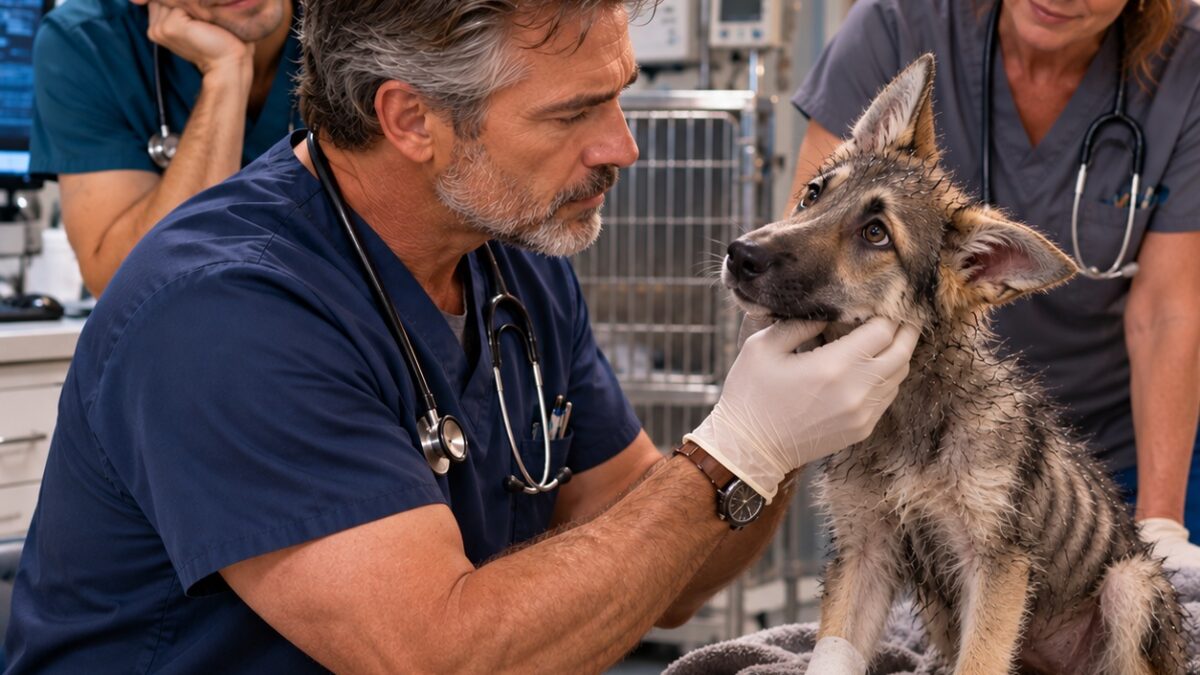
By that afternoon, Counselor had transformed from an exhausted stray into something much more inconvenient.
A curious puppy.
He ate a small meal, drank again, slept for almost two hours, and woke with enough energy to inspect every corner of his recovery pen.
He watched staff walk by.
Listened to doors.
Tracked footsteps.
When a metal tray clattered in another room, his head snapped up.
I happened to be walking down the hall.
Our eyes met.
He watched me for two seconds.
I kept walking.
He lowered himself back onto the blanket.
I noticed.
Only because noticing animal behavior was part of my profession.
That was the explanation I used.
At 2:17, an old blue pickup pulled into the parking lot.
Counselor stood so quickly one rear paw slipped.
His whole body changed.
Alert.
Hopeful.
A gray-haired man climbed from the truck carrying a terrier.
Counselor’s tail began moving.
Not wildly.
Carefully.
The man entered.
Counselor leaned forward.
The man walked past without looking at him.
Ten seconds later, Counselor sat down.
At 3:40, it happened again.
Different pickup.
Different older man.
Same sequence.
Stand.
Watch.
Wait.
Disappointment.
At 4:55, another pickup rolled past without stopping.
Counselor rose anyway.
He followed it with his eyes until it vanished through the rain.
Then he returned to his blanket.
Something tightened inside my chest.
I had seen animals wait before.
At windows.
Near familiar coats.
Beside doors their people used.
Dogs do not understand explanations the way humans wish they did.
They understand patterns.
Smells.
Sounds.
Footsteps.
The shape of someone entering a room.
The old Brier Road bus stop sat far outside town.
Too far for a four-month-old puppy to casually wander from most neighborhoods.
Someone had belonged to him.
Or he had belonged to someone.
The distinction suddenly mattered.
That evening, after everyone left, I made my final clinic rounds.
Treatment One.
Treatment Two.
Pharmacy.
Rear door.
Lights.
Counselor lay in the recovery area.
I glanced through the glass.
“You’re safe tonight.”
A vehicle passed outside.
Earlier, the sound would have sent him toward the front of the pen.
This time, he did not look toward the street.
He did not look toward the door.
He looked directly at me.
My hand stopped on the light switch.
For several seconds, neither of us moved.
Then his crooked ear tipped sideways.
I turned off the light.
I told myself it meant nothing.
That became harder to maintain.
By the third morning, Counselor had learned where we kept treats, where the refrigerator hummed loudest, and exactly how long I could tolerate a crooked food bowl.
Fourteen seconds.
Marissa placed his bowl beside the pen after breakfast, perfectly parallel to the water dish.
I walked past.
Stopped.
Moved it half an inch.
Continued down the hall.
Counselor waited until I disappeared.
Then stretched one paw through the gate and shoved the bowl sideways.
Evan saw him.
“Do that again.”
Counselor nudged it farther.
Thirty degrees off center.
I returned carrying a folder.
Saw the bowl.
Stopped.
Evan suddenly became fascinated by gauze.
I moved the bowl straight.
Took one step.
Scrape.
I turned.
Counselor sat motionless.
Evan made a choking sound.
“Problem?”
“No.”
I looked at him.
“I’m breathing.”
“You were not.”
I walked away.
Behind me, Evan whispered to the puppy, “You’re going to get me fired.”
A low grumble answered.
The following day, Counselor stole one of my indoor shoes.
My office shoes were plain.
Dark.
Practical.
Always stored under the desk with the toes facing outward.
Evan appeared in my doorway.
“Missing something?”
“No.”
“One shoe.”
I looked down.
Left shoe.
No right shoe.
Counselor lay in Treatment Two with his chin between his paws.
Under his chest was my shoe.
I stared at him.
He stared back.
“Bring it.”
Nothing.
“Counselor.”
One ear rose.
I walked toward him.
He placed one paw on the shoe.
Evan appeared behind me.
“I’m no legal expert, but that looks like possession.”
I crouched.
“Drop.”
Counselor released it immediately.
I picked it up.
“A-wooo.”
“No commentary.”
“A-woo.”
“This is not a discussion.”
Ten minutes later, the shoe disappeared again.
Marissa found it beneath the reception chair.
Nobody could prove anything.
By Friday, I had begun doing something I disliked.
Anticipating him.
When I entered the staff room, I looked beneath the table first.
When I placed something low enough for a German Shepherd nose to reach, I reconsidered.
When the clinic became too quiet, I became suspicious.
And one afternoon, while I was reading lab results at my desk, Counselor curled against my boot and fell asleep.
His head rested on my foot.
I needed the drawer behind my chair.
I stayed still for eleven minutes.
Later, I told myself waking a resting patient would have been unnecessary.
That explanation might have worked if I had told no one.
I did not.
The imitation started gradually.
I crossed my arms.
Counselor sat taller.
I leaned against a cabinet.
He shifted onto one hip.
I heard something outside and tilted my head.
He tilted his.
Evan began keeping notes.
I found a sheet taped inside a supply cabinet.
TIMES COUNSELOR HAS COPIED DR. MERCER.
8:02 — Doctor crosses arms. Puppy sits taller.
9:47 — Doctor tilts head at printer. Puppy tilts head at doctor.
11:03 — Doctor stares at Evan after inappropriate comment. Puppy also stares at Evan.
11:04 — Hostile workplace.
I tore it down.
“No.”
Evan looked innocent.
“It’s observational data.”
“It is nonsense.”
“Science has been called worse.”
“Stop documenting it.”
The next morning, another page appeared.
The title had changed.
COMPLETELY RANDOM COINCIDENCES WITH NO PATTERN WHATSOEVER.
I stared at it.
Marissa passed.
“Better title.”
“You encouraged this.”
“I corrected the spelling.”
I removed that one too.
After lunch, Evan made a third.
I left it.
I claimed I had more important things to do.
There were always more important things.
Vaccinations.
Follow-up calls.
Medication schedules.
A beagle who would only cooperate when Marissa sang softly.
An orange cat named Walter who attempted to occupy every surface except the examination table.
Counselor’s world expanded.
Short supervised periods in the halls.
Time in the staff area.
Walks.
Training.
And as the days passed, the funny pattern stopped being entirely funny.
The clinic vacuum started unexpectedly near the boarding area.
Counselor startled.
Shoulders tight.
One step backward.
Then he looked down the hall.
At me.
I was discussing a discharge plan with Marissa.
I did not react to the vacuum.
He watched me.
Two seconds.
His body loosened.
He sat.
Another day, a broad-shouldered stranger entered carrying a pet carrier.
Counselor rose.
The man offered a hand.
Counselor did not approach.
He looked at me.
I was relaxed at reception.
Only then did he move forward.
Later, Evan dropped a metal frame.
It hit the floor hard.
Counselor jumped sideways.
Froze.
Before looking at the sound, before looking at Evan, he looked at me.
“It’s fine,” I said.
Nothing gentle.
Nothing dramatic.
Just normal.
The tension left him.
He sniffed the floor.
Marissa saw everything.
That evening she stood beside me at the sink.
“He checks you.”
“He watches everyone.”
“No. He watches everyone. He checks you.”
“That is not a clinical distinction.”
“It is if you’re paying attention.”
“I am paying attention.”
“That’s why you’re annoyed.”
I gave her the look that usually ended conversations.
Marissa had known me too long.
“When something surprises him,” she said, “he looks at you before deciding whether it’s dangerous.”
“He’s young. Unfamiliar environment. He is looking for environmental cues.”
“Yes.”
“So we agree.”
“You just used six words to avoid saying safe.”
I looked at her.
“What?”
“He uses you to decide whether something is safe.”
“That is not what I said.”
“It’s exactly what you said with better posture.”
I picked up a chart.
“You’re anthropomorphizing.”
“You’re hiding behind vocabulary.”
I walked away.
“That’s also a pattern,” she called.
I did not answer.
Because she was right about one thing.
The idea bothered me.
Trust is heavier than affection.
Affection can happen accidentally.
Trust feels like a promise.
And promises had become complicated for me a long time before a silver-gray puppy started sleeping against my boot.
That night, I found an old photograph in my office drawer.
I had been looking for batteries.
Instead, I pulled out twenty years.
Two men stood beside a military transport vehicle beneath a washed-out sky.
One was me.
Younger.
No gray.
No beard.
Beside me stood Daniel Cross.
Laughing.
At Daniel’s boots sat an old shepherd mix with a gray muzzle.
Scout.
Daniel and I served together.
Years later, illness shrank his world from deployments and travel to medical appointments and a quiet house.
Scout had aged with him.
Three weeks before Daniel died, I sat beside his bed while Scout slept nearby.
Daniel looked at me and said, “You’ll look after him.”
I answered immediately.
“Of course.”
At the time, promises seemed simple.
Then orders came.
A long overseas assignment.
No practical way to take Scout.
I arranged for another former-service family to keep him permanently.
Good people.
Large yard.
Someone home most days.
I visited after returning.
Scout was happy.
Safe.
Loved.
Nobody accused me of betrayal.
Scout certainly did not.
He greeted me with the same tail wag and gray face as though nothing between us needed forgiving.
That somehow made it worse.
Daniel had asked me to be the one.
I had said yes.
Then I was not.
Every rational argument told me I had done the responsible thing.
Circumstances changed.
Scout had a good home.
He lived comfortably into old age.
None of it changed my private verdict.
Promise made.
Promise broken.
So I stopped making certain promises.
Animals came into my care.
I treated them.
Protected them while they were mine to protect.
Then they went home.
Clean.
Defined.
Professional.
No confusion about where duty ended.
I put the photograph away.
Closed the drawer.
From the hallway came:
“A-woo.”
I looked toward the door.
Counselor was awake.
“Go to sleep.”
He lowered his head.
I stayed another minute.
Meanwhile, Marissa searched.
Rescue networks.
Shelters.
Missing dog reports.
Neighborhood groups.
Animal control records.
Surrounding counties.
Nothing.
No tag.
No chip.
Only behavior.
Old trucks.
Older men.
Waiting.
Nearly a week after Counselor arrived, I was working in my office when the reception phone rang.
Marissa answered.
“Mercer Veterinary Clinic.”
Pause.
“Yes, this is she.”
Her expression changed.
I looked up.
She reached for a pen.
“Yes.”
Another pause.
“About four months?”
Counselor lifted his head.
Marissa’s questions became deliberate.
“Male German Shepherd?”
She looked at me.
“What color?”
The clinic seemed to narrow around the answer.
“Silver-gray?”
She wrote.
“Cream on the chest and muzzle?”
Another note.
“One ear tips slightly when he’s tired?”
I stood.
Counselor stood.
“What’s your name?” Marissa asked.
Rachel Danner.
Thirty-nine.
Her father had been hospitalized unexpectedly several weeks earlier.
During the rush of managing his medical care and moving some belongings, his German Shepherd puppy had stayed temporarily with an acquaintance.
Someone left a gate unsecured.
By the time anyone noticed, the puppy was gone.
They searched.
Nothing.
Eventually, they assumed he had traveled farther than expected.
Rachel’s voice cracked once.
Then steadied.
Marissa asked for photographs.
The first arrived within minutes.
An older man sat beneath a porch roof.
White hair.
Weathered hands.
Wooden chair.
At his feet lay a silver-gray German Shepherd puppy.
Cream chest.
Amber eyes.
One crooked ear.
Large paws.
Pale triangle on the chest.
Counselor.
No question.
In the photo, he pressed against the man’s boots as though that space had always belonged to him.
I stared longer than necessary.
Behind me came the click of nails.
Counselor had moved closer.
He looked at the screen.
Then at me.
Waiting for my face to tell him something.
For the first time, I understood the trucks.
The gray-haired strangers.
The door.
He had not been waiting for anyone.
He had been waiting for someone to come back.
His real name was Benny.
The next morning, Marissa and I drove him twenty-two minutes east.
Evan fastened Benny’s lead before we left.
“So this is it,” he said solemnly. “You’re going home, Counselor.”
Benny looked up.
“Remember me when you become wealthy.”
I stepped into the doorway.
“He is a dog.”
“That attitude is why he’ll cut you out of the will.”
I took the lead.
Benny looked at me.
Not the door.
Me.
I pretended not to notice.
The Danner house stood at the end of a narrow road lined with sycamores.
Modest brick ranch.
Detached garage.
Shallow porch.
And beneath an aluminum awning sat an old blue pickup.
The instant I turned into the driveway, Benny stood.
His entire body changed.
Marissa saw it too.
“That truck.”
I nodded.
Rachel met us outside.
When she saw Benny, her face broke.
“Oh.”
That was all.
Benny stayed close to my leg.
Rachel approached carefully.
“He got bigger.”
“Puppies are inconsiderate that way,” Marissa said.
Rachel laughed through wet eyes.
“My dad’s inside.”
We entered.
The house smelled like coffee, old wood, and machine oil.
Work boots near the door.
Boxes in the hallway.
A photograph of a woman laughing beside a fishing boat.
A house preparing to become smaller.
Benny stopped.
Nose working.
Once.
Twice.
Then his head snapped toward the living room.
Arthur Danner sat in a wooden chair by the window.
Seventy-one.
Broad hands.
Shoulders that had once carried more weight than they did now.
White hair.
Flannel shirt hanging loose.
A cane resting against one knee.
Nobody moved.
Arthur stared at Benny.
Benny stared back.
Then Arthur’s hand slipped from the cane.
“Benny.”
The sound Benny made was nothing like his usual argument.
A thin, breathless whine.
“Benny, boy.”
I loosened the lead without thinking.
He ran.
Not chaotic.
Direct.
Certain.
He crossed the room and pressed himself against Arthur’s knees so hard Arthur had to brace against the chair.
Tail everywhere.
Head beneath Arthur’s palm.
Trying to climb closer despite having already become too large to fit where he remembered fitting.
Arthur laughed.
Then the laugh broke.
Both hands wrapped around Benny’s neck.
“Oh, you ridiculous thing.”
Rachel turned toward the window.
Marissa looked down.
I stayed near the door.
I had seen reunions.
Thousands.
This one was different.
No hesitation.
No testing.
Benny knew him from one word.
Good.
I remember thinking that.
Good.
This was the ending.
Problem identified.
Owner located.
Dog returned.
Waiting over.
Problems should feel satisfying when solved.
Then Arthur tried to stand.
The first attempt failed.
The second got him halfway.
His left leg trembled.
Rachel moved.
“I’m fine.”
“I didn’t say anything.”
“You were going to.”
“I was going to breathe.”
“Do it farther away.”
He straightened using the cane.
Three careful steps.
Benny followed immediately.
Too close.
Young.
Strong.
Still growing.
Arthur stopped.
Benny almost bumped him.
Arthur caught the wall.
Rachel reached him.
“I said I’m fine.”
Benny sat.
His ears lowered.
Arthur looked at him.
The anger vanished.
“Sorry, boy.”
Over the next hour, the situation became clear.
Arthur had suffered a serious medical episode.
His stamina and balance were reduced.
Doctors expected improvement.
Nobody knew how much.
Rachel wanted him to move ten minutes from her into a smaller one-story rental.
No facility.
No assisted living.
Just fewer stairs.
Less yard.
Safer.
Arthur hated the idea.
“It sounds like a shoe box.”
“It has two bedrooms.”
“One is the size of that coffee table.”
“It is not.”
“Then your coffee table is unusually ambitious.”
Marissa smiled.
Arthur scratched Benny’s chest.
“I got him after my wife died.”
Rachel softened.
“The house got too quiet,” Arthur said. “Thirty-eight years of somebody moving through rooms. Then suddenly you can hear the refrigerator turn on from the other end of the house.”
Nobody interrupted.
“Rachel suggested a dog.”
“I suggested an older dog,” Rachel corrected.
“She suggested an older dog.”
“And you drove two counties away and came home with a puppy.”
“He looked lonely.”
“You looked lonely.”
Arthur glanced at her.
“That too.”
Benny grumbled.
Arthur rubbed his forehead.
“Still correcting me.”
I could have said nothing.
Arthur loved Benny.
Benny loved Arthur.
Both facts were obvious.
They were also not enough to erase physics.
“How much walking are you doing?” I asked.
Arthur looked at me.
“Enough.”
Rachel closed her eyes.
“How far?”
“Mailbox.”
“On good days,” Rachel added.
Arthur frowned.
I kept my voice neutral.
“Benny is four months old.”
“I know how old my dog is.”
“I’m not questioning that.”
His jaw tightened.
“He’ll become substantially larger. Stronger. He’ll need structured exercise, training, socialization. He’s going to become stronger before he becomes sensible.”
Marissa murmured, “Sometimes much stronger.”
Arthur watched Benny.
“I’ve had dogs.”
“I believe you.”
“Then what are you saying?”
“I’m saying think about what caring for him looks like six months from now, not only today.”
Silence.
Rainwater dripped from the porch roof.
Arthur tightened his grip on the cane.
Rachel stepped in.
“He isn’t telling you to give him up.”
“No,” I said. “I’m not.”
Arthur kept looking at me.
“Sounds like it.”
“I’m telling you to decide based on the dog Benny is becoming, not only the puppy he is today.”
That landed differently.
Benny had found a loose corner on a cardboard box.
“Benny.”
He froze.
Arthur pointed away.
Benny sat immediately.
Then grumbled.
Arthur smiled.
“Still listens.”
“He does.”
Listening was not the problem.
Strength.
Energy.
Time.
Recovery.
Those were the problems.
Arthur looked at Rachel.
“You already decided.”
“No.”
“Don’t lie.”
“I decided I’m worried.”
“That’s the same thing in softer clothes.”
“No, Dad.”
They looked at each other.
Finally, Arthur turned away.
“I need a few days.”
“That’s reasonable.”
He looked surprised.
“You’re not going to tell me what to do?”
“No.”
He rested both hands over the cane.
“I want him home.”
“I know.”
“I can take care of him.”
I said nothing.
His voice lowered.
“I could.”
Could.
Not can.
Confidence turning backward because the future would not cooperate.
I let it remain unspoken.
“Take a few days.”
We returned Benny to the clinic.
I hated how relieved I felt.
So I avoided him.
Not obviously.
I simply did charts in Treatment Three instead of my office.
Reorganized inventory myself.
Used the rear entrance.
The first time, Benny lay outside my office.
The second, he waited in the rear hall.
“How did you know I was here?”
He stood.
I walked past.
He followed three steps.
Stopped at the doorway.
Later I moved into the consultation room.
Ten minutes later, Benny lay outside the closed door.
Evan opened it.
“Doctor.”
“What?”
“You’re losing.”
“To what?”
“Hide-and-seek.”
“I am not hiding.”
He pointed down.
One silver paw crossed the threshold.
“You are losing hide-and-seek to a dog who doesn’t have all his adult teeth yet.”
“Go back to work.”
“I am working.”
“No. You’re narrating.”
Benny stayed.
That was the problem.
He did not panic when I left.
Did not cry.
Did not stop eating.
He simply preferred knowing where I was.
Once he knew, he settled.
Dependency I could reject.
Preference was harder.
On the fourth afternoon, Arthur returned.
Benny heard his voice and ran to him.
Same joy.
Same certainty.
Arthur held him as long as he safely could.
Asked whether he had eaten.
“Too much,” Marissa said.
“Behaving?”
“No,” Evan said.
“A-woo.”
Everyone laughed.
Then Arthur sat.
Benny stayed against his leg.
Arthur stroked his head for a long time.
Finally:
“I can give him love.”
Nobody moved.
“I’m no longer sure I can give him the life he’ll need.”
Rachel lowered her eyes.
Arthur’s hand slowed against Benny’s fur.
That sentence cost him.
I knew because I had spent years telling myself the opposite about Scout.
That letting go meant you had loved less.
Arthur looked at me.
“Don’t let anybody take him because he’s pretty.”
“We’ll screen them.”
“He needs someone who’ll work with him.”
“Yes.”
“He gets bored.”
“I know.”
“He talks too much.”
From reception, Evan whispered, “We know.”
Arthur almost smiled.
Then looked down.
“You’re going to be a lot of dog.”
Benny placed his chin on Arthur’s knee.
Arthur’s face folded just slightly.
“I thought I had more time.”
Rachel moved closer.
Eventually, Arthur stood.
Benny stood.
Arthur walked toward the door.
Benny followed.
Arthur stopped.
Turned back.
Put both hands around Benny’s face.
“You listen to somebody, all right?”
Benny licked his wrist.
Arthur laughed through whatever was happening in his throat.
“Never did listen to me.”
Marissa took Benny’s lead.
Arthur walked outside.
Benny tried to follow.
One step.
Two.
The lead tightened gently.
He stopped.
Arthur froze in the doorway when he heard Benny’s nails behind him.
For one second, I thought he would turn around.
He did not.
Rachel put one hand on his back.
They walked to the blue pickup.
Benny watched.
Arthur climbed into the passenger seat.
Only after the door shut did Benny sit.
I stood several feet away.
For years, I had believed that what I did with Scout was abandonment dressed in responsibility.
Now I had watched Arthur make almost the same choice.
It did not look like abandonment.
It looked like love stripped of pride.
Love willing to be misunderstood.
Love strong enough to admit that wanting someone beside you and being able to give them what they needed were not always the same thing.
The truck disappeared.
Benny turned from the glass.
Looked at me.
Crossed the lobby.
Sat at my boots.
Something inside me shifted.
Not enough.
Not yet.
We arranged a foster home.
David and Helen Lawson lived fifteen minutes north.
Both in their fifties.
Experience with large dogs.
Fenced yard.
Stable schedules.
No children.
No other animals.
Good references.
Good veterinarian.
Marissa checked them twice.
I checked them a third time.
“You realize I already did this,” she said.
“I realize.”
“And you trust me.”
“I do.”
She waited.
I turned another page.
“This is fascinating.”
“What?”
“Watching someone verify information he already believes.”
I ignored her.
At 10:30, the Lawsons arrived.
They did everything correctly.
No squealing.
No rushing.
No grabbing.
They let Benny approach.
He sniffed David.
Then Helen.
Then returned to my leg.
Helen smiled.
“He likes you.”
“He watches everyone.”
Behind me, Marissa coughed.
The Lawsons asked intelligent questions.
Food.
Training.
Leash work.
Fear responses.
Resource guarding.
Exercise.
I answered carefully.
“He startles, but recovers quickly.”
“And the talking?” Helen asked.
Evan appeared.
“He has opinions.”
I looked at him.
“Medically insignificant opinions,” he corrected.
Benny grumbled.
David laughed.
Everything about the placement was right.
That was what made it difficult.
At noon, they took him.
Marissa packed food, medical notes, his rubber toy, and the blanket from recovery.
I stayed near the hallway.
Benny walked with Helen to the door.
Stopped.
Turned.
Looked at me.
Not panicked.
Not pleading.
A question.
“Go on.”
He left.
The clinic became quieter.
That afternoon, a terrier barked.
Evan dropped a bowl and blamed gravity.
Work continued.
But underneath everything, something was missing.
A rhythm.
Small interruptions I had spent two weeks pretending were inconvenient.
Near closing, Evan carried two water bowls into the staff room.
Set them down.
Stopped.
Looked at both.
Then picked one up.
I saw him.
He saw me seeing him.
Neither of us joked.
That bothered me more.
The next day was easier.
Which made it worse.
Humans adapt quickly.
The recovery pen was cleaned.
Blanket removed.
Another dog used the space.
Work filled the gap.
Friday morning, Helen sent an update.
Benny slept near their front door.
Ate only part of dinner.
Explored the yard.
Responded to commands.
No destructive behavior.
Photo attached.
He lay beside a wide front window.
Eyes open.
“Adjustment period,” I said.
Marissa looked at me.
“I said nothing.”
“He needs time.”
“Still nothing.”
At noon, another message.
Played with a ball.
Good.
That night, he slept near the front door again.
Saturday, Helen called.
By Sunday, Marissa and I drove out.
Benny was calm.
He played with David.
Responded to Helen.
Drank water.
The Lawsons were not a bad home.
I needed that to remain true.
When we arrived, Benny came straight to us.
Not wild.
Relieved.
He spent the visit near me.
Helen saw it.
David saw it.
Marissa certainly saw it.
After forty minutes, Helen said, “We’ve been talking.”
I already disliked the sentence.
“We think he should go back with you. With the clinic for now.”
I frowned.
“You agreed to foster.”
“We did.”
“You have space.”
“Yes.”
“Experience.”
“Yes.”
“No behavioral problems.”
“Correct.”
“Then why end it after three days?”
Helen leaned forward.
“Because fostering isn’t about proving a dog can tolerate our house.”
I said nothing.
“It’s about helping him get where he belongs.”
The sentence landed too cleanly.
David added, “Maybe that isn’t with you. Maybe it’s somebody else eventually. But he’s telling us something right now.”
My jaw tightened.
“Dogs do not make adoption decisions.”
“No,” Helen said. “People do.”
Marissa looked at me.
I stood.
Benny stood instantly.
“This does not mean I’m adopting him.”
Marissa blinked.
“No one just asked you.”
David looked down to hide a smile.
Helen failed.
“This is temporary.”
“Of course,” Marissa said.
“Until we identify appropriate placement.”
“Absolutely.”
“You’re doing that thing.”
“What thing?”
“Agreeing in a way that is not agreement.”
“I have no idea what you mean.”
Benny walked beside me to the van.
For the first time that afternoon, his tail lifted.
Back at the clinic, Evan froze when he saw us.
“Did I miss a board meeting?”
“Foster placement ended.”
“Any particular reason?”
“No.”
Marissa walked past.
“Yes.”
I turned.
She kept walking.
Evan looked at Benny.
“Welcome back, Counselor.”
“A-wooooo.”
“There he is.”
That night, I stayed late.
Benny followed me into the staff room.
I sat with coffee I did not need.
He sat beside me.
I looked down.
He looked up.
I tilted my head left.
He tilted his.
I straightened.
He straightened.
I narrowed my eyes.
His dark mask made it look as if he narrowed his back.
And I laughed.
Not the short breath I usually gave Evan when I refused to reward him.
A real laugh.
Warm.
Unexpected.
Benny’s tail hammered the floor.
“You are ridiculous.”
“A-woo!”
I laughed again.
Then it faded.
Because the question had changed.
For days, I had asked what Benny wanted.
Arthur.
Safety.
A familiar person.
A place to settle.
Now the answer was becoming obvious.
The difficult question belonged to me.
Did I want him?
Not until another foster home.
Not until life became inconvenient.
Not for a week.
For mornings.
Training.
Hair.
Mud.
Bills.
Emergency calls.
Years.
And whatever changes came with those years.
Benny put one paw on my boot.
He said nothing.
He did not need to.
A storm moved over Bellweather the next afternoon.
By four, the sky had become charcoal.
Wind bent the trees.
At 4:17, a transformer failed.
At 4:19, the lights flickered.
At 4:20, everything went black.
Animals reacted all at once.
Barking.
Yowling.
Movement.
Our generator coughed twice and started.
Emergency lights came on.
“Marissa, treatment rooms. Evan, rear kennels and generator panel. Nobody opens an exterior door unless someone is standing there.”
The clinic changed immediately.
Appointments no longer mattered.
Only needs.
I checked the rooms.
Treatment One.
Clear.
Treatment Two.
Two cats waiting for pickup.
Recovery.
Stable.
Benny stood with both paws against his gate.
The moment I entered, his eyes found me.
“Stay.”
He sat.
I moved on.
Thunder hit close enough to shake the glass.
A woman arrived carrying a terrified spaniel from an apartment that had lost power.
Another owner showed up soaked with a cat.
Phones worked intermittently.
Rain slammed against the clinic.
For two hours, we handled problems.
Real ones.
Immediate ones.
Around seven, the worst passed.
The generator continued humming.
I found Benny under my desk.
He had somehow escaped no enclosure, broken no rule, created no emergency.
Marissa had simply moved him there once the building became calmer because, according to her, “He works better when he knows where you are.”
I sat.
Benny rested his chin on my boot.
Outside, rain moved in silver sheets.
I looked at the drawer where Daniel’s photograph waited.
For the first time in years, I allowed myself to consider that perhaps the lesson I had taken from Scout was wrong.
Maybe the lesson was not never promise.
Maybe it was never pretend circumstances cannot change.
There is a difference.
Over the following weeks, I did what I do when emotion becomes inconvenient.
Research.
I called trainers.
Read German Shepherd developmental guidance I already knew.
Built schedules.
Calculated exercise requirements.
Long-term cost.
Food.
Insurance.
Travel arrangements.
Emergency coverage.
Behavior.
Housing.
My list of reasons not to adopt Benny filled most of a page.
Long work hours.
Training demands.
Travel limitations.
Noise.
Hair.
Expense.
Schedule changes.
Responsibility if I became ill.
Responsibility as he aged.
Then I wrote another heading.
REASONS TO DO THIS.
My pen stopped.
Benny slept under the desk.
I listened to him breathe.
Soft.
Steady.
I wrote nothing.
That list was more dangerous.
There was one conversation left.
Arthur.
I drove out alone.
Benny stayed at the clinic with Marissa.
I did that deliberately.
This was not an emotional sales pitch.
Arthur answered the door using his cane.
“Nolan.”
“Arthur.”
“You bring him?”
“No.”
His eyes sharpened.
“That bad?”
“No.”
I almost smiled.
“He’s fine.”
Arthur stepped aside.
“Coffee?”
“Black.”
“I assumed.”
The house had changed.
More boxes.
Fewer photographs.
The process of leaving was visible.
Arthur poured coffee and lowered himself into the chair where Benny had found him.
I sat opposite.
Neither spoke immediately.
Then Arthur looked at my face.
“You want him.”
I exhaled.
“I came prepared with a much longer explanation.”
“Still give it.”
So I did.
Training.
Daily schedule.
Food.
Costs.
Insurance.
Backups.
Travel.
Emergency care.
Adult size.
Behavior.
Aging.
What if my work changed?
What if the clinic changed?
What if Benny became difficult?
Arthur listened.
No interruption.
By the time I finished, the coffee was cold.
He rested both hands on his cane.
“You rehearsed that.”
“No.”
“You absolutely rehearsed that.”
I looked at him.
He almost laughed.
Then his face became serious.
“I’m going to ask one question.”
I waited.
“When he becomes inconvenient.”
Silence.
“When he isn’t funny anymore.”
My jaw tightened.
“When he gets too big for your office.”
I looked at the coffee.
“When he ruins something expensive.”
Arthur’s voice stayed calm.
“When your schedule gets ugly.”
Then:
“When he gets old.”
That one went deepest.
He was not asking about logistics.
He was asking about permanence.
I let the silence remain.
Then I said:
“Then he’ll still be mine.”
Arthur did not move.
“If I take responsibility for him, it doesn’t end when he becomes difficult.”
Arthur looked away.
His thumb moved over the cane.
A slow breath left him.
“That’s what I needed to hear.”
Rachel came later.
We handled the transfer carefully.
Ownership records.
Medical information.
Consent.
Clinic paperwork.
Nothing cinematic.
Arthur read every page.
Rachel did too.
I signed last.
Nolan Mercer.
Owner.
I stared at the word.
Marissa slid a dark navy collar across the counter.
A small tag hung from it.
BENNY.
Underneath:
NOLAN MERCER
BELLWEATHER, VA.
Arthur sat nearby.
Benny rested between his boots one last time.
Arthur unfastened the old collar.
His fingers paused at the buckle.
Benny licked his wrist.
Arthur smiled.
“There you go again.”
He handed me the collar.
Directly.
No ceremony.
I fastened the new one.
The tag clicked softly.
Benny shook himself.
Everyone looked at him.
I reached for the pen.
Benny grabbed it.
“Benny.”
He stepped backward.
“Give.”
Eyes bright.
“Give.”
He dropped the pen.
Then picked it up again.
Evan covered his mouth.
Arthur laughed.
Rachel laughed.
Marissa leaned against the counter.
“Benny.”
He finally surrendered it.
Tooth marks covered the cap.
Evan nodded.
“Beautiful ceremony.”
Arthur laughed harder.
Benny looked at me.
“A-woo.”
This time I smiled without fighting it.
Not because everything had become simple.
Tomorrow meant training.
Schedules.
Bills.
Rain walks.
Mud.
Problems.
Years.
That was the point.
I clipped the leash to his new collar.
He came to my side.
I looked at Arthur.
“I’ll bring him to visit.”
Arthur nodded.
“I know.”
I turned toward the door.
Benny followed.
Not because he was being rescued.
Not because I needed saving.
Because a decision had finally been made in daylight with all the difficult parts included.
When the clinic door closed behind us, I understood something that had taken me twenty years to learn.
A promise is not a guarantee that nothing will change.
It is a decision about who you intend to be when it does.
By spring, Benny had grown into most of his paws.
Mostly.
Both ears stood upright except the right one still tipped outward when he was tired.
I learned that a tired Benny was more likely to steal something.
Socks.
Towels.
Once, the television remote.
I found it beneath his bed.
No damage.
I held it up.
“Explanation?”
“A-woo.”
“That is not an explanation.”
“Woo.”
“That is also not an explanation.”
From my kitchen, Evan called, “Sounds convincing from here.”
Some things did not change.
I still arrived early.
Still straightened clipboards.
Still checked the back door twice.
Still preferred instruments arranged in a system nobody else considered necessary.
But there were other signs now.
Dog hair in my passenger seat.
Travel bowl behind the driver’s seat.
Leash beside my coat.
Rubber toy under my office cabinet.
One corner of the staff-room couch Benny had claimed.
I never officially acknowledged the couch arrangement.
Evan taped up a handwritten sign:
COUNSELOR’S OFFICE.
I removed it.
The next morning, it returned laminated.
I left it.
That was considered an institutional victory.
Laughter came easier.
Not always.
Enough.
There were still evenings when certain smells, military jackets, or kinds of silence pulled me toward memories I had not requested.
Benny did not erase those.
Eventually, I stopped expecting him to.
Healing, I discovered, was not replacing a damaged part.
It was learning how to live without pretending the damage never happened.
Arthur came to visit in early spring.
He called ahead.
That gave me several hours to pretend I was not anxious.
At ten, I checked Benny’s collar.
At eleven, again.
At noon, I reorganized a stack of forms I had already organized.
Marissa watched.
“What are you doing?”
“Working.”
“You moved that folder three times.”
“It was in the wrong place.”
“It was in your hand.”
I set it down.
“He’ll be fine,” she said.
“I know.”
“Arthur will be fine.”
“I know.”
“You’re worried anyway.”
I did not answer.
At 2:18, the front door bell rang.
Arthur’s voice came through reception.
“Well, that bell is still obnoxious.”
Benny was asleep in my office.
His head came up.
One second.
Then Arthur laughed at something Marissa said.
Benny exploded into motion.
He crossed the hall so quickly I barely got his name out.
Arthur had just stepped inside.
Benny stopped for half a heartbeat.
Then pressed his head against Arthur’s chest.
Arthur’s breath left him.
“Oh.”
His cane shifted.
Marissa caught it.
Both hands went into Benny’s fur.
“Look at you.”
Benny pushed closer.
Arthur lowered himself into a chair.
Benny sat between his knees and pressed his chin to Arthur’s chest.
Arthur closed his eyes.
The tears came quietly.
No collapse.
No sobbing.
Just tears moving down an old man’s face while a dog he had loved and released leaned against him as though the missing months had been nothing but an interruption.
I stayed away.
The moment belonged to Arthur first.
Rachel stood near the window with one hand over her mouth.
Marissa studied the counter.
Even Evan stayed silent.
Arthur cupped Benny’s face.
“You remember me?”
Benny licked his wrist.
Arthur laughed through the tears.
“Of course you do.”
Eventually, conversation returned.
Training.
Weight.
Food.
Exercise.
Arthur rubbed beneath Benny’s chin.
“He still talks?”
From under his hand:
“A-woo.”
Arthur laughed.
“There it is.”
Evan said, “We’ve tried discouraging unnecessary testimony.”
I looked at him.
He shrugged.
“Unsuccessful.”
Rachel told us Arthur had moved to the smaller place near her.
Arthur complained the second bedroom remained too small.
Rachel reminded him it fit a queen bed.
Arthur said that proved nothing.
Benny stayed at his feet.
I watched too closely.
I knew I did.
Then Benny lifted his head.
Looked across the room at me.
I did nothing.
No command.
No pat.
No whistle.
He looked back at Arthur.
Then at me again.
Arthur saw it.
Benny stood.
For one second, something small and painfully human crossed Arthur’s face.
Then Benny walked across the lobby.
Straight to me.
He sat against my left leg.
Shoulder touching my boot.
But he did not turn away from Arthur.
He faced him.
Watched him.
Tail resting calmly on the floor.
I looked at Arthur.
Arthur stared at Benny.
His sadness did not disappear.
It widened.
He nodded once.
“He remembers where he came from.”
I swallowed.
Arthur looked at me.
“And he knows where he lives.”
The room became very quiet.
Benny was not choosing one man by rejecting another.
That was what struck me.
He had not erased Arthur to make room for me.
He had carried Arthur with him.
For years, I imagined love as limited space.
Someone leaves.
Someone else enters.
One promise changes.
Another risks replacing it.
Benny did not understand love that way.
He remembered Arthur.
Loved Arthur.
Lived with me.
Trusted me.
None of those truths canceled another.
Benny looked up.
Then gave a long theatrical:
“A-WOO.”
Arthur laughed.
Rachel laughed.
Evan bent over the counter.
Marissa shook her head.
I closed my eyes.
“All right.”
His tail moved.
I scratched behind the slightly crooked ear.
“Our home.”
Arthur turned toward the window.
One hand briefly touched his eyes.
I pretended not to notice.
A minute later, I had to blink several times myself.
Evan noticed.
To his credit, he said nothing.
Arthur stayed almost an hour.
Before leaving, he knelt as far as his recovering body allowed and put both hands around Benny’s neck.
“I’ll visit again.”
Benny made a soft sound.
Arthur smiled.
“That wasn’t a question.”
When Arthur stood, Benny walked him to the door.
Watched Rachel help him into the car.
Then remained beside me as they drove away.
I looked down.
He looked up.
No panic.
No confusion.
Just awareness.
People could leave a room without disappearing from a life.
I wished I had understood that twenty years earlier.
Maybe forty.
After everyone left that evening, I finished my final chart.
Benny slept on the couch corner nobody officially admitted belonged to him.
Golden light stretched across the parking lot.
I closed the file.
Sat still.
Daniel came to mind.
Not Daniel dying.
Not the last promise.
Daniel laughing beside that military vehicle with Scout at his feet.
For years, I had allowed one unfinished promise to rewrite the entire memory.
I treated love as though it only counted if completed perfectly.
If I could not stay forever, I had failed.
If I could not guarantee the ending, I should never begin.
Arthur challenged that.
Benny destroyed it.
No one can promise life will remain still.
People become ill.
Orders change.
Homes become too large.
Dogs grow stronger.
Then old.
Plans break without asking permission.
The promise was never that nothing would change.
It was presence while presence was possible.
Care while care was needed.
Honesty when the original plan stopped working.
And courage enough to continue loving after learning exactly what loss could cost.
Benny had not repaired my past.
Had not replaced Daniel.
Had not transformed the Scout decision into something painless.
He did something more useful.
He separated grief from guilt.
I stood.
“Time to go.”
Benny opened one eye.
Did not move.
I picked up the leash.
“Benny.”
The other eye opened.
“We’re leaving.”
Low grumble.
“You have been asleep forty minutes.”
“A-woo.”
“You’ve had a difficult day?”
“Woo.”
“You greeted one person.”
He stretched.
Slowly.
Deliberately.
Then climbed down.
I turned off the office light.
We walked through the clinic.
Dark treatment rooms.
Quiet reception.
The laminated COUNSELOR’S OFFICE sign crooked near the staff-room couch.
At the front door, I checked the lock once.
Then again.
Benny sat beside me.
I looked down.
He looked up.
I folded my arms.
He straightened his front legs.
I tilted my head left.
He tilted his left.
For one second, I simply stared.
Then I laughed.
His tail struck the floor.
I opened the door.
Cold evening air moved around us.
We crossed the parking lot.
Close.
Not touching.
Streetlights came alive.
A truck rolled through the intersection.
Someone started a lawn mower two houses away.
Ordinary sounds.
An ordinary evening.
For the first time in years, I did not measure the present against everything I had lost.
I did not think about endings.
I thought about tomorrow morning.
Muddy paws.
Training appointments.
Missing socks.
A water bowl he would absolutely push out of alignment.
A life that would never be perfectly controlled again.
I opened the truck door.
Benny jumped inside.
Then turned around and gave me that serious look.
I shook my head.
“I know.”
One ear tipped.
I climbed in.
Ahead of us, the road stretched through the fading Virginia light.
And for once, the future did not feel like something waiting to take from me.
It simply felt like somewhere we were going together.