The HOA’s Emergency Road Hit the One Power Line They Never Bothered to Own.v
PART 2 and FULL ENDING  Thank you

His stamp was crooked because his hands were swollen from cold.
I laughed.
He looked at me like I had missed the point.
“You’ll know it’s mine,” he said.
Years later, after he was gone and Mason Ridge Utility LLC was mine, that crooked plate was still there.
Scarred.
Weathered.
Ordinary to anybody who didn’t know the story.
To me, it was a memory nailed into cedar.
That was why my chest went cold the morning I turned into my yard and saw a bucket truck parked under that line.
Outriggers down.
Crew staged.
Hardware on the ground.
One conductor already removed and lying on padded blocks in the red dirt.
A man in a hard hat was reaching toward the hardware beside pole 17 like he had every right in the world to touch it.
I didn’t think.
I didn’t park neatly.
I stopped the truck hard enough for gravel to spray, climbed out, and shouted before my door had even swung shut.
“Who authorized you to touch that feeder?”
The crew froze.
The man on the ground looked back at me.
I pointed at the line.
“Shut the job down before anybody removes another piece of my electrical system.”
The man in the hard hat lowered his hand.
A second crewman turned toward the bucket truck operator.
Nobody moved.
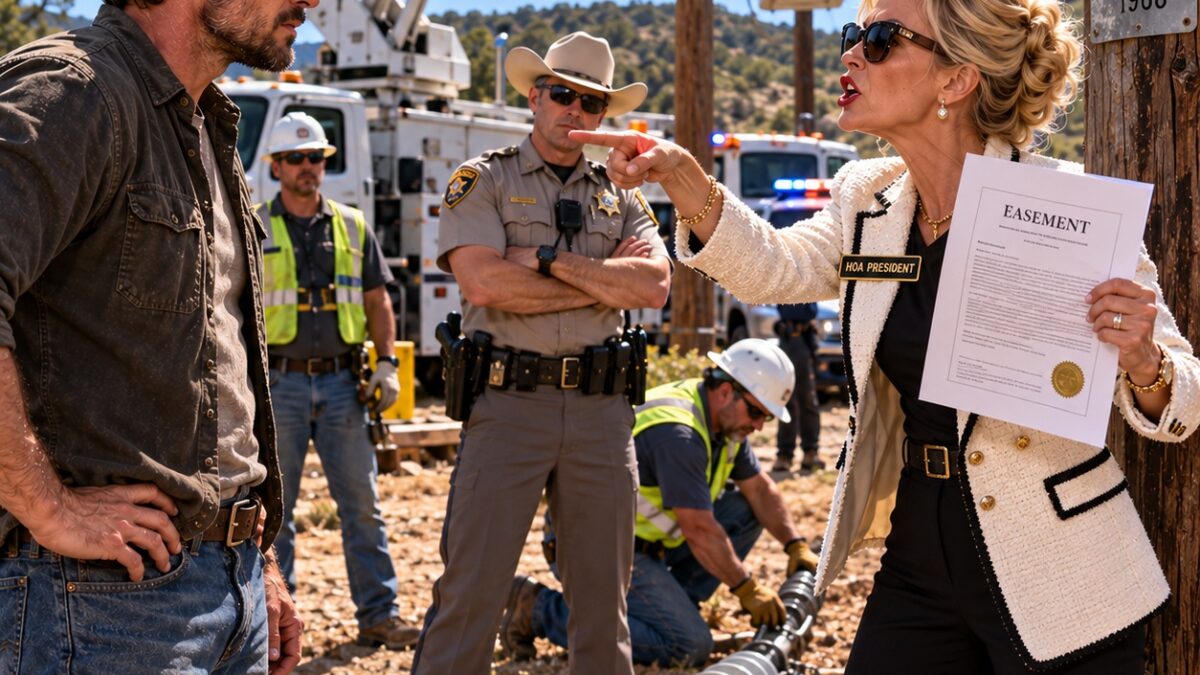
Then Clare stepped out from beside a white SUV with Silver Canyon’s logo on the door.
Clare was president of the Silver Canyon board, though she liked titles that sounded more practical than political. Infrastructure chair. Emergency-access coordinator. Project liaison. She had a way of saying ordinary HOA words like they came from a municipal command center.
She wore a white hard hat, a pressed shirt, work boots too clean for the site, and an expression that told me she had already decided the problem was not the crew, the line, or the cut conductor.
The problem was me arriving before they finished.
“Owen,” she said, calm as a closing statement. “Silver Canyon hired a contractor for a relocation. The board approved it under our recorded easement.”
I looked past her.
Past the plan set clipped to her board.
Past the orange cones and the rigging straps.
Past the printed work packet in Luke’s hand.
My eyes went straight to the aluminum plate beneath the crossarm.
MR17.
Still there.
Still crooked.
Still scarred.
Still my father’s mark.
“That line is not HOA equipment,” I said.
Clare lifted her chin.
“The easement covers this corridor.”
“Your easement does not make this feeder yours.”
“The line interferes with emergency road clearance.”
“Your road project does not give you authority to disconnect, move, dismantle, or damage Mason Ridge assets.”
A contractor stepped forward.
The name stitched on his vest read Luke.
He was younger than me by at least ten years, but he had the look of a man who had already learned that the most dangerous jobsite hazard is bad information from someone who sounds certain.
“Sir,” he said carefully, “Silver Canyon hired us for relocation work. The work order says owner authorization was confirmed.”
Those words hit harder than the conductor on the ground.
Owner authorization confirmed.
I held out my hand.
“Show me.”
Luke hesitated only a second before handing over the packet.
I flipped through the work order until I found the line.
Utility owner authorization confirmed.
I read it twice.
Then a third time.
“I never signed this,” I said. “Nobody at Mason Ridge signed this.”
Luke glanced at Clare.
Not at the line.
Not at the cut span.
At Clare.
That glance told me more than he meant to.
He had asked someone.
Someone had answered.
And now the answer was standing between a recorded easement and my father’s pole.
Clare tapped her board with one finger.
“We have a utility and access easement through this corridor. Counsel says obstructions can be relocated when they interfere with its use.”
“An easement gives you certain rights to use land,” I said. “It does not hand you ownership of switchgear, conductors, poles, transformers, or operating authority over a utility system.”
“You can argue about ownership later. Right now, two hundred forty homes need a second route fire apparatus can use before dry season.”
“Then you should have called the actual facility owner before cutting into his feeder.”
Her eyes narrowed.
“If you’re claiming to be the facility owner, show proof.”
I almost laughed.
Not because anything was funny.
Because the absurdity of standing beside my own line, my own asset plate, my own cut conductor, and being asked to prove I had rights before the people cutting it had proved theirs was nearly too much.
Luke said quietly, “My crew will not guess around energized gear.”
“Good,” I said. “Don’t.”
I pointed to the conductor on the padded blocks.
“Nobody moves another asset while I isolate this section and document what has already happened.”
Clare stepped toward me.
“You are treating a safety project like a title fight.”
“No,” I said. “I am treating energized electrical infrastructure like energized electrical infrastructure.”
Her expression hardened.
The crew stayed still.
That, at least, told me Luke had sense.
I took out my phone and began photographing everything.
The downed conductor.
The cut ends.
The truck number.
The work order.
The packet pages.
The project tag tied above MR17.
The yellow crew tag read HOA RELOCATION.
Six inches below it, my father’s aluminum plate read MR17.
Two claims of authority hanging on the same pole.
One printed yesterday.
One nailed there for decades.
I photographed them both.
FULL STORY CONTINUATION
Clare watched me like every picture was a personal insult.
“That tag identifies the project,” she said. “It does not claim title.”
“Then stop acting like your project controls my equipment.”
“The easement gives the association access to complete necessary work safely.”
“Access to land is not ownership of the system standing on it.”
“You are obstructing an emergency-access improvement.”
“No. I am stopping unauthorized work on my utility.”
For the first time, her confidence flickered.
Not disappeared.
Just flickered.
Because she had started the morning believing she was dealing with a stubborn adjacent landowner, a man upset that HOA contractors were moving wires across his property.
She had not understood that Mason Ridge Utility was not some outside service company I happened to hire.
It was mine.
The feeder was mine.
The poles were mine.
The assets were mine.
The switching responsibility was mine.
And one conductor was already down.
Clare flipped another page in her packet.
“Then have Mason Ridge contact us.”
I stared at her.
“Mason Ridge does not need to contact me, Clare.”
She looked up.
“I own the company. I own this feeder. I own the poles. I own every asset your crew cut.”
The air changed.
Luke lowered his radio.
One of his crewmen stepped farther back from the hardware.
Clare stopped turning pages.
For the first time since she stepped out of the SUV, she did not have an immediate answer.
I let the silence sit.
It needed to.
Because the question now was no longer whether Silver Canyon had a road project.
They did.
It was no longer whether the corridor mattered.
It did.
It was no longer whether emergency access for 240 homes was important.
Of course it was.
The question was how far an HOA’s easement could reach into somebody else’s electrical system.
And whether a board could turn its own legal interpretation into owner authorization by writing it onto a contractor’s work order.
I walked to the sectional switch and began the isolation sequence myself.
Luke watched every movement.
Good.
If he was going to be on my site, near my equipment, he was going to understand the difference between safety cooperation and permission.
“I am isolating this section for safety,” I said. “Not conceding your authority. Everybody clear?”
Luke repeated it to his crew.
Nobody touched the span while I worked.
That much, at least, they got right.
After the damaged section was isolated, I called Mason Ridge dispatch.
“Move the three affected customers onto backup power.”
“Estimated duration?”
“Unknown.”
“What happened?”
“Unauthorized relocation attempt. Start a field incident log now.”
A pause.
“Understood.”
“Refrigeration tenant gets generator priority. Their inventory cannot wait.”
Within minutes, my crew was moving.
That is what people outside utility work often fail to understand. A cut line is not just a cut line. It is customers, loads, equipment, downtime, switching, safety, liability, and the invisible chain of consequences that starts when someone treats infrastructure like an obstacle instead of a system.
One compressor at the refrigeration tenant failed to restart cleanly after transfer.
By late morning, they discarded a specialty food shipment they had already packed for delivery.
I watched workers roll boxes toward a dumpster.
One man stood with his hands on his hips, looking down at labels he had printed before sunrise, knowing the product would never leave his building now.
That was the first moment my anger changed shape.
Until then, it had been personal.
My line.
My pole.
My father’s plate.
But watching those boxes go into the trash made it operational.
Commercial.
Documentable.
Somebody else was losing money because Silver Canyon decided its timeline mattered more than verifying ownership.
I turned to Clare.
“This is why I don’t call it paperwork.”
She looked irritated.
“What?”
“That shipment. Those customers. That downtime. Somebody else is throwing away product because your crew chose to cut that line.”
“We chose to complete a safety project.”
“You chose to proceed without the facility owner’s authorization.”
“We had authorization under the easement.”
“You had an argument under the easement. That is not authorization to operate Mason Ridge equipment.”
Luke stood near the truck, listening and saying nothing.
I respected him for that.
He had stopped his crew.
He had not bluffed.
But the damage was already real.
By noon, my utility lawyer, Maya Chen, was sitting across from me in my office with the easement spread across the conference table.
Maya had represented Mason Ridge for years. She was short, direct, and patient in the way only people who read contracts for a living can be patient. She never raised her voice. She didn’t need to. By the time Maya spoke softly, somebody’s argument was usually already bleeding out on the page.
She read the easement once in silence.
Then again with a pencil in her hand.
I paced near the window until she finally looked up.
“I need you to hear the inconvenient part first.”
“Fine.”
“Silver Canyon really does hold an easement along that corridor.”
“I know that.”
“It is recorded. It is not imaginary.”
“I know that too.”
“It grants defined access for drainage and common utility work. It also has language about relocating obstructions that interfere with the easement’s use.”
“That’s Clare’s entire argument.”
“It is a real argument.”
I stopped pacing.
“Maya.”
She held up a hand.
“A real argument is not the same as a winning argument. And it is not the same as ownership.”
She drew three columns on a legal pad.
Land access.
Corridor use.
Facility ownership.
“This is how we keep the dispute clean,” she said. “Silver Canyon may have land-access rights. It may have some corridor-use rights. But who can operate, disconnect, remove, replace, or dispose of Mason Ridge electrical facilities is a separate question.”
I sat down.
“An access right can reach the ground around the asset.”
“Yes.”
“But it does not automatically give them control over the asset.”
“Exactly.”
I pulled the Mason Ridge files.
Transformer serials.
Pull inventories.
Purchase orders.
Repair logs.
Inspection reports.
Insurance schedules.
Equipment ledgers.
Pole records.
Maps.
Switching protocols.
Every component on that feeder appeared in our asset schedule.
Every repair invoice had been paid by Mason Ridge Utility LLC.
Every inspection record tied the feeder back to our system.
Maya organized the documents into a neat stack.
“These establish separate facility ownership.”
“Enough?”
“Enough to put them on notice immediately. Maybe enough to win the narrow relief we need. But we need the authorization chain.”
“What chain?”
“How did Luke’s work order end up saying owner authorization confirmed?”
That question mattered more than I wanted it to.
Because nobody had forged my signature.
Nobody had produced a fake Mason Ridge approval letter.
Nobody had pretended to be me on the phone.
The problem was subtler.
More dangerous in its way.
Luke emailed his original request that afternoon.
He had written to Daniel Price, Silver Canyon’s property manager, two business days before mobilizing.
Before we schedule work on Canyon Loop relocation, please verify facility-owner authorization for any utility assets to be relocated or disconnected.
That was responsible.
The reply came from Daniel.
The board believes the line falls within Silver Canyon’s recorded easement control rights and may be relocated as part of the approved emergency-access project.
Maya circled one word.
Believes.
“That word matters,” she said.
I nodded.
“Believes describes a legal position.”
“Not authorization.”
“Exactly. Somewhere between Daniel’s cautious statement and Luke’s internal work order, belief became confirmation.”
A belief.
A board interpretation.
An easement argument.
By the time it reached the field crew, it had become owner authorization confirmed.
That was how bad decisions entered the world wearing clean boots.
Not always through fraud.
Sometimes through compression.
Nuance removed for convenience.
Legal uncertainty converted into a green light.
Doubt sanded down until it fit into a work-order checkbox.
Maya drafted a stop notice that afternoon.
It attached our asset schedule, equipment records, photos of MR17, corporate ownership documents, and the incident log.
The notice said Silver Canyon had direct knowledge Mason Ridge owned and operated the feeder. It demanded no further work on the assets until authority was resolved in writing.
We sent it to Clare, Daniel, Silver Canyon’s counsel, Luke’s company, and the insurer contacts we could identify.
Clare acknowledged receipt.
Then refused to concede.
Her response came through counsel.
Silver Canyon maintains that ownership of the equipment does not, by itself, defeat the relocation rights created by the recorded easement. The association is reviewing whether necessary relocation may be completed within the corridor to allow emergency access improvements.
I read it twice.
“She’s still going to push,” I said.
Maya nodded.
“She is preserving her argument.”
“She’s already cut my line.”
“Yes.”
“How is that not the end of it?”
“Because she thinks the road deadline gives her equities.”
“Equities don’t switch circuits.”
“No, but they influence courts.”
That irritated me because it was true.
Later that afternoon, Daniel forwarded the engineering packet for the Canyon Loop project.
For the first time, I saw the full emergency-access issue.
After a wildfire scare the previous year, the county fire consultant had inspected Silver Canyon’s roads and flagged a narrow curve on Canyon Loop. Apparatus clearance was poor. During a fast evacuation response, a truck could lose precious minutes maneuvering around the pinch point.
The project would widen and clear that corridor.
Two hundred forty homes would gain a better secondary route.
The paving window closed Friday at 5 p.m.
If the clearance missed that slot, the paving contractor would demobilize, costs would jump, and the next insurance review would arrive before completion.
I understood Clare’s pressure better after reading it.
That did not make her right.
It did make her human.
I sat at my desk with the fire memo in one hand and the photo of my cut conductor in the other.
This was the problem with real disputes.
The other side was not always lying about everything.
Canyon Loop mattered.
Emergency access mattered.
Fire weather mattered.
Two hundred forty homes mattered.
But none of that transformed Mason Ridge equipment into HOA property.
A safety deadline could explain Clare’s choice.
It could not authorize it.
Maya worked through the easement late into the night.
At 9:18 p.m., she called me.
“Silver Canyon may enter the corridor for listed uses,” she said. “But the document does not give it full control of Mason Ridge equipment.”
“So?”
“So they can access the land. They can coordinate work. They may be able to require a properly authorized relocation if the line truly conflicts with the easement’s stated use. But they cannot treat your electrical system like an HOA-owned obstruction.”
“That’s the line?”
“That’s the line.”
I slept badly.
Too much of that night was my father’s voice.
Not in some mystical way.
In memory.
Check your grounds.
Don’t trust a tag you didn’t place.
Records keep men honest after memory gets convenient.
By dawn, I was back at the yard.
The out-of-service section sat quiet.
The crew was gone.
Pole 17 stood with the yellow HOA tag still tied above MR17.
I climbed down from my truck and removed nothing.
Not the tag.
Not the plate.
Evidence had to stay as found.
That was another thing my father taught me without using legal language.
When something goes wrong, do not tidy up the scene before you understand it.
At 6:42 a.m., Luke called.
“I’ve been directed to return.”
“By who?”
“Silver Canyon.”
“Are you touching the feeder?”
“I have a revised directive. But I need a switching sequence before my crew goes near anything.”
I stared across the yard at pole 17.
I knew exactly what was happening.
If I refused, I risked workers.
If I helped, Clare would treat my cooperation as practical consent.
Maya was already on the call because I had learned, by then, not to have important conversations alone.
She said nothing.
She didn’t have to.
I told Luke, “I will give you a safe switching sequence because I will not risk your crew. But this is not consent to the relocation.”
“I understand.”
“I need you to repeat it.”
“This is safety information, not owner consent.”
“Again, with your superintendent listening.”
He repeated it.
Good.
By 8:00 a.m., the site was active again.
Clare stood near the work zone in a white hard hat.
Luke’s crew moved more cautiously than before.
My field supervisor stood with me, documenting times, actions, and equipment status.
Clare approached.
“Thank you for helping us preserve both legal positions while finishing the clearance.”
I looked at her.
“That sentence belongs in a lawyer’s email, not beside a damaged feeder.”
“We have residents counting on this road.”
“You keep saying that as though I don’t understand fire risk.”
“Then help us finish.”
“I am helping you not kill someone. That is not the same as agreeing you have authority.”
She turned away before I finished.
The work continued under tension.
Every sound felt too loud.
The lift.
The radio chatter.
The clank of hardware.
The scrape of boots on rock.
Then a rigging strap shifted as the old crossarm came free.
The load moved wrong.
Not dramatically.
Not enough for a bystander to gasp.
Enough for people who know pole work to feel their stomachs drop.
Wood cracked near the top of pole 17.
A short, ugly split through the crossarm seat.
“Stop!” I shouted.
Luke signaled immediately.
Everything stopped.
I walked closer and looked up.
The cedar had split where it mattered.
“That pole was serviceable this morning.”
Luke photographed it.
His superintendent tagged it for engineering inspection.
Clare looked at the crack, then toward the road crew waiting beyond the corridor.
“The paving crew is ready,” she said.
I turned slowly.
“You are standing beside damaged utility equipment you do not own, and you are talking about paving.”
“If this corridor is not clear today, the road schedule triggers a change order.”
“And if my pole fails later because you rushed?”
“Luke says remaining work can proceed de-energized.”
“De-energized is not the same as authorized.”
Luke looked miserable.
I almost felt bad for him.
Almost.
He said, “We can complete the de-energized clearance safely if the client directs us.”
Clare did not hesitate long enough to make it look difficult.
“Complete the work.”
I wrote down the time.
9:37 a.m.
Clare authorizes remaining work after visible damage to pole 17.
My supervisor took photos from three angles.
By sunset, the corridor was clear.
The conductors were down.
Asphalt equipment rolled toward Canyon Loop.
Silver Canyon’s road project moved forward.
My customers remained on temporary power.
Generators ran.
Fuel burned.
Crews worked through the night to price a safe restoration plan.
And the old cedar pole with my father’s plate stood damaged, tagged, and waiting for an engineer to decide what my heart already knew.
The next morning, I opened the damage file.
Not emotionally.
Not loosely.
Like a utility owner.
“Every cost gets tied to a ticket, rental, purchase order, contract rate, or invoice,” I told my operations manager. “No round numbers. No revenge premium.”
He nodded.
“Keep it easy to audit,” I said. “Strong invoices are harder to dismiss than angry letters.”
The categories grew quickly.
Emergency isolation and field response.
Temporary generation.
Temporary distribution.
Replacement conductors.
Poles.
Crossarms.
Hardware.
Switchgear testing.
Transformer testing.
Specialized crews.
Engineering.
Recommissioning.
Customer restoration costs.
Tenant losses.
Every hour documented.
Every vendor invoice attached.
Every field note scanned.
Meanwhile, Maya kept gathering the paper trail.
The more we reviewed, the clearer Silver Canyon’s decision became.
The paving deadline was real.
The fire memo was real.
The residents’ concerns were real.
But so were the warnings.
Utility ownership remained unresolved before remobilization.
Clare knew it.
Daniel knew it.
Luke had asked about it.
Maya had sent direct notice.
Silver Canyon proceeded anyway.
Maya found the email that separated urgency from authority.
Clare had received a summary from counsel before the second mobilization.
Utility ownership remains disputed. Facility-owner verification has not been obtained. Proceeding may create exposure if the easement is later found insufficient to authorize relocation of Mason Ridge assets.
I read that email more times than I should have.
It made the second day different.
The first cut might be framed as confusion.
Bad paperwork.
Miscommunication.
A mistaken belief.
The second mobilization was something else.
By then, Clare knew enough to stop.
She chose not to.
During one call, she said the quiet part more plainly.
“I knew ownership was disputed,” she said. “But I believed delaying the road created a larger safety risk.”
I answered, “A safety risk can explain your choice. It cannot turn my poles into your property.”
Maya’s lips tightened in approval.
By the end of the week, the restoration cost file settled at exactly $340,000.
Emergency isolation and field response totaled $38,000.
Temporary generation and distribution added $54,000 while customers stayed in service safely.
New conductor, poles, crossarms, and hardware added $96,000.
Testing switchgear and transformers added $61,000 after unauthorized work disturbed the system.
Specialized crews added $47,000.
Engineering and recommissioning added $24,000.
Customer restoration costs added $20,000.
Total:
$340,000.
Not a dramatic round number.
Not a threat.
A documented restoration invoice.
Mason Ridge sent the package to Silver Canyon with every supporting record attached.
Clare called it punitive within an hour.
Maya told me not to respond directly.
“Let the claim speak in invoices.”
So we sent the same package to Silver Canyon’s insurer for independent review.
The carrier assigned Rachel Morgan.
Rachel arrived with an electrical engineer and the expression of someone who had spent a career listening to policyholders insist every loss was either exaggerated or misunderstood.
She stood under pole 17, looking up at the damaged top.
“I’m not here to judge motives,” she said. “I need invoices, work orders, ownership, causation, and proof each cost was reasonably required.”
“That’s what we brought.”
Her engineer inspected the cut spans.
The conductor ends.
The cracked crossarm seat.
The hardware.
The temporary generation records.
Then he spent a long time with pole 17.
Too long.
I knew before he spoke.
“Pole cannot return to service.”
I stared at the cedar.
“Can it be reinforced?”
“Not for this application.”
“It was serviceable before the lift.”
“Yes.”
“And now?”
“Safe restoration requires replacement.”
“What about the plate?”
He looked at MR17.
“You can preserve the identification plate. That’s separate from reusing the structure.”
That sentence hurt in a way I did not expect.
I knew better than to confuse sentiment with safe equipment.
I had made that same call for customers.
For other people.
For assets with stories I did not know.
Unsafe equipment comes down.
Always.
Still, I stood there looking at the plate my father stamped after the ice storm and felt nineteen years old again, cold-fingered and exhausted, laughing at crooked letters I would someday protect in court.
Maya filed for narrow civil relief the following Monday.
We were not asking the court to block Canyon Loop permanently.
We were not asking the judge to regulate every utility issue between neighbors.
We asked for a clear ruling that Silver Canyon could not modify Mason Ridge equipment without owner authorization, and for the court to decide what the easement did and did not allow.
The hearing was packed enough to prove Silver Canyon residents finally understood this was not just a utility squabble.
The road was finished.
Or close to it.
But the bill was coming.
And nobody wanted to pay for a mistake they did not understand.
Clare sat at the front with Silver Canyon’s attorney.
Daniel Price sat behind her.
Luke sat farther back, looking uncomfortable but steady.
Maya spread our exhibits across the table in the order she wanted them.
She had told me the night before:
“We do not win by making Clare a cartoon villain. We win by showing the boundary she crossed.”
That was good advice.
Hard advice.
Because part of me wanted to make it personal.
Part of me wanted the judge to understand what pole 17 meant.
But courts do not decide cases because a pole belonged to your father.
They decide ownership, authority, causation, and damages.
So Maya started there.
The easement.
The asset schedule.
The work order.
Daniel’s email.
Luke’s request for facility-owner approval.
The stop notice.
The second mobilization.
The switching sequence disclaimer.
The cracked pole.
The restoration invoice.
Silver Canyon argued first that the easement allowed necessary relocation of obstructions interfering with corridor use.
Their attorney emphasized the fire memo.
Two hundred forty homes.
Evacuation access.
Fire weather.
The paving deadline.
He said Silver Canyon never claimed to own Mason Ridge.
He said the association believed it had the right to complete necessary work within its recorded corridor.
He said the board had to balance competing risks.
He said Clare made a hard decision under pressure.
Some of that was true.
That was the uncomfortable part.
Maya did not fight the facts that helped them sound reasonable.
She accepted them and moved around them.
“Silver Canyon had a real emergency-access concern,” she said. “Mason Ridge does not dispute that. Canyon Loop needed improvement. Residents needed a safer route. The question is not whether the road mattered. The question is whether that need gave Silver Canyon authority to operate, remove, and damage electrical facilities owned by Mason Ridge.”
The judge leaned back.
Maya continued.
“An easement is not ownership. Access is not operational control. A board’s belief is not owner authorization.”
Then Luke testified.
He was nervous at first.
But honest.
He said his crew asked for facility-owner approval before mobilizing.
He said the client represented that authority had been confirmed.
He said once Owen Hail disputed ownership, his crew stood down.
He said he later returned under Silver Canyon’s direction.
He confirmed I provided switching information only after stating it was for safety and not consent.
He confirmed the pole was damaged during work performed after the ownership dispute was known.
That made Luke something Clare did not want him to be.
Not the villain.
Not the excuse.
A witness to the authorization chain.
Daniel testified next.
He tried to stay careful.
He said the board believed its easement rights covered relocation.
Maya asked, “Did you ever receive written authorization from Mason Ridge Utility LLC?”
“No.”
“Did Owen Hail sign any relocation approval?”
“No.”
“Did anyone at Mason Ridge sign one?”
“No.”
“Then when the work order said owner authorization confirmed, what owner did that refer to?”
Daniel swallowed.
“The board’s easement authority.”
“That is not what the phrase says.”
“No.”
“What does it say?”
He looked at the exhibit.
“Owner authorization confirmed.”
“Was that accurate?”
Long pause.
“No.”
Clare’s testimony was last.
She was composed.
She always was.
She explained the wildfire scare.
The residents’ fears.
The fire consultant’s memo.
The paving deadline.
The demobilization costs.
The insurance review.
She said she believed the easement gave Silver Canyon relocation rights.
She said delaying Canyon Loop could have exposed the community to risk entering dry season.
The judge listened.
Then asked the question that changed the room.
“Once you knew Mason Ridge claimed ownership of the facilities, why did you not pause until the owner-authorization issue was resolved in writing?”
Clare sat straighter.
“Because delaying the road placed two hundred forty homes at risk.”
“Did that risk give Silver Canyon ownership of Mason Ridge’s feeder?”
“No.”
“Did that risk give Silver Canyon authority to certify Mason Ridge’s consent?”
Clare did not answer immediately.
Her attorney leaned toward her.
The judge waited.
Finally Clare said, “I believed the easement allowed relocation.”
“That is not what I asked.”
Silence.
“No,” Clare said.
The ruling came the same day.
It was narrow.
But it was enough.
The court restrained Silver Canyon from modifying Mason Ridge equipment without owner authorization.
It held that the easement survived.
Silver Canyon retained corridor access.
The road upgrade could continue lawfully through a coordinated process.
But Mason Ridge retained switching authority, asset control, and the right to authorize work on its electrical facilities unless a separate recorded agreement clearly gave those rights away.
No such agreement existed.
The judge said it in language simple enough for every resident in the room to understand.
“An easement right of access is not a blank check to operate, dismantle, or relocate another entity’s electrical infrastructure.”
Nobody spoke for a moment after that.
Then pens started moving.
People writing it down.
Because that was the sentence that would follow Silver Canyon home.
The insurer’s engineering review finished shortly after.
Rachel Morgan separated necessary restoration from betterment.
That mattered.
I had authorized some improvements during replacement because once a system is opened, only a fool restores it poorly just to prove a point.
But anything that made the system better than before, beyond required restoration, came out of the claim.
Anything directly caused by the unauthorized work stayed.
The $340,000 survived review because every line item had a source.
Not because I was angry.
Not because I wanted a trophy.
Because the damage cost what it cost.
Silver Canyon’s insurer accepted portions of the covered loss, subject to policy terms, deductibles, and exclusions.
The uncovered balance fell back on the HOA.
That was when residents became truly furious.
Not in court.
Not when the road was delayed.
When the invoices touched them.
An emergency HOA meeting filled the clubhouse beyond capacity.
I did not want to go.
Maya advised me to attend.
“Documents read differently when the person damaged by them is in the room,” she said.
So I went.
The mood was ugly.
Not dangerous.
But hot.
Some residents arrived angry at me.
I could feel it.
To them, I was the man whose utility fight had turned into a bill.
Then the board packet was distributed.
Emails.
Work orders.
Photos.
The court order.
Rachel’s engineering review.
Maya’s stop notice.
Daniel’s email.
Luke’s request.
The second-mobilization timeline.
By the time residents reached the document showing Clare had been warned ownership remained unresolved before work resumed, the anger started shifting.
A man in the back stood first.
“Did the contractor ask for owner authorization before mobilizing?”
Daniel answered from the side table.
“Yes.”
“And what did we give him?”
Daniel looked at Clare.
Clare said nothing.
Daniel answered, “The board’s position that the easement gave authority.”
“That’s not owner authorization.”
“No.”
A woman near the front held up the photo of the two tags on pole 17.
“Is this Mason Ridge plate older than the relocation tag?”
“Yes,” Daniel said.
“How much older?”
Nobody answered.
I did.
“Decades.”
The room turned toward me.
“My father stamped it after an ice storm when I was nineteen. Mason Ridge has records for that feeder. Asset schedules. Repair invoices. Insurance schedules. Inspection logs. Everything your contractor should have been told to verify before the first cut.”
Another resident asked Clare, “Did you know he owned the utility before the second mobilization?”
Clare’s face held.
“I knew ownership was disputed.”
“That’s not what I asked.”
She inhaled.
“Yes.”
A murmur moved through the room.
She raised her voice slightly.
“I also knew the evacuation route was unfinished entering fire weather. I made the best decision I believed I could make for this community.”
That sentence landed differently than she hoped.
Because it sounded noble until placed next to the invoices.
A safety concern does not erase the need for consent.
It only makes good procedure more important.
Clare stood at the front of the clubhouse, hands resting on the table.
“I would still choose an emergency route,” she said.
Nobody argued.
“But I would not proceed again until ownership and relocation rights were fully settled in writing.”
That was as close to an apology as I ever got from her.
It was not enough.
It was still something.
The board adopted new procedures that night.
No manager could certify facility-owner authorization based on a board interpretation.
No contractor could mobilize around utility assets without direct written verification from the owner or operator.
Any future work inside an easement corridor involving privately owned infrastructure required a written coordination agreement.
Switching authority had to be identified before field work.
Asset ownership had to be documented, not assumed.
Good rules.
Expensive rules.
Rules that should have existed before a conductor hit the dirt.
Clare left the infrastructure committee a week later.
She stayed long enough to transfer the project records cleanly.
I respected that much.
Not enough to forgive the decision.
But enough to admit she did not run from the paperwork once the damage was undeniable.
Silver Canyon and Mason Ridge eventually signed a revised Canyon Loop crossing agreement.
It named Mason Ridge as facility owner.
It required written approval for any future relocation.
It established procedures for de-energizing, switching, equipment handling, access windows, restoration responsibilities, and emergency exceptions.
It confirmed Silver Canyon’s easement rights.
It confirmed Mason Ridge’s asset control.
It allowed the road to function safely without pretending the HOA owned what it didn’t.
That agreement should have been written before the first bucket truck arrived.
Instead, it was written after a damaged feeder, a $340,000 restoration invoice, a court hearing, an insurance review, and one old cedar pole lost forever.
Mason Ridge rebuilt under our own work order.
No HOA direction.
No contractor guessing.
No board interpretation masquerading as consent.
A new pole 17 went up near the pump house.
Straight.
Strong.
Correctly set.
Properly documented.
Better equipment in every measurable way.
That matters in utility work.
It still was not the pole my father and I had set after the ice storm.
When the crew removed the MR17 plate, they wrapped it in a shop rag and brought it to me.
I held it for a long time.
The plate was lighter than I remembered.
Maybe because memory had made it heavier.
The aluminum was scratched from removal.
The corners had bent slightly.
The letters were still crooked.
MR17.
I cleaned it gently in the workshop behind my office.
Not too clean.
I wanted the weathering to remain.
I wanted the scar marks.
I mounted it on the wall beside the new crossing drawings.
The new drawings were precise.
Professional.
Useful.
The old plate was none of those things.
It was crooked.
Scarred.
Personal.
I stood there after everyone left and looked at both of them.
That was the whole story, really.
A line between memory and modern procedure.
Between land access and asset control.
Between urgency and authority.
Between doing something fast and doing it right.
My father would have hated the entire mess.
He would have hated the waste.
The carelessness.
The damage.
The way a committee used a safety goal to justify touching equipment it didn’t own.
But he also would have told me not to let sentiment cloud system safety.
If the pole failed inspection, it came down.
No debate.
Frank Hail loved utility work too much to romanticize unsafe equipment.
That helped.
A little.
The tenant resumed normal service after the rebuild.
The spoiled shipment and missed delivery were paid.
Customers came off temporary power.
The new hardware tested clean.
The feeder was recommissioned.
Canyon Loop reopened with proper clearance.
Fire apparatus could make the turn.
Silver Canyon got the safer road it needed.
Mason Ridge retained switching and asset control.
That was the strange ending.
Everyone got what should have happened in the beginning.
Only now it cost far more.
The road survived.
The easement survived.
The utility survived.
What did not survive was the blurred line Silver Canyon tried to live inside.
Access is not ownership.
Urgency is not authorization.
An easement is not a master key.
People asked whether I hated Clare.
I didn’t.
That answer disappointed some of them.
They wanted a villain simple enough to hate without effort.
But real stories are rarely that clean.
I hated Clare’s decision.
I hated that she remobilized after receiving notice.
I hated the damaged pole.
I hated the cost.
I hated seeing a yellow HOA relocation tag tied above my father’s plate.
But I understood the fear behind the road project.
Fire risk in Texas is not abstract.
A bad evacuation route can become a tragedy.
Clare’s strongest argument was never greed.
It was fear.
She believed delay could leave two hundred forty homes exposed.
That belief was real.
But real fear can still produce unlawful overreach.
That was the lesson.
Not that emergency access didn’t matter.
It did.
Not that Silver Canyon’s easement was fake.
It wasn’t.
Not that Clare had no reason to act.
She did.
The lesson was that a valid project still needs valid authority.
Especially when people are afraid.
Maybe especially then.
Because fear is when boards start cutting corners and calling it leadership.
I still drive Canyon Loop sometimes.
It is a good road now.
Wider.
Cleaner.
Safer.
The curve works.
The clearance is right.
If a fire truck has to use it, it can.
That matters.
I am glad it was fixed.
I just wish they had asked first.
That sounds too simple after everything that happened, but it is the truth.
Ask first.
If Silver Canyon had come to Mason Ridge before cutting anything, we could have designed a safe crossing.
We could have coordinated switching.
We could have protected customers.
We could have scheduled crews.
We could have preserved pole 17 if possible, or replaced it under controlled conditions if necessary.
We could have separated betterment from relocation costs before damage occurred.
We could have helped them finish the emergency route without court, insurer, or residents opening invoices with shaking hands.
Instead, a deadline became a shortcut.
A shortcut became damage.
Damage became a claim.
The claim became a lawsuit.
The lawsuit became a rule everyone should have known already.
When young linemen come through my shop now, some of them notice the MR17 plate on the wall.
They ask what it is.
I tell them.
Not the whole story every time.
Sometimes just enough.
“That plate is why we verify ownership before touching anything.”
If they look interested, I tell the longer version.
The bucket truck.
The easement.
The conductor in the dirt.
The work order saying owner authorization confirmed.
The board’s belief becoming field permission.
The stop notice.
The second mobilization.
The cracked pole.
The $340,000 invoice.
The judge.
The new agreement.
I tell them because utility work is full of moments where somebody with urgency tries to borrow your authority.
A contractor says the client approved it.
A manager says the board signed off.
A developer says the easement covers it.
A property owner says it’s always been done this way.
A supervisor says just get it done.
Maybe they’re right.
Maybe they’re half-right.
Maybe they’re dangerously wrong.
Your job is to know the difference before your hands touch the system.
Luke learned that too.
He called months later, after everything settled.
“I changed our intake process,” he said.
“For owner authorization?”
“Yes. Direct verification now. No more relying on a client’s interpretation if utility assets are involved.”
“Good.”
“I should have pushed harder.”
“You stopped when I told you to stop.”
“Not enough.”
“No,” I said. “Not enough.”
He accepted that.
I respected him more for not arguing.
Daniel Price changed Silver Canyon’s management language.
No property manager could certify owner authorization based solely on board interpretation.
Rachel Morgan used the claim file in a training seminar about separating restoration from betterment.
Maya kept the court order in her teaching file for younger attorneys.
Even Clare, in her own way, changed procedure before leaving the infrastructure committee.
The damage traveled farther than the original mistake.
At least the lesson traveled with it.
That is the only useful thing damage can do after it is paid for.
Still, I would rather have the old pole.
That is the honest part.
I can talk all day about property rights, easement law, operating authority, damage categories, insurer review, and safe restoration standards.
But some mornings I walk into the workshop and see MR17 on the wall, and none of that comes first.
What comes first is cold.
The ice storm.
My father’s stiff gloves.
The sound of his hammer striking aluminum.
His crooked stamp.
His voice saying, “You’ll know it’s mine.”
He was right.
I knew.
The records knew.
The asset schedule knew.
The repair logs knew.
The court knew.
Eventually, Silver Canyon knew too.
The plate did not decide the case by itself.
That would make a cleaner story, but it would not be true.
The case was decided by records.
By emails.
By the easement language.
By ownership schedules.
By Luke’s request.
By Daniel’s wording.
By Maya’s notice.
By Clare’s choice to proceed after the dispute was clear.
By Rachel’s engineering review.
By every invoice tied to a real cost.
But the plate was the first truth my eyes found that morning.
Before lawyers.
Before court.
Before residents.
Before damage files.
Before insurance review.
A scarred little piece of aluminum beneath a crossarm, saying in crooked letters what everyone should have verified before a crew arrived.
This belongs to Mason Ridge.
Ask first.
That is the part I cannot let go of.
Not because I need to stay angry.
Because it is so simple.
Ask first.
The world would avoid half its expensive disasters if people with authority stopped assuming their paperwork reached farther than it did.
An easement is powerful.
A deadline is powerful.
A safety concern is powerful.
A board vote is powerful.
But none of those things are infinite.
They stop somewhere.
At the edge of another right.
Another owner.
Another system.
Another person who has to live with the consequences.
Silver Canyon learned that line at pole 17.
I learned something too.
I learned that even when you win, restoration is not the same as replacement.
A conductor can be replaced.
A pole can be replaced.
A bill can be paid.
A road can be reopened.
A court can draw a boundary.
But some things only survive if nobody touches them carelessly in the first place.
I cannot put that old cedar pole back where my father left it.
I cannot make the tenant’s spoiled shipment unspoiled.
I cannot erase the hours customers spent on temporary power.
I cannot undo the moment I drove into my yard and saw a bucket truck under my line like my own property had become a jobsite without me.
But I can keep the plate.
I can keep the record.
I can keep the ruling.
I can keep the procedures Mason Ridge now requires for every crossing, every corridor, every relocation request, no matter who says it is urgent.
And I can keep repeating the sentence that should have ended the argument before it started.
An easement lets you use a corridor.
It does not let you claim what you never owned.