The HOA Queen Who Slashed My Wife’s Tires at 2:47 A.M. Never Saw the Camera That Would Bury Her Kingdom.v
FULL STORY CONTINUATION
Jenna turned toward me so quickly the chair squeaked against the floor.
“What do you mean, we don’t do anything?”
“I mean not tonight.”
“Marcus, she slashed my tires.”
“I know.”
“She walked onto our property while our children were asleep.”
“I know.”
“She lied to the police.”
“I know.”
Jenna stood.
She had changed out of her scrubs, but the exhaustion of the sixteen-hour shift had not left her face. Neither had the fear from that morning.
“You have a video.”
“Yes.”
“A perfect video.”
“Yes.”
“And you want to wait?”
I knew exactly how it sounded.
Passive.
Cowardly, almost.
But patience had put more fraudsters into settlement rooms than confrontation ever did.
I turned the monitor back toward myself and paused the image on Cynthia’s face.
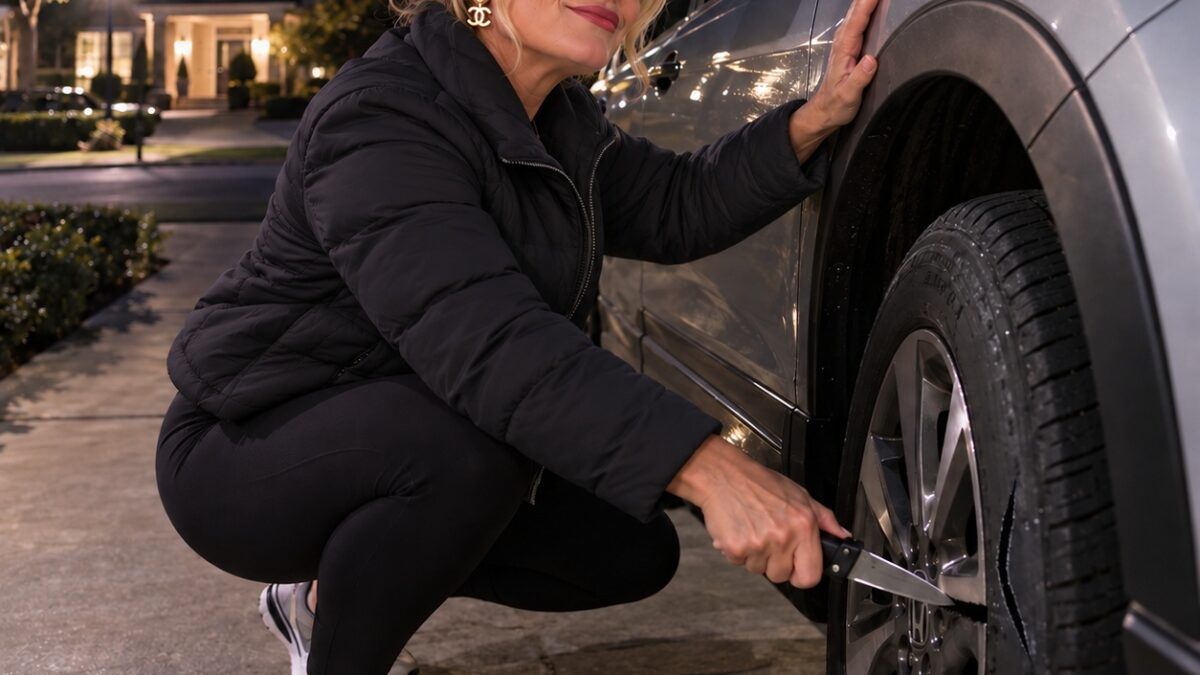
Infrared lighting flattened all the expensive work she had done to look younger. No salon lighting. No foundation. No flattering angles. Just a fifty-two-year-old woman looking directly into the device that would eventually dismantle the world she had spent years constructing around herself.
“A good case catches someone committing one crime,” I said.
“And?”
“A great case lets them explain why they committed it.”
Jenna folded her arms.
“She already lied to police.”
“And if we confront her now, she hires a lawyer, stops talking, deletes things, starts claiming it was an accident or that the footage was altered. She’ll turn herself into a victim before anyone else sees the first frame.”
“You think she’ll do more.”
“I know she will.”
“How?”
“Because Cynthia doesn’t think she committed a crime.”
Jenna stared at me.
“She thinks she enforced a rule.”
That distinction mattered.
Criminals who know they have committed crimes hide.
People who believe they are morally entitled to commit crimes document themselves.
They email.
They convene meetings.
They create policies.
They spend money.
They explain.
And the more convinced they are of their own righteousness, the cleaner the evidence becomes.
Cynthia Aldrich was not going to disappear.
She was going to build the rest of my file for me.
That was Cynthia’s greatest weakness.
Not cruelty.
Certainty.
To understand how certain she had become, you have to understand Hawthorne Glenn.
Our house at 1247 Stonebridge Drive sat at the end of a cul-de-sac in Cabarrus County, North Carolina, about thirty minutes northeast of Charlotte where suburbs begin surrendering to horse farms and the nearest major cultural attraction is a Tractor Supply with an ambitious garden department.
Hawthorne Glenn contained eighty-two homes.
Community pool.
Playground.
Walking trail around a retention pond the HOA called a nature preserve with the same confidence a gas station calls the rotating cylinders under hot dogs a grill.
The houses were comfortable without being spectacular.
Four hundred thousand.
Five hundred thousand.
Vinyl siding.
Shutters.
Two-car garages.
Streets named after flowers the developer had bulldozed before pouring foundations.
We bought 1247 in October of 2021.
Four bedrooms.
Two and a half baths.
Two-car garage.
L-shaped driveway wrapping down the side of the house.
Most importantly, a sixty-year-old southern red oak in the front yard.
The county arborist had designated it a heritage specimen. The developer built around it, which made our lot one of the only lots on Stonebridge Drive with anything that existed before the subdivision.
The oak was why Jenna loved the house.
I loved Jenna.
So we bought it.
We beat another offer by $27,000.
I did not know until later whose offer it was.
Cynthia Aldrich’s daughter and son-in-law.
Kyle and Britney.
They had offered $460,000.
We offered $487,000.
Seller took ours.
Gail Patterson, our next-door neighbor, later told Jenna that Cynthia stood in her kitchen watching our moving truck and said loud enough for Gail to hear through an open window:
“I can’t believe they gave the oak-tree lot to people who drive a pickup truck.”
That was our original offense.
Not the truck.
Not the basketball hoop.
Not Jenna’s herb garden.
We had purchased a house Cynthia believed belonged to her bloodline by natural law.
Everything after that grew from the same petty root.
Cynthia lived two houses down at 1243 Stonebridge.
Direct line of sight to our driveway from her kitchen.
She had been HOA president for seven years after first winning the job with twelve votes out of nineteen cast.
Twelve votes.
In an eighty-two-home subdivision.
But power does not care how many people hand it to you once you begin acting as if everybody did.
Cynthia had spent her working years as a residential staging consultant.
She had made money telling strangers their furniture was wrong, their curtains were depressing, their kitchen looked cheap, and their family photos needed to disappear so potential buyers could imagine replacing them.
When her husband Doug began earning enough selling surgical robotics for Cynthia’s income to become optional, she stopped staging houses professionally.
But she did not stop staging.
She staged the neighborhood instead.
She was fifty-two.
Beautiful in the way a weapon is beautiful.
Maintained.
Engineered.
Pointed.
Chestnut hair with caramel balayage refreshed every six weeks.
Microbladed eyebrows shaped into exact arches.
Cosmetic work precise enough to make normal human expressions look like software attempting emotion.
Cashmere.
Lululemon.
Tory Burch flats.
David Yurman bracelet she touched constantly like royalty checking the crown was still there.
Pearl-white Lexus RX 350.
Personalized plate: HGLEN1.
Hawthorne Glenn One.
Subtlety had not survived the consultation.
She chaired the architectural standards committee.
Landscape compliance board.
And something she had created called the Curb Appeal Task Force, which consisted mainly of Cynthia walking around with a clipboard and tape measure looking disappointed by other people’s lives.
She had issued 147 violation notices in seven years.
Nearly half she later admitted were only advisory.
That was her word.
Advisory.
A polished synonym for threatening people without legal authority because she enjoyed watching them comply.
Our first letter arrived eleven days after move-in.
Cream linen envelope.
Gold HOA crest.
Three-page orientation packet.
Sections on driveway parking, commercial activity, and exterior alterations highlighted in yellow.
Everything she had already cataloged from her window.
My truck.
Caleb’s portable basketball hoop.
The magnetic consulting sign I occasionally put on the truck when meeting clients.
Jenna looked at the packet.
“That’s not orientation.”
“What is it?”
“A warning shot with a sticky note.”
She was right.
Two weeks later came our first formal violation.
Vehicle storage in driveway.
My Tundra was outside because the garage still held moving boxes.
Fine: $75.
I moved boxes.
Parked inside.
Emailed compliance.
Cynthia answered within forty minutes.
Thanked me.
Then informed me Caleb’s basketball hoop required architectural review.
It was a portable children’s hoop with a blue plastic base you fill with water.
Caleb was seven.
He shot baskets for twenty minutes after school and considered anything from beyond six feet a three-pointer because NBA rules are flexible when you are seven and your father wants dinner cooked before dark.
Cynthia demanded fourteen pages of application documents.
Photographs.
Dimensions.
Location diagram.
Color information.
Three weeks later, the committee denied it.
Reason:
Bright blue base inconsistent with Hawthorne Glenn earth-tone exterior palette.
A plastic basketball hoop base.
In a North Carolina subdivision where the actual earth tone is red clay turning to mud after thunderstorms.
I bought a black fabric base cover online for sixteen dollars.
Resubmitted.
Approved.
Forty-one days elapsed between Caleb’s first driveway basket and official permission to keep taking them.
The architectural committee had spent more time considering a seven-year-old’s toy than most municipalities spend considering small bridges.
That was when I started the file.
ALDRICH.
Every letter.
Every email.
Every fine.
Every screenshot.
Every response.
Within six months, the folder had fourteen entries.
Navy-blue front door.
Fine.
The previous owners had received written approval for that exact paint color four years earlier.
Signed by Cynthia herself.
I sent her a copy.
She wrote back:
Color approvals are subject to periodic review and evolving community standards.
Meaning:
Thursday felt different.
Fine: $150.
I left the door navy blue.
Then Jenna planted herbs.
Basil.
Rosemary.
Thyme.
Cherry tomatoes.
Along the side yard.
Cynthia called the cherry tomatoes visually inconsistent with the community walking-trail corridor.
Fine: $75.
Jenna pulled them out and replanted behind the house.
She did not cry.
She became quiet.
That was worse.
It was never about tomatoes.
It was about a woman making my wife feel unwelcome on property we worked fifteen years to afford.
Then came the whisper campaign.
Gail told us Cynthia had started suggesting my consulting company was actually some sort of surveillance business.
She implied my cameras might be pointed at neighbors.
I worked from a laptop reviewing insurance claims.
The most exciting part of my average Thursday was finding an invoice dated after the loss someone claimed destroyed it.
But facts were not Cynthia’s preferred medium.
Atmosphere was.
Make the neighborhood suspicious of the family in Lot 14.
Then escalation looks like protection.
March 2023, Cynthia reported me to Cabarrus County Code Enforcement for operating an unlicensed business.
Officer checked my license.
Current.
Valid.
Case closed in eleven minutes.
Two weeks later:
Noise complaint.
Basketball bouncing.
Children shouting.
3:30 to 5:30 p.m.
County dismissed it.
Apparently children playing after school had not yet become illegal in North Carolina.
Then Cynthia pushed through the overnight vehicle storage amendment.
Every vehicle had to be garaged between 10:00 p.m. and 6:00 a.m.
No exception.
The garage fit Jenna’s CR-V beside my office storage.
My truck stayed outside.
Six other families parked outside too.
Only one household received fines.
Ours.
$75.
Then $100.
Then $150.
I paid every one.
Every receipt went into ALDRICH.
Documentation is not something you begin after catastrophe.
You start when the first thing smells wrong.
And Cynthia Aldrich smelled like a five-alarm fire wearing perfume.
Then came November 15.
2:47 a.m.
The four tires.
The invented man.
The false police report.
And the first piece of evidence strong enough to stop documenting harassment and start documenting crimes.
Patricia Yun understood immediately.
She was a civil litigator in Concord who specialized in property disputes and HOA conflicts. Precise. Patient. The rare kind of attorney who could make a jury furious without ever raising her voice above the level most people use to order coffee.
I drove to her office with the dash-cam footage, Cynthia’s police report, and the ALDRICH folder.
She watched the video once.
Rewound.
Paused on Cynthia’s infrared-lit face.
“She looked directly at it.”
“She did.”
“She didn’t know the camera existed?”
“No.”
Patricia leaned back.
“Beautiful.”
I raised an eyebrow.
“Legally.”
“Good clarification.”
She reviewed the police statement next.
Medium-height male.
Dark hoodie.
Jeans.
Walked toward Winslow Court.
Patricia set it beside the still frame showing Cynthia in yoga pants and white Nikes.
“You have criminal property damage.”
“Yes.”
“False police report.”
“Yes.”
“And probably a civil harassment claim if the pattern supports it.”
“It does.”
Patricia folded her hands.
“But I agree with you about waiting.”
I had not told her my plan yet.
She smiled slightly.
“I’ve represented enough HOA presidents to know how this works. She’s going to use the vandalism.”
“How?”
“She created a criminal threat. Now she gets to solve it.”
That was exactly what happened.
Within a week, Cynthia sent an urgent email to all eighty-two households.
CRIMINAL ACTIVITY IN HAWTHORNE GLENN.
She cited her own fabricated report about the hooded prowler as if it were independent evidence.
She proposed enhanced lighting.
Neighborhood watch.
New safety spending.
Emergency meeting.
Forty-one homeowners attended.
Largest meeting in subdivision history.
Cynthia stood in front wearing a navy blazer with gold buttons and pearl studs, presenting stock photos of slashed tires from Google alongside photographs of Jenna’s CR-V.
She never once mentioned she had taken the photographs before most people knew anything had happened.
She recommended seventeen LED floodlights around common areas.
Cost: $4,200 from HOA reserves.
Approved unanimously.
She had turned her own crime into a budget item.
Then she formed Glen Watch.
Volunteer patrol teams.
Laminated badges.
Group text.
Reflective vest reading PATROL LEAD across the back.
Cynthia walked through Hawthorne Glenn at night with a flashlight searching for the fictional criminal she had created to conceal herself.
The actual criminal was leading the neighborhood watch.
The irony would have been funny if my wife had not been the one buying $1,847 worth of tires.
Then Cynthia proposed an exterior surveillance equipment policy requiring every homeowner with cameras to submit diagrams showing camera positions and coverage areas.
That told me exactly what she was afraid of.
Footage.
I submitted a diagram.
Ring doorbell.
Two exterior Eufy cameras.
Nothing else.
The dash cams lived inside private vehicles.
They were not exterior surveillance equipment.
Cynthia never asked.
The same confidence that made her destructive also made her lazy.
She assumed that if I had evidence, I would already have used it.
Silence convinced her no evidence existed.
That was what I needed.
For the next three weeks, we watched Cynthia transform fear she manufactured into authority she expanded.
The floodlights went up.
Neighborhood watch began.
Residents thanked her.
Her Facebook posts drew praise.
Thanks for keeping us safe, Cynthia.
So grateful for your leadership.
Exactly the kind of comments that convince a guilty person the world is not only fooled, but applauding.
Then she did it again.
Saturday morning in December.
11:14.
Broad daylight.
I was at a consulting job.
Jenna had taken the kids shopping.
House empty.
Cynthia walked up my driveway.
No mask.
No attempt to hide.
Camel coat.
Tortoiseshell sunglasses.
Key in her right hand.
The Vantrue in my Tundra recorded her approach.
She stopped beside the driver’s door.
Looked toward her own house.
Then dragged the key through the blue paint.
Six-inch letters.
M.
O.
V.
E.
MOVE.
She pressed hard enough at the bottom of the E to gouge through primer and expose bare steel.
Then she stepped backward.
Admired it.
Adjusted her sunglasses.
Walked home.
All three truck cameras captured her.
Front.
Cabin.
Rear.
I got the alert twenty minutes later.
Downloaded the clips.
Copied them.
Backed them up.
Then called Patricia.
“She did it again.”
Patricia paused.
“We’re ready.”
That night, Jenna stood in the garage looking at the word carved into my truck.
“You knew she’d escalate.”
“I suspected.”
“You didn’t know she’d do this.”
“No.”
“Do you ever get tired of being right about terrible people?”
I looked at my wife.
“Yes.”
That was the truth.
Investigative instincts are useful professionally.
They are miserable domestically.
Nobody wants to be the man who can see exactly where another person’s cruelty is heading while the people he loves are standing in the path.
I put one hand against the truck door.
“Tomorrow we finish it.”
Over the next forty-eight hours, Patricia and I rebuilt the file from the beginning.
Not because we lacked evidence.
Because good evidence delivered badly can become background noise.
Original dash-cam microSD sealed and signed.
Forensic copy.
Encrypted drive.
Cloud backup.
USB.
Safe-deposit copy.
Thirty-one high-resolution stills from the tire slashing.
Approach.
Knife.
Cut.
Second wheel.
Third.
Fourth.
Face.
License plate.
Then truck damage.
Approach.
Key.
Lettering.
Face.
Return path.
ALDRICH folder.
Twenty-three notices.
Eleven fines totaling $2,175.
Code complaint.
Noise complaint.
Overnight parking rule.
Her surveillance policy.
Gail’s statement.
Jenna’s statement.
My statement.
Cynthia’s false police report.
HOA meeting minutes authorizing $4,200 in spending to respond to the threat Cynthia herself created.
Her mass emails.
Her neighborhood watch materials.
Everything.
Monday morning in January 2024, I walked into the Cabarrus County Sheriff’s Office beside Patricia carrying the binder, encrypted drive, and flash drive.
Detective Amanda Solis met us.
She watched the tire video first.
No expression.
People who spend careers watching evidence learn to keep reactions behind their eyes.
Cynthia entered frame.
Knelt.
Cut.
Moved.
Cut.
Moved.
Cut.
Moved.
Cut.
Brushed knees.
Looked into camera.
Amanda paused on the face.
“This is the HOA president?”
“Two doors down.”
“And she reported a male?”
I handed her Cynthia’s statement.
Amanda read it.
“Height, hoodie, jeans, direction of travel.”
“Yes.”
“Three hours after this video?”
“Yes.”
She watched the truck footage next.
MOVE appearing one letter at a time.
She closed her notebook.
Looked at Patricia.
Then me.
“Mr. Webb, I need about two hours.”
It took two hours and fourteen minutes.
At 2:31 p.m., Detective Solis and Deputy Ramos knocked on the door of 1243 Stonebridge Drive.
I know the exact time because my living-room security camera captured part of the view across the cul-de-sac.
Cynthia opened the door wearing an ivory silk blouse, pressed linen trousers, her David Yurman bracelet, ballet-pink manicure, and the expression of a woman who had spent seven years assuming police cars arrived because she called them.
Detective Solis identified herself.
Asked Cynthia to step outside.
Cynthia smiled.
Professional.
Closed lips.
Control.
“I’m sorry, what is this regarding?”
“Ma’am, you’re being placed under arrest.”
The smile stayed on her face for three seconds.
Frozen.
Like a display mannequin after the store lights go out.
Then the color left her cheeks.
Her hand went automatically to the bracelet.
“There must be a mistake.”
“No, ma’am.”
“I’m the HOA president. I’m the one who reported the vandalism.”
“Yes, ma’am,” Amanda said. “We know.”
That sentence traveled two houses and hit me harder than I expected.
We know.
For years, Cynthia’s power came from being the person who knew.
Who reported.
Who measured.
Who photographed.
Who interpreted.
Who accused.
Now someone with actual authority knew something about her.
Detective Solis read the charges.
Two counts of injury to personal property.
One count of filing a false police report.
Cynthia’s hands went behind her back.
Metal closed over the David Yurman bracelet.
A small click.
Nothing dramatic.
But after seven years of violation notices and fabricated authority, that click sounded like punctuation.
She walked toward the patrol car with her chin lifted.
Still performing.
Still staging.
Still believing posture could alter reality.
But her hair had fallen flat on one side.
Her blouse came untucked slightly in back.
Her chin trembled.
For the first time since we moved to Hawthorne Glenn, Cynthia Aldrich looked less like an authority and more like a person whose choices had caught up with her.
Doug returned from a conference in Savannah that evening.
He called me from his driveway.
“Marcus, I don’t know what to say.”
“You don’t have to say anything.”
“I’m sorry.”
I looked through the window at his darkened house.
“I am too.”
I meant it.
Not for Cynthia.
For Doug.
A man who had survived his wife by traveling three nights a week and believing absence counted as neutrality.
Turns out if the person you live with keeps setting fires, leaving the room does not mean you are safe.
Eventually, the house burns.
Three days later, Patricia filed our civil complaint.
Property damage.
Systematic harassment.
Intentional infliction of emotional distress.
Fraudulent exercise of HOA authority.
The filing traced everything.
The first violation.
The basketball hoop.
The door.
The herbs.
The whisper campaign.
County complaints.
Noise complaint.
Overnight parking amendment.
Selective fines.
Tire slashing.
False report.
Emergency safety spending.
Surveillance policy.
Truck keying.
The case was not about four tires.
It was about two years of one woman using the HOA to turn personal resentment into institutional pressure.
The board called an emergency meeting.
Patricia and I attended.
The community room was packed.
Cynthia was not there.
Donna Wyatt, her closest ally, sat at the front table. Gerald Fisk, retired dentist and reliable Cynthia vote, sat beside her. Tom Hadley, the retired engineer who had cast the only dissenting vote on the parking amendment, sat at the far end.
Patricia connected her laptop to the projector.
She did not give a speech.
Did not summarize.
Did not accuse.
She just played the videos.
First:
2:47 a.m.
Cynthia in yoga pants.
Four tires.
Ninety-three seconds.
Brushes knees.
Looks into camera.
Then:
11:14 a.m.
Cynthia with key.
M.
O.
V.
E.
Steps back.
Admires the damage.
Walks home.
Total playback time:
Two minutes fourteen seconds.
That was all it took to end seven years of authority.
When the lights came on, nobody spoke.
Donna had both hands covering her face.
When she lowered them, mascara stained her palms.
Gerald Fisk stared at the blank projector like a man discovering the religion he had practiced for years had been founded by someone keying cars in daylight.
Tom Hadley stood.
“I move that Cynthia Aldrich be removed as president of the Hawthorne Glenn Homeowners Association effective immediately and permanently.”
He paused.
“Permanently.”
There was satisfaction in that word.
Donna seconded.
Vote:
Four to zero.
Gerald’s hand went up fast enough to create a breeze.
Then the room changed.
It was as if Cynthia’s authority had been holding a lid over years of stories and the moment the lid came off, everything rose at once.
The Garcias said Cynthia reported their grill as a fire hazard and hired someone without proper board approval to remove it from their patio.
The Patels said she sent fourteen notices about Diwali lights, a welcome mat, and their mailbox flag.
Janet Cole said Cynthia threatened a lien because Janet’s sister parked overnight during Thanksgiving dinner.
The Windsors said she labeled their birdbath a disease-vector habitat.
The Hendersons said Cynthia once measured their grass with a ruler and fined them because one patch exceeded four inches by a quarter inch.
An actual ruler.
A quarter inch.
A margin of error most reasonable people call wind.
Seven years.
One hundred forty-seven violation notices.
Dozens of families trained to assume the woman with the clipboard must be correct because nobody else had the energy to challenge every tiny thing.
That was the trick.
Abuse of small power almost never starts with a knife at 2:47 a.m.
It starts with something too petty to fight.
A sticky note.
A letter.
A color chart.
A fine smaller than a lawyer’s hourly rate.
Then another.
Then another.
Eventually, compliance becomes muscle memory.
By the time the person crosses a line everybody recognizes, the community has already spent years teaching her that nobody pushes back.
Cynthia’s criminal case resolved in March.
She pleaded no contest.
Eighteen months supervised probation.
Eighty hours community service.
Full restitution.
$1,847 for Jenna’s tires.
$2,600 for repainting the Tundra door.
I attended sentencing with Jenna.
Cynthia wore a dark navy dress and low heels.
No dramatic makeup.
No HOA binder.
No clipboard.
The judge explained that she had committed crimes against neighbors whose only offense was buying a home and expecting to feel safe there.
Cynthia looked down.
I do not know whether she felt remorse.
I stopped caring before that hearing.
Consequences do not require remorse to be real.
Community service required her to spend weekends picking up litter in a county-issued reflective vest.
I admit there was something poetic about that.
The former head of the Curb Appeal Task Force cleaning roadside trash in government fluorescent yellow.
Jenna said I should not enjoy it.
I told her I did not.
Then she looked at my face and said, “Marcus.”
“Fine. A little.”
Our civil case lasted longer.
Cynthia and Doug’s homeowners insurance refused coverage because policies generally do not protect people against intentional criminal acts.
That left personal assets.
Patricia negotiated from strength.
Our file was organized enough that opposing counsel understood exactly what trial would look like.
Video first.
Then false report.
Then harassment history.
Then selective enforcement.
Then spending.
Then Cynthia’s own documents.
The settlement came in June.
$38,000.
Property damage.
Fine reimbursements.
Legal costs.
Compensatory damages.
The HOA separately refunded the $4,200 it had spent on floodlights responding to the fictional prowler.
Tom Hadley was elected HOA president sixty-one to four.
His first act:
Dissolve the Curb Appeal Task Force.
Second:
Rescind the overnight parking amendment.
Third:
Rescind Cynthia’s camera mapping policy.
Fourth:
Send a letter to every homeowner.
This neighborhood should be a place where families feel safe, respected, and welcome.
We’re going to start acting like it.
It was one page.
No embossing.
No serif font selected for gravitas.
No handwritten sticky note.
Just a man admitting the neighborhood needed to stop treating governance like a personality cult.
Jenna framed it.
By summer, Hawthorne Glenn felt different.
Not transformed.
Normal.
Normal is underrated after years of being watched.
Caleb left his basketball hoop in the driveway.
The sixteen-dollar black cover remained around the base because he said it looked cooler.
He shot baskets every afternoon after school.
Nobody requested architectural review.
Sophie sat on the front steps with her journal, occasionally correcting his shooting form without being invited.
He ignored her.
Standard sibling governance.
Jenna moved the herb garden back to the side yard.
Basil.
Rosemary.
Thyme.
Cherry tomatoes.
Raised cedar beds visible from the walking trail.
Nobody complained.
The navy-blue front door stayed navy blue.
Nobody reviewed it.
My Tundra occasionally stayed in the driveway overnight.
Nobody fined it.
We left the dash cams running.
Twenty-four hours a day.
Some lessons come from training.
Others come from experience.
And some come from watching a woman kneel in the dark, destroy something belonging to a pediatric nurse who had just worked sixteen hours, invent a stranger to blame, build a neighborhood safety campaign around her own crime, spend HOA money solving a threat she created, then stare directly into the camera that would end all of it without knowing it was recording.
Cynthia and Doug listed 1243 Stonebridge Drive in August.
Asking price: $545,000.
Sold for $510,000.
Below asking.
Below what they had paid.
The new owners were a young couple with a Labrador and a camper trailer.
They parked the camper in the driveway for three weeks after moving in.
Nobody filed a violation.
Edith—no, not Edith; Gail Patterson—came over the first evening they arrived and introduced herself with banana bread.
Jenna took wine.
I helped the husband figure out the irrigation shutoff.
Normal things.
Human things.
The kinds of things neighborhoods should be built around.
Not rulers.
Not fines.
Not fake prowlers.
A year after the tire incident, I was standing in the driveway checking the pressure on Jenna’s replacement Michelin tires when Cynthia’s old house caught my eye.
The Labrador was lying under a maple tree.
A bicycle leaned against the garage.
Camper still visible around the side.
Front door painted dark green.
Definitely not on Cynthia’s old approved color chart.
I smiled.
Jenna came outside.
“What?”
“Nothing.”
“You have that look.”
“What look?”
“The investigator look where you’re secretly pleased because reality finally organized itself into evidence.”
I laughed.
“She spent seven years trying to make this place perfect.”
“And?”
I looked at Caleb’s blue basketball hoop beneath the black cover.
Sophie’s shoes abandoned by the porch.
Herbs spilling over their beds.
My truck outside.
The new neighbor’s camper.
A dog asleep under a tree.
“It looks better now.”
Jenna slipped her arm through mine.
“That’s because people are living here again.”
That was the difference Cynthia never understood.
A neighborhood is not a staged house.
Families are not furniture.
Children are not noise violations.
Vegetable gardens are not aesthetic threats.
A pickup truck is not evidence of class failure.
And rules do not become legitimate because the person writing them uses expensive stationery.
Cynthia thought the neighborhood belonged to whoever could control its appearance.
She believed if every front door matched, every car disappeared by ten, every toy went through committee, and every blade of grass stayed below four inches, Hawthorne Glenn would become the perfect community.
All she created was fear with landscaping.
The night she cut Jenna’s tires was supposed to be her biggest act of control.
Punish us.
Scare us.
Create a threat.
Use that threat to gain more authority.
Instead, it exposed everything.
The fake concern.
The selective enforcement.
The obsession.
The willingness to criminalize anyone who refused to obey.
The lie became the evidence.
The evidence became the arrest.
The arrest broke the silence.
And once everyone began speaking, Cynthia’s kingdom lasted less than one meeting.
People ask me sometimes why I waited.
Why not give the tire video to police immediately?
Why let her walk around for weeks pretending to protect us?
I have asked myself the same question.
Maybe there was risk in waiting.
I will not pretend there was not.
But I knew people like Cynthia professionally.
A single crime could become an aberration.
A loss of temper.
A one-time lapse.
A neighborhood dispute that got out of hand.
What happened afterward showed something larger.
She used the crime.
She lied to police.
Cited her own lie in official HOA communications.
Spent community money because of it.
Built new authority around it.
Tried to identify camera locations.
Then committed property damage again.
She did not merely make one bad decision.
She built a system around dishonesty.
Waiting did not create that system.
It revealed it.
The patience was not revenge.
Documentation was not revenge.
The arrest was not revenge.
The $38,000 was not revenge.
The real victory came later.
One Tuesday afternoon, I stood at the kitchen window and watched Caleb miss six basketball shots in a row.
Jenna’s tomatoes were bright red along the trail side of the house.
Sophie was reading under the old oak.
My truck sat in the driveway.
Nobody photographed it.
Nobody measured anything.
Nobody sent a letter.
No one treated our family like an intrusion.
Jenna came home from work and parked wherever she wanted.
Then she walked through the front door, kissed me, checked homework, and started dinner without first looking over her shoulder to see whether the woman two houses down was taking notes.
That was the thing Cynthia had stolen long before she touched the tires.
The feeling that home was private.
The feeling that home was safe.
It took months to get that back.
But we did.
I still keep the ALDRICH folder.
One hundred thirty-seven pages.
Top shelf of my office filing cabinet.
Jenna once asked why I did not throw it away.
I told her because cases end, but lessons should stay accessible.
Inside are eleven fines.
Twenty-three notices.
Photos.
County dismissals.
Meeting minutes.
Police report.
Still frame of Cynthia looking directly into the infrared lens at 2:47:48 a.m.
It is the final image in the folder.
Not the arrest.
Not the courthouse.
Not the reimbursement check.
Her face.
Looking straight into a camera she did not know existed.
That frame contains the whole story.
Certainty.
Entitlement.
The assumption that nobody else in the world was watching closely enough to matter.
People like Cynthia do not usually begin as monsters.
They begin as the person who complains about a basketball hoop.
The person who cares too much about a door color.
The person who sends a letter because a tomato plant is visible from a sidewalk.
Everyone around them decides the issue is too small to fight.
That is how the habit forms.
They push.
People yield.
They push farther.
People yield again.
Soon, they cannot tell the difference between cooperation and obedience.
Then one night they are kneeling beside a pediatric nurse’s Honda CR-V with a knife in their hand because somewhere along the way nobody made them believe the word no still applied.
Cynthia believed begging proved Jenna did not belong in Hawthorne Glenn.
She was wrong.
Cynthia was the one who eventually left.
The garden stayed.
The basketball hoop stayed.
The blue door stayed.
The pickup stayed.
The oak stayed.
Our family stayed.
And the camera kept recording.