The HOA Queen Chained My 76-Year-Old Veteran Father to His Own Porch—She Never Expected 34 Trucks to Bring Down Her Six-Figure Scheme
FULL STORY CONTINUATION
My father never filed a complaint in his life.
That is the first thing you need to understand about Roy Briggs.
He came from a generation of men who believed complaining was something machinery did when a bearing went bad.
People worked.
People endured.
People fixed things.
Dad spent thirty-eight years as a pipeline welder under Tulsa Local 798 jurisdiction. West Texas. Louisiana coast. Oklahoma. South Texas. Gas lines. Oil lines. Repair work under pressure. Trenches narrow enough that a man could touch both dirt walls with his shoulders.
Weather did not impress him.
Mud did not impress him.
Heat definitely did not impress him.
He would work twelve hours in August and come home saying only, “Warm one.”
Before pipeline work, he served three years with the Navy Seabees.
1969 through 1972.
Construction Battalion.
Runways.
Field hospitals.
Utility systems.
The kind of work where somebody needed the concrete cured before the next incoming round.
He came home with a Purple Heart he kept inside an old cigar tin on his workbench.
Not framed.
Not displayed.
Cigar tin.
Under spare welding tips.
That was Dad.
He believed a medal told you what happened once.
Work told you who a man was every day afterward.
In 1986, he bought the house at 9 Mosquite Lane outside Kerrville, Texas.
Forty-eight thousand dollars.
Three-bedroom limestone ranch.
Three-quarters of an acre.
Live oaks thick enough to turn summer sunlight green.
Cedar in the evening air.
Six homes on a dead-end road.
No HOA.
No gates.
No lifestyle director.
No architectural review.
Just six families, one gravel turnaround, and the old Texas understanding that you took care of your own place, helped a neighbor when his pump died, and did not tell another man what to do on land he had already paid for.
Dad built the workshop himself.
Cinder block.
Steel roof.
Lincoln Electric stick welder.
MIG machine.
Plasma cutter.
Pegboard wall so organized that every wrench looked like it had signed a lease.
He poured the driveway.
Set fence posts.
Ran electrical.
Reworked the septic.
Roy Briggs did not hire somebody to do a job until he had first determined he absolutely could not do it himself.
My mother, Dorothy—Dot to everyone—created the only part of the property Dad admitted he did not understand.
The garden.
She planted it the spring they moved in.
Not decorative beds.
Food.
Tomatoes.
Okra.
Squash.
Jalapeños.
Sweet corn seven feet high by August.
She planted six Desirable pecan trees along the southern fence, bare-root stock ordered from Georgia, and watered them by hand until their roots took hold.
She hung a hummingbird feeder beneath the workshop eave.
Refilled it every Tuesday.
“A yard without birds has no grace,” she used to say.
Dad would roll his eyes.
Then wash the feeder when she asked.
Mom died in October 2019.
Pancreatic cancer.
Seventeen days from diagnosis to funeral.
There are losses that feel like doors closing.
Mom’s death felt like the house losing a wall.
Everything still stood.
Nothing felt protected anymore.
Dad retired shortly afterward.
Then he took over the garden.
A man who had spent four decades burning metal together learned how much water Cherokee Purple tomatoes needed.
He composted.
Mulched.
Staked vines.
Picked okra at dawn.
Cracked pecans at the kitchen table and left brown paper sacks on the porch for neighbors.
Free.
Always free.
“Your mother wouldn’t charge people for something a tree made,” he said.
He filled the hummingbird feeder every Tuesday.
Same day.
Same mixture.
Same red plastic feeder.
He was not tending plants.
He was tending memory.
Victoria Langford looked at all of that and saw violations.
By 2020, Mosquite Lane was no longer just six homes at the edge of Kerrville.
Development had surrounded it.
Kendall Ranch to the south had been rezoned into Ridgerest Estates, a 380-home master-planned community with a limestone entrance arch, resort pool, gym, walking paths, and monthly dues of $520.
Everything matched.
Mailboxes.
Street lamps.
Stone colors.
Shrubs.
Even trees appeared to have been planted according to a PowerPoint presentation.
The original six Mosquite Lane homes were annexed into the HOA in 2007 during a boundary expansion vote that none of the original residents were properly invited to attend.
Twelve votes yes.
Four no.
The people who had lived there before Ridgerest existed woke up one day and discovered a private board had acquired opinions about their driveways.
Dad hated it.
But the early boards mostly left the old homes alone.
There was an understanding.
Grandfathered structures.
Existing gardens.
Old trees.
Legacy properties.
Then Victoria Langford became HOA president in February 2021.
She won by nineteen votes in a turnout of sixty-seven.
That is how petty kingdoms begin.
Most people stay home because the job sounds boring.
The people who crave control never stay home.
Victoria was forty-four.
She looked younger, but not because nature had been generous.
Because she had declared war on nature and her husband financed the campaign.
Dr. Preston Langford was a cosmetic dentist in San Antonio’s Dominion area.
Victoria was both spouse and portfolio.
Botox.
Fillers.
Brow work.
Laser resurfacing.
Teeth engineered to reflect sunlight.
She was five-ten barefoot, over six feet in heels, platinum hair cut into a geometric lob so exact that I suspected individual strands had signed employment contracts.
She drove a pearl-white Porsche Cayenne Turbo GT.
Vanity plate:
VICTORY.
I wish I had invented that.
She carried an ivory Bottega Veneta bag stuffed with violation notices printed on heavy linen stock embossed with the Ridgerest crest in copper.
Her Montblanc fountain pen cost more than some of the fines she issued.
Victoria understood that punishment was theater.
If you are going to tell an elderly widow her porch rail is unauthorized, apparently the pen needs weight.
Her first major project as president was a fifty-four-page Community Vision Initiative.
Fence material.
Driveway surfaces.
Mailbox dimensions.
Landscaping symmetry.
Approved ornaments.
Outdoor storage.
Paint palettes.
A phrase called visual cohesion appeared forty-three times.
It was never defined.
That was useful.
Undefined standards allow unlimited violations.
Dad’s first notice came March 15.
Five infractions.
Fence nonconformity.
Driveway deterioration.
Workshop finish inconsistency.
Unauthorized agricultural activity.
Unmanaged canopy overhang.
The agricultural activity was Mom’s vegetable garden.
The unmanaged canopy consisted of her six pecan trees.
Victoria described the garden as:
A nonconforming cultivation arrangement inconsistent with community structured landscaping standards.
She called the pecans:
Unregulated canopy elements.
My father read the letter twice at the kitchen table through drugstore bifocals.
Then wrote his response in pencil on a yellow legal pad.
Ma’am,
My fence is cedar and was built to county code in 1987. My wife planted that garden. The pecan trees are older than your HOA.
Thank you for your concern.
Roy Briggs
Thirty-six hours later, Victoria replied.
The fence, while potentially consistent with county minimum standards, did not meet Ridgerest’s new aesthetic enhancement protocol.
The garden had been reclassified as an open-soil agricultural installation.
She included a handwritten line.
Mr. Briggs, community standards do not grandfather sentiment. Your wife’s preferences, while I am sure they were charming, are not a legal exemption. Compliance is not optional.
Dad read it.
Folded it.
Placed it beside the fruit bowl.
Then went outside to water Mom’s garden.
Victoria started the fines.
Seventy-five dollars per day for the fence.
Fifty for the driveway.
Fifty for the workshop.
Seventy-five for the garden.
Twenty-five for the pecan canopy.
Within three months, Dad supposedly owed $6,400.
He paid nothing.
She escalated.
Six county complaints.
Electrical.
Septic.
Structural.
Drainage.
Hazardous materials.
Unauthorized water usage because he watered vegetables with a garden hose.
The county sent an inspector named Bobby Fuentes.
Nineteen years on the job.
Bobby inspected everything.
“Mr. Briggs,” he said afterward, “your electrical is cleaner than half the new construction I inspect.”
Zero violations.
Victoria filed four more complaints the following month.
Bobby returned.
Zero violations again.
He finally told Dad, “Whoever keeps filing this is wasting county resources and my Saturdays.”
Victoria did not care.
By fall, she had filed an $8,900 lien against a house Dad owned free and clear.
Gene Tully called me.
“That woman put paper on your daddy’s house.”
“What paper?”
“Lien.”
That was the first time I understood this had moved past annoyance.
Gene continued.
“She drives out here every Tuesday with that camera. Measured your daddy’s tomato cages last week with a tape measure.”
“You’re joking.”
“I’ve been known to lie, but never that creatively.”
He lowered his voice.
“She’s hunting him, Colton.”
I called Dad.
He minimized it.
As expected.
“It’s paper.”
“You have a lien.”
“Fake lien.”
“Dad.”
“I’ve welded live gas line. I am not scared of blond hair and office supplies.”
That ended the conversation.
Not the problem.
Victoria kept issuing notices.
Wheelbarrow outside the workshop.
Hummingbird feeder.
Family sign.
Pecan branches.
The feeder violation was my favorite in the darkest possible way.
She classified it as an unauthorized wildlife attractant.
Gene confronted her.
“Those birds are federally protected.”
Victoria did not look up from her clipboard.
“I’m not removing the birds, Mr. Tully. I’m removing the invitation.”
That was Victoria.
Even hummingbirds required compliance.
By August, Dad’s fictional balance was $14,200.
He ignored every invoice.
Kept the garden alive.
Filled the feeder.
Cracked pecans.
Sat on the porch every evening.
Then she started calling the police.
Noise complaint.
Dad was watching Jeopardy at volume twelve and eating Blue Bell ice cream when officers arrived.
Suspicious activity.
Dad walking his own property at 5:45 in the morning to water tomatoes.
Aggressive confrontation.
Dad saying, “Morning, Mrs. Langford.”
Twelve calls over nine months.
Twelve police responses.
Zero citations.
One officer wrote in his report:
Resident appears to be engaged in ordinary property maintenance. Complainant may be attempting to use dispatch resources in an ongoing civil dispute.
Victoria saw no warning.
Only another system she had not yet bent hard enough.
Then she hired Wade Pickens.
Wade was thirty-one.
Six-three.
Crew cut.
Wraparound Oakleys he sometimes wore indoors.
Off-duty constable deputy working private security.
Victoria created the position Community Patrol Coordinator and paid him forty dollars an hour from HOA dues.
His matte-black Ford Interceptor had RIDGEREST COMMUNITY PATROL on the doors.
Large enough lettering that people assumed he was county law enforcement.
That ambiguity was part of the product.
Victoria introduced him at a board meeting.
“I’ve retained Deputy Pickens to protect the safety and aesthetic integrity of Ridgerest.”
Aesthetic integrity.
With a badge.
Wade drove past Dad’s house ten to fourteen times a day.
Photographed him checking mail.
Photographed him sitting outside.
Photographed him entering the workshop.
Once, Wade parked across the street for fifty-three minutes with the engine running.
Dad eventually walked out carrying two glasses of sweet tea.
He approached the driver window.
Wade rolled it up.
Dad placed one glass on the curb and went back inside.
That was the man Victoria was portraying as dangerous.
I still did not know the full scope of it.
Because Dad did not ask for help.
Roy Briggs would have asked the moon to lower itself before asking his son to solve a neighborhood dispute.
The phone call that changed everything came on a Saturday in August.
He called to tell me Mom’s heirloom tomatoes had come in.
Cherokee Purples.
Seeds she had saved since 1991.
We talked about rain.
Freight rates.
The pecans.
Then, in the last forty seconds, Dad said, “Some woman keeps sending me letters on fancy paper.”
I went still.
“What letters?”
“Says I owe money for the garden and trees.”
“How much?”
“I don’t know.”
“How do you not know?”
“I stopped opening them.”
His voice carried something I had never heard from him before.
Not fear.
Weariness.
That was worse.
My father had survived Vietnam-era construction work, pipeline explosions, layoffs, storms, cancer beside my mother’s hospital bed.
A woman in a Porsche had made him tired of sitting in his own house.
I drove to Kerrville that weekend.
Gene met me at the curb.
“I’m glad you’re here.”
That sentence was enough.
My name is Colton Briggs.
I spent six years in the United States Army as an 88M motor transport operator.
Two deployments.
Thirty-seven months overseas.
Two hundred twelve convoy missions.
Outside Kandahar, my convoy took contact from three positions.
Seven vehicles.
Fourteen drivers.
Zero casualties.
People later called the Bronze Star I received bravery.
It was not bravery.
It was procedure under pressure.
My father taught me early that when everything is breaking, the calm man brings people home.
After the Army, I drove long-haul for three years.
Saved everything.
In 2016, I bought two used Peterbilt 579s and started Briggs Continental Freight from a rented yard outside Katy.
By 2023, we operated forty-two trucks across fourteen states.
Sixty-eight employees.
My operations manager, Darnell Washington, was a retired Army master sergeant who could move thirty trucks through three states with less confusion than most people experience ordering lunch.
Our compliance counsel was Margot Chen.
Former DOJ prosecutor.
Twelve years handling federal contracts, fraud, and procurement cases.
Our forensic accountant was Derek Hines, formerly IRS Criminal Investigation.
Tomas Reyes, another Army veteran, handled internal investigations and security compliance.
I did not build a freight company by improvising.
I built systems.
When I arrived at Dad’s house and saw the stack of unopened Ridgerest envelopes, the lien notice, the county reports, police call logs, photos, and Victoria’s signatures, my brain did what it had always done.
I built a system around the problem.
I assigned Derek to the HOA finances.
Tomas to property and surveillance records.
Margot to legal exposure.
What they found was bigger than Dad.
Victoria had awarded nine HOA contracts over two and a half years totaling $342,000 to Hill Country Premier Services LLC.
Owner:
Brett Langford.
Her cousin.
No real website.
No employees on record.
Operating address:
UPS Store mailbox in Fredericksburg.
Contracts included a $94,000 drainage and erosion mitigation project that was never completed.
A $61,000 landscape enhancement program that consisted largely of removing mature trees.
Maintenance consulting.
Community improvement.
Security coordination.
Invoices vague enough to hide inside almost any budget.
But that was only the first layer.
The real scheme was property acquisition.
Victoria and Brett were coordinating a forty-two-unit luxury townhome project called The Overlook at Ridgerest.
The preferred development footprint included the six original Mosquite Lane lots.
Dad’s house.
Gene’s.
Viola Henderson’s.
The Monteros.
Petermans.
Delgados.
The legacy homes had become obstacles.
Three families had already sold.
All after harassment patterns similar to Dad’s.
The Monteros received thousands in fines over a basketball hoop and Christmas lights.
Guidelines written shortly before enforcement.
The Petermans endured repeated septic complaints even after county inspections cleared the system.
Viola Henderson was seventy-nine, retired schoolteacher, wheelchair user.
Victoria cited her wheelchair ramp as an unauthorized structural modification.
When Viola’s daughter mentioned the Fair Housing Act, Victoria smiled and said she would have the actual attorney respond.
Then reclassified Viola’s screened porch as a nonconforming entertainment structure.
One hundred dollars per day.
Viola sold after eleven months.
Below market.
Buyer:
An LLC controlled by Brett Langford.
Every pressured sale closed twelve to twenty-three percent below appraisal.
Every closing generated a four-percent referral fee paid to Victoria’s personal account.
Thirty-one thousand dollars total.
She was earning commission on suffering she created.
Dad was not being governed.
He was being softened for acquisition.
Derek said it best.
“This isn’t HOA management. It’s racketeering in designer shoes.”
Then we found $72,000 in HOA reserve funds reclassified as administrative consulting fees paid to Victoria herself.
Invoices she drafted.
Approved.
Deposited.
No proper board authorization.
She was billing residents for the privilege of being controlled by her.
Tomas pulled the police records.
Twelve complaints from Victoria involving Dad.
No citations.
No probable cause.
Repeated officer notes suggesting civil misuse.
Margot reviewed the full file.
Six hundred eighty-four pages.
“She has a cleaner paper trail than half the RICO defendants I prosecuted,” Margot said.
I misunderstood.
“You mean clean?”
“No. Organized. There’s a difference.”
She tapped the binder.
“People like Victoria think documentation makes wrongdoing legitimate. All it really does is make the prosecution easier.”
We installed cameras on Dad’s property.
Front porch.
Driveway.
Mailbox approach.
Workshop.
South fence.
We documented thirty-nine separate instances of Victoria photographing his property from outside or near the line.
Four occasions where she examined or touched mail near the box.
Gene witnessed two.
“That woman treats the Postal Service like her personal intelligence agency,” he said.
We sent preservation notices.
Records requests.
Legal objections.
Margot met with Kerr County District Attorney Patricia Aguilar.
Seventeen years in office.
She read the file.
“This is extensive.”
“Comprehensive,” Margot corrected.
Patricia nodded.
“Give us a week.”
Then Margot said something that proved prophetic.
“People like her always do one more thing.”
“Why?”
“Because power becomes performance. And they need the audience.”
Victoria’s next performance was the restraining order.
Emergency ex parte petition.
Four alleged incidents of intimidation.
Incident one:
Dad said good morning at the mailbox.
Incident two:
He asked why live oaks had been removed.
Incident three:
He walked the perimeter of his own property.
Victoria called that aggressive surveillance of adjacent residents.
Incident four:
Prolonged intimidating eye contact from his porch as she drove past.
I read that line three times.
My father looked at her car.
From his porch.
She swore that constituted intimidation.
The temporary order was granted.
Dad had to remain two hundred feet away.
He could not attend HOA meetings or enter certain common areas.
The order’s practical effect was absurd.
Mosquite Lane was narrow.
Victoria could drive to the turnaround, park near Dad’s mailbox, and instantly create a situation where Dad was within two hundred feet of her without leaving his property.
Margot filed to dissolve it.
But before the hearing, Victoria discovered the weapon.
She increased Wade’s hours.
Forty per week.
One instruction:
Document every movement Roy Briggs made outside his home.
Wade followed Dad to the mailbox.
Thirty-seven feet.
Four feet behind him.
Followed him back.
Sat outside while Dad ate dinner.
Gene confronted Wade.
“What are you doing?”
“Community security operation.”
Gene looked toward Dad’s dining-room window.
“Son, he’s eating chicken-fried steak. The only thing at risk is his cholesterol.”
Wade did not laugh.
People borrowing authority rarely have much sense of humor.
Tomas reviewed the footage.
“That’s not security.”
“What is it?”
“Stalking with payroll records.”
Margot added it to the file.
The DA reviewed the update.
Then we waited.
Twelve days later, Victoria did the one more thing.
Wednesday.
April 16.
I was at the BCF terminal in Katy when Gene called at 1:47 p.m.
I knew from his breathing it was bad.
“Colton, you need to get here.”
“What happened?”
“Victoria pulled up with Wade.”
My chair moved back.
“Where’s Dad?”
“On the porch.”
“Is he okay?”
“He’s sitting down. Coffee in his hand.”
“What’s she doing?”
“Standing on the sidewalk filming.”
I looked at the clock.
Three hours away.
“Gene, stay on the line.”
I walked toward the dispatch office.
“Do not interfere physically. Do not give them any excuse.”
“She’s dressed like she’s getting an award.”
“Gene.”
“I know. I know.”
Through his phone, I could hear voices.
Victoria first.
Bright.
Controlled.
Performative.
She was narrating for her camera.
Then Wade.
Then Dad.
“Ma’am,” my father said in the distance, “I’m sitting on my own porch.”
Gene whispered, “She parked at the curb and walked toward him. Now she says he violated the two-hundred-foot order.”
“She created the proximity.”
“I know.”
“Is camera one recording?”
“All four are.”
“Good.”
Then Wade spoke.
“Sir, I need you to stand.”
Dad answered.
“What did I do?”
“Stand, please.”
Victoria’s voice came next.
“This is the fourth proximity violation this quarter. For the safety and aesthetic integrity of our community, enforcement action is required. Note the time: 1:52 p.m.”
She timestamped it.
For her video.
Aesthetic integrity.
My father being detained on his own porch apparently improved neighborhood design.
Then I heard handcuffs.
Metal.
Click.
Click.
My hand closed around the phone.
“What is happening?”
Gene said nothing.
Then I heard another sound.
Chain sliding against wood.
Metal through metal.
A lock.
Gene’s voice broke.
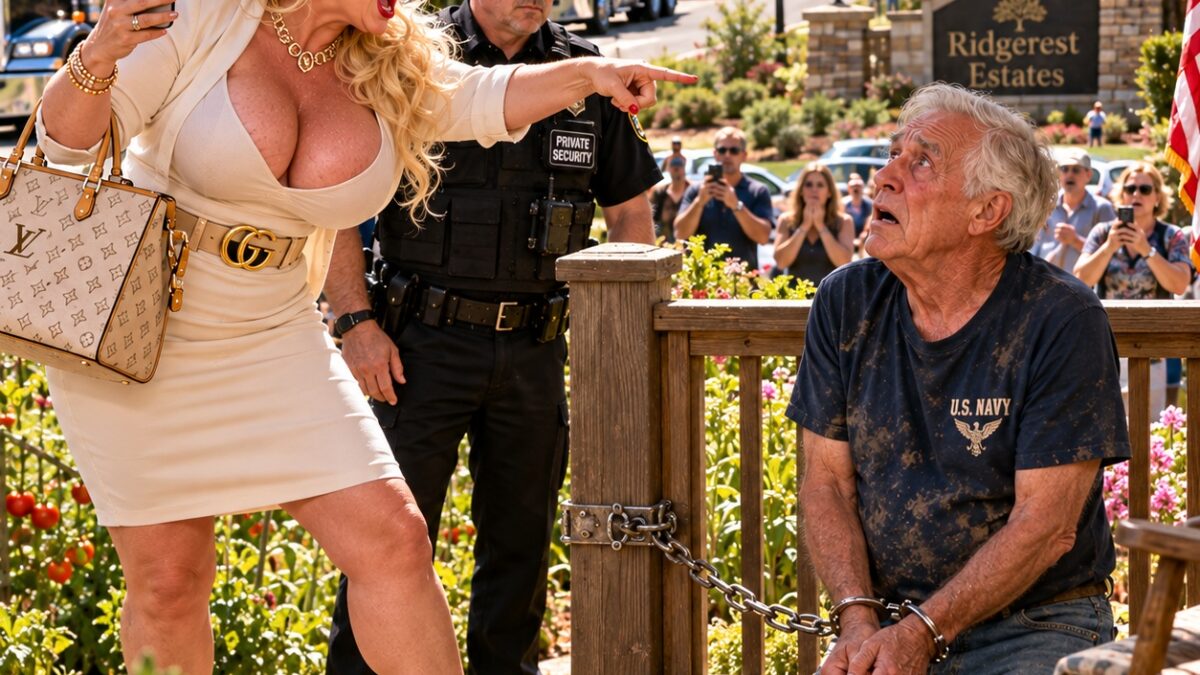
“Colton.”
“What?”
“They chained him.”
For a moment, I stopped moving.
“Say that again.”
“Wade ran the cuff chain through the porch railing.”
The porch railing.
Dad built it in 1987.
Cedar.
Sanded by hand.
Bolted to the concrete porch he poured himself.
Mom leaned on that rail while watching hummingbirds.
My father was now attached to it.
“Is he standing?”
“No.”
Pause.
“He’s on his knees.”
Something in me went very still.
Gene continued.
“His coffee spilled.”
I could hear him struggling.
“Victoria is still filming.”
I closed my eyes.
“What is she doing?”
“She just fixed her hair.”
That sentence was almost more than I could process.
My father on his knees.
Seventy-six years old.
Cuffed.
Chained.
Coffee on concrete.
And Victoria Langford adjusting her hair to make sure the footage looked right.
“Gene.”
“Yeah?”
“Do not touch anyone. Watch everything.”
Then I called Margot.
“They chained Dad to the porch.”
Silence.
“The restraining order?”
“She drove to him. He never moved.”
Another silence.
Then Margot became a prosecutor again.
“Emergency motion. Civil filing. DA notification. I’ll have it moving before you arrive.”
I called Darnell.
He answered on the first ring.
“How many units in the yard?”
“Thirty-four.”
“Status?”
“Twenty-two loaded for tomorrow. Twelve staged.”
“Redirect all thirty-four.”
“Where?”
“Kerrville. Mosquite Lane.”
There was no question about why.
Darnell had met Dad.
“All thirty-four?”
“Yes.”
“I’m briefing drivers.”
I climbed into Unit One.
Midnight-blue Peterbilt 579 Ultraloft.
BRIGGS CONTINENTAL FREIGHT in silver on the door.
Behind me, the yard came alive.
Diesels turning.
Air systems building pressure.
Trailers connecting.
Radios switching channels.
Darnell could move a fleet faster than most families move a dinner reservation.
Four minutes later, thirty-four trucks rolled out.
I led.
Exactly the speed limit.
Always.
Dad taught me young that a man who breaks rules in the name of enforcing justice is not enforcing justice.
He is just choosing different rules.
So we obeyed every traffic law.
Stayed legal.
Stayed calm.
And kept moving.
Gene stayed on the phone.
At two hours, Dad was still chained.
Victoria had refreshed her lipstick twice.
Walked to the Porsche for bottled water.
Returned.
Dad had not been offered any.
At almost three hours, Gene told me Victoria took a selfie near the Porsche.
My father remained on his knees.
I turned onto Ranch Road 27 at 4:51.
Mosquite Lane was seven minutes away.
“Gene.”
“I’m here.”
“Tell me what you see.”
“Victoria. Wade. Porsche. Your dad.”
“Police?”
“No county unit.”
Because Wade was operating as HOA-paid private patrol, not executing a lawful arrest as a county deputy.
That distinction was about to matter.
Then I saw the entrance.
White Porsche first.
Matte-black Interceptor.
Dad’s house.
And my father.
On his knees.
Chained to his porch.
Victoria stood near the sidewalk in a spotless white dress.
Dior sunglasses pushed onto her head.
Phone in one hand.
Evian in the other.
She looked like she had dressed for the destruction of an old man’s dignity and expected applause.
I stopped Unit One at the mouth of Mosquite Lane.
Thirty-three trucks rolled to a halt behind me.
There is nothing subtle about thirty-four diesel engines idling together.
It is not a roar.
It is deeper.
A mechanical pressure you feel in your sternum.
Windows vibrate.
Mirrors tremble.
Plastic bottles hum in cup holders.
Victoria heard us before she turned.
Her head snapped toward the road.
The sunglasses slid forward.
She caught them.
Then she saw the trucks.
Peterbilts.
Kenworths.
Freightliners.
Loaded flatbeds.
Dry vans.
Tankers.
Empty chassis.
All carrying BCF markings.
Darnell coordinated legal parking on the public roads surrounding the entrance and connecting streets.
Nothing blocked emergency access.
Nothing crossed private driveways.
Nothing illegal.
But visually?
It was absolute.
The pearl-white Porsche with the VICTORY plate sat trapped behind a fifty-three-foot flatbed loaded with structural steel.
The trucks did not care about visual cohesion.
The trucks did not care about ivory stationery.
The trucks did not care how much Victoria paid for her shoes.
For the first time in two and a half years, something had entered Ridgerest that did not recognize her authority.
I climbed down.
Boots on Texas gravel.
Drivers stepped out of cabs behind me.
Not threatening.
No shouting.
Just present.
Men and women who moved the freight that kept stores stocked and construction sites alive.
People who knew my father.
People who knew what they were looking at.
I walked toward the porch.
Wade watched me approach.
Then watched the trucks.
“Remove the chain.”
He straightened.
“Sir, this is a—”
“My name is Colton Briggs.”
I pointed toward Dad.
“That is my father.”
Victoria lifted her phone higher.
“You need to leave this community immediately.”
I ignored her.
I kept my eyes on Wade.
“My father was sitting on his own porch. He never approached Mrs. Langford. She drove here, parked beside his property, created the proximity she is calling a violation, and directed you to restrain him.”
Wade shifted.
I continued.
“Four cameras recorded everything.”
His expression changed.
“You are working private security right now. You are not acting under county authority. You chained a seventy-six-year-old combat veteran to his own porch railing because the woman paying you told you to.”
Victoria stepped closer.
“That is an outrageous characterization.”
I raised my voice just enough for the neighbors gathering outside to hear.
“Victoria Langford is currently under review by the Kerr County District Attorney for fraud, embezzlement, false reporting, perjury concerns, and conspiracy tied to HOA contracting and property acquisition.”
Her face changed.
Small at first.
Not fear.
Recognition.
The knowledge that I knew more than she thought I knew.
Gene stood on his porch with his arms crossed.
Martha Delgado, eighty-three, appeared in house slippers.
Viola Henderson’s daughter stood in the driveway of the home her mother had lost.
Ridgerest residents started coming outside.
Witnesses.
An audience Victoria had not chosen.
“Wade,” I said again. “Remove the chain.”
He looked at Victoria.
Then at the trucks.
Then at Dad.
His hands began shaking.
He unlocked the chain.
Removed the cuffs.
Dad rubbed his wrists.
The skin was raw.
He picked up Mom’s old white 798 coffee mug from where it had rolled onto the porch.
Set it upright.
Then he stood.
Slowly.
The way a man stands after life has knocked him down many times and learned it cannot make him stay there.
“Dad.”
He looked at me.
“Long drive?”
That was Roy Briggs.
Three hours on his knees.
First question:
Traffic.
I stepped toward him.
He shook his head slightly.
Not now.
Not in front of her.
He would accept a hug later.
Margot’s silver Lexus arrived behind the last truck.
She stepped out carrying a manila envelope.
Charcoal suit.
Black heels.
No theatrical entrance.
She did not need one.
She walked directly to Victoria.
“Ms. Langford. Margot Chen. I represent Roy Briggs.”
Victoria stared.
“This envelope contains a civil complaint alleging fraud, misappropriation of HOA reserves, twelve false police reports, conspiracy involving Hill Country Premier Services and Brett Langford, unlawful harassment, abuse of process, and claims arising from today’s detention.”
Margot handed her the envelope.
“A complete evidence package was delivered to the Kerr County District Attorney this morning.”
Victoria reached for her Bottega bag.
Reflex.
Like authority might still be somewhere inside.
Violation forms.
Fine schedule.
Montblanc pen.
She had buried people under paper for years.
Now the paper belonged to someone else.
“This is a gated community,” she started. “You can’t simply— I am the president of—”
Margot cut her off.
“You are the president of nothing relevant to this complaint, Ms. Langford.”
Quiet.
Level.
Absolute.
“Read it. Hire counsel. Do not contact Mr. Briggs.”
Victoria looked toward Wade.
He was already walking to his Interceptor.
He did not turn around.
Forty-dollar-an-hour loyalty evaporates fast when the legal bill becomes four hundred dollars an hour.
Victoria looked at the neighbors.
Nobody moved toward her.
Nobody defended her.
Gene stood silent.
Martha silent.
Viola’s daughter silent.
Dad silent.
It was the silence of people who had spent years watching a woman perform power and had finally seen the wires holding the scenery up.
She looked toward the Porsche.
Blocked.
Waiting.
That mattered more than it should have.
Victoria had made everyone else wait.
Wait for hearings.
Wait for responses.
Wait for inspections.
Wait for permission.
Wait for her to decide whether their homes met standards she invented.
Now she waited for a truck.
Darnell eventually moved the flatbed.
Slowly.
Legally.
No theatrics.
The truck took exactly as long as a truck that size takes.
Victoria walked to the Porsche.
The same heels that used to click across Dad’s driveway like punctuation now sounded hollow.
She fumbled the key fob.
The Cayenne chirped.
She sat inside for eleven seconds before starting it.
Then drove away.
Mosquite Lane exhaled.
Dad watched her taillights disappear.
“Thank you, son.”
“We’re not done.”
“I know.”
The restraining-order hearing happened first.
Margot played the full surveillance footage.
Victoria driving to Dad’s house.
Parking near him.
Approaching.
Filming.
Wade ordering Dad up.
Dad remaining compliant.
The chain.
The railing.
Everything.
The judge removed his glasses.
Looked at Victoria’s attorney.
Then at Dad.
“The court regrets that this temporary order was issued on the representations presented.”
He reviewed his notes.
“The petitioner appears to have deliberately created the proximity later characterized as a violation.”
Then he looked at Dad.
“Mr. Briggs, I am sorry.”
Dad nodded.
Same small nod he gave people who offered condolences at Mom’s funeral.
The order was dissolved in nine minutes.
No apology from Victoria.
Not then.
The district attorney moved next.
Charges were filed May 9.
Three counts related to false police reporting.
Two counts involving property obtained by false pretenses.
Embezzlement.
Perjury.
The exact legal theories shifted as the investigation developed, but the central case was simple.
Victoria had used HOA authority as a tool to punish homeowners, route money to herself and relatives, and pressure legacy residents toward below-market sales connected to a development plan.
She was arrested at home at 6:45 on a Tuesday morning.
I was not there.
I saw the body-camera footage later through counsel.
She answered in a silk robe.
Bare feet.
No makeup.
Hair unstyled.
Coffee stain near the collar.
No Porsche.
No heels.
No Montblanc.
No bag.
For the first time, there was no costume between Victoria and consequence.
“Do you know who I am?” she asked the deputy.
“Yes, ma’am.”
He held the warrant.
“That’s why we’re here.”
She was handcuffed in her foyer.
There was a mirror opposite the door.
Victoria glanced toward it once.
I do not know what she saw.
Maybe the person she had always hidden beneath everything else.
Brett Langford was indicted separately on conspiracy and real-estate fraud allegations tied to the property scheme.
Wade Pickens lost his private-security work in Kerr County and was suspended pending review of his conduct.
Dr. Preston Langford hired separate counsel.
Smartest decision anybody in that house made.
Civil cases followed.
The Monteros sued.
The Petermans sued.
Viola Henderson’s family sued over the pressure campaign and below-market sale.
Records subpoenas exposed more of the acquisition plan than Victoria ever expected people to see.
Site plans.
Emails.
Projected profits.
A draft brochure for The Overlook at Ridgerest showing luxury townhomes on land that still belonged to people being fined out of their homes.
Dad’s house had been marked:
Phase II acquisition.
Not garden violation.
Not aesthetic concern.
Acquisition.
That document changed how the neighborhood saw everything.
Dad’s tomatoes had never been the problem.
His ownership was.
Gene Tully was elected HOA president unopposed.
His first letter to the original Mosquite Lane residents was handwritten.
No crest.
No copper embossing.
No perfume.
Your homes were here first.
Your rights come first.
Welcome back to your street.
Martha Delgado taped hers to the refrigerator.
Dad put his inside the cigar tin beside his Purple Heart.
That told me exactly what it meant to him.
The new board immediately suspended the Community Vision Initiative pending legal review.
They terminated Hill Country Premier Services.
Hired an independent auditor.
Reopened financial records to residents.
Cancelled questionable fines.
Released liens where counsel determined they had been improperly imposed.
The architectural committee went from eleven people to five.
Gene’s first board meeting lasted forty-two minutes.
He told me later that half the time was spent deciding whether the pool filter needed replacement.
“That’s what an HOA meeting should be,” he said. “Boring enough that nobody wants power.”
Dad’s garden survived.
That mattered more to me than most of the criminal case.
The tomatoes returned the next summer.
Cherokee Purples.
Big, ugly, sweet.
Exactly the kind of tomato Victoria would have failed for visual cohesion.
The okra stood shoulder high.
Jalapeños came in hard.
Pecans dropped heavy enough in October that Dad complained about bending over to collect them.
I visited one Sunday.
He was on the porch in his metal glider, drinking coffee from the old 798 mug.
The hummingbird feeder hung full beneath the workshop eave.
A ruby-throated hummingbird hovered in front of it, wings disappearing in the light.
“Garden looks good,” I said.
“Your mother would want it kept up.”
I sat beside him.
We rocked quietly.
After a while, I looked at the porch railing.
The cuff marks were still there.
Small cuts in the cedar.
“You want me to replace that spindle?”
Dad followed my eyes.
“No.”
“You sure?”
“Leave it.”
I knew why.
Scars can be reminders.
Not only of what happened.
Of what failed to break you.
“What are you going to do with all this?” he asked.
“All what?”
“The company. Court mess. Her.”
“I’m going to let the lawyers finish it.”
He nodded.
“Good.”
“You disappointed?”
“In what?”
“That I brought thirty-four trucks.”
For the first time that afternoon, he smiled.
“Your mother would’ve thought it was excessive.”
“And you?”
He took another drink.
“Could’ve brought forty-two.”
That was the closest Roy Briggs ever came to admitting he enjoyed revenge.
The legal cases took time.
Cases do.
Social media makes justice look like a five-minute board meeting where somebody reads a deed and the villain cries.
Real justice is mostly waiting rooms, depositions, subpoenas, accountants, postponed hearings, discovery disputes, and people realizing too late that deleting an email does not make the server forget.
Victoria’s criminal case did not end in one dramatic afternoon.
But her power ended long before the final plea negotiations.
It ended when residents stopped believing the paper in her hand was more important than the law behind it.
It ended when the people she had frightened began comparing notes.
It ended when homeowners realized the fines were not random.
They were pressure.
It ended when Dad stood up from the porch.
Victoria had always understood appearance.
She understood that a white Porsche looked powerful.
A designer bag looked successful.
A thick packet looked official.
A uniform-looking patrol car looked like law.
A restraining order looked like proof.
She built everything around what things looked like.
My father built differently.
Concrete.
Cedar.
Steel.
Welds.
Roots.
Habits.
Promises.
He kept a Purple Heart in a cigar box and a dead woman’s hummingbird feeder full.
Nothing about Roy Briggs needed an audience to be real.
That was why Victoria never understood him.
And maybe that was why she never understood me either.
The thirty-four trucks became the part of the story everybody talked about.
People love the trucks.
I understand why.
Thirty-four eighteen-wheelers surrounding a woman who thought she controlled the street makes a strong picture.
But the trucks were never the revenge.
The trucks did not arrest Victoria.
Did not dissolve the restraining order.
Did not uncover $72,000 in reserve funds paid to herself.
Did not find $342,000 in contracts tied to her cousin.
Did not identify the referral fees from distressed property sales.
Did not clear the liens.
Did not restore Viola’s dignity.
The trucks were only a message.
We showed up.
The real revenge was documentation.
Dad’s camera footage.
County inspection reports.
Police call logs.
HOA financial statements.
LLC registrations.
Bank records.
Real-estate closing documents.
Emails.
Invoices.
The paperwork Victoria loved became the thing that buried her.
That irony would have made Mom laugh.
She loved irony.
Usually while burning cornbread.
A year after everything started, Briggs Continental Freight held its summer cookout near the Katy terminal.
Dad came.
He hated Houston traffic but came anyway.
Darnell gave him a folding chair in the shade.
Drivers kept walking over to shake his hand.
Dad looked increasingly uncomfortable.
He did not know what to do with admiration.
One of the younger drivers, Miguel, said, “Mr. Briggs, I was driving Unit Twenty-Three that day.”
Dad nodded.
“Good truck?”
“Very good truck.”
“That Cummins?”
“Yes, sir.”
“Keep an eye on the fuel pump.”
Conversation over.
That was Dad.
Hero worship redirected into maintenance advice.
Margot came to the cookout too.
She sat beside him for twenty minutes.
At one point I heard him ask whether Victoria could sue us over the trucks.
Margot laughed.
“For parking legally?”
“You lawyers find reasons.”
“We do.”
He nodded like she had confirmed a suspicion.
Then he gave her a sack of pecans.
The next fall, Gene called me.
“You’ll like this.”
“What?”
“Board voted on landscaping.”
“That sentence already worries me.”
“Unanimous approval.”
“For what?”
“To designate the Briggs garden and pecan line as legacy features exempt from future architectural review.”
I smiled.
“Dad know?”
“No.”
“Don’t tell him.”
“Why?”
“He’ll complain about people making a fuss.”
Gene laughed.
“Fair.”
Dad found out eventually.
The board sent the letter.
He read it.
Set it on the kitchen counter.
Then told me, “They don’t need to exempt something they had no business touching in the first place.”
“Exactly.”
“So why send a letter?”
“Peace offering.”
He frowned.
“Waste of stamp.”
Some men cannot be rehabilitated into HOA culture.
Thank God.
The pecan trees still stand along the south fence.
Forty feet tall now.
Maybe more.
Every November, Dad cracks nuts at the table and fills brown bags.
Neighbors take them.
Free.
Martha brings peach preserves in exchange.
Gene usually brings nothing because Dad refuses payment and Gene has learned that friendship is not accounting.
The hummingbird feeder still gets filled on Tuesdays.
Rain or heat.
Even now.
Especially now.
The Briggs Family sign still hangs beside the door.
One of Victoria’s last violation letters called it unauthorized signage.
Dad framed that notice.
It hangs in the workshop above the cigar tin.
Not because he values it.
Because the phrase unauthorized signage makes him laugh now.
Once, I asked him why.
He pointed at the sign.
“House has my name on it.”
Then pointed at the HOA notice.
“That paper doesn’t.”
Hard argument to beat.
Mosquite Lane became quiet again.
Not empty.
Quiet.
There is a difference.
Kids ride bicycles.
Gene complains about deer eating roses.
Martha’s garden gnome remains on her lawn.
She moved it three feet closer to the street after Victoria’s arrest.
Nobody has mentioned visual cohesion.
Viola Henderson never moved back.
That loss could not be repaired.
Her daughter eventually sold the property at fair market value after the civil case progressed, and part of the settlement compensated Viola for some of the loss.
Money cannot restore eleven months of being pressured out of your home.
But accountability matters anyway.
The Petermans returned to the neighborhood Christmas party.
The Monteros installed a basketball hoop again.
Same model Victoria had fined.
Gene helped bolt it down.
No permit.
No committee.
No ceremony.
Just a basketball hoop.
That might be my favorite monument to the whole thing.
People ask me whether I hated Victoria.
I did.
For a while.
Especially during the drive west when Gene kept telling me Dad was still on his knees.
There are moments when hate feels like fuel.
Useful.
Hot.
Clean.
But it is terrible fuel for long trips.
Eventually, I stopped caring about Victoria as a person.
I cared about what she had done.
That is different.
One lets you build consequences.
The other just burns you.
Dad understood that before I did.
A few months after her arrest, we sat outside at dusk.
I asked him if he wanted an apology.
“From her?”
“Yes.”
“No.”
“Why not?”
“Wouldn’t change the garden.”
“What would?”
“Rain.”
Then he looked toward the pecan trees.
“Apologies are for people you still expect something from.”
I never forgot that.
Victoria’s designer life faded from public view.
The Porsche was gone eventually.
Whether sold for legal fees, financial reasons, or simply because she no longer enjoyed being recognized in it, I never found out.
I did not ask.
Her social accounts disappeared.
The Ridgerest website removed the old Community Vision Initiative.
The HOA crest remained.
The pool remained.
The stone entrance remained.
But the tone changed.
Board minutes became actual minutes.
Budgets included vendor identities.
Conflict-of-interest rules were adopted.
Contracts over a threshold required multiple bids.
Private-security authority was restricted.
Residents received a formal explanation of what had happened.
Not enough.
But more than silence.
Dad’s house remained exactly as offensive to visual cohesion as ever.
Old limestone.
Workshop.
Garden.
Weathered fence.
Ford truck.
Pecans.
Hummingbirds.
Slippers at the mailbox.
One afternoon, a young couple from the newer part of Ridgerest walked past while Dad was filling pecan bags.
Their little boy stopped at the garden.
“Can I see the tomatoes?”
Dad looked at the parents.
They nodded.
He waved the kid over.
Ten minutes later, the boy left carrying a tomato the size of both his hands.
No application.
No amenity fee.
No rule.
No approved visiting hours.
Mom would have loved it.
Maybe that is the part Victoria could never understand.
Community cannot be forced.
You can force uniform paint colors.
Force landscaping.
Force fines.
Force attendance.
Force compliance.
But community is the thing that happens when a seventy-six-year-old widower leaves pecans on his porch for strangers.
When an eighty-three-year-old neighbor stands in slippers and watches somebody finally push back.
When thirty-four truck drivers leave a freight terminal because the owner’s father is in trouble.
When an old rancher stays on the phone for three hours because your dad should not be alone.
Victoria had an HOA.
Dad had a community.
There is a difference.
The last time I visited, we sat on the porch until the Hill Country sunset went orange behind the oaks.
The glider squeaked.
Pecans hit the ground now and then with soft thumps.
The feeder swung in the breeze.
Dad drank coffee.
I watched the road.
No Porsche.
No patrol car.
No clipboard.
No camera.
Quiet.
The kind of quiet that does not need an architectural review committee to approve it.
Dad looked toward Mom’s garden.
“She would’ve hated those trucks.”
I laughed.
“No, she wouldn’t.”
“She’d have said they were loud.”
“She married a pipeline welder.”
“Fair.”
Then he leaned back.
“You know what she would have liked?”
“What?”
“That you came.”
Three words.
That was all.
I looked at him.
He kept his eyes on the garden.
Thirty-four trucks were memorable.
The lawsuit mattered.
The fraud case mattered.
The arrest mattered.
But Dad did not care about any of that in the moment he remembered.
He cared that his son came.
Roy Briggs had spent my entire childhood teaching me what a man does when somebody he loves needs him.
You show up.
Sometimes with a wrench.
Sometimes with a welding hood.
Sometimes with paperwork.
And once in a lifetime, when an HOA queen chains your seventy-six-year-old father to his own porch and mistakes cruelty for authority, you show up with thirty-four trucks.
Then you let the evidence finish the job.