The HOA Put My Private Gate on Their Emergency Map and Tried to Make the Sheriff Hand Them My Road
The HOA Put My Private Gate on Their Emergency Map and Tried to Make the Sheriff Hand Them My Road
THE THIRD TIME CEDAR RIDGE CALLED THE SHERIFF ON ME, THEY HAD A CONTRACTOR STANDING AT MY EAST GATE WITH A CUTTING WHEEL STILL COOLING IN HIS HAND.
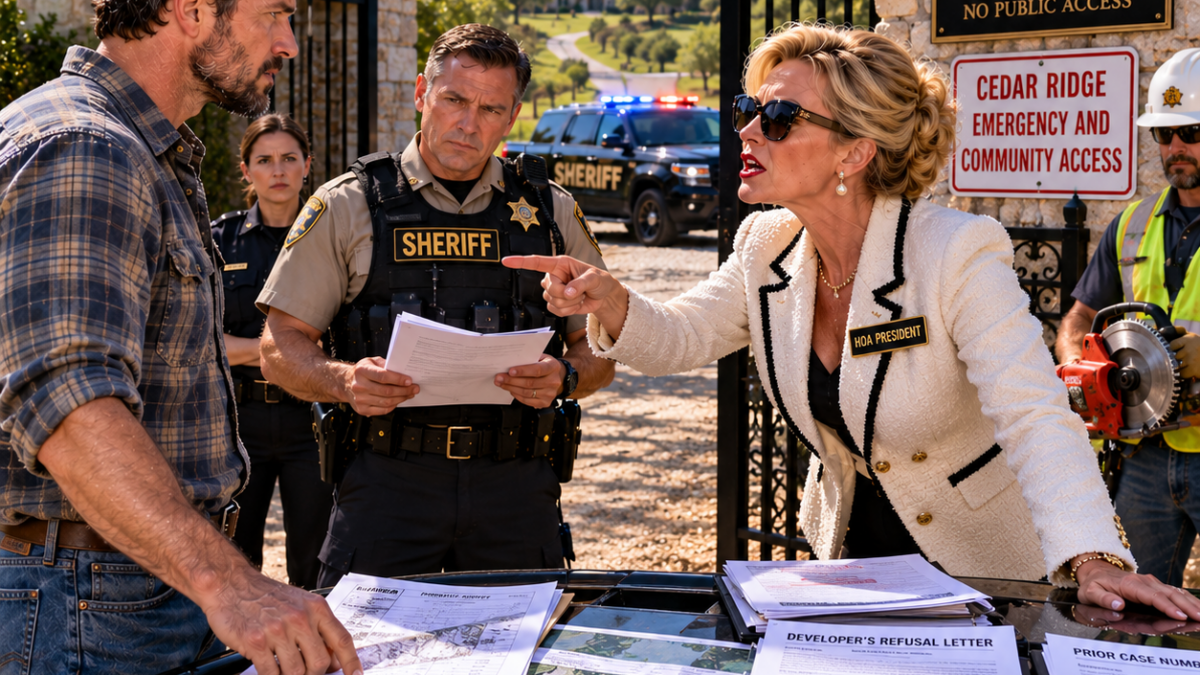
THE HOA PRESIDENT TOLD DEPUTIES I WAS BLOCKING AN EMERGENCY ACCESS ROAD, BUT THE FOLDER IN MY TRUCK HELD THE SURVEY, THE OLD PLAT, THE DEVELOPER’S REFUSAL LETTER, AND TWO PRIOR CASE NUMBERS THAT SAID OTHERWISE.
WHEN SHERIFF REED LOOKED AT VANESSA HAIL AND ASKED HOW MANY TIMES HER BOARD HAD CALLED ABOUT THE SAME PROPERTY, THE ENTIRE FIGHT CHANGED FROM A NEIGHBORHOOD DISPUTE INTO A RECORD OF PRESSURE THEY COULD NO LONGER EXPLAIN.
My name is Grant Mercer.
Ashwood Estate sits on sixty acres near Richmond, tucked behind old oaks, brick pillars, and an east drive that looks peaceful enough if you do not know what people are willing to claim when a private road becomes useful to them.
The house itself was never just a house to me.
It was seven years of work.
Seven years of dust, contractors, inspections, roofing bills, rotten beams, pond repairs, barn restoration, drainage problems, stonework, and the kind of slow rebuilding that changes a man because every repaired inch begins to feel like a promise kept.
People talked about the price.
Fifty-two million dollars.
They always said that number like it explained the place.
It didn’t.
Money did not explain why I kept the hammered latch on the old east gate when every contractor told me replacing it would be easier.
Money did not explain why I spent three days matching the original hinge pins instead of ordering something new.
Money did not explain why I still kept my father’s steel file wrapped in cloth inside the lower drawer of the workshop bench.
My father and I restored that gate during his final summer.
He could barely lift the heavier iron pieces by then, but he refused to sit back and watch me do all of it.
He filed the latch edge by hand.
Slow.
Patient.
Stubborn.
He said old iron deserved patience because it had already outlasted impatient men.
After he died, I left his work visible.
The latch still had the slight uneven edge where his file had passed over it.
If you looked closely, you could see the difference between factory shape and my father’s hand.
That mattered to me.
Maybe it shouldn’t have.
But it did.
For years, the gate stood quiet.
Locked when I wanted it locked.
Open when I chose.
Silvered with dew in the mornings.
Covered in oak shade by afternoon.
Then, one Monday, I came down the east drive and found a placard bolted beside my father’s latch.
CEDAR RIDGE EMERGENCY AND COMMUNITY ACCESS.
I stood there staring at it for a long time.
Not because I was confused.
Because I understood immediately what kind of problem had arrived.
The placard was neat.
Official-looking.
Confident.
The kind of sign people install when they want the next person to assume the argument has already been settled.
I removed it carefully.
I did not break it.
I did not throw it in the pond.
I photographed it from every angle, unscrewed it, stored it intact in the workshop, and emailed the Cedar Ridge board asking for written proof of any recorded easement across Ashwood’s east drive.
Vanessa Hail arrived before noon in a black SUV.
Board binder in hand.
Maps under one arm.
Smile already sharpened.
“That road has served Cedar Ridge for years,” she said, standing by my gate like she had been appointed guardian of it. “It needs to remain fully open.”
“Usage is not ownership, Vanessa.”
“It is designated in our emergency plan.”
“My deed shows no easement across this drive.”
She opened her binder and pointed to a colored map.
There was Ashwood’s east drive, drawn like it belonged to Cedar Ridge’s emergency network.
“Our emergency plan identifies this road as secondary access for all Cedar Ridge homes.”
“Then show me the recorded right that lets your plan control property I own.”
Her smile thinned.
She had a map.
She had resident notices.
She had board language.
She had years of habit.
What she did not have was a recorded easement.
And that was where the real fight began.
FULL STORY CONTINUATION
Vanessa’s first mistake was believing confidence could fill the space where a document should have been.
Her second was believing I would be embarrassed into opening the gate because she said the word emergency enough times.
Do not misunderstand me.
Emergency access matters.
I knew that then.
I know it now.
Cedar Ridge sat beyond a stretch of wooded land where summer dryness could turn from inconvenience to danger fast. A second road mattered when fire apparatus needed room, when evacuation routes needed redundancy, when residents wanted to know they were not trapped behind one narrow entrance.
I never argued safety was unimportant.
What I argued, from the first morning, was that safety planning did not turn my private road into HOA property.
There is a difference.
Vanessa did not want that difference to exist.
She tapped the map again.
“This is not simply a private preference issue, Grant.”
“My locked gate is on my land.”
“It affects our residents.”
“Lots of private property affects nearby residents.”
“If your property affects this community, then it becomes our community’s concern too.”
That sentence stayed with me.
Not because it was legally strong.
Because it explained her.
Vanessa did not see herself as stealing access.
She saw herself as correcting an inconvenience.
In her mind, Ashwood’s east drive had become part of Cedar Ridge’s practical world because Cedar Ridge wanted it there. The fact that my deed did not agree with her map felt, to her, like a technicality standing in the way of responsibility.
I looked at the placard lying in the back of my truck.
“I understand why backup access matters,” I said. “But you cannot invent a legal right to use my land.”
She closed the binder.
“You’re making a mistake.”
“No. I’m asking for proof.”
“You’ll get proof.”
“I’ll wait for it.”
Two mornings later, I was repairing a loose stone in the east pillar when a county cruiser pulled up.
The deputy got out slowly, one hand resting near his belt, already wearing the tired expression of a man sent to handle something that sounded more urgent over the radio than it looked in person.
“Mr. Mercer?”
“Yes.”
“I’m responding to a complaint from Cedar Ridge.”
“Of course you are.”
He looked at the closed gate.
“They’re reporting an owner blocking an HOA emergency road.”
I wiped my hands on a rag and walked to my truck.
“Here is my deed. Here is the parcel sketch filed when I bought Ashwood seven years ago. Here are photographs of the placard they installed without permission, and here is my written request for a recorded easement.”
The deputy looked from the papers to the gate.
Then back to the papers.
A few minutes later, Vanessa arrived.
Not surprised.
That told me something.
“This road has served Cedar Ridge longer than Mr. Mercer has owned Ashwood,” she told the deputy.
“Function does not create title,” I said. “And I will not surrender land because Cedar Ridge keeps repeating that it needs it.”
The deputy compared the parcel sketch with the gate location.
He did not pretend to settle title from the roadside.
Good.
He called it a civil dispute for now.
No arrest.
No citation.
He told both sides to document their claims.
Vanessa stood beside the gate after he left, her eyes fixed on the latch.
“You are turning a simple safety issue into litigation.”
“Simple cooperation cannot mean surrendering private property whenever the board finds it convenient.”
Her expression hardened.
Then she left.
That evening, I opened the old drawer in my workshop and found my father’s steel file.
The handle was worn smooth where his palm had held it.
Dark marks still stained the metal.
I placed it beside my deed on the workbench.
That was when the argument became personal.
Not because I could not separate emotion from law.
I could.
But because I understood that Vanessa was not just asking to use a strip of gravel.
She was asking me to let a board erase a boundary my father had helped me restore by hand.
The next morning, I ordered a licensed boundary survey.
I did not want another conversation.
I wanted an answer nobody could redraw with a marker at the next Cedar Ridge board meeting.
While I waited for the survey crew, Vanessa sent a notice to Cedar Ridge residents.
A neighbor forwarded it to me before lunch.
URGENT COMMUNITY SAFETY ISSUE.
Cedar Ridge is working to restore a long-standing secondary access route that has historically served our homes and emergency planning needs.
I read the sentence twice.
Long-standing.
That word bothered me more than emergency.
Emergency was emotional.
Long-standing was strategic.
It suggested time had ripened habit into right.
But every document I had showed the same problem.
No recorded easement.
No access agreement.
No grant.
No right-of-way crossing Ashwood’s private parcel.
If Cedar Ridge truly owned or controlled access, why did every document avoid saying where the right was recorded?
The survey crew arrived the following Tuesday.
They moved carefully, setting bright pins along the east approach and the stone-pillared boundary.
I walked with the surveyor from point to point.
“Walk me through every line,” I said. “I want to know exactly where their claim ends.”
He pointed toward the drive.
“The gate, both pillars, and this section of the east drive sit entirely inside your recorded parcel.”
“No strip?”
“No.”
“No association-owned road?”
“No.”
“No ambiguous overlap?”
“Not according to the legal description and the recorded survey.”
“So Cedar Ridge cannot honestly call this association property.”
He gave me the cautious look professionals give when they do not want their words stretched past their role.
“I can say the surveyed boundary places this gate and drive within Ashwood Estate.”
“That’s enough.”
I sent the survey to Cedar Ridge by certified mail.
Attached the plat page.
Included photographs of the pins.
Asked the board to acknowledge receipt and stop representing my private east drive as Cedar Ridge access.
Their response came two days later.
We received your materials. The association does not accept your interpretation.
I read that line aloud in my kitchen.
Then laughed once.
Not happily.
The surveyor’s boundary.
The recorded deed.
Pins in the ground.
And Vanessa called it my interpretation.
I wrote back:
It is not my interpretation that the gate sits inside my recorded parcel. It is the licensed surveyor’s boundary determination. If Cedar Ridge claims a legal right to cross Ashwood’s east drive, provide the recorded instrument.
Their reply was shorter.
Cedar Ridge has safety duties that cannot be defeated by one owner’s private position.
There it was again.
Safety as a solvent.
Pour enough of it over a boundary and Vanessa believed the line would blur.
I answered:
You can meet safety duties without inventing rights that were never granted across my land.
Three days later, I found two cameras and a wireless box bolted onto my gate.
They were positioned to watch the latch, the drive, and the approach from my side.
No notice.
No permission.
No contractor had called.
No board member had asked.
They had simply attached equipment to my private gate after receiving a survey showing it was private.
For a few seconds, I stood there too angry to move.
Then I made myself do the thing anger hates.
I documented.
Photographs from every angle.
Close-ups of mounting screws.
Serial numbers.
Camera positions.
The wireless box.
The holes drilled into the iron and wood.
The gate.
The survey pins visible near the pillar.
Then I emailed Cedar Ridge.
Who authorized equipment to be attached to my gate after receiving a survey confirming this is private land?
Vanessa answered herself.
The devices protect community access. Removing them would create another issue.
Another issue.
That was the phrase she used for two cameras and a wireless box drilled into my gate.
I replied:
I am asking once in writing for Cedar Ridge to remove every device by tomorrow morning. If you do not, I will have them removed intact by a licensed electrician and preserved for immediate return.
Her answer arrived within fifteen minutes.
If you touch association equipment, the board will treat it as deliberate interference.
I stood in the workshop staring at the email.
Then I looked at my father’s file.
The old gate.
The camera feed from my own estate security system showing the Cedar Ridge contractor drilling into the gate.
I called a licensed electrician.
“Photograph the mounts first,” I told him. “Remove everything intact. Nothing broken. Nothing disappears. Every screw gets bagged. Every serial number goes on the inventory.”
He did exactly that.
Each camera came off cleanly.
Each bracket was labeled.
The wireless box was removed intact.
The holes were photographed.
The hardware went into labeled bags.
I placed everything on a workbench under a security camera and emailed Cedar Ridge that the equipment was available for pickup.
That afternoon, the second cruiser arrived.
This time the complaint was theft and destruction of association security equipment.
The deputy was different.
Younger.
More alert.
“The report says equipment was stolen and destroyed,” he said.
“Yes,” I said. “I assumed they would say that.”
He blinked.
“Can you show me what happened?”
“Absolutely.”
I walked him into the workshop.
Every device sat on the bench.
Undamaged.
Numbered.
Photographed.
Hardware bagged.
The electrician’s invoice beside them.
A printed copy of my warning email and Vanessa’s response.
Then I showed him estate footage of the contractor drilling directly into my gate.
The deputy watched quietly.
Vanessa arrived while we were still reviewing the footage.
She walked in like she expected to find broken equipment.
Instead, she found proof.
“You had no authority to dismantle association security equipment serving Cedar Ridge,” she said.
“You had no authority to install it on my gate.”
“That gate is our community access point.”
“Then show the deputy the recorded easement.”
Her face tightened.
The deputy looked at her.
“Do you have one?”
“We have long-standing use and emergency planning documents.”
“That’s not what he asked,” I said.
The deputy raised a hand slightly, not rude, just controlling the room.
“Mrs. Hail, who owns the gate?”
Vanessa did not answer directly.
“The route has served Cedar Ridge for years.”
The deputy made notes.
No arrest.
No citation.
Again.
But as the cruiser left, I felt colder than before.
The first police visit could have been called confusion.
The second was different.
After the survey.
After the cameras.
After proof the equipment had not been stolen or destroyed.
After Vanessa knew ownership was disputed.
Two reports under her name meant this was no longer neighborhood annoyance.
It was becoming a pattern.
I called Laura Dennett that evening.
Laura was the property attorney who had handled parts of Ashwood’s restoration when old title issues surfaced near the pond.
She had a calm voice and a ruthless filing system.
“I don’t want a third deputy deciding my rights from another accusation at my gate,” I told her.
“Then we build the record before the third call.”
“You think there will be one?”
“I think Vanessa has not gotten what she wants.”
Laura told me to create three files.
Gate.
Police contacts.
HOA records.
Every timestamp.
Every letter.
Every resident notice.
Every board message.
Every piece of footage.
Every case number.
“Do not argue casually anymore,” she said. “Respond in writing. Preserve everything. If they keep calling law enforcement, what they knew before each call will matter.”
That sentence became important later.
What they knew.
Not what they claimed.
What they knew.
The next question was why this particular road mattered so much.
Vanessa could have backed down after the survey.
She could have backed down after the camera incident.
She could have redesigned the emergency plan.
Instead, she kept pushing.
What was Cedar Ridge protecting?
Laura began with the old subdivision plat.
Not Cedar Ridge’s newer emergency access map.
The recorded plat showed the subdivision road stopping before Ashwood’s boundary.
It ended at a turnaround.
No line crossed onto my parcel.
No right-of-way continued through the east drive.
A small note referenced possible future access discussions.
Possible.
Future.
Discussions.
No grant.
No easement.
No right.
“So their own recorded plat shows the community road ending before my property begins,” I said.
“Exactly,” Laura said. “The later emergency map cannot create a right the plat never granted.”
Then we found the developer file.
It was archived in old county planning correspondence.
The Cedar Ridge developer had asked Ashwood’s prior owner for permanent use of the east drive.
The prior owner refused.
In writing.
The developer acknowledged the refusal.
Also in writing.
The reply called the route Ashwood’s private drive and suggested another future access alternative.
I held the letter in both hands.
“This means they knew.”
“The developer knew,” Laura said. “Before Cedar Ridge even had a board.”
“They knew the road was private.”
“Yes.”
“And sold homes with emergency materials showing it anyway?”
“We need to be careful how we phrase that. But yes, it answers the first mystery.”
The HOA had an emergency plan.
But no easement crossed Ashwood.
No recorded right.
No access grant.
No ownership.
The dispute shifted in that moment.
It was no longer uncertain boundaries.
It was a clear limit on HOA authority.
Laura drafted another demand letter.
This one attached the survey, the recorded plat, and the developer correspondence.
It instructed Cedar Ridge to stop representing Ashwood’s east drive as HOA emergency or community access, remove it from maps and resident materials, and cease police complaints based on ownership or access claims unsupported by recorded documents.
Vanessa’s response was exactly what I expected by then.
We disagree that these older materials defeat the association’s present safety duties.
Laura read that line twice.
“She has no recorded right.”
“No.”
“She knows the plat doesn’t cross.”
“Yes.”
“She knows the developer was refused.”
“Yes.”
“And she’s still calling this safety.”
“Yes.”
Laura looked up.
“Then we give them a clean off-ramp.”
The off-ramp was simple.
Redesign the plan.
Remove Ashwood from the access map.
Stop calling police.
Pursue a lawful alternate route.
Instead, Vanessa called a special board meeting and labeled the issue urgent.
A Cedar Ridge board member sent me the meeting packet anonymously the night before the meeting.
“Thought you should see what they removed,” the message said.
There were two versions.
The circulated version.
And the version sent to residents.
One attachment was missing from the resident packet.
A letter from Cedar Ridge’s own counsel.
Laura read it at my kitchen table.
Then looked at me over the page.
“This matters.”
The letter warned the board not to describe the disputed road to law enforcement as HOA-owned property.
It said Cedar Ridge lacked recorded proof of ownership or easement rights across Ashwood.
It said the board could continue evaluating emergency planning options, but should avoid statements suggesting legal rights not supported by recorded instruments.
I leaned back.
“They were warned.”
“Yes.”
“Before the third call.”
“Yes.”
“This is the moment to stop.”
Laura nodded.
“It should be.”
But Vanessa did not stop.
The next morning, I sent formal notice revoking any past permissive use of Ashwood’s east drive.
I did not concede there had been permission.
But Laura wanted the record clear.
No silence.
No ambiguity.
No habit to be misread later.
I am revoking any permissive use and closing the gate until a lawful written agreement exists.
The survey was recorded.
Fresh photographs marked the boundary.
Delivery receipts were saved.
For several days, nothing happened.
The gate stayed quiet.
No cameras.
No placard.
No cruiser.
I allowed myself to believe the documents had finally ended it.
That was naive.
The contractor truck arrived before sunrise on a Thursday.
I saw the headlights first through the oaks.
Then Vanessa’s black SUV behind it.
By the time I reached the east gate, the crew had unloaded a cutoff wheel, chain, replacement lock, and work lights.
The contractor’s name was Caleb.
He looked like a man who had done enough gate work to know when a property owner was about to make his morning difficult.
“Mrs. Hail says this gate blocks an HOA emergency route and must be reopened today,” he said.
I kept my hands visible.
Voice calm.
“Your work order is wrong, Caleb. This is private land. Your crew needs to stop.”
He showed me the work order.
Cedar Ridge authorization.
Emergency access route.
Gate obstruction.
Reopen access.
Attached map.
The same map contradicted by the recorded plat in my folder.
I photographed every page.
Called Laura.
Put her on speaker.
“Do not interfere physically,” she told me. “Tell him ownership is fully documented. Ask him to wait while authorities review it.”
I did.
Caleb hesitated.
That hesitation might have saved him from becoming more than a witness.
But Vanessa stepped forward.
“The association has exhausted discussion,” she said. “Emergency access must be restored now.”
“Vanessa,” I said, “your own counsel warned you not to describe this road as HOA property.”
“Our counsel was protecting the association from risk. I am protecting real residents.”
“You are damaging private property.”
“You are obstructing authorized workers.”
She turned to Caleb.
“Open it.”
A worker set the cutoff wheel against the old latch my father had repaired by hand.
For one second, the tool whined without biting.
Then sparks flew.
Bright.
Orange.
Violent.
They carved a raw silver groove across iron that had survived nearly a century.
Something moved through me that was not anger.
Not exactly.
It was grief arriving too fast to have a name.
“Stop the tool now!” I shouted.
Caleb raised a hand.
The wheel stopped.
The smell of hot metal hung in the air.
The old latch had a bright cut line across the dark handmade surface.
I walked to it and touched the edge after it cooled enough not to burn.
My father’s filed line was still there.
Now interrupted by a scar that had nothing to do with age, weather, or honest repair.
Caleb looked at the latch.
Then at me.
“I’m not cutting another inch until ownership is verified.”
Vanessa’s face flushed.
“Your refusal is obstructing authorized workers from restoring emergency access today.”
I looked at her.
“You were warned by the survey, the plat, the developer letter, and your own counsel.”
She stepped toward her SUV.
Then made the third call to the sheriff’s office.
For a few minutes, it looked like she had won.
The gate was damaged.
The contractor was on site.
Deputies were coming.
Her words were already on the dispatch call.
Owner blocking emergency access.
Threatening authorized workers.
Interfering with community safety.
The first cruiser arrived.
Then a second.
Then Sheriff Reed himself pulled under the Ashwood oaks.
He stepped out slowly, took in the contractor, the cutoff wheel, the damaged latch, Vanessa, me, the gate, and the line of vehicles.
“Nobody touches the gate,” he said, “until I know who owns what and what was reported today.”
I walked to my truck and pulled out the folder.
By then, it was thick.
Survey.
Recorded plat.
Developer refusal letter.
Certified-mail receipts.
Cedar Ridge counsel warning.
Prior case numbers.
Photographs.
Camera-installation records.
Electrician inventory.
Resident notice.
Board packet.
Work order.
I handed it to him.
“Start with the survey,” I said. “Then the plat. Then the developer letter. Then the prior reports.”
Sheriff Reed opened the folder on the hood of his cruiser.
Nobody spoke for several minutes.
The contractor stood back.
Caleb had placed the cutoff wheel on the ground, cooling in the shade.
Vanessa stood very still.
Reed read the survey.
Then the two earlier case numbers.
Then he looked at Vanessa.
“Mrs. Hail, how many times has your board called us about this exact property?”
Her eyes moved to the folder.
“I have three complaints here,” Reed continued. “And each one depends on who owns this road today.”
Vanessa lifted her chin.
“Cedar Ridge has long-standing use, emergency planning obligations, and a duty to protect residents.”
“That is not what I asked. Do you have a recorded easement crossing Mr. Mercer’s property here?”
“We have emergency plans.”
“Do you have a recorded easement?”
She paused.
“No.”
“Do you have a deeded right-of-way?”
“No.”
“Do you have a written access agreement signed by Ashwood’s owner?”
“No.”
Reed turned to Caleb.
“Who described the gate as association property?”
Caleb swallowed.
“The work order called it HOA emergency access and authorized reopening.”
“Were you told ownership was disputed?”
“We were told documents were disputed.”
“Were you told the association had no recorded easement?”
Caleb looked at Vanessa.
“No.”
Reed opened the prior reports.
“Report one called the road HOA access. Report two called the gate HOA property. Both reports use ownership language.”
Laura arrived then, parking behind my truck.
She came directly to Reed with delivery receipts and a copy of Cedar Ridge counsel’s warning.
“The board had this before today’s call,” she said.
Reed read the warning.
Then read it again.
His face did not change much.
But his voice did.
“Mrs. Hail, your own counsel warned against describing this road to law enforcement as HOA-owned property.”
Vanessa’s composure cracked slightly.
“Counsel was protecting the association from risk while I was protecting residents.”
“For once,” I said quietly, “that may be the most honest thing you’ve said.”
She turned toward me.
I did not look away.
Sheriff Reed raised a hand.
“Enough.”
Then he asked the question that finally pulled the hidden pressure into daylight.
“Why is this road worth a third call after all these warnings?”
For a moment, Vanessa did not answer.
Then, perhaps because she was tired or perhaps because the folder had made denial useless, she explained.
Cedar Ridge had a premium expansion nearing final sales.
A refinance deadline.
An emergency access package showing Ashwood’s east drive as secondary access for that section.
If the route disappeared, safety plans had to be revised.
Maps changed.
Disclosure materials corrected.
Financing documents amended.
The alternate route required grading, drainage work, and another owner’s agreement.
Board estimates showed the replacement would be expensive enough to disrupt refinancing plans.
There it was.
Not just one lock.
Not just one gate.
Not even only one emergency route.
It was money.
Momentum.
Resident promises.
Premium lots.
A community plan that worked only if Ashwood’s private east drive remained on Cedar Ridge maps as if it belonged there.
Vanessa’s goal was understandable.
Preserve access.
Protect financing.
Avoid panic.
Avoid expensive correction.
But understandable is not the same as lawful.
“A hard correction,” Laura said, “does not turn somebody else’s driveway into HOA property.”
Reed ordered the crew away from the gate.
“This dispute is documented now,” he said. “Nobody is using my department as leverage today.”
Vanessa objected.
“Grant is still blocking a route shown in Cedar Ridge materials.”
“Fix the materials lawfully,” Reed said. “Do not solve this with another complaint.”
The confrontation ended there.
But the investigation did not.
Reed requested dispatch notes, call recordings, body-cam video, and written statements.
He asked for every prior report.
Every document submitted before each complaint.
Every warning.
Every receipt.
Laura told me afterward, “Each warning narrows what the board could honestly believe.”
The first call could still be described as boundary confusion.
Maybe.
The second was harder after the survey and intact equipment were shown.
The third changed everything after the plat, developer letter, and counsel warning.
Then board minutes surfaced.
That was the line that shifted the investigation from messy property dispute to possible misuse of police pressure.
Another sheriff response might persuade Grant to cooperate.
The sentence sat in the minutes like a loaded weapon.
I read it three times.
That was what had scared me from the second call onward.
Not that deputies would make a mistake intentionally.
But that repeated calls, urgent language, and ownership claims could create enough pressure to make my rights look like the problem.
Reed did not debate Vanessa’s intent.
He documented what was known, what was said, and what was reported.
“Intent is for the proper process,” he told us. “My job is preserving the complete record.”
The gate stayed closed.
No deputy ordered me to surrender access.
No arrest followed.
No citation.
The sheriff’s office completed the file and forwarded what required outside review.
Laura separated the issues for me.
There were report concerns.
There were civil property claims.
There was trespass.
Interference.
Legal costs.
Damage to the latch.
Repeated claims after notice.
“I never wanted a windfall,” I told her.
“I know.”
“I wanted the calls to stop and my boundary to mean something.”
“That is what the record is for.”
Negotiations followed.
They were not quick.
Cedar Ridge’s insurer and counsel had the same timeline Reed preserved.
The third call made innocent confusion much harder to argue.
The strongest fact was not my anger.
It was what the board knew before each step.
Survey before the camera installation.
Intact equipment before the theft report.
Plat and developer letter before the special meeting.
Counsel warning before the contractor came.
Board minutes before the third call.
The financial resolution combined penalties, cost recovery, civil settlement, repair costs, and legal fees.
Together, the consequences reached exactly $250,000.
People later focused on that number.
I did not.
The number mattered less than knowing nobody could weaponize another report at my gate.
Cedar Ridge had to correct its emergency plan.
Ashwood’s east drive came off every access map.
The brochures were revised.
Resident materials were updated.
The placard was gone.
The cameras were gone.
HOA hardware never returned.
An internal board review followed the sheriff’s final file and the settlement.
Vanessa lost the presidency.
She did not apologize.
I never expected her to.
At the final board session I attended, she stood at the front of the room with the same stiff posture she had carried to my gate.
“I made choices under pressure,” she said. “I still believe delay created serious risks.”
Laura answered before I could.
“Pressure explains decisions, Mrs. Hail. It does not change what the records show.”
That was the cleanest sentence in the room.
Cedar Ridge hired engineers to design an alternate route on land it legally controlled.
It cost time.
It cost money.
It required grading, drainage work, and negotiations they should have started before three sheriff calls, two cameras, one cut latch, and a thick folder of warnings existed.
I hope the route serves residents well.
I mean that.
Safety was never the part I refused to take seriously.
What I refused was the idea that safety needs could be used as a shortcut through someone else’s deed.
Weeks later, a metalworker came to Ashwood to repair the old latch.
He was gray-haired, careful, and quiet.
The kind of craftsman who understood that the job was not to make old iron look new.
It was to make damaged history stable without lying about what happened to it.
He studied the groove left by the cutoff wheel.
“I can smooth it more.”
“No.”
He looked at me.
“My father filed that edge by hand. Do not grind the scar away.”
“You want it visible?”
“I want it honest.”
He stabilized the cut.
Matched the finish.
Darkened the raw silver until it no longer shouted in the morning light.
But the missing metal never returned.
No settlement restores that part.
The boundary survived.
The object changed.
That is the truth people forget when they say, “At least you won.”
Yes.
I won control of Ashwood.
I won the corrected maps.
I won the end of the calls.
I won the written record.
But I did not get back the untouched surface of the latch my father repaired.
I did not get back the morning before the sparks.
I did not get back the quiet trust that people would read a survey and stop.
The survey pins still stand near the stone pillars.
Sometimes I look at them and think about how little they are.
Bright caps.
Metal stakes.
Measured points in dirt.
Yet the whole fight turned on lines like that.
Funny thing about property lines:
phone calls do not move them.
Maps drawn by an HOA do not move them.
Emergency language does not move them.
A board binder does not move them.
Even three sheriff cruisers under the Ashwood oaks did not move them.
Only lawful documents do.
And Cedar Ridge never had one.
The first morning after the latch repair, I walked down the east drive before sunrise.
The oaks were quiet.
Dew silvered the grass.
The gate stood closed.
It looked almost the same as it had before.
Almost.
Then the light caught the groove.
A thin silver-dark line across the old iron.
I touched it with my thumb.
My father’s filed edge was still there.
Interrupted now.
But still there.
I thought about him saying old iron deserved patience because it had outlasted impatient men.
Vanessa had been impatient.
The board had been impatient.
The developer before them had been impatient enough to plan around a road it never secured.
Maybe I had been impatient too, in smaller ways, wanting documents to end what pressure kept reviving.
But the gate remained.
Scarred.
Closed.
Mine.
I put my father’s steel file back into the lower drawer of the workshop bench.
Not as a relic.
As a reminder.
Records matter.
Tools matter.
Boundaries matter.
And sometimes the only way to protect something old is to become very exact about paper.
A few weeks after everything settled, Sheriff Reed drove by while I was working near the east pillar.
He stopped long enough to roll down his window.
“Quiet out here.”
“For now.”
He smiled faintly.
“Keep your records, Grant.”
“I plan to.”
“I hope this is the last call I make at this gate.”
“So do I.”
After he left, I stood by the repaired latch and looked down the oak-lined drive.
No contractors.
No cruisers.
No black SUV.
No placard.
No cameras.
Just Ashwood.
The Cedar Ridge alternate route would be built somewhere else.
Their maps would stop showing my private drive.
Residents would eventually forget how close their board came to turning a planning failure into someone else’s property problem.
Maybe that was fine.
Not every lesson has to be remembered by everyone forever.
It only has to be written clearly enough that the next board cannot pretend not to know.
That is the cleanest victory:
a corrected record.
Because a corrected record prevents the next dispute before it starts.
Vanessa’s final comment to me came through an email copied to counsel.
I hope the new route serves residents better than this conflict did.
There was no apology in it.
No surrender.
Just recognition that the fight was over.
I wrote back one sentence.
I hope it does too, because safety was never the part I refused to take seriously.
That was the truth.
It still is.
If Cedar Ridge had come to me seven years earlier with honesty, surveys, compensation, and a lawful proposal, maybe we could have talked.
Maybe not.
But they never did.
They relied on habit.
Then maps.
Then signs.
Then cameras.
Then police reports.
Then a contractor’s cutting wheel.
At every step, they tried to make pressure do the work a recorded right could not.
That is why I fought.
Not because I hated neighbors.
Not because I wanted to block emergency planning.
Not because I enjoyed seeing Vanessa lose her position or Cedar Ridge pay money it should have spent on a lawful route from the beginning.
I fought because if a board can claim your road by calling it necessary, then necessity becomes a weapon.
And once that happens, nobody’s gate is really private.
The gate closes the same way now.
Heavy.
Slow.
Iron against iron.
But every morning, I notice the scar.
That silver line is part of Ashwood now.
I would rather it were not.
But I left it visible because hidden damage teaches nothing.
When I see it, I remember three sheriff cruisers under the oaks.
A contractor holding a cooling cutoff wheel.
Vanessa standing beside a folder of maps that could not move a boundary one inch.
Sheriff Reed asking for the recorded easement.
Laura placing counsel’s warning into the record.
My father’s file in the drawer.
The survey pins by the pillars.
The old plat showing Cedar Ridge’s road ending exactly where it always had.
And I remember the simple truth that could have ended the entire fight before the first placard ever touched my gate.
Safety need is not property ownership.
Pressure is not proof.
And no matter how many times someone calls the sheriff, a private road does not become theirs just because they drew it on their map.