The HOA President Buried My Father’s Fire Road Under Concrete
The HOA President Buried My Father’s Fire Road Under Concrete
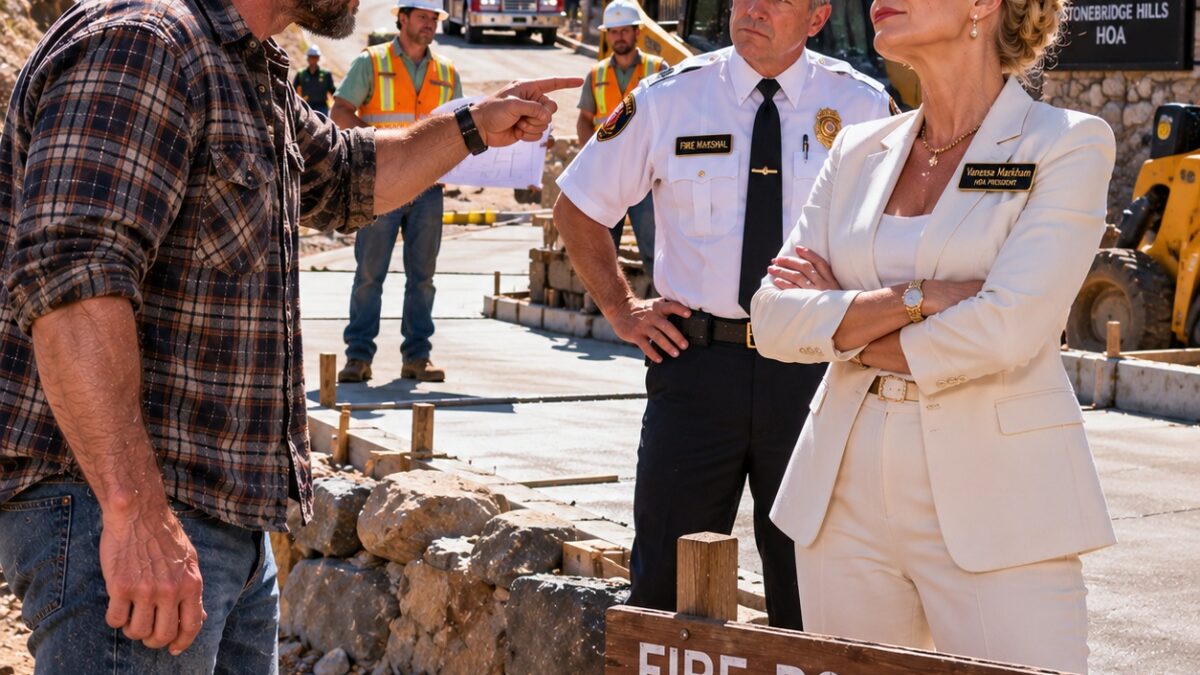
VANESSA MARKHAM CALLED MY FATHER’S OLD GRAVEL FIRE ROAD AN EYESORE UNTIL THE FIRE MARSHAL STOOD BESIDE HER NEW GATE AND ASKED WHERE A FIRE ENGINE WAS SUPPOSED TO TURN.
SHE HAD ALREADY POURED CONCRETE, PLANTED CURBS, AND SHATTERED THE HAND-BUILT STONE SWALE MY FATHER LAID AFTER THE LAST WILDFIRE, BUT SHE STILL LOOKED ME IN THE EYE AND CALLED MY WARNING SENTIMENTAL.
BY THE TIME THE ENGINE FINALLY ROLLED THROUGH THE CORRIDOR AGAIN, THE HOA HAD PAID NEARLY $180,000 TO UNDO THE ONE MISTAKE I HAD BEGGED THEM NOT TO MAKE.
The first orange line appeared across my gravel fire road on a Monday morning outside Redding, California, bright enough to look almost violent against the dust.
I saw it from my porch before I had even finished my coffee.
Fresh paint.
Not the faded blue and yellow utility marks that show up before a cable crew digs near a shoulder.
Not the harmless little arrows surveyors leave behind and forget.
This line cut straight across the gravel lane that bent along the edge of my acreage, passed the old drainage swale my father built after the Gray Hollow wildfire, and climbed toward the ridge where the pines grew close enough to whisper in a dry wind.
A skid steer sat beyond the Stonebridge entrance with its bucket lowered.
A survey tripod stood on the shoulder.
A young man in a hard hat was driving stakes into the ground like he was marking territory.
And beside him, wearing white slacks, a pale blazer, and the kind of smile people use when they have already decided the argument is beneath them, stood Vanessa Markham, president of the Stonebridge Hills Homeowners Association.
I knew that smile.
Most of us around the ridge did.
Vanessa could make trespass sound like leadership if she said the word community slowly enough.
I set my coffee down on the porch rail and watched for another few seconds, hoping there was some explanation that did not involve the HOA treating my father’s fire road like landscaping trim.
There wasn’t.
The crew had already painted one line across the lane and another along the widened shoulder before the turn. Fresh wooden stakes marked the place where the old road opened up just enough for a heavy vehicle to swing wide.
My father had widened that turn by hand after the fire.
A lot of people would never have noticed.
Vanessa clearly had not.
I walked down from the porch with my boots untied and my coffee cooling behind me.
The gravel crunched under my soles. The air was already warm, heavy with pine sap, dust, and the faint metallic smell of machinery waiting to start. Late summer in our part of Northern California always carried two seasons at once: the one on the calendar and the one every local felt in his bones.
Fire season.
Even on quiet mornings, we listened differently.
We noticed wind.
We noticed brush.
We noticed whether the hills looked too dry.
We noticed every access road, because a blocked road does not matter until the hour it becomes the only road that might save your house.
Vanessa saw me coming and lifted one hand in a greeting that felt more like a warning to keep my voice down.
“Morning, Ethan.”
I stopped beside the first orange line.
“Why is there paint on my road?”
Her smile did not move.
“We’re improving the entrance corridor.”
“That is not your entrance corridor.”
She turned slightly, as if inviting me to admire the whole operation—the crew, the stakes, the skid steer, the contractor with the clipboard, the neat little flags in the dirt.
“The association maintains this frontage.”
“You maintain the frontage near your entrance,” I said. “You do not build across my fire road.”
Rick Dawson, the contractor, lowered his clipboard but did not step in.
I knew Rick. Not well, but enough. Dawson Site Works had done grading, curb repair, drainage cuts, and entrance landscaping all over the county. He was not the kind of contractor who woke up hoping to become the villain in a property dispute. He was the kind who had a stamped plan, a mobilized crew, rental equipment on the clock, and a client telling him the board had approved everything.
That made him dangerous in a different way.
Good people can do permanent damage when they think somebody else checked the limits.
Vanessa gestured toward the orange paint.
“This road has not carried a fire engine in years.”
“Unused is not the same as abandoned.”
Her smile thinned.
“Ethan, this is a neglected service lane. It creates dust, encourages cut-through traffic, and makes the entrance look unfinished.”
I looked past her at the stakes.
“Your plan narrows the shoulder before the turn.”
“Our engineer reviewed it.”
“Your landscape engineer?”
“The board approved a complete entrance improvement package.”
“Show me the fire review.”
That touched something.
Not fear.
Irritation.
Vanessa disliked questions that stepped outside the language she had prepared.
“The permits are in place,” she said. “The contractor is mobilized. We are not delaying a community project because of one old gravel road nobody uses.”
“My father used it.”
Her eyes softened in that practiced way people use when they are about to dismiss grief without understanding it.
“I understand this land is sentimental to you.”
“No,” I said. “You don’t.”
The words came out flatter than I intended.
Rick looked up.
Vanessa blinked once.
I pointed beyond her, toward the faded gravel bending between the pines.
“That road is not sentimental. It is recorded emergency fire access.”
“Nothing in our current site plan treats it as active emergency infrastructure.”
“A newer drawing does not erase an older right.”
She folded her arms.
“The association owns the entrance parcel.”
“Subject to recorded conditions.”
“Council says we control maintenance along this frontage.”
“Maintenance is not obstruction.”
Rick cleared his throat.
“I’m working from the stamped landscape set the association provided to us. That’s all I can say right now.”
“Then mark my objection in writing before your crew makes anything permanent.”
He hesitated.
Vanessa turned her head toward him just enough for me to see the warning in her profile.
Rick looked at me.
Then at the orange line.
Then at his clipboard.
“I’ll note it.”
Vanessa exhaled like I had forced the entire neighborhood to suffer through an unnecessary history lesson.
“Ethan, an old gravel lane cannot freeze Stonebridge Hills in the past.”
That was the first time I understood how she had already framed the whole fight.
Past versus progress.
Dust versus beauty.
One stubborn landowner versus a modern neighborhood.
To Vanessa, my objection was nostalgia wearing work boots.
She had not asked what the road was for.
She had decided what it looked like.
That afternoon, I photographed everything.
Every stake.
Every paint mark.
Every shoulder.
Every drainage cut.
Every point where the road widened before the turn.
I took wide shots, close shots, measurements, video, and a slow pan from the gate line to the old swale. I wrote the time on a legal pad and noted the names of the contractor trucks, the crew count, and the exact place where the proposed planter forms were marked.
That was what my father would have done.
Not because he loved conflict.
Because he trusted records more than memory once other people started lying.
My father’s name was Henry Cole, and he treated land like a promise between people who might never meet.
He bought our acreage before Stonebridge Hills existed, before the entrance monument, before the decorative lights, before the walking path signs, before the HOA board learned how to make every decision sound like the future depended on matching mulch.
Back then, the slope was scrub, pine, hardpan, and wild oats. Deer came through the lower draw. Coyotes sang at night. In the summer, smoke appeared on the horizon often enough that nobody in our part of the county treated fire like a distant possibility.
My father worked for the county road department for thirty-two years. He was a quiet man with large hands, a permanent sun line at the back of his neck, and a deep suspicion of anything built without thinking about water.
“Water always wins,” he used to tell me. “Your job is just to convince it to win somewhere else.”
He believed in drainage.
He believed in maps.
He believed in leaving roads wider than some desk plan required, because the person drawing lines in an office was rarely the one trying to make a turn in smoke.
The Gray Hollow wildfire proved him right.
I was sixteen when it came over the ridge.
Old enough to think I understood danger.
Young enough to learn, in one afternoon, that danger does not care what you understand.
The wind shifted after lunch. By two, the sky had turned a color I had never seen and never wanted to see again—a brown-orange ceiling that swallowed the sun and made every shadow look wrong. Ash fell into my mother’s hair while she stood in the driveway with both hands over her mouth.
My father did not shout.
That was how I knew he was scared.
He moved quickly, but quietly, dragging hoses, clearing space near the barn, telling me where to stand and what to watch. I remember the sound of the fire before I saw it. People compare wildfire to a train because they do not know what else to call something that large and hungry. It was a roar, but alive. It ate distance. It bent the air.
The main subdivision road below us jammed with vehicles and smoke. People who had never thought about evacuation routes suddenly became experts in panic. Cars stopped where they should have kept moving. Someone abandoned a trailer half in the lane. Sirens came from two directions at once.
Then an engine came through the old gravel fire road.
Not gracefully.
Not cleanly.
But it came.
My father stood near the bend, waving the driver wide, shouting over the wind. The engine cleared the turn because years earlier he had graded extra width there even though everybody told him it was unnecessary.
A lot of unnecessary things become sacred when the emergency finally arrives.
The fire took three outbuildings.
It spared the house.
It spared my mother.
It spared my father.
It spared me.
Afterward, my father rebuilt the drainage swale along that road by hand. Stone by stone. He set flat rock into the channel where runoff came down too fast after storms. He marked certain stones with tiny chisel notches so he knew which pieces had to sit at which angle.
I asked him once why he bothered with all that when nobody saw it.
He looked at me like I had asked why a roof needed nails on the back side.
“Function doesn’t need an audience,” he said.
For the rest of his life, he kept a cardboard tube of plats, approvals, maps, and fire access notes behind the steel cabinet in his workshop.
“Why not keep it in the house?” I asked him.
“Because house files get cleaned,” he said. “Tool cabinets don’t.”
At sixteen, I thought that was funny.
At forty-three, standing in that same workshop after Vanessa painted orange lines across the fire road, I pulled the cardboard tube from behind the cabinet and finally understood.
The paper smelled like dust, old oil, and my father’s hands.
The plat inside had yellowed edges, but the shaded strip was clear.
It crossed the entrance parcel owned by the HOA, continued along my boundary, bent with the gravel road toward the ridge, and carried small block letters printed beside the line.
EMERGENCY FIRE ACCESS.
I placed my photographs beside it.
The orange paint crossed the shaded strip.
The stakes sat inside the widened turning area.
The proposed gate would stand exactly where a responding engine entered the corridor.
My father had been gone five years, but I heard him as plainly as if he stood behind me.
A line nobody checks is just an invitation to the next fool with a shovel.
I called Laura Bennett that afternoon.
Laura was a civil engineer out of Red Bluff who had worked on rural fire roads, slope drainage, and apparatus access all over Northern California. She had a reputation for being expensive, blunt, and impossible to charm.
I liked her immediately.
“I can read geometry and notes,” she told me. “I can compare the old plat against the new site plan. I can identify physical access problems. But I will not invent property rights for you.”
“I don’t need you to.”
“Good. Then send me the plat, photographs with measurements, and the new plan.”
“I don’t have the new plan yet.”
“Get it.”
That was Laura.
No soothing.
No outrage.
Just the next useful step.
I requested the easement, the HOA declaration, the full landscape permit, the county approval packet, the contractor site plan, and any fire review documents from Stonebridge Hills the same day.
Vanessa responded four hours later with an email that sounded like it had been written for a newsletter rather than a property owner whose emergency access had just been painted over.
The Board has reviewed your concerns. You appear to be treating a landscaping project as an emergency when the subject lane has not functioned as active infrastructure for many years. Council has reviewed this entrance area and considers the road unnecessary for normal community operations.
Normal community operations.
I read the phrase twice.
Then typed my reply slowly.
Fire response is not normal community operations.
She did not answer.
The next morning, a black steel gate stood where the old road met the subdivision.
Twelve feet wide.
Decorative top rail.
Fresh posts.
Keypad.
Camera.
A lock box mounted on the left.
It would have looked handsome anywhere else.
Vanessa met me before eight, as if she expected me to come.
“Access is controlled now,” she said. “Authorized crews can still open this gate when needed.”
“A fire crew cannot depend on finding your keyholder while smoke is moving uphill.”
She pointed to the lock box.
“Emergency responders use lock boxes everywhere. This is normal access control.”
“Not when the gate is only one part of a bigger project narrowing the approach.”
Beyond it, fresh wooden forms outlined concrete planters on both sides of the lane.
The forms sat exactly where the road widened before the turn.
My father had widened that space after watching an engine barely clear it during the Gray Hollow fire. Vanessa saw unfinished dirt. I saw apparatus swing.
“The entrance has looked neglected for years,” she said. “Residents are exhausted by the dust.”
“I understand dust.”
“People want cut-through traffic stopped.”
“I understand traffic complaints.”
“And they want this neglected frontage repaired.”
“I understand that too.”
She looked momentarily satisfied.
“Then you understand the project.”
“No,” I said. “I understand the complaints. Solving them does not give you control of my fire road.”
Her face cooled.
“Ethan, the association owns the entrance parcel.”
“And the entrance parcel remains subject to recorded access.”
“You keep saying recorded as if the word ends the discussion.”
“It starts the discussion.”
“You have no stop-work order.”
“Not yet.”
That irritated her most.
Not the objection.
The confidence that her approval might not be final.
“Be careful,” she said. “The board has been patient, but obstruction of an approved project creates liability.”
That was the first threat.
Not a shouted threat.
An HOA threat.
Polished.
Folded into procedure.
I walked home without touching the lock, carrying photos, measurements, and enough anger to be useful if I refused to spend it too quickly.
By Friday, Laura had reviewed the old plat, the partial landscape set Rick’s office reluctantly provided, and my photographs.
“What bothers me most,” she said, “is the turning pinch.”
“What exactly does that mean?”
“The curb line cuts usable width at the place the apparatus needs swing space. The planters remove recovery area. The gate might be reviewable on its own, but the combined conditions—the curb, planters, shoulder loss, and drainage changes—could make the route nonfunctional.”
“Can you put that in writing?”
“Yes.”
“Does the landscape permit allow this?”
“The landscape permit allows landscape improvements. It does not prove they can alter a recorded fire access condition. I do not see a fire review stamp or an approved alternate apparatus route in the documents you sent.”
“Meaning?”
“Meaning someone may have permitted beautification without asking the question that matters.”
“Can a fire engine still use it?”
“Based on what I’m seeing, not safely. But I want the full county packet before I say more.”
I requested the full packet.
Then I waited.
That is one of the most insulting parts of a property fight. You can stand on recorded paper, professional measurements, old approval conditions, and plain common sense, and still watch machinery move faster than review.
Concrete does not wait for records.
Crews do not wait for clarity when the person paying them says proceed.
The county file arrived in pieces.
First the cover sheet.
Then the landscape approval.
Then old subdivision approval notes.
Then a faded map with fire access annotations.
One page was missing.
Of course it was.
The missing page was the one everyone needed.
Vanessa used that delay like a weapon.
You still have no stop-work order, she wrote. Our contractor remains firmly on schedule.
The next morning, excavation began along the shoulder.
By noon, Rick’s crew had trenched across the stone swale my father built by hand.
I got there while the excavator was still working.
The fitted stones, each one placed decades earlier, were scattered into a spoil pile beside the new curb line.
I felt something go out of my chest.
It is strange what breaks a man.
Not always the big thing.
Not the gate.
Not the legal threat.
Not the arrogance.
Sometimes it is seeing one flat stone turned upside down in dirt and remembering your father on his knees after a wildfire, placing it there because he believed the next storm mattered too.
“Stop,” I shouted.
Rick turned.
The excavator paused.
Vanessa appeared near the gate like disobedience had summoned her.
“Ethan, do not interfere with the crew.”
“Those stones were set after the wildfire. At least move them carefully before you dig.”
Her eyes flicked toward the pile.
“The drainage work is approved.”
“That does not mean you destroy everything in the path because it looks old.”
“The crew cannot redesign around every old feature.”
“That swale carried water off the access road for thirty years.”
“And the new drainage will do the same more effectively.”
“You can replace function,” I said. “You cannot replace handwork.”
That annoyed her more than any technical objection.
“I will not stop a community project because every stone carries sentimental value.”
There it was again.
Sentimental.
A useful word for people who want to dismiss memory without understanding it.
I walked to the spoil pile and found one flat stone with the small chisel mark my father used on each course. A tiny notch. Almost invisible unless you knew to look.
I picked it up and carried it to my truck.
Vanessa watched as though I were performing grief for attention.
Maybe I was.
Some things deserve attention.
That afternoon, my fuel reduction crew canceled the hillside work I had scheduled before October.
They had planned to bring a water trailer through the fire road to access the upper slope. With the gate, the forms, the narrowed approach, and the torn shoulder, they would not risk it.
The mobilization deposit was nonrefundable.
$1,200 gone.
Dry brush still standing above my house.
I called Vanessa.
“My fuel reduction crew canceled because your project blocked the route.”
“The contractor can coordinate access.”
“They cannot bring a water trailer through that turn.”
“Then use another route.”
“There is no other safe route to that slope.”
“Ethan, Tom Alvarez’s opinion does not replace approved plans.”
That was the first time she mentioned Tom because she knew he had walked the route with me.
Tom Alvarez was a retired fire captain who lived three miles down the county road. He had fought the Gray Hollow fire when he was young and still had a burn scar on one arm from a flare-up near an old orchard. He was not an engineer. He was not a lawyer. But he had spent thirty years watching engines go where people assumed they could go until smoke proved otherwise.
His summary had been simple.
“A fire engine needs room before flames arrive. You cannot bargain with smoke.”
Vanessa dismissed him too.
The following Monday, concrete trucks backed toward the blocked fire road.
Fresh rebar cages sat inside planter forms.
Stakes lined the road shoulder.
The smell of wet concrete traveled farther than it should have.
I arrived with Laura’s preliminary review, the county plat, my written notice, photographs, and enough restraint to keep my hands open at my sides.
Rick saw me first and paused.
Vanessa stepped between me and the forms.
“We reviewed your materials,” she said. “Nothing you sent requires this association to stop.”
“You have the recorded plat.”
“You have one interpretation of an old drawing.”
“You have an engineer’s warning.”
“We have an approved project.”
A mixer turned behind her.
Wet concrete slid toward the first curb form.
I did not block the truck.
That mattered later.
God knows I wanted to.
I wanted to stand in front of the chute and make them either stop or push past me on camera. I wanted a clean moral scene where everyone watching could see who was wrong.
Real disputes rarely reward satisfying gestures.
So I photographed the pour.
Recorded the time.
Recorded the crew.
Recorded the forms.
Recorded Vanessa standing there after receiving my written objection, Laura’s review, and the old plat.
Restraint felt like swallowing gravel.
But it became evidence.
Two hours later, Laura called.
“I found the missing page.”
I stepped away from the noise.
“Where?”
“Your father’s tube had a partial copy, but I found the full permit file online under the original subdivision approval number. The HOA owns the entrance parcel, but ownership remains subject to a fire access condition. Continuous secondary apparatus access must remain available through the marked corridor unless an alternate route is reviewed and approved.”
I closed my eyes.
“So they may maintain the frontage.”
“Yes.”
“But they cannot make the recorded corridor unusable.”
“Correct.”
“Say that again.”
“Maintenance authority survives. Blocking the easement does not.”
It should have ended there.
It did not.
I sent Laura’s review and the recorded condition to Vanessa before noon.
You now know the easement is active. Stop before permanent work becomes more expensive to remove.
Her reply came twenty-three minutes later.
We remain within our approved project scope and will address any agency comments later.
That sentence cost Stonebridge Hills more than any mistake Vanessa had made before it.
From that moment forward, delay was no longer caused by uncertainty.
It was caused by refusal.
For a few hours, it looked like she might still win.
The planning desk confirmed the landscape permit remained valid because fire access belonged to a separate county review. Rick resumed work. Another truck poured curb where I had marked the old widening.
Being right on paper does not help much when concrete cures faster than government.
Laura noticed something in the timeline.
“She is no longer arguing the recorded condition doesn’t exist,” she said. “She is arguing delay cost.”
“What does that tell us?”
“Something is driving the schedule.”
I requested board minutes, change orders, invoices, contractor memos, insurance correspondence, and project emails.
Vanessa ignored my request at first.
So I sent the full packet to the county fire prevention office and asked for an access review, not a property ruling.
That was Laura’s advice.
“Keep them in their lane,” she said. “Fire prevention can decide whether apparatus can use the route. Don’t ask them to adjudicate ownership.”
The next afternoon, a county vehicle turned into the subdivision and stopped before the black gate.
Daniel Reyes stepped out.
Deputy fire marshal.
Mid-forties.
Calm face.
Tape measure in hand.
Vanessa hurried down the sidewalk with a binder pressed to her chest.
“If this is about the gate,” she said, “we can show the lock box and emergency responder plan.”
Daniel looked at the gate.
Then past it.
“I’m reviewing the entire apparatus route, not merely the hardware.”
Her confidence dimmed.
He started measuring.
Curb edge to planter face.
Shoulder width.
Turning area.
Drainage cut.
Surface condition.
Gate opening.
Distance from post to post.
Clear zone.
Slope.
He asked for the alternate approved fire route.
Vanessa opened her binder.
There was no alternate route.
He asked for the revised fire access plan supporting the new layout.
There was no revised fire access plan.
He asked for the fire review stamp on the entrance modification.
There was no stamp.
He measured the place where my father had widened the bend.
Then he looked through the gate toward my acreage.
“This subdivision approval depends on maintaining this secondary apparatus route.”
Vanessa’s voice sharpened.
“That road has not carried a fire engine in years.”
Daniel did not look up from his notes.
“Unused is not the same as abandoned when emergency access remains recorded.”
I almost smiled.
Not because this was good.
Because it was finally being said by someone she could not dismiss as sentimental.
Daniel studied the concrete planters.
“Who approved permanent landscaping inside this marked emergency access corridor?”
“The board did after council said we control maintenance along this entrance tract.”
Daniel opened the old plat, looked through the gate toward my acreage, then tapped one shaded strip on the plan.
The silence settled around them.
“Then your problem is much larger than the gate standing in front of us today.”
That was the moment Vanessa understood the argument had changed.
Until then, she had treated the gate as the controversy.
Maybe remove it.
Maybe adjust access.
Maybe improve the lock box.
But Daniel was not testing whether the gate could open.
He was testing whether the route could function.
The gate was only one obstruction.
The planters.
The curb.
The narrowed shoulder.
The broken drainage.
The changed surface.
The turning pinch.
All of it mattered.
Rick stood off to the side, watching the inspection with the expression of a contractor calculating how much bad certainty costs after it hardens.
“Can we remove one planter and adjust the gate?” Vanessa asked.
Daniel shook his head.
“I cannot approve a guess. Show me a reviewed plan making this route compliant.”
“There isn’t one yet.”
“Then I cannot accept the altered corridor.”
For once, Vanessa had no polished sentence ready.
The records arrived that evening through a combination of homeowner requests, Laura’s persistence, and one board member who had grown tired of pretending confidence was competence.
His name was Peter Lang.
He forwarded minutes and project emails with one line:
I should have asked more questions before the vote.
The minutes revealed what had been driving Vanessa.
Insurance pressure.
The drainage problem at the Stonebridge entrance was real. After two storms caused runoff to flood the lower cul-de-sac, the association’s insurance broker warned that unresolved drainage and sightline issues could affect renewal review. The board had a narrow window to show corrective work before the next policy period.
Vanessa bundled drainage repairs, beautification, traffic control, entrance redesign, and fire road changes into one fixed-price contract.
Rick’s company warned that stopping after mobilization could trigger added costs.
Remobilization.
Demolition risk.
Repricing.
Subcontractor delays.
Vanessa feared a special assessment.
That part was understandable.
Residents hate special assessments. Boards fear them. Insurance renewal mattered. Drainage needed correction.
For the first time, her motive sounded human.
Still wrong.
But human.
At the next heated exchange near the entrance, she finally said it plainly.
“I was protecting homeowners from delay costs while fixing drainage we inherited.”
I believed her.
Not completely.
Not innocently.
But enough to see that she was not trying to steal land for some secret development deal. She was trying to avoid expense, embarrassment, and resident anger by forcing a complicated project through a corridor she had decided was obsolete.
“I understand why you feared that bill,” I said. “But you still could not spend my access to avoid it.”
She looked at me then, and for half a second I thought she might hear it.
Then she said, “The board had to make a decision.”
“No,” I said. “The board had to check the limits before making one.”
Daniel’s formal correction notice arrived before the concrete finished curing.
The route had to be restored to approved fire access before the work could be accepted.
The notice did not award damages.
It did not decide every private dispute.
It did not declare me the winner of every argument.
It did something narrower and more powerful.
It required usable fire access.
Again.
Vanessa responded publicly at the next board meeting.
“We still disagree with Mr. Cole’s ownership claims,” she said, “but we will comply with the county review.”
That line let her remain defensive without changing what had to happen.
Fine.
I did not need an apology for the road to reopen.
Residents packed the meeting because now the estimate was on the table.
Rick’s correction pricing separated the damage into categories.
Gate, bollard, and concrete planter removal: $46,000.
Curb removal and drainage reconstruction: $38,000.
Rebuilding the load-bearing access surface and turning area: $61,000.
Engineering and revised plans: $21,000.
Restoration: $14,000.
Total: approximately $180,000.
There was no dramatic fine.
No giant penalty invented by an angry agency.
Daniel’s inspection exposed a $180,000 mistake the HOA had already poured into place.
So the expensive part was never my warning.
The expensive part was ignoring it.
At the meeting, residents were angry.
Some were angry at me, because I was easier to see than the board’s process failure.
Some at Vanessa.
Some at Rick.
Some at the county.
Some at reality itself, which is usually where people aim anger when no single target feels safe.
An older woman named Mrs. Keller stood and said, “People can argue about landscaping, but emergency access should never be a gamble.”
That quieted the room.
A younger man asked why the board had proceeded after receiving my certified notice and Laura’s review.
Vanessa said the permit remained active at the time.
Peter Lang said, “That isn’t what he asked.”
The room turned toward him.
Peter looked uncomfortable but continued.
“We had notice. We had an objection. We had an engineer’s warning. We voted anyway because we were afraid of delay costs.”
Vanessa stared at him.
Peter did not look back at her.
That was when I knew her control over the room had cracked.
The board approved reserve funding rather than prolong the blocked access route. Another entrance project was postponed. New site approvals would require cross-review before any major physical change. No more unilateral approval for projects touching recorded corridors, drainage infrastructure, utility easements, neighboring property impacts, or fire access.
The lesson was procedural.
Limited authority still has limits.
You can own a parcel and still be bound by what runs across it.
You can maintain an entrance and still be forbidden from narrowing an emergency route.
You can have a valid reason to fix one problem and still create a worse one by refusing to pause.
Rick’s crew returned with saws, loaders, revised plans, and a very different attitude.
“This time,” he told me, “we remove obstructions first, then rebuild from approved dimensions.”
The black gate came off its hinges by noon.
It left two bare posts standing in the dust like a monument to bad certainty.
Concrete planters lifted onto a flatbed.
Bollards followed.
Then curb sections.
A saw cut through work barely old enough to cure.
The sound was miserable.
Expensive.
Avoidable.
Laura stood beside me with the revised plan.
“Keep the turning area open while drainage is rebuilt outside the clear zone,” she told Rick.
He nodded.
No argument.
They regraded the shoulder, rebuilt the load-bearing gravel surface, restored width at the bend, and redesigned the drainage so water moved properly without crowding the apparatus route. The new swale worked.
Function returned.
But the original hand-built crossing did not.
I kept the marked stone from my father’s swale beside my workshop door.
Not hidden.
Not framed.
Just there.
A small flat piece of rock with a chisel notch most people would never notice.
Tom brought me coffee on the morning of the final access test.
He found me standing by the workshop, looking at the stone.
“Your father would know the road,” he said, “even if he complained about the fresh gravel.”
I laughed despite myself.
“He would complain before breakfast.”
“And after.”
“He’d say they crowned it too high.”
“Did they?”
“A little.”
Tom smiled.
“Then he’d be proud.”
I looked toward the entrance where the gate had stood.
“You think?”
“I know.”
The county engine arrived at ten.
Daniel came with the revised plan, a measuring wheel, and an apparatus crew.
Vanessa attended, of course.
So did Rick, Laura, Peter Lang, half the Stonebridge board, and at least twenty residents who pretended not to be emotionally invested in watching a fire truck make a turn.
“Open the route fully,” Daniel said, “and we’ll test approach, turn, clearance, and exit.”
There was no gate to open now.
Only road.
The engine rolled forward.
Big.
Heavy.
Unsentimental.
It crossed the former gate line without stopping, made the turn where planters had been, cleared the drainage edge, and continued toward my acreage with room to spare.
No tire slipped off the shoulder.
No mirror brushed pine.
No wheel hung near the ditch.
No driver had to correct twice.
It simply moved where it was supposed to move.
That was the strongest proof.
Not my anger.
Not Vanessa’s meeting language.
Not Laura’s diagrams.
Not even Daniel’s notice.
A fire engine moving through the corridor was the whole argument made visible.
Daniel watched it complete the run, then wrote his final note.
“The route is usable again, and the corrected work now matches approved access.”
No one cheered.
I was glad no one cheered.
Some victories are too expensive to celebrate.
The HOA had paid to build the obstruction.
Then paid about $180,000 to undo it.
The road was restored.
My deposit was not.
My father’s swale was not.
The months of tension, the dust, the broken stone, the canceled fuel reduction, the unnecessary hostility—none of that vanished because the engine passed.
Vanessa walked over after the test.
For once, she was not smiling.
“I would still have fixed the entrance,” she said.
“I know.”
“I would separate drainage from access.”
“That would have been smarter.”
She looked toward the fresh gravel.
“I did not think the old road still mattered.”
“That was the problem.”
Her jaw tightened slightly, but she did not argue.
Maybe that was the closest I was going to get to an apology.
I did not need one.
Not from her.
Not for the road.
“You didn’t have to agree with me,” I said. “You only had to stop treating the limit as optional.”
She nodded once.
Small.
Not graceful.
But real enough.
Then she walked back toward the board members.
Laura stayed beside me.
“You okay?” she asked.
“No.”
She looked at the marked stone near my workshop.
“Function can return even when the original handwork cannot be recreated.”
“That’s supposed to make me feel better?”
“No,” she said. “It’s supposed to be true.”
Engineers are not always comforting people.
But the good ones tell the truth.
That evening, after everyone left, I walked the road alone.
The gravel was fresh underfoot.
The shoulder widened again.
The turn open.
Drainage rebuilt outside the clear zone.
Pines stood tall beyond the ridge, dry needles shifting in the breeze. The air carried that late-summer California smell that always makes people who live near wildland pause for half a second.
Dust.
Heat.
Sap.
Risk.
I stopped where the swale had been.
The new drainage would work.
Maybe better than the old one.
But my father’s fitted stones were gone, except for the one by my workshop. I stood there a while, remembering him bent over in work gloves, setting rock by rock after the Gray Hollow fire, muttering about water, fools, and the arrogance of people who think an unused road has no purpose.
He would have hated the planter forms.
He would have distrusted Vanessa on sight.
He would have liked Laura.
He would have told me I talked too much at least twice.
Then he would have checked the slope himself.
I walked back near sunset.
The marked stone waited by the workshop door.
I picked it up, brushed dust from the notch, and set it on the shelf above my workbench beneath the old plat.
Not as a shrine.
As a reminder.
The plat showed the line.
The stone showed the cost of ignoring it.
Stonebridge Hills looked better by fall.
The entrance was cleaner.
The drainage worked.
The dust was reduced.
No gate blocked the fire road.
No planters pinched the turn.
Residents still complained about the money, but complaints soften when stormwater stops flooding the street and the fire marshal signs off.
Vanessa stayed president through the end of her term, but she lost unilateral approval power over major site changes. The board created a review checklist. Easements. Access conditions. Fire review. Utility corridors. Neighboring property impacts. Construction staging. Written objections. All of it had to be reviewed before contracts were finalized.
That was the real reform.
Not dramatic.
Not satisfying in a courtroom way.
But useful.
The kind of quiet procedure that prevents expensive pride from becoming concrete.
A few residents waved at me again.
Some did not.
Mrs. Keller sent a handwritten note.
You were right about the road. I wish the board had listened sooner.
I kept it in the same folder with Laura’s review and Daniel’s notice.
Not because I needed validation.
Because someday, someone might claim the whole dispute was obvious only in hindsight.
It was not.
The warnings were there before the pour.
The record proved it.
Winter came mild that year.
Rain filled the new drainage, ran clean along the rebuilt channel, and left the gravel intact. I stood under the workshop awning during the first big storm and watched water go where it should.
That, my father would have said, is the whole point of work.
Not whether it looks impressive dry.
Whether it holds when tested.
The next summer, during a countywide fire drill, an engine used the route again. Not because there was a real fire. Not because anyone needed a headline. Just training.
It crossed Stonebridge’s entrance, followed the gravel bend, and continued toward the ridge without hesitation.
I watched from the porch with coffee in my hand.
For once, nothing needed to be said.
A route that works when needed.
That was what the record had protected all along.
People think property disputes are about stubbornness.
Sometimes they are.
Sometimes a fence is just a fence, a gate is just a gate, and two neighbors simply hate each other too much to share the same road.
But sometimes a line on an old plat is memory made official.
Sometimes a gravel lane that looks abandoned is the difference between access and delay.
Sometimes the thing an HOA calls ugly is the thing that saves a hillside when the wind shifts.
And sometimes the dead are still right.
My father kept that map because he knew clean office files could lose context.
He built that swale because water does not care about meeting minutes.
He widened that turn because fire engines do not become smaller during emergencies.
Vanessa looked at the road and saw dust.
He looked at it and saw a way out.
In the end, the fire marshal measured what she had buried, and the engine proved what my father had known before half those homes existed.
The road was never there to look finished.
It was there to work.
And now, again, it does.