The German Shepherd Puppy Who Kept Finding the Man With a One-Way Ticket.v
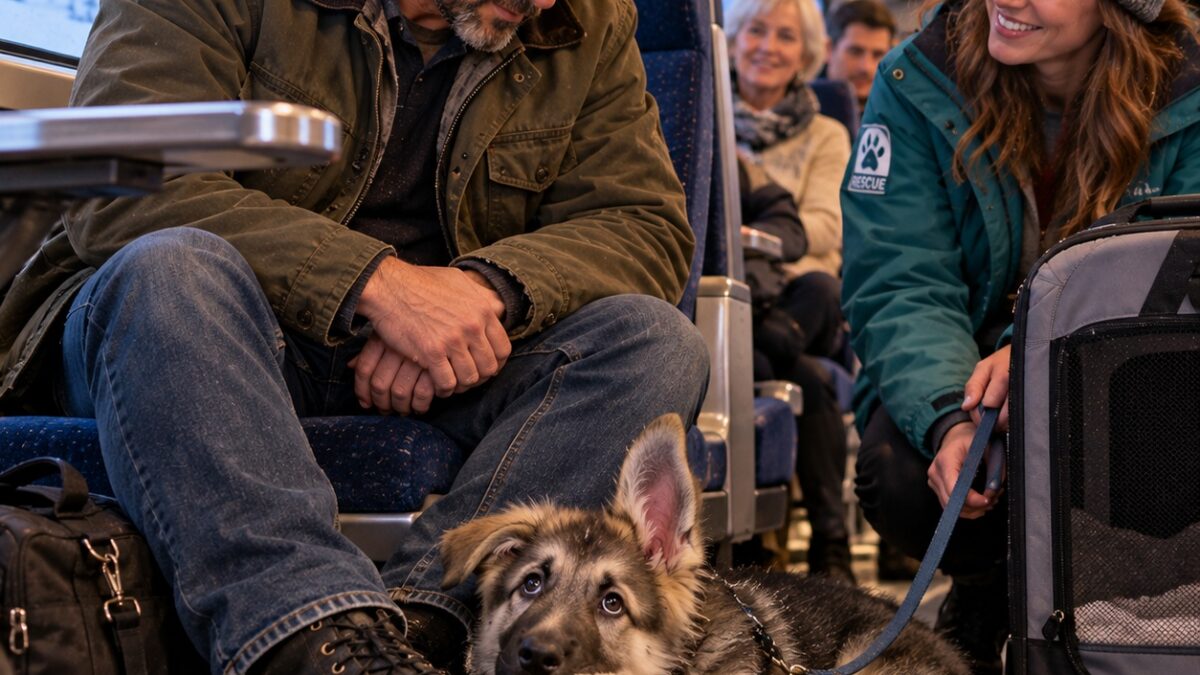
FULL STORY CONTINUATION
By the time we arrived in Brier Glenn, daylight had thinned into that strange blue-gray color snow creates just before dark.
The station looked older than I expected.
Red brick.
Dark green trim.
Tall arched windows.
Black iron supports beneath a wide timber canopy.
Yellow light glowed from the southern waiting room.
The north wing, where I would be working, sat behind temporary barriers and construction fencing.
I stepped onto the platform carrying my tool case in one hand and my duffel in the other.
Comet woke the moment my boot moved away from him.
His head came up.
For half a second, he looked almost alarmed.
I noticed.
I wished I had not.
Camille clipped his leash on.
“Your ride should be here.”
She checked her phone.
Her expression changed.
“That isn’t the face of someone whose ride is here.”
“Road closure.”
“Unfortunate.”
She looked at me.
I pointed toward the station.
“No.”
“I haven’t asked anything.”
“You’re going to.”
A broad man in a brown canvas chore coat crossed the platform through the snow.
Salt-and-pepper mustache.
Carpenter’s pencil behind one ear.
Saw dust embedded permanently in his boots.
“You Carrian?”
“Yes.”
“Derek. Preservation committee.”
We shook hands.
He looked at my tool case.
“That all?”
“And the bag.”
“You moving in or robbing us?”
“Depends on the plumbing.”
He stared at me for a second.
Then laughed.
I liked him slightly less for finding me amusing.
Comet bounced toward him, reached the end of the leash, and sat so abruptly his rear feet skidded under him.
Derek looked at the puppy.
Then me.
“Didn’t know the contractor came with an assistant.”
“He doesn’t.”
Comet sneezed.
Derek nodded solemnly.
“Strong denial.”
Camille explained the problem.
Comet’s intended foster family lived north of the road closure.
The rescue’s overnight transport room was already full.
He was too young for overflow kenneling without supervision.
“No.”
Camille folded her arms.
“I still haven’t asked.”
“You’re circling.”
“I need one night.”
“I don’t foster dogs.”
“You’ve said that.”
“I don’t have supplies.”
“I do.”
“I don’t have an appropriate space.”
Derek cleared his throat.
We both turned.
“The contractor apartment upstairs has a kitchen, bedroom, bathroom, and office.”
I looked at him.
He took the pencil from behind his ear.
“I’m beginning to understand that information should have remained private.”
Snow hissed against the platform roof.
Camille crouched beside Comet.
“I’m not asking you to keep him because he likes your boots. I need to inspect the apartment, verify your identification, confirm Derek actually hired you, and have you sign an emergency foster agreement.”
Derek raised one hand.
“He’s legitimate.”
“You checked?”
“Driver’s license when he got off the train.”
I looked at him.
“You checked my license?”
“I run a historic station. I notice things.”
Camille continued.
“One night. Food, crate, leash, cleaning supplies, routine, veterinary contact. If the road opens tomorrow, his foster family picks him up.”
I looked down.
Comet was trying to catch a snowflake that had blown under the canopy.
He missed.
Another landed directly on his nose.
He crossed his eyes trying to see it.
I closed mine.
“One night.”
Twenty minutes later, Camille was inspecting the apartment above the station.
It was small.
Old pine floors.
Pale plaster.
Narrow kitchen.
One bedroom.
Sitting room with a couch that had survived multiple generations of questionable upholstery.
I had already unpacked.
Boots aligned beside the door.
Clothes folded.
Toiletries arranged.
Tool case against the wall.
Camille noticed.
“You’ve been here twelve minutes.”
“Fourteen.”
“That somehow makes it worse.”
She checked windows, cords, trash, radiator covers, doors.
Then placed several pages on the kitchen table.
“Emergency foster agreement.”
I sat.
Read page one.
Page two.
Veterinary authorization.
Supervision instructions.
Camille checked the time.
“You always read everything?”
“Yes.”
“All of it?”
“Yes.”
“Most people skip to the signature.”
“That explains many things.”
I read the final paragraph before signing.
Camille shook her head.
“Is this an Army thing?”
“Contractor thing.”
“How so?”
“It’s why I still own my tools.”
She laughed.
Comet barked because she laughed.
Then he startled himself because apparently he had not expected the bark to come from him.
“This is already going badly,” I said.
It got worse after dinner.
Comet drank from his stainless-steel bowl.
Then backed directly into it.
Water spread across the kitchen floor.
He stared at the puddle.
Then began drinking from it.
“So this was deliberate.”
His tail moved.
I pulled a mop from the closet.
Comet reacted as if I had released an apex predator.
He retreated three feet and barked.
“It is a mop.”
Another bark.
“It has no plans for you.”
He stole a businessman’s glove without hesitation, but cleaning equipment represented unacceptable risk.
Ten minutes later, I introduced the vacuum cleaner.
That relationship was even more complicated.
When the machine turned on, Comet retreated.
When it turned off, he charged two steps forward.
On.
Retreat.
Off.
Advance.
After the fourth cycle, I leaned against the handle.
“This relationship lacks strategic consistency.”
He wagged his tail.
At nine-thirty, one of my socks vanished.
I found it twenty minutes later inside Comet’s crate beside his chew toy.
I stood over him.
“Evidence.”
He yawned.
I removed the sock.
Then I laughed.
One quiet sound.
So unfamiliar in that apartment that for a moment I almost looked toward the hallway to identify who had made it.
By ten-thirty, Comet was asleep beside the crate instead of inside it, one cream-colored paw extending through the open door as if he intended to maintain legal control over both spaces.
I sat on the couch with the station plans spread across the coffee table.
Every few minutes, I looked over.
Not because I was concerned.
I told myself that more than once.
At 5:42 the next morning, Comet stood beside my bedroom door and made a tiny sound.
I opened one eye.
“No.”
He shifted his paws.
“No reasonable organization begins before six.”
He stared at me.
I got up.
Outside, Brier Glenn was silent beneath new snow.
The sky ahead of sunrise was pale lavender.
I took Comet outside.
Made coffee afterward.
Fed him.
Then my phone rang.
Camille.
“Road’s still closed.”
I looked at Comet.
He was pushing his empty bowl across the kitchen.
“No.”
“Two days.”
“No.”
“His foster family still can’t get south. The rescue is rearranging placements. I can bring more food.”
“No.”
Twenty minutes later, I was installing a baby gate in the station office.
Derek walked in carrying two coffees.
Stopped.
Looked at the gate.
Then at me.
“Should I ask?”
“No.”
“I was absolutely going to.”
Behind the gate, Comet sat on a folded blanket.
Camille had approved the office.
No loose wires.
No chemicals.
No access to active construction.
Derek handed me coffee.
“So. North wing.”
That was how my real work began.
The station had not been abandoned.
The south waiting room still served local trains.
Passengers came and went under the old canopy.
The north wing, however, had been closed for years.
Former baggage room being converted into community space.
Two offices becoming meeting rooms.
Service corridors full of pipe repairs from several different decades, each apparently completed by someone who had been angry at the next person expected to fix it.
I crouched beneath one exposed line.
“Who did this?”
Derek looked down.
“Which decade?”
I pointed at a clamp arrangement.
“The one shaped like regret.”
He laughed.
“We used whoever we could afford.”
“That explains it.”
“You hate it.”
“I respect its optimism.”
Heating branch lines needed replacement.
Several shutoff valves were outdated.
Moisture had gotten into wood near two windows.
The work was not impossible.
It was accumulated neglect.
That was different.
Derek leaned against a doorway.
“I can get volunteers Saturday.”
“No.”
“I have three carpenters, two people who know electrical, and a retired plumber.”
“I don’t know them.”
“You don’t need to.”
“I do if they are working around me.”
He frowned.
I tapped my clipboard.
“One person who knows the job is faster than five people I have to manage.”
“Faster isn’t always better.”
“For repairs, it is close.”
He considered arguing.
Then decided, correctly, that eight weeks offered time for future arguments.
By late morning, the station filled with noises I understood.
Metal against metal.
Tape measure.
Wrench.
Pipes answering with hollow knocks.
From the office behind the baby gate came the occasional sound of puppy paws.
At first, I ignored it.
Then I noticed a pattern.
Every time I crossed the corridor, Comet lifted his head.
If I disappeared into the mechanical room, he sat up.
When I returned, he settled again.
He did not bark.
Did not ask to play.
Did not demand attention.
He checked.
That was all.
Whether I was still there.
At noon, I passed the office carrying a toolbox.
Comet had been asleep.
His eyes opened.
Right ear up.
Left ear attempting cooperation.
I took one step away.
His head followed.
Another.
Still watching.
I stopped.
For years, people had watched me because they needed something.
A repair.
Decision.
Ride.
Solution.
Explanation.
Comet wanted none of that.
He simply wanted to know whether I had disappeared.
“Two days,” I muttered.
He lowered his head and went back to sleep.
Two days became four.
Four became a week.
The rescue’s foster wing suffered a frozen-pipe failure.
Repairs were delayed.
Camille kept calling.
Each conversation started the same way.
“I need a favor.”
“No.”
“You don’t know what I’m asking.”
“I have enough data.”
Eventually she said she could move Comet to another temporary home.
He would then move again when the original foster opened.
I looked across the kitchen.
Comet was attempting to push a rubber toy beneath the refrigerator.
“If I keep him through the weekend, I want the updated feeding schedule.”
Silence.
Then Camille said, “You have it.”
“He’s eating faster.”
“He’s a puppy.”
“He nearly inhaled breakfast.”
“Also puppy behavior.”
“Send it.”
She sighed.
“Anything else?”
“Vaccination record.”
“You have a photograph.”
“I want the file.”
“Veterinary contact?”
“In writing.”
“You’re requesting paperwork like you’re assuming custody of an aircraft.”
“Aircraft are easier.”
Across the room, Comet successfully pushed the toy beneath the refrigerator.
He looked at me.
“No.”
He lay down and stretched one giant paw into the gap.
It could not reach.
Camille heard the silence.
“What did he do?”
“Nothing useful.”
I received every file by noon.
Only then did I agree to the weekend.
Temporary foster.
Nothing more.
That distinction mattered to me.
It mattered to nobody else.
Friday morning, Derek entered the office carrying coffee and a strip of oak trim.
He glanced at Comet.
“Morning, Dad.”
I slowly looked up.
The station became very quiet.
Derek lifted the wood.
“I was referring to the door frame.”
I kept looking.
“Terrible joke,” he said. “Immediate regret.”
Comet wagged.
Derek pointed at him.
“Your dog liked it.”
“He is not my dog.”
“Right. Temporary associate.”
“That is closer.”
After that, nobody called me Comet’s father.
Not within hearing distance.
Saturday introduced Taran Blackwell.
I was on a short ladder inspecting a ceiling chase when the outer door opened.
Cold air entered.
Then a woman’s voice.
“Tell me you’re the man making everyone miserable.”
I looked down.
Mid-forties.
Forest-green quilted vest.
Cream Henley.
Dark jeans.
Tan work boots.
Burgundy scarf.
Dark chestnut hair partly clipped back.
She carried four coffees.
Behind her stood three people with tool bags.
I looked at Derek.
Derek found a window suddenly fascinating.
The woman followed my gaze.
“Don’t blame him. I came voluntarily.”
I climbed down.
“Who are you?”
“Taran Blackwell. I run the diner across the square.”
“I didn’t order coffee.”
“I know.”
She handed me one.
I took it before I could formulate a better objection.
“You also didn’t order the volunteers.”
“I don’t need volunteers.”
“Good morning to you too.”
“I mean it.”
“So do I.”
She pointed toward the north wing.
“Derek says there’s trim to strip, old shelving to remove, and hardware to sort.”
“I can handle it.”
“I didn’t ask if you could.”
That stopped me.
Taran noticed.
She smiled just enough to be irritating.
“I coordinate volunteers for the station. Nobody is touching your plumbing or electrical. One restores furniture. One teaches shop at the high school. The third carries things.”
The third man shrugged.
“I carry things well.”
Within thirty minutes, they were working.
I spent the next two hours checking everything they did.
Discreetly.
I thought.
Taran caught me restacking a box of brass hinges already sorted by the shop teacher.
“What was wrong with them?”
“Nothing.”
“Then why are you holding one?”
I looked at the hinge in my hand.
“It was facing the wrong direction.”
“In the box.”
“Yes.”
Taran studied me.
“That must be exhausting.”
“What?”
“Being responsible for the direction of boxed hinges.”
I put it back.
“I like things organized.”
“That isn’t what I said.”
She took a drink from her stainless mug.
Then asked a question I disliked immediately.
“Which jobs actually need you, Mitchell?”
I looked at her.
“And which ones are you doing because you don’t want to wait for someone else?”
“I have work.”
“So do I.”
She walked away.
The question stayed.
Comet developed his own routines.
I woke at 5:40.
He preferred 5:31.
I fed him at fixed times.
He began sitting beside the food cabinet fifteen minutes early and staring at it as if concentration could manipulate clocks.
I aligned my boots beside the door.
He slept across them.
I stacked paperwork neatly.
He discovered paper produced satisfying sounds when hit with one giant paw.
He also developed a personal conflict with his reflection in the dark station windows.
One evening, he stopped in front of a window.
Another silver-gray puppy appeared.
Comet froze.
The enemy froze.
Comet stepped forward.
So did the enemy.
He barked.
The window barked.
Taran stood nearby holding sandwiches.
“Who’s winning?”
“Too early.”
Comet tilted his head.
Reflection matched him.
“This may become diplomatic.”
She laughed.
Comet abandoned negotiations and walked toward her.
But when she bent down quickly, he slowed.
Not frightened.
Cautious.
Taran noticed.
Straightened.
Waited.
Comet approached on his own.
Sniffed her boot.
Leaned against her shin.
Over the next week, I began noticing more.
He loved people.
But volume mattered.
Speed mattered.
A loud stranger clapping for him made him step backward.
A quiet volunteer sitting on the floor sorting screws would eventually find Comet sleeping nearby.
He was learning people.
Maybe I was too.
One Sunday afternoon, Derek and I worked alone.
Snow whispered against the windows.
Comet slept beneath the office table.
Derek sanded trim.
I examined an old shutoff valve.
“You ever stay anywhere?”
“I stay where the work is.”
“Not what I asked.”
“Usually eight to twelve weeks.”
“Then?”
“Next job.”
He kept sanding.
“You like traveling?”
“Sometimes.”
“You hate unpacking?”
“No.”
“Owe money in several states?”
I looked over.
He smiled.
“I’m narrowing it down.”
“Short contracts work.”
Derek waited.
He was good at silence.
Eventually, I talked.
“In the Army, I solved problems.”
He nodded.
“Bridges. Power. Temporary facilities. Infrastructure. Something failed, someone found me.”
“You were good at it.”
“Yes.”
No pride.
No false humility.
Fact.
“When I left, it didn’t stop. Family called because a furnace made noise. Friends called because contractors didn’t show. Employers learned fast that if something broke and nobody knew what to do, I probably did.”
“That’s useful.”
“It was.”
Derek stopped sanding.
I stared at the valve.
“For a long time, being useful felt like belonging.”
He said nothing.
“Eventually I couldn’t tell whether people wanted me around or wanted something fixed.”
Derek looked toward Comet.
The puppy was awake now, watching us.
“That one doesn’t know what a furnace is.”
“He would try to eat part of it.”
“Exactly.”
That evening, my lower back hurt from working beneath old pipe.
I fed Comet.
Took him outside.
Cleaned his bowl.
Checked tomorrow’s list.
Then sat on the kitchen floor because stretching there felt better than sitting in a chair.
For once, nothing was in my hands.
No tool.
No clipboard.
No coffee.
No job.
Comet was across the room chewing his rope toy.
He looked over.
I did not call him.
He abandoned the toy.
Walked across the kitchen.
Stepped between my boots.
Turned once.
Lay down beside me.
Then placed his head across my thigh.
I went still.
Within seconds, his eyes closed.
The rope toy remained across the room.
I had nothing to give him.
Nothing needed repairing.
Nothing needed solving.
Nothing needed carrying.
And he came anyway.
I rested one hand against the fur behind his right ear.
A thought arrived that I did not like because it was too simple.
Maybe being wanted and being useful were not the same thing.
The next morning brought six degrees above zero.
Old buildings speak in cold.
Wood tightens.
Radiators click.
Metal contracts.
I knew that language.
At 8:12, I heard the wrong sound.
Sharp metallic tick.
Then another.
Derek looked up.
“You hear that?”
I was already moving.
Third tick.
Then water.
I rounded the service corridor.
A narrow sheet spread from beneath an access panel.
“Joint let go.”
We opened it.
A coupling on an old branch line had split.
Water sprayed against framing and ran toward the mechanical area.
“There’s a secondary valve inside the chase,” I said.
“I know.”
“I can close it.”
Derek looked toward the nearby electrical conduit.
“No.”
I reached for gloves.
“We don’t have time.”
“We haven’t confirmed the nearby circuit is isolated.”
“Water hasn’t reached it.”
“You don’t know that.”
I hated those words.
Because he was right.
The chase was partly hidden.
I could see enough.
Or believed I could.
“Call the electrician.”
“He’s twenty minutes away.”
“In twenty minutes that room is soaked.”
“We isolate upstream.”
“Slower.”
“Safer.”
My body had already made the calculation.
Thirty feet.
Maybe forty-five seconds to the valve.
I had spent most of my adult life moving toward problems before other people finished talking about them.
I stepped toward the caution line.
Behind me came a sharp bark.
I stopped.
Comet barked again from the office.
Not playful.
Not impatient.
High.
Urgent.
Taran crouched beside him.
“Easy.”
Comet scratched once against the baby gate.
I looked back.
Five seconds.
Maybe less.
Enough.
“Mitchell.”
Derek’s voice came hard.
“Electrical says do not enter.”
I turned.
Water spread in a shining line across the concrete.
Everything in me wanted to go.
I could do it.
I knew I could.
Derek came closer.
Then spoke quietly.
“We hired you to fix the station.”
I looked at him.
“No one hired you to prove you are the only person who can.”
That landed harder than the shouting would have.
Water tapped behind the wall.
Comet whined once.
I lowered my foot.
“Upstream valve.”
Derek nodded.
We reduced the flow from the safe side.
Set absorbent barriers.
Waited for electrical isolation.
The electrician arrived eighteen minutes later.
Not twenty.
I noticed.
Of course I noticed.
By 10:30, circuit dead.
Secondary valve closed.
Damaged coupling removed.
By 11:15, replacement installed and tested.
No heroic rescue.
No injury.
Nothing dramatic.
Four people doing work in the correct order.
I spent the rest of the morning irritated.
Not because Derek stopped me.
Because he needed to.
Taran found me cleaning tools.
Handed me coffee.
“You look angry.”
“I’m not.”
“Then your face has a manufacturing defect.”
I wiped down a wrench.
“I could have closed it.”
“I know.”
“I was right about the water.”
“I know.”
“I could have done it safely.”
She leaned against the doorway.
“Maybe.”
I stopped cleaning.
“That word doing a lot of work.”
“So were you.”
I looked at her.
Taran’s expression softened.
“You don’t have to be first into every bad room, Mitchell.”
“I wasn’t trying to be.”
“I know.”
That was worse.
She understood.
A few days later, the rescue called.
The foster wing was operational again.
Camille’s voice was lighter than usual.
“According to the emergency agreement, I can pick Comet up tomorrow morning.”
I stood behind the glass office wall.
Comet was awake.
Watching me.
“That was the agreement.”
“Yes.”
“He returns to normal foster placement.”
“Yes.”
“Then adoption when appropriate.”
“Yes.”
“Fine.”
Camille waited.
I hated waiting on telephones.
“Anything I should know?” she asked.
“He pushes toys under refrigerators.”
“I know.”
“How?”
“He did it at the rescue.”
“He dislikes the mop.”
“He dislikes your mop.”
“There’s a difference?”
“Apparently.”
I looked away.
“He eats well.”
“Good.”
“Sleeps most of the night.”
“Most?”
“Five-thirty is not morning.”
Camille laughed.
Then her voice changed.
“You did well with him.”
“He’s manageable.”
“No puppy is manageable.”
“This one is.”
“That may be the nicest thing you’ve said.”
“It isn’t.”
“Eight o’clock tomorrow.”
The call ended.
The station felt quieter.
There was no emergency.
Comet was safe.
Nobody was taking him unfairly.
Temporary fostering had ended.
That was how agreements worked.
Orderly.
Correct.
Exactly the kind of outcome I usually preferred.
The next morning, Camille arrived at eight.
Comet was excited to see her.
That helped.
And did not.
I crouched.
Scratched behind his right ear.
“Behave.”
He leaned his chest into my knee.
My hand paused.
Then he licked my wrist.
“Unnecessary.”
Camille clipped on the leash.
She led him toward the stairs.
Comet looked back once.
Only once.
I remained where I was.
“Go.”
He went.
I worked.
Harder than usual.
Two valves.
Materials inventory.
South wall measurements twice.
No unnecessary risks.
At six, I climbed the apartment stairs.
Unlocked the door.
Nothing moved.
No bowl.
No rope toy.
No oversized paws sliding toward me.
I set down my bag.
For years, I had arranged my life to create exactly that silence.
No one waiting.
Nothing needing tomorrow.
No obligations.
No expectations.
I stood in the center of the room listening.
For the first time, silence did not sound like freedom.
The call from Wyoming came the next morning.
Company I had worked for before.
Commercial restoration.
Good money.
Long contract.
They wanted me as lead for a mountain facility rehabilitation.
More pay than Brier Glenn.
Housing included.
Start after my Vermont contract.
The kind of offer my old system had been designed to accept automatically.
I said I would think about it.
That surprised both of us.
Later that day, Derek handed me a position description from the preservation board.
Facilities supervisor.
Year-round.
Preventive maintenance.
Vendor coordination.
Heating and utility oversight.
Minor repairs.
Capital planning.
Emergency response when necessary.
Forty hours.
Benefits.
I read one phrase twice.
Year-round.
A year was not a contract.
Not in my head.
A year was routine.
Routine became familiarity.
Familiarity became expectation.
Expectation became dependence.
I knew how that path felt.
I had spent years walking away from it.
But I noticed something else in the job description.
It did not ask me to become everything.
At least not explicitly.
I asked Derek who controlled staffing.
He nearly dropped his coffee.
“Why?”
“I have conditions.”
The preservation board chair was Helen Crowe.
Two members sat with us in a small room overlooking the tracks.
I brought notes.
Helen had barely finished introducing herself when I started.
“I won’t take a position where I’m effectively on call every hour of every day.”
She blinked.
Derek looked delighted.
“I need a defined emergency threshold. Heat failure in January? Emergency. Loose hinge at nine at night? Not emergency.”
“Reasonable,” Helen said.
“I need a preapproved vendor budget so I’m not waiting for a committee vote every time specialized work is necessary.”
“We can do that.”
“Part-time maintenance assistant when the north wing fully opens.”
Derek raised his hand.
“I have requested that for two years.”
Nobody acknowledged him.
I continued.
“If I supervise volunteers, they follow an actual work plan. I don’t want twelve people arriving with twelve opinions because someone posted online that the station needs help.”
Derek looked offended.
“Taran did that once.”
I turned to him.
He stopped talking.
The meeting lasted an hour.
We negotiated.
They did not accept everything exactly as I wanted.
That mattered.
They were not asking me to rescue them.
They were asking me to work with them.
Defined hours.
Emergency rotation.
Vendor budget.
Maintenance assistant in spring.
For the first time in years, I was discussing how to stay somewhere without silently agreeing to let the place consume me.
Two days later, I stood outside the station and called Wyoming.
Taran was across the square unlocking her diner.
Derek carried a ladder toward the east entrance.
The door would need adjustment before it closed properly.
I knew that without checking.
“I appreciate the offer,” I said into the phone, “but I’m staying in Vermont.”
Silence.
Then the man laughed once.
“Didn’t see that coming.”
“Neither did I.”
I ended the call.
No revelation.
No music.
Just steadiness.
A few days later, I signed a one-year agreement with Brier Glenn Station.
I read every line.
Helen waited.
Derek did not.
“You challenging punctuation?”
“There’s an inconsistent comma.”
He groaned.
I signed.
Only after the employment agreement was finished did I call Camille.
Then I drove to the rescue facility.
Comet was in an indoor play area.
He saw me.
Stopped.
For half a second, nothing happened.
Then he ran.
His oversized paws struck the rubber floor unevenly.
Tail moving so hard the entire dog moved with it.
He reached the gate.
I stood there feeling something tighten under my ribs.
Camille appeared.
“Careful.”
“With what?”
“You look emotional.”
“I don’t.”
“You absolutely do.”
“I came to ask something.”
“I know.”
Comet tried to put both front paws through the gate.
“I want to apply.”
Camille folded her arms.
“Apply for what?”
I looked at her.
She waited.
I hated her slightly.
“For Comet.”
“Good.”
Then she ruined the moment with paperwork.
A lot of paperwork.
“German Shepherds grow.”
“I’m aware.”
“Adult exercise requirements.”
“Yes.”
“Training.”
“Yes.”
“Preventive veterinary care.”
“Yes.”
“Food.”
“Yes.”
“Emergency caregiver.”
I paused.
Camille noticed.
“Exactly.”
“I can arrange one.”
“Who?”
Derek’s face appeared in my mind.
I resented it immediately.
I called him from the parking lot.
He answered.
“What broke?”
“Nothing.”
Pause.
“Are you ill?”
“I need a backup caregiver listed on an adoption application.”
Long silence.
Then his voice changed.
“For Comet?”
I closed my eyes.
“Yes.”
“Absolutely.”
“You don’t know what I am asking.”
“Yes.”
“You may need to keep him overnight occasionally.”
“Yes.”
“Possibly longer if—”
“Yes.”
“Stop saying yes before I finish.”
“Can’t.”
“I regret this.”
“I know.”
One problem solved.
The apartment rules created another.
Temporary foster animals were permitted under rescue agreements.
Permanent pets were not mentioned.
I read the clause twice.
Then brought it to Helen.
She read it.
“So?”
“So it needs changing.”
“You haven’t adopted him.”
“I’m applying.”
“Does Camille know?”
“Yes.”
“Then why are you looking at me like the building code insulted your family?”
“The policy is incomplete.”
The board amended the housing rules.
Not only for me.
For future station employees and long-term residents.
Reasonable pet policy.
Vaccination.
Registration.
Damage responsibility.
Basic rules.
No special exemption.
I preferred that.
Adoption took longer than the emotional part, which was appropriate.
Home check.
References.
Veterinary planning.
Training commitment.
Caregiver.
Camille took the process seriously.
So did I.
When I finally brought Comet back to the station, he arrived carrying a small paper bag from the rescue.
Camille handed it to me.
“What is this?”
“His things.”
“He has things?”
“One blanket. Rope toy. Rubber ring. Spare harness.”
“Very moving.”
“He’s eleven weeks old.”
“That makes it worse.”
Comet shoved his nose toward the bag.
Camille lifted it.
He sat and looked betrayed.
I crouched.
Comet stepped forward.
Pressed his chest into my knee.
Rested his chin briefly on my forearm.
No wild celebration.
Just contact.
Then he noticed my glove.
He stole it.
“Comet.”
He ran three feet.
Camille laughed.
I laughed too.
By Friday, the apartment had changed.
Water bowl beside the kitchen wall.
Rope toy under the table.
Folded blanket near the radiator.
Boots no longer perfectly aligned because Comet slept across them.
It did not feel like disorder anymore.
It felt like evidence.
Something else lived there.
For once, I did not feel compelled to erase the evidence.
Then the winter storm came.
Brier Glenn knew storms.
The town did not panic.
It prepared.
Heavy snow.
High winds.
Visibility expected to collapse by evening.
Derek checked doors.
Taran brought coffee, soup, bread, and enough paper cups to provision a small battalion.
The south waiting room remained approved for public use.
North wing stayed closed.
I checked the heating system twice.
Boiler stable.
South circulation good.
Backup unit tested.
Emergency lights functional.
Generator fuel adequate.
Derek watched me.
“You going to interrogate the furnace?”
“If necessary.”
“Ask where it was Tuesday night. Looked suspicious.”
At four, snow filled the tracks.
Comet watched from behind the office gate.
He loved snow outside.
From behind glass, he viewed it as a potential invasion.
At 5:10, my radio crackled.
Regional passenger train inbound.
Terminating at Brier Glenn due to conditions ahead.
Thirty-eight adult passengers.
Road transportation being arranged.
Then town emergency coordinator Dana Whitlock arrived.
Midnight-blue parka.
Radio on one shoulder.
Mustard-colored waterproof notebook.
Athletic.
Direct.
She walked in already working.
“Who’s Carrian?”
I raised my hand.
“Facilities?”
“Yes.”
“Good. South-zone heat, emergency power, bathrooms, safe access. Nothing else.”
I blinked.
“That direct?”
“I have thirty-eight people arriving in twelve minutes and a transportation dispatcher who believes repeating the same question changes reality.”
She opened the notebook.
“Derek?”
“Doors.”
“Taran?”
“Food.”
She pointed at me.
“Heat.”
That was the meeting.
I liked Dana immediately.
The train arrived at 5:23.
Passengers entered in groups.
Snow on coats.
Scarves loosening.
Phones appearing.
Questions.
When buses?
How long?
Where can we charge phones?
One man asked Dana the bus question three times.
She answered the same way three times without changing her tone.
The station warmed with bodies and noise.
Taran organized soup.
Volunteers moved chairs.
Derek managed doors and snow accumulation.
I stayed with the mechanical systems.
Comet stayed secured with Camille, who had come to help manage the crowd and animal-handling area.
At one point, a man with a cane sat alone near the wall.
Older.
Tense.
He gripped the handle too tightly.
Comet noticed.
Camille gave him leash slack.
The puppy approached slowly.
Not the old Comet who launched himself at strangers because life was one large social event.
He had learned.
He stopped several feet away.
Waited.
The man looked down.
Comet moved closer.
Then sat.
Nothing dramatic.
No magical alert.
No miraculous cure.
He simply stayed near the man until the hand gripping the cane loosened.
I watched.
Remembered the kitchen floor.
The night I had nothing to offer Comet.
Maybe he was not drawn to people who needed saving.
Maybe he simply knew how to be near someone without demanding the moment become more than it was.
That mattered.
Around eight-ten, the first bus finally checked in.
Dana began organizing departures.
I looked toward the north door.
Derek had made a temporary repair.
It was holding.
Still, I stood.
“I’ll check the north door.”
Comet returned at that exact moment.
He stepped between my boots.
Placed both front paws directly over my toes.
“Move.”
He looked up.
Taran appeared beside me holding coffee.
“Sit down for five minutes.”
“The north door.”
“Derek fixed it.”
“I know.”
“Then why?”
I stopped.
Taran held out the cup.
“For once in your life, try accepting evidence.”
I looked around.
Derek was helping Dana move chairs.
Door closed.
Volunteer crew working.
Camille handling Comet’s leash.
Dana coordinating transportation.
Heating system humming.
Nobody waited for me.
Nobody needed me to tell them what to do.
I sat.
The action felt deliberate.
Almost dangerous.
I accepted the coffee.
Comet circled once.
Settled over my boots.
Dropped his head.
Within a minute, he was asleep.
Outside, snow moved across the platform in silver waves.
Inside, strangers shared soup.
Somebody loaned a phone charger.
Two women compared garden photos.
Derek laughed at something Dana said.
Taran refilled cups.
The station remained warm.
Buses were coming.
The night kept moving.
And I sat still.
Nothing collapsed.
For years, I had confused belonging with responsibility.
If a place needed me, maybe I had a reason to stay.
If people depended on me, maybe my place among them could not be questioned.
But dependence has weight.
Too much becomes a harness.
I had blamed other people for handing me the straps.
Maybe sometimes I reached for them first.
Comet breathed against my boots.
Maybe belonging to a place did not mean carrying it.
Maybe it meant trusting other people to carry their part.
I stayed seated the full five minutes.
Everything survived.
Six weeks later, winter began releasing Brier Glenn.
Snow still banked beside the station.
Trees remained bare.
But daylight changed.
Afternoons stretched longer.
Sunlight entered the waiting room at a different angle and turned the old floors honey-colored.
I noticed things like that now.
I had not before.
Weather used to be only a condition.
Ice affected roads.
Cold affected pipes.
Wind affected schedules.
Now I knew which patch of snow beneath the east canopy melted first.
Comet liked sitting there when sunlight reached it.
The north wing was finished.
Heating replaced.
Old service lines corrected.
Wood restored.
Rooms opened.
Hardware sorted.
Even the hinges faced acceptable directions.
Mostly.
The official completion gathering happened on a Saturday.
Brier Glenn was incapable of doing anything formal enough to call it a ceremony.
Coffee.
Soup.
Local officials.
Railway employees.
Volunteers.
People who donated lumber.
People who donated labor.
People who donated opinions, often more than requested.
I stayed near the edge of the room reviewing a heating report.
Then I heard a voice.
“Don’t tell me that’s the same puppy.”
I looked up.
Lydia Prescott stood at the entrance in her cranberry coat.
Silver-white hair curved along her jaw.
Reading glasses hanging on their cord.
I had not seen her since the train.
We had exchanged occasional messages.
She sent a picture once of an old piano she was helping tune.
I sent a photograph of Comet sitting inside an empty cardboard box.
Caption:
STRUCTURAL INSPECTION UNSUCCESSFUL.
Lydia replied:
MANAGEMENT LOOKS UNDERQUALIFIED.
When I told her the north wing would open in March, she wrote:
I expect coffee and proof you finished properly.
Apparently, she meant it.
Comet took three quick steps toward her.
Then stopped.
Months earlier, he would have run the whole distance.
Now he looked back.
His eyes found me.
I did not call.
Did not pat my leg.
Did not tell him what to do.
I nodded once.
Comet turned.
Walked to Lydia.
Calm.
Approached her boots.
Sniffed.
Sat.
Lydia crouched.
“Hello, trouble.”
His tail swept the floor.
She stroked his shoulder.
A minute later, he wandered back to me on his own.
Lydia followed.
“Well.”
“What?”
“He’s different.”
I watched Comet settle near my boots.
“I think both of us are.”
I regretted saying it immediately because Lydia looked pleased.
“Careful,” she said. “You’re becoming reflective.”
“Temporary condition.”
“Of course.”
We stood together watching the room.
Derek explained restored woodwork to somebody who had clearly not asked.
Taran rearranged food trays.
Dana discussed future winter planning with station staff.
Camille moved through the north hall guiding another rescue animal in a carrier.
Nobody controlled the whole room.
Nobody needed to.
I could feel that now.
Not like a lesson.
Like weather.
By late afternoon, people left.
Lydia extracted a promise that I would answer her messages sooner than every three weeks.
Taran carried trays across the square.
Derek started removing signs.
Dana checked next week’s schedule.
The station settled back into itself.
A train stood beneath the canopy outside.
Its windows caught pale late-winter light.
I went to my office.
Looked at the departure board.
Saw the date.
Something in my chest shifted.
I opened the bottom section of my duffel.
I had not used the bag in weeks.
Inside an outer pocket sat a white envelope.
I knew what it contained.
The one-way ticket.
I bought it before traveling to Vermont.
That was part of the system.
Always know the exit.
The ticket would have carried me west after the original eight-week contract ended.
The printed departure week was now.
For years, I carried tickets like that the way other people carried spare keys.
Control.
An open door.
Proof that no town, job, relationship, or expectation had become permanent without my permission.
If things became complicated, I left.
Another job.
Another room.
Another place where nobody knew how I drank coffee.
Nobody knew where I kept screwdrivers.
Nobody noticed when I came home.
Nobody waited.
Once, that sounded like freedom.
I held the ticket between two fingers.
Outside, the conductor checked the platform.
A boarding announcement sounded.
I could still leave.
That mattered.
I had signed a one-year agreement, not surrendered my life.
Contracts could end.
Plans could change.
Nothing physically stopped me from repacking the duffel, closing the tool case, and walking onto the train.
I looked through the office window.
Derek stood beneath a newly installed sign.
Crooked.
I narrowed my eyes.
Taran walked past.
Stopped.
Looked at the sign.
Looked at Derek.
Straightened it.
Derek protested.
I could not hear him.
Did not need to.
Dana stood farther down the platform speaking with a railway employee, yellow notebook under her arm.
Camille came through the north hallway guiding a carrier toward the rescue transfer room.
Then something warm settled against my boot.
I looked down.
Comet had crawled beneath the desk.
One cream-colored paw rested across the toe of my weathered black boot.
Eyes closed.
I looked back at the ticket.
Once, I believed a life became dangerous the moment it expected tomorrow from me.
A job tomorrow.
People tomorrow.
A dog waiting for breakfast tomorrow.
I spent years keeping tomorrow negotiable.
But choice did not disappear because a man stayed.
Choice was what gave staying meaning.
The departure whistle sounded.
I watched the train doors close.
I did not tear up the ticket.
That would have felt dishonest.
I did not throw it away.
I opened my desk drawer.
Placed the envelope inside.
Closed it.
The train moved.
Slowly first.
Then faster.
Car after car passed the window until only two red rear lights remained beyond the platform.
I watched until they disappeared into the white distance.
Then I looked down.
Comet had not moved.
I crouched.
Ran one hand behind his left ear.
“Tomorrow,” I said, “we fix the east door.”
One amber eye opened.
He stared at me half a second.
Closed it again.
I laughed.
Outside, late-afternoon sunlight stretched across the snow beside the tracks.
Inside, the station held ordinary sounds.
Derek complaining somewhere.
Coffee cup touching a counter.
Heating system humming.
Footsteps in the hall.
Comet breathing beneath my desk.
Nothing miraculous.
That matters.
Comet did not save me.
He did not repair me.
He did not magically turn loneliness into happiness.
A dog is not a cure.
Brier Glenn was not a cure either.
Neither were Derek, Camille, Taran, Lydia, Dana, or an old railway station full of bad plumbing.
They simply stayed close long enough for me to notice something.
There were still things worth staying close to.
People.
Work.
Warm rooms in winter.
A crooked sign.
A dog asleep across my boots.
A tomorrow I no longer wanted to avoid.
I rested my hand against Comet’s silver-gray fur.
Then looked around the office that had become mine almost without permission.
For the first time in years, I was not thinking about where I would go next.
I was thinking about what needed doing tomorrow.