The German Shepherd Puppy in the Snow Knew I Was Leaving Before I Did.v
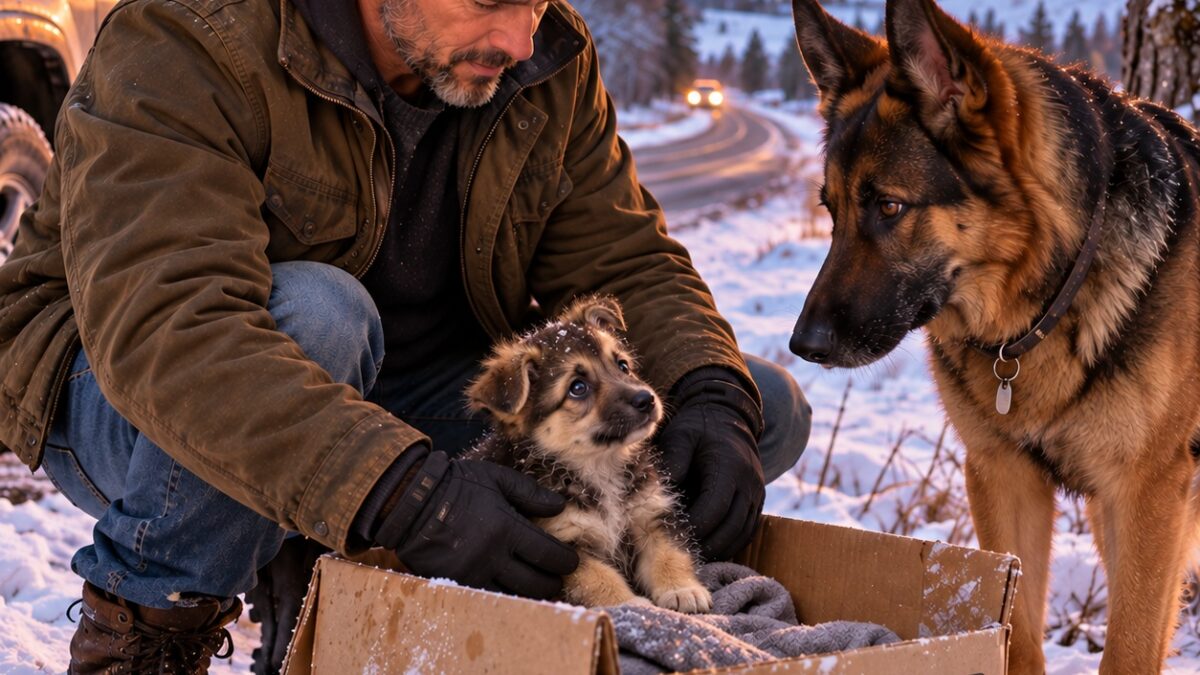
FULL STORY CONTINUATION
The puppy objected to almost everything between Route 8 and my driveway.
Windshield wipers.
Turn signals.
Potholes.
The heater changing fan speed.
Every bump in the road appeared to offend her personally.
Bishop rode in the passenger seat and refused to acknowledge any connection to the problem in the cardboard box behind him.
My house stood beyond a row of spruce near the edge of North Brier.
Dark cedar siding.
Stone chimney.
Workshop fifty feet behind it beneath a metal roof.
The place had been quiet for years.
The puppy ended that in less than thirty seconds.
The moment I put the box down inside, she climbed over the edge, landed on the hardwood floor, scrambled for traction, and went skidding toward the kitchen.
Her nails made a rapid clicking sound.
Click-click-click-click.
She recovered.
Saw a heating vent.
Barked at it.
Warm air moved her whiskers.
She barked harder.
Bishop walked past her without looking.
“Smartest one in the house.”
The puppy abandoned the vent and attacked one of my bootlaces.
“No.”
She pulled backward.
“No.”
I raised my foot.
For half a second she rose with it, still attached to the lace, then dropped back down looking delighted.
Bishop stopped near the living room.
His amber eyes moved from her to me.
“Don’t start.”
He looked away.
The puppy sprinted toward the kitchen.
Her front end turned.
Her back end did not.
She slid sideways past the refrigerator, spun halfway around, and disappeared under the table facing the wrong direction.
I bit the inside of my cheek.
She emerged immediately as if that had been the plan.
Then she found Bishop’s rubber ball.
That was the first genuine diplomatic crisis.
The ball lay beside his bed.
She grabbed it.
Or tried.
It was almost too large for her mouth.
She waddled three steps.
Bishop’s head came up.
The puppy froze.
Bishop stood, walked over, lowered his head, and calmly removed the ball from her mouth.
No growling.
No drama.
Simple repossession.
He carried it to the sofa.
Jumped up.
Turned once.
Lay down with the ball between his paws.
The puppy stood below him and barked.
Bishop looked down at her with an expression so deeply tired that something inside me broke loose.
I laughed.
Not one sound this time.
A real laugh.
It filled the room.
Rough.
Unused.
Almost foreign.
I stopped when I heard it.
So did the dogs.
The house seemed to notice.
I looked away.
“Don’t make anything out of it.”
Bishop put his chin over the ball.
That evening, I carried the roadside box inside and placed it near the fireplace.
Two clean towels.
Water.
A little food.
She ate like conversation had never been invented.
Then refused to sleep.
She barked at Bishop.
Bishop ignored her.
She barked at me.
I ignored her.
Her own shadow moved across the wall.
Apparently that required intervention.
“That’s you.”
Bark.
“Still you.”
Bark.
After forty minutes, I sat in my chair with coffee and began reconsidering whether silence had been one of civilization’s greatest achievements.
Bishop lay near the sofa with his front paws crossed.
The puppy made one final attempt to defeat the shadow.
Then she collapsed in the middle of turning around.
One second awake.
Next second gone.
Her back leg stuck out awkwardly.
One giant paw pressed against the cardboard wall.
The folded ear twitched once.
The room changed.
Not quieter.
The fire still crackled.
The furnace still moved warm air.
Snow brushed softly along the windows.
But something small had inserted itself into spaces that had been empty for a long time.
My phone vibrated.
The real estate agent.
Buyer’s final agreement ready.
Closing schedule still good.
I read the message twice.
Then looked around.
Cedar beams.
Stone fireplace.
A shelf I had built badly years ago and never fixed because Cole had laughed too hard at the crooked edge.
Bishop in his usual place.
A nameless puppy asleep in a microwave box that never should have been beside a winter road.
Two months.
Less, probably.
I had spent months telling myself this place was only materials.
That night, the argument sounded weaker.
The puppy woke the next morning at 6:17 by barking at the furnace.
A metal vent had clicked.
Apparently that justified a security response.
I lay in bed for three seconds, staring at the ceiling and considering every decision that had led me there.
She barked again.
I got up.
By seven, the kitchen looked like a small weather system had passed through.
Water bowl three feet from where I left it.
One bootlace untied.
Dish towel halfway off the oven handle.
The puppy investigating chair legs as if they concealed intelligence.
Bishop stood in the doorway looking spiritually exhausted.
“You wanted me to stop yesterday.”
He blinked.
“No revisionist history.”
The puppy charged a chair rung, lost interest halfway there, and ran down the hall.
I drank coffee.
“Three days.”
Bishop looked at me.
“Maximum.”
The veterinary clinic sat near the south end of town behind a pharmacy.
The puppy hated the automatic doors.
They opened.
She barked.
Closed.
Barked again.
A woman holding a terrier smiled.
“First visit?”
“Is it that obvious?”
Inside, the puppy changed strategies.
Instead of objecting to everything, she inspected everything.
Rubber floor mat.
Chair leg.
Brochure rack.
Shoelaces of a man filling out paperwork.
Bishop sat beside me so calmly that the little dog looked like a natural disaster occurring next to a monument.
A technician glanced at them.
“Same household?”
“No.”
I paused.
“Temporarily.”
She nodded without comment.
Dr. Mara Ellison examined the puppy.
Mara was in her fifties, compact, dark hair threaded with silver, reading glasses on a cord.
She had the patience of somebody accustomed to patients moving in several directions at once.
“Ten weeks, roughly.”
The puppy tried to chew examination paper.
Mara redirected her.
“Female. Little underweight. Mild dehydration. No obvious injury.”
She scanned for a chip.
Nothing.
“No microchip.”
“County has the found report.”
“Good. We’ll send her photo to nearby clinics and shelters. Put her on community boards too. Don’t post every identifying detail. Make anyone who claims her prove something.”
“How long?”
“Until someone shows up.”
“How long is that?”
“Could be an hour. Could be never.”
I disliked the answer.
Mara noticed.
“You aren’t obligated to keep her forever.”
“I’m not keeping her.”
The puppy sneezed.
Mara smiled.
“Of course not.”
I looked at Bishop.
“I had a witness when I stopped.”
Mara nodded toward him.
“County didn’t make you turn your truck around.”
Bishop studied the wall.
Traitor.
By ten-thirty, the puppy’s photograph appeared in more public places than mine had in years.
Found German Shepherd puppy.
North side of Route 8.
Female.
Approximately ten weeks.
Contact Animal Control.
I refused to post my number.
I had boundaries.
On the way home, she slept in the back seat with her head against the cardboard box.
Bishop watched her in the mirror.
He had stopped pretending she did not exist.
That was either progress or surrender.
I still had not named her.
At least that was what I claimed.
But that first night, when she had skidded across the hardwood and her nails made that rapid summer-insect sound, a word had arrived in my mind.
Cricket.
I resisted it for almost a day.
Then Mara asked what she should put on the temporary clinic file.
I looked down.
The puppy was chewing Bishop’s leash.
“Cricket.”
Bishop turned his head.
I ignored him.
The three days became five.
Five became seven.
Nobody produced a valid claim.
One man from two towns over had lost a male puppy months earlier.
Not her.
One family submitted photographs of a black dog with white paws.
Not her.
Another caller apparently believed all German Shepherd puppies in New Hampshire were interchangeable.
Lena Price called afterward.
“How’s your temporary guest?”
“Loud.”
“That wasn’t the question.”
“Ask better questions.”
She laughed.
“No verified owner yet.”
“Good.”
The word came too quickly.
I corrected.
“I mean—good that nobody is making false claims.”
“Of course.”
I could hear her smiling.
“Keep doing what you’re doing.”
That was the problem.
I did.
By the second week, Cricket had taken Bishop’s bed.
Not borrowed.
Taken.
I found her asleep sideways across the middle, belly exposed, one giant paw hanging over the edge.
Bishop stood two feet away looking offended.
“That’s your bed.”
He looked at me.
“Handle your business.”
Bishop walked forward.
Cricket opened one eye.
He lowered his head.
I expected a nudge.
Instead, Bishop gripped the edge of the bed and dragged the entire thing across the room.
Cricket woke while moving.
The bed traveled four feet.
She rolled once, stood, stepped off, walked back to the empty patch where the bed had originally been, and lay on the floor.
Bishop stared at her.
I rubbed my beard.
“I don’t know who’s winning.”
He abandoned the bed.
Next morning, Cricket stole his ball again.
Bishop took it.
Cricket followed.
He went down the hall.
She followed.
Under the dining table.
She followed.
Finally Bishop lay with the ball between his paws.
Cricket considered the problem.
Then changed objectives and bit the tip of his tail.
Not hard.
Just enough.
His head snapped around.
She released it and sat.
The disappointment on Bishop’s face looked ancient.
“She’s ten weeks old.”
He looked at me.
“You’re seven.”
Cricket bit his tail again.
Bishop got up and left.
Mature.
She chased him.
By day four or five, the house had sounds again.
Not only hers.
Mine.
I started talking without realizing it.
“That isn’t food.”
“Put that down.”
“No, the wall is not attacking you.”
“Where did you even find that?”
I discovered her beneath the table one afternoon with one of my socks.
I held up the matching one.
“Trade.”
She stared.
I showed her a biscuit.
The sock fell instantly.
“You understand economics.”
Bishop sneezed from the hallway.
“Don’t encourage her.”
The move continued around us.
I sold an old band saw to a contractor from Concord.
Boxed books I had not opened in years.
Separated tools into keep, sell, donate.
The house was easy compared with the workshop.
Every drawer in the shop contained memory.
A socket with blue paint on its handle.
A bent square.
A coffee ring burned into one corner of the bench.
A dent in a stool with a story attached.
The left side of that workshop had belonged to Cole Maddox.
Cole and I had left military service six months apart.
Both restless.
Both expecting civilian life to be slower.
Then irritated when it became complicated in completely different ways.
The shop had been his idea.
“We build something small,” he told me.
“Why?”
“So our hands stay busy before our heads get stupid.”
I called it sentimental garbage.
He threw a rag at me.
Then we built the shop.
Snowblowers.
Boat motors.
Generators.
Lawn tractors.
Anything with a carburetor and an owner too stubborn to replace it.
We never got rich.
We were useful.
That was enough.
Cole died three years later from a heart condition nobody understood until understanding no longer helped.
The shop stayed.
That was the problem.
For nearly a year, I used his side of the bench without changing anything.
Then one wrench moved.
Then another.
Eventually, physically, the space became mine.
Emotionally, it never did.
The stain beneath the grinder was Cole’s.
The nail where he hung his jacket was Cole’s.
The dent in the stool was Cole’s.
Selling the property was not supposed to cure grief.
I was not stupid enough to believe geography could do that.
But memory uses objects.
Walls.
Smells.
Habits.
Remove enough of those, I thought, and maybe the mind would have to learn a different road.
I sealed another box with packing tape.
The sound ripped through the workshop.
Cricket barked from the doorway.
“It’s tape.”
Bark.
I tore another strip.
She rushed forward, circled the box, grabbed a cleaning rag, and ran.
“Absolutely not.”
By the time I caught her inside the house, she had abandoned the rag and climbed into an open box of clothes.
I lifted her out.
She climbed back in.
I lifted her again.
“You’re not helping.”
Bark.
I pointed at Bishop.
“You could intervene.”
He lowered his head.
“Traitor.”
That evening, Cricket pulled a scarf from another box.
Then a sweater.
Dragged the sweater across the living room.
Sat on it.
I took it.
She barked.
I put it inside.
She climbed into the box.
“Are you making a point?”
She licked my wrist.
I removed her.
Folded the flaps.
Tape tore across cardboard.
Cricket went still.
Not playful stillness.
Different.
Her folded ear pulled back.
She looked toward the front door.
Bishop saw it.
I did not.
I was writing KITCHEN on another box.
That night, I placed a large suitcase near the entry.
Cricket had been chasing a rubber ring.
The moment the suitcase touched the floor, she stopped.
The ring rolled past.
She did not follow.
She looked at the suitcase.
Then me.
Then the hallway.
I was reading an email and missed most of it.
Only noticed the silence.
“Cricket?”
Nothing.
Bishop lifted his head.
I checked under the table.
Kitchen.
Laundry room.
Nothing.
Bishop walked toward the garage.
I followed.
The old microwave box sat in the back corner.
I had dried it beside the heater because Lena told me to preserve the original materials until the report could be closed.
Cricket was curled inside it.
Tight.
Nose tucked against one back leg.
I stopped.
“Hey.”
One eye opened.
I crouched.
“Why are you in there?”
She did not move.
The suitcase was visible through the open interior door.
I looked from it to her.
For one second, I almost understood.
Then practicality stepped in.
Dogs like enclosed spaces.
She had slept in the box her first night.
Nothing remarkable.
Bishop entered.
Sniffed the cardboard.
Then lay directly in front of the opening.
His broad body filled it like a wall.
Cricket closed her eyes.
I stood there longer than necessary.
Cold concrete worked through my boots.
The sealed moving boxes lined the garage wall behind me.
Bishop rested his chin between his paws.
A memory returned.
Cole sitting on the shop floor after fourteen hours rebuilding a generator for a family before a storm.
He had leaned against the bench and said, “You know what I like about this?”
I expected a joke.
Instead he looked around.
“We work with our hands here instead of living in our memories.”
I laughed at him then.
Called it sentimental nonsense.
He threw another rag at me.
Now the workshop sat fifty feet away.
Half packed.
Half erased.
I looked at the dogs.
Turned off the overhead light.
Left the interior door open enough for heat.
Next morning, I carried an empty box into the living room.
Set it down.
Held the tape.
Stopped.
For almost a minute I stood there.
Cricket watched me.
Bishop watched Cricket.
I put the tape down.
Not forever.
Only for the morning.
By the end of the second week, North Brier had adopted Cricket socially even if I refused to do it legally.
Her found notice remained at the pharmacy.
The vet.
The municipal building.
Shelters south of town shared it.
No legitimate owner appeared.
The practical problem was that a ten-week-old shepherd could not be left alone long.
Bishop could.
He had perfected sleeping through anything he considered irrelevant.
Cricket considered nothing irrelevant.
So when I needed belts and filters in town, both dogs went.
North Brier looked almost cheerful under fresh snow that morning.
Red-brick storefronts.
Green awnings.
Steam drifting from the diner vent.
I parked outside Barlo’s Market.
“Stay close.”
Bishop stepped down.
Cricket followed with the discipline of a dropped firecracker.
Mustard-yellow temporary collar flashing against the snow.
She zigzagged toward three smells simultaneously.
“Straight line. Revolutionary concept.”
She looked at me.
Then wrapped the leash around Bishop’s front legs.
He stopped.
Looked down.
Looked at me.
“I know.”
I stepped forward to untangle them.
Cricket backed cleanly out of the loop.
For one impossible second, my hand held an empty leash.
She stood three feet away.
We looked at each other.
“No.”
She ran.
Not toward the road.
Toward the market.
The automatic doors opened for a customer.
Cricket shot through.
“Cricket.”
Too late.
Bishop and I followed.
She hit polished tile at full speed.
Lost traction.
Slid sideways past canned soup.
Spun.
Vanished behind paper grocery bags.
A woman gasped.
Then laughed.
One bag fell.
Cricket’s head appeared.
Ears uneven.
Eyes bright.
Utterly pleased.
“You are making a strong case for outdoor living.”
Bishop entered behind me.
No hurry.
He walked to the bags, lowered his head, found Cricket’s dangling leash, took it gently in his mouth, and walked toward the door.
Cricket followed because there were few alternatives.
A seventy-pound adult shepherd leading a thirteen-pound puppy through a grocery store.
People laughed.
Somebody clapped.
I closed my eyes.
“This town has too much free time.”
“Absolutely.”
Clare Barlo stood behind the register.
Burgundy-and-navy flannel under a canvas apron.
Auburn hair tied back.
Pencil behind one ear.
She had known me long enough to recognize irritation from embarrassment.
She enjoyed both.
Cricket tried to bite the leash Bishop was carrying.
Clare raised her phone.
“Don’t.”
Click.
“Clare.”
“What?”
“Delete it.”
“I haven’t even looked yet.”
“That has never stopped you from making bad decisions.”
She checked the picture.
Her mouth twitched.
“Oh, this is excellent.”
“It’s evidence.”
“Of what?”
“Negligence.”
“Whose?”
I looked at Cricket.
She was barking at winter mittens.
“Fair.”
By the time I finished shopping, Clare had printed the photo and taped it beside the community board.
Underneath:
BISHOP AND HIS UNPAID INTERN.
“No.”
“It’s accurate.”
“Neither is employed.”
“I can write temporary intern.”
“That does not improve anything.”
Cricket barked.
Clare pointed.
“She likes it.”
“She likes electrical outlets.”
“Strong argument.”
I left before the sign acquired amendments.
By the next day, strangers asked about “the intern.”
Hardware store employees saved puppy biscuits.
A man at the feed store crouched beside Cricket.
“So this is the loud one.”
I looked down.
“How are you already famous?”
She sneezed.
Bishop walked ahead like a man who had accepted public humiliation as part of retirement.
Their relationship changed too.
Slowly.
A snowplow passed the house one afternoon, blade rattling violently over packed ice.
Cricket jumped.
She had been chewing a towel.
The noise sent her running into the living room.
I expected her to head for the cardboard box.
Instead, she stopped beside Bishop.
He lay near the sofa.
Raised his head.
Looked at her.
Then lowered it.
Cricket lay down close.
Not touching.
Close enough.
I saw it from the kitchen.
Pretended not to.
A few days later, I worked on “wait” at the front door.
Bishop sat instantly.
Cricket tried to launch through the opening.
I blocked her with one boot.
“Wait.”
She bounced backward.
“Wait.”
Bishop did not move.
Cricket looked at him.
Looked at the door.
Looked at him again.
With extraordinary effort, she lowered herself into a crooked sit.
I raised an eyebrow.
“About time.”
She looked proud enough for a medal.
A week later, after a long walk through crusted snow, Bishop returned moving more carefully than usual.
Nothing alarming.
Age speaking quietly through his back legs.
He lay near the fireplace.
Cricket approached with a rubber ring.
Usually she would have dropped it on his head.
She stopped.
Watched him.
Lay down a few inches away.
Ring between her paws.
Bishop closed his eyes.
She stayed.
Recognition came before trust.
Maybe trust before loyalty.
Or maybe loyalty arrived first and nobody admitted it.
The workshop changed because people started entering it again.
Arthur Bell arrived one Tuesday with an ancient snowblower in his pickup.
Arthur was old enough to believe replacing machinery represented moral failure.
He climbed down wearing a tobacco-brown barn coat.
“It’s making a noise.”
“It’s a snowblower.”
“A new noise.”
“What kind?”
He thought.
“Concerning.”
“That is not a mechanical description.”
“It concerned me.”
Thirty minutes later, I found a loose shield.
One bolt.
Tightened it.
“How much?” Arthur asked.
“Nothing.”
“Then it wasn’t fixed correctly.”
“Go home.”
He smiled.
A week later he returned with a radio.
Put it on the bench.
“What’s wrong?”
“Not sure.”
I plugged it in.
Music.
Perfect.
Weather channel.
Perfect.
No static.
I shut it off.
“You know this isn’t broken.”
Arthur nodded.
“I know.”
I stared at him.
“Then why did you bring it?”
“To see if you’d notice.”
“You drove half a mile in January to test whether I could identify a functioning radio.”
“I had confidence.”
“You need a hobby.”
He looked around my shop.
“I thought this was one.”
He stayed twenty minutes.
Drank coffee.
I noticed.
Did not mention it.
Then Mason Reed appeared.
Sixteen.
Gray hoodie beneath a denim jacket.
Dark curls.
Hands in pockets.
First day, he stood outside the open shop and watched me rebuild a carburetor.
Said nothing.
Next afternoon, he came back.
Third day, I looked up.
“You lose something?”
“No, sir.”
I disliked sir.
“What do you want?”
“Just watching.”
“That usually works better after you ask.”
He nodded.
“Can I watch?”
“You already are.”
Ten minutes later, I held out an old spark plug.
“What is this?”
“Spark plug.”
“What does it do?”
“Ignites the air-fuel mixture.”
I looked at him.
He shrugged.
“My mom’s mower hates starting.”
“That does not explain why you know that.”
“YouTube.”
I made a face.
“Dangerous institution.”
He almost smiled.
Next day I gave him bolts to sort by thread size.
Three wrong.
He did it again.
Then a carburetor bowl.
Then plug gap.
Then listening.
That part mattered.
“Machines tell you things.”
Mason frowned at the snowblower.
“It isn’t talking.”
“You’re waiting for words.”
I tapped the housing.
“Sound. Heat. Vibration. Smell. Start there.”
He nodded.
I heard Cole in my own voice.
The recognition arrived quietly.
I kept working.
Two days later, North Brier High called.
The vocational coordinator heard Mason was spending time at my shop.
They wanted somebody to lead a basic small-engine workshop.
One afternoon.
Two hours.
I said no so quickly the woman went silent.
“We can work around your schedule.”
“That isn’t the problem.”
“What is?”
I looked through the window.
Mason was brushing snow from Bishop’s back.
Cricket was attacking the broom.
“I’m not teaching a class.”
I ended politely.
That evening, I stood at the door with both dogs.
“Bishop. Sit.”
He sat.
“Cricket.”
She bounced.
“Sit.”
Nothing.
She looked at Bishop.
Then me.
Then lowered herself.
Bishop did not correct her.
Did not reward her.
He simply remained what he was long enough for her to understand.
I stared at him.
Bishop had not become less by showing Cricket something.
He had not lost his position.
He had made room.
I disliked that thought because it applied too easily to other things.
That night the developer sent the final purchase agreement.
All inspection contingencies satisfied.
Closing timeline confirmed.
I opened the file at the kitchen table.
Cricket slept with her chin on Bishop’s bed.
Bishop lay beside her.
The workshop lights glowed through the back window.
I scrolled to the signature page.
Thought about Clare’s market.
Arthur’s fake broken radio.
Mason in the doorway.
The school phone call.
Cole’s laughter trapped somewhere inside old wood.
The blank signature line waited.
A signature should not have felt heavier than steel.
I signed anyway.
Wednesday morning, while I was disassembling a carburetor, my phone rang.
Cricket immediately looked up.
Bishop did not.
That alone told me which dog understood too much about the world.
“Dorsey.”
A woman introduced herself as Helen Ward.
“I’m calling about the German Shepherd puppy.”
I stopped.
Cricket had found a cardboard tube and was attempting to destroy it.
“What about her?”
“I saw the found-dog post.”
Pause.
“I don’t think she’s mine.”
My shoulders changed.
Not exactly relief.
Not disappointment either.
“Then why call?”
“The towel.”
“What towel?”
“The blue-and-white towel in the box. You could see part of it in the photograph.”
I looked toward the clear tote where I had stored the original roadside materials.
“You recognize it?”
“Maybe.”
Helen had stopped at a gas station outside Ashford several weeks before.
A man there had three German Shepherd puppies in the back of an SUV.
Selling them for cash.
No papers.
No breeder information.
One puppy sat on a towel with the same faded blue stripe.
“Did you buy one?”
“No.”
“License plate?”
“No. I should have.”
I heard guilt in her voice.
I knew that kind of sentence.
The mind builds alternate histories after an event and punishes us for not having known the future.
“You didn’t know what you were looking at.”
“I knew enough to feel strange.”
She remembered a dark SUV.
Out-of-state temporary tag.
Maybe Massachusetts.
Maybe Vermont.
Man in a red winter jacket.
Three puppies.
One darker.
Less than ten minutes.
Lena checked what she could.
No reliable plate.
No confirmed identity.
No sale documentation.
No valid owner matching Cricket.
“We’re nearing the end of the required hold,” Lena told me later.
I leaned against the kitchen counter.
Cricket slept with her muzzle on my boot.
“So that’s it?”
“Almost. If you want to file adoption paperwork, Mara can start the process.”
I looked down.
The mustard collar had shifted sideways.
It was not the collar that bothered me.
It was the word.
Adoption.
Permanent words carry weight.
Lena waited.
“You still there?”
“Yes.”
“Want me to send the forms?”
Moving boxes stood in the hallway.
“I’ll think about it.”
She waited one beat.
“All right.”
Then, because Lena enjoyed making my life harder, she added, “For what it’s worth, she seems to have picked a place.”
“Dogs don’t file legal claims.”
“No. Usually less complicated.”
I ended the call.
The forms arrived twenty minutes later.
I did not open them.
Not that day.
Not the next.
I had sold the property.
Closing date.
No long-term destination chosen.
Adopting a ten-week-old German Shepherd while dismantling my life was not responsible.
The fact that Cricket lived in my house, ate beside Bishop, slept near my boots, and followed me from room to room did not change the argument.
Temporary responsibility was still temporary.
I repeated that until it sounded clean enough to ignore.
Arthur arrived Friday without machinery.
That made me suspicious.
He carried two coffees.
“You look under-equipped.”
He handed me one.
“What’s this?”
“Peace offering.”
“For what?”
“Future conversation.”
“That sounds worse.”
He leaned against the bench.
“Clare told me.”
“Clare tells everybody everything.”
“Not everything.”
“What?”
“That you sold the place.”
The workshop quieted.
He took a drink.
I stared.
“You here to lecture me?”
“No.”
“Judge me?”
“No.”
“Then what?”
“I wanted to know if you were going somewhere.”
I waited.
Arthur’s pale eyes stayed on mine.
“Or just leaving here.”
The sentence landed without force.
That made it worse.
“Same thing.”
“No. Same truck. Different thing.”
“I have work.”
“I can see that.”
He stayed.
I picked up a wrench.
Set it down.
“What do you want me to say?”
“Nothing.”
“That’s convenient.”
“I’m old. Convenience matters.”
Then he changed subjects.
“I need help with something.”
“Of course you do.”
That afternoon, he brought an old snowmobile.
Square body.
Faded orange paint.
He bought it decades earlier for his son.
His grandson would turn twelve in March.
“I thought I’d get it running.”
I walked around it.
“You thought wrong.”
“That bad?”
“Fuel lines brittle. Carb probably varnished. Track stiff. Belt questionable.”
“So there’s hope.”
“I’m saying you enjoy giving me problems.”
“Same thing.”
Mason arrived.
Stopped in the doorway.
“What’s that?”
Arthur looked offended.
“A vehicle.”
“It’s ancient.”
Arthur pointed at him.
“I liked you better before you spoke.”
I pulled on gloves.
“If everyone’s staying, move the bench lamp.”
Mason did.
Arthur removed his coat.
Cricket stole one glove.
Bishop sighed.
We worked.
Hours.
Not efficiently.
Arthur told stories unrelated to the work.
Mason asked questions.
Cricket carried anything we failed to secure above nose level.
Bishop slept under a table.
At one point a wrench hit the floor.
Somebody said, “Got it.”
Mason laughed.
Arthur argued.
Cricket barked in her sleep.
The workshop stopped feeling sealed.
That frightened me more than I expected.
Dead places are easier to leave.
Living places ask questions.
When Arthur drove Mason home that night, the snowmobile remained half restored on its stand.
“We’ll finish tomorrow,” Arthur said.
“You invited yourself.”
“You are going to.”
“No.”
He pulled on his cap.
“Same result.”
After they left, I turned off the bench lights.
Cricket followed me.
Bishop behind her.
I stopped at Cole’s old side of the bench.
A scratch ran through the wood near the vise.
Cole had dropped an engine housing there years earlier and blamed gravity for being aggressive.
I placed my hand on the bench.
For the first time in years, the memory did not feel like a room closing.
It hurt.
That was different.
Next morning:
Closing confirmation.
Ten days.
I opened Cricket’s adoption forms.
Name of animal: Cricket.
Breed: German Shepherd.
Current caretaker: Evan Dorsey.
I stared.
Filled out nothing.
Closed the file.
Then the house began disappearing.
Not metaphorically anymore.
Boxes everywhere.
Books gone.
Photographs removed.
Kitchen drawers empty.
Pale rectangles showing where frames had hung.
Moving company representative measuring the workshop door.
Equipment inventory.
Strangers entering.
Leaving.
Cricket barked at them.
Followed Bishop so closely she stepped on his back feet.
At night, she stopped sleeping wherever exhaustion found her.
She chose sight lines.
Hallway.
Front door.
Near Bishop.
I noticed.
Interpreted it as disruption.
Puppies dislike changes.
Reasonable.
What I did not notice was how often she watched my hands when I carried something outside.
How her ears changed when packing tape tore.
How Bishop started looking at her before looking at me.
One evening, I dropped flattened boxes against the living room wall.
Cricket stopped chewing.
Moved closer to Bishop.
“You’re fine.”
She watched me.
Bishop did too.
I reached for tape.
Snow fell outside.
The house filled with cardboard.
This time Cricket stopped treating the boxes as toys.
First walls changed.
Then shelves.
Then little things.
The bowl near the door where screws and keys had collected.
Coffee mugs.
Extra blankets.
A jacket on a hook.
Every room was losing evidence that people lived there.
I kept calling it progress.
By Thursday, even Arthur had stopped joking.
Mason helped sort shop tools after school.
He asked twice whether I really wanted to sell the lathe.
“Yes.”
The second time, my answer sounded weaker.
Pegboards showed outlines where tools had been.
Cabinets stood open.
The air smelled of metal, dust, old oil.
Cricket hated the shop packing most.
Tape tearing.
Drawers shutting.
Wrenches dropping into bins.
She moved constantly.
Bench to Bishop.
Bishop to me.
Me to door.
Back again.
“Cricket.”
She looked up.
“Settle.”
She tried.
Five seconds later, Mason moved a box.
She followed it.
I rubbed both hands over my face.
I had slept badly.
Lender questions.
Closing revisions.
Moving company schedules.
Developer easement questions.
Every small thing required another decision.
Another signature.
One more piece of a life I was trying to finish.
Cricket grabbed a shop rag.
I took it.
She found a glove.
I traded.
She pushed her nose into a half-packed toolbox.
“No.”
She backed away.
Five minutes later, I turned for a marker.
Cricket moved behind me.
Her side hit a low metal tray.
The tray tipped.
Sockets and small fittings hit concrete.
Clang.
Clatter.
Roll.
A socket spun across the floor and struck the workbench leg.
I turned.
“Enough!”
The word came out harder than I intended.
Everything stopped.
Mason froze at the far bench.
Bishop raised his head.
Cricket did not bark.
She did not move.
Her whole body changed.
Shoulders lowered.
Head down.
Tail still.
My anger vanished so fast embarrassment replaced it.
She stepped backward.
Then again.
Toward Bishop.
“Cricket.”
She retreated.
Bishop stood.
Slowly.
Then moved between us.
No growl.
No tension.
No challenge.
He simply placed his body there.
I went completely still.
Bishop had never done that.
My first reflex read the posture as opposition.
Then I saw his ears.
Saw Cricket behind him.
Saw how small she had made herself.
He was not standing against me.
He was standing for her.
I looked down.
My hands were clenched.
I opened them.
Mason said nothing.
Smart kid.
I stepped backward.
Then sat on the concrete floor.
Not close.
Did not reach.
The shop heater hummed.
Snowlight came through the windows.
Cricket watched from behind Bishop.
I did not call her.
Did not pat the floor.
Did not make my voice falsely gentle.
I sat.
Bishop remained between us.
One minute.
Maybe two.
Cricket moved.
Not directly.
A small arc around Bishop.
Nails clicking lightly.
She approached enough to smell my boot.
Then sleeve.
Stopped.
I kept my hands on my knees.
One more step.
She rested her chin on my knee.
That was all.
I swallowed.
“I’m sorry.”
Cricket blinked.
Bishop sat behind her.
Mason quietly crouched to pick up scattered sockets.
“I’ve got it.”
He shook his head.
“So do I.”
I did not argue.
That night I packed nothing else.
The tape stayed on the kitchen counter.
Cricket slept beside Bishop.
The adoption forms stayed unopened.
And despite everything I had seen, I still did not cancel the move.
Morning arrived gray.
The moving crew came early.
Three workers.
Box truck.
Boots stomping snow from the porch.
Furniture pads.
Straps.
Clipboards.
Doors opening and closing.
I put both dogs in the laundry room while the crew moved the first load.
Water.
Blanket.
Chew toy.
Door shut.
“Just until they finish.”
Cricket barked the moment I left.
Bishop did not.
The house filled with noise.
Furniture moving.
Tape tearing.
Garage door rising.
Closing.
Rising again.
Cricket continued barking.
At first I ignored it.
Then talked through the door.
“You’re fine.”
Bark.
“Bishop’s with you.”
Bark.
Bark.
I went back outside.
A mover needed tie-down straps from the utility shelf near the laundry room.
I was checking inventory in the garage.
He did not know the dogs were behind that side door.
He opened it.
Only a few inches.
That was enough.
Cricket shot through.
The worker shouted.
Reached.
Missed.
Bishop followed.
I heard the commotion and turned.
Cricket streaked across the snow.
Bishop behind her.
“Bishop!”
He slowed.
Not immediately.
Then stopped.
I grabbed his collar.
Cricket reached the end of the driveway.
Looked back.
For one fraction of a second, I saw everything clearly.
Mustard-yellow collar.
One ear up.
One still folded.
Dark eyes wide.
Then she turned.
Crossed the snow-covered road.
Ran behind trees.
Disappeared.
I stood there holding Bishop.
Snow drifted across the road in thin sheets.
Daylight still good.
It would not stay that way.
“CRICKET!”
My voice carried through the trees.
Nothing.
Bishop pulled toward the woods.
I released him.
“Go.”
He lowered his nose.
Moved fast toward the property line.
My brain switched into the old mode.
Move first.
Think moving.
Truck keys.
Phone.
Jacket.
Cover back roads.
Creek road.
Lake road.
Turnouts.
Someone shouted.
“Mr. Dorsey!”
Mason stood at the shop entrance.
Backpack over one shoulder.
Paper cup in his hand.
He must have arrived expecting to work on the snowmobile.
“What happened?”
“Cricket got out.”
His face changed.
“How long?”
“Minute.”
“I’ll help.”
“No. Go home.”
He did not move.
“Why?”
“Because this isn’t—”
I stopped.
My problem.
My responsibility.
The answer I had built half my life around.
Mason looked toward the road.
“Which way?”
I took out my phone.
Clare answered before the second ring.
“Cricket’s loose.”
No greeting.
“When?”
“Just now.”
“I’m closing the store.”
“You don’t need—”
She hung up.
Arthur answered.
Same result.
Then Lena.
Her voice became practical instantly.
“Exact time.”
I checked my watch.
“2:47.”
“Direction?”
“North side. Tree line.”
“Collar?”
“Mustard yellow.”
“Leash?”
“No.”
“Do not chase if you see her. Young stressed dog may keep running.”
“I know.”
“Good. I’m alerting patrol, animal control, shelters. Send me a current picture.”
Snow began falling steadily.
Not heavy yet.
Enough to soften edges.
Mason was already pulling out his phone.
“I’ll check road cameras.”
“What cameras?”
“Mr. Halpern has one facing the road. Tailor shop has two. Clare’s store covers the intersection.”
Arthur’s pickup came up the road.
Clare’s Subaru followed.
The moving crew had stopped working.
One worker stood by the truck with his hat in his hands.
Guilt all over his face.
I did not look long.
There was no time for blame.
Arthur got out.
“What have we got?”
“Nothing.”
“Then let’s get something.”
“I’m taking Bishop north.”
“Good.”
“I’ll circle alone.”
“No.”
“Arthur—”
“You can search one direction fast.”
He pointed toward Clare.
Mason.
The movers.
“Or all of us search six directions.”
“I don’t need six people in each other’s way.”
“You need a plan.”
My jaw tightened.
Arthur stepped closer.
“You can look fast alone. Or we can look wide together.”
I stared at the people in my driveway.
Clare already calling businesses.
Mason asking the worker for exact direction.
Arthur waiting.
Lena’s cruiser appearing down the road.
These were people I had spent months preparing to leave.
Not because they failed me.
Because they had gotten close enough that leaving them could hurt.
The realization arrived at the worst possible moment.
I swallowed.
“I need help.”
The words felt heavier than they should have.
Nobody made anything of it.
Clare just nodded.
“Okay.”
That saved me.
Lena marked the last-seen point.
Arthur took west-side houses.
Clare contacted the market, hardware store, vet clinic, gas station, anyone still open.
Mason started checking cameras.
One mover drove the south road.
The other stayed at my house in case Cricket doubled back.
Lena alerted patrol units and shelters.
I clipped Bishop’s leash.
He pulled toward the tree line.
“Let’s go.”
For the first hundred yards, I thought finding her would be easy.
Small paw prints crossed fresh powder beside a ditch.
Bishop put his nose down.
We followed.
Tracks curved through brush.
Past a fallen limb.
Across a packed driveway.
Then vanished.
Bishop moved left.
Right.
Back.
“Come on.”
Nothing.
He sniffed a hedge.
Behind a shed.
Old tracks.
Rabbit.
Boot.
Melted patch near a vent.
My breathing shortened.
“Come on.”
Bishop changed direction.
Ten yards later, he stopped again.
I tugged the leash.
“No. This way.”
He resisted.
I pulled once more.
Bishop looked at me.
Not stubborn.
Confused.
I stopped.
I had turned him into a tool because I needed certainty.
He was not a tracking dog.
He knew Cricket.
Knew her smell.
That did not make him something he was not.
I crouched in the snow.
“Sorry.”
Bishop stepped closer.
I loosened the leash.
“All right. Your way.”
This time I followed.
Some moments he moved purposefully.
Other times he investigated nonsense.
At one point he took me directly to a trash bag under somebody’s porch.
I nearly laughed.
Could not.
My phone rang.
Mason.
“I found something.”
“Where?”
“Halpern camera. She crossed north at 2:49.”
My pulse jumped.
“Anything else?”
“The tailor camera catches her farther toward the lake. Maybe three blocks.”
“Direction?”
“Summer houses.”
Seconds later Lena confirmed the footage.
Bishop and I cut east.
Snow fell thicker now.
Gray sky lowering.
The temperature sharpening.
Near a drainage ditch, paw prints appeared.
“There.”
Bishop found them.
We followed almost two hundred yards.
Then Lake Road.
A plow had passed.
Packed snow and tire spray erased everything.
Bishop searched both sides.
Nothing.
I stood in the road.
Too many directions.
Too much cold.
Too much open ground.
Then I remembered the maple.
The box.
The first place Cricket had hidden when frightened.
Of course.
Fear returns to familiar shelter.
“Come on.”
We got back to the truck.
I drove too fast for the first half mile.
Then heard Lena’s warning in my head.
Don’t turn panic into another problem.
I slowed.
The maple appeared ahead.
Bare branches.
White shoulder.
Same place.
No box.
I pulled over.
Ran to the tree.
“Cricket!”
Nothing.
Behind the trunk.
Ditch.
Snowbank.
Across the road.
Nothing.
Bishop sniffed around.
Walked away.
“No.”
I checked again as if moving enough snow might create a puppy.
Nothing.
I put one hand against the maple trunk.
Cold bark through my glove.
I had built a story.
Fear equals box.
Box equals tree.
And mistaken the story for knowledge.
I had been wrong again.
Wrong about packing.
Wrong about barking.
Wrong about what Cricket understood.
Wrong about what she needed.
We kept searching.
Mason called with another camera angle.
Arthur reported no sighting west.
Clare had half the town watching.
Lena checked vacant properties.
The summer-house road stretched along the lake, most homes empty until warmer months.
Bishop and I moved house by house.
Calling occasionally.
Listening more.
Snow softened sound.
Twilight started gathering.
My mind kept trying to race ahead.
Coyotes.
Road.
Cold.
Water.
I forced it back.
Next yard.
Next porch.
Next tree line.
Bishop stopped near one old seasonal house.
The property looked shut down for winter.
Snow drifted against the porch.
He lifted his head.
I waited.
His ears came forward.
Then I heard it.
Tiny.
Muffled.
A bark.
I dropped to one knee.
The gap beneath the porch was narrow, partly blocked by snow.
Behind a loose board:
Darkness.
Then another bark.
My breath left me.
“There you are.”
Bishop started digging.
I joined him.
Snow scraped away beneath our gloves.
A low weathered board crossed the opening.
I shined my phone light.
Something moved.
Mustard-yellow collar.
“Cricket.”
She was curled against the back wall where the space narrowed.
Trembling.
No obvious blood.
No visible injury.
Cold.
Terrified.
Alive.
I reached toward the opening.
Too tight.
The board shifted when I tested it.
The porch above looked unstable enough that forcing it could bring weight down.
Everything in my body said:
Go.
Crawl.
Break the board.
Get her.
Now.
My hand gripped the edge.
Then I stopped.
The pipe at the station never happened in my life, but the lesson had been written into me through other mistakes often enough.
Caring does not always mean being first through the opening.
Sometimes it means not making the rescue harder because your fear cannot wait.
I took out my phone.
“Lena.”
“What?”
“I found her.”
Everything on the other end changed.
“Condition?”
“Cold. Responsive. Under a porch. Tight access.”
“Do not force it.”
“I know.”
This time, I did.
Arthur arrived first.
Then Lena.
Arthur looked at the drift.
“Need a shovel?”
Lena had one in the cruiser.
No speech.
No drama.
They worked.
Arthur cleared snow from the side.
Lena inspected boards.
I stayed near the opening talking to Cricket.
“Easy.”
A bark.
“We’re here.”
Bishop stayed at the gap.
Every time he shifted, Cricket barked softly.
Lena found one exterior board that could be removed without disturbing the porch structure.
Arthur loosened packed snow below it.
I held the light.
Three people.
One dog.
Small movements.
Patient.
The opening widened.
Bishop tried to push forward.
I caught his collar.
“Wait. For once.”
He did.
Lena eased the board free.
“That’s enough.”
I crouched.
“Cricket.”
For a second she stayed where she was.
Then moved slowly.
One paw.
Then another.
Faster.
She came out into the snow.
Ran straight past me.
My heart dropped.
Then she slammed into Bishop’s chest.
Pushed herself beneath his neck.
Bishop lowered his body around her immediately.
Right there in the snow.
He curled around the little dog as much as his body allowed.
Cricket disappeared into dark sable fur except for one folded ear.
I stared.
Something broke open inside me.
Not dramatically.
Quietly.
I dropped onto both knees.
Put one hand on Bishop’s back.
Warm fur beneath my glove.
Cricket raised her head.
Looked at me.
No bark.
No running.
Just those dark eyes.
I tried to speak.
Nothing came.
My face tightened.
I looked down.
A tear hit the snow.
Disappeared instantly.
Then another.
Arthur turned away.
Lena became suddenly interested in the removed board.
Neither said anything.
I pressed my hand against Bishop’s shoulder.
Cricket tucked herself closer.
And the previous week finally made sense.
The barking at tape.
Clothes dragged from boxes.
Sleeping near doors.
Watching suitcases.
Following Bishop.
The panic around movers.
She had not been trying to disrupt the move.
She had already lost one world.
Somewhere, before I found her, rooms had changed.
People had disappeared.
Then she ended up in a cardboard box beside a road.
Now she had watched objects vanish again.
Pictures leave walls.
Boxes close.
Doors remain open.
Strangers carry furniture away.
I had called it puppy behavior.
I had been so busy preparing to leave that I never stopped to ask what leaving looked like from six inches above the floor.
Cricket placed one paw against Bishop’s front leg.
I closed my eyes.
I had not rescued her alone.
Arthur cleared snow.
Lena made the opening safe.
Mason found her direction.
Clare spread word through town.
Bishop heard her bark.
Everybody carried part of the distance.
The same people I had been packing my life to escape because needing people felt dangerous.
I opened my eyes.
Cricket was still watching me.
“I’m sorry.”
The words almost disappeared into falling snow.
That time, I knew exactly what I meant.
At the veterinary clinic, Cricket slept through most of Mara’s examination.
That scared me more than barking would have.
For weeks, everything had required an opinion from her.
Automatic doors.
Metal bowls.
Examination tables.
Stethoscopes.
Shoelaces.
Now she lay on a towel with her head against Bishop’s front leg and barely opened her eyes when Mara checked her chest.
“She’s tired.”
“That all?”
Mara looked up.
“You want a longer list?”
“No.”
“Then stop asking questions like you do.”
Mild dehydration.
Low temperature from exposure.
Exhaustion.
No serious injury.
No reason she would not recover quickly with warmth, water, food, and rest.
I exhaled.
Cricket opened one eye.
“You’re fine.”
Mara looked at me.
“What?”
“Nothing.”
“You’re doing the doctor thing where ‘nothing’ definitely means something.”
“I’m a veterinarian.”
“Same profession. Different patients.”
She smiled.
“She’s going to be all right.”
That was the first sentence I believed completely that day.
When we returned home, the moving truck was gone.
The crew had stopped after Cricket escaped.
Half the house packed.
Half suspended between living and leaving.
Boxes crowded the hallway.
Sofa wrapped.
Two dining chairs gone.
Pale marks on walls.
I stood in the doorway holding Cricket.
Bishop beside me.
The house did not look like home anymore.
For the first time, I understood that did not mean it had stopped being one.
I set her down.
She took three tired steps.
Bishop moved with her.
Cricket climbed into his bed.
Curled up.
Bishop looked at her.
Then at me.
I waited for him to object.
He lay beside the bed.
“Yeah,” I said.
“I know.”
The purchase documents waited on my kitchen table.
Closing in seven days.
I sat after the dogs fell asleep.
Heater clicked.
Snow slid from a branch outside.
I opened the agreement.
I had read it.
Signed it.
This time, I was not looking for signature lines.
I was looking at what I had agreed to lose.
House.
Workshop.
Rear acreage.
Access strip.
Outbuildings.
I read every page.
Again.
Then the site map caught my attention.
The developer’s planned access corridor ran behind the primary workshop toward another parcel they had bought the previous fall.
The house itself sat outside the required corridor.
Most of the shop did too.
I leaned back.
Maybe nothing.
Maybe everything.
I called the attorney on the closing correspondence.
Next morning I drove to Concord wearing the same faded military field blouse I wore most days.
I considered changing.
Decided that if someone needed nicer clothes before taking my money seriously, we were already having the wrong meeting.
Across the table sat Rachel Wynn, the development company’s representative, and two attorneys who appeared to own the same navy coat.
Rachel studied the map.
“You want to carve out the residence and primary workshop.”
“Yes.”
“And sell the rear acreage.”
“Yes.”
“That significantly changes valuation.”
“I know.”
“You would also pay legal costs for revising the deal.”
“I know.”
An attorney slid an estimate across.
I looked.
It hurt.
Not enough.
Rachel folded her hands.
“The original purchase price included a premium for a clean acquisition. Buying everything was easier.”
“Exactly.”
“What we actually need is the rear parcel and access corridor.”
“Yes.”
She looked at the attorneys.
Then me.
“That is the important component for us.”
Something settled inside me.
Not victory.
There was nothing victorious about it.
I would lose substantial money.
Moving company cancellation fees.
Legal costs.
Survey changes.
Equipment already sold.
Decisions that could not be neatly reversed.
Good.
I no longer trusted neat endings.
“What would it take?”
We negotiated almost two hours.
Boundary lines.
Access width.
Snow maintenance.
Insurance.
Survey costs.
Numbers.
Nothing cinematic.
That made it real.
When I stepped outside, slow snow fell over Concord.
I held the preliminary amendment.
I could still choose the original agreement.
Take the larger check.
Drive south.
Start again somewhere nobody knew Cole’s name.
Nobody knew Bishop’s routines.
Nobody kept coffee ready.
Nobody noticed whether my workshop lights stayed dark for a week.
For years, that had sounded like freedom.
Now it sounded like an empty room.
I signed the amendment.
Three days later, Cricket’s adoption papers sat beside it on my kitchen table.
County release signed by Lena.
Veterinary record attached.
No legal owner.
Animal name:
Cricket.
Breed:
German Shepherd.
Sex:
Female.
Approximate age:
Ten weeks.
Adopter.
I stopped.
Bishop lay near the fire.
Cricket was trying to climb over his back.
He remained absolutely still, apparently believing immobility might cause her to disappear.
It did not.
She reached the top.
Slid down the other side.
Landed in blankets.
Emerged thrilled.
I looked at the paper.
Evan Dorsey.
I signed.
No hesitation.
“Congratulations,” Lena said when I returned the papers.
I looked at Cricket.
“She is already eating my furniture.”
“That is not legally binding.”
“It should be.”
Lena scratched beneath Cricket’s yellow collar.
“So. No more temporary?”
I looked down.
“No.”
Cricket stole one of my gloves from a chair.
Lena laughed.
The house changed again.
Not backward.
Forward.
Some boxes were opened.
Others stayed sealed because I discovered I did not need what was inside.
Photographs went back up, but in different places.
I moved Cole’s picture into the workshop.
Not hidden.
Not treated like a shrine.
Just there.
The shop reopened Monday.
Mason arrived at 2:40.
“We start at three.”
“I know.”
“Then why are you here?”
“Didn’t want to be late.”
I handed him a broom.
“Congratulations.”
He looked at it.
“Early people sweep.”
He smiled.
By Friday, Mason had brought three more students.
Then six.
I agreed to teach two afternoons.
No more.
Arthur appointed himself senior technical adviser.
I corrected him.
“You drink coffee.”
“Senior advisers delegate.”
“You have not advised anyone.”
“I advised Mason not to drink your coffee.”
“That was self-preservation.”
“Public service.”
Clare began appearing with pastries.
She claimed leftovers.
Nobody believed her.
Cricket discovered the workshop storage door would open if she pushed from the bottom.
I found her emerging one afternoon with a work glove.
Clare watched.
“I think she’s building a collection.”
“She has a collection.”
“You should buy cheaper gloves.”
“I should fix the door.”
“That lacks imagination.”
Bishop slept beside the heater while teenagers argued over a carburetor.
Cricket moved among them carrying whatever object had most recently been declared forbidden.
The workshop filled with noise.
Wrenches.
Questions.
Compressed air.
Laughter.
Arthur’s stories nobody requested.
Me correcting Mason’s screwdriver grip.
Clare threatening double prices to anyone tracking snow into her market.
Sometimes, I looked toward Cole’s side of the bench.
The memories were still there.
They had not become lighter.
The room had become larger around them.
That was different.
Late winter loosened slowly.
Snow still lay deep beneath trees.
Afternoon sunlight stayed longer.
Water began dripping from the shop roof.
One Saturday, I cleaned the garage.
Behind flattened moving boxes sat the old microwave carton.
The roadside box.
One wall bent inward.
Bottom stained from melted snow.
I stood looking at it.
I had forgotten it remained.
Cricket entered.
Her nails clicked softly across concrete.
She stopped when she saw the box.
I said nothing.
Did not call.
Did not encourage.
She approached on her own.
Sniffed one corner.
Walked around.
Sniffed again.
Then stood completely still.
I wondered what dogs remember.
Probably not stories.
Not the way we do.
Maybe smell.
Cold.
Texture.
Fear without language.
Cricket lifted her head.
Bishop appeared in the doorway.
She looked at him.
Then turned away from the box.
Ran across the garage.
Hit him in the chest with both paws.
Bishop stepped backward and exhaled like an exhausted old man.
Then moved enough to make space.
Cricket pressed herself against his shoulder.
That was it.
I looked at the carton.
I could have kept it.
People keep stranger things.
First collars.
Hospital bracelets.
Photographs.
Objects become proof that something important happened.
But Cricket did not need the box.
Neither did I.
I folded the cardboard along its old creases.
It resisted once.
Then collapsed.
I carried it outside.
Put it in recycling.
Closed the lid.
No ceremony.
That evening, snow returned.
Big soft flakes.
Not enough to close roads.
Enough to make North Brier quiet.
Cricket slept on her back in the middle of the living room, all four paws loose.
The front door was twelve feet away.
She was not watching it.
Bishop lay beside her.
Dark sable back against the rug.
I sat in my chair with coffee warming my hands.
My phone vibrated.
Mason.
Can I come early tomorrow? Want to finish the carburetor before class.
Another message.
Arthur.
A paragraph about overnight temperatures, snow density, wind direction, and why every television meteorologist in New Hampshire was apparently incompetent.
Then Clare sent a photograph.
Work gloves.
Thirty percent off.
Her message:
CRICKET NEEDS NEW INVENTORY.
I laughed.
Cricket’s paws twitched in her sleep.
Bishop opened one eye.
Decided nothing meaningful had happened.
Closed it.
The house was not quiet anymore.
Probably never would be.
Muddy paw prints near the back door.
Coffee cups in the shop sink I had not used.
People calling.
People stopping by.
Mason asking questions.
Arthur ignoring boundaries.
Clare criticizing every purchasing decision I made.
Cricket stealing things.
Bishop shedding enough fur to qualify as a building material.
For years, I believed peace meant absence.
No obligation.
No expectations.
Nobody depending on me.
Nobody close enough to leave a hole.
I kept making my world smaller and calling the empty space freedom.
Now the house was full.
Strangely, so was I.
Arthur’s question came back.
Are you going somewhere?
Or are you just leaving here?
I looked through the window toward the workshop.
Lights off tonight.
Tomorrow they would come on.
Mason would arrive too early.
Arthur would appear without invitation.
Clare would invent an excuse to stop by.
Bishop would take his place beside the heater.
Cricket would steal something before noon.
I smiled into my coffee.
I finally had an answer.
I had not stayed because I was afraid to leave.
I stayed because there was somewhere here I wanted to come back to.
Cricket shifted in her sleep.
One paw touched Bishop’s side.
He did not move away.
For most of my life, I thought love meant holding on hard enough to prevent loss.
It does not.
You cannot.
People leave.
Dogs age.
Friends die.
Rooms change.
Houses empty.
Nothing you love comes with a contract promising it will remain exactly where you put it.
Love is quieter than that.
It is giving another living thing enough safety to stop watching the door.
Enough trust to sleep without listening for footsteps.
Enough certainty to wander and still understand where home is.
It is not preventing someone from leaving.
It is making sure they know there is somewhere worth returning to.
Cricket did not erase Cole.
She did not fix grief.
Bishop did not replace anybody.
Neither did Mason, Arthur, Clare, Lena, or a workshop full of teenagers.
The memories stayed.
Some days they still hurt exactly where they always had.
Opening my life again did not remove what I lost.
It made enough room that loss was no longer the only thing living there.
I looked down at the two shepherds asleep near the fire.
The old one who had known when to stand between anger and a frightened puppy.
The little one who had barked at winter from inside a cardboard box and somehow become brave enough to sleep twelve feet from an open hallway without checking whether someone was packing.
Outside, snow softened the road.
Inside, the furnace clicked.
Cricket did not bark at it.
That may have been the clearest proof of progress I ever got.
I took another drink of coffee.
Tomorrow there would be a carburetor on the bench.
A student waiting before three.
An old man drinking my coffee.
A market owner insulting my gloves.
A German Shepherd stealing one of them.
And Bishop watching all of us with the tired patience of a dog who had understood the truth long before I did.
Home was never the place I could not leave.
It was the place I finally wanted to return to.