The Frozen Pit Where Two Puppies Found the Part of Me I Left Behind
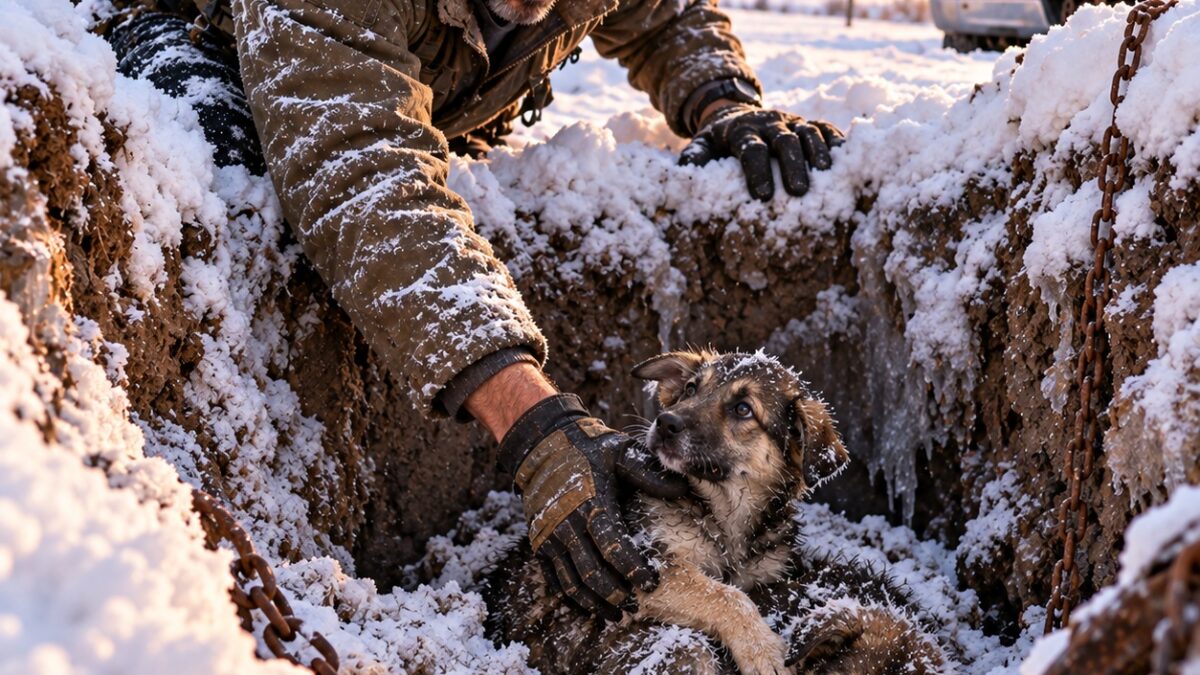
The Frozen Pit Where Two Puppies Found the Part of Me I Left Behind
I ONLY STOPPED BECAUSE I HEARD A WHIMPER UNDER THE WYOMING WIND, BUT THE SOUND THAT TRULY SCARED ME WAS THE CHAIN RATTLING IN MY TRUCK BED.
TWELVE FEET BELOW THE SNOW, ONE GERMAN SHEPHERD PUPPY WAS DYING, AND THE OTHER WAS SO COLD HE COULD BARELY STAND—BUT HE STILL PUT HIMSELF BETWEEN HER BODY AND ME.
I THOUGHT I WAS CLIMBING DOWN TO SAVE TWO ABANDONED DOGS, UNTIL THE ONE WHO WOULDN’T LET GO FORCED ME TO FACE THE ORDER I HAD SPENT FIFTEEN YEARS TRYING TO OUTRUN.
The first sound I heard was metal.
A loose length of chain struck the side of my truck bed with a flat, hollow clack as I rounded the last bend above Star Valley, and my hands tightened on the steering wheel before my mind caught up.
Chain.
Truck.
Wyoming.
Not then.
Not there.
The reaction lasted less than a second. Invisible, probably, to anyone who might have been watching from the road. That was one thing I had become good at over the years—making certain things look smaller than they were.
I eased my pickup onto the snowy shoulder and sat there a moment with the engine idling.
Late afternoon sunlight poured across the valley with almost painful brightness. The storm that had passed through that morning had left every field white and untouched, every fence post capped with snow, every cottonwood branch outlined in silver. Far beyond the ranches, the mountains rose blue beneath a clean winter sky.
Beautiful country.
I had always thought beautiful places were sometimes the worst at understanding what people carried through them.
At forty-eight, I still had the kind of body military engineering and heavy civilian work leave behind if a man keeps moving. Broad shoulders. Hard, economical build. Bad knees that only complained when the weather changed or when I lied to myself about how much something weighed. My ash-brown hair had gone silver at the temples, and a short boxed beard covered a face marked by a nose that had once been broken and never returned to center.
I stepped out into the cold wearing my faded woodland work blouse, the sleeves pushed below my forearms, dark olive work pants tucked into insulated brown boots powdered with road snow. On my left wrist, the old field watch caught the light.
I checked the truck bed.
Generator housing.
Tool cases.
Tow straps.
Steel jack.
Two lengths of chain under the canvas sheet.
One hook had worked loose on the drive back from the Mercer ranch.
“Of course,” I muttered.
Machines rarely surprised me.
That was one reason I preferred them.
A cracked belt had a reason. A dead starter had a reason. A frozen fuel line did not tell you it was fine and then lie awake for fifteen years asking whether thirty more seconds would have changed anything.
I tightened the chain.
The sound stopped.
I stood beside the truck for a moment, looking across the open field.
I had three invitations waiting at home.
One was to a veteran’s breakfast I had no intention of attending. Another was a note from a ranch family whose generator I had repaired, inviting me to Sunday supper. The third was from a neighbor who had written, Come over sometime. No occasion required.
That one bothered me most.
People understood refusing occasions.
Refusing kindness required more explanation.
I preferred work orders.
Fix this.
Replace that.
Tell me what I owe you.
Simple things.
I climbed halfway back into the cab.
Then I heard something.
I stopped.
The sound was so thin I almost mistook it for wind moving under the truck.
I waited.
Nothing.
I put one boot on the running board.
There.
A faint, broken whimper.
My head turned toward the field.
The snow beyond the roadside fence lay smooth except for several dark stalks of dead grass pushing through. Fifty yards away, a line of old irrigation equipment crossed the pasture toward a cluster of cottonwoods.
I listened again.
No sound.
I could have driven home.
The thought came clearly enough that I noticed it.
I had learned years ago that some choices announce themselves like commands, while others arrive quietly enough to be ignored.
Then the cry came again.
Small.
Weak.
Alive.
I closed the truck door.
Then I climbed the fence.
FULL STORY CONTINUATION
Snow reached halfway up my boots.
Beneath the bright surface was a crust formed by the morning freeze, and every step broke through with a crisp crunch. I followed the old irrigation line across the field. The pipe had not carried water in years. Rust stained the joints. A leaning warning post had faded until only fragments of lettering remained.
I stopped beside it.
Ahead, the ground appeared to end.
I approached carefully.
What looked from the road like a white depression was actually an abandoned concrete irrigation reservoir sunk into the field. The rectangular basin was maybe twelve feet deep, wide enough for a small truck to fit inside. Snow covered the rim. The inner walls were dark with old moss, frozen runoff, and years of neglect.
One section of upper concrete had collapsed inward, leaving a sloping shelf of dirt and stone.
I crouched.
“Hello?”
Nothing answered.
I moved closer to the edge and looked down.
For several seconds, my mind refused to arrange what I was seeing.
Then something moved.
Two German Shepherd puppies were huddled in the far corner.
They could not have been more than three months old.
One had a rich honey-tan coat beneath a dark saddle, though mud and melted snow dulled the colors. The puppy was standing, barely. Its legs trembled continuously. One ear rose almost straight while the other tipped outward as if it had not yet decided what adulthood required.
Behind him lay another puppy.
Smaller.
Paler.
Cream-gold coat, black along the muzzle and ears. She rested partly on old straw washed into the reservoir by weather. Her head lifted when I appeared, then lowered again.
The standing puppy immediately shifted sideways between me and the one on the ground.
I stared down at him.
“Easy.”
The puppy did not bark.
His thin body shook with cold, but he held his position.
I moved two feet along the rim.
He moved with me.
Not chasing.
Blocking.
“That’s what you’re doing.”
My voice sounded strange in the open field.
The standing puppy glanced down at the smaller one, touched his muzzle briefly against her face, then looked back up.
I saw enough.
The smaller puppy tried to shift position.
Her front paws moved.
One hind leg did not seem to help.
My jaw tightened.
I took out my phone and called 911.
The dispatcher transferred the animal component to county response while keeping the location active. I gave the road number, the nearest ranch marker, and my GPS coordinates.
“Two puppies,” I said. “German Shepherds. Bottom of an abandoned irrigation reservoir. Maybe twelve feet down.”
“Are they responsive?”
“One is standing, barely. The second one is lying down.”
“Visible bleeding?”
“No.”
“Any obvious entrapment?”
“Not that I can see.”
“Please don’t enter the structure if it isn’t safe.”
I looked at the concrete wall.
“I know.”
The dispatcher put me through to the county animal control contact already coordinating with road rescue. Because of the snow, the estimate was thirty-five minutes.
Maybe forty.
I looked down again.
The pale puppy had stopped trying to move.
“How long has the injured one been exposed?” the woman on the line asked.
“No idea.”
“Is she shivering?”
I watched carefully.
“Not much anymore.”
The woman became quieter.
“All right. That can mean she’s very cold. If you can do so without entering, block wind if possible. Don’t encourage her to stand. If there’s a possible fracture or spinal injury, unnecessary movement could make things worse.”
“Understood.”
“You have rescue equipment?”
I looked toward my truck.
“I have work equipment.”
“What kind?”
“Harness. Rated tow line. Locking carabiners. Soft equipment sling.”
“You use them professionally?”
“Yes.”
Another pause.
“We still recommend waiting for the responding team if conditions are unsafe.”
I understood why she had to say it.
I would have said the same thing.
“How long?” I asked.
“Thirty-five minutes is the current estimate.”
The darker puppy had lowered himself beside the pale one again. Not on top of her. Beside her. Close enough that their bodies touched. He tucked his head across her neck.
I watched his ribs moving fast.
Shallow.
I turned away from the reservoir.
“I’ll stay on the line.”
I walked back toward the truck.
For one moment, another landscape crossed behind the bright Wyoming snow.
Not fully.
Never fully.
A road from another life.
A vehicle stopped where it should not have stopped.
Radio voices stepping over one another.
A man trapped where I could not reach him without putting more people at risk.
I did not remember the worst details in pictures anymore.
I remembered the seconds.
That was what survived.
Seconds had no faces, no smell, no color.
They simply kept counting.
Move now.
Wait.
Hold.
Pull back.
Thirty seconds could live longer than a man.
I opened the truck bed.
My breathing remained controlled.
I removed the heavy recovery line first, then the work harness, two locking carabiners, and the soft sling I used when hoisting equipment that could not safely take a steel hook. I checked every piece, then checked them again.
That habit had followed me home from military service and never left.
The dispatcher was still speaking through the phone clipped near my collar.
“Mr. Reic, what are you doing?”
“Setting an anchor.”
“I need to remind you—”
“I heard you.”
My tone was not hostile.
Just certain.
I attached the rated line to the recovery point of the pickup, not the bumper. I backed the truck several feet until the angle toward the reservoir was clean, set the parking brake, placed wheel chocks from the toolbox, and tested the load with my full weight.
Nothing shifted.
I returned to the edge.
The darker puppy saw me.
His head came up.
The pale one did not.
I crouched.
For years, I had convinced myself hesitation was the thing I feared most—standing still while something disappeared beyond reach. But experience had taught me another truth I liked less.
Moving too fast could also be a form of fear.
I examined the wall.
The collapsed section gave me a reasonable descent route. Old maintenance brackets remained embedded in the concrete, but I ignored them. Rust did not deserve trust.
I clipped into my line.
“Mr. Reic,” the dispatcher said, “responders are on the way.”
“I know.”
“You don’t have to prove anything.”
My hand stopped on the carabiner.
The sentence reached deeper than she could possibly know.
I looked down into the reservoir.
“No,” I said quietly. “I don’t.”
Then I began descending.
My boots pressed into the snowy dirt of the collapsed section. One hand controlled the line while the other tested each foothold before committing weight. The basin grew larger around me. The sky became a bright rectangle overhead.
Halfway down, the darker puppy stood again.
His body shook violently now.
I stopped.
“Easy.”
The puppy’s ears flattened.
I descended another foot.
A weak growl came from below.
I almost smiled.
There was very little strength behind the warning, but the intention was unmistakable.
“You’ve got opinions.”
The growl came again.
I reached the bottom.
My boots touched frozen mud with a soft crunch.
I did not immediately approach.
The puppies were perhaps fifteen feet away. The darker one moved in front of his companion, legs spread for balance. He looked impossibly small from that close. Too small to be making a stand.
Too tired to win one.
Still making it.
I lowered myself slowly onto one knee.
No reaching.
No sudden movement.
I unclipped the empty sling and placed it beside me.
The puppy watched every motion.
I could hear his breathing now.
I could also hear the faint breath of the smaller dog behind him.
Above us, wind moved across the mouth of the reservoir.
Down there, the world felt strangely still.
I remembered another voice.
A younger man.
A radio channel.
Someone saying my name.
I pushed the memory away without fighting it.
Not now.
I looked at the small guardian standing between me and the pale puppy.
“All right,” I whispered.
The German Shepherd’s growl faded into a trembling breath.
I stayed exactly where I was.
“I see her.”
The puppy’s amber eyes never left me.
I swallowed.
“I’m not leaving her down here.”
The words were meant for the dog.
But the moment they entered the cold air, something inside me tightened so suddenly that I had to turn my face away.
Above me, Wyoming sunlight filled the snow with gold.
Below it, in the abandoned reservoir, I sat motionless before two frightened puppies and discovered that some promises could find wounds even when spoken to creatures too young to understand the words.
The darker puppy did not trust the sling.
I could not blame him.
It was a piece of faded blue fabric with reinforced straps, the sort of thing I normally used to cradle pumps or awkward machine parts that could not safely take a steel hook. Down there in the frozen reservoir, it probably looked like one more strange object in a world that had already become too large and too cold.
I stayed on one knee.
The puppy stood between me and the pale shepherd, trembling so hard his paws shifted against the frozen mud.
“All right,” I murmured. “We do this your way until we can’t.”
The dog watched me.
I moved only when his breathing eased.
First the sling.
Then one hand across the ground.
Then another pause.
I had spent much of my life believing efficiency meant reducing the number of steps between a problem and its solution.
Animals apparently had no respect for efficiency.
The darker puppy gave a weak warning sound when I came closer.
“I heard you.”
I stopped again.
Behind me, my phone lay on speaker near the wall. The county dispatcher was still connected. Somewhere above the reservoir, wind dragged powdery snow across the rim with a sound like dry paper.
The pale puppy lifted her head.
Her eyes were dark brown, almost chocolate, and far too tired for such a young face.
That did it.
I angled my body sideways, avoiding a direct approach. I let the darker puppy sniff the back of my gloved hand. He did once. Then again.
No friendship was declared.
No trust suddenly bloomed.
The dog simply decided, for the moment, not to spend the little strength he had left resisting.
“That’ll do.”
I carefully worked the sling beneath the injured puppy without forcing her hindquarters to move more than necessary. I supported her chest and hips with both forearms, keeping everything as level as I could.
The darker puppy immediately pressed closer.
His nose touched her ear.
Something tightened in my throat.
“Stay with me.”
I was not sure which dog I meant.
I clipped the sling to the line and called up to the dispatcher.
“I’m sending the weaker one first.”
“Responders are less than ten minutes out.”
“She doesn’t have ten good minutes.”
The woman on the other end paused.
“Keep her supported. Slow and steady.”
That was the plan.
I began lifting.
The line took weight.
The pale puppy rose several inches.
The darker shepherd panicked.
He lunged after her, scrambling beneath the sling as though sheer determination might keep her on the ground. A sharp cry escaped him.
“Easy.”
I lowered the sling immediately.
The puppy rushed to the pale one and pushed his muzzle beneath her neck.
I closed my eyes for half a heartbeat.
So that was the problem.
It was not the sling.
It was separation.
“All right,” I said. “You think I’m stealing her?”
The puppy stared at me.
“Fair assessment.”
I adjusted.
I shortened the line so the sling would move only a few feet at a time. Each time it rose, I allowed the darker puppy to follow beneath it until the wall prevented him from going farther.
Then I stopped.
The puppy stood with his front paws against the concrete, watching his companion ascend toward the rectangle of winter sky. His whining grew thin and desperate.
I put a hand against his shoulder.
The dog whipped around, not to bite, only to demand an explanation I could not give.
“She’s going up.”
The puppy looked toward the sling.
“I’m coming back.”
It was a ridiculous promise to make to an animal.
I made it anyway.
I guided the line until the sling reached the rim, where one of the first county responders had arrived and took control. The pale puppy disappeared over the edge.
The darker shepherd stared after her.
Then he turned on me.
For the first time, the weak growl vanished completely.
What remained on his face looked almost worse.
Confusion.
I knew something about that expression.
“I told you.”
I reached for the line.
“I’m going back up too.”
The second ascent was easier only because the puppy no longer fought me. I secured him separately in the sling, keeping one hand against his chest until the line tightened. The dog twisted his head toward the top.
“Yeah,” I said. “She’s there.”
The puppy went still.
I sent him up.
Then I climbed after him.
By the time my boots cleared the reservoir rim, three county vehicles had reached the field.
A woman in a forest-green insulated jacket was already kneeling beside the puppies. She was maybe mid-thirties, compact and steady, copper-red hair pulled into a low ponytail beneath a charcoal knit cap. Snow darkened one knee of her cargo pants where she had settled on the ground.
She did not crowd either dog.
That earned my attention immediately.
“Dawson Reic?” she asked.
I unclipped my harness.
“Yes.”
“Tessa Kincaid. County animal response.”
She nodded toward the pale puppy.
“You kept her stable coming up.”
“As much as I could.”
“Good.”
Not praise.
Assessment.
I liked her better for that.
The darker puppy had already pressed himself against the pale one again, chest touching shoulder. Tessa watched the movement.
“They came down together,” I said.
“So I see.”
Another responder unfolded a thermal blanket nearby. Tessa spoke softly before moving it into place, letting both dogs see what she was doing. The darker shepherd flinched but did not retreat.
“Protective,” I said.
“Attached,” Tessa corrected.
I glanced at her.
“There’s a difference?”
“Usually. Protection is what we call it when we think we understand motive. Attachment is what I can actually document.”
I almost smiled.
Almost.
They transported the dogs in the county animal response vehicle rather than my truck.
I followed.
I told myself I was going because Tessa still had my soft sling.
That explanation lasted about four miles.
The veterinary clinic sat near the edge of town beneath a blue-gray roof, its parking lot glowing under sodium lamps as daylight faded behind the mountains. Inside, warmth hit my face.
So did the smell.
Disinfectant.
Wet wool.
Coffee.
Animal fur.
A veterinary technician took the pale puppy first.
The darker shepherd immediately followed until the leash reached its limit. He pulled once, twice, then looked back at me as if I had arranged this betrayal personally.
“I know.”
Tessa glanced over.
“You talk to machinery too?”
“Machinery listens better.”
“Less judgment?”
“Usually.”
That earned a brief smile.
The darker puppy did not share it. He planted himself near the treatment room door.
The veterinarian came out several minutes later.
Dr. Laurel Finch did not enter the room with the brisk cheerfulness people use when they are trying to make bad news easier to swallow.
She simply appeared.
Forty-four, perhaps. Black hair cut into a slightly uneven bob. Silver beginning naturally at both temples. Hazel eyes behind thin rectangular glasses. Deep teal scrubs beneath a slate-gray utility jacket. A black stethoscope hung at her neck with a strip of yellow tape near the chestpiece.
She looked at me.
“You brought them in?”
“He found them,” Tessa said.
Laurel nodded once.
“The smaller one is very cold and dehydrated. We’re warming her gradually. Her left rear leg is badly injured, so we’re limiting movement until we know more.”
I glanced at the door.
“How bad?”
“I don’t know yet.”
I disliked the answer immediately.
Laurel noticed.
“That isn’t me being evasive.”
“I didn’t say it was.”
“You didn’t have to.”
Tessa folded her arms.
I looked between them.
“Is this a county habit?”
“What?”
“Everyone answering the part I didn’t say.”
Tessa shrugged.
“Occupational hazard.”
Laurel continued.
“The darker puppy is cold too, but much more stable. No major injury I can find on the initial exam.”
“Can they stay together?”
“When it’s medically safe.”
The darker puppy whined once from beside the door.
Laurel looked down at him.
“He has apparently submitted the same request.”
A technician brought out a handheld scanner.
No microchip registered on either dog.
No collar.
Tessa checked the county database from her phone. Nothing matching two young German Shepherds had been reported missing.
“That doesn’t mean they don’t belong to someone,” she said. “Legally, they go under emergency medical hold while we try to locate an owner.”
I nodded.
“How long?”
“That depends on county stray hold requirements and whether anyone makes a verified claim. For now, they’re under animal control.”
I glanced at the treatment room door again.
For now.
Another phrase I disliked.
Near nine that evening, a technician needed temporary names for the records.
Tessa stared at the intake form.
“Male, darker coat.”
The puppy lay against my boot now, though I had never invited him there.
Tessa looked toward the window. Beyond the glass, snow-covered cedar fencing bordered the clinic property.
“Cedar.”
Laurel glanced over.
“He doesn’t look like a Cedar.”
“What does a Cedar look like?”
“I don’t know. Taller.”
I looked down.
The puppy’s one half-confident ear had finally collapsed sideways with exhaustion.
“Cedar works.”
Tessa wrote it down.
“For the female?”
We all looked toward the treatment room. A narrow band of warm light showed beneath the door.
Laurel said, “Lumen.”
I frowned slightly.
“Meaning light?”
“Yes.”
Tessa wrote that too.
“You name all your patients poetically?” I asked.
“No. Last week, I named a terrier Gary.”
Cedar lifted his head at the sound of the new names, decided nothing relevant had happened, and put his chin back on my boot.
The X-rays came later.
Laurel showed me the images without dramatizing them.
“There’s a significant fracture in the left rear leg,” she said. “What concerns me more tonight is circulation below the injury.”
“Can you fix it?”
“Maybe.”
There was the word.
My shoulders became still.
Laurel tapped the screen.
“We need to get her temperature up, correct dehydration, manage pain, and watch the blood flow. Right now, making a big decision would be irresponsible.”
“Maybe means yes or no.”
“It means we don’t know yet.”
I stared at the bright bones on the screen.
I had heard uncertainty delivered through radios, briefings, weather reports, medical tents.
Maybe the route will clear.
Maybe they can reach him.
Maybe we have time.
Maybe.
A word people used when the future had not decided whether it intended to be merciful.
I looked away from the monitor.
“What do you need tonight?”
Laurel’s expression softened, but only slightly.
“Time.”
Of course.
Cedar was brought food just after midnight.
He sniffed it and turned away.
Tessa had gone back to finish county intake paperwork, leaving me with absolutely no official reason to remain.
Still, I sat in the waiting room.
One hour became two.
The receptionist turned off half the lights. Snow began falling again outside, soft and nearly vertical. Cedar paced from the door to me and back again.
At 1:30, Laurel emerged carrying a folded towel.
“She was lying on this during the exam.”
She placed it near Cedar’s food bowl.
The puppy stopped.
Sniffed.
His whole posture changed.
Not dramatically.
Just enough.
He lowered his nose to the towel, breathed in several times, then ate three bites. Paused. Sniffed again. Ate a little more.
I watched.
Laurel stood beside me.
“That’s encouraging.”
“He thinks she’s coming back.”
Laurel considered the puppy.
“Maybe he just knows she was here.”
I looked at her.
She seemed to realize what she had said.
“Sorry.”
“No,” I said, looking back at Cedar. “Accurate word.”
By dawn, Lumen was warmer and stable enough for continued monitoring.
Not better.
Stable.
I learned there was a difference.
The following days moved through phone calls, county forms, brief clinic visits, and weather reports.
No owner came forward.
No missing dog notice matched.
No photograph surfaced from a family searching desperately for two puppies.
When the required hold period expired, Tessa called me.
“You still interested in fostering?”
I was repairing a snowblower when the phone rang.
“I never said I was.”
“You filled out fourteen pages of foster paperwork.”
“Administrative curiosity.”
“Of course.”
A pause.
“Cedar can leave the clinic. Lumen can’t yet.”
My hand stopped on the wrench.
“How is she?”
“Stable. Laurel wants more monitoring before anyone talks about next steps.”
Next steps.
Another phrase.
“When for Cedar?”
“This afternoon.”
I looked through the workshop window at my house.
It had been built for one man and organized accordingly.
One chair at the kitchen table used regularly.
One mug drying beside the sink.
One set of boots by the door.
I had spent years making sure nothing waited for me.
Now something would.
“I’ll be there.”
Cedar entered my house at 4:17 that afternoon.
He inspected it badly.
He sniffed the kitchen, barked once at a floor vent, slid on the hallway rug, recovered with visible embarrassment, and then began searching.
Front room.
Kitchen.
Hallway.
Back door.
Again.
I understood before the dog returned to the entrance for the third time.
“She isn’t here.”
Cedar stared at me.
I set down the small bag of food Laurel had sent home.
The puppy paced again.
Then I remembered the towel.
I had brought it from the clinic in a sealed bag. I unfolded it beside the dog bed Tessa had insisted I take from county supplies.
Cedar came over immediately.
He sniffed the towel once.
Again, longer.
Then he turned twice and folded himself onto it, nose tucked against the fabric.
For the first time since entering the house, he stopped searching.
I stood in the middle of the room.
Outside, snow whispered against the windows.
Inside, the house contained another heartbeat.
I should have gone to bed.
Instead, I sat on the sofa with my boots still on.
Cedar opened one amber eye.
“I’m making sure you don’t destroy anything.”
The eye closed again.
I leaned back.
Neither of us believed me.
Somewhere across town, under warm clinic lights, Lumen was still being watched through the night.
And in my quiet house, a man and a young dog kept vigil without admitting that was what they were doing.
Forty-eight hours after Lumen had been pulled from the reservoir, the snow outside Laurel Finch’s clinic had hardened into a bright white crust.
Inside, nothing felt bright.
I sat in the same chair I had occupied two nights earlier, elbows on my knees, hands locked loosely between them. Cedar lay under the chair with his chin on my boot, no longer pacing the hallway, but still lifting his head whenever footsteps approached the treatment room.
The clinic had become a place of small sounds.
A printer waking.
A cabinet closing.
A dog shaking a collar somewhere down the hall.
The soft electronic pulse of equipment behind a closed door.
I had never liked rooms where important decisions arrived quietly.
Laurel came through the treatment room door carrying a tablet and a thin folder.
She did not say, “We need to talk.”
I appreciated that.
People only said those words when the conversation had already decided what it wanted from you.
She pulled a stool over and sat across from me.
“Tessa’s on her way,” she said. “I spoke with the orthopedic surgeon in Jackson again this morning.”
My fingers tightened once.
“And?”
Laurel turned the tablet toward me.
The images were gray, clean, almost abstract.
Bone.
Shadow.
Alignment.
A body reduced to structures a person could point at without touching the life attached to them.
Laurel enlarged one section.
“The fracture is serious, but the fracture itself isn’t the biggest problem anymore.”
I looked at her.
She continued evenly.
“The circulation below the injury hasn’t improved the way we hoped. We’re also getting very little response from the nerves in the lower part of the leg.”
I looked back at the screen.
“So what does that mean?”
“It means we can try to preserve the limb.”
I waited.
Laurel did not rush to soften the rest.
“It would likely mean multiple procedures, long recovery, strict confinement, and there’s still a strong chance the leg would never be functional.”
“But there is a chance.”
“Yes.”
There it was.
Chance.
A cousin of maybe.
I leaned back slowly.
“How strong?”
Laurel gave me the number.
It was not good.
I asked for it again.
She repeated it.
“What happens if it fails?”
“We reassess. But by then, Lumen may have gone through weeks of treatment for a result we already have reason to doubt.”
My jaw shifted.
“What’s the alternative?”
Laurel met my eyes.
“Removing the damaged leg.”
The room seemed to lose one degree of temperature.
Cedar raised his head beneath the chair.
I stared at Laurel.
She did not look away.
“You’re saying that’s the safer choice.”
“I’m saying it gives her the most reliable path toward a comfortable life. She’s three months old, which is part of why young dogs often adapt remarkably well.”
I stood.
Not violently.
Not suddenly enough to frighten Cedar.
I simply could no longer sit.
I crossed to the window. Outside, a snowplow passed on the road, yellow lights turning slowly in the pale morning.
“What if we wait another day?”
“We can wait a short period if her condition remains stable. But waiting won’t repair the nerve damage.”
“Another opinion.”
“You already have one.”
“Another one.”
“I can make that call.”
“Someone in Salt Lake.”
“If you want.”
“What about a specialist in Boise?”
Laurel was silent a moment.
Then she said, “I’ll call anyone whose answer will help you understand the situation.”
I turned.
“But I don’t think you’re searching for information anymore.”
The sentence landed cleanly.
My face hardened.
Laurel did not retreat from it.
“You think I’m being unreasonable.”
“No,” she said. “You think I already know the answer. I think you dislike the answer.”
Cedar crawled out from beneath the chair and sat between us, looking first at me, then at Laurel, as if disappointed in the direction of the meeting.
I exhaled through my nose.
“I don’t like giving up on something because the numbers are bad.”
Laurel’s expression changed.
Not softer.
More careful.
“This isn’t about whether the leg deserves to be saved.”
I said nothing.
“It’s about what gives the dog the best chance at a good life.”
I looked at the tablet again.
Laurel continued.
“You’re not deciding whether that leg matters. Of course it matters. You’re deciding whether keeping it matters more than her comfort, her mobility, and the rest of her life.”
Something old moved behind my ribs.
Not an image at first.
A number.
Seconds.
Then a road beneath a foreign sky.
A disabled vehicle at the end of a convoy.
A voice in a headset breaking apart beneath static.
Someone saying there was still time.
Someone else saying there was not.
My own voice giving an order I had replayed so many times that memory had worn the words smooth.
Move.
I blinked.
The clinic returned.
White walls.
Blue-gray light.
Cedar.
Laurel.
No dust.
No radio.
No man trapped in a place I could not safely reach.
I pressed one thumb against the scratched face of my field watch.
“I need a few hours.”
Laurel nodded.
“Take them.”
I looked at her.
“You’re not going to tell me I need to decide now.”
“If I needed you to decide now, I would tell you.”
That was why I trusted her.
Not because she made hard things easier.
Because she refused to make them theatrical.
Tessa arrived twenty minutes later carrying two rolled mats under one arm and a bag of hardware in the other.
“The county signed off on the treatment recommendation,” she said after hearing where things stood. “No owner came forward during the hold. Lumen stays under county foster authority for now, but if she’s going home with you afterward, we need the recovery setup ready.”
I looked at the mats.
“You brought supplies.”
“I brought things you were going to pretend you didn’t need.”
“I have floors.”
“You have hardwood.”
“I have rugs.”
“You have two rugs. One is large. It also slides.”
I took one of the mats from her.
“This is becoming very personal.”
“Safety often is.”
We drove back to my place separately.
The afternoon sky over Star Valley was an impossible blue, the kind that made winter look harmless. Sunlight flashed off the snowpack. The mountains stood sharp enough to seem carved from glass.
At my house, Cedar was left in the fenced kitchen area with water and a chew toy he ignored in favor of watching us work.
Tessa rolled the rubber-backed mats from the kitchen toward the living room.
I measured the space twice.
“You’re building a hospital wing?” she asked.
“I’m building something level.”
“She’ll need room to move.”
“She’ll have room.”
“She’ll also need you not to redesign the entire house around six square feet of dog.”
I marked a board with pencil.
“We’ll see.”
We worked nearly an hour.
No speeches.
No dramatic silences.
Just the dry rasp of a saw, the click of screws going into wood, the scrape of rubber flooring being aligned along the baseboard.
I preferred it that way.
Work gave people something useful to look at.
At one point, Tessa crouched to adjust the edge of a mat. Her cargo pant leg pulled slightly higher, and I noticed the carbon-fiber curve beneath it.
I looked away immediately.
Tessa kept working.
Five minutes passed.
Then ten.
We were fitting a low wooden barrier near the hallway when I finally said, “Can I ask you something?”
Tessa held the board steady.
“You just did.”
I gave her a flat look.
She almost smiled.
“Go ahead.”
I nodded briefly toward her left leg.
“If you’d rather I didn’t—”
“It’s fine.”
She adjusted her grip on the board.
“Climbing accident. I was twenty-seven.”
I waited.
She did not seem interested in telling the story unless I actually wanted the answer.
“So you lost it then?”
“Below the knee.”
“You still climb sometimes.”
That surprised me enough that she noticed.
“There,” Tessa said.
“What?”
“That look.”
“What look?”
“The one people get when they realize I didn’t stop existing after the accident.”
I looked down at the screw in my hand.
“I wasn’t thinking that.”
“Good.”
She shifted the board half an inch.
“Because that was the worst part. Not the injury. The way people looked at me afterward.”
I said nothing.
“Like the interesting part of my life had already happened.”
The drill hung loosely in my hand.
Tessa looked at the barrier.
“A little left.”
I moved it.
“No, your other left.”
“You’re enjoying this.”
“A little.”
We finished attaching the board.
No lesson followed.
No perfect sentence arranged itself between us.
Tessa stood, dusted sawdust from her jacket, and checked the mat seam with the toe of her boot.
“That’ll work.”
I looked across the room.
Cedar sat behind the gate, watching.
The house had changed shape in less than an afternoon.
Not much.
Just enough that it was clearly waiting for someone.
At 3:40, I drove back to the clinic.
I sat in my truck for a full minute before going inside.
Laurel was at the desk.
She looked up.
“You want the Salt Lake consultation?”
“No.”
“Boise?”
“No.”
She studied me.
I took off one glove.
“I want to know one thing.”
“All right.”
“If she were your dog?”
Laurel did not answer immediately.
That mattered.
“If she were mine,” she said, “I would remove the leg.”
I looked toward the treatment room.
Then nodded once.
Tessa had already arranged the county authorization. Laurel placed the caregiver consent and postoperative responsibility forms in front of me.
I read every line twice.
Then I signed.
The procedure took place that evening.
I did not wait in the treatment corridor.
I went home.
That surprised me.
A year earlier—or perhaps a week earlier—I would have convinced myself that staying in the building somehow counted as vigilance.
Instead, I fed Cedar.
I cleaned the tools Tessa and I had used that afternoon.
I checked my phone too often.
At 8:16 p.m., Laurel called.
“She’s awake.”
I closed my eyes.
“How did it go?”
“Cleanly. She’s stable.”
I leaned one hand against the kitchen counter.
“Good.”
“She’ll stay with us tonight. Maybe longer, depending on how she does.”
“Can Cedar see her tomorrow if she’s ready?”
Cedar stood at my feet, watching my face.
I ended the call.
“She’s here,” I told the puppy.
Cedar tilted his head.
“Still here.”
The next afternoon, Laurel approved a brief visit.
I brought Cedar into the clinic on leash. The young shepherd entered too quickly at first, then stopped the moment he saw Lumen resting on a padded blanket.
His entire body changed.
No pulling.
No whining.
He approached one careful step at a time.
I stayed back.
So did Laurel.
Lumen lifted her head. Her right ear bent slightly forward.
Cedar moved closer.
He sniffed her muzzle.
Her shoulder.
Her side.
Then he reached the place where her left rear leg was no longer there.
I stopped breathing.
Cedar sniffed once.
Then again.
He looked at Lumen.
Lumen looked back.
That was all.
Cedar leaned forward and gave one small lick to the edge of her ear. Then he circled carefully and lay down beside her.
Not across her.
Not guarding.
Just close.
Lumen lowered her head onto the blanket.
Within a minute, her eyes closed.
I stood outside the glass partition with Laurel beside me.
For days, I had been thinking about what Lumen had lost.
Cedar seemed entirely uninterested in the question.
The dog he loved was still there.
That was enough.
I looked at my own reflection faintly layered over the glass.
For years, I had measured certain moments only by what had not come home.
A man.
A decision.
A few seconds.
Parts of myself I had assumed were gone because they no longer resembled what existed before.
Inside the room, Cedar shifted closer to Lumen without waking her.
I watched them, and for the first time a different question entered the place where the old one had lived for years.
Not what could have been saved.
What was still here?
Lumen came home on a morning so bright the snow outside my house looked almost blue.
There was no dramatic arrival.
No triumphant music in anyone’s head.
No sudden burst of strength from a puppy determined to prove the world wrong.
There was only me carrying a padded transport crate through my front door while Cedar spun useless circles around my boots and nearly caused the entire operation to fail before it began.
“Move.”
Cedar moved directly into the wrong place.
“Other way.”
The young shepherd backed into the wall.
I stared at him.
Cedar sneezed.
From inside the crate came a faint movement.
Every foolish thing in the room stopped mattering.
I lowered the crate carefully onto the rubber-backed mats Tessa and I had laid across the living room. A low wooden barrier separated the recovery area from the hallway. Soft bedding covered one corner. Water sat in a shallow bowl that would not slide. The path from the crate to the back door contained no step, no loose rug, no polished section of floor.
I had measured everything twice.
Then the night before, I measured it again.
Laurel had given me written instructions.
Medication schedule.
Short assisted bathroom trips.
No rough play.
No jumping.
Watch appetite.
Watch fatigue.
Call if anything concerned me.
The last instruction annoyed me because almost everything concerned me.
I opened the crate.
Lumen remained inside.
Her cream-gold face appeared first, eyes moving across the room. Her right ear tipped slightly forward.
Cedar lowered himself immediately.
Front legs stretched along the mat.
For once, he did not rush her.
Lumen sniffed.
Cedar’s tail tapped the floor once.
Then again.
Lumen shifted forward.
Her body seemed to pause where the missing rear leg should have answered.
She corrected too late.
I reached out instinctively.
Laurel’s voice returned to me from the clinic.
Let her learn where she is now.
My hand stopped.
Lumen tipped sideways onto the blanket.
Cedar sprang up.
I pointed at him.
“Don’t.”
Cedar froze so completely he appeared offended.
Lumen lifted her head.
She looked at me.
Then at Cedar.
Then she tried again.
This time, she moved her front paws farther apart. Her remaining back leg pushed. She rose.
Three seconds.
Maybe four.
Then she sat down abruptly.
I realized I had been holding my breath.
“There you go.”
Lumen gave me a tired look suggesting I had contributed very little.
That first week taught me how little improvement resembled progress when watched up close.
One morning, Lumen crossed half the living room by herself.
That afternoon, she refused to leave her bed.
On Tuesday, she balanced long enough to drink without assistance.
On Wednesday, she became furious when I tried to adjust the blanket beneath her and turned her head sharply toward my hand.
I withdrew.
“Message received.”
She settled again.
Cedar, meanwhile, demonstrated no respect whatsoever for postoperative recovery.
He stole one of my wool socks.
He attempted to chew the corner of the wooden barrier.
He discovered that snow falling from the back porch rail could be attacked from below.
He carried a work glove through the kitchen with the solemn pride of a dog returning from a successful military campaign.
Twice, he forgot Lumen could not yet wrestle.
The second time, I intercepted him by the chest.
“No.”
Cedar looked past me toward Lumen.
Lumen looked back.
Cedar lowered himself dramatically to the floor.
“You’ll survive the injustice.”
His tail struck the mat.
Lumen’s eyes softened.
I began to suspect Cedar knew exactly how ridiculous he was.
The nights were harder.
Sometimes Lumen woke unsettled and made a small sound from the recovery area. I never rushed in. I had learned that too. I would switch on the low lamp, sit on the floor several feet away, and wait until she decided whether she wanted me closer.
Some nights she did.
Some nights Cedar reached her first and simply lay nearby.
Not pressed against her.
Not performing some impossible act of healing.
Present.
That was all.
I was beginning to understand that presence required more discipline than rescue.
Rescue had instructions.
Rope.
Anchor.
Lift.
Move.
Presence asked a man to remain useful when there was nothing to fix.
I was still learning.
A week after Lumen came home, a truck pulled into the driveway shortly after noon.
I recognized it before the engine stopped.
Evan Avery owned a cattle operation half a mile east and had been one of my customers for nearly six years. He was forty-two, broad through the middle and shoulders, with a thick mustache, weather-reddened cheeks, and the patient movements of a man who had spent most of his life around animals larger than himself.
He climbed out wearing his tobacco-brown canvas coat and faded olive cap.
A boy emerged from the passenger side carrying two short cedar boards.
I opened the workshop door.
“Lose a bet?”
Evan looked at the lumber in his son’s arms.
“Heard you were building a ramp.”
“I am.”
“Heard you were building it alone.”
“I was.”
“Then yes. Lost a bet.”
The boy lowered the boards near the porch.
“This is Milo,” Evan said.
Milo Avery was twelve, lean and long-limbed, with thick sandy-brown hair escaping beneath a mustard knit cap. Freckles crossed his nose. A navy puffer vest sat over a gray hoodie, and a small spiral notebook protruded from one pocket.
Milo lifted a hand.
“Hi.”
I nodded.
“Dawson.”
Evan looked at me.
“He knows.”
“I figured.”
Milo’s mouth twitched.
Good, I thought.
The boy could recognize bad conversation when he heard it.
Cedar exploded out of the house before I could block the door.
“Cedar.”
The dog skidded on packed snow, corrected himself, and charged directly toward Milo.
Milo stood still.
Cedar stopped inches away, sniffed both boots, inspected one knee, then attempted to steal the boy’s glove.
Milo laughed.
The sound came quickly enough to surprise all three humans.
Evan folded his arms.
“Well. Betrayal on first contact.”
Milo rescued the glove.
Then he saw Lumen.
She stood inside the open doorway behind the low barrier, body still thin from recovery, pale coat luminous against the darker room. She watched the visitors without moving.
Milo’s face changed.
Not pity.
Curiosity.
He approached only as far as I allowed.
“She’s the one?”
I nodded.
“Lumen.”
Milo crouched several feet away.
Lumen watched him.
The boy did not call her.
Did not slap his knees.
Did not reach through the barrier.
After a while, he simply sat in the snow on the porch boards.
Evan looked down.
“You’re getting wet.”
“I know.”
“That was not permission.”
Milo stayed where he was.
Evan sighed.
“Apparently, fatherhood has become ceremonial.”
They built the ramp that afternoon.
I had designed it wider than necessary, with a shallow incline and cross strips for traction. Evan held the frame steady while I drove screws. Milo measured boards and wrote numbers in his notebook.
“What’s that for?” I asked.
Milo glanced down.
“I forget things.”
“So does everyone.”
“I write them.”
“That puts you ahead of everyone.”
Milo considered this, then wrote something else.
I suspected it was not a measurement.
By the time we finished, the winter sun had dropped low enough to turn the snow peach-colored.
Lumen was brought to the doorway on leash.
She examined the ramp.
Then me.
Then the ramp again.
“Your engineering review is noted.”
She placed one front paw forward, then the other.
Her rear leg followed.
Halfway down, her balance shifted.
My hand moved.
Stopped.
Lumen corrected herself.
Evan noticed.
He said nothing.
Neither did I.
Lumen reached the bottom and stood in the snow.
Cedar immediately launched into a circle around her.
“Cedar.”
The dog stopped.
Lumen took three uncertain steps.
Cedar backed away.
That became their rhythm over the next two weeks.
Lumen advanced.
Cedar forgot.
I corrected Cedar.
Cedar remembered for approximately seven minutes.
Then Lumen improved enough to correct him herself by giving him a look so severe I nearly laughed.
Nearly became often.
Then one afternoon, it happened without permission.
Milo was sitting on my living room floor with a library book open across his knees. The book was about North American wildlife, chosen because, according to Milo, most dogs already knew enough about dogs.
Lumen lay beside him.
Cedar slept upside down near the stove, all dignity abandoned.
I was replacing a loose hinge on a cabinet across the room.
Milo read aloud.
Not for me.
For Lumen.
His voice moved carefully through the sentences.
Sometimes smoothly.
Sometimes catching.
Lumen did not care.
She had placed her chin on his knee and appeared more interested in the movement of the pages than the words.
“The gray wolf can tra—”
Milo stopped.
My screwdriver stopped too.
The boy tried again.
“Can travel?”
His face tightened.
I knew that moment.
Not the stutter.
The expectation surrounding it.
The terrible fraction of a second when another person could decide to help too quickly and turn difficulty into embarrassment.
The word was obvious.
I could finish it.
I almost did.
Then Lumen shifted.
She put a little more weight against Milo’s knee.
Nothing else.
Milo looked down at her.
His shoulders dropped.
He breathed.
“Travel more than thirty miles in a day.”
The sentence came out.
Milo turned the page.
I resumed tightening the hinge.
No one congratulated him.
No one exchanged a meaningful look.
Five minutes later, Cedar woke, stole the bookmark, and destroyed whatever solemnity the room might have developed.
Milo laughed so hard the next sentence took twice as long.
By then, I was laughing too.
A real laugh.
Short.
Rough from disuse.
But unmistakable.
I stopped with the screwdriver in my hand.
Evan, who had come to collect Milo and was standing near the door, looked at me.
I pointed the screwdriver.
“Say nothing.”
Evan raised both hands.
“Wouldn’t dream of it.”
The house seemed embarrassed by the noise.
It had been quiet too long.
By the end of the month, Lumen had learned the mathematics of her new body.
Not perfectly.
Never beautifully every time.
But well enough.
She knew where to place her front feet before turning. She knew how to sit without collapsing sideways. She knew which surfaces were trustworthy. She knew Cedar would always take the first three steps too fast.
The afternoon of her first real run came after fresh snow.
I opened the back door, expecting nothing more than their usual short exercise.
Cedar shot into the yard.
Lumen followed.
At first, I thought she was only moving quickly.
Then I saw it.
The change.
Her stride lengthened. Front paws reached. Rear leg drove. Her body found a rhythm no one had taught it.
She was running.
Not like Cedar.
Not like she might once have run.
Like herself.
Cedar was already ten yards ahead when he finally noticed.
He stopped.
Snow powdered his dark muzzle.
He turned.
Lumen stumbled.
Her chest touched the snow.
I stepped off the porch.
Lumen was already rising.
I stopped.
Cedar did not race back.
He simply stood there waiting.
Lumen shook snow from her face and started again.
Three legs.
Uneven rhythm.
Head forward.
Cedar remained where he was until she reached him.
Then they ran together.
Slower this time.
From the porch, I watched their tracks cross the white yard—one set long and careless, the other shorter, deeper, deliberate.
For most of my life, loyalty had meant going back.
Carrying someone.
Refusing to leave.
Dragging weight until there was nothing left in your hands.
But Cedar offered another version.
He could have run farther.
He simply chose not to.
I rested one hand on the porch rail.
Across the yard, Cedar looked back again.
Lumen was already beside him.
And I understood quietly that sometimes staying loyal does not mean carrying someone where they can no longer go.
Sometimes it means refusing to travel so far ahead that they have to make the journey alone.
The first sign that my life had changed was not the dogs.
It was the second coffee mug.
For years, one dark ceramic cup had lived beside the sink. I washed it every evening, turned it upside down on a folded towel, and reached for it again before sunrise.
Now a blue mug sat beside it.
Evan Avery had brought it over one morning after helping clear snow from the ramp.
“Your coffee tastes like axle grease,” he had said.
I looked into my own cup.
Then stopped drinking it.
Evan took another swallow.
“I can’t. I’m invested now.”
The blue mug stayed.
So did Evan.
Not every day.
Not long enough to become an obligation.
But sometimes, after checking cattle or dropping off a part I had ordered, he stepped through the kitchen door instead of conducting the entire conversation from the yard.
That difference was small enough that I could pretend not to notice it.
Small things were becoming difficult to ignore.
Milo came with his father most weekends.
The boy appointed himself unofficial keeper of the porch ramp. Whenever fresh snow fell, he cleared it before Cedar could turn the loose powder into a battlefield.
Cedar considered snow removal a personal attack on his interests.
The moment Milo pushed a clean strip down the center of the ramp, the young shepherd raced across it, plunged chest-first into the snowbank beside the porch, and emerged with white powder packed across his muzzle.
Milo laughed.
“You ruined it.”
Cedar sneezed on him.
“Good argument,” I said from the workshop door.
Milo began spending more time in the workshop too.
At first, he stood just inside the entrance, hands in his pockets, eyes moving over the pegboard of wrenches and sockets as though he had entered a museum where touching the exhibits might trigger an alarm.
Eventually, I put a spark plug in his hand.
“What’s this?”
Milo turned it over.
“Spark plug?”
“That was the easy question.”
The boy glanced up.
I pointed toward an old portable generator on the bench.
“What does it do?”
Milo started an answer, caught on the first syllable, then stopped.
I waited.
Milo tried again.
“It makes the spark that ignites the fuel mixture.”
“Better.”
“You knew I knew.”
“Knowing something and explaining it are different jobs.”
Milo studied the plug again.
“Which one’s harder?”
“Depends who’s listening.”
Milo smiled.
Over the next few weeks, I taught him how to identify a stripped screw before destroying it completely, how to clean corrosion from a battery terminal, and why forcing a bolt was often the fastest route to spending the rest of an afternoon regretting yourself.
Milo wrote everything in his navy spiral notebook.
Cedar stole the notebook once.
That lesson was recorded too.
DO NOT LEAVE PAPER NEAR CEDAR.
Lumen’s progress continued without ceremony.
She could now move through the house without me monitoring every step. Her three-legged gait had become efficient. Not smooth, exactly, but confident enough that visitors stopped watching for the moment she might fall.
Laurel Finch came by twice for home follow-ups because the drive and clinic floor still tired Lumen more than necessary.
On the second visit, Laurel was kneeling beside Lumen near the living room window when Cedar walked behind me and removed one of the tan work gloves from my back pocket.
I felt the tug.
Turned.
Cedar froze with half the glove hanging from his mouth.
Laurel looked up.
“Evidence is overwhelming.”
“Drop it.”
Cedar backed away.
“That is the opposite of drop it.”
Laurel checked Lumen’s remaining rear leg while Cedar retreated under the kitchen table with the glove.
“You’ve trained him well.”
“I’ve trained tractors. Results seem similar.”
I pointed toward the table.
“Traitors, both of you.”
Lumen rested her chin on Laurel’s knee, entirely unwilling to defend me.
The house made more sounds now.
Coffee spoons.
Boots by the door.
Milo turning pages.
Evan complaining about the weather as though Wyoming had personally violated a contract.
Cedar’s nails skidding across the kitchen when he took corners too fast.
Lumen’s softer, uneven rhythm following behind.
I had once known every sound in my home because there had been so few.
Now I occasionally had to ask what had fallen.
I was learning not to mind.
The adoption papers arrived on a Thursday.
Tessa Kincaid brought them herself, standing at my kitchen counter in her forest-green jacket, county folder opened between us. Cedar sat near her boots wearing an expression of intense administrative concern. Lumen lay on the rug in a patch of sunlight.
“The hold is cleared,” Tessa said. “No verified owner claim. No microchip record. County signed the release. You’re eligible to finalize both adoptions today.”
I picked up the pen.
Tessa pushed the packet toward me.
“You should read that.”
“I did.”
She watched me sign the first marked line.
“When?”
“Last night.”
I signed the second.
“How many times?”
I turned a page.
“Three.”
Tessa blinked.
“You emailed it at 6:30.”
“I was awake.”
“I’m beginning to think you were designed in a government facility.”
“Poor funding.”
For half a second, Tessa stared at me.
Then she laughed.
It was not the first time I had said something funny.
It was the first time I had done it without hiding the joke inside irritation.
I noticed that too, which annoyed me.
Tessa collected the forms.
“All right. Officially, they’re yours.”
I looked toward the dogs.
Cedar was chewing the edge of a cardboard box.
Lumen was watching a dust particle drift through the sunbeam.
“They seem unimpressed.”
“Give them time. Legal status is emotionally complex.”
I folded my arms.
“Are you finished?”
“Completely.”
Tessa reached the door, then turned.
“Congratulations.”
I almost told her not to make it into something.
Instead, I said, “Thanks.”
The word remained in the room after she left.
Not heavy.
Just new.
Three days later, winter reminded me that new things did not erase old ones.
I was alone in the workshop after lunch. Evan had gone to town. Milo was in school. Cedar and Lumen were inside the house, separated from the machinery by the closed connecting door.
I was replacing the tension spring on a snowblower when a steel chain slipped from a wall hook.
It struck the concrete floor.
The sound was not particularly loud.
That did not matter.
For an instant, the workshop disappeared.
My hands went cold.
Not physically.
Something deeper than temperature.
My breathing shortened before I had decided to breathe differently.
The floor under my boots seemed to move farther away.
A road.
A radio.
Metal somewhere it should not be.
No.
I stared at the workbench.
I knew where I was.
Knowledge arrived first.
My body remained somewhere else.
From the next room, Cedar barked once.
Then again.
Not frantic.
Just loud enough to enter the silence.
I closed my eyes.
“No.”
Opened them again.
“Eyes open. Here.”
I forced myself to name what I could see.
“Red vise.”
My voice sounded thin.
“Yellow extension cord.”
The chain lay on the concrete.
I did not look at it yet.
“Green toolbox.”
My fingers pressed against the edge of the workbench.
“Cold steel. Solid. White door.”
Cedar scratched once from the other side.
“Black heater. Five.”
I drew breath through my nose.
Held it.
Let it out slowly again.
My boots.
Concrete beneath them.
The smell of motor oil.
Sunlight through the high window.
“Workshop. Star Valley. Wyoming.”
Now the memory tried once more to open.
I did not slam it shut.
I let it remain a door without walking through.
My breathing lengthened.
The room came back to its proper size.
I looked at the fallen chain.
Nothing moved.
Nothing needed to be rescued.
No one was waiting for an order.
The chain was simply a chain.
I bent and picked it up.
My hand shook once.
I hung it back on the hook.
Then I stood there another minute before returning to the snowblower.
That was the part nobody would have put in a story about recovery.
I did not feel victorious.
I felt tired.
When I opened the connecting door, Cedar rushed into the workshop, inspected me, inspected the floor, then shoved his nose into my thigh.
Lumen appeared behind him.
She stopped at the threshold, looked at me, then turned around and walked back toward the living room.
I stared after her.
“Helpful.”
Cedar sat on my boot.
Lumen did not return, and somehow that helped more.
No animal sensed the hidden wound and performed a miracle.
No one rescued me from myself.
The moment had passed because I had stayed inside it long enough to find the exit.
That evening, Evan stopped by with a fuel filter.
He placed it on the workbench.
“Wrong size.”
“Right one.”
“That’s disappointing. I was ready to blame the supplier.”
I took the filter.
Evan started toward the door.
Normally, that would have been the end of it.
I looked at the chain on the wall.
“Coffee?”
Evan stopped.
He turned slowly.
I pointed at him.
“Don’t.”
“I didn’t say anything.”
“You were about to.”
“I was thinking loudly.”
We went inside.
Cedar immediately stole one of Evan’s gloves and fled down the hallway.
Evan watched him go.
“You know, I’m starting to believe this is your fault.”
“Your hand was inside it. Poor security.”
Evan sat at the kitchen table.
I poured coffee into the blue mug.
We talked first about machines.
Then weather.
Then Milo, who had apparently attempted to repair the latch on the Avery chicken coop without permission and improved it so completely that Evan could no longer open the door.
Eventually, the conversation went quiet.
Not uncomfortable.
Just empty for a moment.
I looked at my coffee.
“Something happened today.”
Evan waited.
I disliked him for being good at that.
“A chain fell in the shop.”
Evan glanced toward the workshop door.
“Hit you?”
“No.”
Another pause.
I ran one thumb along the edge of my mug.
“Sometimes sounds do something.”
Evan said nothing.
“They get in before I know what they are.”
I could feel the sentence trying to become smaller.
I made myself leave it alone.
“Old sounds,” I added. “They still find their way in sometimes.”
Evan’s expression did not change into sympathy.
I was grateful.
“You okay now?”
“Yes.”
“Need anything?”
The automatic answer rose immediately.
No.
It had served me for years.
No, I’m fine.
No, don’t come over.
No, I can handle it.
No, nothing happened.
I looked across the table.
“I don’t know.”
Evan nodded as though that were a complete answer.
Then he drank his coffee.
After a while, he said, “Next time, call.”
I gave a short, humorless breath.
“For what?”
“I don’t know. Coffee. Help. Someone to stand around and criticize your generator maintenance.”
“I don’t need help with generator maintenance.”
“See? We already have a plan.”
I looked down.
Evan’s voice stayed casual.
“You don’t have to explain the sound to me. Just don’t decide I’m not allowed through the door before I get here.”
The kitchen went very quiet.
From the hallway came a muffled tearing noise.
Both men turned.
“Cedar,” I called.
Silence.
Evan stood.
“That’s never good.”
We found Cedar in the living room with the stolen glove and a piece of packing paper he had somehow obtained from beneath the side table. Lumen lay nearby, watching with the weary patience of someone who had accepted that intelligence was distributed unevenly across the household.
Evan rescued his glove.
I picked up the paper.
Cedar wagged his tail.
“You’re a criminal.”
The dog sneezed.
Later, after Evan left, I stood at the front door.
Snow had begun again.
Fine flakes moved through the porch light and disappeared into darkness.
For years, the door had been one of the simplest objects in my life.
Closed meant quiet.
Locked meant control.
No surprise visitors.
No expectations.
No one close enough to notice when a dropped chain became something else.
Behind me, Cedar and Lumen settled near the stove.
The blue mug remained beside my own on the drying towel.
I reached for the deadbolt.
My hand stopped.
Not because I was afraid to lock the house.
Because I suddenly understood that safety and isolation were not the same thing.
I turned the lock.
Then I left the porch light on.
Not an invitation to the whole world.
Just enough light for the people who already knew the road.
The storm arrived before dark.
By four in the afternoon, Star Valley had disappeared behind moving white. Snow crossed the field sideways, erased fence lines, buried tire tracks almost as quickly as they appeared, and turned the mountains into something that existed only in memory.
I knew the power was failing before my phone rang.
The lights over the workbench flickered twice.
The compressor went silent.
Then the house dropped into darkness.
A second later, my small automatic backup system caught and warm amber light returned to the kitchen.
Cedar barked at the ceiling.
Lumen did not.
She was stretched near the stove, three legs folded beneath her, watching Cedar with the calm disappointment of a creature accustomed to his opinions.
I looked toward the window.
“Not our problem.”
My phone rang.
Tessa Kincaid.
I stared at the screen.
Cedar stared at me.
“Don’t.”
Cedar tilted his head.
I answered.
“What failed?”
Tessa skipped hello.
“How did you know something failed?”
“You don’t call me during a blizzard to discuss county paperwork.”
Wind battered her end of the connection.
“We lost power at the temporary foster facility twenty minutes ago. The building’s standby generator started, ran maybe thirty seconds, then shut itself down. Controller fault. Display is dead.”
“Fuel?”
“Full tank.”
“Breaker?”
“Checked.”
I rubbed one hand across my beard.
“How cold inside?”
“Dropping.”
“What animals?”
“Four senior dogs, three recovering cats, two litters of young kittens. Nothing critical on powered medical support. But we need heat.”
I looked toward my workshop.
Against the far wall sat a trailer-mounted diesel generator I used during winter outages on ranch properties. Larger than anything I normally needed at home. Serviced two weeks ago. Compatible with the county building’s emergency connection if their inlet was what I remembered.
“You still have the transfer inlet on the south wall?”
“Yes.”
“Manual transfer?”
“Yes.”
“Rated?”
Tessa gave me the number.
I closed my eyes.
Of course it would work.
I had wanted one reason to say no.
Instead, the problem had arrived already shaped like my hands.
“I can bring a unit.”
Tessa exhaled.
“Thank you.”
“I didn’t say when.”
I looked outside.
The road between my house and the foster facility crossed the old steel bridge over the Salt River. There were other routes.
Not tonight.
The northern county road would be nearly impassable by now, and the southern detour added almost forty miles through open country.
The bridge was the road.
I could already hear it without being there.
Tire chains striking frozen deck joints.
Metal repeating beneath the chassis.
Sound traveling through steel.
Old sound wearing new clothes.
“How bad is the bridge?” I asked.
“Plows went through an hour ago.”
“That wasn’t the question.”
Tessa became quiet.
She knew.
“Passable,” she said. “Slow, but passable.”
I stared through the kitchen doorway at the two dogs.
“All right.”
When Evan Avery arrived twenty minutes later, he brought Milo and enough food to suggest he was preparing for a siege.
“You own groceries,” I said.
Evan set two bags on the counter.
“I don’t trust your definition of groceries.”
“I have food.”
“You have coffee, canned chili, and six eggs.”
“Seven.”
“I rest my case.”
Milo was already on the floor between Cedar and Lumen, his mustard knit cap still on his head. Cedar shoved his nose beneath the boy’s arm while Lumen inspected one of the grocery bags from a respectful distance.
“You’ll stay here until I get back,” I said.
Evan glanced toward the storm.
“Was planning on it.”
“The generator here will keep the heat running. If it alarms, call me. If you can’t reach me, shut nothing down unless there’s an actual problem and call the utility.”
Evan looked at me.
He spread his hands.
“You’ve explained this seventeen times.”
“Six.”
“Felt like seventeen.”
I pulled on my gloves.
One slipped from my hand and landed near the doorway.
I bent to retrieve it.
Cedar got there first.
The young shepherd picked it up, walked three steps, and dropped it directly against my boot.
Milo smiled.
I looked at the glove.
Then at Cedar.
No one said the dog knew what was happening.
No one called it instinct, fate, or a sign.
Cedar had a long history of stealing gloves.
This time, apparently, he had returned one.
I picked it up.
“Your criminal record remains intact.”
Cedar wagged.
I put the glove on and went into the storm.
The generator trailer pulled heavily behind the truck.
Visibility came and went in waves. Snow swept across the headlights so quickly it seemed the vehicle was driving into a river of white insects. I kept both hands on the wheel.
Twenty-five miles an hour.
Then twenty.
Road marker.
Fence reflector.
Curve.
I did not think about the bridge.
That lasted eleven minutes.
The structure emerged through blowing snow as a dark geometry of beams and trusses. The Salt River beneath it was mostly hidden beneath ice and darkness.
I slowed.
My tire chains contacted the first steel expansion joint.
Clang.
My shoulders tightened.
The next joint came beneath me.
Clang.
Then the chains began their repeating rhythm under the truck.
Steel against steel.
Hard.
Regular.
Too familiar.
The bridge amplified everything, throwing each sound beneath the floor and back through the seat.
My grip tightened.
Not there.
Bridge.
Wyoming.
Storm.
The truck drifted slightly toward the center line.
I corrected.
Another joint passed beneath me.
The sound opened a narrow door in memory.
I saw nothing clearly.
That was worse.
Static.
Movement.
A command forming before I wanted to give it.
I pressed my palm hard against the steering wheel.
“Bridge.”
My voice sounded swallowed by the cab.
“Salt River.”
The tires rolled over another seam.
“Wyoming.”
Snow struck the windshield.
The far end of the bridge existed somewhere ahead.
I did not accelerate.
I did not flee the sound.
I held twenty miles an hour and let each section of steel arrive when it arrived.
One.
Then another.
Then the truck crossed onto asphalt.
The sound changed instantly.
Muted rubber.
Snow.
Engine.
I drove another quarter mile before realizing my jaw hurt from clenching it.
I loosened it.
Nothing triumphant happened.
I simply kept driving.
The temporary foster facility had once been a county maintenance annex, a low concrete building with a newer insulated kennel wing added behind it. Tonight, portable work lights glowed near the entrance from battery packs. Tessa stood outside in her forest-green jacket, snow collecting on her shoulders.
“You made good time.”
“I made time.”
She looked at my face.
I began unhitching the safety chains.
“Don’t.”
“I didn’t say anything.”
“You were about to.”
Tessa smiled faintly.
“That phrase is becoming very popular around you.”
Inside, the temperature had already fallen enough that staff had moved smaller animals into an interior room. Blankets covered several kennels. A gray senior hound watched me enter without lifting his head. Somewhere behind a closed door, kittens made thin, questioning sounds.
No panic.
That helped.
Problems were easier when everyone stopped trying to turn them into emergencies larger than they already were.
I inspected the failed standby generator first.
The controller had lost power internally.
“Not fixing this tonight.”
“Can we bypass it?” Tessa asked.
“We don’t need to. The building’s transfer equipment is intact. That’s what matters.”
With the main supply isolated through the facility’s existing transfer system, I positioned the towable generator outside beneath the sheltered service area. I checked the connection, then the output before allowing any load onto the building.
Tessa stood beside the electrical panel with a clipboard.
“Heat first,” I said. “Kennel wing and interior recovery room. Water heater waits. Laundry definitely waits.”
“You’ve never smelled twelve foster blankets after six hours.”
“Still waits.”
The generator started with a low diesel rumble.
I watched the instrument settle.
Voltage steady.
Frequency steady.
I nodded.
“Give me the kennel heat.”
Tessa switched the first load.
The engine changed tone slightly.
Held.
Then the second heating zone.
Held.
Lights returned down the kennel corridor one row at a time. Not bright lights, just ordinary ceiling fixtures.
But in the storm-darkened building, they looked almost golden.
One of the older dogs lifted its head.
Tessa exhaled.
“Interior temperatures climbing.”
“Good.”
We spent the next hour checking circuits, limiting unnecessary loads, and making sure the generator was running within capacity. The work was familiar enough that I stopped thinking about the bridge.
That was when the second sound came.
A maintenance worker had been moving a shallow steel equipment tray from a shelf. One corner slipped. The tray struck the concrete floor.
The crash lasted perhaps half a second.
I stopped.
The wrench remained in my hand.
Tessa was saying something.
I could see her mouth move.
Sound had gone somewhere else.
The room narrowed.
Not completely.
Enough.
My hand became cold around the wrench. The generator’s steady vibration changed in my ears until it almost became another machine from another place.
I knew what was happening.
That did not stop it.
The blue service door stood twenty feet away.
I stared at it.
Blue door.
My breathing shortened.
Tessa saw me.
She did not approach.
That mattered.
She did not say my name repeatedly.
Did not reach for my arm.
Did not ask whether I was okay when the answer was obviously complicated.
She simply stood several steps away.
I swallowed.
“Give me—”
The first attempt failed.
I tried again.
“Give me a minute.”
Tessa nodded.
“All right.”
Nothing else.
I looked at the door.
“Blue.”
I did not care whether Tessa heard me.
My left hand rested on the edge of the workbench.
I looked at it.
“Glove. Brown leather. My own hand inside it.”
A yellow electrical cable crossed the floor toward the wall.
“Yellow.”
Beyond the small window, snow moved through the security light.
“White. Fast. Here.”
I looked at Tessa.
“Forest green jacket. Copper hair under cap.”
Here, the generator vibrated through the floor.
Different machine.
Different night.
I pressed my boots against the concrete.
“Star Valley. Wyoming. County Foster Facility. Winter. Now.”
My breathing slowly lengthened.
The room widened.
The generator became a generator again.
The tray on the floor was only a tray.
Tessa waited thirty seconds.
Forty.
Perhaps a minute.
I looked down at the wrench still in my hand. I bent, picked up the fallen tray, and placed it on the bench.
Then I looked toward the panel.
“What’s the load?”
Tessa checked the meter.
“Sixty-one percent.”
“Good.”
“Want another minute?”
I considered it.
“No.”
I pointed toward the recovery wing.
“Bring the third heating zone online. Leave laundry off.”
Tessa did.
The generator took the additional load without complaint.
We continued.
No one mentioned what had happened.
Near midnight, the storm was still moving across Star Valley, but the kennel building had warmed several degrees. The senior hound slept beneath a clean blanket. The kittens had stopped calling. Condensation had begun to disappear from the inside corners of the windows.
I stood near the service door, drinking coffee from a paper cup that tasted worse than my own.
Tessa joined me.
“The bridge will still be there when you go home.”
“I know.”
“You want me to find another route?”
“No.”
She looked out into the snow.
I expected her to say something about courage.
Progress.
Facing things.
She did not.
Instead, she said, “The county coffee budget is criminal.”
I looked into my cup.
“Finally, something we can agree on.”
We stood there listening to the generator.
The sound was low.
Steady.
Useful.
Behind us, ordinary lights remained on over ordinary kennels.
There had been no miracle.
I had not defeated the past.
The past had found me twice that night. Once on the bridge. Once on a concrete floor.
Both times, it had been convincing.
Both times, I had known the way back.
That was different.
For years, I had believed healing would mean reaching some future day when the old road could no longer find me.
Standing in the warm kennel corridor while snow struck the windows, I began to understand that perhaps there was no such day.
Perhaps progress was smaller.
Less impressive.
More useful.
The road might still appear.
The sounds might still open the door.
What mattered was that I was beginning to remember where the return path was.
And tonight, when something living had needed me on the other side of the storm, I had taken it.
By the following autumn, I had stopped counting how many people knew where my spare key was.
That would have bothered me once.
Now it mostly meant someone had forgotten a drill bit.
The detached storage building behind my workshop had spent twelve years holding old tractor tires, cracked irrigation pipe, obsolete engine housings, and several boxes I had moved from one house to another without opening.
By October, nearly all of it was gone.
In its place stood six insulated kennel runs, a washable floor, separate ventilation, a small isolation room, a utility sink, locked storage for medication, and a low ramp leading to the enclosed yard.
A backup generator sat beneath a weather cover outside.
I had tested it eleven times.
Tessa said five would have been enough.
I told her five was a recreational number.
She stopped asking.
The project had not begun with a grand announcement. It started with a county meeting after the winter storm, then another meeting, then permits. A local rescue nonprofit offered funding for materials if animal control approved the site. Laurel submitted a list of medical requirements long enough to make me suspect she had developed a personal grudge against bare plywood. Tessa built the intake procedures. Evan helped frame interior walls. Milo painted labels and letters far larger than necessary.
ISOLATION.
SUPPLIES.
CLEAN BLANKETS.
Cedar added one muddy paw print to the bottom of the last sign.
Milo refused to paint over it.
“Historical record,” he said.
I looked at the mark.
“Vandalism.”
“History is mostly vandalism that gets old enough.”
Evan slowly turned toward his son.
I lowered my hammer.
“Did you teach him that?”
“No.”
“That’s concerning.”
Milo smiled and returned to painting.
Lumen slept in the doorway while we worked.
She was nearly grown now, her cream-gold coat fuller across the shoulders, her movement so practiced that strangers often watched several seconds before noticing she had only three legs. That did not mean she had no limits. After twenty minutes of play, she usually rested. Deep snow tired her quickly. Ice required caution.
Laurel had warned me against allowing admiration to become carelessness.
“She’s adapted,” Laurel had said. “She hasn’t become indestructible.”
I understood that better than I once would have.
Cedar, by contrast, appeared convinced that durability was a moral obligation. He had grown into a large honey shepherd with a dark saddle and one ear whose tip still leaned slightly outward.
He ran as if every open field had been specifically constructed for him.
He also retained his oldest habit.
Run ahead.
Stop.
Look back.
Wait.
At first, I believed Cedar did it only for Lumen.
Eventually, I noticed he did it for Milo too.
And once, embarrassingly, for me.
Nobody mentioned that.
Winter returned slowly.
The first frost silvered the pasture. Then the creek edges hardened. Then a morning came when I opened the kitchen door and found the world covered in the season’s first clean snow.
Cedar launched through it.
Lumen followed at a more sensible pace.
I remained on the porch holding coffee.
I had slept badly.
Not disastrously.
Just badly.
A metallic sound from the workshop around two in the morning had woken me, and afterward sleep had returned in short fragments.
That still happened.
Some nights, old memories arrived with no invitation at all.
I no longer treated those nights as evidence that I had failed at recovery.
I drank coffee.
Worked more slowly.
Told Evan when I was tired enough to make mistakes.
Life had become less dramatic and considerably more honest.
Tessa still occasionally shifted weight off her left side after long days, pretending nobody noticed. Laurel still reminded everyone that veterinary instructions were not suggestions. Milo still caught on words, sometimes badly. He no longer apologized afterward.
No one had been repaired into perfection.
The word had lost much of its appeal.
At 9:20 that morning, a county animal control truck came down my driveway.
Tessa stepped out first.
An officer opened the rear compartment.
Inside was an old German Shepherd.
Gray had overtaken most of his muzzle. His coat was heavy, black along the back and faded tan along the legs. One ear stood upright. The other folded near the tip.
He did not come forward.
Tessa closed the vehicle door again.
“Owner died last week,” she said. “Family’s out of state. Nobody can take him.”
“Name?”
“Otis.”
I looked toward the truck.
“Medical?”
“Basic exam done. Older joints. Underweight. Nothing urgent. He’s just shut down.”
Laurel’s car arrived three minutes later.
I looked at Tessa.
“You planned this.”
“I coordinated it.”
“Same crime. Better paperwork.”
Laurel stepped out carrying her medical bag.
“I heard that.”
“You were meant to.”
It took nearly fifteen minutes to move Otis from the transport vehicle to the warming facility.
No one pulled him.
No one filled the air with encouragement.
Tessa opened the path.
Laurel remained to one side.
I crouched at a distance.
Eventually, the old shepherd stepped down.
Then stopped.
Snow fell around him in slow, dry flakes.
Cedar watched from behind the yard fence.
Lumen sat beside him.
Neither dog barked.
Otis looked toward them once, then toward the open kennel building.
He walked inside.
That was all the victory we were given.
He chose the farthest corner of the first kennel and stayed there.
Laurel completed what examination he would tolerate without unnecessary pressure. Tessa recorded his intake information. I brought in a folded blanket.
When I approached, Otis shifted farther back.
I stopped.
An older version of me might have felt compelled to solve that.
Win trust.
Prove safety.
Get the dog to take food from my hand before sunset.
I understood now how often urgency belonged to the rescuer rather than the one being rescued.
I placed the blanket halfway between the kennel entrance and the corner.
Then the water bowl farther away so Otis would not have to pass close to anyone to reach it.
I backed out.
Tessa watched.
“That’s it?”
“That’s it.”
“You’re not going to sit there for four hours?”
“No.”
She looked impressed.
I frowned.
“I’m capable of growth.”
“Documenting that for the county.”
I shut the kennel gate gently.
Several feet outside, Lumen lowered herself onto a mat.
I had not put her there.
She simply chose the spot.
Otis looked at her.
Lumen looked toward the window.
Nothing passed between them that required interpretation.
That was enough.
The day moved on.
Milo arrived with Evan shortly before noon, carrying a broom and his navy notebook. He had grown taller. His hair had not accepted this development and remained determined to fall into his eyes.
“What can I do?”
Tessa pointed toward the supply shelves.
“Blanket count.”
Milo looked disappointed.
“That’s important,” I said.
“You hate inventory.”
“Yes.”
“Then why is it important?”
“So someone else does it.”
Milo rolled his eyes and went to work.
Evan brought lumber for a windbreak extension that absolutely did not need to be installed that day. This fact did not prevent him and me from measuring for it.
Laurel checked the animals already in temporary foster.
Tessa reorganized intake forms.
The building filled with ordinary activity.
Not rescue in the dramatic sense.
No ropes.
No storm.
No desperate race against a clock.
Just bowls washed, medication logged, blankets folded, a hinge tightened, a nervous dog allowed to remain nervous without anyone punishing him for it.
I discovered I preferred this kind of rescue.
It lasted longer.
Late in the afternoon, I checked Otis again.
The water level had dropped.
The blanket was no longer where I had left it. The old shepherd had pulled it into the corner and was lying partly on top of it.
Progress.
I did not tell anyone.
I suspected Tessa already knew.
Outside, Cedar had convinced Milo that the newly fallen snow beside the fence contained something of enormous archaeological significance. The dog dug furiously. Snow flew behind him. Milo laughed and tried to protect his boots. Lumen stood nearby, watching Cedar with an expression I had learned to recognize as profound disappointment.
Cedar dug deeper.
There was nothing there.
There had never been anything there.
This did not discourage him.
I stood at the window longer than necessary.
Behind me, Tessa locked the medication cabinet.
“Done,” she said.
Laurel had already left for an evening clinic appointment. Milo came inside, brushing snow from his jacket. Evan checked his watch.
“Dinner.”
I turned.
Evan pointed at me.
“You too.”
There it was.
The old doorway.
The familiar answer.
No thanks.
Got work.
Need to monitor the kennel.
Maybe another time.
I looked toward Otis.
The shepherd was resting quietly. The facility had temperature monitoring with an alarm routed to my phone. Backup power was ready. The security camera worked. Tessa would be on call.
There was no practical reason to stay.
Which meant the only reason left was habit.
I looked through the window again.
Milo was trying to convince Cedar to stop digging.
Lumen had given up on both of them.
The kennel building glowed warm against the blue winter dusk.
A year earlier, it had been full of broken equipment nobody needed.
Now an old dog who had lost the only home he knew was asleep beneath its roof.
Not healed.
Not trusting.
Just warm.
That counted.
I shut down the auxiliary heater because the main system had reached temperature. I checked Otis’s kennel one final time. The old shepherd opened his eyes.
I did not approach.
“Night.”
Otis blinked once.
I turned off the work light.
I took my jacket from the hook.
Evan had reached the outer door when I said, “Save me a plate.”
Evan turned.
“You’re actually coming.”
I pulled on my gloves.
“Don’t make it an event.”
Milo grinned.
Evan opened his mouth.
I pointed at him.
“Not one word.”
“I’m deeply respectful of personal growth.”
“You’re about three seconds from losing that privilege.”
We stepped outside.
Snow had stopped. The sky above Star Valley was clear enough for the first stars to appear between the mountains.
Cedar exploded across the yard.
Lumen followed.
He gained distance quickly, carving a wild path through the snow. Then, as always, Cedar stopped, turned, looked back.
Lumen was closer than she used to be.
Her three-legged stride carried her steadily across the yard.
Cedar waited only a moment before she reached him.
Then both dogs continued toward Evan’s truck.
Milo ran behind them.
I walked more slowly.
A year earlier, I believed that if I could somehow revisit every difficult decision, calculate every lost second, and discover the one correct choice hidden among them, the past might finally release me.
It had not.
Some things remained lost.
Some questions remained unanswered.
Some nights still stretched too long.
Lumen would never have four legs again.
Tessa would still hurt after certain days.
Milo would still stop at words that refused to come easily.
Otis might need weeks before he trusted a hand.
None of those truths made their lives unfinished.
I looked back once.
The warming facility stood behind me, windows yellow against the snow.
A place built not to promise that nothing bad would ever happen again, only to make sure that when something did, no one had to face the cold alone.
I turned toward the others.
Cedar had stopped beside Lumen again.
This time, she was already there.
I followed them through the snow.
I had not recovered what the years had taken.
I had simply stopped demanding that the past return everything before I allowed myself a future.
Behind me, the light stayed on.
And inside the warm building, an old shepherd slept beneath a borrowed blanket, waiting not for a miracle, but for morning.