The Empty Cup Beside the Old Marine Was the Secret the Sheriff Never Saw Coming
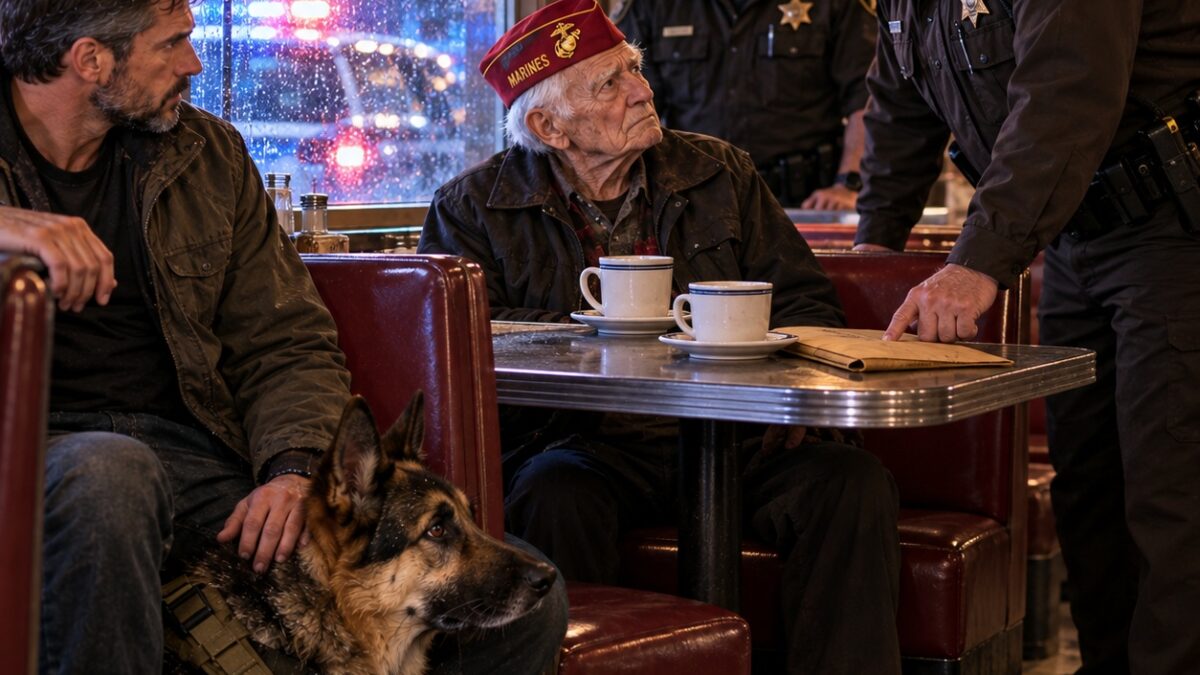
The Empty Cup Beside the Old Marine Was the Secret the Sheriff Never Saw Coming
THE SHERIFF THOUGHT THE OLD MARINE SITTING ALONE IN THAT ROADSIDE DINER WAS TOO WEAK TO FIGHT BACK, TOO TIRED TO MATTER, AND TOO FORGOTTEN FOR ANYONE TO COME WHEN HE RAISED HIS HAND.
WHAT HE DIDN’T KNOW WAS THAT THE BROWN ENVELOPE ON THE TABLE HAD ALREADY TRAVELED FARTHER THAN HIS BADGE COULD REACH, AND THE SECOND CUP OF COFFEE WAS NEVER MEANT FOR A LIVING MAN.
I WAS ONLY A MARINE PASSING THROUGH WITH MY GERMAN SHEPHERD K-9 UNDER THE BOOTH, BUT BY THE TIME THE SIRENS HIT THAT RAIN-SOAKED WINDOW, I UNDERSTOOD THE OLD MAN HAD BEEN FIGHTING A WAR MOST PEOPLE NEVER SAW.
Cold rain had been falling over the outskirts of Coeur d’Alene, Idaho since late afternoon, washing the highway black beneath the headlights and turning the pine-covered hills beyond it into dark shapes behind a veil of water.
I had been driving through that rain long enough for the steady sweep of the windshield wipers to become part of my breathing.
My name is Gunnery Sergeant Silas Corbett.
At forty-one, I stood six-foot-one with the compact, hardened build of a man who had spent most of his adult life asking more from his body than comfort ever required. My dark brown hair was clipped close, my gray eyes sat beneath a heavy brow, and a narrow scar beside my right jaw sharpened an already angular face. I wore civilian clothes that night—a charcoal thermal shirt beneath a weathered field jacket, dark jeans, and boots—but nothing about the way I moved had ever learned how to look soft.
Years in the Marine Corps had taught me to conserve movement, words, and judgment.
Experience had taught me something harder.
Not every tense situation required intervention.
But every dangerous one required attention.
In the rear passenger space rode Vesper, my seven-year-old German Shepherd K-9.
He was large without being oversized, black across the saddle with rich tan along his chest and legs, amber-brown eyes alert beneath upright ears. A small notch marked the edge of his right ear. Vesper possessed the unusual calm of a working dog that did not confuse stillness with inattention. He could sleep through highway noise and wake at the smallest change in my breathing.
After hours behind the wheel, I spotted the diner glowing beside the highway and turned into the wet gravel lot.
Inside, warmth smelled of coffee, fried onions, and old wood.
I took the rear booth automatically.
Back protected.
Front door visible.
Counter visible.
Kitchen pass-through visible.
Vesper settled beside my left boot without being told twice.
A waitress approached carrying a coffee pot. Her name tag read Mara. She looked to be in her early fifties, short and slightly heavy through the shoulders, with auburn hair streaked with gray and gathered loosely behind her head. Fine lines framed kind brown eyes, though something cautious lived beneath them, as if years of serving strangers had taught her which conversations were safe to enter and which were better left alone.
“Long drive?” she asked.
“Long enough.”
Her gaze dropped toward Vesper.
“He working?”
“Always a little.”
That earned the faintest smile.
Mara returned with a stainless-steel bowl of water and placed it near my boot without reaching for the dog.
I noticed the restraint and appreciated it.
While waiting for my meal, my attention drifted toward the window booth.
The old man sitting there was perhaps seventy-nine, thin enough that his faded canvas coat hung loosely from once-broad shoulders. Close-cut silver hair. Deeply lined face. Pale blue eyes that seemed older than the rest of him. His veined right hand trembled slightly when he lifted his spoon, but his spine remained straight.
A red-and-gold Marine veteran cap rested on the seat beside him near worn brown boots planted squarely on the floor.
A scuffed brown document envelope lay beside his soup.
And there were two cups of coffee.
I looked briefly toward the empty seat opposite him.
No coat.
No bag.
Nobody walking back from the restroom.
The second cup sat untouched, its thin ribbon of steam already fading.
Earlier, someone had apparently been at the booth. I had noticed a nervous-looking man leaving through the entrance just as I pulled into the parking lot, but something told me the second coffee had nothing to do with that man.
The old Marine never glanced toward the door as though expecting him back.
Instead, once while reaching for his soup, his eyes settled on the empty chair with an expression I could not name.
Not expectation.
Something quieter.
I looked away.
Some silences belonged to the person carrying them.
My meal arrived, and for the next several minutes, the diner returned to its small evening rhythm.
Forks touched plates.
Rain ticked against glass.
A radio murmured somewhere near the kitchen.
Yet I found myself noticing the old Marine again.
He never fully turned his back on the entrance. Each time the door opened, his eyes moved first and his head followed. When a tray fell behind the counter, his shoulders tightened before anyone else reacted.
Old habits, I thought.
The kind that survived long after a uniform was put away.
I did not ask.
Twenty minutes later, headlights swept across the windows.
A county sheriff’s SUV stopped near the entrance.
The change inside the diner happened before the door opened.
Mara’s conversation with a customer ended mid-sentence. An elderly couple near the counter exchanged a glance and reached for their check. Through the kitchen pass-through, the cook lowered his eyes toward the grill.
I stopped chewing.
Sheriff Boyd Renshaw entered first.
He was fifty-four, broad through the chest and stomach, with a thick neck, graying temples, and a fleshy face permanently flushed around the cheeks. His uniform fit tightly across his shoulders, and he carried himself with the expansive confidence of a man accustomed to other people moving before he had to ask.
Three deputies followed him in.
Two were heavyset men in their forties.
The third was younger—blond, lean, and visibly less comfortable than the others.
Renshaw did not greet Mara.
He did not need to.
The room had already greeted him with silence.
I had seen that kind of silence before.
Respect and fear could look similar from a distance.
Up close, they were nothing alike.
There were six empty booths.
Renshaw ignored every one of them.
He walked directly toward the old Marine.
FULL STORY CONTINUATION
The old man watched the sheriff approach but made no move to rise.
Renshaw stopped beside the table and looked down at him as if he had found something sitting where it did not belong.
“You’re in my booth, old man.”
The Marine slowly lowered his spoon.
His pale eyes traveled across the half-empty diner before returning to the sheriff.
“Then tonight, you’ve got six others to choose from.”
One deputy chuckled.
Renshaw did not.
His gaze fell on the red-and-gold Marine cap beside the old man, and something mean crept across his face.
“That thing real?” he asked. “Or did you buy it somewhere so people would pick up your coffee?”
The old man’s fingers tightened once around the spoon.
Then relaxed.
He said nothing.
Renshaw leaned closer.
At the rear of the diner, I slowly placed my fork beside my plate.
Under the table, Vesper lifted his head, and for the first time that evening, the German Shepherd’s eyes locked on the sheriff.
Rain whispered against the windows as Boyd Renshaw remained beside the booth, close enough that the old man’s only easy way out was blocked by the sheriff’s body.
“You deaf, too?” Renshaw asked. “I said that’s my booth.”
The Marine lifted his eyes without lifting his voice.
“And I said I’d like to finish my supper.”
The younger deputy looked toward the floor.
One of the older deputies smirked, but the sound died when nobody else joined him.
Mara stood behind the counter with the coffee pot held motionless in one hand.
I watched from the rear booth, measuring distances rather than insults.
Renshaw to the old man.
Deputies to the door.
Civilians to the counter.
My own position to Vesper.
The sheriff was being cruel, but cruelty spoken aloud was not yet a reason to turn a crowded diner containing four armed officers into something worse.
I had learned long ago that restraint was not passivity.
Sometimes restraint was the hardest form of readiness.
Vesper remained beside my left leg, head raised now, ears forward.
I lowered two fingers beside my thigh.
Stay.
The German Shepherd obeyed.
Renshaw glanced at the old Marine’s weathered hands.
“How old are you anyway?”
“Eighty. Close enough.”
“And you’re still playing Marine?”
Something changed in the old man’s eyes, but only for a second.
“I don’t play at things I already did.”
I almost looked up at the Marine cap again.
That answered one question.
Renshaw’s mouth tightened.
His gaze moved across the table and stopped at the brown envelope.
“What have you got there?”
The old man placed one hand over it.
“Nothing that belongs to you.”
Renshaw pulled it away.
The motion was casual enough to look almost harmless, but the envelope caught beneath the old man’s wrist and opened.
Several photocopied pages slid across the tabletop.
One landed against spilled sugar packets.
Another stopped beside the untouched second coffee.
I could not read everything from where I sat, but I caught headings and fragments.
Towing invoices.
Property seizure forms.
Dates.
Vehicle descriptions.
Handwritten statements attached to official-looking records.
Renshaw could read them.
The mockery left his face.
The old Marine saw it happen.
Nearly two years earlier, another old Marine had sat at Harlon Voss’s kitchen table with paperwork spread between them.
That was a story I learned later.
His name had been Elias Pruitt.
Harlon’s closest friend for more than four decades.
A fellow Marine from their youth who had aged into a narrow-shouldered man with white hair, a weathered face, and the stubborn patience of someone who hated asking for help.
Time had softened Elias’s stride but not his humor.
He was the kind of man who apologized to waitresses when someone else bumped his table and who would drive twenty miles to help a neighbor repair a fence, then refuse gas money.
What happened to Elias had not made Harlon an investigator.
It had made him angry.
Elias had become one of several people caught in a pattern of questionable towing, property seizures, intimidation, and complaints that seemed to disappear before anyone outside the county took them seriously.
By the time he showed Harlon the papers, the old Marine spoke less about what he had lost than about how small the experience had made him feel.
That was the part Harlon could not forgive.
Not the money.
Not even the property.
The humiliation.
So Harlon began listening.
When someone trusted him enough to talk, he wrote down what they said. When a person had a receipt, notice, photograph, or letter, he kept a copy. He forwarded what he could to people with authority beyond Renshaw’s immediate reach.
Other residents were doing their own part, some openly and some quietly, and evidence from multiple sources eventually began moving through the proper investigative channels.
Harlon never imagined himself exposing an entire system.
He was simply one old man refusing to throw away another piece of paper.
Elias never lived to see where those papers went.
His death came later from natural causes, quietly and without the dramatic ending Harlon’s anger sometimes seemed to demand.
Near the end, when Harlon’s bitterness had become harder to hide, Elias had made him promise only one thing.
Don’t let them do it to somebody else.
Harlon had carried those words for nearly two years.
Now Sheriff Boyd Renshaw picked up one of the photocopies and stared at it.
“You’re still doing this?”
Harlon said nothing.
Renshaw scanned another page and gave a short laugh, but I heard something different in it now.
The sheriff was not amused anymore.
He was calculating.
“All those complaints,” Renshaw said. “All those envelopes. How many places you mailed this garbage to?”
Harlon carefully retrieved one dampening sheet from beside his soup.
“Enough.”
“And what happened?”
Renshaw tossed the page down.
“Nothing.”
Harlon smoothed the corner with two fingers.
Renshaw leaned closer.
“That’s what I thought. Nobody reads this stuff, old man.”
For the first time since the sheriff had approached the booth, Harlon smiled.
It was not triumph.
It was certainty.
“Someone finally read this one.”
I saw the instant the words landed.
Renshaw’s smile disappeared.
His palms slammed onto the table.
Coffee jumped from both cups. The untouched one rocked against its saucer, and dark liquid spread across several photocopies before dripping from the table’s edge.
Mara flinched behind the counter.
The elderly couple who had been preparing to leave froze near the register.
Harlon did not flinch.
But beneath the table, hidden from Renshaw’s view, his right hand began to tremble.
I saw that too.
Renshaw bent until his face was only a short distance from Harlon’s.
“You live alone out there, don’t you?”
The question was quieter than everything that had come before.
Harlon’s expression hardened.
Renshaw continued.
“Winter roads get slick around here. Especially after dark. Man your age ought to be careful.”
I felt something cold settle beneath my ribs.
That was not mockery.
That was a threat designed to remain just barely deniable.
What Renshaw did not know was that it was not the first.
Earlier intimidation had already persuaded investigators outside his immediate authority to take precautions. They knew Harlon intended to be at this diner tonight because he had told them about a brief meeting with a frightened local source.
The nervous man I had seen leaving before I entered had departed early, worried about being recognized.
No one had expected Renshaw to appear.
No one had arranged a confrontation.
But because of previous threats, Harlon had been asked to carry a small alert and recording device in case someone tried to intimidate him again.
It remained concealed.
Harlon made no move toward it.
He simply looked up at the sheriff.
“You finished?”
Renshaw stared at him.
“No,” he said. “I don’t think I am.”
At the rear booth, my hand rested loosely beside my plate. My face remained calm, but every part of my attention had narrowed toward the window booth.
Under the table, Harlon’s fingers trembled harder.
Beside me, Vesper rose slowly onto all four paws.
I had not commanded him to stand.
The dog had simply understood that the room had changed.
For several seconds, nobody moved.
Rain rattled softly against the glass while Vesper stood beside my booth, silent and watchful, and Boyd Renshaw stared down at Harlon as though deciding how much fear an old man ought to show.
Apparently, Harlon was not showing enough.
“Pack it up,” Renshaw said. “You’re leaving.”
Harlon glanced at the soup he had barely finished, then at the coffee spreading through the edges of his papers.
“Did the owner ask me to leave?”
Renshaw’s jaw shifted.
“I’m asking.”
“That wasn’t my question.”
A faint sound escaped one of the deputies—almost a laugh, quickly swallowed.
Renshaw turned just enough to silence him with a look.
Harlon carefully gathered two damp pages and returned them to the brown envelope.
“I paid for my meal. I haven’t threatened anyone. I haven’t broken a law. Unless the owner wants me gone, I think I’ll finish what I came here to do.”
I watched the deputies now.
The two older men had widened their stances, less amused than before, but the youngest was the one my attention kept returning to.
Tate Mullen looked no older than twenty-seven, tall and narrow through the shoulders, with sandy blond hair cut close at the sides and a clean-shaven face that had not yet learned to hide every thought passing across it. His pale complexion had gone nearly colorless.
Unlike Renshaw, Tate carried no swagger.
His uncertainty showed in small movements.
A shifting heel.
A tightening jaw.
Eyes repeatedly checking his sheriff before returning to the room.
Most troubling was his right hand.
Twice, it drifted toward his holster.
Twice, it stopped.
Fear made people unpredictable.
Harlon noticed it too.
His gaze rested on Tate for several seconds, then shifted toward the rear booth.
“Watch the young one, Marine,” he said. “He’s scared.”
I met Harlon’s eyes.
There it was.
Not the cap.
Not the posture.
Not even the old man’s refusal to be intimidated.
Harlon had read the room exactly as I had, ignored the loudest threat long enough to identify the uncertain man with a firearm.
That kind of awareness was learned somewhere.
Consequences arrived faster than explanations.
I gave the smallest nod.
Renshaw looked between us.
“Marine?”
He gave a humorless laugh.
“What? You two got some secret handshake now?”
I did not answer.
I had risen from the booth but remained beside it, both hands visible and empty.
Vesper stood near my left leg. The German Shepherd’s weight had shifted slightly forward, yet he remained exactly where I expected him to remain.
“Sit down,” Renshaw told me.
My voice stayed level.
“I’m fine here.”
That answer seemed to irritate Renshaw more than open defiance might have.
He turned back toward Harlon.
“Last chance.”
“For what?”
“To walk out of here without making this difficult.”
Harlon looked toward Mara.
She stood behind the counter, frightened but silent.
Then he looked back at Renshaw.
“You’re the only one making it difficult.”
Renshaw reached down and seized the front of Harlon’s canvas jacket.
The movement changed everything.
He jerked Harlon forward hard enough that the old man’s hip struck the edge of the table. One coffee cup tipped onto its side. Harlon caught himself with his left palm against the tabletop, veined fingers spreading for balance.
Vesper’s ears snapped forward.
I lowered my hand beside my thigh.
“Hold.”
The dog froze.
Renshaw tightened his fist in Harlon’s jacket.
“You think being old means nobody can touch you?”
Harlon’s breathing had changed. I could see it now—shorter, shallower.
But the old man did not grab Renshaw’s arm.
He did not swing.
He did not give the sheriff the excuse he seemed to be searching for.
Instead, Harlon straightened as much as Renshaw’s grip allowed.
“I wore a uniform too,” he said. “It never made me the law.”
Something broke behind Renshaw’s expression.
His free hand came up.
Not a gesture.
Not a pointed finger.
A strike.
I moved.
Three quick steps carried me across the distance. I caught Renshaw’s raised wrist before the hand could reach Harlon, redirected the arm away from the old man’s face, and used only enough leverage to force Renshaw to release the jacket.
Harlon stumbled backward.
I immediately let go and created distance.
No punch.
No takedown.
No second move.
Just separation.
“Take your hand off the veteran.”
The diner went completely still.
Renshaw stared at me as though nobody had physically denied him anything in years.
Behind him, leather creaked.
One deputy’s hand moved toward his holster.
Then Tate’s did too.
I saw both.
“Vesper. Block.”
The German Shepherd moved instantly.
Vesper crossed in front of Harlon and settled into a low, controlled stance between the old man and the deputies. His mouth was closed. His ears stood forward. His eyes tracked the hands nearest the holsters, shifting from one deputy to the other without barking, lunging, or making contact.
“Hands away from your weapons,” I said.
It was not shouted.
That made it carry farther.
Tate stopped first.
His fingers hovered inches from the holster before slowly spreading away from it.
The older deputy hesitated, then did the same.
Renshaw’s face reddened.
“You have any idea what you just did?”
“I stopped you from hitting an unarmed man.”
“You put your hands on a sheriff.”
“I stopped an armed man from striking an unarmed seventy-nine-year-old in front of a room full of witnesses.”
Renshaw stepped toward me.
Vesper did not turn toward the sheriff.
I had given him a job.
The dog stayed with it.
“You just ended your career,” Renshaw said. “Whatever branch you’re in, whatever command you crawl back to, I’ll make sure they know exactly what you did.”
I studied him calmly.
“Make sure you tell them the whole part.”
Renshaw blinked.
“The part where I released you the moment you released him.”
Behind the counter, Mara’s eyes moved toward the security camera mounted near the ceiling.
Renshaw noticed.
For the first time, uncertainty entered his face.
Behind Vesper, Harlon steadied himself against the booth. His jacket collar sat crooked where Renshaw had grabbed it. His hand was still trembling, but he was standing.
And he was watching.
Not me.
Renshaw.
Harlon slipped one hand beneath the edge of his coat.
I saw the movement, but I recognized immediately he was not reaching toward a weapon. His thumb pressed something small concealed beneath the fabric.
Once.
No dramatic signal followed.
No light flashed.
No voice answered.
Harlon simply let his hand fall back to his side.
Renshaw saw none of it.
He pointed at me.
“You’re going to regret stepping into something that has nothing to do with you.”
Harlon’s voice came from behind the dog.
“Boyd.”
Renshaw turned.
Harlon stood with one hand resting against the booth, breathing carefully, his pale eyes steadier than his fingers.
“I told you someone finally read the file.”
The sheriff stared at him.
Outside, rain continued drumming against the diner roof.
For one long moment, that was the only sound.
Then Vesper’s right ear turned toward the windows.
I heard it a second later.
Faint at first.
Distant but growing.
Sirens.
The sirens grew until blue and red light began washing across the rain-streaked diner windows, turning every wet surface inside into a trembling reflection.
I kept my attention on the deputies until the front door opened and voices outside identified the arriving state personnel.
Once the first investigators entered and the deputies were ordered to keep their hands visible, I gave a quiet command.
“Vesper, here.”
The German Shepherd immediately left his blocking position and returned to my left side. The tension remained in his posture for several seconds before I touched two fingers lightly against his shoulder.
Only then did the dog settle.
The woman leading the arriving team introduced herself as Investigator Lena Ward, a forty-six-year-old state investigator with a lean frame, dark hair pulled into a practical knot, and an angular face made more severe by tired hazel eyes. She spoke without wasted words and listened without interrupting, carrying the deliberate patience of someone accustomed to separating what people knew from what they merely believed.
Two uniformed state officers remained near the entrance while another investigator began speaking separately with Mara and the customers.
Harlon did not stand before the room and explain two years of records.
He did not need to.
He confirmed Renshaw had taken his envelope without permission, threatened him, grabbed his jacket, and raised a hand toward him. Then he surrendered the recording device and the copies investigators requested.
Mara confirmed what she had seen.
The security camera remained above the counter.
I gave a concise account of my own intervention.
The evidence could speak later.
Tonight, the people only had to tell the truth.
Tate Mullen asked to speak with Ward privately, then changed his mind.
“No,” he said, swallowing. “Maybe everybody should hear this part.”
His face was still pale.
“I kept copies. Tow reports. A couple seizure forms. Things I was told to change after the fact.”
Renshaw turned toward him.
“Shut your mouth.”
Tate flinched, but this time his hand did not move toward his holster.
“I was scared of you,” he said.
Ward raised one hand before anyone could respond.
“Deputy Mullen, cooperation doesn’t determine responsibility. We’ll take your statement, preserve whatever records you have, and establish your involvement separately.”
Tate nodded.
I respected that answer.
Fear could explain a decision without erasing it.
Renshaw was escorted outside so the legal process could continue. No one in the diner announced what charge would ultimately survive review. No one predicted a sentence. There would be statements, records, lawyers, evidence, and questions beyond this room.
At the door, Renshaw stopped.
Rain blew across the threshold behind him.
He looked back at Harlon.
“Why?”
Harlon said nothing.
“You’re almost eighty. Why spend what you’ve got left doing this?”
Harlon’s gaze moved to the old Marine cap on the booth seat.
When he answered, his voice was quiet.
“Because the last man you frightened asked me not to look away.”
Renshaw had no answer for that.
The door closed behind him.
For several seconds, the diner remained silent.
Then somebody exhaled.
A chair scraped.
The cook appeared in the kitchen opening.
Mara pressed her fingertips against her mouth, her eyes shining as though she had been holding something inside for years and had finally been given permission to release it.
But Harlon did not look relieved.
He sat down.
His hands began to shake.
Not the faint tremor I had noticed earlier.
Both hands trembled now enough that Harlon placed them flat against the table, as if ashamed of what his body was admitting.
I waited until Ward and the others moved away.
Then I sat in the chair opposite him.
“You all right, Gunny?”
Harlon stared at the coffee-stained papers.
A tired smile touched his mouth.
“You figured that out eventually.”
Harlon looked toward the second cup.
“I thought this would feel better.”
I said nothing.
“I’ve been angry for almost two years,” Harlon continued. “Kept telling myself it had a purpose. Every receipt I copied. Every call I made. Every person I listened to.”
He touched his chest.
“I thought if that man ever had to answer for what he’d done, something in here would finally let go.”
His eyes moved toward the door through which Renshaw had disappeared.
“He’s gone.”
Harlon swallowed.
“Elias is still dead.”
I let the silence remain.
After Harlon’s wife died, he explained, the house became a place he no longer recognized. Not because anything had changed, but because nothing moved. Her chair stayed where it had always been. Her coffee mug remained in the cabinet. At night, the refrigerator motor sounded impossibly loud.
Elias had understood without being asked.
Every Sunday morning, he came over carrying two coffees.
“He never knocked after the first month,” Harlon said. “Just walked in and complained that I made the place too cold.”
Some Sundays, they talked for hours.
Old deployments.
Bad knees.
Baseball.
Men whose names they could still remember but whose faces were getting harder to picture.
Other Sundays, Elias sat across from Harlon, and neither man said much at all.
“That was the thing about him,” Harlon whispered. “He knew silence wasn’t always something you had to fix.”
Then Elias was gone too.
The first Sunday afterward, Harlon drove to the diner.
He ordered two coffees.
He had been doing it ever since.
One for himself.
One for the empty chair.
I looked at the cup near my hand.
Without thinking, I pulled it closer.
Harlon’s eyes followed it.
“That was Elias’s seat.”
I stopped.
My hand immediately moved to return the cup.
Harlon watched me for a long moment.
Then something in the old man’s face softened.
“It’s all right, Marine.”
I looked at him.
“He wouldn’t mind.”
I slowly pulled the cup back.
The coffee was cold.
I drank anyway.
Vesper walked beneath the table and lowered himself between us, his back near my boots and his front paws stretching toward Harlon’s side.
Neither man spoke for a while.
Rain softened against the windows.
Harlon looked down at the old dog between us.
“I kept thinking justice would finish the grief.”
I rested both hands around the cold cup.
“Maybe it just finished the promise.”
Harlon’s eyes lifted.
I did not add anything else.
There was nothing else to add.
For nearly two years, Harlon had given his anger a job because grief without a job had been harder to carry. Renshaw facing consequences mattered. Elias’s last request mattered.
But neither could make Sunday morning sound the way it once had.
I finally understood what the old Marine across from me needed.
Not another investigation.
Not another fight.
Not another man trying to save him.
Just someone willing to remain in the chair.
So I stayed.
Between two Marines from different generations, Vesper lowered his head onto his paws while the second cup slowly became empty.
A week later, morning sunlight broke through thinning clouds above Coeur d’Alene, catching on the wet highway as I turned into the diner parking lot with Vesper riding quietly behind me.
My schedule had brought me through the area again.
At least, that was the reason I gave myself when I parked.
Inside, Mara recognized me immediately. She looked toward the window booth before I did.
It was empty.
I ordered coffee, stayed twenty minutes, and left without asking where Harlon was.
The following week, I stopped again.
Same empty booth.
This time, Mara answered the question I had not asked.
“He hasn’t been coming in much.”
I looked toward the two-person table.
“Since that night?”
“Pretty much.”
Mara wiped her hands against her apron.
“For almost two years, that man woke up knowing exactly what he had to do. Now everybody keeps telling him he won.”
Her expression softened.
“Maybe nobody thought to ask what he’s supposed to do the morning after.”
The words followed me back to my truck.
I understood more than I wanted to.
Months earlier, a Marine I had served beside for years had suffered an injury serious enough to end his career. I had watched a capable man lose not only his uniform but the structure around which he had built his identity.
The injury healed better than the silence that followed it.
Since then, an uncomfortable question had begun visiting me during long drives.
Someday, I would take off the uniform for the last time.
Someday, Vesper’s muzzle would gray, his joints would stiffen, and duty would become retirement.
The Corps would continue.
The unit would continue.
Who would Silas Corbett be when nobody needed Gunnery Sergeant Corbett anymore?
I had never found an answer.
Two days later, I drove to Harlon’s house with Vesper and two coffees.
There was no plan that mattered.
Harlon opened the door wearing an old flannel shirt and looked from me to Vesper, then to the cups.
“You lost?”
“Probably.”
Harlon almost smiled.
I noticed a loose porch step when he turned. I crouched and pressed one corner.
The board shifted.
“I can still fix my own porch,” Harlon said.
I looked up.
There was no humor in his face now.
I understood immediately.
Help could become humiliation when offered carelessly.
I stood, reached toward the small toolbox beside the porch wall, took out a wrench, and held it toward him.
“Never said you couldn’t.”
Harlon stared at me.
Then he took the wrench.
We fixed the step together.
That became the pattern.
I returned when my schedule allowed.
I never arrived with a list.
Sometimes there was something small to repair, and sometimes Harlon told me to leave it alone.
I learned to respect both answers.
Some mornings, we drank coffee on the porch while Vesper stretched across the boards in a patch of sunlight.
Other days, we spoke barely ten words.
Eventually, Harlon began talking.
Not because I asked.
Because silence had stopped feeling dangerous.
He told stories about Elias that had nothing to do with Renshaw.
Elias ruining a fishing reel and blaming the manufacturer.
Elias showing up every Sunday with coffee so bad Harlon accused him of buying it as punishment.
He spoke about his wife too, sometimes stopping halfway through a memory because grief had arrived unexpectedly.
I never rushed to fill the pause.
One afternoon, I finally told Harlon about the Marine who had been forced out by injury.
Then I admitted the part I had told nobody.
“I keep wondering what happens when it’s my turn.”
Harlon looked toward Vesper, sleeping near the porch steps.
“My turn to leave. His turn to retire. Everybody keeps moving.”
Harlon lifted his coffee.
“You think service belongs to the uniform?”
I considered it.
“Some days.”
Harlon nodded as though he understood exactly why.
“The Corps teaches you how to serve, Marine. Life decides where you do it next.”
That was all.
No speech.
No promise the transition would be easy.
I remembered it anyway.
The first real change in Harlon came through a phone call from Mara.
An elderly veteran in town had received a benefits-related letter he did not understand. He was embarrassed to ask for help and afraid of signing the wrong thing.
Mara remembered that Harlon had spent nearly two years sorting records and finding the right offices.
Harlon stood in his kitchen holding the phone after the call ended.
I happened to be there.
“I don’t do that anymore,” Harlon said.
I did not argue.
Vesper lay near the doorway watching us both.
A minute passed.
I picked up my keys.
“Need a ride, Gunny?”
Harlon looked at me, then toward the coat hanging beside the door.
“No.”
He took it from the hook.
“But you can follow me.”
I smiled.
“Yes, Gunny.”
That one visit became another.
Harlon did not become a lawyer, investigator, or savior.
He became something simpler and perhaps more useful.
A man willing to sit beside someone who was confused.
He helped older veterans organize letters, identify which office to call, find qualified assistants, or write down questions before appointments. Sometimes there was nothing he could solve.
So he listened.
I recognized the irony before Harlon did.
Elias had once taught Harlon that silence was not always something to fix.
Now Harlon was giving that same gift away.
Weeks later, I entered the diner with Vesper beside me.
Mara did not ask where I wanted to sit.
Harlon was already at the window booth.
Two cups arrived.
I sat opposite him.
Vesper walked to Harlon’s side and gently placed his muzzle across the old man’s knee.
Harlon’s veined hand settled behind the German Shepherd’s ear, rubbing the small place dogs always seem to find impossible to reach themselves.
After a while, Harlon looked at me.
“When did you know?”
“Know what?”
“That I was a Marine.”
I smiled.
“Before you told me.”
“How?”
I glanced toward the entrance.
Harlon had chosen the same seat again, facing the door.
“You never stopped being one.”
Harlon looked down at his coffee.
Once, the chair opposite him had belonged to absence.
Now I sat there.
That did not make me Elias.
Nobody could be Elias.
But Harlon was beginning to understand that memory did not demand loneliness as proof of loyalty.
Letting another man sit in the chair did not remove the one who had sat there before.
Across from him, I understood something too.
A mission could end.
A uniform could come off.
A good dog could grow old.
And purpose could remain.
Morning light filled the diner while two Marines drank coffee and Vesper settled between us.
Sometimes the last patrol was not a battlefield, a convoy, a rescue, or a report.
Sometimes it was simply making sure another Marine never had to walk home alone.