The Empty Bracket Beside My Father’s Fence
The Empty Bracket Beside My Father’s Fence
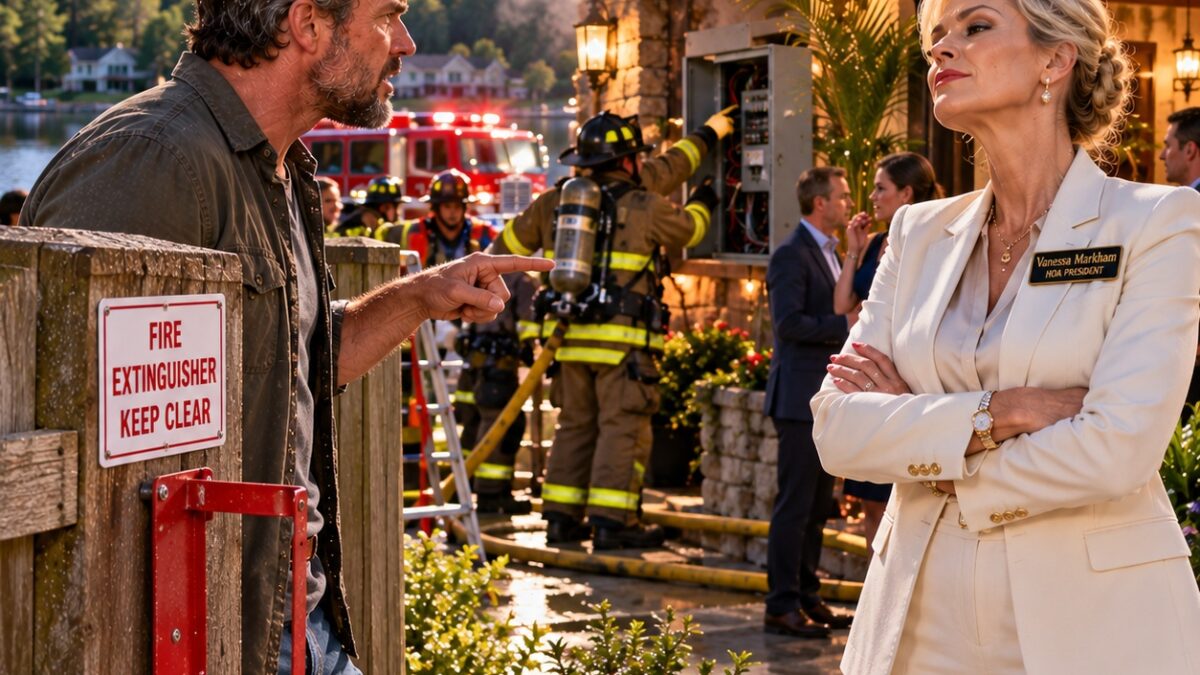
VANESSA MARKHAM CALLED MY FIRE EXTINGUISHERS UGLY UNTIL SMOKE STARTED ROLLING UNDER THE CLUBHOUSE EAVES AND HER OWN STAFF RAN STRAIGHT TO THE EMPTY BRACKET SHE HAD ORDERED ME TO CLEAR.
SHE SAID FOURTEEN RED CYLINDERS WERE “VISUAL CLUTTER,” BUT SHE NEVER TOLD THE NEIGHBORHOOD SHE WAS RUSHING TO PROTECT A $180,000 SHOWCASE DEADLINE.
BY THE TIME THE FIRE MARSHAL READ THE EMAIL SHE SENT ME, THE QUESTION WAS NO LONGER WHETHER MY PROPERTY LOOKED NICE FROM THE ROAD—IT WAS HOW FAR AN HOA COULD GO BEFORE SAFETY BECAME SOMETHING THEY WERE WILLING TO HIDE.
Smoke rolled beneath the clubhouse eaves while alarms cut across the lake road.
For one second, nobody understood what they were seeing.
The string lights were still glowing over the patio. Music still thumped faintly through the outdoor speakers. A cluster of well-dressed guests stood near the lake with wine glasses in their hands, turning toward the service wall with the confused faces people wear when danger interrupts an event that was supposed to be beautiful.
Then the smell hit me.
Hot plastic.
Burning insulation.
Not campfire smoke.
Not grill smoke.
Electrical.
I was across the fence at my repair shop when I heard the first shout.
“Kill the power!”
I dropped the wrench in my hand and ran toward the gate.
The clubhouse sat across the frontage road from my property, close enough that I could hear music during every Stonebridge Hills event and close enough that their board had spent the last three weeks telling me everything visible from that road was somehow their business.
Vanessa Markham was near the patio entrance in a cream dress, one hand pressed to her throat, looking from the smoke to the guests like she was still trying to decide whether this was an emergency or an embarrassment.
Daniel Price, one of the HOA board members, reached the outdoor kitchen service panel first. He yanked at the cabinet door, but a decorative display of potted palms and event signage blocked it from opening fully.
“Move this!” he shouted.
A staff member shoved the display aside. The cabinet door opened halfway, not enough for clean access. Smoke thickened behind the siding.
Then Daniel turned toward my fence.
I knew exactly what he was looking for before he said it.
The old red bracket.
The one bolted to the cedar post near my service gate.
The one that had held extinguisher 7 for years.
My father had mounted that bracket after a grass fire came close enough to blacken the lower side of the post. He had sanded the scorch line smooth but never painted over it. He said a hidden scar was just a lesson asking to be forgotten.
For seven years, that extinguisher had hung there in its weather hood, bright red, inspected, tagged, charged, and ready. It faced the clubhouse corner because wind had a habit of pushing sparks uphill and sideways in ways maps did not respect.
Three weeks earlier, Vanessa ordered me to remove it.
Now Daniel was running toward it.
“Where’s the extinguisher that used to hang here?” he shouted as he reached the fence.
I was already opening my service gate for the engines, my hands moving faster than my thoughts.
I looked at the empty steel cradle on the cedar post.
Only the pale scar remained where the bracket had bitten into wood for nearly two decades.
“You ordered me to remove it,” I said.
Vanessa turned.
Smoke thickened above the clubhouse roofline, gray against the early evening sky.
Her face changed when she saw the bare post.
Not guilt.
Not yet.
Recognition.
“You confirmed that exact order in writing,” I said.
“This is not the time to argue over a compliance notice from three weeks ago,” she snapped.
“No,” I said, swinging the gate wide. “This is the time everyone finds out what that notice actually cost.”
FULL STORY CONTINUATION
The fire engine had not reached the turn yet, but I could already hear it coming from the county road—sirens bouncing off the lake, heavy brakes, diesel growl, the sound of trained people arriving where untrained people had spent too many minutes pretending the problem might stay small.
I stepped into the frontage lane and waved guests away from the narrow service entrance.
“Back up,” I shouted. “Everybody behind the fence line. Keep this lane clear.”
A man in a navy blazer looked offended, like I had interrupted his wine tasting.
“Sir, move,” I said, louder.
He moved.
Fear does that when politeness fails.
Daniel was still at the service wall, coughing once as smoke pushed out through a seam near the outdoor kitchen. A staffer had finally gotten the cabinet open enough to reach inside, but by then the first crew was already pulling hose toward the patio. Vanessa stood near the lake walk with her phone in one hand and her other arm wrapped across her stomach, watching the evening she had polished for months turn into something wet, smoky, and official.
I opened the second gate by my shop and moved my truck out of the service path. It took less than a minute, but my hands shook while I did it.
Not because I was scared of the fire.
I respected fire. That was different.
I was shaking because the exact thing I had warned about had arrived wearing smoke, and the one piece of equipment that had always been within arm’s reach was gone because Vanessa wanted a cleaner view.
My name is Ethan Cole.
I am forty-five years old, and I run a small equipment repair shop on the edge of Stonebridge Hills, a planned lake community outside Gainesville, Florida. I fix tractors, compact loaders, lawn equipment, utility carts, small engines, irrigation pumps, and anything else somebody drags onto my gravel lot with the sentence, “It was running fine yesterday.”
My property existed before Stonebridge Hills became a gated community with lakefront paths, stucco clubhouses, designer banners, and enough architectural guidelines to regulate the emotional tone of a mailbox.
My father bought the parcel when the road was still two lanes, the lake road had no decorative lights, and the land where the clubhouse now stood was mostly scrub, wet ditch, and old pasture. His name was Henry Cole, and he believed in three things: tools that worked, promises written down, and keeping emergency equipment close enough to reach with one bad breath left.
He put the first extinguisher on the cedar post after a grass fire swept through the frontage one August afternoon when I was seventeen.
It started in the ditch.
A cigarette, maybe.
A mower spark.
Nobody ever knew for sure.
What I remember is the dry wind.
The way it pushed flame through dead grass so fast that my father did not run toward the barn. He ran toward the old red extinguisher by the shop door, pulled the pin, and beat the fire back before it reached the fuel shed.
Afterward, he stood beside that cedar post with soot on his arms and said, “Seconds matter when fire already knows where it wants to go.”
The next weekend, he mounted a second bracket on that post.
Then another by the barn.
Then one near the shop.
Then one by the fuel shed.
Over the years, the property collected fourteen extinguishers in weather hoods, all serviced, all tagged, all visible, all where somebody could grab one without running into a burning building to find it.
For seven quiet years after Stonebridge annexed the frontage parcel into its development agreement, nobody cared.
Residents drove past them.
Clubhouse staff borrowed one once when a grill flared up at a Fourth of July event.
A maintenance worker thanked me the next week and promised to bring it back recharged. He did.
The red cylinders were not new.
The brackets were not new.
The safety logic was not new.
What changed was Vanessa Markham’s showcase.
Three weeks before the clubhouse fire, I found the notice zip-tied to my gate at sunrise.
It hung there in a plastic sleeve, neat and official, with the Stonebridge Hills HOA letterhead across the top and photographs of my own property printed in color.
Fourteen violations.
Each red cylinder marked with a yellow circle.
A fine schedule highlighted in pink.
I stood there in the morning heat reading the first line twice because it was so absurd my mind rejected it the first time.
Visible exterior fire extinguishers are improper visual clutter and must be concealed, relocated indoors, or removed from frontage view within the compliance period.
I looked up from the notice at extinguisher 7 on the cedar post.
The red cylinder sat inside its hood, clean, inspected, and ready. Beneath it, the post still carried the faint dark line from the old grass fire. My father had sanded it smooth, but he had refused to hide it completely.
“Don’t paint over warnings,” he had told me. “That’s how people repeat stupid.”
I took a picture of the notice.
Then I took pictures of all fourteen extinguishers.
The one by the barn door.
The one beside the shop entrance.
The one near the fuel shed.
The one on the back wall.
The pair near the equipment wash pad.
The unit by the old cedar post facing the clubhouse.
Each tag had been punched the month before.
Each gauge read in the green.
Each pin was sealed.
None were junk.
None were abandoned.
None were decorative.
By eight-thirty, Vanessa arrived in her golf cart.
She never walked when she could make an entrance.
She was in her early fifties, polished in the way certain HOA presidents become when they have mistaken volunteer authority for elected office. Her hair was always shaped, her nails always done, her voice always softest when she was saying something unreasonable.
“Ethan,” she said, stepping down from the cart with a packet under one arm. “I assume you saw the notice.”
“I did.”
“Good. Then we can make this simple.”
I held up the paper.
“Fourteen fire extinguishers are now an aesthetic violation after seven quiet years?”
“They are visible from our road, and the board considers them improper visual clutter.”
“They are visible because they are supposed to be visible.”
“Safety matters,” she said. “But appearance affects every resident and every property value here.”
I laughed once.
Not because it was funny.
Because it was the only way to keep from saying something less useful.
“You are asking me to make emergency equipment harder to reach because the paint is red.”
“I am asking you to comply with exterior standards that already bind this parcel.”
“Show me the recorded language that gives Stonebridge control over portable safety gear on my property.”
She opened the packet as if she had been waiting for that.
Inside were board rules, color photographs, architectural guidelines, and a fine schedule. The fine was $250 per day if I did not comply after the deadline.
“The architectural authority covers visible exterior items along this entire frontage,” she said.
“Fences?”
“Yes.”
“Landscaping?”
“Yes.”
“Permanent improvements?”
“Yes.”
“Portable extinguishers?”
Her eyes hardened.
“The board may interpret exterior standards as local conditions change.”
“A board vote can enforce real power,” I said. “It cannot invent power you never legally had.”
“Then bring that argument to the hearing.”
“The compliance deadline still stands while you figure out whether you have authority?”
“The compliance deadline stands because the board has already reviewed the issue.”
I looked past her golf cart toward the clubhouse.
Workers were hanging banners along the lake walk.
Fresh flowers had been planted by the entrance.
A crew was cleaning the patio stone near the outdoor kitchen.
“Why did this become urgent the same week you started dressing up the clubhouse?”
Vanessa did not blink.
“We have a community event coming, and neglected frontage reflects badly on everyone.”
That answer was polished.
Too polished.
It did not explain why a safety setup that had been acceptable for seven years had suddenly become visual clutter ten days before a showcase.
“My father put the first bracket on this post after a grass fire reached our old barn,” I said.
“I respect that history.”
“No, you respect the way that sounds when you say it.”
Her mouth tightened.
“Personal history does not cancel community rules.”
“Neither does community branding cancel safety.”
The fight was no longer about red cylinders.
It had touched what my father built.
And people like Vanessa rarely understand that a piece of equipment can carry more than function.
Sometimes it carries memory.
Sometimes it carries a lesson paid for in smoke.
Sometimes it carries a dead man’s common sense into a meeting room full of people who think clean sightlines matter more than what happens when something burns.
I called Maya Rosen that afternoon.
Maya was a property attorney who had helped me once before when Stonebridge tried to claim they could dictate the color of my shop doors from the road. She was calm, precise, and allergic to sloppy authority.
“Send me everything,” she said.
I spread the HOA packet across my workbench beside the service tags and photographs. Maya came by the next morning and worked through it page by page while I rebuilt a carburetor at the far end of the bench and pretended not to watch her expression.
“The board has real design authority here,” she said finally.
“I know.”
“But this packet skips where that authority ends.”
“That’s what bothered me.”
She tapped the annexation summary.
“Your parcel joined the development under a narrow annexation agreement in 2018. The HOA got authority over fencing, landscaping, and fixed exterior improvements along the frontage. I see references to screening, permanent storage structures, signs, lighting, and exterior materials.”
“Fire extinguishers?”
“No.”
“Portable safety gear?”
“No.”
“Wall brackets?”
“Possibly reviewable depending on the exact exhibit language, but this packet is incomplete.”
I leaned on the bench.
“Incomplete how?”
“There’s a referenced exhibit missing from the copy. It may help you. It may hurt you. I don’t guess from missing pages.”
At the hearing two days later, Vanessa joined by video from what looked like the clubhouse office. She had the violation photos already on screen. I sat in my shop with Maya beside me and Tom Alvarez leaning against the far wall.
Tom was not my lawyer.
He was my safety inspector, repair helper, friend, and occasional conscience. He had been servicing extinguishers in our county for twenty-three years and had known my father long enough to earn the right to complain about him.
“The extinguishers are maintained,” Tom said at the hearing. “Every one passed service last month.”
“A service tag does not decide whether exterior equipment violates design standards,” Vanessa replied.
“No,” I said. “But it proves you’re targeting working safety equipment, not abandoned junk.”
Vanessa smiled thinly.
“The board is not questioning whether the units function. The board is addressing their exterior display.”
Maya leaned forward.
“Then show us the recorded section allowing a design guideline to expand the association’s authority to maintained portable life safety equipment.”
Vanessa’s eyes moved slightly off camera, probably toward someone else in the office.
“Our architectural standards allow the board to interpret exterior conditions as local needs change.”
“Interpretation is one thing,” Maya said. “Adding a new category of regulated property is another.”
The hearing ended the way HOA hearings often end.
The board “took the matter under advisement,” which meant Vanessa remained sure of herself and the fine clock kept running.
Maya requested certified annexation pages and every architectural amendment.
Vanessa sent a short reply.
You may request anything you like, but the compliance clock will continue.
Maya asked them to pause fines voluntarily until the record was complete.
Vanessa refused.
The board already reviewed this, and we are not delaying standards for one property.
That refusal turned a paperwork dispute into a practical problem.
If I kept the extinguishers outside and lost, the fines could stack fast.
If I moved them indoors, I made the property less safe and gave Vanessa exactly what she wanted.
Tom gave me the safest compliant option.
“We can put them in weather-rated cabinets near each access point,” he said. “Still visible as safety equipment, protected, clean looking.”
“How much?”
He looked uncomfortable.
“Just under four grand with mounts and labor if we do it right.”
I swore under my breath.
“No one required costly cabinets,” Vanessa wrote when Maya floated that option. “Mr. Cole may simply store the extinguishers indoors.”
Inside storage defeated the reason they were outside.
It meant running into a barn, shop, or fuel area during the first seconds of a fire instead of grabbing equipment before entering danger.
But I was not going to pretend safety was improved just because the HOA preferred hidden risk.
“Do it safely,” Maya told me. “Document every step. Leave nothing they can call noncompliance later.”
To make room for the work, I canceled two repair jobs and postponed a third. One customer had been with me for eight years. He needed a tractor intake slot that week, and I lost it because I was photographing serial numbers on extinguishers Vanessa did not want visible from the road.
That was the quiet cost of these disputes.
Not just legal fees.
Lost work.
Lost trust.
Lost time.
The kind nobody includes in a board packet.
Daniel Price called me that evening.
Daniel sat on the Stonebridge board, but he had never struck me as one of Vanessa’s loyalists. He was practical, a little nervous, and far more comfortable with spreadsheets than conflict.
“I sent the board photos,” he said. “The arrival corridor is the real concern.”
“Who decided my extinguishers belonged in that corridor project in the first place?”
He hesitated.
“Vanessa raised them after the sales committee walked the route from the clubhouse.”
“Sales committee?”
“It’s tied to the showcase.”
“What showcase?”
He sighed.
“The event next week. Developer representatives. A regional broker. Prospective buyers. The route from the lake entrance to the clubhouse is part of the presentation.”
I looked across the road toward the banners.
So there it was.
Not safety.
Not covenant purity.
Not some sudden discovery of exterior standards.
A view.
My extinguishers sat in the visual corridor Vanessa wanted polished before people with money drove in.
Daniel sent me board minutes.
The phrase appeared twice.
Improve the visual corridor between clubhouse and lake entrance.
That corridor pointed straight across my fence.
Directly at extinguisher 7 on my father’s old cedar post.
No resident complaint names appeared.
The sales committee appeared three times.
The timing began to make sense.
Not enough to prove motive alone.
Enough to show where to dig.
Then Vanessa sent the email that went too far.
All exterior extinguisher displays and associated visible mounting hardware must go.
Maya read it and sat back slowly.
“That sentence is broader than the hearing record.”
“Good or bad?”
“Useful. Preserve it.”
“Because?”
“Because now she is not only asking you to relocate cylinders. She is trying to clear brackets and hardware too. If the annexation record excludes safety gear, that overreach matters.”
The certified record arrived the next morning.
A folded exhibit had been tucked behind the recorded plat.
Maya opened it on my workbench.
The heading read:
Emergency Access and Life Safety Equipment.
I felt my pulse change.
“Maya.”
“Do not jump ahead,” she said.
She traced the paragraph with one finger, reading silently first because lawyers trust their eyes more than another person’s excitement.
Then she stopped.
“This clause is narrow,” she said. “But it changes what the board may call exterior design.”
“Tell me.”
“The annexation gives HOA control over fencing, landscaping, and fixed improvements, but it excludes maintained emergency and life safety gear from aesthetic review.”
I stared at the page.
“The extinguishers are portable equipment.”
“Yes.”
“Even if a bracket keeps one handy outside?”
“The bracket may be reviewable as hardware or mounting, but the serviced extinguisher itself is clearly excluded.”
“So they can question a bracket or ask for screening?”
“Possibly, within reason.”
“But they cannot ban the extinguisher.”
“Correct.”
At last, the missing page answered the question Vanessa had tied to my gate.
Design authority stopped at life safety gear.
Maya sent the exhibit, her reading, and a demand to rescind the violation.
Vanessa replied two hours later.
The board disputes your interpretation and the violation will remain under review.
Under review.
Not withdrawn.
Not paused.
Not corrected.
Under review while the fines remained a threat and the showcase drew closer.
“What exactly is she protecting?” I asked Maya.
Maya looked at the event calendar Daniel had sent.
“Let’s find out.”
The answer came from a finance packet attached to the sales committee agenda.
The showcase was not just a social night.
Not just flowers, music, banners, broker tours, and prospective buyers.
The event triggered a developer contribution if the launch proceeded on schedule.
$180,000.
The money was earmarked for overdue clubhouse repairs.
Roof issues.
Exterior rot.
A service wall upgrade.
Deferred maintenance the HOA had been delaying because nobody wanted another special assessment.
I sat at my workbench staring at the number.
One hundred eighty thousand dollars.
“So the board was protecting residents from a special assessment by rushing this event,” I said.
Maya nodded.
“The goal is understandable.”
“I hate that.”
“Most bad decisions are easier when they start with a goal people can understand.”
Vanessa later said it plainly when Maya pressed her.
“That contribution keeps a major repair bill from landing on every household here. I have elderly owners asking whether another assessment might force them to sell.”
For the first time, her strongest argument sounded human.
Real pressure.
Real money.
Real residents.
Still separate from legal power.
“You could have asked me to cooperate,” I told her on a call. “You could have said the board had a showcase deadline and wanted to clean up the corridor. We could have talked about cabinets, signage, screening, placement. Instead, you called working fire extinguishers violations.”
“I chose certainty for the community because the deadline was already closing.”
“No,” I said. “You chose control because asking gave me the right to say no.”
By then, the units were indoors.
Tom and I documented every move.
He photographed gauges, seals, tags, serial numbers, and bracket locations. Each extinguisher moved from an exterior weather hood to a marked indoor access point, reachable but slower.
The last one was extinguisher 7.
The old bracket had bitten deep into the cedar post.
“Take the cylinder first,” I told Tom. “I want to remove my father’s bracket myself.”
He lifted the red cylinder out of the cradle, checked the tag, and set it carefully in the truck.
I put a wrench on the first rusted bolt.
It turned halfway.
Then seized.
I pushed harder.
A long splinter pulled away from the cedar.
“Stop,” Tom said.
I froze.
He moved closer and ran one hand over the wood.
“If you force it, you’ll split the post along the scorch line.”
I let go of the wrench.
For a moment, neither of us spoke.
The scorch line sat beneath the bracket, dark beneath newer weathering, the last visible trace of the fire that had made my father mount it there.
“We can cut the bracket away,” Tom said gently. “But the wood around that bolt will never match again.”
I chose the saw.
It preserved the post.
Mostly.
The metal came free, but a palm-sized section of cedar grain disappeared with it.
That mark was not valuable to anyone else.
No appraiser would count it.
No HOA packet would mention it.
But my father had sanded that post with his own hands, and now part of it was gone because Vanessa wanted a cleaner view for people who might buy homes beside a lake.
I placed the broken cedar sliver in my shop drawer instead of throwing it away.
By sunset, fourteen red cylinders had vanished from outside my property.
The arrival corridor looked clean enough for banners, flowers, and lake views.
I emailed Vanessa.
Before I accept closure, confirm that all fourteen were moved because you required it.
Her reply came at 6:11 p.m.
Confirmed. The board required relocation of all visible exterior extinguishers.
I saved it beside the service report and photos from every mount.
The next morning, Vanessa drove the corridor with two event committee members.
I watched from the shop bay.
She stopped near the cedar post where 7 had faced the clubhouse for years. Nothing red broke the view now. Only the pale wood scar remained, too small for anyone in a passing car to notice.
By noon, the violation was marked resolved.
Stonebridge had won, at least on paper.
The fines stopped.
The corridor cleared.
The showcase moved forward.
And for two days, it looked as if the story would end the way these stories often do—with the person who pushed too far getting exactly what she wanted because fighting her cost more than compliance.
Then came the fire.
The showcase began just before sunset.
Cars filled the clubhouse lot beneath strings of patio lights. A valet stand appeared near the lake entrance. People walked past the fresh banners in linen shirts, heels, summer dresses, and sport coats too warm for the weather. A jazz trio played near the patio. The outdoor kitchen smelled like grilled shrimp, citrus, and expensive smoke.
I worked late in my shop across the road.
Not because I wanted to listen to the party.
Because I was behind on repairs after losing a week to Vanessa’s extinguisher campaign.
A mower deck sat half apart on my lift. A utility cart waited for a battery test. A tractor fuel pump sat in pieces on the bench.
Music carried over the fence, soft and annoying.
At 8:17, I smelled hot plastic.
I looked up.
At first, I thought it came from my shop.
Then the patio lights flickered across the road.
A breaker snapped loud enough that even from my bay, I heard the pop.
Someone shouted.
The music cut out.
A gray ribbon climbed behind the clubhouse siding near the outdoor kitchen service wall.
For one second, the whole place seemed frozen between party and panic.
Then Daniel’s voice cut through.
“Kill power to that patio section and move everyone away from the kitchen doors!”
I ran.
By the time I reached the fence, Daniel had gotten to the service cabinet. The decorative display blocked the door, and a staffer was shoving it aside. The cabinet opened halfway. Smoke thickened behind it.
“Bring me the extinguisher!” Daniel shouted.
A staff member turned toward the clubhouse interior.
“Not inside,” Daniel snapped. “The one by Ethan’s fence!”
That was when he ran toward my cedar post.
Toward extinguisher 7.
Toward the empty bracket.
The moment his hand landed on the bare steel cradle, the whole fight became visible in a way no hearing, email, exhibit, or legal clause ever could.
“Where is the extinguisher that used to hang here beside this old fence post?”
“You ordered me to remove it,” I said.
Vanessa stared at the bare bracket, then at the smoke thickening above the roofline.
“You confirmed that exact order in writing too.”
“This is not the time to argue over a compliance notice from three weeks ago,” she said.
She was right in one way.
The fire did not care about our paperwork.
So I opened my service gate, moved my truck, and kept civilians behind the engine line. The first crew contained the fire before it reached the main hall, but smoke spread through the wall cavity, water soaked the kitchen wall, and part of the storage room ceiling had to be opened.
No one was hurt.
That mattered most.
The rest came afterward.
Fire Marshal Grant Ellis arrived before the scene cleared.
Grant was not dramatic. He was square-built, gray at the temples, and had the exhausted patience of a man who had spent decades watching preventable things become reports.
He inspected the damaged wall, the service connection, the cabinets, the event layout, the access lane, and finally the empty bracket on my post.
“Why is there a bracket on that post with no extinguisher mounted tonight?” he asked.
Vanessa stood nearby, arms folded.
“It belonged to Ethan,” Daniel said. “The board required him to relocate exterior equipment.”
I opened my phone.
“I have the notice, service records, relocation invoice, and Vanessa’s written confirmation.”
Grant lifted one hand.
“Send copies. Not conclusions.”
That sentence mattered.
Grant refused the easy story of poetic punishment.
He was right to refuse it.
The missing extinguisher did not automatically cause the damage. A fire investigation is not a morality play. It is a discipline.
His report later separated the fire cause from the dispute over my property.
The origin was an electrical fault near the outdoor kitchen service connection.
Nothing in his findings said extinguisher 7 would have prevented the damage.
That mattered to me.
I did not want a false victory.
I wanted the record accurate, not a story that made me look lucky.
But Grant did find two preventable readiness problems inside the clubhouse.
The cabinet clearance was poor because event décor blocked full access.
Service documentation for some clubhouse extinguishers was overdue.
Staff training was inconsistent.
And no fire safety professional had reviewed the board’s removal demand before they ordered me to relocate fourteen maintained exterior units.
“We treated his equipment as architecture,” Daniel said during a later meeting, “not as a fire safety decision.”
Grant answered, “That distinction is why a safety review should have happened before board action.”
His correction notice focused on the clubhouse, not on punishing Vanessa personally.
Stonebridge had to clear emergency equipment access, service its units, retrain event staff, revise event layout procedures, and preserve emergency equipment corridors.
Meanwhile, Maya sent the full annexation exhibit, violation packet, relocation confirmation, and Grant’s initial findings to the HOA’s attorney.
This time, the attorney did not defend Vanessa’s broad wording.
The board rescinded the directive.
They rewrote the exterior safety guidance.
Safety equipment is exempt from aesthetic review when maintained, serviced, and properly placed.
Mounts, cabinets, and placement could be reviewed for safety and durability, but not banned for appearance alone.
At the next meeting, residents heard both truths without turning either into myth.
The fire did not prove I was right about everything.
The record showed where board power ended.
Vanessa stood near the front with her notes in hand while residents asked questions she could no longer smooth away.
Why had the missing exhibit not been included in the original packet?
Why had fines continued after the clause surfaced?
Why had no safety review been conducted?
Why had the board pressed the issue when the event deadline and developer contribution created pressure?
Daniel answered more than Vanessa did.
That told residents enough.
A useful goal had pushed the board into claiming power its own documents did not give.
The vote removed Vanessa as board president.
She stayed an elected member, but her unilateral control ended.
There was no theatrical apology.
No public collapse.
No dramatic humiliation.
I did not ask for one.
I wanted the boundary fixed.
I wanted the equipment restored.
I wanted the record left honest.
Insurance covered part of the clubhouse damage, but the HOA still paid its deductible. The developer payment was delayed until the clubhouse could host another showcase. That delay was a financial consequence, not proof my extinguisher would have stopped the fire.
The distinction mattered.
Justice turns ugly when people start bending facts just because the outcome feels fair.
Tom returned with fourteen serviced extinguishers and weather-rated cabinets.
“These cabinets protect the units, keep them visible, and preserve quick access,” he said.
Thirteen went back to their original zones beside the shop, barn, fuel shed, garage, and wash pad.
Extinguisher 7 required more care.
The cedar post still bore the pale scar where the old bracket had come free.
“Do not replace that post,” I told Tom.
“I wasn’t going to.”
“Mount the new bracket beside it. Leave the old mark visible.”
He nodded.
“I can add a cedar support inches away without cutting into the original post again.”
He did.
The new cabinet stood beside the scar, not over it.
When he rehung 7 at the same working height, the red cylinder looked both restored and changed.
The fire extinguisher was back.
The mark remained.
Across the road, crews repaired the clubhouse wall and reopened the service lane. Stonebridge adopted procedures requiring clear access to cabinets, recorded service dates, staff training before events, and review before any board order touching emergency equipment.
I reopened the repair bay after nearly a month of disrupted work.
One customer never came back.
The lost job was money I never recovered.
A legal win can restore a boundary without restoring every hour, every relationship, every piece of work, or every mark in a cedar post.
I kept the broken cedar sliver in the same drawer as my father’s old service tags.
Not because I wanted to stay angry.
Because forgetting too quickly is how the next bad rule gets called reasonable.
A month later, Vanessa stopped by while I was closing the shop.
She did not come in.
She stood just outside the bay door, looking at the restored cabinets.
“I was protecting residents from a bill,” she said.
I wiped my hands on a rag.
“I know.”
“I still believe that pressure was real.”
“It was.”
She looked surprised that I gave her that.
Her explanation did not erase the overreach, but it made the pressure visible. And I had learned from my father that if you want a repair to hold, you have to see the break clearly.
“You could have said that in the beginning,” I told her.
“I thought you would refuse.”
“I might have.”
“That is why I didn’t ask.”
“And that is why you lost the right to decide.”
She looked toward the clubhouse, where the repaired wall was still a shade lighter than the rest.
“I did not mean for anyone to be less safe.”
“I believe that too.”
Her eyes came back to me.
“But you were willing to make safety less visible.”
She had no answer.
That was enough.
Seven stood red against the fence again beside a scar no bracket could conceal.
The property was restored, but the cost of defending its boundary stayed visible.
My father’s cedar post still holds the old scorch line, the pale scar, and now the new support beside it. People driving to the clubhouse probably see nothing but a clean weather-rated cabinet and a red cylinder inside. Maybe some think it is ugly. Maybe some think it is practical. Most probably do not think about it at all.
That is fine.
Safety equipment does not need admiration.
It needs to be there.
Some evenings, after closing the shop, I stand near that post and listen to the lake road quiet down. The clubhouse lights reflect on the water. Residents walk dogs. Carts hum past. Vanessa no longer slows down when she passes my fence.
The bracket is not the story.
The extinguisher is not the story.
The fire is not even the whole story.
The story is what happens when authority forgets why limits exist.
A board can have a valid goal.
A deadline can be real.
A repair bill can scare elderly residents.
A view can matter to buyers.
A community can need money.
All of that can be true.
And still, none of it gives anyone the right to turn safety into clutter because red paint ruins the mood.
My father understood that better than anyone I knew.
He did not mount extinguisher 7 because it looked good.
He mounted it because one day someone might need it before there was time to explain why.
For seven years, it hung quietly on that cedar post, visible, ready, and ignored.
Then Vanessa made it disappear for the sake of a perfect arrival corridor.
And the night smoke rose under the clubhouse eaves, everyone finally looked toward the empty bracket.
That was the lesson.
Not karma.
Not revenge.
Not some easy story about a fire proving one person right.
The lesson was simpler and harder.
If something exists for an emergency, do not judge it only by how it looks on a calm day.
The calm day is not what it was built for.