She Stole My Wife’s Land, Rented It Out for Thousands, and Claimed the HOA Owned It — Then I Let Her Biggest Event Begin Before Making One Move She Never Expected!
FULL STORY CONTINUATION
Brenda was the president of the Crest View Meadows Homeowners Association.
If you have never met someone like Brenda Kesler, count yourself lucky.
She was fifty-one, salon blonde, and polished to the point that she looked less like a human being than a brochure for a lifestyle nobody actually enjoyed. Tailored blazers over silk blouses, even when it was a hundred degrees outside. White Mercedes in a driveway that looked pressure-washed by angels. Sunglasses large enough to suggest the sun needed her permission.
She had moved into Crest View Meadows six years earlier, taken over the HOA board within two, and spent the next four years ruling two hundred homes with the iron grip of a woman who believed a volunteer title had somehow made her a government official.
My field sat directly west of the subdivision’s fence line.
Flat.
Wide.
Visible from half the homes.
Connected to the county highway through a steel cattle gate I kept padlocked.
To me, it was Meadow Bend.
To Clare, it had been our future.
To Levi, it was where he helped me scatter feed, learned the names of the cattle, and sometimes sat on the fence after school when he needed quiet.
To Brenda, it was wasted land.
She called it an eyesore at HOA meetings. I knew because one of my neighbors, Rey Alvarez, liked to stop by the fence and report neighborhood gossip the way some men report weather.
“She said your field is dragging down property values,” Rey told me one evening, leaning on the fence with his hat pushed back.
“Did she now?”
“Said it looks like ‘unmanaged rural frontage.’”
I looked at the cattle grazing under a copper sky.
“They look managed to me.”
Rey grinned. “I told her cows don’t read HOA newsletters.”
That was before the notes started.
The first was on monogrammed stationery because of course it was.
Dear Mr. Hollis, the Crest View Meadows Board would like to discuss opportunities for mutually beneficial beautification of the unused acreage adjacent to our community.
Unused.
That word sat under my skin.
There are different kinds of insult. Some strike you hard and leave fast. Others sit quietly and rot.
Unused land.
As if cattle did not count.
As if grief did not count.
As if Clare’s name on the deed did not count because Brenda could not monetize memory.
I folded the note and put it in the bottom drawer of Clare’s old desk.
That desk became the place where the whole case would eventually gather. Heavy oak, dovetailed joints, old brass handles, found by Clare at an estate sale in Camp Verde before Levi was born. She had used it for bills, seed catalogs, school forms, and the little sketches she made of the barn we never built.
After Brenda’s first note, I started using it for evidence.
I did not know yet how much evidence I would need.
The first real trespass happened on a Saturday morning in April.
I was repairing a sagging section of fence when I saw Brenda walking across my field with two women I did not know. All three pointed toward the flat center section like real estate agents showing buyers where the clubhouse might go.
I shut off the fence stretcher and walked over.
“Ma’am,” I said, “this is private property.”
Brenda lowered her sunglasses.
“Garrett,” she said, like my name tasted inconvenient. “We’re exploring options.”
“There’s nothing to explore.”
“This land is adjacent to our community.”
“That doesn’t make it yours.”
“It’s being wasted.”
“No. It’s being ranched.”
She smiled.
Not warmly.
Brenda never did anything warmly unless there was an audience and a camera.
“We’ll see about that, won’t we?”
Two weeks later, I found fresh tire tracks across the field.
Deep ones.
Not pickup tracks.
Something heavier.
The grass in the center had been pressed flat in a wide rectangle, and cigarette butts were scattered in the dirt. Near the gate, the padlock was gone. My padlock. Cut off and removed.
In its place was a shiny new combination lock I had never seen.
Taped inside the gate was a glossy laminated sign with the Crest View Meadows logo stamped in gold.
Crest View Meadows Overflow Parking. Authorized Vehicles Only.
I stood there for a long time staring at a sign someone else had placed on my gate, on my land, granting permission I had never given.
The desert wind smelled faintly of diesel and porta-potty chemicals.
Behind the subdivision fence, somewhere in a climate-controlled kitchen, Brenda Kesler was probably already counting money.
I cut her lock off with thirty-six-inch bolt cutters that same afternoon. Put on my own heavy-duty lock. Took photographs of the sign before tearing it down. Then I drove to Brenda’s house.
She lived on a corner lot on the east side of Crest View Meadows, all imported stone and ornamental grasses that probably had their own irrigation schedule more complicated than my cattle operation.
The Mercedes gleamed in the driveway.
I knocked.
Brenda opened the door in a silk wrap top and cream-colored pants, holding a glass of white wine like it was two in the afternoon on a yacht.
“Garrett,” she said. “What can I do for you?”
“Someone cut my lock and put an HOA parking sign on my gate. You know anything about that?”
She took a sip of wine.
Not a nervous sip.
A sip designed to make me wait.
“The community needed overflow parking for the scenic overlook tours.”
“My field is not overflow parking.”
“It isn’t being used.”
I felt heat rise behind my ears.
“It is being used. By my cattle. By my son. By me.”
“Don’t be dramatic.”
“Don’t trespass.”
Her eyes hardened a little, but her smile stayed.
“Garrett, that field benefits everyone when properly utilized. You should be grateful someone with vision is putting it to use.”
Grateful.
She actually used that word.
A woman who had cut my lock, printed a fake sign, and rented out my land was standing in her doorway telling me to be grateful.
“You don’t have permission to use my land,” I said. “You don’t have permission to cut my lock. And you don’t have authority over anything outside your subdivision fence.”
She set her wine glass on the porch railing.
A deliberate motion.
The kind queens make before ordering someone’s head.
“I’ve already spoken to the county about that field. If you refuse to maintain it, we can have it classified as blighted. Then the county decides what happens to it, not you.”
“Good luck with that.”
“Don’t test me, Garrett. I know people. I know how things work around here. And I always get what I want.”
I left without another word.
There are arguments that make you feel bigger in the moment and smaller afterward.
I had Levi waiting at home.
I had cattle to feed.
I had a folder to start.
The next morning, I found two blue porta-potties sitting near the southeast corner of the field by the fence line.
A sticker on the side read Desert Comfort Rentals.
I called the number.
The dispatcher told me a woman named Brenda Kesler had ordered two units for the Crest View Meadows community parking area and paid with an American Express Platinum.
Of course she had.
Premium card.
Premium entitlement.
Laws optional.
“This is my property,” I told the dispatcher. “She had no permission.”
A pause.
“Sir, we’ll have to check with the person who placed the order.”
“She placed the order illegally.”
Another pause.
“I’ll need to speak with my supervisor.”
Three days later, the porta-potties were still there.
That Wednesday afternoon, I came home to find Levi standing by the fence, backpack still on one shoulder, watching four charter buses roll through the gate and park in a neat row across the center of the field.
“Dad,” he said quietly, “whose buses are those?”
I looked at my son’s face before I looked at the buses.
He was twelve by then.
Old enough to know when adults were lying, too young to have the power to do much about it.
“I don’t know,” I said. “But they don’t belong here.”
Tourists poured out in sun hats and sneakers, clutching water bottles and cameras, walking toward the overlook trail a quarter mile west. The buses idled. Exhaust hung low in the dry air. Drivers stepped out, stretched, checked phones, laughed with guides.
To them, it was just parking.
To me, it was tire ruts cut across the field Clare had named.
I pulled out my phone and started recording.
That evening, I called the Yavapai County Sheriff’s Office and reported unauthorized commercial vehicles on my property.
A deputy came the next day, looked at the empty field where the buses had been, and sighed.
“If we don’t catch them in the act, this is hard to move beyond a civil dispute.”
“They’ll be back.”
“Then call when they’re here.”
After he left, I stood alone in the field.
The grass was torn in wide arcs where the buses had turned around. There were water bottles in the wash, napkins tangled in brush, a crushed soda can half-buried in dirt. Diesel lingered like it had soaked into the soil.
I took twenty-three timestamped photographs and saved them in a folder on my phone labeled BRENDA.
Two weeks later, a certified letter arrived.
Heavy linen paper.
Gold embossed HOA logo.
Signed by Brenda Kesler in a looping signature that took up half the page like she was autographing a fan’s photo.
The letter informed me that parcel 401-26-038 had been incorporated into the Crest View Meadows community area plan by unanimous vote of the board. Effective immediately, I was expected to maintain the property to HOA standards, submit structural changes for approval, and contribute a quarterly assessment of $475.
I read it twice in the kitchen.
Levi was doing homework at the table.
“Dad, what is it?”
“A letter from someone who thinks she’s the governor of Arizona.”
He frowned. “Can she do that?”
“No.”
“Then why does she act like she can?”
That question hit harder than it should have.
Because children can often see the shape of injustice before adults explain it into complexity.
“She’s used to people letting her,” I said.
The next morning, I called the Yavapai County Assessor’s Office. I asked whether any ownership, zoning, designation, or association status changes had been filed for parcel 401-26-038.
The clerk pulled the record.
“No changes,” she said. “Privately owned. Not part of a homeowners association. Deed appears clean.”
“Has anyone filed anything saying otherwise?”
“Not with our office.”
“I received a letter saying an HOA voted to incorporate my land.”
Silence.
Then, carefully, “Sir, an HOA cannot vote to take your property.”
“I know. I wanted that on record.”
“It’s noted.”
My second call was to Paul Wakefield, a real estate attorney in Prescott who specialized in land use, property rights, and HOA overreach. He had a reputation for being thorough, patient, and the kind of man who could make a courtroom feel colder without raising his voice.
I drove to his office that afternoon with the folder.
Letters.
Photographs.
Desert Comfort delivery information.
HOA annexation notice.
County assessor printout.
Bus videos.
Wakefield read for twenty minutes without speaking.
Then he leaned back.
“She’s renting out your land and keeping the money.”
“Looks that way.”
“Has she filed anything with the county?”
“Assessor said not there. I haven’t checked the recorder yet.”
“We’ll pull everything.”
He tapped the annexation letter.
“If she filed a false lien, fraudulent boundary claim, affidavit, anything like that, this stops being a neighborhood dispute and becomes the kind of trouble designer clothes can’t fix.”
While I was building my case quietly, Brenda was building hers loudly.
That was the only way she knew.
She filed a noise complaint about my cattle, claiming constant bellowing from dawn until midnight and fecal contamination of shared waterways. I had twelve head on thirty-eight acres. The nearest Crest View house was four hundred feet from the fence. There was no shared waterway. The wash drained south into open desert.
The county inspector walked the land, counted the cattle, looked at the wash, took photographs, and closed the complaint in forty minutes.
“Whoever filed this has never actually seen a cow in person,” he told me before leaving.
I added his report to the folder in Clare’s old desk.
By then, I understood Brenda’s strategy.
File enough complaints, and people stop asking whether they are true. They start asking why so many exist. That question does half the damage by itself.
Then the bulldozer came.
I was in town picking up feed when Rey called.
“Garrett,” he said, “there’s a Cat D5 driving onto your field right now. Yellow cab. Contractor decal. Your favorite HOA princess is standing by the gate watching it like she’s directing a movie.”
“Don’t touch anything. I’ll be there in fifteen.”
I drove back with my heart hammering against my ribs but kept my speed steady. I had learned long ago that panic only gets you pulled over before the real problem starts.
When I reached the gate, a Caterpillar D5 sat in the center of the field, blade lowered. An eighty-foot strip of earth had already been scraped clean of grass. A dump truck full of crushed gravel waited near the fence. Brenda stood ten feet from the gate in a tailored white blazer and wedge sandals, on a construction site in the desert dressed like she was walking into a board meeting at Saks.
The smell of freshly turned earth came through my truck vents.
Normally, that smell meant work.
My work.
On my terms.
That day, it smelled like theft.
I got out slowly.
Walked to the gate.
Looked at the raw strip where three years of grass had been scraped away in twenty minutes.
“What is this?”
Brenda turned and smiled.
Not a real smile.
A factory-installed smile.
“We’re improving the parking area. The tour companies need a graded surface.”
“This is my property.”
“It’s community-adjacent land, and the board approved the improvement.”
“We didn’t discuss anything. You sent me a letter I didn’t agree to, and now you’ve got a bulldozer on my field.”
The contractor, a sunburned man in dusty Carhartt pants, looked like he wanted to evaporate.
He glanced at Brenda, then me.
“Ma’am, you told me this was HOA common area.”
“It is,” Brenda said.
“It’s not,” I said. “Parcel 401-26-038. Privately owned. Not part of any HOA. My family has held the deed since 1978.”
The contractor pulled off his hard hat and wiped his forehead.
“Lady, if this isn’t your land, I can’t be out here grading it.”
Brenda’s face changed.
Only for a second.
The polished mask slipped, and something raw looked through.
Not fear.
Rage.
Not because she might be wrong, but because someone had dared say so in front of hired help.
“I authorized this work,” she snapped. “I am the HOA president.”
“You have authority over Crest View Meadows,” I said. “Not over my ranch.”
The contractor loaded the dozer back onto the trailer.
The dump truck left with its gravel still in the bed.
Brenda stood by the gate watching them go, her blazer catching the dust, her clipboard pressed to her chest like she was protecting a child.
I called the sheriff again.
A different deputy came, older and calmer. She photographed the scraped land and took my statement.
“Can you arrest her?”
“Not today.”
“What about damage to my land?”
“That’s civil. Sue for restoration. But file a formal trespassing complaint and document ownership. If she enters again after proper notice, we’re talking criminal trespass.”
That evening, Levi and I sat on the porch watching the sunset turn the field copper.
“Dad,” he said, “is the mean lady going to take our land?”
“No, buddy.”
“Promise?”
I looked at the field.
At the scraped earth.
At the cattle moving slowly in the distance.
At the place Clare once said the grass looked like it was trying to write music.
“I promise.”
After Levi went to bed, I opened my laptop and began drafting the formal trespass complaint.
Wakefield’s records request changed everything.
He had asked the Yavapai County Recorder’s Office for any documents filed in the previous two years referencing my parcel.
The envelope that came back was thick enough to use as a doorstop.
Brenda had not just been using my field.
She had been building a paper empire around it.
Three filings.
The first was a “community area designation form,” a document that does not actually exist in Arizona property law, claiming my parcel had been voluntarily incorporated into the Crest View Meadows common area plan.
The second was a letter to the county planning department requesting rezoning from agricultural to commercial recreational based on “community use” and “established parking operations.”
The third was the one that made Wakefield sit forward.
A filing with the county assessor requesting a change-of-use designation, accompanied by a sworn affidavit from Brenda stating she was the authorized representative of the property and that it had been transferred to community management by mutual agreement.
“She swore to this?” I asked.
Wakefield tapped the notarized page.
“She did.”
“But she knew—”
“Yes.”
“That’s false.”
“Yes.”
“What does that make it?”
“Potential felony filing of a false instrument with a government office.”
For a while, I could only stare at the signature.
Brenda Kesler had put her arrogance under oath.
Wakefield also pulled financial information through the tour companies. He contacted five operators known to use the field. Three responded quickly. They believed the parking was authorized HOA land. They had been paying Brenda directly.
Two hundred dollars per bus per visit.
During peak season, four or five days a week.
Some days, six or seven buses.
Wakefield and I sat in his office while he wrote numbers on a yellow legal pad.
Conservative estimate: $8,000 a month during peak season, $5,000 in winter.
Over two years: somewhere between $140,000 and $170,000.
None reported.
None taxed.
None shared with the HOA.
All pocketed by a woman who had posted a kitchen renovation on Facebook with the caption: Blessed and grateful. Hard work pays off.
Hard work.
She had typed those words while spending money she stole from my field.
“She’s been making more from my land than I make ranching it,” I said.
“She’s been committing fraud, tax evasion, trespass, and filing false government documents,” Wakefield said. “And she’s been doing it in designer heels because she’s convinced no man in muddy boots will challenge her.”
“What do we do?”
He closed the folder.
“We build it tight. We document everything. And when we move, we move once with enough force that no connections can wiggle her loose.”
Over the next three weeks, I built the case the way I used to build fence lines with Clare.
One post at a time.
First, cameras.
Four trail cameras. Infrared. Motion activated. Two facing the gate. Two inside the field. Within a week, they captured buses entering, tourists walking through, Brenda’s Mercedes parked on the shoulder, Brenda collecting envelopes from drivers through her window, one French-manicured hand thumbing through twenties.
One image caught her handing laminated parking passes to a tour operator.
Crest View Meadows logo in gold.
Second, survey.
I hired a licensed surveyor out of Prescott Valley to run a professional boundary survey. Two days with total station and GPS. Corners and midpoints marked with pink-flagged rebar.
The final plat matched the 1978 deed exactly.
No overlap.
No ambiguity.
My property line sat 212 feet west of the nearest HOA common area.
The field was mine.
The gate was mine.
The road was mine.
Third, legal notice.
Wakefield filed the formal trespass complaint with the sheriff’s office, naming Brenda Kesler as the offending party. He attached the deed, survey, trail camera photos, false filings, timeline, and documentation.
He sent Brenda a cease-and-desist by certified mail.
She signed for it.
I kept the receipt.
Fourth, the IRS.
I called the whistleblower tip line and reported unreported income from commercial parking operations conducted on property she did not own. I provided estimated revenue, tour company names, payment information, and photos showing cash exchanges.
The IRS does not confirm investigations.
But four days later, Wakefield received a request from a revenue agent for additional documentation.
We sent everything.
Fifth, tour companies.
Wakefield notified all five operators that the parking area was private property and Brenda Kesler had no authority to rent it.
Three responded in writing within forty-eight hours.
Copper Canyon Tours sent a two-page summary of every payment they had made to Brenda over eighteen months.
Total: $31,400.
And finally, the chain.
I drove to a welding supply shop in Prescott and bought twenty feet of grade 70 transport chain, the kind used to secure heavy equipment to flatbeds. I fitted it with a high-security padlock that would not surrender to bolt cutters.
I hung it across the gate on a Wednesday evening.
Beside it, I bolted a metal sign.
Private Property — Parcel 401-26-038.
Not HOA Land. No HOA Jurisdiction.
Trespassers Will Be Prosecuted.
I stepped back and looked at it.
The chain hung heavy and still.
The sign caught the last light.
Behind it, Meadow Bend was quiet, grasshoppers clicking in the brush, wind humming through the fence wire.
For the first time in two years, it felt like my land again.
Brenda did not take the cease-and-desist well.
She took it the way she took everything that did not obey her—as a personal insult the universe would correct once it remembered who she was.
Within three days, I received another HOA letter.
This one informed me that the board had voted to fine me $2,500 for failure to maintain community-adjacent property and obstruction of community access routes. Failure to pay would result in a lien.
Wakefield read it and shook his head.
“They can’t fine you.”
“I know.”
“You’re not a member. You never signed CC&Rs. Your land isn’t in their jurisdiction. This is like a stranger on the street writing you a parking ticket on a napkin.”
“Can they file a lien?”
“They can try. It would be fraudulent. I’d remove it. But the threat tells me she’s getting desperate.”
Desperate people in expensive clothes do spectacular things.
Brenda proved him right.
She circulated a petition through Crest View Meadows demanding the county condemn my field as a public nuisance. It described the property as abandoned agricultural land harboring vermin, producing unsanitary runoff, and endangering residents.
Eighty-four signatures.
Rey told me they were gathered at a wine and cheese event in Brenda’s remodeled kitchen.
“Most signed between the second and third glass of Chardonnay,” he said. “Half couldn’t find your field on a map.”
Then Brenda came to Levi’s school.
I was in the pickup line at Bradshaw Mountain Middle, waiting with the windows down, when her white Mercedes pulled behind me. She got out, walked to my truck, and tapped the window with one manicured knuckle.
Tap.
Tap.
Tap.
Like she was summoning room service.
I rolled it down.
“I got your lawyer’s letter,” she said.
“You’re on school property, Brenda.”
“I’m picking up my niece.”
“I’m waiting for my son.”
“And I’m telling you that if you keep blocking that field, the community will come down on you hard. We have eighty-four signatures. We have county contacts. I have connections you can’t even imagine.”
I looked past her at parents in minivans, teachers directing students, kids laughing with backpacks bigger than their torsos.
“You’ve been renting out my land, cutting my locks, and filing false documents with the county. I’d say your connections should worry about themselves.”
She leaned closer.
Her perfume came through the window, jasmine and dominance.
“That field was sitting empty,” she hissed. “I created revenue. I created a service. All you did was let it go to waste while you played cowboy.”
Played cowboy.
She said that to a man who ran cattle on his own land to feed his son.
“It’s not your field,” I said. “It never was.”
“We’ll see what the county thinks.”
She straightened, smoothed her blazer, and walked back to her Mercedes like she was leaving a press conference.
That evening, I checked the trail cameras.
For twelve days since I hung the chain, no one had entered. But Brenda’s Mercedes had driven past the entrance four times, slowing each time, never stopping.
She was circling.
Planning.
Looking for a way in.
I called Wakefield.
“She’s going to do something bigger.”
“People like Brenda do not back down,” he said. “They double down. The more expensive the outfit, the harder the fall.”
I sat on the porch that night watching the field in the dark. Somewhere beyond the fence, a coyote called once, the note hanging in the air before dissolving.
I did not have Brenda’s money.
I did not have her connections.
I did not have her wardrobe.
But I had patience.
I had the law.
And I had a chain.
Brenda made her move on a Friday night.
Levi and I were at the kitchen table working on his history project about Hohokam irrigation canals when my phone buzzed.
Trail camera alert.
Camera two.
The gate.
I opened it.
A figure hunched over the chain, holding something that threw sparks.
Angle grinder.
Timestamp: 9:47 p.m.
I zoomed in.
Brenda Kesler, in a black Lululemon jacket and tennis shoes, cutting my grade 70 chain with a battery-powered DeWalt angle grinder. Behind her, parked on the shoulder with headlights off, was the white Mercedes.
For a woman who spent three hundred dollars on her hair every six weeks, she was remarkably comfortable committing crimes in the dark.
My first instinct was to drive out and stop her.
Then Wakefield’s voice came back.
Let her dig the hole.
Every crime is another charge.
The deeper the hole, the harder it is to climb out in heels.
So I watched.
The camera captured her cutting the chain.
Dragging it away.
Opening the gate.
Driving through.
Parking in the center of the field.
Standing with her phone pressed to her ear, gesturing like she was planning the invasion of a small country.
I saved every image.
Then I called Wakefield.
“She cut the chain. I have it all.”
“Do not go out there tonight.”
“She’s on my land.”
“She also just violated the notice. Let her think she got away with it. What she does next matters.”
What she did next was the most Brenda Kesler thing imaginable.
Over the following week, she organized Crest View Meadows Community Discovery Day.
A Saturday event.
Ten charter buses from three tour companies.
A taco truck.
A kettle corn vendor.
Two portable bathroom trailers.
A bounce house.
Flyers at the clubhouse.
Email blast to the community list.
A vinyl banner that probably cost four hundred dollars.
Welcome to Crest View Meadows Community Day — Celebrating Our Beautiful Open Spaces.
All scheduled on my field.
After she cut my chain.
After she signed for the cease-and-desist.
After she filed false county documents.
After she was warned.
Rey brought me the flyer after finding it taped to the mailbox cluster.
“She’s throwing a festival on your land,” he said. “I’m surprised she didn’t hire a DJ.”
I called Wakefield.
“She’s planning a public event. Ten buses. Food trucks. Bounce house.”
He was quiet for a moment.
Then he said, “She’s giving us the case on a silver platter.”
“A silver platter with a monogram.”
“What do we do?”
“We let it happen.”
I looked out the window toward the field.
“Let it happen?”
“Let the buses come. Let the tourists park. Let the vendors set up. Then close the gate.”
“Close the gate.”
“Chain it. Lock it with everyone inside. Then call the sheriff. Not the non-emergency line. The real one. Meet them with deed, survey, camera footage, notice receipt, false filings, financial records, everything.”
I did not speak.
Wakefield continued.
“We give law enforcement a crime scene they cannot call a civil matter.”
“She’s going to lose her mind.”
“She’s going to lose more than that. And she’s going to do it in front of five hundred witnesses.”
Saturday morning broke clear and hot.
A flat blue sky over Yavapai County with no cloud willing to offer mercy.
I woke at five.
Fed the cattle.
Moved them behind the secondary fence on the north end.
Drove to the gate.
The chain was gone.
Brenda had cut it.
The gate stood open.
I parked my truck on the county road shoulder fifty yards east of the entrance and waited with a thermos of coffee.
At 7:40, the first bus arrived.
Copper Canyon Tours.
Full-size motorcoach.
Forty-six passengers.
It rolled through the gate and parked in the center of my field with the confidence of a driver who had done this a hundred times.
By 8:15, four buses.
By 8:45, eight.
By 9:00, all ten sat lined across Meadow Bend.
Five hundred twelve passengers total.
The taco truck set up near the south fence. Kettle corn under a canopy. Bounce house inflating with a wheezing electric pump near the east side. Portable restroom trailers parked where my cattle usually wandered. Tour guides pointing toward the overlook trail.
And Brenda.
Coral sundress.
White Valentino sandals.
Bullhorn.
Hair shining like a helmet in the sun.
She stood near the gate welcoming people like she was hosting the Met Gala in a cow pasture.
I waited until every bus had parked, every passenger had gotten out, and the gate stood clear.
Then I moved.
I drove my truck to the entrance, pulled the new chain from the bed, threaded it through both gate posts, and locked it with a second high-security padlock.
Click.
That sound was small.
But it traveled through my body like thunder.
I leaned against my truck, crossed my arms, took one sip of coffee, and called the Yavapai County Sheriff’s Office.
Two patrol cars arrived within twelve minutes.
A sergeant and three deputies.
I met them at the gate with a folder three inches thick.
Deed.
Survey.
Trail camera photos.
Cease-and-desist.
Certified receipt.
False filings.
Tour company letters.
Revenue estimates.
Timeline.
The sergeant read quietly.
He looked through the folder.
Looked at the field.
Looked at the chain.
“This is all your land?”
“Every acre inside that fence.”
Inside the field, the mood shifted like weather.
The first bus driver noticed the chain and walked over. Then another. Then a tour guide. Then tourists with cameras still around their necks.
“Why is there a chain on the gate?”
“We can’t get out?”
“Who locked us in?”
Murmuring became talking.
Talking became shouting.
A woman with a plate of tacos stopped mid-bite.
A mother picked up her toddler and started pacing near the bounce house, which was still wheezing like the world’s most oblivious party guest.
Phones came out.
Not for scenery anymore.
For evidence.
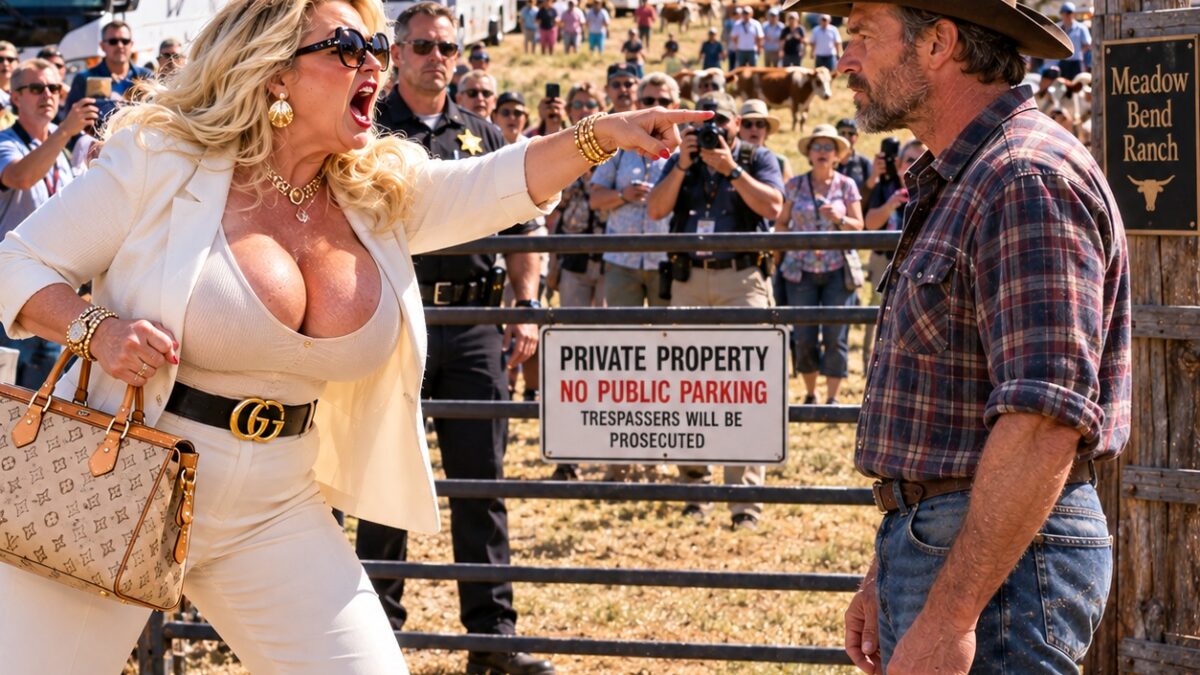
Brenda saw the uniforms and came marching across the field, bullhorn swinging at her side, Valentino sandals kicking up dust.
“Officers,” she said, “this is a community event. We have full authorization.”
The sergeant turned to her.
“Ma’am, whose property is this?”
“It’s community land. The HOA.”
“According to county records, this land belongs to Garrett Hollis. It is not HOA property.”
Brenda’s face went through three colors in four seconds.
Pink.
Red.
White.
The kind of white people turn when they realize charm has reached the end of the road.
“The board voted,” she said.
“The board cannot vote to take someone else’s property.”
“I have documents.”
“We have documents too.”
The Copper Canyon driver walked up, gray mustache stiff with anger.
“You told us this was authorized parking,” he said. “You told us it was HOA land. We’ve been paying you for eighteen months.”
Brenda opened her mouth.
Nothing came out.
Just air.
I stood by my truck with my thermos and watched the whole thing unravel.
Five hundred people.
Ten buses.
One bounce house.
And Brenda Kesler standing in the middle of a field she did not own, surrounded by people she had scammed and officers she could not charm, watching her empire collapse in the Saturday morning sun.
Her bullhorn hung at her side.
Her clipboard was gone.
Her Valentino sandals were covered in dust.
The deputies issued her a criminal trespass citation on the spot.
Two weeks later, the Yavapai County Attorney filed formal charges: criminal trespass, theft of services, fraud, and filing a false instrument with a government agency.
That sworn affidavit claiming she was authorized to represent my parcel carried the most weight.
Turns out signing fake government documents is harder to explain than an HOA letter.
The tour companies moved fast.
Within ten days, three of the five operators filed civil claims against Brenda personally, seeking refunds for parking fees. Copper Canyon alone had paid $31,400. Across all five, the amount came to just under $112,000.
The IRS investigation accelerated after the charges became public.
Brenda had reported none of the parking income.
Not a dollar.
Estimated unreported amount: $140,000 to $170,000.
The IRS does not care about designer handbags.
They care about receipts.
Brenda did not have any.
Crest View Meadows held an emergency board meeting three days after charges were filed. Brenda was removed as president by a vote of eleven to one.
The one vote in her favor was her own.
The board issued a formal letter apologizing for unauthorized actions taken without knowledge or approval of the general membership. Then they began auditing every expenditure Brenda made during her four years as president.
The early numbers were not flattering.
Six weeks later, a Yavapai County judge signed a permanent no-trespass order barring Brenda Kesler from entering parcel 401-26-038 for ten years.
Violation meant immediate arrest.
Wakefield called me with the news.
“She’s done.”
“What about the felony?”
“Her attorney is negotiating. Probation, community service, restitution. The IRS case is separate.”
“That one worse?”
“That one is going to cost her the Mercedes.”
I hung up and walked out to Meadow Bend.
It was early October. The monsoon rains had come and gone. The grass was thick and green, the kind of growth that happens when land is left alone long enough to remember what it is supposed to do.
The tire ruts were mostly filled.
The scraped strip where the bulldozer had worked was covered with new shoots of buffalo grass and desert marigold.
I stood in the center of the field and looked east toward Crest View Meadows. The terracotta rooflines caught the afternoon sun. Somewhere behind one of those walls, Brenda was probably sitting with a criminal defense attorney, a tax bill, and the slow realization that she had lost everything because she could not resist controlling one thing that did not belong to her.
I did not feel triumphant.
I felt tired.
And clean.
Two weeks later, I rented a tiller and plowed a quarter-acre patch on the south end of the field, where the soil was deepest and the afternoon shade lasted longest.
I built sixteen raised beds out of cedar planks and filled them with compost.
I did not offer them to the HOA.
I offered them to families.
The Winslows from the cul-de-sac took two beds for tomatoes. A retired couple on Pinion Lane planted herbs. Rey’s granddaughter claimed one for sunflowers. Levi took the last bed on the east row and planted watermelons because Clare always said there was nothing better than watermelon grown in Arizona dirt.
The sign at the entrance was small.
Cedar plank.
Hand-painted letters.
Meadow Bend Community Garden
Established by the Hollis Family
Below that, in smaller letters:
This land belongs to the people who take care of it.
The first evening after we put the sign up, Levi and I stood beside it while the sun dropped behind the low hills. The garden beds were still new, the cedar bright, the soil dark and soft under the surface.
“You think Mom would like it?” he asked.
I looked at the field.
At the cattle on the north end.
At the garden.
At the gate.
At the land Brenda had tried to turn into a parking lot, now coming back to life one seed at a time.
“She’d love it,” I said.
Levi nodded.
Then, after a while, “She’d probably tell us the sign is crooked.”
I laughed for the first time in what felt like months.
“She would.”
“So fix it.”
I did.
That night, I sat at Clare’s old desk and opened the bottom drawer.
The folder labeled Kesler Trespass Ongoing was too thick for the drawer now. Legal notices. Photos. Letters. Reports. Receipts. Camera stills. Court orders. Everything.
I should have felt like putting it away for good.
Instead, I opened the first note Brenda had sent, the one suggesting I donate the unused acreage for beautification purposes.
Unused.
I set it beside a photograph of Levi planting watermelon seeds in the garden bed.
Then I thought about Clare.
How she had named the field.
How she had seen what it could become long before I did.
How grief had made me think all I could do was preserve what she loved exactly as she left it.
But land is not memory sealed in glass.
Land has to live.
It has to change.
It has to be worked, rested, repaired, defended, and shared with people who understand that using something is not the same as stealing it.
Brenda never understood that.
She saw empty space and thought ownership belonged to the person bold enough to claim it.
She saw cattle and called them filthy.
She saw a widower and thought grief made him weak.
She saw a boy and assumed his father would be too scared to fight.
She saw a field and turned it into revenue.
But she forgot something simple.
A deed may sit in a drawer.
A fence may weather.
A chain may be cut.
But the truth of ownership does not disappear because someone with nicer shoes chooses not to read it.
Meadow Bend is still mine.
Still ours.
Still Clare’s in the way places remain tied to the people who loved them first.
The HOA stays on its side of the fence now.
The tour buses do not come.
The cattle graze.
The garden grows.
Levi’s watermelons came in small that first year, lopsided and pale, but when we cut one open on the porch, it was sweet enough to make him grin.
Clare would have said the desert rewards stubborn people.
Maybe she was right.
I used to think defending land meant keeping everyone off it.
Now I know better.
Defending land means deciding what kind of life is allowed to grow there.
Brenda tried to turn Meadow Bend into a parking lot for strangers.
I turned it into a place where neighbors plant tomatoes, kids chase grasshoppers, cattle move slow under the evening light, and my son can still feel his mother in the soil beneath his hands.
That is not revenge.
That is restoration.
And if there is one thing Brenda Kesler taught me, it is this:
Some people will only respect a boundary after they hit it hard enough to lose something.
Mine was marked with a deed, a survey, a chain, and the memory of a woman who believed that land, like love, only means something when you take care of it.