PART 2:The HOA President Brought Police to Steal My Ranch Road—She Didn’t Know the Captain Was My Wife
PART 2 and FULL ENDING  Thank you

At that moment, she held it like scripture.
Officer Russell Hail stepped out of the lead cruiser first.
I knew him by sight, not personally.
Thirty-eight or so. Broad-shouldered. Careful eyes. The kind of officer who looked at the whole scene before deciding what mattered. Officer Paige Donovan came around from the passenger side with a tablet in her hand and her hair pulled tight at the back of her head. The third unit stayed near the gate, engine running.
Vanessa moved forward before either officer had taken three steps.
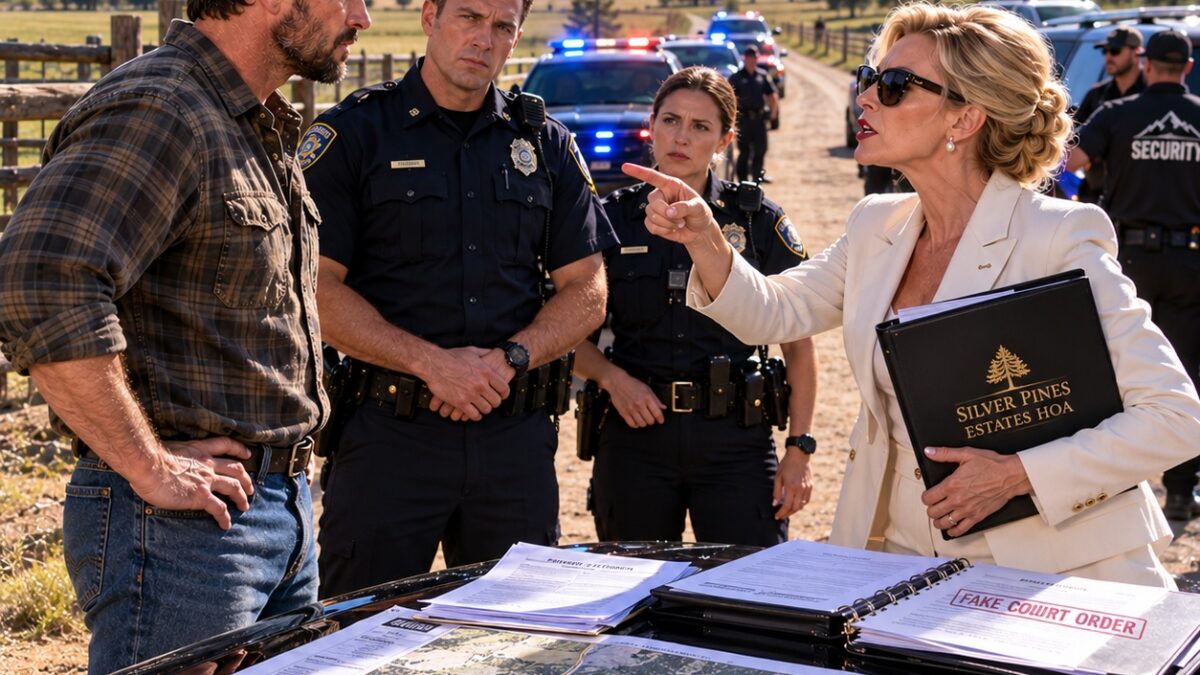
“Officer,” she said, “this is the man I told dispatch about.”
I folded the rag once, slowly, and set it on the tractor hood.
Hail lifted a hand—not at me, at her.
“Ma’am, let me make contact.”
She did not like that.
It showed for half a second in her mouth.
Then she smiled again because people like Vanessa know how to repair their faces faster than most people know how to tell the truth.
“Mr. Mercer?” Hail called.
“That’s me.”
“We’ve been asked to assist with enforcement of a property access order.”
“By whom?”
Before he could answer, Vanessa stepped in.
“By the lawful property holder.”
I did not look at her.
I kept my eyes on Hail.
“Officer, I’m asking you.”
The line was drawn right there in the gravel.
On one side stood a man who owned the land beneath his boots and had the papers to prove it.
On the other stood a woman who believed police officers were just another kind of contractor if you gave them the right-looking document.
Hail studied me for a second.
Then he said, “The complaint came from Ms. Whitmore on behalf of the Silver Pines Homeowners Association.”
“Silver Pines doesn’t own this road.”
Vanessa laughed softly.
Not a loud laugh.
Worse.
A pitying one.
“Grant, we’re past this.”
People like Vanessa love first names when they’re trying to make public humiliation feel intimate.
I turned toward her then.
Only then.
“No, Vanessa,” I said. “You are past patience. That is not the same thing as being right.”
Her smile thinned.
Officer Donovan glanced down at her tablet.
“Mr. Mercer, according to the paperwork sent to dispatch, this road is an HOA-recognized emergency access corridor, and you’ve been ordered to vacate and stop interfering with access.”
“Ordered by whom?”
She looked at Hail.
Hail looked at the folder Vanessa had provided.
Vanessa opened it quickly, like she had practiced the motion.
“The county has recognized the corridor,” she said. “Mr. Mercer has refused compliance for months.”
I asked, “Do you have a warrant?”
“No,” Hail said.
“A court eviction order?”
Hail hesitated.
“Apparently this is the order.”
“Who signed it?”
Nobody answered.
That was when I knew.
Not because I had not suspected before.
I had suspected a lot.
But suspicion is weather. It moves around you.
Proof is a fence line.
You either stand on one side of it or the other.
Paige Donovan took the document from Vanessa’s folder and studied it more closely. I watched her eyes slow down near the bottom of the page.
There was no legible judge’s signature.
Only a blurred seal, a docket number, and a clerk’s name I already knew did not match anyone currently working at the courthouse.
I had called the clerk myself the day the fake notice arrived.
There was no case.
There had been no hearing.
No judge had signed anything.
No lawful order existed.
Vanessa had brought police to my ranch with counterfeit paper and confidence.
That was all.
Before anybody could touch me, before anyone could step onto my land under the color of that lie, I said, “I’d like you to verify that document.”
Vanessa’s composure cracked.
“He’s stalling,” she snapped. “I told dispatch he would do exactly this.”
Hail did not look at her.
He looked at me.
“Do you have documentation supporting your claim?”
“Yes.”
I turned toward my workshop.
Vanessa’s voice jumped.
“He’s fleeing.”
Hail raised his hand again.
“Ma’am, stay where you are.”
I walked to the workshop, opened the steel cabinet near the tack room, and pulled out the binder I had prepared weeks earlier because my grandfather used to say two things saved land: fences and paper. The binder was black, three inches thick, tabbed in yellow and blue, and heavy enough to feel like a brick.
When I returned, Vanessa was whispering to one of her security guards.
She stopped when she saw the binder.
That was the first time I saw something close to fear touch her eyes.
Not enough.
But something.
I opened the binder across the hood of Hail’s patrol car.
Recorded deed.
Certified survey.
Title insurance policy.
County map.
Expired temporary construction easement.
Recorded termination.
Correspondence.
Photographs.
Non-emergency reports.
My hands were steady because I had forced them to be steady every day for six months.
“This is my deed,” I said.
Hail leaned in.
“This is my recorded survey. Here is the road. It leaves the county road, runs along my land past the barns and loading pens, and ends near the rear service gate Silver Pines built after the developer finished construction. The road belongs to Blackstone Ridge Ranch from first stone to last.”
Vanessa folded her arms.
“That corridor supersedes his private claim.”
I looked at her.
“Show me the court judgment.”
She opened her folder.
Flipped once.
Then again.
Then too many times.
There was no judgment.
There never had been.
“The county administratively approved the access correction,” she said.
“Did Caleb Strickland sign off on it?”
Her eyes hesitated one beat too long.
Officer Hail noticed.
So did Paige.
I had spent most of my life around cattle, fence lines, and contracts. I knew the moment when a predator stops moving like a predator and starts calculating escape.
Vanessa did not know I had already seen the proposed survey amendment.
She did not know Caleb had called me the afternoon it arrived at the county records office.
She did not know the signature at the bottom—the one meant to be mine—had already been flagged as fraudulent.
She did not know the county document examiner had the original.
She did not know I had been waiting for her to try turning paper into force.
“Caleb Strickland,” Hail repeated. “County surveyor?”
“Yes,” I said.
Paige looked at the HOA document again.
“This is a survey amendment?”
“A fake one,” I said.
Vanessa’s voice sharpened.
“He is making accusations to delay lawful enforcement.”
“No,” I said. “I’m asking you to verify what you brought to my ranch before anyone uses it against me.”
Hail stepped away and radioed dispatch.
“Unit Twelve requesting supervisory review of a property access document prior to enforcement. Possible authenticity issue.”
Vanessa’s patience evaporated.
“He can be arrested for obstruction.”
I looked at her.
“You don’t get to order arrests.”
Her eyes flashed.
“Maybe not. But they do.”
Then she turned toward Hail.
“Remove him.”
Hail did not move.
That, more than anything, changed the morning.
For months, Vanessa had been speaking to me like I was stubborn furniture she could eventually have hauled away. But now there was a man in uniform standing between her demand and my freedom, and for the first time he was not moving when she pushed.
I looked at Hail and Paige.
“Have you called your captain yet?”
Vanessa laughed.
The sound cut across the gravel.
“That’s your last trick? Asking for a supervisor?”
I didn’t smile.
“No,” I said. “I just think she’ll want to see the signature.”
Vanessa did not understand.
Hail didn’t either.
Not fully.
He thought I was talking about department policy, and I was.
Any disputed enforcement paperwork—especially one involving removal from land—had to be verified through command staff if field officers raised concerns.
I knew that because my wife had spent twenty years building a career around rules other people treated like obstacles.
I had not called her.
I would not call her.
That mattered.
Mallerie Mercer was forty-four years old, a captain with the county police department, and the most principled person I had ever loved.
She also happened to be my wife.
Most people in Silver Pines had no idea.
Mercer was not an unusual name.
Mallerie worked long hours at headquarters. She did not attend HOA meetings. She did not come to ranch supply stores in uniform. She had her own life, and I had never once used her badge as a shield in mine.
That morning, I was not invoking my marriage.
I was invoking verification.
But fate has a cruel sense of timing.
Dispatch forwarded the document and call details to command staff.
Mallerie was driving toward headquarters when the notification lit up her screen.
Blackstone Ridge Road.
Complainant: Vanessa Whitmore.
Respondent: Grant Mercer.
Later, she told me she pulled onto the shoulder so hard gravel spit against the cruiser tires.
For a few seconds, she sat with both hands on the wheel.
Part of her wanted to call me.
She did not.
If she called me, she would become my wife before she became the captain on duty.
And that morning, whether either of us liked it or not, her officers needed a captain.
She keyed her radio.
“Do not take enforcement action until document verification is complete.”
Then she called Lieutenant Owen Barrett and requested he respond as an independent command officer because the respondent was her spouse and any criminal investigation would require a separate chain of command.
That was Mallerie.
She did not bend rules even when bending them might protect me faster.
Especially then.
Ten minutes after Vanessa laughed, an unmarked command SUV rolled up the gravel road.
Vanessa was still arguing with Hail when the door opened.
Mallerie stepped out in full uniform.
Dark navy.
Gold badge.
Hair pinned back.
Face unreadable.
Vanessa turned toward the officers with visible relief.
“Finally,” she said. “Someone in command.”
Mallerie walked past her.
Not rudely.
Worse.
Professionally.
She looked at Hail.
“Status.”
Hail gave a clean report.
Complaint of unlawful obstruction of alleged HOA emergency access corridor.
Document presented as judicial order.
Property owner disputes validity.
Deed and survey contradict HOA document.
Officer Donovan notes concerns regarding seal and signature.
No enforcement action taken pending verification.
Mallerie listened without looking at me.
I stood by the patrol car with my binder open, trying not to love her more than I already did.
Vanessa jumped in.
“Captain, this man is illegally occupying HOA-controlled land.”
Mallerie glanced at her.
“Ma’am, stop talking for a moment.”
Vanessa’s mouth tightened.
No one spoke to her that way in Silver Pines.
Mallerie took the document from Paige and read it top to bottom.
The silence stretched.
A cow lowed from the lower pasture.
One of the security guards shifted his feet.
The morning sun climbed higher.
Mallerie turned to me with the same neutral tone she would have used with a stranger.
“Mr. Mercer, have you been served with an order from a court?”
“No, Captain.”
Vanessa interrupted.
“He has.”
Mallerie turned to her.
“Did you serve him?”
“Yes.”
“Are you an officer of the court?”
Vanessa faltered.
“No.”
“Who issued this document?”
“Our legal department.”
“What legal department?”
“Our counsel.”
Mallerie looked at Hail.
“Call the clerk of court. Put it on speaker.”
Hail did.
The clerk’s voice came through clearly in the cool morning air.
No matching case number.
No order on file.
No judge assigned.
No hearing.
No seal matching the current court seal.
No clerk with the job title listed at the bottom of the document.
The ranch seemed to go very quiet.
Vanessa’s face changed color.
Not pale exactly.
Thinner.
As if the blood had stepped back from the surface to wait for instructions.
“That may be an administrative notice,” she said quickly. “The terminology may have been imprecise.”
Mallerie looked at her.
“Ten minutes ago, you represented it as a court order.”
“I may have used the wrong term.”
Officer Donovan spoke up.
“Dispatch recording from last night captured Ms. Whitmore stating she had a signed judicial order.”
Vanessa shot her a look sharp enough to cut wire.
Paige did not blink.
That was the moment Vanessa understood she no longer controlled a single officer standing on my land.
So she did what cornered people do.
She tried to change the target.
She turned toward me and pointed.
“You’re exploiting a relationship.”
Mallerie asked, “What relationship?”
Vanessa jabbed her finger harder.
“Whatever connection he has with your department.”
Hail glanced at me.
I said nothing.
Mallerie’s face did not change.
“He’s my husband.”
For a moment, nobody spoke.
Even the security guards looked up.
Vanessa seized on it like a drowning woman reaching for rope.
“This is corruption.”
Mallerie had prepared for exactly that before she arrived.
Lieutenant Owen Barrett’s cruiser was already turning through the gate.
Mallerie looked at him as he stepped out.
“Lieutenant Barrett will assume investigative command on any criminal matter arising from this incident due to my conflict of interest.”
Then she turned back to Vanessa.
“I will not investigate a case involving my husband. But I am still the commanding officer on this scene, and I am responsible for ensuring my officers do not enforce an unverified document.”
Her voice was calm.
Not defensive.
Not apologetic.
That calm seemed to infuriate Vanessa more than shouting would have.
“You came here because of him.”
“I came here because officers under my command were asked to remove a citizen using a document that does not verify.”
“He called you.”
“No,” Mallerie said. “Dispatch did.”
She turned to Hail.
“Preserve every document Ms. Whitmore provided.”
Vanessa reached for the folder.
Paige held on.
“That belongs to the HOA.”
Mallerie shook her head.
“Not anymore. It is evidence.”
That was when Vanessa’s smile vanished completely.
I had seen people lose their tempers.
I had seen buyers lose deals, ranch hands lose money, contractors lose lawsuits, and men in feed stores lose arguments they should never have started.
But I had never seen a woman lose the reality she thought she controlled.
The county clerk sent written confirmation within the hour.
The document examiner issued a preliminary opinion from the scanned copy.
The seal had been lifted from a public county file and digitally altered.
The case number belonged to an unrelated matter closed years before.
The survey amendment carried a forged version of my signature.
The signature labeled “county recording deputy” belonged to a woman who had retired from that office long before the document was created.
Hail turned to Vanessa.
“Did you create these documents?”
“No.”
“Who did?”
“Our attorney.”
Paige stepped aside and called Derek Vaughn, the HOA’s attorney.
He picked up on the second ring.
Paige put him on speaker.
“Mr. Vaughn, this is Officer Donovan with county police. Did you prepare a court order authorizing removal of Grant Mercer from Blackstone Ridge Ranch?”
“No,” Derek said immediately.
Vanessa could hear every word.
Her face tightened.
“Did you authorize Ms. Whitmore to present any HOA document as an eviction order or judicial order?”
“Absolutely not.”
“Did you approve or submit an amended survey transferring or creating a corridor across Blackstone Ridge Ranch?”
“No.”
“Have you advised the HOA that it has authority to seize or occupy the road without a court judgment?”
“No. In fact, I advised the opposite.”
Vanessa whispered, “Derek.”
Her voice held warning.
The speaker picked it up.
Derek said, “Vanessa, if you are standing with police, stop talking.”
That was the first good legal advice she took all morning.
But it was too late.
Lieutenant Barrett reviewed the dispatch recording, the clerk confirmation, the document examiner’s preliminary findings, Derek’s denial, and the paperwork Vanessa had handed officers.
Then he looked at Mallerie and said, “We have enough.”
Mallerie turned to Hail.
Her voice was short.
Steady.
“Place Ms. Whitmore under arrest.”
Vanessa froze.
“Arrest me?”
Hail stepped forward.
“Ms. Whitmore, turn around and place your hands behind your back.”
Vanessa spun toward Mallerie.
“Because of your husband.”
Mallerie did not blink.
“No. Because you lied to my officers and handed them a forged government document.”
Vanessa backed up one step.
Her two security guards glanced at each other.
Neither moved to help her.
That told me something about the kind of loyalty money buys.
It ends at handcuffs.
“Silver Pines pays taxes,” Vanessa said, voice rising. “Your department works for us.”
Mallerie’s answer was quiet and final.
“My officers enforce the law. They do not work for your HOA.”
The cuffs clicked shut.
I did not smile.
I did not gloat.
I did not say what part of me wanted to say.
I only stood beside the patrol car with my binder under my arm and watched the woman who had spent six months trying to take my road discover that paper cuts both ways when the ink is false.
As Hail guided her toward the cruiser, Vanessa twisted around.
“You set me up.”
I finally answered her.
“I told you to take me to court.”
Inside the cruiser, she sat rigid against the seat, staring through the glass at the ranch she had been so sure she could take.
Her phone buzzed twice in her jacket pocket.
She could not reach it.
Somewhere across the county, I would later learn, a developer was waiting for a promised photograph of HOA trucks rolling down my road.
For the first time in months, Vanessa had nothing to send.
It should have ended there.
Of course it didn’t.
Before Hail could close the cruiser door, a silver sedan came racing up the gravel road so fast dust followed it like smoke.
It skidded to a stop behind Barrett’s cruiser.
A woman climbed out clutching a laptop against her chest.
Marlene Bishop.
Sixty-one years old.
Treasurer of the Silver Pines HOA.
I knew her only in passing. She had always seemed loyal to Vanessa in that silent way some people are loyal to storms—they learn which way to lean so they do not get knocked over.
That morning, she did not look loyal.
She looked terrified and determined, which is a stronger combination.
She walked straight past the security guards toward Lieutenant Barrett.
“If you’re arresting Vanessa over those papers,” she said, breathless, “then you need to see where the money went.”
Vanessa’s head snapped toward the cruiser window.
“Marlene,” she shouted through the glass.
Marlene flinched.
But she did not stop.
That tiny act of not stopping may have been the bravest thing I saw that morning.
She opened her laptop on the hood of Barrett’s cruiser.
Her hands shook so badly she mistyped her password once.
Then she pulled up the HOA ledger.
Over six months, Vanessa had moved tens of thousands of dollars from the HOA reserve fund to a company called Civic Boundary Solutions.
Purpose: Land Acquisition Consulting.
The company had existed for only six months.
Its registered agent used the same home address as Vanessa’s brother.
The payments were not small.
$18,500.
$27,000.
$34,000.
Smaller transfers in between.
Altogether, almost $96,000 had left the reserve fund without valid board approval.
Marlene’s voice broke when she said it.
“I questioned it months ago. She told me it was legal strategy. She said Derek approved it.”
Derek had not.
Vanessa kicked the inside of the cruiser door.
“Do not listen to her!”
No one looked at Vanessa.
That was another kind of ending.
Based on Marlene’s records, the document forgeries, the recovered dispatch recording, and Derek’s statements, investigators obtained a search warrant for the HOA office.
I had no role in that.
Mallerie recused herself entirely from investigative command.
Lieutenant Barrett ran it from start to finish.
That mattered to both of us.
I did not want the case saved by my marriage.
I wanted it saved by evidence.
And the evidence, once they opened the HOA office computers, came out like rot from a broken wall.
High-resolution scans of county seals.
Blank deed templates.
Editable notice forms.
A spreadsheet of parcel numbers.
Draft survey language.
Fake docket formats.
A folder of scanned signatures.
And an email where Vanessa wrote:
Make the order look official enough that police will honor it.
I read that line later in Barrett’s report and had to set the paper down.
Not because I was surprised.
Because I wasn’t.
The worst discovery sat in a folder labeled Phase 2 Acquisition.
Silver Pines was preparing to expand.
A developer wanted to build sixty-four new luxury homes beyond the existing subdivision, up along the ridge where scrub oak gave way to views rich people liked to describe as untouched while planning to touch all of it.
The county would only approve the project if the subdivision secured a second entrance that met emergency access standards.
Without the road across Blackstone Ridge Ranch, the expansion was dead.
That was the real motive.
Not safety.
Not community necessity.
Not property values.
Not emergency access.
Money.
The developer had offered the HOA a $3.6 million infrastructure contribution on one condition.
The corridor had to be secured before the approval deadline.
Vanessa had already assured them she controlled my land.
In one email, she wrote:
Mercer will fold once enforcement arrives.
I sat at my kitchen table when Barrett walked me through the findings.
Mallerie sat beside me, off duty, silent.
The room smelled like coffee and dust because I had come in from the barns and forgotten to change my boots.
Barrett read the sequence.
First, create paperwork convincing enough to survive a quick glance.
Second, call police.
Third, frighten me with arrest.
Fourth, force me off the corridor.
Fifth, photograph HOA vehicles using the road.
Sixth, use physical occupation as leverage in negotiations and county approvals.
I had thought I was dealing with a rich HOA president who couldn’t hear the word no.
I had been wrong.
She had already sold my road in her mind.
She had already built the future on top of my signature.
She had already decided I was not a person.
I was the last obstacle before the payout.
For a long time, I said nothing.
Mallerie’s hand moved under the table and found mine.
She did not speak either.
She knew silence sometimes holds more than words can carry.
Finally, I said, “She never thought I mattered.”
Barrett closed the folder gently.
“I think she thought you mattered only as a problem.”
That was worse.
Derek Vaughn turned over his private correspondence next.
He had warned Vanessa repeatedly.
Do not alter deed records.
Do not create court paperwork.
Do not call law enforcement to settle a title dispute.
Do not represent HOA notices as judicial orders.
One exchange stood above the rest.
Derek wrote:
If Mercer challenges this, we lose.
Vanessa replied:
Then don’t give him time to challenge it.
That was her whole philosophy in one sentence.
Don’t give him time.
Don’t give him room.
Don’t give him process.
Don’t give him court.
Don’t give him truth.
Just arrive early, arrive loudly, arrive with police, and make the lie real before anyone can read it.
Vanessa was released pending proceedings with a court order barring her from contacting me directly.
Most people, after being arrested at the scene of their own forgery unraveling, might have gone home quietly.
Vanessa called an emergency HOA meeting.
Of course she did.
By then, Silver Pines was buzzing like a kicked hornet’s nest.
Residents had seen police at the ranch.
They had seen Vanessa taken away.
They had heard rumors about forged documents.
They had received vague emails from a temporary board member telling them the matter was “under review.”
Vanessa could not allow silence to do what facts might do.
So she stood before a packed clubhouse and tried to turn herself into the victim.
She told them I was an angry rancher abusing my wife’s police position.
She told them Mallerie had intervened corruptly.
She told them the expansion, the emergency access plan, and the financial future of Silver Pines were under attack by one hostile landowner.
Some residents believed her.
At first.
People often believe the first confident voice they hear, especially when the truth might cost them money.
Then Vanessa asked the board to authorize emergency funds for her legal defense.
That was when Marlene stood up.
I was not there.
I heard about it later from Derek, from Marlene, from three residents who called me to apologize in different ways, and from the meeting recording that eventually became evidence.
Marlene walked to the front of the clubhouse carrying copies of bank statements.
She handed them out row by row.
Vanessa ordered her to sit down.
Marlene kept walking.
When everyone had a copy, she turned to the room and said, “Before any homeowner here agrees to spend another dollar defending Vanessa Whitmore, you need to know where ninety-six thousand dollars of your reserve fund went.”
The room quieted.
Vanessa laughed too sharply.
“This is a confidential legal matter.”
Marlene held up a bank statement.
“Civic Boundary Solutions received these payments. Vanessa called them land acquisition consulting fees.”
A man in the front row said, “Who is Civic Boundary Solutions?”
Marlene looked at Vanessa.
“That’s what I asked.”
Vanessa’s voice cooled.
“A legitimate consultant.”
Marlene asked one question.
“Then why is your consultant’s address your brother’s house?”
The clubhouse went silent.
A retired pilot named Art Coleman set down his coffee so carefully the paper cup did not make a sound.
A young couple near the back looked at each other with matching expressions of dawning fear.
These were the same people who had applauded Vanessa when she said one man could not stand in the way of more than a hundred homeowners.
Now they were realizing every dollar in that reserve fund had come out of their pockets.
Then the side door opened.
Derek Vaughn walked in.
The association’s attorney.
The man Vanessa had tried to blame in front of police.
He did not make a speech.
He simply walked to the front, placed his briefcase on the table, and said, “Effective immediately, I resign as counsel for Silver Pines HOA.”
The room erupted.
He raised one hand.
“I will not represent a board while its president tells residents I produced documents I did not prepare and advised actions I specifically warned against.”
Vanessa stood.
“You are violating attorney-client privilege.”
“No,” Derek said. “I’m correcting false statements you made about me.”
He read one email aloud.
Vanessa had written:
Can you make something the police won’t question?
His reply had been two words.
Absolutely not.
The room turned.
Vanessa felt it.
So she did what she always did when cornered.
She attacked.
She moved for an emergency vote to remove Marlene from the board.
But by then, the fear had shifted sides.
Residents began demanding an audit.
A motion came from the floor.
Seconded.
Passed by a wide margin.
An independent forensic audit of every account the HOA held.
Vanessa gathered her folder, her purse, and what remained of her dignity and walked out while the argument raged behind her.
I was not there.
I didn’t need to be.
For months, she had made it Grant against Silver Pines.
That night, it became Silver Pines against the woman who had used them.
The audit was worse than anyone expected.
Inflated consulting invoices.
Unauthorized security contracts.
Payments routed through shell vendors.
A deposit tied to the expansion deal that the board had never formally approved.
The total financial exposure exceeded $640,000.
When the developer’s lawyers saw the audit alongside the criminal charges, they suspended the agreement.
No corridor.
No Phase 2.
No $3.6 million infrastructure contribution.
Everything Vanessa had built began collapsing under its own weight.
The civil case moved alongside the criminal one.
I did not sue every resident of Silver Pines.
I had no interest in punishing families who had trusted their HOA president and then discovered too late that trust had been expensive.
My claims were specific.
Vanessa personally.
The HOA only for actions its board had authorized.
Civic Boundary Solutions.
Anyone connected to the forged filings.
I wanted my title confirmed.
A permanent injunction.
Damages.
Legal fees.
Restoration costs for my fence line and road.
Compensation from the people who had actually committed the fraud.
In court, Vanessa looked different.
Not humbled.
Diminished.
There is a difference.
Humility requires understanding what you did to other people.
Diminishment only means the room no longer bends around you.
She wore gray instead of white.
Her attorney did most of the speaking.
She kept her eyes low when the forged documents were discussed.
She looked up only when money was mentioned.
That told me enough.
The judge ruled decisively.
Blackstone Ridge Ranch belonged entirely to me.
The temporary construction easement had terminated years earlier.
The HOA held no right of access whatsoever.
The proposed survey amendment was void.
The forged instrument was expunged from the county record.
Then came the permanent injunction.
Silver Pines HOA was barred from entering my land, posting signs on it, installing cameras on it, sending contractors onto it, claiming ownership of any corridor, or creating any access document without my valid signature and proper legal process.
I thought that would feel like victory.
It felt like exhaustion wearing a suit.
Mallerie sat behind me that day, not in uniform.
She had no role except wife.
When the judge finished, she squeezed my shoulder once.
Just once.
That was enough.
Civil discovery made things even worse for Vanessa.
Civic Boundary Solutions had no employees.
No office.
No real work product.
Money went in, then moved back out to accounts connected to Vanessa’s family.
The HOA’s insurance carrier refused to cover much of her conduct, citing intentional fraud exclusions.
The new Silver Pines board sued her directly to recover association losses.
Consequences came the slow, lawful way.
Judgment liens.
Asset disclosures.
Settlement negotiations.
A rental house she owned across town was sold.
Her luxury SUV disappeared next.
A substantial share of the equity in her large Silver Pines home was pulled into the settlement.
Months earlier, standing in my driveway, she had told me I had two choices.
Sell them the easement or the county would take it.
Now she was the one running out of choices.
The criminal case ended with a plea.
Vanessa pleaded guilty to charges tied to filing a fraudulent instrument, making false statements to law enforcement, attempting to deceive officers into enforcing a fake order, and financial misconduct involving HOA funds.
At sentencing, the judge did not focus only on money.
That surprised some people.
It did not surprise me.
The judge leaned forward and said what troubled the court most was that Vanessa had attempted to turn sworn police officers into tools in a private scheme to seize another person’s property.
“An HOA may carry influence,” he said, “but it cannot turn fake paper into real law.”
Vanessa stood at the defense table with her hands clasped.
She stared at the floor.
The woman who had once told a clubhouse full of homeowners that one man could not stand in the way had finally learned that one recorded deed, one careful officer, and one call to the clerk could stop her cold.
Mallerie did not speak at sentencing.
She did not sit with prosecutors.
She testified only once, strictly about command decisions she made at the scene.
She never used her rank to add weight to my anger.
I loved her for that too.
Afterward, outside the courthouse, a reporter tried to ask me how it felt knowing my wife had been the captain on scene.
I said, “My wife did her job. Officer Hail did his. Officer Donovan did hers. The clerk did hers. That’s why this worked.”
The reporter looked disappointed.
I suppose she wanted romance or scandal.
All I had was respect.
Vanessa was permanently barred from serving on the Silver Pines board.
The association adopted new bylaws requiring independent legal review and full member disclosure before any land action above a certain amount could move forward.
The same residents who once applauded her voted for those changes almost unanimously.
A few wrote letters to me.
Some apologized.
Some explained.
Some did both badly.
I read them all.
Responded to few.
There are apologies that want to heal the wound, and apologies that only want relief from guilt.
Time teaches a man the difference.
Marlene came to the ranch once after everything settled.
She drove an old silver sedan, parked outside the gate, and called instead of assuming she could come in.
I respected that.
I opened the gate.
She stepped out holding a paper bag.
“Banana bread,” she said awkwardly.
I took it.
“Thank you.”
“I didn’t know what else to bring.”
“Most people don’t bring anything.”
She looked toward the road Vanessa had tried to steal.
“I should have questioned her sooner.”
“Yes.”
Marlene nodded.
No defense.
“I was afraid of being the difficult woman in the room.”
“You became her anyway.”
She laughed once, sad.
“Too late.”
“Late matters less than never.”
She looked at me then.
“Do you believe that?”
I thought about it.
“Yes. But late still leaves damage.”
Her eyes filled.
“That’s fair.”
We stood by the gate in silence.
Then she said, “The new board approved the letter of apology.”
“I received it.”
“It wasn’t enough.”
“No.”
“But it was true.”
“Yes.”
She nodded as if that was all she came for.
Before she left, she said, “For what it’s worth, Vanessa underestimated you because you were quiet.”
I looked out over the pasture.
“No. She underestimated quiet.”
A few months later, I stood at the same gate where the cruisers had lined up in the early light.
The Silver Pines emergency signs were gone.
So were the cameras Vanessa had ordered installed near my utility poles.
No white security vehicles sat nearby.
No one wrote down the plates of my hay trucks.
The county had placed new survey monuments along the boundary—granite markers set in concrete so that no one would ever again pretend the line was a matter of opinion.
Silver Pines eventually built a separate emergency access route on land it legally purchased on the far side of the subdivision.
It cost far more than the easement Vanessa had tried to buy from me.
But this time, there were no forged papers.
No threats.
No police at anyone’s gate.
No coercion.
Just a deal, a deed, a permit, and a road built where the owners had actually agreed to build it.
That is how civilization is supposed to work.
People forget that until someone like Vanessa reminds them what happens when power outruns permission.
The formal apology from the new board arrived on cream-colored paper.
I read it once at the kitchen table.
Mallerie watched over her coffee.
“Well?” she asked.
“It says the right things.”
“Do you believe them?”
“Some of them.”
“What will you do with it?”
“File it.”
“You’re not going to frame it?”
I looked at her.
She smiled.
It was the first joke either of us had made about Silver Pines in months.
“No,” I said. “I’m not going to frame the HOA apology.”
But I did frame something.
Not the forged order.
Not the newspaper clipping.
Not a photograph of Vanessa in handcuffs.
I framed the original survey of Blackstone Ridge Ranch.
The one recorded eighteen years before Vanessa decided the truth had become inconvenient.
I hung it on the workshop wall above my main bench.
Beneath it, I fixed a small brass plate engraved with one line:
RECORDED 18 YEARS BEFORE ANYONE DECIDED THE TRUTH WAS INCONVENIENT.
Caleb Strickland saw it when he stopped by to inspect the new monuments.
He stood under it for a long time with his coffee in one hand.
“Subtle,” he said.
“I considered bigger letters.”
He chuckled.
“Your grandfather would’ve liked this.”
“You think?”
“He liked anything that reminded people to read before building.”
That was true.
Caleb stayed for an hour, and we talked about rain, fence posts, old county maps, and a bull I had named Congressman because he made a lot of noise and broke things without helping.
We did not talk about Vanessa.
That felt like progress.
One evening, months after the sentencing, Mallerie came home from a long shift and found me on the porch.
The sun was dropping behind the hills.
Blackstone Ridge lay quiet in the gold light.
Cattle grazed near the lower pasture.
Far beyond the tree line, the rooftops of Silver Pines caught the last of the sun.
Two properties.
Two boundaries.
For the first time in many months, no one pretending the line between them did not exist.
Mallerie sat beside me with a tired sigh.
“You know what the strangest part is?” I asked.
“What?”
“She could have just negotiated.”
Mallerie looked toward the gate.
“She could have offered a fair price,” I said. “She could have bought another parcel. She could have built another road. She could have walked away from the expansion.”
“But she didn’t.”
“No.”
We sat quietly.
Then Mallerie said, “She didn’t understand power.”
I turned to her.
“What do you mean?”
“She thought power meant making people do what she wanted.”
I waited.
Mallerie’s voice softened.
“Real authority is knowing what you’re not allowed to do.”
I carried that sentence with me for a long time.
I remembered Vanessa standing behind officers as if their badges belonged to her.
I remembered her folder full of false seals and copied signatures.
I remembered her telling me the county would take what I refused to sell.
I remembered how close it had been.
Because it had been close.
People like cleaner endings than real life gives.
They want to believe the truth always announces itself with trumpets.
It does not.
If Hail had been in a hurry, if Paige had not looked closely, if Mallerie had not required verification, if the clerk had not answered, if Caleb had not warned me, if Marlene had stayed afraid, that morning could have gone differently.
Not permanently, maybe.
But badly enough.
I could have been removed from my own road in front of my own barns under a fake order.
HOA trucks could have rolled through.
Photos could have been sent.
The developer could have argued existing access.
The lie could have gained weight before the truth had boots on.
That is how land gets stolen.
Not always with fences torn down in the night.
Sometimes with paperwork passed quickly to tired people and confident voices saying everything has already been settled.
So I keep records.
Still.
Every deed.
Every survey.
Every letter.
Every boundary marker.
I check the locks on the gate, not because I expect Vanessa to return, but because stewardship is not paranoia.
It is memory with work gloves on.
Late one afternoon, I drove my pickup down to the ranch gate.
The air smelled like dust and cut hay.
I stepped out, unlocked the chain, and swung the gate open.
Out on the county road, a patrol cruiser passed by.
Officer Russell Hail was behind the wheel.
He lifted one hand.
I raised mine in return.
Neither of us stopped.
Neither of us needed to.
He had done his job on a morning when doing it carefully mattered more than he knew.
I pulled through, closed the gate behind me, and locked it.
Blackstone Ridge Ranch lay still under the evening light.
Pastures turning gold.
Oak shadows stretching across the draws.
Barn roofs catching the last fire of sunset.
Beyond the tree line, Silver Pines looked almost peaceful.
Maybe it was.
I hoped so.
Not because I owed them peace.
Because people living beside you in this world should not have to keep paying for one woman’s greed forever.
Vanessa had brought police to my ranch to prove power was on her side.
Instead, those same officers became the first witnesses to her lies falling apart.
She wanted my road without court, without consent, without truth.
In the end, the papers she forged to avoid the law delivered her straight into its hands.
And the road stayed where it had always been.
On Blackstone Ridge Ranch.
Behind my gate.
Under my name.
Protected not by power, not by anger, not by who I was married to, but by something Vanessa never respected enough to fear until it was too late.
A recorded truth.
A careful record.
And people willing to stop, read, and verify before obeying a lie.