PART 2:The HOA Karen Screamed at My Locked Gate—Then the Shortcut She Loved Exposed Her Million-Dollar Lie


“I’ve built half the world for other people.”
“That’s not what I asked.”
I looked out over his yard, where the grass had gone patchy and the shed roof sagged.
“I don’t know.”
He nodded.
“You should. A man needs something that doesn’t salute back.”
That was the closest my father ever came to poetry.
When he died, he left me what he had saved. Not a fortune, but enough. Combined with my own savings from years of living carefully on an Army paycheck, it gave me nearly three hundred thousand dollars to work with.
I had a son to think about.
Wyatt was fourteen, long-legged, sharp-eyed, and too quiet after his mother left. She did not die. Sometimes that makes a wound harder to explain. She simply decided the Army life had taken too much, and when I retired, she decided she did not want the civilian version of us either. She moved to Charlotte with a man who sold boats and posted motivational quotes under gym selfies.
Wyatt stayed with me.
He said he wanted land.
At least, that was how he put it.
“I want somewhere I can see the sky without looking past somebody’s roof.”
That made the decision easy.
The sixty acres outside Ridgewood Heights Estates were not pretty in the way real estate brochures like. There was no white fencing, no stocked pond shaped like a heart, no farmhouse porch staged with rocking chairs and lemonade. It was raw Georgia land—pine and hardwood, a narrow creek through the back, two sagging barns, an old mobile home that smelled like mice and mildew, and a dirt track worn across the north side where people had been cutting through for years.
But it had sky.
It had quiet.
It had room for Wyatt to breathe.
The first time I walked the property with the selling agent, a silver SUV came barreling down the dirt track at forty miles an hour, throwing red dust behind it like smoke. The driver did not slow when he saw us. He lifted two fingers from the steering wheel like he owned the place and kept going.
I watched the dust settle.
“What was that?”
The agent, a nervous man named Kip with shoes too clean for land work, cleared his throat.
“That’s just the neighborhood shortcut.”
“Neighborhood?”
“Ridgewood Heights. The subdivision on the other side.”
“This is private property.”
“Yes, but the previous owner allowed them to use it.”
“Allowed?”
Kip looked toward the tree line.
“Well, didn’t stop them.”
Those are two very different things.
I knew it then.
I also knew I could use that difference to lower the price.
The previous owner was a man named Hollis Crane, eighty-two years old and already living with his daughter in Valdosta. He had bought the tract decades earlier for timber and hunting. He had not lived on it in years. People from Ridgewood had started cutting across in small numbers at first—one car, two cars, maybe a delivery driver following bad GPS. Then more. Then every weekday morning and afternoon, an informal commuter lane had formed across his land.
When I asked if there was a recorded easement, Kip said he did not believe so.
I told him belief was for church.
Records were for land.
The closing attorney pulled the title work. No public road. No access easement for Ridgewood residents. No recorded maintenance agreement. No HOA rights. No county dedication. No prescriptive easement established through legal action. Nothing.
The track was mine if I bought the land.
The problem was that half a subdivision had decided it was theirs because nobody had made them stop.
I bought the property anyway.
Maybe because of that.
Maybe because I was tired of watching people treat undefended lines as invitations.
I signed the papers on a Friday morning. Wyatt and I drove out that afternoon with two folding chairs, sandwiches, a cooler, and my father’s old field binoculars. We sat beneath a pine near the mobile home and watched cars cut across the north track for nearly two hours.
Sedans.
Pickup trucks.
Two delivery vans.
A landscaping trailer.
A teenager in a Jeep who fishtailed in the clay and laughed while his passenger filmed it.
Wyatt counted seventy-three vehicles before dinner.
“That seems like a lot,” he said.
“It is.”
“Are they allowed?”
“No.”
“Do they know that?”
“Some do.”
“What about the rest?”
“They’re about to.”
I said it calmly.
Wyatt looked at me sideways.
“Is this going to be one of those things where you say everything is fine, but then it turns into a whole thing?”
I looked at my son, who was old enough to know me too well and young enough to still hope I might surprise him.
“Yes.”
He nodded.
“Okay. Just checking.”
The first week, I did not block anything.
I watched.
I documented.
I set up trail cameras.
I walked the track, measured the width, photographed the erosion, mapped the drainage, checked the old culvert where the dirt road crossed the shallow creek bed near the western edge.
That culvert worried me most.
Two rusted corrugated pipes, half-choked with silt, with the soil beginning to undercut around them. Fine for an old farmer’s pickup once in a while. Not fine for hundreds of vehicles a day. Not fine for delivery vans. Definitely not fine for the loaded dump truck I saw cut through on Wednesday afternoon like it had every right in the world.
The Army teaches you that roads are not just lines on a map.
They are systems.
Surface.
Drainage.
Base.
Load.
Sight distance.
Maintenance.
Failure points.
A road used incorrectly becomes a weapon waiting for gravity.
By the tenth day, I had enough photographs to fill a binder.
By the twelfth, I had a surveyor on site.
By the fifteenth, I had a county-certified copy of my property boundary and a written opinion from a real estate attorney named Paula Wexler that Ridgewood Heights had no recorded right to cross my land.
By the end of the month, I had hired a local welder, poured posts, installed the black steel gate, mounted cameras, and placed a lockbox for emergency services after coordinating with the county fire marshal.
That last detail matters.
I did not block emergency access.
I did not trap anyone.
I did not create danger.
I closed a private commuter shortcut and made sure firefighters could still get through if life or property required it.
Tammy Prescott never mentioned that part.
People like Tammy do not like details that ruin a villain story.
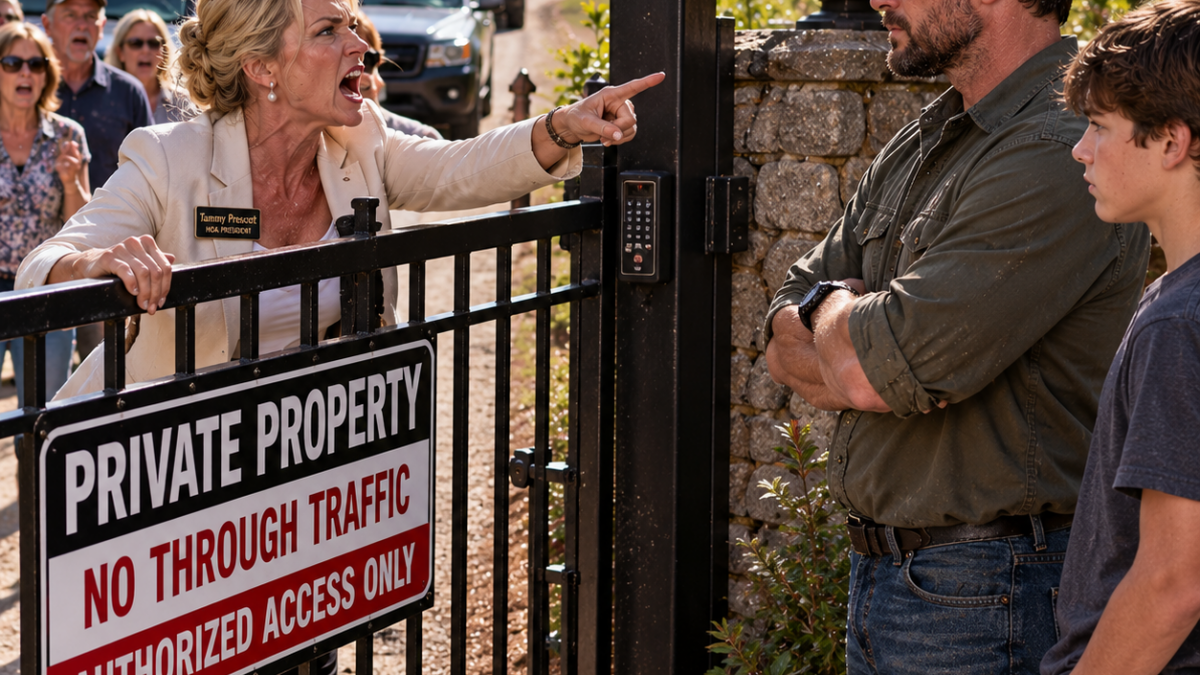
The morning she screamed at my gate, she was wearing white capris, wedge sandals, a coral blouse, and sunglasses pushed into honey-blond hair that looked expensive enough to have its own maintenance budget. She was somewhere in her early fifties, but she carried herself with the brittle energy of someone who had confused control with youth.
She shook the gate a third time.
A man in the first car behind her rolled down his window.
“Tammy, I’ve got a nine o’clock.”
She spun on him.
“So do I, Gerald.”
He rolled the window back up.
Wyatt snorted into his orange juice.
“She’s scary.”
“No,” I said. “She’s loud.”
“What’s the difference?”
“Scary has power. Loud wants you to think it does.”
He thought about that.
Down at the gate, Tammy turned and looked toward my porch. She saw us then. Or saw movement. She marched up the dirt track toward the house, waving her phone like a weapon.
“Here we go,” Wyatt said.
“Stay on the porch.”
“I wasn’t planning to joust her.”
“Wyatt.”
“I’ll stay on the porch.”
Tammy stopped ten feet from the steps.
“Are you Colt Brannigan?”
“Yes, ma’am.”
“Do you have any idea what you’ve done?”
“I installed a gate.”
“You blocked the Ridgewood Connector.”
“I blocked my private road.”
“It is not private.”
“It is.”
“This route has been used by Ridgewood residents for years.”
“I’m aware.”
“Then you know you can’t just close it.”
I leaned back in my chair.
“Watch me.”
Her nostrils flared.
Wyatt made a choking sound and turned it into a cough.
Tammy pointed at the gate.
“That is a recognized community access route.”
“Recognized by whom?”
“Ridgewood Heights Estates.”
“You don’t recognize property lines into nonexistence.”
“This is a matter of community necessity.”
“No. It’s a matter of convenience.”
“You have no idea how many families depend on that road.”
“I counted seventy-three vehicles in two hours last Friday.”
She blinked.
Only once.
But I saw it.
“You were spying?”
“I was observing traffic on my land.”
“That shortcut reduces congestion, improves emergency evacuation, and supports the property values of more than one hundred and eighty homes.”
“Then one hundred and eighty homes should have bought land with a shortcut.”
Her mouth tightened.
“You’re military, aren’t you?”
“Retired.”
“I respect your service.”
That sentence always made me brace for the disrespect coming next.
“But service also means understanding sacrifice for the greater good.”
There it was.
I set my coffee down.
“Ms. Prescott, I gave twenty years to the greater good. This gate is for my son, my liability policy, my land, and every driver who thinks a dirt track with a failing culvert is a public commuter lane because your HOA found it useful.”
“You don’t get to make that decision unilaterally.”
“I own the land unilaterally.”
“You bought property with an established road.”
“I bought property with trespass wear.”
She stared at me like I had spoken a foreign language.
Then she looked at Wyatt.
That was her mistake.
“Young man,” she said, softening her voice in a way I did not like, “I’m sure your father doesn’t want all your new neighbors angry with you.”
Wyatt froze.
The air shifted.
My son had survived enough adult selfishness to recognize when someone was trying to make him responsible for their feelings.
I stood.
Not fast.
Not dramatic.
Just stood.
Tammy’s eyes came back to me.
“Do not speak to my son.”
“I was only—”
“No.”
One word.
Quiet.
The way I had said it to men twice my size when they were about to step somewhere they should not.
Tammy swallowed whatever she had planned to say.
Then she lifted her phone.
“I’m calling the county.”
“Good.”
“You’ll be ordered to remove that gate.”
“I won’t.”
“You don’t know who you’re dealing with.”
“I know exactly who I’m dealing with.”
That afternoon, the sheriff’s office sent a deputy named Aaron Bell. He was polite, sunburned, and young enough to still look uncomfortable when older women yelled at him. Tammy arrived before he did, along with two Ridgewood board members, a man with a tablet, and fifteen residents who parked on the road shoulder like they were attending a protest.
Deputy Bell listened to Tammy first.
That irritated her because she expected him to obey, not listen.
She told him the road was an established community connector, that I had created a public hazard, that I was preventing residents from reaching work, school, medical appointments, and essential services.
Then she used the phrase “landlocked access.”
I laughed.
I should not have.
Deputy Bell looked at me.
“Mr. Brannigan?”
I handed him my binder.
Deed.
Survey.
Attorney letter.
Fire marshal lockbox agreement.
Traffic photos.
Culvert inspection notes.
No recorded easement.
No public dedication.
No county maintenance.
No HOA access rights.
Bell read longer than Tammy liked.
“This is a private property matter,” he finally said.
Tammy’s face hardened.
“He is blocking a road.”
“He is blocking a private drive on land the county records show belongs to him.”
“Our residents have used it for years.”
“That may be relevant if you pursue civil action. It does not give me authority to make him open the gate today.”
“Are you saying people can just buy land and cut off entire communities?”
I said, “I bought sixty acres, not your subdivision.”
Bell held up a hand without looking at me.
Tammy turned on him.
“Deputy, do you understand how many taxpayers live in Ridgewood Heights?”
Bell closed my binder carefully.
“I understand this is a civil issue unless someone damages the gate, trespasses past it, threatens Mr. Brannigan, or creates a disturbance.”
Tammy’s eyes flickered toward me.
I smiled.
Not big.
Just enough.
That was the first public loss.
She did not take it well.
By sunset, Ridgewood Heights had a Facebook post.
Not from Tammy’s personal account.
From the official HOA page.
Ridgewood Residents: As many of you discovered this morning, the privately installed obstruction on the Ridgewood Connector has caused severe disruption to working families, school transportation, medical appointments, and local traffic safety. Your board is working diligently to restore long-standing access. Please remain patient while we address this hostile action through appropriate channels.
Hostile action.
That was what she called my locked gate.
I read it sitting at the kitchen table in the old mobile home while Wyatt ate microwave macaroni and cheese from a bowl.
“Are we hostile?” he asked.
“Depends who you ask.”
“Dad.”
“No.”
He stirred the macaroni.
“They’re mad in the comments.”
“I know.”
“One lady said you hate families.”
“I have you.”
“You hate mornings.”
“That’s different.”
He smiled a little, but it faded quickly.
“A kid from school lives there.”
“In Ridgewood?”
“Yeah. Aiden Markham. He said his mom says you’re a selfish psycho veteran.”
I put my fork down.
Wyatt kept his eyes on the bowl.
“I told him you’re not psycho.”
“Thanks.”
“I said selfish was debatable.”
That surprised a laugh out of me.
He smiled then.
But only for a second.
“I don’t want everybody hating us.”
“They don’t know us.”
“That makes it easier.”
He was right.
Adults forget that children pay for wars they never declared.
I wanted to tell him it would all blow over.
I did not.
One of the promises I made myself when his mother left was that I would not comfort him with lies.
“It may get ugly,” I said.
“How ugly?”
“I don’t know yet.”
“Are we still staying?”
I looked around the mobile home with its stained ceiling panels, its humming refrigerator, its warped cabinets, and the window that looked west across our own trees.
“Yes.”
He nodded.
“Okay.”
That was Wyatt’s courage.
Quiet.
Reluctant.
Real.
Tammy’s first letter came two days later.
Certified.
Three pages.
It demanded immediate restoration of Ridgewood Connector access and threatened legal action for interfering with established community rights, diminishing property values, obstructing emergency evacuation, and creating traffic hardship.
It also referenced “maintenance contributions previously assessed to Ridgewood residents for the improvement and preservation of said connector.”
That line caught my attention.
I read it twice.
Maintenance contributions.
For my road.
I circled it in red.
Then I called Paula Wexler.
Paula was the kind of attorney who made silence feel expensive. She listened without interrupting as I read the sentence aloud.
“Interesting,” she said.
“That sounds bad.”
“It sounds useful.”
“How?”
“If they’ve been assessing residents for a road they don’t own, either they have documents we haven’t seen or they have a problem.”
“There are no documents.”
“Then they may have a bigger problem.”
I made a copy of the letter, filed the original, and sent Tammy a response through Paula.
Short.
Clean.
No legal right.
No recorded easement.
No access.
Do not trespass.
Communicate through counsel.
Tammy responded by escalating everywhere except court.
Code enforcement showed up over alleged illegal fencing.
The county environmental office received a complaint about “unpermitted road obstruction affecting drainage.”
A local parents’ group shared a post claiming school buses had been forced onto dangerous routes because of me.
That was false.
The school buses never used my shortcut.
A man from Ridgewood parked outside my gate at 6:00 a.m. and livestreamed himself talking about “government-trained intimidation tactics.”
I waved from the porch.
He called me unhinged.
Two days later, someone threw nails across my driveway.
Wyatt found them before I backed out.
He stood in the red clay holding one between two fingers.
“Dad.”
I saw his face and knew before I saw the nail.
There are moments when a father’s anger becomes so clean it scares him.
I took the nail from him.
“Go inside.”
“I can help.”
“Inside, Wyatt.”
He went.
I gathered thirty-six roofing nails and two screws from the driveway. Then I checked the camera.
A gray pickup.
No plate visible.
2:13 a.m.
A hand out the window.
Not enough for an arrest.
Enough for the file.
Every incident became a brick.
My father used to say, “Don’t swing at smoke. Stack proof.”
So I stacked proof.
Screenshots.
Photos.
Camera clips.
Certified letters.
Deputy reports.
Repair receipts.
Traffic counts.
Harassment posts.
Then the first chain got cut.
It happened three weeks after the gate went up.
Wyatt found it on a Sunday morning.
The heavy chain hung in two clean pieces, bolt-cut clean, dangling through the bars like a dead snake. The gate itself had not opened because I had installed a secondary internal lock and ground anchors. The camera caught two figures at 1:47 a.m., faces covered, one holding bolt cutters.
Wyatt stood beside me staring at it.
“They came at night.”
“Yes.”
“When we were asleep.”
“Yes.”
“They were right there.”
He pointed to the gate.
Half a football field from the porch.
Close enough to see from his bedroom window if he had been awake.
I felt something in my chest fold inward.
The gate had been about land.
Now it was about my son feeling hunted in the one place I had promised him sky.
I called the sheriff’s office.
Deputy Bell came again.
This time, he did not look uncomfortable.
He looked pissed.
“Same people?” he asked.
“Can’t prove it.”
“Any threats?”
I handed him the folder.
He flipped through screenshots of comments, including one from an account named RidgewoodMomof3 that said, “Somebody should cut that stupid lock and be done with it.”
Bell sighed.
“People think the internet isn’t real life until real life uses their username.”
He took the report.
I replaced the chain with a heavier one, added another camera, and installed motion lights bright enough to make the gate look like a prison yard when triggered.
That night, Wyatt slept on the couch instead of his room.
He said the air conditioner worked better there.
I did not call him out.
I slept in the recliner with the shotgun unloaded but close, because I am not a fool and because fear makes strange bargains with pride.
The next break in the case came from someone I did not expect.
Her name was Denise Albright.
She lived in Ridgewood Heights, Lot 118, according to the folder she carried when she walked up to my gate on a Tuesday afternoon and pressed the call button.
I was installing a new camera on the barn when my phone buzzed.
The gate camera showed a woman in her late thirties with curly brown hair, office clothes, and the exhausted look of someone who had been arguing with herself for days.
I answered through the speaker.
“Can I help you?”
“My name is Denise Albright. I live in Ridgewood. I need to speak with you.”
“If you’re here about the shortcut, contact my attorney.”
“I’m here about the money.”
That got me moving.
I opened the gate but did not invite her into the house. We stood under the shade of a pine near the drive while Wyatt watched from the porch.
Denise held out a packet.
“I’m on the HOA finance committee. Or I was. Tammy removed me yesterday.”
“What’s in there?”
“Budget summaries. Assessment notices. Meeting minutes. A contractor ledger. And the sales packet we were given when we bought into Ridgewood.”
I did not take it immediately.
“Why bring it to me?”
She looked down at the dirt.
“Because my husband and I paid an eight-thousand-dollar Ridgewood Connector Preservation Fee when we bought our house.”
I stared at her.
“You paid what?”
“Eight thousand dollars. At closing. We were told it funded maintenance and long-term preservation of the private connector road.”
“My road.”
She nodded.
“I didn’t know that then.”
“How many residents paid it?”
Her mouth tightened.
“Most of the newer section. Maybe sixty homes. Plus annual connector assessments built into regular dues.”
“How much annually?”
“Three hundred and seventy-five dollars per household.”
I looked past her toward the tree line, toward Ridgewood, toward the manicured entrances and big houses where people had been calling me selfish for three weeks.
“They’ve been charging people to use land they don’t own.”
“I think so.”
“You think?”
Denise flinched.
I regretted my tone, but not the question.
“I know,” she said quietly. “I know now.”
She handed me the packet.
Inside was the first real glimpse of the fraud.
A glossy Ridgewood Heights Estates sales brochure showed smiling families walking dogs beside a tree-lined road.
Private resident connector providing convenient regional access.
Another page showed a map with a bold green line crossing what was now my land.
RIDGEWOOD CONNECTOR ACCESS
The line did not stop at the subdivision boundary.
It cut straight through my sixty acres.
There was no note saying “subject to private owner permission.”
No easement reference.
No recorded instrument.
Just a green lie printed in high resolution.
The budget showed annual income from Connector Preservation Assessments.
Three hundred seventy-five dollars per household.
One hundred eighty homes.
That was $67,500 a year.
For how many years?
Denise pointed.
“Seven years at full rate. Lower before that.”
I did the math in my head and did not like the number.
The contractor ledger was worse.
Payments to a company called P&R Access Solutions.
Road maintenance.
Drainage repair.
Traffic stabilization.
Security monitoring.
Public safety access planning.
Amounts ranging from $4,200 to $38,000.
Over nine years, nearly $600,000 had been paid to P&R.
“Who owns this company?” I asked.
Denise looked miserable.
“Tammy’s brother-in-law.”
There it was.
Not the whole thing.
But enough to smell rot.
“Why did nobody question this?”
“Some did. Tammy said the access agreement was confidential because it involved private landowners and liability.”
“Private landowners?”
“She said the previous owner had signed long-term access rights.”
“Hollis Crane?”
“I guess.”
“He didn’t.”
“How do you know?”
“Because I bought title insurance and paid a lawyer to check.”
Denise hugged her folder to her chest.
“I started asking after you closed the gate. People were furious because we were told the connector was guaranteed. Tammy told everyone you were violating an agreement. I asked to see it. She said board officers had reviewed it. I asked which officers. She removed me from the finance committee.”
I looked toward the porch.
Wyatt was pretending not to listen.
He had inherited my bad habit of looking away when he wanted to hear better.
“Ms. Albright,” I said, “do you understand what this means?”
“I think it means we were lied to.”
“It means you need your own attorney.”
She nodded.
“I already called one.”
“Good.”
Her eyes filled suddenly.
“My husband thought I was overreacting until last night.”
“What happened last night?”
She opened the folder again and showed me a printed email.
Tammy had written to the board:
Brannigan is a short-term obstacle. Once legal pressure forces access restoration, residents will forget this disruption. Do not release connector financials until after compliance is secured.
Short-term obstacle.
That was me.
Not a landowner.
Not a father.
Not a retired soldier.
An obstacle.
I made copies of everything and called Paula.
Her silence over the phone lasted longer than usual.
Then she said, “Colt, this is no longer just trespass and harassment.”
“I know.”
“No,” she said. “You don’t. If these records are accurate, Ridgewood residents may have been charged nearly or over a million dollars in fees, assessments, and contractor payments tied to a road the HOA never controlled.”
Million.
The word did not surprise me.
That made it worse.
It fit too neatly into the shape Tammy had left behind.
Paula advised me not to contact Tammy directly under any circumstances.
I had no problem with that.
Tammy had other ideas.
The next morning, she came back to the gate with a news crew.
A small local station from Atlanta.
One reporter.
One cameraman.
Tammy wore navy blue this time, hair curled, makeup soft, expression arranged into concerned leadership.
Behind her stood several Ridgewood residents, including Gerald from the first morning, a woman with a stroller, and two older men who looked uncomfortable but committed.
The reporter began filming with the locked gate in the background.
Tammy spoke toward the camera.
“For years, Ridgewood families used this connector safely and responsibly. Then Mr. Brannigan purchased the adjacent land and, without warning or compassion, cut off access for working parents, elderly residents, and emergency vehicles.”
I watched from my porch through binoculars.
Wyatt stood beside me.
“Is she lying on TV?”
“Yes.”
“Can she do that?”
“People do it all the time.”
The reporter said something I could not hear.
Tammy touched one hand to her chest.
“We have made every effort to resolve this peacefully. Unfortunately, Mr. Brannigan has refused even basic communication.”
My phone buzzed.
Paula.
Do not speak to reporter without me.
I texted back:
Wasn’t planning to.
Then Tammy looked directly toward my house.
“Some people come into a community and see neighbors. Others see only property lines.”
Wyatt stiffened.
I lowered the binoculars.
“What?”
“Nothing.”
“What did she say?”
He shook his head.
I did not push.
Not then.
At school that afternoon, three Ridgewood kids cornered him near the bus line and asked if his dad was the reason their parents were late to work. One of them called him “gate boy.” Another said Tammy had told their mothers I was “unstable from the war.”
Wyatt did not tell me when he got home.
He went straight to his room.
I found out because the assistant principal called.
A teacher had intervened before it became a fight.
Wyatt had not thrown a punch.
I was proud of him and heartbroken for him and furious in ways that made my vision narrow.
When I knocked on his bedroom door, he said, “I’m fine.”
“You’re not.”
“I said I’m fine.”
I opened the door anyway.
He sat on the floor beside his bed, backpack still on, staring at the wall.
“They said you’re crazy.”
“I know.”
“You’re not.”
“I know.”
“They said Mom left because of that.”
That one landed.
I sat on the edge of the bed.
For a minute, I could not speak.
I had heard insults in five languages. I had been shot at by men who did not know my name. I had watched officers scream over radios while dust and smoke ate daylight.
But nothing prepares you for your child absorbing cruelty aimed at you.
“I’m sorry,” I said.
Wyatt wiped his face angrily.
“I hate this place.”
“I know.”
“No, you don’t. You like it because it’s yours. You like proving you’re right.”
That stung because part of it was close enough to truth.
“I like that it can be ours,” I said. “But I don’t like what it’s costing you.”
He looked at me then.
“Then open the gate.”
“No.”
“Why?”
“Because opening it won’t make Tammy honest. It’ll teach her that hurting you works.”
He looked away.
I said the next part carefully.
“You can be angry at me.”
“I am.”
“You can wish I handled it differently.”
“I do.”
“But I need you to understand this. If someone can take your peace by using other people’s pressure, they will keep taking until there is nothing left.”
He said nothing.
I stood to leave.
At the door, he asked, “Are we going to win?”
I turned back.
“I don’t know.”
His face fell.
I hated that too.
“But we’re not going to lie.”
That was all I had.
Some nights, truth is a poor blanket.
But it is better than covering your child with something that falls apart by morning.
The news segment aired that evening.
It made Tammy look sympathetic, Ridgewood look trapped, and me look like a paranoid landowner behind a gate. To their credit, the station included one sentence from county records: the land was privately owned and no public easement had been confirmed.
Tammy ignored that sentence and shared the clip everywhere.
Comments exploded.
Some called me selfish.
Some called me a hero for standing up to HOAs.
People who knew nothing spoke with great confidence.
That is the internet’s oldest tradition.
Then Denise Albright made her move.
She posted one page from the Ridgewood sales packet in the community group.
The green line.
RIDGEWOOD CONNECTOR ACCESS.
Under it, she wrote:
Can the board please provide the recorded easement or access agreement supporting this marketing material and the assessments residents have paid for years?
Tammy deleted it in nine minutes.
Denise reposted it.
Others screenshot it.
By midnight, twenty-seven residents had commented asking the same question.
Where is the access agreement?
The next morning, Tammy sent a message to all Ridgewood homeowners.
The Board is actively addressing misinformation being circulated by individuals seeking to undermine community stability. Certain historical access documents involve confidential third-party agreements and cannot be distributed publicly at this time. Residents are urged not to engage with inflammatory speculation.
Confidential third-party agreements.
Paula laughed when I read it to her.
“That means she doesn’t have them.”
“Can we force her to show?”
“Not directly. Ridgewood residents can. And if we file suit, discovery can.”
“Then file.”
“Colt—”
“File.”
“You sure?”
I looked out the window at Wyatt walking the fence line with our dog, a mutt named Ranger we had adopted two weeks earlier because every boy on land deserves at least one dog and every veteran needs something alive that is happy when he comes home.
“No,” I said. “But do it.”
The lawsuit was filed three days later.
Trespass.
Nuisance.
Property damage.
Defamation.
Harassment.
Declaratory judgment confirming no access rights across my property.
Injunction against Ridgewood Heights HOA, Tammy Prescott personally, and unknown parties involved in damaging the gate.
Paula attached exhibits.
My deed.
Survey.
Title records.
Fire marshal access letter.
Photos.
Sheriff’s reports.
Screenshots.
Nails.
Cut chain.
Tammy’s public statements.
Denise’s packet was not attached yet. Paula held that back for discovery and for Denise’s own attorney to handle.
But the filing did what filings do.
It turned gossip into procedure.
Tammy could no longer win by volume alone.
Her attorney responded aggressively.
He claimed longstanding use, community reliance, implied easement, prescriptive rights, necessity, detrimental dependence, and the public interest.
Paula read the response over the phone and said, “They threw every wet sock in the hamper.”
“What does that mean?”
“It means they’re hoping something sticks.”
“Will it?”
“No.”
“Good.”
“But they will make noise.”
They did.
Tammy held an emergency HOA meeting at the Ridgewood clubhouse.
Denise sent me the audio later.
I did not attend.
Neither did Paula recommend it.
Tammy stood at the front of the room and called my lawsuit an attack on all Ridgewood families.
She said legal defense would require a special assessment.
That was when the room turned.
Not fully.
Not against her yet.
But enough.
A man asked why the HOA needed to defend access if it already had an agreement.
A woman asked why connector fees had been collected for years.
Another asked who owned P&R Access Solutions.
Tammy tried to move on.
Residents did not let her.
Denise stood.
Her voice shook, but it carried.
“I request that the board produce the recorded easement, the access agreement, the maintenance contract, and all invoices paid from connector assessments.”
Tammy said, “This is not the appropriate venue.”
A man shouted, “We paid for the venue.”
That was the second public loss.
People talk about courage as if it arrives polished.
Most of the time, it arrives irritated.
A room full of homeowners who had been willing to hate me suddenly realized they might have been paying hundreds of dollars a year for a lie.
Anger turned around.
Not morally.
Financially.
I accepted the help anyway.
Discovery began six weeks later.
That was when the fraud truly opened.
The access agreement Tammy claimed was confidential did not exist.
There had been a draft letter nine years earlier from Tammy to Hollis Crane, the old owner, offering him $5,000 a year to formalize Ridgewood access. Hollis never signed. His handwritten response sat in the HOA file:
No through traffic. Too much dust. No deal.
Tammy had scanned that letter.
Saved it.
Ignored it.
Three months later, the HOA budget added a Ridgewood Connector Preservation Assessment.
The first year: $125 per household.
Then $250.
Then $375.
In addition, new buyers in certain phases were charged “Connector Preservation Fees” at closing, ranging from $3,000 to $8,000 depending on lot size.
The total collected over nine years exceeded $1.1 million.
My attorney confirmed it twice because the number seemed too large to believe.
$1.1 million tied to a road the HOA never owned, never leased, never held an easement over, and never had permission to market.
Then came P&R Access Solutions.
Tammy’s brother-in-law, Paul Prescott, owned it through a holding company.
P&R submitted invoices for grading work on “Ridgewood Connector.”
Drainage stabilization.
Security monitoring.
Dust mitigation.
Vegetation control.
Road safety improvements.
Most of the work had either never been done or had been performed illegally on my land without the owner’s permission years before I bought it.
Hollis Crane’s daughter found old photos from trail cameras her father had installed after he got tired of people dumping trash.
A P&R truck appeared in one photo.
Date stamped.
Workers spreading gravel on the track.
No permission.
No contract with Hollis.
Tammy had used homeowner money to pay her brother-in-law to maintain a shortcut across land she knew Ridgewood did not own.
It got worse.
Of course it did.
P&R had subcontracted “traffic calming and access safety consulting” to a company owned by Tammy’s adult son.
$84,000 over three years.
No reports.
No work product.
Just invoices.
There were also “legal reserve transfers” supposedly set aside to secure formal access someday.
Those funds had been moved into a special account.
From there, $212,000 had been used as a deposit toward a planned Ridgewood commercial annex—an expansion project that would add shops, medical offices, and another forty-two high-end townhomes near the subdivision entrance.
The annex depended on continued use of the shortcut to ease traffic projections.
There it was.
The real reason Tammy lost her mind.
Twelve minutes was the resident reason.
The million-dollar lie was the board reason.
The future money was Tammy’s reason.
If the shortcut disappeared, the annex traffic study failed.
If the traffic study failed, the development deal collapsed.
If the deal collapsed, the financial hole inside Ridgewood’s budgets became visible.
My gate had not caused the fraud.
It had stopped traffic long enough for people to ask why they had been paying to drive through it.
The first mediation session was ugly.
Tammy arrived in a charcoal suit with her attorney, two board members, and the same expression she wore at my gate the first morning. Polished outrage. Managed injury. A woman wronged by unreasonable men and inconvenient documents.
I came with Paula.
I also brought Wyatt.
Paula advised against it.
So did I, at first.
But Wyatt asked to come.
“I want to hear them say it,” he told me.
“Say what?”
“That they lied.”
“They may not.”
“Then I want to see them not say it.”
I understood.
He had been carrying other people’s version of our story at school, online, in the grocery store, at the feed store, everywhere Ridgewood touched the county.
He deserved to see the truth in a room with fluorescent lights and ugly carpet, even if it came wearing legal language.
The mediator began with polite statements.
Tammy’s attorney argued community reliance and financial harm.
Paula laid out the title records.
Then the assessments.
Then P&R.
Then the closing fees.
Then the deleted posts.
Then the contractor relationships.
Then Hollis Crane’s unsigned letter.
Tammy sat still.
Too still.
Her attorney asked for a private caucus.
The mediator split the parties into separate rooms.
An hour later, he came back to us.
“They’re willing to discuss purchasing an easement.”
Paula looked at me.
I said, “No.”
The mediator blinked.
“It could resolve the matter.”
“No.”
“Mr. Brannigan, I understand emotions are high, but—”
“This is not an emotional no. It’s a liability no. That track runs past my house, my barn, my son’s yard, a failing culvert, and land I intend to work. It was never designed for subdivision traffic. They can build their annex somewhere else, fix their own entrance, or refund their residents. My land is not the patch for their fraud.”
Wyatt sat beside me, silent.
But I saw him straighten.
Tammy’s second offer came through two hours later.
$150,000 for an easement.
“No.”
$300,000.
“No.”
$500,000.
Paula looked at me carefully.
“No.”
Wyatt whispered, “Dad.”
I looked at him.
“That’s a lot.”
“It is.”
“We could fix everything.”
“Yes.”
“But?”
“But some money costs too much.”
He looked down at his hands.
Then nodded.
The mediation failed.
The court hearing for temporary injunction came two weeks later.
By then, Ridgewood was in open revolt.
Residents had formed a group called Ridgewood Owners for Transparency.
Denise Albright became the face of it, which she hated but accepted.
Tammy called them “disgruntled extremists.”
That word lost force when the forensic accountant retained by the group produced a preliminary report showing over $1.1 million in connector-related assessments, fees, transfers, and contractor payments without valid underlying access rights.
The courtroom was full the morning of the hearing.
Ridgewood residents on one side.
A few reporters in the back.
Wyatt beside me.
Tammy across the aisle, jaw tight.
The judge was a woman named Gloria Hensley, sixty or so, with silver hair and the expression of someone who had heard every excuse at least twice and disliked most of them.
Paula presented our case.
Deed.
Survey.
No easement.
Private road.
Trespass.
Gate damage.
Harassment.
Fire marshal access.
Unsafe culvert.
Then Tammy’s attorney stood and argued hardship.
He talked about families, commute times, expectations, public reliance, property values, and community stability.
Judge Hensley let him speak.
Then she asked one question.
“Counsel, where is the recorded easement?”
He began to answer.
She lifted a hand.
“No. Not reliance. Not expectation. Not marketing language. Not assessments. Where is the recorded easement giving Ridgewood Heights the right to cross Mr. Brannigan’s land?”
He shuffled papers.
Tammy leaned toward him and whispered.
He did not repeat what she said.
“There is no recorded easement, Your Honor.”
The room shifted.
People had heard it before from me.
From Denise.
From Paula.
But hearing Ridgewood’s own attorney say it in court was different.
Judge Hensley looked over her glasses.
“Then why have residents been charged assessments for that access?”
Tammy’s attorney said, “That issue is beyond the scope of today’s injunction hearing.”
The judge leaned back.
“I suspect it will not remain beyond the scope of much for long.”
Tammy’s face went red.
The injunction was granted.
Ridgewood Heights HOA, its officers, residents acting at its direction, contractors, agents, and anyone with notice were barred from entering, damaging, altering, crossing, maintaining, marketing, or claiming any right to the road across my property without my written consent or further court order.
The judge also ordered preservation of HOA records.
No deletions.
No shredding.
No altered minutes.
No missing backups.
That order mattered.
Because two nights later, Tammy’s board secretary tried to delete four years of archived email.
The server backup caught it.
The secretary claimed she misunderstood.
Nobody believed her.
That was when the county district attorney got interested.
Fraud is one thing.
Destroying records after a judge tells you not to is another.
The investigation moved slowly, then all at once.
Search warrants for HOA offices.
Subpoenas to P&R Access Solutions.
Bank records.
Closing documents.
Developer correspondence.
Emails between Tammy, her brother-in-law, her son, and the commercial annex developer.
The picture became painfully clear.
Tammy had known for years that Ridgewood had no formal right to the shortcut.
She marketed it anyway.
Collected fees anyway.
Paid family-linked contractors anyway.
Used the continued existence of the informal route to support traffic claims for future development anyway.
When I bought the land and locked the gate, I had not merely inconvenienced commuters.
I had exposed the supporting beam under a fraudulent financial structure.
Once removed, the roof fell.
Ridgewood residents sued Tammy, several former board members, P&R Access Solutions, the closing firm that had passed through connector fees without verifying access rights, and the developer involved in the annex planning.
The HOA’s insurance carrier issued a reservation of rights, which Paula explained meant, “We might not pay for intentional wrongdoing, so everyone should start sweating.”
The annex deal collapsed within a month.
P&R’s license came under review.
Tammy resigned as HOA president three days before the board could remove her.
She framed it as “stepping back due to harassment.”
Then the audit went public.
After that, even her supporters got quiet.
I saw her once at the grocery store in town.
She was standing near the bakery section wearing sunglasses indoors.
Wyatt was with me.
We had come for milk, cereal, and the frozen pizza he liked but pretended not to.
Tammy saw us.
For a second, I thought she might turn away.
Instead, she walked straight over.
People like Tammy treat retreat as death.
“You must be proud,” she said.
I put myself slightly between her and Wyatt.
“Not here.”
“You destroyed a community.”
“No. I locked a gate.”
“You turned neighbors against each other.”
“You charged them for my land.”
Her mouth tightened.
“You have no idea how much work it takes to keep a place like Ridgewood desirable.”
“I know exactly how much you billed for it.”
She looked at Wyatt then.
Again.
Still not learning.
“Your father could have been reasonable.”
Wyatt surprised both of us.
“He was.”
Tammy blinked.
Wyatt’s voice shook, but he kept going.
“He told you no before you lied about him. He told you no before people at school called him crazy. He told you no before someone cut our chain. You just thought no didn’t count unless someone richer said it.”
I turned to my son.
Tammy had no answer.
Not one.
For the first time, her face looked not angry, not polished, not wounded.
Empty.
We walked away with milk, cereal, and frozen pizza.
In the truck, Wyatt stared out the window.
“I shouldn’t have said anything.”
“Yes, you should.”
“My voice cracked.”
“So?”
“I wanted it to sound cooler.”
I laughed.
He tried not to.
Then he did.
It was the first good laugh either of us had shared in weeks.
The legal consequences took time.
They always do.
People think justice should move like lightning. Mostly, it moves like paperwork through tired offices. But it moved.
Tammy was indicted on charges tied to wire fraud, theft by deception, falsifying HOA records, and conspiracy involving contractor payments. Her brother-in-law faced his own charges. Her son took a plea tied to false invoices and cooperated.
Civil settlements followed.
Ridgewood residents recovered a significant portion of the improper connector fees through insurance, asset sales, and judgments against contractors and individuals involved. Not all of it. Fraud rarely returns every dollar cleanly. But enough to matter.
The HOA was placed under temporary court supervision.
New bylaws required recorded documentation for any assessment tied to property rights, independent audits, conflict-of-interest disclosures, and homeowner access to contracts.
The words RIDGEWOOD CONNECTOR disappeared from official materials.
The green line was removed from maps.
The shortcut became what it had always legally been.
My dirt track.
Behind my gate.
The county required Ridgewood to update traffic plans for the annex area. Without the shortcut, the commercial expansion was no longer financially attractive. The developer withdrew.
Some residents blamed me for that too.
That was fine.
People are allowed to be wrong quietly.
As for the road itself, I did not leave it as a scar.
That mattered to me.
I brought in gravel for my own use, regraded the slope near the culvert, installed proper drainage, and rerouted a section away from the creek. Not for Ridgewood. For us. For the barn I planned to repair. For the workshop Wyatt and I started building that fall. For a future that did not involve commuters throwing dust over our porch.
Wyatt helped more than I expected.
He learned to run a transit level.
He learned why water always wins if you do not give it somewhere to go.
He learned the difference between crushed stone and river rock.
He learned to drive the old tractor, badly at first, then less badly.
One Saturday, while we were setting fence posts near the north line, he asked, “Do you miss the Army?”
I tamped dirt around a post.
“Sometimes.”
“What part?”
“The clarity.”
He frowned.
“What does that mean?”
“In the Army, orders may be stupid, but they’re usually clear. Civilian life has more people pretending wants are rights.”
He considered that.
“Like Tammy.”
“Yes.”
He held the post steady.
“Do you miss being told what to do?”
“No.”
“Do you miss people knowing what line they’re supposed to stand behind?”
I looked at him.
That boy noticed too much.
“Yes,” I said. “Sometimes.”
He nodded.
Then he said, “I like this line.”
He tapped the fence post.
“So do I.”
The next spring, one year after the gate went up, I planted pines along the old track near the Ridgewood side. Not to be petty. Not only to be petty. I planted them because I wanted the land to heal from being used as a convenience lane.
Denise Albright came by with her husband one afternoon.
They parked outside the gate and used the call box.
I let them in.
She brought a small envelope.
Inside was a check from the Ridgewood Owners for Transparency group.
Not legal money.
Not settlement money.
A personal collection.
The note said:
For the trees.
I tried to refuse it.
Denise said, “Please don’t. Some of us need to contribute to something that isn’t a lawsuit.”
So I accepted.
We planted twenty-seven saplings with that money.
Wyatt named one Gerald after the man who had complained about his nine o’clock meeting the first morning.
Denise laughed so hard she had to sit on a stump.
Time softened some things.
Not all.
I still got nasty looks from certain Ridgewood residents at the hardware store.
A few apologized.
Some did it well.
Some did it badly.
One man said, “I’m sorry things got out of hand,” which is what people say when they want the situation blamed instead of anyone in it.
Mrs. Coleman from Ridgewood came by with peach preserves and said, “I believed Tammy because believing you meant admitting I was stupid.”
I told her, “You weren’t stupid.”
She said, “I was comfortable.”
That was honest.
I respected it.
She and Wyatt ended up talking about algebra because she had taught math for thirty-one years, and somehow she became his unpaid tutor on Wednesday afternoons. Life is strange that way. A woman from the subdivision that hated us helped my son pass geometry.
Not everything breaks cleanly into enemy and friend.
Tammy Prescott’s sentencing happened in August.
I went alone.
Wyatt asked to come.
I said no.
He argued.
I still said no.
Some rooms are not for children, even brave ones.
Tammy wore gray.
Not because she had suddenly become humble, I think, but because her attorney had finally convinced her that courtroom sympathy did not come in coral blouses and wedge sandals.
Several Ridgewood residents gave victim impact statements.
Denise spoke.
So did Gerald, surprisingly. He admitted he had mocked me online and said he had been angry about losing convenience without asking why convenience had been sold to him as a right.
Then the prosecutor laid out the numbers.
Years of connector assessments.
Closing fees.
Contractor payments.
Shell invoices.
Deleted posts.
Attempts to preserve a development deal using access Tammy knew Ridgewood did not own.
Over $1.1 million collected or moved through connector-related channels.
A million-dollar lie built over a dirt track.
When Tammy spoke, she cried.
Some people believed her.
I did not.
Maybe that makes me hard.
Or maybe by then I had learned the difference between sorrow over harm and sorrow over consequences.
She said she had only wanted to protect Ridgewood.
She said the community depended on her.
She said she made mistakes.
She did not say she lied.
She did not say she targeted my son through public pressure.
She did not say she charged families for rights they did not have.
She did not say she paid her own family with money collected under false pretenses.
The judge noticed.
“Mrs. Prescott,” he said, “this case is not about a shortcut. It is about what happens when private authority is used to manufacture public-looking rights, and when homeowners are charged for benefits their association cannot lawfully provide.”
Tammy stared down.
The sentence was not as dramatic as people online wanted.
It never is.
There was prison time, suspended in part under conditions.
Restitution.
Probation.
Permanent prohibition from serving on any HOA or nonprofit board handling funds.
Financial judgments.
Asset forfeiture connected to the fraud.
Her house in Ridgewood went up for sale that fall.
I did not drive by to see it.
Denise told me anyway.
“She listed it as ‘convenient to regional routes,’” she said.
I laughed for a full minute.
Maybe that was petty.
I had earned a little petty.
That winter, Wyatt and I moved out of the mobile home and into the barndominium we had built on the south rise.
Nothing fancy.
Metal roof.
Wide porch.
Open kitchen.
Two bedrooms.
A loft Wyatt claimed immediately.
A mudroom large enough for boots, dog food, and the kind of clutter that means people live there.
On the wall by the front door, I hung a framed photograph of my father sitting on his porch, squinting at the camera like he suspected it of wasting his time.
Under it, Wyatt taped a note:
A man needs something that doesn’t salute back.
He had heard me tell the story enough times to know the line mattered.
The first night in the new house, we sat on the porch under wool blankets even though the heat worked fine.
Ranger slept between us.
The gate lights glowed faintly in the distance.
Beyond them, through trees, we could see a few Ridgewood rooftops.
Wyatt sipped hot chocolate.
“Do you think Grandpa would like it?”
“The house?”
“All of it.”
I looked over the dark outline of our land.
The repaired road.
The new fence.
The pines.
The locked gate.
The sky unobstructed by anyone else’s roof.
“Yes,” I said. “He’d pretend not to. But yes.”
Wyatt smiled.
“Do you think Mom would?”
That question was harder.
His mother had visited once after the court case, wearing expensive sunglasses and an expression full of regret she did not know where to put. She told Wyatt she was proud of him. He thanked her politely. Their relationship was still a bridge under repair, and I had learned not to stand in the middle of it unless invited.
“I think she’d like that you’re happy here,” I said.
He nodded.
“I am.”
That was worth every lawsuit.
Every insult.
Every nail in the driveway.
Every sleepless night in the recliner.
Not because winning felt good.
Winning is overrated.
Peace feels better.
And peace, real peace, often begins with a defended line.
The gate still stands.
Black steel.
Twelve feet wide.
Concrete-set posts.
Keypad.
Camera.
Sign.
PRIVATE PROPERTY
NO THROUGH TRAFFIC
AUTHORIZED ACCESS ONLY
People still slow down sometimes.
Some out of habit.
Some out of curiosity.
Every once in a while, someone pulls up, reads the sign, and backs away.
Steel understands boundaries better than people.
But people can learn.
The old dirt shortcut is quiet now.
Grass grows along the edges.
Young pines rise where tire ruts used to be.
The culvert no longer groans under commuter traffic.
Dust no longer rolls across the porch every morning.
Wyatt can stand outside at sunrise and hear birds instead of engines.
Sometimes, when the humidity is thick and the red clay smells warm, I take my coffee out to the porch and remember Tammy Prescott shaking the bars of that gate like the world had wronged her by having limits.
She thought the gate was the problem.
It was never the problem.
It was the first honest thing anyone had put on that road in years.
It told the truth in black steel.
This land belongs to someone.
This line matters.
This shortcut was never yours to sell.
Tammy lost her mind because the gate stopped cars.
What it really stopped was the lie.
And once the traffic backed up, once angry residents started asking why they had paid for a road they could no longer use, once a finance committee woman found the courage to carry a folder to my land, everything hidden under the dust began rising into the light.
A million dollars in fees.
Family contracts.
Fake marketing maps.
A development deal.
Years of people mistaking convenience for ownership because one woman had learned how profitable confusion could be.
My father was right.
A man needs something that doesn’t salute back.
But I would add one thing now.
A man also needs something worth defending when the world tells him it would be easier to move the line.
For me, it was sixty acres of Georgia red clay.
A boy who wanted sky.
A locked gate.
And the simple truth that no matter how many people drive across your land, no matter how many dollars someone collects pretending it is theirs, no matter how loudly they scream when you finally close it, a habit does not become a right just because a liar put it on a brochure.
The line only matters if you defend it.
So I did.