PART 2: My Mother-in-Law Threw My Belongings Onto the Road—She Forgot Whose Name Was on the House
PART 2 and FULL ENDING  Thank you

I said yes.
The house was large enough.
Four bedrooms.
Old brick colonial.
Beautiful backyard.
Nothing extravagant, but solid.
Jack loved that house because it had belonged to his grandfather before being sold outside the family, and years later he had managed to buy it back.
When we married, I helped refinance it.
I paid toward the mortgage.
Repairs.
Property taxes.
Utilities.
Appliances.
Most months, I covered more because my salary was stronger than Jack’s during the early years.
I worked as a senior project director for an engineering-services company.
Long days.
Six days some weeks.
Good pay.
Not glamorous.
Reliable.
Jack and I treated money as shared responsibility.
Then his parents moved in.
I paid their utilities without complaint.
Covered groceries.
Helped replace the furnace.
Paid for a contractor when Sarah decided the soft green exterior paint looked “depressing” and insisted the house would feel happier in cream.
That repaint alone cost more than I care to remember.
Jack laughed when I complained.
“You know Mom.”
“Yes.”
“You love her.”
“I tolerate her beautifully.”
He kissed me.
“You love her.”
I did.
Or I thought I did.
Sarah could be difficult.
Opinionated.
Possessive of Jack.
Sharp when anxious.
But before his death, there had always been a boundary.
Jack.
If Sarah criticized my job hours too much, he told her to stop.
If she complained that dinner was late, he reminded her that I worked.
If she tried to rearrange our kitchen, he moved everything back.
“Mom, this is Jane’s home too.”
I never realized how much those sentences mattered until he was no longer alive to say them.
After the funeral, Sarah collapsed.
Not physically.
Emotionally.
Robert died four months later.
Stroke.
Fast.
It felt impossible.
Sarah lost her husband and son within the same year.
So when she asked if she could stay with me indefinitely, I did not hesitate.
“Of course.”
She cried.
Held me.
“You’re all I have here.”
“That isn’t true.”
“Nancy is gone.”
Nancy was Jack’s younger sister.
Thirty-one.
Beautiful.
Impulsive.
Always somewhere else.
Austin.
Miami.
Los Angeles.
Barcelona.
Paris.
London.
She changed jobs the way normal people changed hairstyles.
Fashion retail.
Influencer marketing.
Event planning.
Hospitality.
Online consulting.
Every few months, there was a new opportunity.
After Jack died, Nancy appeared for the funeral.
Stayed three days.
Cried beautifully.
Took selfies with relatives.
Then disappeared to Europe.
At first, she texted Sarah.
Then less.
Then barely at all.
So I became the person who stayed.
I paid the mortgage.
Maintenance.
Food.
Insurance.
Sarah’s medical appointments.
Her prescriptions when coverage fell short.
I drove her places when she did not want to take the bus.
I repaired the leaking guest-room window.
Hired landscapers.
Paid property taxes.
Cooked.
Cleaned when I could.
And every evening, I walked through the house Jack had once filled with laughter and tried not to resent the fact that grief had apparently assigned me responsibility for everyone left behind.
Then I met John.
Not immediately.
Almost eleven months after Jack died.
I did not go looking.
That matters to me.
Maybe it should not.
But it does.
John Hale was forty-three and worked as chief operating officer of a consumer-products company that had recently partnered with my firm on a sustainability project.
We met in a conference room.
Romantic.
He disagreed with me about a projected cost reduction.
I thought he was arrogant.
He thought I was intimidating.
Later, over coffee after a twelve-hour meeting, we discovered both impressions were correct.
We became friends first.
Lunch occasionally.
Texts.
Then dinners.
Nothing physical for months.
John knew about Jack from the beginning.
I talked about him openly.
I did not want a relationship where my dead husband became a ghost nobody was allowed to name.
John never acted threatened.
Once I apologized after telling a story about Jack for too long.
John looked confused.
“Why are you apologizing?”
“I don’t know.”
“You loved him.”
“Yes.”
“You still do.”
My eyes filled.
“Yes.”
He nodded.
“That doesn’t insult me.”
That was probably when I fell in love with him.
I did not tell Sarah.
Not at first.
She was still drowning in grief.
And I knew how she thought.
To her, loving again would look like replacing Jack.
It was not.
There is no replacement for a person.
Love does not occupy assigned parking spaces.
But grief is rarely logical.
So John and I stayed quiet.
Until somebody saw us.
A restaurant.
A social-media post.
A friend of a friend.
I never found out.
One Monday morning at work, my phone rang.
Sarah.
I considered ignoring it because I was preparing for a presentation.
Then answered.
“Hi, Sarah. Everything okay?”
“Do you have a minute?”
“I’m at work.”
“Of course you are.”
I heard the judgment already.
“What’s wrong?”
“I heard something.”
“What?”
“A rumor.”
I leaned back.
“What rumor?”
“That you’re seeing a man.”
There it was.
My stomach tightened.
I looked through my glass office wall at coworkers moving past.
“Yes.”
Sarah went silent.
I waited.
Then:
“How could you?”
It hurt more than I expected.
“Sarah.”
“My son has been dead one year.”
“I know exactly how long he has been dead.”
“Do you?”
I closed my eyes.
“Please don’t do this.”
“A year, Jane.”
“I grieved every day of that year.”
“And now you have a boyfriend.”
“His name is John.”
“I don’t care what his name is.”
My jaw tightened.
“He is not replacing Jack.”
“You say that.”
“It’s true.”
“You loved my son.”
“I still love him.”
“You don’t act like it.”
My throat closed.
“That’s cruel.”
“Is it?”
“Yes.”
Sarah began crying.
“I buried my boy.”
I stood and closed my office door.
“I know.”
“No, you don’t.”
“I was his wife.”
“I was his mother.”
There it was.
The grief competition.
A game nobody wins.
“I’m not saying my grief is bigger.”
“You can move on.”
“I am trying to live.”
“I can’t live in a world where my son is buried.”
I softened.
“I know.”
“Then how can you date?”
“Because Jack would not want me buried too.”
She breathed sharply.
“You don’t know that.”
“I knew him.”
“So did I.”
“Then you know how much he hated seeing people waste life.”
Silence.
“He would want me to be okay.”
Sarah sounded bitter.
“You sound very sure.”
“I am.”
“How long?”
“What?”
“How long have you been with him?”
“A few months.”
“Months?”
“We started as friends.”
“Doesn’t matter.”
“Sarah—”
“You should be careful.”
I frowned.
“About what?”
“You have money.”
I almost laughed.
“What does that have to do with anything?”
“Men know.”
“John has his own career.”
“So he says.”
“He runs operations at a major company.”
“That doesn’t mean he isn’t after your money.”
I exhaled.
“Sarah, I’m thirty-nine years old.”
“So?”
“I can evaluate whether a man is using me.”
“Apparently not very well.”
That was enough.
“I have a meeting.”
She went quiet.
Then:
“Fine.”
“I’ll see you at dinner tomorrow.”
“If you remember us.”
I hung up.
My hands shook.
Not because she disapproved.
Because one year of caring for her had apparently earned me nothing if I dared live differently than she wanted.
I told myself she was grieving.
That phrase became my excuse for everything Sarah did next.
The following afternoon, she called again.
“Jane?”
“I’m on lunch.”
“I want to apologize.”
I was surprised.
“Okay.”
“I was unfair.”
My shoulders relaxed.
“I understand.”
“No. You’re right. Grief does strange things.”
“It does.”
“You helped me so much.”
My eyes burned.
“Of course.”
“You paid bills. Took care of everything.”
“We’re family.”
“Yes.”
She paused.
Then:
“That’s why I think it’s time we both move forward.”
Something about her voice changed.
“What do you mean?”
“Nancy is coming home.”
I sat straighter.
“From Europe?”
“Yes.”
“When?”
“Tomorrow.”
“That’s sudden.”
“She needs somewhere to stay.”
“Okay.”
Another pause.
“So I need you to move.”
For a second, I genuinely thought I misunderstood.
“What?”
“Nancy is moving back into the house.”
“There are four bedrooms.”
“It’ll be crowded.”
“No, it won’t.”
“I think it’s better if you find your own place.”
I stared at my desk.
“Sarah, this is my home.”
“It was Jack’s home.”
“No.”
“Yes.”
I laughed once in disbelief.
“I have paid the mortgage for years.”
“Because you wanted to.”
“I pay almost every bill.”
“You offered.”
“Sarah.”
“What?”
“Are you seriously asking me to leave the house where I lived with my husband because your daughter suddenly came back?”
“You said you’ve moved on.”
“That has nothing to do with the house.”
“You have John now.”
“So?”
“Go live with him.”
“I’m not moving in with someone because you ordered me out.”
Her voice hardened.
“You don’t belong here the way we do.”
I felt something crack.
“What did you say?”
“You’re not blood.”
I closed my eyes.
One year.
All those bills.
Appointments.
Meals.
Repairs.
Nights she cried in my arms.
Not blood.
Not family.
“I married Jack.”
“He’s gone.”
The words landed like a slap.
“Don’t.”
“You asked for truth.”
“No. You’re using his death to erase me.”
“I let you stay because I felt sorry for you.”
I actually stopped breathing.
“You let me?”
“Yes.”
“In the house whose mortgage I pay.”
“My son’s house.”
“Sarah.”
“You have a boyfriend now. So go live your happy new life somewhere else.”
I laughed in disbelief.
“This is unbelievable.”
“Don’t be dramatic.”
“I paid for the roof repair.”
“Nobody asked.”
“The furnace.”
“You offered.”
“Your groceries.”
“I appreciated it.”
“Property tax.”
“That was your choice.”
“The paint job you demanded.”
She became defensive.
“I hated that green.”
I leaned back.
“So all the help mattered until you didn’t need me.”
“That isn’t what I said.”
“It is exactly what you said.”
“Don’t twist my words.”
“I’m not moving.”
Silence.
Then:
“You have three days.”
I smiled without humor.
“No.”
“This is my family’s property.”
“No.”
“Yes.”
“You may want to verify that.”
“What does that mean?”
“You’ll find out.”
I hung up.
My entire body trembled.
That night, I stayed with John.
Not because Sarah scared me.
Because I could not sleep in the same house and pretend nothing had changed.
John opened the door wearing a T-shirt and sweatpants.
One look at my face and he stopped smiling.
“What happened?”
I walked into his arms.
He held me.
No questions for almost a minute.
Then:
“Sarah?”
“Yes.”
“What did she do?”
“She wants me out.”
He pulled back.
“Out of what?”
“The house.”
“Your house?”
“She says it belongs to her family.”
John stared.
“Does it?”
“No.”
I explained.
When Jack and I married, he had added me to the title.
Joint ownership with right of survivorship.
I remembered the lawyer.
Signing.
Jack saying:
“If anything happens to me, nobody gets to make you fight for your home.”
I had told him he was being morbid.
Now those words felt prophetic.
John listened.
“So legally?”
“It’s mine.”
“Entirely?”
“Yes.”
“And Sarah doesn’t know.”
“Apparently.”
He shook his head.
“She’s going to learn.”
I sat.
“She’s grieving.”
John gave me a look.
“Jane.”
“I know.”
“Grief does not make you rewrite deeds.”
“I know.”
He sat beside me.
“Stay here tonight.”
“Okay.”
“What about your stuff?”
“I’ll deal with it tomorrow.”
I did not know Nancy had already decided to deal with it for me.
The next morning, my phone rang at 8:06.
Unknown number.
I answered while driving to work.
“Jane.”
Nancy.
I almost drove off the road.
“Nancy?”
“Yeah.”
“When did you get back?”
“Last night.”
“Sarah said tomorrow.”
“Flights change.”
Her tone had the same careless confidence I remembered.
Then:
“Anyway, your stuff is outside.”
I slowed the car.
“What?”
“I needed the room.”
“What room?”
“All of them.”
“Nancy.”
“I threw your things out.”
I pulled onto the shoulder.
“You did what?”
“Front yard. Near the curb.”
My heartbeat became thunder.
“My clothes?”
“Yes.”
“My personal belongings?”
“Yes.”
“Photographs?”
“Probably.”
I saw Jack’s face in my mind.
Wedding photographs.
Letters.
His watch box.
The sweater I still could not wash because it smelled faintly like him.
“You touched my things.”
“You were told to leave.”
“By someone who does not own the house.”
Nancy laughed.
“My brother owned it.”
“And now I do.”
“No.”
“Yes.”
“You’re nobody in this family anymore.”
My hand tightened around the steering wheel.
“That’s interesting.”
“What?”
“Considering I’m the one who supported this family after Jack died.”
Nancy scoffed.
“Mom told me all about you.”
“I bet.”
“You came home late.”
“I work.”
“You didn’t help enough.”
“I paid for almost everything.”
“Mom did housework.”
“She lives there.”
“She maintained the yard.”
“I hired landscapers.”
Nancy hesitated.
Then recovered.
“Well, I’m here now.”
“Where were you the last year?”
“Europe.”
“I know.”
“Then why ask?”
“Because while I was paying your mother’s bills, you disappeared.”
“I had my own life.”
“So did I.”
“Whatever. We don’t need your pennies now.”
“Pennies?”
“I have an executive job.”
Interesting.
“What kind?”
“Marketing.”
“Where?”
“None of your business.”
“You sound proud.”
“I earn more than enough.”
“Good.”
“What’s that supposed to mean?”
“It means you can afford to help your mother now.”
“I will.”
“Excellent.”
“Now come get your garbage.”
I closed my eyes.
“Nancy.”
“What?”
“If anything of mine is damaged, I’ll hold you responsible.”
She laughed.
“You’re threatening me?”
“I’m explaining consequences.”
“You can’t scare me.”
“No.”
I looked toward the road ahead.
“But you should probably start learning the difference between confidence and ownership.”
I hung up.
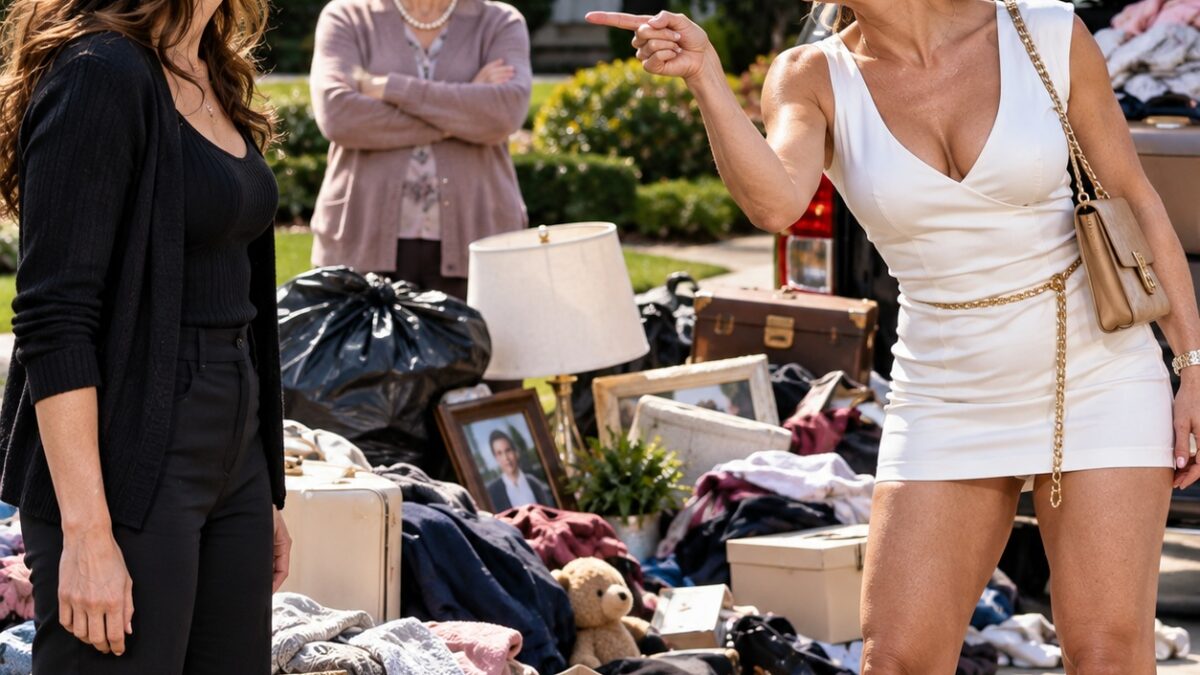
When I reached the house thirty minutes later, my life was scattered across the lawn.
Shoes.
Coats.
Boxes.
Two suitcases open.
A framed photograph lying face down in grass.
My jewelry box.
Books.
Documents.
A lamp.
Even my wedding veil.
I stopped beside the curb.
For several seconds, I could not move.
Then I saw the gray sweater.
Jack’s.
On the damp grass.
That did it.
I picked it up.
Pressed it against my chest.
And cried.
Not quietly.
Not gracefully.
The way grief sounded the night he died.
John arrived fifteen minutes later because I had texted him one sentence:
They threw Jack out too.
He did not understand until he saw everything.
“Jesus.”
He came toward me.
I pointed at the sweater.
“They had no right.”
“No.”
“I’m done.”
He nodded.
“Okay.”
“No more excuses.”
“Okay.”
“No more ‘she’s grieving.’”
“Okay.”
I wiped my face.
“I’m telling them.”
“About ownership?”
“Yes.”
We spent two hours collecting everything.
John hired movers from his phone.
I photographed every item.
Every damaged frame.
Every stain.
Every broken object.
Evidence.
I had learned enough at work to document before arguing.
That evening, I walked back into the house.
Sarah and Nancy sat in the living room.
Nancy had already rearranged furniture.
One of her suitcases occupied the hallway.
Sarah looked irritated.
“What are you doing here?”
I almost laughed.
“Interesting question.”
“You got your things.”
“Most of them.”
Nancy rolled her eyes.
“Don’t start.”
I set a folder on the coffee table.
Sarah frowned.
“What is that?”
“The deed.”
Silence.
Nancy looked at me.
I opened it.
“When Jack and I married, he added me to the property title.”
Sarah shook her head.
“No.”
“Yes.”
“He wouldn’t.”
“He did.”
“Why wouldn’t he tell me?”
“Because it wasn’t your property transaction.”
Her face reddened.
“Watch your tone.”
“I have spent a year watching my tone.”
I pointed at the paper.
“Read.”
Sarah did.
Slowly.
Her expression changed.
Joint tenancy.
Right of survivorship.
Jack deceased.
Remaining owner:
Jane Sanders.
Nancy grabbed the document.
“This is fake.”
“No.”
“You could have made this.”
“County records are public.”
She stared.
Sarah whispered:
“The house is yours?”
“Yes.”
“All of it?”
“Yes.”
She looked stunned.
I should have felt satisfaction.
Instead, I felt sad.
Because Jack had specifically built this protection, probably knowing some version of this conflict was possible.
“I am not throwing you out tonight.”
Sarah looked up.
“I’m giving you three days.”
“What?”
“The same timeline you gave me.”
Her face twisted.
“You can’t.”
“I can.”
“Jane.”
“You threw my belongings onto the road.”
“Nancy did.”
“You allowed it.”
“I told you she needed space.”
“This is my home.”
“We have nowhere to go.”
“You told me I could find somewhere.”
“That was different.”
“How?”
“You have money.”
“And?”
“Nancy just moved back.”
“Nancy has a wonderful executive salary.”
Nancy crossed her arms.
“Exactly.”
I looked at her.
“Then you’ll be fine.”
Sarah’s eyes filled.
“Jack would hate this.”
That hurt.
I did not show it.
“Jack made me owner.”
“He would not want his mother homeless.”
“No.”
I swallowed.
“He also would not want his wife thrown into the street.”
Silence.
“I would have helped you find another place.”
Sarah looked at me.
“Would have?”
“Yes.”
“Before you treated me like garbage.”
Her face hardened.
“There she is.”
“Who?”
“The real Jane.”
I stared.
“The woman who finally says no?”
“You were waiting for this.”
“No.”
“Yes.”
“You think I wanted any of this?”
“You have John.”
Nancy looked interested.
“John?”
Sarah’s mouth tightened.
“Her boyfriend.”
Nancy laughed.
“Already?”
My skin went cold.
“Careful.”
“Jack hasn’t even been dead that long.”
“One year.”
“That’s disgusting.”
I stepped closer.
“Do not use your brother to police my grief when you barely came home for his funeral.”
Her face changed.
“I was devastated.”
“You disappeared.”
“I needed space.”
“So did I.”
“That’s different.”
“Everything is different when it benefits you.”
Sarah stood.
“Enough.”
I looked at both of them.
“Three days.”
Then I left.
John proposed two weeks later.
Not because of the house battle.
The ring had apparently been in his desk for six weeks.
He had been waiting.
We were eating takeout on his balcony.
No photographer.
No restaurant.
No spectacle.
He said:
“I know Jack matters.”
I looked at him.
“He always will.”
“I know.”
“I don’t want to erase your life before me.”
My eyes filled.
“I know.”
“I just want to be part of the life after.”
I cried before he asked.
“Yes.”
He laughed.
“I haven’t actually asked yet.”
“Ask faster.”
He did.
I said yes again.
I delayed telling Sarah because I knew what she would say.
John understood.
But the house conflict was not over.
Two days before the deadline I gave Sarah and Nancy, John and I were discussing whether to postpone wedding planning until the situation settled.
He mentioned a marketing executive recently hired at his company.
“Worked in Europe,” he said.
I looked up.
“What?”
“What?”
“Say that again.”
“We hired a new marketing executive. Luxury-brand background. Supposedly Europe.”
My stomach tightened.
“What’s her name?”
He frowned.
“I don’t personally supervise her.”
“Can you check?”
“Jane.”
“Please.”
He opened his phone.
Called his assistant.
Ten minutes later, his expression changed.
“Nancy Sanders.”
I stared.
“No.”
“Yes.”
“That’s Jack’s sister.”
“The résumé says eight years international luxury marketing.”
I laughed.
“What?”
“She has never kept a job longer than maybe eight months.”
John sat straighter.
“You’re sure?”
“Jack complained constantly.”
“Could she have built experience later?”
“In one year?”
“No.”
“What exactly does the résumé say?”
John read.
Creative director.
Senior regional marketing manager.
Brand strategist.
Executive leadership.
Companies I had never heard Nancy mention.
John looked disturbed.
“I need HR to verify.”
“Please do.”
The next evening, John attended a client cocktail event.
Nancy was there.
He did not confront her immediately.
Asked questions.
Europe.
Experience.
Previous employers.
According to John, she bragged.
Too much.
Said she knew how to “upgrade” credentials so recruiters would notice.
Joked that everybody lies.
Then complained about family money and mentioned “handling Jack’s investments” after the funeral.
John called me immediately.
“What investments?”
I sat very still.
“Jack had shares.”
“In what?”
“Several private holdings.”
“Beneficiaries?”
“I thought some went to Sarah.”
John’s voice changed.
“Jane.”
“What?”
“Check.”
I called the broker who had managed Jack’s accounts.
Mr. David Coleman.
Seventy.
Old-school.
Formal.
He remembered me instantly.
“I’ve been wondering when you would call.”
That sentence terrified me.
“Why?”
“There is a problem.”
“What problem?”
“Some of Jack’s share positions were liquidated shortly after his death.”
My stomach dropped.
“By whom?”
Pause.
“Documents identified Nancy Sanders as authorized estate representative.”
“She wasn’t.”
“I suspected as much.”
“How much?”
He gave me a number.
I sat down.
It was more than Sarah could have lived on comfortably for several years.
“Those shares were intended for Sarah.”
“Yes.”
“Did she receive anything?”
“Not through our office.”
My skin turned cold.
“Where did the money go?”
“Accounts connected to Nancy.”
There it was.
Europe.
Sudden executive lifestyle.
Money.
Not salary.
Theft.
Fraud.
Whatever exact legal category applied, it was not innocent.
I called Sarah.
She answered angrily.
“What now?”
“Did you receive paperwork about Jack’s shares?”
Silence.
“What shares?”
“The ones he left for you.”
“I don’t know.”
“Sarah.”
“There was some letter.”
“When?”
“Months after the funeral.”
“What did it say?”
“I thought it was a scam.”
“Do you still have it?”
“I might.”
“Find it.”
She became suspicious.
“Why do you care?”
“Because Nancy may have taken the money.”
Her voice changed.
“No.”
“I spoke to Jack’s broker.”
“Jane.”
“He says Nancy submitted paperwork.”
“No.”
“Accounts connected to her received proceeds.”
“You’re lying.”
I closed my eyes.
“I’m trying to protect you.”
“You lied about John.”
“What?”
“You said you had barely started dating.”
“I said it was new.”
“You’re engaged.”
Silence.
“How did you know?”
“Nancy.”
Of course.
Sarah continued.
“You hid that.”
“Because I knew it would hurt you.”
“So why should I believe anything else?”
“Because these are financial records.”
“Nancy would never steal from me.”
“Sarah.”
“I raised her.”
I nearly said:
You raised Mark too—
No.
Wrong story.
Wrong family.
I stopped myself.
“Nancy disappeared for a year.”
“For work.”
“She lied on her résumé.”
“What?”
“John’s company verified it.”
“John?”
“Yes.”
“What does John have to do with her job?”
“She works at his company.”
Silence.
“He’s her boss’s boss.”
Sarah laughed bitterly.
“How convenient.”
“This is not about revenge.”
“You’ve already taken the house.”
“It is my house.”
“You fired my daughter.”
“I didn’t.”
“John did.”
“After discovering résumé fraud.”
“You two are destroying us.”
My patience broke.
“No, Sarah.”
I stood in my kitchen.
“Nancy took money Jack intended for you.”
“No.”
“She falsified documents.”
“No.”
“She disappeared.”
“Stop.”
“And now you are defending the person who stole from you while attacking the person who paid your bills for a year.”
“Don’t talk to me like I’m stupid.”
“Then stop refusing to look.”
Silence.
I regretted the wording immediately.
Not the truth.
The cruelty.
“Sarah.”
“No.”
“Find the letter.”
“I’m done talking.”
She hung up.
John’s company terminated Nancy after independent verification showed major résumé falsification.
Not because of me.
Not because she was my sister-in-law.
Because she lied.
Nancy called me screaming.
“You did this!”
“No.”
“Your fiancé did!”
“HR did.”
“You told him to fire me.”
“I told him who you were.”
“You ruined my life.”
“You lied about your professional history.”
“So what?”
I actually laughed.
“So what?”
“Everyone exaggerates.”
“You invented executive roles.”
“I could do the job.”
“That isn’t how hiring works.”
She cursed.
Then:
“You’re jealous.”
“Of what?”
“My money.”
I became very still.
“There it is.”
“What?”
“Where did it come from?”
“My work.”
“Europe?”
“Yes.”
“Jack’s shares?”
Silence.
Not long.
But enough.
“I don’t know what you’re talking about.”
“You will.”
I sent the records to an attorney.
Then law enforcement.
Not immediately dramatic.
Paperwork.
Interviews.
Broker statements.
Authentication.
Signatures.
Transfer records.
The truth moved slowly.
Sarah still refused to believe me.
Until the shares were frozen.
What remained of them.
Then Nancy received a summons.
Then another.
Then the broker formally stated that authorization documents had been falsified.
Sarah called me late one night.
Her voice was small.
“What did you do?”
“Nothing.”
“They froze Nancy’s account.”
“I know.”
“She has almost no money.”
“I know.”
“You’re going to put her in prison.”
“I’m not the prosecutor.”
“You reported her.”
“Yes.”
“She’s Jack’s sister.”
“She stole from Jack’s estate.”
“She’s my daughter.”
“And you were the person he intended to support.”
Sarah cried.
“You don’t understand family.”
That hurt more than I expected.
“I paid your expenses for a year.”
“That was money.”
“I stayed when Nancy disappeared.”
“She was grieving.”
“So was I.”
“You had somewhere to go.”
“No.”
I looked around my apartment.
“I built somewhere to go.”
Sarah became angry again because anger was easier than admitting what Nancy had done.
“You’re obsessed with the house.”
I laughed.
“You tried to throw me out.”
“That house belongs to our family.”
“Jack made me his family.”
“No.”
That was the final cut.
No.
Not blood.
Not family.
Not after seven years of marriage.
Not after one year caring for her.
I stopped trying.
“Sarah.”
“What?”
“I wanted to recover the stolen money for you.”
Silence.
“I still do what is legally correct.”
“You just said—”
“But emotionally, I am done fighting for someone who keeps telling me I am nobody.”
Her breathing changed.
“Jane.”
“You and Nancy need to leave the house.”
“Where?”
“I don’t know.”
“You know our relatives are hundreds of miles away.”
“Yes.”
“We can’t afford much.”
“You told me Nancy could support you.”
“She can’t now.”
“That is not my doing.”
“You have money.”
“So?”
“You have John.”
“So?”
“Have some compassion.”
I laughed quietly.
“Compassion?”
“Yes.”
“I gave you a year of it.”
“That’s cruel.”
“No.”
I swallowed.
“It is finished.”
The next night, somebody smashed my bedroom window.
I was still checking the house regularly because legal possession had not yet been enforced.
Crash.
Glass across the floor.
Then another window.
I ran downstairs.
Plant pots broken.
Grass ripped.
Spray-painted insults across the side wall.
A teenage boy ran toward the street.
I caught up enough to see him.
Called police.
They found him two blocks away.
Seventeen.
Terrified.
Not a criminal mastermind.
He admitted somebody paid him.
Tall brunette.
Late twenties or early thirties.
Cash.
Description matched Nancy.
When I called her, she did not even deny it properly.
“I didn’t use him.”
“What?”
“I paid him.”
I stared at my phone.
“You realize that isn’t better.”
“Whatever.”
“You vandalized my house.”
“You stole my house.”
“I own it.”
“You stole my job.”
“You lied.”
“You stole Mom.”
I laughed in disbelief.
“Your mother threw me out.”
“You turned her against me.”
“She still defends you.”
Nancy screamed.
“You don’t deserve any of it!”
I became quiet.
“What?”
“The house. The job. John.”
She was crying now.
“My brother had everything.”
I listened.
“Great career. House. Wife. Everybody loved him.”
“Nancy.”
“And I had nothing.”
“That isn’t Jack’s fault.”
“Then he died and somehow you still got everything!”
There it was.
Not grief.
Resentment.
I understood suddenly.
Nancy did not only steal because she was selfish.
She stole because she had spent her life measuring herself against Jack.
His stability became evidence of her failure.
His death became opportunity.
Then guilt probably drove her farther.
“You could have built your own life.”
“Easy for you to say.”
“It wasn’t easy.”
“You have everything.”
“No.”
My voice cracked.
“I would trade the house for Jack in a second.”
Silence.
“I would trade the money.”
More silence.
“The job.”
Nothing.
“John would understand.”
My throat tightened.
“I would trade almost everything to hear your brother laugh one more time.”
Nancy began crying.
For one second, I saw the sister beneath the anger.
Then she said:
“I’m not going to court.”
The moment vanished.
“You may not have a choice.”
“I won’t.”
“That’s between you and the judge.”
Three weeks later, Sarah appeared at my rehearsal dinner.
Uninvited.
John and I had decided on a small wedding.
Close friends.
Family.
Nothing elaborate.
A restaurant private room.
Sarah burst through the entrance shouting.
People froze.
She pointed at me.
“You ruined my family!”
John stood immediately.
I touched his arm.
“Let me.”
Sarah looked thinner.
Older.
The year had finally reached her face.
“You stole my son.”
I flinched.
“You know that isn’t true.”
“You replaced him.”
“No.”
“With this man.”
She pointed at John.
“Sarah.”
“You took the house.”
“Jack gave it to me.”
“You sent Nancy to prison.”
“She isn’t sentenced.”
“You destroyed her.”
“She stole.”
“You turned everyone against us.”
Wine glasses trembled as servers stopped moving.
I walked toward her.
“Why are you here?”
“To show them who you are.”
My guests stared.
I felt humiliation rise.
Then disappear.
I had survived worse.
“Who am I?”
“A money-hungry woman.”
That was almost funny.
“I paid your bills.”
“You did it to control me.”
“No.”
“You wanted the house.”
“I already owned it.”
Someone behind me gasped quietly.
Sarah’s voice cracked.
“You wanted us gone.”
“I would have helped you move.”
“Liar.”
“Before you threw my clothes into the street.”
“Nancy did that.”
“You watched.”
She said nothing.
I continued.
“You called me nobody.”
Silence.
“You told me Jack’s death removed me from the family.”
Her eyes filled.
“I was angry.”
“So was I.”
“You should have forgiven me.”
“I forgave a lot.”
John remained near me.
Not touching.
Letting me stand alone because he knew I needed to.
Sarah looked at him.
“What did my son see in her?”
John answered before I could.
“A woman who worked, loved him, supported his parents, paid half the mortgage, kept his family together after he died, and somehow still feels guilty when people hurt her.”
The room became silent.
My eyes burned.
Sarah screamed:
“You don’t know anything!”
Then knocked into a side table.
Two glasses fell.
A wine bottle shattered.
People stepped back.
Restaurant security approached.
Sarah fought them verbally.
Then physically enough that police were called.
She was escorted out.
I stood shaking.
John took my hand.
“Do you want to cancel?”
I looked at him.
“No.”
“Tonight?”
“No.”
“Wedding?”
“Absolutely not.”
He smiled.
“Good.”
Sarah received a fine related to the disturbance.
Later, I sent an invoice for damaged items because the restaurant billed us.
She refused.
I stopped caring.
Nancy’s case continued.
The evidence was overwhelming.
Forgery.
Misappropriation.
Estate-related theft.
Additional fraud tied to the share transfers.
Eventually, she stopped denying the basic facts.
She accepted that the money came from assets Jack intended for family distribution and that she had falsified authority to access them.
She was sentenced to five years.
I did not attend sentencing.
I had no desire to watch Jack’s sister go to prison.
Justice can be necessary without being satisfying.
The recovered money returned through the legal process.
Between what was restored to the estate, what came to me under Jack’s succession documents, and the financial rebuilding John and I had done, we were able to pay off the remaining mortgage.
I renovated the house.
Not to erase Jack.
To let it live again.
New windows.
Repaired lawn.
Fresh paint.
I kept one section of the old green color inside the garage because Jack had once joked that his mother hated it enough to keep burglars away.
John laughed when I told him.
“Then it stays.”
We moved in after the wedding.
Not immediately.
I needed time.
The first night we slept there, I woke at two in the morning.
For one terrible second, I forgot where I was in time.
I reached across the bed.
John.
Not Jack.
Grief hit unexpectedly.
I cried.
John woke.
Said nothing.
Held me.
“I’m sorry.”
He kissed my hair.
“Never apologize for missing him.”
That was why I knew marrying John had not betrayed Jack.
A person who loves you does not demand that the dead disappear.
They make room.
Our wedding happened six weeks after the rehearsal disaster.
Small.
Beautiful.
No Sarah.
No Nancy.
My parents.
John’s sister.
Friends.
Coworkers.
Jack’s best friend came.
That mattered.
Before the ceremony, he found me alone.
“You okay?”
“I think so.”
“Jack would like him.”
I started crying immediately.
“That’s unfair.”
“Sorry.”
“No, you’re not.”
He smiled.
“No.”
Then he hugged me.
“Jack wanted you alive.”
Those words stayed with me.
John and I exchanged vows outdoors beneath oak trees.
I wore no veil.
The first veil had been thrown onto a roadside.
I did not need a second.
We came home after a short trip.
Our house.
Mine legally.
Ours emotionally.
Sarah’s life deteriorated.
Her financial situation became severe.
Without Nancy’s stolen funds and without me covering the mortgage, she struggled.
She rented a small apartment.
Then a smaller one.
Her health declined.
Eventually, she qualified for a government-funded nursing facility.
When I heard, I sat at the kitchen table for a long time.
John found me.
“What?”
“Sarah.”
He waited.
“Nursing home.”
He pulled out a chair.
“You want to help?”
I hated how quickly he understood.
“I don’t know.”
“That’s okay.”
“I promised Jack.”
“What?”
“Not literally.”
I looked at my hands.
“But he always worried about her.”
“Then help if you want.”
“But she treated me horribly.”
“Yes.”
“What if helping means I’m letting her use me again?”
“Then set conditions.”
I looked at him.
“You make things sound easy.”
“They’re not.”
He took my hand.
“Compassion and access are different.”
That sentence saved me from months of guilt.
I could care that Sarah was suffering without inviting her back into my life.
I anonymously paid for a few additional services at the facility during her first months.
Not rent.
Not luxury.
Better physical therapy.
A private dental procedure.
A pair of hearing aids her coverage barely supported.
She never knew.
Or if she did, nobody told me.
I did not visit.
Some people will judge that.
That is fine.
Forgiveness does not require proximity.
Our communication ended.
Nancy served her sentence.
I heard occasional updates through attorneys.
Nothing more.
I hoped prison changed her.
I did not need to witness it.
My job continued.
John’s did too.
We learned how to be married without turning marriage into rescue.
We split bills.
Housework.
Decisions.
Sometimes John cooks.
Badly.
He thinks seasoning is a personality trait.
I do laundry.
He folds terribly.
We argue.
Normal arguments.
Not about ownership.
Not about whether I belong.
Sometimes I stand in the backyard where the vandalized lawn once was.
New grass.
Flowers.
A small maple tree planted near the fence.
Jack wanted a maple there.
John helped me choose it.
The first spring it grew new leaves, I cried.
Life feels cruel because it continues.
Then beautiful for exactly the same reason.
I still talk to Jack sometimes.
Not because I think he answers.
Maybe he does.
I do not know.
I talk anyway.
Usually while gardening.
“You would hate what I did with the kitchen.”
Or:
“Your sister would hate the new paint.”
Sometimes:
“I hope you don’t mind John.”
That one hurts.
Then I remember something Jack said once years before his death.
We were watching a movie where a widow stayed alone forever.
He said:
“If I die first, you better not do that.”
I threw popcorn at him.
“Stop.”
“I’m serious.”
“You’re not dying.”
“Everybody dies.”
“Romantic.”
He laughed.
“Find somebody.”
“Absolutely not.”
“Somebody rich.”
“Why?”
“So he can finish paying this mortgage.”
I laughed so hard I spilled wine.
I forgot that conversation until after marrying John.
When I remembered, I sat on the floor laughing and crying.
Jack would have found all of it absurd.
Maybe that is what finally gave me peace.
Not certainty that he would approve.
The memory of who he actually was.
He loved me.
Real love does not demand that the person you love stop living after you.
Sarah could not understand that.
Maybe because motherhood and marriage are different.
Maybe because grief broke something in her.
Maybe because she had always believed blood outranked choice.
Jack did not.
He chose me.
He put my name on the house.
Shared his life.
Trusted me.
Built legal protection around our home.
That was family too.
The hardest thing I learned was that helping someone does not guarantee gratitude.
I paid Sarah’s bills because I believed we were family.
She accepted because she needed them.
I believed those things meant the same to both of us.
They did not.
That realization hurt.
But it also freed me.
Kindness should not be an investment where you expect repayment through loyalty.
I helped because it was who I wanted to be.
Sarah’s later cruelty could not retroactively make my kindness foolish.
The money mattered less once I understood that.
Would I pay all those bills again knowing how it ended?
Maybe.
Because Jack loved his mother.
Because I loved Jack.
Because at the time, helping felt right.
What I would not do again is confuse helping with surrendering boundaries.
That is different.
Nancy taught me another lesson.
Envy grows dangerous when people treat somebody else’s life as proof they were cheated.
She believed Jack got everything.
Career.
House.
Marriage.
Stability.
So after his death, she took what she thought should have been hers.
But Jack’s success had not stolen hers.
His stability had not caused her chaos.
She was responsible for building her own life.
I hope five years gave her time to understand that.
Maybe not.
That is no longer my burden.
John and I paid off the mortgage.
That felt strange.
The final bank letter arrived on a Tuesday.
PAID IN FULL.
I held it at the same kitchen table where Sarah once told me the house was not mine.
John opened champagne.
“You and my father would get along.”
“Why?”
“He thinks champagne makes everything legal.”
“Smart man.”
We stood in the kitchen.
I looked around.
Walls repainted.
New cabinets.
Jack’s old coffee mug still in one cupboard.
I kept it.
John knows.
No jealousy.
No problem.
One cabinet.
One mug.
One life before.
One life now.
I lifted my glass.
“To complicated houses.”
John smiled.
“To impossible women.”
I frowned.
“What?”
“Good impossible.”
“There is no good recovery from that sentence.”
He laughed.
“To Jane.”
“Better.”
We drank.
The house did not feel like victory.
It felt like home.
There is a difference.
Victory requires someone else to lose.
Home only requires safety.
That is what Sarah never understood when she tried to throw me out.
She thought the house represented family ownership.
Blood.
History.
Control.
For me, it represented years.
Mortgage payments.
Jack’s laughter.
Arguments.
Late dinners.
Grief.
Bills.
Repair invoices.
One terrible lawn.
A broken bedroom window.
Boxes on the roadside.
John holding me while I cried.
A wedding photograph now sitting beside one of Jack and me.
Both exist.
I no longer need one story to erase another.
Sometimes people ask whether I regret not letting Sarah stay.
That question is usually asked by someone who hears the short version.
Older mother-in-law.
Widowed daughter-in-law.
Housing conflict.
They imagine a cruel young woman evicting a grieving old lady.
Life sounds simple when you remove details.
I gave Sarah time.
Money.
Housing.
Transportation.
Care.
Patience.
Then she told me I was nobody.
Allowed Nancy to throw my possessions into the road.
Denied my legal ownership.
Defended financial theft.
Blamed me for reporting crimes.
Disrupted my wedding events.
At some point, compassion without boundaries becomes permission.
So no.
I do not regret refusing to let her stay.
I regret that we ever reached the point where refusal became necessary.
Those are not the same thing.
The last thing I heard directly from Sarah came through a letter.
No return address.
Nursing facility stationery.
I almost did not open it.
Inside, shaky handwriting.
Jane,
I don’t expect you to answer.
I was wrong about the house.
I was wrong about Nancy.
I was wrong about many things.
Losing Jack broke something in me and I made you pay for surviving him.
I told myself you moving on meant you loved him less.
I know now that was not true.
I thought blood made Nancy mine and you temporary.
But Nancy left when I needed her and you stayed when you did not have to.
I understand what I did.
I am sorry.
Sarah
I read it three times.
Then gave it to John.
He read quietly.
“What do you want to do?”
I looked out the window.
“I don’t know.”
“Answer?”
“Maybe.”
“Visit?”
My stomach tightened.
“No.”
“Okay.”
“Is that horrible?”
“No.”
I looked at him.
“I believe she’s sorry.”
“You can believe that.”
“And still not see her?”
“Yes.”
“People won’t understand.”
“People don’t live your life.”
I kept the letter.
Months later, I wrote back.
Short.
Sarah,
I believe you are sorry.
I loved Jack. I still do.
I hope you find peace.
Jane
No promises.
No reopening doors.
No punishment.
Just truth.
I never heard back.
Maybe that was enough for both of us.
John and I have been married several years now.
The maple tree is taller.
The mortgage is gone.
My career continues.
His company survived Nancy’s brief résumé adventure.
We joke about that carefully.
Some things become funny only after enough time.
The front lawn looks normal.
No broken pots.
No graffiti.
New windows.
I still own the house legally.
John never asked me to add him to the deed.
That mattered.
One day I asked why.
He shrugged.
“It’s your house.”
“Ours.”
“Emotionally.”
I smiled.
“Legally too, if we change it.”
“No rush.”
I looked at him.
“You’re weird.”
“You knew that.”
Later, I chose to update the estate plan so he would be protected if something happened to me.
Choice.
That is the word.
Jack chose to protect me.
I chose to protect John.
Sarah chose to betray trust.
Nancy chose theft.
Then vandalism.
I chose boundaries.
John chose patience.
Grief did not make any of those choices inevitable.
That matters because people sometimes blame pain for everything.
Pain explains.
It does not automatically excuse.
Sarah suffered enormously.
So did I.
Nancy lost her brother.
So did I lose my husband.
We each decided what to do afterward.
The ending could have been different.
If Sarah had said:
Jane, I’m afraid you’ll leave.
I would have hugged her.
If she had said:
Nancy needs help moving home.
I would have helped.
If Nancy had admitted:
I took the money because I panicked and envied Jack.
Maybe we could have found a different legal path before everything escalated.
If she had not vandalized the house.
If.
If.
If.
But healing cannot live forever inside imaginary versions of people.
At some point, you deal with what happened.
Not what should have.
What happened is this:
My husband died.
His mother and sister decided his death made me disposable.
They tried to remove me from my own home.
His sister stole money from the estate.
Lied for a job.
Lost it.
Vandalized my property.
Went to prison.
His mother defended her until reality became impossible to deny.
Sarah eventually lost the comfortable life I had been funding.
She ended up in subsidized care.
I did not bring her back.
The stolen assets were recovered.
The mortgage was paid.
I repaired the house.
And I married a man who understood that loving me meant respecting the life I had before him.
I moved forward.
Not on.
People say “move on” as though grief is a location.
As though love sits behind you once you walk far enough.
I did not move on from Jack.
I moved forward carrying him differently.
That is what Sarah could not imagine at first.
It is what I had to learn.
I can love the husband I lost.
Love the man I married later.
Remember one.
Build with the other.
Keep Jack’s mug.
Wear John’s ring.
Plant Jack’s maple.
Renovate the kitchen with John.
Human hearts are not houses with only one bedroom.
There is room.
The house itself taught me that.
Four bedrooms.
Many lives.
Parents.
Marriage.
Death.
Conflict.
Recovery.
A new marriage.
The walls stayed.
People changed.
For a long time, I thought Jack had saved me by putting my name on the deed.
Maybe he did.
Without that document, the fight would have been uglier.
But later I realized something.
The deed protected my property.
It did not save me.
I did that part.
The morning I saw my clothes on the roadside, I could have folded.
Apologized.
Walked away.
Told myself keeping peace mattered more than being right.
I had spent a year doing versions of that.
Instead, I picked up Jack’s sweater.
Looked at everything scattered in grass.
And decided:
No more.
That decision changed everything.
Not because I suddenly became ruthless.
Because I finally understood that being kind did not require volunteering to be erased.
Jack once put my name beside his because he wanted me protected.
The least I could do was believe him.
Now, when I stand at the front window and look toward the road, I sometimes remember the shoes, boxes, clothes, photographs.
That morning felt like the lowest point after Jack’s death.
But it was also the last morning anyone in his family got to decide whether I belonged.
The answer was never theirs.
Jack had already answered it years earlier.
So had I.
I belonged in the life I had built.
And when that life changed, I had every right to build another one.