I Returned From War With Nothing Left to Live For — Then a Scarred German Shepherd Led Me Into the Ruins, and I Heard a Child Crying.v
FULL STORY CONTINUATION
There were three children inside.
The oldest was a girl.
Maybe twelve.
Thin enough that her coat hung from her shoulders like it belonged to somebody else.
She held a piece of broken chair leg like a weapon.
Behind her stood a boy of perhaps eight and another little girl who could not have been more than five.
The youngest was the one crying.
She stopped when she saw me.
The older girl raised the wood.
“Stay back.”
I did.
Franz came beside me.
The boy’s eyes widened.
“Dog.”
Franz sat.
That surprised me.
He had barely allowed me within arm’s reach after a week of feeding him, yet the moment he saw those children, something in his whole body changed.
The tension left his shoulders.
His head lowered slightly.
His ears softened.
Working-dog behavior.
I had seen military dogs before.
Guard dogs.
Messenger dogs.
Dogs trained to locate wounded men.
Franz had probably spent years being told that certain voices, smells, gestures, and uniforms meant work.
Whatever his past had been, children meant something else.
The youngest girl reached toward him.
The older one caught her wrist.
“No.”
Franz did not move.
I put both hands where they could see them.
“My name is Walter.”
Silence.
“You’re hungry.”
The older girl looked offended by the obviousness of it.
“We’re fine.”
The boy stared at the loaf under my arm.
His stomach answered for him.
I almost smiled.
“I have soup.”
That was not entirely true.
I had potatoes.
An onion.
Water.
A little salt.
In those days, that qualified.
The older girl tightened her grip on the chair leg.
“We aren’t going anywhere.”
“All right.”
I set the bread on the ground.
“You can stay.”
I turned.
Franz did not follow.
“Come.”
He looked at the children.
Then at me.
“Franz.”
Still nothing.
The little girl stretched one hand toward him again.
This time the older one was too tired to stop her.
Her fingers touched Franz’s muzzle.
The shepherd closed his eyes.
Just for a second.
That was the first time I saw him accept human touch.
Not from me.
From her.
I stood there watching.
Then said, “Apparently he disagrees with my plan.”
The boy laughed.
A tiny sound.
The first laughter I had heard in the village.
So I stayed.
Their names were Anna, Lukas, and Elise.
They were not siblings.
Not by blood.
The war had made them something similar.
Anna’s mother had died during an air raid.
Her father never returned from the eastern front.
Lukas had been separated from his family during one of the chaotic movements of refugees near the war’s end.
Nobody knew whether they were alive.
Elise barely remembered her parents.
Anna had found her near a railway siding months earlier.
Since then, the three had moved from abandoned house to abandoned house.
Sometimes relief workers brought food.
Sometimes villagers helped.
But the village itself had too many widows, injured men, elderly people, and hungry families.
Everybody was carrying more need than they could lift.
That afternoon, I made potato soup in the farmhouse kitchen.
Half the roof was missing.
We ate near the stove.
Franz lay beside the children.
When I approached, he watched me carefully.
When Anna approached, he barely opened one eye.
I pointed my spoon at him.
“Traitor.”
Elise giggled.
Franz’s tail moved once against the floor.
I had planned to return to my cellar before dark.
Instead, I inspected the farmhouse.
Two rooms were structurally sound.
Roof damage over the kitchen.
Broken window upstairs.
Stove functioning poorly but functioning.
Better than where I was sleeping.
“You should not stay here alone,” I told them.
Anna stared at me.
“We’re not alone.”
She pointed at Lukas and Elise.
I knew what she meant.
“You need an adult.”
“We had adults.”
That silenced me.
Children should not know how to say something like that.
The words belonged to somebody much older.
I looked toward the stove.
“I can fix the roof.”
“We didn’t ask you.”
“I know.”
“The window too?”
“Yes.”
She studied me.
“What do you want?”
“Nothing.”
Nobody believed that after a war.
Every favor had cost somebody something.
Information.
Food.
Labor.
Loyalty.
I understood her suspicion.
“I need somewhere dry to work.”
“That’s a lie.”
She was sharp.
“Partly.”
Her eyes narrowed.
I pointed toward Franz.
“He refuses to leave.”
That finally almost made her smile.
So began the arrangement.
I repaired the farmhouse during the day.
At night, I returned to my cellar.
At first.
By the fifth evening, snow began falling through the broken section of roof.
I worked until after dark covering it with salvaged boards and tar paper.
When I finished, Anna put a bowl of soup in front of me.
It was thinner than the one I had made.
“You’re staying tonight.”
I looked at her.
“That an order?”
“Yes.”
“Dangerous habit.”
She sat across from me.
“You listen badly.”
“That has been said before.”
Franz lay beneath the table.
Elise slept against him with one hand buried in his fur.
I stayed.
One night became several.
My house could wait.
That surprised me.
I had spent weeks thinking about what remained mine.
Suddenly, ownership mattered less than where people were warm.
Word spread.
People came because people always notice smoke from a chimney that was cold the week before.
Marta Vogel arrived first.
Forty-something widow.
Two sons lost in the war.
One daughter living somewhere near Munich.
Marta carried a basket of carrots and no patience.
She stood in the farmhouse doorway, looked at me, looked at the children, looked at Franz, and said, “This place smells terrible.”
“Good morning.”
“You need soap.”
“We need food more.”
“I brought both.”
She entered without invitation.
That was how Marta operated for the next fifteen years.
Behind her came Herr Keller.
The baker.
He had survived after all.
His bakery had not.
He walked with a cane now and had lost two fingers on his left hand.
He carried six hard rolls under one arm.
“They’re terrible.”
Lukas took one.
Ate half immediately.
Herr Keller nodded.
“Still terrible?”
Lukas shook his head with his mouth full.
The old baker looked at me.
“Boy has no standards.”
Then he sat near the stove.
Soon there were other children.
Not all orphans.
Some had mothers but no fathers.
Some fathers had returned unable to work.
Some families had one room for eight people.
Some children simply came because the farmhouse was warm and Franz was there.
A boy named Dieter started appearing every afternoon.
He never spoke much.
His father had returned from the war with one leg.
Dieter stole food the first week.
I caught him putting potatoes inside his coat.
He froze.
I remembered being hungry during the war.
Not ordinary hunger.
The kind where the body becomes more convincing than morality.
“How many?” I asked.
He stared.
“How many people at home?”
“Four.”
I put six more potatoes in his bag.
“Next time ask.”
He nodded.
The next day he returned.
“May I have potatoes?”
“You just discovered bureaucracy.”
He did not understand the joke.
Franz did.
Or I decided he did.
By December, the farmhouse had become something nobody planned.
Breakfast room.
Schoolroom.
Shelter.
Repair shop.
Kitchen.
Sometimes clinic.
Marta organized food.
Herr Keller found flour and began baking again using a damaged oven in the back of the farmhouse.
I repaired furniture.
Windows.
Shoes badly.
Stoves better.
People started bringing things.
A chair with a broken leg.
A cracked bucket.
A bicycle.
Then staying.
That was how villages heal.
Not through speeches.
Through chores nobody can finish alone.
Franz became the center of it.
Children who were afraid of adults trusted him.
I saw it again and again.
A newly arrived boy would stand in the doorway.
Silent.
Dirty.
Eyes too alert.
Franz would not rush him.
He would lie sideways.
Look away.
Wait.
Eventually, the child would move closer.
A hand touched fur.
Then words came.
Sometimes a name.
Sometimes hunger.
Sometimes the location of another child hiding somewhere.
Once Franz led us to an abandoned rail shed after Elise insisted he had “heard somebody.”
I did not believe her.
The dog scratched at the shed door.
Inside we found twin brothers, nine years old, sleeping under coal sacks.
Franz had apparently heard one coughing.
Marta looked at me afterward.
“He’s still working.”
“What?”
“The dog.”
She nodded toward Franz.
“He thinks this is his unit now.”
I watched him walk between the children.
Maybe she was right.
His military harness hung from a nail inside the farmhouse.
I removed it weeks earlier.
He hated having it touched.
One afternoon, I examined the leather more closely.
Old identification numbers.
A faded marking suggesting a military training unit.
No name.
Nothing telling me who handled him.
Whether that man lived.
Whether Franz had been abandoned deliberately or simply separated during retreat.
I never found out.
For a while, I tried.
I asked soldiers.
Officials.
Relief workers.
Nobody knew.
Eventually, I stopped.
A life does not have to explain where it came from before it can belong somewhere new.
That lesson applied to more than Franz.
Winter became difficult.
Food ran low.
Coal ran lower.
One January night, temperatures dropped so sharply that ice formed inside the windows.
We had twelve children sleeping in the farmhouse.
Marta.
Herr Keller.
Me.
Franz.
The stove could not heat the whole building.
So we closed rooms.
Moved mattresses toward the kitchen.
Hung blankets across doorways.
Everyone slept near the stove.
That night, Elise developed a fever.
High.
Too high.
Her breathing became fast.
Marta touched her forehead.
“We need a doctor.”
The nearest functioning clinic was in the next town, almost nine kilometers away.
Snow covered the road.
No vehicle in our village had fuel.
I put on my coat.
Anna grabbed my sleeve.
“You can’t walk that far tonight.”
“I’ve walked farther.”
“You’re old.”
“I’m fifty-three.”
“To me that’s old.”
I looked at Marta.
She tried not to smile.
“I’m going.”
Franz stood.
“No.”
He remained standing.
“You’re staying.”
He walked toward the door.
I closed it.
“Absolutely not.”
Franz looked at me.
There is a certain stare German Shepherds possess.
It suggests human authority is under review.
I pointed toward Elise.
“She needs you.”
That changed him.
He looked back.
Walked to her mattress.
Lay beside her.
I nodded.
“Good.”
I left.
The snow was knee-deep on parts of the road.
Halfway there, my injured shoulder began throbbing.
I kept walking.
War had taught me the body can do almost anything when the alternative is unacceptable.
I reached the clinic after midnight.
Returned near dawn with a doctor and two men pulling a wooden sled loaded with supplies.
Elise had pneumonia.
The doctor stayed two days.
She survived.
When the fever finally broke, Franz stood, stretched, and walked to me.
For months, he had tolerated me.
That morning, he pressed his head against my leg.
I placed my hand behind his ear.
He did not pull away.
Something tightened in my throat.
“You had to make this dramatic.”
His tail moved.
From then on, Franz slept beside my bed.
Not every night.
Dogs have their own decisions.
But often enough.
Spring came reluctantly.
Mud replaced snow.
Roofs leaked.
People emerged from winter looking smaller.
But alive.
We planted vegetables behind the farmhouse.
Every child received a row.
This was a mistake.
Children interpret rows as suggestions.
Carrots appeared with cabbage.
Onions were planted beside flowers.
Lukas buried potatoes so deeply I suspected he was storing them for another century.
Herr Keller watched.
“You are teaching agriculture badly.”
“I repair roofs.”
“Apparently you also destroy farms.”
Marta told him to stop criticizing and pick up a shovel.
He complained for twenty minutes.
Then did.
Franz dug up three rows.
Nobody assigned him a row after that.
The village slowly returned.
Not to what it had been.
That village was gone.
This one was different.
Women ran shops their husbands had once owned.
Men missing limbs learned new trades.
Children became laborers before they should have.
Ruined homes became half-homes.
Then three-quarter homes.
Then homes again.
The church received a temporary roof.
The school reopened in two rooms.
I repaired desks.
Marta somehow convinced me to teach older boys basic carpentry.
“I am not a teacher.”
“You talk constantly while repairing things.”
“That is complaining.”
“Educational complaining.”
I lost the argument.
Anna became my best student.
She could measure accurately after seeing something once.
Better than Lukas.
Better than most grown men.
One afternoon, she was planing a board when she asked, “Were you afraid in the war?”
I stopped.
Children ask difficult questions without warning.
“Yes.”
“All the time?”
“Almost.”
“But soldiers aren’t supposed to be scared.”
“Anyone who says that has never been under artillery fire.”
She continued planing.
“Did you do bad things?”
There it was.
I set down the hammer.
Outside, Franz lay in the sun while Elise read aloud to him.
My first instinct was to refuse.
Children deserve protection.
But lies are poor protection.
“Yes.”
Anna looked up.
“Very bad?”
“I did things I wish I had not done.”
Her face did not change.
“Why?”
“Sometimes because I was ordered.”
“Is that a good reason?”
“No.”
That answer came easily.
Easier than it would have years earlier.
She waited.
“Sometimes because I was afraid. Sometimes because everyone around me was doing the same thing. Sometimes because war makes wrong things feel ordinary if you stay inside it long enough.”
Anna stared at the board.
“What do you do after?”
“I don’t know.”
I looked toward Franz.
“Maybe you try to stop choosing wrong when you have a choice again.”
She absorbed that.
Then resumed working.
I never knew whether it was enough.
Maybe honest answers are not supposed to be enough.
By summer, relief organizations became more structured.
Officials came.
Lists were made.
Children registered.
Families searched.
Lukas’s mother was found.
Alive.
Living with relatives near Augsburg.
The letter arrived in July.
I read it three times before calling him.
He stood in front of me.
Hands behind his back.
“What?”
“Your mother.”
Everything in his face vanished.
“She’s alive.”
He sat down.
Not because I told him.
His knees gave way.
Franz immediately came beside him.
Lukas buried both hands in the shepherd’s fur.
“No.”
I crouched.
“What?”
“I can’t go.”
“Yes, you can.”
“No.”
“Lukas.”
“She left me.”
“You were separated.”
“How do you know?”
I did not.
He was crying now.
Angry tears.
“She found other people.”
“She has been looking.”
“How do you know?”
“Because the letter says so.”
“You believe letters?”
There was nothing eight years old about him in that moment.
I looked at Franz.
Then back at Lukas.
“You don’t have to stop loving this place because your mother is alive.”
He shook his head.
“You don’t have to choose which family was real.”
That slowed him.
“People can belong to more than one place.”
I said the words before understanding them fully myself.
Lukas stared.
“You’ll still be here?”
I almost answered automatically.
Of course.
The word frightened me.
Of course meant a future.
Expectation.
Promise.
Things I had avoided since returning.
Then Franz leaned against Lukas.
I looked around the farmhouse.
Marta kneading dough.
Anna repairing a stool.
Elise drawing on scrap paper.
Herr Keller arguing with a stove.
All the things that could be taken from me.
All the things I had started loving anyway.
“Yes.”
My voice came out rough.
“I’ll still be here.”
Lukas left two weeks later.
His mother arrived on the back of a relief truck.
She stepped down before it fully stopped.
Thirty-something.
Thin.
Hair cut short.
She saw Lukas.
Covered her mouth.
He stood completely still.
Then ran.
She dropped to her knees.
They collided so hard they nearly fell.
Everyone turned away because some reunions deserve privacy.
Franz did not.
He sat watching.
Tail moving.
When they left the next morning, Lukas hugged him first.
Then me.
“Don’t get too old.”
“I’ll make an effort.”
He gave me a folded piece of paper.
I opened it later.
A drawing.
Farmhouse.
Children.
Franz enormous in the middle.
I was beside him.
Lukas had drawn me almost the same height as the dog.
Insulting.
I kept it.
Children came and left after that.
Some reunited with family.
Some found foster homes.
Some remained.
The farmhouse was never empty.
Franz became older.
I noticed gray around his muzzle.
He had probably been six or seven when I found him.
Maybe older.
War ages dogs too.
His old shoulder scar began bothering him during cold mornings.
I made a padded bed.
He refused it for a week.
Then discovered comfort.
Pride has limits.
My own house received a roof eventually.
I repaired it slowly.
The first night it became habitable, I stood inside the kitchen.
New window.
Patched walls.
One blue cup without a handle still sitting on the shelf.
I had worked toward that room for almost two years.
My home.
I looked around.
It felt empty.
I returned to the farmhouse before dark.
Marta saw me enter.
“You forgot something?”
“No.”
“House leaking?”
“No.”
“Then why are you here?”
I hung up my coat.
“Too quiet.”
She smiled.
Said nothing.
That was one of her better qualities.
I slept at my house sometimes.
Mostly, I slept at the farmhouse.
Eventually, nobody asked why.
Years began passing.
The village no longer looked ruined from a distance.
That mattered more than I expected.
Roofs returned.
Windows.
Gardens.
Children’s clothing hanging from lines.
Bread smell in the morning after Herr Keller rebuilt his bakery.
He painted a sign above the door.
KELLER BÄCKEREI.
The lettering was crooked.
I told him.
He said he knew.
I offered to fix it.
He threatened to break my remaining fingers.
Friendship after war could be surprisingly ordinary.
Anna became seventeen.
Then eighteen.
She refused every suggestion that she move to a larger town.
“I’m becoming a teacher.”
“Teachers are poorly paid.”
“You taught us for free.”
“I am evidence for my own argument.”
She became the first instructor when the village school fully reopened.
Elise became fascinated with medicine because of the doctor who saved her.
Marta said she would grow out of it.
She did not.
At fourteen, she could bandage a cut better than I could.
Dieter apprenticed with Herr Keller.
Franz continued supervising everyone.
People began calling him the village dog.
I objected.
“He lives with me.”
Marta looked at me.
“He eats at six houses.”
“That is opportunism.”
“He patrols the school.”
“Habit.”
“Children use him as a pillow.”
“Lack of discipline.”
Franz entered carrying half a sausage someone had given him.
Marta raised an eyebrow.
“Your dog?”
I looked at him.
“Increasingly unclear.”
One autumn morning, Franz did not get up when I opened the farmhouse door.
He lifted his head.
Tail moved.
Body stayed down.
I knew.
Not everything.
Enough.
I sat beside him.
His muzzle had turned almost white.
The scarred ear still stood.
The old military harness remained on the wall, though nobody had touched it in years.
Franz looked at me.
“You’re getting lazy.”
Tail thump.
I brought water.
He drank a little.
Did not eat.
Elise, now fifteen, knelt beside him and checked his gums the way the doctor once showed her.
“He’s sick.”
“Yes.”
“We need the doctor.”
“Yes.”
The veterinarian from the neighboring town came that afternoon.
Old man.
Older than me, which I found reassuring.
He examined Franz.
Heart.
Joints.
Abdomen.
Eyes.
“He’s very old.”
“How old?”
“Hard to know. Twelve? Thirteen? Maybe more.”
I looked at Franz.
The veterinarian continued.
“His heart is weak.”
I understood those words too well.
“Pain?”
“Some. We can help.”
“Can you fix it?”
The man looked at me.
“No.”
Children handle truth differently.
Elise cried immediately.
Anna became practical.
Blankets.
Water.
Food.
Marta disappeared into the kitchen because grief often needs work.
I sat beside Franz.
For years he had been the one waiting for frightened children to approach.
Now children came to him.
One after another.
Some village children had known him their entire lives.
They brought things.
Bread he could no longer eat.
A wooden ball.
Flowers.
A leather strip.
One boy brought his best toy soldier.
I almost told him not to leave it.
Then stopped.
Franz had spent enough of his life surrounded by soldiers.
Perhaps one more would not hurt.
He lasted through winter.
Barely.
Spring returned.
One morning, sunlight came through the farmhouse doorway.
Franz stood.
Slowly.
Walked outside.
I followed.
He crossed the yard.
Stopped near the vegetable rows.
Children were arriving for school.
Some ran toward him.
Anna told them quietly to slow down.
Franz lay beneath the apple tree we had planted three years earlier.
I sat beside him.
He put his head on my boot.
Exactly the way he had eventually learned to sleep beside my bed.
Marta brought a chair.
I did not use it.
My knees hurt.
I stayed on the ground.
Franz breathed slowly.
I scratched behind his torn ear.
“You did enough.”
His eye opened.
“You hear me?”
Tail moved once.
“You found them.”
Another slow breath.
“You found me too.”
That was harder to say.
I had spent years thinking I rescued a starving dog from beneath a cart.
That was not the whole story.
I fed him.
Treated his wounds.
Gave him a name.
But Franz gave me obligation when I wanted emptiness.
Children when I wanted silence.
A village when I planned only to repair one room and disappear inside it.
He had dragged me toward life as surely as he dragged my sleeve toward that farmhouse.
I leaned closer.
“I’m sorry it took me so long to understand.”
His breathing became shallow.
Anna sat on the other side.
Elise arrived from the clinic where she had begun training as an assistant.
Marta stood behind us.
Nobody spoke.
Franz looked toward the schoolhouse.
Children’s voices floated across the yard.
The village sounded alive.
His eyes closed.
One breath.
Then another.
Then none.
My hand remained in his fur.
Warm.
For a while.
I do not remember how long we sat.
We buried Franz on the hill overlooking the village.
The children chose the place.
From there, you could see the church.
School.
Bakery.
Farmhouse.
Fields.
The roofs we had rebuilt.
Herr Keller made a wooden marker.
Anna wrote the words.
FRANZ
HE FOUND US.
I thought it was too simple.
Then realized nothing else needed saying.
People came from neighboring villages.
Former soldiers.
Relief workers.
Children who had grown up and moved away.
Lukas returned with his mother.
He was fifteen.
Taller than me.
He carried the old drawing he had made years before.
The one where Franz was enormous.
“I made another.”
He showed it to me.
The village from the hill.
Franz sitting above it.
Normal size this time.
“Better proportions.”
Lukas smiled.
“No.”
“What?”
“The first one was right.”
He placed the drawing beside the grave.
Years moved on.
Anna became headmistress of the school.
Elise became a nurse.
Dieter inherited Herr Keller’s bakery after the old man died cursing the fact that nobody baked bread properly anymore.
Marta never stopped telling me what to do.
I never stopped pretending not to listen.
The farmhouse became an official children’s home eventually.
Not an institution.
We refused that word.
A home.
Children stayed as long as needed.
Some for nights.
Some for years.
No one slept hungry if we could prevent it.
No child was called a burden.
No one was required to explain every wound before being allowed to belong.
Above the entrance hung a carved wooden sign.
FRANZ HOUSE.
Marta said naming a building after a dog was ridiculous.
She was the person who suggested it.
I lived long enough to watch children who once arrived barefoot bring their own children back.
They would walk to the hill.
Point toward Franz’s stone.
Tell stories.
Some stories grew inaccurate.
Franz became larger.
Faster.
More heroic.
According to one boy, Franz once fought three wolves during winter.
That absolutely did not happen.
I corrected him.
The boy looked disappointed.
Marta told me to stop ruining legends.
But I never wanted Franz turned into something impossible.
The truth was enough.
A hungry abandoned military dog trusted people again.
A broken soldier followed him.
Together, we found children who needed both of us.
That was enough.
When I think about the war now, I still remember terrible things.
Certain memories never soften.
The sound of aircraft overhead.
Burned buildings.
Men calling for mothers.
Snow stained dark.
Faces of people I could not save.
For years, I thought healing meant forgetting those things.
It does not.
Healing is not memory disappearing.
It is memory losing the right to decide every choice that comes after.
Franz taught me that without words.
He never forgot fear.
I could see it when doors slammed.
When boots approached too quickly.
When unfamiliar men wore uniforms.
His body remembered.
But he still chose the child reaching for him.
Still slept near people.
Still followed me home.
He carried the past without letting the past become the only thing he knew.
Eventually, so did I.
I returned to that village wanting nothing.
No family.
No responsibility.
No hope large enough to disappoint me.
I thought surviving the war was the same as having a life afterward.
It was not.
Survival keeps the heart beating.
Living requires something else.
A reason to get up.
Someone waiting.
Work worth finishing.
Bread shared around a table.
Children arguing over carrots.
A dog sleeping beside your boots.
Years after Franz died, I stood on the hill above the village with Anna.
She was gray-haired by then.
I was very old.
Below us, children ran from the schoolhouse.
The bakery chimney smoked.
Church bells rang.
The farmhouse windows were open.
Someone was singing badly inside.
Anna looked at Franz’s weathered marker.
“Do you remember the first day?”
“I remember you threatening me with a chair leg.”
“You were a stranger.”
“You were twelve.”
“I was responsible.”
“You were terrifying.”
She smiled.
Then looked toward the village.
“We would have survived without you.”
I considered that.
“Probably.”
She nodded.
“But we became something because you stayed.”
I looked at the stone.
“No.”
She turned toward me.
“Franz stayed.”
Anna laughed softly.
“He stayed because you did.”
I wanted to argue.
Did not.
Maybe that was healing too.
Accepting you had mattered without believing you had done everything alone.
The evening light turned the rebuilt roofs gold.
Children shouted below.
Someone called Anna’s name.
The wind moved through the grass around Franz’s grave.
For a moment, I could almost feel him beside me.
Not as a ghost.
As memory.
Warm fur beneath my hand.
One torn ear.
Patient eyes.
A scarred military harness hanging useless on a wall because the dog wearing it had finally found work no army had assigned him.
He had spent the first part of his life trained for war.
The second part belonged to children.
I think that was the better service.
And if anyone ever asks what saved our village after the war, they may expect me to say food shipments.
Builders.
Doctors.
Government plans.
Those things mattered.
But they were not the beginning.
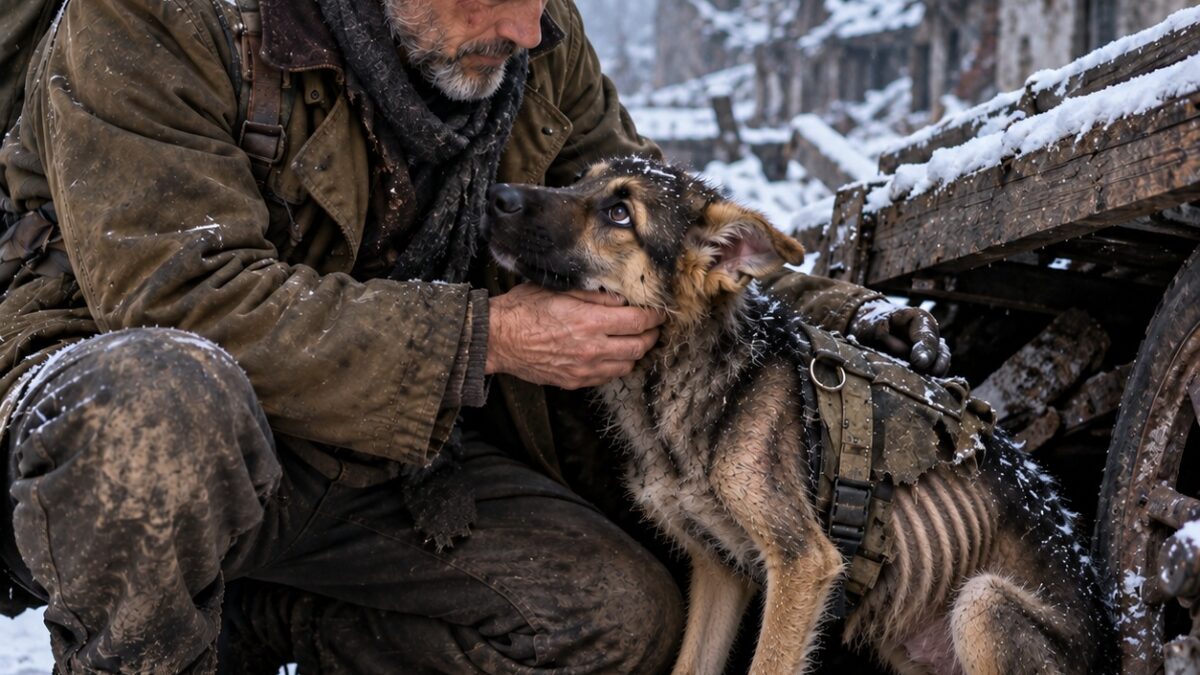
The beginning was a starving German Shepherd beneath an overturned cart who refused to trust me.
Then one morning, he heard a child crying.
He grabbed my sleeve.
And he pulled me back toward the living.