HOA Queen Forged My Signature and Sold My Family’s 5,200 Acres for $4.8 Million — She Never Expected the “Nobody” She Tried to Evict to Be the Judge Who Would Bring Her Down!
FULL STORY CONTINUATION
The Caldwell Ranch sits on 5,200 acres of Texas Hill Country about an hour and a half west of San Antonio, where cedar brakes break open into live oak savannah and limestone bluffs catch the last light every evening like somebody brushed them with fire.
It is the kind of land people have always wanted.
In my grandfather’s time, they wanted it for grazing, water, shade, and survival.
Now they want it for gated entrances, golf courses, boutique hotels, and renderings printed on glossy paper by people who have never fixed a fence, pulled a calf, or stood outside in July heat praying for rain that does not come.
Either way, somebody always wants it.
My grandfather, William Caldwell, bought the first 600 acres in 1947 with money he saved from four years of Army service in the Pacific and, according to family legend, a poker game in Manila he refused to describe but smiled about until the day he died.
He served in the 36th Infantry Division.
Texas’s own.
He came home with a Bronze Star, a bad shoulder, and a clear idea of what he wanted.
Land nobody could take from him.
That was how he said it.
Not land to become rich.
Not land to impress anyone.
Land nobody could take.
Over the next thirty years, he expanded the ranch piece by piece. He bought adjacent pastures when neighbors retired. Picked up foreclosed sections during the droughts of the fifties. Traded cattle for acreage when cash ran short. He was stubborn, patient, and careful in that way men become after seeing enough of the world to know the difference between luck and possession.
By the time I was born, the Caldwell Ranch stretched across 5,200 deeded acres, crossed two county roads, held three spring-fed creeks, two hay meadows, more live oaks than any man could count, and carried the double C brand my grandfather registered with the Harland County Clerk in 1948.
The brand was burned into the cedar gate post at the south entrance.
It had faded over the years, but never disappeared.
My father, Robert Caldwell, loved that gate post more than most men love monuments.
He served on the same district court bench I now occupy for twenty-two years before he retired. He raised cattle before sunrise, wore a robe after nine, and believed those two worlds supported each other instead of conflicting.
“The Caldwells were put here for two things,” he used to say. “Raise cattle and uphold the law.”
Then he would look at me over the top of his glasses.
“And I see no reason those things should interfere with each other.”
So I went to law school at the University of Texas.
Spent six years as an assistant district attorney.
Tried theft cases, assault cases, fraud cases, property disputes that turned neighbors into enemies, contract claims where the paper told one story and every witness told another.
Fourteen years ago, the governor appointed me to the bench.
I still wore boots under my robe.
I still drove my grandfather’s 1983 Ford F-250, bone white, 340,000 miles on the odometer, bench seat smelling like leather and hay, heater dead since the Clinton administration.
Every Friday at four, I hung up my robe, drove forty-five minutes west, and did what three generations of Caldwells had done before me.
Checked fence.
Worked cattle.
Walked the creeks.
Read the land.
About two miles southeast of the main ranch house sat Sunset Ridge Estates, 120 homes on quarter-acre lots built nine years earlier on 200 acres my uncle Vernon sold to a developer named Doug Weston.
Vernon’s sale was legal.
The land was his.
Two hundred acres.
Not 5,200.
That distinction should have mattered to everyone.
It did not matter to Brenda Hargrove.
The families who moved into Sunset Ridge had no idea the quiet rancher they saw sometimes riding fence line on a sorrel mare was the same man who sat behind the bench in courtroom 3A and decided property disputes for a living.
I preferred it that way.
I kept my courtroom and ranch in separate pockets the way my father taught me.
For nine years, that worked.
Then Brenda Hargrove moved into Sunset Ridge in the spring of 2020 and decided 5,200 acres of my family’s land were being wasted because no one had put a clubhouse on them.
I had seen HOA presidents before.
Most are not evil.
Most are tired people who got elected because nobody else wanted to argue about mailboxes.
Brenda was different.
Brenda was beautiful in a way that made people hesitate before disagreeing with her. Thirty-six years old, five-foot-eight, cheekbones like cut glass, hair so perfectly blown out it looked engineered, and a wardrobe built for women who believe entering a room is a form of conquest.
She wore Louboutins to check the mail.
Red soles clicking on pavement like a metronome counting down to trouble.
She carried a Hermès Birkin bag everywhere: the pool, HOA meetings, the hardware store, as if she might be called at any moment to accessorize a hostage negotiation.
She walked a goldendoodle named Coco in matching Burberry harnesses when the temperature dropped below seventy.
The dog wore Burberry in Harland County, Texas.
I will give you a moment with that.
Brenda came from Plano, where people talk about property values the way ranchers talk about rainfall. She had been a licensed real estate agent since twenty-three, married and divorced a tech executive, and left that marriage with a seven-figure settlement and a deep conviction that she was smarter than everyone in any room she entered.
She called it confidence.
I had seen enough witnesses lie under oath to recognize something else.
Entitlement with a blowout.
She ran for HOA president six weeks after moving in.
The previous president, Dave Guzman, a retired electrician who had held the job for four years because nobody else wanted it, did not even run against her.
He told me later, standing at the fence line between my pasture and his backyard, “Judge, I saw her presentation slides, her dress, her smile, and I thought, if she wants the headache that badly, let her have it.”
He regretted that for a long time.
Brenda treated Sunset Ridge like a hostile takeover in stilettos.
She rewrote the covenants in a font she personally selected because it “projected authority.” She hired a community compliance coordinator, a retired city inspector named Phil, to patrol the neighborhood with a clipboard, tape measure, and digital camera.
Trash cans still visible at 7:01 p.m. earned fines.
Mailbox paint chips became violations.
Garden hoses became evidence of “declining exterior discipline.”
She once fined Ray Beckett, a retired Marine colonel, because his American flag bracket was brushed nickel instead of oil-rubbed bronze. Ray read the violation, folded it into a paper airplane, and sailed it into Brenda’s yard.
She fined him for littering.
That was Brenda.
She confused beauty with authority, fashion with substance, and cruelty with leadership.
The residents were too exhausted, too polite, or too intimidated to stop her.
The real problem, the problem that would eventually put her in handcuffs in her own marble foyer, was that she could not look at my ranch without seeing money reflected in her contoured face.
The first time she mentioned Caldwell Ranch at an HOA meeting, it was August 2020.
I was not there.
I heard about it from Dave Guzman, who still attended meetings out of habit and regret.
Brenda stood in the Sunset Ridge clubhouse wearing a cream Valentino blazer and gold earrings that probably cost more than my annual feed bill. She projected a satellite image of the ranch on a portable screen. All 5,200 acres circled in red. Dotted lines showed roads, commercial centers, a golf course, a resort pool, a boutique hotel, and enough cul-de-sacs to make any honest cow lose its way.
“This is wasted potential,” she told the room. “Prime Hill Country land sitting there doing nothing but feeding cows.”
She paused for effect.
“Do you know what this property would be worth if developed? Ninety to one hundred twenty million dollars.”
She was not entirely wrong about the math.
Undeveloped Hill Country acreage within commuting distance of San Antonio had become obscenely valuable. Fifteen thousand an acre. Twenty thousand. Sometimes more if a developer could sell views, privacy, and the illusion of rustic authenticity to people who wanted land without inconvenience.
But Brenda skipped the only fact that mattered.
The land was not for sale.
The Caldwell family had held it for seventy-six years.
We had sold parcels only when family ownership made it lawful, intentional, and limited. My uncle Vernon’s 200 acres became Sunset Ridge because those 200 acres belonged to Vernon.
The rest did not.
Brenda knew some of that.
Not enough.
People like her learn exactly as much as they need to justify what they already want.
In October 2023, I left for a three-week judicial conference in San Antonio. The conference covered digital evidence standards, remote warrant procedures, emerging forensic issues in financial crimes, and a few ethics panels designed mostly to remind judges that common sense still has footnotes.
I left Tuck Marsden in charge of the ranch.
Tuck was fifty-nine, weathered, and built like a cedar fence post. He had worked cattle in Harland County since before Brenda Hargrove had learned whatever prep-school lesson taught her that designer boots were suitable ranch-country footwear.
He did not say much.
He did not need to.
He showed up before dawn, fixed what needed fixing, and went home when the work was done. I trusted him with the ranch the way I trusted my own hands.
Before I drove to San Antonio, I stood on the porch of the ranch house and looked south toward the ridge.
The same ridge my grandfather had stood on in 1947.
Everything was where it was supposed to be.
I had no idea that within seventy-two hours, Brenda Hargrove would put my name on a forged deed and sell every acre like she was moving a used sofa on Facebook Marketplace.
Three days after I left, Brenda walked into her sister-in-law’s notary office wearing Jimmy Choo ankle boots and a cashmere wrap. Lisa Vance, her sister-in-law, ran a small notary and title-assistance service in town. She owed Brenda $40,000 from a kitchen renovation loan and, according to her later statement, had spent two years being reminded of it with the kind of smile that never quite touched Brenda’s eyes.
Brenda set a stack of documents on Lisa’s desk.
Quitclaim deed.
Power of attorney.
Affidavit of authority.
All three claiming I had voluntarily authorized Brenda Hargrove to sell the Caldwell Ranch to Crescent Hills Development LLC, a Delaware company registered three weeks earlier by Doug Weston.
The quitclaim deed transferred 5,200 acres from Elijah W. Caldwell to Crescent Hills Development.
Sale price: $4.8 million.
That alone should have stopped someone.
The land was worth somewhere between $78 million and $120 million depending on who was drooling over it.
Selling it for $4.8 million would have been like selling the Sistine Chapel for the price of a studio apartment and calling it efficiency.
A quitclaim deed transfers whatever interest the grantor has in a property. It does not guarantee clear title. It is simple, fast, and, in the wrong hands, dangerous.
It also requires the actual owner’s signature.
My signature was not on that deed.
A forgery was.
Brenda had hired a commercial artist in Austin named Vincent Tran and paid him $3,000 cash to reproduce my signature from court filings she had photographed at the county clerk’s office. She told Vincent she needed it for a commemorative legal presentation.
He later testified that she wore latex gloves during the cash handoff.
Like she was performing surgery instead of commissioning a felony.
Vincent practiced until the loops and pressure looked close enough to fool someone who wanted to be fooled.
Lisa Vance notarized it.
She notarized the deed, power of attorney, and affidavit.
Then she filed them with the Harland County Clerk.
In one afternoon, on paper, 5,200 acres of Caldwell land changed hands.
While I sat in a hotel ballroom in San Antonio listening to a panel about digital chain of custody, Brenda Hargrove stole my family’s ranch with a fountain pen and a corrupt notary stamp.
Doug Weston wired the $4.8 million through accounts in Houston, San Antonio, and Austin. Brenda received a $320,000 commission, her “finder’s fee” for brokering the deal.
She deposited it the same afternoon.
Her first purchase after the deposit, according to later bank records, was a $14,000 Chanel handbag.
I want you to sit with that for a second.
She bought a purse with the proceeds of selling my grandfather’s land.
The entire operation, from forged signature to funded wire, took less than a week.
She probably spent more time choosing her outfit for the closing than worrying about prison.
Nobody at the clerk’s office flagged it.
The system records instruments.
It does not investigate them.
Brenda counted on exactly that.
Then she did the thing that would become Exhibit A at her criminal trial.
She threw a party.
The celebration happened at the Sunset Ridge clubhouse two nights after recording.
Brenda brought in catering from a restaurant in Boerne.
Wagyu sliders.
Shrimp cocktail.
A three-tier cheese display from some artisanal dairy she followed on Instagram.
She invited every homeowner, Doug Weston, and six members of his development team.
She wore a white Roland Mouret power dress and gold Cartier earrings, held a glass of Veuve Clicquot like a general holding a sword, and announced that Crescent Hills Development had acquired the Caldwell Ranch for the largest residential and commercial project in Harland County history.
PowerPoint slides followed.
Eight hundred luxury homes.
Tom Fazio-designed golf course.
Retail village.
Resort-style pool complex.
Boutique hotel.
Across the top:
Crescent Hills: Where the Hill Country Comes Home.
The room applauded.
People clinked glasses.
Brenda posed for photographs and later posted three with the caption:
Dreams don’t have acreage limits.
No, apparently not.
Fraud does, though.
And hers had 5,200 of them.
The next morning, Doug Weston’s survey crews arrived at the ranch.
Three white trucks with Crescent Hills Development logos freshly printed on the doors rolled up the county road and turned onto my ranch road at 6:45.
Tuck was in the barn loading hay when he heard the gate rattle. He walked down and found two men in hard hats planting orange survey stakes beside my grandfather’s gate post.
“Can I help you boys?” Tuck asked.
The lead man held up a clipboard.
“We’re surveying for the new development. This property was sold last week.”
“Sold by who?”
“The owner. Elijah Caldwell signed the deed himself.”
Tuck looked at the clipboard.
Then at the stakes.
Then at three trucks parked on a private ranch road that had been Caldwell property since the Eisenhower administration.
“I’ve worked this ranch eleven years,” Tuck said. “Judge Caldwell didn’t sell a thing. Plant one more stake, and I’m calling the sheriff. Then I’m calling the judge. You do not want to be here when either one of them arrives.”
The survey crew called Doug.
Doug called Brenda.
Brenda called her attorney.
Within two hours, a cease-and-desist letter was faxed to the ranch addressed to “Ranch Employee.”
Not Tuck.
Not me.
Ranch Employee.
It demanded that unauthorized personnel stop interfering with lawful development activities on property owned by Crescent Hills Development LLC.
Tuck read it, folded it in half, and called me.
I was standing outside a conference room at the Marriott Rivercenter when my phone buzzed.
I stepped into the hallway and listened as Tuck described survey stakes, development trucks, a quitclaim deed with my name on it, and a letter calling him unauthorized personnel on land where he had fixed fence, buried calves, and worked cattle for more than a decade.
My hands did not shake.
My voice did not rise.
Something colder happened.
Clarity.
The absolute certainty that someone has made a catastrophic mistake, combined with the patience to let the evidence assemble before anger steps on it.
“Tuck,” I said, “don’t touch the stakes. Don’t argue. Lock the gates. Sit tight.”
“You coming home?”
“Not yet.”
“Judge—”
“I need to make some calls first.”
I hung up and stood there for maybe thirty seconds, thinking about my grandfather buying those first 600 acres in 1947. Thinking about my father building stone fence when I was twelve. Thinking about the double C brand on the cedar gate.
Then I made four phone calls.
First, the Harland County Clerk.
Margie Fuentes had worked there nineteen years. She pulled the deed while I stayed on the line. I heard paper moving, keys clicking, her breath catch slightly.
“Judge,” she said, “I know your signature better than I know my husband’s. This is close. But it isn’t yours.”
Second, Harland County District Attorney Carmen Reyes.
Carmen was razor sharp, six years as DA and four years before that as my law clerk. When I told her someone had committed real estate fraud against a sitting district judge, she went silent for three full seconds.
Then she opened a case file and assigned her chief investigator, Hector Solis, a retired Texas Ranger with twenty-two years in white-collar crime.
Third, Ray Gutierrez, a forensic document examiner in Austin.
Best in the state.
He confirmed the forgery within twenty-four hours.
Wrong baseline pressure.
Wrong loop structure.
Wrong terminal stroke.
Professional certainty.
Not my hand.
Fourth, the FBI field office in San Antonio.
A $4.8 million wire crossing multiple banking systems based on fraudulent documents is not just local stupidity.
It is federal wire fraud.
Special Agent Diana Marsh listened for twelve minutes.
Then she said, “We’ll open a case today.”
I sat on the edge of the hotel bed afterward and stared out the window. Eighteen floors below, the River Walk glittered with tourist lights.
I did not see any of it.
I saw Brenda Hargrove standing in a clubhouse with champagne, showing people a rendering of 800 homes on my grandfather’s land, smiling like she had closed a deal instead of committing the dumbest crime in Harland County real estate history.
My father taught me many things.
That night, one sentence came back.
There is no worse place to commit a crime than in a courthouse county where the judge is the victim.
I drove home Friday afternoon.
At about three, I passed through the ranch gate and saw the survey stakes.
Dozens of them.
Orange plastic flags on wire shafts marching across my south pasture like an absurd little army. They crossed the hay meadow where my father taught me to drive a tractor. They cut through ground my grandfather cleared by hand. They fluttered in wind over land that had been Caldwell land longer than most of the men planting them had been alive.
Tuck sat on the porch with iced tea.
“They came back twice,” he said. “Walked in through the creek crossing after I locked the gates. Deputies came both times. Crew showed them the recorded deed. Deputies said they couldn’t determine ownership on the spot.”
“I don’t blame them.”
“I don’t either.”
A recorded deed looks legitimate until someone investigates the signature. The clerk’s office records instruments; it does not verify souls.
Two days later, a certified letter arrived from Kendrick & Foley, a San Antonio law firm. It was addressed to Occupant, Caldwell Ranch.
Occupant.
Not Judge Caldwell.
Not Elijah Caldwell.
Not landowner.
Occupant.
The letter stated that Crescent Hills Development LLC was the legal owner of record, that any persons currently occupying the property were unauthorized tenants in holdover, and that failure to vacate within thirty days would result in formal eviction proceedings.
They were trying to evict me from my own ranch.
A woman who had lived in Harland County three years was trying to remove a family that had been there seventy-six.
The audacity was almost beautiful in its stupidity.
The letter was signed by Paul Kendrick, a real estate litigator I had seen on filings in my courtroom. Competent, not exceptional. He had clearly accepted the representation without checking who actually owned the property or who presided over the court where his motion would land.
Five days later, Brenda came to the ranch.
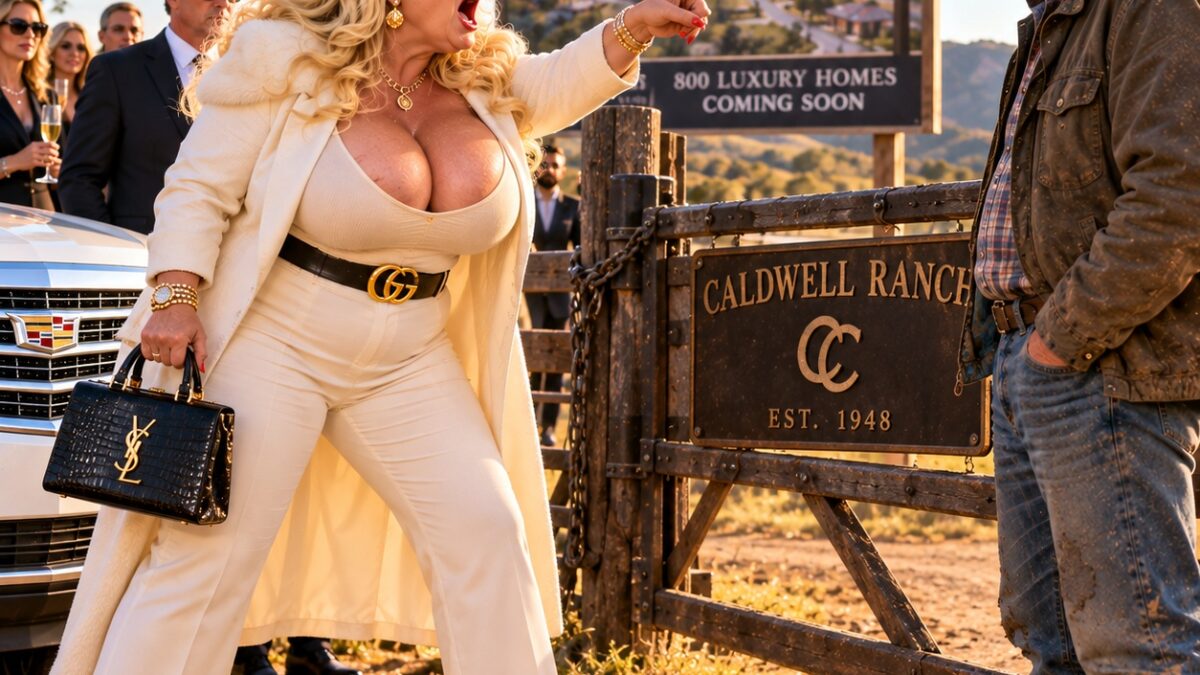
White Escalade.
Doug Weston following in a black Land Rover.
They stopped at the main gate, now padlocked with a chain thick enough to tow a tractor.
Tuck called me from the barn.
I walked down to the gate.
Brenda stood on the other side of the chain in a camel-colored Loro Piana coat, oversized Celine sunglasses, and red-soled heels planted in road dust like the entire Hill Country should apologize for being unpaved.
Her hair was perfect.
Her lipstick was perfect.
Her cruelty was immaculate.
Doug stood behind her, arms crossed, trying hard to look like a man who owned something.
“Mr. Caldwell,” Brenda said, “this is getting ridiculous.”
She said it like a woman correcting a valet who had parked her car in the wrong spot.
“You’ve been served with a notice to vacate. The deed is recorded. The sale is final. You need to accept that and move on.”
I leaned against the cedar gate post.
The double C brand was under my palm.
“Brenda, I’m going to say this once. I did not sign that deed. I did not authorize that sale. And you know it.”
She lowered her sunglasses.
An actual motion.
Like a villain in a soap opera.
“I have recorded documents. I have a notarized power of attorney. I have a $4.8 million wire transfer. The courts will sort this out.”
“Yes,” I said. “They will.”
She did not understand what I meant.
She would.
Doug stepped forward.
“Judge, we’re prepared to offer a reasonable settlement. Fair market value for the ranch house and surrounding acreage.”
“Doug,” I said, “you did not buy this ranch. You bought a piece of paper with a forged signature on it. The difference between those two things is going to become very clear to you very soon.”
They left.
Brenda was already on her phone before the Escalade hit the county road.
While she made calls, Carmen Reyes and Hector Solis kept digging.
What they found was worse than expected.
Vincent Tran, the calligrapher, cooperated within forty-eight hours. He said Brenda paid cash, wore gloves, and told him the signature reproduction was for a legal ceremony.
Lisa Vance cracked even faster.
She admitted she knew the signature was not authentic. Brenda had told her the signing was pre-authorized and would be “ratified later.”
Lisa knew that was nonsense.
She notarized anyway because Brenda had leverage: the $40,000 kitchen renovation loan.
“I knew it was wrong,” Lisa told Hector through tears. “I just didn’t think anyone would find out.”
That is the anthem of nearly every fraud case I have ever heard.
I just didn’t think anyone would find out.
The money trail was equally damning.
Doug wired $4.8 million through multiple accounts. $320,000 landed in Brenda’s personal checking account. The FBI traced every transfer. There were closing costs, title fees, operating accounts, and enough interstate movement to interest the federal government very quickly.
Rick Farley, the title company owner in Austin, processed the transaction without performing a proper title search. No ownership verification. No title insurance. No questions.
Doug had told him the deal was pre-cleared by seller’s counsel.
There was no seller’s counsel.
There was no seller.
Just a forged signature, a notary under pressure, and a woman in designer shoes who thought confidence could substitute for title.
Then came the history.
Brenda had done something close to this before.
In 2018, in Williamson County, a ninety-two-year-old widow named Edna Pilkington transferred her sixty-acre homestead to a development company for $200,000. Her family later alleged she had been pressured repeatedly, told the land was worthless, warned about back taxes, and pushed into signing.
The agent on the transaction?
Brenda Hargrove.
The Texas Real Estate Commission had found irregularities but declined charges because Edna, by then suffering from dementia, could not testify clearly.
Brenda walked away clean.
Her blowout intact.
Her record polished.
But the file existed.
When Carmen subpoenaed it, the Pilkington complaint read like a rehearsal.
Same charm.
Same pressure.
Same land hunger.
Same beautiful cruelty.
Carmen convened a grand jury in November.
Evidence took three days.
On the fourth, the grand jury returned a sealed twelve-count indictment.
Brenda Hargrove: forgery, fraud, conspiracy to commit real estate fraud, tampering with a government record.
Douglas Weston: fraud and conspiracy.
Lisa Vance: notary fraud.
The warrants sat sealed at the DA’s office.
Brenda did not know.
Doug did not know.
Their lawyers did not know.
Meanwhile, Brenda’s civil eviction case was still pending.
Paul Kendrick filed a motion for summary judgment asking the court to evict me based on the recorded deed without a full trial. The hearing was set for a Wednesday morning in December.
In courtroom 3A.
My courtroom.
Now, I need to explain something.
In Harland County, the 187th Judicial District Court handles civil filings. At that time, there was no rotation wheel that would automatically send the case elsewhere. A civil matter filed in the county came to courtroom 3A unless I recused or the case was transferred.
Paul Kendrick apparently did not check the brass plate outside the door.
He filed an eviction motion against Elijah Caldwell in the courtroom of Judge Elijah Caldwell and never stopped to wonder whether those two men might share more than a last name.
Carmen and I had a careful conversation.
I could not ethically preside over a case in which I was the party, victim, and landowner. The Texas Code of Judicial Conduct required recusal when a judge has a personal interest in the outcome. My interest was 5,200 acres large.
But recusal would happen on the record.
The criminal arraignment was separate.
The defendants had a right to prompt appearance.
The scheduling was administrative.
The law did not require me to hide from the woman who forged my name. It required me to step aside once the conflict was formally stated.
Carmen’s plan was precise.
The arrests would happen the morning of the civil hearing.
The defendants would be processed.
They would be brought to courtroom 3A for arraignment.
I would read the charges, state the conflict clearly, recuse myself from both the criminal and civil matters, and transfer the cases to Judge Margaret Solis in Kendall County.
Everything legal.
Everything on the record.
Everything Brenda should have thought about before forging a judge’s signature.
The week before the hearing, Brenda was still celebrating.
She posted new renderings of Crescent Hills.
Hosted an information session at a hotel in Boerne.
Sixty people signed interest cards for homes on land she did not own.
She ordered custom stationery reading:
Crescent Hills
A Brenda Hargrove Development
She spent three weeks selecting the font.
One afternoon she drove past my ranch, stopped on the county road, and took a picture of herself with my gate in the background. She wore a cream trench coat and heels on gravel.
The caption read:
Every empire starts with a gate.
Tuck saw it online and shook his head.
“She’s measuring drapes in a house she broke into,” he said.
I spent those final days preparing differently.
I reviewed the indictment with Carmen.
Confirmed procedure with my court coordinator, Linda Reyes.
Laid out my robe the night before, hanging it on the back of my chamber door with the zipper facing out, the way my father used to do.
Then I called Howard Harmon, my personal attorney of twenty years.
“Howard,” I said, “tomorrow morning Brenda Hargrove is going to walk into my courtroom thinking she is about to take my ranch.”
He chuckled once.
“And?”
“She’s going to learn that you do not commit fraud in a courthouse county without the courthouse finding out.”
“Eli,” Howard said, “your grandfather would have loved this.”
“Yes,” I said. “He would have.”
The morning of December 11 was cold for the Hill Country.
Thirty-eight degrees.
Thin frost over the pastures.
Tuck was at the ranch before dawn, feeding cattle by headlight.
I put on a white dress shirt, navy tie, pressed slacks, and mahogany Justin ropers my wife gave me the year I was appointed. Then I drove the old F-250 to the courthouse, parked in my usual spot, and went in through the judge’s entrance.
Linda was already at her desk.
“Morning, Judge. Full docket. Hargrove eviction motion first at nine. DA Reyes called. She’ll be present with her investigator.”
“Thank you, Linda.”
I went into chambers.
Closed the door.
Put on my robe.
At 7:45, two Harland County sheriff’s deputies knocked on Brenda Hargrove’s front door.
She answered in a silk La Perla robe, hair in expensive ceramic rollers, coffee cup in one manicured hand.
“Brenda Hargrove?”
“Yes?”
“We have a warrant for your arrest.”
The charges were read at her doorway.
Forgery.
Fraud.
Conspiracy.
Tampering with a government record.
The coffee cup hit the marble foyer and shattered.
Brenda stared at the deputy like a woman watching her reflection break.
“There must be a mistake. I need to call my attorney.”
“You can call from the station, ma’am. Turn around, please.”
She was handcuffed in her foyer at 7:46 a.m.
Coco, the goldendoodle, sat in the hallway wearing a Burberry harness and did not bark.
For once, the dog was the most dignified one in the house.
Doug Weston was arrested thirty minutes later at his office in San Antonio.
He went quietly.
Lisa Vance was arrested at 8:15 at her notary office.
She was already crying when deputies arrived.
All three were processed, fingerprinted, photographed, advised of their rights, and transported to the Harland County Justice Center for arraignment.
At 9:00, courtroom 3A filled.
Paul Kendrick arrived out of breath, tie crooked, briefcase disorganized. He still thought this was about the eviction hearing. He was muttering about improper service and judicial overreach when he walked through security.
Then the doors opened.
Brenda entered in jail-issued clothing, wrists cuffed in front. No Louboutins. No Celine sunglasses. No Birkin. Her face kept moving between fury and fear, unable to settle.
She took three steps into courtroom 3A.
Then she looked up.
The bench in that courtroom is solid oak, built by a furniture maker in Fredericksburg during my father’s tenure. It sits high enough that from counsel table, you have to lift your eyes toward the judge.
Brenda lifted hers.
And there I was.
Judge Elijah Caldwell.
In my robe.
On my bench.
In my courtroom.
The same man whose signature she forged.
The same man she tried to evict.
The same man whose ranch she sold with champagne, PowerPoint slides, Cartier earrings, and a smile meant for cameras.
She stopped walking.
Paul Kendrick bumped into her back.
The deputy behind her nearly stumbled.
For the first time since she arrived in Harland County with her Escalade, designer dog, and curated confidence, Brenda Hargrove had nothing to say.
The courtroom was silent.
I had seen that look before.
The look of someone whose mind is trying to reconcile two realities that cannot coexist.
The world she believed she controlled.
And the one she was actually standing in.
“Counsel,” I said, “please be seated.”
Paul helped Brenda into her chair.
Carmen Reyes stood at the prosecution table. Hector Solis sat behind her. Two FBI agents, including Diana Marsh, sat in the second row.
“This court is now in session. Case number 2023-C-4471. State of Texas versus Brenda Louise Hargrove, Douglas Ray Weston, and Lisa Marie Vance. This is an arraignment on a sealed indictment returned by a Harland County grand jury.”
I looked at Brenda.
“Ms. Hargrove, you are charged with four counts of forgery in the first degree, two counts of fraud, one count of conspiracy to commit real estate fraud, and one count of tampering with a government record. These charges allege that you knowingly forged or caused to be forged the signature of a property owner on a quitclaim deed and related instruments, and used those instruments to fraudulently transfer title to 5,200 acres of deeded ranch land in Harland County.”
Her lips parted.
No sound came out.
I turned to Doug.
“Mr. Weston, you are charged with fraud and conspiracy. These charges allege you knowingly participated in a scheme to acquire real property through forged instruments and wired $4.8 million in furtherance of that scheme.”
Then Lisa.
“Ms. Vance, you are charged with notary fraud for knowingly notarizing documents you knew contained a forged signature.”
The courtroom was so quiet I could hear the clock ticking on the back wall.
I took a breath.
“Before we proceed further, the court has an obligation to address judicial ethics. I am Judge Elijah Caldwell. I am the owner of the property described in this indictment. The quitclaim deed referenced in these charges bears a forgery of my signature. In the plainest terms, I am the victim of the crimes charged in this proceeding.”
I looked at Brenda.
Her mouth remained slightly open.
The last sixty seconds had finally penetrated whatever designer wall she had built around herself.
“Under the Texas Code of Judicial Conduct, I am required to recuse myself. I am also recusing from the pending civil matter Crescent Hills Development versus Caldwell, which I now understand to be an eviction proceeding filed against me on my own property using the very instruments this grand jury has found sufficient cause to believe fraudulent.”
I paused.
The moment held.
“Both matters will be transferred to the Honorable Judge Margaret Solis of the 216th District Court in Kendall County.”
I closed the file.
“However, before I step down, I want the record to reflect one thing.”
I looked directly at Brenda Hargrove.
“Ms. Hargrove, you came to this courthouse today expecting to pursue an eviction motion against the owner of the Caldwell Ranch. Instead, you are standing in that owner’s courtroom facing felony charges returned by a grand jury of this county. You celebrated the sale of my property with champagne and PowerPoint slides. You posted photographs of my gate on social media. You told your neighbors that 5,200 acres of my family’s land was being wasted.”
I let the word sit there.
Wasted.
“This proceeding will continue under Judge Solis. But I want you to understand exactly where you are. You are in courtroom 3A. My courtroom. The courtroom of the man whose name you forged. And the law I have spent fourteen years upholding from this bench is the same law that brought you here today.”
Brenda’s hands tightened around the edge of the table.
“No amount of designer clothing changes that.”
I stood.
“Court is in recess.”
The gavel came down once.
The sound filled the room like a door closing.
Brenda Hargrove, the woman with the Escalade, the Birkin, the champagne party, the custom stationery, the dog in Burberry, the forged deed, and the Chanel handbag purchased with stolen money, had absolutely nothing left to say.
Judge Margaret Solis did not waste time.
Three days after transfer, the civil eviction case was dismissed. The quitclaim deed was voided. Title was restored to me and the unbroken Caldwell chain of ownership running from William Caldwell in 1947 to the present.
Crescent Hills Development LLC was dissolved after Carmen demonstrated the company existed solely to commit the fraudulent transfer.
The criminal trials happened the following spring.
Brenda went first.
She appeared in a tailored navy suit, still beautiful, still composed, still dressed like she was attending a charity luncheon instead of fighting felony charges. Her new defense attorney, a high-priced litigator from Austin, argued she had acted under Doug Weston’s direction and did not fully understand the legal consequences.
The jury did not believe it.
Carmen presented the emails between Brenda and Doug.
Messages where Brenda proposed the forged signature scheme.
Identified Vincent Tran.
Recruited Lisa Vance.
Calculated her commission to the penny.
Carmen introduced the champagne party photos, the Crescent Hills PowerPoint, the Instagram post at my gate with the caption Every empire starts with a gate, and the Pilkington file from Williamson County showing a pattern that stretched back years.
Then Vincent testified.
He told the jury Brenda gave him eight sample signatures copied from court filings. He told them she paid cash. Told them she wore gloves. Told them she warned him never to contact her by email. He said he had nightmares after learning what the signature had been used for.
Lisa testified too.
By then, she had taken a plea agreement.
She cried on the stand.
Not for drama.
Because the truth had finally cost more than Brenda’s leverage.
The jury deliberated ninety minutes.
Guilty on all counts.
Brenda Hargrove was sentenced to twelve years in the Texas Department of Criminal Justice.
They do not allow Louis Vuitton there.
No Birkin bags.
No red-soled heels.
And the uniform is the same for everyone, regardless of cheekbones.
Doug Weston pleaded guilty before trial.
Eight years.
Forfeiture of the $4.8 million.
Restitution.
Federal wire fraud charges followed. He pleaded guilty to three counts and received additional time.
Lisa Vance received probation in exchange for cooperation and permanently surrendered her notary commission.
The sixty people who had signed interest cards at Brenda’s Boerne event received letters explaining that no development had ever been authorized, no land had been lawfully sold, and the entire project rested on forged documents and designer confidence.
Sunset Ridge held a special election.
Every board member who supported Brenda was voted out.
The new president, a retired principal named Tom Andrade, called me two weeks later.
“Judge, I want to apologize on behalf of the homeowners.”
“Tom, you couldn’t have known everything.”
“We should have asked more questions.”
“Yes,” I said. “You should have.”
He was quiet.
“What can we do?”
“Be good neighbors,” I said. “That’s all I ever asked.”
The ranch is still here.
Every acre.
Every fence post.
Every live oak.
Every limestone bluff.
Every spring-fed creek my grandfather looked at in 1947 and decided was worth everything he had.
I rebuilt the south fence line with cedar posts and five-strand wire. Repainted the double C brand on the gate post. Replaced the tin roof on the pecan stand my grandmother built in 1963. And with part of the restitution, I paid off the remaining ranch debt.
For the first time in seventy-six years, a Caldwell owned the ranch free and clear.
Most mornings, I still drive fence line in my grandfather’s truck.
The heater still does not work.
Sometimes I stop on the high ridge above the south pasture and look out across 5,200 acres of Hill Country that four generations of my family have kept the way it was meant to be.
Brenda Hargrove called it wasted.
I call it home.
And courtroom 3A of the 187th Judicial District Court of Harland County, Texas, is still open for business.
My name is still on the brass plate.
Every morning, I put on my boots, zip up my robe, and remember something my grandfather said the day he registered the double C brand in 1948.
The law does not belong to the loudest person in the room.
It does not belong to the richest.
It does not belong to the best dressed.
It belongs to the one who knows how to use it.
I am Judge Elijah Caldwell.
This is Caldwell land.
And anyone who thinks they can take it had better bring their best forgery, their best attorney, and their best champagne.
I will see them in my courtroom.