FULL STORY:They Called Me a Roadside Carpenter in a Room Full of Millionaires—My Answer Was Hidden in Their Basement
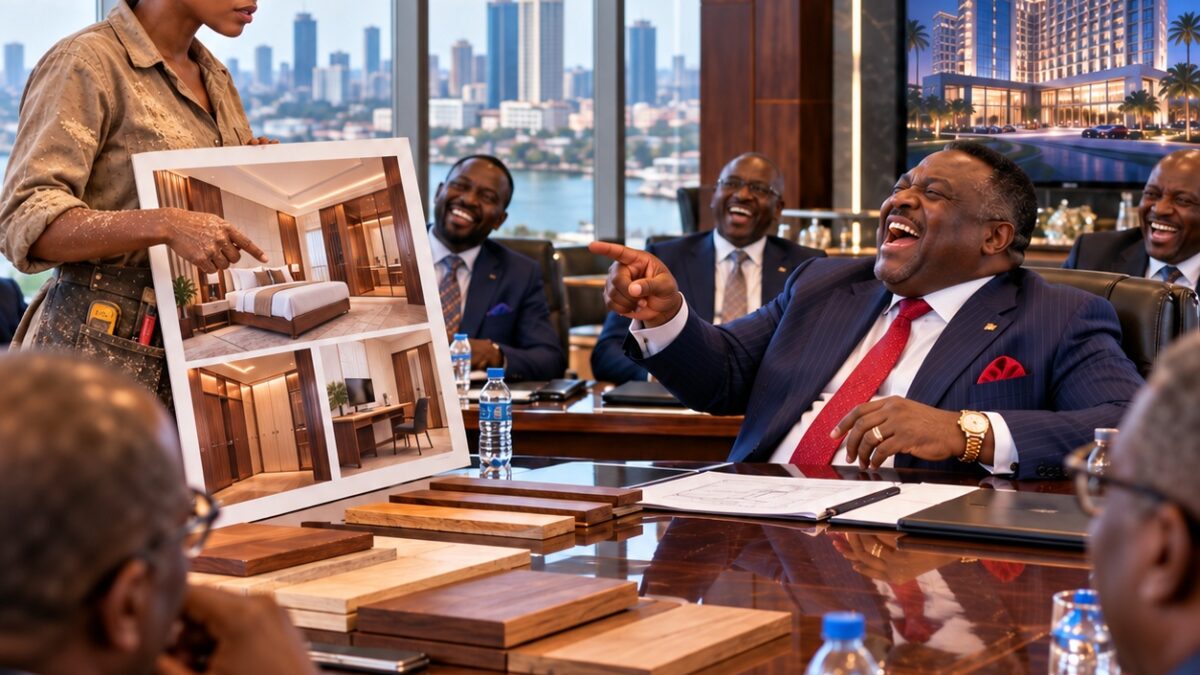
FULL STORY CONTINUATION
“No.”
My mother sat across from me as calmly as if she’d placed a grocery list on the table.
“Funke.”
“No, Mama.”
“You have not even heard me.”
“I know exactly what you’re saying.”
“Then save us time.”
I pushed the certificate back toward her.
“This house is everything you have.”
She pushed it back.
“This house is cement and zinc.”
“Mama.”
“Your father’s name is what I have.”
I stood.
“If the bank calls this guarantee and something goes wrong, they can take your home.”
“And where will I sleep?”
“That is not funny.”
“I did not laugh.”
Her voice softened.
“I slept before this house existed. I slept when your father and I shared one room with a leaking roof. I slept when we had nothing except one plane, two chisels, and a man who believed his hands could feed a family.”
She touched the envelope.
“He built this house so we could stand on something. Not so we could sit on it while fear finished what poverty started.”
My eyes burned.
“I cannot risk your home because somebody published a tender.”
“You are not risking it because of a tender.”
She looked toward the old wooden box where she kept my father’s remaining tools.
“You are risking it because the work is yours.”
I said nothing.
She leaned closer.
“One condition.”
I looked at her.
“You do not beat that man because he laughed at you.”
Chief Badmus.
“You beat him only by doing the work well.”
“Mama—”
“Anger is a poor carpenter.”
That sounded exactly like my father.
I lowered my head.
She reached across the table and took my hand.
“Bring the paper back to me.”
“I will.”
“I know.”
The next morning, the bank manager stared at the property documents for a long time.
Then at me.
Then back at the documents.
“You understand this is your mother’s house?”
“Yes.”
“And she has consented?”
“She insisted.”
He sighed.
“Madam Ado, people usually bring me business plans and optimism. You have brought your mother’s roof.”
“I brought collateral.”
That made him smile despite himself.
He reviewed our four years of statements again.
No returned checks.
Salaries paid regularly.
Loans serviced.
No disappearing transactions.
No unexplained cash movements.
A small account.
But a disciplined one.
Finally, he closed the file.
“I will fight for the guarantee.”
That was all I needed.
Two days later, I walked into the Havila Crest bidders’ conference wearing the best jacket I owned.
Our pickup was parked between vehicles worth more than my entire street.
Tunde sat in the passenger seat and counted them.
“Eleven cars,” he said, “that can buy this workshop.”
“Stop counting.”
“I am motivating myself.”
“Pray the pickup starts when I come out.”
He looked toward the hotel entrance.
“Boss.”
“What?”
“Front row.”
I frowned.
“Why?”
“If you’re going to win, sit where the winner can be seen.”
So I did.
That was how Chief Badmus spotted me.
He stood among men who knew him, greeted him, and laughed before he finished his jokes.
When he saw me, his face brightened.
Not with kindness.
With opportunity.
“The roadside carpenter.”
Several heads turned.
He looked delighted.
“Madam, have you lost your way?”
His friends laughed.
I sat down.
Then Mrs. Ngozi Ezani entered.
Group Chief Operating Officer of Havila Crest Hotels and Resorts.
She didn’t waste time.
“Three suppliers have already failed this group,” she said. “Wardrobes swelled. Beds collapsed. Drawers failed. We replaced furniture twice in four years at one property.”
The room went silent.
“I am not buying furniture.”
She looked around us.
“I am buying ten years of peace.”
That sentence changed everything for me.
One by one, the bidders introduced themselves.
Chief Badmus stood first.
“Titan Crest Interiors. Twenty-six years. Forty containers annually. European and Turkish imports.”
Richard Ibe from Apex Line Living spoke about 3D visualization, smart modular systems, and European production standards.
Another bidder talked about banks and corporate clients.
Then I walked to the microphone.
“Good morning. My name is Funke Ado of Ado Woodworks, Surulere.”
Chief Badmus laughed.
“Ado Woodworks? Is that not the roadside carpenter?”
The hall erupted.
“You make stools beside the gutter and want to furnish a five-star hotel?”
Another man slapped the table.
Chief Badmus raised his hands.
“Madam, forgive me. This is not a village meeting.”
More laughter.
My hands started trembling.
I put them behind my back.
Mrs. Ezani looked at Chief Badmus.
“This is a tender, not a comedy hall.”
The laughter died.
She turned toward me.
“How many employees?”
“Five, ma’am. Six including me.”
Someone chuckled.
“One worker for every thirty-three hotel rooms,” she said.
“Yes.”
“And you believe six people can furnish two hundred rooms?”
“Not yet.”
That made her pause.
I continued.
“First, I need to understand why your furniture keeps dying.”
Nobody laughed.
“Will bidders be permitted to inspect the failed furniture?”
Mrs. Ezani stared at me.
“What?”
“The pieces that failed. I want to see the broken wardrobes, beds, drawers, anything you’ve removed from service.”
She looked toward her procurement team.
“Has any bidder requested that?”
A woman shook her head.
“Not once.”
Mrs. Ezani looked back at me.
“You are the first bidder in eleven years who has asked to inspect our failures.”
She handed me an access card.
“Go listen to them.”
Chief Badmus snorted.
“We know furniture. I don’t need to tour a storeroom.”
Richard from Apex Line smiled.
“Our failure models already account for that data.”
I looked at them.
That was the difference.
They wanted to show the hotel what they knew.
I wanted the hotel to show me what I didn’t.
When I got back to the pickup, Tunde saw my hands shaking.
“Boss?”
“He humiliated me in front of everybody.”
He waited.
I told him what happened.
When I finished, he leaned back.
“My first week with your father, he gave me a plank to plane.”
“I know this story.”
“No, today you need it.”
He continued.
“I destroyed the first board. Then the second. The other apprentices laughed. Your father looked at me and said, ‘Tunde, the wood is not laughing. Only people laugh. Wood waits.’”
I stared at him.
“So let Chief Laughing laugh.”
Despite myself, I smiled.
“Chief Laughing?”
“He has earned the title.”
I held up the hotel access card.
“She gave me this.”
Tunde looked at it.
“What is it?”
“Permission to inspect every piece of furniture that failed.”
His grin disappeared.
Then he started the truck.
“Boss.”
“What?”
“Let’s go listen to wood.”
The first hotel we inspected changed our bid completely.
Mrs. Fatima Yusuf, the head housekeeper, met us in the lobby.
Three other bidders had already visited.
“They measured the lobby,” she said. “Photographed the chandelier. Asked for room dimensions.”
“I don’t want the best room.”
She looked surprised.
“Show me the worst.”
Room 214 had been removed from inventory months earlier.
The wardrobe bottom was swollen.
The edge banding had failed.
Moisture from mopping and condensation had seeped into the board.
The bed frame had once collapsed beneath a guest.
A room attendant named Blessing had been blamed and dismissed.
I stared at the cracked frame.
“The bed failed.”
Mrs. Yusuf nodded.
“Blessing had worked here twelve years. Never one complaint.”
“Where is she?”
Mrs. Yusuf looked toward the window.
“Outside the hotel gate. She sells recharge cards under an umbrella.”
I wrote her name in my notebook.
BLESSING.
Aisha looked at me.
“Why?”
“So we remember who bad furniture hurts.”
We spent hours with Mrs. Yusuf.
For the first time, someone asked housekeeping what they needed.
Her requests weren’t glamorous.
Raise wardrobes high enough for a mop to pass beneath.
Round table corners so staff wouldn’t cut themselves.
Use handles that didn’t catch uniforms.
Make broken parts replaceable.
“Furniture should not fight the people cleaning sixteen rooms a day,” she said.
Aisha started sketching.
“What if every section is numbered?”
I looked at her.
“Explain.”
“Door, shelf, panel, drawer. If one fails, maintenance changes one piece. Not the whole wardrobe.”
Mrs. Yusuf stared at us.
“You can do that?”
“Yes.”
“Then please do.”
The basement was worse.
Mr. Eyong, head of maintenance, called it the furniture mortuary.
Rows of broken pieces were stacked against the walls.
Three generations of hotel furniture.
Different colors.
Different suppliers.
Same failures.
Swollen bases.
Weak joints.
Disposable hinges.
Particleboard disguised as luxury.
Mr. Eyong pulled out a notebook.
Four years of repair records.
Six hundred and twelve entries.
“Nobody has ever asked for this.”
I opened it.
Date.
Room.
Furniture item.
Failure.
Repair attempt.
Replacement.
A pattern appeared almost immediately.
Water.
Joints.
Unrepairable parts.
Then Tunde called my name.
“Boss.”
He pointed toward a broken wardrobe.
The supplier label remained attached.
TITAN CREST INTERIORS.
“How many?”
Mr. Eyong answered.
“Forty-one wardrobes.”
I looked at Chief Badmus’s company name.
He had laughed because I worked beside a road.
His own expensive furniture was lying dead in a basement.
“Photograph the failure,” I told Aisha.
She lifted her phone.
“And the company tag?”
I thought about it.
“No.”
She lowered the phone.
“Why?”
“Because we’re studying furniture, not preparing revenge.”
That distinction became harder to maintain later.
But in that basement, it mattered.
Over the next week, we rebuilt our entire proposal.
No chipboard near the floor.
Local hardwood where appropriate.
Every surface sealed, including the backs, bottoms, tops, and edges customers would never see.
Traditional mortise-and-tenon joints where strength mattered.
Wardrobes raised fifteen centimeters.
Aisha called it Mrs. Yusuf’s Gap.
Numbered replaceable components.
Spare-parts cabinets on every hotel floor.
A five-year guarantee.
Forty-eight-hour repairs.
And something nobody else offered.
Traceability.
Every piece built by local craftsmen would carry a small brass plate inside.
Not just Ado Woodworks.
The names of the people whose hands made it.
Tunde stared at me.
“The first cost is eighteen percent higher.”
Kemi kept calculating.
Then stopped.
“Do it again.”
She did.
Her eyes widened.
“Over ten years?”
“Tell me.”
“We are cheaper by almost half.”
The room went silent.
The hotel had told us what it wanted.
Ten years of peace.
So that became the name of our bid.
THE TEN-YEAR ROOM.
Our next challenge was scale.
I had six people.
We needed dozens.
Tunde took me to the carpenters’ association in Mushin.
Alhaji Jimoh had known my father.
He remembered Tunde as the apprentice who couldn’t cut a straight line.
He remembered me as “Ado’s daughter who left for an office and learned to wear a blazer.”
“I came back and took it off,” I told him.
He laughed.
Then I asked for forty skilled carpenters.
His smile vanished.
“Contract people came here in 2019. We built hundreds of chairs. They paid for a fraction. Then they put their own stickers on our work.”
“I won’t.”
“Everybody says that.”
So he handed me a plane.
“One face. Flat and true.”
Tunde reached to set the blade.
I stopped him.
“If he touches it, it is his board.”
Alhaji’s eyebrows rose.
I planed the board.
Slowly.
Left thumb forward.
The way my father taught me.
When I finished, Alhaji ran his palm over the surface.
“The hands are his.”
His expression remained hard.
“But hands do not pay people.”
So I gave him the agreement.
Payment every two weeks.
Association witnesses.
Names inside every finished piece.
No invisible labor.
He didn’t promise me anything.
“Win first,” he said. “Then come back as one master speaking to another.”
We were shortlisted.
Titan Crest.
Apex Line.
Ado Woodworks.
When Chief Badmus learned his friends had been dropped and I remained, the laughter ended.
I didn’t know that yet.
I only knew I had two weeks to prepare the presentation that might save my workshop.
And Dio’s mother needed surgery.
He tried to hide it.
I found him outside one afternoon after a hospital call.
“How much?”
“Ma, don’t.”
“How much?”
“₦2.8 million.”
He looked away.
“You are carrying enough already.”
I put a hand on his shoulder.
“If we win this bid, we carry it together.”
He nodded.
I didn’t know that Chief Badmus’s people had already learned about his mother.
The final presentation was scheduled for Monday.
The night before, my mother handed me my father’s old carving chisel.
“Do not use it.”
I looked confused.
“Then why give it to me?”
“To remember whose daughter is speaking.”
She straightened my jacket.
“Those men will speak to her pocket.”
She touched my chest.
“You speak to her problem.”
At the hotel, Chief Badmus went first.
Sixty containers already on the sea.
Forty-five-day installation.
Imported finishes.
Scale.
Confidence.
Mrs. Ezani asked one question.
“Your company furnished our Ikeja property in 2021.”
“Yes, ma’am.”
“Forty-one wardrobes are in my basement.”
The room went still.
Chief Badmus blamed housekeeping.
“They use too much water.”
Mrs. Ezani looked at him.
“My hotels are cleaned with water.”
His answer was a new model.
A new brochure.
A replacement discount when future units failed.
She thanked him.
Apex Line went next.
Beautiful renderings.
Modular components.
European engineered board.
An app to track furniture.
A four-year refresh cycle.
Mrs. Ezani leaned back.
“So I buy everything again in four years?”
Richard hesitated.
“That is the recommended lifecycle.”
Then came my turn.
I didn’t open a slide.
I placed a damaged wardrobe door wrapped in brown paper on the table.
“This is from Room 214.”
Mrs. Ezani recognized the number.
I told her about Mrs. Yusuf.
Blessing.
Mr. Eyong.
Six hundred and twelve failures.
Then I pushed the damaged door toward the directors.
“Press the corner.”
A man pressed his thumb into it.
It sank.
“Now knock this.”
I placed a sample of properly dried local hardwood beside it.
Knock.
A clean, solid sound.
I unveiled the Ten-Year Room.
Fifteen-centimeter clearance.
Sealed surfaces.
Repairable components.
Traditional joints.
Spare-parts system.
Five-year warranty.
Forty-eight-hour repair promise.
Eighteen percent more expensive on day one.
Almost half the cost across ten years.
One director checked Kemi’s calculations.
“She is correct.”
Then Mrs. Ezani asked the question I’d been expecting.
“You have five employees and ninety days.”
“Yes.”
“How?”
I took a breath.
“The largest furniture factory in Lagos doesn’t have one roof.”
They stared at me.
“It is thousands of trained carpenters working in roadside sheds, small workshops, and markets across this city.”
I looked toward Chief Badmus.
“My competitors call those places the gutter.”
Then I turned back to the board.
“I call them capacity.”
My plan used standardized drawings, shared quality control, central inspection, numbered components, and forty additional craftsmen trained to one specification.
“And every carpenter gets his name inside what he builds.”
Mrs. Ezani looked at me for a long moment.
“Thank you, Miss Ado.”
When we left the room, Chief Badmus stopped me in the corridor.
“A fine little story.”
“Aisha stays,” I said when he looked at her.
He smiled.
“Withdraw today.”
“No.”
“I’ll give you fifty wardrobes as subcontract work. More money than your workshop has seen in years.”
“Under your name?”
“Of course.”
“No.”
His smile disappeared.
“Lagos is small, young lady.”
“I know.”
“Banks talk. Landlords talk. Timber sellers talk.”
I felt cold despite the air conditioning.
“Is that a threat?”
He smiled again.
“No.”
Then he adjusted his cuff.
“A weather forecast.”
The storm began the next morning.
An article appeared online.
BANKRUPT ROADSIDE WORKSHOP SHORTLISTED FOR ₦4.2 BILLION HOTEL CONTRACT.
It claimed we owed rent.
That we had abandoned customer orders.
That we couldn’t pay workers.
One customer called for her deposit back.
Another asked whether we were closing.
Then my bank manager called.
“Head office has seen the story.”
My stomach tightened.
“Our guarantee?”
“Under review.”
“That guarantee is secured by my mother’s house.”
“I know.”
I looked across the workshop.
Everyone was silent.
Then Dio’s phone rang.
He didn’t answer it.
That silence stayed with me.
Mrs. Ezani called an hour later.
“I read the article.”
“Ma’am, it is—”
“I didn’t ask whether it was true.”
I stopped.
“I do not buy furniture from newspapers.”
I closed my eyes.
Then she continued.
“My board is nervous.”
There it was.
“Each shortlisted bidder will furnish one sample room at the new Grand Hotel.”
“When?”
“Friday morning. Doors open at six.”
“How long?”
“Seventy-two hours.”
I looked at my team.
“Complete room?”
“Bed. Wardrobe. Desk. Chair. Headboard.”
She paused.
“Real furniture. Real conditions. Monday morning at ten, I open all three doors.”
I swallowed.
“We’ll be ready.”
When I hung up, Tunde stared at me.
“A full hotel room in three days?”
“Yes.”
“With this generator?”
Ibuka looked toward the machine.
“Maybe it will be moved by purpose.”
Then Tunde smiled.
“Boss.”
“What?”
“Somebody very big is afraid of us.”
That was when Dio finally spoke.
“I need to tell you something.”
His face had gone gray.
A man from Chief Badmus’s office had approached him outside his mother’s hospital room.
Three million naira.
Surgery.
Medication.
Private care.
All Dio had to do was make our presentation materials disappear.
He had carried the man’s card for days.
He had never accepted.
But he’d never told us.
Tunde stepped toward him.
I raised my hand.
“Let him finish.”
Dio pulled out his phone.
“They called again.”
He pressed play.
The recording was clear.
Three million still stands.
In the sample room, the headboard cracks on the last night.
Chief does not forget his friends.
Aisha covered her mouth.
Kemi whispered, “We take this to Havila Crest.”
“Not yet.”
Everyone looked at me.
“We don’t use it to win.”
“Ma—”
“We use it only if we need to defend ourselves.”
Dio looked ashamed.
“Why didn’t you take the money?” I asked.
His eyes filled.
“Two years ago, you paid my salary the month you sold your car.”
I stared at him.
“You thought we didn’t know where the pickup came from?”
I almost laughed.
Instead, I put my hand on his shoulder.
“Your mother’s hospital bill belongs to this workshop now.”
He shook his head.
“It does.”
Then I turned toward everybody else.
“Seventy-two hours.”
We began.
The generator lasted less than a day.
The coil burned out.
No money for another machine.
So Tunde looked at me.
“Your father didn’t own a generator until 1996.”
I understood.
Hand tools.
We worked like it was 1985.
Sawing.
Planing.
Fitting.
Sanding.
Nobody went home.
We slept in turns.
Two hours.
Sometimes less.
Aisha checked drawings.
Tunde worked joints.
Dio built the bed frame.
Ibuka worked on the desk under supervision severe enough to improve both his carpentry and his religion.
I carved the headboard.
A rose copied from the wardrobe my father had made when I was ten.
His chisel in my hand.
Left thumb forward.
Slow pressure.
Listen to the grain.
At four in the morning on the final day, someone woke me.
“Boss.”
I opened my eyes.
Aisha was crying.
The carved rose had split directly through the center.
For one terrible second, everybody looked at Dio.
Including me.
He had been alone near the finish overnight.
The bribery recording flashed through my head.
“Dio.”
He stepped back as if I’d hit him.
“I didn’t touch it.”
“Your phone?”
“He called. I refused.”
Tunde’s voice cut through the room.
“Quiet.”
He lifted the damaged headboard.
Ran his hand over it.
Looked at the grain.
Then at me.
“The wood was wet.”
I knew immediately.
I had rushed the timber.
The finish sealed one face.
Moisture remained trapped.
The board moved against itself and tore through the carving.
My mistake.
Not sabotage.
I looked at Dio.
“I’m sorry.”
He swallowed.
“If I were you, I would have thought the same.”
“No.”
I shook my head.
“I should have listened to the wood before I judged the man.”
We had less than two hours.
No headboard.
No proper dry timber.
No generator.
No answer.
Then headlights appeared outside.
A group of carpenters walked through the workshop door.
Alhaji Jimoh stood in front.
“Tunde called me yesterday.”
He looked at the broken rose.
“He said Ado’s daughter was trying to build hotel furniture by hand like 1985.”
He shook his head.
“I came to see the foolishness.”
Behind him, two men carried a board.
Mahogany.
Properly dried.
Two years.
Light.
Stable.
I stared at him.
“I have not won. I cannot pay you tonight.”
“Did I ask?”
He handed me the board.
“Tonight is not contract.”
He looked around my exhausted workshop.
“Tonight is carpenters.”
We carved the rose again.
This time, no rushing.
No pride.
No shortcuts.
Tunde guided one section.
Alhaji checked the grain.
I held my father’s chisel.
The oil went on before dawn.
We loaded everything into the pickup.
The headboard arrived last.
Twenty minutes before the doors closed.
Room 501 belonged to Titan Crest.
Imported showroom furniture.
Beautiful.
Shiny.
Not built during the seventy-two hours.
The real shipment was still at sea.
Room 502 belonged to Apex Line.
Fast assembly.
Clean lines.
Engineered board.
Adhesive still curing.
Then they opened Room 503.
Ours.
No gold.
No dramatic lighting.
Wood.
Real joints.
A wardrobe raised above the floor.
A bed that made no sound when the inspector sat on it.
Mrs. Ezani moved a mop beneath the wardrobe.
“Fifteen centimeters.”
“Mrs. Yusuf’s Gap,” I said.
She opened a drawer.
Closed it.
Opened the wardrobe.
Inside were brass names.
FUNKE ADO.
TUNDE OKAFOR.
AISHA.
DIO AKINOLA.
IBUKA.
Mrs. Ezani touched the carved rose on the headboard.
“Who carved this?”
I could have said me.
Instead, I said, “Twice.”
She looked at me.
“The first one cracked at four this morning.”
Everyone went still.
“Why are you telling me?”
“Because I rushed wet timber.”
Chief Badmus almost smiled.
I continued.
“I made the mistake. We replaced it with properly dried mahogany.”
Mrs. Ezani studied me.
“You are the first furniture supplier in eleven years to tell me about a failure before I discovered it.”
Then she walked out.
We went home.
And waited.
Aisha refreshed her email until I threatened to remove the keyboard.
Tunde sanded the same piece of wood so long I told him it would become paper.
I kept the cracked headboard leaning against my office wall.
Dio asked why.
“To remember.”
“Remember what?”
“That honesty does not prevent mistakes.”
I touched the split rose.
“It only prevents us from building lies around them.”
The email arrived at 2:16 p.m.
Aisha saw it first.
Her hands started shaking.
“I can’t open it.”
“You found the tender.”
“No.”
“You open it.”
She clicked.
Dear Miss Ado…
She stopped.
“Read.”
Her voice cracked.
Following the unanimous decision of the Havila Crest tender board, we are pleased to inform you that Ado Woodworks has been awarded—
Ibuka screamed before she finished.
“WE WON.”
Tunde lifted him off the floor.
Kemi sat down and cried.
Dio stood against the wall with both hands over his face.
I called my mother.
“Mama.”
“Funke?”
“We won.”
Silence.
Then I heard her exhale.
“Unanimous.”
“Your house is safe.”
She laughed through tears.
“I have been praying since six this morning. Come home. Food is waiting.”
I thought winning would be the end of the fight.
It wasn’t even the middle.
Mrs. Ezani congratulated me the next morning.
Then slid the contract across her desk.
“Two hundred rooms.”
“Yes.”
“Ninety days.”
“Yes.”
“First fifty rooms inspected on Day Thirty.”
I nodded.
“Failure ends the contract that afternoon.”
My stomach tightened.
She continued.
“Twenty-percent advance after signing.”
I almost breathed again.
“Against a bank performance bond.”
The breath disappeared.
My bank rejected it.
Reputational concern.
The online article.
A phone call from senior management nobody was supposed to mention.
I walked out holding a ₦4.2 billion contract and no money to buy enough timber for the first major production run.
Then I discovered Chief Badmus had bought nearly every supply of properly dried hardwood available from the dealers I’d contacted.
Cash.
Double price.
No negotiation.
Mama Bisi had kept some for me because of my father.
Enough for roughly forty-five rooms.
Not two hundred.
Drying fresh timber would take time I didn’t have.
The landlord shortened our remaining grace period from thirty days to seven.
Chief Badmus had promised rain.
Now it was flooding.
That evening, Tunde asked me a question no employee wants to ask the owner.
“Can this actually be done?”
I looked at the cracked rose.
Then I remembered the second headboard.
“The first one failed because I tried to go fast.”
I looked around the shop.
“The second held because other hands came.”
That was the answer.
Other hands.
I returned to Mushin.
Alhaji Jimoh stood with dozens of craftsmen.
I brought the contract.
And bad news.
“No bank bond.”
Faces hardened.
“No advance.”
Someone muttered.
“I have timber for forty rooms.”
Another voice.
“So you want us to work on promises.”
“Yes.”
I didn’t soften it.
“Your first payment may be two weeks late.”
Alhaji stared at me.
“You come here asking men to work, and your first sentence is that you have no money.”
“I would rather tell you today than disappear on payday.”
Nobody spoke.
Then a familiar voice came from outside.
Chief Badmus.
He entered carrying money.
Cash.
He offered every carpenter double my rate.
Paid immediately.
“If you follow her,” he said, “in ninety days you will be back beside the gutter with her.”
Several men looked at the bag.
I couldn’t blame them.
Some owed rent.
Some had children in school.
Some had already been cheated by contractors.
Tunde whispered, “Boss, say something.”
I shook my head.
“I already told them everything true.”
That was all I had.
Alhaji Jimoh picked up one of Chief Badmus’s sample pieces.
“Heavy.”
Chief smiled.
“Quality.”
Alhaji peeled back a label.
“Titan Crest.”
Then he looked at him.
“In 2019, who put this sticker on the chairs we made?”
Chief Badmus stiffened.
“That was a subcontractor.”
Alhaji dropped the piece.
“Double of a promise already broken is still nothing.”
He turned toward the other carpenters.
“This woman came with empty hands and told us she had empty hands.”
Then he looked at me.
“I know which master I stand behind.”
One by one, the others moved away from Chief Badmus’s money.
Forty carpenters.
But forty carpenters still couldn’t solve one critical problem.
We needed industrial cutting capacity.
Consistent dimensions.
Drying infrastructure.
And a performance bond.
Then the last person I expected appeared at our gate.
Richard Ibe.
Apex Line Living.
One of my competitors.
Tunde reached for a mallet.
“Put it down.”
“He builds wardrobes with a key.”
“Put it down.”
Richard asked for five minutes.
Tunde promised to count loudly.
Richard walked into my workshop and saw the broken headboard.
“You kept it.”
“Yes.”
“I would have burned it.”
“I know.”
He took a small broken component from his pocket.
“This came off my sample room.”
I looked at him.
“For six years, I’ve sold renderings.”
He laughed bitterly.
“One wet housekeeping cloth beat my entire company.”
“Why are you here?”
“Because you won with the things I don’t have.”
He glanced around my workshop.
“And you’re about to lose for lack of the things I do.”
He had two computer-controlled cutting machines sitting idle.
A dry warehouse.
A timber kiln.
And a bank willing to issue a performance bond.
I crossed my arms.
“What do you want?”
“A partnership.”
I laughed once.
“Chief Badmus offered me subcontract work.”
“I don’t want you under my name.”
He looked directly at me.
“I want to stand beside yours.”
The terms came slowly.
My designs.
My quality standards.
My contract remained with Havila Crest.
His machines processed solid wood precisely.
My carpenters handled joinery, fitting, assembly, finishing, inspection.
Apex Line’s name would appear on the brass plate.
Small.
His request.
“I want to earn one line.”
I gave him two conditions.
“No engineered board.”
“Agreed.”
“And the first money we receive pays Dio’s mother’s hospital bill before either partner takes one naira.”
Richard stared at Dio.
Then nodded.
“Agreed twice.”
The performance bond was issued.
The advance came.
The hospital was paid.
Dio’s mother had surgery.
And for the first time since the tender began, the numbers almost worked.
Almost.
We built.
Forty carpenters.
Apex Line machines.
My six-person core team.
Shared checklists.
Every component numbered.
Every joint inspected.
Every hidden edge treated like the customer would crawl under the wardrobe with a flashlight.
Day Thirty approached.
Forty-six rooms completed.
Then Mr. Eyong called me.
“Ma.”
His voice sounded wrong.
“What?”
“Twelve rooms.”
I went immediately.
Wardrobe doors were binding along the top.
Tunde removed one.
Bare wood.
The top edge had not been sealed.
Five sides.
Not six.
Moisture from fresh plaster had entered through the exposed edge.
Twenty-four doors from one finishing batch.
Inspection was forty-eight hours away.
Tunde looked sick.
“It was my line.”
“We fix it.”
“They close if you push.”
He demonstrated.
The door shut.
“Inspector may not notice.”
I looked at him.
“How long before they would?”
“A year, maybe.”
I thought of Room 214.
Its swollen wardrobe.
Blessing.
Mrs. Yusuf.
Four years of furniture corpses in a basement.
“A year is exactly how long their old furniture lasted before someone discovered the truth.”
I ordered twenty-four replacement doors.
Six hundred thousand naira from our margin.
Two nights of work.
Then I drove to Havila Crest.
Mrs. Ezani stared at me.
“Inspection is the day after tomorrow.”
“I know.”
“Why are you here?”
“To report a failure.”
Her expression changed.
“Twenty-four wardrobe doors. Rooms 512 through 523. Top edges were not sealed. Our finishing error.”
“My inspectors walked that floor yesterday.”
“They wouldn’t notice yet.”
“Then why tell me?”
“Because you asked me to build furniture that lasts ten years.”
I held her gaze.
“I don’t want you discovering our mistake in year one.”
She looked at the contract.
“Clause Nine allows a penalty.”
“I know.”
“Do you need more time?”
“No.”
“What do you want?”
“Nothing.”
I swallowed.
“Two nights to replace them at our cost.”
She closed the contract.
“Do it.”
Then she looked toward her finance director.
“Release their next payment early this week.”
I blinked.
“Ma’am—”
“Clause Nine was written for people who hide things.”
We worked through the night.
Top.
Bottom.
Left.
Right.
Front.
Back.
Six surfaces.
Tunde counted each one personally.
When the final replacement door closed without resistance, he leaned his forehead against it.
“That.”
He smiled.
“That is the sound of a door that will not shame us.”
We passed inspection.
Then Havila Crest received a complaint from Chief Badmus.
He accused me of bribing housekeeping staff and maintenance workers to obtain inside information.
That was when Dio’s recording finally mattered.
I sat across from Mrs. Ezani and played the call.
Three million still stands.
Headboard cracks on the last night.
Chief does not forget his friends.
Mrs. Ezani stared at the phone.
“You’ve had this since before the award?”
“Yes.”
“You could have eliminated him.”
“Yes.”
“Why didn’t you?”
“Because I wanted to win with a wardrobe.”
For several seconds, she said nothing.
Then she called her legal department.
Titan Crest was permanently barred from future Havila Crest tenders.
The recording went to lawyers.
His bank learned about the attempted interference.
The sixty imported containers he had financed remained trapped at the port.
Storage costs mounted.
Credit tightened.
His showroom eventually went to the bank.
His SUV disappeared.
His assistant resigned and gave a statement.
I heard all of that through other people.
I never called Chief Badmus.
Never wrote a post.
Never published photographs of his forty-one failed wardrobes.
I had promised my mother I would not build my victory out of another man’s humiliation.
Then one morning, Chief Badmus came to my workshop on foot.
Tunde saw him first.
“The weather forecast is at the gate.”
I looked up.
Chief Badmus stood outside wearing an ordinary shirt.
No driver.
No expensive watch.
No entourage.
Tunde reached to close the gate.
“Leave it.”
“Boss.”
“He walked here.”
I brought him a stool.
One of ours.
He sat.
“The containers are still at the port.”
I said nothing.
“The bank took the showroom.”
He looked down.
“Yesterday they took the SUV.”
Still nothing.
“I sold my watch this morning.”
Tunde folded his arms.
Chief Badmus looked at me.
“I came to ask whether you have subcontract installation work.”
The workshop went completely silent.
“Not for me.”
He swallowed.
“Forty-one families eat because of Titan Crest.”
Tunde couldn’t hold himself.
“After the blog? The bribery? Buying the timber? The landlord?”
“I remember,” I said.
Every one.
I looked at Chief Badmus.
“Are your installers good?”
“The best in Lagos.”
His answer came without hesitation.
“It was never the men.”
He looked ashamed.
“It was what I gave them to install.”
That was the most honest thing I’d ever heard him say.
“Your installers can fit my last fifty rooms.”
Tunde turned toward me.
“Boss?”
“Fair rates paid directly to each installer.”
I looked at Chief Badmus.
“They train to our standard.”
He nodded slowly.
“This is not for you.”
“I understand.”
“It is for forty-one families.”
His eyes filled.
I didn’t look away.
He had hurt me.
Tried to destroy my business.
Targeted my worker’s sick mother.
Manipulated my landlord.
Bought timber simply to starve my production line.
I had forgiven none of it.
But forty-one families hadn’t done those things.
Chief Badmus stood.
“Madam Ado.”
“Yes?”
“I once told you I do not remember small things.”
I waited.
“I was wrong about what was small.”
He took a breath.
“I am sorry for the laughter.”
His voice dropped.
“And everything that came after.”
I nodded.
“You called me something that day.”
He knew immediately.
“The roadside carpenter.”
“Say it again.”
He looked at me.
This time, there was no laughter.
“The roadside carpenter.”
Then he added quietly, “With respect, madam.”
I smiled.
“My mother said you would.”
One year later, Havila Crest held its official grand opening.
Two hundred rooms completed one day ahead of final schedule.
Thirty-one repairs during the first year.
Every one completed within twenty-four hours.
Not a single wardrobe in the basement.
Mrs. Yusuf walked through the finished hotel touching the furniture like she couldn’t believe it existed.
“You actually measured my mop.”
“Fifteen centimeters.”
She laughed.
“And Blessing?”
“She is back.”
I looked at her.
“What?”
“Housekeeping rehired her.”
She smiled.
“The wardrobe finally did its job.”
Mr. Eyong stood beside his spare-parts cabinet.
Hinges.
Handles.
Drawer runners.
Numbered replacement sections.
He held up one small component.
“Four years I asked suppliers for this.”
He laughed.
“They told me to buy a new wardrobe.”
The brass plates inside each wardrobe carried names.
Not anonymous factories.
Not invisible workers.
People.
By then, our network had grown to more than two hundred carpenters.
Mama Bisi’s timber cooperative received payment within seven days every time.
Alhaji Jimoh had stopped calling me “Ado’s daughter” like I was still being tested.
Now he called me “Madam Master” whenever he wanted to annoy me.
Dio’s mother recovered.
Eight days after surgery, she walked from her bed to the hospital door.
Months later, she went to church without her stick.
Richard remained my partner.
Apex Line changed.
No more four-year disposable rooms.
No more beautiful renderings designed around furniture nobody could repair.
He once told me, “I thought technology made craftsmanship obsolete.”
“What changed?”
“I met furniture.”
At the grand opening, Mrs. Ezani stood before the crowd.
“One year ago, I told bidders I was buying ten years of peace.”
She lifted a report.
“Here is Year One.”
Applause.
Then she said the ribbon would not be cut by a minister.
Not by a hotel executive.
Not by me.
My mother.
Mrs. Yetunde Ado.
The woman who had placed her home beneath my dream.
Mama stepped forward slowly.
She wore a simple dress and held the scissors with both hands.
Before cutting the ribbon, she closed her eyes.
“In the name of the One who gives hands their skill.”
Then she cut.
The room exploded in applause.
I cried.
She pretended not to notice.
Afterward, my bank manager approached us.
“Madam Ado.”
He handed me an envelope.
Inside was my mother’s certificate of occupancy.
Released.
Clean.
No added claim.
No bank stamp.
Nothing.
I gave it to her.
“I told you I’d bring it back.”
Mama barely looked at the paper.
“I was never worried about paper.”
“You risked your house.”
“Paper is paper.”
She touched my hands.
“I prayed for these.”
Then she touched my chest.
“And this.”
She looked around at the carpenters, hotel staff, my employees, Richard, Dio, Mrs. Yusuf, Mr. Eyong.
“The hands and hearts behind them.”
Several weeks later, I went back to the workshop early one morning.
The old sign still hung above the gate.
ADO AND SONS.
Thirty-two years of dust and rain.
Ibuka arrived while I was carrying a paint tin outside.
“Boss.”
“What?”
“What are you doing?”
“Fixing something.”
He looked up.
“A signwriter can do that in ten minutes.”
“The last signwriter had opinions about daughters.”
Tunde laughed from behind him.
My mother arrived before I started.
I had asked her to come.
She stood beside the road where my father had worked most of his adult life.
Where Chief Badmus had once told customers we made stools by the gutter.
Where an old pickup had carried antiques, sample rooms, broken headboards, workers, timber, and eventually a contract nobody believed we deserved.
I climbed the ladder.
Painted slowly.
D.
A.
U.
G.
H.
T.
E.
R.
When I finished, I climbed down.
Mama’s eyes were wet.
“Read it,” she said.
“You can read it.”
“My glasses have gone misty.”
So I read it aloud.
“ADO AND DAUGHTER.”
Underneath:
FURNITURE SINCE 1994.
Mama laughed and cried at the same time.
“Your father would have complained about the lettering.”
“I know.”
“He would say this one is one millimeter too high.”
“I checked.”
“With a level?”
“With my eye.”
She looked at me.
“And?”
I smiled.
“My heart.”
I tightened the final support beneath the sign.
Mortise and tenon.
No loose nails.
No shortcut.
Solid.
That evening, when everyone had gone inside, I stood under it alone.
For most of my life, that old board had told a small lie.
Not because my father didn’t believe in me.
Because the world around him had convinced him that customers wanted sons.
Men.
Names that sounded established.
He had never corrected it.
But he had corrected something more important.
He taught me the work.
He put a plane in my hands.
Showed me how to read grain.
Made me redo joints nobody else would see.
Taught me that the back of a wardrobe mattered as much as the front because the customer paid for both.
Taught Tunde.
Fed apprentices.
Paid timber sellers.
Built a house.
Built a reputation.
Built enough of a foundation that decades after he was gone, his daughter could stand in a room full of wealthy men and survive being laughed at.
They had looked at my beginning and mistaken it for my limit.
A roadside workshop.
Five employees.
One dying generator.
A pickup leaking on expensive stones.
Eighty-four thousand naira in the bank.
Two months of unpaid rent.
That was what Chief Badmus saw.
He saw smallness.
He never saw knowledge.
He never saw Mrs. Yusuf pushing a broken wardrobe door closed every morning.
He never saw Mr. Eyong’s six hundred and twelve repair entries.
He never asked why Room 214 couldn’t be sold.
He never asked what happened to Blessing.
He never sat with timber sellers who understood Lagos humidity better than European brochures.
He never looked at roadside carpenters as capacity.
He looked at people and saw what he could use.
I learned to look at people and ask what they knew.
That was the difference.
Not intelligence.
Not luck.
Listening.
A hotel housekeeper taught us how high a wardrobe should stand.
A maintenance man taught us that spare parts mattered.
An old timber seller taught us that drying couldn’t be bribed.
A carpenter’s association taught us that invisible workers eventually stop trusting visible companies.
Dio taught me that loyalty isn’t never being tempted.
Sometimes loyalty is standing beside your mother’s hospital bed, hearing an offer that could solve everything, and still refusing to destroy the person who once sold her own car to pay your salary.
Richard taught me that losing can make a man smaller or make him curious.
Chief Badmus taught me something too.
Pride is expensive.
But so is revenge.
I could have destroyed him publicly.
I had the photographs.
The notebook.
The recording.
Evidence of bribery.
Evidence of interference.
I could have posted every rotten Titan Crest wardrobe and watched Lagos tear him apart.
But my mother had been right.
Anger is a poor carpenter.
It measures badly.
Cuts too deep.
Wastes good material.
So when Chief Badmus finally came to me with nothing but forty-one families behind him, I didn’t forget what he had done.
Forgiveness didn’t require amnesia.
I simply refused to let my pain choose which innocent people ate.
The hotel contract changed my company.
It didn’t make me stop being a roadside carpenter.
That surprised me.
For months, journalists kept asking whether I planned to move into a luxury showroom.
I visited a few properties.
Glass walls.
Polished floors.
Air conditioning.
Parking spaces where our pickup would no longer leak on anybody’s imported stone.
Then I returned to Surulere.
The road was noisy.
A bus conductor was shouting.
Ibuka was arguing with a timber delivery man.
The generator was still temperamental even after we replaced it.
Tunde was correcting an apprentice’s joint.
Aisha was standing over a drawing.
Kemi was complaining that three carpenters had submitted invoices with different spellings of their own names.
Dio was drinking tea and pretending he wasn’t on the phone with his mother.
Wood dust floated through a shaft of sunlight.
I looked up at the new sign.
ADO AND DAUGHTER.
And I understood.
This wasn’t the place I needed to escape.
It was the place I needed to build from.
My father had spent thirty years beside that road.
I had spent too many years thinking success meant getting far enough away that nobody could call me roadside again.
Chief Badmus taught me the opposite.
He used that word because he believed beginnings were shameful.
I learned beginnings are only shameful when we refuse to honor what they gave us.
The roadside gave my father customers.
Apprentices.
Friends.
A house.
A daughter who learned to carve roses.
It gave me my first angry customer.
My first employee.
My first rent problem.
My first serious contract.
And eventually, it gave me the confidence to stand before hotel directors and say that the greatest furniture factory in Lagos had no roof.
It was everywhere.
In sheds.
Markets.
Roadside workshops.
Places respectable people passed without looking twice.
The people working there didn’t lack skill.
They lacked systems.
Access.
Credit.
Respect.
That became the next part of Ado and Daughter.
Training.
Standardized drawings.
Quality checks.
Shared machinery.
Transparent payment schedules.
Real names on finished work.
We didn’t turn roadside carpenters into factory workers.
We built a system that allowed them to remain craftsmen without remaining invisible.
The first time Abuja called asking about a Ten-Year Room, Ibuka ran through the workshop shouting that we were becoming a national billion-naira company.
Tunde yelled after him.
“You still cannot spell wardrobe.”
Ibuka stopped.
“A director does not spell.”
“What does a director do?”
“Signs.”
Kemi threw a pencil at him.
Mama still lived in the same house.
The bank offered me a generous facility after the hotel opened.
I told the manager I would think about it.
He laughed.
“Banks talk, madam.”
“Yes.”
“They talk differently when your account grows.”
“I noticed.”
I didn’t hate banks.
I didn’t hate Chief Badmus.
I didn’t hate the men who laughed.
Hatred required too much maintenance.
I had wardrobes to build.
One evening, after everyone left, I found the original cracked rose headboard still leaning against the wall.
We had never thrown it away.
The split ran through the flower.
Ugly.
Permanent.
Aisha once asked why I didn’t repair it.
Because that would miss the point.
The mistake deserved to remain visible.
It reminded me that our best ideas could still fail if we rushed.
That good people could suspect loyal people when fear entered the room.
That craftsmanship was not the absence of mistakes.
It was the refusal to hide them.
I ran my hand across the split.
Then I walked outside.
Mama was waiting by the gate.
“Supper is covered.”
“I am coming.”
“You said that ten minutes ago.”
“I want to look at the sign once more.”
She stood beside me.
The evening traffic moved beyond us.
Headlights.
Horns.
People calling to one another.
The same road that had been there when my father opened the workshop.
The same gutter Chief Badmus had used as an insult.
Mama leaned against my shoulder.
“He would have liked it.”
“The sign?”
“The fight.”
I smiled.
“He hated conflict.”
“No.”
She shook her head.
“Your father hated noise. There is a difference.”
We stood quietly.
Then I looked up at the lettering.
Ado and Daughter.
For years, I thought inheriting my father’s workshop meant protecting what he had built exactly as he left it.
The sign.
The tools.
The methods.
The reputation.
But inheritance isn’t preservation.
Not completely.
Wood itself taught me that.
A tree becomes useful because somebody changes its form.
Cuts it.
Dries it.
Planes it.
Joins it.
Seals it.
Respecting the wood doesn’t mean leaving it untouched.
It means understanding what it can become without destroying what makes it strong.
My father had given me the grain.
My job was to build the next shape.
I tightened one last screw beneath the sign.
Then stepped back.
Level.
Solid.
No wobble.
No lie.
“Good evening, Daddy,” I whispered.
Mama heard me.
She said nothing.
I looked at the workshop.
At the lights.
At the sawdust beneath the benches.
At my father’s carving chisel hanging above my desk.
At the contract files stacked where our unpaid-rent notices had once sat.
Then I looked toward the road.
They had laughed at where we started.
A roadside workshop.
One old pickup.
A faded sign.
Five workers.
A woman they believed had entered the wrong room.
They looked at the beginning and thought it was the whole story.
They never asked where we were going.
Mama touched my arm.
“Come, my daughter.”
I nodded.
“Supper is getting cold.”
I switched off the outside light.
The new sign remained visible beneath the streetlamp.
ADO AND DAUGHTER.
I smiled.
“I am coming, Mama.”
And for the first time in thirty-two years, when I walked beneath my father’s sign, it finally told the truth.