FULL STORY:The Shelter’s Most Broken Dog Had One Person Left to Trust—and I Had Only Known Him for Five Minutes
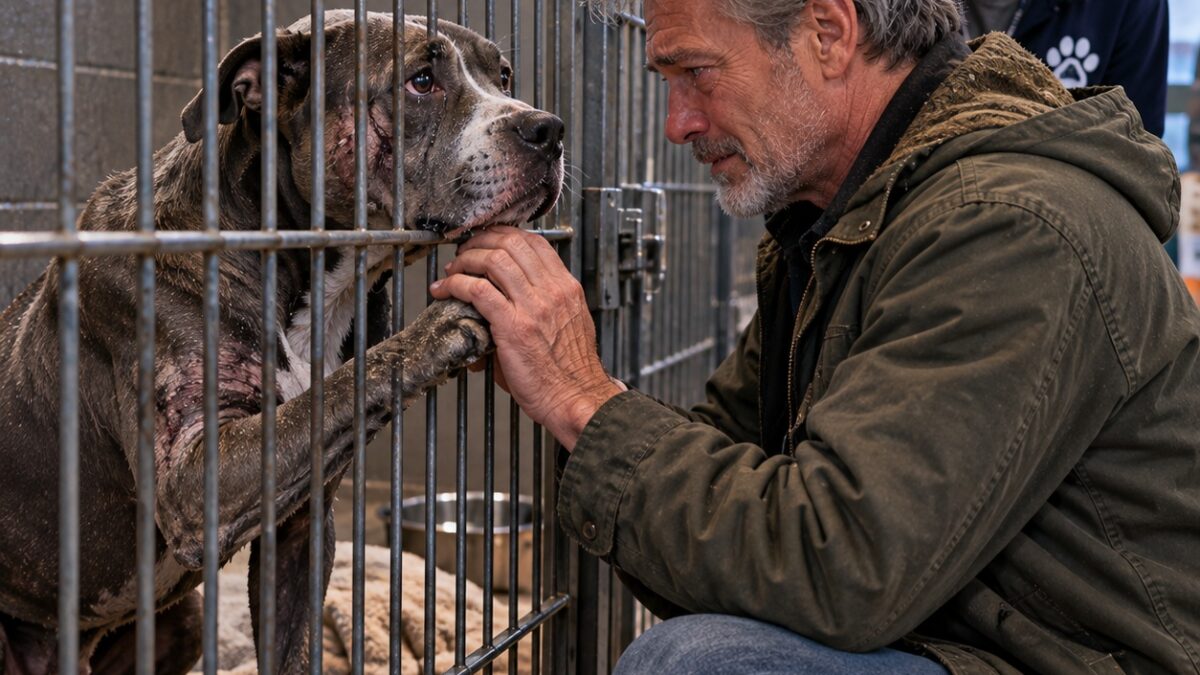
FULL STORY CONTINUATION
His ears came forward.
His eyes opened wide.
And the dog who had looked half-dead a second earlier rose so quickly that his paws slipped against the concrete.
“Boris.”
He came to the gate.
Not walking.
Almost stumbling.
His entire body trembled.
His tail hit the metal hard enough to rattle it.
Then he made a sound I had never heard from a dog before.
Not barking.
Not whining exactly.
Something low and broken came from deep in his chest, like relief had become too large to remain silent.
I turned toward Elena.
Her eyes were already wet.
“Open it.”
She reached for her keys.
“Victor, he’s excited. Let me get another staff member so—”
“Open it.”
Not harshly.
I just knew.
She unlocked the kennel.
The gate moved six inches.
Boris pushed through.
For a large, powerful dog who had spent three days apparently waiting for me, he did something strangely formal.
He stopped directly in front of my legs.
Sat.
Looked up.
That was it.
No jumping.
No barking.
No frantic circling.
Just those eyes.
I lowered myself slowly until I was sitting on the floor.
My knees complained.
I ignored them.
I opened my arms.
Boris stepped forward.
His head went under my chin.
His chest pressed against mine.
All eighty-something pounds of him leaned into me like he had finally reached solid ground.
I wrapped both arms around him.
His body shook.
Then gradually stopped.
He released one enormous breath against my neck.
I felt it through my shirt.
Elena wiped her face.
“Oh, come on,” I muttered.
“What?”
“You’re crying.”
“So are you.”
“I have allergies.”
“In November?”
“Very aggressive allergies.”
She laughed.
Boris pushed closer.
I ran my hand down his spine.
His ribs were too easy to feel.
“How much has he eaten?”
“Almost nothing yesterday. A little this morning.”
I looked at him.
“You planning to kill yourself over five minutes with a stranger?”
His tail moved once.
Elena sat on the floor across from us.
“We’ve had volunteers here every day for months.”
“I know.”
“He was never aggressive. That almost made it harder.”
“What do you mean?”
“Aggressive dogs tell you what they feel.”
She looked at Boris.
“He just disappeared inside himself.”
I understood that sentence immediately.
Elena continued.
“He ate. Slept. Went outside when we asked. Came back in. Never sought attention.”
“And Tuesday?”
“You stopped.”
“I stopped at his kennel.”
“No.”
She smiled faintly.
“You stopped.”
I looked at her.
“Most people saw him and kept moving because he didn’t perform for them.”
I glanced at Boris.
“He looked tired.”
“He was.”
“So was I.”
Elena laughed quietly.
Boris moved one paw onto my shoe.
Something inside me shifted.
Maybe it had started Tuesday.
Maybe long before that.
“You said he needs a home.”
Elena’s face changed.
“Victor.”
“I’m asking a question.”
“Yes.”
“What would that involve?”
Her smile began slowly.
“Victor.”
“Stop saying my name like that.”
“You’re considering adopting him.”
“I said I’m asking.”
Boris put more weight on my foot.
I looked down.
“Traitor.”
His tail hit the floor.
Elena stood.
“Come with me.”
“Where?”
“Before you regain common sense.”
The paperwork took almost an hour.
During that hour, I discovered just how little I knew about dogs.
Food.
Vaccinations.
Leashes.
Harnesses.
Crates.
Training.
Veterinary care.
Separation anxiety.
Apartment rules.
Exercise.
Body language.
I signed forms with Boris pressed against my left leg.
Every time I stopped writing, he placed one paw on my shoe.
“You know this is emotional manipulation,” I told him.
Elena heard me.
“He’s very talented.”
The shelter veterinarian examined him before we left.
“He’s medically stable,” she said. “But stress has affected his appetite.”
“How do I get him eating?”
“Routine. Quiet. Give him time.”
“What if he refuses?”
“Call us.”
I nodded.
She looked at me carefully.
“Victor, dogs with abandonment histories sometimes attach very hard to the first person they trust.”
“That sounds healthy.”
“It can become healthy.”
That distinction stayed with me.
She continued.
“Don’t reward panic, but don’t punish fear either. Teach him that leaving doesn’t always mean disappearing forever.”
I looked at Boris.
“How?”
“By coming back.”
Simple.
The shelter gave me a starter bag.
Food.
A blanket carrying familiar smells.
Heavy leash.
Rubber toys.
Information sheets.
Numbers to call.
On the parking lot, Boris stopped when he saw my sedan.
His body went rigid.
“Cars bad?”
Elena shook her head.
“Unknown.”
I opened the passenger door.
Put the blanket across the seat.
Then looked at him.
“Okay, buddy.”
His eyes moved from me to the car.
“We can stand here all night.”
He sniffed the doorway.
“You have more patience than I do.”
One paw went inside.
Then another.
Finally he jumped onto the passenger seat.
He sat upright.
Very upright.
Like a nervous businessman on the way to a meeting.
I closed the door gently and walked around.
When I got behind the wheel, Boris leaned across the console.
One large tongue swept from my jaw to my cheek.
I froze.
Then looked at him.
“Absolutely not.”
His tail hit the seat.
“I have rules.”
He stared forward through the windshield.
“The first rule is no licking my face.”
He glanced at me.
“Good talk.”
I started the engine.
He watched everything.
Traffic lights.
People on sidewalks.
Passing trucks.
At one intersection, a motorcycle roared beside us.
Boris ducked.
I placed my hand on his shoulder.
“Just noise.”
He looked at me.
“I used to work around machines louder than that.”
The light changed.
“We’re both retired now.”
The first night exposed how badly I had underestimated what I had taken home.
Boris inspected every room.
Not curiously.
Strategically.
Door.
Window.
Kitchen.
Hallway.
Bedroom.
Back to the front door.
He sniffed beneath furniture.
Studied corners.
Checked reflections in the glass.
When the upstairs neighbor dropped something, Boris froze so completely that I could see muscles tighten beneath his coat.
“It’s okay.”
He looked at me.
I realized I had no idea whether saying that helped.
I showed him his water bowl.
Food.
He drank.
Wouldn’t eat.
I sat beside the bowl.
He ate three mouthfuls.
Then stopped when I stood.
So I sat again.
He finished half.
“You understand this is blackmail.”
His tail moved.
I had placed his bed in the living room.
At ten-thirty, I turned off the lights.
“Good night.”
I walked toward my bedroom.
Three seconds later, claws clicked behind me.
I stopped.
He stopped.
I walked.
Click.
Click.
Click.
I turned.
Boris sat.
“No.”
His ears shifted.
“Your bed is there.”
I pointed.
He stared at me.
“Living room.”
Nothing.
“I’m not negotiating with someone who eats from the floor.”
His head lowered.
I went into the bedroom and closed the door most of the way.
Thirty seconds passed.
Then a soft whine.
I ignored it.
Another.
Then silence.
I lay down.
Five minutes later, I heard breathing directly beneath the door.
I got up.
Opened it.
Boris was stretched across the hallway with his nose pressed against the gap.
I stared at him.
He stared back.
“You’re ridiculous.”
His tail thumped.
I dragged his bed into my room.
“Temporary.”
He climbed onto it immediately.
I got back under the blanket.
For several minutes, Boris did not lie down.
He stood beside the mattress watching me.
Finally, he lowered his head until his chin rested on the edge near my hand.
I put my fingers against his forehead.
His eyes closed.
That became our nighttime ritual.
For weeks.
I learned the vocabulary of Boris’s fear.
Keys meant anxiety.
Shoes meant alertness.
Jacket meant possible abandonment.
Closing the bathroom door was unacceptable.
Taking trash outside produced pacing.
Checking the mailbox meant he stood at the window until I returned.
The first time I left him alone intentionally, I lasted seven minutes.
I drove around the block.
When I returned, Boris was sitting directly behind the apartment door.
Not destructive.
Not barking.
Waiting.
I crouched beside him.
“I came back.”
He pushed his head against my chest.
The next attempt was ten minutes.
Then fifteen.
We built slowly.
Elena called twice during the first week.
“How’s he doing?”
“He follows me into the bathroom.”
“Good.”
“How is that good?”
“He’s attached.”
“He watches me brush my teeth.”
“Very intimate.”
“He judges.”
“He’s a dog.”
“You haven’t seen his face.”
She laughed.
“Eating?”
“Better.”
“Sleeping?”
“At the foot of my bed.”
“Good.”
“On a bed I bought for the living room.”
“Victor.”
“What?”
“You adopted a traumatized dog three days ago.”
“I know.”
“You sound happy.”
I looked toward the bedroom.
Boris was asleep with one ear standing halfway up.
“I’m tired.”
“That was not what I said.”
I changed the subject.
Walks were another education.
Boris needed exercise.
Real exercise.
My definition of activity before him had included carrying groceries from the parking lot.
His definition involved several miles.
Every morning around seven, he stood beside the leash.
At first, I resented him.
Rain?
Leash.
Cold?
Leash.
Slept badly?
Leash.
“I’m older than you,” I told him.
He stared.
“By human standards.”
Nothing.
“This is elder abuse.”
Tail wag.
Outside, his whole personality changed.
He moved carefully.
Never pulled hard.
Watched everything.
At intersections, he sat.
Children made him nervous at first.
Fast movement.
High voices.
Hands reaching.
I learned to intervene.
“Ask first.”
Some parents looked offended.
Most understood.
One little boy named Noah saw us in the park almost every morning.
He was maybe eight.
Red coat.
Missing front tooth.
He loved Boris from a distance.
“Can I pet him today?”
“Not today.”
The next morning:
“Today?”
“Still no.”
A week later:
“Today?”
I looked at Boris.
Boris sniffed the boy’s hand.
Then stood still.
“Chest,” I said. “Not over his head.”
Noah touched him.
Boris looked at me.
Then back at Noah.
His tail moved once.
The boy smiled like he had been handed a medal.
After that, more people began talking to us.
That was inconvenient.
I had spent years perfecting the art of passing strangers with a polite nod.
Boris ruined it.
People wanted his name.
His story.
His breed.
His age.
Women who had lived in my building for two years suddenly knew my name because they knew his.
The coffee-shop owner put a water bowl outside.
A retired teacher named Harold started walking his terrier with us.
A woman named Denise from two blocks away brought Boris homemade dog biscuits.
I became suspicious.
“Why does everybody like you?”
Boris ate the biscuit.
“I have lived here six years.”
He ate another.
“Nobody baked me anything.”
Denise heard.
“They probably would if you wagged your tail more.”
I laughed.
Actually laughed.
It surprised me.
The sound felt unfamiliar in my own chest.
Boris improved physically.
His weight returned.
His shoulders filled out.
The dull gray coat developed a silver shine.
His eyes changed most.
When I first saw him, his expression had seemed permanently distant.
By month two, he watched me with active curiosity.
By month three, he started doing something I had not expected.
Playing.
The first time, he found a rubber ball Elena had included.
He carried it toward me.
Dropped it.
I picked it up.
“What?”
He stared.
I put it down.
He nudged it back.
“Oh.”
I threw it badly.
It bounced off a chair.
Boris chased it.
His paws slipped on the floor.
He hit the couch.
I shouted.
“Careful!”
He emerged with the ball.
Tail whipping.
Something about seeing him look foolish broke through me.
I laughed until I had to sit down.
Boris dropped the ball again.
“Fine.”
I threw it.
For twenty minutes, we played in a living room that had been quiet for years.
That night, I called my daughter, Claire.
“You got a dog?”
She sounded personally betrayed.
“Yes.”
“You?”
“Yes.”
“Dad, you once returned a houseplant because you said it created maintenance obligations.”
“It was needy.”
“It needed water.”
“Exactly.”
“What kind of dog?”
“Pit bull.”
Silence.
“A what?”
“He’s very polite.”
“Dad.”
“He has better manners than most people.”
“How big?”
“About eighty pounds.”
“You adopted an eighty-pound pit bull?”
“Apparently.”
“Do you know anything about dogs?”
“No.”
She started laughing.
Not mocking.
Delighted.
“I need a picture.”
I sent one.
Boris lying across my feet.
Claire replied instantly.
Oh my God.
Then:
He looks like he owns you.
I typed:
Temporary administrative arrangement.
She called again.
“You’re happy.”
Everyone kept saying that.
I disliked it.
Happiness felt like an accusation against the life I had been living before.
As though I should have known how empty it had become.
The truth was more complicated.
I had not thought I was miserable.
I thought I was finished.
There is a difference.
I had worked.
Raised children.
Paid mortgages.
Fixed appliances.
Attended school concerts.
Buried parents.
Lost a marriage.
Lost a career.
Survived.
I assumed the meaningful part was behind me.
Boris challenged that simply by expecting tomorrow.
Dogs are ruthless about tomorrow.
Breakfast will happen.
Walks will happen.
The park will still exist.
You will wake up.
You will return.
Life, according to Boris, was a series of things worth getting up for.
One night during his second month with me, a thunderstorm rolled through.
The first crack hit after midnight.
Boris came upright instantly.
Another.
He began panting.
Then pacing.
I turned on the lamp.
“Hey.”
He went toward the door.
Back to me.
Door.
Window.
Me.
Another thunderclap.
He tried to push behind the nightstand.
Eighty-pound dogs do not fit behind nightstands.
I sat on the floor.
“Come here.”
He couldn’t.
His eyes were wild.
I remembered Elena’s advice.
Don’t punish fear.
Don’t force.
Be predictable.
So I talked.
Not to calm him exactly.
Just to give the room something normal.
I told him about the factory.
The first day I worked there.
Twenty-two years old.
Terrified of machines that could take fingers faster than your brain registered pain.
I told him about Frank Delaney, the supervisor who taught me never to reach across moving equipment.
About night shifts.
Union arguments.
Birthday cakes in the break room.
The time the cooling system failed in July and we all worked wearing wet towels around our necks.
Boris stopped pacing.
I kept talking.
I told him about Claire learning to ride a bicycle.
About my son Michael breaking his arm jumping from the garage roof because another twelve-year-old told him he wouldn’t do it.
About my wife.
About how two people can love one another and still become strangers.
About how loneliness doesn’t always arrive when somebody leaves.
Sometimes it comes years later when you realize you have stopped expecting anyone to knock.
Boris slowly crossed the room.
He lay beside me.
Another crack of thunder.
He flinched.
But stayed.
I placed my hand on his shoulder.
“You don’t have to be brave.”
His breathing slowed.
“Neither do I.”
That night, sometime around two, we both fell asleep on the floor.
Healing did not happen in one direction.
By spring, my doctor noticed I had lost twelve pounds.
“Diet?”
“No.”
“Exercise?”
“Dog.”
He nodded.
“Excellent.”
“I’m being held hostage.”
“Keep paying the ransom.”
My blood pressure improved.
Sleep improved.
I complained less about my knees because Boris did not recognize knee-related appeals.
More importantly, my world expanded.
I joined a Saturday walking group accidentally.
Harold invited me.
I said no.
He told Denise I had said yes.
Denise told three other people.
Saturday morning, six adults and seven dogs were waiting in the park.
“This is manipulation.”
Harold smiled.
“You can go home.”
Boris saw the other dogs.
We stayed.
Soon I knew people’s names.
Jobs.
Children.
Problems.
Harold’s wife was undergoing chemotherapy.
Denise was caring for her mother.
A young guy named Aaron had moved to town for work and knew nobody.
We were not a dramatic support group.
We mostly talked about dogs and weather.
But connection does not require dramatic language.
Sometimes it is simply someone noticing you missed Saturday.
Three months after the adoption, I returned to the shelter.
Boris knew the building before I turned into the parking lot.
His body stiffened.
I almost turned around.
Then his nose went toward the window.
He smelled.
Watched.
I parked.
“Want to go?”
He looked at me.
I opened the door.
He jumped out.
Elena saw us through the front window.
She came outside laughing.
“Look at him.”
Boris recognized her.
He approached.
Not with the desperate attachment he showed me.
But warmly.
Tail moving.
Elena crouched.
“Boris.”
He let her rub his chest.
She looked up.
“He looks incredible.”
“He eats like I’m hiding a second stomach somewhere.”
“You’re feeding the measured amount?”
I hesitated.
“Victor.”
“He has persuasive eyes.”
“He’s a pit bull, not a starving orphan.”
“He was a starving orphan.”
“Six months ago.”
Boris licked her chin.
“See?”
“Both of you are impossible.”
We walked inside.
The kennel corridor smelled exactly the same.
Cleaner.
Disinfectant.
Dog food.
Anxiety.
Boris slowed when we reached his old enclosure.
It was occupied by a brown dog curled near the back.
Boris stood looking through the gate.
The brown dog glanced at him.
Then away.
I felt something squeeze my chest.
“That was him,” Elena said.
“I know.”
“No. I mean that posture.”
Boris sat.
For a few seconds, he simply watched.
Then he made the same soft sound he used when he wanted my attention.
The brown dog’s ear moved.
I looked at Elena.
“Can dogs do what you did to me?”
“What?”
“Make terrible decisions at shelters.”
She smiled.
“They’re very influential.”
We stayed nearly an hour.
On the drive home, Boris slept with his head against the passenger door.
I kept thinking about the brown dog.
Two weeks later, I started volunteering.
Not because I wanted another dog.
One was enough to reorganize my entire existence.
I cleaned bowls.
Folded blankets.
Walked easy dogs.
Sat outside difficult kennels.
Sometimes I talked.
Sometimes I didn’t.
Elena trained me properly.
“Don’t stare.”
“I know.”
“Don’t crowd.”
“I know.”
“Let them decide.”
“I know.”
“You think Boris made you an expert.”
“I never said that.”
“You have the expression.”
“What expression?”
“Retired man discovers one skill and begins consulting.”
I laughed.
The strangest part was that some dogs did respond to me.
Not all.
Maybe not even most.
But frightened older dogs seemed comfortable with quiet.
I understood waiting.
One afternoon, a trembling shepherd mix refused to come near anyone.
I sat sideways outside her run reading the newspaper aloud.
Not even interesting articles.
Local zoning dispute.
Weather.
Obituaries.
After forty minutes, she moved closer.
Elena walked by and stopped.
“Don’t ruin it.”
“I’m reading.”
“You’re showing off.”
“The obituaries are gripping.”
She rolled her eyes.
The shepherd eventually rested near the gate.
That was enough.
I learned that rescue work is built from enough.
One step.
One meal.
One night without panic.
One stranger tolerated.
One hand accepted.
Humans like dramatic transformations.
Animals usually heal in inches.
Boris did too.
Even after a year, he hated being left longer than usual.
If I packed a suitcase, he became anxious.
If I was late returning from errands, he waited beside the door.
We worked on it.
Routine.
A pet sitter he trusted.
Short absences.
Longer ones.
I always came back.
That mattered.
I used to think trust was a feeling.
Boris taught me trust is repetition.
You come back.
You feed him again.
You do not hurt him when he is afraid.
You do tomorrow what you did yesterday.
Eventually, the nervous system believes you.
People are not so different.
My children began visiting more.
Claire came first.
The moment she entered, Boris positioned himself between us.
She froze.
“Dad.”
“He’s assessing.”
“I would prefer not to be assessed by a pit bull.”
“Don’t reach.”
Boris sniffed.
Claire stood still.
Then he accepted her.
Within two hours, he was asleep with his head in her lap.
“Traitor,” I said.
Claire stroked his ear.
“He loves me more.”
“He has known you four hours.”
“Some relationships are immediate.”
I stared at her.
She smiled.
“Like yours.”
That silenced me.
Later, while Boris slept between us, Claire said something I wasn’t prepared for.
“I was worried about you.”
“Why?”
“After the plant closed.”
“I was fine.”
“No.”
She looked at me.
“You were existing.”
I disliked the word because it was accurate.
“I didn’t know what I was supposed to do.”
“I know.”
“I worked since I was nineteen.”
“I know.”
“When they closed the plant, everybody acted like retirement was a prize.”
She listened.
“People kept telling me to enjoy myself.”
I laughed bitterly.
“I didn’t know what that meant.”
Claire looked down at Boris.
“Apparently it means adopting a dog who controls your schedule.”
“That seems to be part of it.”
She squeezed my hand.
“We have him to thank.”
I looked away.
“Don’t make it sentimental.”
“You volunteer at an animal shelter.”
“That’s logistical support.”
She laughed.
My son Michael visited that summer with his wife and two children.
Boris had limited experience with children.
We introduced them carefully.
My granddaughter Lily sat on the floor and read him a picture book.
By page four, Boris lay beside her.
By page nine, his eyes closed.
“He’s listening,” Lily whispered.
“He’s pretending.”
“No. He likes it.”
Maybe he did.
I watched my grandchildren with him and realized something painful.
I had allowed distance to become habit.
Not because my children didn’t want me.
Because I had stopped asking.
Stopped traveling.
Stopped inviting.
Stopped risking the small rejection of someone saying they were busy.
Boris had forced me to become inconvenient again.
He needed things.
And somewhere along the way, I remembered I was allowed to need people too.
I started calling my children without an occasion.
Not every day.
Enough.
I accepted invitations.
Bought train tickets.
Asked neighbors to watch Boris.
Came home.
Always came home.
Two years after the afternoon I first stopped at his kennel, Boris turned eight.
Elena called around his adoption anniversary.
“How’s the legend?”
“Overweight.”
“I told you.”
“He is not overweight.”
“You just said—”
“He is structurally generous.”
She laughed.
“Send pictures.”
I did.
Boris in the park.
Boris asleep upside down.
Boris beside Lily.
Boris wearing a ridiculous birthday hat Claire mailed.
Elena called me back after the last photo.
“You know we still tell his story.”
“What story?”
“The five-minute man.”
“I hate that name.”
“Volunteers love it.”
“It sounds like a disappointing magician.”
She laughed harder.
Then her voice softened.
“Victor, some people working here get discouraged.”
“I know.”
“They work with an animal for months and think nothing is changing.”
I looked at Boris asleep near the window.
“So you tell them about him?”
“Yes.”
“Why?”
“Because nobody knew he was still capable of choosing someone.”
I was quiet.
Elena continued.
“And nobody knew that person would be a man who only came inside because it was raining.”
“Very inspiring.”
“It is.”
“I was bored.”
“Also inspiring.”
I smiled.
“He saved me too.”
There was a pause.
“I know.”
“How?”
“You looked different the second time you came in.”
“I was worried.”
“No.”
She said it gently.
“You had somewhere to be.”
That sentence stayed with me longer than almost anything else.
You had somewhere to be.
For years, retirement had felt like a hallway with no doors.
Boris gave me a destination.
Then another.
The park.
The veterinarian.
The shelter.
Claire’s house.
Michael’s.
Saturday walks.
Volunteer shifts.
Coffee with Harold.
Dinner with Denise and her mother.
My calendar became annoyingly full.
I bought an actual paper planner.
Claire saw it during a video call.
“Who are you?”
“I have commitments.”
“You used to complain when I scheduled lunch four days in advance.”
“I’m a busy man.”
Boris barked from the hallway.
Claire smiled.
“Yes, we know who manages your calendar.”
The biggest test of Boris’s recovery came that fall.
I had to spend two nights in the hospital for a minor procedure.
Nothing dramatic.
Routine.
But I couldn’t bring him.
Denise agreed to stay at my apartment.
I started packing.
The suitcase came out.
Boris froze.
I saw the old dog again.
Not physically.
In his eyes.
The dog behind the shelter gate.
Waiting for abandonment.
I sat on the floor.
“Hey.”
He would not approach.
I put the suitcase aside.
“You remember this, don’t you?”
His ears lowered.
I stayed there.
“I’m coming back.”
Words alone were meaningless.
I knew that.
So Denise came over.
We spent the afternoon together.
She fed him.
Walked him with me.
I left for five minutes.
Returned.
Ten minutes.
Returned.
Then one hour.
Returned.
The morning of the procedure, Boris stood beside the door.
I knelt.
My knees hurt more than they had two years earlier.
Age remained rude.
“I’m coming back.”
He pressed his forehead against mine.
Two nights later, Denise drove me home.
When I opened the door, Boris did not behave calmly.
All progress temporarily disappeared.
He slammed into me hard enough that Denise grabbed my shoulder.
“Easy!”
Boris whined.
Licked my hands.
My face.
Circled.
Returned.
I laughed and cried at the same time.
“Okay.”
He pressed against me.
“I came back.”
That night, he slept with his head on my mattress again.
Something he had not done in months.
I kept my hand on him until morning.
The next day, he was fine.
Trust does not mean fear never returns.
It means fear no longer gets the final word.
The same became true for me.
There were still lonely days.
Days when the factory closure felt like somebody had erased the first half of my identity.
Days when I missed the version of my family that existed twenty years earlier.
Days when aging frightened me.
Days when I wondered how much time Boris and I had.
Dogs are cruel that way.
They save you on a schedule shorter than yours.
I refused to think about it too much.
Instead, I learned from him.
Eat when food arrives.
Walk when the morning is beautiful.
Nap when tired.
Greet people you love as though their return is extraordinary.
Forgive quickly when possible.
Sit beside grief when it cannot be fixed.
Simple things.
Not easy.
Simple.
On the second anniversary of his adoption, I took Boris back to the shelter again.
This time he entered confidently.
No stiff body.
No hesitation.
He remembered Elena.
Tail wagging.
She hugged me first.
Then him.
“You look older,” she told me.
“Thank you.”
“He doesn’t.”
“Because he gets expensive food.”
We walked the corridor.
The shelter had changed.
Fresh paint.
Some new kennels.
Different dogs.
Same sound.
Same smell.
We passed Boris’s old enclosure.
Empty that day.
He stopped.
I stopped too.
For a second, I could see him there again.
Thin.
Gray.
Head down.
Invisible.
I remembered standing outside the gate thinking he looked tired.
That simple thought had changed two lives.
Elena stood beside me.
“You okay?”
“Yes.”
Boris leaned against my leg.
“I keep thinking about how close I came to walking past.”
“But you didn’t.”
“I almost did.”
“Most important things in life probably have an almost attached somewhere.”
I looked at her.
“That sounds suspiciously philosophical.”
“I work at an animal shelter. We’re allowed.”
Before leaving, we sat in the lobby.
A younger volunteer approached.
“Are you Victor?”
I looked at Elena.
She smiled innocently.
“Depends.”
The volunteer pointed at Boris.
“Is that him?”
“The disappointing magician?”
Elena laughed.
“The five-minute dog.”
“Apparently.”
The young woman crouched several feet away.
Boris approached her on his own.
She stroked his shoulder.
“I heard he didn’t trust anyone.”
“He didn’t.”
“What did you do?”
That question again.
People always wanted a technique.
Some secret thing.
“I sat down.”
“That’s it?”
“I talked.”
“What did you say?”
“Nothing important.”
She looked disappointed.
I smiled.
“That may have been the point.”
Boris sat beside her.
“Sometimes people are so focused on getting an animal to respond that they forget to let the animal decide.”
She nodded.
I continued.
“He didn’t owe me affection.”
“He didn’t owe me trust.”
“I was just there.”
Boris looked toward me.
“And apparently that was enough for five minutes.”
On the drive home, he fell asleep before we reached the highway.
His muzzle rested against the door.
Gray coat shining in afternoon light.
I thought about the phrase Elena used.
Enough for five minutes.
Most of my life had been built around measurable productivity.
Units completed.
Hours worked.
Bills paid.
Tasks finished.
Then one of the most important things I ever did required five minutes of absolutely nothing productive.
I sat beside a cage.
Talked to a dog.
Touched his face.
Left.
That small act became a thread.
Three days later, the shelter tugged it.
I returned.
Boris followed me home.
He pulled me outside.
Outside pulled me toward neighbors.
Neighbors pulled me toward friendship.
Friendship pulled me toward volunteering.
Volunteering pulled me back toward purpose.
Purpose pulled me back toward my children.
And somewhere along that chain, I stopped thinking of myself as a man whose useful years had ended.
People say I rescued Boris.
That is technically true.
My name is on the adoption paperwork.
I paid the fee.
I bought the food.
I signed the veterinary forms.
I brought him home.
But paperwork is not the whole story.
Boris found me in a place where I had become emotionally very similar to him.
Fed.
Sheltered.
Safe.
And disconnected from everything that made survival feel worthwhile.
Neither of us was dying.
Neither of us was really living either.
He taught me that healing does not always arrive as happiness.
Sometimes it arrives as responsibility.
A leash hanging beside the door.
A food bowl that has to be filled.
A frightened animal who notices when you leave.
A reason to come home.
Tonight, as I tell this story, Boris is asleep on the rug beside my chair.
The sun is going down through the living-room windows.
Gold light runs across his gray coat.
His paws twitch occasionally.
Probably chasing something in a dream.
Maybe squirrels.
Maybe that one arrogant pigeon he has hated for nearly two years.
The apartment looks different now.
Dog toys under furniture.
Leash by the door.
Photographs of my children and grandchildren where I can actually see them.
A calendar covered with appointments.
A shelter volunteer badge hanging beside my old factory ID.
The factory badge represents thirty-three years of my life.
For a long time, I thought when that job ended, the useful part of me ended with it.
I was wrong.
Boris exhales.
Long.
Content.
The same kind of breath he released against my neck the day Elena opened his kennel.
I reach down.
My fingers rest on his warm head.
His eyes stay closed.
His tail moves once against the floor.
I smile.
Two years ago, I walked into a shelter because it was raining and I had nowhere important to be.
Five minutes beside a gray dog changed that.
Now somebody always waits for me to come home.
And, because of him, I finally learned how to come home to my own life too.