FULL STORY:The Security Chief Raised a Taser at a War Dog—Then the Nurse He Erased Walked In
FULL STORY CONTINUATION
For half a second, nobody noticed me.
That was normal.
I had spent fourteen months becoming invisible in that building. Invisible people learn where everyone stands. They learn which voices climb first. They learn who performs authority and who actually carries it. They learn which corners catch security footage and which hallways swallow sound.
In trauma bay two, everything had already tilted toward disaster.
Cara had both hands full with Travis. Blood was sliding under her gloves. The makeshift tourniquet had shifted. Travis was fighting consciousness with the kind of stubbornness I had seen in men who did not trust their bodies to quit at the right time.
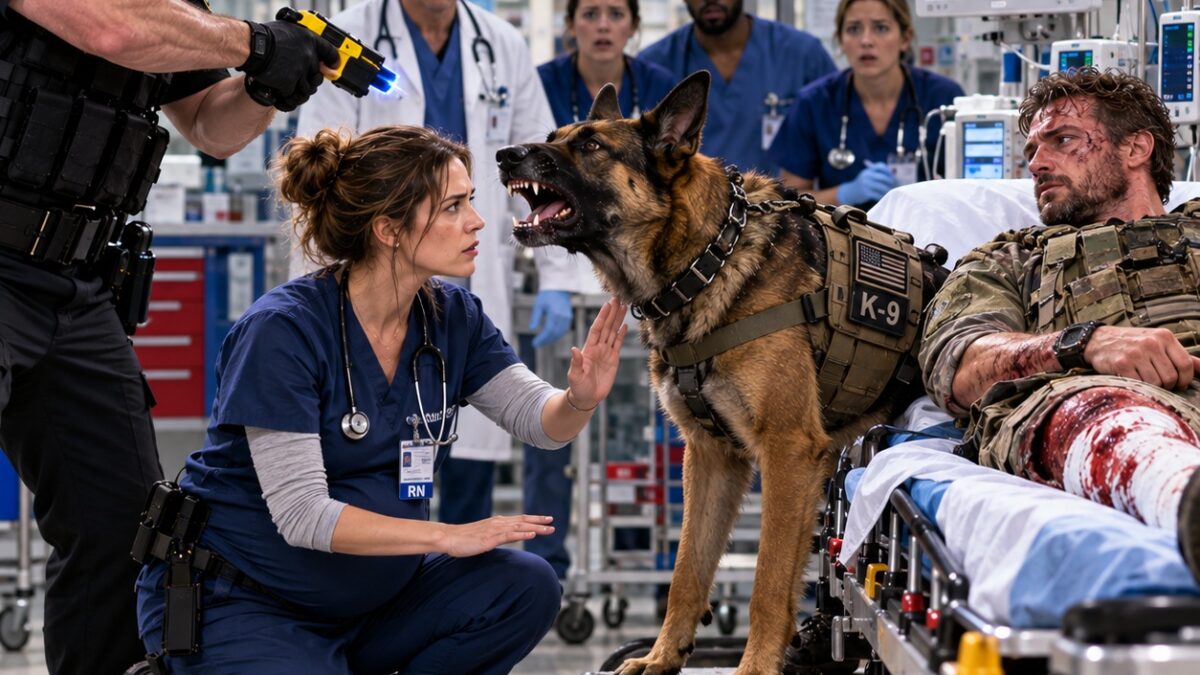
Dale stood near the door with two guards behind him, taser out, pride fully engaged.
Duke was between them and Travis.
And that dog’s warning was not a bark.
It was a low, continuous sound that lived under the ribs and meant one more step.
Travis’s voice had thinned from blood loss.
“Put that away.”
Dale’s jaw clenched.
“Last chance, sir. Control your animal.”
“He is controlled,” Travis said. “He’s warning you. There’s a difference.”
That was the first thing Travis said in that room that made me look at him more carefully.
Because he was right.
Duke was not out of control.
Duke was doing exactly what he had been trained to do.
He had positioned himself between a threat and a compromised handler. He had not lunged at Cara. He had not interfered with the person applying pressure. He had tracked Dale because Dale had made himself the threat.
Then Dale raised the taser a fraction higher.
Duke’s weight shifted.
The room went still in the way rooms go still when everybody inside understands that one more movement will decide what happens next.
I set my medication tray down on the equipment cart.
Dale turned toward me.
“Webb, this isn’t your bay.”
I did not answer him.
I looked at Travis first.
Face pale.
Sweat at the hairline.
Breathing controlled but shortening.
Blood pressure sliding.
Improvised tourniquet failing.
Then I looked at Duke.
Duke looked back.
The growl stopped.
Not faded.
Not softened.
Stopped.
Clean.
Like a switch had been flipped somewhere inside him.
Dale blinked.
Cara froze for one beat, pressure still locked over Travis’s wound.
I crouched on the trauma bay floor four feet from Duke’s teeth. I did not reach for him. I did not coo. I did not make that foolish clicking sound people make at dogs they do not understand.
I made myself smaller.
I turned slightly away.
I looked near his jaw, not into his eyes.
Duke’s ears moved forward, then relaxed.
Travis’s voice cut through the room.
“Easy.”
He was not talking to Duke.
He was talking to Dale.
“Don’t move.”
I looked at Duke and said the one word no one in that room expected from me.
“Stand down.”
Duke sat.
Immediately.
No hesitation. No confusion. No resistance.
His hindquarters dropped to the tile, and the focused violence that had filled the room simply vanished. He stayed alert, but the terrible edge came off him. The bay remained silent long enough for the fluorescent hum to become audible.
Travis stared at me.
His eyes were sharper than they should have been for a man losing that much blood.
“Civilians don’t know that command.”
I stood and moved toward the bed.
“I need to check his tourniquet.”
The next four minutes did not come from nursing school.
They came from muscle memory.
Angle of pressure.
Placement.
Bleed control.
Voice.
Command.
Sequence.
I pulled the military-grade CAT tourniquet from the pouch on my scrubs. Olive drab. Standard issue. Not something most Clover Ridge nurses carried. I placed it high and tight on Travis’s thigh and cranked until the bleed slowed the way it needed to slow.
Travis watched every movement.
“You’ve done this before,” he said.
It was not a question.
I pressed a fluid cup into his hand.
“Drink this. Small sips.”
“That’s not how you answer the question.”
“Drink.”
He drank.
Dale still had not reholstered the taser.
That told me everything I needed to know about him.
The danger had changed. The room had changed. Duke had changed. But Dale still needed to be seen holding power.
“Webb,” he said finally. “I’m telling you one more time. That dog needs to be removed, or I am calling animal control. Your presence in this bay doesn’t change that.”
I looked up.
“If you call animal control right now, you will delay this patient’s transfer to OR by at least fifteen minutes while we manage the dog’s removal. His pressure is eighty-four over fifty. Fifteen minutes is too long.”
Then I looked back at Travis.
“Blood thinners in the last twenty-four hours?”
“No.”
“Allergies to anesthesia?”
“None documented.”
Cara caught the wording. I saw her file it away.
Not no.
None documented.
There is a difference.
“Then I’m recommending immediate surgical consult,” I said. “And we need Dr. Ferris in here now.”
Cara moved.
She was almost out the door when Dale said what I had been waiting for.
“You’re done here, Webb. Get out of my bay.”
I did not raise my voice.
“He has maybe ten minutes. Fire me after he survives.”
Dr. James Ferris came in with the exhausted face of a community hospital trauma surgeon who had been called into too many bad rooms and still walked into every one like it deserved his whole attention.
He took in Travis, the vitals, the tourniquet, Duke sitting calmly, the three security guards against the wall, Dale’s red face, my hands on the wound.
Then he looked at me.
“Talk to me.”
So I did.
Estimated blood loss.
Tourniquet placement and time.
Blood pressure trend.
Suspected vascular involvement based on location and wound depth.
Fluid response.
Need for OR.
I gave it to him in the order he needed it.
Ferris did not interrupt.
Ferris interrupted everyone.
When I finished, he nodded once.
“Okay. We’re going upstairs.”
Travis looked at him.
“The animal goes with the staff member I authorize. Nobody else touches the leash.”
Ferris looked at me.
I looked at Travis.
Travis studied me for three seconds. Not suspicious. Thorough. The way a man checks gear before trusting his life to it.
Then he gave one small nod.
“You.”
Duke stood the moment Travis’s eyes moved to him, as if the decision had traveled down the leash before any word did.
Dale stepped forward.
“That is absolutely not—”
“Dale,” Ferris said.
His voice was quiet and final.
“Stand down.”
It was almost exactly what I had said to Duke.
It worked less elegantly on Dale, but it worked.
He stepped back.
As they rolled Travis toward the OR elevator, Duke stayed at my left side. Not exactly on the leash. Choosing to be there. That was more meaningful.
Cara fell into step beside me.
Her voice was low.
“Where did you learn that command?”
I kept my eyes forward.
“What command?”
“Don’t.”
I said nothing.
“I’ve worked with service dog handlers. That wasn’t handler training.”
Her words trailed off as she saw the faded mark on my forearm where my sleeve had ridden up while I worked the tourniquet.
Small.
Precise.
Not decorative.
Military.
“Norah.”
“He’s going to be okay,” I said.
Which did not answer her question.
At the elevator, Travis’s hand found my wrist.
Not grabbing.
Contact.
His grip was weaker than it should have been, but deliberate.
“I need to know one thing.”
“You can ask me after surgery.”
“I need to know now.”
His eyes were direct, burning through the last coherent window before blood loss and anesthesia took over.
“The way you handled Duke. The tourniquet. The way you briefed Ferris. That’s not civilian.”
The elevator opened.
I held his gaze a moment longer than I should have.
“Get through surgery first,” I said. “Then we’ll talk.”
The doors closed.
Behind us, from the direction of trauma bay two, I heard Dale on his radio.
His voice clipped.
Controlled.
Furious.
He was already building something.
I could hear it in the passive language. In the careful sequencing. In the way he described my presence as unauthorized and my actions as reckless. Men like Dale do not wait until truth settles. They rush to frame it before anybody else can write first.
He thought he had the first move.
He didn’t know Cara Novak was already pulling up the incident system.
He didn’t know the security camera above the trauma bay door had been recording since Travis walked through the emergency entrance.
And he did not know that the timestamp on his own altered report would become the most incriminating part of it.
I stayed outside the OR with Duke at my feet.
No one formally authorized it.
I did not ask.
Some places you ask permission.
Some places you maintain position.
The OR waiting area smelled like old upholstery and recycled air. Duke settled against my ankle. He did not sleep. Neither did I.
A post-op nurse named Bet Salas came by around 12:15 and stopped when she saw me.
“You’re from ER, right?”
“Yes.”
“Family?”
“No.”
She looked at Duke.
“Is the dog going to be a problem?”
“No.”
She stood there, clearly considering whether there was a policy she was supposed to enforce and just as clearly deciding she did not have the emotional capacity to go looking for it after midnight.
“Coffee at the end of the hall,” she said. “It’s bad.”
“Thank you.”
She left.
I did not get coffee.
Downstairs, Dale stayed in his security office until after one in the morning.
I learned that later.
He made calls. He revised his report. He wrote himself into the role of calm protector and wrote me into the role of reckless junior nurse who had escalated a dangerous animal situation. He marked the report urgent and sent it directly to administration at 1:22 a.m.
He did what he had done for years.
Made the story complicated.
Made himself sound reasonable.
Made the person challenging him sound unstable.
What he did not know was that Cara had written her report at 12:31 and attached it to the same case number.
Every detail.
Every timestamp.
Every word Dale had said.
The taser.
The blood pressure.
The fact that Travis was bleeding toward shock while Dale held a weapon and threatened to remove the only thing keeping that patient calm enough to treat.
Cara did not send it anywhere special.
She just made sure it existed.
Records matter.
That is something people like Dale never understand until the wrong person starts keeping them.
Ferris came out at 2:07 a.m.
Still in his surgical cap. Gloves coming off. Face carrying the contained relief of a man who had been inside a hard case and come out with the patient alive.
“He’s out,” he said. “Stable. We got the vessel. Four units intraoperative. He’ll need monitoring for the next twelve hours, but the repair held.”
He looked at Duke.
“Dog okay out here?”
“Yes.”
Then he looked at me.
“Webb.”
I waited.
“Where did you train?”
“Clover Ridge Regional.”
He held my gaze.
He was sixty-one and had worked with enough nurses to know when one answered a question without answering it.
“Get some sleep,” he said.
He let me have it.
For now.
By six in the morning, administration had read Dale’s report.
By 6:15, they had read Cara’s.
By 6:45, Sandra Keel, Clover Ridge’s director of operations, had both reports open on her screen and a third tab playing the trauma bay security footage.
Her assistant had pulled the camera footage without being asked, because experienced assistants know that when two incident reports contradict each other, you go to the camera before anyone starts explaining.
Sandra watched all fourteen minutes twice.
Then she called Dale.
“I’ve reviewed your report,” she said.
“And the counterreport from Nurse Novak.”
“Novak wasn’t—”
“And the camera footage from trauma two.”
Silence.
“I’d like you to come in this morning. Nine o’clock.”
“I can clarify anything that seems—”
“Nine o’clock, Dale.”
She hung up.
Then she froze the footage on the exact frame where Dale had unholstered his taser, Travis’s blood pressure reading visible on the monitor behind him, my hands moving over the tourniquet without stopping.
Sandra Keel was not known for fast decisions.
But that morning, she opened a second report window and started pulling Dale Morrow’s history.
Travis woke up around 8:17.
I was outside post-op, sitting beside Duke on the other side of the glass partition. Duke lay flat with his chin on his forelegs, eyes locked on Travis. I was in the chair beside him, same scrubs, same night, same unresolved weight pressing behind my ribs.
Travis saw me through the glass and raised one hand slightly.
Not a wave.
Acknowledgment.
When the post-op nurse finished checking him and left, I brought Duke in.
He went straight to Travis’s bedside.
Travis put one hand on his head without thinking.
I stopped two feet from the bed.
“How’s the pain?”
“Not yet.”
“Give it an hour.”
He looked at me.
“You stayed.”
“Duke needed someone.”
He almost said that was not the reason.
He did not.
Instead, he said, “I asked you a question last night.”
“You were about to go under anesthesia.”
“I remember it anyway.”
His voice was rough, but his mind had returned. Not fully. Enough.
“You were Army.”
I looked at his hand on Duke’s head.
Then the window.
Then him.
“Forward surgical team,” I said. “Three deployments. Last one ended about four years ago.”
He processed that.
Forward surgical teams do not work far from the damage. They go where casualties come from. That was why I could walk into an Oregon ER and recognize a thigh wound the way most nurses recognized a medication error.
“Why ER nursing?” he asked.
Something moved through me.
Not pain.
Pain’s cousin.
“Seemed like the right direction.”
“And the command?”
“I worked alongside a K-9 unit on my second deployment. You learn the vocabulary, or the dogs don’t trust you. It matters in the field.”
Travis studied me.
He knew I had given him the outline of a truth, not the center of it.
He did not push.
Not then.
“Morrow is going to go after you,” he said.
“I know.”
“That man does not let things go. I’ve seen the type.”
“I’ve managed worse things than a security supervisor with a grudge.”
That was not bravado.
That was weather.
He looked at me longer.
“What’s in your service record, Webb?”
My expression did not change.
Something behind it did.
“Ask me that again when you’re not on post-op medication.”
At nine o’clock, Dale walked into Sandra Keel’s office and found Sandra not alone.
Dr. Vincent Puett, the chief medical officer, sat beside her with a folder on his knee and the expression of a man who had already formed an opinion and was waiting to see whether Dale would make it worse.
Dale tried.
I heard the summary later from three directions.
Sandra, Cara, and eventually the formal report.
Dale started with danger. Liability. An unregistered animal. A junior nurse acting outside her lane.
Sandra let him speak.
Then Puett opened the folder.
“At 11:51 p.m., the dog ceased aggressive behavior in response to a verbal command from Nurse Webb,” he said. “Your taser was drawn at 11:52 and remained out until 11:58, six minutes after the animal was no longer behaving aggressively.”
“I had no way of knowing—”
“The patient’s blood pressure at 11:52 was eighty-two over forty-eight,” Puett said. “Nurse Webb’s tourniquet application slowed the blood loss, but he remained in a critical window. Your continued confrontation, with a drawn taser, contributed to a stress response Dr. Ferris documented as a complicating factor.”
Then Sandra turned her monitor.
Duke was registered.
Federal database.
Travis Holt listed as primary handler.
Public access protections.
The registration tag had been visible on Duke’s collar from the moment he entered the building.
Dale’s report did not mention it.
That was bad.
The next part was worse.
Puett slid a screenshot across the desk.
My personnel file.
Edit history open.
The prior professional background section had been deleted from a workstation in the security supervisor’s office five weeks earlier.
My military service documentation.
Prior medical training credentials.
Deployment history.
Commendation recommendations.
All removed.
Dale’s color changed slowly, like a tide going out.
“That’s—there was a system migration last month. Formatting error.”
“You deleted the records that would have shown this hospital what Nurse Webb was qualified to do,” Puett said.
Sandra’s voice changed then.
Not louder.
Worse.
“Dale. Why?”
He hesitated.
Three seconds.
Maybe four.
Enough.
“It was an error.”
Nobody responded.
Dale tried to move the conversation back to the dog. The bay. The security situation.
Puett closed the folder.
“Dr. Ferris’s surgical notes state that the tourniquet placement was textbook high and tight, consistent with advanced tactical medicine training, and likely decisive in maintaining pressure long enough for surgical intervention to succeed.”
Then Sandra said the part that finally hit the center of it.
“She knew exactly what she was doing. You didn’t know what she was capable of because you removed the documentation that would have told you.”
By then, Cara had received a notification not to discuss the incident pending HR review.
She was forty minutes from the end of her shift and still thinking about my personnel file when her phone rang from an unknown number.
She almost did not answer.
She did.
The caller identified himself as Sergeant First Class Daniel Kio, military liaison with the Veteran Services Office.
A registered military working dog incident at Clover Ridge had triggered an automated notification.
He needed details.
Then he asked about me.
“Norah Webb. Is she still on site?”
Cara said I had been forty minutes earlier.
Kio paused.
“We have been trying to locate Staff Sergeant Webb for about eight months.”
Cara’s hand tightened on the phone.
“What kind of people are trying to reach her?”
“The kind who were in the room when she earned her commendations,” he said. “And the kind who have been waiting for the opportunity to deliver them in person.”
Cara found me upstairs outside post-op, Duke at my side.
She told me what she knew.
Not everything yet.
Enough.
Kio.
Veteran Services.
Eight months looking.
Commendations.
Proper channels.
I listened without interrupting.
Duke pressed his shoulder into my knee.
“What did you tell him?” I asked.
“That you were here. That you’d been here all night.”
“Was that wrong?”
I looked down the hall.
“No. That’s fine.”
“Are you in trouble?”
“No.”
That answer was specific.
Not defensive.
I had been in trouble before.
This was different.
“What Morrow did to your file,” Cara said. “Did you know?”
“I noticed the access log change six weeks ago.”
Her eyes widened.
“I didn’t know who until this morning,” I added.
“You knew something happened and stayed?”
“I needed the hours toward my state recertification. And I wanted to make sure he couldn’t just move on to the next person without someone here who knew what he was doing.”
Cara stared at me.
“You were documenting him.”
I did not confirm it.
I did not deny it.
Some answers are better left as records.
By 10:45, I was back in Travis’s room with coffee.
He looked irritated in the specific way injured men look when lying still has become the worst part of recovery.
“How long have you been here?” he asked.
“I left for about forty minutes around four to take Duke outside.”
“You should have gone home.”
“I was going to.”
“What changed?”
“I thought about what happens when a veteran wakes up in an unfamiliar civilian hospital room with his dog on the other side of a glass wall and nobody nearby understands the context.”
He said nothing to that.
He just picked up the coffee.
“It’s decent,” he said.
“Staff kitchen.”
A voice came from the doorway.
“I know how Morrow’s meeting went.”
Cara stood there in street clothes, jacket half-on, phone in hand.
“Dale Morrow has been suspended pending formal HR investigation. Security access revoked as of ten. They found the edit logs from his office terminal.”
Travis’s jaw tightened.
Not relief.
Recognition.
“What else?”
“They’re pulling HR records going back four years. Other complaints. Aaron Dill has already been contacted.”
I nodded slowly.
My file had not been the first.
That was the part that mattered.
Dale had not invented this for me.
He had practiced it.
Cara looked at me.
“Your file is being restored from backup. Everything. And the senior floor position committee is being reconvened with the actual file.”
“I’m not asking for that position.”
“I know. Apparently, the committee wants to reevaluate anyway.”
Then Cara’s face changed.
“Kio called me back. He wants to speak with you today if possible. He said to tell you Lieutenant Colonel Reyes sends his regards.”
The name hit me harder than Dale’s suspension.
For one second, the room changed.
Not visually.
Inside me.
Reyes.
My commanding officer on my second deployment.
The man who had organized extraction when our forward surgical team took fire with three patients open on the tables and no clean evacuation window.
The man who had seen me in the version of myself I had spent years setting down.
“He was my CO,” I said.
Travis watched me.
Cara waited.
“He put three of us in for commendations after Kandahar,” I said. “I left before the ceremony. Six months after I transitioned out. I didn’t go back.”
“Why?” Cara asked, then immediately said, “You don’t have to answer.”
“It’s fine.”
I looked toward the window.
“I wasn’t in a good place when I got out. The transition was harder than I planned. The VSO had my old address. I moved around. I wasn’t hiding exactly. I just wasn’t ready.”
“For the commendations?” Travis asked.
“For the version of myself those commendations described.”
At noon, Sandra Keel called me directly.
She apologized for the file deletion without hedging, which I did not expect.
She explained what had been found, what was being restored, and what the investigation would include. Aaron Dill. Two other former employees. Prior complaints. Missed patterns.
Then she said, “There’s something else. I reviewed the radio transcript. There are references from staff about you that are not acceptable. The word rookie appears several times in contexts that are—”
She paused.
“You had combat surgical experience relevant to at least three situations this floor has handled in the past year, and we did not know because someone deleted it. That is a failure of this institution. Not just one individual.”
I looked out the window toward the Oregon mountains sitting under November cloud.
“I appreciate that.”
“I would like to meet with you and Dr. Puett this week. Not just about the senior floor position, though we want to revisit that too. About what your presence here could look like with your actual background taken into account.”
Training.
Veteran patient protocols.
Service animal accommodation.
Combat trauma presentations.
She stopped herself because she was getting ahead.
“I can do that,” I said.
At 1:15, Sergeant Kio called me.
I took it in the stairwell.
He explained the commendations. Two of them. Processed four years ago. Never presented. Administrative hold pending location.
Then he said Reyes wanted to be there if I was comfortable.
“He retired eighteen months ago,” Kio said. “Civilian now. Portland. He kept the file active when most of them would have closed it.”
I closed my eyes.
“Yes,” I said. “I’m comfortable with that.”
Then Kio shifted.
“The Travis Holt incident is going to generate attention. He is known in the veteran services community. His unit. His background. His dog. We would like to coordinate, with your permission, to make sure the right picture is—”
“I’m not interested in attention.”
“I understand,” he said. “But Holt is.”
I leaned against the stairwell wall.
“Then you should talk to him directly. He’s awake and clear. I’ll ask.”
I had barely stepped back into the post-op corridor when Dr. Ferris came out of Travis’s room.
Behind him was a woman from Oregon Veterans Affairs named Margaret Dolan.
And behind her, standing in Travis’s room in business casual with the posture and haircut of a man who never fully stopped being military, was Marcus Teller.
I knew him.
Second deployment.
Army Ranger.
He had been there in the part of my past I had spent years keeping quiet.
“Webb,” he said.
The sound of my name in his voice cracked something open.
Not badly.
The good kind.
A person you trusted in a world where trust had weight appearing in a hallway where you had never expected to be found.
“You look terrible,” he said. “When did you last sleep?”
“I’ll sleep later.”
“That’s what you said in Kandahar.”
Travis, from the bed, said, “Can someone tell me what’s happening?”
Teller looked at him, recalibrating automatically. Veteran to veteran. Injured to injured. Service recognizing service before either man had enough information to explain why.
“You’re Holt,” Teller said. “Your file crossed my desk three months ago through the VSO network.”
“My file?”
“Rural veteran. Service animal needs. Limited medical facility options. We keep track where we can.”
Then he looked back at me.
“Kio’s automated notification came through this morning about a registered military working dog and a veteran in the ER. It flagged your name because I was already case officer for this region.”
“You drove from Eugene?”
“Two and a half hours. Terrible coffee on 58.”
Dolan cleared her throat gently.
“There are time-sensitive elements here. The commendation presentation. The hospital’s HR situation. Mr. Holt’s situation. There may be an opportunity to address all three in a coordinated way.”
“To make an example,” I said flatly.
“To create a record,” Dolan corrected. “Of what went wrong and what went right. The nurse who stayed through surgery. The handler who protected his animal and his right to care. The documentation that was altered. The system that caught it.”
Travis looked at me.
“You’ve got the record anyway,” he said. “Camera footage. Incident reports. The only question is whether your version goes in front of it or you let someone else frame it.”
Before I could answer, the monitor in Travis’s room emitted a sharp alert.
Not a crash alarm.
But enough.
His blood pressure had dropped six points in three minutes.
Ferris moved first.
I was right behind him.
Travis’s face had changed.
Color shift.
Fine perspiration.
Breathing shallower.
I looked at the dressing.
“Ferris,” I said. “Inside the pressure bandage. Tension changed.”
His jaw tightened.
“Get vascular now.”
Possible hematoma at the repair site.
Caught early.
Manageable.
But real.
Travis’s hand found my wrist again.
Same as before.
Deliberate.
“It’s okay,” I said.
“I know,” he said. “I’m not worried about the leg.”
I looked at him.
“The statement. Dolan. The record. Don’t let them make it about me.”
“The story is about you too.”
“No.” His grip was weaker than before, but still there. “You stayed fourteen months in a place that treated you like you had no history. You documented him. You kept showing up. That’s the story. Make sure they get that part right.”
Then vascular arrived, and the room reorganized itself around the crisis.
Exactly the way rooms do when the work is real and everyone in them understands the sequence.
The hematoma stabilized without returning to OR.
Twenty minutes later, Travis was pale, frustrated, and still alive.
By then, Teller had received a call from Reyes.
There was more.
Dale had filed a complaint with the Oregon State Nursing Board at 7:32 that morning.
Before his nine o’clock HR meeting.
Before the hospital formally presented him with the edit logs.
The complaint claimed I practiced outside my scope, made unilateral treatment decisions without physician oversight, and misrepresented my credentials to obtain my position.
He had deleted the credentials.
Then reported me for the absence.
I did not laugh.
I almost did.
“He filed it before the meeting,” I said.
“Yes,” Teller said.
“So he walked in knowing he had already filed it.”
“Insurance.”
“Muddy the water. Active board complaint against the nurse who wrote the counter-record.”
“That’s Kio’s read too.”
I looked at my hospital ID still clipped to my jacket.
I had not removed it all day.
As if taking it off would concede something.
“I need a lawyer.”
“Kio has a VSO legal referral. Military-affiliated. Credential disputes. Veteran employment cases.”
I nodded.
“Okay.”
“You all right?”
“No. But okay.”
Then I did what I always did when something threatened to split me open.
I organized the next step.
“I need you to stay with Duke for six hours.”
Teller blinked.
“You want me to dog-sit?”
“You have clearance, and he already assessed you. Travis knows you’re here. Post-op has my number. Don’t let Morrow back in the building.”
“I don’t think that’s a real risk.”
“Just don’t.”
“Webb.”
I stopped.
He looked at me with an expression I remembered from Kandahar.
The field version of you do not have to manage everybody else right now.
“Go sleep,” he said. “I’ve got it.”
I left.
I slept six hours in daylight and woke in the dark, not fully certain what day it was.
When I returned to Clover Ridge, Teller met me in the parking lot with Duke.
“How’d it go?” I asked.
“Reyes and Dolan did their thing.”
“With Morrow?”
“He lawyered up after they left.”
That meant they had hit something.
Inside, Cara was at the ER desk even though she should have been off.
“Keel called at five,” she said. “They completed the initial HR review. All of it. Not just your file. Not just Clover Ridge.”
I waited.
“Three institutions,” Cara said. “Eight years.”
Dale had done this before.
Credential editing.
File manipulation.
Complaints buried as communication issues.
A nursing tech in Eugene.
A radiology supervisor before that.
A settlement sealed by confidentiality.
People who had tried to speak and been made separate from each other so the pattern never had to exist in one folder.
“How many institutions?” I asked.
“Three counting here.”
The silence had texture.
I was about to call Reyes when Travis appeared in the lobby.
Not in a wheelchair.
On his feet.
Barely.
One hand on the wall, the other gripping a hospital cane, surgical wrapping visible under the gown, looking like a man who had made several terrible choices in the last five minutes and committed to all of them.
“Holt,” I said. “What are you doing?”
“I heard you pull up.”
“You heard me pull up? You are eighteen hours out of vascular surgery.”
“I’m aware.”
The post-op nurse behind him looked ready to commit violence in the name of patient safety.
Travis looked from me to Teller to Cara.
“What happened?”
“Three institutions,” I said. “Eight years. Confidentiality clauses.”
He processed it.
His face moved through anger, recognition, and something more personal.
“I want to give a statement,” he said. “On record. Not about the dog. Not about the tourniquet. About what it looks like when a veteran shows up somewhere and gets handled the way I got handled before you walked in. And what it looks like when the person who knows how to help has been systematically erased from the room.”
“You said that was my story,” I said.
“It is. I’m context.”
His nurse cleared her throat.
“Mr. Holt.”
“One more minute.”
“You said that two minutes ago.”
“I know.”
I studied him.
Duke sat beside me, tail moving once, low.
“Upstairs,” I said. “We’ll talk through it upstairs.”
He turned carefully toward the elevator, using the cane more than he wanted us to notice.
Then my phone rang.
Unknown number.
Oregon area code.
“Miss Webb?” a woman said. “My name is Lena Ferris. You may know me by my former name, Sandra Ferris. I worked at Clover Ridge Regional three years ago.”
One of the names from Dolan’s folder.
“I heard the story on the regional news tonight,” she said. “I have a confidentiality agreement from a settlement. I need to know if I come forward now with everything I documented before I signed it, what happens to the clause?”
I looked at Cara.
Cara looked back.
“I’m not an attorney,” I said carefully. “But I know people who are, and there’s a VSO legal team reviewing exactly those questions right now. Can I connect you directly?”
Her voice shifted.
Not breaking.
Releasing.
“Yes,” she said. “Please.”
What none of us knew yet was that Sandra Keel had just opened an email from external legal counsel.
Dale Morrow’s original security certification—the one he had used for the Eugene job before Clover Ridge—was under review. The certifier had lost licensing authority in 2021. The certification was void.
That meant every employment contract, every settlement, every confidentiality clause attached to Dale’s official authority over seven years had been built on a foundation that no longer existed.
Keel read the email twice.
Then a third time.
Then she called Dr. Puett.
By nightfall, legal was moving.
The Department of Public Safety had been notified.
Dale had received the call that his entire professional foundation was now under formal review.
And Sandra Keel sat alone in her office thinking about Aaron Dill, who had come to her two years earlier with printed emails and the eyes of a person trying one last time.
She opened a blank document and wrote him a note.
Not an administrative memo.
A real note.
I should have done more when you came to me. I’m sorry I didn’t. The investigation is now active, and your original documentation is part of it. Your account will be heard fully this time.
Then she added one more line.
That should have been true two years ago.
She sent it before she could revise it into something less honest.
That night, the VSO legal call with Sandra Ferris lasted forty minutes.
The attorney used the word void once.
Clearly.
Then let it sit.
Sandra was quiet.
“Three years,” she said. “I couldn’t say anything to anyone for three years. I told my husband. That was it.”
I sat at the other end of the conference table and listened.
What I felt was not triumph.
It was heavier than that.
I thought about the fourteen months I had spent inside Clover Ridge knowing Dale had taken something from my file and choosing not to burn everything down because fire is fast and satisfying and leaves you standing in ash.
What I needed was not fire.
It was a record.
I had built one.
It took fourteen months, a bleeding veteran, a war dog, a security camera above a trauma bay, Cara’s counterreport, Keel finally looking backward, and people from three institutions deciding they were no longer alone.
It was not clean.
It was not the story I would have chosen.
I would have chosen no story.
No Dale.
No deleted file.
No bleeding man in a doorway at 11:43.
No dog forced to stand between arrogance and survival.
But the record existed.
Two weeks later, the commendation ceremony was held in Clover Ridge’s third-floor conference room.
They had booked it for forty people and stopped counting at sixty-three.
Cara was there.
Bet Salas from post-op.
Dr. Ferris in the back corner, present and uncomfortable in the specific way surgeons get around emotion.
Sandra Ferris had driven up from south of Portland.
Aaron Dill came with his wife, who held his hand like she had heard the story many times and was finally watching its last chapter happen in public.
Travis was in the front row with crutches leaning against the empty seat beside him. He had shaved. Duke lay at his feet, watching the room with his usual steady contempt for unnecessary ceremony.
Lieutenant Colonel Walter Reyes stood at the front.
Retired now.
Sixty-three.
Still carrying the gravity of someone whose words had once needed to hold men together in places where language was all anyone had left.
I sat beside the podium in scrubs.
I had considered wearing something else.
Civilian clothes.
Something formal.
Something assembled.
But I was a nurse.
I had been a soldier.
The scrubs felt like both.
Reyes spoke for eleven minutes.
He talked about a forward surgical team operating thirty kilometers from an active engagement. A night when communications failed, extraction stretched past every planning parameter, and three patients were mid-surgery when the situation changed.
He named what I had done.
Specifically.
No dramatics.
No decorations beyond what the record supported.
Decisive.
Irreplaceable.
He used each word once because once was enough.
Then he looked around the room.
“Staff Sergeant Webb transitioned out of service, but she did not stop doing the work. She moved it to a different building. She sat fourteen months in a place that tried to make her invisible, and she documented the attempt with the same methodical patience she brought to every field situation I ever saw her manage.”
The room went quiet.
“The commendations we are presenting today were earned four years ago,” he said. “What we are recognizing now is what she did with the four years after, which was to keep showing up.”
Then he presented the first commendation.
I took it with both hands.
Then the second.
I took that one too.
Reyes looked at me.
Not for the room.
Not for the record.
For the person I had been when he last knew me.
“Well done, Staff Sergeant,” he said quietly.
My jaw set.
My eyes stayed dry.
Barely.
“Thank you, sir.”
Three weeks later, Clover Ridge released the summary of the HR investigation.
Forty-one pages.
Complaint records.
Edit logs.
Certification issues.
Prior institutions.
Settlements executed under void authority.
The document named the conduct.
Named the pattern.
Named the institutional failures that allowed it to continue across three workplaces and eight years.
Dale Morrow was terminated for cause.
The notice cited falsification of employment credentials, retaliatory professional conduct, systematic misconduct toward subordinate employees, and obstruction of emergency medical care.
His security certification was permanently revoked.
The nursing board complaint he filed against me was dismissed with prejudice and added to the misconduct record.
His wrongful termination challenge was filed ten days after his termination and withdrawn six weeks later.
The Eugene settlement was reopened.
Sandra Ferris called me one Tuesday evening in December and said simply, “It’s done.”
Her voice was steady.
The way something sounds when it has finally been allowed to be still.
Aaron Dill received a formal written apology and a settlement offer the hospital insurer called appropriate. He did not return to hospital work. He had built something else in the intervening years, something that fit him better now.
He cashed the check.
When someone later asked what he did with the money, he said he paid off the car.
That is what you do with money that comes too late to fix the past.
You make the present slightly more bearable.
My personnel file was restored in full.
Military service documentation.
Deployment history.
Commendation records.
Prior medical training credentials.
All reinstated and backdated to my hire date with an administrative note acknowledging unauthorized deletion and its effects.
The senior floor position was reposted.
I did not apply.
What I applied for instead was a newly created role Sandra Keel had outlined in the meeting she had asked for after everything broke open.
Veteran and Combat Trauma Liaison.
It had never existed at Clover Ridge before.
It existed now because someone finally looked at the gap between what the hospital claimed to provide veteran patients and what it actually understood—and saw that the gap had a face, a name, and fourteen months of night shift work behind it.
The role involved veteran admissions, combat trauma protocols, service animal accommodation, staff training, and coordination with the VSO regional office.
It was not a desk job.
It was not a consolation prize.
It was the work taken to scale.
I signed the offer letter on a Wednesday afternoon with coffee going cold beside me and Duke lying across my feet the way he had started doing in the weeks after the hospital, like proximity was a decision he had made and intended to honor.
I texted Teller one word.
Done.
He replied almost instantly.
Reyes wants dinner Friday. You coming?
I thought about it for three seconds.
Yes.
Travis was discharged after eleven days.
He came back twice afterward. Once for follow-up with Ferris, who declared the repair site healed with the satisfaction of a surgeon who had handled a difficult case well and had no intention of pretending otherwise.
The second time was the day before the ceremony, supposedly to figure out crutch logistics, though he ended up sitting with me in the family waiting area for an hour talking about everything except logistics.
He started the veteran support program Teller ran.
He hated the first session.
That was not a bad sign.
Useful things are often hateful at the beginning. The forced presence. The unfamiliar faces. The requirement of language for things that had lived for years without words.
He went to the second session too.
Then the third.
Eventually, he rented a place in town instead of going back full-time to the property where isolation had once looked like peace.
Duke adjusted with the calm dignity of a dog who had slept in operational conditions and knew adequate was adequate.
In January, Teller invited Travis to co-present at a VSO regional workshop on veteran navigation in civilian medical systems, specifically service animal rights and what to do when they are challenged.
Travis said yes without overthinking it.
He was not fixed.
He was becoming less broken.
That is slower.
And more honest.
The morning after the commendation ceremony, I arrived at Clover Ridge at 7:15 for day shift.
That was not unusual.
I had been arriving at 7:15 for fourteen months.
What changed was the way the lobby received me.
No speeches.
No ceremony.
The overnight receptionist looked up and nodded.
Not carefully.
Not awkwardly.
Like I belonged there.
The security guard at the entrance, Phil, had worked at Clover Ridge for six years and had never once asked how my shift was going.
“Morning, Webb,” he said.
“Morning, Phil.”
I meant it.
The ER floor was still the ER floor.
Four patients waiting.
A supply cart blocking hallway B.
The fluorescent light that had been fixed in November flickering again because apparently some problems require more than one repair.
Cara was at the desk, twenty minutes from the end of her night shift.
“Quiet night?” I asked.
“Relatively. Eighteen-year-old suspected fracture in bay one. Waiting on radiology. Chest pain in bay three turned out to be severe reflux. He’s embarrassed and ready to go home.”
She paused.
“Bet called down from post-op. Veteran admit overnight. Army, sixty-two. Appendectomy. Daughter with him. First time in a civilian hospital since he transitioned out. She says he’s managing, but tight.”
I knew what tight meant.
The held-in quality of a person in an unfamiliar environment who had spent years treating control as survival and had not learned how to set it down.
I had seen it in Travis when he walked into the ER bleeding, one hand locked on Duke’s leash.
I had seen it in myself the first day I entered a civilian hospital and spent the entire orientation calculating exits.
“Tell Bet I’ll be there by eight-thirty,” I said.
I took off my jacket.
Clipped on my badge.
And went to work.
That is the part that never makes the official record.
The part that happens every day between the documented moments.
A sixty-two-year-old veteran on a post-op floor who needs someone to understand why his shoulders are held like that.
A daughter who needs to know it is not about her.
A nurse who knows the difference between adequate care and actual care is sometimes only two inches—the distance between doing the task and understanding what the task is for.
I had always known what the work was for.
I spent fourteen months doing it in a building that tried to pretend I had no history.
Then one night, a man walked in bleeding with a war dog, and the whole invisible structure became visible all at once.
I did not plan that night.
I did not engineer the camera footage.
I did not choose the moment Dale Morrow drew his taser.
I did not orchestrate the sequence that carried his career to its end.
I was simply there the way I had always been there.
Watching.
Documenting.
Staying.
Doing the work quietly and completely until the room finally had no choice but to understand who had been standing in it all along.
That is the thing about people who do the work for a long time without applause.
They do not need a moment.
The moment needs them.
The elevator opened on the post-op floor with Duke in his harness beside me. Under the new protocol, he came to the hospital three days a week when veteran admissions required service animal coordination or when Travis joined VSO training. Officially registered. Paperwork complete.
Duke stood with his shoulder against my knee, amber eyes on the doors, patient and alert and entirely unimpressed by the significance of anything.
I put my hand on his head.
He leaned into it.
Then we walked out together.
Badge on.
Ready.
The same person I had always been.
Now simply in a building that finally had the sense to know it.