FULL STORY:The Pregnant German Shepherd With a Dented Bowl Was Terrified of My Touch—and the Colorado Blizzard Was Closing In
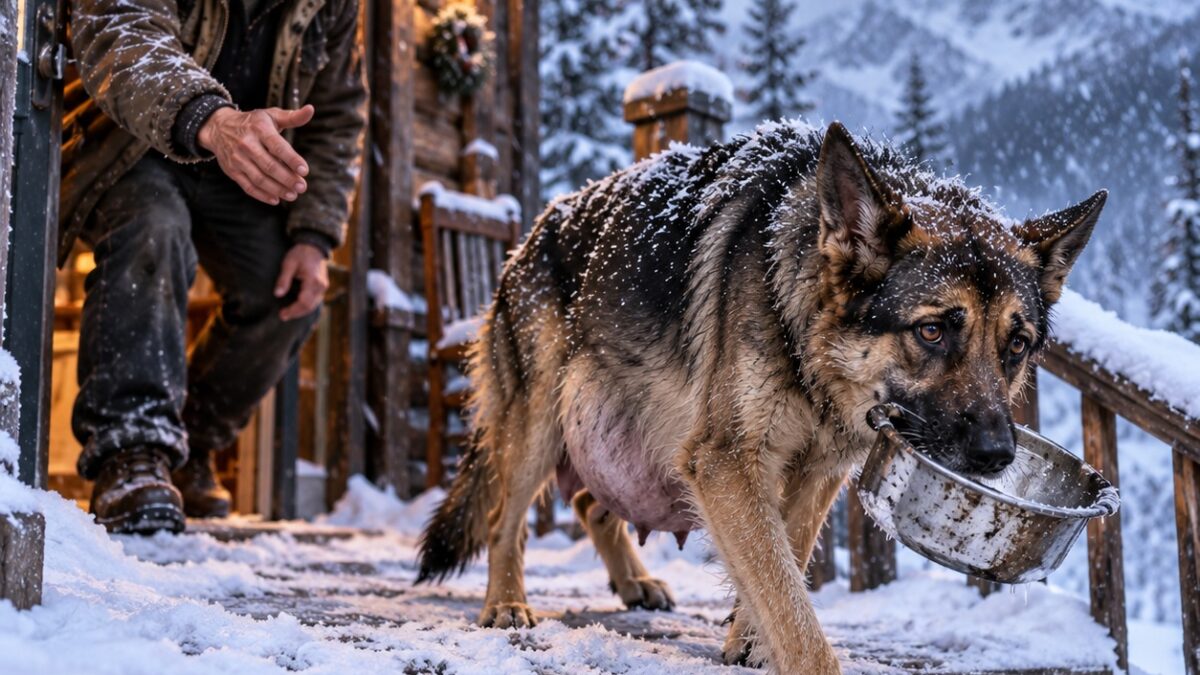
FULL STORY CONTINUATION
The bag had been sitting beside my front door for years.
I hadn’t used most of its contents since leaving the military, but I still checked it every month. Old habits were difficult to break, especially the ones that had once kept people breathing.
I opened it on the kitchen table and began taking inventory.
Gauze. Bandages. Antiseptic. Thermal blankets. Gloves. A flashlight. A folding knife.
Then I stopped.
None of those supplies was going to solve the problem of a dog giving birth in subzero temperatures.
I knew how to treat hypothermia in people. I knew how quickly exposure could turn a survivable situation into a fatal one. But I wasn’t a veterinarian, and I wasn’t foolish enough to pretend that experience treating wounded soldiers qualified me to handle every emergency involving an animal.
I needed help.
The storm made that considerably more complicated.
I walked to the window.
Snow swept across the clearing in horizontal sheets. The porch light illuminated only a few feet beyond the steps. Past that was darkness and the occasional movement of pine branches bending under the wind.
I could barely see the rope I’d tied between the porch and the tool shed earlier that afternoon.
Red Ash Ridge wasn’t a place where you ignored weather warnings.
I had lived there long enough to know what a bad storm could do to an experienced person. Familiar trails disappeared. Snow concealed drainage cuts deep enough to break a leg. The old logging road crossed unstable ground near the abandoned maintenance shed.
Going out blindly after dark would accomplish nothing if I became another person who needed rescuing.
I hated that the sensible decision was to wait.
I hated it because waiting was what I’d done with Hollis.
Not by choice.
Not because I’d failed to act.
But I had been beside him while we waited for people who were trying desperately to reach us.
I remembered his face more clearly than I wanted to.
He had always been able to find something sarcastic to say, even when conditions were miserable. On that last rescue, he’d tried to joke about the cold.
I’d laughed because he’d needed me to.
Then I’d watched the light in his eyes begin to change.
I pressed my palms against the kitchen counter.
“Not the same,” I said aloud.
Hollis had been a man.
Meera was a dog.
The circumstances were entirely different.
But the fear felt familiar.
Someone was somewhere beyond my reach, and I didn’t know whether I could get there in time.
I turned back toward the table.
Fear was useless unless I gave it a job.
I checked the generator and cleared snow from the exhaust area. I brought additional firewood inside. I filled containers with clean water and charged the backup batteries.
Then I unfolded my map of Red Ash Ridge.
The route to the maintenance shed wasn’t long in good weather.
North through the lodgepole pines.
Left at the split boulder.
Down into a shallow draw.
Across the edge of the old logging cut.
Then east toward the shed beneath the rock wall.
It was straightforward terrain in summer.
In a blizzard, it could become a trap.
I marked the route in pencil and set the map beside the radio.
Then I made a second inventory.
Two wool blankets.
My old military jacket.
A waterproof pack cover.
A sturdy cardboard box.
A small tarp with metal grommets.
Rope.
Wrapped hand warmers.
A thermos.
Food for Meera.
It wasn’t a perfect rescue kit.
It was what I had.
I checked the window again.
The dish I’d left for her was almost buried.
There were no tracks.
No movement.
Nothing to suggest she’d come near the cabin.
I stood there until the cold from the glass reached my face.
“Come on, girl,” I whispered.
But the woods stayed empty.
I didn’t sleep that night.
I sat near the stove with my boots on, listening to the radio and watching the clock.
At midnight, the wind shook the cabin hard enough to rattle the windows.
At two, the generator coughed, recovered, and settled into its steady hum.
At four, the temperature dropped farther.
Every hour made the thought of newborn puppies in that shed more frightening.
At the same time, every hour made it harder to believe a mother dog would leave a sheltered nesting place to come looking for food.
I tried to use that reasoning to reassure myself.
Maybe she’d found a protected corner.
Maybe she’d already delivered her puppies.
Maybe she was lying around them, keeping them warm, and doing exactly what a mother was supposed to do.
Then I remembered the shed’s sagging roof.
I stopped trying to reassure myself.
Just before dawn, the wind eased enough for the trees to become visible beyond the porch.
The storm was far from over.
But it was the first workable opening I’d seen.
I switched on the community radio.
“Beverly, this is Evan Ror on upper Red Ash. You reading me?”
Static hissed.
I waited.
Then her voice came through.
“Evan? You still have power?”
“Generator’s running.”
“Good. We’re checking everyone on the ridge.”
“I’m going north into the timber.”
There was a pause.
“For the dog?”
“Yes.”
“Evan, the upper logging cut is under a slope warning.”
“I heard it.”
“Then you know that’s dangerous.”
“She’s close to giving birth. She hasn’t come back, and I know the direction she’s been traveling.”
Beverly said nothing for a moment.
Then her voice changed.
Not frightened.
Professional.
“Tell me the exact route.”
I read the landmarks from my map.
She repeated them.
I corrected one direction.
She repeated it again.
“You check in every thirty minutes,” she said.
“All right.”
“If I miss two calls, I’m contacting Otis and Dr. Ward.”
I looked toward the window.
“Otis can’t get a plow up here yet.”
“Otis Bramwell has been operating snow equipment on this mountain longer than you’ve been alive. If there’s a way to get partway up, he’ll find it.”
I almost argued.
Then I stopped.
There was no good reason to turn a difficult rescue into a demonstration of pride.
“Thirty minutes,” I agreed.
“Stay out of the unstable cut if you can.”
“I will.”
“And Evan?”
“Yeah?”
“Bring yourself back too.”
I didn’t answer immediately.
It had been a long time since anyone had said something like that to me.
“Understood.”
I ended the transmission.
Then I wrote a note and left it on the kitchen table.
North timber. Old maintenance shed. Departed 7:10 a.m. Radio check every thirty minutes.
I stood looking at it.
For years, I’d deliberately arranged my life so that nobody needed to know where I was going.
Now I was leaving directions because another person might have to come looking for me.
The admission was uncomfortable.
But it was also sensible.
I pulled on my heavy jacket and packed the supplies.
The cardboard box went into the waterproof cover. I padded it with my old military jacket and a blanket, leaving room for ventilation. I kept the hand warmers separate until I needed them.
The tarp and rope were secured outside my pack.
Then I stepped onto the porch.
Cold air struck my face.
Snow crunched beneath my boots.
The forest waited beyond the clearing.
I took one last look at the empty dish near the steps.
Then I started walking.
The first twenty yards were easy.
After that, the snow deepened.
Wind had polished some areas into hard crust while piling loose powder into hollows. I moved carefully, testing the ground before shifting my full weight.
The cabin disappeared behind the trees.
I followed the northward slope.
The route was familiar enough that I could picture it with my eyes closed, but I had no intention of trusting memory alone. I checked the compass, studied the tree line, and watched for the split boulder.
The first radio check came before I’d reached the draw.
“Beverly, this is Evan. Still moving. No sighting.”
Static covered most of the response.
I caught what sounded like my name and the word copy.
Good enough.
I continued.
Near a fallen branch, I found the first track.
It was partly filled with snow.
A broad paw print pressed into the sheltered ground beneath a low pine.
I crouched.
Farther ahead was another.
Then a shallow drag mark.
I followed it carefully.
A few long sable hairs clung to the rough bark of a young fir.
Brown.
Gray.
Cream.
The same colors I’d seen every evening on my porch.
I touched the fur.
“Good girl.”
The words escaped before I thought about them.
I kept going.
The tracks weren’t fresh enough to tell me exactly when she’d passed, but they confirmed that she’d traveled toward the logging cut.
Her movements had been slow.
Several prints were close together, as though she’d paused to rest. In one protected patch of snow, I could see the faint scrape of her belly.
I imagined how heavy she’d been.
How hard she’d worked just to reach shelter.
I quickened my pace.
Then forced myself to slow down.
Panic made people careless.
And careless people missed things.
The terrain dropped toward the shallow draw.
I crossed beneath a cluster of firs where the wind had stripped snow from the lower branches.
A sharp cracking sound came from somewhere above.
I stopped.
Waited.
A small drift slid down the slope beyond the trees.
It wasn’t a major slide.
But it reminded me that the mountain wasn’t finished moving.
I adjusted my route to avoid the exposed edge.
Then I saw the roof.
At first, it was just a crooked dark line through the snow.
The maintenance shed stood beneath the rock wall, partly hidden by branches.
Its old gray boards looked almost black against the white hillside.
Snow had collected along the roof in a heavy, uneven mound.
The center sagged.
I stopped at the tree line.
“Meera?”
Nothing.
I studied the ground.
The main door was sealed with ice. Snow reached halfway up the wall beside it.
Along the south side, however, an old service entrance remained partly exposed.
I moved closer.
Scratches marked the wood near the bottom.
There were strands of fur caught along a splintered edge.
Then I saw several tiny reddish-brown stains in the snow.
My stomach tightened.
They weren’t extensive, but they were enough to make me worry that she’d injured herself forcing her way inside.
I called again.
“Meera?”
The wind moved through the trees.
I listened.
Nothing.
Then a sound came from inside the shed.
So faint that I nearly dismissed it as wind pushing through the boards.
A tiny cry.
High.
Weak.
I froze.
I knew immediately what it was.
Newborn.
I moved to the side door.
The wood had swollen against its frame and frozen around the lower hinge.
I cleared snow from the edge and worked the opening wider with my knife and shoulder.
The door shifted a few inches.
A cold, musty smell came through the gap.
Damp timber.
Rust.
Old road salt.
Then something else.
The warm, unmistakable smell of a large animal confined in a small space.
“Meera?”
A low growl answered.
I closed my eyes for half a second.
Alive.
She was alive.
I turned sideways, pushed my pack through the opening, and followed.
The shed was darker than I expected.
My headlamp picked out rusted chains hanging from a hook, a collapsed shelf, hardened sacks of salt, and a yellow tarp frozen stiff along one edge.
Snow sifted through cracks in the roof.
I followed the sound toward the far wall.
Then my light reached the corner.
Meera lay curled behind a rough barrier she’d made from torn tarp, old sacks, and dry grass.
She looked terrible.
Her fur was damp along her legs and belly. Her breathing was shallow with exhaustion, and her amber eyes seemed enormous in her narrow face.
But she was alive.
And pressed against her stomach were five newborn puppies.
I counted them once.
Then again.
Five.
Tiny, blind, fragile creatures, their bodies barely larger than my hands.
One was dark across the back.
One had a pale patch on its chest.
One had cream-colored front paws.
Another pushed weakly against its mother’s belly.
The smallest was ash gray, tucked beneath Meera’s throat.
That one hardly moved.
Meera lifted her head.
Her lips pulled back.
A growl rose from deep in her chest.
I stopped immediately.
“All right, girl.”
I lowered myself slowly onto one knee.
“I see them.”
Her eyes never left my hands.
“I see what you’ve been protecting.”
She growled again.
It wasn’t an empty warning.
Exhausted as she was, she would have bitten me if she believed I meant to hurt her puppies.
I respected that.
I had approached frightened patients before.
People who didn’t understand what was happening.
People whose fear made them fight the very hands trying to help.
I knew that forcing contact could make a bad situation worse.
I took the food tin from my pack and opened it.
Meera’s nose moved.
I spotted the dented aluminum bowl near the edge of her nest.
For a moment, I just stared at it.
She’d brought it here.
The same bowl she carried to my porch every evening.
The object that had become our strange little agreement.
She hadn’t abandoned it.
She’d carried it to the place where she intended to give birth.
I filled the bowl with food and moved it close enough for her to reach.
Then I backed away.
She watched me.
A puppy shifted against her belly.
She lowered her head and ate.
Slowly at first.
Then with more determination.
I used the moment to examine the shed.
The corner she’d chosen was the most protected space inside.
The rock wall blocked some of the wind. The torn sacks raised part of the nest above the cold floor. The tarp created a barrier against drifting snow.
She had done everything she could.
But the roof was in worse condition than I’d feared.
The main beam had bowed under the load.
One rafter was visibly split.
Several nails had pulled partly free where the framing joined the wall.
As I watched, another fine line of snow spilled through the ceiling.
Then came a low wooden groan.
I looked toward Meera.
“We can’t stay here.”
She kept eating.
I looked at the puppies.
One had pushed away from her warmth.
The ash-gray one.
It lay partly exposed, its little body trembling.
Meera tried to shift.
Her front legs shook.
She couldn’t reach it without disturbing the others.
The growl returned when I moved closer.
I stopped.
“Easy.”
I took a clean towel from my pack.
Held it where she could see.
Then slowly guided the puppy back toward her belly without lifting it farther than necessary.
Meera’s body tightened.
Her eyes fixed on my hand.
I stopped moving the instant the puppy reached her.
She lowered her muzzle and licked its head.
For several seconds, neither of us moved.
Then a cracking sound came from above.
I looked up.
The split rafter shifted.
Snow dropped onto the floor ten feet away.
The puppies cried.
Meera jerked her head toward the noise.
Another groan traveled through the roof.
I’d seen enough failing structures to recognize that we were running out of time.
I couldn’t repair that roof.
I couldn’t wait for the storm to stop.
And I couldn’t carry Meera and five newborns separately through the woods.
I needed to move all six.
Now.
I pulled the waterproof-wrapped box from my pack.
Lined it with my military jacket.
Folded the wool blanket around the sides.
Activated the hand warmers and placed them within protected cloth layers where no puppy could touch them directly.
Then I set the box beside Meera.
She lifted her head.
Her eyes moved from the box to my hands.
“I know,” I whispered.
“I know you don’t want me taking them.”
I held out one hand.
She sniffed it.
Then I reached for the first puppy.
The dark-backed one.
Meera growled.
I stopped with the puppy cupped low in my hands.
“Look.”
I held the tiny body where she could smell it.
She leaned forward and touched its head with her nose.
Only then did I place it into the padded box.
The second puppy came next.
Then the third.
The fourth cried loudly enough to make Meera attempt to stand.
I paused and allowed her to inspect it.
She licked its ear.
I lowered it beside its littermates.
The smallest was last.
It lay close beneath her throat.
Its body felt frighteningly light.
For a moment, I couldn’t move.
The memory of Hollis came back without warning.
His face.
The cold.
The awful feeling of a life slipping beyond my hands.
I swallowed.
“Not this time.”
I didn’t know whether I was speaking to the puppy, Meera, or myself.
I let her sniff the little body.
Then I placed it into the deepest fold of the jacket beside the others.
Five.
Still breathing.
Still alive.
I closed the waterproof covering loosely enough to protect them from drifting snow while preserving airflow.
Then I attached the box securely to the tarp and tested the rope.
The arrangement would function as a drag sled.
Not elegantly.
But it could move.
Above me, something snapped.
A narrow section of timber broke free and crashed near the side entrance.
Snow burst across the floor.
I flinched.
Meera scrambled upright.
Her legs nearly folded.
I moved beside her and supported her briefly beneath the chest.
She didn’t bite.
Didn’t growl.
She kept looking at the box.
“Come on, girl.”
I dragged it toward the opening.
She followed.
One step.
Then another.
At the doorway, the fallen timber blocked part of the gap.
I set down the rope and pushed the broken rafter aside.
It moved an inch.
I braced my shoulder and shoved again.
Pain shot down my arm.
The timber shifted enough to leave a narrow opening.
I pulled the box through first.
Then turned back.
Meera stood trembling inside the shed.
Her ears were flat.
Her eyes fixed on the puppies outside.
“Come on.”
I held out my hand.
This time, she let me touch her shoulder.
I guided her toward the opening.
She squeezed through, stumbled into the snow, and immediately moved toward the box.
I pulled the tarp away from the shed.
Twenty yards.
Thirty.
We reached the shelter of the trees.
Then the roof gave way.
The sound was enormous.
A heavy crack.
A deep wooden collapse.
Snow and broken timber crashed into the far corner where Meera had been lying.
For several seconds, I couldn’t breathe.
I stared at the ruin.
At the splintered beams.
At the white cloud settling over what had been her nest.
If I’d stayed inside a few minutes longer, I wouldn’t have had to worry about getting anyone back to the cabin.
None of us would have made it.
Meera stood beside the box, shaking.
I crouched and opened the cover just enough to check the puppies.
Five tiny bodies moved against my old jacket.
I closed it carefully.
Then I looked at their mother.
She was exhausted.
Hungry.
Barely able to stand.
And she had just watched the only shelter she’d found collapse behind her.
I rested a hand lightly against her damp shoulder.
“We’re not done yet, sweetheart.”
The wind rose through the pines.
The cabin was still a long way away.
And now I had six lives to bring home.
I learned quickly that rescuing five newborn puppies was easier than transporting them through a Colorado mountain storm.
They weighed almost nothing compared with the equipment I’d carried during my military years.
But weight wasn’t the problem.
Every jolt mattered.
Every minute in the cold mattered.
And Meera was in no condition to hurry.
I secured the rope around my forearm, leaving enough freedom to release it if the tarp caught or slid. Then I checked the padded box again.
The puppies were nestled together beneath the folds of my old jacket.
I kept the top protected against blowing snow, with space for air to circulate.
Meera pushed her nose toward the opening.
I let her sniff them.
“Still here.”
She looked up at me.
For the first time since we’d met, she didn’t move away from my hand.
Then I started walking.
The first stretch wasn’t terrible.
The trees shielded us from the worst wind, and the packed snow held the tarp well enough that the box slid with little resistance.
Meera followed beside it.
Every few steps, she lowered her head toward the puppies.
Sometimes she moved ahead of me.
Sometimes she fell behind.
I kept my pace slow enough that she didn’t have to choose between keeping up and collapsing.
After twenty minutes, we reached the shallow draw.
The wind was stronger there.
Snow moved across the ground in sheets so fine they looked like smoke.
My bootprints disappeared almost as soon as I made them.
I stopped beneath a pine and checked the map.
Then I looked at Meera.
She stood with her head low, sides moving beneath her damp coat.
Her back legs trembled.
“Need a minute?”
She watched the box.
I brought it closer.
She lowered herself into the snow beside it.
Not gracefully.
Not comfortably.
Her body simply seemed to run out of strength.
I crouched and opened the cover slightly.
The puppies made tiny, impatient sounds.
Meera leaned forward and touched her nose to the nearest one.
Her ears moved.
Then she pushed herself upright.
I offered support beneath her chest.
She accepted it for one second.
Then she steadied herself.
“Good girl.”
I had no way to know whether she understood the words.
But she understood my tone.
We continued.
I couldn’t keep track of time by distance anymore.
The landscape had become a series of small goals.
That tree.
That sheltered patch.
The next rise.
The turn beside the split boulder.
Stop.
Check the puppies.
Check Meera.
Move again.
I tried the radio beneath a cluster of firs.
“Beverly, this is Evan. I found her.”
Static answered.
“Mother alive. Five puppies. Heading back.”
For a second, I heard a broken piece of Beverly’s voice.
Then the signal vanished.
I couldn’t tell whether she’d received enough information to understand.
I considered trying again.
Then Meera stumbled.
I put the radio away.
“All right. Moving.”
I pulled the tarp another fifteen yards.
The rope tightened.
A buried branch caught beneath the fabric.
The box jerked.
Meera lunged toward it.
I stopped immediately.
“Easy. Easy.”
I freed the tarp with one hand and checked the box.
Nothing had shifted badly.
The puppies were still bundled together.
Meera sniffed them.
Her breathing slowed a little.
I looked at her.
“You’d be easier to rescue if you weren’t inspecting my work every thirty seconds.”
She blinked.
I almost smiled.
The next problem came farther down the draw.
I stepped onto a patch of snow that looked solid.
My right boot broke through the crust.
My leg dropped almost to the knee.
The sudden movement twisted my body and pulled the tarp sideways.
The box slid toward a shallow hollow glazed with ice.
I threw my weight backward.
Caught the rope with both hands.
And slammed my left shoulder against a pine trunk.
Pain shot from my shoulder into my arm.
I grunted.
The box stopped against my boot.
For several seconds, I held still, trying to breathe without moving the wrong muscles.
My old knee injury had started aching again.
Now my shoulder was joining the discussion.
I looked down.
The tarp hadn’t overturned.
The box was upright.
I crouched carefully and checked inside.
Five puppies.
The smallest moved faintly when I touched the blanket near it.
Warm.
Still breathing.
I let out a breath I hadn’t realized I was holding.
“Okay.”
My voice sounded rough.
“Okay.”
Meera moved close enough to sniff my wrist.
Then, very gently, she pressed her cold muzzle against my hand.
I looked at her.
She didn’t pull away.
It lasted only a second.
But something about that small contact almost undid me.
She had watched me fall.
Watched me fight to keep the box upright.
And instead of retreating, she’d come closer.
I rested my hand beneath her chin.
“You would’ve done the same.”
She looked toward the puppies.
Of course she would have.
She’d spent the entire night doing exactly that.
I pulled myself out of the snow and tested my leg.
Painful.
Functional.
I checked my shoulder.
Same answer.
Then we kept moving.
By the time I reached the split boulder, my gloves had stiffened from ice.
Snow had worked its way beneath my collar.
My knee throbbed with every downhill step.
Meera had fallen twice more.
Each time, I moved the box close enough for her to see the puppies.
Each time, she eventually rose.
I wanted to carry her.
She was too large, and my shoulder wasn’t reliable enough to risk dropping her or losing control of the sled.
So I did the only thing I could.
I walked beside her.
I kept the puppies close.
And I refused to rush her beyond what her body could manage.
Eventually, the timber began to thin.
Through the snow, I saw a faint yellow glow.
My porch light.
I stopped.
For a second, the relief was so powerful that my legs felt weak.
But I wasn’t going to make the mistake of celebrating before everyone was safe.
“Come on, Meera.”
The open clearing was the hardest stretch.
Without the protection of the trees, wind struck us from the side. Snow piled around my boots, and the tarp dragged heavily through soft drifts.
I could see the cabin.
Then I couldn’t.
Then the porch light appeared again.
I focused on it.
One step.
Another.
Meera stumbled near the woodpile.
I brought the box back to her.
She sniffed it and stood.
Then, with a final surge of stubbornness, she followed me up the porch steps.
I’d left the door unlocked.
I lifted the box with both arms and carried it inside.
Warm air met my face.
Meera stopped at the threshold.
Her ears went back.
For weeks, she’d refused to cross that doorway.
A warm cabin was something she could smell and see but had never trusted enough to enter.
Now she stood staring into it while wind pushed snow against her hind legs.
I set the box on the floor where she could see it.
The puppies cried.
Meera’s head lifted.
She stepped forward.
Then another step.
She crossed the threshold and hurried to the box.
I closed the door.
For the first time since leaving the shed, the wind disappeared.
The sudden quiet was almost painful.
Meera stood in my cabin.
Five newborn puppies breathed inside my old military jacket.
We had made it.
Then I noticed the smallest puppy wasn’t moving like the others.
And the relief vanished.
I fed the fire first.
Not until the room became hot, but enough to keep the temperature steady and comfortably warm.
Then I moved the furniture back from the hearth and spread clean blankets on the floor.
I set the puppies in a protected area well away from direct heat.
Meera followed the box.
When I opened it, she immediately began nosing and licking the puppies.
I brought her aluminum bowl from the sled, warmed the remaining food, and placed it beside her.
This time, she ate without waiting for me to leave.
I noticed that.
But I didn’t have time to appreciate it.
The little ash-gray puppy was weak.
It searched for a teat and failed to latch.
Its breathing seemed regular but shallow.
I touched its body carefully.
It felt cooler than the others.
Meera watched me.
She didn’t growl.
I reached for the radio.
“Beverly, this is Evan. I’m back.”
A burst of static.
Then her voice.
“Thank God. Are you hurt?”
“Nothing serious. Mother alive. Five puppies. One’s weak and not nursing.”
“Hold on. I’ll get Helen.”
I waited with the radio on the table beside me.
I could hear Beverly speaking faintly over the line.
Then another voice came through.
“Evan? This is Dr. Helen Ward.”
I recognized the name.
Helen was the veterinarian in Timber Falls.
I’d never met her in person, but Beverly trusted her, and that was good enough for me.
“Tell me what you’ve got,” Helen said.
I gave her everything I knew.
The estimated time outside.
The shed.
The damp bedding.
Meera’s condition.
The newborn’s weak movement and difficulty nursing.
Helen asked direct questions.
Breathing.
Color.
Temperature by touch.
Whether the puppy responded when stimulated.
I answered as accurately as I could.
“All right,” she said. “We need to warm that puppy gradually. Don’t try to feed it while it’s cold. Don’t pour anything into its mouth. We don’t want it aspirating fluid.”
“Understood.”
“Keep the mother where she can see what’s happening.”
I looked at Meera.
She watched my hand.
“I can do that.”
“Put the puppy against your body under a dry layer. Use your warmth. Not a direct heat source. Tell me if the breathing changes.”
I took off my wet jacket.
Pulled aside my sweater.
And carefully placed the tiny puppy against my chest, wrapped in a dry piece of cloth.
It was almost weightless.
So small that I could support its entire body with one hand.
Meera lifted her head.
I lowered myself onto the floor beside her.
“Right here, girl.”
She stared at the puppy.
“I’m not taking it away.”
Helen stayed on the radio.
I told her what I was seeing.
Minutes passed.
My back cramped.
The puppy barely moved.
I could hear the fire cracking behind me.
Outside, the wind struck the cabin walls.
Inside, there was nothing to do but hold a tiny life against my chest and hope its body responded.
I hated that feeling.
Hated it with an intensity that surprised me.
I had spent my career learning how to intervene.
How to do something.
How to make a difference with my hands.
Now the most important thing I could do was remain still and provide warmth.
Hollis’s face appeared in my memory.
I tried to push it away.
It wouldn’t go.
I remembered telling him help was coming.
Remembered keeping him talking.
Remembered the moment I realized his body was losing a battle I couldn’t win.
My throat tightened.
“Come on, little one,” I whispered.
The puppy moved faintly.
I looked down.
Then it made a sound.
Small.
Thin.
But stronger than before.
“Helen?”
“I’m here.”
“It moved.”
“Good. Keep going. Don’t rush.”
I waited.
Another tiny movement.
Then a weak cry.
Meera’s ears lifted.
Helen asked me to continue warming the puppy until it was more responsive, then help guide it back toward its mother.
I followed her instructions carefully.
The puppy searched against Meera’s belly.
Missed.
Tried again.
Meera lowered her muzzle and licked its head.
I adjusted the little body.
Waited.
It searched once more.
Then its mouth found the teat.
Its tiny jaw began to move.
I stopped breathing for a moment.
“Helen?”
“Yes?”
“It’s nursing.”
I heard her exhale.
“That’s good, Evan. Very good.”
I stared at the puppy.
It kept nursing.
Meera lowered her head onto the blanket.
Her eyes closed halfway.
I sat there with one hand on the floor and the other resting near the litter.
I wanted to believe everything would be fine.
Helen reminded me that the puppy still needed monitoring and that she wanted to examine all six as soon as the road was safe.
I agreed.
There was no certainty yet.
But there was life.
Warmth.
A mother feeding her puppies.
And a tiny ash-gray body refusing to stop trying.
I ended the call only after Helen had repeated the instructions and Beverly confirmed she’d keep checking on us.
Then I leaned back against the hearthstone.
My hands were shaking.
Not violently.
Just enough that I noticed.
I looked toward Meera.
She was lying around her puppies, one paw curled protectively beside the smallest.
The old aluminum bowl rested near her head.
Beyond the windows, the blizzard continued.
Inside, my cabin smelled like wet dog, woodsmoke, warm food, and damp wool.
It was crowded.
Messy.
And unlike anything I’d intended when I bought the place.
For the first time in years, that didn’t bother me.
Near dawn, I realized I’d been awake for almost two full days.
I was sitting on the floor when Meera shifted beside me.
She raised her head.
Looked at the puppies.
Then at me.
Slowly, painfully, she moved closer.
Her muzzle touched my old jacket.
She lowered her head onto the fabric.
I held still.
For weeks, she’d refused to let me get within arm’s reach.
Now she was lying beside me with her newborn puppies less than two feet away.
I reached toward the fur behind her bent ear.
Stopped.
Waited.
She watched me.
Then she lowered her head again.
I scratched gently behind the ear.
She closed her eyes.
I don’t know how long I sat there.
Long enough for the fire to settle.
Long enough for the windows to turn gray with morning light.
Long enough to understand that trust wasn’t something I’d earned by being stronger, louder, or more determined.
I’d earned one small piece of it by giving her room to be afraid.
And by coming when she needed help.
The next six days changed my cabin completely.
Before Meera, the living room had been arranged according to usefulness.
One chair near the stove.
A small table.
A shelf for the radio.
A place for boots.
Everything else stayed clear.
Now the chair was pushed toward the wall.
The table was covered with clean towels, a notebook, a scale, and supplies.
The floor near the hearth belonged to Meera and her puppies.
I slept in short stretches.
I woke whenever one of the puppies cried differently.
I checked the fire.
Changed bedding.
Prepared food.
Watched Meera nurse.
Checked the little ash-gray puppy more often than I wanted to admit.
Helen called every day when the radio connection allowed it.
She wanted accurate observations.
I gave them to her.
I wrote everything down because I knew memory became unreliable when a person was exhausted and worried.
The largest puppy was gaining steadily.
The others were doing well.
The smallest lagged behind but continued nursing and gradually showed more strength.
Meera watched me constantly.
The first morning, she growled when I reached toward the bedding.
I stopped and waited.
By the third day, she allowed me to replace one side of the nest while she rested on the other.
By the fifth, she barely lifted her head when I approached with fresh towels.
She still didn’t like sudden movements.
I didn’t blame her.
The more comfortable she became, the more I noticed how exhausted she’d been when I found her.
Her coat had concealed much of her condition.
She was underweight.
There were old abrasions along her shoulder and flank.
One side of her muzzle showed signs of healed damage, and her bent ear had clearly been that way for a long time.
I wondered where she’d lived before finding Red Ash Ridge.
Whether someone had abandoned her.
Whether she’d escaped from a bad situation.
Whether she’d simply become lost.
The questions bothered me.
But they were questions, not answers.
I had no proof anyone had deliberately hurt her.
And I wasn’t going to invent a villain simply because I wanted someone to blame.
For the moment, what mattered was getting her healthy.
On the sixth day, I heard an engine outside.
A deep mechanical rumble came up the driveway.
Meera lifted her head.
I went to the window.
An orange county snowplow crawled into the clearing, pushing a wall of snow ahead of it.
Otis Bramwell stepped down from the cab.
He was sixty-three, broad through the shoulders, with a gray-white beard and a nose that looked as though it had once lost an argument.
He wore a blaze-orange work coat and carried a steel thermos.
Behind him came Dr. Helen Ward.
I opened the door.
Otis looked at my driveway.
“Road’s ugly.”
“Looks better than it did.”
“That’s because you didn’t have to plow it.”
He stomped snow from his boots.
“Where do you want the supplies?”
“What supplies?”
He pointed toward the truck.
“Food. Blankets. Couple other things Beverly thought you might need.”
I stared at him.
He shrugged.
“Don’t get sentimental. Help me unload.”
We carried everything inside.
Then Helen stepped through the doorway.
She wore a dark-green parka, and her glasses were fogged from the sudden warmth.
Her brown hair was tied back loosely.
She looked around the living room.
Then she saw Meera.
“Well,” she said softly. “There you are.”
Meera raised her head.
A low warning came from her chest.
Helen stopped several feet away.
“That’s all right.”
She crouched and let Meera study her.
No reaching.
No sudden attempt to touch the puppies.
After several minutes, Meera leaned forward and sniffed her gloved hand.
Only then did Helen begin examining her.
I watched every movement.
Helen was calm and thorough.
She checked Meera’s hydration, breathing, gums, body condition, and the old abrasions.
Then she examined each puppy.
I tried not to hover.
Apparently, I failed.
“Evan,” she said after the third puppy, “you can breathe.”
“I am breathing.”
“Not very convincingly.”
Otis laughed from the kitchen.
I gave him a look.
He opened his thermos.
“Don’t mind me.”
Helen checked the ash-gray puppy last.
I watched her face.
She lifted the little body carefully, examined it, and placed it back beside Meera.
“He’s small,” she said.
I nodded.
“But he’s stronger than I expected from what you described on the radio.”
I felt my shoulders loosen.
“He’s going to make it?”
Helen looked at me.
“I’m encouraged. That’s not the same as a guarantee.”
I appreciated the honesty.
“He’s nursing. He’s gaining. His temperature and responsiveness look better. Keep following the plan.”
I nodded again.
Helen glanced toward Meera.
“She’s been through a lot.”
“Anything serious?”
“Undernourished, and she was likely dehydrated when you found her. She’s improving. Those abrasions are old and healing.”
I looked at the scars beneath her fur.
“Fence wire?”
“Possibly. Could be several things.”
I clenched my jaw.
Helen noticed.
“Evan.”
I looked at her.
“Sometimes an animal can suffer terribly without there being one person responsible for every injury.”
I said nothing.
“Cold. Hunger. Roads. Neglect. Accidents. Bad luck. It doesn’t make the suffering less real.”
I looked toward Meera.
She was licking one of her puppies.
Helen continued.
“What matters right now is that she’s alive, she’s recovering, and she has somewhere safe to raise them.”
Otis cleared his throat.
“That dog’s tougher than most people who complain at my plow window.”
I almost smiled.
“That’s a low standard.”
“Most people are.”
Helen laughed quietly.
Later, after she’d given me detailed instructions for feeding, monitoring, and caring for the litter, she sat at my kitchen table with a cup of coffee.
Otis was outside widening the turnaround.
Meera lay near the hearth.
The puppies slept.
Helen looked at my notebook.
Every puppy had its own row.
Daily weights.
Feeding observations.
Anything unusual.
She turned a page.
“You’re thorough.”
“Old habit.”
“Good one.”
I looked toward the litter.
Helen followed my gaze.
Then she asked, “Have you thought about what happens when they’re old enough to leave their mother?”
I didn’t answer.
She studied me.
“Evan.”
“What?”
“You have five German Shepherd puppies.”
“I can count.”
“And their mother.”
“I noticed.”
She put down her coffee.
“Six dogs will require a great deal of space, food, veterinary care, training, and attention.”
“I have land.”
“You do.”
“And time.”
“You have some.”
I folded my arms.
Helen didn’t look away.
“Safe isn’t the same thing as keeping them all with you forever.”
I felt irritation rise.
“They almost died out there.”
“I know.”
“They’re alive because we got them here.”
“I know that too.”
“Then why are we already discussing giving them away?”
“Because caring about their future means thinking beyond the part of the story where you saved them.”
I looked down.
She let the silence settle.
Then she said, more gently, “You don’t have to decide today.”
I nodded.
“But eventually, you’ll need to ask what kind of home each one deserves. Not just what makes it easier for you to sleep.”
I stared toward the hearth.
Meera was curled around her puppies.
The smallest had managed to push between two littermates and find a comfortable place against her chest.
The thought of those little bodies leaving my cabin felt unbearable.
I had spent years making sure nothing in my life could make me feel that way.
Now there were six living creatures who could do it without even trying.
Helen stood and collected her medical bag.
“One thing at a time,” she said.
I walked her to the door.
Outside, Otis was climbing back into the plow.
Helen paused beside her vehicle.
“You did good work out there.”
I shook my head.
“I got lucky.”
“Both can be true.”
I looked at her.
She continued.
“You made a plan. You told Beverly where you were going. You brought supplies. You didn’t lose your head. And when you reached the cabin, you asked for help instead of pretending you knew everything.”
I didn’t know what to say.
Helen adjusted her glasses.
“That’s what competent people do.”
Then she got into the truck.
I stood watching until the plow disappeared down the driveway.
When I went back inside, Meera lifted her head.
I sat beside her.
She looked at me for a moment.
Then lowered her muzzle onto my boot.
I didn’t move.
It was the first time in years that someone had told me I’d done a good job and I hadn’t immediately started thinking about everything I could have done differently.
Not because Hollis was forgotten.
He never would be.
But because the six lives breathing beside my fire were real, too.
And I needed to let them matter.
The puppies didn’t receive names all at once.
At first, I resisted naming them.
That probably sounds ridiculous coming from a man who’d dragged five newborn animals through a blizzard and stayed awake for days making sure they could nurse.
But names felt like commitments.
I’d learned how dangerous commitments could be.
If I called them Puppy One through Puppy Five, I could tell myself I was supervising a temporary rescue.
If I gave them names, I was admitting they already had places in my life.
That argument lasted about three days.
The largest puppy was responsible for breaking it.
He had a dark back with a warm copper-colored patch near his shoulder, and he seemed determined to crawl over every obstacle in his path.
He crawled over his littermates.
Across Meera’s paw.
Into the edge of the blanket.
Sometimes he got stuck.
That didn’t seem to bother him.
One morning, I was changing the bedding when he climbed directly onto my hand and refused to move.
I looked at him.
“You’re going to be trouble.”
He wriggled forward.
I turned him gently toward his mother.
“Come on, Copper.”
The name appeared without planning.
I froze.
Meera looked at me.
Then she nudged him back toward the litter.
“Fine,” I muttered.
“Copper it is.”
Once I’d named one, the others became impossible to ignore.
The smallest ash-gray puppy became Ren.
He was still lighter than his siblings, but his little cry had developed into something surprisingly determined.
He would be pushed away from a comfortable nursing spot, protest, and immediately work his way back.
The broadest puppy became Boulder.
He was solid and warm, and whenever I tried to move the blanket around him, he behaved as though he’d been permanently installed.
Pip was the explorer.
Long before his eyes opened, he developed an alarming talent for disappearing beneath folds of fabric.
More than once, I found him in a corner of the nest where I couldn’t imagine he’d intended to go.
The last puppy became Hearth.
He was quieter than the others.
When I sat beside Meera, he often shifted toward my boots and settled there, content with the warmth and the sound of my voice.
I tried not to read too much into it.
He was a puppy.
He wasn’t analyzing my emotional state.
But I found myself waiting for that small body to settle beside me.
One night, I caught myself talking to him about the weather.
Then the state of the roof.
Then the condition of my truck.
I stopped halfway through an explanation of a fuel-line problem.
“You’re a terrible conversationalist.”
Hearth slept.
“Probably better than most of the people I know.”
Meera lifted her head.
I looked at her.
“No offense.”
She put her head down again.
By the time the puppies were two weeks old, my cabin no longer resembled the quiet retreat I’d spent years maintaining.
The floors were covered with washable bedding.
Clean towels occupied an entire shelf.
The kitchen smelled faintly of dog food.
My notebook sat permanently open beside the stove.
I had learned to make coffee while watching five small bodies move around their mother.
I had learned that puppies could be astonishingly loud for creatures that weighed so little.
And I’d learned that Meera trusted me most when I didn’t make a production out of helping.
She no longer backed away when I approached with food.
She allowed me to check her paws.
She tolerated having the old abrasions examined.
Sometimes, when I sat on the floor, she moved closer and rested against my leg.
Other times, she wanted space.
I gave it to her.
That was our arrangement.
We didn’t need to turn every moment into a test of affection.
Then the generator failed.
It happened on a bitter evening when the temperature dropped sharply after sunset.
The engine outside coughed once.
The electric heater shut off.
The lights flickered.
Then everything went quiet except the fire.
I checked the temperature in the puppy area, made sure the hearth was safe, and went outside to inspect the generator.
It was an inconvenient but familiar problem.
I’d repaired more complicated equipment in worse weather.
I restored power after a short inspection and adjustment, then came back inside.
Meera was standing near the bedding.
Her body was tense.
At first, I thought the generator noise had frightened her.
“Easy, girl.”
She came toward me.
Then caught the cuff of my sleeve gently between her teeth.
I stopped.
She tugged.
Once.
Not hard.
Just enough to make me look.
“What is it?”
She released my sleeve and moved toward the storage crate beside the outside wall.
I followed.
The moment I looked behind it, my stomach dropped.
Pip was there.
He’d managed to wriggle away from the nest, crawl beneath the edge of the crate, and become trapped in a narrow cold space.
His body felt chilled.
I picked him up carefully.
“Well, that was a terrible idea.”
He made a faint protesting sound.
I brought him back to the warm area and checked him closely, following the precautions Helen had already taught me. Once he’d warmed and was responding normally, Meera sniffed him thoroughly.
Then she licked his head.
I looked at her.
She looked back.
“You came and got me.”
I said it quietly.
Not because I believed she understood the words.
Because I needed to hear them myself.
For weeks, she’d been afraid of my hands.
Now she’d taken hold of my sleeve because she needed me.
I sat down beside the nest.
Meera touched her nose to my wrist.
Then returned to her puppies.
I stayed there for a long time.
That small act of trust affected me more than I wanted to admit.
I knew what it meant to be needed.
I’d spent much of my adult life being needed.
But there was a difference between being assigned responsibility and being trusted by someone who had every reason to be afraid.
Meera hadn’t obeyed an order.
She hadn’t surrendered.
She’d made a choice.
And I’d been there when she asked.
The morning the puppies began opening their eyes, I came inside carrying firewood and nearly dropped an armful of logs.
Copper was staring toward me.
Not clearly.
Not with the sharp awareness he’d develop later.
But his eyes were open.
I set down the firewood.
“Well, look at that.”
He blinked.
Ren’s eyes were beginning to open too, though one seemed to be taking longer than the other.
Boulder looked profoundly unimpressed by the entire experience.
Pip was already moving toward the edge of the bedding as if vision were merely another tool he’d been waiting to acquire.
Hearth lifted his head.
Then slowly crawled toward my boots.
I crouched.
He bumped into the leather and settled against it.
Within minutes, the others followed.
Five clumsy little bodies gathered around my feet.
Copper attempted to climb my ankle.
Pip got distracted by a shoelace.
Ren sat still for a moment, listening to my voice.
Boulder wedged himself between my boots.
Hearth simply leaned against me.
I laughed.
The sound surprised me.
I couldn’t remember the last time I’d laughed alone in that cabin.
Not at a television show.
Not because somebody had said something funny over the radio.
Because something in front of me was so unexpectedly wonderful that I couldn’t keep the feeling inside.
Then my eyes filled.
I sat down on the floor.
The puppies crawled against my knees.
Meera watched from the hearth.
I covered my face with one hand.
I wasn’t crying because anything had gone wrong.
That almost made it harder to understand.
I’d spent years arranging my life around the possibility of pain.
Avoiding people.
Avoiding expectations.
Keeping my distance.
I’d convinced myself that if I didn’t love anything too deeply, I couldn’t lose it.
Now five little creatures were chewing on my boots, and I was crying because they were alive.
Because their eyes were open.
Because a dog who had once been too frightened to eat while I watched was lying peacefully in my living room.
And because I hadn’t realized how much of my life I’d spent refusing to feel happy.
Meera rose.
Walked over.
And rested her chin on my knee.
I put my hand on her head.
“Yeah,” I whispered.
“I know.”
For the first time since Hollis died, I allowed myself to feel grateful without immediately thinking about how gratitude could become grief.
The puppies kept growing.
And as they grew, so did the demands on my time.
I began structured training when they were developmentally ready, starting with simple things.
Names.
Recall.
Gentle handling.
Waiting before crossing a doorway.
Learning that dropped food wasn’t automatically theirs.
Getting comfortable with leashes and ordinary household sounds.
I didn’t treat them like military recruits.
They were young dogs.
They needed patience, repetition, and appropriate boundaries.
Copper wanted to charge toward anything that moved.
Ren noticed sounds before the others.
Boulder liked to plant himself in inconvenient places and behave as though relocation required an official written request.
Pip treated the entire cabin as an obstacle course.
Hearth was content to sit quietly beside someone.
Meera supervised all of it.
Sometimes she’d correct a puppy with a look.
Sometimes she’d intervene when the play got too rough.
Sometimes she’d lie on the porch in the sunlight and watch them with an expression I could only describe as deeply tired maternal tolerance.
I understood that one.
My cabin was alive with noise.
And with every passing week, Helen’s question became harder to avoid.
What happens when they’re old enough to leave?
I tried every possible argument.
I had land.
I had a sturdy cabin.
I knew how to care for dogs now.
I had a routine.
I could build outdoor runs.
I could buy more supplies.
I could make it work.
Helen listened.
Then asked whether keeping five growing German Shepherds and their mother was the best long-term choice for each animal.
That question was harder to answer.
The puppies were developing different temperaments.
Different needs.
Different strengths.
Copper would need structured work and someone who could manage his boldness.
Ren needed a patient person who appreciated his alert nature.
Boulder would do well with stability and a predictable routine.
Pip needed exercise, mental stimulation, and firm boundaries.
Hearth seemed happiest when allowed to stay close to people.
I couldn’t provide all six dogs with everything they needed simply by loving them.
And loving them didn’t entitle me to keep them.
So Helen and Beverly helped me establish a careful adoption process.
We wouldn’t accept impulse decisions.
We wouldn’t place puppies simply because somebody liked the story.
Potential adopters needed to understand the breed, demonstrate appropriate living arrangements, commit to training, and spend enough time with the dogs to determine whether the match made sense.
We wouldn’t separate puppies from Meera before they were ready.
And I wouldn’t be persuaded by somebody offering money.
Not that money mattered.
I wasn’t selling a heroic story.
I was trying to protect five lives that had already survived more than enough.
The first unsuitable visitor arrived wearing an expensive white ski jacket and boots that looked brand-new.
She’d heard about the puppies from somebody in Timber Falls.
She wanted Ren.
Specifically because he was the smallest.
“Oh, he’s adorable,” she said.
I nodded.
“He is.”
“He’ll stay pretty small, right?”
I looked at Helen.
Helen looked at me.
“He’s a German Shepherd,” I said.
The woman laughed.
“But he’s the runt.”
“He’s still going to become a substantial dog.”
She glanced toward the yard.
“How much exercise would he need?”
We explained.
Her expression changed.
“What about training?”
We explained that too.
Eventually, she admitted she lived in an apartment where large dogs weren’t permitted.
The visit ended politely.
Ren remained with me.
A few days later, a man arrived carrying a camera and asked whether he could film the puppies for a local feature.
He seemed more interested in the rescue story than in the animals’ future.
Beverly happened to be there delivering mail.
She looked at the camera.
Then at him.
“Road’s closed.”
He glanced toward the open driveway.
“No, it isn’t.”
“It is for this conversation.”
He left.
I watched his truck disappear.
Then I looked at Beverly.
“You know, that was unnecessarily satisfying.”
She smiled.
“I have a gift.”
But not everyone who came was unsuitable.
Some people were exactly what the puppies needed.
And meeting them would force me to face a kind of goodbye I hadn’t prepared myself for.
Gail Hartwell was the first.
She was the mountain rescue captain in Timber Falls, a lean, weathered woman in her early fifties with short gray-blonde hair and the quiet confidence of someone who’d spent years making decisions where mistakes had consequences.
She didn’t arrive talking about bravery or hero dogs.
She asked practical questions.
Temperament.
Health.
Training progress.
How Copper responded to sudden noises.
How he behaved around other dogs.
Whether he could settle after becoming excited.
Then she sat on an overturned crate in the yard and waited.
Copper approached her immediately.
He circled twice.
Sniffed the rope attached to her belt.
Then stood in front of her.
She didn’t reach for him.
She allowed him to decide whether to come closer.
Finally, he touched her hand with his nose.
Gail stroked his chest.
“Bold little guy.”
“Too bold sometimes,” I said.
She nodded.
“Then we’ll teach him that courage isn’t the same as charging ahead.”
I studied her.
That was exactly what Copper needed.
Someone who wouldn’t mistake enthusiasm for discipline.
Someone who understood that a working dog had to learn when to stop as well as when to move.
We arranged additional visits.
Copper responded well to her.
When they trained together, she was firm without being harsh.
He liked the structure.
And I could see a future for him that was larger than my cabin.
Ren’s future arrived in an old blue truck.
Wade Haskin was fifty-seven and worked repairing generators and small engines below the ridge.
He was narrow-shouldered, quiet, and had the kind of hands that never seemed entirely free of engine oil.
A small hearing aid sat behind his right ear.
He didn’t say much when he came.
He sat on the porch step while the puppies explored the yard.
Ren approached cautiously.
Sniffed his boot.
Then sat beside him.
Wade looked down.
For several minutes, neither moved.
A truck passed along the road below.
Ren’s ears lifted before I heard the engine.
Wade noticed.
He looked toward the road.
Then at the puppy.
“You heard that first, didn’t you?”
Ren leaned against his leg.
Wade smiled.
It was a small expression, but it changed his face.
I watched from the porch.
Wade wasn’t asking the dog to become some extraordinary replacement for his hearing.
He understood the limitations of that idea.
But he liked Ren’s attentiveness, and Ren seemed comfortable with his quiet presence.
Over several visits, I saw Wade become more animated.
He talked to Ren while working on harmless training exercises.
He took careful notes about the puppy’s routine.
He asked questions that showed he’d thought seriously about the responsibility.
And Ren, who’d spent his first weeks being pushed aside by larger littermates, found someone who noticed him without needing him to be loud.
Boulder found Marla Vos.
Marla owned a small inn near the ridge road.
The place served travelers when winter storms made the pass dangerous.
She was warm, practical, and impossible to intimidate.
When she visited, she wore a plum cardigan beneath her coat and carried a ring of keys at her belt.
Boulder walked up to her.
Sniffed the keys.
Then lay down across her boots.
She looked at him.
“Well.”
He didn’t move.
“Apparently, I’ve been acquired.”
Helen laughed.
Marla looked toward me.
“Does he always do this?”
“Only when he’s decided somebody belongs to him.”
She scratched his neck.
“That’s going to make hotel management interesting.”
Boulder was calm around noise and new people, something that mattered at the inn.
He didn’t need the adventure Copper seemed to crave.
He needed a steady home where his quiet presence would be appreciated.
Marla understood that.
Theo Klene came for Pip.
Theo worked as a ranger and spent much of his time maintaining trails through difficult terrain.
He was tall, wiry, and patient in a way that wasn’t immediately obvious.
He had a short gray-brown beard and weathered hands.
Pip noticed him almost immediately.
More accurately, Pip noticed the yellow trail ribbon hanging from his pack.
He followed it.
Then climbed onto a fallen log.
Slipped.
Recovered.
And attempted to climb higher.
Theo watched without interfering.
I shook my head.
“He’s going to need boundaries.”
Theo nodded.
“Definitely.”
“He thinks every obstacle is an invitation.”
“Then we’ll have to teach him that some obstacles are worth walking around.”
Pip jumped down and raced toward the ribbon again.
Theo crouched.
“Come here, trouble.”
Pip came.
Not immediately.
But he came.
That was enough to begin.
The final visitor was Ruth Adler.
Helen brought her from the veterans’ care home in Timber Falls.
Ruth was fifty-nine, soft-spoken, and had silver hair cut just above her shoulders.
She wore a pale-blue sweater beneath a cream-colored coat.
She didn’t arrive with a speech about therapy animals.
She asked about temperament.
Training.
How the puppies handled unfamiliar people.
Whether any of them seemed uncomfortable around mobility aids or unusual sounds.
Then she sat in my chair near the hearth.
Before approaching the puppies, she spoke to Meera.
“You’ve done a good job with them.”
Meera watched her.
Ruth didn’t reach.
She waited.
Eventually, Meera stepped forward and sniffed her hand.
Then Hearth woke from his nap beside my boot.
He lifted his head.
Studied Ruth for a moment.
And crossed the room.
He placed his chin on her shoe.
Ruth looked down.
Her eyes filled.
I felt something tighten in my chest.
She didn’t try to pick him up.
Didn’t call him adorable.
Didn’t ask him to perform.
She simply rested one hand beside him.
Then she looked at me.
“Some of the men where I work wake up believing they’re still in places they left decades ago.”
I said nothing.
“Sometimes talking helps. Sometimes it doesn’t.”
Hearth remained beside her.
Ruth stroked his neck gently.
“Sometimes it helps to have somebody sit there without asking questions.”
I looked toward the window.
I knew exactly what she meant.
Ruth continued.
“We wouldn’t rush him into any official role. He’d need to mature, train, and be evaluated for whatever kind of visits might be appropriate. But I think he could be very good with quiet people.”
I watched Hearth.
He was looking up at her calmly.
For a moment, I wanted to tell her no.
Not because she was unsuitable.
Because she was exactly the kind of person who should have him.
And that made the possibility of losing him real.
Helen noticed.
She didn’t say anything.
She didn’t have to.
That evening, after the visitors left, I sat on the floor with the puppies.
Copper chewed a toy near the door.
Ren watched something through the window.
Boulder slept against the hearth.
Pip attempted to climb onto a chair.
Hearth curled beside my boot.
Meera lay near the fireplace watching all five.
I looked around the room.
Then I told her the truth.
“I don’t know how to do this part.”
She lifted her head.
“The saving was easier.”
That wasn’t entirely true.
The rescue had been terrifying.
But it had given me a simple objective.
Keep them alive.
Get them warm.
Find help.
Now the right thing required letting them go.
There was no dramatic emergency.
No collapsing roof.
No storm to blame.
Just the ordinary responsibility of choosing what was best for them.
I reached down and scratched Hearth behind the ear.
“You’re going to break my heart, you know that?”
He leaned closer.
Meera stood and moved beside us.
She sniffed Hearth.
Then rested her head briefly against my knee.
I stayed there until the fire burned low.
And the next morning, I began preparing for the goodbyes.
Copper left first.
Gail arrived in her rescue truck on a clear morning when the snow had hardened beneath a pale blue sky.
I had spent the previous evening preparing a bag for him.
Food.
Veterinary records.
Training notes.
His favorite towel.
A collar I’d adjusted twice because I couldn’t seem to convince myself it fit properly.
Then I’d sat at the kitchen table writing instructions.
Copper dislikes slick floors.
Responds best to a calm, firm voice.
Very food-motivated.
Tends to move before thinking.
Needs work on waiting when excited.
I kept adding things.
Then crossing them out.
Then adding them again.
By the time Gail arrived, the notes were four pages long.
She looked at them.
Then at me.
“Planning to send him to college?”
“Just being thorough.”
“I noticed.”
She read everything.
Didn’t laugh.
Didn’t dismiss any of it.
That helped more than she knew.
Meera followed Copper to the truck.
She sniffed his travel crate.
His blanket.
Gail’s gloves.
Then she looked at me.
I wanted to explain what was happening.
That he wasn’t being abandoned.
That Gail would care for him.
That he’d be coming back for visits.
But Meera couldn’t understand those promises in the way a person would.
So I let her inspect everything.
Copper climbed into the crate after Gail gave him a calm command.
For once, he obeyed without argument.
I closed the door.
He looked at me.
I rested my hand against the crate.
“Listen to her,” I said.
Gail put a hand on my shoulder.
“He’ll be all right.”
I nodded.
“I know.”
She waited.
I looked away.
“That’s the problem.”
When her truck disappeared down the ridge, Meera stood beside me.
Her nose remained pointed toward the road.
I wondered whether she’d try to follow.
She didn’t.
Eventually, she turned toward the cabin.
I followed her inside.
The house felt different immediately.
Not dramatically quieter.
Four puppies could still produce an astonishing amount of noise.
But the empty space near the door was noticeable.
Copper had always been first to investigate anything new.
Now the door opened without a puppy rushing toward it.
I hated that.
A week later, Ren left with Wade.
He climbed into the old blue truck after several careful introductions and a familiar treat.
Wade had already prepared a sleeping area in his workshop office, away from machinery and anything dangerous.
He’d made arrangements so Ren wouldn’t be left alone for long periods.
He’d even bought a notebook for training records.
I approved of that.
Probably more than I should have.
Wade stood beside his truck with one hand resting on Ren’s crate.
“I’ll bring him up next weekend.”
“You don’t have to.”
“I know.”
He looked at me.
“Thought you might want to see him.”
I swallowed.
“Yeah.”
Wade nodded.
“Then we will.”
The truck started with its usual cough.
Ren lifted his head at the sound.
And they were gone.
Boulder left next.
Marla came from the inn carrying a thick blanket and a practical list of the changes she’d made to prepare for him.
He would have a quiet space away from guests until he’d adjusted.
He would meet people gradually.
He would continue training.
She understood he was still young and that his calm temperament didn’t mean he should be expected to behave like a fully mature dog.
Boulder examined her boots.
Then climbed into her vehicle as though he had personally selected the destination.
Marla looked at me.
“Apparently, this was my idea all along.”
I smiled.
“He’s very persuasive.”
She reached through the door and scratched his head.
“I’ll take good care of him.”
“I know.”
After she left, I stood in the driveway looking at the place where her car had been.
Then I went inside and found Pip chewing the edge of a rug.
“You’re lucky you’re cute.”
He looked delighted.
Pip left with Theo after several more visits and training sessions.
Of all the puppies, he seemed least concerned about leaving.
Theo opened the door of his vehicle.
Pip investigated the crate.
Found a toy.
Climbed inside.
And settled down.
I stared.
“That’s it?”
Theo smiled.
“Sometimes they make the decision easy.”
I looked toward Meera.
She sniffed the crate and stepped back.
Pip watched us through the door.
Then became fascinated by the toy again.
I laughed despite myself.
“Take care of him.”
Theo nodded.
“I will.”
Four puppies gone.
One remained.
Hearth.
I told myself his adoption was taking longer because the paperwork was more complicated.
Ruth wanted to make sure the care home was prepared.
Helen wanted continued training.
The staff needed to understand Hearth’s limits.
All of those things were true.
They were also convenient reasons to delay a goodbye.
Helen finally said as much during one of her visits.
We were standing beside the kitchen table while Hearth slept beneath my chair.
“You’re not ready,” she said.
I looked up.
“For what?”
“To let him go.”
I frowned.
“There’s still paperwork.”
“Most of it’s done.”
“He needs more training.”
“Ruth understands that.”
“He could become overwhelmed in a place like that.”
“Which is why she’s introducing him gradually and keeping his welfare first.”
I said nothing.
Helen waited.
Finally, I looked toward the puppy.
“He’s different.”
“I know.”
“He stays close.”
“I’ve noticed.”
I rubbed the back of my neck.
“Sometimes when I wake up at night, he’s already beside the bed.”
Helen’s expression softened.
“That doesn’t mean you owe him a life where he never gets to be anything except your comfort.”
The words hurt.
But they weren’t cruel.
I looked at Hearth.
He had helped me through difficult nights.
He’d given me company without demanding explanations.
And I had begun relying on his quiet presence.
But Ruth could offer him a good home.
A stable routine.
Thoughtful training.
And eventually, if he proved suited to it, opportunities to provide that same quiet companionship to others.
I knew what the right decision was.
I just didn’t like how much it would cost.
Ruth arrived on a clear afternoon.
Her station wagon was clean, with a secured crate in the back and a folded blanket inside.
She didn’t rush.
She came in for coffee.
Talked with me about Hearth’s routine.
Let him settle beside her.
Then, when everything was ready, we went outside.
Meera followed.
Hearth walked between us on his leash.
I loaded his food, records, toys, and familiar towel.
Then I adjusted his collar.
Once.
Twice.
Ruth waited.
Finally, I stepped back.
“All right.”
Hearth climbed into the crate.
Then turned around.
He looked at me.
That was all.
One quiet look.
I felt my throat close.
For a terrible second, I wanted to open the door.
Take him out.
Tell Ruth I’d changed my mind.
Keep him in the cabin where I could see him every morning and hear him breathing every night.
The word stay reached the back of my throat.
Then something warm pressed against my leg.
Meera.
She stepped beside me and leaned her shoulder against my knee.
I looked down.
Her amber eyes lifted toward mine.
She didn’t pull.
Didn’t bark.
Didn’t try to stop the car from leaving.
She simply stood there.
I rested my hand against her neck.
And somehow, that helped.
I looked back at Hearth.
“Go be a good dog.”
He tilted his head.
I managed a small smile.
“You’re already pretty good at it.”
Ruth closed the crate.
Then she looked at me.
“We’ll visit.”
“I know.”
“And I’ll send updates.”
“Thank you.”
She paused.
“You’ve given him a wonderful beginning.”
I shook my head.
“His mother did most of the work.”
Ruth smiled.
“Then you’ve both done something good.”
The station wagon drove away.
I stood beside Meera until the road was empty.
Then we went inside.
The silence was enormous.
No nails clicking across the floor.
No wrestling over toys.
No puppies knocking over the water bowl.
No sudden barking because somebody had discovered a pinecone.
My cabin looked almost the way it had before Meera arrived.
The chair was back near the hearth.
The kitchen table was clear.
The puppy bedding had been washed and stored.
But it didn’t feel the same.
I sat down.
Meera lay across the room.
For a while, neither of us moved.
Then she stood.
Walked toward the boot bench.
Picked up her dented aluminum bowl.
And carried it to me.
She set it gently at my feet.
I looked at it.
The same bent rim.
The same scratches.
The same dull silver surface.
For weeks, it had been the first thing I saw every evening.
Then it had disappeared into the blizzard.
Now it sat between us.
I picked it up.
Filled it with her supper.
And placed it beside my chair.
Meera came closer.
She ate without hesitation.
When she’d finished, she rested her head on my knee.
I scratched behind her bent ear.
Five puppies had found their own homes.
Five families had gained something good.
And I had lost the noise of their childhood without losing the love that brought them here.
I looked down at Meera.
“Guess it’s just us.”
She exhaled.
Her eyes closed.
I leaned back in my chair.
The cabin was quiet.
But it wasn’t empty.
And neither was I.
A year later, winter returned to Red Ash Ridge.
The mountain looked much the same.
Snow still gathered against the cabin walls.
The pines still bowed beneath ice.
The road to Timber Falls still became dangerous whenever storms settled over the pass.
But the cabin had changed.
A braided rug lay beside the hearth.
A leash hung by the door.
Two towels waited beneath the bench for muddy paws.
And along one wall, a string of photographs displayed five German Shepherds who had grown into their separate lives.
Beverly had brought the photographs and put them up herself.
When I protested, she told me a man with a family ought to stop decorating his house like a storage building.
I had not argued very hard.
Copper appeared in one picture beside Gail’s rescue truck.
He’d grown broad through the chest, with the warm copper markings on his shoulder more visible than ever.
He was still bold.
Still eager.
But Gail was teaching him that an enthusiastic dog wasn’t useful in dangerous terrain unless he could follow instructions.
Ren appeared in Wade’s workshop, sitting beside a generator.
He had developed a habit of noticing sounds before Wade did.
Sometimes he raised his head at unusual vibrations or distant vehicles.
Wade joked that Ren was his second set of ears.
He was careful not to treat the dog as a substitute for proper equipment or safety procedures.
But their companionship suited them both.
Boulder had become a familiar presence at Marla’s inn.
Travelers stranded by storms sometimes found him sleeping near the lobby stove.
Marla said he had a remarkable talent for making people sit down and stop worrying.
Pip spent his days with Theo, learning to navigate trails and respect boundaries that still offended his adventurous spirit.
He wasn’t allowed to investigate every ravine or chase every interesting scent.
That remained a difficult concept for him.
But he was learning.
And Hearth had become a beloved companion at the veterans’ care home.
Ruth never rushed him into more responsibility than he could handle.
Some days, he simply lay beside the residents while they watched television or talked.
Other days, he rested quietly near men who found the winter nights difficult.
One of those men was Leonard Pike.
Leonard was a retired Marine in his late seventies.
His hair was cropped short.
His hands were usually steady, except when thunder or a certain kind of wind brought old memories too close.
He called Hearth the quiet medic.
Ruth told me that during a visit one Sunday.
The phrase struck somewhere deep inside my chest.
I looked away.
Not because I was ashamed.
Because I remembered Hollis.
And because, for the first time, the memory didn’t arrive alone.
It came with the image of Hearth lying beside an old man who needed company.
It came with the knowledge that pain could be carried without becoming the only thing a person had to offer.
I still missed Hollis.
I always would.
But I had stopped treating every new attachment as a betrayal of the friend I couldn’t save.
Meera seemed to understand my changing life long before I did.
She no longer watched the door as though every visitor might take something from her.
She greeted Beverly with a cautious wag.
Accepted Otis after he’d made himself useful carrying dog food up the driveway.
Allowed Helen to examine her without the defensive tension she’d shown during those first weeks.
And wherever I went around the cabin, she was usually nearby.
Not because she was frightened of being left.
Because she liked being with me.
I began traveling into Timber Falls more often.
Sometimes I needed supplies.
Sometimes I didn’t.
I repaired a sagging shelf at Beverly’s post office.
Helped Otis inspect a plow winch.
Carried medicine to a neighbor when ice made the road dangerous.
And sometimes I simply drank coffee with people.
That last part took the most getting used to.
Nobody made speeches about my change.
Nobody asked why I’d suddenly decided to become part of the community.
They just made room for me.
And slowly, I learned how to accept it.
Then February brought another storm.
It began with light snow.
The kind that looked harmless from indoors.
By late afternoon, the wind shifted north.
Temperatures dropped.
The ridge road disappeared into a white tunnel.
I was beside the stove when the radio crackled.
“Beverly, this is Wade.”
His voice was sharper than usual.
“Ren’s been alerting toward the pass for the last ten minutes. I think I hear a horn under the wind.”
I stood.
Meera raised her head from the rug.
Wade continued.
“Can’t tell where it’s coming from. Could be north of the lower bend.”
Beverly answered immediately.
“Copy. Let me check with Marla.”
Static filled the channel.
Then Marla’s voice came through.
“We’ve got nine guests at the inn. Power’s flickering. Road south looks blocked.”
She paused.
“Boulder’s been standing at the front window. Something’s wrong down near the bend.”
I reached for the ridge map.
That part of the road ran beneath an unstable slope.
Heavy snow could slide across it without warning.
If a vehicle had been caught beyond the bend, the occupants might not be able to get out.
I unfolded the map on the table.
“Beverly, Evan here.”
“Evan?”
“Mark Wade’s sound report north of the pass and Marla’s blockage near the lower bend.”
“Copy.”
“Can Gail get a team toward the rescue shed?”
“I’ll ask.”
“Have Theo check whether the ranger cut above the rock wall is accessible. That may give us a way around the slide on foot.”
Beverly didn’t question me.
She asked for the landmarks.
I gave them.
Then she said, “Are you heading out?”
I looked toward Meera.
She was already standing beside the door.
Healthy.
Strong.
Her sable coat thick around her neck.
The silver-gray streak on her forehead bright in the lamplight.
I thought about the starving dog who’d once waited on my porch, too frightened to come close.
Then I looked at my map.
“Yes,” I said.
“But not alone.”
This time, I wasn’t trying to prove I could save somebody by myself.
I knew who had the equipment.
Who knew the terrain.
Who could coordinate safely.
Who needed to be called.
And who should remain where they were.
Beverly kept the radio network operating from Timber Falls.
Wade stayed at his workshop, listening for the intermittent sound and reporting the direction Ren continued to notice.
Gail mobilized two trained rescue volunteers.
Copper went with her under close control, still learning to work around difficult terrain.
Theo approached from the ranger cut with Pip.
Marla kept the inn prepared for anyone the team could bring out.
Ruth remained at the care home, where the storm had unsettled several residents.
I took the upper slope with Meera.
We carried the appropriate winter gear, rope, a headlamp, and emergency signaling equipment.
The wind was fierce.
Snow struck my face.
But this time, the storm didn’t make me feel as if I’d been dropped back into the worst moment of my life.
I knew what needed to happen.
And I knew I wasn’t the only person responsible for making it happen.
Near the lower bend, I saw Gail’s headlamp through the snow.
Then Copper’s shape moving near her.
Theo’s light flashed from the cut above the rock wall.
We coordinated over the radio and confirmed the blocked section before advancing.
Beyond the slide was a delivery van.
It had been caught where snow had shifted across the road.
Its doors were partly packed in.
Two adults were inside.
They were cold and frightened, but conscious.
There was no explosion.
No dramatic villain.
No miraculous last-second discovery.
Just two people who’d found themselves in the wrong place when the weather changed.
Gail’s team worked from below, clearing snow and establishing a safe approach.
I helped secure the rope from the upper side.
Theo identified a usable route along the ranger cut, avoiding the worst hidden drop-offs.
Pip remained under his control as they moved through the difficult section.
Copper waited beside Gail until she directed him.
I noticed that.
A year earlier, he’d have thrown himself into the nearest snowbank simply because it looked interesting.
Now he was learning that sometimes the bravest thing a dog could do was wait.
Eventually, the first passenger was helped out of the van.
She was shaking.
Her boots slipped on the packed snow.
I moved toward her.
Meera stayed beside me.
Then, as the woman stumbled, Meera stepped forward and pressed her shoulder against the woman’s leg.
It wasn’t enough to support her full weight.
But it helped steady her for a moment while I guided her toward the rope-supported route.
The woman looked down.
“Oh, sweetheart.”
Meera stood quietly.
I rested a hand against her back.
“Good girl.”
We moved her to safety.
Then the driver followed.
By midnight, both adults were at Marla’s inn, wrapped in blankets and drinking hot soup.
They needed further assessment and care, but the immediate danger had passed.
The road remained blocked.
The wind continued.
But everyone involved in the rescue had checked in.
Beverly kept the channel open until she accounted for the team.
Wade reported that Ren had finally settled beneath his workbench.
Gail said Copper was extremely pleased with himself but had mostly behaved.
Theo reported that Pip had discovered several routes he wasn’t allowed to take and one he was.
Marla informed everyone that Boulder had apparently decided the frightened travelers required his personal supervision.
And Ruth reported that Leonard Pike had settled after a difficult evening.
Hearth had stayed near him while she reminded him where he was.
I listened to those reports from the doorway of the inn.
My jacket was stiff with snow.
My knee ached.
Meera stood beside me, tired but steady.
I looked around the room.
People drinking soup.
Rescue volunteers removing wet gloves.
Marla moving between tables.
The two stranded travelers warming beside the stove.
And somewhere beyond the snow, the five puppies I’d once carried inside my military jacket were living lives I couldn’t possibly have provided for them on my own.
When I finally stepped inside, several people looked toward me.
Nobody applauded.
Nobody called me a hero.
Marla walked over, placed a bowl of soup in my hands, and pointed toward an empty chair.
“Sit down before you fall over.”
I smiled.
“Yes, ma’am.”
She narrowed her eyes.
“Don’t start.”
I sat.
Meera curled up beside my boots.
For a while, I ate in silence.
Then I reached down and rested my hand against her neck.
A year earlier, she’d been too frightened to approach a man standing beside a bowl of food.
Now she’d walked through a storm at my side.
Not because I commanded her.
Because we’d learned to trust each other.
And because we’d both discovered that needing someone didn’t have to mean losing ourselves.
A few days after the storm, when the roads reopened, everyone came to my cabin.
Nobody called it a reunion.
Beverly said that sounded too formal for a gathering involving six German Shepherds, several muddy vehicles, and a questionable amount of food.
Otis brought coffee.
Beverly brought bread.
Helen brought a veterinary supply bag out of habit and stern instructions that nobody was to feed the dogs table scraps.
Gail arrived with Copper.
Wade brought Ren.
Marla came with Boulder.
Theo brought Pip.
And Ruth arrived with Hearth.
My driveway filled with trucks and cars.
Wet boots crowded the porch.
Coats hung from every available hook.
The cabin that had once contained one plate, one fork, and one lonely man became almost impossibly full.
Then the dogs saw one another.
Copper was first through the door, though Gail made him wait before entering.
Ren followed, alert and interested.
Boulder walked inside with the quiet confidence of a dog who believed every comfortable room had been built with him in mind.
Pip immediately tried to investigate the woodpile.
Theo redirected him.
Hearth came in last.
He paused beside Ruth.
Looked across the room.
Then moved toward Meera.
She stood near the hearth.
For a moment, she didn’t move.
Five grown young dogs approached her.
Copper lowered his head.
Ren pressed close beneath her chin.
Boulder leaned against her so heavily that Marla laughed.
Pip circled twice before settling near her front paws.
Hearth rested his muzzle across her leg.
Meera lowered her head.
She licked his ear.
The same patient, gentle movement she’d made when he was a blind newborn barely able to crawl.
I stood beside the stove watching.
Something tightened in my chest.
Then eased.
I had once been terrified of this moment.
The possibility that loving them meant losing them.
That once they left my cabin, the story would end.
But there they were.
Healthy.
Growing.
Loved.
Surrounded by people who had made room for them.
And through those dogs, people who might otherwise have remained strangers had become part of one another’s lives.
Gail talked with Theo about trail conditions.
Wade discussed generator maintenance with Otis.
Marla argued with Beverly over the correct amount of coffee to put in a pot.
Ruth sat beside Helen, sharing updates about Hearth’s progress.
I looked around.
My cabin was too crowded.
The dogs were shedding everywhere.
Someone had put a wet coat too close to the woodpile.
Pip was trying to steal a glove.
And Beverly had rearranged the mugs in my kitchen without asking.
I should have been irritated.
Instead, I felt happier than I could remember feeling in years.
Meera looked toward me.
I crouched beside her.
“You did good, girl.”
She pressed her head against my shoulder.
I wrapped one arm around her.
For a moment, I remembered the shed.
The broken roof.
The five newborns trembling in my jacket.
The awful fear that I would be too late.
Then I looked at them now.
Copper beside Gail.
Ren resting against Wade’s leg.
Boulder blocking a doorway.
Pip being gently redirected by Theo.
Hearth curled beside Ruth’s chair.
Five lives.
Five homes.
And the mother who had carried them through the beginning of it all.
I thought about Hollis.
I wished he could have seen this.
He would have laughed at me.
He would have called the entire situation ridiculous.
Then he would have sat on the floor with the dogs and probably been the last man willing to leave.
I could almost hear him.
For the first time, remembering his voice made me smile before it made me sad.
That was something I hadn’t believed possible.
The next morning, the storm had passed completely.
Clean snow covered the ridge.
Sunlight poured through the windows.
Most of the visitors had gone home the evening before, and the cabin had returned to its quieter rhythm.
I woke early.
Fed the stove.
Made coffee.
Then opened the front door.
Cold air moved across the porch.
And there, exactly where Meera had placed it more than a year earlier, sat her dented aluminum bowl.
I stopped.
The metal was scratched.
The rim was bent.
One side was still nearly flat.
For a moment, I wondered whether somebody had left it outside after the gathering.
Then Meera stepped beside me.
She looked at the bowl.
Then up at my face.
I bent and picked it up.
It wasn’t beautiful.
It wasn’t valuable.
Most people would have thrown it away.
But I remembered the first evening she’d stood on those steps.
Thin.
Pregnant.
Terrified.
Watching my hands as though kindness might come with a price.
I remembered the sound of the bowl touching the wood.
The way she’d backed away.
How I’d filled it and closed the door because she’d needed space more than affection.
I remembered the empty porch during the blizzard.
The tracks disappearing into the timber.
The broken shed.
Five tiny bodies wrapped inside my military jacket.
And Meera following them through the snow because she refused to leave her puppies behind.
I looked down at her.
She stood quietly beside me.
Her coat was thick and healthy.
Her amber eyes were calm.
The old bend in her ear was still there.
She wasn’t the same frightened animal who’d come looking for food.
And I wasn’t the same man who’d opened the door.
I carried the bowl inside.
Washed it.
Filled it with clean water.
Then placed it near the entrance.
I didn’t hang it on the wall.
Didn’t build a shelf to display it.
It wasn’t a trophy.
It was a bowl.
Something useful.
Something that had once helped a starving dog survive.
I left it where another thirsty animal could reach it safely.
Then I put a covered container of dog food on the shelf inside.
Meera watched me.
I crouched and scratched behind her bent ear.
“You know, I thought I was just feeding you.”
She leaned closer.
I smiled.
“Turns out I was doing a lot more than that.”
The morning was quiet.
Snow shone on the trees.
The road to Timber Falls lay open beneath the winter sun.
Somewhere below the ridge, Copper was learning to work with Gail.
Ren was keeping Wade company in his workshop.
Boulder was probably asleep near Marla’s stove.
Pip was almost certainly trying to investigate something Theo had told him to leave alone.
And Hearth was bringing quiet comfort to people who understood the kind of memories I had once tried to escape.
They weren’t mine to keep.
They had never been mine to keep.
But I’d been part of their lives.
And that would always matter.
I looked toward the old photograph of the field hospital on my wall.
For years, I’d kept it there without knowing exactly why.
Maybe because it reminded me of the person I’d been before Hollis died.
Maybe because it was easier to remember courage in other people than to recognize the possibility of it in myself.
I didn’t take it down.
I didn’t need to.
The past was still part of my life.
Hollis was still gone.
There were still nights when the wind sounded too much like the worst hours I’d lived through.
But I no longer believed that closing my door would protect me from grief.
All it had done was keep out everything else.
I stood and looked around my cabin.
The extra chair Beverly had insisted I buy.
The photographs.
The blankets.
The dog leash.
The muddy paw prints near the entrance.
The coffee pot I’d finally learned to keep full when visitors were expected.
And Meera beside me.
I realized then that the most important thing she’d brought to my porch wasn’t food for herself.
It wasn’t a request for rescue.
It wasn’t even the beginning of the extraordinary winter we’d survived.
She’d brought me a reason to open the door.
And after years of believing that love was something dangerous because it could be lost, I’d finally learned that refusing it wasn’t the same as being safe.
Meera rested her head against my leg.
I put my hand on her shoulder.
Outside, the wind moved gently through the pines.
I thought about the man I’d been when she first arrived.
A veteran who could save lives in terrible circumstances but couldn’t bear to let anyone close enough to need him.
A man who ate standing up, washed one plate, and convinced himself that being alone was the same as being at peace.
That man hadn’t disappeared completely.
He was still part of me.
But he wasn’t the only person I knew how to be anymore.
I opened the door a little wider.
Meera stepped onto the porch.
She looked out over Red Ash Ridge, her nose lifting toward the clean mountain air.
Then she turned back and waited for me.
Not because she was hungry.
Not because she was afraid.
Not because she had nowhere else to go.
She waited because we’d become a family.
I stepped outside beside her.
And as the sun rose above the snowy trees, I finally understood something Hollis’s death had made me forget.
Home wasn’t a place where nothing could hurt you.
It was a place where you no longer had to face every storm alone.
Meera leaned against my leg.
I rested my hand on her head.
And together, we watched the morning arrive.