FULL STORY:The Old Pit Bull Who Hadn’t Left His Corner in Two Years Was Waiting for Someone as Broken as He Was
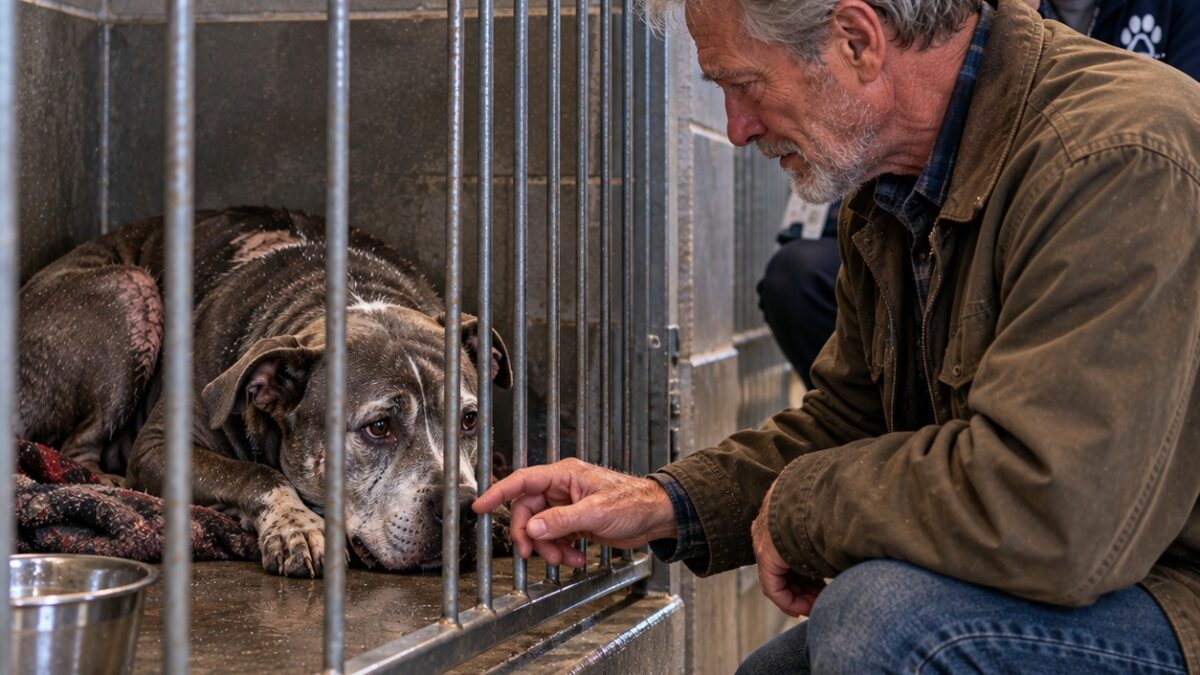
FULL STORY CONTINUATION
Elizabeth did not hand me adoption papers immediately.
Instead, she took me into a small office beside the reception area and closed the door.
There were photographs on the wall.
Dogs with new families.
Children hugging puppies.
Older couples smiling beside senior dogs.
Happy endings displayed in cheap black frames.
Elizabeth sat across from me.
“Arthur, I need to be certain this isn’t pity.”
“It isn’t.”
“You met him five minutes ago.”
“I know.”
“He is thirteen.”
“I heard you.”
“He has arthritis.”
“So do I.”
That almost made her smile.
“He may have accidents.”
“I’m retired.”
“He may never play.”
“I’m not exactly known for my athletic lifestyle.”
“He may never become affectionate.”
That one hurt more than I expected.
Elizabeth saw it.
“I’m not trying to talk you out of him.”
“It sounds like you are.”
“I’m trying to protect both of you.”
I nodded.
Fair.
She continued.
“A senior dog can decline quickly.”
“I know.”
“You could have him six years.”
“I know.”
“You could have him six months.”
That landed.
I looked at the photographs behind her.
People smiling because nobody had taken a picture of what happened later.
The medication.
The final veterinary visit.
The empty leash.
Love always contains the possibility of grief.
Margaret had taught me that.
Maybe that was why I wasn’t afraid of Barnaby’s age.
I had already learned the most important lesson.
Avoiding love doesn’t prevent loss.
It only prevents everything before it.
“Elizabeth.”
“Yes?”
“I came here for a young dog.”
She nodded.
“I wanted something cheerful.”
“Barnaby is many things.”
“Cheerful isn’t currently one.”
“No.”
“I wanted something easy.”
She smiled now.
“He definitely isn’t that.”
“But when I looked at him…”
I stopped.
Words failed.
Then I tried again.
“He looks like I feel.”
Elizabeth’s expression changed.
“I know that sounds ridiculous.”
“It doesn’t.”
“My wife died two years ago.”
“I’m sorry.”
“I’m tired of people being sorry.”
She nodded.
“I understand.”
“No, you don’t.”
I regretted saying it immediately.
Elizabeth didn’t react defensively.
“No,” she said. “Probably not.”
That kindness made it worse.
I rubbed my hands together.
“I don’t need Barnaby to perform happiness for me.”
She listened.
“I don’t need him to greet me at the door.”
“I don’t need tricks.”
“I don’t need him to fix me.”
I looked through the office window toward the kennel wing.
“I can give him a quiet place.”
Elizabeth remained silent.
“A bed.”
“Food.”
“A yard.”
“Time.”
Then I said the only thing that mattered.
“And if all he ever does is sit in the corner while I sit in another one, at least neither of us will be doing it alone.”
Elizabeth lowered her eyes.
When she looked back up, they were wet.
“That,” she said, “is a much better answer.”
The paperwork took almost two hours.
Medical history.
Medication schedule.
Diet.
Previous records.
Microchip transfer.
Senior-animal agreement.
The shelter veterinarian talked me through Barnaby’s arthritis and mild heart changes.
Nothing immediately dangerous.
Just age.
Time making itself visible.
When everything was signed, Elizabeth brought Barnaby out on a thick leash.
He walked slowly beside her.
Did not resist.
Did not look curious.
He stopped near me.
His eyes briefly lifted toward mine.
Then away.
“Ready?” Elizabeth asked.
“No.”
She laughed softly.
“Good answer.”
Outside, Barnaby stood beside my car.
I opened the back door.
For a moment, he did nothing.
Then he climbed inside with the heavy, deliberate movement of an old animal accustomed to obeying because resisting had stopped making sense.
He settled on the back seat.
Turned toward the window.
I drove home.
For the first ten minutes, I talked.
I told him the road would get quieter after the highway.
I told him I had bought a dog bed that cost more than my first mattress.
I told him there were squirrels in my backyard and that I considered them criminals.
Nothing.
So I tried something else.
I sang.
Badly.
An old song Margaret used to hum while gardening.
Barnaby’s ears moved once.
That was enough to keep me singing.
When we reached home, I opened the car door.
He stepped down.
Then stopped in the driveway.
His nose lifted.
He smelled the wind.
The garden.
Dry leaves.
Old wood.
Earth.
For the first time since leaving the shelter, something resembling attention entered his face.
He looked toward the backyard.
Then toward the house.
Then walked slowly around the side.
I followed.
He passed the porch.
Passed the garden beds.
Stopped beside the old stone well.
The same place where I had sat after Margaret died.
Barnaby lowered himself onto the ground.
I stood behind him.
Of every place on the property, he had chosen mine.
“That’s taken,” I whispered.
One ear moved.
I sat beside him.
Not close.
Just there.
For nearly an hour, we watched afternoon light move across the grass.
That was our first conversation.
The first night went exactly as Elizabeth had warned.
I had prepared a thick orthopedic mattress beside the fireplace.
Fresh blanket.
Water nearby.
Everything comfortable.
Barnaby sniffed it once.
Then walked into the darkest corner behind my armchair and lay directly on the hardwood floor.
“You know that thing cost eighty dollars.”
He closed his eyes.
“Fine.”
I left the bed where it was.
Around midnight, I woke in my recliner.
Barnaby was still behind the chair.
His eyes were open.
We looked at each other through the darkness.
I expected sadness.
Instead, I felt something gentler.
Recognition.
Two creatures unable to sleep inside a house filled with absences.
The next morning, he would not eat while I was in the room.
I put down his bowl.
He turned his head.
I waited.
Nothing.
I moved into the kitchen.
Still nothing.
Finally, I went upstairs.
Thirty seconds later, I heard him approach the food.
I stood on the landing listening.
The bowl moved.
Soft chewing.
I smiled.
Every meal became the same.
Food down.
Arthur disappears.
Barnaby eats.
If I entered early, he stopped.
So I stopped entering early.
That sounds obvious now.
It wasn’t.
When you love something wounded, the instinct is to move closer.
Fix.
Touch.
Comfort.
But sometimes closeness is exactly what frightens them.
I had to learn that love could look like leaving the room.
Every afternoon, I brought a wooden chair near his corner.
Not too near.
I drank tea.
Talked.
At first, about practical things.
Weather.
The plumbing.
Neighbor’s new truck.
Then I started telling him about my work.
How I learned cabinetmaking from my father.
How walnut smelled when cut.
Why old oak fought every blade.
How Margaret could tell when I had ruined a piece before I admitted it.
Barnaby never looked at me.
But his ears moved.
So I kept talking.
Eventually, I told him about Margaret.
That was harder.
“She hated this chair.”
His ear moved.
“Said it looked like something a dentist would put in a waiting room.”
Nothing.
“She was right.”
I drank my tea.
“She usually was.”
Some afternoons, I told him about my children.
My daughter in Australia.
My son in Germany.
Grandchildren I loved but mostly saw through a screen.
I confessed things I had never said aloud.
“I think they worry if they call too much, they’ll remind me I’m alone.”
Barnaby breathed slowly.
“I think I don’t call because I don’t want them hearing it in my voice.”
His eyes remained half closed.
“Stupid arrangement, isn’t it?”
One ear tilted.
“I’ll take that as agreement.”
Weeks passed.
I stopped measuring progress by what Barnaby did.
Instead, I measured what he stopped doing.
He stopped freezing every time I crossed the room.
Stopped waiting an hour after I went upstairs before eating.
Stopped watching the front door constantly.
Then one evening, I entered the living room and realized he had moved six feet closer to my chair.
He still lay on the floor.
Still facing away.
But closer.
I didn’t acknowledge it.
The next afternoon, he lay there again.
A week later, closer still.
Healing announces itself quietly.
You miss it if you demand miracles.
The first real miracle happened on a rainy Tuesday.
Almost seven weeks after the adoption.
I was in the kitchen making coffee.
Rain tapped the windows.
The kettle began hissing.
Then I heard claws against hardwood.
Slow.
Scrape.
Pause.
Scrape.
I turned.
Barnaby stood in the doorway.
Every part of me wanted to speak.
I didn’t.
He looked at me.
Directly.
Not past me.
At me.
Then he walked forward.
One step.
Another.
Another.
He came to my bare feet.
Sat.
No tail wag.
No request for food.
No dramatic gesture.
Just presence.
My throat tightened.
“Morning.”
Barnaby blinked.
I poured coffee.
He stayed.
I sat at the table.
Barnaby lowered himself beside my chair.
For forty-five minutes, we shared breakfast.
That became the new routine.
Every morning.
Coffee for me.
Food for him.
Same kitchen.
Same room.
No need for hiding.
Two months later, another shift happened.
I had been renting a small piece of rural land outside town for years.
Originally, Margaret and I planned to build a workshop there.
After she died, I kept the lease because canceling it felt too final.
The property had open pasture.
Wild grass.
A line of trees.
Barnaby’s shelter records said he had once lived on a farm.
I wondered whether he remembered.
So one bright afternoon, I put him in the car.
“You’re going to hate this.”
He stared through the windshield.
“Then I’ll feel guilty.”
No response.
“Excellent arrangement.”
The drive took forty minutes.
When the pavement became dirt, Barnaby’s nose lifted.
Then his entire body changed.
Not dramatically.
But enough.
He sat straighter.
His nostrils moved.
He smelled something.
When I parked, he stood before I opened the door.
“Well.”
I stepped out.
The air smelled like cut grass and wet earth.
I opened Barnaby’s side.
He climbed down.
Then froze.
He looked across the field.
No buildings.
No kennel walls.
No traffic.
Just grass moving beneath wind.
Barnaby stood there so long I wondered whether I had made a mistake.
Then he took one step.
Another.
I followed with the long lead loose in my hand.
He walked farther.
His stride lengthened.
His head rose.
Twenty yards.
Thirty.
Then something extraordinary happened.
Barnaby ran.
Not fast.
Not gracefully.
His old hips were stiff.
His legs carried thirteen years of age.
But he ran.
He crossed the field like a dog remembering himself.
Ears moving in the wind.
Tail lifted.
For one glorious stretch of seconds, age disappeared.
I laughed.
Then cried.
I didn’t care who saw.
There was nobody there anyway.
Barnaby ran perhaps a hundred yards before slowing.
He stopped.
Turned.
Looked back at me.
Waiting.
I walked as quickly as my knees allowed.
“Don’t start showing off now.”
His mouth opened slightly.
Not quite a smile.
But close.
When I reached him, I lowered myself into the grass.
My knees protested.
I opened my arms without thinking.
Barnaby took two steps.
Then came into them.
He pressed his chest against mine.
His head settled beside my neck.
I wrapped both arms around him.
For the first time, he did not remain rigid.
He leaned.
Trusted.
His body trembled once.
Then relaxed.
I buried my face against the white fur along his muzzle.
“I miss her too.”
I don’t know why I said that.
Maybe because in that field, Barnaby seemed closer to the dog he had been before losing his first owner.
And I felt closer to the man I had been before losing Margaret.
Neither of us had forgotten.
That was the point.
Healing wasn’t forgetting.
Barnaby wasn’t replacing eleven years with another man.
I wasn’t replacing forty-one years with a dog.
Love is not furniture.
You do not drag out the old piece because a new one has arrived.
You make room.
After that afternoon, Barnaby changed faster.
Not completely.
Never completely.
But life began appearing in him.
A tail wag when I returned from the store.
Small at first.
Then unmistakable.
He started sleeping beside my chair rather than behind it.
The expensive orthopedic bed finally became acceptable.
Three months after I bought it.
“You’re welcome.”
He sighed.
One morning, I found an old leather ball near the shed.
I tossed it aside while cleaning.
Barnaby followed it.
Stopped.
Picked it up.
Then brought it back.
I stared.
“You know what fetch is?”
He dropped the ball near my foot.
I threw it.
He walked after it.
Not ran.
Walked.
Returned.
Dropped it.
“That may be the least athletic fetch I’ve ever seen.”
Tail wag.
I threw it again.
Soon the yard had sound again.
My voice.
His paws.
Occasional barking.
A ball bouncing against the porch.
Margaret’s garden still existed.
But it no longer felt like a museum.
That change scared me at first.
One afternoon I moved her old gardening basket to make room for Barnaby’s food storage.
I stood holding it.
Guilt hit me.
Ridiculous, sharp guilt.
As if Margaret might walk in and accuse me of rearranging our life without permission.
I put the basket back.
That night, I dreamed about her.
Nothing dramatic.
She was kneeling in the roses.
Barnaby lay beside her.
She looked up.
“Arthur, you’re blocking the path.”
I woke laughing.
The next morning, I moved the basket.
Life continued.
Barnaby taught me that more gently than anyone else could.
My daughter noticed first.
“You sound different.”
We were on a video call.
“I sound old.”
“You sound busy.”
“Barnaby needs things.”
“Good.”
“What does that mean?”
“It means you need things too.”
I changed the subject.
A month later, she surprised me by flying home.
When she entered, Barnaby stood between us.
Protective but quiet.
My daughter froze.
“Dad.”
“He’s assessing you.”
“He is enormous.”
“He’s elderly.”
“That does not make his head smaller.”
I laughed.
She followed my instructions.
No reaching.
No leaning over him.
Let him come.
Barnaby sniffed her hand.
Then walked away.
“Excellent,” she said. “He hates me.”
“He ignores people he doesn’t trust.”
“Comforting.”
Two hours later, she sat on the sofa.
Barnaby approached.
Rested his head on her knee.
She looked at me.
I smiled.
“Congratulations.”
Her eyes filled.
“Oh, Dad.”
“Don’t make this dramatic.”
“He chose me.”
“He chooses people now.”
She ran her hand carefully over his head.
Then whispered, “I think you saved each other.”
I hated how accurate everyone was becoming.
My son visited that summer.
Then grandchildren.
Barnaby handled them better than expected.
Not because I assumed every pit bull should automatically love children.
Because we introduced them carefully.
Boundaries.
Quiet voices.
Supervision.
My youngest grandson, Peter, sat six feet away reading a comic book aloud.
Barnaby watched him.
By the third afternoon, he lay beside the boy.
That became Peter’s favorite story.
“Grandpa, Barnaby likes superheroes.”
“He likes sleeping.”
“He was listening.”
“Of course.”
Life built itself around small things.
Morning walk.
Breakfast.
Work in the old shed.
I started restoring furniture again.
Not commercially at first.
Just for myself.
A damaged table from the garage.
Two chairs.
A cabinet Margaret always wanted repaired.
Barnaby lay near the workshop entrance while I worked.
The smell of sawdust returned to my clothes.
One afternoon, my neighbor stopped.
“You taking jobs again?”
“No.”
“Could you fix my dining chair?”
“No.”
He brought it over anyway.
I fixed it.
Then another neighbor had an old chest.
Then a rocking chair.
Within months, I had more work than I wanted.
I charged almost nothing.
Sometimes nothing.
Money wasn’t the point.
My hands remembered who they were.
So did I.
Elizabeth called occasionally.
“How’s Barnaby?”
“Bossy.”
“Really?”
“He expects breakfast at seven.”
“Good.”
“He expects a walk at eight.”
“Good.”
“He uses emotional pressure to get extra chicken.”
“Very good.”
“You’re not helpful.”
“Send pictures.”
I sent one of Barnaby in the field.
Elizabeth called immediately.
“He ran?”
“Yes.”
“Actually ran?”
“For about thirty seconds.”
She went quiet.
Then said, “Arthur, in two years at the shelter, I never saw him run.”
I looked at the photograph.
“I think he remembered something.”
“Maybe.”
“His old owner.”
“Maybe.”
I worried that saying that might hurt her.
Instead, Elizabeth said, “That’s good.”
“How?”
“Because loving you doesn’t require forgetting him.”
That sentence became part of me.
Loving forward does not require erasing backward.
I put a photograph of Margaret on the workshop wall.
Beside it, months later, I placed one of Barnaby running through the field.
Not competing memories.
One life.
Different chapters.
By fourteen, Barnaby slowed noticeably.
Stairs were harder.
Cold mornings bothered him.
The veterinarian adjusted his medication.
I added rugs across slick floors.
Built a shallow ramp beside the back steps.
Custom oak frame.
Rubber grip.
Margaret would have called it excessive.
Barnaby used it without appreciation.
“I built that by hand.”
He walked away.
“Ungrateful animal.”
But age did something else too.
It made him more affectionate.
He started sleeping beside my bed.
Not at the doorway.
Not guarding.
Beside me.
Some mornings I woke to his chin resting on the mattress.
Eyes watching.
“You hungry?”
Tail thump.
“Of course.”
We walked slower.
A route that once took thirty minutes took forty-five.
Then an hour.
We stopped more often.
Barnaby sniffed everything.
At first I grew impatient.
Then I realized I was rushing an old dog through one of the last seasons of his life.
So I stopped rushing.
Let him smell the grass.
Study a tree.
Watch children.
Stand in sunlight.
I began doing the same.
Retirement had once made time feel empty.
Barnaby made it feel expensive.
You spend differently when you know the supply is limited.
One evening, we returned to the field.
I knew he would not run.
He knew too, I think.
He stepped into the grass.
Walked slowly.
Stopped where he had once turned back toward me.
I remembered that day perfectly.
The wind.
The sunlight.
His body moving freely.
My tears.
Now his muzzle was almost entirely white.
His hips weak.
He looked across the field.
Then at me.
I sat beside him.
“You remember?”
He lowered himself into the grass.
I rested my hand on his shoulder.
We stayed until sunset.
I thought about his first owner.
A man I had never met.
Someone who had loved Barnaby for eleven years.
I used to feel strangely jealous of him.
Not because Barnaby preferred him.
Because he had received Barnaby young.
Strong.
Healthy.
He got eleven years.
I got the ending.
Then I understood how selfish that thought was.
The ending matters too.
Maybe especially.
Someone has to stay when the running stops.
Someone has to lift the bowl when bending becomes difficult.
Someone has to walk at half speed.
Someone has to make the last years feel like years rather than waiting rooms.
I was honored that person was me.
Barnaby turned fifteen.
Elizabeth visited for his birthday.
She brought a ridiculous blue bandana.
“No.”
“What?”
“He is not wearing that.”
Five minutes later, Barnaby wore it.
Elizabeth took twenty pictures.
“You’ve lost control of your house.”
“I lost control two years ago.”
Barnaby accepted cake made for dogs.
Then slept through the rest of his party.
Elizabeth and I sat on the porch.
“He looks good.”
“For fifteen?”
“For anyone.”
I knew what she meant.
“He sleeps more.”
“That’s normal.”
“He had trouble getting up yesterday.”
“Arthur.”
“I know.”
She placed her hand on mine.
“I know.”
I hated that tone.
Same tone doctors used with Margaret.
Not yet.
But coming.
That night, Barnaby slept beside my bed.
I left my hand near his head.
Just as I had during those early months when neither of us fully believed the other would stay.
Our roles had reversed.
Back then, he needed proof I wouldn’t disappear.
Now I needed proof he was still breathing.
Rise.
Fall.
Rise.
Fall.
I would lie awake listening.
Somewhere along the way, grief returned before loss.
Again.
Life repeats lessons until we finally understand them.
I could have responded by pulling away.
Protecting myself.
Loving him less because time was shorter.
Instead, I loved him more carefully.
More walks.
More field visits.
Chicken when the veterinarian allowed it.
Long afternoons in the workshop where he slept in sawdust-smelling sunlight.
Phone calls with my children where they always asked to see him before they asked to see me.
“He’s the favorite.”
My daughter smiled.
“Correct.”
“You admit it?”
“Absolutely.”
I looked at Barnaby.
“I raised you.”
“And now Barnaby is raising you.”
Unfair.
Accurate.
One evening, rain began tapping the roof.
The same kind of slow rain that had defined so many quiet nights after Margaret died.
I sat in my leather chair.
Barnaby lay beside me.
For some reason, I started telling him the story of our first night together.
“You hated that expensive bed.”
His ear moved.
“You slept on hardwood.”
Tail thump.
“I thought you were broken.”
He opened his eyes.
“That was arrogant.”
I leaned down.
“We were both broken.”
Barnaby lifted his head.
I touched his forehead.
“But broken isn’t dead, is it?”
His eyes closed again.
No.
It isn’t.
My name is Arthur Pendleton.
I thought I walked into a shelter because my house was too quiet.
I thought I needed an animal to occupy empty hours.
Maybe a young dog to keep me active.
Maybe something cheerful enough to distract me from the life I had lost.
Instead, I met Barnaby.
An old pit bull who had already given eleven years of love to one man and then spent two years sitting in a corner because the world had removed that man without explanation.
He did not need excitement.
He did not need somebody demanding that he “move on.”
He needed time.
Consistency.
Space.
A person willing to sit nearby without asking for anything.
So did I.
That is what we gave each other.
Barnaby never replaced Margaret.
I never replaced the man who raised him.
We didn’t heal by forgetting.
We healed by discovering that grief and love are not opposites.
Grief is what remains when love loses somewhere to go.
Barnaby gave mine somewhere to go again.
I gave his somewhere too.
Today, his steps are slow.
Mine aren’t much faster.
Every morning, he still comes beside the bed and rests his head near my hand.
Every evening, we walk one quiet circle around the garden.
Past Margaret’s roses.
Past the workshop.
Past the old stone well where Barnaby first chose to sit when I brought him home.
Sometimes we stop there.
Two old survivors.
Not saying much.
We don’t need to anymore.
The house that once felt enormous and cold now carries familiar sounds.
Claws against wood.
A collar tag touching a water bowl.
My tools in the workshop.
My daughter calling from another continent.
Grandchildren laughing through a phone speaker.
Barnaby breathing beside my chair.
Nothing miraculous.
Everything miraculous.
The old dog I adopted because he looked as lonely as I felt never became the young, joyful companion I originally imagined finding at the shelter.
He became something better.
He became proof that a heart does not have to return to what it was before breaking.
It can become something different.
Softer.
Slower.
More patient.
Still capable of love.
Tonight, Barnaby is asleep at my feet while the last light fades beyond the windows.
His white muzzle rests across one paw.
His chest rises slowly.
I reach down and place my hand on his head.
Without opening his eyes, he moves slightly closer.
That tiny movement still feels like a gift.
Elizabeth once warned me Barnaby might never run toward me.
She was right.
He never became that kind of dog.
He did something much more important.
He taught me that love does not always run.
Sometimes it sits quietly in the darkest corner and waits for someone patient enough to sit beside it.