FULL STORY:The “Nobody” My Wife Humiliated at Our ₦80 Million Gala Held My Company’s Entire Future in His Hands
FULL STORY CONTINUATION
I didn’t know any of that while it was happening.
I was upstairs.
Of course I was.
That was the pattern.
Whenever people became complicated, I went toward machines.
Machines were honest.
If a node failed, there was a reason.
If latency increased, I could trace it.
If an application crashed, somebody had introduced a flaw.
Human systems were different.
People smiled while hiding debt.
They said yes while meaning no.
They laughed at someone to prove loyalty to someone else.
They created rules nobody wrote down but everybody understood.
Who mattered.
Who didn’t.
Who got a seat.
Who entered through the front door.
Who was expected to disappear quietly.
I had built systems for emergency infrastructure across Nigeria and somehow never designed one for the moral infrastructure of my own company.
Chairman Olaran entered the ballroom carrying no obvious sign of wealth.
The security supervisor, Mr. Akpan, checked the guest list.
“A. Olaran.”
The name was there.
Akpan still looked at him suspiciously.
“Fine. Go in.”
Then, according to several people who later gave statements, he added:
“Stay out of the way.”
Chairman Olaran thanked him.
That was the beginning of his due diligence.
Not financial due diligence.
Human due diligence.
He stood near the edge of the ballroom while executives, politicians, socialites, investors, and journalists greeted one another.
Champagne moved around him.
Food moved around him.
Nobody offered him anything.
Not because the room lacked hospitality.
People were falling over themselves to serve important guests.
He simply didn’t look important.
Then Blessing saw him.
She was nineteen.
Computer Science at the University of Lagos.
Worked events on weekends.
Her mother sold food and helped her save for university registration and fees.
By the night of the gala, Blessing had saved ₦210,000.
She needed more by Friday.
She had agreed to work our event for ₦25,000 because ₦25,000 mattered to her.
Before leaving home, her mother told her:
“You do not serve people because they are important. You serve them because you are.”
Blessing later told me she had rolled her eyes at that sentence.
Teenagers are allowed to be teenagers.
Then she carried it into our ballroom anyway.
She approached the chairman.
“Good evening, sir.”
He turned.
“You’ve been standing a while. Would you like water?”
Apparently, he looked genuinely surprised.
“Water would be perfect.”
She handed him a glass.
Then, because Blessing had never learned the executive skill of pretending ordinary people were invisible, she stayed and spoke with him for a moment.
He asked whether event work was full-time.
“No, sir. I study Computer Science.”
“What do you want to build?”
She lit up.
That was the moment Olaran started paying attention.
She told him about an application she had been building for market women.
Not a sophisticated app requiring smartphones and constant data.
Something that could work through SMS.
Inventory.
Simple pricing.
Stock information.
Basic trading support.
A trader in Mushin could check what she had, update prices, and access information without needing an expensive device.
“My father worked in Mushin,” Olaran told her.
Blessing smiled.
“Then you know how hard those women work.”
She also told him she had read my paper on the Irawo Grid three times.
“I understand maybe half.”
Chairman Olaran laughed.
“Understanding half of something difficult is how every expert begins.”
Blessing had to return to work.
Before she left, she told him something that later appeared in sworn testimony.
“Sir, don’t let anybody here make you feel small. Some people are rich. It doesn’t make them big.”
The chairman said he would remember.
Then Aduni noticed him.
Not personally at first.
One of her friends did.
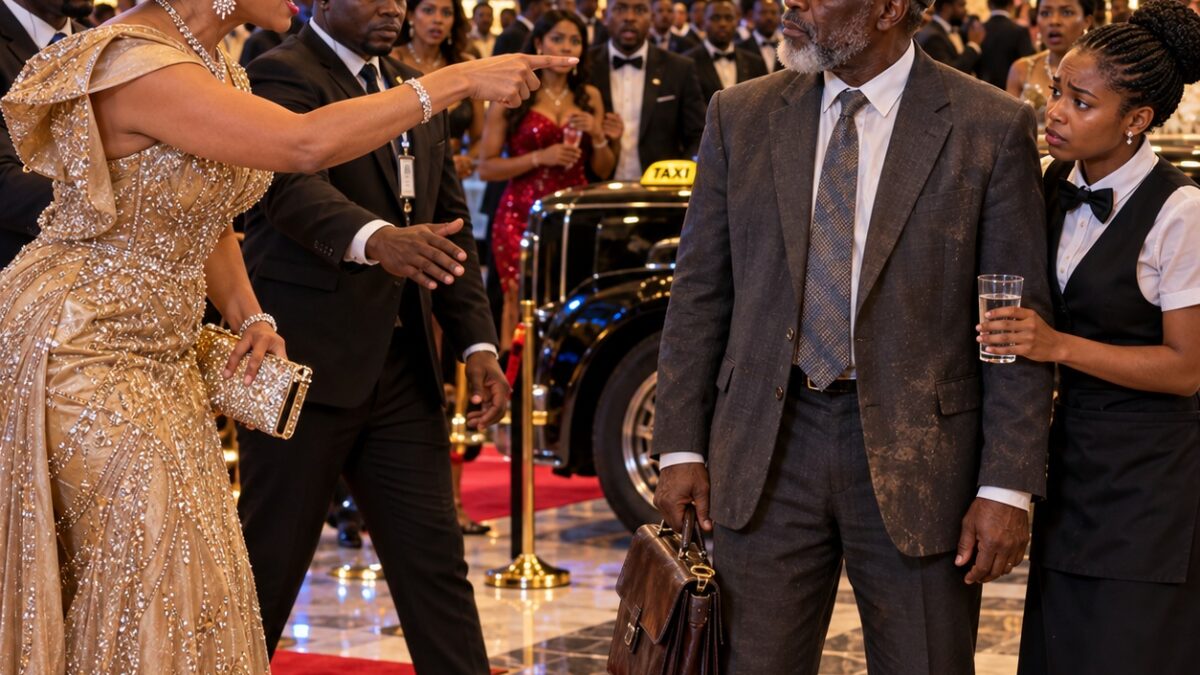
“Who comes to a gala like this in a taxi?”
Another laughed about his suit.
No luxury watch.
No driver.
No visible importance.
My wife worried that photographs of the minister’s arrival might capture an ordinary-looking stranger in the background.
That was apparently enough.
Aduni walked over personally.
“Good evening.”
Olaran answered politely.
She smiled the way people smile when they are about to insult you but want witnesses to call it professionalism.
“I think you may be lost.”
“No, madam.”
“The service entrance is at the back.”
“I was invited.”
A few people laughed.
“By whom?”
“Your husband’s company.”
That should have stopped her.
His name had already been checked.
Security had admitted him.
Instead, Aduni asked for proof.
He told her his name was on the list.
“Lists can be wrong.”
Then she said the sentence that eventually played millions of times online.
“Faces rarely are.”
Blessing stepped forward.
“Madam, Mr. Akpan checked him in. He has been polite all evening.”
Aduni turned.
“Did anybody ask you?”
Blessing froze.
“Madam—”
“Who is your supervisor?”
The catering supervisor hurried over.
Apologized.
Said Blessing was new.
Aduni pointed toward the service area.
“Fire her.”
Blessing’s face collapsed.
“Madam, please. I need this job for my school fees.”
“Then you should have kept your mouth shut.”
The chairman intervened.
“Be angry with me. Leave the young woman out of it.”
That made things worse.
My wife did not like being corrected publicly.
Especially by someone she had already decided was beneath her.
“Do not tell me what to do at my own event.”
She called security.
“Escort him off the premises.”
Olaran raised his hands.
“There is no need to touch me.”
He began walking.
Mr. Akpan took his arm anyway.
A guest was filming.
People laughed.
Someone said, “Taxi man, your taxi is waiting.”
Another told him next time to take the bus.
Blessing watched the man she had defended being marched toward the side entrance.
Then her supervisor demanded her apron and name tag.
Two people were being removed from the same gala for the same underlying offense.
One looked poor.
The other treated him as human.
I was still upstairs.
I was preparing remarks about how Irawo was “a family.”
That detail haunted me later.
The minister arrived just as security was reaching the exit.
Government vehicles stopped.
Cameras repositioned.
Aduni rushed forward.
Then the minister saw the man being held by the arm.
His expression changed.
“Chairman Olaran?”
The ballroom went silent.
Aduni froze.
The minister walked past her.
“Meridian Crest’s chairman. What an honor.”
Forty-eight thousand people were watching the livestream by then.
The entire room heard it.
Chairman Olaran.
The man my wife had called a taxi driver.
The man security was removing.
The man Blessing had been fired for defending.
Chairman Olaran turned toward Mr. Akpan.
The security guard began apologizing.
“Sir, I didn’t know.”
Olaran stopped him.
“You followed instructions.”
Then he looked directly at Aduni.
“Remember who gave them.”
That was when somebody came upstairs for me.
I don’t remember taking the stairs.
Only arriving in the ballroom and understanding from people’s faces that something irreversible had happened.
I pushed through the crowd.
“Mr. Olaran.”
He turned.
“I am Tochi Okafor.”
“I know.”
“Sir, I didn’t know you were here.”
That sentence sounded stupid the moment it left my mouth.
Of course I didn’t know.
That was the point.
I looked toward Aduni.
Then back at him.
“Whatever happened, I apologize.”
Olaran watched me.
Then he asked:
“Doctor, last week I asked you one question.”
I remembered immediately.
During our acquisition call, before the preliminary approval, he had asked something that seemed strange for a multibillion-naira negotiation.
If a stranger walked into Irawo tomorrow, who would offer that person a seat first?
I had answered honestly.
“Our office cleaner.”
He offers tea to couriers and governors alike.
The chairman had laughed.
Then approved moving forward.
Now he said:
“Tonight, the only person who offered me anything was a student waitress.”
He looked around the ballroom.
“She was fired for defending me.”
I felt physically sick.
“Sir—”
“I did not come here to see how you treat a chairman.”
He looked at my wife.
“I came to see how you treat a nobody.”
Then he turned toward Barrister Halima Yusuf, Meridian’s counsel.
“Pause everything.”
Two words.
Nine billion naira of future value began disappearing.
Aduni stepped forward.
“Chairman, please. This was a misunderstanding.”
“No.”
His voice remained calm.
“That is what I came here to understand.”
The minister offered to have a car take him home.
Olaran declined.
He walked outside.
Near the service gate, he found Blessing holding her folded uniform.
She stared at him.
“You got thrown out too?”
He almost smiled.
“In a manner of speaking.”
Then he asked for her full name.
“Blessing Etim.”
“Blessing.”
He repeated it.
“Tonight, you were the only person in that building who truly saw me.”
She looked confused.
He continued.
“Never stop being that person.”
Then he left.
The gala died within thirty minutes.
Not officially.
The band kept playing.
Food remained on the tables.
Champagne remained cold.
But guests began leaving.
People who had laughed suddenly remembered early meetings.
Aduni’s friends disappeared.
The minister did not stay for dinner.
Four hundred plates of jollof sat almost untouched.
By midnight, the number I cared about was no longer four hundred.
It was nine billion.
Because Meridian had paused the deal.
And Monday morning, Unitrust Bank wanted us at eight.
I did not sleep.
At 1:00 a.m., I was calling numbers nobody answered.
Aduni paced the house.
“This is ridiculous.”
I looked at her.
“What is ridiculous?”
“One misunderstanding destroying a deal.”
“You fired a student because she offered water to a guest you didn’t like.”
“She contradicted me.”
“You threw out the investor buying the company.”
“How was I supposed to know who he was?”
That sentence stopped me.
I looked at her for a long time.
“You weren’t supposed to know.”
She frowned.
“What?”
“You were supposed to be decent.”
For once, she had no immediate answer.
Then she crossed her arms.
“He dressed like a driver.”
I walked away.
By sunrise, the gala video had millions of views.
The headline was unavoidable.
IRAwo GALA HUMILIATION.
CHAIRMAN THROWN OUT OF COMPANY HE PLANNED TO BUY.
The internet showed us no mercy.
Clips repeated Aduni’s words.
“The service entrance is at the back.”
“Faces rarely are.”
“Fire her.”
“Taxi man, your taxi is waiting.”
Our valuation dropped.
Employees arrived frightened.
Some had seen the video before they saw their families that morning.
The engineer who had planned to buy his mother a refrigerator sat at his desk staring at nothing.
Then Meridian called.
Barrister Yusuf.
I answered.
“Please.”
“Good morning, Dr. Okafor.”
“Let me speak to the chairman.”
“I am calling to formally notify you that Meridian Crest Capital is withdrawing from the proposed acquisition.”
I closed my eyes.
“Barrister, the letter of intent—”
“Nonbinding.”
“Our technology hasn’t changed.”
“No.”
“Our revenues haven’t changed.”
“No.”
“Then what changed?”
“Leadership assessment.”
I almost laughed from desperation.
“This company has three hundred people.”
“I know.”
“Let me speak to him for five minutes.”
Silence.
Then:
“The chairman asked me to tell you something.”
I waited.
“He read your code.”
My throat tightened.
“He admired it.”
“Then why?”
“Because it was never about the code.”
The call ended.
I sat in the silence.
Aduni stood in the doorway.
“Did you fix it?”
I looked at her.
“It is gone.”
Her eyes widened.
“All of it?”
“Meridian withdrew.”
“Nine billion?”
“Gone.”
She sat.
Then she said, “Send flowers.”
I stared.
“What?”
“A serious arrangement. A letter. Something tasteful.”
“You fired Blessing for being kind.”
“She was insolent.”
“Flowers do not fix that.”
She looked angry at me now.
As if I had joined the enemy.
Our CFO called.
The bank meeting was still at eight.
That was where the second disaster arrived.
The first facility was ₦6.2 billion.
Then the bank mentioned Facility B.
I looked at Shagun.
“What is Facility B?”
He went pale.
The bank officer slid another document toward me.
₦2.8 billion.
Secured against our core Irawo Grid patents.
I didn’t understand what I was reading.
Then I did.
I looked at Shagun.
“You pledged our patents?”
“The Kano expansion ran over.”
“You pledged the patents.”
“I needed bridge funding.”
“Without telling me?”
“You signed the board papers.”
That hit harder.
Because he was right.
The signatures were mine.
I had not read closely.
I had been writing code.
Always the code.
Always the excuse.
Shagun had hidden the seriousness.
I had made hiding easy by refusing to engage with anything outside engineering.
The bank wanted the full ₦9 billion within thirty days.
If we failed, they could seize and sell the patent portfolio.
I asked for ninety days.
The banker shook his head.
“Doctor, the whole market watched what happened Saturday.”
Our culture problem had become credit risk.
The bank wasn’t interested in separating the two.
After the meeting, Shagun resigned.
He looked destroyed.
“When you asked me whether there were other surprises, I lied.”
“Yes.”
“I was ashamed.”
“Honesty early is cheaper than honesty late.”
He nodded.
“I know.”
Neither of us said what both understood.
He had hidden debt.
I had hidden from leadership.
Different failures.
Same company.
Blessing’s Monday looked very different.
She had been fired Saturday night.
Her registration deadline was Friday.
She needed money.
Her mother was frightened.
Then her phone rang.
“Miss Blessing Etim?”
“Yes.”
“My name is Halima Yusuf. I represent Meridian Crest Capital.”
Blessing nearly hung up because she thought it was a joke.
“The chairman would like to meet you.”
“For what?”
“Bring your laptop.”
“My laptop?”
“And your market application.”
The chairman had remembered everything.
Monday morning, Blessing entered Meridian Tower carrying a cheap laptop and an unfinished project.
She later told me she expected a thank-you.
Maybe a small scholarship.
Instead, Olaran asked her to demonstrate the application.
It crashed once.
She apologized.
He told her to restart.
She did.
The concept worked.
SMS inventory.
Simple price updates.
Low-data access.
Designed for traders who didn’t live inside expensive smartphones.
He asked questions.
Hard ones.
She answered some.
Couldn’t answer others.
When she didn’t know, she said so.
That mattered.
Meridian offered to fund her education.
Then they offered technical mentorship for the project.
Her mother’s words had been right.
Blessing had served him because of who she was.
Not because of who he turned out to be.
The opportunity came later.
Character came first.
I met Blessing in Meridian Tower after waiting six hours to see the chairman.
She recognized me immediately.
“Dr. Okafor.”
I felt ashamed.
“I am sorry for what happened to you.”
“Thank you, sir.”
Then she smiled nervously.
“I’ve read your Irawo Grid paper three times.”
I laughed despite myself.
“You may be the only person.”
She left for the lift.
Barrister Yusuf appeared.
“The chairman will see you.”
Six hours.
Ten minutes.
I entered Olaran’s office and remained standing.
“Sit, Doctor.”
“I came to beg.”
He waited.
“Not for me.”
I sat.
“For the engineers.”
He surprised me by naming them.
Uche Nnadi.
Funmi Bakare.
Others.
The people who had built routing modules, emergency channels, logistics infrastructure.
He knew their work.
“You read the technical reports?”
“All of them.”
“Then you know the code is world-class.”
“It is.”
“Why walk away from world-class code?”
He leaned back.
“I didn’t walk away from your code.”
I knew the next sentence before he said it.
“I walked away from your culture.”
I wanted to defend Irawo.
Say that Aduni wasn’t the company.
That one event wasn’t three hundred engineers.
That hospitality didn’t define software quality.
But he continued.
“Culture is what happens when the boss is not in the room.”
And there it was.
The thing I had spent years avoiding.
“Saturday night, you were not in the room.”
“No.”
“Your wife controlled the room.”
“Yes.”
“Who gave her that authority?”
“I did.”
“Who allowed staff to be removed from the guest list?”
“I did.”
“Who let branding become more important than the people building the company?”
I couldn’t answer.
He did it for me.
“You.”
I looked at the floor.
“I hid in the code.”
He stopped.
I continued.
“It was easier than leading.”
For the first time, his tone softened.
“That is the first true thing anyone from Irawo has told me since Saturday.”
I looked up.
“Is there anything I can do?”
“To restore the acquisition?”
“Yes.”
“No.”
The answer hurt.
Then he added:
“But you can decide who you become after it falls.”
That was all I got.
Ten minutes.
I thanked him.
And left.
At home, Aduni still believed the story was about one bad decision.
“One party.”
“One misunderstanding.”
“One man who was too sensitive.”
I told her what Olaran said.
“He didn’t leave the technology.”
She looked at me.
“He left the culture.”
“Our culture?”
“Yes.”
“What does that even mean?”
“Kazim.”
She frowned.
“Our driver?”
“You deducted cleaning costs from his salary because he brought mud onto your rug.”
“He should have been careful.”
“The junior engineers.”
“What about them?”
“You removed their gala seats.”
“It was an investor event.”
“Blessing.”
“She disobeyed me.”
“The chairman.”
“I did not know who he was.”
I felt exhausted.
“That is the point.”
She shook her head.
“No. You are doing what everybody does when something goes wrong. You need somebody to blame.”
“I am blaming myself.”
That surprised her.
“I gave you the microphone.”
“Tochi—”
“I gave Shagun board papers I didn’t read.”
“That is not the same.”
“I disappeared into code and called it leadership.”
She looked frightened now.
I continued.
“We became this together.”
Her expression hardened.
“I built your image.”
“Maybe.”
“Without me, you would still be a nobody writing software in Yaba.”
I stared at her.
Then I said something crueler than I intended.
“Maybe I should have remained a nobody.”
She laughed bitterly.
“Nobodies do not build billion-naira companies.”
“No.”
I thought of Blessing.
“But some of them offer water.”
That night, I slept in the study.
The engineers started leaving.
I didn’t stop them.
How could I?
A Nairobi firm offered one of our best people a lead role.
“Take it.”
Another got an offer from a Lagos technology company.
“Take it.”
Uche came into my office last.
I had mentored him for years.
“The Kano node,” he said.
“What about it?”
“I don’t want them to lose it.”
“They won’t.”
“Boss.”
His eyes filled.
“Years.”
“I know.”
“You taught me everything.”
“No.”
I shook my head.
“You built as much of this as I did.”
He swallowed.
“If you start again, call me.”
“I don’t know if I will.”
“Even if it is a garage in Yaba.”
I smiled.
“Go.”
He left.
The office cleaner came in afterward.
“Sir, tea?”
Half the desks were empty.
But tea was still tea.
I accepted.
Then I asked him something.
“If a stranger walked in here, would you offer him a chair?”
He looked confused.
“Of course.”
“Why?”
“A chair costs nothing, sir.”
I laughed.
Then I cried after he left.
The bank appointed a liquidator.
Machines received stickers.
Screens were unplugged.
Furniture disappeared.
The infrastructure my engineers had spent years building was packed into vans.
I tried to keep one early prototype board.
The liquidator checked the inventory list.
“Company asset number 417.”
“I built that myself.”
“Then you may bid for it at auction.”
I watched strangers carry my company out one crate at a time.
That was the cost of leadership failure in physical form.
Not a social-media headline.
Not embarrassment.
Desks.
Jobs.
Patents.
People.
Aduni’s world collapsed differently.
The friends who had encouraged her at the gala disappeared.
One had laughed beside her on camera.
Then appeared on television saying she had repeatedly begged Aduni to stop.
A charity committee Aduni chaired asked her to step down.
Sponsors were nervous.
She accused them of hypocrisy.
She was right about some of them.
But being betrayed by hypocrites doesn’t make your original behavior right.
Kazim, our driver, still greeted her politely.
That upset her more than anger would have.
“Why are you sorry for me?” she asked him.
“My mother taught me not to return evil for evil.”
Eventually, Aduni began paying back the salary deductions she had imposed.
Including Kazim’s.
Three months.
Cleaning fees.
Other petty punishments.
When she handed him the money, he tried to refuse.
“I have to,” she said.
That was the beginning of change.
Not public statements.
Not tears.
Restitution.
Chairman Olaran filed a civil action.
So did Blessing.
He said publicly that he wasn’t interested in revenge.
He wanted the facts established.
The gala video was entered into evidence.
Millions had already watched it.
My wife’s defense emphasized that she had not known his identity.
Meridian’s lawyer gave the simplest answer.
“Exactly.”
The court listened to Mr. Akpan.
“What instructions were you given?”
He looked ashamed.
“Anyone who looks as though they do not belong should be removed.”
“How were you to determine that?”
He lowered his eyes.
“Shoes.”
The court heard testimony from Aduni’s former social friend who claimed she had warned her.
Then the video played her laughing.
The judge asked whether lying under oath had become part of the defense strategy.
The courtroom stopped laughing.
Then Blessing testified.
“Why did you defend the claimant?”
“Because nobody else did.”
“At the time, did you know he controlled Meridian Crest?”
“No.”
“Did you know he could help your education?”
“No.”
“Then why?”
She thought for a moment.
“My mother taught me nobody is nothing.”
Chairman Olaran was asked why that mattered.
He answered:
“She defended me when she believed I could do nothing for her.”
The judgment came days later.
The court found that Aduni had wrongfully caused Blessing’s dismissal and had humiliated Olaran publicly.
Damages were awarded.
₦300 million to the chairman.
₦50 million to Blessing.
And Aduni was required to publish written apologies.
When the judge finished, Olaran requested permission to speak.
He stood.
“My Lord, I don’t want the ₦300 million.”
Everyone turned.
“Every naira should fund a community technology center in Yaba.”
He paused.
“For young people who serve tables, drive taxis, clean offices, repair machines, and study at night.”
Then he looked toward Blessing.
“This case was never about teaching someone how expensive it is to insult a rich man.”
He looked around the courtroom.
“It was about making dignity expensive to violate.”
I never forgot that.
Character is capital.
People say capital means money.
It doesn’t always.
Money can be borrowed.
Raised.
Lost.
Recovered.
Character determines what remains when the money goes.
The Irawo patents went to auction.
I attended.
I didn’t know why.
Maybe grief.
Maybe I needed to watch the burial.
The opening bid was ₦500 million.
It climbed.
₦700 million.
₦1 billion.
₦1.5 billion.
Then higher.
Finally:
₦3 billion.
Sold.
Telephone bidder.
The auctioneer asked the buyer to identify itself.
“Meridian Crest Capital.”
I closed my eyes.
Olaran had bought the patents.
He had refused to buy the company.
But he had not abandoned the engineering.
That distinction mattered.
A week later, I went to Blessing’s house.
Her mother answered.
“Good afternoon, ma.”
“Yes?”
“My name is Tochi Okafor.”
Her expression changed.
“The husband of that woman.”
“Yes.”
I swallowed.
“That is why I came.”
Blessing appeared behind her.
“Dr. Okafor?”
“I came to apologize.”
No lawyers.
No cameras.
No press.
“It happened under my company’s name.”
I looked at her mother.
“I was upstairs preparing a speech about family while your daughter was losing her job downstairs for showing kindness.”
Her mother watched me.
“I am sorry.”
She opened the door wider.
“Sit down, my son.”
That almost broke me.
“In this house, we offer a seat.”
Blessing laughed despite herself.
Tea came.
Food came.
Because dignity didn’t depend on whether I deserved either.
I had bought the prototype board at auction.
Asset 417.
The first Irawo Grid board.
I placed it on the table.
“I want you to have this.”
Blessing stared.
“No.”
“Yes.”
“Sir, I cannot.”
“You are building for the people this was supposed to serve.”
She looked at the board.
Then at me.
I asked to see her application.
We spent two hours on it.
Her routing logic was messy in one place.
Better than mine had been at her age in another.
I suggested caching price data higher in the system to reduce delay.
She stared at the screen.
“That solves it.”
Her mother brought more food.
“Eat.”
Blessing groaned.
“Mama.”
“Hungry programmers make poor decisions.”
I laughed.
For the first time in months, talking about technology did not feel like hiding.
It felt like serving.
Before I left, Blessing asked:
“Will you build again?”
I thought about the empty Irawo offices.
“Someday.”
“With Meridian?”
“No.”
“Then how?”
“With better character than money.”
That answer became a promise to myself.
Aduni’s apology took longer.
The newspapers printed the court-required statement.
She hated it.
Not because it was false.
Because lawyers wrote it.
It sounded correct.
It did not sound like her.
One day she stood among boxes in the smaller house she had moved into and told me:
“I keep waiting for someone to say I was right.”
I said nothing.
“Nobody does.”
“No.”
She looked at me.
“Not even me anymore.”
That was when I knew something had changed.
She eventually went to Meridian Tower alone.
No lawyer.
No camera.
No assistant.
She gave her name at reception.
“I do not have an appointment.”
The receptionist told her the chairman’s schedule was full.
“I will wait.”
“How long?”
“As long as necessary.”
Hours later, Barrister Yusuf gave her five minutes.
Olaran allowed her in.
Aduni remained standing.
“Please sit,” he said.
She shook her head.
“Nobody offered you one that night.”
He watched her.
She took out no prepared statement.
“I saw your suit.”
Silence.
“Your taxi.”
Silence.
“Your shoes.”
Her voice began shaking.
“And I decided you were nothing.”
Olaran didn’t rescue her from the sentence.
She continued.
“I did the same thing to Kazim.”
“Our engineers.”
“Blessing.”
“People who worked events.”
“People who couldn’t help me.”
She lowered her eyes.
“I am sorry.”
Then she said the most important part.
“Not because of who you turned out to be.”
Olaran’s face changed slightly.
“Because of who I was.”
For several seconds, the office was silent.
Then he nodded.
“That is the apology I was waiting for.”
Aduni cried.
“The damage is still here.”
“Yes.”
“Do you forgive me?”
“I do.”
She looked almost relieved.
Then he added:
“Forgiveness is mine to give.”
He leaned forward.
“The consequences are yours to carry.”
She nodded.
“Both can be true?”
“Yes.”
She wiped her face.
“What do I do with them?”
“Carry them well.”
Before she left, Olaran told her:
“One day someone who looks like nobody will walk into your life again.”
She waited.
“This time you’ll know what to do.”
The community technology hub opened in Yaba the following year.
It occupied a renovated building that once would have looked too ordinary for Aduni to enter.
Now its doors were wide.
Students.
Market traders.
Junior developers.
Mechanics.
Designers.
Teenagers with old laptops.
People who could not afford expensive coding schools.
Blessing stood onstage wearing a simple dress and a badge that said PROGRAM LEAD.
Her market application had become OjaLink.
Four thousand traders were already using versions of it through SMS and low-data services.
Her mother stood in the front row.
Every time someone mentioned Blessing’s name, she laughed as though the success personally surprised her.
Meridian funded the hub.
The ₦300 million court award helped build it.
Olaran joked during the opening:
“One insult paid for this building.”
The crowd laughed.
“Let it remain the most expensive insult in Lagos because of what it built.”
Then came the part I wasn’t expecting.
Former Irawo engineers walked into the hall.
Uche.
Funmi.
Others.
Some had jobs elsewhere.
Some had returned part-time.
Some were helping train students.
Uche saw me and grinned.
“I told you.”
“What?”
“I would come back even if it was a garage in Yaba.”
He looked around.
“This is a nicer garage.”
I laughed.
Then Chairman Olaran called me forward.
“The Irawo patents live here now.”
I stared at him.
He continued.
“They need a mentor who understands the technology.”
I shook my head.
“I don’t deserve a title.”
“It isn’t a title.”
He pointed toward a chair.
“It is a chair.”
The old office cleaner who had joined the program as facilities supervisor placed one beside me.
“A chair costs nothing, sir.”
I had to look away for a moment.
That was how I returned to technology.
Not as CEO.
Not founder.
Not savior.
Mentor.
A chair.
A desk.
People.
That was enough.
Aduni came too.
Quietly.
She wasn’t onstage.
She volunteered on Saturdays.
The first time I saw her at the hub, she was standing behind a table pouring water into paper cups.
I almost laughed.
She noticed.
“What?”
“Nothing.”
“Say it.”
“I remember a different gala.”
“So do I.”
A young student approached.
Plain shirt.
Old shoes.
Nervous.
Aduni handed him water.
“Hot day.”
“Yes, ma’am.”
“Sit wherever you like.”
He smiled.
“Thank you.”
She watched him walk away.
Then she looked at me.
“I understand the chair now.”
I nodded.
“So do I.”
Our marriage did not magically return to what it had been.
Some things don’t.
We rebuilt pieces.
Slowly.
I had to learn not to disappear when a conversation became uncomfortable.
She had to learn that social status was not evidence of human worth.
We both learned that apologies without altered behavior are only language.
Some weekends, we worked at the hub together.
Some weekends, separately.
There was no dramatic reconciliation speech.
Just repetition.
Different choices.
That is usually how character changes.
Not through one beautiful realization.
Through practice.
Years earlier, before the gala, Olaran had told Barrister Yusuf why he wanted to attend anonymously.
His father had repaired cars beside a road in Mushin.
People threw coins toward him instead of placing money in his hand.
Customers spoke past him.
People who needed his skill still behaved as though they were doing him a favor by noticing him.
When Olaran was young, he went to a bank seeking a tiny loan.
₦50,000.
He had a business plan.
Numbers.
A real idea.
The banker didn’t read a page.
He looked at Olaran’s shoes.
His clothes.
His background.
Then laughed.
“Loans are for serious businessmen.”
Outside the bank, Olaran sat in the heat.
An akara seller gave him food and water.
“Your shirt does not decide your destiny,” she said.
“Your hands do.”
He never forgot.
Years later, when Meridian Crest considered buying Irawo, our numbers impressed him.
Our technology impressed him.
What he did not know was whether the people behind it deserved the power more money would give them.
So he attended the gala as someone we had no reason to impress.
That was the test.
Most of us failed before we knew we were taking it.
Blessing passed before knowing there was a reward.
That difference is the whole story.
One evening, long after the hub opened, I found Olaran standing near the entrance after everyone else had left.
The lights from computer labs glowed behind him.
A student was still debugging something upstairs.
A cleaner pushed a mop across the corridor.
Outside, a taxi waited.
“Still using taxis?” I asked.
“Old habits.”
I stood beside him.
“Sir.”
“Hm?”
“Was it worth it?”
He looked at me.
“What?”
“The deal.”
“Everything.”
“Was losing Irawo worth the lesson?”
He frowned slightly.
“I would never call destruction worth it.”
I nodded.
“That isn’t what I meant.”
He understood.
“Did the lesson justify the cost?”
“Yes.”
He thought.
Then said:
“It cost nine billion naira.”
He looked back at the hub.
“It cost engineers their jobs.”
“Your company.”
“Your wife’s reputation.”
“Years of work.”
He paused.
“No lesson needs that price.”
Then he looked at me.
“But once the price was paid, we had a responsibility not to waste it.”
That answer stayed with me.
Because there is a dangerous way people tell redemption stories.
They make the disaster sound necessary.
It wasn’t.
Aduni did not need to humiliate Olaran.
Blessing did not need to lose her job.
Irawo did not need to collapse.
Three hundred engineers did not need to watch their company disappear.
I didn’t need to lose my patents to discover I was avoiding leadership.
Those things were preventable.
The lesson was valuable.
The damage was still damage.
Redemption doesn’t turn harm into something good.
It decides what good can still be built after harm has already occurred.
That was what the hub represented.
Not proof that the gala had somehow been worth it.
Proof that we refused to let the gala be the only thing that remained.
Blessing eventually finished university.
She no longer worked event tables to survive.
But sometimes, at large community events, she picked up a water tray herself.
The first time I saw it, I said:
“You have staff.”
“So?”
“You are program lead.”
“So?”
“You don’t need to serve drinks.”
She looked at me as though I’d failed a basic exam.
“Dr. Okafor.”
“Yes?”
“My mother will personally come here and disgrace me if she hears you.”
I laughed.
Then she handed water to a boy waiting nervously near the door.
He couldn’t have been more than seventeen.
Cheap sandals.
Old backpack.
He had come to ask whether the hub would allow him to learn coding without a laptop.
Blessing gave him a seat.
Found him a shared computer.
Registered him.
Nobody asked who his father was.
Nobody checked his watch.
Nobody asked whether he arrived by bus or taxi.
That was the system we were building now.
Not charity.
Access.
Meridian funded more centers.
OjaLink expanded.
Market women who once tracked inventory in exercise books began using simple SMS tools.
Blessing loved going to Mushin herself.
Chairman Olaran sometimes joined without warning.
Still plain suit.
Still no convoy when he could avoid it.
The traders didn’t care.
To them, Blessing was the important person.
She was the one who fixed problems.
Olaran enjoyed that.
I did too.
The Irawo Grid technology eventually supported new infrastructure projects through Meridian.
The patents survived the company that created them.
That was painful and comforting at the same time.
I used to believe founders owned ideas because we originated them.
Now I think useful ideas belong partly to whoever keeps them useful.
Irawo as a legal company died.
Some of what we built lived.
So did the people.
Uche’s career grew.
Funmi led new systems.
Former engineers mentored younger ones.
The thing I had called my company became part of something larger than my name.
That humility took time.
I kept the original debt notice.
₦6.2 billion.
I also kept a copy of Facility B.
₦2.8 billion.
Not because I enjoyed pain.
Because numbers matter.
People like to say one woman cost us ₦9 billion.
That is too simple.
Aduni caused the incident that exposed our vulnerability.
But the debt existed before the gala.
Shagun hid Facility B.
I signed papers I didn’t read.
I spent ahead of revenue.
I expanded too quickly.
I gave away cultural authority because I considered it beneath me.
The gala didn’t create our structural weakness.
It revealed it.
That was the engineer’s lesson hidden inside the human one.
Structures fail slowly.
Before the visible collapse, there are warnings.
Stress concentrations.
Untested assumptions.
Deferred maintenance.
Small cracks.
At Irawo, our cracks were everywhere.
Debt.
Ego.
Hierarchy.
Fear.
A founder who believed technical brilliance excused absence.
A brand culture obsessed with appearance.
A CFO too ashamed to tell the truth early.
Employees afraid to challenge power.
People who treated drivers, waitresses, and junior engineers as background objects.
Saturday night was simply the moment the load exceeded what the structure could carry.
I tell young founders that now.
They usually expect advice about product-market fit.
Hiring.
Fundraising.
Technology.
I give them that too.
Then I ask:
“What happens when you leave the room?”
If nobody knows, I tell them to find out.
Who gets interrupted?
Who gets blamed?
Who gets the best chairs?
Who cleans after everybody?
Who is afraid to speak?
Who can make a mistake and still be heard?
Who cannot?
How does your receptionist treat someone with no appointment?
How does the CEO treat the receptionist?
How does your company behave toward someone who cannot advance anybody’s career?
That is not soft leadership.
It is risk management.
Culture can lose deals.
Destroy trust.
Raise credit costs.
Drive talent away.
And sometimes, culture can cause three hundred people to pay for decisions they never made.
I learned that at an unbearable price.
Aduni once asked Chairman Olaran why he allowed security to escort him so far before revealing himself.
He could have said one sentence.
“I am Chairman Olaran.”
Everything would have changed.
The room would have transformed instantly.
Champagne.
Apologies.
A chair.
A better table.
Aduni herself would probably have escorted him to the front.
Instead, he waited.
She asked him why.
He answered:
“Had I told you who I was, I would only learn how you treat a chairman.”
Then he added:
“I needed to learn how you treat a nobody.”
That became the sentence people associated with the scandal.
But I think the more important sentence came later.
Blessing once asked him what he had learned.
We were closing the hub for the night.
He looked at the darkening rooms.
Then said:
“The true measure of a person is how they treat someone they believe has no power.”
He turned toward Blessing.
“You passed before you knew it was a test.”
She laughed.
“I was not taking a test.”
“Exactly.”
That is why she passed.
Character that appears only when rewards are visible isn’t character.
It is strategy.
The waiter should receive dignity before you know she has a scholarship offer.
The driver should receive respect before you know who he transports.
The junior engineer should be heard before her idea becomes profitable.
The old man in a taxi should get water before you discover he controls billions.
Anything else is transaction.
I sometimes think about the first Irawo celebration.
The demo room.
Engineers cheering.
Uche joking about his mother’s refrigerator.
I had promised them that if Meridian bought us, everybody would share.
I meant it.
Then I failed them in another way.
Good intentions don’t erase poor leadership.
That was one of the hardest lessons to accept.
I loved those engineers.
I didn’t steal from them.
I didn’t intentionally put their jobs at risk.
I wasn’t cruel.
But leadership isn’t judged only by what you intend.
It’s also judged by what you tolerate.
What you ignore.
What you delegate without supervision.
What you refuse to learn because it makes you uncomfortable.
I used to think being “the technical founder” allowed me to avoid those questions.
Now, whenever a young engineer tells me, “I just want to build. I don’t care about people politics,” I tell them:
“You will care when the politics touches the build.”
They laugh.
I don’t.
Because I remember walking into an empty office while liquidators numbered my equipment.
I remember Uche packing his desk.
I remember the prototype board becoming Asset 417.
I remember the sound of three hundred people’s future changing because those of us in charge confused technical success with institutional health.
And I remember a cleaner offering me tea after half the office had disappeared.
A chair costs nothing, sir.
The most valuable leadership lesson I ever received cost nothing.
Just a chair.
The last time I saw Aduni serving water at the hub, a woman arrived wearing a faded dress and carrying a plastic bag full of papers.
She looked nervous.
Aduni greeted her.
“Good afternoon.”
“I was told somebody here helps small traders.”
“Yes.”
“I don’t have smartphone.”
“That is fine.”
“I only sell tomatoes.”
Aduni pulled out a chair.
“There is no only here.”
The woman sat.
Blessing came over.
Within twenty minutes they had registered her for OjaLink training.
I stood across the room watching.
Aduni noticed.
She walked over after the woman left.
“What?”
“Nothing.”
“You have that look.”
“What look?”
“The one where you are writing a speech in your head.”
I smiled.
“You offered her a seat.”
She looked toward the empty chair.
“Apparently they are inexpensive.”
I laughed.
She did too.
Then she became serious.
“I still think about that night.”
“So do I.”
“I wish I could remove it.”
“I know.”
“Sometimes people still recognize me.”
“I know.”
“They quote the service-entrance line.”
I nodded.
“Does it ever stop?”
“No.”
She looked hurt.
Then I continued.
“But it changes.”
“How?”
“At first it was the only thing people knew about you.”
She waited.
“Now some people also know what you did afterward.”
“That doesn’t erase it.”
“No.”
She looked at me.
“Good.”
That answer surprised me.
“I don’t want it erased.”
She looked around the hub.
“I want it behind me, but I don’t want to forget.”
I understood.
The goal was never amnesia.
It was integration.
The worst thing you did can become part of your history without becoming your entire identity.
But only if you stop defending it.
Only if you repair what you can.
Only if your later choices contradict the old pattern often enough that people are no longer required to trust an apology alone.
Consequences remained.
So did forgiveness.
Both could be true.
Chairman Olaran had taught her that.
He taught me too.
At closing time one evening, Olaran’s taxi arrived outside.
I stood beside him.
“You know Meridian owns cars.”
“So I am told.”
“Drivers too.”
“Several.”
“Yet you still take taxis.”
“Good conversations.”
He smiled.
Then Blessing came through the doors carrying her laptop.
“Sir, the new trader pricing module is live.”
“Any problems?”
“One.”
“What?”
“Four thousand women are now calling me directly.”
He laughed.
“Success.”
“It does not feel like success at 5:30 in the morning.”
She looked at me.
“Dr. Okafor, tell him.”
“He funds you. I am staying neutral.”
“Coward.”
Olaran opened the taxi door.
Then paused.
“Blessing.”
“Yes, sir?”
“Do you remember the gala?”
She rolled her eyes.
“Everybody asks me that.”
“One more time.”
“What?”
“Why did you give me water?”
She thought.
Then shrugged.
“You looked thirsty.”
That was it.
No philosophy.
No networking plan.
No foresight.
A man looked thirsty.
She gave him water.
The smallest action in an ₦80 million ballroom became the only one the richest man there remembered.
Olaran smiled.
“Good night.”
“Good night, sir.”
The taxi pulled away.
I remained standing beside Blessing.
The lights inside the hub were still on.
Students worked behind glass.
Former Irawo engineers reviewed code.
A market trader was learning to update prices by SMS.
Aduni stacked cups at the back.
A cleaner pushed a mop across the floor.
Nothing about the place looked like the future I imagined while building Irawo.
It was better in some ways.
Smaller in others.
Less impressive.
More human.
I thought about the gala.
The red carpet.
The flowers.
The ₦80 million budget.
Four hundred polished plates.
Photographers.
Ministers.
People measuring importance by watches, cars, shoes, and surnames.
Then I looked at a building partly funded by the damages from that night’s humiliation.
Computers hummed.
Students argued over code.
Someone laughed.
Nobody checked shoes at the door.
I finally understood the name I had given my first company.
Irawo.
A star.
I used to tell employees that a star doesn’t shine for itself.
It guides others home.
Beautiful sentence.
I believed it.
I just wasn’t living it.
Maybe that was why losing the company hurt so much.
The mission had been better than our behavior.
Now, in a building I did not own, mentoring people whose futures I couldn’t control, the old mission felt honest again.
I picked up an empty chair and carried it back inside.
Blessing looked at me.
“Where are you going?”
“Home eventually.”
“You said that twenty minutes ago.”
“I know.”
She pointed toward the door.
“Go, Dr. Okafor.”
I laughed.
Then I looked once more at the room.
At Blessing.
At the engineers.
At the traders.
At Aduni.
At the life built after the collapse.
The lesson that cost us billions had always been free.
A glass of water.
A chair.
A little dignity.
The willingness to see someone before learning whether they can do anything for you.
That night, Chairman Olaran came to test us disguised as nobody.
He didn’t need a disguise.
We supplied it ourselves.
We saw a taxi.
A plain suit.
Ordinary shoes.
And decided we knew the value of the man wearing them.
Blessing saw something else.
A person standing alone.
Someone thirsty.
Someone who deserved kindness before proving anything.
That was why Meridian’s chairman remembered her when the money disappeared.
Why the court believed her when status became irrelevant.
Why her application eventually served thousands of traders.
And why, years after Irawo disappeared from the corporate registry, the best thing our failure produced still wasn’t a patent or a valuation.
It was a room where anybody could walk through the front door.
Where nobody was directed to the service entrance because of their shoes.
Where a driver could sit beside a founder.
Where a waitress could become a program lead.
Where an engineer who lost a company could earn another chance to teach.
And where every person who entered was offered the same thing before anyone asked who they were.
A seat.