FULL STORY:The Lost German Shepherd on My Truck Refused to Surrender an Old Leather Collar
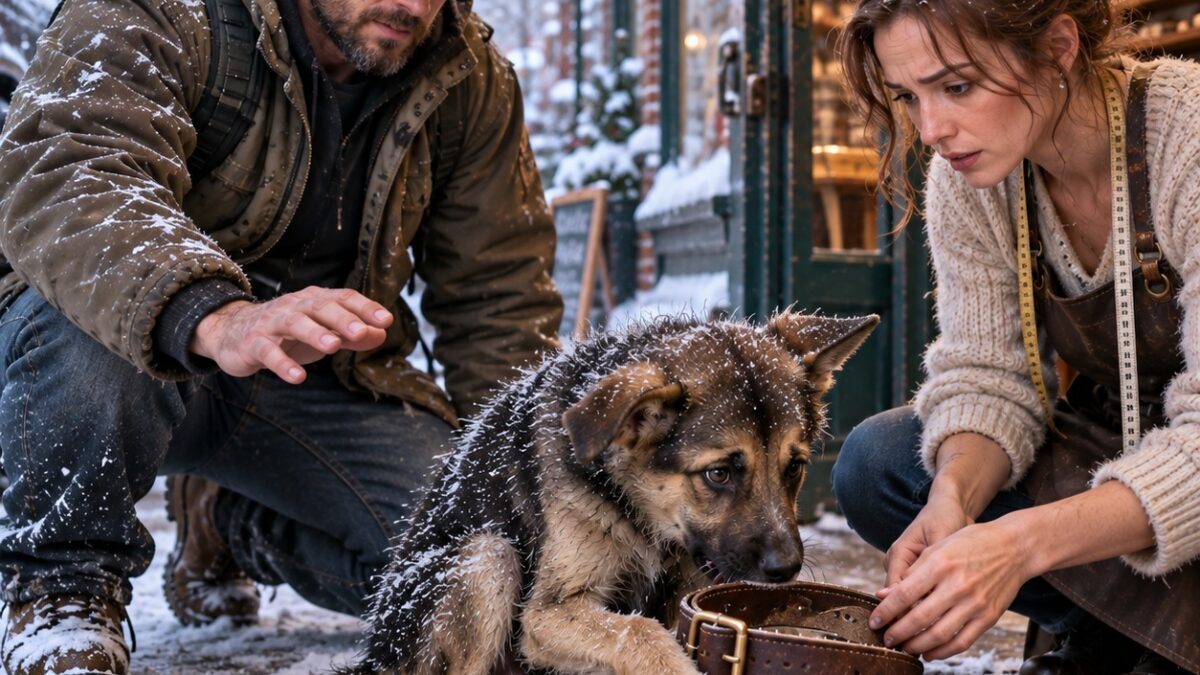
I looked at the collar again.
It was dark brown, almost black in places, with a brass buckle worn smooth from years of use. The stitching along one edge had started to separate. Near the buckle, the leather had developed the fine white cracks I’d seen on old equipment straps just before they failed.
It wasn’t valuable in the usual sense.
No fancy ornamentation. No engraving. No expensive hardware.
Just a collar that had clearly spent years around a dog’s neck.
“Can you fix it?” I asked.
The woman turned it over in her hands.
“I can preserve it.”
“Same thing, isn’t it?”
“No.”
She bent the leather slightly, then stopped before it could crack further.
“I could replace the stitching, condition the surface, and make it look presentable. But that wouldn’t make it safe for a dog to wear. See how the fibers are separating around the buckle?”
I nodded.
“That’s structural damage. If somebody attached a leash and the dog pulled hard enough, this could tear.”
I appreciated that answer.
She wasn’t trying to sell me a repair I didn’t need. She was telling me the difference between making something look useful and making it safe.
“You’re a mechanic?” she asked.
“Maintenance. Construction. Whatever’s broken.”
“That explains the expression.”
“What expression?”
“The one that says you’re already trying to figure out what kind of tool would solve this.”
I looked at her.
She smiled.
“Tessa Marin.”
“Sawyer Bellamy.”
“I know. June’s been talking about the new maintenance contractor who refuses to order eggs.”
“Apparently, my reputation is already ruined.”
“It’s a small town.”
At our feet, the puppy sneezed.
Tessa crouched again, holding one hand several inches from his nose.
“Hello, sweetheart.”
He sniffed her fingers.
Then, to my considerable irritation, he stepped closer and allowed her to scratch beneath his chin.
I stared.
“Seriously?”
Tessa glanced up.
“What?”
“I’ve spent fifteen minutes trying to keep him from getting himself killed, and you make one polite introduction.”
“Maybe he appreciates manners.”
“I was perfectly polite.”
“You ordered him off your truck like he was a sailor who’d missed inspection.”
The puppy leaned against her knee.
She looked at me with an expression that said the case was closed.
I probably should have walked out then.
I had a maintenance contract, a motel room, and a Saturday afternoon I’d intended to spend servicing my truck.
An unidentified puppy wasn’t part of any of those plans.
But I couldn’t forget how thin he felt when I finally got my hands beneath his chest.
He wasn’t starving, but I could feel more of his ribs than I liked. His coat was thick enough to hide it, and beneath the warmth of the shop I could still feel the cold trapped in his fur.
“There’s a veterinary clinic a few blocks over,” Tessa said.
“I’ll take him.”
“Good.”
She stood and reached for her coat.
I frowned.
“What are you doing?”
“Coming with you.”
“I don’t need an escort.”
“I know.”
“Then why?”
She slipped her arms into an ivory winter coat.
“Because he came into my shop, and now I’m involved.”
I studied her for a moment.
There was nothing dramatic about the way she said it. No heroic declaration. No request for applause.
She simply considered the puppy a problem that deserved an answer.
That should have sounded familiar.
Instead, it made me uncomfortable.
At the community veterinary clinic, the puppy immediately demonstrated that gratitude wasn’t one of his strongest qualities.
He attempted to eat the examination table paper.
Then he tried to chew the scanner.
Then he stole a disposable glove from the technician.
The technician took it back.
He looked offended.
“Healthy little guy,” she said after finishing his exam. “A little lean. Probably been wandering a few days, but he’s hydrated and alert.”
“That’s one word for it,” I said.
She scanned his neck and shoulders again.
Nothing.
“No microchip.”
Tessa folded her arms.
“Can you check the missing-dog reports?”
“We already have. Nothing matching him locally.”
“What about the neighboring counties?”
“We’ll reach out.”
I watched the puppy attempt to steal a roll of paper towels.
“Wonderful. He’s expanding his criminal record.”
The technician laughed.
The situation stopped being funny when the receptionist told us the shelter was full.
A bitter cold spell had forced several rescue organizations to bring in animals they would normally have placed elsewhere. Every available kennel had been filled.
They could take a found-animal report.
They could post photographs.
They could contact rescue groups and check ownership claims.
What they couldn’t do was put another dog in a kennel that afternoon.
“Do you know anyone who could foster him temporarily?” the receptionist asked.
I looked at Tessa.
Tessa looked at me.
“No,” I said.
She raised an eyebrow.
I recognized the expression immediately.
It was the same one Mason wore when I told him a piece of equipment couldn’t be repaired before lunch.
“Don’t,” I warned.
“I haven’t said anything.”
“You don’t need to.”
The receptionist glanced between us.
“We’d only need someone to keep him safe while we start the search. Seventy-two hours initially, and we’ll stay in contact if he hasn’t been claimed.”
“Seventy-two hours?”
“Yes.”
“Three days.”
“That’s usually what it means.”
Tessa turned away, but not quickly enough to hide her smile.
I looked down at the puppy.
He sat at my feet, gazing up as though he’d already made arrangements.
There are moments when a man can feel his life getting complicated before anything has actually happened.
This was one of them.
“My motel charges extra for animals,” I said.
Tessa crossed her arms.
“Tragic.”
“And I work.”
“Most adults do.”
“And I don’t have dog supplies.”
“Fortunately, stores exist.”
I gave her a long look.
She gave me an innocent one.
Ten minutes later, I had signed the temporary foster paperwork.
On the way out, the puppy wrapped the borrowed slip lead around my legs twice, tried to swallow a chunk of snow, and nearly followed a stranger into a parked car.
Tessa watched him with obvious affection.
“He needs a name.”
“No, he doesn’t.”
“He can’t be listed as ‘gray puppy’ forever.”
“He’s not staying forever.”
“Slate.”
I turned.
“What?”
“Slate. Look at his coat. That silver-gray color.”
The puppy lifted his head.
Tessa smiled.
“See? He likes it.”
“Coincidence.”
“Slate.”
He looked at her again.
I stared at him.
“You’re doing that on purpose.”
The puppy sneezed on my boot.
Tessa laughed.
And that was how I became the temporary guardian of a German Shepherd puppy named Slate.
Not because I’d planned to.
Not because I wanted a dog.
Because somebody had to take responsibility for him, and somehow that somebody had become me.
I drove back to the motel with Slate sitting in the passenger seat, secured with a borrowed restraint from the clinic.
He watched the world through the windshield, occasionally turning toward me with an expression of profound curiosity.
At one stoplight, he put his nose against my sleeve.
“What?”
His tail moved.
“I’m not buying you a steak.”
His tail moved again.
“That isn’t a negotiation.”
By the time we reached the motel, he’d discovered how to make me look at him without barking.
That skill would become dangerous.
The Hawthorne Motor Lodge had been perfectly adequate before Slate arrived.
A bed.
A small table.
A heater under the window.
A bathroom with a shower that took three minutes to produce hot water.
A place to sleep, eat something simple, wash clothes, and prepare for the next workday.
It wasn’t supposed to be a home.
Slate apparently hadn’t received that information.
He explored every inch of the room.
He sniffed the bathroom.
Investigated the curtains.
Disappeared beneath the table.
Located the small wastebasket and tipped it onto its side.
Then he found my duffel.
“No.”
He removed a sock.
I took it back.
“No.”
He sat down.
I placed a folded motel towel beside the heater.
“That’s your bed.”
Slate inspected it.
Then he looked at my actual bed.
“Don’t even think about it.”
He climbed onto the mattress.
I watched him turn in two circles, shove his nose beneath my work blouse, and collapse directly on top of it.
Within thirty seconds, he was asleep.
His breathing settled into a quiet rhythm.
One enormous paw twitched.
His crooked ear folded against the fabric.
I stood beside the bed, hands on my hips, considering my options.
I could move him.
I should move him.
I had spent thirteen years learning the importance of rules, boundaries, and consistency.
This seemed like an excellent opportunity to demonstrate all three.
I reached for the edge of my blouse.
Slate made a tiny sound in his sleep.
Then he tucked his nose deeper into the fabric.
I stopped.
The heater clicked beneath the window.
Outside, a plow truck passed with a low metallic rumble.
I stared at the puppy.
“Seventy-two hours,” I muttered.
He didn’t move.
I pulled a spare blanket from the closet and spread it over the other side of the bed.
The next morning, I woke with a cold nose against my cheek.
Slate stood over me.
His tail was wagging.
My second sock was missing.
By the third morning, he’d reorganized the room according to a system nobody understood.
One motel towel had become a nest beside the heater.
My wastebasket had moved to the bathroom.
A plastic bottle cap had been transported beneath the bed.
My work gloves were no longer safe anywhere within reach of the floor.
Worst of all, Slate had developed the ability to look personally betrayed whenever I tried to leave without him.
The first time I walked toward my truck alone, I glanced back through the motel window.
He was standing with both front paws against the glass.
One ear straight.
One ear folded.
Watching me.
I stood in the parking lot for several seconds.
Then I went back inside.
“That worked once,” I told him. “Don’t start believing you run my life.”
He licked my hand.
Within a week, he had become a regular presence in places where I hadn’t expected to become a regular presence myself.
Mason allowed me to bring him to some outdoor maintenance sites as long as he remained safely secured away from machinery, vehicles, and active work areas.
On days when that wasn’t possible, I brought him to Tessa.
I told myself it was practical.
Her shop was warm.
She liked dogs.
Slate liked her.
And because she spent most days repairing clothing and leather goods, there was usually someone there to supervise him.
I didn’t mention that I had started looking forward to those mornings.
Tessa never seemed surprised when we appeared.
The bell would ring.
She’d look up from her sewing machine.
“Morning, Slate.”
He’d nearly dislocate my shoulder trying to reach her.
“Nice to see you too,” I’d mutter.
She’d scratch his chin.
“How’s my favorite customer?”
“He hasn’t paid for anything.”
“He brings personality.”
“He brings stolen laundry.”
“Every business needs a specialty.”
The worst part was that Slate seemed to understand her.
He sat when she asked.
Came when she called.
Stopped chewing things when she said his name.
Then he’d turn around and steal one of my gloves while looking directly at me.
I began to suspect they were working together.
But the longer I spent at Marin Stitch & Repair, the more I noticed things that had nothing to do with the puppy.
The shop wasn’t large.
There were racks of coats, shelves of boots, leather bags waiting for new straps, and a heavy sewing machine beneath a brass work lamp.
But behind the counter, boxes kept appearing.
Dozens of them.
Children’s coats.
Men’s boots.
Women’s gloves.
Winter scarves.
Blankets.
Every carton had a handwritten label.
At first, I assumed Tessa was taking on some kind of secondhand clothing business.
Then I noticed that people brought things in without discussing prices.
A retired schoolteacher dropped off two bags of scarves.
A father carried in winter coats his children had outgrown.
An older woman delivered a box of knitted mittens.
Tessa inspected everything, separated the damaged items, and began repairing them.
One afternoon, I found her replacing a broken zipper on a child’s blue coat.
“You’re doing a lot of free repairs,” I said.
She didn’t look up.
“That’s a terrible business model, isn’t it?”
“Usually.”
“This isn’t business.”
Before I could ask what she meant, the front door opened.
A woman with dark curls, tortoiseshell glasses, and a red clipboard walked in carrying coffee.
“Tessa, the elementary school added four families.”
Tessa stopped sewing.
“Four?”
“Three confirmed, one corrected. Somebody entered a six-year-old boy as needing men’s size-ten boots.”
“Maybe he’s going to be extremely tall.”
The woman noticed me.
She studied my Navy blouse, glanced at Slate, then smiled.
“You’re the motel dog man.”
I looked at Tessa.
She suddenly became very interested in her sewing machine.
“That’s what people are calling me?”
“Only the people who’ve met you.”
The woman offered her hand.
“Rosa Navarro. Library manager.”
“Sawyer Bellamy.”
“I know.”
“Of course you do.”
Rosa handed Tessa a coffee and pointed toward the boxes.
“Welcome to Second Winter.”
I looked around.
“What is Second Winter?”
Tessa finally stopped sewing.
And over the next twenty minutes, I began to understand that the little repair shop was only one part of something much larger.
Second Winter was a community clothing program.
Every January, families around Hawthorne Gap donated coats, boots, gloves, blankets, and other winter supplies they no longer needed.
Some items were almost new.
Others needed repairs.
Tessa handled the repairs.
Rosa coordinated families through the library, school counselors, and a resource center in the neighboring township.
Volunteers cleaned, sorted, packed, and distributed everything.
The goal that year was eighty complete winter sets.
Not eighty random bags.
Eighty people with coats that fit, boots that didn’t leak, and enough winter clothing to get through the rest of Pennsylvania’s coldest months.
“Most people don’t need somebody feeling sorry for them,” Tessa said, pulling the needle through the blue coat. “They need something warm that works.”
Rosa nodded.
“And it helps if they don’t have to fill out twelve forms explaining why.”
I looked at the boxes again.
Suddenly, they meant something different.
I had worked in enough places to know how quickly people could become invisible when money got tight.
A broken zipper.
A pair of boots one size too small.
A heating bill that had to be paid before somebody could buy a decent winter coat.
Those weren’t spectacular problems.
They were ordinary ones.
And ordinary problems could wear people down just as efficiently as disasters.
I didn’t announce that I wanted to help.
I just noticed Rosa struggling to lift a carton onto a high shelf.
“Here.”
I took the box and put it where she needed it.
The next day, I noticed the shelf rocking.
I tightened the bolts.
Two days later, a rolling clothing rack developed a broken wheel.
I replaced it.
Nobody gave me a title.
Nobody made a speech.
Nobody asked about my military service.
They simply found another practical thing that needed doing.
I liked that.
Slate liked it even more.
He stole a red mitten from a children’s clothing bin and deposited it beside a leather work glove.
Rosa held up the mismatched pair.
“Creative.”
“Inventory management,” I said.
Later, he climbed into a box of freshly folded sweaters and fell asleep.
Tessa found him twenty minutes afterward.
“Sawyer.”
I looked up from a cartwheel.
“What?”
“These were sorted.”
“He appears satisfied with your system.”
“You’re encouraging him.”
“I haven’t said anything.”
“Your face is encouraging him.”
By the end of that week, Slate had discovered the biscuit jar on a low shelf behind Tessa’s counter.
Nobody showed it to him.
He simply entered one morning, walked straight to the shelf, and sat down.
Tessa opened the jar.
“No,” I said.
She handed him half a biscuit.
“You are undermining my authority.”
“You don’t have authority here.”
“I used to.”
“According to whom?”
I considered that.
“An increasingly unreliable source.”
She smiled.
And somewhere between the stolen gloves, the repaired clothing racks, and those ridiculous morning conversations, I stopped thinking of Tessa’s shop as a convenient place to leave a puppy.
I began thinking of it as somewhere I wanted to be.
That frightened me more than I admitted.
Because I knew how the story was supposed to end.
My eight-week contract would finish.
I’d put everything into my truck.
I’d shake Mason’s hand.
I’d thank Tessa for helping with the dog.
And I’d leave Hawthorne Gap the same way I’d left every other town.
Without making promises I might regret.
Without needing anyone to ask me to stay.
At least, that was still the plan.
One evening, I noticed a small lamp in the front window of Tessa’s shop.
It was an old-fashioned thing, with a brass base and a frosted glass shade. Nothing expensive or impressive.
But every afternoon, just as daylight began fading from Main Street, Tessa switched it on.
The first few times, I assumed it was decoration.
Then I realized she always did it at almost exactly the same time, regardless of whether customers were still inside.
“That lamp important?” I asked.
She looked over her shoulder.
“It was my father’s.”
“Antique?”
“Probably. But that’s not why I keep it.”
She adjusted the shade and looked out toward the snow-covered street.
“My parents used to live about six miles west of town. Before the county improved the road, heavy snow could close it pretty quickly. Dad always kept a lamp burning in the front window during storms.”
“For visibility?”
“For people.”
I waited.
“If someone slid off the road or got stranded, the light meant there was a warm place nearby. Somewhere they could knock. Dad would make coffee, Mom would find blankets, and they’d figure out what came next.”
I looked at the little pool of light spreading across the window.
“Where are they now?”
“Virginia.”
“Big change.”
“My mother decided she’d endured enough Pennsylvania winters for one lifetime. My father pretended he couldn’t stand Virginia for six months, then admitted he liked having feeling in his fingers.”
I smiled.
“So you kept the tradition.”
Tessa shrugged.
“Somebody should.”
Something about that stayed with me.
My whole life was designed around having no fixed destination.
Tessa kept a light in her window for people who didn’t have one.
Neither of us seemed to think our arrangement was unusual.
And neither of us understood how much it would eventually matter.
The first real problem arrived three days later.
Rosa had arranged to use an old freight warehouse near Hawthorne Gap’s abandoned passenger station as Second Winter’s primary sorting location.
The warehouse belonged to the borough.
It was a solid-looking building from the outside, with red brick walls, tall windows, and weathered timber framing above the ground floor.
Inside, there was a large concrete working area, several long tables, and a wooden mezzanine running along one side.
Boxes already occupied shelves upstairs.
Rosa was walking across the mezzanine when I heard it.
A low wooden complaint.
Not especially loud.
Just a sound that didn’t belong.
I stopped beneath the support beams.
Tessa continued toward the far wall.
“Sawyer?”
I looked up.
Rosa took another step.
The floor moved.
Barely.
But enough.
“Rosa,” I called.
She looked over the railing.
“Yeah?”
“Come downstairs.”
Something in my voice made her stop.
“Why?”
“Please.”
She descended the stairs.
I walked toward the nearest support post and crouched.
The steel bracket connecting the timber to the post looked old. There was visible wear around the connection, and when I stepped back, I could see a slight downward bow in the beam.
Not enough to cause an immediate panic.
Enough to require an evaluation.
“How long have those shelves been loaded?” I asked.
Tessa came beside me.
“Two days.”
“How much weight?”
“Clothing. Winter coats. Blankets. Probably several hundred pounds.”
“Has anyone inspected the mezzanine recently?”
“It’s borough property.”
“That wasn’t my question.”
Her expression tightened.
“Sawyer.”
“Has anyone inspected it?”
“I don’t know.”
I took out my phone.
She saw what I was doing.
“Wait.”
I looked at her.
“We’re supposed to start organizing volunteers here next weekend.”
“I know.”
“We have less than two weeks until distribution.”
“I know.”
“If you close that mezzanine, we lose half our planned sorting area.”
I kept my voice even.
“I’m not closing anything. I’m asking somebody qualified to tell us whether it’s safe.”
She folded her arms.
“Can you at least wait until Rosa moves the boxes?”
“No.”
Her eyes hardened.
“Why not?”
“Because I’m not going to ask her to walk across a floor I’m concerned about.”
For a moment, neither of us spoke.
Then I called Dileia Hargrove.
Dileia handled building inspections and structural assessments for the borough. She was one of those people whose reputation arrived before she did.
Mason had once described her as a woman who could detect a bad beam through three coats of paint and a dishonest contractor’s smile.
She arrived forty minutes later wearing a graphite utility coat, carrying a measuring device and a narrow field notebook.
I pointed out exactly what I’d seen.
The movement.
The deflection.
The concentrated load.
I didn’t diagnose anything.
That was her job.
Dileia inspected the support connections, measured the beam, examined the shelving arrangement, and checked the mezzanine from several positions.
When she finished, she closed her notebook.
“The ground floor can remain in use within appropriate limits.”
Tessa’s shoulders relaxed slightly.
“The mezzanine is closed.”
They tightened again.
“For how long?”
“Until we can complete the necessary evaluation and reinforcement.”
“What if we move the shelves?”
“No.”
“Reduce the weight?”
“Not without further assessment.”
“Dileia, we’re trying to prepare eighty winter clothing sets.”
“I understand.”
“We don’t have another location this size.”
“I understand that too.”
Dileia’s expression softened.
“But a worthwhile purpose doesn’t make an unsafe structure acceptable.”
I watched Tessa look up at the shelving.
Months of preparation had gone into Second Winter.
She’d worked late nights repairing coats while other people went home. She’d organized donation categories, built lists, and found volunteers. When somebody needed an unusual size, she remembered who might have it. When deliveries ran late, she rearranged everything herself.
That mezzanine wasn’t just storage to her.
It represented hundreds of decisions she’d made to keep other people warm.
Dileia taped a closure notice across the stair entrance.
The bright yellow paper looked cruel against the old wood.
After she left, Rosa quietly mentioned contacting the library about additional space.
Tessa nodded.
Then she asked Rosa to take Slate outside.
I should have recognized the warning.
The moment the side door closed, Tessa turned toward me.
“You couldn’t have waited?”
I kept my voice controlled.
“For what?”
“Ten minutes. An hour. Enough time to make a plan before you brought Dileia down here.”
“The problem would still be there.”
“That’s not what I said.”
“Then what are you saying?”
She looked toward the mezzanine.
“I’m saying you walked into something we’ve spent months building and decided to shut half of it down.”
I felt my jaw tighten.
“I didn’t decide anything. Dileia did.”
“Because you called her.”
“Because there was a legitimate safety concern.”
“You’re here for eight weeks, Sawyer.”
The words landed harder than I expected.
She continued.
“You can walk into this town, identify a problem, tell everybody to stop, and drive away when your contract ends.”
I stared at her.
“You think that’s what I’m doing?”
“I think stopping things is easy when you’re not the one who has to keep them going.”
My first impulse was anger.
Not loud anger.
The colder kind.
The kind that makes you choose exactly the wrong words because you know they’ll land.
“That beam doesn’t care how long I’m staying.”
She looked away.
“Wonderful. Put that on the inspection report.”
“A good cause doesn’t make a bad structure safe.”
“I heard Dileia.”
“Then why are you angry at me?”
“Because you always seem to know exactly what to do when something’s broken.”
I shook my head.
“No. I know when something needs to stop being used until somebody can determine how to fix it.”
She folded her arms tighter.
“And that’s enough for you.”
“What’s that supposed to mean?”
“You find the problem, fix it or hand it off, and leave. Some of us have to live with what happens afterward.”
That hurt.
Mostly because it wasn’t entirely wrong.
I knew how to finish assignments.
I’d become very good at leaving the consequences of attachment to other people.
But she was wrong about the warehouse.
“This isn’t about me leaving,” I said.
“Maybe not to you.”
I looked at the closed stairs.
Then at her.
“You saw the same problem I did. You were already calculating how much risk you could keep because the deadline mattered more.”
Silence filled the warehouse.
Her expression changed.
I regretted the sentence immediately.
Not because safety was negotiable.
Because I’d turned a real concern into an accusation about her character.
Tessa looked as though I’d struck something she’d been trying desperately to protect.
“You think I’d knowingly put volunteers in danger?”
“No.”
“Then why would you say that?”
I didn’t have a good answer.
Or rather, I had one I didn’t want to admit.
Because she’d gotten close enough to hurt me, and I’d wanted the advantage back.
Before I could speak, the side door opened.
Slate came trotting inside.
He stopped between us.
Looked at Tessa.
Looked at me.
Then spotted a tan work glove protruding from my back pocket.
I saw his eyes move.
“No.”
His ears lifted.
“Slate.”
He lunged.
One quick pull, and the glove was gone.
Then he sprinted across the concrete floor.
“Slate!”
Tessa made a small sound.
I turned.
She was trying not to laugh.
“Don’t encourage him.”
That did it.
She started laughing.
Not politely.
Not quietly.
She bent forward, one hand over her mouth, while Slate raced around a table carrying my stolen glove like a victorious criminal.
I stood there with an empty pocket.
“This is why standards collapse.”
Tessa laughed harder.
Eventually, I did too.
For a few seconds, the argument loosened its grip on both of us.
But laughter didn’t change the yellow notice across the stairs.
And it didn’t change the expression Tessa wore when she looked up afterward.
“I don’t know how we’re going to do this,” she admitted.
It was the first time I’d heard her say those words.
I wanted to give her an answer.
I didn’t have one.
So I said the only thing that felt honest.
“I don’t know yet either.”
She looked at me.
And for the first time since we’d met, neither of us tried to make the uncertainty disappear.
The second problem came the following Tuesday.
A warm spell moved through Hawthorne Gap after several days of hard freezing temperatures.
Snow slid from rooftops.
Gutters overflowed.
The roads turned wet and dark.
At seven-thirty that morning, Tessa called Rosa because a water line had cracked behind the rear wall of her shop.
By the time I arrived, boxes were scattered across the front tables.
Towels lined the hallway.
A fan was running beside the open back-room door.
Rosa was carrying a plastic storage bin toward the entrance.
Her ten-year-old son, Eli, sat at a small table labeling dry donations with the solemn concentration of an accountant facing a criminal investigation.
Slate pulled toward him.
Eli looked up.
“Hi, Slate.”
The puppy changed direction halfway across the room and headed straight for Tessa.
She crouched as he buried his face against her knees.
“You shameless little fraud,” I told him.
Tessa scratched his chin.
“Maybe he prefers personality.”
“He ate a snowball this morning.”
“He’s still young.”
I took off one glove.
Then I noticed the water stains along the wall.
“What happened?”
“Pipe leak.”
“When?”
“This morning.”
“Did you shut off the water?”
“Yes.”
“How much got wet?”
“Enough to irritate me.”
Rosa passed behind us carrying another bin.
“Translation: two boxes of sweaters, a few scarves, and three bags she moved before breakfast.”
Tessa looked at her.
“Those bags were dry.”
“Because you moved them.”
“You’re welcome.”
I started toward the back room.
Tessa raised one hand.
“Before you begin.”
I stopped.
“Begin what?”
“The thing where you find a problem and immediately take over.”
I knew exactly what she meant.
The warehouse argument was still between us, even though neither of us had mentioned it since.
I looked at the boxes.
Then at the water.
Then back at her.
“All right.”
She blinked.
“All right?”
“What do you want me responsible for?”
She stared at me.
I waited.
I could have made a list of everything I’d noticed within thirty seconds of entering.
Shelves too close to the floor.
Boxes blocking the rear passage.
An extension cord lying near a damp area.
A cabinet that needed moving.
But none of those observations gave me the right to run her business.
Tessa looked toward the hallway.
“Raise the bottom shelves three inches. I don’t want anything sitting on the floor until the moisture is completely gone.”
“Okay.”
“Check the baseboards and subfloor near the leak. If you see anything that needs a licensed contractor, tell me.”
“Okay.”
“And make sure there’s a clear path between the back room and the front door.”
I nodded.
“Anything else?”
She studied my face.
“No.”
I collected my tools.
For almost an hour, we worked in the same room without discussing the warehouse.
I raised the shelves.
She moved the repaired clothing.
Rosa coordinated temporary storage at the library.
Eli labeled cartons.
Slate found a spot beneath the table and watched the operation as though he were supervising an underperforming crew.
Mason gave me permission to use the borough utility van for one off-duty transport run after confirming the proper arrangements.
“You’re not billing the borough for this?” he asked over the phone.
“No.”
“You’ll log the mileage and fuel?”
“Yes.”
“Bring it back clean.”
“I’ll bring it back with more fuel than it had.”
“That isn’t generally how accounting works.”
“Seems like a limitation of accounting.”
He hung up.
I looked at the phone.
Tessa passed with a basket of mittens.
“Your boss?”
“He has a gift for encouragement.”
She smiled.
By noon, we had moved the dry donations to the library’s community room.
The damp clothing was being washed or dried properly.
A plumber had confirmed that the broken fitting was a straightforward repair.
The moisture under the shelving had been contained before it caused serious damage.
The crisis was over.
Tessa hadn’t sat down once.
When Rosa finally ordered her to take a break, Tessa insisted she was fine.
“You’ve been lifting boxes since seven,” Rosa said.
“I’ve lifted boxes before.”
“Sit down.”
“I need to finish—”
“Tessa.”
The tone made even me stop working.
Tessa looked at her friend.
Rosa pointed toward a chair.
“Five minutes.”
Tessa sat.
Barely.
I could see her mentally counting the things she wasn’t doing.
I understood that feeling.
There were times in the Navy when stopping work had seemed harder than continuing, even when the work was finished.
But I had also learned that exhaustion could make a competent person dangerous.
Tessa didn’t seem to believe exhaustion applied to her.
That afternoon, Dileia returned to inspect the shop and review the warehouse ground-floor arrangement.
She confirmed that Tessa’s leak hadn’t created a structural problem.
Then she walked us through the minimum conditions for keeping the warehouse’s concrete level operational.
Shelving would have to be moved away from the mezzanine support line.
A central aisle needed to remain clear.
Heavy donations had to be stored in designated areas.
Two racks needed securing.
Stacking heights had to be limited.
And one old extension cord had to be replaced.
Tessa looked personally offended by that last point.
“That cord has worked for six years.”
Dileia didn’t look up from her notebook.
“That’s not the argument you think it is.”
I coughed into my fist.
Tessa turned toward me.
“Don’t.”
“I didn’t say anything.”
“Your face did.”
Dileia studied us.
“I’m beginning to understand how this operation works.”
“There isn’t an operation,” Tessa and I said together.
For the first time, Dileia actually smiled.
“Clearly.”
We left the warehouse with a workable ground-floor plan.
It wasn’t enough to replace the mezzanine, but it was something.
That evening, after Rosa had taken Eli home and the last volunteer had left, I found Tessa standing behind her cutting table, refolding a stack of scarves.
They were already folded.
I watched her straighten the corners.
Then she did it again.
“Those seem adequately folded,” I said.
“They’re uneven.”
“They’re scarves.”
“They have standards.”
I leaned against the counter.
Slate sat beside my boot.
Outside, blue evening light settled over Main Street.
The little brass lamp glowed in the front window.
“You could go home,” I said.
“So could you.”
“I’m not the one refolding things that are already folded.”
She gave me a look.
I waited.
Eventually, she put the scarf down.
“My parents keep asking me to move to Virginia.”
I hadn’t expected that.
“Really?”
“About twice a year. My mother has a guest room that somehow already has curtains I’d pick myself.”
“Sounds coordinated.”
“It’s practically a military campaign.”
I smiled.
“Why don’t you go?”
“Because I don’t want to.”
She said it without hesitation.
Then she looked around the shop.
“I like it here. I like my work. I like knowing Mrs. Becker’s left boot always wears out before the right one. I like Rosa showing up with impossible lists. I even like the winters, most days.”
“Then stay.”
“I am staying.”
She paused.
“People don’t understand that.”
I looked at her.
“They assume I must feel obligated. Like I’m sacrificing my life to keep this shop and help people. My parents are happy where they are. I’m happy here. We don’t have to live in the same state to love each other.”
“Sounds reasonable.”
“It is.”
Then she rubbed one thumb along the edge of the measuring tape in her apron pocket.
“Mostly.”
I waited.
She looked down.
“I just don’t always know what to do with myself when nobody needs something.”
There it was.
The truth behind the lists, the late nights, the carefully folded scarves, and the way she took responsibility for every problem within reach.
I understood it more than she realized.
“You don’t have to earn your place in town every day,” I said.
She laughed softly.
“Coming from the man who fixes anything within twenty feet.”
“Fair.”
“You like being useful too.”
“Very much.”
“What’s the difference?”
I thought about it.
Then I said, “Maybe you stay until everyone depends on you, and I leave before anybody can.”
She looked up.
For several seconds, neither of us spoke.
Then she said, “That’s a pretty miserable system we’ve built.”
“Efficient, though.”
“Terrible management.”
“Consistently.”
She laughed.
I did too.
And because the conversation had gone farther than either of us expected, I told her something I hadn’t told anyone in years.
When I first left the Navy, traveling had felt like winning back a part of myself.
For thirteen years, somebody had known where I was supposed to be.
A duty station.
A construction project.
A deployment schedule.
A deadline.
When I became a civilian, I took a job in Montana because I could.
When it ended, I drove to Wyoming because I could.
Then Idaho.
Then Ohio.
Every departure felt like proof that my life belonged to me.
“I got good at it,” I said.
Tessa watched me.
“At traveling?”
“At leaving.”
She didn’t interrupt.
“New town. Temporary contract. Motel room. Learn the good coffee place. Fix whatever needs fixing. Move before people start making plans that include me.”
“Why?”
I looked toward the window.
“I don’t know anymore.”
It was an uncomfortable answer.
But it was true.
Tessa sat on the edge of the worktable.
“Maybe we’ve both confused being useful with being safe.”
I looked at her.
She gave a small, uncertain smile.
“Different methods. Same problem.”
Slate stretched between us.
His head settled on one enormous paw.
He had no opinion about human emotional avoidance.
As far as he was concerned, we’d already solved the important problems.
He had food.
He had a warm place to sleep.
And the two people he’d chosen were still in the same room.
Then the front door opened.
Rosa came in without removing her coat.
She held her red clipboard in one hand and her phone in the other.
There was something different about her expression.
Tessa stood immediately.
“What happened?”
“Nothing bad.”
Rosa paused.
“At least, I don’t think it’s bad.”
I looked toward Slate.
He was asleep beneath the table.
Rosa followed my gaze.
Then she turned her phone toward us.
“Somebody answered the found-dog post.”
My stomach tightened.
Tessa stopped moving.
On Rosa’s screen was the photograph she’d shared across several regional community groups.
Slate sat beside a stack of winter coats.
His crooked ear was visible.
So was the white crescent on his chest.
Underneath was a message from a woman in a neighboring county.
Rosa read it aloud.
“I think that’s the puppy we’ve been looking for.”
I stared at the screen.
For nearly two weeks, we’d been trying to find his home.
We’d checked reports.
Shared photographs.
Asked questions.
Made calls.
This was what we wanted.
This was what we’d been working toward.
So why did my chest suddenly feel as though somebody had reached inside and tightened a fist around it?
“Who sent it?” I asked.
Rosa looked at me.
“Lena Whitlock. She runs a small foster and socialization farm in Clearfield County.”
“Does she have proof?”
“Photographs. Veterinary records. Litter information.”
“Have you checked the dates?”
“Yes.”
I held out my hand.
“Show me.”
She gave me the phone.
The first photograph showed six German Shepherd puppies in a straw-lined pen.
Most were dark.
One was silver-gray.
One ear stood straight.
The other folded outward.
I didn’t need to see another photograph.
But I kept looking anyway.
The next picture showed the same puppy sleeping against the foreleg of an older German Shepherd.
Another showed him carrying a work glove across a yard.
I felt Tessa glance at me.
I didn’t look up.
Rosa took the phone back.
“She’s coming here with the records.”
“When?”
“About forty minutes.”
I looked down.
Slate was asleep with his paw resting across my boot.
He had no idea that the people responsible for his first home were on their way.
No idea that his name might not be Slate.
No idea that the temporary arrangement I’d been pretending not to care about was about to end.
I moved my foot carefully so I wouldn’t wake him.
For the first time since leaving the Navy, I found myself wishing an assignment didn’t have an ending.
Lena Whitlock arrived fifty-three minutes later.
I know because I checked the clock three times while pretending to inspect a loose screw on Tessa’s counter.
Her vehicle was a dark-green station wagon with salt stains along the wheel wells.
A teenage girl climbed out first.
She wore a navy knit cap over dark-blonde hair and moved toward the shop with the kind of urgency people try to hide when they’re afraid of being disappointed.
Through the front window, she saw Slate.
She stopped.
One hand went to her mouth.
I watched her expression change.
Hope first.
Then disbelief.
Then something that looked painfully close to relief.
I wanted that reaction to be enough.
But I’d spent too many years learning that wanting something to be true didn’t make it true.
Lena came in behind her daughter carrying a manila folder.
She was lean, probably in her early forties, with chin-length dark-blonde hair and a practical olive barn jacket.
A small brass training whistle hung around her neck.
Slate lifted his head.
For a second, nothing happened.
Then the girl knelt.
“Ash?”
The puppy went completely still.
His ears lifted.
The girl held out both hands.
“Ash, baby?”
He launched himself across the floor.
Not running.
Launching.
He hit her with both front paws, nearly knocked her backward, and buried his face against her neck.
She laughed once.
Then she began crying.
“Oh my God. Ash.”
His tail whipped from side to side so violently that his entire body moved with it.
He tried to climb into her lap.
He licked her chin.
She held him with both arms and buried her face in his fur.
I turned away.
Not because I doubted them.
Because I didn’t.
Tessa stood beside me.
Neither of us spoke.
Lena crouched next to her daughter, resting one hand on the puppy’s back.
Then she looked up.
“You’re Sawyer?”
“That’s right.”
“I’m Lena Whitlock. This is my daughter, Meera.”
Meera barely looked away from the puppy.
“I’m sorry,” she said, wiping at her face. “I just—”
“You don’t need to apologize.”
She nodded quickly.
Then she hugged him again.
Lena stood.
“You found him?”
“He found my truck.”
She blinked.
Tessa leaned against the counter.
“That is unfortunately a completely accurate description.”
For the first time, Lena smiled.
I didn’t let myself smile back.
Not yet.
“Can I see the records?”
“Of course.”
She opened the folder without hesitation.
There were veterinary records, vaccination dates, litter information, photographs, and a record of his birth date.
Everything matched.
Meera pointed out the small swirl of white fur beneath his jaw.
“That’s been there since he was born.”
I crouched to look.
She was right.
I had noticed the mark while drying him after one of our walks.
The records and photographs were convincing, and his reaction had removed any remaining doubt.
“How did he get out?” I asked.
Lena exhaled.
“Feed delivery.”
She explained that a driver had used the secondary gate during a morning of high winds.
The main driveway had been slick.
The latch on the side gate appeared to have caught, but it hadn’t seated completely.
The wind pushed it open.
Ash got out before anyone noticed.
“How long was he missing?” I asked.
“Ten days before your post reached us.”
“Ten?”
“We searched every day.”
Her voice changed slightly.
“Neighboring farms. Roads. The wooded trail east of our property. We filed a report with the sheriff’s office, contacted rescue groups, put photographs everywhere we could.”
Rosa nodded.
“Your notices never reached our county groups.”
“Apparently not.”
Lena looked at the puppy.
“We were starting to worry he’d gone much farther than we thought.”
Meera stroked his ear.
“He always wanders toward anything interesting.”
“That part hasn’t changed,” I said.
She smiled through tears.
The explanation was painfully ordinary.
A faulty gate.
A curious puppy.
Weather.
Distance.
Community groups that didn’t overlap.
Nobody had abandoned him.
Nobody had stolen him.
There wasn’t a criminal mystery hiding behind the old collar.
Just a little dog who’d gotten lost and somehow traveled farther than anyone imagined.
I should have felt entirely relieved.
Instead, I felt relieved and miserable at the same time.
Then Meera noticed the paper bag behind Tessa’s counter.
“Did he have anything with him?”
Tessa looked at me.
“The collar,” I said.
Lena’s expression changed.
“What kind?”
“Old brown leather. Brass buckle.”
Tessa brought out the labeled bag.
Meera stood immediately.
“Mom.”
Lena looked inside.
“Oh, Ash.”
Her voice was so gentle that I felt something tighten behind my ribs.
“That’s Atlas’s collar.”
I looked between them.
“Who’s Atlas?”
Lena pulled out her phone.
The picture she showed me was of an enormous older German Shepherd lying on a mat inside a barn.
His coat was dark sable, with gray spreading around his muzzle.
Several puppies slept against him.
One was unmistakably Ash.
“Atlas is eleven,” Lena explained. “He used to work around the farm. He’s retired now, but he’s been around more foster litters than I can count.”
Meera knelt beside the puppy again.
“Ash follows him everywhere.”
Lena nodded.
“Atlas is very patient with the younger dogs. Especially this one.”
She looked at the bag.
“That collar was his for years. We stopped using it last fall because the leather started failing near the buckle.”
Tessa nodded immediately.
“That’s exactly what I found.”
“I hung it in the utility room.”
Meera looked embarrassed.
“I wanted to keep it. It still smelled like him.”
I looked down at the puppy.
He was pressed against her legs, completely content.
Lena continued.
“He must have picked it up when he got out.”
I stared at the old leather.
Suddenly, the entire strange Saturday morning came back to me.
The puppy on my hood.
The way he’d planted his paws over the collar.
His refusal to let me touch it.
The way he’d carried it through the snow even when he slipped and almost fell.
I’d assumed he was guarding a possession.
Something valuable.
Something he didn’t want a stranger to steal.
Now I understood.
He’d been cold.
Lost.
Far from his family.
And the collar was one familiar thing he could carry.
It smelled like Atlas.
Like the barn.
Like the life he’d known before everything went wrong.
I felt the explanation settle inside me with uncomfortable force.
I’d spent eight years traveling with two duffel bags because I wanted to avoid being attached to any particular place.
A four-month-old puppy had apparently done everything he could to take a piece of home with him.
Tessa watched me.
I knew she’d reached the same conclusion.
But she didn’t say it.
Instead, she turned toward Lena.
“I can preserve this, if you’d like.”
Lena looked at her.
“Really?”
“The leather isn’t safe to wear anymore, but I can stabilize the weakened stitching and condition it carefully without removing the signs of age.”
Meera looked at her mother.
“Please?”
Lena smiled.
“That would mean a lot.”
Tessa nodded.
“Then I’ll take care of it.”
We spent another half hour going through the necessary details with the clinic.
The found report could be closed.
The veterinary records matched.
Lena had confirmed ownership.
Ash could go home.
There was nothing left to dispute.
I picked up the borrowed lead.
“You’ll need this.”
Lena shook her head.
“Keep it. Consider it repayment for taking care of him.”
I almost told her about the socks.
The motel towel.
The paper pamphlet.
The glove.
Then Tessa looked at me with the expression she wore whenever she knew something I didn’t.
“What?” I asked.
“Nothing.”
“That’s never true.”
She smiled.
“You might want to check the inside pocket of your work bag.”
I stared.
“Slate.”
The puppy looked up.
Meera laughed.
“Ash,” she corrected gently.
I looked at her.
“Right.”
Ash.
The name sounded strange.
Not wrong.
Just a reminder that there had been an entire life before he appeared on my truck.
One that didn’t include me.
I helped Lena carry her folder outside.
Meera led the puppy toward the station wagon.
He stopped once and looked back.
My chest tightened.
Then Meera said his name.
He turned toward her and climbed happily into the car.
It was exactly what he should have done.
I told myself that twice.
It didn’t help.
Lena mentioned that she’d replaced the faulty gate latch after he escaped.
I asked what kind of latch.
She told me.
I frowned.
“Mind if I take a look?”
She seemed surprised.
“You don’t have to.”
“I know.”
That was how I ended up following them out to Whitlock Farm.
I told myself it was to check the gate.
And I did check it.
The replacement latch was installed correctly, but the lower hinge had developed more play than I liked.
With Lena’s permission, I tightened the hardware and adjusted the gate swing until the latch seated cleanly every time.
Meera stood nearby with Ash on a long lead.
“You know,” she said, “I think he likes you.”
I glanced at the puppy.
He was trying to eat snow from the fence.
“His judgment is questionable.”
“He doesn’t climb all over everybody.”
“He climbed onto my work clothes.”
“That counts.”
I tightened the last bolt.
Meera watched me.
“You could visit.”
I stopped.
She said it so easily.
As if adults could simply visit people and animals they cared about without turning the idea into a complicated argument.
“Maybe,” I said.
She nodded.
“Okay.”
I appreciated that she didn’t push.
Lena walked me toward the driveway when I finished.
“Thank you,” she said. “For the gate. And for taking care of Ash.”
I looked back toward the barn.
The puppy had found Atlas.
The old German Shepherd stood near the open doorway, his gray muzzle lowered.
Ash circled him, tail whipping, bouncing so hard that his paws barely seemed to touch the ground.
Atlas remained patient.
Then he touched his nose to the puppy’s forehead.
Ash stopped bouncing.
He leaned against the older dog.
And just like that, he settled.
No command.
No correction.
No frantic need to prove anything.
He was home.
Lena followed my gaze.
“He found you,” she said.
I put my hands in my pockets.
“More like he found my truck.”
She smiled.
“Those are usually the stories people remember.”
I looked toward the Ford.
“I’m trying not to make it one.”
She didn’t ask what I meant.
I was grateful.
Because I didn’t think I could have explained it without sounding ridiculous.
I drove back to Hawthorne Gap alone.
The passenger seat was empty.
At the motel, I opened my door and automatically stepped sideways to make room for a puppy that wasn’t there.
Nothing pushed past my legs.
No nails clicked against the floor.
No nose disappeared into my duffel.
The towel beside the heater remained exactly where I’d left it.
I dropped my keys into the ceramic dish.
The sound seemed unusually loud.
Then I sat on the edge of the bed.
For almost two weeks, I’d complained that Slate occupied more space than one puppy reasonably should.
Now the room felt enormous.
I looked toward the empty corner by the heater.
“Good,” I muttered.
No one answered.
I lay down.
Five minutes later, I sat up again.
For the first time in years, being alone didn’t feel like the same thing as being free.
I stayed away from Marin Stitch & Repair for two days.
Not deliberately.
At least, that was what I told myself.
Mason assigned me to a drainage repair east of town, then a salt-spreader service job at the borough garage.
Both took longer than expected.
I worked.
Went back to the motel.
Ate dinner.
Checked messages.
Slept.
Everything was normal.
Which was irritating.
Because normal had apparently become something I didn’t want anymore.
On Thursday afternoon, I drove down Main Street after work.
I passed Tessa’s shop.
At the next intersection, I stopped for a red light.
There was no puppy to pick up.
No borrowed lead.
No reason to turn around.
The light changed.
A car behind me waited.
I drove through the intersection.
Two blocks later, I turned right.
Then right again.
And came back.
When I walked into the shop, Tessa looked up.
Her eyes moved automatically toward the floor behind me.
“No Slate?”
“No.”
“Did you forget something?”
I looked around.
Rosa was sorting labels near the back.
Eli sat at a table reading.
A rolling cart squeaked every time Rosa pushed it.
I pointed.
“That.”
Tessa followed my finger.
“The cart?”
“Wheel needs attention.”
“We have oil.”
“I have better oil.”
Rosa looked between us.
I ignored her.
Tessa crossed her arms.
“So you came all the way back to fix a squeaky wheel?”
“Yes.”
“After work.”
“Yes.”
She studied me.
Then she stepped aside.
“Well, we can’t have a squeaky wheel.”
I crouched beside the cart and removed my gloves.
No one asked why I couldn’t have kept driving.
No one had to.
The next morning, Dileia delivered the final warehouse assessment.
We stood around a table on the concrete ground floor while she spread out the report.
The mezzanine required real reinforcement.
Not a quick patch.
Not a few extra bolts.
Not something volunteers could safely handle before distribution.
Tessa looked at the drawings.
“Can it be done this winter?”
“No.”
Dileia’s answer was calm.
Final.
“The ground floor can still be used within the conditions we’ve discussed. But you need another plan for sorting.”
Rosa began making notes.
Tessa didn’t speak.
That worried me more than an argument would have.
She stood looking at the drawings while the reality of losing her original setup settled in.
After Dileia left, I picked up a box.
“Where do you want this?”
Tessa looked at me.
For half a second, there was surprise in her expression.
Then she pointed.
“Front table.”
I moved it.
There was no dog waiting to be picked up anymore.
And for once, I wasn’t pretending I needed an excuse to stay.
That afternoon, Mason called me into the equipment shed.
He stood beside a disassembled spreader motor, drinking coffee from a dented steel thermos.
“How long left on your contract?” he asked.
“You hired me.”
“I asked a question.”
“Three weeks.”
He nodded.
“Got a call from Erie.”
I waited.
“Commercial maintenance company. They need a supervisor. Year-round position.”
I looked at him.
“Why are you telling me?”
“I gave them your name.”
I frowned.
“Without asking?”
“They wanted somebody competent. I knew one.”
I almost smiled.
“High praise.”
“Don’t get emotional.”
He told me the salary.
It was better than anything I’d made recently.
Considerably better.
Steady employment.
Benefits.
A chance to supervise a larger operation.
Erie was big enough that I could disappear into it without anyone noticing.
I could rent an apartment, keep my schedule, make decent money, and avoid the kind of closeness that had started developing in Hawthorne Gap.
It was exactly the opportunity I’d spent eight years positioning myself to take.
“When do they need an answer?” I asked.
“Few days.”
I nodded.
Mason studied me.
“Interested?”
I should have said yes.
At least, I should have been excited.
Instead, my mind produced an image of Tessa standing beneath that little brass lamp.
Then Rosa’s red clipboard.
Eli reading beside a sleeping puppy.
The repaired clothing rack.
Slate stretched across my boots.
I forced the images away.
“I’ll think about it.”
Mason shrugged.
“Do that.”
He went back to the spreader motor.
Conversation over.
I remained beside the workbench for another moment.
Three weeks.
Then Erie.
Another contract.
Another address.
Another town where nobody knew me well enough to be disappointed when I left.
The road ahead was clear.
For the first time in years, I wasn’t sure I wanted to take it.
That evening, I returned to the motel and opened the folder Mason had handed me.
The salary was good.
The responsibilities were familiar.
The offer made sense.
I could already picture the drive north.
But when I tried to imagine leaving Hawthorne Gap, I kept thinking about things I hadn’t finished.
Not jobs.
People.
That distinction bothered me enough that I closed the folder without making a decision.
The following morning, I went to Tessa’s shop carrying a folded borough map.
Rosa was already there with her clipboard.
Eli was sorting labels into neat piles.
Tessa stood behind the counter repairing a pair of gloves.
She looked up.
“What’s that?”
“A different approach.”
“To what?”
“Second Winter.”
She lowered the gloves.
“I’m listening.”
“Reluctantly?”
“Extremely.”
I unfolded the map across her cutting table.
Four metal washers held down the corners.
Then I pointed to the warehouse.
“We keep the ground floor within Dileia’s limits. No large sorting crews. No trying to squeeze the whole operation into one unsafe building.”
Tessa nodded slowly.
I moved my finger to the library.
“Children’s clothing goes here. Parents already know the building. Rosa can manage distribution and inventory.”
Rosa stepped closer.
“That makes sense.”
“The fire station can handle blankets and emergency supplies. Heated storage. Staff present around the clock. Easier pickup when somebody needs something quickly.”
Rosa nodded again.
I pointed west.
“Lena’s farm has space for rural deliveries. Boots, heavy socks, insulated coats. Families outside town wouldn’t have to drive all the way into Hawthorne Gap.”
Tessa looked up sharply.
“You asked Lena?”
“I asked whether she had storage space. I didn’t volunteer your program.”
She stared at me.
“That’s annoyingly responsible.”
I almost smiled.
Then I pointed to the shop.
“This stays repair central. Everything that needs sewing, mending, or inspection comes through here before distribution.”
Tessa looked at the map.
“And what happens when something gets lost?”
“Better labels.”
Rosa nodded.
“We can manage that.”
“What if the library gets overloaded?”
“Set capacity limits.”
“What if volunteers deliver to the wrong location?”
“Update the inventory when items move.”
Tessa folded her arms.
“You’re making this sound easy.”
“No. I’m making it sound possible.”
She studied the map for a long time.
Then she said something I hadn’t expected.
“The whole reason we started using the warehouse was because I wanted everything in one place.”
“I know.”
“I could see it all. Check it all.”
“I know.”
“If something was wrong, I could fix it immediately.”
I looked at her.
“That’s also why you’re exhausted.”
She glanced away.
I kept my voice gentle.
“You don’t have to personally touch every coat for it to reach the right person.”
Rosa looked at Tessa.
“He’s right.”
Tessa gave her a wounded expression.
“I liked you better before you started agreeing with him.”
“I liked you better before you tried to become an entire distribution department.”
Eli looked up from his labels.
“Mom says trying something isn’t the same as marrying it.”
Rosa blinked.
“I have never said that.”
“You said it about the new library catalog software.”
I covered my mouth.
Tessa closed her eyes.
Then, slowly, she placed one hand on the map.
“Fine.”
I didn’t celebrate.
“Fine,” I repeated.
“But everything leaving my shop gets logged.”
“Absolutely.”
“And nothing moves between locations without updating the list.”
“Agreed.”
“And if anybody stacks wet boots on top of wool coats, I reserve the right to become extremely unpleasant.”
Rosa smiled.
“I think we can accommodate that.”
We started that afternoon.
Within two days, Second Winter changed shape.
The library community room became children’s clothing central.
Rosa created a simple checkout system and assigned volunteers to organize items by size.
The fire station cleared a section of shelving for blankets and emergency winter gear.
Lena offered a dry, enclosed tack room beside her barn for rural supplies.
I built low wooden platforms to keep boot boxes off the concrete.
Dileia inspected every site.
She approved what met the requirements and rejected what didn’t.
Nobody argued with her anymore.
Not even Tessa.
At the fire station, I helped Mason mark a proper loading area so volunteers wouldn’t block emergency vehicle access.
At the library, I repaired a leaning rack.
At Lena’s farm, I adjusted another gate hinge.
For the first time, I had reasons to move around Hawthorne Gap that had nothing to do with my borough contract or Tessa’s shop.
People began expecting me.
Rosa handed me keys to the library side entrance.
Mason called when the program needed coordination with borough facilities.
Eli started collecting broken things for me.
First a pencil sharpener.
Then a plastic snow shovel.
Then a wooden model airplane with one wing hanging loose.
I held up the plane.
“There’s a pattern developing here.”
Eli shrugged.
“You fix stuff.”
“So does glue.”
He looked at me seriously.
“Glue doesn’t explain things.”
I stopped.
There are compliments that slide off a man.
Then there are ones that find places he didn’t realize were empty.
I handed the plane back.
“I’ll bring clamps tomorrow.”
Eli nodded as though he’d known all along.
Lena brought Slate to the first volunteer day at the fire station.
I was carrying a box of blankets when I heard claws scrambling across the concrete.
I turned.
The puppy was running straight toward me.
He hit a damp patch.
His front paws slid.
His rear legs tried to continue.
For a moment, his entire body seemed to forget how gravity worked.
He bumped gently into my shin, recovered, and stood with his front paws against my leg.
I looked down.
“You had one entrance to make.”
He sneezed.
Lena followed him through the doorway.
“He’s working on subtlety.”
Meera came behind her, laughing.
Then Tessa appeared from the storage room.
Slate spotted her.
My reunion ended immediately.
He launched himself toward her, sat at her feet, and stared at her apron pocket.
I looked at Tessa.
“He remembers the biscuits.”
“He’s observant.”
“He’s corrupt.”
She handed him half a treat.
Meera smiled.
“His loyalty is worth half a biscuit.”
“That’s being generous,” I said.
But I couldn’t stop smiling.
Slate was home with Lena and Meera.
He had Atlas.
He had a familiar yard and people who loved him.
And somehow, he still had room in his life for us.
I hadn’t expected that.
I’d assumed belonging was exclusive.
That leaving one place meant cutting every connection to it.
Watching that ridiculous puppy greet everybody he’d missed, I began to understand how wrong I might have been.
During the next several days, Second Winter became something I’d never quite experienced before.
A project that didn’t belong to any one person.
Rosa managed the library operation with the kind of organized authority that made volunteers move faster without realizing they were being directed.
Lena coordinated rural deliveries.
Mason handled the borough side of things.
Dileia kept us from getting creative with safety regulations.
Tessa repaired coats, boots, and gloves, then forced herself to let other people handle what happened afterward.
That last part was the hardest.
One afternoon, I watched Rosa load the van without asking Tessa to inspect every box.
Tessa stood in the doorway gripping the edges of her apron.
“You can breathe,” I said.
“I am breathing.”
“Not convincingly.”
“She put the children’s medium box under the large box.”
“Both boxes appear to have survived.”
Tessa turned toward me.
“You’re enjoying this.”
“A little.”
The van pulled away.
Nothing fell out.
Nobody screamed.
No inventory crisis materialized.
Tessa watched until the taillights disappeared.
Then she sighed.
“I hate that this is working.”
I smiled.
“That’s how you know it’s working really well.”
She elbowed me as she passed.
It wasn’t much.
Just a small, ordinary touch.
But I thought about it for the rest of the afternoon.
And later that evening, while I was eating dinner alone at the motel, I realized something that made me put down my fork.
I couldn’t remember the last time I’d wanted to tell somebody how my day had gone.
Not report what I’d accomplished.
Not explain a repair.
Just tell someone about a small, ridiculous thing because I knew they’d understand why it mattered.
I had been alone for so long that I’d mistaken the absence of disappointment for the presence of peace.
Those weren’t the same thing.
Distribution day arrived beneath a bright winter sky.
Fresh snow covered the lawns and rooftops, and the hills beyond town stood out sharply against the blue.
By eight that morning, families were arriving at the library.
Volunteers checked sizes.
Children tried on coats.
Parents collected boots, gloves, and insulated clothing that had been cleaned and checked.
At the fire station, another crew handled emergency supplies and blankets.
Lena and Meera loaded rural deliveries from the farm.
Tessa moved between locations with a clipboard.
But she didn’t take over.
That was a bigger accomplishment than she seemed to realize.
I spent most of the morning driving the borough van between the library and fire station with Mason.
By noon, the program was running almost perfectly.
Then the weather radio crackled.
A fast-moving snow squall had developed west of the county.
Mason looked at the forecast.
“Could miss us.”
I glanced through the window.
The western horizon had started losing its blue.
“Could.”
Twenty minutes later, the advisory was upgraded.
Visibility might deteriorate rapidly.
Several higher roads were being considered for temporary closure.
Mason made the decision immediately.
“We shut down distribution early.”
Nobody argued.
And that mattered.
We weren’t going to put volunteers on dangerous roads to deliver coats one afternoon sooner than necessary.
Rosa announced the early closing.
Tessa helped families finish collecting the items already being distributed.
Lena called the remaining rural recipients to arrange another delivery time.
Mason and I moved excess supplies into the fire station, where there was backup power, room for storage, and direct communication with road crews.
At one-thirty, we could still see sunlight on the snow.
At one-forty, the sky turned silver.
By one-fifty, wind drove fine snow sideways across the parking lot.
The world beyond the fire station windows began disappearing.
Inside, everyone became busy.
Radios crackled.
People carried boxes.
Boots scraped across concrete.
Doors opened and closed with bursts of freezing air.
Mason coordinated with the road crews while I helped confirm that volunteers had safe transportation home.
Lena had Slate on a lead near a bench.
Eli sat nearby reading.
Rosa moved through a side doorway to help an elderly woman contact her daughter.
I saw her go.
So did Eli.
At first, he didn’t seem concerned.
Then several people crossed in front of him.
A firefighter carried a load of blankets toward the storage area.
Someone called for Rosa.
The side door closed.
Eli stood.
“Mom?”
Nobody heard him.
I did.
I was carrying a carton toward the shelves.
Eli looked toward the side doorway.
Then toward the main entrance.
Snow hammered against the glass.
“Mom?”
His voice changed.
It got smaller.
He backed toward the wall.
I set down the carton.
Before I could reach him, Slate moved.
Lena was standing several feet away, holding the loose end of the leash.
The puppy pulled gently toward Eli.
She looked at him.
Then at the boy.
“Go ahead,” she said.
She followed as Slate crossed the floor.
He didn’t bark.
Didn’t jump.
Didn’t try to distract anybody.
He simply walked over and sat against Eli’s leg.
The boy looked down.
Slate leaned closer.
Eli’s hands were clenched inside his sleeves.
For several seconds, he didn’t move.
Then he slowly knelt.
He wrapped his arms around the puppy’s neck and buried his face in the thick silver-gray fur.
Slate stayed perfectly still.
People continued moving around them.
The radios kept crackling.
The wind kept pushing snow against the doors.
Nothing spectacular happened.
The puppy didn’t lead anyone through the storm.
He didn’t rescue somebody from danger.
He didn’t perform some extraordinary trick.
He sat beside a frightened ten-year-old boy and let him hold on.
I stood where I was, watching.
For years, I’d believed loyalty was something you proved through action.
You showed up.
Worked hard.
Carried your share.
Solved the problem.
Finished the job.
Stayed until you were no longer needed.
But what Slate was doing didn’t involve a task.
He wasn’t making himself useful in any way I would have recognized.
He was simply there.
And it was enough.
A minute later, the side door opened.
Rosa returned with her clipboard.
The moment she saw Eli, she stopped.
Her expression changed.
She crossed the room and knelt beside him.
“Hey, sweetheart.”
Eli lifted his face from Slate’s neck.
“I couldn’t find you.”
Rosa wrapped an arm around him.
“I was in the office. I’m sorry. I should’ve told you where I was going.”
He nodded.
“I’m okay.”
“I know.”
She looked at Lena.
Then at Slate.
“Thank you.”
Lena smiled gently.
“He just stayed with him.”
Those four words followed me for the rest of the day.
By early evening, the squall had passed.
Road crews inspected the affected routes and began reopening them.
Volunteers departed in small groups.
Nobody had been hurt.
The unfinished deliveries could safely wait.
I stood outside the fire station beside Mason while he locked the van.
Through the window, I could see Eli kneeling next to Slate one last time.
Mason followed my gaze.
“Good dog.”
I nodded.
“He didn’t really do anything.”
Mason pulled on his gloves.
“Sometimes that’s useful.”
Then he walked toward his truck.
I stayed where I was.
The cold air smelled metallic and clean.
Fine snow moved across the parking lot.
Main Street glowed faintly beyond the buildings.
Somewhere downtown, Tessa’s little lamp would be burning in the window.
I thought about Eli and the puppy.
About the way Slate hadn’t hesitated when someone needed him.
And about the way I’d spent years making sure nobody could expect that kind of presence from me.
My contract ended in four days.
Erie still wanted an answer.
I’d spent almost eight years treating every departure as proof of independence.
Suddenly, the idea of leaving felt less like freedom and more like a habit I hadn’t bothered to question.
By Monday, the storm was already becoming a story people told instead of an emergency they were managing.
The roads were clear.
The library reopened.
Second Winter finished the remaining deliveries.
Rosa’s red clipboard accumulated more check marks than blank lines.
And for once, Tessa didn’t look as though she might collapse beneath the responsibility of keeping the whole operation alive.
The system we’d built worked.
Children’s sizes were easier to distribute through the library.
Rural families didn’t have to travel all the way into town.
Emergency supplies stayed available through the fire station.
And the repair work remained exactly where it belonged, at Tessa’s shop.
She didn’t enjoy admitting it.
Rosa enjoyed that part tremendously.
“Do you know what the worst thing is?” Rosa asked one morning.
Tessa continued stitching a coat.
“That you’re still talking?”
“The decentralized system was objectively better.”
Tessa pulled the thread tight.
“I preferred you before you learned that phrase.”
I was tightening a bolt on a rolling rack.
Rosa looked toward me.
“She’s handling this very maturely.”
“Only corrected your inventory twice today.”
“Growth.”
Tessa pointed her needle toward us.
“I can hear both of you.”
Slate was lying beneath the worktable.
At the sound of his name, he lifted his head.
I looked down.
“At least somebody respects authority.”
He stood.
Walked directly to Tessa.
And sat beside the biscuit jar.
I nodded.
“Never mind.”
Everybody laughed.
I laughed too.
And then I looked at the calendar on the wall.
Four days.
The number felt like a threat.
Usually, my last week in a town brought relief.
I’d clean my tools.
Check the truck.
Pack my clothes.
Leave the motel room exactly as I’d found it.
No uncomfortable conversations.
No promises.
No one disappointed because they’d assumed I would be there next month.
This time, I kept noticing things that would happen after I was gone.
The library needed a new threshold strip before spring rain.
Mason’s youngest maintenance worker was still drilling too aggressively through thin metal.
The fire station rack would need another support if Second Winter expanded next year.
Tessa wanted to replace the shop awning after the thaw.
None of those things were my responsibility.
That was exactly why they bothered me.
On Tuesday afternoon, Mason called me into the equipment shed.
He stood beside an open toolbox.
His thermos was on the bench.
“Erie called again,” he said.
I nodded.
“They want your answer tomorrow.”
“Figured.”
Mason wiped his hands on a shop rag.
“I’ve got another option.”
I looked up.
“Here.”
The word hung between us.
He reached beneath a folder and pulled out a printed job description.
“Year-round maintenance. Facilities, road support, field repairs. Some supervision. You’d still get dirty.”
“Devastating.”
“I know.”
“Pay?”
He told me.
It was lower than Erie.
Not dramatically lower.
Enough to matter.
“Benefits?”
“After probation.”
“Hours?”
“Mostly regular. Unless the weather gets stupid.”
I almost smiled.
Then I looked at the paper.
“Why me?”
Mason shrugged.
“You show up.”
“That’s it?”
“You fix what needs fixing. You know when you don’t know something. And you can explain a job to a younger worker without making him feel like an idiot.”
I stared at him.
“That sounded dangerously close to a compliment.”
“Don’t make it weird.”
He slid the paper toward me.
“Need an answer in two days.”
I picked it up.
The job was steady.
Predictable.
The same garage.
The same streets.
The same coworkers.
No ending date.
No built-in departure.
It should have sounded boring.
Instead, it sounded terrifying.
Because I could no longer pretend the next decision was about money or geography alone.
If I took the Erie job, I’d make more money.
If I stayed in Hawthorne Gap, I’d have to learn how to be a man other people could count on after the workday ended.
I wasn’t sure I knew how.
That evening, I drove to Whitlock Farm to return a borrowed crate.
Slate was playing in the fenced yard with Meera.
He saw me through the rails.
Dropped his rubber ring.
And charged.
I crouched just before impact.
He pushed against my chest, tail sweeping snow.
“Still no subtlety.”
Meera leaned against the gate.
“He had some yesterday.”
“What happened?”
“Misplaced it.”
Lena came over from the barn.
“Walk with me,” she said.
Something in her tone made me stand.
We crossed toward the smaller training yard.
She tucked her hands into her jacket pockets.
“I’ve been watching Ash.”
“Hard not to.”
“I mean his temperament.”
I looked back.
The puppy was attempting to climb onto Meera’s lap despite being far too large to pretend he was a small dog.
Lena continued.
“He’s very attentive to people. More than I expected.”
“He’s a German Shepherd.”
“Not quite like this. He notices when somebody is uncomfortable or outside the group. He’ll sit beside a quiet volunteer. He’s gentle with children. He seems to understand when somebody wants company without being crowded.”
I thought about Eli at the fire station.
Lena followed my expression.
“Exactly.”
I said nothing.
“I originally thought he might be suited to a more structured working placement when he got older. But his social instincts are strong, and he follows his own priorities. I think he’d do better as a companion in a stable home.”
I looked at her.
She looked straight back.
“I’m not giving him away to you.”
I blinked.
“I didn’t ask.”
“I know.”
“Then this is an unusual conversation.”
She smiled.
“I’m saying that if you decide you want him, you can apply to adopt him.”
I glanced toward the yard.
Slate was attempting to steal Meera’s hat.
“Apply?”
“Like anyone else.”
“Good.”
“Home inspection. Fenced yard. Work schedule. Veterinary plan. References.”
“Also good.”
“I wouldn’t skip any of it because he likes you.”
“I’d hope not.”
Lena studied me.
“You sound relieved.”
“I like rules when they make sense.”
“That’s not what I meant.”
I waited.
She nodded toward the road.
“You move.”
I let out a short breath.
“That’s the problem.”
“Is it?”
“I don’t stay in one place long enough to own a dog.”
Lena watched me for a moment.
Then she said something that stopped me cold.
“You talk about moving like it’s weather.”
I frowned.
“What?”
“You say ‘I move’ the way somebody says ‘It snows here.’ Like it’s a condition nobody can change.”
I looked toward Slate.
“Been doing it a long time.”
“So?”
I almost laughed.
“You make everything sound simple.”
“No. I make choices sound like choices.”
She paused.
“That’s your habit, Sawyer. Not his fate.”
The words landed harder than any lecture would have.
I folded my arms.
She didn’t push.
Didn’t tell me I was lonely.
Didn’t insist I needed a dog or a family or a permanent address.
She simply let the truth sit between us.
That night, I went back to the motel and packed.
Not because I’d decided to leave.
Because packing was what I always did when the end of a contract approached.
Toiletries in the side pouch.
Chargers wrapped.
Clothes folded.
Boots cleaned.
Tools secured.
The second duffel required almost no effort.
I had never completely unpacked it.
When I finished, I stood in the middle of the room.
Everything was ready.
The room looked exactly the way it usually looked before I drove away.
For years, I’d found that comforting.
That night, it looked empty.
I opened the bottom dresser drawer.
One thing remained.
A tan work glove.
The seam near the thumb had torn when Slate stole it at the warehouse.
Tessa had repaired it with dark thread.
I picked it up.
Three short strands of silver-gray fur were caught in the stitching.
I brushed them with my thumb.
They stayed.
I sat on the bed.
For a long time, I didn’t move.
Then I remembered the fire station.
Eli against the wall.
Slate walking toward him.
Sitting down.
Staying.
I looked at my packed bags.
I’d spent eight years believing that if I could leave whenever I wanted, nobody could control my life.
That had been true in the beginning.
After thirteen years of Navy schedules and orders, I had needed to know the road belonged to me.
But somewhere along the way, I’d stopped traveling because I wanted to see what came next.
I’d started leaving because staying required something I wasn’t sure I could give.
If I left before anyone grew close, nobody could disappoint me.
And nobody could discover I might disappoint them.
It was easier to be the reliable man for eight weeks than to promise reliability for eight years.
Easier to fix a broken cabinet than to ask a woman if she wanted company when nothing was broken.
Easier to care for a puppy temporarily than to accept responsibility for the life he would have after the first excitement wore off.
I stared at the glove.
Lena’s words came back.
That’s your habit. Not his fate.
I looked toward the empty towel by the heater.
“Maybe not mine either,” I said quietly.
For the first time, I considered that I could choose to stay without losing the freedom to leave.
And that I might be more afraid of getting what I wanted than of losing it.
The next morning, I woke before my alarm.
For several seconds, I lay staring at the ceiling while the heater clicked beneath the window.
My bags stood beside the door.
My truck keys were on the table.
Nothing had changed overnight.
Erie still wanted me.
Mason’s offer was still on the table.
Tessa still had a shop full of things that needed repairing.
Slate still belonged to Lena and Meera.
I wasn’t going to wake up and discover somebody had made the decision for me.
That was the uncomfortable part.
For thirteen years in the Navy, I’d lived with orders.
For eight years afterward, I’d built my identity around not taking any.
Now I had to choose something without blaming the choice on duty, obligation, or circumstance.
I got out of bed.
Showered.
Shaved.
Pulled on my work clothes.
Then I picked up my keys.
The road east led toward the highway.
Toward Erie.
Toward another version of the life I knew.
I turned west.
Mason was in the borough garage at seven, exactly where I expected him to be.
He stood beside an open toolbox, drinking coffee from his steel thermos.
He looked up as I entered.
“Erie?”
“No.”
He waited.
I put my hands in my jacket pockets.
“If the position here is still available, I’d like it.”
Mason set down his cup.
Without changing expression, he reached beneath the workbench and pulled out a folder.
I stared at him.
“You already printed the paperwork?”
“I print things.”
“You expected me to say yes?”
“I prepare for multiple outcomes.”
“That sounds suspiciously optimistic.”
“Sign the paper before I reconsider.”
I opened the folder.
Job description.
Pay.
Benefits.
Probation period.
Start date.
I examined each line.
Then my eyes stopped on something that wasn’t there.
An end date.
There wasn’t one.
Every contract I’d signed in the last eight years had contained an end date.
Eight weeks.
Three months.
One winter.
A specific project.
A date when my responsibility would be complete and I could drive away without having to explain myself.
This document offered something entirely different.
An ordinary job without a planned departure.
I picked up the pen.
My hand didn’t shake.
I didn’t hesitate dramatically.
I simply signed.
Sawyer Bellamy.
Thirty-nine years old.
Permanent employee of the Borough of Hawthorne Gap.
Or as permanent as any ordinary human arrangement could reasonably be.
Mason took the paperwork.
“Good.”
I looked at him.
“That’s it?”
“What else?”
“I don’t know. Balloons?”
“No.”
“A small ceremony?”
“Absolutely not.”
“An emotional speech?”
“Go check the hydraulic line on truck three.”
I smiled.
“Yes, sir.”
He looked offended.
“Don’t start that.”
I left the office feeling something I couldn’t immediately identify.
Not excitement exactly.
Not relief.
It felt as though I’d set down a weight I hadn’t realized I’d been carrying.
For years, my life had been measured by the number of weeks until I left.
Now there was no countdown.
I still had a truck.
I still had a driver’s license.
I still had the ability to take another job somewhere else if I wanted to.
The difference was that I no longer needed to prove those things by constantly using them.
An hour later, I parked outside Marin Stitch & Repair.
The brass lamp was dark in the morning sunlight.
Through the front window, I could see Tessa working on a green winter coat.
She wore her dusty-rose dress, ivory cardigan, and caramel-colored apron.
Her auburn hair was pulled back with the familiar cream ribbon.
For a few seconds, I watched her.
Then I opened the door.
The bell rang.
She looked up.
Her eyes moved automatically toward the floor behind me.
No puppy.
Then back to my face.
“You’re early.”
“Apparently.”
She set down her measuring tape.
“Did you forget something?”
I leaned one hand against the counter.
“Looks that way.”
“What?”
I glanced around the shop.
The repaired garment rack.
The nearly empty Second Winter boxes.
The biscuit jar still sitting on the low shelf.
The sewing machine.
The little lamp in the front window.
Then I looked at her.
“A whole spring, apparently.”
She stopped moving.
For one second, she seemed unsure she’d heard me correctly.
Then the meaning reached her.
Her eyes changed.
“You took Mason’s job?”
I nodded.
“Year-round.”
“What about Erie?”
“Turned it down.”
She stared at me.
I waited.
There were several questions she could have asked.
Why?
Was I staying because of her?
Was this another temporary impulse?
Would I change my mind when the next opportunity came along?
I could have answered all of them.
But Tessa didn’t ask.
She reached for the coffee pot.
“Your timing is terrible.”
I blinked.
“That sounds familiar.”
“I just made a fresh pot.”
She took down another mug.
Filled it.
Placed it on the counter in front of me.
“Careful. It’s hot.”
I wrapped my hands around it.
“Thanks.”
She returned to the green coat.
For several minutes, neither of us said anything.
The sewing machine clicked softly.
Outside, traffic moved down Main Street.
Somewhere near the pharmacy, somebody honked at a delivery truck blocking the road.
Everything was ordinary.
And that was exactly why the moment mattered.
Tessa hadn’t asked me to stay.
She hadn’t pleaded.
Hadn’t tried to make me feel responsible for her happiness.
I’d made the decision before anyone could turn it into an obligation.
For the first time in years, I wasn’t remaining somewhere because a job required it.
I was staying because I wanted the life waiting outside my motel room.
Tessa looked up from her sewing.
“Did you tell Rosa?”
“No.”
“Good.”
I frowned.
“Why?”
“Because she’ll make a thing out of it.”
“What kind of thing?”
“The kind involving a clipboard.”
I smiled.
She watched me over the sewing machine.
Then she smiled too.
And just like that, the future became something we were both allowed to look forward to.
March came slowly to Hawthorne Gap.
Winter didn’t disappear.
It loosened its hold.
The snowbanks along Main Street shrank into gray ridges.
Water ran through gutters in the afternoon.
The hills remained white in the shaded places, but patches of brown earth began appearing beneath the trees.
People stopped complaining about the cold and started complaining about mud.
I had expected settling into a permanent job to feel strange.
In some ways, it did.
There were meetings about things that wouldn’t happen until summer.
Maintenance schedules for next winter.
Equipment budgets.
Projects that required planning beyond the next eight weeks.
People spoke about spring as though I would still be there when it arrived.
At first, I found myself mentally correcting them.
Then I stopped.
I was going to be there.
That was the point.
I also began looking for somewhere to live.
Not another motel.
Not a room with temporary furniture and curtains nobody would ever choose for themselves.
A home.
I found a small rental house about three miles outside town.
Two bedrooms.
One bathroom.
A narrow kitchen.
A living room floor that sloped slightly toward the front windows.
Nothing fancy.
The cabinet beneath the sink wouldn’t close properly.
I fixed that on the second day.
What mattered most was the yard.
It had a fence.
Not a beautiful fence.
Not a new one.
But it was secure enough to become suitable for a growing German Shepherd after a few repairs.
The landlord allowed dogs.
That mattered too.
I signed the lease.
Then I carried my two duffel bags inside.
For a while, I stood in the bedroom looking at them.
They were the same bags I’d carried through Montana, Wyoming, Idaho, Ohio, New York, and half a dozen other places.
They’d held almost everything I owned that mattered.
I’d become so accustomed to keeping my life portable that I’d stopped noticing how little space I’d allowed myself to occupy.
I opened the first bag.
Then the second.
And I unpacked.
All of it.
Shirts went into the closet.
Socks into a drawer.
Boots beneath a bench.
Toiletries into the bathroom cabinet.
A paperback I’d carried across four states went onto a shelf instead of back into the side pocket of my travel bag.
It took less than twenty minutes.
I stood looking at the empty duffels.
Eight years of refusing to unpack.
Twenty minutes to stop.
I almost laughed.
Then I folded the bags.
Usually, I left them somewhere visible.
Under the bed.
Beside the closet.
Near the door.
Ready.
This time, I carried them into the hallway, lowered the attic ladder, and climbed up.
I pushed them behind a box of old curtain rods the landlord had left.
Then I came down and closed the attic panel.
I stood beneath it for a moment.
Nothing dramatic happened.
No sudden revelation.
No grand sense that my entire life had changed in an instant.
But I felt settled.
And I realized that the feeling didn’t frighten me anymore.
The next step was harder.
I called Lena.
“Still accepting applications?” I asked.
There was a pause.
“For Ash?”
“Unless you’re running a separate adoption program for problematic veterans.”
She laughed softly.
“Come out Saturday.”
She didn’t promise anything.
I appreciated that.
Lena treated the adoption process exactly as she’d said she would.
There were forms.
References.
Questions about my work schedule.
Questions about veterinary care.
Questions about training.
Questions about what I’d do during emergency borough callouts.
Where would the dog stay if I had to work twelve hours during a snowstorm?
Who would supervise him?
What would happen if my job changed?
What if the rental house wasn’t available next year?
How did I intend to provide exercise and socialization for an intelligent, energetic dog as he grew?
Those were all fair questions.
I answered them seriously.
I’d spoken with Mason about scheduling.
Tessa had agreed she could help on appropriate days, but I also arranged backup care that didn’t depend on her being available.
I’d identified a veterinary clinic.
I had a fenced yard.
I planned to continue structured training and involve Lena when I needed guidance.
I knew a German Shepherd wouldn’t remain a small, amusing puppy forever.
He would become a large dog with real needs.
Years of responsibility.
Not seventy-two hours.
Not an eight-week assignment.
Something I couldn’t simply hand back because it became inconvenient.
Lena read every answer.
Meera sat beside her at the kitchen table with a legal pad.
She wrote something down.
I looked at her.
“Are you enjoying this?”
“I’m the assistant inspector.”
“That sounds invented.”
She continued writing.
I leaned forward.
“What did you put?”
“Applicant displays resistance to authority.”
Lena didn’t look up.
“Accurate.”
I shook my head.
“This is a hostile process.”
Meera grinned.
A week later, they visited the rental house.
Lena inspected the fence.
Meera followed with her legal pad.
Near the back corner, Lena pressed one boot against the bottom board.
It moved.
“Loose.”
“I’ll fix it.”
Meera wrote something.
I looked at her.
“Now what?”
“Applicant responds positively to criticism.”
“You’re fifteen.”
“Inspection quality is unrelated to age.”
Lena covered a smile.
I tightened the board before they finished examining the yard.
Inside, Lena checked where the dog would sleep.
Where I’d store his food.
Which rooms would be available initially.
Whether I had a plan for training, exercise, and veterinary care.
Then she noticed the dog bed beside the living room window.
She raised one eyebrow.
I folded my arms.
“I’m prepared.”
Meera wrote again.
“What?”
“Applicant emotionally compromised.”
I pointed toward the door.
“You can inspect the truck.”
She laughed and went outside.
Lena waited until we were alone.
Then she looked at me.
“You sure about this?”
I didn’t answer immediately.
Weeks earlier, I would have said yes without thinking.
I would have wanted to appear decisive.
Certain.
Competent.
But I understood the question differently now.
Slate might live another ten or twelve years.
Maybe longer, if we were lucky.
He would need care when he was sick.
Training when he was difficult.
Patience when he was afraid.
He would shed on the furniture, steal gloves, destroy things I forgot to put away, and require attention on days when I was exhausted.
There would be mornings when the temperature was below freezing and he still needed to go outside.
There would be vet bills.
Scheduling problems.
Responsibilities I couldn’t avoid simply because I wanted to drive somewhere.
And someday, if his life ran its natural course, there would be grief.
Real grief.
The kind you only experience after letting something matter.
I considered all of it.
Then I nodded.
“Yes.”
Lena studied me for another moment.
Her expression softened.
“Good.”
Three days later, the adoption paperwork was signed.
Slate became mine.
Officially.
Lena and Meera brought him to the rental house in the dark-green station wagon.
He arrived carrying his blue rubber ring and enough enthusiasm to suggest he’d been informed of a major promotion.
The moment the leash came off inside the fenced yard, he ran three complete circles.
He skidded near the porch.
Changed direction.
Raced toward me.
Planted both front paws against my stomach.
Then shot away before I could touch him.
Meera folded her arms.
“He seems devastated.”
“Absolutely miserable,” I said.
Slate attacked a patch of melting snow.
Lena handed me his veterinary folder.
“Everything’s updated.”
I nodded.
“Thank you.”
She looked toward the yard.
“He’ll need you to be consistent.”
“I know.”
“And patient.”
“Working on it.”
“And he’s still going to try to steal your gloves.”
“I’ve already accepted that as a permanent condition.”
She smiled.
Meera knelt beside Slate.
She wrapped her arms around his neck.
For a moment, she held him without speaking.
He licked her chin.
She laughed, but when she stood, I noticed the shine in her eyes.
I remembered the day she’d arrived at Tessa’s shop and cried because she’d finally found him.
Now she was letting him leave again.
That couldn’t have been easy.
I walked over.
“You can visit,” I said.
She looked at me.
It was the same offer she’d made at the farm.
Simple.
No complicated explanation.
No attempt to pretend nobody would miss anybody.
“You better mean that.”
“I do.”
She studied my face.
Then she nodded.
“Good.”
When the station wagon pulled away, Slate stood beside me at the end of the driveway.
We watched until it disappeared around the curve.
Then he looked up.
His ears shifted.
For a second, he seemed uncertain.
Not frightened.
Just aware that somebody familiar had gone out of sight.
I rested one hand against his neck.
“They’re still there,” I said.
He leaned against my leg.
“So are we.”
Two days later, Tessa arrived carrying a small package wrapped in brown paper.
Slate recognized her car before I did.
He nearly tangled himself around the porch post trying to reach the gate.
I opened it.
Tessa stepped inside wearing her familiar dress, cardigan, and work apron.
I looked at the apron.
“Most people take those off before making house calls.”
“Most people aren’t delivering custom leather goods to a client who pays in terrible coffee.”
“My coffee is perfectly fine.”
“Your coffee is technically liquid.”
Slate sat at her feet.
She smiled down at him.
“I missed you too.”
Then she handed me the package.
I removed the paper.
Inside was a dog collar.
Simple.
Strong dark leather dyed a muted slate blue.
A solid brass buckle.
Clean, careful stitching.
No elaborate decoration.
No attempt to make it look old.
I turned it over in my hands.
“You made this?”
“Yes.”
“It’s beautiful.”
Tessa looked momentarily surprised.
“Thank you.”
I examined the buckle.
Then the leather.
Then the stitching.
“You didn’t copy Atlas’s collar.”
She shook her head.
“No.”
“Why not?”
She crouched beside Slate.
“Because that collar belongs to another story.”
I looked at her.
She continued gently.
“Atlas’s collar represents where he came from. It doesn’t need to follow him everywhere he goes.”
She fastened the new collar around Slate’s neck.
Checked the fit.
Adjusted it one notch.
Slate shook his head.
The brass tag clicked softly against the buckle.
I turned it toward me.
The engraving read:
Slate Bellamy.
For a moment, I couldn’t speak.
I’d spent eight years moving through places where my name appeared on motel registers, temporary contracts, and fuel receipts.
Now it was engraved on something another living creature would wear because I was responsible for him.
Tessa watched me.
“If the last name offends your independence, I can change it.”
I looked up.
“It’s fine.”
“Powerful emotional response.”
“I’m overwhelmed.”
She smiled.
I reached down and scratched Slate behind his crooked ear.
He leaned into my hand.
Then he tried to chew the wrapping paper.
“Some things never change,” I muttered.
Tessa laughed.
I stood and looked at her.
“Have dinner with me?”
She raised an eyebrow.
“Are you cooking?”
“I was considering it.”
“Should I be concerned?”
“Probably.”
She glanced toward the kitchen.
“Do you own vegetables?”
“Several.”
“That sounds suspicious.”
“I bought them yesterday.”
“Progress.”
I smiled.
She did too.
It wasn’t some grand declaration.
We weren’t promising each other a lifetime after a few winter weeks.
We were two adults who had spent a long time using work as an excuse to avoid things we didn’t know how to ask for.
Now we were learning.
One dinner.
One conversation.
One ordinary day at a time.
Later, I visited Whitlock Farm and saw what Tessa had done with Atlas’s old collar.
She’d preserved the leather without disguising its age.
The weakened stitching had been stabilized.
The surface had been cleaned gently, not polished until it looked like something it had never been.
Lena had hung it from a wooden hook near Atlas’s bed inside the warm section of the barn.
The old German Shepherd lay beneath it.
Meera told me he’d sniffed it once when they brought it home, then settled down as though everything was in its proper place.
I stood there looking at the collar.
The same one Slate had guarded on my truck.
The same one he’d carried through freezing streets.
The same one that had led me into Tessa’s shop.
It hadn’t been a secret treasure.
It had been a reminder of safety.
Of familiarity.
Of belonging.
And now it could stay exactly where it belonged.
Slate didn’t need to carry it anymore.
He hadn’t forgotten Atlas.
He hadn’t stopped loving Meera and Lena.
He’d simply made room for another home.
I thought about the places I’d lived before Hawthorne Gap.
The ranch in Wyoming.
The construction crew in Idaho.
The warehouse in Ohio.
The people who’d helped me when I needed it, even though I’d rarely stayed long enough to let them know much about me.
Leaving those places hadn’t erased them.
Staying in Pennsylvania didn’t mean the road I’d traveled had been a mistake.
I could appreciate what my years of independence had given me without allowing them to dictate every year that followed.
I looked down at Slate.
He was sitting beside Atlas, content to be near the old dog.
For once, he wasn’t trying to steal anything.
I smiled.
“Look at you. Developing character.”
His ears lifted.
Then he reached for my glove.
“Never mind.”
Second Winter changed after that winter too.
The old warehouse never became a polished community center overnight.
Dileia wouldn’t have permitted it.
The borough approved a six-month pilot for use of the ground floor under strict capacity and storage requirements.
Dileia marked the permitted areas herself.
Mason complained about the amount of tape she used.
“What is this, an airport?”
Dileia didn’t look up.
“It’s a building full of people who think six inches is a philosophical suggestion.”
Mason pointed at me.
“That him?”
I was tightening a shelving bracket.
“I’m staying out of this.”
Rosa continued managing distribution.
Tessa handled repairs through her shop.
Lena provided support for rural donations.
The fire station remained available for emergency supplies.
I worked on facilities issues that Mason officially assigned to me.
No single person had to hold the whole operation together anymore.
That was why it became stronger.
Even Tessa eventually admitted the new system worked better.
She made the mistake of saying it while Rosa was present.
By lunchtime, most of Hawthorne Gap apparently knew.
I found Tessa that evening repairing a pair of boots behind the counter.
She looked up.
“If you’re here to congratulate me on delegating, you can leave.”
I leaned against the doorway.
“I wasn’t.”
“Good.”
“I came to repair that loose cabinet hinge.”
She narrowed her eyes.
“You repaired that last month.”
“Different hinge.”
“Convenient.”
I took out my screwdriver.
Slate curled up beneath the cutting table.
Twenty minutes later, I finished tightening the hardware and tested the cabinet door twice.
Tessa watched me.
“Are you hungry?”
“Usually.”
“I was going to make dinner at home.”
“That’s generally where people keep food.”
She folded her arms.
“You know, I’m beginning to suspect you deliberately find things to repair so you have an excuse to come here.”
I held up one tan glove.
“I can neither confirm nor deny that accusation.”
She smiled.
“Dinner, Sawyer.”
I looked down at Slate.
He opened one eye.
“Looks like we’re invited.”
Tessa pointed at the puppy.
“He is.”
I nodded.
“Understood.”
She laughed.
Then she switched off the shop lights.
The brass lamp remained glowing in the window while we gathered our things.
I looked at it.
For years, I’d believed the most important thing a man could have was the ability to walk away.
Now I was beginning to understand the value of knowing where I wanted to return.
A few weeks later, the last real snow of the season fell over Hawthorne Gap.
It was soft and light.
The kind that melted almost as soon as it touched the pavement.
The warehouse doors stood open because the afternoon was warmer than it looked.
Inside, Second Winter volunteers were preparing storage for the next round of donations.
Tessa worked at a sewing machine near the repair table.
Rosa checked inventory beside a stack of empty bins.
Eli sat in a corner doing math homework, occasionally glaring at a problem as though the numbers had personally betrayed him.
Dileia and Mason were arguing about a shelving unit.
“Four inches outside the marked line,” Dileia said.
“It’s been there all morning.”
“That doesn’t change the measurement.”
“It changes my patience.”
I was at a workbench adjusting a drawer slide.
Slate slept beneath my feet.
Tessa passed and placed a mug of coffee beside my elbow.
I looked at it.
“Trying to improve my standards?”
“It’s an intervention.”
“My coffee is still better.”
“No one believes that.”
I took a sip.
It was good.
I wasn’t going to admit it.
Then I felt movement beneath the bench.
I looked down.
Too late.
Slate emerged with one of my tan work gloves in his mouth.
“Slate.”
He froze.
Everyone nearby looked over.
I pointed toward the floor.
“Drop it.”
His tail wagged.
“Slate.”
He turned.
And ran.
Straight through the open warehouse doors.
Across the concrete.
Out into the thin layer of snow.
I stared after him.
Tessa folded her arms.
“Your dog.”
I looked at her.
“You named him.”
Rosa laughed.
Mason shook his head.
Eli abandoned his math problem immediately.
I walked outside.
Slate stood halfway across the yard.
Snow dotted his silver-gray back.
His blue collar showed against the white fur on his chest.
The glove hung from his mouth.
I advanced.
He backed away.
“This is theft.”
His tail swept harder.
I took another step.
He moved again.
“You’re not even trying to hide the evidence.”
He bounced sideways.
I almost reached him.
Then he turned and ran another ten yards.
He stopped.
Looked back.
Waited.
I slowed down.
Behind me, warm light spilled through the open warehouse door.
I could hear Tessa’s sewing machine start again.
Rosa saying something to Eli.
Mason arguing with Dileia.
A cart rolling over concrete.
Someone laughing.
Nothing important was happening.
No emergency.
No dramatic decision.
No special reason to remain in Hawthorne Gap another day.
I stood in the yard and realized I couldn’t remember the last time I’d counted how many days remained before I left.
For years, I’d measured every town backward.
Eight weeks remaining.
Three weeks.
Four days.
Tomorrow.
My freedom had lived inside that countdown.
Now there was no countdown.
And instead of feeling trapped, I felt something I hadn’t experienced in a very long time.
I felt available.
Available for tomorrow.
For another winter.
For the ordinary problems and ordinary joys that came with belonging somewhere.
Slate dropped the glove.
I moved toward it.
He snatched it up again.
“Seriously?”
He wagged his tail.
I laughed.
Not the polite laugh I’d learned to give people in towns I was about to leave.
A real one.
The kind that comes out before you can decide whether anybody should hear it.
For eight years, I’d been afraid that staying would cost me my independence.
That loving a place would mean losing the freedom to move.
That allowing someone to depend on me would eventually become a burden I couldn’t carry.
But standing there with melting snow on my boots and a ridiculous puppy challenging me to another game, I finally understood.
The road was still there.
My truck would still start.
Nobody had taken my keys.
Nobody had locked the gate behind me.
I could leave if I truly wanted to.
I simply didn’t want to anymore.
I looked over my shoulder.
Tessa stood in the warehouse doorway, watching me.
She wasn’t trying to hide her smile.
Behind her were the people I’d come to know.
The work we’d done.
The community I’d almost walked away from because I’d convinced myself that leaving was the only way to remain free.
Slate barked.
I turned back.
“All right, you little thief.”
He ran.
Not far.
Just far enough to make sure I followed.
And I did.
Because the little German Shepherd who’d appeared on my truck with an old leather collar hadn’t needed me to rescue him from some terrible secret.
He’d needed somewhere safe while his family searched for him.
He’d needed warmth.
Food.
Patience.
And someone willing to stay until he could find his way home.
Somewhere in the middle of giving him those things, I’d finally allowed myself to want them too.
I hadn’t found a home because somebody begged me not to leave.
I hadn’t stayed because I owed anyone a debt.
I hadn’t changed because of a miracle, a tragedy, or some sudden revelation that erased eight years of my life.
I’d changed because of a puppy with mismatched ears.
A woman who kept a lamp burning for people who needed a place to go.
A boy who knew that fixing something mattered more when you took the time to explain it.
A supervisor who offered me a job without asking for a speech.
And a town that made room for me before I knew how to ask.
Slate stopped near the fence and looked back.
The glove was still in his mouth.
I shook my head.
“You know, one of these days, you’re actually going to listen.”
He barked.
From the doorway, Tessa called, “I wouldn’t count on it!”
I looked over my shoulder.
“You’re supposed to be on my side!”
She laughed.
“I am!”
I smiled.
Then I turned back toward my dog.
The snow was already melting.
Spring was coming.
And for the first time in eight years, I wasn’t wondering where I’d go next.
I was thinking about coming back tomorrow.
That was enough.
That was home.