FULL STORY:The HOA Queen Weaponized Her Cop Husband Over My Kids’ Pool Keys—A Buried County Clause Put Her Six-Figure Empire at Risk
FULL STORY CONTINUATION
For about three seconds, Brent said nothing.
It was a tiny pause.
Most people would not have noticed it.
I did.
When you spend years interviewing suspects, witnesses, informants, and people who have rehearsed lies for days before sitting across from you, you learn that silence can be louder than an answer.
Brent shifted his weight.
“This is an official complaint.”
“I understand. What’s the incident number?”
“You want to cooperate, Mr. Dalton.”
“I do. That’s why I’m asking for the report number.”
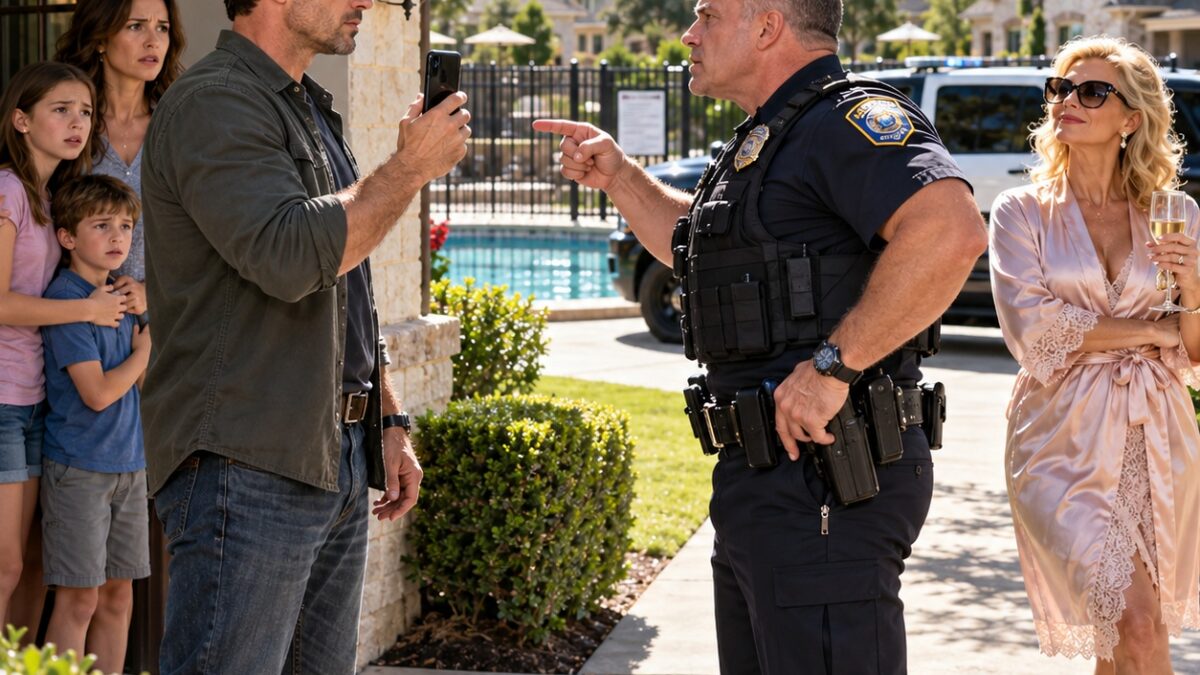
Constance started walking across the street.
Her silk robe fluttered around her ankles, and the expression on her face changed from amusement to irritation.
“Brent, why are you arguing with him? Just take the cards.”
I turned the phone slightly so both of them were in frame.
Brent noticed.
“Put that thing down.”
“No.”
His nostrils flared.
“Recording an officer can create safety concerns.”
“I’m standing barefoot on my own porch holding coffee.”
Behind me, Elena whispered, “Miles.”
There was a warning in her voice.
Not because she thought I was wrong.
Because she knew me.
She had watched me spend too many years walking toward danger when every sane instinct said to walk away.
I lowered my voice.
“Officer Blackwood, if you have lawful authority to seize something belonging to my family, show me the paperwork and I’ll comply.”
Constance laughed.
“You don’t seem to understand how things work here.”
That sentence told me more than she intended.
I stepped inside and returned with the closing packet I had reviewed the night before.
Constance’s face changed when she saw it.
I opened the recorded covenants to the section governing amenities.
“Our deed includes an appurtenant right to use the common recreational facilities while assessments are current. Ours are current.”
Brent glanced toward his wife.
I continued.
“The board can impose restrictions under certain circumstances, but there are notice requirements and a hearing procedure. We received neither.”
“This isn’t a courtroom,” Constance snapped.
“No. That makes it even stranger that your husband is here threatening arrest.”
Brent moved closer.
He was trying to regain control of the physical space.
I had seen the tactic before.
Chest forward.
Voice lowered.
Invade the other person’s comfort zone and make the conversation feel like it might become something else.
“Listen carefully,” he said. “I’ve been doing this job twenty years. People who create problems around here usually discover that problems have a way of following them.”
Elena heard every word.
So did my phone.
I looked at his badge number.
Then at his face.
“Is that an official warning, Officer?”
He realized what he had just done.
For the first time, actual uncertainty flickered behind his eyes.
He stepped back.
“The board meets Thursday. Take it up there.”
“I intend to.”
He turned toward the cruiser.
Constance stayed another moment.
“You moved into the wrong neighborhood if you think you’re going to make enemies of everyone.”
I looked past her at the rows of quiet houses.
Curtains moved in two windows.
Someone was watching from behind a garage.
Another neighbor had stopped pretending to water his lawn.
I didn’t think I was making enemies of everyone.
I thought everyone was afraid of the same two people.
Constance followed Brent home.
Elena closed the front door.
Then she turned on me.
“What was that?”
“The HOA president sent her police officer husband to threaten us over pool access.”
“I know what happened.”
Her arms folded over her chest.
“I’m asking what’s happening to you.”
That landed harder.
I set the phone down.
“Elena—”
“You promised.”
“I retired.”
“No. You promised you were done living like every problem was an operation.”
I wanted to tell her this was different.
Then I looked toward the hallway.
Sophie was standing there in pajamas.
Jake was behind her.
They had heard enough.
“Is the policeman going to arrest Dad?” Jake asked.
Elena closed her eyes.
I hated Brent Blackwood in that moment more than I had hated men who had threatened me with guns.
Those men had known exactly what I was.
Brent had walked into my family’s home life because his wife wanted to win an HOA argument.
I crouched in front of Jake.
“No one is arresting anybody.”
“Because you didn’t do anything?”
“Exactly.”
Sophie looked unconvinced.
“Then why did he say he would?”
There wasn’t a good answer for a twelve-year-old.
Because sometimes adults misuse authority.
Because a badge does not remove weakness from the person wearing it.
Because institutions only work when people insist that rules apply to those enforcing them too.
Instead, I said, “Sometimes people say things they shouldn’t when they think no one will challenge them.”
“Are you going to challenge him?”
Elena looked at me.
So did both kids.
I chose my words carefully.
“I’m going to make sure everything is handled the right way.”
Later, after they left for school, Elena stood at the kitchen counter pouring coffee.
“You’re already thinking about evidence.”
“Yes.”
“You’re thinking about patterns.”
“Yes.”
“And you’re going to start talking to neighbors.”
I hesitated.
She pointed at me.
“That pause means yes.”
I almost smiled.
She didn’t.
“Miles, I can’t go back to wondering what door somebody is going to kick in because of something you’re investigating.”
“I’m not an agent anymore.”
“Exactly.”
That was the part I needed to hear.
I could document what happened to my family.
I could study public records.
I could help neighbors organize information.
But I no longer had a badge, subpoena power, or federal authority.
If this became criminal, professionals still on the job would handle it.
I crossed the kitchen and took her hand.
“I won’t play FBI agent.”
“You swear?”
“I swear.”
She squeezed my fingers.
“Protect our family. Don’t turn our family into the battlefield.”
That afternoon, I went for a walk.
Not surveillance.
Just a walk.
At least that was what I told myself.
Willowbrook was the kind of neighborhood designed to advertise tranquility. Mature oaks. Clean sidewalks. Identical brick monuments at both entrances. Sprinklers ticking over immaculate grass.
But once I started paying attention, the atmosphere felt wrong.
People waved without stopping.
Conversations ended when cars slowed.
A woman across from the playground looked toward the Blackwood house before answering a simple question about trash pickup.
Fear had become routine.
Mrs. Dorothy Brighton was tending roses beside a pale yellow house near the corner.
She looked to be in her sixties, with silver hair pulled back and gardening gloves stained dark with soil.
“Those are impressive,” I said.
She smiled.
“Forty years of practice.”
“I’m Miles. We just moved in.”
Her smile weakened slightly.
“The Dalton family.”
There it was.
Our name had already traveled.
“That obvious?”
“Willowbrook notices new people.”
“Constance certainly does.”
Dorothy’s hand froze over a rose stem.
Then she looked toward the street.
“Some people here are very committed to regulations.”
“That’s a diplomatic way to put it.”
She gave me a tired look.
“Retired schoolteacher.”
“Explains the diplomacy.”
That got a quiet laugh.
I told her Brent had come to our house that morning.
Her face changed.
Not surprise.
Recognition.
“Was he in uniform?”
“Yes.”
“Did he say it was about police business?”
“He claimed trespassing.”
She set down her pruning shears.
“The Hendersons lasted two years.”
“Who?”
“Young couple who lived three houses down. Nice people. New baby. They questioned why the HOA spent fifteen thousand dollars on an emergency roof repair for a structure nobody remembered being damaged.”
“What happened?”
“Noise complaints. Parking complaints. Patio furniture violations. Then Officer Blackwood started visiting.”
“For what?”
“Whatever reason he needed that week.”
She looked toward another house.
“Jim Santos asked why the landscaping company never seemed to have employees. Suddenly his backyard shed was a code emergency.”
“Did anyone file complaints?”
“People tried.”
“With the police department?”
She nodded.
“Nothing ever seemed to happen.”
I absorbed that.
“Did you have problems too?”
Her expression closed.
“That’s enough neighborhood history for one afternoon.”
I respected the boundary.
But as I turned to leave, she spoke again.
“I suggested an independent audit eighteen months ago.”
I looked back.
“What happened?”
“The next week, I received notices about my bird feeders, my garden border, and a flag bracket that had been on this house since 1998.”
She put her gloves back on.
“Welcome to Willowbrook, Mr. Dalton.”
Thursday night, the HOA called an “emergency safety meeting.”
The community center smelled like old coffee, floor cleaner, and years of bad decisions.
Elena stayed home with the kids.
I wanted her there.
She refused.
“I trust you,” she said. “I don’t trust myself not to throw the gavel through a window.”
Fair enough.
Only twelve residents attended.
Five board members sat behind folding tables.
Constance occupied the center chair.
A small wooden gavel rested in front of her.
Seeing it almost made me laugh.
She waited until seven sharp, then struck the table.
“This emergency session is called to order.”
No approval of agenda.
No roll call.
No homeowner comment period.
She went directly to me.
“We are here to address serious security concerns involving a new resident.”
Every face turned.
I stayed seated.
Constance read from a prepared page.
“Mr. Miles Dalton has engaged in confrontational conduct toward law enforcement, refused HOA safety directives, made unauthorized recordings, and attempted to access amenities while his household eligibility remained under review.”
Unauthorized recordings.
Interesting choice of words.
Board member Patricia Mills raised her hand.
“What household eligibility review?”
Constance barely looked at her.
“New resident security protocol.”
“I don’t remember voting on one.”
“We delegated administrative authority.”
“When?”
Constance’s eyes sharpened.
“Patricia, this is not the time.”
Which meant it was exactly the time.
Constance continued.
“For the protection of our residents, I move that the Dalton household’s amenity privileges be suspended pending a behavioral review.”
A man named Frank Torres immediately seconded.
“Discussion?” Patricia asked.
“Emergency matters do not require extended discussion.”
I opened the bylaws.
“Actually, they do.”
Constance stared at me.
“You are not recognized.”
“That’s fine. I can wait for homeowner comments.”
“There will be no homeowner comments during an emergency proceeding.”
I held up the bylaws.
“Page thirty-two says otherwise.”
A few people shifted in their chairs.
Frank leaned toward his microphone.
“You also illegally recorded Officer Blackwood.”
“No.”
“You didn’t record him?”
“I recorded him. It wasn’t illegal.”
Frank blinked.
I kept my tone flat.
“Texas generally permits a participant in a conversation to record it. More importantly, he was standing on my property performing what he claimed was official police business.”
Constance grabbed her gavel.
“We are not debating state law.”
“No problem.”
I flipped another page.
“Can we debate your bylaws?”
Her face tightened.
She called for the vote.
Four hands went up.
Patricia voted no.
Constance slammed the gavel.
“Motion passes.”
I stood.
“Before you enforce that, you may want to count.”
“What?”
“Board membership.”
Silence.
“Emergency action requires seven directors present under your own quorum provision. There are five.”
Frank started flipping papers.
Constance didn’t need to.
She knew.
The rage that crossed her face was so pure it almost impressed me.
“This meeting is adjourned.”
She struck the table hard enough to make the gavel bounce.
Residents started leaving.
I was gathering my papers when a man in his late thirties approached.
“Mr. Dalton?”
“Yes.”
“Tyler Brooks. Pine Street.”
He looked toward the door to make sure Constance had left.
“My wife and I have videos.”
“Of what?”
“Officer Blackwood.”
His voice dropped.
“You should see them.”
The next morning, Tyler and Madison Brooks sat at my kitchen table.
Madison looked nervous enough to bolt every time a car passed outside.
Tyler connected his phone to my television.
The first video showed Brent walking along the side of their house at 12:41 a.m.
Uniformed.
Flashlight in hand.
The second showed him photographing their vehicles.
The third showed him tugging a side-gate latch.
“What reason did he give?” I asked.
“Suspicious-person complaint,” Tyler said.
“At your own house?”
“He claimed somebody saw movement in our backyard.”
Madison rubbed her palms together.
“There was nobody. We checked every camera.”
“When did this start?”
They looked at each other.
Madison answered.
“After I asked about pool expenses.”
That got my attention.
“What pool expenses?”
“Eight thousand dollars a month for maintenance.”
I thought I had misheard.
“For one community pool?”
“Yes.”
“Who’s the vendor?”
“Maintenance Solutions LLC.”
She slid a folder across the table.
“These are copies of the HOA financial summaries distributed to homeowners. I started checking vendor names after the board refused to provide competitive bids.”
I opened the documents.
Maintenance Solutions LLC.
Landscape Emergency Services.
Community Security Consulting.
Large round numbers.
Recurring payments.
Minimal descriptions.
“What made you suspicious?”
“I work in banking.”
She paused.
“I’m not giving you private customer information. I know where that line is. But the names on the HOA disclosures looked wrong, so Tyler and I searched the state business registry.”
She handed me printed records.
Maintenance Solutions had been formed three weeks after Constance became HOA president.
Registered mailing address: a private mailbox store.
No website.
No listed employees.
No visible operating address.
Landscape Emergency Services was almost identical.
Same organizer.
Same mailing location.
Different suite number.
I looked at Madison.
“Who’s the organizer?”
She turned the page.
A man named Brent A. Blackwood.
Not enough by itself.
But plenty enough to ask questions.
Tyler leaned forward.
“We did ask.”
“What happened?”
He pointed toward the television.
“That happened.”
Now I understood the system.
The harassment wasn’t random.
It was enforcement.
Not HOA enforcement.
Silence enforcement.
Question the money, and suddenly rules appeared.
Ask for records, and a police cruiser started circling your house.
I called Elena during her lunch break.
“I think this is bigger than the pool.”
There was a long silence.
“How much bigger?”
“Possibly financial fraud.”
“Miles.”
“I’m not investigating it as an agent.”
“That sentence contained the word investigating.”
“I’m documenting.”
“Document quietly.”
“I will.”
“And call somebody who still has a badge.”
“I will.”
That afternoon I contacted Lisa Rodriguez.
Lisa and I had worked two cases together years earlier. She had since moved into a federal public-corruption and civil-rights task force.
I gave her only the basics.
Retired agent.
HOA dispute.
Local officer possibly using official authority to intimidate residents who questioned finances.
Potential shell companies.
She listened without interrupting.
Then she said exactly what Elena wanted her to say.
“You are retired, Miles.”
“I’m aware.”
“I mean it.”
“I know.”
“Preserve what comes to you. Do not represent yourself as FBI. Do not access restricted systems. Do not direct witnesses. Do not trespass, bait anybody, or play hero.”
“You always knew how to ruin my fun.”
“I’m serious.”
“So am I.”
Her tone softened.
“If there’s something here, send it through proper channels. We’ll decide what it is.”
I sent her the recording from my driveway, the HOA documents, the publicly available corporate filings, and Tyler’s videos with his permission.
Then I stopped.
For almost forty-eight hours.
Constance ended that streak for me.
Monday morning, three city inspectors arrived within thirty minutes of one another.
One measured the height of my grass.
Another photographed the angle of our mailbox.
A third cited garbage cans visible from the street twenty minutes after pickup.
Elena came home carrying a stack of notices.
“Five hundred dollars.”
She dropped them on the counter.
“Five hundred dollars because our grass is a quarter inch too tall and apparently our mailbox has developed moral defects.”
Sophie sat at the table doing homework.
“Is that because of the pool lady?”
No child should know the phrase HOA retaliation.
Yet here we were.
Elena forced a smile.
“It’s adult nonsense.”
Sophie looked at me.
“Dad?”
I hated that she was learning to read my face.
“Yes,” I said. “Probably.”
“Can they make us move?”
“No.”
“Can the policeman?”
“No.”
I said it with confidence because she needed confidence.
But later, in our bedroom, Elena closed the door.
“This is what I was afraid of.”
“I know.”
“We came here so the kids could feel normal.”
“I know.”
“Jake asked me yesterday if police officers are allowed to help their wives punish people.”
I sat on the edge of the bed.
That one hurt.
Elena’s anger faded.
She sat beside me.
“I’m not asking you to surrender.”
“I know.”
“I’m asking you to remember why you retired.”
I looked around the room.
Half-unpacked boxes remained against the wall.
A family photograph from our old house sat on the dresser.
We had come to Willowbrook because we wanted boring.
Constance and Brent had managed to turn a swimming pool into a lesson about power.
“I’ll handle it without becoming who I was at work.”
Elena rested her head against my shoulder.
“Good.”
Then she added, “But please handle it.”
That night, Brent drove past our house four times.
The fifth time, he stopped.
At 11:07 p.m., one of my newly installed cameras captured him walking toward our mailbox.
I had installed the system after his first visit.
Nothing exotic.
Good residential cameras.
Infrared.
Cloud backup.
Time stamps.
No spy toys.
No classified equipment.
Just equipment anybody could buy.
Brent shined a light on our house numbers and photographed the mailbox.
Then he walked toward the driveway and aimed his flashlight through the windshield of my truck.
He never touched the house.
He never crossed our locked gate.
But he spent seven minutes on my property without knocking.
The next morning, I downloaded the footage and sent it to Lisa.
Her reply came two hours later.
Received. Do not engage.
That was all.
Elena, meanwhile, discovered a pattern I had missed.
She had been scrolling through six months of neighborhood social-media posts.
“The Hendersons,” she said.
She turned the laptop toward me.
There was a post from the previous spring asking why an emergency roof repair had cost fifteen thousand dollars.
Two weeks later came a thread in which Constance complained about “ongoing nuisance violations” at the Henderson property.
Then another.
Jim Santos had asked for competitive bidding on maintenance contracts.
Within a month, complaints appeared about auto work at his home.
Dorothy had suggested an independent audit.
Then came bird-feeder violations.
Tyler had asked about pool expenses.
Then Brent started appearing at midnight.
Elena sat back.
“They aren’t targeting random people.”
“No.”
“They’re targeting questions.”
“Yes.”
She stared at the screen.
“This isn’t an HOA with a bullying problem.”
“No.”
“What is it?”
I thought about the shell companies.
The inflated invoices.
The police visits.
“A protection system.”
Tuesday afternoon, Tyler called.
His voice was shaking.
“Madison got the records.”
“What records?”
“The financial inspection request.”
Under the HOA’s own rules, members could request certain association financial records.
Madison and several homeowners had done it together.
This time, probably because Constance wanted to appear transparent after I had challenged her publicly, the management office produced a thick batch of statements, invoices, and canceled-check images.
Tyler and Madison came over that evening.
Madison laid out the documents.
“I made a spreadsheet.”
Elena smiled despite herself.
“I like her.”
The numbers were worse than I expected.
Maintenance Solutions LLC had received more than sixty thousand dollars.
Landscape Emergency Services had received another twenty-eight thousand.
There were payments for emergency tree removal on weeks when nobody remembered losing a tree.
Pool-equipment replacements that did not correspond to any visible new equipment.
Security consulting bills with no reports attached.
Some invoices were duplicates with altered dates.
Others were sequentially numbered despite supposedly coming from different vendors.
Then Madison showed me the canceled checks.
Constance’s signature appeared as HOA president.
The second authorized signature on several of the largest checks belonged to Brent Blackwood.
Elena whispered, “Oh my God.”
Madison nodded.
“I estimate at least seventy-three thousand dollars cannot be matched to legitimate services.”
I did not celebrate.
That amount meant this had moved far beyond petty neighborhood tyranny.
“Make copies,” I said. “Keep originals exactly as received.”
Madison nodded.
“I already scanned the whole production.”
“Good. Give the same material to an attorney and law enforcement.”
Tyler looked at me.
“You think they can be arrested?”
“I think you need to stop thinking about arrest and start thinking about preserving evidence.”
A motion alert sounded from my phone.
Brent.
He was walking up the driveway.
Constance followed him.
Of course she did.
Elena looked at me.
“Do not enjoy this.”
“I’m not.”
“You’re smiling.”
“I’m appreciating the timing.”
I opened the door before Brent could knock.
The visible camera above the frame pointed directly at us.
His eyes found it immediately.
“Evening, Officer.”
He had lost some of his swagger.
“We received another neighborhood complaint.”
“About?”
“Possible code violations.”
“Police respond to mailbox angles now?”
His mouth hardened.
Constance stepped forward.
“You think you’re clever.”
“No. I think your inspectors left timestamps.”
Her face flickered.
I held up the city notices.
“Three departments. Thirty minutes. All anonymous complaints.”
Brent shifted.
“If you have an issue with city enforcement, take it up with the city.”
“I will.”
Then I looked directly into his eyes.
“Since you’re here in an official capacity, I’d also like to report suspected financial fraud involving HOA funds.”
Constance went perfectly still.
“Excuse me?”
“Potential false invoices. Shell companies. Possibly tens of thousands of dollars.”
Brent’s face drained.
It happened fast.
But cameras don’t blink.
“You don’t know what you’re talking about.”
“I didn’t say who was involved.”
Silence.
Behind me, I heard Elena inhale.
Constance recovered first.
“This is defamation.”
“Then you should be eager for an independent audit.”
Her phone slipped slightly in her hand.
Not all the way to the ground.
Just enough to show that her fingers had stopped cooperating.
Brent stepped backward.
“You’re making serious accusations.”
“No. I’m reporting serious concerns.”
I paused.
“And everything I have has already been preserved off-site.”
That was the only bluff-like sentence I allowed myself.
It also happened to be true.
Lisa had copies.
So did Tyler.
So did Madison.
So did our attorney.
Brent looked at the camera again.
“Have a good night, Mr. Dalton.”
They walked away.
Constance did not speak until they were across the street.
I couldn’t hear the words.
I didn’t need to.
Her arms were moving like she was trying to conduct an orchestra during a fire.
At 2:00 the next morning, I was still awake.
Not because I was watching them.
Because I was reading.
I had pulled the original Willowbrook development documents from county records.
The stack was enormous.
Most of it was exactly what you would expect: plats, utility easements, drainage agreements, architectural restrictions, turnover procedures, maintenance obligations.
Then I reached a recorded development agreement from the subdivision’s early years.
Page forty-seven.
A paragraph buried beneath common-area management provisions.
I read it once.
Then again.
Then I sat upright.
The original developer, Pinnacle Properties LLC, had retained a permanent recorded management easement and contractual reversion right over designated common areas under specific emergency conditions.
Not because the developer wanted to run the HOA forever.
Because the subdivision had suffered governance problems during its early years.
The trigger language included material financial misconduct, fraud, intentional breach of fiduciary duty, or conduct threatening the lawful administration of common property.
If triggered, Pinnacle could temporarily assume operational management of designated common facilities and invoke a transition procedure for association governance until independent controls were restored.
It wasn’t magic.
It did not give the developer ownership of every house.
It did not erase the HOA.
But it could remove the board from day-to-day control long enough to stop the bleeding.
And the clause had been recorded with the county.
Constance could rewrite newsletters.
She could bully board members.
She could invent “amenity reviews.”
She could not make a recorded development agreement disappear.
I stared at the page.
For the first time since this began, I smiled.
Not because I had found revenge.
Because I had found an off switch.
The next morning, I called Pinnacle Properties.
I expected three assistants, a voicemail tree, and six business days of silence.
Instead, a man answered after I mentioned the Willowbrook emergency-management clause.
“Harrison Webb.”
“You’re Harrison Webb?”
“Last time I checked.”
I introduced myself and explained what we had found.
He became quiet.
“How much?”
“Potentially seventy-three thousand dollars in unsupported or fraudulent expenditures. Possibly more.”
“Shell companies?”
“Yes.”
“Board president involved?”
“Her signature is on the checks.”
“Police officer husband?”
“Second signer on several.”
A long breath came through the phone.
Then he said, “I’ve been waiting six years for somebody to force that clause into daylight.”
I leaned back.
“You knew?”
“I knew Willowbrook’s governance had problems. I didn’t know this.”
“Why retain the clause?”
He laughed without humor.
“Because the first board nearly destroyed the development over a construction lawsuit. I lost more than two million dollars cleaning up the mess. After that, my lawyers insisted we build an emergency mechanism into future turnover documents.”
“Can you activate it?”
“Not because one homeowner calls me angry.”
“I wouldn’t expect you to.”
“But if what you’re describing is documented?”
“Yes?”
“My lawyers will have a very interesting week.”
Harrison Webb arrived the following afternoon.
He was sixty-one, silver-haired, and less theatrical than I expected.
No entourage at first.
Just Webb and a leather document case.
Elena joined us at the dining table.
So did Tyler and Madison.
Webb read quietly for almost forty minutes.
Every few pages, he asked Madison where a document came from.
She answered.
Homeowner financial inspection.
Public corporate registry.
HOA disclosure packet.
County records.
No stolen bank files.
No unauthorized access.
That mattered.
Then Webb reached the checks.
He frowned.
“Brent Blackwood.”
“Yes.”
“The police officer?”
“Yes.”
Webb removed his glasses.
“I’ve heard that name.”
“From where?”
Instead of answering, he opened his document case.
Inside was a folder nearly two inches thick.
Resident complaints.
Emails.
Certified letters.
Notes from former homeowners.
The Hendersons.
Jim Santos.
Dorothy Brighton.
Tyler and Madison.
Different years.
Same pattern.
Financial question.
Selective enforcement.
Police contact.
Fear.
Silence.
Elena flipped through several pages.
“You had all this?”
“Pieces,” Webb said. “Not proof.”
“You couldn’t do anything?”
“I could complain. I could send counsel letters. I could demand records. Every time, the board produced enough paperwork to create plausible explanations.”
He tapped Madison’s spreadsheet.
“This is different.”
I studied him.
“Why?”
“Because now we have transactions, corporate records, resident testimony, and a pattern linking retaliation to financial scrutiny.”
He pulled out the recorded agreement.
“And this.”
The following day, Webb returned with Patricia Vance, outside counsel for Pinnacle, and David Kim, a forensic accountant.
Patricia was precise to the point of intimidation.
She did not care that I was former FBI.
She did not care that Webb wanted action.
She cared whether the documents supported the remedy.
Good lawyers are supposed to disappoint people who want shortcuts.
For four hours, she tried to break our case.
Was the clause still enforceable?
Was it properly recorded?
Had later amendments superseded it?
Did Pinnacle retain the relevant rights?
Were the common parcels still subject to the management easement?
Did the misconduct threshold require a judicial finding?
Could the temporary transfer be invoked on documented evidence pending formal review?
By late afternoon, she had answers.
She closed the final binder.
“The mechanism is active.”
Tyler blinked.
“That means?”
“It means Pinnacle can assume emergency operational control of the common areas and management functions identified in the agreement, subject to notice and the transition procedure.”
“Can Constance stop it?”
“She can challenge it.”
Patricia’s expression barely changed.
“She may not enjoy the discovery process if she does.”
Webb looked at me.
“There’s another problem.”
“Brent.”
“Exactly.”
A corrupt HOA president was dangerous to a neighborhood.
A police officer willing to use his uniform on her behalf changed the risk.
I called Lisa.
This time, she spoke less casually.
“We’re already moving.”
My stomach tightened.
“Meaning?”
“Meaning you should not ask questions I cannot answer.”
Fair.
“Do you need anything else from me?”
“Stay out of the way.”
“Elena will frame that sentence.”
Lisa paused.
“Miles.”
“Yes?”
“If Blackwood comes to your house again, call dispatch. Not me. Not Webb. Dispatch. Make a normal record.”
“I understand.”
“And stop testing him.”
“I haven’t.”
“You told a potentially corrupt police officer that you had evidence of financial fraud while a camera was recording his reaction.”
“That happened naturally.”
“I know you too well.”
She hung up.
Elena was standing behind me.
“She likes me.”
“She really does.”
“When is all this ending?”
“Monday.”
That was Webb’s plan.
Not an ambush.
A formal emergency community meeting with notice to every homeowner.
Pinnacle would present the recorded authority, explain the documented financial irregularities, announce temporary management control, and install professional accounting.
Homeowners would receive copies of the relevant documents.
The HOA’s own records would be preserved.
A licensed management company would take possession of association books and common-area access systems.
Constance’s ability to lock families out of facilities would end.
Whether she faced criminal consequences was no longer our decision.
But Webb wanted witnesses.
Lots of them.
By Friday, word had spread.
Not details.
Just enough.
“Important financial presentation.”
“Original developer attending.”
“Independent accounting review.”
That was all it took.
People who had skipped HOA meetings for years suddenly planned to attend.
Dorothy came to my house carrying her own archive.
She had documented everything.
Violation notices.
Dates of police visits.
Photographs.
Emails.
Copies of letters asking for financial audits.
One page showed the sequence better than any speech could.
March 3: Dorothy requested an independent audit.
March 10: bird-feeder violation.
March 14: landscape-border violation.
March 18: police “wellness visit” at 10:36 p.m.
March 21: second police visit.
March 24: Dorothy withdrew her audit request.
I looked at her.
“Why did you stop?”
Her eyes filled, but she did not cry.
“My husband was still alive then. Cancer.”
I said nothing.
“Brent came one night while Harold was sleeping. Shined lights through the bedroom window. Said somebody reported suspicious activity.”
Her mouth tightened.
“Harold was frightened. He asked me what I had done.”
That explained the careful politeness.
The constant glances toward the Blackwood house.
“What happened to your husband?”
“He died eight months later.”
“I’m sorry.”
She nodded.
“After he died, I kept records because I was ashamed that I’d been scared into silence.”
“No.”
She looked at me.
“You stayed alive inside a system designed to exhaust you. That’s not the same thing.”
Dorothy folded her hands.
“Will they actually lose control?”
“Yes.”
She exhaled.
“Then I’ll be there.”
Sunday night, I found Sophie sitting at the kitchen table.
She was pretending to read.
“You okay?”
She shrugged.
A twelve-year-old shrug can mean anything from I’m bored to civilization is collapsing.
I sat opposite her.
“You want to ask me something?”
“Mom said the HOA people might not be in charge anymore.”
“That’s probably true.”
“Because of you?”
“Because a lot of people kept records.”
She looked down.
“Are you going back to the FBI?”
There it was.
“No.”
“You look like you used to.”
That scared me more than I expected.
“What do you mean?”
“Like when your phone would ring and you’d stop hearing everybody.”
I sat back.
Kids notice everything.
“I’m sorry.”
She looked at me.
“I don’t want you to leave again.”
“I’m not leaving.”
“Promise?”
“I promise.”
I reached across the table.
“This is almost finished.”
Jake wandered in wearing dinosaur pajamas.
“Can we use the pool when it is?”
I smiled.
“Yes.”
“Even the diving board?”
“Especially the diving board.”
Monday arrived with the strange pressure of a storm that had not yet broken.
By six-thirty, the Willowbrook community center parking lot was full.
Webb’s management team had set up projection equipment.
David Kim had prepared a clean financial presentation.
No dramatic music.
No theatrics.
Just numbers.
Invoices.
Corporate registrations.
Canceled checks.
Dates.
Amounts.
Facts are more frightening than theatrics when the facts are good.
Patricia had copies of the recorded development agreement and notice of emergency management transfer.
A local television crew arrived after residents contacted Channel 7.
Amanda Cross, an investigative reporter, stood near the back with her cameraman.
I had not invited her.
Webb hadn’t either.
Apparently Willowbrook had become news.
At 6:45, the Blackwoods walked in.
Constance wore a navy designer blazer and carried her gavel.
Brent wore civilian clothes.
That interested me.
No uniform.
No service weapon visible.
He looked exhausted.
Constance did not.
She looked furious.
She marched to the front.
“What is all this equipment?”
Webb stood.
“Good evening, Constance.”
She stared at him.
“Who are you?”
“Harrison Webb. Pinnacle Properties.”
For the first time since I had met her, Constance Blackwood looked genuinely afraid.
She recovered quickly.
“This is an HOA meeting. You have no authority to interfere.”
“That’s what we’re here to discuss.”
At seven, she struck the gavel.
“This meeting will come to order.”
Webb remained standing.
“Before routine business, Pinnacle Properties is serving formal notice under the recorded emergency management provisions governing Willowbrook’s common facilities and association operations.”
The room went silent.
Constance laughed.
It sounded forced.
“I have no idea what you’re talking about.”
Patricia Vance walked forward and placed a certified copy of the agreement on the table.
“You do now.”
Constance glanced at the first page.
Then another.
Her face changed.
“This is decades old.”
“It remains recorded.”
“It was superseded.”
“It was not.”
“You can’t just walk in and take control.”
Patricia’s voice stayed calm.
“Under ordinary circumstances, correct.”
She opened the document to the relevant section.
“These are not ordinary circumstances.”
David Kim activated the projector.
A spreadsheet appeared.
Seventy-three thousand dollars in questioned transactions.
The room erupted in murmurs.
Constance turned.
“What is that?”
David faced the homeowners.
“My name is David Kim. I am a forensic accountant retained to conduct a preliminary review of Willowbrook HOA financial records provided through a lawful member inspection.”
He clicked.
Maintenance Solutions LLC.
Eight thousand dollars per month.
Another click.
State corporate registration.
Brent Blackwood listed as organizer.
Another.
Invoices.
Another.
Canceled checks.
Constance Blackwood.
Brent Blackwood.
The room got louder.
“This is false!” Constance shouted.
David continued.
“Maintenance Solutions reports no verifiable employees, physical operating facility, equipment inventory, or service documentation sufficient to support the amounts billed.”
Click.
Landscape Emergency Services.
Another mailbox company.
Related registration information.
More checks.
More signatures.
Constance grabbed her gavel.
“I am ending this meeting.”
Webb shook his head.
“You no longer control the facility.”
Her mouth fell open.
“This is HOA property.”
“It is a common parcel subject to the recorded management easement you were just served.”
She looked toward Brent.
That was when I saw the old system reappear between them.
One glance.
That was all.
He stepped forward.
“Everybody needs to leave.”
Nobody moved.
Brent raised his voice.
“This gathering is becoming disorderly.”
Amanda Cross lifted her microphone.
“Mr. Blackwood, are you acting as a police officer right now?”
He froze.
“I am asking people to disperse.”
“In what capacity?”
He looked at the camera.
Bad timing.
“I’m a sworn officer.”
“Are you on duty?”
“No.”
“Did your department authorize you to disperse an HOA meeting?”
His face darkened.
“You need to stop interfering.”
“I’m asking a question.”
Tyler stood.
His hands were trembling.
But he stood.
“Your signature is on those checks.”
Brent turned.
“You need to sit down.”
“No.”
It was probably the first time Tyler had ever told him that.
“You came to our house after midnight because Madison asked about pool expenses.”
“Suspicious activity had been reported.”
“By who?”
“That information is confidential.”
Madison stood beside her husband.
“You photographed our license plates. You tried our side gate.”
“I was conducting a safety check.”
Dorothy rose.
“So was shining a flashlight through my dying husband’s bedroom window a safety check?”
The room changed.
Up to that moment, this had been numbers.
Money.
Contracts.
Now it had a face.
Dorothy’s.
Jim Santos stood next.
“You threatened to cite my customers because I asked for competitive bids.”
Another resident stood.
Then another.
The Blackwoods had relied on isolation.
One frightened homeowner is manageable.
Twenty standing together are not.
Constance lost control first.
“All of you benefited from what we did!”
Her voice cracked through the room.
“We maintained standards. We protected property values. We kept this neighborhood from becoming—”
She stopped herself.
Too late.
“Becoming what?” someone called.
Constance’s eyes jumped across the crowd.
“You know exactly what happens when standards disappear.”
I stood slowly.
She saw me.
Whatever restraint remained vanished.
“You.”
She pointed across the room.
“This is you.”
“No.”
“You came here three weeks ago and poisoned everyone.”
“I asked why my kids couldn’t use a pool I pay for.”
“You refused procedures.”
“You invented the procedure.”
“You challenged law enforcement.”
“Your husband threatened arrest over an HOA access card.”
Brent moved toward me.
“Miles.”
The use of my first name was deliberate.
A warning.
I didn’t move.
“Don’t.”
“Don’t what?”
“Push this.”
“Why?”
He lowered his voice.
“You have no idea what you’re doing.”
A strange calm settled over me.
For fifteen years, I had heard versions of that sentence from men with more money, more guns, and far more reason to believe it.
But I was not an agent now.
That mattered.
So I did not threaten him.
I did not reveal confidential information.
I did not pretend I was running a federal operation.
I simply said the truth.
“I know exactly what I’m doing. I’m standing in my community meeting while an accountant explains your signatures on seventy-three thousand dollars in questionable transactions.”
Amanda’s camera stayed on him.
His jaw worked.
Then he made the mistake that destroyed whatever credibility he had left.
“I could arrest half the people in this room if I wanted to.”
Silence.
Amanda Cross spoke first.
“For what?”
Brent turned toward her.
“Interference. Disorderly conduct. Harassment. There are plenty of options.”
The doors behind him opened.
Lisa Rodriguez entered with two federal agents and a uniformed supervisor from Brent’s own department.
Nobody cheered.
Nobody spoke.
The mood became instantly serious.
Lisa’s gaze found mine for half a second.
Then moved on.
Good.
This was not my operation.
It was hers.
“Brent Blackwood?”
His face went gray.
The police supervisor stepped forward.
“Brent, keep your hands where I can see them.”
Constance stared.
“What is happening?”
Lisa produced identification.
“Federal Bureau of Investigation.”
The room seemed to contract around those words.
Brent’s shoulders sagged.
Lisa approached.
“We have a federal arrest warrant.”
Constance started shouting.
“For what? This is insane. He’s a police officer.”
Lisa did not answer her.
She looked only at Brent.
“You are under arrest in connection with an ongoing investigation involving suspected conspiracy, financial fraud, and deprivation of rights under color of law.”
Brent looked at me.
Not Lisa.
Me.
“You did this.”
I shook my head.
“No. Your choices did.”
The supervisor removed Brent’s weapon and secured it.
Then the cuffs went on.
The sound was quieter than movies make it.
Two clicks.
That was all.
Twenty years of intimidation reduced to two small mechanical sounds.
Constance rushed forward.
“This is persecution!”
Patricia stepped between her and the table of financial records.
“Please do not touch the evidence.”
“Those are HOA documents. They belong to me.”
“They belong to the association.”
“I am the association!”
That sentence did more damage to her than any accountant could.
Around the room, people stared.
Constance realized what she had said.
She tried to recover.
“You know what I mean.”
Webb shook his head.
“I think everyone finally knows exactly what you mean.”
Lisa turned to Constance.
“Mrs. Blackwood, we also have a warrant for your arrest.”
For the first time, Constance had no response.
No gavel.
No rule citation.
No threat.
Nothing.
Her eyes went to the exit.
Then to Brent.
Then to the cameras.
Amanda Cross did not move closer.
She did not need to.
Constance whispered, “This is a setup.”
Lisa remained professional.
“You’ll have the opportunity to address the allegations through counsel.”
“I have done nothing but protect this neighborhood.”
Nobody answered.
She became louder.
“We kept undesirable people out. We maintained property values. We protected families.”
The phrase undesirable people hung in the air.
I thought about the day she had looked at my truck.
Some vehicles enhance security.
Others attract the wrong kind of people.
This had never been only about money.
The money had created the need for fear.
But power had become its own reward.
Lisa placed Constance under arrest.
Amanda’s camera recorded it.
Dorothy sat down and covered her mouth.
Tyler wrapped an arm around Madison.
Jim Santos stared at Brent as if he had spent two years imagining this moment and discovered it felt quieter than expected.
Brent was escorted out first.
As he passed me, he slowed.
The federal agent holding his arm tightened his grip.
Brent stared directly at me.
“You think this makes you a hero?”
“No.”
I meant it.
Heroes were something people invented after danger ended.
I was a father who wanted his daughter to stop wondering whether she had done something wrong by going swimming.
That was all.
Constance came next.
Mascara had begun to run beneath her eyes.
She looked at the crowd.
“You need us.”
Nobody responded.
“Wait six months,” she shouted. “Property values will drop. Crime will increase. This place will fall apart without standards.”
Dorothy stood again.
Her voice was soft.
“We need rules, Constance.”
Constance stopped.
Dorothy continued.
“We never needed you to be above them.”
The room erupted in applause.
Not because the Blackwoods were being humiliated.
At least that was not how it felt to me.
People were applauding because somebody had finally said the thing they had all been afraid to say.
Rules are not tyranny.
Accountability is not chaos.
Authority is not ownership.
Webb waited until the agents left before returning to the microphone.
“The criminal investigation is separate from association management,” he said. “Tonight, we begin stabilizing Willowbrook.”
That distinction mattered.
For the next hour, Patricia explained exactly what would happen.
Pinnacle would exercise temporary emergency management authority.
An independent management company would control common-area access systems.
No resident would lose amenities without written notice and a valid process.
All financial accounts would undergo forensic review.
Existing contracts would be suspended or reverified.
Homeowners would receive monthly financial reports.
A temporary resident advisory committee would be created.
Once the emergency period ended, Willowbrook would hold supervised board elections.
For the first time since moving there, an HOA meeting sounded boring.
Beautifully boring.
At 10:15 that night, I walked home.
Elena was waiting at the kitchen table.
She had watched part of the news coverage.
The kids were asleep.
She searched my face.
“Over?”
“The HOA part mostly is.”
“And the criminal case?”
“Not ours.”
She stood.
I wrapped my arms around her.
For several seconds neither of us spoke.
Then she whispered, “You kept your promise.”
“Which one?”
“You didn’t disappear into it.”
I held her tighter.
That meant more to me than anything that had happened at the community center.
The next morning, Jake woke me at 6:42.
Not Brent.
Jake.
He was wearing swim trunks.
I opened one eye.
“What are you doing?”
“The pool opens at nine.”
“It is not nine.”
“I know.”
“Then why are you dressed?”
“So I’m ready.”
At breakfast, Sophie pretended not to be excited.
At 8:55 we walked together toward the community pool.
A professional management employee stood near the gate replacing the access controller.
For one second, Sophie hesitated.
I noticed.
“Go ahead.”
She held her card to the reader.
Green light.
Beep.
The lock opened.
That tiny sound did something to me.
Jake ran through.
Sophie followed.
Elena slipped her hand into mine.
Constance had taken something simple and turned it into a symbol of whether we belonged.
Watching the gate open felt like getting that piece of our lives back.
But the consequences for the Blackwoods were only beginning.
The forensic audit eventually found more than the original seventy-three thousand dollars in suspicious transactions.
Some expenditures had legitimate components mixed with inflated charges.
Others were entirely fabricated.
Prosecutors focused on the transactions they could prove cleanly.
Federal investigators also reviewed Brent’s conduct toward residents.
My driveway video mattered.
Tyler’s cameras mattered.
Dorothy’s documentation mattered.
Dispatch logs mattered.
Patrol records mattered.
The city-inspection pattern mattered.
No single late-night visit proved the entire case.
Together, they showed something much harder to explain away.
People who questioned the HOA’s money repeatedly became police “problems.”
Lisa interviewed us once.
Officially.
I sat in a conference room on the other side of the process for the first time in my adult life.
Before beginning, she looked at me.
“This is strange.”
“For you?”
“For me, you usually stole my chair.”
“I’m retired.”
“Keep saying it.”
She took my statement like I was any other witness.
That was exactly how it should have been.
The Blackwoods hired separate lawyers.
Their first strategy was denial.
Then blame.
Then Constance claimed unauthorized vendors had deceived the board.
That failed when investigators produced emails showing her directing invoice language.
Brent claimed his signatures were routine administrative approvals.
That became difficult to maintain when financial records connected him to the companies receiving the money.
Their lawyers eventually stopped speaking to reporters.
Willowbrook changed faster than I expected.
Within thirty days, Pinnacle’s management team posted the first full financial report.
People crowded around it online as if accounting had become a spectator sport.
The legitimate monthly pool-maintenance cost was nowhere near eight thousand dollars.
Several contracts were rebid.
Insurance was reviewed.
Landscaping costs fell.
Duplicate “security consulting” fees vanished.
The association discovered it had been collecting far more than necessary to maintain the services residents actually used.
Fees were reduced in stages.
Eventually, monthly assessments dropped by roughly thirty percent.
Service improved.
The grass did not die.
The pool did not turn green.
Crime did not engulf the streets.
Civilization somehow survived without Constance Blackwood measuring garbage-can visibility.
Dorothy joined the temporary advisory committee.
At first she resisted.
“I’m too old for this nonsense.”
“You taught middle school for thirty-two years,” I told her. “You’re overqualified.”
She laughed.
Months later, when supervised elections were scheduled, neighbors pushed her to run for president.
She won by the largest margin anyone could remember.
Her first meeting lasted forty-eight minutes.
No gavel.
No speeches about standards.
She brought coffee.
Every homeowner who wanted to speak got three minutes.
When Jim Santos complained that three minutes wasn’t enough, Dorothy gave him four and told him not to get greedy.
It was the loudest laugh I had ever heard in that building.
Tyler and Madison changed too.
Once people learned Madison had been the person who recognized the vendor pattern, neighbors started asking her for help reading budgets.
She eventually left traditional banking and trained further in forensic accounting.
Her first clients were homeowner associations.
“Apparently corruption pays,” Tyler joked.
Madison glared at him.
“Investigating corruption pays.”
“Important distinction.”
Jim finally stopped receiving mysterious code visits.
He expanded his auto shop and hired three people.
The shed Brent had once treated like a threat to public safety became a neighborhood tool library.
Drills.
Ladders.
Pressure washers.
Things people used twice a year and hated buying.
Jim put a sign on the door.
RETURN IT CLEAN OR DOROTHY WILL FIND YOU.
Dorothy pretended to disapprove.
She secretly loved it.
Elena started teaching basic first aid and CPR once a month at the community center.
She had spent years resenting the risks of my job.
Now she became the person residents trusted when their children scraped knees at the playground or an elderly neighbor needed help understanding when chest pain meant call 911 now.
Sophie made friends.
Real friends.
Not the cautious relationships that existed during our first weeks.
Jake practically became amphibious.
Every afternoon he was at the pool.
Sometimes I sat in the same chair where Constance had first demanded our cards.
I thought about how small the original moment had seemed.
Two kids.
Two plastic access cards.
One woman saying no.
If I had handed them over, maybe nothing else would have happened to us.
We might have stayed quiet.
Maybe we would have learned the neighborhood rule everyone else had already learned.
Don’t ask.
Don’t challenge.
Don’t make yourself noticeable.
That was how systems like the Blackwoods’ survived.
Not because everyone supported them.
Because everyone believed they were alone.
Six months after the emergency meeting, the criminal cases resolved.
Constance pleaded guilty to multiple fraud and embezzlement-related counts tied to association funds.
She received eight years in federal prison.
Brent’s case included the financial conspiracy and charges arising from his misuse of police authority.
He received twelve.
His department terminated him long before sentencing.
His pension issues became a separate fight I had no interest in following.
Restitution, recovered funds, insurance proceeds, and civil damages ultimately returned the stolen money and additional compensation to the community, totaling roughly one hundred fifty thousand dollars.
The Blackwoods’ house was sold as their financial and legal problems consumed what remained of their life in Willowbrook.
Eventually, the property changed hands through a redevelopment arrangement connected to the restitution process.
Part of the land became a community garden.
The first season, Dorothy planted tomatoes.
Jim built raised beds.
Elena organized volunteers.
Jake planted cucumbers in crooked rows.
Sophie painted the small sign by the entrance.
WILLOWBROOK COMMUNITY GARDEN.
No Blackwood name.
No victory slogan.
No revenge message.
We didn’t need one.
Harrison Webb surprised everyone with what he did with part of the recovered damages his company received.
He established a scholarship fund for local students studying criminal justice, public administration, accounting, or civil-rights law.
At the announcement, he told me, “Bad people already spent enough of this money on themselves. Might as well make some of it useful.”
Our case also triggered changes outside Willowbrook.
Nearby associations began reviewing vendor contracts.
Some discovered nothing more serious than sloppy bookkeeping.
Others found conflicts of interest.
A few found fraud.
The city strengthened audit and disclosure requirements for associations under its jurisdiction and created clearer channels for residents reporting coordinated code-enforcement retaliation.
Amanda Cross produced a series on suburban financial abuse.
She won a regional journalism award.
I knew because Dorothy brought the newspaper clipping to the pool and acted as if Amanda were her granddaughter.
Lisa called me after the sentencing.
“Congratulations.”
“For what?”
“Surviving retirement.”
“Barely.”
“You planning to come back?”
“No.”
The answer came easily.
That surprised me.
“You sure?”
I looked through the kitchen window.
Jake and Sophie were arguing over whose turn it was to take out the trash.
Elena was outside talking to Dorothy.
Ordinary life.
Finally.
“I’m sure.”
I did end up consulting occasionally with Webb’s attorneys and management team.
Not as an investigator.
As someone who could teach communities how to document patterns without escalating conflicts.
Keep copies.
Use written requests.
Preserve original records.
Understand governing documents.
Separate suspicion from proof.
Report police misconduct through appropriate channels.
Never confuse revenge with accountability.
That last lesson mattered most.
People sometimes asked me whether I had enjoyed destroying Constance and Brent.
The answer was complicated.
Did I enjoy watching them lose the power they had abused?
Yes.
Did I enjoy seeing frightened neighbors finally stand up?
Absolutely.
Did I enjoy knowing Sophie and Jake could walk to the pool without wondering whether an adult had secretly decided they did not belong?
More than anything.
But the handcuffs?
The prison sentences?
The collapse of a marriage and a career and a reputation?
No.
Those were consequences.
Necessary ones.
Maybe deserved ones.
But not entertainment.
The real victory came later.
It came on an ordinary Saturday afternoon.
I was sitting beside the pool with Elena.
The Texas heat pressed down on everything.
Chlorine hung in the air.
Somebody was grilling burgers behind the community center.
Parents talked beneath umbrellas.
Kids screamed every time someone jumped from the diving board.
Dorothy sat three chairs away arguing with Jim about whether the garden needed another compost bin.
Tyler was chasing his toddler around the shallow end.
Madison had a laptop open on her knees because apparently forensic accountants do not understand weekends.
Sophie climbed out of the pool.
She was taller than she had been when we moved in.
Or maybe she just carried herself differently.
She grabbed a towel.
“Dad?”
“Yeah?”
“You remember when that lady said we weren’t allowed in here?”
I looked toward the gate.
“Yeah.”
“That was stupid.”
I laughed.
“That is one way to describe it.”
Jake cannonballed into the deep end before the lifeguard could tell him not to run.
Water splashed halfway across the deck.
Elena wiped droplets from her sunglasses.
“Your son.”
“My son?”
“He gets the dramatic entrances from you.”
“Pretty sure that’s genetic on your side.”
She leaned against me.
For a while, we watched the kids.
No patrol car circled the block.
No one photographed license plates.
No resident lowered their voice when discussing finances.
No one needed permission from Constance Blackwood to feel at home.
I thought back to my first week in Willowbrook.
I had believed safety meant the absence of danger.
A quiet street.
A good school.
A pool.
A boring mortgage.
After everything that happened, I understood it differently.
Safety is knowing the person with authority over you can be questioned.
It is knowing rules are written down.
It is knowing records can be inspected.
It is knowing a badge does not erase accountability.
It is knowing one frightened neighbor can become twenty neighbors once somebody finally says, “Show me where it says you can do that.”
Constance believed the HOA belonged to her.
Brent believed his badge could turn her grudges into law.
For years, that combination worked because fear kept everyone separated.
Then they picked a fight over two plastic pool cards.
They expected me to surrender them because everyone else had learned to surrender something.
Money.
Privacy.
Dignity.
A voice at meetings.
The right to ask questions.
They never imagined anyone would read the bylaws.
They never imagined homeowners would compare stories.
They never imagined Madison would follow the money.
They never imagined Dorothy had kept every piece of paper.
And they definitely never imagined a forgotten clause buried in county records had left their entire power structure resting on a trapdoor.
But that was the thing about power built on intimidation.
It looks permanent right up until the moment people stop being afraid of it.
Jake climbed from the pool and came running toward me.
“Dad!”
Water streamed from his hair.
“What?”
“Watch this one.”
“You said that about the last six.”
“This one’s better.”
He sprinted back toward the diving board.
The lifeguard blew his whistle.
“Walk!”
Jake slowed dramatically, looking offended by the concept of gravity.
Sophie laughed.
Elena laughed.
I laughed too.
Six months earlier, my son had asked whether a police officer could arrest me because our family wanted to use that pool.
Now his biggest problem was a lifeguard telling him not to run.
That was the boring life we had moved here to find.
And after everything it cost to get it back, boring had never looked so good.