FULL STORY:The HOA Queen Stole Thousands From My Porch—She Didn’t Know My Next Package Was Already Evidence
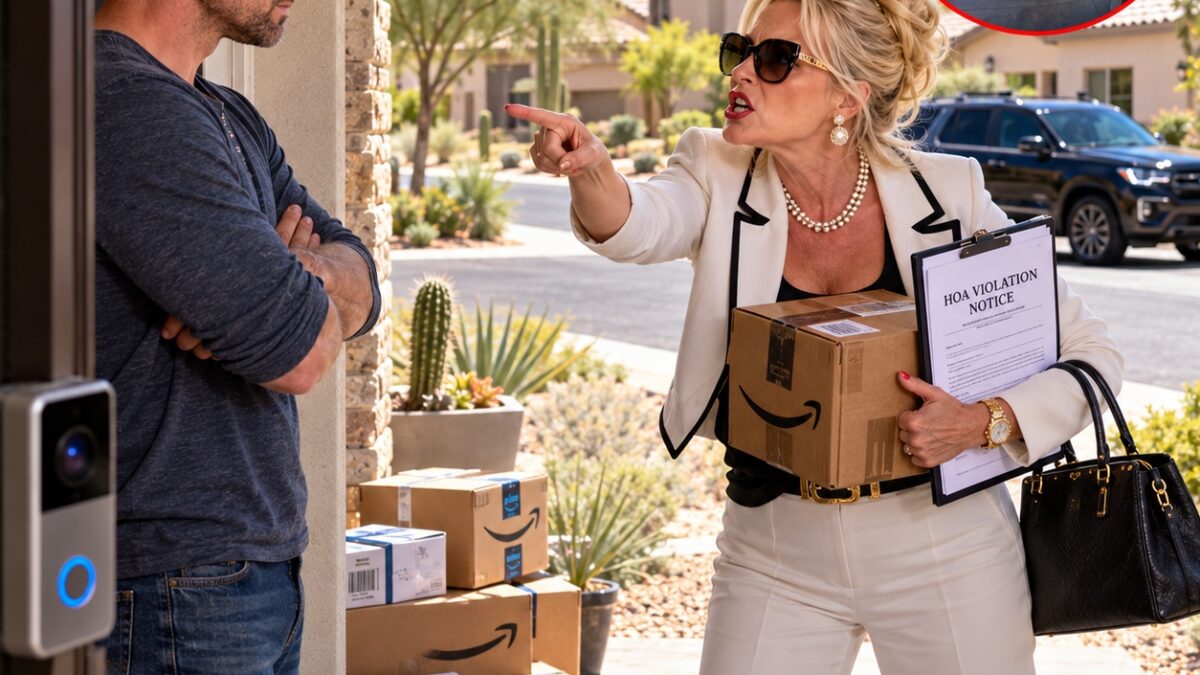
FULL STORY CONTINUATION
The violation arrived in an envelope with the HOA logo centered at the top and enough boldface to make a fifty-dollar fine look like a federal indictment.
NON-CONFORMING LANDSCAPE DESIGN.
Fifty dollars per day until corrected.
The citation referenced Section 4.7 of the Willowbrook covenants.
So I opened Section 4.7.
Then I opened the architectural committee minutes.
Then I opened the neighborhood design amendments.
By midnight, I had photographs, approval records, dates, and three addresses containing landscaping nearly identical to mine.
One belonged to Sarah Martinez.
Another to an elderly couple, Tom and Evelyn Johnson.
The third belonged to Brenda’s next-door neighbor.
None had active violations.
I requested a hearing.
Brenda looked genuinely annoyed when I arrived carrying a binder.
She sat beside Steve Mercer, chair of the architectural committee, while two other members looked as if they had been tricked into attending.
Steve cleared his throat.
“Mr. River, you’re appealing the landscaping notice?”
“Yes.”
I slid photographs across the table.
“Same design.”
Next page.
“Approved.”
Another.
“Approved.”
Another.
“Approved.”
Then I placed the original approval attached to my property file in front of him.
“This exact configuration was already reviewed before I bought the house.”
Steve read for less than a minute.
Then looked at Brenda.
She stared straight ahead.
“Well,” he said carefully, “it appears the violation was issued in error.”
Brenda turned.
“In error?”
Steve swallowed.
“The design is clearly within the approved xeriscaping standards.”
“But the density—”
“Approved.”
“The placement—”
“Approved.”
“The color palette—”
“Brenda.”
Steve’s voice dropped.
“We need to withdraw it.”
Her face went tight.
I said nothing.
There is a special kind of satisfaction in letting someone lose an argument entirely through their own paperwork.
Forty-eight hours later, I received another notice.
Window treatments.
My standard white blinds were allegedly visible from the street at an “inconsistent angle.”
I laughed.
Not because it was funny.
Because it clarified everything.
Rules were not Brenda’s belief system.
Rules were ammunition.
Once I saw that, I stopped treating each incident separately.
I created a file.
Date.
Allegation.
Supporting rule.
Comparable properties.
Outcome.
Who signed the notice.
Who attended the hearing.
Any connection to the package incident.
Engineers love logs.
Bullies hate them.
I started attending HOA meetings.
The community center was a beige stucco building that smelled like industrial carpet, old coffee, and the death of civic enthusiasm.
Before I began showing up, maybe six homeowners attended.
Brenda liked it that way.
Low participation gave her total control of the room.
I sat in the second row with the covenants in a binder.
The first meeting I attended, she discussed parking.
I asked how many vehicles had been cited.
She hesitated.
“Several.”
“How many?”
“I don’t have the number in front of me.”
“Are enforcement records available?”
She stared.
“This is not a records hearing.”
“I’m asking whether they’re available.”
“They can be requested.”
“Good.”
I requested them.
Next meeting, I asked about landscaping enforcement.
Then financial statements.
Then vendor bids.
Then meeting minutes.
Attendance doubled.
People did not come because they loved governance.
They came because somebody was finally asking questions they had assumed they weren’t allowed to ask.
Sarah Martinez caught me after one meeting.
“You’re the new guy Brenda hates.”
“I’m trying not to put that on business cards.”
She laughed.
Then lowered her voice.
“I’ve had packages disappear.”
That got my attention.
“How many?”
“Three.”
“What kind?”
“Cosmetics. headphones. A birthday gift.”
“Do you have cameras?”
“No.”
“Delivery confirmation?”
“Yes.”
The Johnsons had a similar story.
Their grandson’s birthday present disappeared after tracking showed it had been delivered.
Another resident, Neil Harper, lost expensive golf equipment.
Different houses.
Same weekday pattern.
I raised the issue during homeowner comments.
Brenda shut it down.
“Individual delivery matters are not HOA business.”
“Security affects residents.”
“Contact your carriers.”
“Some residents believe there may be a pattern.”
Her expression sharpened.
“There is no evidence of a pattern.”
That sentence bothered me.
I had not said what the pattern was.
She had answered too fast.
That weekend, I upgraded my cameras.
Not because I wanted revenge.
Because documentation only works if it survives.
Front porch.
Driveway.
A second angle from inside the garage window.
Cloud storage.
Cellular backup.
Time synchronization.
Then I started leaving decoy packages.
Nothing dangerous.
Nothing that could injure anyone.
Cheap electronics.
Empty project boxes.
An old keyboard wrapped in expensive-looking packaging.
If Brenda wanted to keep shopping from my porch, she was going to give me clean evidence.
She became cautious.
For almost three weeks, nothing happened.
Then Tuesday at 2:47 p.m., my phone vibrated.
Motion alert.
I opened the feed.
Brenda.
She walked to the porch.
Lifted a package.
Read the label.
Turned it over.
Looked both directions.
Then carried it to her Escalade.
No attempt to knock.
No HOA office explanation.
No concern about misdelivery.
Just theft.
The package was a real delivery this time.
Six hundred dollars’ worth of processors for an engineering consulting project.
I had deliberately arranged signature-free delivery because I wanted to know whether she would take something she believed was valuable.
She did.
I saved the footage.
Local.
Cloud.
External drive.
Then I called the police.
Detective Maria Santos met me that afternoon.
She had twenty years on the job and the expression of someone who had already seen every possible way suburban adults could embarrass themselves.
She watched the video twice.
“HOA president?”
“Yes.”
“Of course.”
I looked at her.
“Is that common?”
“Power and boredom are a bad combination.”
She took the delivery record.
Serial numbers.
Purchase invoice.
Video.
Prior missing-package list.
Then she asked about other residents.
I gave her names only after asking Sarah and the Johnsons for permission.
Maria started connecting reports.
The real break came through resale records.
Several electronics matching missing neighborhood deliveries had appeared through an online account called Brenda’s Bargains.
New in box.
Never used.
Local pickup.
Different categories.
Small electronics.
Home goods.
Cosmetics.
Tools.
Enough to look like somebody decluttering.
Too many to be normal.
One serial number matched a missing package reported by Neil.
Another matched a device ordered by Sarah.
Maria called me two days later.
“She’s been selling stolen property.”
“How much?”
“Enough that you should let me worry about the exact classification.”
“Understood.”
“And Marcus?”
“Yes?”
“Do not confront her.”
“I wasn’t planning to.”
“I mean it.”
“I’m an engineer.”
“That does not reassure me.”
The district attorney initially treated the case cautiously.
No surprise.
Brenda had no criminal history.
She had lived in the area for years.
She chaired charity events.
She knew local business owners.
Her attorney argued the videos were misunderstandings.
Brenda claimed she had been “collecting unsecured packages under informal HOA safety practice.”
There was no such practice.
She was offered a path involving restitution and cooperation.
She refused.
Then her lawyer sent me a cease-and-desist letter accusing me of harassment, defamation, and unlawful surveillance.
I read it twice.
Then hired Jennifer Walsh.
Jennifer specialized in HOA litigation and retaliation cases.
She wore dark suits, spoke quietly, and seemed happiest when someone else had documented their own bad behavior.
She read Brenda’s letter.
“This is aggressive.”
“Is it dangerous?”
“To you?”
“Yes.”
“No.”
She flipped the page.
“To her, possibly.”
“What does that mean?”
“It means if she keeps retaliating after a police report, she’s going to make our job easier.”
That week, Brenda called an emergency HOA meeting.
Agenda:
RESIDENT SURVEILLANCE AND PRIVACY CONCERNS.
Translation:
Marcus’s cameras are inconvenient.
The room filled.
Thirty-plus homeowners.
More than I had ever seen.
Brenda began with a prepared speech.
“Certain residents have begun using surveillance technology in ways that threaten the privacy and harmony of Willowbrook Estates.”
Mrs. Johnson raised her hand.
Brenda ignored her.
Mrs. Johnson stood anyway.
At eighty-three, she was five feet tall on a generous day and carried herself like the room belonged to her.
“Are you talking about the cameras that caught you taking packages, dear?”
The room went silent.
Brenda’s face flushed.
“These allegations are unproven.”
I stood.
“Would you like the board to see the footage?”
“No.”
That answer was too fast.
Steve looked at her.
“Why not?”
Brenda turned.
“Because this meeting is about privacy.”
“It’s also about whether the president is trying to ban cameras after getting recorded taking property.”
Phil Dawson, another board member, spoke from the end of the table.
“I’d like to see it.”
So I connected my laptop to the projector.
The first video.
Brenda taking my package.
Second.
The more recent theft.
Third.
A compilation of earlier visits where she approached, checked labels, then left when something looked uninteresting.
Nobody laughed.
That made it more powerful.
Residents watched the woman who had lectured them for years about rules quietly violate the most basic one.
Don’t take what is not yours.
When the lights came back up, Brenda was shaking.
“This is manipulated.”
Maria Santos stood from the back row.
Brenda froze.
The detective walked toward the front.
“I’ve reviewed the original files.”
Every head turned.
Brenda looked at me.
Not Maria.
Me.
“You set me up.”
“No.”
“You planted packages.”
“On my own porch.”
“You knew I would take them.”
“I hoped you wouldn’t.”
That was true.
Maria approached.
“Mrs. Kowalski, I need you to come with me.”
Brenda stood.
“This is ridiculous.”
“You can discuss that with your attorney.”
“Am I under arrest?”
“You’re being detained in connection with an active theft investigation.”
For the first time since I met her, Brenda had no useful sentence ready.
She was escorted out.
The neighborhood did not applaud.
Again, I was glad.
This wasn’t entertainment.
At least I still believed that then.
Brenda made bail that evening.
And whatever small chance she had of de-escalating disappeared with it.
Two days later, I received a notice from the state licensing office responding to a complaint that I was operating an unapproved industrial business from a residential property.
False.
Then an IRS inquiry related to alleged hidden consulting income.
False.
Then a city safety complaint about hazardous chemicals stored near children.
Misleading.
I kept standard electronics solvents, adhesives, resins, and printing materials in labeled storage inside my workshop.
Nothing illegal.
Nothing outside normal use.
But bureaucracies still have to check.
Every accusation cost time.
Phone calls.
Documents.
Inspections.
Legal fees.
Stress.
Jennifer called it paper harassment.
“People imagine false complaints don’t matter if you’re innocent,” she told me.
“They matter because proving innocence still consumes resources.”
Brenda understood that.
That was the point.
She could not beat me on the landscaping rule.
Could not erase the package videos.
Could not stop the police investigation.
So she tried to exhaust me.
Her next move was a request for a protective order claiming I had become obsessed with her.
The filing described military-grade surveillance, intimidation, stalking behavior, and “increasingly threatening technical capabilities.”
Jennifer read that phrase aloud.
“Increasingly threatening technical capabilities.”
I rubbed my forehead.
“She means cameras.”
“She means you have a job she doesn’t understand.”
The petition included photographs of my roof-mounted weather sensor.
My garage camera.
A 3D printer visible through the window.
One image showed me carrying a sealed equipment case from my car.
According to Brenda, it contained “unknown potentially explosive devices.”
It contained torque sensors.
Jennifer smiled.
“This might be useful.”
“How?”
“Because she’s committing to a version of events under penalty of perjury.”
Discovery opened the HOA’s records.
That changed everything.
Brenda had focused so completely on me that she forgot Jennifer could subpoena documents.
Frank Rodriguez became important by accident.
He lived three houses down.
Retired accountant.
Quiet.
The kind of man who brought his own calculator to HOA budget meetings and apologized before correcting people.
He knocked on my door one afternoon carrying a grocery bag full of financial statements.
“Marcus.”
“Frank.”
“I think Brenda’s stealing more than packages.”
I stepped aside.
“Come in.”
He spread documents across my kitchen table.
HOA expenses.
Invoices.
Quarterly reports.
Vendor payments.
He pointed at a company called DNB Consulting.
“Eighteen thousand dollars.”
“For?”
“Community wellness assessments. security review. landscaping optimization.”
“What does any of that mean?”
“Exactly.”
We checked the entity.
Nothing.
No Arizona registration under that name.
No website.
No professional listing.
The bank-routing information tied through records available in discovery led to an account associated with Brenda and her husband Dave.
Jennifer leaned over the table.
“That’s not a clerical error.”
“No,” Frank said.
Then he opened another folder.
BND Services.
Desert Consulting LLC.
Kowalski Property Solutions.
Different names.
Similar pattern.
Small invoices.
Enough to appear ordinary.
Never large enough to trigger panic.
Three thousand four hundred dollars for an emergency pool pump repair.
The legitimate pool contractor had no record of performing it.
Two thousand eight hundred for landscape redesign.
The actual landscaping company knew nothing about it.
Nineteen hundred for security analysis.
There had been no security analysis.
More entries.
More vendors.
More connections.
When Frank finished totaling the suspicious payments across three and a half years, the number sat on his spreadsheet like an accusation.
$67,000.
I stared at it.
“That much?”
“Minimum.”
Jennifer corrected him.
“Potentially unsupported.”
Frank nodded.
“Until we obtain full banking records.”
That distinction mattered.
We were not Brenda.
We did not turn suspicion into certainty because it felt satisfying.
But the pattern was ugly.
Payments to entities tied to the president.
Services no one could verify.
Invoices approved during low-attendance meetings.
Financial summaries burying expenses under “community improvement.”
A president using HOA power to retaliate against residents who asked questions.
Suddenly, package theft looked less like a weird side habit.
It looked like the same mentality.
Everything is mine because nobody stops me.
Jennifer referred the financial evidence to the appropriate authorities.
We also called a special homeowners’ records review.
That was when Brenda approached me in a grocery store parking lot.
She looked different.
No clipboard.
No giant sunglasses.
No audience.
“Marcus.”
I closed my trunk.
“Brenda.”
“I think this has gone too far.”
I almost laughed.
She glanced around.
“We both made mistakes.”
“What mistake did I make?”
Her jaw tightened.
“Fine. You’re angry.”
“I’m not negotiating emotions with you.”
She lowered her voice.
“I can withdraw every HOA complaint.”
“That would be appropriate.”
“I can make sure the violations disappear.”
“They already should.”
“And I can reimburse some of your legal costs.”
I said nothing.
“Five thousand dollars.”
There it was.
“For what?”
“For closure.”
“Closure from what?”
“This whole situation.”
“Packages?”
“All of it.”
“HOA finances too?”
Her face changed.
Tiny.
But there.
“I don’t know what Frank thinks he found.”
“I didn’t mention Frank.”
Silence.
I looked at her.
“You should speak to your attorney.”
She stepped closer.
“Marcus, think about what you’re doing.”
“I am.”
“You could ruin people.”
“Who?”
She looked toward her Escalade.
Then back.
“My family.”
That almost worked.
Almost.
Then I remembered the Johnsons.
Sarah.
Neil.
Every homeowner whose dues had funded whatever Frank had uncovered.
“See you at the community meeting.”
I walked away.
She did not follow.
Frank called two days later.
His voice was shaking.
“Marcus.”
“What happened?”
“Brenda tried to pay me.”
I stood.
“For what?”
“To change my report.”
“How much?”
“Fifteen thousand.”
“Do you have evidence?”
He paused.
Then said the sentence that made Jennifer smile when we told her.
“I recorded it.”
Brenda had approached him beside the produce section.
Friendly at first.
Accounting is complicated.
Honest mistakes happen.
Numbers can be interpreted different ways.
Then the offer.
Fifteen thousand dollars if Frank issued a revised analysis describing the suspicious expenses as properly authorized.
He recorded the entire conversation.
No theatrical threat.
No explicit “commit fraud for me” language.
Just a careful, unmistakable attempt to influence a witness.
Maria listened.
Then called the investigator handling the financial side.
Brenda had moved from defending herself to creating new evidence.
But she wasn’t finished.
My irrigation line was cut.
Eight hundred dollars’ worth of desert plants died before I noticed.
Sugar was found in my gas tank before it caused serious engine damage.
My mailbox lock was superglued.
Anonymous social accounts appeared accusing me of storing explosives.
Somebody posted edited photographs making ordinary workshop equipment look like industrial chemical storage.
Late-night cars drove past my house revving engines.
Each incident was hard to tie directly to Brenda.
That was the point.
Jennifer told me to document and stop speculating publicly.
So I did.
Then Brenda made a mistake big enough to remove speculation.
Her own house was vandalized.
Front window broken.
THIEF spray-painted across the garage.
She called police and told them she believed I had escalated.
There was only one problem.
Sarah Martinez had installed a new camera after the package-theft meeting.
Her angle covered part of Brenda’s driveway.
At 11:47 p.m., the footage showed Brenda herself carrying a rock.
Throwing it through her own window.
Then spray-painting her garage.
Then stepping back to photograph it.
Maria watched the video.
Closed her eyes.
Opened them.
Watched again.
“This woman is creating the prosecution’s exhibit list herself.”
Brenda filed a police report anyway.
That was when even people who had defended her stopped trying.
The HOA board called an emergency meeting.
This time the agenda was not about me.
FINANCIAL INTEGRITY AND BOARD GOVERNANCE.
Jennifer advised me not to turn it into a spectacle.
“Facts.”
“I know.”
“No victory speech.”
“I know.”
“No embarrassing package trick.”
“I know.”
“You sound disappointed.”
“I’m an engineer. We like demonstrations.”
“You’ll survive.”
Before the meeting, however, Maria asked if I was willing to assist with one additional controlled package delivery.
Not a trap designed to harm or humiliate.
Evidence.
Police coordination.
Marked package.
GPS tracker.
Inert contents.
Serial-numbered property.
Cameras.
Clear chain of custody.
If Brenda took it, there would be no plausible explanation left.
I agreed.
The package was placed on my porch Tuesday morning.
No alarm.
No dye.
No glitter.
Nothing dangerous.
Just expensive-looking packaging containing tracked electronics owned for the operation.
My cameras recorded continuously.
Police monitored from off-site.
Frank stayed inside his house.
Sarah did the same.
No audience.
No television van.
No neighborhood ambush.
If Brenda ignored it, nothing happened.
I genuinely hoped she would.
At 7:15, her garage opened.
White Escalade.
She drove out.
Then returned.
Parked.
At 7:31, she walked past my house.
Slowed.
Looked.
Kept walking.
Seven minutes later, she came back.
Stopped at the porch.
Read the label.
Looked up and down the street.
Picked up the package.
Walked to her Escalade.
Put it inside.
Drove away.
The GPS moved.
Maria’s team followed.
The package went directly to Brenda’s house.
Not the HOA office.
Not a shipping center.
Not another address.
Her house.
Police obtained what they needed.
When officers approached later that morning, the package was inside.
Brenda’s explanation changed three times.
She was protecting it.
She thought it was misdelivered.
She intended to return it.
The address label was clearly mine.
The cameras were clear.
The GPS was clear.
Her prior conduct was clear.
No hornets required.
No theatrics.
Greed did the work.
The real public collapse happened that evening.
The Willowbrook community center was packed.
All 127 homeowners were either present or represented.
News had begun circulating because of the financial investigation, but cameras remained outside until the meeting opened.
Frank stood at the projector.
He looked nervous.
I had never seen him present to more than six people.
Sarah squeezed his shoulder.
He began.
“Over the last forty-two months, Willowbrook Estates paid approximately sixty-seven thousand dollars to vendors that require further explanation.”
Slide one.
DNB Consulting.
Slide two.
BND Services.
Slide three.
Kowalski Property Solutions.
Addresses.
Accounts.
Ownership links.
Invoices.
Then comparisons.
Invoice:
Emergency pump repair.
Legitimate contractor:
No repair performed.
Invoice:
Landscape redesign.
Landscaping company:
No consultation performed.
Invoice:
Security evaluation.
No report.
No contract.
No evidence of work.
Frank paused.
“These may ultimately require legal determinations beyond my role.”
That sentence told me everything about why I trusted him.
“But based on the records available, I cannot reconcile these payments to documented services.”
People began asking questions.
How long?
Who approved them?
Were bids taken?
Why didn’t the board know?
Steve looked devastated.
“I signed some of those minutes.”
Frank nodded.
“You approved broad spending categories.”
Steve stared at Brenda’s empty chair.
“She gave us summaries.”
“Exactly.”
Then Jennifer explained the civil implications.
Not sensationally.
No dramatic federal-prison predictions.
Just potential breach of fiduciary duty.
Restitution.
Insurance.
Personal liability depending on what investigators proved.
False certifications.
Improper conflicts.
Homeowners listened.
Then Maria entered.
The room quieted.
She did not announce every charge.
She simply confirmed that Brenda had been taken into custody earlier that day in connection with the theft investigation and that financial and false-report allegations were being reviewed separately.
Mrs. Johnson raised her hand.
“Can we remove her now?”
Half the room laughed.
Steve looked at the bylaws.
“Yes.”
The vote was not dramatic.
That made it better.
Motion to remove Brenda Kowalski from the office of HOA president pending investigation.
Hands rose.
One after another.
Unanimous.
Then came a second motion.
Independent forensic audit.
Approved.
Third.
Suspend all retaliatory violations issued against residents connected to financial-record requests until independent review.
Approved.
Fourth.
Temporary financial controls requiring two independent approvals for all non-routine payments.
Approved.
The neighborhood was fixing itself in real time.
I stood only when homeowner comments opened.
No speech prepared.
Just the truth.
“When this started, I thought somebody was stealing packages.”
People watched.
“Then I thought Brenda was retaliating because she got caught.”
I looked toward Frank.
“Then people started comparing notes.”
Toward Sarah.
“The cameras mattered.”
Toward the Johnsons.
“The old stories mattered.”
Toward the board.
“The financial records mattered.”
I paused.
“The important part wasn’t that one person finally stood up to Brenda.”
I shook my head.
“The important part was that everybody stopped treating their experience as isolated.”
Silence.
“That’s how abuse of authority survives.”
“One homeowner thinks their fine is personal.”
“One neighbor thinks their package disappeared randomly.”
“One board member assumes an invoice was reviewed by someone else.”
“One witness decides fifteen thousand dollars is easier than a fight.”
“But when the records sit beside each other, patterns appear.”
I looked around.
“I design systems for a living.”
“And systems fail when nobody checks assumptions.”
Brenda’s system had one assumption.
Nobody will compare notes.
She was wrong.
The criminal case moved over the next several months.
Not as quickly as neighbors expected.
Real cases rarely do.
There were warrants.
Bank records.
Interviews.
Digital accounts.
Vendor records.
Financial tracing.
Dave Kowalski, Brenda’s husband, initially claimed complete ignorance.
Investigators found enough financial connections to include him in parts of the case.
The exact legal resolution took negotiation.
Brenda ultimately pleaded guilty to multiple felony counts involving theft, financial fraud, witness interference, and the false report.
She received a prison sentence.
Restitution was ordered.
Dave resolved his own exposure separately with probation and financial penalties tied to the money movement investigators established.
The HOA pursued civil recovery.
Insurance covered some losses.
Assets covered others.
The Escalade was sold.
When Sarah sent me the listing, I refused to buy it.
She called me a coward.
The final recovery did not happen in one dramatic check.
It came through restitution, insurance, settlements, and asset liquidation.
Most of the sixty-seven thousand dollars was recovered.
Legal costs were another matter.
Willowbrook still had to absorb part of them.
Nobody was thrilled.
But for the first time, homeowners voted knowing exactly what they were paying for.
That difference mattered more than I expected.
We rebuilt governance from scratch.
Quarterly statements.
Independent annual reviews.
Competitive bids.
Conflict disclosures.
Recorded votes.
Public meeting packets.
Digital access to minutes.
Rotation of board leadership.
No president could approve vendor payments connected to family or personal interests.
No single officer could control financial records.
Frank became volunteer financial oversight coordinator.
He hated the title.
“I retired to avoid accounting.”
“You brought seventy pages of spreadsheets to my house voluntarily.”
“That was different.”
“It was accounting.”
“Fine.”
Sarah won a board seat.
She focused on communication and resident events.
The Johnsons became unofficial community historians.
Mrs. Johnson attended every meeting.
Nobody dared start late.
Greg Hale became president.
He was so boring that I trusted him immediately.
His first major controversy involved recycled mulch.
It lasted twenty-two minutes.
Nobody called the police.
Progress.
My violation history was reviewed.
Every retaliatory fine connected to Brenda disappeared.
The landscaping remained exactly where it had always been.
The white blinds somehow stopped threatening property values.
My IRS documentation closed cleanly.
The licensing complaint went nowhere.
The dangerous-chemical allegation was dismissed.
The protective-order request failed.
Jennifer recovered part of my legal expenses through the civil resolution.
The rest I paid.
It hurt.
But I would do it again.
Not because I enjoyed beating Brenda.
Because paper harassment works when the target is too tired to respond.
I had money, technical skills, legal help, cameras, and time.
A lot of people don’t.
That realization changed what I wanted from the ending.
At first, I wanted restitution.
Then I wanted Brenda gone.
Eventually, I wanted Willowbrook built so that the next Brenda could not do the same thing.
We created a small resident legal-assistance reserve for document review in serious disputes.
Nothing huge.
Just enough that an elderly homeowner receiving a questionable five-hundred-dollar daily fine could talk to a lawyer before panicking.
Frank taught quarterly “Budget Basics” sessions.
The first had six attendees.
The second had twenty-four.
He used Brenda’s fake invoices as anonymized examples.
“How do we spot this?” someone asked.
Frank clicked to a slide.
“Ask stupid questions.”
People laughed.
“I’m serious.”
He pointed at an invoice.
“What company?”
“What work?”
“What date?”
“What proof?”
“Who approved it?”
“Who benefits?”
“If your board gets angry because you ask, ask louder.”
Sarah started a secure package locker program through a neighborhood vote.
That one felt almost poetic.
Shared lockers near the clubhouse.
Carrier access.
Cameras.
Delivery notifications.
Mrs. Johnson insisted the ribbon-cutting include cake.
I stood there looking at the lockers and thought about the first missing forty-seven-dollar printer part.
That tiny loss had opened everything.
Laura Kim, a local investigative reporter, eventually covered the Willowbrook story as part of a broader report on HOA fraud and board transparency.
I agreed to speak with her only if the story focused on systems.
Not revenge.
Not “engineer destroys HOA Karen.”
She laughed.
“You know that headline would get clicks.”
“I know.”
“What headline do you want?”
“Neighborhood learns to read financial statements.”
“That headline gets six clicks.”
“Seven if Frank shares it.”
The finished report was better than I expected.
Package theft was the hook.
The financial fraud became the center.
The reform became the ending.
Other communities contacted Frank afterward asking how he reviewed records.
Sarah began speaking with nearby boards about transparency procedures.
Jennifer joked that Willowbrook had become “the HOA that survived its own true-crime documentary.”
Six months later, we held the first Willowbrook Unity Festival.
I hated the name.
Sarah loved it.
Therefore the name survived.
Kids played near the pool.
Food trucks lined the clubhouse lot.
The Johnsons had a table with old neighborhood photographs.
Frank ran a “Spot the Suspicious Invoice” game that nobody under fifty understood.
Greg gave a speech about native landscaping.
I disappeared before he finished.
Sarah found me standing beside the package lockers.
“You hiding?”
“Strategic repositioning.”
“You’re an aerospace engineer, Marcus. You don’t get to make standing near mailboxes sound tactical.”
“I can try.”
She handed me a lemonade.
Across the lawn, people who had barely spoken during Brenda’s presidency were laughing together.
Not because everybody suddenly agreed on everything.
We argued constantly.
Pool hours.
Parking.
Trees.
Budgets.
Dogs.
Holiday lights.
But the arguments happened in daylight.
With records.
With votes.
With people allowed to disagree without finding violation notices taped to their doors two days later.
That was the difference.
“Worth it?” Sarah asked.
I thought about the legal bills.
The police interviews.
The nights checking cameras.
The vandalized irrigation.
The sugar in my gas tank.
The humiliation of having strangers investigate whether I was some unstable man hoarding explosives.
Then I looked at the crowd.
“Yes.”
She nodded.
“Even the packages?”
“No.”
“Fair.”
I still order specialized equipment online.
The first few months after Brenda’s arrest, every delivery notification made me check the camera immediately.
Then less often.
Eventually, not at all.
Trust returns in boring increments.
One uneventful Tuesday at a time.
My divorce taught me something similar.
People imagine major endings arrive with explosions.
Usually they don’t.
A marriage fades through unspoken disappointments.
A community becomes corrupt through unchallenged shortcuts.
A bully becomes powerful because everybody independently decides one confrontation is not worth it.
Brenda did not wake up one morning and steal sixty-seven thousand dollars.
She learned gradually.
A questionable invoice went through.
Nobody asked.
Another.
Nobody compared.
She pushed a homeowner.
They backed down.
She invented a violation.
The board accepted her summary.
She picked up a package.
Nobody saw.
Then another.
Each success taught her the same lesson.
You can.
That was the system she built.
And the system that finally destroyed her taught the opposite lesson.
Document it.
Compare it.
Ask.
Verify.
Share.
I never built a dangerous trap.
I never needed one.
In the end, the most effective package I ever put on my porch contained nothing more dramatic than tracked electronics and a legal evidence trail.
Brenda picked it up because she believed she was still the person who could.
That was enough.
People sometimes ask me what it felt like when police recovered that final package.
Satisfied?
Yes.
Vindicated?
Definitely.
Triumphant?
For maybe ten minutes.
The bigger feeling came months later.
Greg called a meeting to discuss increasing the community landscaping contract.
Old Willowbrook would have approved whatever number the president recommended.
New Willowbrook had forty-three residents present.
Frank asked for bids.
Sarah asked about water use.
Mrs. Johnson asked why the proposal was printed in eight-point font and accused Greg of “hiding crimes in small letters.”
Greg nearly cried.
Three bids were obtained.
The contract went to the best value.
Meeting adjourned.
No theft.
No intimidation.
No secret vendor.
Just boring governance.
I walked home smiling.
That was when I understood the best revenge had never been catching Brenda.
It was making Brenda’s way of running the neighborhood impossible.
My workbench is still in the garage.
The 3D printers still hum late at night.
The desert plants Brenda once tried to fine are bigger now.
Palo verde blooming yellow.
Agave throwing long shadows across the gravel.
The HOA newsletter recently featured my yard in a water-conservation article.
Sarah framed the page.
I did not.
Some dignity has limits.
One Sunday morning, I was outside drinking coffee when a delivery truck stopped.
The driver walked up carrying a box.
“Marcus River?”
“Yep.”
“Need a signature.”
I signed.
He handed it over.
I carried it inside.
No checking the street.
No scanning for a white Escalade.
No phone camera open.
Just a package.
Margaret—who had adopted me somewhere in the middle of all this despite technically belonging to a neighbor—rubbed against the box.
I looked down.
“You know, for three thousand dollars in stolen deliveries, you’d think at least one would have contained something exciting.”
She ignored me.
I opened the package.
Printer parts.
Of course.
That afternoon, I walked to the clubhouse.
Frank was teaching six homeowners how to read the reserve budget.
Sarah was setting up a family movie night.
Greg was arguing with a vendor about mulch depth.
Mrs. Johnson was correcting everybody.
Willowbrook had become almost offensively normal.
I loved it.
Brenda once thought power meant being the person everyone feared enough not to question.
She was wrong.
Real power turned out to be much less dramatic.
A camera file nobody could erase.
A homeowner willing to ask for minutes.
A retired accountant who noticed a vendor name didn’t make sense.
An eighty-three-year-old woman willing to stand up in a room and ask the obvious question.
A detective who followed evidence.
A lawyer who understood retaliation.
Neighbors who stopped whispering separately and started talking together.
And one very ordinary cardboard box sitting on a porch.
Brenda built her own trap.
All I did was make sure the record was clear when she stepped into it.