FULL STORY:The HOA Queen Stole My Pool Key Over a Lounge Chair—She Had No Idea the Whole Neighborhood Was Ready to Turn on Her
FULL STORY CONTINUATION
Gus stared at me.
Then at Margaret.
Margaret stared back.
Neither of them seemed impressed.
Finally Gus said, “I need you to say whatever you’re thinking out loud so I can decide whether to call your daughter.”
“Piranhas.”
He closed his eyes.
“Calling your daughter.”
“Not real ones swimming around biting children.”
His eyes opened.
“That sentence did not improve the situation.”
I laughed.
The original thought was wild enough to be funny precisely because it sounded impossible.
And once we started talking, it became less about creating actual danger and more about creating a spectacle Karen could not control.
Something visual.
Something outrageous.
Something that would force the whole neighborhood to gather in one place and watch the great Queen of Compliance confront a situation not covered by subsection 12.3.
Gus leaned back on the porch swing.
“So, the goal is panic?”
“The goal is embarrassment.”
“Healthy distinction.”
“And nobody gets hurt.”
“Very important distinction.”
We kicked ideas around for two days.
Rubber fish.
Mechanical props.
A coordinated prank.
Signs.
Something big enough to make Karen lose composure but harmless enough that nobody ended up in an ambulance or court.
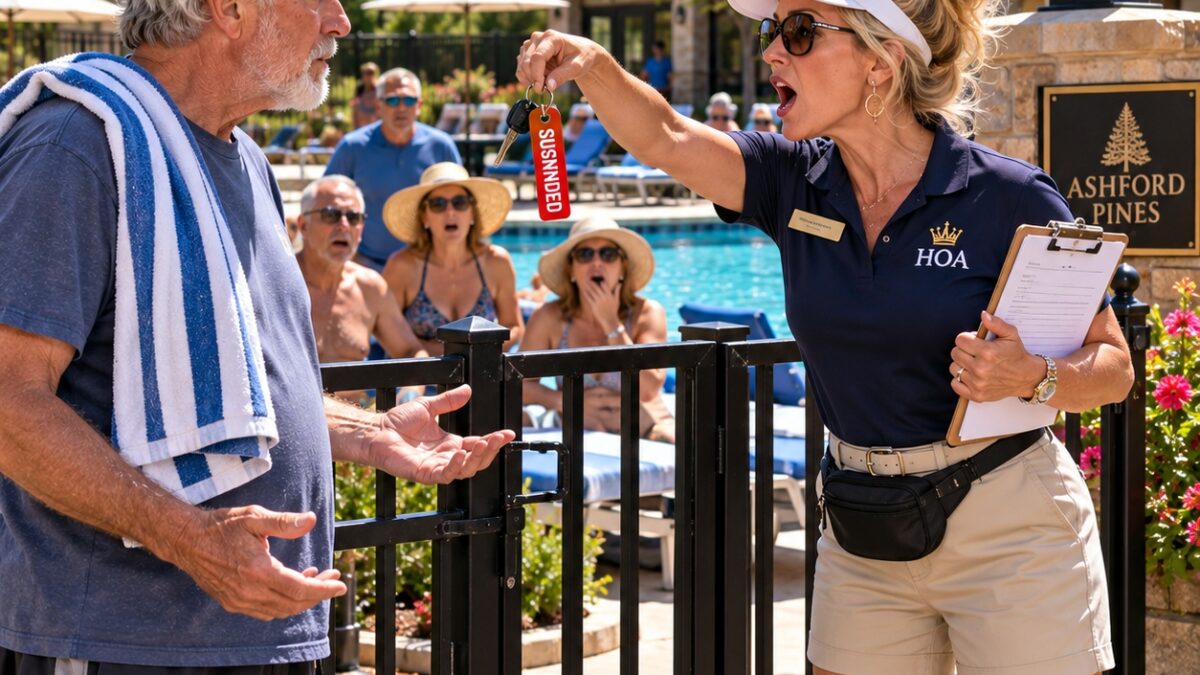
Gus had spent one term on the HOA board twenty years earlier and still possessed an old maintenance access key that had never been replaced because Ashford Pines believed in two things: excessive bureaucracy and terrible lock management.
I had no intention of sneaking into the pool at night and poisoning anything.
The actual stunt that eventually happened was mostly theater.
That is something I want to make clear because the legend became much better than the facts.
By the time local teenagers finished editing video clips, people were claiming I had released ten thousand man-eating piranhas into suburban Pennsylvania water and survived some kind of aquatic siege.
The truth was less dangerous and much funnier.
A local aquarium hobbyist named Reggie helped us create the visual.
A temporary controlled display.
Several real fish in secure, supervised containers placed where Karen would see movement from the deck.
More fake ones beneath the surface.
Remote splashing.
Enough confusion to make a woman expecting perfect pool symmetry suddenly believe nature had filed an appeal.
No swimmers were allowed in.
Gus posted a “maintenance delay” notice early that morning.
And Reggie stayed nearby because unlike Gus and me, Reggie understood fish.
“Your biggest problem,” he told us, “is that you two think you’re clever.”
“We are clever.”
“You’re retired.”
“Same thing.”
“No.”
Still, he helped.
Why?
Because Karen had fined his sister two years earlier for displaying a children’s plastic pool in her driveway for ninety minutes after sunset.
Ashford Pines had a longer memory than Karen realized.
While we prepared, Karen escalated.
New signs appeared around the pool.
ENTRY BY AUTHORIZATION ONLY.
NO PERSONAL BEVERAGES OUTSIDE DESIGNATED AREAS.
NO LOUD SUNSCREEN APPLICATION.
That last one was real.
I read it twice.
Then asked Dave, another board member, what loud sunscreen application meant.
He looked exhausted.
“I don’t know.”
“Did you vote for it?”
He lowered his voice.
“I don’t remember voting for half of these.”
That interested me.
“What do you mean?”
Dave glanced toward Karen’s house.
“She circulates amendments, nobody objects fast enough, then she says silence is consent.”
“That isn’t how board voting works.”
“I know.”
“So why are you letting her?”
He looked at me.
And there it was.
The answer.
Because confronting Karen was unpleasant.
That was the foundation of her authority.
Not law.
Not covenants.
Not elections.
Fatigue.
People surrendered because fighting her required time.
Karen had turned exhaustion into governance.
Once I saw that, the fish prank stopped feeling like retaliation over my key.
It became a trigger.
People needed to see Karen fail publicly.
Not criminally.
Not violently.
Just visibly.
They needed proof that the woman behind the clipboard could lose control of a moment and survive.
Then maybe they could speak.
Linda was already close.
Karen had recently cited her for using an “unauthorized crochet implement” in the clubhouse knitting circle.
“What is an authorized crochet hook?” I asked.
“Apparently one without a glitter handle.”
“Dangerous.”
“Very.”
Mr. Simmons had been warned because his mailbox post leaned four degrees off vertical.
Mrs. Patel had received a notice because Diwali lights remained up forty-eight hours past Karen’s approved seasonal lighting period.
A teenager named Mason had been threatened with a business-license complaint for running a lemonade stand.
One family was fined because their child’s sidewalk chalk “altered the visual character of common-facing concrete.”
People weren’t angry about one big injustice.
They were suffocating under tiny ones.
Karen’s genius, if I can call it that, was keeping every insult small enough to seem silly if challenged alone.
Who wants to hire a lawyer over a flamingo?
Who wants to spend Tuesday night arguing about mailbox lean?
Who wants to look like the unreasonable person screaming about crochet hooks?
So everyone swallowed it.
One by one.
Until the whole neighborhood was living under rules nobody respected.
My stolen key was simply the stupidest example yet.
The day of Karen’s scheduled “emergency pool inspection” gave us the opening.
She loved inspections.
They were theater for her.
Visor.
Clipboard.
Helen from the board.
Dave.
Sometimes a measuring tape.
We had the pool closed before she arrived.
Reggie handled the fish setup.
Gus handled the harmless mechanical splashes.
I handled absolutely nothing technical because both men had correctly concluded I was too excited.
At 9:03 a.m., Karen appeared.
White visor.
Navy shirt.
Clipboard.
Helen walked beside her.
Dave followed like a man being taken to jury duty.
Several neighbors already knew something strange was happening.
Not the full plan.
Just enough to be outside.
Linda positioned her scooter near the sidewalk with a bowl of popcorn.
I asked why.
“I know you.”
Fair.
Karen unlocked the gate.
She entered.
Checked the deck furniture.
Wrote something.
Measured the placement of a trash can.
Wrote something else.
Then she approached the water.
A movement passed beneath the surface.
She stopped.
Another ripple.
Helen leaned toward her.
“What was that?”
Karen bent over.
Something flashed red and silver.
She jumped backward.
“What is in the pool?”
Dave looked at the water.
“I don’t know.”
Another splash.
Karen shrieked.
That sound brought three more neighbors outside.
Then one of Reggie’s visible fish surfaced safely behind the clear barrier in the deep-end display zone.
Karen saw teeth.
That was all she needed.
She dropped the clipboard.
“PIRANHAS!”
Linda nearly fell off her scooter laughing.
Helen backed into a chair.
Dave froze.
Karen pointed at the water.
“WILDLIFE VIOLATION!”
I was standing across the street by then.
More people gathered.
Phones appeared.
Mason, the lemonade kid, started filming.
Karen raised both hands toward the pool like a priest performing an exorcism.
“As president of this homeowners association, I order these animals removed immediately!”
Silence.
Then Gus triggered another splash.
Water hit Karen’s visor.
The visor flew off.
It landed in the shallow end.
The entire crowd gasped.
Then somebody clapped.
I still don’t know who started it.
Maybe Simmons.
Maybe Linda.
One clap.
Then another.
Then laughter.
Not cruel at first.
Disbelief.
Release.
The kind of laughter people make when pressure disappears suddenly.
Karen turned.
Saw me.
Her face changed.
“You.”
I raised both hands.
“Good morning.”
“You did this.”
“Did what?”
“You filled our pool with dangerous animals.”
“Our pool?”
Her eyes narrowed.
I smiled.
“I thought my privileges were suspended.”
More laughter.
Karen marched toward me.
“What have you done?”
“Created a teachable moment.”
“This is vandalism.”
“No damage.”
“Biological terrorism.”
That phrase became famous later.
“That’s dramatic.”
“There are flesh-eating monsters in the pool!”
Reggie muttered behind me, “That is not scientifically accurate.”
Karen spun.
“Who are you?”
“The only person here actually qualified to talk about the fish.”
She looked from him to me.
“You’re finished.”
I had heard that from her before.
This time, nobody looked frightened.
People were grinning.
Recording.
Talking openly.
Karen sensed it too.
That was the moment everything changed.
Not when the fish moved.
When Karen looked around and realized nobody was waiting for permission to laugh.
Animal control eventually came because Karen called everybody with a badge.
So did a county officer.
Reggie explained the setup.
Controlled.
No public exposure.
No swimmers.
No loose dangerous animals roaming a community pool despite what the internet would later claim.
The officer looked at Karen.
Then at me.
Then at the visor floating near the steps.
He tried not to smile.
“Mr. Harper.”
“Yes?”
“Don’t do this again.”
“Fair.”
Karen exploded.
“That is it?”
“No property damage appears to have occurred.”
“What about trauma?”
Linda shouted from her scooter, “My flamingo is still recovering too.”
Even the officer laughed.
That nearly killed Karen.
By noon, the pool was cleared.
Cleaned.
Inspected.
Safe.
The fish display went back with Reggie.
But the videos stayed.
One clip showed Karen commanding the water to obey HOA authority.
Another caught the visor splash.
A third caught her shouting “biological terrorism.”
By dinner, half the neighborhood had seen them.
By breakfast, teenagers had created memes.
PIRANHAS DON’T READ BYLAWS.
SECTION 7B: TEETH PROHIBITED.
SWIM AT YOUR OWN RISK OF COMPLIANCE.
I was mortified.
Gus was delighted.
“You’re famous.”
“I don’t want to be famous.”
“You should have considered that before weaponizing aquatic comedy.”
“We agreed not to call it that.”
“I changed my mind.”
Two days later, Karen called a special HOA meeting.
ACTS OF VANDALISM, ANARCHY, AND FISH-BASED TERRORISM.
The notice was taped to every door.
Gus brought me one.
“She actually wrote fish-based terrorism.”
“I see that.”
“You need to frame this.”
I folded it.
“I need to survive the meeting first.”
I expected a hostile hearing.
Karen expected one too.
What neither of us fully understood was how much resentment had accumulated.
The clubhouse was full before seven.
Every folding chair taken.
People standing along the walls.
Families who had not attended an HOA meeting in ten years were there.
Linda arrived early in her scooter.
Mrs. Patel brought a binder.
Mr. Simmons brought every citation he had received since 2019.
Mason’s mother carried printed copies of the warning letter threatening her son’s lemonade stand.
Even Dave looked different.
Nervous.
But awake.
Karen entered in black slacks and a white blouse.
No visor.
Interesting choice.
She called the meeting to order.
Her prepared statement lasted eleven minutes.
She described the pool stunt as reckless.
Dangerous.
Subversive.
A threat to property values.
She used “aquatic aggression.”
Gus leaned toward me.
“Drink every time she says aquatic.”
“No.”
“Coward.”
Karen demanded disciplinary action against me.
Permanent loss of pool access.
Fines.
Possible legal referral.
When she finished, she expected applause from Helen.
Helen looked at the floor.
Karen looked toward Dave.
Dave cleared his throat.
“We’ll hear resident comments.”
Karen frowned.
“We are not required to—”
“The room requested it.”
“The room doesn’t run board procedure.”
Dave looked at her.
“The board does.”
That was the first crack.
Linda rolled forward.
Everyone knew Linda.
Soft voice.
Church volunteer.
Knitting circle.
The least revolutionary woman in Ashford Pines.
She stopped in front of Karen.
“You fined me because my garden flamingo was pink.”
Karen sighed.
“This meeting is about Elliot.”
“No.”
Linda’s voice changed.
“This meeting is about you.”
Silence.
“You called my flamingo aesthetic pollution.”
Someone snorted.
“You told me my crochet hook wasn’t approved.”
Laughter.
“You sent me three notices because my Christmas wreath was still up on January fifth.”
Karen crossed her arms.
“These rules apply equally.”
“They don’t.”
Linda pointed toward Karen.
“You have twelve decorative gnomes in your yard.”
“Those comply.”
“Because you approved your own gnomes.”
Applause.
Karen struck the table.
“Order.”
Mr. Simmons stood next.
“My mailbox.”
Karen closed her eyes.
“It leaned.”
“Four degrees.”
“The standard is vertical.”
“It survived forty winters until you discovered geometry.”
More laughter.
Mrs. Patel stood.
She described the Diwali light citation.
Another man described being fined because his trash can remained visible nine minutes after the collection window.
A young mother described receiving a notice about chalk flowers drawn by her six-year-old.
One family had been warned because a basketball hoop was “visually inconsistent with mature residential identity.”
Another because wind chimes exceeded approved decibel levels.
Then Mason’s mother held up the lemonade complaint.
“My son was eleven.”
Karen answered, “Neighborhood commercial rules—”
“He made fourteen dollars.”
“The amount is irrelevant.”
“No.”
She looked around the room.
“That’s your whole problem.”
Karen stared.
“You make people irrelevant.”
That landed harder than the jokes.
The laughter stopped.
Then Gus stood.
Gus rarely spoke at meetings.
He preferred sarcasm from safe distances.
That night he spoke quietly.
“Elliot’s stunt was ridiculous.”
I looked at him.
He shrugged.
“It was.”
People laughed.
“But look around.”
He pointed at the room.
“When was the last time this many residents came here?”
Nobody answered.
“We’ve been living like inmates.”
Karen rolled her eyes.
“Oh, please.”
“Mailbox angle.”
He held up one finger.
“Flamingos.”
Second finger.
“Chalk.”
Third.
“Crochet hooks.”
Fourth.
“Coffee before nine.”
That one made people angry.
He pointed toward me.
“He did not put us under this system.”
Then toward Karen.
“You did.”
Karen stood.
“I was elected.”
A voice from the back answered.
“So was every person who ever got voted out.”
The room reacted.
Karen looked at Dave.
He was pale.
But he stood.
“Karen.”
“What?”
“The board met before tonight.”
Her face froze.
“With whose authority?”
“Mine as vice president.”
“You cannot hold a board meeting without me.”
“We reviewed the bylaws.”
She laughed sharply.
“You reviewed them?”
“Yes.”
Helen finally spoke.
“I was there.”
Karen turned toward her.
“You?”
Helen swallowed.
“Yes.”
Dave picked up a paper.
“The board voted four to one.”
Karen’s voice became very quiet.
“On what?”
“To remove you as president.”
Nobody moved.
For once, even Gus stopped joking.
Karen looked at the room as though waiting for somebody to say this was theater.
Dave continued.
“Effective immediately.”
Her mouth opened.
Closed.
“You cannot do that.”
Dave had spent years shrinking whenever she raised her voice.
That night, he didn’t.
“We just did.”
She looked toward Helen.
Helen didn’t meet her eyes.
Then toward the residents.
Folded arms.
Still faces.
No rescue.
Karen pointed at me.
“He caused this.”
Linda answered.
“No.”
Karen turned.
“You caused it.”
The meeting exploded into applause.
Karen grabbed her bag.
“You will regret this.”
She walked out.
The door slammed.
For several seconds nobody spoke.
Then Mason yelled:
“FREE THE FLAMINGOS!”
I laughed so hard I had to sit down.
The HOA did not disappear.
That would have been unrealistic.
Ashford Pines still needed common-area maintenance.
Pool insurance.
Landscaping.
Road contracts.
Budgeting.
Rules.
What changed was the understanding that rules were supposed to serve residents, not entertain whoever held the clipboard.
Dave became interim president.
His first board meeting lasted forty-two minutes.
Karen’s meetings had averaged three hours.
“That alone gets my vote,” Simmons said.
They reviewed enforcement procedures.
No new rule without recorded vote.
No self-approved exceptions.
No confiscation of resident property without proper authority.
Clear appeal process.
Reasonable recreation policies.
My permanent pool-access clause was acknowledged in writing.
Dave personally returned my key.
No fluorescent tag.
He handed it over.
“I believe this is yours.”
I looked at it.
“Are you sure? My chair may wander.”
“Control it.”
“I’ll try.”
Three days later, the pool reopened.
No fish.
No spectacle.
Just children.
Parents.
Old people.
Sunlight.
Gus wore flamingo swim trunks.
Karen had once attempted to ban them under a rule regarding “provocative novelty graphics.”
Nobody stopped him.
I put my lounge chair beside Lane Three.
Crooked on purpose.
Then swam ten laps.
Nobody timed how long it remained unattended.
When I returned, Linda had placed a pink flamingo towel over it.
“Approved?” I asked.
She smiled.
“By me.”
The videos escaped Ashford Pines.
Of course they did.
A local station aired one.
Then another.
Teenagers made edits.
Someone put Karen’s “aquatic aggression” speech over dramatic movie music.
I hated all of it.
Gus sent me every clip.
“Stop.”
“No.”
“I’m serious.”
“So am I.”
One afternoon, a teenager at the grocery store stared at me.
“Are you the fish guy?”
I sighed.
“My name is Elliot.”
“Legend.”
“I bought oatmeal.”
He asked for a selfie.
I refused.
He took one with Gus two days later instead.
Gus began introducing himself as “strategic aquatic consultant.”
I considered ending the friendship.
The neighborhood settled.
Not perfectly.
There were disagreements.
People still complained about noise.
Dogs escaped.
Trash cans stayed out.
Children drew on sidewalks.
The difference was proportion.
A problem became a conversation before it became a citation.
A rule required a reason.
The board stopped confusing property values with human value.
Helen came to my house with a lemon meringue pie.
She stood on the porch awkwardly.
“I owe you an apology.”
“For what?”
“I supported her.”
“So did other people.”
“I knew some rules were ridiculous.”
“That doesn’t make you unique either.”
“I stayed quiet.”
That mattered more.
I took the pie.
She continued.
“I thought that was easier.”
“It was.”
She looked surprised.
I nodded.
“Silence usually is.”
“For a while.”
“Exactly.”
She smiled.
Then said, “Thank you.”
“For embarrassing a former HOA president with fish?”
“For reminding us we were allowed to say no.”
That sat with me.
Because people told the story afterward as though I defeated Karen.
I didn’t.
A prank embarrassed her.
The neighborhood removed her.
Those are different things.
If everybody had gone back to silence afterward, Karen would have recovered.
Maybe doubled down.
Maybe convinced enough people that I was unstable.
The stunt was only a crack in the wall.
Residents had to walk through it.
Several months passed before I heard from Karen again.
I came home one afternoon and found an envelope beneath my door.
No stamp.
My name in tight handwriting.
I recognized it immediately.
Inside was one page.
Elliot,
I hope you are pleased with yourself.
That opening told me everything.
Karen had moved.
A development called Serenity Glen.
She proudly informed me she was helping establish a new HOA.
“A community committed to standards.”
Apparently, she had learned nothing.
Then came the last line.
Visors will be mandatory at all outdoor compliance events.
I sat at the kitchen table laughing.
Margaret left the room.
Gus arrived twenty minutes later.
I handed him the letter.
He read it.
“Serenity Glen.”
“Yes.”
“That sounds threatening.”
“Apparently they have standards.”
“Do they know?”
“About Karen?”
“About the fish.”
“I hope not.”
He handed it back.
“What will you do?”
“Nothing.”
“Nothing?”
“She doesn’t live here anymore.”
“But another neighborhood—”
“Gus.”
“What?”
“We are not traveling across the state conducting anti-HOA interventions.”
He looked disappointed.
“Seems selfish.”
I folded the letter.
“Serenity Glen has to save itself.”
Then I wrote RETURN TO SENDER across the envelope.
That was enough.
Ashford Pines became lighter after Karen left.
Not lawless.
Lighter.
People organized porch concerts.
Children held lemonade stands without filing corporate documents.
Linda brought her flamingo back.
Then another.
Then five.
Her yard looked ridiculous.
Good.
The knitting group met in the clubhouse.
Glitter crochet hooks everywhere.
Mrs. Patel joined the HOA committee and somehow transformed the holiday-decoration policy into one sentence:
Be reasonable.
It passed unanimously.
Mason painted a small piranha on the community bulletin board.
Dave made him remove it because technically you still cannot paint public property without approval.
Fair.
So they framed the drawing instead.
It hung beside the pool rules.
Someone added a brass label.
THE FISH THAT FREED ASHFORD PINES.
I objected.
Nobody cared.
I kept swimming.
Ten laps.
Same time.
Same lane when available.
My chair occasionally sat unattended longer than thirteen minutes.
Civilization survived.
One morning, Dave met me outside the pool.
“Can I ask something?”
“Sure.”
“Why fish?”
I laughed.
“No clue.”
“Seriously.”
“I was angry.”
“You could have sued.”
“Over a key?”
“You had access rights.”
“I could have filed another appeal.”
“Why didn’t you?”
I looked through the fence.
Several children were playing with foam noodles.
Linda sat under an umbrella.
Gus was pretending to stretch.
“The rules were never the real problem.”
Dave waited.
“The problem was everyone had forgotten they could laugh at her.”
He nodded slowly.
“Humor.”
“Authority hates ridicule when authority depends on theater.”
He smiled.
“That sounds like something you rehearsed.”
“I had coffee.”
Then he asked:
“Would you do it again?”
I considered that seriously.
“No.”
He looked surprised.
“Really?”
“Too complicated.”
“And ridiculous?”
“Extremely.”
“And irresponsible?”
“Possibly.”
“Then why do you sound proud?”
“I’m proud of what happened afterward.”
That was the truth.
The prank itself was stupid.
Memorable.
Funny.
But stupid.
The meeting mattered.
The testimonies mattered.
Dave standing up mattered.
Helen changing sides mattered.
Linda speaking mattered.
People discovering that their private frustration was shared mattered.
Karen’s power hadn’t come from a clipboard.
It came from isolation.
She kept every dispute individual.
Elliot versus the chair rule.
Linda versus the flamingo rule.
Mason versus the lemonade rule.
Patel versus the lights.
Simmons versus the mailbox.
Everyone thought they were the only unreasonable person.
Then one ridiculous morning at a pool made them all stand together.
That was the real event.
Years of pressure becoming visible at once.
I thought about that often.
My generation was raised to avoid making scenes.
Be polite.
Handle your business.
Don’t embarrass yourself.
Good rules.
Usually.
But politeness can become an accomplice when somebody weaponizes it.
Karen counted on people being too embarrassed to protest absurdity.
Nobody wanted to say:
This is insane.
So the insanity acquired subsection numbers.
One Friday evening, Ashford Pines held its first community barbecue under the new board.
No dress code.
No seating chart.
No laminated FAQ.
I grilled burgers.
Because yes, Karen, I will barbecue in my driveway if I feel like it.
Gus controlled the music.
Badly.
Linda brought pie.
Mrs. Patel organized tables.
Mason operated a lemonade stand.
He made ninety-two dollars.
Dave bought two cups.
At sunset, someone asked me to make a speech.
I refused.
They booed.
Gus grabbed a plastic cup.
“I’ll speak.”
“No.”
Too late.
He raised it.
“To Elliot.”
Groans.
“To bad ideas.”
More applause.
“To fish.”
Children cheered.
“And most importantly, to never letting one person convince an entire neighborhood that being miserable is the same thing as being well managed.”
That was actually pretty good.
I hated that he had said it instead of me.
We drank.
Even me.
Later, when everybody went home, I returned to my porch.
Margaret jumped onto the railing.
The pool area was quiet in the distance.
No special signs.
No inspection patrol.
No one measuring anything.
I drank coffee even though it was night because retirement removes consequences.
I thought about Karen.
Not angrily.
Mostly curiously.
People like her fascinate me.
She wanted control because control looked like respect.
She wanted compliance because compliance looked like admiration.
She wanted people to fear citations because fear looked like authority.
But the minute people stopped pretending, all that power disappeared.
No army.
No empire.
Just a woman with a clipboard standing in a clubhouse while neighbors voted.
That should have happened years earlier.
It didn’t because everyone waited for somebody else.
Apparently, I became somebody else.
With fish.
My daughter called the week after the story hit local news.
“Dad.”
“Hi, sweetheart.”
“Did you put piranhas in your HOA pool?”
“Define put.”
“Dad.”
“Nothing dangerous happened.”
“That is not an answer.”
“It was controlled.”
“Gus was involved.”
“That is worse.”
She sighed.
“You’re sixty-eight.”
“I am aware.”
“You’re supposed to be calming down.”
“Who decided that?”
“Society.”
“I don’t recognize its authority.”
She started laughing.
Then tried to stop.
“I’m serious.”
“I know.”
“Promise me no more fish.”
“I promise.”
“No reptiles.”
“That feels unrelated.”
“Dad.”
“Fine.”
“No exotic birds.”
“Now you’re just limiting my retirement.”
She called me an idiot.
Affectionately.
Then asked whether I got my pool key back.
I held it up even though she couldn’t see.
“Yes.”
“Worth it?”
I looked at the neighborhood.
Kids riding bikes.
Linda’s flamingos.
Mrs. Patel’s lights.
Gus waving from across the street.
“More than the key.”
She understood.
“Okay.”
Then:
“I still think you’re insane.”
“Runs in the family.”
“Goodbye, Dad.”
I smiled after we hung up.
The truth was, I knew how close righteous anger can come to becoming self-righteousness.
That was why I tried not to turn the story into proof I was always right.
I wasn’t.
I had participated in a ridiculous stunt because somebody stole my key.
That is not exactly Gandhi.
The difference was what came next.
When Karen fell, I didn’t take her chair.
I didn’t run for president.
Gus tried to nominate me.
I threatened to move.
The board asked whether I wanted an advisory position.
“No.”
“Why?”
“I want to swim.”
Simple.
Power was never what I wanted.
That was another difference between Karen and me.
She thought victory meant controlling the neighborhood.
I thought victory meant not having to think about the neighborhood rules every morning.
Freedom is often boring.
That is why it is wonderful.
No drama.
No inspection.
No fluorescent SUSPENDED tag hanging from your own key.
Just coffee.
Cat.
Pool.
Roses.
One year after Karen left, Ashford Pines held another election.
Real turnout.
People debated budgets.
Maintenance.
Insurance.
Nobody mentioned flamingos except Linda, who asked for written confirmation that hers remained legal.
They did.
Dave chose not to run again.
Mrs. Patel became president.
Her first announcement was:
“I have no interest in knowing how tall your grass is unless snakes start paying dues.”
She was very popular.
She also created an enforcement rule requiring two board members to approve any fine above a small threshold.
No single-person punishment.
Complaints had to cite actual covenant language.
Warnings came before penalties except in true safety issues.
Meeting minutes were posted publicly.
Simple transparency.
Karen had made basic governance feel revolutionary.
Sometimes failure teaches institutions exactly what should have been obvious.
I watched all of it from a safe distance.
One Sunday, Linda parked her scooter beside my porch.
She handed me a small package.
“What is this?”
“Open it.”
Inside was a new coffee mug.
BEST AQUATIC TERRORIST GRANDPA.
I stared at her.
“I hate this.”
“Good.”
“I will never use it.”
The next morning, I used it.
Gus took a picture.
Traitor.
It ended up on the bulletin board.
ASHFORD PINES HERITAGE.
We were becoming unbearable.
But peaceful.
And that is what mattered.
People sometimes ask whether Karen ever came back.
Not physically.
Not while I lived there.
Once, a letter arrived from Serenity Glen’s new board.
I assumed she had sent it.
Instead, it was from a man named Robert.
He had apparently searched Karen’s name after she began proposing a set of strict neighborhood appearance regulations.
The fish video appeared.
So did news about her removal.
He wrote:
Mr. Harper,
I don’t know whether the story is exaggerated, but thank you for the warning.
Our board has decided all rule changes require open resident vote.
No offense, but please do not send fish.
I laughed for five minutes.
Then wrote back:
Robert,
Glad to hear it.
No fish planned.
Keep your bylaws boring.
Sincerely,
Elliot.
Maybe that was Karen’s final contribution to the world.
She accidentally became a cautionary tale.
Not the legacy she wanted.
But legacies are funny.
You don’t always control which part people remember.
Karen wanted people to remember standards.
They remembered the visor.
She wanted obedience.
They remembered “aquatic aggression.”
She wanted Ashford Pines to look perfect.
What people remembered was the year it finally became pleasant.
As for me, I returned to normal life.
Mostly.
Morning coffee.
Pool.
Roses.
Margaret continued judging everyone.
Gus continued existing despite my best efforts.
Sometimes I left the lounge chair unattended for exactly fourteen minutes out of principle.
Nobody noticed.
Perfect.
One summer evening, I walked past the pool and saw a new family sitting together.
Young parents.
Two little boys.
They had moved into Karen’s former house after she sold it.
The father waved.
“Mr. Harper?”
“Yes?”
“Is it true?”
“That depends.”
“The fish?”
I sighed.
“Parts of it.”
The boys stared at me.
“Were there really ten thousand?”
“No.”
“Were they really piranhas?”
I looked at their father.
He was trying not to laugh.
“There were enough fish to teach adults not to believe everything on TikTok.”
The boys looked disappointed.
One asked:
“Did they bite Karen?”
“No.”
“Aw.”
“That’s good.”
He thought about it.
Then nodded.
“Did she really yell at them?”
“Yes.”
His eyes widened.
“She yelled at fish?”
“Yes.”
“That’s weird.”
“Correct.”
His father laughed.
Then said:
“We moved here because my wife liked how friendly everyone seemed.”
I looked around.
Kids playing.
Music from someone’s backyard.
Linda’s flamingos glowing pink in the sunset.
“That took work.”
“I heard.”
He smiled.
“Thank you.”
I never knew what to say to that.
I hadn’t saved anyone.
I had simply stopped accepting something everyone hated.
Maybe that was enough.
I walked home.
The porch light was on.
My roses needed pruning.
Margaret waited by the door.
I sat in the old chair.
The same chair where Karen had first marched up with that clipboard.
The same porch where I had looked at Gus and proposed the stupidest protest of my life.
I thought about the key.
Such a small object.
Metal.
Cheap.
Replaceable.
Karen thought taking it would remind me that she controlled access.
Instead, it reminded me that I had spent too long allowing another person to define what I was entitled to question.
She stole a key.
She lost a presidency.
Not because the punishment fit the offense.
Because the key exposed everything beneath it.
The selective enforcement.
The fear.
The fatigue.
The silent resentment.
The absurdity.
By confiscating something petty, she forced everyone to look at the larger pattern.
That was her mistake.
Bullies often survive because each individual act seems too small to fight.
One fine.
One warning.
One insult.
One stolen morning.
One lounge chair.
One pool key.
But small things accumulate.
People remember.
And sometimes resistance begins over something almost embarrassingly trivial.
A pink flamingo.
A glass of lemonade.
A crooked mailbox.
A chair left alone for twenty-two minutes.
The trigger doesn’t have to be grand.
It only has to arrive after everyone has finally had enough.
That night, Gus came over with two sodas.
He sat beside me.
We watched the streetlights come on.
“You miss it?” he asked.
“What?”
“The excitement.”
“No.”
“Not even a little?”
I looked toward the quiet pool.
“No.”
He nodded.
“Me neither.”
A beat passed.
“Reggie says he can get an alligator.”
I turned slowly.
Gus grinned.
I pointed toward the street.
“Go home.”
“Just asking.”
“Go.”
“Tiny alligator.”
“Gus.”
“Educational.”
I stood.
He ran laughing down the steps.
Margaret watched him leave.
Then looked at me.
“I know.”
I picked up my mug.
“Bad influence.”
The neighborhood was quiet again.
The good kind.
Not silence caused by fear.
Silence caused by nobody needing to fight.
I took another sip.
The pool key rested on the table beside me.
No fluorescent tag.
No suspension notice.
No hearing date.
Just a key.
Exactly as important as a key should be.
And that may have been the best part.
Karen wanted every ordinary thing to become proof of authority.
A chair.
A sign.
A visor.
A key.
A rule.
We eventually returned them to their proper size.
A chair became somewhere to sit.
A pool became somewhere to swim.
A board became neighbors doing boring administrative work.
A rule became something people understood and agreed to.
And a key became a key.
That was freedom in Ashford Pines.
Not fireworks.
Not rebellion.
Not even fish.
It was ordinary life no longer requiring permission.
I looked toward the clubhouse.
Someone had left the lights on.
Probably Dave.
Some things never improve.
I smiled.
Then I went inside.
The next morning, at 7:04, I carried my coffee to the pool.
The sun had barely cleared the rooftops.
I put my lounge chair down.
Went for my swim.
Ten laps.
Slow.
Quiet.
When I came back, the chair was exactly where I had left it.
Twenty-seven minutes unattended.
No tag.
No clipboard.
No Karen.
I sat.
Closed my eyes.
And listened to the neighborhood waking up around me.
For the first time in years, nobody was afraid of getting fined for being alive.