FULL STORY:The HOA Queen Sent Armed Guards to Evict Me From Grandpa’s Cabin—She Never Checked the 1963 Survey Under Her $2 Million Marina
FULL STORY CONTINUATION
Inside was a yellowed survey dated 1963.
Under it were deeds.
Plat maps.
County correspondence.
And a small leather notebook I had seen Grandpa carry hundreds of times when I was a kid.
I unfolded the survey carefully.
The paper smelled old.
The ink had faded around the edges, but the lines were clear.
Then I saw the signature at the bottom.
Prepared by George Porter, Registered Land Surveyor.
Grandpa.
I knew he had done surveying work when he was younger.
I never understood that he had surveyed the original Pinewood parcels himself.
I spread the HOA’s modern map beside his.
They were not slightly different.
They were fundamentally different.
According to Grandpa’s recorded survey, Lot 67—our lot—extended all the way to the shoreline and included roughly seventy feet of lake frontage.
The cove beside it was part of the same water-access rights attached to the deed.
Our cabin was not encroaching fifty feet onto HOA property.
If anything, the HOA had pushed into ours.
My eyes moved toward the window.
Toward the enormous new dock.
“No way.”
I read it again.
Same result.
Then I opened Grandpa’s notebook.
At first it was technical.
Bearings.
Elevations.
Drainage.
Markers.
Then the entries changed.
May 12.
Doris Clark visited. Offered to purchase Lot 67. Far below market value. Refused. She mentioned “upcoming compliance problems.”
August 3.
Unauthorized camera installed on pine near eastern line. Reported. Removed after complaint.
December 17.
HOA claims dock violates setback adopted this year. Dock predates rule by more than two decades.
Another entry.
Doris says shoreline redevelopment will happen “with or without stubborn owners.”
I stopped reading.
My hands had started shaking.
Grandpa had been fighting her for years.
The worn porch.
The half-repaired deck.
The folders.
The notes.
I had thought those were signs of age.
Some of them were.
Others were evidence.
Shanley returned that evening.
I showed him the notebook.
He sat quietly on Grandpa’s porch.
“I knew they were pressuring him.”
“You knew this much?”
“No.”
He touched one page gently.
“George didn’t talk about the worst of it. Didn’t want people worrying.”
“Did it hurt him?”
Shanley looked at me.
“He was ninety-two, Carwin. Everything hurt him.”
That wasn’t the answer.
He knew it.
Finally, he sighed.
“Yes.”
I looked toward the water.
“He thought if he gave in, Doris would take every old property on this shore.”
“Was he right?”
Shanley gave me a sad smile.
“You’re an accountant.”
“What does that mean?”
“Follow the pattern.”
So I did.
The next morning, I started with county records.
Lot 67.
George Porter.
Recorded deeds.
Amendments.
Assessments.
Easements.
Anything tied to Pinewood Lake.
Then a woman walked along the tree line north of my cabin carrying a camera.
I stepped outside.
“Can I help you?”
She looked up.
“You must be Carwin.”
“That depends on who’s asking.”
She smiled.
“Era Finley.”
She gestured toward the neighboring property.
“I own the place north of you.”
“You with the HOA?”
She actually laughed.
“Oh, absolutely not.”
“Good answer.”
“I’m an environmental lawyer.”
That changed things.
“And I’ve been fighting Doris Clark for two years.”
I invited her onto the porch.
She reviewed Grandpa’s survey.
Then the deed.
Then the notebook.
Her expression became increasingly serious.
“Where did you get these?”
“Bookshelf.”
“You may have just found the most valuable bookshelf in Wisconsin.”
I smiled.
“Are these good?”
“Good?”
She turned the survey toward me.
“Carwin, assuming the recorded chain confirms what I’m seeing, the HOA’s claim against your cabin is nonsense.”
She pointed to the cove.
“And this is worse for them.”
“What?”
“That new community marina.”
“Dock.”
“Call it whatever you want. It’s built inside the water-access area attached to your parcel.”
I stared.
“They built it on my property?”
“Possibly over your riparian zone, yes.”
“That sounds expensive.”
“It can be.”
She looked toward the lake.
“Especially when the dock exists to support the development Doris has been pitching.”
“You know about the condos?”
“Everybody who has challenged her knows about the condos.”
Era explained.
Doris had created Pinewood Development Corporation two years earlier.
The plan called for high-end condominiums across the cove.
Private lake access.
Boat slips.
Expanded marina infrastructure.
Projected value: roughly two million dollars in the first phase, possibly more later.
There was one problem.
Access.
The best deep-water channel crossed directly through the cove tied to Grandpa’s property.
“Your grandfather was in the way,” Era said.
“And now I’m in the way.”
“Yes.”
“What happens if I leave?”
“Doris consolidates her claim, calls the property abandoned or noncompliant, forces a sale if she can create enough liens, and her development company eventually acquires it cheap.”
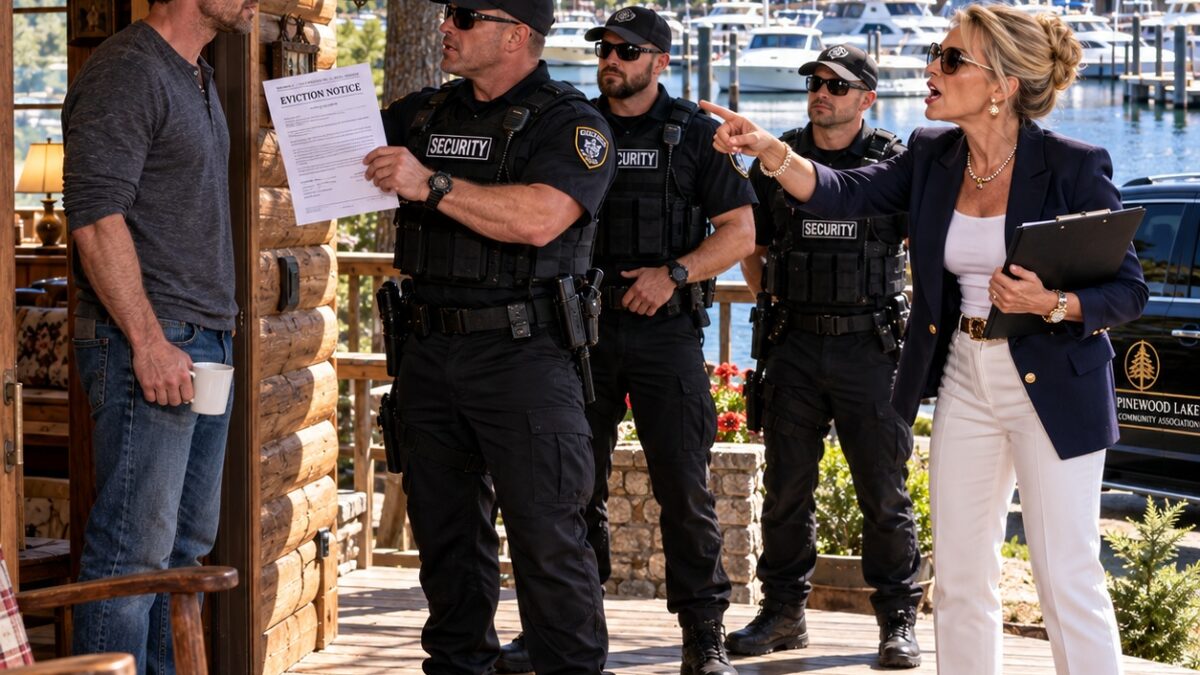
I looked at the armed eviction notice.
It suddenly made perfect sense.
This wasn’t an HOA dispute.
It was leverage.
“Why hasn’t somebody stopped her?”
Era looked away.
“People tried.”
“What happened?”
“Some sold.”
“Some?”
“Some got tired.”
“That’s not an answer.”
She looked back at me.
“Doris does not rely on one tactic.”
Era started counting.
“Fines. Utility problems. contractor complaints. permit challenges. anonymous reports. security patrols. legal letters. code enforcement. social pressure.”
“Against people who won’t sell?”
“Usually.”
I thought of Grandpa.
“He documented everything.”
“Good.”
Era tapped the notebook.
“Because people like Doris survive by making each incident look isolated.”
I knew exactly what she meant.
Fraud worked the same way.
One irregular payment could be error.
Twenty irregular payments sharing a pattern were evidence.
That afternoon, Doris Clark came to meet me personally.
She arrived in a white SUV so clean it looked allergic to gravel.
Cream suit.
Perfect hair.
Two assistants carrying clipboards.
Doris walked directly onto my deck without asking.
Snap.
Her phone photographed the railing.
Snap.
The boat.
Snap.
My bird feeder.
“Mr. Porter.”
“Ms. Clark.”
“We’re conducting a compliance inspection.”
“On private property?”
“HOA authority.”
“Show me.”
She ignored that.
“Your deck railing appears noncompliant.”
“It’s Grandpa’s original railing.”
“That does not make it safe.”
“The boat?”
“Unregistered with the community.”
“The bird feeder?”
She looked at it as though personally offended.
“Potential nuisance wildlife attractant.”
I almost admired the creativity.
Then she pointed toward the tree line.
“We’ve also installed additional community security cameras because of recent concerns.”
I followed her finger.
A small black camera sat high on a pine.
Pointed directly toward my bedroom window.
I felt my temper rise.
“Take that down.”
“Community safety equipment.”
“Take it down.”
Her expression hardened.
“Mr. Porter, you inherited an unusual parcel. The cleanest solution would be for you to cooperate.”
“With what?”
She gestured toward the cabin.
“Vacate until the boundary issue is resolved.”
I went inside and returned with a photocopy of Grandpa’s survey.
“I found this.”
For the first time, Doris lost control of her face.
Barely.
Half a second.
Then she recovered.
“That is obsolete.”
“According to what?”
“Later development documents.”
“I’d like copies.”
“They’re available through proper request channels.”
“Which documents supersede the deed?”
She smiled again.
“I’m not going to conduct a legal seminar on your porch.”
“No.”
I smiled back.
“You seem more comfortable conducting photography seminars.”
One assistant looked down to hide amusement.
Doris noticed.
“Fines accumulate daily.”
“I understand.”
“I strongly recommend compliance.”
“I strongly recommend you stop trespassing.”
Her smile disappeared.
She turned and walked away.
Her assistants followed.
Before leaving, one photographed my mailbox.
Five minutes later, I called the county assessor.
Twenty minutes after that, I learned something Doris either did not know or hoped I never would.
Grandpa had requested a complete reassessment six months before his death.
The county finished it three weeks before he passed.
The final record confirmed the original parcel boundaries.
Seventy feet of shoreline.
Associated riparian rights.
Original deed references intact.
No recorded conveyance transferring the cove to the HOA.
I asked the clerk to send me certified copies.
Then I called Era.
She arrived thirty minutes later.
After reading the reassessment summary, she leaned back.
“This is very bad for Doris.”
“How bad?”
Era pointed toward the marina.
“She has investors relying on lake access she may not control.”
I smiled.
“So the eviction isn’t because I’m on HOA land.”
“No.”
“She needs me off mine.”
“Yes.”
That evening, three HOA board members walked through my garden.
No permission.
No knock.
One photographed the cabin.
Another tugged on my locked shed.
The third stepped directly through Grandma’s old flower bed.
I recorded all of it.
The next morning, I installed cameras.
Not spy equipment.
Ordinary security cameras.
Driveway.
Deck.
Tree line.
Dock.
Shed.
I mounted signs.
PRIVATE PROPERTY.
VIDEO RECORDING IN USE.
If Doris wanted documentation, I would give her documentation.
That night I returned to Grandpa’s notebook.
Near the back, I found an envelope.
FOR CARWIN.
WHEN THE HOA COMES KNOCKING.
I sat there holding it for a long time.
Then I opened it.
Carwin,
If you’re reading this, Doris finally decided patience was cheaper than honesty.
I fought them as long as I could.
They want this land because of the cove.
The truth is in the surveys, county records, photographs, and every note I kept.
Don’t let anger make you careless.
You see through numbers.
Use that.
And remember something I learned surveying land for forty years:
Most people lie with words.
Property lies are harder.
Eventually somebody has to draw the line.
Love,
Grandpa.
I read it three times.
The last line broke me.
Eventually somebody has to draw the line.
He had.
In 1963.
With ink.
And Doris had spent years pretending it wasn’t there.
The county’s certified package arrived the following morning.
I opened it on Grandpa’s kitchen table.
Final Property Assessment.
Lot 67.
Shoreline ownership confirmed.
Recorded water-access rights intact.
I laughed.
Actually laughed.
Not because the fight was over.
Because for the first time, I knew exactly where I stood.
Literally.
Then I noticed another note in Grandpa’s journal.
Sometimes you need to see what happens when people think you aren’t looking.
I had no idea what it meant.
Until Shanley visited that evening.
He carried an old wooden wall clock.
“George left this with me.”
I recognized it immediately.
It had hung in the cabin hallway when I was a kid.
“Why do you have Grandpa’s clock?”
“He gave it to me last year.”
Shanley handed it over.
“Said if things got ugly, you’d know what to do.”
I flipped it around.
The back panel had been modified.
Behind a small opening sat a camera module.
A hidden camera.
“Grandpa?”
Shanley smiled faintly.
“Your grandfather trusted technology more than people thought.”
Inside was a memory card.
I inserted it into my laptop.
The first clip showed HOA inspectors entering the cabin while Grandpa was away.
No warrant.
No emergency.
They photographed drawers.
Opened mail.
Looked inside cabinets.
Another clip showed Doris.
She stood in Grandpa’s living room with a man I didn’t recognize.
“He’s too old to fight forever,” she said.
The man asked, “What if the grandson wants it?”
Doris laughed.
“Then we bury him in violations until he sells.”
My skin went cold.
Another clip.
Doris again.
“Once George is gone, we clear the lot fast.”
I paused the video.
Era stared at the frozen image.
“Do you understand what you have?”
“Yes.”
“Tell me.”
“A woman who just lied to me on my porch about compliance.”
“No.”
Era leaned closer.
“You have intent.”
That was the difference.
Trespassing was bad.
Harassment was bad.
Boundary fraud was bad.
But the video connected them.
Grandpa wasn’t paranoid.
He had been targeted.
And I was next.
The monthly HOA meeting happened the following evening.
I arrived carrying certified county documents, the deed chain, photographs, copies of Grandpa’s survey, and the eviction notice.
Doris sat at the front beside six board members.
I recognized two of the men who had walked through my garden.
When homeowner comments opened, I stood.
“Carwin Porter. Lot 67.”
Doris immediately interrupted.
“Boundary disputes are legal matters and will not be discussed in public session.”
I opened the bylaws.
“Section 7.3 allows discussion when a property dispute affects association-owned or association-operated community resources.”
Several people looked up.
“What community resource?” a man asked.
I pointed toward the lake.
“The dock.”
Doris’s jaw tightened.
I continued.
“The HOA has been operating and apparently renting boat space on a dock built partly within the riparian area attached to Lot 67.”
Murmurs.
Someone behind me whispered, “Renting?”
I held up the certified assessment.
“This is the county’s final recorded assessment completed three weeks before my grandfather died.”
Doris looked at the board.
“It is being contested.”
“By whom?”
No answer.
“It confirms seventy feet of shoreline and associated water access.”
I handed copies to the nearest board member.
“The HOA has also issued an eviction notice claiming my cabin sits fifty feet inside community property.”
More murmurs.
“That allegation does not match county records.”
Doris slammed her pen on the table.
“Mr. Porter is presenting incomplete historical documents.”
“Then show everyone the complete ones.”
Silence.
I continued.
“I’m also documenting unauthorized entry, surveillance, and trespassing.”
Her face reddened.
“This meeting is becoming disruptive.”
“I’m finished.”
I sat.
Doris adjourned ten minutes later.
As people left, an older woman whispered to me.
“Finally.”
Another man gave me a quiet thumbs-up.
I drove home realizing something important.
Doris wasn’t feared because everyone believed her.
She was feared because everyone believed they were alone.
The next morning, my electricity stopped.
Then the water.
A red notice was taped to the cabin door.
EMERGENCY INFRASTRUCTURE REPAIRS.
ESTIMATED DURATION: TWO TO FOUR WEEKS.
ORDERED BY PINEWOOD LAKE COMMUNITY ASSOCIATION.
I called the utility provider.
They had no emergency outage.
Service had been suspended after an HOA request involving “unsafe infrastructure.”
I laughed.
Not because it was funny.
Because Doris had finally become predictable.
Era came over.
“She did this to the Hendersons.”
“Who?”
“Family on the east ridge. Last year.”
“What happened?”
“Utilities. fines. blocked driveway.”
“They sold?”
“After eleven days.”
I looked at the red notice.
“Then Doris is about to discover something.”
“What?”
“I’m an accountant.”
Era waited.
“That sounded less intimidating than you probably intended.”
“I hate hotels.”
She laughed.
We drove into town.
Solar panels.
Portable battery system.
Generator.
Water tank.
Filtration equipment.
By sunset, Grandpa’s cabin had lights.
I stood on the porch drinking coffee.
Across the road, one of Doris’s security SUVs slowed.
I raised the mug.
The driver kept going.
The next morning, I marked the actual property line.
Solar lights.
Orange stakes.
Laminated survey references.
And because HOA inspectors seemed incapable of respecting signs, I added motion-activated sprinklers along the garden and tree line.
Legal.
Harmless.
Extremely satisfying.
At 11:17, Doris’s assistant walked onto the property carrying a camera.
The sprinkler activated.
She screamed.
I watched from the porch.
“Private property,” I called.
She ran back toward the SUV dripping wet.
For the first time since I arrived, I enjoyed myself.
Then my camera alert came.
Another feed.
Back yard.
Doris.
Two men.
They entered my shed.
One opened drawers.
Another photographed files.
Then I heard Doris clearly.
“Take anything that looks official.”
I turned up the volume.
“He’s bluffing. I want every scrap before lawyers get involved.”
One man removed a folder.
My humor vanished.
That wasn’t harassment.
That was theft.
I downloaded the footage.
Made three copies.
Cloud.
External drive.
Era.
Then we started building the larger picture.
Era had spent two years tracking environmental filings connected to Doris’s development.
She showed me two documents.
One submitted to tourism investors described an expanded marina, dozens of slips, and substantial shoreline modification.
Another filed with environmental authorities described “minimal impact” and “limited recreational access improvements.”
Same project.
Same location.
Different reality.
Both signed under Doris Clark’s authority.
“Why?”
I asked.
“Because environmental review becomes more complicated if the full marina footprint is disclosed.”
“So she minimized it.”
“Looks that way.”
I studied the project timeline.
Then the buyouts.
Era had records of six older cabin properties acquired by Pinewood Development or affiliates.
Every owner had experienced sudden HOA enforcement before selling.
Excessive landscaping violations.
Unsafe structures.
Driveway restrictions.
Dock citations.
Utility issues.
It looked less like community management and more like acquisition strategy.
“You think it’s criminal?”
“I think somebody should investigate.”
“I agree.”
I also wanted to test Doris before escalating.
So I sent the HOA a proposal.
Not a demand to demolish the marina.
Not a lawsuit.
A license.
A modest annual payment.
Formal written acknowledgement that Lot 67 controlled the relevant shoreline and water access.
Environmental compliance.
Transparent accounting of dock revenue.
No selective enforcement.
It was deliberately reasonable.
Era read it.
“You’re giving her an escape route.”
“Yes.”
“Why?”
“Because if she refuses, she can never say this was about protecting the community.”
The answer arrived within hours.
Emergency HOA meeting.
Doris accused me of extortion.
“Mr. Porter is attempting to monetize historical technicalities against every family in Pinewood.”
I sat in the front row beside Era.
Doris continued.
“If we accept his interpretation, every waterfront owner may begin charging the community for access.”
A homeowner asked, “Is the dock on his property?”
Doris ignored him.
Then the community center doors opened.
Jeffrey Taylor walked in.
Harbor master.
I had met him once years earlier with Grandpa.
He carried a folder.
Doris looked annoyed.
“Jeffrey, this is a closed board matter.”
“No.”
He stood at the back.
“It affects harbor operations.”
Doris’s face tightened.
Jeffrey looked at the homeowners.
“I reviewed Lot 67’s deed, county reassessment, original survey references, and shoreline maps.”
Nobody moved.
“Mr. Porter’s claim is valid.”
Doris stared.
Jeffrey continued.
“The community dock, in its current configuration, requires his authorization.”
A board member leaned back.
Another whispered something.
Doris snapped.
“Those maps are outdated.”
Jeffrey shook his head.
“No, Doris.”
Then he said four words that spread through Pinewood before midnight.
“You’re out of order.”
Her control cracked.
The next day, she did something desperate.
I returned from town carrying groceries.
A new padlock hung from Grandpa’s front door.
My key did not work.
I heard voices inside.
I pounded.
A man shouted back.
“HOA maintenance crew.”
“This is my house!”
“Step back, sir.”
Through the window, I saw men moving furniture.
Opening drawers.
Boxes sat on the floor.
PINEWOOD DEVELOPMENT CORP.
Printed on the sides.
I dropped the groceries.
Called the sheriff.
Then waited.
And waited.
Nobody came for eighteen hours.
I spent the night inside my truck watching strangers move through the house where Grandpa had raised half my childhood.
A man carried out the tackle box we had used together.
That was when I cried.
Not because of the value.
Because memory looks ridiculous in somebody else’s hands.
The sheriff arrived the next morning.
He barely reviewed the documents.
“Civil dispute.”
“They broke into my house.”
“HOA says emergency maintenance possession.”
“I have certified county ownership records.”
“Courts will sort it out.”
“My belongings are being removed.”
“Take inventory.”
I stared at him.
“You’re not doing anything?”
He leaned against his cruiser.
“Property lines and HOA enforcement are civil.”
Then he left.
I called five law firms.
Conflict.
Conflict.
Conflict.
Era explained why.
“Doris has used most of the larger local firms at some point.”
“So everyone conflicts out.”
“Pretty much.”
I sat in my truck after sunset.
For the first time, I wondered whether Grandpa had been wrong.
Maybe fighting wasn’t brave.
Maybe it was just expensive.
Exhausting.
Lonely.
I called my mother.
She listened.
Then said softly, “Carwin, Grandpa loved that cabin.”
“I know.”
“He would not want it to destroy you.”
I looked through the windshield at men inside his house.
“Maybe I should let it go.”
The words tasted wrong.
Then headlights appeared.
Era’s Jeep.
She parked beside me.
Opened the passenger door.
“You’re sleeping at my place.”
“I’m fine.”
“That wasn’t a question.”
At her cabin, Shanley was waiting.
So were three neighbors.
An older woman named Mabel used a cane.
She looked at me.
“Doris did this to my brother.”
“What?”
“Not exactly this.”
She sat.
“But close enough.”
Then the stories began.
A widower whose driveway was blocked repeatedly until he sold.
A retired teacher fined for decorative violations.
A family cited for “excessive native landscaping” after rejecting a purchase offer.
An elderly owner whose dock was condemned days after refusing Doris’s development company.
Harassment.
Pressure.
Sale.
Property transfer.
Development affiliate.
Again.
Again.
Again.
The pattern was undeniable.
And patterns are where forensic accountants become dangerous.
Shanley brought dusty boxes of HOA newsletters and financial summaries.
I started reading.
Annual dues had nearly tripled in three years.
Road maintenance expenses rose despite almost no road work.
Administrative costs exploded.
A “community development reserve” accumulated large transfers.
No detailed expenditure reports.
The banking address for that fund matched the mailing address used by Pinewood Development Corporation.
I stopped.
“Era.”
She came behind me.
“What?”
I pointed.
“These accounts touch the same address.”
She stared.
“Are you sure?”
“Yes.”
I pulled another report.
Then another.
Over three years, roughly seven hundred thousand dollars in HOA funds had been routed through categories connected to development work, consulting, dock construction, legal planning, and “future community enhancement.”
Some might have been legitimate.
But none were transparent.
And several vendors linked back to entities controlled by Doris or business associates.
Era whispered, “She’s using association money.”
“I can’t say that yet.”
“You just showed me seven hundred thousand dollars.”
“I showed you transfers.”
I pointed at the paperwork.
“I want bank records before I call it theft.”
Era smiled.
“You really are an accountant.”
“Unfortunately.”
Then we found the investor materials.
Doris’s condo project had pre-sold units based on promised exclusive marina access.
The sales brochure featured the cove.
My cove.
The whole project depended on a shoreline right her company did not own.
“Two million,” I said.
“Minimum.”
“So if my deed holds—”
“The marina promise collapses.”
“If investors learn she knew—”
“They may sue.”
“If regulators see conflicting environmental filings—”
“Permits freeze.”
“And if homeowners learn their dues funded any of it—”
Era finished.
“Doris burns.”
I leaned back.
Suddenly the armed guards made perfect sense.
She wasn’t merely greedy.
She was trapped.
Grandpa had blocked the one piece she needed.
Then he died.
Doris thought inheritance created weakness.
Instead, it gave his records to a forensic accountant.
We filed for an emergency injunction.
Illegal exclusion from property.
Unauthorized entry.
Conversion of personal property.
Trespass.
Interference with lawful possession.
Era found outside counsel with no Pinewood conflicts.
Within forty-eight hours, we had a hearing.
Before court, I built the evidence package the same way I would build a fraud case.
Chronology.
Not emotion.
Purchase offers to Grandpa.
Violation escalation.
County documents.
HOA false boundary map.
Unauthorized cameras.
Hidden-camera footage.
Trespass recordings.
Utility suspension.
The padlock.
Boxes labeled Pinewood Development.
Financial irregularities.
Neighbor affidavits.
The judge started skeptical.
Then Era played Grandpa’s footage.
Doris inside the cabin.
“He’s too old to fight forever.”
Then another clip.
“Once George is gone, we clear the lot fast.”
Then my security footage.
“Take anything that looks official.”
The judge’s expression changed.
He removed his glasses.
“Counsel, is the association disputing that this woman is its current president?”
The HOA attorney looked miserable.
“No, Your Honor.”
“Is the association disputing that these men entered Mr. Porter’s residence?”
“They were responding to perceived maintenance authority.”
“Perceived by whom?”
Silence.
The judge granted temporary relief.
Immediate restoration of my access.
Return of removed belongings.
No HOA personnel on Lot 67 without my written permission or genuine emergency necessity.
No utility interference.
No further enforcement based on the disputed boundary until full review.
Then he looked directly at the HOA attorney.
“And advise your client that destroying records after notice of litigation would be extraordinarily unwise.”
The sheriff’s department had to escort me home.
Same department that had called it civil.
When we pulled into Grandpa’s driveway, the security guard at the door looked like he wanted the earth to open.
The sheriff handed him the order.
“Remove the lock.”
Click.
The door opened.
I stood in the threshold.
Same place where the three guards had told me to leave.
I walked inside.
Several boxes were missing.
Furniture had been moved.
Desk drawers emptied.
But the cabin was still there.
Grandpa’s lures.
The pine walls.
The sagging couch.
I put my palm against the kitchen table.
“I’m back.”
The following morning, I dealt with the marina.
Not with chainsaws.
Not recklessly.
Through Jeffrey.
Engineers reviewed exactly which segments crossed my protected access zone.
A licensed marine contractor disconnected those sections safely.
Boats were relocated to the public marina.
The HOA dock lost its prime slips.
Photos spread through the community message board within an hour.
Someone called it “The Great Dock Eviction.”
I hated how much I enjoyed that.
Doris did not.
She called another emergency meeting.
This time she proposed a three-thousand-dollar special assessment against every homeowner.
Purpose:
Legal Defense of Community Property Rights.
Translation:
Make everybody pay to defend her.
Daniel Atkins, one of the quieter board members, contacted Era privately.
“She’s calling the meeting at seven.”
“Are we invited?”
“No.”
Era looked at me.
I smiled.
“What?”
“You already know we’re going.”
We arrived at 7:14.
Doris was mid-speech.
“…cannot allow one entitled lakefront owner to hold this entire community hostage.”
I opened the door.
She stopped.
Every homeowner turned.
I carried a thick folder.
Era carried another.
Daniel looked relieved.
Doris pointed.
“He has no standing in this executive meeting.”
Daniel spoke.
“I invited him.”
“You don’t have authority.”
“I’m a board member.”
Doris glared.
I stepped forward.
“Before you vote to charge every homeowner three thousand dollars, they should probably know why you need the money.”
“What are you suggesting?”
“I’m suggesting transparency.”
“Security.”
No one moved.
The board’s contracted guard looked at the court order in my hand.
Then at Doris.
He stayed where he was.
I connected my laptop to the projector.
The first slide was simple.
PINEWOOD LAKE COMMUNITY ASSOCIATION.
FINANCIAL REVIEW.
Three years.
Seven hundred thousand dollars in transfers associated with development-related categories.
One board member leaned forward.
“What?”
I displayed vendor addresses.
Entity registrations.
Shared mailing addresses.
Payments.
Pinewood Development Corporation.
A homeowner shouted, “That’s Doris’s company.”
Another voice.
“She used our dues?”
Doris stood.
“These are legitimate community development expenses.”
“Then show the approvals.”
“We have them.”
“Great.”
I smiled.
“Where?”
No answer.
Next slide.
Grandpa’s purchase offers.
The dates.
Then enforcement notices.
Then properties of other residents.
Offers.
Violations.
Sales.
Development affiliates.
A pattern.
Then Era showed the environmental filings.
Two descriptions of the same marina.
One for investors.
One for regulators.
Different footprint.
Different expected shoreline impact.
Doris’s lawyer had signed both.
Then I played Grandpa’s video.
Doris’s voice filled the room.
“He’s too old to fight forever.”
Silence.
Another clip.
“Once George is gone, we clear it out.”
Somebody gasped.
Then my camera footage.
“Take anything that looks official.”
Doris shot to her feet.
“Those recordings are illegal.”
Era answered calmly.
“We’ll let the court decide admissibility.”
Then came the clip that ended Doris.
She was speaking to one of her assistants inside Grandpa’s cabin months earlier.
“I don’t care what violations you make up. Just get him out. Investors are breathing down my neck.”
The room erupted.
Doris shouted over everybody.
“This is manipulation!”
I paused the video.
“There’s one more.”
Era looked at me.
I played it.
Doris laughed.
“Who is going to charge us? My husband plays poker with the sheriff every week.”
Silence.
Pure silence.
Even Doris realized what she had done.
Daniel stood.
“I move for an immediate vote of no confidence.”
Another board member seconded.
Doris slammed her hand on the table.
“You can’t remove me based on stolen recordings.”
Daniel looked around.
“All in favor of removing Doris Clark as president pending financial audit?”
Hands rose.
One.
Two.
Three.
Four.
Five.
Six.
Unanimous except Doris.
Her face transformed.
“You ungrateful people!”
Nobody spoke.
“I carried this community.”
She pointed around the room.
“Those old cabins were destroying property values.”
Mabel, the woman with the cane, stood.
“My brother’s cabin?”
Doris barely heard her.
“I was creating something valuable here.”
Her voice cracked.
“Luxury development. Better residents. Better facilities.”
Then she said it.
“We could have gotten rid of all this riffraff.”
There it was.
Not regulation.
Not community.
Not safety.
Contempt.
Someone in the back held up a phone.
Recording.
Doris saw it.
Too late.
Daniel continued the motion.
“Forensic audit.”
Approved.
“Immediate suspension of all disputed enforcement actions.”
Approved.
“Review of every forced sale or lien initiated during Doris Clark’s presidency.”
Approved.
Doris grabbed her purse.
“You’re all going to regret this.”
She stormed toward the door.
When she passed me, she stopped.
“You think you won?”
“No.”
“You destroyed Pinewood.”
I looked around.
At homeowners talking openly for the first time.
At board members demanding bank records.
At Era.
At Shanley.
At Mabel.
“No.”
I said quietly.
“I think Pinewood finally started looking at the numbers.”
The forensic audit was worse than I expected.
Fake approvals.
Conflicted contracts.
Unexplained consulting payments.
Development expenses charged as community improvements.
Forged or questionable signatures.
Missing maintenance funds.
Money routed through entities connected to Doris.
The final confirmed amount differed from my preliminary estimate, but the essential truth held.
Homeowner dues had helped subsidize a private development strategy that benefited Doris.
Regulators opened inquiries.
Investors froze funding.
The environmental permit process stopped.
Pre-sale buyers demanded refunds.
Pinewood Development Corporation began collapsing.
The two-million-dollar condo plan died.
Doris’s civil attorneys sent threats.
Then stopped.
Her lake house went on the market.
One week later, the white SUV disappeared.
She left Pinewood without a goodbye.
The civil case took longer.
Real justice usually does.
There were depositions.
Motions.
Insurance disputes.
Property-damage calculations.
Arguments about possession.
Arguments about damages.
Arguments about everything lawyers can turn into billable hours.
Eventually, the matter settled.
Enough to repair Grandpa’s cabin.
Enough to reimburse documented losses.
Enough to fund something better.
Daniel became interim HOA president.
His first meeting began with a sentence I never expected to hear in Pinewood.
“We should probably ask homeowners what they want.”
People laughed.
Then they did exactly that.
I helped draft reforms.
Not because I wanted authority.
Because I wanted rules that made abuse harder.
No unilateral property enforcement without documented process.
Public financial reports.
Mandatory conflict-of-interest disclosure.
Competitive bidding above defined thresholds.
Homeowner comment rights.
Independent review of large assessments.
No HOA officer allowed to hold undisclosed financial interests in development projects affecting community land.
Recorded votes.
Accessible minutes.
Clear appeal procedures.
We called the package the Pinewood Property Owners Protection Rules.
Shanley wanted to name it the Doris Clark Never Again Act.
Era refused.
“Too emotional.”
“I like mine better,” he said.
The homeowners approved the reforms almost unanimously.
Then I turned back toward Grandpa’s cabin.
The damage was worse than it looked.
Window trim broken.
Desk scratched.
Several papers missing.
Wall damaged where someone removed a mounted shelf.
Dock boards cracked.
The first Saturday I started repairs, Shanley arrived carrying a toolbox.
Then Era.
Then Daniel.
Then Mabel’s nephew.
Then three people I barely knew.
Somebody brought sandwiches.
Somebody brought beer.
Somebody brought a speaker.
By noon, twelve people were rebuilding Grandpa’s place.
I stood in the yard watching them.
A month earlier, neighbors avoided eye contact when Doris’s security trucks drove past.
Now one man was on a ladder repainting my window trim while arguing with another about classic rock.
That afternoon, a kid from three cabins down stood at the edge of the dock holding a fishing rod.
“Mr. Porter?”
“Carwin.”
“Can I fish here?”
I looked at Grandpa’s old chair.
“Yeah.”
The kid smiled.
“Really?”
“That’s what docks are for.”
The words caught in my throat.
Era heard.
She didn’t say anything.
She just squeezed my shoulder.
The rebuilt dock became less private than Grandpa’s had been.
Not legally.
Legally, it stayed mine.
But kids used it.
Neighbors fished.
Jeffrey coordinated fair boat access elsewhere so nobody depended on a president’s personal favor.
The lake felt different.
Open.
The community center changed too.
Potlucks.
Game nights.
Actual budget meetings where financial statements were displayed without homeowners needing subpoenas.
Funny how boring accounting becomes reassuring after financial abuse.
Era and I kept spending time together.
At first because there was always another document.
Another deposition.
Another meeting.
Another repair.
Then the documents disappeared and she still came over.
Lake walks.
Dinner.
Coffee.
Long conversations on the porch.
Six months after Doris fell, Era moved her environmental law office into town.
Most nights she ended up at Grandpa’s cabin.
One evening she was standing in the kitchen wearing one of my old sweatshirts.
I looked at her.
“What?”
“You have your own cabin.”
“I know.”
“You’ve been here eleven nights this month.”
“Are you keeping a spreadsheet?”
“I’m an accountant.”
She laughed.
“Maybe I like your coffee.”
“My coffee is terrible.”
“Maybe I like your dock.”
“You own waterfront.”
“Maybe I like you.”
That ended the audit.
We used part of the settlement to create the Pinewood Legal Defense Fund.
Small.
Local.
Focused on helping homeowners understand governing documents, obtain records, and find independent legal counsel when associations crossed lines.
Not every HOA dispute was corruption.
Most weren’t.
Sometimes owners were wrong.
Sometimes boards were right.
The point wasn’t to make HOAs powerless.
It was to make accountability possible.
One year after the morning security guards ordered me out, Pinewood held a lakeside barbecue.
String lights between the pines.
Kids swimming.
Old men arguing over fish size.
Families eating at picnic tables.
Someone had turned the community center speakers toward the shore.
Music drifted across the water.
Daniel handed me a microphone.
“I hate you.”
“Why?”
“You’re saying something.”
“I don’t give speeches.”
“You removed half a marina.”
“Different skill.”
He pushed the microphone into my hand.
People quieted.
I looked toward Grandpa’s cabin.
Then I held up a framed photograph.
Grandpa standing on his dock.
Fishing rod in one hand.
That crooked smile.
“He didn’t leave me a cabin.”
People looked confused.
“He left me more responsibility than that.”
I took a breath.
“When Grandpa refused to sell, he wasn’t protecting rotten deck boards.”
A few people laughed.
“He was protecting the idea that ownership means something.”
“That rules apply to people with power too.”
“That communities belong to the people living in them, not the person who shouts loudest at meetings.”
I looked toward the lake.
“This place was almost turned into something none of us chose.”
“And I didn’t stop that alone.”
I pointed toward Era.
“Lawyers.”
She groaned.
“Shanley.”
He raised his drink.
“Daniel.”
He nodded.
“Mabel.”
She tapped her cane on the ground.
“Every homeowner who finally asked to see a bank statement.”
People laughed.
“Grandpa drew a boundary in 1963.”
I smiled.
“All we did was remember where it was.”
Applause rolled across the lake.
Later, after most people left, Shanley approached carrying a small box.
“Final delivery.”
I frowned.
“Grandpa again?”
“Of course.”
I opened it.
Inside was a framed copy of the original 1963 survey.
Gold trim.
Grandpa’s signature at the bottom.
On the back was a note.
IF SHE EVER PUSHES TOO FAR, SEND HER THIS.
Era read over my shoulder.
“You are absolutely going to do it.”
“No.”
“You’re smiling.”
“I’m thinking.”
Shanley laughed.
The next morning, I found Doris’s forwarding address.
Nevada.
She was apparently managing a struggling commercial strip outside Reno.
I wrapped the survey carefully.
No letter.
No speech.
Just the framed map.
One line highlighted.
LOT 67 — SHORELINE AND ASSOCIATED RIPARIAN RIGHTS.
I added a small card.
Always read the fine print.
Era watched me seal the box.
“Petty.”
“Historically educational.”
“Petty.”
“Grandpa requested it.”
“That is not how inheritance law works.”
I mailed it anyway.
Then I went home.
Home.
That word meant something different now.
I sold my city condo and kept it as a rental.
Pinewood became permanent.
I upgraded the cabin carefully.
Solar power.
Better water system.
New roof.
Modern wiring.
But the pine walls stayed.
The old lures stayed above the fireplace.
The sagging couch stayed longer than Era thought reasonable.
“That thing is destroying your back.”
“It has historical value.”
“It has exposed springs.”
“Authenticity.”
“We’re buying a couch.”
She won.
Mostly.
One evening, we sat on the rebuilt dock with Shanley.
The lake reflected gold light.
A kid jumped from the far end.
Somebody shouted at him not to run.
Boat engines hummed farther out.
Normal sounds.
Peaceful sounds.
Shanley sipped cider.
“You know George would have enjoyed the sprinkler.”
Era laughed.
“Especially the second time his assistant walked into it.”
“That clipboard never recovered.”
I looked toward the cabin.
Sometimes I still remembered the morning I opened the door.
Three guards.
Three guns.
Forty-eight hours.
I remembered how small I had felt for maybe thirty seconds.
Then I remembered something else.
Doris had expected property ownership to be about confidence.
If she acted certain enough, maybe I would doubt myself.
If her guards looked official enough, maybe I would leave.
If her paperwork looked expensive enough, maybe I would never check the underlying record.
That was how her system worked.
Grandpa understood it.
People usually don’t lose property all at once.
They lose it one unanswered letter at a time.
One intimidation visit.
One unexplained fine.
One exhausted compromise.
One decision that fighting is too expensive.
Doris built her empire on fatigue.
She never expected resistance to become organized.
I looked down at Grandpa’s dock boards.
Era rested her head against my shoulder.
“This place was almost gone,” I said.
She nodded.
“You fought for it.”
“No.”
I looked toward Shanley’s cabin.
Toward the community center.
Toward kids fishing along the shore.
Toward homeowners who once whispered and now argued loudly about landscaping budgets like free people should.
“We fought for it.”
Grandpa left me a cabin.
He left me surveys.
Records.
Videos.
A stubborn sense that truth matters even when enforcing it becomes inconvenient.
But the biggest thing he left me was a line.
A property line, yes.
Also another kind.
The line between authority and abuse.
Between community rules and personal control.
Between compromise and surrender.
Doris crossed all of them because she assumed no one would stop her.
In the end, she lost the presidency.
Her development collapsed.
Her investors walked.
Her financial dealings became public.
Her marina claim disappeared.
And the two-million-dollar future she had built on land she didn’t own fell apart because one old surveyor had done what surveyors do.
He measured carefully.
Recorded everything.
And kept the original.
People sometimes ask whether mailing Doris that framed survey was the best part.
It wasn’t.
The best part is quieter.
It is six in the morning.
Coffee in my hand.
Bare feet on Grandpa’s porch.
No security guards.
No eviction notice.
No white SUV.
Just pine trees, still water, and the same view I knew when I was ten years old.
Sometimes a kid is already waiting at the dock with a fishing pole.
Sometimes Era is still asleep inside.
Sometimes Shanley waves from next door.
And sometimes I stand there thinking about Grandpa’s note.
Eventually somebody has to draw the line.
He drew his in 1963.
Decades later, all I had to do was refuse to let anyone erase it.