FULL STORY:The HOA Queen Ordered Me Off My Own Porch—She Had No Idea Her $800,000 Pool Was Sitting on My Family’s Land
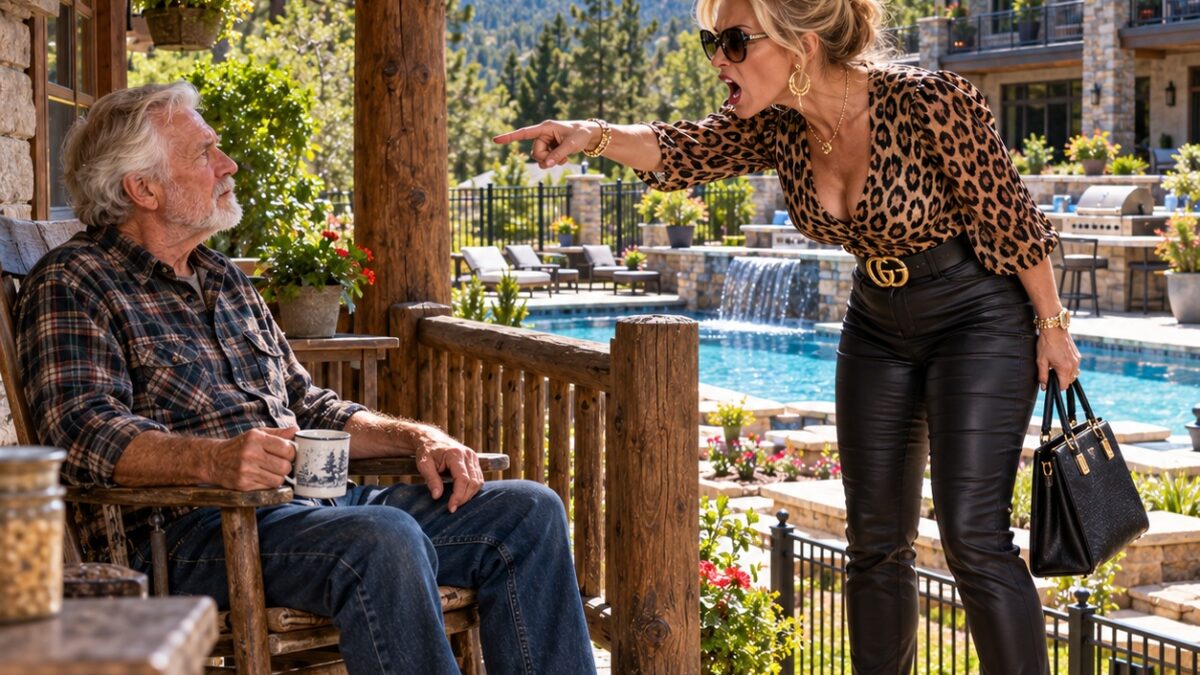
FULL STORY CONTINUATION
My first instinct was not revenge.
That surprises people when they hear the story later.
They expect me to say I laughed.
That I immediately pictured bulldozers.
That I stood at the window enjoying the thought of Vivian’s face when she found out.
I didn’t.
I felt tired.
Grief changes your relationship with conflict.
Before Emily died, I had the energy for arguments.
Afterward, peace became something I protected like a scarce resource.
I wanted to sit on my porch.
Read.
Drink coffee.
Remember my wife without someone shouting over the memory.
But Vivian had already promised to make my life uncomfortable.
Within three days, she started.
The first weapon was noise.
Tuesday night.
DJ.
Music until nearly two in the morning.
Friday night.
Another party.
Sunday.
Another.
Her outdoor speakers faced the valley, but enough sound hit my cabin that glasses rattled in the kitchen cabinet.
Then the landscapers began arriving at six every Saturday morning.
Leaf blowers.
Mowers.
Trimmers.
Most of the work happened along the property edge closest to my bedroom.
I documented it.
Decibel readings.
Dates.
Times.
Photographs.
I had spent a career documenting infrastructure disputes.
If there was one thing Vivian chose poorly, it was antagonizing a retired engineer who enjoyed organized evidence.
I sent a polite complaint to the HOA board.
Chairman Henderson responded two days later.
Vivian was, according to him, “enhancing neighborhood value.”
I asked whether enhancing value required amplified music after midnight.
No answer.
Then new HOA rules appeared.
No unapproved porch decorations.
No firewood visible from the road.
No exterior wood finishes outside the approved palette.
Pet registration requirements.
Rules governing morning outdoor activity.
One sentence effectively prohibited “repetitive residential porch use causing visual or lifestyle disruption” before nine in the morning.
I read it three times.
They had regulated my coffee.
Emily would have laughed for ten minutes.
I almost did.
Then someone reported my fireplace.
Vivian claimed smoke was contaminating neighboring air.
The county inspector came.
He checked the system.
“Nothing wrong with it.”
“I know.”
He looked embarrassed.
“I have to respond when complaints are filed.”
“I know that too.”
Then one morning I stepped outside and found part of my porch painted yellow.
Not tasteful yellow.
Not cedar stain.
Neon yellow.
Painters were packing equipment beside Vivian’s driveway.
I walked toward them.
“What happened?”
One man avoided my eyes.
“Mrs. Rosewood said this section was authorized for HOA correction.”
Vivian appeared holding a glitter-covered coffee cup.
“Oh.”
She pretended surprise.
“Wrong property line.”
“You painted my porch.”
“I’ll have it corrected.”
“When?”
“Soon.”
She never corrected it.
I did.
By hand.
The cameras came next.
Three security units appeared along the Rosewood roofline.
One covered her driveway.
Reasonable.
The second covered the pool.
Reasonable.
The third pointed directly toward my porch and bedroom windows.
I called the HOA.
No response.
I sent certified letters.
No response.
Then I stopped sleeping properly.
That was what angered me most.
Not the paint.
Not the music.
Not even the cameras.
I had survived losing Emily by constructing small routines.
Coffee at seven.
Walk the creek at ten.
Read after lunch.
Sit beneath the western pine before sunset.
Vivian disrupted them one at a time.
Within a month I stopped using the porch before nine because I was tired of conflict.
I stopped opening the bedroom curtains.
I stopped walking near the boundary.
One night I sat at the kitchen table staring at Emily’s photograph.
“What would you want me to do?”
Of course she didn’t answer.
But I remembered the hospital.
The last week.
Her voice barely above a whisper.
“Promise me something.”
“Anything.”
“Don’t let anyone push you off land that carries your soul.”
I had laughed because it sounded dramatic.
“Who is pushing me off anything?”
“People change.”
“Emily.”
“Promise.”
So I had.
That memory got me to pick up the phone.
I called Payton Reed.
Payton had been my friend for nearly thirty years.
Real-estate attorney.
Land-use specialist.
The man who helped me through probate after Emily died.
He answered on the second ring.
“Ted?”
“I need you to look at a property file.”
“What happened?”
“My HOA president may have built forty percent of an $800,000 pool on my land.”
Silence.
Then:
“Say that again.”
An hour later I was driving into town.
Payton’s office smelled exactly as it had ten years earlier.
Burned coffee.
Old paper.
Dust.
Law.
I put the 1914 deed on his desk.
Then the survey.
Then the 1960s county correspondence.
He spent almost forty minutes without speaking.
Finally, he looked up.
“Ted.”
“I know.”
“No, I don’t think you understand.”
He rotated the map toward me.
“The old boundary isn’t just persuasive. It appears to have been carried forward incorrectly during a later county update.”
“So?”
“So modern records may have been using a shifted reference line.”
He traced the discrepancy.
“We need a licensed survey immediately.”
We hired one.
Not a friend.
Not someone from the HOA.
A surveyor with no connection to either side.
He located old markers.
Cross-checked deeds.
Used modern GPS measurement.
Reviewed county archives.
Three days later, he called us back.
The result was worse for Vivian than I expected.
Approximately forty percent of the pool complex crossed onto Harrington land.
Not forty percent of the water surface alone.
Forty percent of the developed installation.
Part of the pool.
Filtration system.
Mechanical lines.
Waterfall structure.
Section of the outdoor kitchen.
A retaining feature.
Payton leaned back.
“She has a serious encroachment problem.”
I should have felt satisfied.
Instead, something else bothered me.
I had spent my career in water infrastructure.
The pool site was above the small creek that fed through our valley.
During construction, I had noticed unusual excavation depth.
Drainage lines routed in strange ways.
Concrete work completed unusually quickly.
I asked Payton to request permits.
What we received was incomplete.
Missing disposal records.
Inspection gaps.
Signatures that didn’t match.
One permit number belonged to a different project.
Payton frowned.
“This is messy.”
“Sloppy?”
“Maybe.”
He paused.
“Or deliberate.”
We kept digging.
Tax assessments connected to Rosewood Corp showed inconsistencies.
Construction invoices didn’t match declared values.
Environmental paperwork was thin.
Then an anonymous email arrived.
Subject:
I KNOW WHAT SHE BURIED.
Payton told me not to answer immediately.
We forwarded it through secure channels and arranged a meeting in a diner twenty miles away.
The sender was a woman named Casey Miller.
Twenty-six.
Construction-site supervisor.
She looked as though she had not slept properly in weeks.
Dirt remained under her fingernails despite the clean sweater she wore.
She ordered coffee and never drank it.
“They told us it was temporary.”
“What was?”
“The containers.”
Payton leaned forward.
“What containers?”
“Waste.”
My stomach tightened.
“Paint thinner. Solvents. Lead-based material from demolition. Other stuff with hazard labels.”
“Where?”
She looked directly at me.
“Under the pool area.”
The diner seemed to become quieter.
“How many?”
“At least twelve drums and containers that I saw.”
Payton asked, “Why bury them?”
“Vivian wanted the schedule maintained. Disposal transport was delayed.”
“So they stored them.”
“At first.”
Casey’s hands shook.
“Then she told us concrete was going over it anyway.”
I stared at her.
“She knowingly buried hazardous material?”
Casey nodded.
“She said nobody would ever know.”
I thought of the creek.
The deer.
The well systems farther down the valley.
Children playing near the water.
Emily sitting beside that creek with lemonade and a book.
This was no longer an encroachment dispute.
No longer HOA bullying.
No longer about a porch.
I asked one question.
“Do you have proof?”
Casey looked toward the diner window.
Then back at us.
“More than she thinks.”
She had photographs.
Audio recordings.
Internal messages.
Site notes.
Video.
Payton immediately told her to stop talking until we could arrange proper legal representation and whistleblower protection.
He handled it correctly.
That mattered.
We did not want evidence disappearing because we had rushed.
The next week moved slowly on the surface and very quickly underneath.
Environmental counsel joined us.
Independent water testing began through licensed channels.
The first results showed contamination.
Additional tests confirmed abnormal levels of industrial pollutants consistent with what Casey described.
I felt sick reading the report.
I had wanted Vivian to move her pool.
Now I wanted that entire site isolated.
The evidence went to environmental authorities.
Then federal agencies became interested because disposal, permits, and corporate records crossed multiple areas of law.
I stopped thinking of it as my case.
This was bigger.
Vivian apparently sensed something.
Her behavior changed.
First came a harassment complaint against me.
Then a trespassing accusation.
She claimed I was collecting water near her property.
That part was true.
I had collected samples where legally permitted, under advice and documentation.
She cropped video footage and posted it online.
The caption described me as a “disturbed older man attempting to contaminate a family pool.”
People believed it.
Not everyone.
Enough.
Suddenly neighbors stopped waving.
Then police arrived.
I was questioned.
A temporary complaint escalated.
For one humiliating night I sat in a local holding cell while Payton worked.
I had never been arrested.
Never spent a night behind a locked door.
The mattress was thin.
The lights stayed on.
I stared at the ceiling and wondered whether Emily’s promise had become foolishness.
Maybe land wasn’t worth this.
Maybe memory wasn’t worth it.
Maybe a rational man would sell.
Before dawn, Officer Reynolds came by.
I knew him from years earlier.
We had taught public-safety seminars together.
He couldn’t discuss the case.
He only handed me coffee.
“Hang in there, Ted.”
I nodded.
He hesitated.
“Truth usually takes longer than accusation.”
That morning I was released.
Payton was outside.
He looked exhausted.
And strangely pleased.
“What?”
“She overreached.”
“How?”
“Enough that people are starting to ask why she is working so hard to discredit one retired engineer.”
He opened the passenger door.
“Get in.”
From that point forward, we stopped responding defensively.
We filed.
Property action.
Emergency injunctive requests.
Formal environmental submissions.
Requests for full permit review.
Corporate-record referrals.
Everything through proper channels.
No anonymous leaks.
No online war.
No dramatic posts.
Paper.
Evidence.
Law.
Vivian responded with spectacle.
She announced the Pinewood Valley Community Appreciation Pool Extravaganza.
Gold invitations.
Band.
Catering.
Fireworks.
Hundreds of neighbors.
I was not invited.
I watched from my darkened cabin.
The illegal pool glowed blue through the trees.
People laughed beside it.
Music rolled across the valley.
Vivian eventually took a microphone.
She spoke about protecting Pinewood Valley from “bitterness” and “people who refuse progress.”
People applauded.
I held Emily’s chipped mug.
Then Payton arrived carrying another document.
“What now?”
His expression told me.
Vivian had obtained a temporary protective order based on her harassment allegations.
I was ordered to maintain distance from specified parts of her property while the dispute continued.
The absurdity was almost unbearable.
Some of the area I was being warned away from was land my own deed said belonged to me.
That same night, my utilities failed.
Electricity.
Then water.
A complaint had triggered inspection issues.
Garbage somehow appeared at the edge of my yard.
By morning another complaint alleged sanitation violations.
I sat in my cold cabin wrapped in a sweater and thought:
Enough.
Not enough fighting.
Enough believing fairness happened automatically.
I had always believed evidence spoke for itself.
Engineers love that idea.
Data is data.
Coordinates are coordinates.
Pollution levels are pollution levels.
But evidence still needs people willing to present it.
Defend it.
Wait for it.
So I stopped hoping Vivian would become reasonable.
I focused on the process.
At 6:45 the following morning, I heard heavy engines.
Not party trucks.
Not landscapers.
Official vehicles.
County inspectors.
Environmental-response units.
Local law enforcement.
Federal investigators.
Fire personnel.
They moved toward the Rosewood estate.
Vivian came outside in a silk robe.
No sunglasses.
Hair pinned up.
Coffee in hand.
She looked irritated rather than afraid.
At first.
Then one of the environmental officials spoke to her.
The site was being restricted pending hazardous-material investigation.
Her expression changed.
She looked across toward my porch.
I was standing there.
Coffee.
Old sweater.
Emily’s mug.
For months she had wanted me gone.
Now every official in the valley seemed to be standing around the pool she had built to replace my view.
I did not wave.
I did not celebrate.
I simply drank my coffee.
She shouted something I couldn’t hear.
An agent redirected her away from the pool.
Then technicians began working.
Soil.
Water.
Drainage.
Subsurface scans.
Paperwork.
The contaminated area was worse than early testing suggested.
Not apocalyptic.
Not movie-level poison.
But serious enough to require containment, excavation, and investigation.
The original deed and new survey were also presented.
The property encroachment became impossible to dismiss.
Then Casey arrived under legal protection.
That was the moment Vivian understood.
She knew who Casey was.
Casey knew what she had ordered.
And Casey had kept records.
Photos showed containers at the site before concrete work.
Audio captured Vivian pushing the crew to complete work without waiting for proper disposal.
Permit records raised further problems.
Corporate tax valuations drew separate scrutiny.
HOA Chairman Henderson suddenly stopped returning calls.
Within days he resigned.
Later, investigators discovered consulting payments connected to Rosewood interests.
The neighborhood changed almost overnight.
People who had ignored my complaints appeared on my porch.
Some apologized.
Some made excuses.
Some said they always thought something was wrong.
I tried not to judge them too harshly.
Fear likes crowds.
So does cowardice.
One evening, Vivian walked up my porch alone.
For the first time since I met her, she looked tired.
No glitter.
No giant sunglasses.
No audience.
She carried a folder.
“Mr. Harrington.”
I waited.
“I think this has gone too far.”
“That is one description.”
She placed the folder on the railing.
“Settlement offer.”
I opened it.
Seven times estimated value for the disputed land.
Enough money that selling would have been rational.
I closed it.
“No.”
She stared.
“I can make it ten.”
“No.”
“You haven’t even considered it.”
“I’ve considered it for months.”
Her jaw tightened.
“This could end.”
“The contamination doesn’t end because I sell you land.”
“That is being handled.”
“By federal investigators.”
She stepped closer.
“You think you’ve won?”
“I think your pool is on my property and hazardous material was buried near a watershed.”
“Don’t pretend this is about water.”
I almost laughed.
“I spent forty years working in water systems.”
She looked toward the creek.
Then back at me.
I slid the folder toward her.
“No.”
She picked it up.
The sweetness vanished.
“You’ll regret this.”
I had heard that before.
“Good night, Vivian.”
She left.
Her desperation increased after that.
Private investigators followed Payton.
Rumors appeared about his practice.
Complaints were filed.
Then Casey gave investigators more.
Recordings suggesting Vivian knew about the boundary issue before construction.
She had apparently gambled that I would not challenge the modern parcel line.
In one audio clip, she discussed waiting.
Old man.
Time.
Property.
Adverse possession.
Her legal interpretation was sloppy.
Her intention was not.
She believed I was alone.
Old.
Grieving.
Passive.
Temporary.
That hurt in a way the pool never did.
She had looked at my life and seen an expiration date.
Then, weeks into the investigation, everything accelerated.
I woke after midnight to machinery.
At first I assumed it was official remediation.
Then I noticed there were no marked vehicles.
Men moved near the restricted pool site.
Vivian was there.
Dark clothing.
Flashlights.
Equipment.
I called Payton.
Then the environmental enforcement contact listed on the case documents.
Then local law enforcement.
I did not approach.
That was important.
I stayed on my property.
Recorded what I could from a lawful distance.
Authorities arrived quickly.
Later I learned the crew had been attempting to remove material from the site without authorization.
Drainage equipment had been repositioned.
Potential evidence was being disturbed.
Whatever possibility Vivian had of framing everything as contractor negligence disappeared that night.
She was arrested.
Not because she was an HOA bully.
Not because she insulted me.
Because investigators now had evidence supporting serious allegations involving obstruction, environmental violations, permit fraud, and evidence tampering.
The next months were less dramatic than people imagine.
No television courtroom speeches.
Mostly documents.
Depositions.
Hearings.
Experts.
Testing.
Accounting.
Survey testimony.
Environmental remediation plans.
The glamorous part of justice is usually fictional.
Real justice is folders.
Deadlines.
Chain of custody.
People waiting in hallways.
Vivian’s pool was condemned.
The contaminated material had to be removed.
Affected soil was excavated.
Drainage was reconstructed.
The disputed construction was dismantled.
Her HOA influence disappeared.
Chairman Henderson was gone.
Rosewood Corp faced its own consequences.
Vivian eventually lost the role she had used as a private throne.
By the time the last section of the pool was broken apart, she had already left Pinewood Valley.
I stood on the porch one morning watching an excavator remove concrete from land my great-grandfather had walked more than a century earlier.
I expected satisfaction.
Instead, I felt sadness.
So much money.
So much conflict.
So much damage.
All because one person had decided ownership, law, and dignity were obstacles to be managed.
Payton stood beside me.
“You all right?”
“I thought this would feel better.”
“It usually doesn’t.”
“I wanted peace.”
“You’re getting there.”
The excavation left an ugly scar.
Bare earth.
Temporary fencing.
Drainage channels.
The place looked wounded.
Then I thought of Emily.
She hated wasted space.
When an old tree fell, she planted wildflowers around the stump.
When a storm destroyed part of our vegetable garden, she turned the broken fence into trellises.
When cancer began limiting what she could do, she planted bulbs for the spring she knew she might not see.
That was Emily.
Always asking what could still grow.
So I called Payton.
“I have an idea.”
“Oh no.”
“You say that every time.”
“Because your ideas become litigation.”
“This one doesn’t.”
I proposed that the reclaimed and remediated land become a public environmental education site.
Not all of my private property.
The affected area.
A managed partnership.
Nature trails.
Groundwater education.
Safe play areas.
Native plants.
A demonstration garden.
Programs about watershed protection.
The county liked the idea.
So did environmental officials.
Neighbors offered money.
Some volunteered labor.
The judge handling part of the remediation arrangement approved the necessary framework.
For the first time since Vivian arrived, Pinewood Valley built something together.
Not against someone.
For something.
The design took months.
I reviewed drainage.
Of course I did.
I was retired, not dead.
Children from the local school helped choose native plants.
A landscape architect designed a trail that passed near the creek without disturbing the bank.
We installed educational signs explaining how groundwater moves.
How pollutants travel.
Why improper disposal matters.
How wetlands protect communities.
One sign showed an old property survey.
Not mine specifically.
Just enough to teach children that maps and boundaries matter too.
Then someone asked what to call the place.
I didn’t answer immediately.
That night I sat on the porch.
Emily’s photograph was visible through the living-room window.
I remembered her kneeling beside the creek.
Blue-flowered mug.
Gardening gloves.
The way she had loved teaching children the names of birds.
I whispered:
“Is this too much?”
The wind moved the chimes.
I took that as permission.
Eighteen months after Vivian’s pool was dismantled, we opened the Emily Harrington Environmental Education Park.
I hated the ceremony.
Too many people.
Too many speeches.
Payton enjoyed watching me suffer.
“Smile.”
“I am smiling.”
“You look constipated.”
“I am sixty-nine years old. Let me have dignity.”
Children ran past us laughing.
That helped.
The mayor spoke.
An environmental scientist spoke.
Casey came.
She stood far back until I saw her.
I walked over.
“You should be closer.”
“I don’t like crowds.”
“Neither do I.”
She looked at the garden.
“I didn’t think anything good could come out of that site.”
“Neither did I.”
Her eyes filled.
“I should have spoken sooner.”
I shook my head.
“You spoke.”
“After months.”
“You spoke.”
She looked down.
“I was scared.”
“That doesn’t make the truth less useful.”
She nodded.
I meant it.
People like simple heroes.
Casey wasn’t simple.
She had worked on the site.
She had followed orders longer than she wished she had.
Then she stopped.
Documented.
Reported.
Cooperated.
That mattered.
Henderson sent a letter.
I never answered it.
Not out of cruelty.
I simply had nothing to say.
Some relationships end when trust does.
Vivian’s eventual legal outcome was complicated.
Different matters resolved differently.
Some through pleas.
Some through civil penalties.
Some through restrictions and restitution.
She lost her HOA power.
Her company paid heavily.
She was barred for years from certain leadership and development activities.
She moved out of state.
I did not follow her life.
I didn’t need to.
People sometimes ask whether I wanted her to suffer.
The answer is no.
I wanted her stopped.
There is a difference.
Revenge wants pain.
Justice wants the harmful thing to end.
By the time the park opened, the harmful thing had ended.
The cameras no longer pointed at my windows.
The parties were gone.
Nobody regulated my coffee.
I sat on the porch before nine whenever I wanted.
My fireplace passed inspection.
The railing was cedar again instead of neon yellow.
And the pool?
Gone.
In its place were grasses.
Flowers.
Trail signs.
Children.
One autumn morning, I sat in my old chair watching a class of fourth graders gather near the creek.
Their teacher was explaining watershed contamination.
A boy raised his hand.
“If something gets buried far away, how does it get into water?”
The teacher pointed downhill.
“Water moves.”
The boy frowned.
“Even underground?”
“Especially underground.”
I smiled into my coffee.
That was the entire case, in a way.
Things move.
Water.
Lies.
Consequences.
History.
Grief.
Nothing stays exactly where you bury it.
Vivian had buried containers beneath concrete.
She thought concrete meant permanence.
It didn’t.
She buried permit problems inside paperwork.
They surfaced.
She buried contempt inside HOA rules.
People eventually recognized it.
I buried grief inside routine.
That surfaced too.
Emily once told me a house could hold memory without becoming a museum.
I didn’t understand that after she died.
I thought protecting her meant freezing everything.
Same mug.
Same chair.
Same porch.
Same path.
Same roses.
Then Vivian attacked the place, and I realized the cabin wasn’t valuable because nothing changed.
It was valuable because Emily had changed me there.
The porch carried conversations.
The creek carried summers.
The garden carried her hands.
Memory did not depend on preserving every nail exactly where she left it.
That realization let me do something I hadn’t expected.
I shared part of the land.
Not with Vivian.
With the community.
The woman who wanted to erase my history accidentally forced me to open part of it.
I found that funny.
Emily would have found it hilarious.
One evening, Payton came up with a bottle of bourbon.
“I brought legal medicine.”
“Is that what we’re calling it?”
“Billable medicine.”
We sat on the porch.
He looked toward the park.
“You know, at the beginning, I thought you wanted the pool demolished.”
“I did.”
“You wanted her off your land.”
“Yes.”
“You wanted the HOA embarrassed.”
I considered that.
“For about forty-eight hours.”
He laughed.
“What changed?”
“The contamination.”
“That changed the case.”
“No.”
I looked toward the garden.
“It changed me.”
He waited.
“When I thought it was just trespass, I wanted my boundary back.”
“And after?”
“I wanted the valley safe.”
Payton nodded.
“That is why you won.”
“No.”
“What?”
“I won because the deed was right.”
He laughed so hard he nearly spilled his drink.
Engineer to the end.
The deed mattered.
So did the survey.
So did Casey’s evidence.
So did testing.
So did every neighbor who eventually stopped pretending they hadn’t seen what was happening.
But there was another victory I didn’t understand until much later.
Vivian had wanted me to become small.
Angry.
Isolated.
Obsessed with her.
For a while, she succeeded.
I woke thinking about her.
Went to sleep thinking about her.
Measured my days according to what she might do next.
Even my fight against her allowed her to occupy too much of my life.
The park ended that.
Children don’t care about Vivian Rosewood.
They care about frogs.
Birds.
Mud.
Signs they can touch.
Water wheels.
Flowers.
That is a much healthier use of land.
The first spring after the park opened, Emily’s memorial garden bloomed.
Blue columbine.
Penstemon.
Lupine.
Native roses.
I walked down early before anyone arrived.
The cedar bench carried her name.
EMILY HARRINGTON.
Below it:
SHE BELIEVED GOOD THINGS COULD GROW AFTER HARD SEASONS.
I sat there alone.
For a long time.
Then I cried.
Not the way I cried after she died.
That grief had been violent.
This was quieter.
Almost grateful.
“I kept the porch,” I said.
A breeze moved through the grass.
“I know you were worried.”
Nothing answered.
“I may have overdone it with the park.”
A bird landed on the fence.
I smiled.
“You would say that means yes.”
Eventually I walked back to the cabin.
Same porch.
Same chair.
Same chipped mug.
But I wasn’t the same man.
That mattered more.
Neighbors began stopping by.
Some still apologized.
I told them they didn’t have to anymore.
Pinewood Valley had created new HOA rules after the old board collapsed.
Actual conflict-of-interest disclosures.
Independent review of major complaints.
Clear restrictions on surveillance.
Better due process before enforcement.
Strangely radical ideas.
Vivian had governed through social pressure.
The new board governed mostly through boredom.
I considered that progress.
Chairman Henderson’s replacement once asked whether I wanted a seat on the board.
I said no so quickly she laughed.
“I’ve had enough HOA for three lifetimes.”
She nodded.
“Fair.”
“What I do want is one thing.”
“What?”
“Never regulate coffee.”
She promised.
I asked for it in writing.
Some habits remain.
People who hear the story online often want one moment.
The raid.
The arrest.
The pool demolition.
Vivian in shock.
They ask what expression she made.
Whether I laughed.
Whether I said something clever.
I understand why.
Revenge stories are clean.
Real life is not.
The most important moment wasn’t when Vivian realized part of the pool sat on my land.
It wasn’t when officials arrived.
It wasn’t even when Casey’s evidence surfaced.
For me, the important moment happened alone.
Before lawyers.
Before testing.
Before federal investigators.
The morning I opened the 1914 deed.
I had spent months allowing Vivian to make me feel like a guest in my own life.
Then I touched the ink of my great-grandfather’s boundary line and remembered:
I knew who I was before she arrived.
That mattered.
Documents can establish ownership.
But you still have to decide whether you believe you are allowed to stand where the document says you belong.
That was the fight.
The pool was simply concrete.
Vivian believed money could make history irrelevant.
I had almost helped her prove it by surrendering.
Emily’s promise stopped me.
Years later, I still sit outside every morning.
Usually before nine.
Occasionally at six just because I can.
The porch creaks.
The railing needs oil.
A woodpecker has developed a personal disagreement with one of the western beams.
I still read technical manuscripts nobody else would consider recreational.
Sometimes school groups walk past on the trail below.
They wave.
I wave back.
One morning a girl of maybe ten climbed the steps with her teacher.
“Are you Mr. Harrington?”
“Depends who is asking.”
She looked worried.
The teacher smiled.
“He is joking.”
The girl held a clipboard.
“We are doing a project about groundwater.”
“That sounds dangerous.”
She laughed.
“Can we ask you one question?”
“Sure.”
“What is the most important thing you learned?”
I expected an engineering question.
I started thinking about aquifers.
Drainage.
Contaminant pathways.
She added:
“From everything that happened here.”
That stopped me.
I looked toward the park.
Then the old property line.
Then Emily’s picture visible in the window.
Finally I said:
“Do not wait until something is easy to defend what is right.”
She wrote it down.
I almost corrected myself.
Too dramatic.
Not technical enough.
But I let it stand.
Then she asked:
“Did you hate the lady with the pool?”
Children are efficient.
“No.”
“Why not?”
“I was angry.”
“That’s not hate.”
“Correct.”
She waited.
I said:
“Hate lets someone live inside you without paying rent.”
The teacher laughed.
The girl wrote that down too.
“Is that engineering?”
“No.”
“Then where did you learn it?”
I looked through the window at Emily’s photograph.
“My wife.”
The girl nodded as though that explained everything.
Maybe it did.
The class continued down the trail.
I returned to my chair.
Steam rose from my coffee.
The valley was quiet.
Not dead quiet.
Living quiet.
Birds.
Wind.
Children somewhere near the garden.
Water moving over stone.
I thought about the morning Vivian first climbed those steps.
“You don’t get to sit here anymore.”
That was how she began.
Certain.
Loud.
Confident that authority belonged to whoever performed it most aggressively.
She had HOA paperwork.
Money.
A mansion.
A luxury pool.
Friends on the board.
Lawyers.
Contractors.
Cameras.
I had an old cabin.
A dead wife’s memory.
A chipped mug.
And a century-old deed in a drawer.
She saw weakness because she measured power by appearance.
That mistake destroyed her long before any court order did.
The old deed didn’t make me powerful.
The truth did.
The survey didn’t take revenge.
It corrected a line.
The environmental investigation didn’t care whether Vivian wore sequins or I wore an old sweater.
Contaminated water doesn’t respect wealth.
Neither does a property boundary once properly established.
That is one thing I still love about engineering.
Reality is stubborn.
Gravity does not negotiate.
Water does not flatter.
Land does not care who drives the Maserati.
And eventually, facts become expensive to ignore.
The sun moved through the pines.
I lifted Emily’s mug.
The chip in the handle had grown slightly.
I should replace it.
I won’t.
“It still works,” she would say.
I looked toward her garden.
Toward the children.
Toward the land Vivian once expected me to abandon.
“We did it, sweetheart.”
The wind moved the chimes beside the porch.
“We kept the porch.”
I smiled.
Then I corrected myself.
“No.”
I looked at the park again.
“We did better than that.”
Because in the end, the greatest thing I got back wasn’t property.
It was the ability to look across my land without seeing Vivian.
I saw Emily.
I saw neighbors planting trees.
I saw children learning why clean water mattered.
I saw flowers growing where concrete and buried chemicals had once poisoned the ground.
Vivian had tried to turn my home into something smaller.
A property problem.
An HOA violation.
An old man’s stubborn attachment to an outdated cabin.
Instead, the fight reminded an entire community that history has weight, truth needs records, land deserves respect, and dignity does not become less important simply because somebody with more money says it should.
Every morning, I still take my coffee to the same chair.
The porch remains slightly crooked.
The cabin remains old.
The mountains remain indifferent to all of us.
And that is exactly how I like it.
I sit where my great-grandfather sat.
Where my father sat.
Where Emily sat beside me for thirty-seven years.
Nobody tells me when I can drink coffee.
Nobody points a camera at my bedroom.
Nobody paints my railing without permission.
And beyond the trees, where an $800,000 monument to arrogance once stood, children now run through a garden carrying Emily’s name.
Sometimes the best victory is not watching the person who hurt you lose everything.
Sometimes it is looking at the damage they left behind and realizing they no longer get to decide what it becomes.
Vivian built a pool on my land because she believed I was temporary.
She was wrong.
The pool disappeared.
The poison was removed.
The land stayed.
And somehow, after all of it, we made the place more beautiful than it had been before.