FULL STORY:The HOA Queen Fined My Wheelchair Ramp $10,000—She Had No Idea I Quietly Owned 423 Homes Behind Her Board
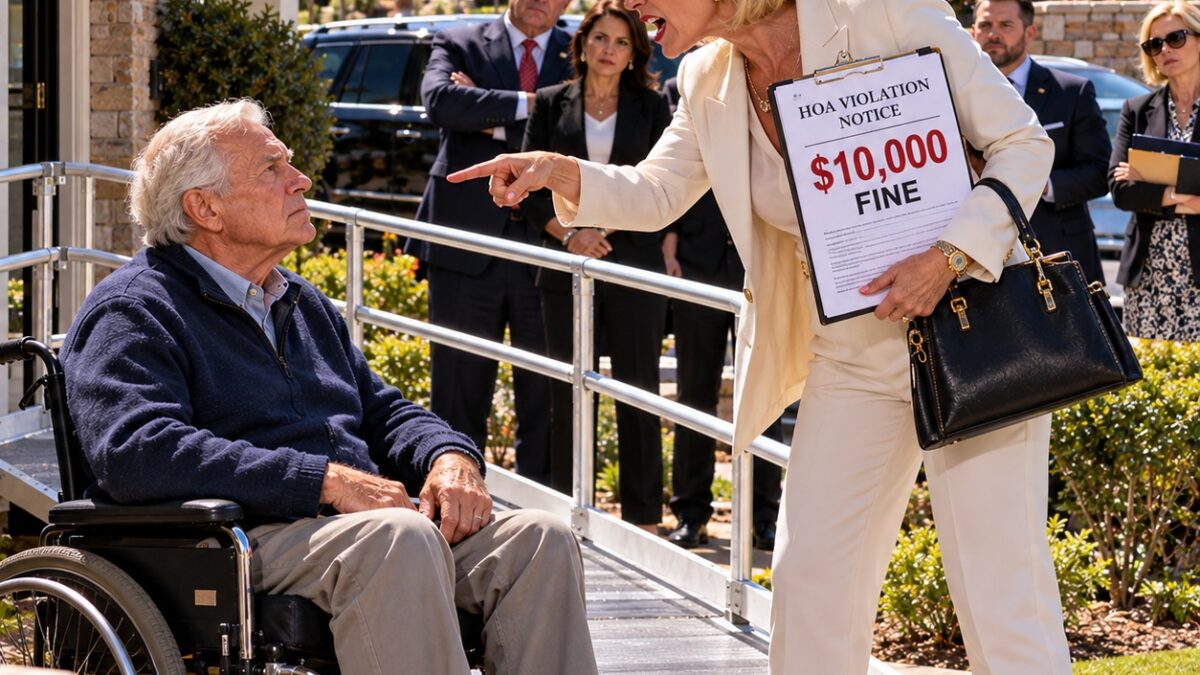
FULL STORY CONTINUATION
Marcus was quiet for several seconds.
He knew me well enough to understand what “everything” meant.
“You want litigation?”
“Not yet.”
“A demand letter?”
“Not yet.”
“What do you want?”
“Records.”
“Which?”
“All association financials we’re entitled to inspect. Vendor contracts. Enforcement logs. Architectural approvals. Meeting minutes. Legal invoices. Management contracts.”
Another pause.
“You’ve been waiting for this.”
“No.”
I looked toward Martha’s photograph.
“I’ve been hoping I was wrong.”
The next morning, Vivien began proving I wasn’t.
A new notice appeared in my mailbox.
Mailbox height.
Two inches too high.
Two hundred fifty dollars.
The day after that:
Trash container visible after collection.
Five hundred dollars.
Then:
Excessive bird-feeding equipment.
Three hundred fifty.
My “excessive equipment” consisted of two feeders.
One had hung from the same mesquite branch for eleven years.
I started photographing everything.
My house.
Board members’ houses.
Comparable violations.
Vivien’s fence extended past the setback line by several inches.
The HOA treasurer had an enclosed deck addition with no permit record I could find.
The secretary operated a small bookkeeping business with permanent signage visible from the street despite restrictions on commercial signs.
None had active fines.
Rosa found me at the post office.
She was in her early sixties, worked for years as a paralegal, and had a habit of asking questions in the calmest possible voice right before somebody’s argument collapsed.
“You’re documenting selective enforcement.”
“I’m taking pictures.”
She smiled.
“Same thing if you organize them correctly.”
I raised an eyebrow.
“You’ve been watching.”
“I was the only no vote on your ramp.”
“I remember.”
“What Vivien did was wrong.”
“That doesn’t necessarily make it unlawful.”
“It might when she ignores identical violations everywhere else.”
That was exactly the distinction I liked about Rosa.
No exaggeration.
No dramatic declaration.
Maybe.
If supported.
Useful words.
She lowered her voice.
“I’ve been looking at the HOA legal budget.”
“Why?”
“Because it tripled.”
That got my attention.
“Over what period?”
“About eighteen months.”
“For lawsuits?”
“Some.”
“Collections?”
“Some.”
“What else?”
She handed me a folded photocopy.
“Enforcement consulting.”
I read the vendor name.
Blackwood Community Strategies.
I looked at her.
“Related?”
“Registered to Vivien’s nephew.”
Interesting.
Not illegal by itself.
Potential conflict.
Potential improper procurement.
Potential overbilling.
A reason to ask questions.
That afternoon, another truck arrived at my house.
Landscaping.
The crew sprayed weed killer near Martha’s roses.
By evening, leaves had begun curling.
I called the contractor.
The supervisor apologized.
“Work order said treat full front perimeter.”
“Who issued it?”
“HOA management.”
I asked for the work order.
He refused.
Marcus requested it formally.
Two days later my cable line was cut during “common-area maintenance.”
The next week, sprinklers flooded part of my driveway.
Could they all have been mistakes?
Absolutely.
One lesson intelligence work teaches you is not to confuse sequence with proof.
So I documented them without drawing conclusions.
Vivien wanted a reaction.
I gave her folders.
Her nephew Brad became the association’s unofficial inspector.
Every morning, he photographed my house.
I photographed him.
Then Rosa’s son received a two-thousand-dollar fine over a basketball hoop that had been approved three years earlier.
Rosa stood on my porch holding the notice.
“This happened after I spoke against your ramp fine.”
“Yes.”
“They’re retaliating.”
“Probably.”
“You sound very calm.”
“I don’t get paid extra for sounding angry.”
She looked at me.
Then at the stack of binders visible through my doorway.
“How many properties do you actually own?”
That was the first time anyone asked directly.
I smiled.
“More than one.”
She stared.
“You are the strangest retired sailor I’ve ever met.”
“Navy intelligence.”
“That does not make it less strange.”
By week three, my fines had reached eighteen thousand five hundred dollars.
Then Adult Protective Services visited.
Someone had anonymously reported an elderly disabled man living in dangerous conditions and showing signs of mental decline.
The investigator was polite.
My house was clean.
Refrigerator full.
Medication organized.
Finances stable.
Mind intact.
She closed the visit quickly.
But humiliation can exist even when accusations fail.
Vivien understood that.
She wanted officials appearing at my door.
Neighbors watching.
People wondering.
That afternoon she personally delivered a foreclosure warning.
Not foreclosure itself.
A threat based on unpaid assessments and fines she claimed could eventually become lien rights.
She stood beside my mailbox while Brad photographed her.
“Pay up or get out.”
I took the envelope.
“This community has standards,” she said.
“I agree.”
That confused her.
I folded the paper carefully.
“What’s that supposed to mean?”
“Nothing yet.”
I went inside.
Then called Marcus.
“They’ve escalated to collection threats.”
“Good.”
“Good?”
“You told me to wait until their position was clear.”
“It is.”
“So now?”
“Now we challenge the fines formally and request complete enforcement records.”
“And the ownership schedule?”
“Keep it quiet.”
Marcus laughed.
“You enjoy this too much.”
“No.”
I looked at Martha’s roses through the window.
“I’m too old to enjoy being disappointed in people.”
Vivien went to the media first.
A local article appeared with the headline:
DISABLED VETERAN REFUSES HOA SAFETY RULES.
The photograph centered my ramp.
Channel 7 invited Vivien onto a morning segment.
She wore pale blue.
Perfect makeup.
Practiced sympathy.
“Military service does not exempt anyone from community standards.”
I watched from my kitchen.
She continued.
“We have tried repeatedly to work with Mr. Thorne, but some residents believe rules should bend specifically for them.”
I muted the television.
That was her biggest strength.
Not the fines.
Narrative.
She was good at making cruelty sound responsible.
The publicity encouraged her.
Security patrol vehicles began spending long periods near my house.
HOA inspectors appeared more frequently.
City departments received complaints.
Fire safety.
Property maintenance.
Rodents.
Structural concerns.
Every complaint required time.
Every inspector eventually left without meaningful findings.
Every visit went into the file.
Then Rosa found something larger.
Her first discovery came through city procurement records.
Vivien’s husband, Derek Blackwood, served on the city council.
Over several years, companies associated with extended Blackwood family members had received no-bid or limited-bid municipal contracts totaling hundreds of thousands of dollars.
That did not automatically mean corruption.
Cities legitimately use emergency and specialized contracts.
But some vendors also appeared in HOA records.
Same addresses.
Same relatives.
Same circles.
Rosa spread documents across my dining table.
“This company billed the HOA for enforcement consulting.”
“Yes.”
“And the city for neighborhood improvement analysis.”
“Yes.”
“Same owner.”
“Yes.”
“Vivien’s nephew.”
“Yes.”
She frowned.
“You already knew?”
“Marcus found the corporate filing yesterday.”
Rosa leaned back.
“I hate you a little.”
“That’s healthy.”
Then she pointed at another invoice.
“Look at this.”
A large payment for exterior compliance inspections.
Brad’s company.
No competitive bid.
No clear board disclosure.
Then another.
Legal consulting through a company tied to a board member’s cousin.
Then landscaping coordination fees routed through a management vendor.
Individually, none proved theft.
Together, they justified an independent audit.
More importantly, they explained why Vivien fought so hard to keep people from examining records.
Mrs. Morgan changed everything.
She was eighty-four.
Small woman.
Vietnamese immigrant.
Widowed.
She had decorated her front garden with little ceramic figures for fifteen years.
Nothing expensive.
Gnomes.
Birds.
A chipped frog holding an umbrella.
One morning she received a five-thousand-dollar violation notice.
“Excessive decorative objects.”
Rosa found her crying in the driveway.
“I cannot pay,” Mrs. Morgan whispered.
Rosa called me.
I went over.
Mrs. Morgan held the notice with both hands.
“They take house?”
“No.”
She looked at me.
“They say lien.”
“They said a lot of things to me too.”
I asked to see her prior correspondence.
No warnings.
No meaningful cure notice.
Nothing explaining why identical decorations elsewhere had not been cited.
Across the street, a board supporter had six lawn ornaments.
No violation.
That night, twelve households met in Rosa’s living room.
Then twenty.
Then thirty-two.
Stories came out.
A widower pressured over an old fence.
A disabled owner fined over accessibility equipment.
A teacher charged repeated administrative fees.
A veteran whose memorial tree had been removed by a contractor after a disputed landscaping order.
Some complaints were legitimate.
Some rules had actually been violated.
But the enforcement pattern was uneven enough to disturb even people who disliked HOAs only in theory.
Supporters of Vivien started asking for records.
That was the turning point.
Control depends on quiet.
Questions are noisy.
Marcus filed suit challenging the ramp fines and seeking injunctive relief against enforcement while the dispute was pending.
Not a federal civil-rights war.
Not racketeering.
A focused case.
Accessibility.
Selective enforcement.
Defective procedures.
Retaliation.
Records.
Facts first.
The court temporarily blocked aggressive collection against my property while the claims were reviewed.
Vivien called an emergency meeting.
Agenda:
RATIFICATION OF COLLECTION ACTIONS AND COMMUNITY ENFORCEMENT POLICY.
Channel 7 was invited.
Of course.
She wanted a victory.
I wanted a record.
The community center was overflowing when I arrived.
Vivien sat at the front.
Derek occupied a chair beside her, though he held no HOA position.
That interested me.
Rosa sat in the third row holding a thick Manila folder.
Marcus sat behind me.
Most people still did not know who he was.
Vivien began with slides.
Pictures of violations.
Graphs about property values.
Statistics with no cited source.
My house appeared repeatedly.
My ramp.
Bird feeders.
Mailbox.
Driveway.
She described me as a “chronic noncompliant owner.”
Then Rosa stood.
“Point of order.”
Vivien’s expression tightened.
“This is not public comment.”
“The proposed collection action relies on enforcement records.”
“So?”
“I have questions about selective enforcement and conflicts involving association vendors.”
Vivien gripped her gavel.
“This is inappropriate speculation.”
Rosa held up city procurement documents.
“Your husband participated in municipal processes involving companies related to some of the same people receiving HOA contracts.”
Derek leaned forward.
“That is defamatory.”
“No.”
Rosa looked at him.
“It’s a question.”
People murmured.
Then she continued.
“Why has the HOA’s legal and enforcement budget increased by more than three hundred percent?”
Vivien struck the table.
“Sit down.”
Rosa didn’t.
“Why was your nephew’s company paid without competitive bids?”
“Sit down.”
“Why were violations issued to owners who opposed your decisions while identical conditions on board-member properties were ignored?”
“Enough!”
That was when I wheeled toward the microphone.
The room changed.
Not because people feared me.
Because I almost never spoke at meetings.
Vivien looked at me.
“Mr. Thorne, your matter is currently in litigation. I strongly advise—”
“I’m not discussing the litigation.”
Marcus walked to the side wall.
He carried a banker’s box.
Vivien saw him.
Her expression shifted.
I positioned myself at the microphone.
“My wife died three years ago.”
Nobody expected that.
I continued.
“Before she died, she asked me to help people who had difficulty helping themselves.”
Vivien rolled her eyes almost imperceptibly.
I saw it.
So did Rosa.
“I had already been doing that quietly for years.”
I looked around the room.
“Some of you rent from Thornfield Properties.”
A few heads turned.
Others looked confused.
Vivien frowned.
“What does that have to do with this?”
I looked at her.
“Quite a lot.”
Marcus began distributing copies.
Ownership schedule.
Parcel list.
Voting interests.
Entity disclosures.
I continued.
“Over the last fifteen years, Thornfield Properties and related entities acquired distressed homes inside Pinerest Heights.”
Vivien’s face started losing color.
“One hundred?”
Someone whispered.
I shook my head.
“Four hundred twenty-three.”
The room went silent.
Vivien stared at me.
“What?”
“423 homes.”
She actually laughed.
“No.”
Marcus handed documents to the secretary.
County parcel records.
Recorded deeds.
Entity certifications.
Management disclosures.
Nothing secret in the illegal sense.
Just information no one had bothered to connect.
Someone near the back said, “That’s half the neighborhood.”
“Just under half,” Marcus corrected.
423 out of 847.
Vivien looked at me like I had transformed physically.
“You own those rentals?”
“Thornfield does.”
“You?”
“Yes.”
“How much—”
“That isn’t relevant.”
But someone else had already done the math.
The portfolio’s estimated market value had circulated through lender documents and county assessments.
Roughly forty-seven million dollars.
Again, not cash.
Not personal spending money.
Property value.
Debt attached.
Operating costs.
Still enough to destroy the story Vivien had told about a helpless old pensioner she could squeeze.
I held up the wheelchair-ramp fine.
“For months, you treated this dispute as though I had two choices.”
“Pay.”
“Or leave.”
I looked toward the homeowners.
“But Thornfield has standing as owner of 423 lots.”
“And that means we have a direct interest in how this association is governed, how funds are spent, how rules are enforced, and whether officers disclose conflicts.”
Vivien’s hand shook.
“You deliberately concealed this.”
“No.”
I smiled faintly.
“You never asked.”
The room erupted.
She slammed the gavel.
“Order!”
Nobody stopped.
Derek stood.
“This is intimidation.”
Marcus stepped forward.
“No.”
He handed Derek a packet.
“This is a formal demand for records and notice of claims involving fiduciary duties, selective enforcement, vendor conflicts, and retaliation.”
Derek didn’t take it.
Marcus placed it on the table.
“We have also referred municipal procurement concerns to the appropriate city ethics and auditing authorities.”
That did it.
Derek’s face changed completely.
Not guilt.
Fear.
Fear of scrutiny.
The same thing Vivien had used against everyone else.
Vivien pointed at me.
“You planned this.”
“I documented it.”
“You let us continue.”
“I objected every step of the way.”
“You could have told us who you were.”
“I did.”
I looked at her.
“I’m Ezra Thorne.”
People laughed.
She hated that.
I continued.
“You decided that wasn’t important because you saw a wheelchair.”
That quieted the room.
No dramatic arrest happened that night.
That is one of the biggest differences between real accountability and internet fantasy.
Police do not burst through doors because somebody gives a good speech.
Auditors do not handcuff presidents between PowerPoint slides.
What happened was slower.
And worse for Vivien.
The proposed collection motion failed.
Homeowners demanded an independent audit.
Board members who had previously supported her began backing away.
The secretary asked for counsel separate from Vivien.
The treasurer resigned three days later.
Brad stopped appearing at my house.
The security patrols disappeared.
The city ethics office opened a review into contracting procedures involving Derek.
The HOA’s insurer requested records.
The association’s outside law firm advised the board to suspend disputed enforcement against several homeowners pending review.
Vivien still fought.
For another month.
She sent newsletters.
Called the ownership revelation a hostile takeover.
Claimed Thornfield Properties wanted to “commercialize” Pinerest.
That accusation amused my tenants.
Many were paying hundreds below aggressive market rents.
Sarah Collins, a schoolteacher who rented one of my homes, stood at the next meeting.
“I’ve lived in Thornfield property for six years.”
Vivien looked annoyed.
Sarah continued.
“My rent increased once.”
Someone laughed.
“I didn’t know Mr. Thorne owned it.”
She turned toward me.
“Actually, I’m a little irritated he never fixed that ugly kitchen light.”
“I approved that repair last year.”
“You did?”
“Yes.”
She looked at the management representative.
He slowly sank lower in his chair.
The room laughed harder.
Humor helped.
Fear dissolved quickly once Vivien stopped controlling the microphone.
The audit did not uncover an international criminal empire.
It found something far more believable.
Conflicted vendor contracts.
Weak bidding procedures.
Payments to related parties without adequate disclosure.
Legal fees driven by unnecessary enforcement.
Administrative charges that benefited people connected to leadership.
Poor internal controls.
Records that did not support some of the fines.
Payments requiring further explanation.
Enough that the association filed claims against several vendors.
Enough that board members faced potential personal exposure for decisions outside proper authority.
Enough that Derek’s municipal contracting relationships drew separate investigation.
Then investigators found evidence that one Blackwood-connected vendor had billed the city and HOA for work that could not be fully substantiated.
That became a fraud inquiry.
Bank records followed.
Emails followed.
The case grew.
Not overnight.
Months.
Vivien resigned as president before the audit finished.
She called it temporary.
Nobody believed her.
Derek lost committee assignments while his city dealings were reviewed.
Then came charges.
Fraud-related.
Conflict-related.
False invoices.
Improper financial transactions.
Not terrorism.
Not treason.
Not a thousand-count federal spectacular.
Money crimes.
The kind committed by people who think paperwork is boring enough that nobody will read it.
They were wrong.
Brad cooperated.
That surprised everyone.
His company had received contracts, yes, but investigators concluded some decisions had been driven by Vivien and Derek.
He provided emails.
Those emails hurt.
One referred to elderly owners as “soft targets for compliance.”
Another discussed increasing pressure on properties likely to sell.
One message about Mrs. Morgan read:
She won’t fight if the paperwork looks official.
I read that sentence twice.
Then stopped.
Martha used to tell me anger is only useful if you give it a job.
So we gave ours jobs.
Rosa organized owners who needed help appealing fines.
Marcus coordinated civil claims.
Thornfield forgave rent increases for several older tenants during the turmoil.
The new temporary board reviewed hundreds of violations.
Many stood.
Rules still existed.
But dozens were withdrawn because procedures were defective, enforcement was inconsistent, or evidence was missing.
My ramp fine vanished first.
The $10,000 became zero.
Then the mailbox.
Bird feeders.
Trash bin.
All gone.
Mrs. Morgan’s garden-ornament fine disappeared.
Karen Walker’s charges were reviewed.
Luis Rodriguez’s accessibility issues were formally approved.
The memorial tree case resulted in reimbursement for replacement landscaping and a written apology.
Small things.
But people remember small justice.
Especially after large humiliation.
The biggest issue was governance.
Thornfield owned 423 homes.
That gave me enormous voting influence.
I could have used it to install whoever I wanted.
Vivien expected that.
So did some residents.
At the first full election after her resignation, people asked whom I was backing.
“No slate.”
Marcus looked at me.
“You could effectively decide this.”
“That’s exactly why I shouldn’t.”
“You own nearly half the votes.”
“I know.”
“You spent fifteen years building this.”
“For housing.”
I looked around the community center.
“Not a private government.”
Instead, Thornfield announced that our votes would be split proportionally among qualified candidates meeting transparency requirements.
People were shocked.
Rosa understood immediately.
“You don’t want to become her.”
“No.”
She smiled.
“That may be the smartest thing you’ve done.”
“Don’t tell anyone.”
Rosa ran.
She won a board seat.
Luis became president.
Retired engineer.
Boring man.
Excellent quality in an HOA president.
His first meeting lasted ninety minutes because he insisted every agenda item identify the exact bylaw authority supporting it.
People complained.
I loved him.
New rules followed.
Conflict-of-interest disclosures.
Competitive bids above defined limits.
Recorded board votes.
Digital access to financial statements.
No retroactive architectural fees.
Clear cure periods.
Accessibility accommodations reviewed under lawful standards rather than aesthetic whim.
Independent annual audits.
Homeowners entitled to speak before major enforcement votes.
No board officer allowed to approve a contract involving a relative without disclosure and recusal.
And perhaps most importantly:
No one person controlled records.
The culture changed.
That took longer.
For years, Vivien had trained people not to look at each other.
If somebody got fined, neighbors assumed they had done something wrong.
If inspectors arrived, curtains closed.
If an older homeowner struggled, everyone quietly hoped not to become the next target.
Afterward, people started talking.
Mrs. Morgan returned to her garden.
The HOA reimbursed her for the jasmine plants damaged during prior treatments.
I helped replant them.
She slapped my hand when I tried digging from my wheelchair.
“You supervise.”
“I can still use a shovel.”
“You supervise.”
“Yes, ma’am.”
The following spring, jasmine covered the fence again.
Martha’s roses recovered less successfully.
Several bushes died.
I replaced them with the same variety.
Rosa found me planting one afternoon.
“Martha?”
“Yes.”
“She would’ve liked this.”
“She would’ve told me I bought the wrong color.”
“Did you?”
“Probably.”
Rosa laughed.
The civil cases resolved over the next year.
The HOA recovered money from insurers and vendors.
Some funds connected to improper contracts were repaid.
Victims received reimbursements for unsupported fines.
My legal claim settled.
I directed most of my recovery into a resident legal-assistance fund.
Marcus objected.
“You could keep this.”
“I know.”
“You paid fees.”
“I can afford fees.”
“That has never stopped rich people before.”
“I’m not rich.”
He stared at me.
“You own forty-seven million dollars in real estate.”
“I owe banks enough money to make them nervous if I stop breathing.”
“Ezra.”
“Fine.”
I smiled.
“I’m rich on paper.”
He shook his head.
Martha’s promise stayed with me.
Help people who cannot help themselves.
I had spent years interpreting that literally.
Buy houses.
Keep rents reasonable.
Fix roofs.
Prevent foreclosures when possible.
The HOA fight taught me something else.
Sometimes helping people means making systems understandable.
So Thornfield funded workshops.
Property rights.
HOA records.
Budget basics.
Accessibility accommodations.
How to appeal a fine.
When to call an attorney.
When not to.
Rosa taught half of them.
She was terrifying.
Attendance was excellent.
Vivien’s criminal case eventually ended in a plea.
Financial fraud.
False invoicing.
Misuse of association authority tied to personal benefit.
Derek faced his own consequences through the city-contract investigation and related charges.
Their punishments were serious.
Not cinematic.
No life sentences.
No helicopters.
No federal agents rappelling into Pinerest.
Just courtrooms.
Restitution.
Fines.
Convictions.
Loss of professional standing.
Loss of influence.
For people like Vivien and Derek, the last one may have hurt most.
The BMW disappeared.
Their house went up for sale.
One morning, a moving truck arrived.
I watched from my porch.
Vivien came outside carrying a box.
She saw me.
Stopped.
For a second, neither of us spoke.
Then she walked toward the curb.
She looked older.
Not ruined.
Not broken.
Just stripped of the authority that once made her seem larger than everyone else.
“You happy?”
I thought about it.
“No.”
That surprised her.
“You destroyed everything.”
“I didn’t.”
“You think those records would have mattered if you hadn’t pushed?”
“They mattered because they were true.”
She looked toward my ramp.
“I was enforcing standards.”
“You told a disabled man this wasn’t a nursing home.”
Her eyes dropped.
I continued.
“You fined an eighty-four-year-old woman five thousand dollars over garden decorations.”
“She was noncompliant.”
“You still talk that way.”
Her jaw tightened.
“What do you want me to say?”
“Nothing.”
I looked toward the moving truck.
“I stopped needing anything from you a long time ago.”
She walked away.
No final insult.
No dramatic collapse.
Just the click of her shoes fading down the sidewalk.
The same sound that used to make neighbors check their mailboxes with dread.
After she left, Pinerest became boring.
Beautifully boring.
The most controversial vote that summer involved whether residents could install black or bronze solar-screen frames.
People argued for forty-five minutes.
Rosa threatened to go home.
Luis insisted on finishing the agenda.
Mrs. Morgan brought cookies.
I sat in the back.
Someone asked my opinion.
“I don’t care.”
They laughed.
“You own half the neighborhood.”
“Still don’t care about window-frame color.”
Thornfield eventually sold some properties.
Not all.
I wanted more owner-occupants and less concentration.
423 homes gave me leverage at the exact moment it mattered.
It also gave one person too much influence.
Even if that person was me.
Over several years, we offered certain longtime tenants first opportunities to buy when financially realistic.
Teachers.
Mechanics.
Nurses.
Retirees.
Families who had rented from us for years.
Some stayed renters.
Some bought.
That felt right.
The portfolio shrank.
The neighborhood grew stronger.
Rosa once asked whether revealing the 423 homes had been planned from the beginning.
“No.”
“You expect me to believe that?”
“Yes.”
“You literally told Marcus to pull the files the night of the ramp fine.”
“I knew the ownership mattered.”
“So you planned the reveal.”
“I planned to use whatever was necessary.”
“That is intelligence-officer language.”
“I’m retired.”
“You’re impossible.”
She wasn’t wrong.
What I had planned was documentation.
The dramatic meeting happened because Vivien scheduled her own foreclosure ratification with cameras present.
She built the stage.
I simply brought records.
That became the lesson everyone remembered.
Not that a veteran secretly owned forty-seven million dollars in property.
That was the viral part.
The useful part was quieter.
Vivien’s power survived because people accepted documents without reading them.
Accepted meetings without checking quorum.
Accepted vendors without asking who owned them.
Accepted fines without comparing enforcement.
Accepted authority because the letterhead looked official.
The wheelchair ramp changed that.
One ugly piece of aluminum and concrete made people start asking questions.
Two years after the original fine, the new board invited me to speak at the annual meeting.
I declined.
Rosa volunteered me anyway.
When I arrived, someone had placed a photograph of Martha near the podium.
I nearly turned around.
Instead, I wheeled forward.
The room was full.
Not fearful.
Full.
People talked openly before meetings now.
Children ran through the lobby.
Mrs. Morgan argued with Luis about cookies.
Normal human noise.
I looked at Martha’s picture.
Then at everyone else.
“Vivien once told me this wasn’t a nursing home.”
A few people laughed bitterly.
“She was right.”
That confused them.
“It isn’t.”
“It’s a neighborhood.”
I paused.
“And neighborhoods contain old people.”
“Disabled people.”
“Veterans.”
“Widows.”
“Children.”
“Renters.”
“Owners.”
“People with money.”
“People without it.”
“People who need ramps.”
“People who think garden gnomes are attractive.”
Mrs. Morgan yelled, “They are!”
The room laughed.
I smiled.
“My point is that community standards mean nothing if the community itself is treated as disposable.”
Silence settled.
“For years, many of us thought power lived at the board table.”
“It doesn’t.”
“It lives in records.”
“In votes.”
“In neighbors talking to each other.”
“In people asking for the invoice.”
“In someone saying, ‘Show me the rule.’”
I looked at Rosa.
“In one stubborn paralegal refusing to sit down.”
She nodded.
“Correct.”
More laughter.
Then I looked at my wheelchair.
“And sometimes power looks like an old man everybody assumes can’t fight.”
I let that sit.
“But don’t misunderstand what happened here.”
“I did not win because I had money.”
“I did not win because I owned 423 houses.”
“I did not win because I spent thirty years in intelligence.”
“We won because Vivien’s authority depended on nobody checking her work.”
“And eventually, everybody checked.”
That was the truth.
The properties gave me leverage.
The money gave me access to lawyers.
My background gave me patience.
But none of that would have mattered if Rosa had stayed silent.
If Mrs. Morgan had hidden her fine.
If tenants had assumed owners would never care.
If neighbors kept whispering separately.
Martha understood that before I did.
Help people who cannot help themselves.
For years, I thought that meant becoming strong enough to carry them.
Now I think it means something different.
Help people discover where their own strength is.
Sometimes it is in a deed.
Sometimes a vote.
Sometimes a public record.
Sometimes a photograph showing the board president’s fence is six inches out of compliance.
That one remained one of my favorites.
I still live in the same ranch house.
Same Honda, though Marcus keeps threatening to replace it without permission.
Same ramp.
Same little front porch.
The HOA repainted the community center.
The board posts monthly financial summaries.
Nobody loves every decision.
That is healthy.
If everyone loves every HOA decision, either the board is lying or nobody is paying attention.
Every spring, Martha’s roses bloom beside the ramp Vivien tried to fine out of existence.
I sit there some mornings with coffee.
Watch neighbors leave for work.
Wave at Mrs. Morgan.
Listen to children ride bicycles over sidewalks that once felt like surveillance corridors.
No security vehicle idling outside.
No Brad taking pictures.
No clipboard queen inspecting my mailbox.
Just a neighborhood.
A real one.
Sometimes new residents hear the story.
They ask whether it is true that the old man in the little ranch house once owned nearly half of Pinerest.
I tell them Thornfield did.
They ask why I never bought a mansion.
I ask what I would do with more rooms.
They ask why I let Vivien treat me that way for so long if I had the power to stop her.
That question is harder.
I never wanted suffering for evidence.
I never “let” her destroy roses or humiliate Mrs. Morgan.
That part of the story people romanticize too easily.
You do not allow abuse because it improves a legal case.
You oppose it.
You document it.
And sometimes institutions move slower than the person causing harm.
The trick is not to confuse patience with passivity.
I challenged every fine.
Preserved every record.
Called professionals.
Protected the portfolio.
Helped residents appeal.
Waited for the right facts.
Then used them.
Vivien saw silence and assumed weakness.
That was her fundamental mistake.
Silence can be fear.
Sometimes it is.
But sometimes silence is simply a person reading the document before answering.
Martha used to say the quietest person in the room sees the most.
She was right.
Vivien spent years making sure everyone heard her.
I spent the same years learning what the paperwork said after she stopped talking.
In the end, the clipboard lost.
The records won.