FULL STORY:The HOA Queen Called the Police and Branded My Wife a Prostitute—She Had No Idea What Her Own Paper Trail Was About to Expose
FULL STORY CONTINUATION
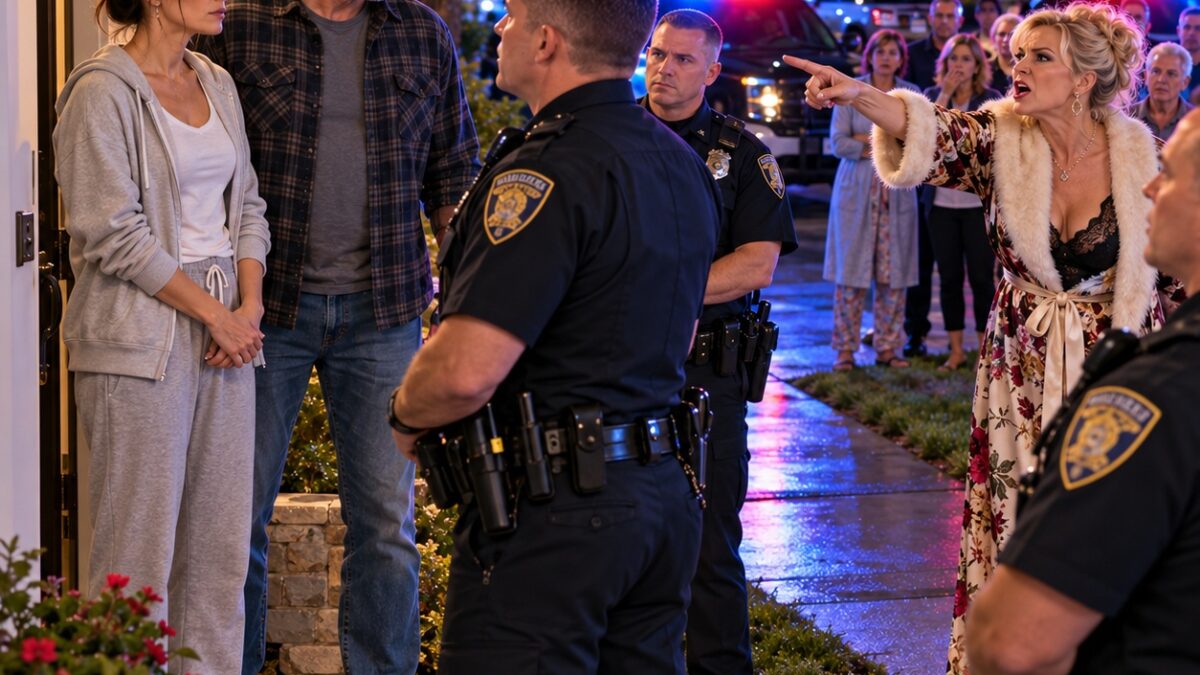
The police stayed about twenty minutes that first night.
It felt like two hours.
The lead officer was professional.
He asked Sarah for identification.
Asked whether she lived at the address.
Asked whether she knew me.
I almost laughed at that one.
Sarah didn’t.
She stayed calm.
“Yes, Officer. Derek is my husband.”
Constance was still across the street.
Watching.
The officer looked at Sarah’s driver’s license, then at me.
“You’re married?”
“Three months.”
He nodded.
“That seems to resolve most of this.”
Sarah folded her arms.
“What exactly was reported?”
He hesitated.
“Unusual traffic. Possible commercial activity.”
I felt my face get hot.
“Commercial activity?”
“Sir.”
He lowered his voice.
“I think we both understand what the caller was implying.”
Sarah’s jaw tightened.
The officer looked embarrassed.
I looked across the street.
Constance smiled.
Not a big smile.
That made it worse.
A satisfied little smile.
She had gotten what she wanted.
Three police vehicles.
Neighbors outside.
My wife standing under porch lights while strangers whispered.
The officers apologized before leaving.
One actually said:
“Sorry for the inconvenience, ma’am.”
Sarah answered politely.
Then we went inside.
Neither of us spoke for a few minutes.
I locked the door.
Sarah put her laptop bag on the floor.
I said, “I’m going over there.”
“No.”
“She just called the police and implied—”
“I know.”
“She called you a prostitute.”
“She implied it.”
“That is somehow worse?”
Sarah took my hand.
“Derek.”
I looked at her.
“If you cross that street angry, she gets a better story tomorrow.”
I hated that she was right.
She always had a way of saying one sentence that made my favorite bad decision inconvenient.
So I stayed home.
But I did not sleep.
I lay beside her staring at the ceiling.
Around three in the morning, I heard Sarah breathing evenly.
I thought about Emma.
About how long it had taken me to allow myself to care about another woman.
About how carefully Sarah and I had built something new without pretending the old grief had vanished.
Then Constance had turned our marriage into neighborhood entertainment.
By sunrise, anger had cooled into something I understood better.
A problem.
Electricians solve problems by tracing circuits.
Find the source.
Identify the fault.
Document what feeds it.
Then isolate it before it burns down the whole system.
Three days later, Constance gave me my first wire to trace.
An HOA violation notice appeared under my windshield wiper.
MULTIPLE UNAUTHORIZED VEHICLES.
FINE: $800.
I stood in the driveway holding the paper.
Sarah came out with coffee.
“What is it?”
I handed it to her.
She read.
“Your truck?”
“Apparently.”
My F-250 had been parked in that driveway for three years.
Same truck.
Same plates.
Same toolbox.
Same company magnets I removed when I wasn’t working.
The bylaws allowed one properly registered work vehicle per household.
Mine was registered.
Constance knew that.
The timing was the point.
She had waited until after the police call.
“This is retaliation,” I said.
Sarah didn’t disagree.
She also didn’t say what I later realized she easily could have said.
She could have announced her new judicial position.
One phone call to the HOA’s attorney probably would have changed Constance’s tone immediately.
Sarah didn’t.
She had spent her career protecting professional boundaries.
She was not going to use public office to win a private neighborhood dispute.
And at that point, I didn’t want her to.
I wanted to beat Constance’s argument with the rules Constance kept claiming mattered so much.
So I went to the community center library.
The HOA stored copies of governing documents there.
Covenants.
Amendments.
Architectural standards.
Meeting minutes.
Resident policies.
I spent four hours reading.
I hadn’t highlighted that much paper since apprentice school.
At first I looked only for the truck provision.
Found it.
Clear as daylight.
One properly registered work vehicle was permitted.
Fine invalid.
But once I started reading, other inconsistencies appeared.
Street parking limits.
Guest vehicle procedures.
Home-business disclosure requirements.
Short-term rental restrictions.
HOA officer conflict-of-interest rules.
Constance liked quoting sections.
Unfortunately for her, sections could be read by other people too.
Her own house had more vehicle traffic than half the street combined.
BMW.
Her husband’s Mercedes.
Then rotating vehicles with out-of-state plates.
Florida.
Nevada.
California.
Texas.
Sometimes two at once.
Sometimes three.
I knew from casual neighborhood talk that she had “friends” visiting often.
The governing documents allowed temporary guests.
They did not allow continuous short-term rental activity without registration.
That interested me.
I started taking pictures.
Nothing invasive.
Public street.
Visible vehicles.
Dates.
Times.
Same thing Constance did to everybody else.
Within a week I had a pattern.
Different guests.
Frequent turnover.
Vehicles occupying restricted street parking.
If Constance wanted strict enforcement, strict enforcement was going to become a two-way mirror.
Then my new security camera caught something stranger.
2:15 a.m.
Motion alert.
I pulled up the footage the next morning.
Constance.
Bathrobe.
Garden hose.
She dragged it across her front yard toward the decorative gravel nearest my bedroom side of the property.
Then she sprayed rocks.
Not plants.
Rocks.
For almost seven minutes.
Why?
I replayed it.
Turned up audio.
The hose nozzle hit a metal planter several times.
Clang.
Clang.
Clang.
Then she dragged the hose back across concrete.
The following morning, my email contained a noise complaint.
TIME OF DISTURBANCE: APPROXIMATELY 2:10 A.M.
SOURCE: CASTELLANO PROPERTY.
I sat there staring at the screen.
Then I laughed.
Sarah walked into the kitchen.
“What?”
I showed her the clip.
She watched once.
Then again.
“She created the noise.”
“Looks that way.”
“Then reported you for it.”
“Looks that way.”
Sarah exhaled.
“Save the original.”
“I already made three copies.”
She looked at me.
“Of course you did.”
“My union representative taught me something twenty-five years ago.”
“What?”
“If you’re going to fight management, have better records than management.”
That became my rule.
No angry posts.
No screaming across the street.
No vandalism.
No threatening letters.
Document.
The next monthly HOA meeting gave me my first chance to use it.
The room smelled like stale coffee and carpet cleaner.
Constance sat at the center table with a thick manila folder.
Three board members sat close to her.
Dave Mitchell stared at the ceiling as though hoping for structural failure.
Tom and Linda Morrison sat in the back.
Betty Kowalski, seventy-eight years old and approximately five feet tall when angry, sat beside them.
I appealed the truck fine.
Constance began before I was even invited to speak.
“Before we address Mr. Castellano’s appeal, I believe the board needs to discuss a more serious situation at 1247 Maple Drive.”
Situation.
That was how she described my wife.
She pulled out photographs.
Sarah entering my house.
Sarah carrying boxes.
Sarah arriving late.
My stomach tightened.
Constance continued.
“Multiple residents have reported an unregistered female cohabitating at the residence.”
I said, “Her name is Sarah.”
Constance ignored me.
“There is concern that Mr. Castellano may be operating an unauthorized commercial activity or housing arrangement.”
Housing arrangement.
She was doing it again.
Cleaning up the accusation just enough to sound official.
I stood.
“My turn?”
She frowned.
“You will be recognized when—”
Dave said quietly, “He is the resident under discussion.”
Constance looked at him.
Then me.
“Proceed.”
I placed my folder on the table.
First, the truck provision.
Section number.
Registration documentation.
Photograph of the current permit.
The $800 fine had no basis.
Then parking.
I laid out the photos.
Different cars at Constance’s property.
Dates.
Times.
Consecutive days.
According to the same rules, multiple violations.
Her face changed.
“These are guests.”
“Some appear every weekend.”
“That is none of your business.”
“Home business registration is HOA business according to section 8.4.”
The room got quieter.
Constance’s perfume suddenly seemed stronger.
Maybe panic has a scent.
Then I pulled out our marriage certificate.
“Now, about the unregistered woman.”
I held it up.
“Sarah Castellano.”
Date.
County seal.
Legal marriage.
“My wife.”
Tom Morrison coughed to hide a laugh.
Constance’s face tightened.
She could have stopped.
Apologized.
Withdrawn the issue.
Instead, she attacked harder.
“Marriage certificate or not, her behavior is suspicious.”
My voice became very calm.
“What behavior?”
“Legitimate wives do not sneak into houses after midnight carrying unexplained packages.”
I stared at her.
For one second, I genuinely didn’t know what to say.
Then I realized everyone else felt it too.
The sentence had crossed some line.
I opened my phone.
“Those unexplained packages were law books.”
Constance rolled her eyes.
“But since we’re discussing suspicious late-night behavior…”
I connected my phone to the small presentation monitor.
Played the video.
Constance at 2:15 a.m.
Hose.
Metal planter.
Noise.
The room watched.
Then I displayed her complaint filed the next morning.
The timestamps almost matched.
Betty whispered:
“Oh, my.”
Constance stood.
“This is surveillance.”
“It is a camera pointed at my own property.”
“You recorded me.”
“You entered the camera’s field of view.”
“This is harassment.”
“No.”
I looked directly at her.
“This is documentation.”
That word bothered her.
Because documentation had always belonged to her.
She tabled the matter.
Of course she did.
The truck fine remained “pending.”
Sarah’s residency required “further documentation.”
I walked out feeling strangely good.
Not because I had won.
I hadn’t.
But for the first time, the board saw Constance lose control of the narrative.
And once people see that happen once, authority never looks exactly the same again.
Three weeks later, she escalated beyond anything I expected.
Saturday.
6:47 a.m.
My phone rang.
Phoenix Police.
A domestic violence report had been made from our address area.
I sat upright.
Sarah was asleep beside me.
“What?”
The officer explained that they were required to investigate.
I looked through the bedroom window.
Constance stood on her lawn.
Bathrobe.
Phone.
Pointing toward my house.
My hands went cold.
When police arrived, they separated us.
Standard procedure.
I understood that intellectually.
Emotionally, I wanted to tear the world apart.
One officer placed me in temporary restraints while the others spoke with Sarah.
Jake was visiting that weekend.
My twenty-four-year-old son stood inside our living room watching his father handcuffed on the front lawn.
That image still bothers me more than almost anything Constance did.
Sarah came outside wearing pajamas and a sweater.
“Ma’am, did your husband threaten you?”
“No.”
“Strike you?”
“Absolutely not.”
“Was there shouting?”
“No.”
“Breaking objects?”
“No.”
“Do you feel unsafe in this home?”
Sarah looked straight at the officer.
“The only thing making me feel unsafe this morning is a neighbor repeatedly filing false reports.”
They released me after the investigation.
Forty-five minutes.
That was all.
Forty-five minutes is enough to alter your relationship with your own front yard.
Afterward, I sat in my workshop holding a multimeter I wasn’t using.
My hands shook.
Sarah sat beside me.
Neither of us spoke for several minutes.
Then she said:
“Derek.”
I looked at her.
“I need to tell you something properly.”
I tried to smile.
“Good news would be nice.”
“My appointment is official.”
I stared.
“What appointment?”
She gave me the full explanation.
Municipal judge.
District jurisdiction.
Her name had been publicly announced while we were on our honeymoon.
She had kept it low-key because she wanted a clean transition and because judges are expected to avoid even the appearance of using office for private advantage.
I blinked.
“You’re already sitting?”
“Training and administrative calendar. Full docket begins soon.”
“And Constance doesn’t know.”
Sarah shook her head.
“I don’t think so.”
“Why didn’t you tell me everything earlier?”
“I told you the appointment was moving forward.”
“You did not tell me you were already the Honorable Sarah Castellano.”
She smiled faintly.
“I was trying to be your wife at home.”
I leaned back.
Then a thought hit me.
“All the harassment filings she’s threatening.”
“Yes.”
“Restraining orders.”
“Yes.”
“HOA appeals.”
“Possibly.”
“They could land in your court.”
Sarah’s expression changed.
“Not if they directly involve you and me without ethical review.”
That mattered.
And I want to be clear about it.
Sarah wasn’t planning some revenge hearing.
She could not simply sit behind the bench and punish a neighbor for insulting us.
Conflicts mattered.
Recusal mattered.
Assignment procedures mattered.
She knew that better than anybody.
But Constance was heading toward sworn legal filings.
And once she entered the actual court system, her claims would be examined under rules far stricter than anything she controlled at an HOA meeting.
“That,” Sarah said, “is what she does not understand.”
I nodded.
“What?”
“HOA authority lets her intimidate people who don’t know the rules.”
She looked toward the house.
“A real court requires evidence.”
That was the first moment I stopped feeling helpless.
Not because my wife was a judge.
Because Constance had started creating evidence against herself.
The police body-camera footage became important almost immediately.
My attorney, Lisa Ren, requested it.
Constance had apparently spoken to officers outside.
The recording captured her claiming I had a history of threatening behavior.
I didn’t.
Then, as officers were leaving, she said:
“I’ll make sure he regrets moving here.”
Not exactly fear.
More like intent.
Lisa called me.
“Save everything.”
“I am.”
“No confrontation.”
“I know.”
“Derek.”
“Yes?”
“No hero stuff.”
“I’m an electrician.”
“Electricians do hero stuff every day and then tell me it was just a panel.”
Fair.
I upgraded our cameras.
Not to spy.
To preserve.
Cloud backups.
Door cameras.
Driveway.
Front yard.
Side gate.
Every angle stayed within our lawful property and public-facing spaces.
I ran cables through conduit because exposed wires offend me spiritually.
Tom Morrison came by.
“Good Lord.”
“What?”
“This is a house, not Fort Knox.”
“Fort Knox probably has worse cable management.”
He admired the setup.
Then lowered his voice.
“Betty has recordings.”
“Of what?”
“Constance.”
That evening, I sat in Betty Kowalski’s living room while she showed me an astonishing collection of audio.
Constance threatening to ban Betty’s grandson from visiting because his motorcycle was “incompatible with residential peace.”
Constance saying she could “make life expensive” for families who challenged the board.
Constance talking about “driving out people who lower neighborhood standards.”
Betty shrugged.
“I started recording after she threatened my grandson.”
“You kept all of these?”
“I am old, Derek. Not dead.”
Fair.
The coalition formed without anybody formally creating one.
Linda had saved every violation notice.
Tom had photographed Constance’s own rule violations for more than a year.
A former board member had resigned because he believed enforcement had become abusive.
Two families who had moved out were willing to give statements.
The more we compared experiences, the clearer the pattern became.
Constance targeted people she considered undesirable.
Working class.
Older vehicles.
Renters.
Visitors.
Anyone who challenged her.
Then public records added another layer.
Short-term rentals connected to her property.
Unpermitted modifications.
Tax inconsistencies.
I didn’t pretend to be an investigator.
I handed what I found to Lisa.
She decided what mattered.
That boundary saved me from turning documentation into obsession.
Constance crossed that boundary completely.
In mid-December, a certified letter arrived.
PETITION FOR ORDER OF PROTECTION.
Against me.
And Sarah.
I read it in the kitchen.
The allegations were extraordinary.
Stalking.
Surveillance.
Threatening gestures.
Following Constance’s vehicle.
Sarah was accused of “using a position of professional authority to intimidate petitioner.”
I laughed at that sentence.
Then stopped laughing.
Because the petition was sworn.
Constance had signed it.
She had taken neighborhood fiction and placed it inside a legal document.
Lisa read it.
“She has a problem.”
“I assume you mean besides personality.”
“She is alleging facts we can disprove.”
“Security footage?”
“Among other things.”
She flipped pages.
“And she’s escalating.”
“How?”
“Your workers’ compensation insurer contacted me.”
My stomach dropped.
“What?”
Constance had submitted complaints suggesting my behavior demonstrated psychological instability and aggression.
My back injury claim was still unresolved.
If she could make me look violent, unstable, or dishonest, it could complicate everything.
My income.
Medical treatment.
Future work restrictions.
“She is trying to make fighting her more expensive than surrendering,” Lisa said.
That angered me more than the police calls.
Then something strange happened.
The anger made me calmer.
Every lie was now official.
Every complaint dated.
Every sworn statement preserved.
Constance wasn’t erasing evidence.
She was generating it.
I organized everything.
Timeline.
Police visit.
Truck fine.
Meeting photos.
Camera footage.
Domestic violence report.
Body-camera audio.
Workers’ compensation interference.
Witness statements.
Public records.
I had spent thirty years troubleshooting electrical systems.
The process felt familiar.
Fault one.
Fault two.
Trace.
Cross-check.
Never assume.
Never skip the source.
Sarah stayed careful.
We talked about our lives.
Not strategy.
She didn’t tell me what a judge would “want.”
She didn’t coach witnesses.
She didn’t review my exhibits.
When she thought a conversation approached an ethical line, she stopped it.
At first that frustrated me.
Later I respected her more for it.
One evening, while I was labeling files, I said:
“Every system needs grounding.”
Sarah looked up from her paperwork.
“Electrical wisdom?”
“Yes.”
“What happens without it?”
“Current goes somewhere it shouldn’t.”
She smiled.
“That does sound familiar.”
Constance had spent six years without grounding.
Nobody stopped her.
Nobody forced transparency.
Nobody required corroboration.
She had become the path of least resistance.
Everything flowed through her.
Complaints.
Fines.
Interpretations.
Pressure.
Now the system was overloaded.
Something was going to trip.
The hearing date was December 22.
The assignment issue became complicated because Sarah’s name appeared in the petition.
Her court administration reviewed it.
She informed the appropriate people of the personal connection.
Ethical procedures were triggered.
The matter could not simply proceed as though nothing unusual existed.
But Constance did not know any of that when she arrived at the courthouse.
That morning, I sat in my truck watching her climb the steps.
Designer suit.
Leather briefcase.
Three HOA board members.
And Channel 12 News.
She had called them herself.
Of course.
“This is about protecting our community,” she told the reporter.
“From what?” he asked.
“People who don’t respect our values.”
I almost admired the consistency.
Inside, Lisa met me.
One folder.
Not three filing cabinets.
“What happened to everything?”
“We don’t bury judges.”
“Good point.”
“Use what proves the pattern. Not what proves you’re angry.”
That was excellent advice.
The courtroom filled.
Neighbors.
Betty.
Tom.
Linda.
Former board members.
A reporter.
I expected Constance to be nervous.
She wasn’t.
She arranged documents at counsel table like a woman finally about to receive the obedience she deserved.
Then the bailiff called the session.
“All rise.”
The door opened.
Sarah entered in black robes.
Constance turned.
Recognition hit.
Her mouth opened.
She sat halfway.
Stood again.
Papers slid off the table.
“This is a mistake.”
Sarah’s expression remained professional.
Constance pointed.
“This woman is one of the respondents.”
Sarah acknowledged the obvious.
Then did what Constance had never expected from anyone with authority.
She followed procedure.
The relationship was placed on the record.
The conflict was disclosed.
The matter was reviewed openly rather than hidden.
Constance had expected either a weak judge she could pressure or an enemy she could accuse.
Instead, the court treated her petition as a legal document subject to scrutiny.
That terrified her.
Because scrutiny was the one thing Constance’s version of authority had never survived.
A replacement judicial officer ultimately handled the contested merits after the conflict issue was addressed, but Sarah’s presence that morning destroyed one part of Constance’s strategy immediately.
She had described Sarah in sworn papers as a suspicious live-in girlfriend masquerading as a professional.
Now an entire courtroom knew exactly who Sarah was.
Not because being a judge made her more worthy of respect.
That distinction mattered.
The humiliation was that Constance had invented a character for Sarah because she never bothered to learn the truth.
The court did not punish her for failing to recognize a judge.
It examined whether she had lied.
That was worse.
Lisa presented the police reports.
No domestic violence.
No threats.
No criminal conduct.
Body-camera footage.
Constance telling officers she would make me regret moving there.
Security video.
Constance creating late-night noise.
Then filing a complaint against me for it.
Marriage certificate.
Residence documentation.
Truck registration.
HOA provision permitting my work vehicle.
Witnesses testified.
Betty played recordings.
Constance’s own HOA allies became visibly uncomfortable.
Dave admitted several enforcement decisions had been driven primarily by Constance.
Helen admitted not all rules had been properly voted through.
Then came the stalking photographs.
Constance had included them as evidence.
Blurry photographs of me in my own driveway.
Me leaving for physical therapy.
Me standing beside my truck.
Sarah carrying a robe bag.
Sarah arriving after court training.
The judge asked:
“How were these obtained?”
Constance hesitated.
“From my residence.”
Meaning through her windows.
The irony was perfect.
She accused us of surveillance while submitting her surveillance as proof.
Lisa questioned the timeline.
One alleged stalking incident occurred while I was at a workers’ compensation medical appointment.
Documented.
Another while I was buying electrical supplies.
Receipt.
Camera timestamp.
Another claim said I followed her BMW at 3:30 p.m.
My truck camera showed the vehicle still parked at home at 3:30.
The petition began collapsing line by line.
Then the domestic-violence report came up.
Dispatch audio.
Constance said she heard screaming.
Our indoor camera microphone recorded a quiet house at the corresponding time.
She said she heard breaking objects.
Nothing.
She described a “history of violent threats.”
No reports existed before she began targeting us.
The judge looked at her.
“Mrs. Palmidge, what is the basis for the claimed history?”
Constance looked toward her board witnesses.
Nobody helped.
“I felt threatened.”
“That is not the question.”
Silence.
The restraining order was denied.
Then came the part Constance truly had not anticipated.
The court referred the apparent false sworn statements for review.
Not conviction.
Not instant punishment.
Review.
That word was enough.
Perjury concerns.
False reporting.
Potential harassment.
Possible retaliatory conduct.
Suddenly all those documents Constance created to scare us belonged to other authorities.
She had spent months demanding official records.
Now official records demanded answers from her.
Outside the courthouse, the reporter approached me.
“What do you think happened today?”
I looked toward Constance leaving with her head down.
For a second I wanted to say something triumphant.
Something that would make a great headline.
Then I thought of Sarah.
Jake.
My front lawn.
The handcuffs.
I said:
“This was never about finding out my wife was a judge.”
The reporter waited.
“It was about what happens when somebody decides another person deserves less dignity because they think that person has no power.”
That was the line they printed.
Constance resigned as HOA president within forty-eight hours.
Two sentences.
Health reasons.
Nobody believed it.
The board called an emergency meeting.
This time the community center overflowed.
People I had never seen at meetings stood along the walls.
The mood was strange.
Relief mixed with embarrassment.
Like everybody had survived a storm and was now asking why nobody closed the windows earlier.
Dave opened the meeting.
“We need a president.”
Half the room looked at me.
“No.”
Laughter.
Tom raised his hand.
“I nominate Derek.”
“I decline.”
“You cannot decline before the vote.”
“Watch me.”
Betty shouted:
“Put him on the board.”
That I accepted.
Reluctantly.
Not because I wanted power.
Because I had finally learned how dangerous empty seats can become.
My first motion was simple.
No fine based on one person’s unverified complaint.
Three-person review committee.
Written evidence.
Right to respond.
Appeal procedure.
Clear meeting minutes.
Second motion:
All board financial reports available monthly.
Third:
Annual outside audit.
Fourth:
No officer receives special enforcement exceptions.
Linda added:
“Can we include common sense?”
“That is difficult to codify.”
She nodded.
“Fair.”
We also abolished several rules Constance had pushed through without proper votes.
Not everything disappeared.
People still had to maintain properties.
No one could park an RV across the sidewalk for six months.
Real safety issues remained real.
The goal was not anarchy.
It was proportion.
Constance’s legal consequences arrived more slowly.
The false police reports produced charges and fines.
Tax and code authorities became interested in her short-term rental activity.
Her illegal unit had problems.
Income reporting raised more questions.
I didn’t chase every result.
At some point, justice becomes somebody else’s job.
My workers’ compensation claim survived.
More than survived.
Once the retaliatory complaints were discredited, the process finally moved.
The approval gave Sarah and me financial breathing room we had badly needed.
My back still hurt.
Money doesn’t repair vertebrae.
But it allowed me to stop taking every side job offered by somebody with an electrical panel and a handshake.
That gave me time.
Time became the best thing I recovered.
I started helping elderly neighbors with basic electrical safety.
At first, just Riverside Heights.
Check outlets.
Test GFCIs.
Inspect extension cords.
Look for overloaded panels.
Replace bad smoke alarms.
Betty became my marketing department without permission.
Within months, people from outside the neighborhood were calling.
I formalized it.
Senior Electrical Safety Program.
Free inspection days.
Union apprentices volunteered.
Retired electricians joined.
The fire department partnered with us.
The first year, we identified twelve serious fire hazards.
Three homes had conditions severe enough that inspectors later told me fires were genuinely likely.
That mattered more than defeating Constance.
Sarah built something too.
She had watched the HOA dispute nearly become a criminal nightmare.
She began advocating for mediation programs that handled neighborhood conflicts before they became restraining-order wars.
Not favoritism.
Structure.
Neutral mediators.
Written issues.
Documented agreements.
The pilot worked.
Noise disputes settled.
Fence disputes settled.
Parking fights settled.
People discovered that sitting in one room with a neutral third person was cheaper than spending six months calling police over garbage cans.
Other municipalities copied the model.
Jake helped me on weekends.
At first he complained.
“You’re using me as free labor.”
“I fed you for eighteen years.”
“You chose to have me.”
“Debatable.”
He laughed.
Then learned to use a meter correctly.
That made me happier than I expected.
One evening Sarah stood in the garage doorway watching us replace a worn receptacle on a practice board.
“You two look alike.”
Jake and I both said:
“No, we don’t.”
She laughed.
For the first time in months, home felt like home.
No police lights.
No camera alerts because Constance was outside.
No envelope under the windshield.
No whispered accusations.
Sarah parked after dark and nobody cared.
That ordinary fact meant everything.
Six months after the hearing, a man from another Phoenix neighborhood called me.
“I heard what happened in Riverside Heights.”
“I’m sorry.”
He laughed.
“Our HOA president is doing something similar.”
“I am not an attorney.”
“I know.”
“I don’t run investigations.”
“I know.”
“What do you want?”
“Where do I start?”
That question I could answer.
“Read your documents.”
Silence.
“All of them?”
“All.”
“That’s a lot.”
“Yes.”
“What else?”
“Document facts.”
“Then?”
“Find out whether other people are having the same problem.”
“And then sue?”
“Not necessarily.”
People always wanted the dramatic answer.
Court.
Judgment.
Public defeat.
Most disputes shouldn’t reach that point.
“Start with procedure,” I told him.
“Make the organization follow its own rules.”
That became another unexpected role.
Not vigilante.
Not HOA destroyer.
Just the annoying retired electrician who told people to read bylaws before declaring war.
I helped families organize records.
Suggested mediation.
Told them when they needed actual legal counsel.
And sometimes told them they were wrong.
One man complained that his HOA was tyrannical because it objected to six broken refrigerators stored in his front yard.
I told him:
“Move the refrigerators.”
He never called again.
Perfect.
Constance moved away about a year later.
Not dramatically.
No sheriff carrying boxes.
No crowd celebrating.
A moving truck arrived.
BMW left.
House listed.
Sold.
That was it.
I watched from my workshop.
Sarah came beside me.
“You okay?”
“Yeah.”
“You don’t look victorious.”
“I don’t feel victorious.”
She leaned against the workbench.
“What do you feel?”
I thought about it.
“Finished.”
That was better.
Revenge keeps somebody important after the conflict should have ended.
I didn’t want Constance important anymore.
I wanted her irrelevant.
The new family who bought her house had two kids and a golden retriever.
Their first week, the dog escaped.
Ran straight into Betty’s yard.
Knocked over a planter.
Three years earlier, Constance would have created six violations.
Betty fed him cheese.
That told me Riverside Heights had recovered.
At the next HOA annual meeting, Dave presented the budget.
Boring.
God bless him.
Thirty minutes of landscaping contracts.
Pool repairs.
Insurance.
Reserves.
Nobody cried.
Nobody accused anyone of prostitution.
Nobody brought police reports.
It was beautiful.
Linda leaned over.
“I miss the drama.”
“No, you don’t.”
“Not really.”
I looked around the room.
Residents asking ordinary questions.
Board members answering them.
Minutes projected on a screen.
Voting done properly.
Power visible.
Reviewable.
Limited.
People think democracy is dramatic.
Usually healthy democracy is paperwork.
That was another thing I learned.
Constance had made everything personal.
Her approval.
Her standards.
Her interpretation.
The new board made things boring enough that no personality could become the system.
That was the real reform.
One night, Sarah and I sat on the back patio.
Phoenix sky.
Warm air.
Jake had gone home.
My back hurt.
Her shoes were off.
She rested her feet on the chair beside mine.
I said:
“Did you ever want to tell her?”
“Tell who?”
“Constance.”
“About being a judge?”
“Yes.”
Sarah considered it.
“The first police visit?”
“Yes.”
“Absolutely.”
I laughed.
“Why didn’t you?”
“Because I wanted her to stop because what she was doing was wrong.”
She looked at me.
“Not because she discovered I had status.”
That answer reminded me of the first night.
Constance didn’t owe Sarah dignity because Sarah wore robes.
She owed Sarah dignity because Sarah was a person walking into her own house.
If Constance had learned Sarah was a cashier, nurse, teacher, waitress, unemployed mother, or anything else, the accusation would have been just as ugly.
The courtroom reveal made a good story.
But it wasn’t the moral.
The moral was how eagerly Constance humiliated a woman she believed couldn’t hurt her back.
I said:
“She thought you were powerless.”
Sarah nodded.
“That was why she felt safe being cruel.”
I looked toward the dark street.
“She was wrong.”
“Yes.”
Then Sarah squeezed my hand.
“But Derek?”
“What?”
“Powerlessness shouldn’t be permission.”
That sentence became the one I remembered.
Not the headlines.
Not the court.
Not the resignation.
Powerlessness shouldn’t be permission.
Constance had built her entire little empire around the opposite idea.
She was polite upward.
Cruel downward.
Pleasant to people she needed.
Suspicious of people she didn’t.
That kind of person can function for a long time in places where authority is informal and accountability weak.
HOAs.
Workplaces.
Clubs.
Committees.
Families.
Anywhere people decide keeping peace is easier than challenging abuse.
Until enough people compare notes.
Betty’s recordings.
Tom’s photos.
Linda’s notices.
The former board member’s testimony.
My cameras.
Police body footage.
One person had a fragment.
Together, we had a pattern.
That was what finally defeated Constance.
Not Sarah’s job.
Not my anger.
Pattern.
Evidence.
People willing to stop being isolated.
At the one-year anniversary of Constance’s resignation, nobody planned a celebration.
Thank God.
I would have refused.
Instead, we held a neighborhood electrical safety day.
Romantic.
I know.
Fire department truck for children.
Smoke detector giveaways.
Free inspections for seniors.
Sarah staffed a mediation information table.
Jake demonstrated basic outlet safety.
Betty ran registration despite having no official role.
At noon, a young woman approached me.
“You’re Derek?”
“Depends.”
She smiled.
“My parents lived here before.”
“Name?”
“Jensen.”
I remembered.
They had moved out years earlier.
Constance had cited them constantly.
Fence.
Visitors.
Work van.
Eventually they sold.
“My parents moved back last month.”
I stared.
“To Riverside Heights?”
“Different house.”
“Why?”
“They heard things changed.”
That hit me unexpectedly.
Three families who had left eventually returned.
Not because property values skyrocketed.
Because the place felt livable again.
Tom created a welcome committee.
Actual welcome.
Not inspection.
Betty started a neighborhood watch focused on stolen packages, elderly residents, and actual safety.
Nobody measured hedges.
Linda put up holiday decorations eleven days early.
Civilization survived.
The playground got new equipment partly funded by money recovered through fines, reimbursements, and restructuring after Constance’s tenure.
She had opposed that playground for years because children created noise.
I sat on a bench one afternoon watching kids climb where she had once wanted more decorative gravel.
Sarah sat beside me.
“You’re smiling.”
“No.”
“You are.”
“Back pain.”
“Sure.”
A little boy ran past screaming.
I said:
“Property values must be collapsing.”
Sarah laughed.
The story had become local legend by then.
Not quite viral nationally.
Enough local press.
HEADLINE: HOA PRESIDENT’S HARASSMENT CAMPAIGN COLLAPSES AFTER FALSE FILINGS.
People called Sarah “the judge next door.”
She hated it.
People called me “the electrician who wired his own case.”
I hated that slightly less.
The reporters always wanted the same ending.
“Did justice win?”
I learned to answer carefully.
Justice isn’t a football team.
We didn’t win because good people automatically win.
For months, bad behavior worked.
Constance used police resources.
Scared residents.
Threatened my income.
Humiliated Sarah.
Made Jake watch me handcuffed.
Those things happened.
They don’t disappear because the ending became satisfying.
What changed the outcome was work.
Records.
Witnesses.
Lawyers.
Ethical procedures.
People showing up.
The law isn’t karma.
It has to be used correctly.
That’s why I dislike telling the story as if Sarah simply stepped behind a bench and crushed Constance.
That would have made us no better.
Sarah’s authority came with limits.
She respected those limits even when it would have felt wonderful not to.
That was why I trusted her.
Constance thought power meant getting your way.
Sarah understood power meant accepting rules even when they slowed you down.
I learned that difference.
So did Riverside Heights.
One evening, years after everything ended, I found the original $800 truck violation in an old file.
Sarah saw it.
“You kept that?”
“I keep everything.”
“I know.”
The paper looked ridiculous now.
Official letterhead.
Large bold type.
Constance’s signature.
A threat that once made my stomach turn.
I thought about framing it.
Then didn’t.
I shredded it.
Sarah watched.
“That is growth.”
“It’s cleaning.”
“Same thing sometimes.”
The marriage certificate copy was in the same folder.
I held it.
“That meeting feels like ten years ago.”
“It wasn’t.”
“She called you unregistered.”
Sarah smiled.
“I am currently registered.”
“With who?”
“You.”
“Terrible agency.”
“Low standards.”
I kissed her.
That was the life Constance nearly made us forget.
Not dramatic.
Not legal.
Not heroic.
Dinner.
Jokes.
Work.
Jake visiting.
Sarah leaving court robes over a chair.
Me complaining about her parking angle.
She reminding me I own three levels and none.
Normal.
The thing bullies often steal first is normality.
They make every ordinary action feel watched.
Parking.
Coming home.
Having visitors.
Driving your work truck.
Turning on lights.
Living.
By the end of Constance’s campaign, I heard every car door outside and wondered whether another officer was arriving.
It took months for that feeling to leave.
Then one night a patrol vehicle stopped two houses down.
I noticed.
Then went back to sanding a table.
That was when I knew I had my home back.
Not when Constance resigned.
Not when the court rejected her filing.
Not when the board elected me.
When flashing lights no longer automatically felt like they belonged to us.
That’s freedom.
Quiet enough to overlook.
Precious enough that you shouldn’t.
I never became an HOA crusader.
Despite what local newspapers implied.
I still hate meetings.
I still think most newsletters are too long.
I still believe any committee requiring more than ninety minutes should provide sandwiches.
But I believe in something I did not believe before.
Good governance matters most when the issue looks small.
The truck fine looked small.
The late-night complaint looked small.
The residency question looked bureaucratic.
The garden hose looked ridiculous.
But selective enforcement is how abuse hides.
Each event gets explained separately.
Misunderstanding.
Procedure.
Concern.
Policy.
Then a pattern emerges.
The same person targeted.
The same discretion.
The same outcome.
That is when small things stop being small.
The police accusation against Sarah was the moment Constance crossed a line I could feel.
The paperwork showed she had crossed many lines before that.
Not just with us.
With everybody.
Betty once told me:
“You didn’t beat her.”
“No?”
“We finally stopped pretending she was unbeatable.”
That sounded right.
Fear is strange.
Everybody assumes everyone else believes in the person they’re afraid of.
Then somebody speaks.
Another person says:
“Me too.”
Then another.
Suddenly the emperor has a clipboard and bad perfume.
I wish we had spoken sooner.
That is probably the closest thing I have to regret.
Constance did not become abusive overnight.
Six years.
Dozens of incidents.
People moved away.
Board members resigned.
Residents paid fines they knew were wrong because fighting cost more energy than paying.
We all participated through silence.
Not equally.
But enough.
When we rebuilt the board, I pushed hardest for distributed authority.
Three-person review.
Published records.
Conflict disclosures.
Written reasons.
Because the solution to a bad ruler is not finding a better ruler.
It is building a system that does not need one.
Eventually I left the board.
Two years.
Enough.
I nominated Linda to replace me.
She nearly hit me with a folder.
“I am seventy-six.”
“You have opinions.”
“That is not qualification.”
“It is here.”
She served one term.
Excellent.
Strict about budgets.
Soft on flamingos.
Riverside Heights did fine without me.
That was the point.
Sarah’s mediation program expanded.
Five municipalities adopted versions.
HOA-related harassment filings dropped.
Not because people became nicer.
Because they had somewhere to go before police and courts.
Sometimes structure gives decent behavior a chance.
My electrical safety program grew too.
The fire department gave me a plaque.
I put it in the workshop behind a stack of clamps.
Sarah moved it.
“People should see this.”
“I see it.”
“No one can see it behind clamps.”
“I know where it is.”
She hung it on the wall.
Marriage.
One afternoon, I inspected an elderly man’s panel and found overheating severe enough that we shut power down immediately.
An electrician replaced components that day.
The fire investigator later told me:
“Another month, maybe less.”
That stayed with me.
Twelve potential fires the first year.
Three considered imminent hazards.
We saved some homes.
Maybe lives.
Constance had tried to destroy my workers’ compensation claim by portraying me as unstable.
Instead, the fight pushed me toward work I could do even with my injured back.
Funny how roads turn.
I wouldn’t thank her.
Some lessons cost too much to romanticize.
But I refused to waste the cost.
Six years after Emma died, I thought grief had already taught me every important thing about losing control.
Then Constance taught me another.
You cannot control whether somebody lies about you.
You can control whether you become what the lie describes.
She called me threatening.
I stayed methodical.
She called Sarah suspicious.
Sarah stayed ethical.
She called us dangerous.
We documented.
She called herself the victim.
We let evidence answer.
That discipline saved us.
Because anger would have been easier.
The morning I was handcuffed, I wanted to cross the street.
I wanted to scream.
If I had, that clip would have become her favorite exhibit.
Sarah stopped me from giving Constance the version of me she needed.
Sometimes love is not telling someone they’re right.
Sometimes it is keeping them from making the worst decision available.
Sarah did that for me more than once.
I tried to return the favor.
Years later, when a journalist asked Sarah whether she considered the case personally satisfying, she answered:
“No.”
He looked surprised.
“Why not?”
“Because a court should never be personally satisfying for a judge.”
That was Sarah.
He asked:
“But your family was vindicated.”
She paused.
“My family was protected by process.”
Then:
“That matters more.”
I clipped that article.
Of course I did.
I keep everything.
The workshop still smells like sawdust.
My back still complains.
Jake knows enough electrical work now to be dangerous.
Sarah still brings home too many books.
We still live in 1247 Maple Drive.
The house Constance tried to redefine as suspicious.
The driveway still holds my F-250 sometimes.
Nobody fines it.
When I take side work, I register it properly.
Because rules still matter.
Good rules.
Fair rules.
Rules applied the same way to everybody.
That distinction is the whole story.
The last time someone asked me what I would say to an HOA president who thought authority meant control, I didn’t give them a dramatic line.
I said:
“Read your own bylaws.”
They laughed.
I didn’t.
Because Constance’s downfall was not magic.
Not cosmic revenge.
Not because she happened to target a judge.
She fell because she spent years creating rules she thought only other people had to obey.
She documented everyone except herself.
She demanded evidence from residents while relying on rumors.
She filed sworn claims because she assumed nobody would examine them closely.
Then somebody did.
Once that happened, the same system she used to scare people became the system that exposed her.
Every electrician knows this principle.
Current follows a path.
A fault may stay hidden for years.
But if enough pressure builds, protection trips.
That doesn’t destroy the system.
It prevents the fire.
Constance thought she was the breaker.
She wasn’t.
She was the fault.
Riverside Heights finally grounded itself.
And life went on.
Better.
Quieter.
Ordinary.
One evening Sarah came home after dark.
I was in the garage sanding a walnut tabletop.
I heard her car.
Then heels.
Front door.
She called:
“Derek?”
“In here.”
She walked into the workshop still wearing her court clothes.
Black robe folded over one arm.
Laptop in the other.
Exactly the kind of late-night arrival Constance once photographed like evidence of a crime.
Sarah put everything down.
“You know what I want?”
“Dinner?”
“Yes.”
“Anything else?”
“No.”
“Suspicious.”
She smiled.
I turned off the sander.
We walked inside.
No police lights.
No neighbors watching.
No woman across the street deciding whether my wife belonged.
Just our house.
Our marriage.
Our evening.
Our ordinary life.
That was the victory.
Not seeing Constance lose her position.
Not watching her lies collapse.
Not reading her resignation.
Not the fines.
Not the headlines.
The victory was that she no longer occupied our home without entering it.
She no longer determined how we felt when Sarah pulled into the driveway.
She no longer turned every envelope into fear.
She no longer made me wonder whether the next knock was police.
Bullies want more than compliance.
They want residency in your mind.
We evicted her.
And Riverside Heights finally learned something Constance had spent six years trying to make everyone forget.
A good neighborhood is not one where every hedge is perfect, every truck is invisible, and every outsider is treated like a threat.
A good neighborhood is one where nobody gets to decide another family does not belong simply because they look different from the picture in somebody else’s head.
Constance tried to decide who belonged.
The law eventually decided she did not get that power.
And the rest of us finally stopped giving it to her.